My Ex Cornered Me at Dinner — Then the Mafia Boss Said, “Sorry I Kept You Waiting, Wife.”

Part 1
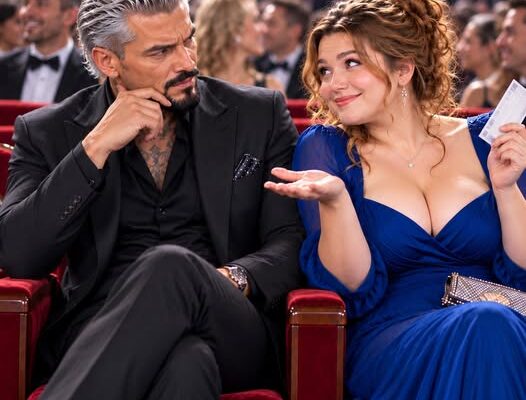
My ex had positioned me neatly between a champagne table and a marble column when the most feared man in Philadelphia sat beside me, took my hand, and apologized for being late.
“To my own wife,” he added.
Warren Pike stopped smiling.
So did I.
I had never spoken to the man holding my hand.
His fingers were warm, his grip calm rather than possessive. More important, he did not trap me. His palm rested beneath mine loosely enough that I could have pulled away without resistance.
That small detail was the only reason I didn’t.
Instead, I looked from Warren’s suddenly rigid expression to the stranger’s patient dark eyes and squeezed his hand.
“You know what traffic is like,” I said, because apparently some hidden part of me had decided that if I was going to lie to my ex-boyfriend beside one of Philadelphia’s most notorious men, I might as well commit to the performance.
The stranger’s mouth softened almost imperceptibly.
“I should have taken the bridge.”
Forty minutes earlier, my greatest concern had been a dead electrical outlet.
That was more typical of my life.
My name is Felicity Moore. I was thirty-four years old, and for eight years I had worked beside Margaret Hale, president of the Carlyle Foundation, until her death the previous spring. I was the woman who remembered which donor had recently lost a husband, which board member was allergic to shellfish, which florist would answer after seven, and exactly how much money remained in a budget after everybody else had enthusiastically spent it.
People called me dependable.
It was intended as praise.
For most of my adult life, I had accepted it as such.
That winter donor dinner was no different. I had greeted the board chairman’s wife, recovered a councilman’s missing coat-check ticket, and rerouted catering staff around the dead outlet before eight o’clock. I was technically attending the event, but no one who knew me would have mistaken me for a guest.
I was working.
I was always working.
I noticed problems, solved them, and stayed until everyone else had gone home.
For years, I had told myself I preferred being necessary to being noticed.
Then Warren Pike taught me how dangerous that distinction could be.
We had dated for eleven months and had been apart for three years. He had never shouted at me. Never struck me. Never done anything dramatic enough to give me a clean story about why I’d felt smaller with him than without him.
His talent had been subtler.
Warren could make taking from me feel like affection.
He liked my patience, my contacts, my willingness to help, the access my job gave me, my habit of listening past midnight when he needed to think aloud. By the end of our relationship, I had begun to suspect that if all those useful parts of me vanished, Warren might look directly through what remained.
After we broke up, I stopped praying for somebody to occupy the empty chair across from me.
I am a Christian, though not loudly.
My prayers became less romantic and more practical.
Give me discernment.
Let me recognize poor treatment even when it arrives dressed as attention.
Keep loneliness from making decisions on my behalf.
That evening, I believed I was doing fairly well.
Then Warren appeared beside me in a navy suit, wearing the same cedar cologne I used to buy for him.
“Felicity.”
His smile carried an old intimacy it no longer had the right to claim.
“You look wonderful.”
There was something almost offensive about how quickly my body remembered him. Not desire. Familiarity. The sound of his voice still fit into old grooves inside me.
“Hello, Warren.”
We talked pleasantly for perhaps two minutes.
Then he asked about Margaret.
Not whether I missed her.
Whether I was still organizing her private archive.
A minute later he wanted to know if I retained the archive-room keys after business hours.
Then he asked whether Edwin Harrow’s desk had been fully cataloged.
That was when the pleasant conversation stopped being pleasant.
Harrow had been a financial adviser who died that winter. His estate had recently donated an extraordinary antique partner’s desk to the museum. It was the sort of object that made furniture historians excited and everybody else say, That’s lovely, before moving on to the paintings.
Warren was not a furniture historian.
“Why?” I asked.
“No reason. Curiosity.”
His gaze dropped.
Not to my dress.
Not to the glass in my hand.
To my handbag.
My keys were inside it.
The old instinct rose automatically: answer the question, smooth the moment, prevent discomfort.
Then another voice inside me—newer, quieter, harder earned—said no.
Warren’s eyes touched my handbag again.
And that was when the stranger appeared.
Now the stranger sat beside me claiming to be my husband, and Warren was trying very hard to decide whether he believed him.
He offered his hand across the table.
“Warren Pike. An old friend of Felicity’s.”
The man beside me shook it once.
“Leandro Costa.”
The name struck harder than his sudden arrival had.
Everyone in Philadelphia knew who Leandro Costa was, even if nobody could agree on precisely what they knew.
His family funded hospitals, housing programs, arts institutions, and charitable foundations. Their name appeared on plaques in buildings all over the city.
There were other stories.
Those stories did not appear on plaques.
Men lowered their voices when they mentioned the Costas. Newspapers chose their verbs carefully. Some people called Leandro a businessman. Others called him the head of one of the city’s most powerful families.
Nobody called him harmless.
Warren should have made his excuses.
Instead, his interest sharpened.
“Funny,” he said. “Felicity never mentioned a husband.”
“Five years this spring,” I said.
“This autumn,” Leandro said simultaneously.
Warren’s eyebrow lifted.
I smiled too brightly.
“Our anniversary depends on which ceremony he’s talking about.”
Leandro looked at me as if this were an argument we had been having for years.
“That is not what you said last time.”
It should have failed.
Somehow it didn’t.
Warren asked where we had honeymooned.
“Iceland,” I said.
“Sicily,” Leandro answered.
Again, together.
Warren leaned back.
Leandro barely paused. “She planned Iceland. I surprised her with Sicily. There was a disagreement at the airport.”
“A large disagreement.”
“She won.”
“We did both.”
His expression suggested I had omitted important details. “At considerable expense.”
I almost laughed.
Then Warren tested us again.
Where did we live?
“A brownstone near the museum,” I said.
“Overlooking the park,” Leandro replied.
This time I recovered first.
“He wanted the view. I wanted to walk to work. Every spring we flip a coin over whether we’re moving.”
“And every spring,” Leandro said, “she claims the coin is defective.”
The absurdity of it loosened something in me.
For the next several minutes we constructed an entire marriage out of glances and instinct.
Apparently we owned a dog named Biscuit.
Biscuit disliked Warren.
Leandro claimed my aunt made terrible fruitcake. I accused him of eating three slices every Christmas to avoid offending her.
We had once nearly divorced over bath towels until he solved the matter by purchasing duplicates in what I called the correct color and he called indistinguishable shades of beige.
And then he mentioned that I took my coffee black.
That one had not been invented.
I turned toward him.
He gave me the smallest shrug.
He had noticed my untouched cream at the place setting.
Warren noticed us noticing each other.
For the first time, uncertainty entered his face.
Yet even then, his eyes returned once to my handbag.
Eventually, he set down his glass.
“I’m happy for you, Felicity.”
His tone suggested he was thinking about anything but my happiness.
He stood.
Then, before leaving, he said, “Give my regards to Margaret’s archive.”
I watched him cross the ballroom.
My pulse was still hard against my throat.
Leandro released my hand immediately.
“Forgive me.”
I looked at him.
“For the wife?”
“For the performance.”
His gaze followed Warren without obvious hostility.
“He watched your handbag more often than he watched you. A man interested in an old romance looks at the woman. A man interested in keys looks somewhere else.”
Every pleasant excuse I had been trying to make for Warren vanished.
Around us, the donor dinner continued as though nothing extraordinary had happened.
But people had heard.
Of course they had heard.
Half of Philadelphia’s old-money families were in that ballroom, and Leandro Costa had just publicly called an unknown museum woman his wife.
He offered me his arm.
I did not take it.
“You knew him.”
Leandro looked back at me.
“That wasn’t a guess. You recognized Warren before you came near us.”
“Yes.”
The lack of evasion unsettled me more than another lie would have.
We stepped onto the terrace, where cold winter air came off the city and stripped away the warmth of the ballroom.
I turned on him.
“I know this kind of transaction.”
His expression remained unreadable.
“You rescue me. Then I owe you something. Dinner. Gratitude. A favor. Perhaps, eventually, access to Margaret’s papers or the keys to the room where we’re keeping Harrow’s desk.”
A faint change passed through his eyes.
Not anger.
Recognition.
“If I were you,” he said, “that is exactly what I would suspect.”
“Good.”
“So ask me what you want to know.”
“All right. Why Warren?”
Leandro rested one hand against the terrace railing.
“Warren Pike is a financial investigator. A discreet one. Years ago, he worked for people hostile to my family. He has spent a long time looking for records Edwin Harrow may have kept.”
“Harrow advised your family?”
“My father did business with him.”
He waited.
“Some legal. Some not.”
At least he did not perfume the answer.
“What records?”
“For decades, Harrow moved money for several families like mine. But not all of it was criminal money.”
He looked through the glass doors toward the ballroom.
“Some of it went to shelters, elder-care facilities, recovery programs. Large anonymous donations.”
I folded my arms.
“That’s supposed to make me trust your family?”
“No.”
The answer surprised me.
“It means,” he continued, “that innocent organizations could be damaged if someone tied their names to ours without context. A donation to an elder-care home may be perfectly legal. Put the Costa name beside it in the right newspaper headline, and suddenly people imagine a conspiracy.”
“And Warren wants leverage.”
“Yes.”
The word seemed natural in his mouth.
“Leverage becomes money. Influence. Protection. Whatever the holder requires.”
I wanted to believe him.
That was precisely why I didn’t.
I had already spent eleven months with one polished man who knew how to make usefulness feel intimate.
“Thank you for getting Warren away from me,” I said. “But hear the rest clearly. I don’t want your cars, your guards, your money, or your attention. I don’t need someone deciding that protecting me gives him a place in my life.”
I waited.
Men accustomed to power often reveal themselves most clearly when denied something.
Leandro only nodded.
“Understood.”
“No one follows me.”
“No one follows you.”
“No calls.”
“None.”
“My home remains mine.”
“Yes.”
He did not smile.
He did not ask for my number.
He did not say I would change my mind.
“Nothing in your life will change because of me,” he said.
Then he kept his word so thoroughly that it became its own kind of disturbance.
No black car appeared outside my house.
No mysterious flowers arrived.
No bodyguard materialized near my office.
My phone remained silent.
The museum, however, became safer.
Evening security quietly increased. The service entrance was re-keyed. Our director received a generous, meticulously documented grant earmarked for building security.
Only later did I learn that Leandro’s attorney had also sent formal notice throughout the network of families connected to his world.
The museum and its employees were not to be approached.
The order was apparently absolute.
But none of it reached into my private life.
He protected the perimeter.
He left me alone inside it.
So I did what I always did when something frightened me.
I worked.
And three days later, Edwin Harrow’s desk told me Warren had not been asking questions out of curiosity.
Furniture does not shrink by three inches.
The auction-house measurements said the desk was deeper than the object sitting in our conservation room.
I measured it twice.
Then I called Doris, our registrar, because I trusted Doris more than I trusted almost anybody when numbers behaved strangely.
She measured it a third time.
Three missing inches.
I opened the broad center drawer and pushed it closed.
It stopped too early.
A soft wooden thunk.
Doris looked at me over her glasses.
“Drawers,” she said, “do not lie.”
We laid a blanket beneath the desk and carefully tilted it.
Under the back rail, in a place invisible to anyone standing upright, the wood had been polished smooth by years of human fingers.
Someone had repeatedly reached beneath that desk.
Not once.
Not accidentally.
Regularly.
Warren had asked whether it had been cataloged before he had even asked how I was.
I stood there looking at the worn strip of wood and realized I could no longer pretend his questions belonged to our past.
They belonged to something hidden three inches behind a drawer.
I could have dealt with it without Leandro.
That mattered to me.
I could have called our director, our counsel, the police.
Instead, after thinking for almost an hour, I called the number his attorney had left with the museum.
I invited Leandro Costa to inspect the desk.
During business hours.
Through the front entrance.
With Doris present.
He arrived alone.
And when I showed him the worn wood beneath Edwin Harrow’s desk, the most controlled man I had ever met became perfectly still.
“My father,” he said, “used to tell me a story about this desk.”
That was when I knew Warren had been searching for something real.
Part 2
Rain tapped against the conservation-room windows while Leandro studied the desk without touching it.
He had arrived in a plain gray coat, signed the visitor log, and listened while Doris repeated our measurements. No entourage. No order that we step aside.
When I showed him where generations of fingers had darkened the underside of the rail, his attention narrowed.
“My father believed Harrow kept records,” he said.
“Of criminal payments?”
“Some, perhaps. But the records he spoke about were different.”
He explained that Harrow had once managed anonymous charitable giving for families whose public names would have complicated the gifts. Shelters, recovery programs, homes for older adults—places that needed money and had little interest in inheriting the reputations attached to it.
“My father called it proof without names,” Leandro said. “A record showing that money promised for charitable purposes actually arrived.”
Doris looked at the desk.
“And if that record is still inside?”
“Then some people will want it destroyed.”
He turned toward me.
“Others will pay an extraordinary amount to own it.”
Both predictions came true before the week ended.
A dealer offered the museum three times the desk’s appraised value, in cash, with almost insulting urgency.
One board member received a friendly call suggesting the piece showed signs of woodworm and might be safer burned.
Then two polite men appeared at our loading dock requesting permission to inspect “their family’s donation.”
Harrow’s estate had donated the desk.
No family had.
Our director began developing the expression of a man who had discovered museums could be considerably more dangerous than he had been promised in graduate school.
During an emergency meeting, he asked whether accepting the dealer’s offer might be prudent.
I thought of Margaret.
She had taught me that institutions reveal their principles most clearly when those principles become inconvenient.
“The minute we sell an object because somebody frightened us,” I said, “we stop behaving like a museum and start behaving like a pawn shop with excellent lighting.”
Doris coughed into her hand to hide a laugh.
I proposed a formal conservation examination instead.
Documentation.
Witnesses.
Gloves.
Daylight.
If Edwin Harrow had built a secret into his desk, we would not answer secrecy with more secrecy.
Leandro faced pressure from the opposite direction.
I learned later that several of his associates wanted him to obtain the desk before someone else could.
He refused.
Not privately.
In front of them.
“The desk is not ours,” he reportedly said. “And neither is the woman responsible for it.”
He never told me he had said that.
Doris heard it through a board member and mentioned it weeks later.
That mattered more than I wanted it to.
My whole adult life, people had praised me publicly and consumed me privately.
Leandro was beginning to do something opposite.
He was defending boundaries in rooms where I would never know about it.
I did not trust him yet.
But my distrust shifted slightly.
Not enough to call itself faith.
Enough to become curiosity.
With written authorization from our director and Doris supervising, we examined the desk.
The mechanism was elegant.
Pressure against the worn rail released a false backing behind the central drawer.
The panel moved.
All three of us leaned forward.
I expected ledgers.
Cash.
Perhaps something worse.
Instead, Doris lifted out a bundle of old letters tied with faded bakery string.
Then another.
Then another.
Dozens became hundreds.
The paper had softened with age. Some envelopes were addressed in careful script, others in uneven handwriting.
They were thank-you letters.
A woman wrote after leaving a shelter and renting an apartment of her own.
A recovering alcoholic described being given another chance at employment.
An elderly widower thanked an unnamed charitable fund for covering care-home expenses after his savings disappeared.
A mother wrote after surgery had been paid for.
Nobody named a Costa.
Nobody named another powerful family.
Most of the writers believed they were thanking an ordinary charitable fund.
Doris, overwhelmed by the historical value, whispered, “This could be extraordinary.”
“Yes,” I said.
Then I looked at the letters.
“No.”
She turned.
“These people didn’t write for us.”
The words came faster once I began.
“They wrote because they were frightened, ill, homeless, grieving, recovering. They believed they were speaking privately. If we turn their worst year into a sensational exhibition about powerful families, how are we different from Warren?”
Doris looked chastened.
I immediately regretted the sharpness in my tone.
But before I could soften it, Leandro returned the single letter he had been handed.
He had read only far enough to establish its provenance.
“She’s right.”
His voice carried no performance.
“We determine what the material is. We do not consume it.”
That sentence stayed with me.
So did his hands.
He could have taken a photograph.
He could have memorized a name.
He could have used the letters to rebuild the very network everyone feared existed.
He touched nothing else.
Doris and I created a restricted cataloging system.
Date.
General theme.
Condition.
No unnecessary names.
Even the guards seemed to lower their voices when they crossed the room.
One evening, Doris read the same brief note several times before removing her glasses.
“Someone paid for my sister’s surgery in 1972,” she said. “We never knew who.”
She looked down at the paper.
“I hope somebody thanked whoever it was.”
Cataloging the letters took weeks.
The quiet hours after closing were the only time we could work without interruption.
Twice each week I stayed late.
Eventually, Leandro began joining me.
He never simply arrived.
He requested permission each time.
The guard logged him in.
He sat across from me at the steel conservation table while we worked through documents written by people neither of us would ever meet.
At first, we spoke only about the collection.
Then the conversations lengthened.
One night we cataloged a letter from a man who had nearly ended up sleeping in his car.
I stared at the handwriting longer than necessary.
“I used to think being useful was the same as being loved.”
Leandro stopped writing.
I hadn’t intended to say it.
Perhaps the room made confession feel natural.
“I organized everything,” I continued. “Remembered birthdays. Loaned money. Covered shifts. Listened to every crisis. With Warren too.”
I turned my pencil between my fingers.
“At some point generosity became bargaining. If I gave enough, maybe somebody would decide I was worth keeping.”
Leandro did not interrupt with reassurance.
I appreciated him for that.
“I learned something afterward,” I said. “Generosity without boundaries can become another form of disappearance.”
He sat quietly for a moment.
“My father believed anonymous mercy was the only kind of generosity power could not completely corrupt.”
I looked up.
“He was not a good man, Felicity.”
Leandro rarely used my first name.
“But he believed that if the person receiving help could not discover who provided it, nobody could demand gratitude afterward.”
His gaze dropped to the letters.
“I never entirely understood why that mattered to him until I watched the way you handle these.”
It was the closest thing to tenderness he had offered me.
Something between us changed in the conservation room.
Neither of us named it.
He walked me to my car but never asked where I lived.
I never used his name to secure favors or thrill people.
He learned that after nine at night I preferred tea to coffee.
The next time he came, he brought tea without announcing that he remembered.
I learned that he had quietly paid enough money to prevent an old rival’s widow from losing her home.
She never discovered the source.
“Why?” I asked.
He thought about it.
“Some debts are cleanest when nobody can repay them.”
I wrote the thought down in the notebook where I kept sentences I did not want to lose.
And I began praying differently.
Not, Please let this man be good.
Not, Please let him choose me.
I had made those kinds of prayers before without admitting what they were.
This time:
Let me see him accurately.
Let me distinguish attraction from evidence.
Because I was attracted to him.
There was no virtue in pretending otherwise.
Leandro was controlled, intelligent, older than me by fifteen years, and capable of creating stillness around himself without demanding it. His reputation frightened people.
What frightened me more was that I felt safe in his restraint.
I did not trust that feeling.
So I watched what he did when restraint cost him something.
The answer came during the foundation’s spring preview.
Each year, major donors were invited before the public opening.
Harrow’s restored desk was the centerpiece.
When the guest list reached me, I found Warren Pike’s name attached to a charitable trust I did not recognize.
I could have manufactured a reason to exclude him.
I didn’t.
People deserved consequences for conduct, not suspicion.
So Warren entered through the front door like every other guest.
He admired the desk.
Complimented the restoration.
Asked Doris one technical question about the drawer runners.
Then moved on.
Nothing happened.
At least, nothing I noticed.
After the last guests left, I passed the desk and saw the center drawer sitting slightly crooked.
Barely enough to register.
I opened it.
My hands began shaking before I consciously understood why.
Doris joined me.
We triggered the false backing.
The letters were untouched.
For several seconds I felt ridiculous.
Then Doris examined the cavity more carefully.
Behind the first compartment was another.
Shallower.
Smaller.
Almost impossible to detect.
Inside it was dust.
Except for one clean rectangular outline.
Something thin had rested there for years.
Now it was gone.
The false compartment could be discovered.
The second one could not—not by accident.
Whoever had removed the object had not searched the desk.
He had known exactly where to reach.
I thought of Warren asking Doris about drawer runners.
I thought of him asking me months earlier whether the desk had been cataloged.
And suddenly the shape of the problem changed.
Warren had never been looking for the secret.
He already knew where the secret was.
He had come to retrieve it.
Two days later, I found an unstamped envelope inside my home mailbox.
That frightened me more than if it had arrived at work.
Warren wanted me to understand that he knew where I lived.
Inside were photographs of a narrow ledger.
Dates.
Amounts.
Initials.
Numbered donor codes.
Edwin Harrow’s handwriting.
There was also a note.
The language was polite.
The meaning was not.
The ledger, Warren claimed, could damage charities, respected civic names, and the entire Costa organization. Unless Leandro paid him and I opened Margaret’s archive, the information would become public.
He ended with something close to affection.
I had always been the kind one.
I should not force him to become cruel.
For eleven months, I had mistaken sentences like that for vulnerability.
Now I recognized them as instructions disguised as emotion.
I took the envelope to Leandro.
He read Warren’s note twice.
Then I saw, for the first time, something resembling the man Philadelphia feared.
He did not shout.
His face did not distort.
He simply became very still.
“Give me one day.”
“No.”
His eyes lifted.
“This ends quietly,” he said. “He will never approach you again.”
For perhaps one full minute, I wanted to say yes.
I wanted somebody else’s power.
I wanted to hand Warren to a world large enough to swallow him and then go home, lock my door, and sleep.
That desire frightened me because it was so easy.
I left Leandro’s office with the envelope still in my possession.
Sitting in my car, I imagined surrendering the whole problem.
Then I pictured Margaret.
She had spent years teaching me how institutions preserved their ethics: not through speeches, but through procedures used precisely when shortcuts seemed justified.
I could bring Leandro the problem.
I would not give him my will with it.
At home, I spread Warren’s photographs across my kitchen table.
And after staring at them for nearly an hour, I finally saw the flaw.
If the ledger truly contained everything Warren claimed, why did he still need Margaret’s archive?
He already had the object he had risked stealing.
Yet he wanted her papers badly enough to threaten me.
Which meant Harrow’s ledger was incomplete.
Only half of something.
The realization dragged me backward three years.
Warren sitting across from me over dinner.
How does Margaret organize personal files?
Do anonymous donors ever leave identifying records?
Does she separate foundation documents from private correspondence?
I had believed he cared about my work.
He had been mapping my access.
The realization hurt.
But pain, I had learned, could still be information.
So I filed it.
And went back to work.
Part 3
Searching through the papers of someone you loved feels different after they die.
Margaret’s handwriting still had the power to turn an ordinary folder into a conversation I could no longer finish.
I did everything formally.
Foundation authorization.
Doris present.
Archive log signed.
No secret midnight search simply because Warren had chosen secrecy.
Margaret had been meticulous.
Grant records.
Closing statements.
Administrative notes.
Correspondence.
But nowhere could I find a permanent document linking Harrow’s donor codes to the people who had received assistance.
Then we reached the final box.
Inside a folder marked EH Closing, I found one page.
A memorandum from Edwin Harrow to Margaret, written about a year before his retirement.
I read it standing up.
Then I sat down on the archive-room floor.
The system was almost painfully simple.
Harrow’s ledger preserved donor codes, dates, and amounts. That permanent record allowed participating families to verify that the funds they provided had actually been distributed.
Recipient cross-reference sheets were different.
Margaret held those only during an active grant cycle.
Once the assistance was completed and properly recorded, she destroyed the cross-reference.
Every time.
The memo explained why.
People accepting help during the most desperate periods of their lives deserved to remain people, not become permanent evidence for someone else’s future use.
I cried over that page.
Not dramatically.
Just quietly, sitting on the floor among Margaret’s boxes while Doris pretended not to watch.
Then I understood what Warren had spent years hunting.
Harrow’s ledger was not the key.
It was the lock.
Warren believed Margaret had preserved a second document connecting every code to a human being.
He thought somewhere in her archive existed a master list.
Once, in a temporary sense, he had been right.
The connecting records had existed.
Margaret had destroyed them one grant cycle at a time for thirty years.
There was no master list to steal.
Harrow and Margaret had protected vulnerable people by refusing to preserve the most valuable information.
The real secret was absence.
I called Leandro.
When I finished explaining, he was silent for several seconds.
Then he laughed.
Only once.
A startled, genuine sound so unlike his usual restraint that I smiled despite myself.
“My father searched for that master list for twenty years,” he said.
“He wasn’t the only one.”
“Harrow beat all of them by keeping nothing.”
Then the amusement vanished.
“Warren cannot learn this casually.”
“I know.”
“If he realizes the ledger has no practical leverage, he may become unpredictable.”
“I know that too.”
“Felicity—”
“I’m going to tell him.”
The silence on the line changed.
Not approval.
Not objection.
Acceptance.
Before we arranged anything, Leandro asked me to meet him.
There was one truth, he said, that I deserved before the situation went further.
He had recognized Warren immediately at the donor dinner because Warren had once examined Costa finances for a rival organization.
That part did not surprise me.
The next part did.
“For several hours after that dinner,” Leandro said, “I did not know what you were.”
I went very still.
He continued before I could answer.
“Warren’s target. His accomplice. Or an accidental point of access.”
“You thought I might be working with him.”
“Yes.”
The honesty hurt.
A younger version of me would have punished him for the feeling.
Instead, I considered the conduct.
Leandro had suspected me.
He had verified what he could.
But he had never searched my handbag.
Never demanded my keys.
Never used our growing closeness to enter Margaret’s archive.
Never suggested affection should purchase access.
Warren had shared my bed for eleven months while secretly evaluating what doors I might open.
One man had investigated a potential danger without taking ownership of me.
The other had cultivated intimacy while cataloging my usefulness.
Those facts were not equal.
“I wish you had trusted me sooner,” I said.
“So do I.”
“But you didn’t owe me blind trust.”
“No.”
“And you still respected my boundaries.”
“Yes.”
I looked at him.
“That’s the difference.”
Warren eventually made the mistake we needed.
His next demand came in writing.
He copied two board members.
Leandro would pay.
I would grant full access to Margaret’s archive.
Otherwise, photographs from the ledger would go to journalists capable of understanding their implications.
By then, we had foundation counsel involved.
Ms. Adler had spent four decades handling estate fights and appeared to regard intimidation as a tedious administrative inconvenience.
She reviewed Warren’s message.
“Good,” she said.
I stared at her.
“Good?”
“He put the demand in writing.”
She tapped the page.
“Never interrupt an arrogant man while he is documenting your case.”
We arranged a meeting at the museum.
Foundation counsel present.
Leandro’s attorney present.
Every communication preserved.
Everything on the record.
No threats.
No claims we could not support.
I added one condition.
“I ask the questions.”
Leandro’s attorney began to object.
Leandro stopped him.
“It is her museum, her archive, and her former relationship.”
He looked at me.
“She leads.”
That affected me more deeply than I allowed anyone in the room to see.
Warren arrived in a gray suit and the same controlled confidence I once found reassuring.
He placed Harrow’s ledger on the boardroom table as if laying down the winning card in a game no one else understood.
For ten minutes, he talked.
Exposure.
Reputational damage.
Civic institutions.
Connected families.
The sensible price of discretion.
The attorneys said almost nothing.
Every sentence entered the record.
Finally, Warren leaned back.
I opened my notebook.
“Are you finished?”
His mouth curved.
“For now.”
I looked at the ledger.
“Open it.”
His expression changed slightly.
“Excuse me?”
“Open Edwin Harrow’s ledger.”
He did.
“Now identify one recipient.”
A short laugh escaped him.
“Felicity—”
“One.”
He turned a page.
“Tell us the name of one person who received the money.”
His finger moved down the paper.
Dates.
Amounts.
Codes.
Another page.
Another.
The room became very quiet.
I watched confidence leave him by degrees.
“These are coded.”
“Yes.”
“The cross-reference exists.”
“Where?”
“Margaret had it.”
I slid Harrow’s closing memorandum across the table.
Then a second set of documents.
Margaret’s destruction certificates.
Thirty years of them.
Grant cycle after grant cycle.
Signed.
Dated.
Procedurally recorded.
Warren stared.
I explained the system.
Donor codes remained permanent.
Amounts remained permanent.
Dates remained permanent.
Recipient identities did not.
The cross-reference sheets existed only long enough to administer each round of assistance.
Then Margaret destroyed them.
Not accidentally.
Not to hide wrongdoing.
By design.
“You spent years searching for the other half,” I said.
Warren looked up at me.
“It existed, Warren. Just never in the form you imagined. There was no permanent master key waiting in Margaret’s archive.”
His face had lost color.
“She destroyed it every single time.”
He tried to recover.
“The implication is enough. Publish this beside the right names and you still have a scandal.”
Ms. Adler answered before I could.
“Implication is not evidence.”
She folded her hands.
“And your written attempt to obtain money and archival access in exchange for withholding publication creates a rather different evidentiary problem.”
Warren’s eyes shifted around the table.
No one rescued him.
He looked back at me.
Then, strangely, his expression softened.
For one terrible second he looked like the man I had once loved.
“I didn’t start dating you because of the archive.”
I said nothing.
“That part was real.”
Was it?
Perhaps.
He swallowed.
“But after I realized how close you were to Margaret, and what access you had… I kept looking.”
There it was.
The answer I had once thought I needed.
Maybe Warren had felt something for me.
Maybe there had been genuine affection in among the calculations.
But affection that quietly feeds on access does not become innocent because some portion of it was sincere.
“You should have told me.”
“I couldn’t.”
“You could.”
His face tightened.
“You mean you wouldn’t.”
That landed.
For the first time, Warren stopped looking like an investigator losing a case and started looking like a man who had lost control of a person.
He leaned across the table.
His voice lowered.
“A woman who humiliates a man like me ought to pay more attention when she locks her doors.”
Nobody moved.
Leandro’s attorney looked toward him.
Leandro did not stand.
Did not raise his voice.
Did not threaten Warren.
He glanced at the recording equipment.
Then at Ms. Adler.
“Please note the time.”
Warren went pale.
“That sentence is part of the record now,” Leandro said.
Nothing more.
And in that moment, I understood the final reason I trusted him.
Leandro possessed enough power to make fear easy.
He chose documentation.
My method.
My rules.
The written demands, museum access records, attempted leverage, and Warren’s recorded threat went where they needed to go.
The financial interests that had supported him withdrew almost immediately once they understood that his prized ledger contained no recipient names and therefore little of the power he had promised.
He lost the network that had made him dangerous.
No alleyway punishment followed.
No mysterious disappearance.
Leandro could have answered Warren through the brutal logic people associated with his world.
He didn’t.
He chose consequences that could survive daylight.
The letters from Harrow’s desk entered a restricted archival collection.
We cataloged them by date and broad subject without trying to identify their writers.
Someone from Leandro’s circle suggested, indirectly, that publishing selected letters might improve the Costa family’s reputation.
Leandro refused.
“Some things remain clean only if they remain quiet.”
The desk itself stayed with the museum.
When it went on public display, visitors could see its hidden backing and learn about Harrow’s unusual accounting system.
But the private pain inside the letters remained private.
Those stories were not ours simply because history had placed them in our hands.
A month after everything ended, Leandro invited me for coffee.
He arrived with what he called a problem.
Our invented marriage had apparently taken on a life of its own.
Among certain Philadelphia families, the prevailing belief was now that Leandro Costa had secretly married a museum employee five years earlier and concealed her from public view.
“I will correct it,” he said.
I lifted my cup.
“All of it?”
“All of it.”
He met my eyes.
“You are not my wife. You are not my employee. You are not under my authority. And you are certainly not my possession.”
He paused.
“No one associated with me will imply otherwise.”
The word wife had once saved me.
It had also belonged to him only because I had temporarily agreed to the lie.
Now he was returning it.
Completely.
No sentimental excuse for keeping the rumor alive.
No claim disguised as protection.
“Correct it,” I said.
He nodded.
That was all.
No flirtation.
No attempt to persuade me.
He finished his coffee, thanked me for meeting him, and stood.
And I watched him walk toward the door.
For weeks, I had been praying for discernment.
I suddenly realized discernment was useless if I never acted on what it showed me.
“Leandro.”
He stopped.
Turned.
After everything—the donor dinner, the archive, Warren, the letters—this was somehow the moment that made me nervous.
“After you correct the rumor,” I said, “you may ask me to dinner.”
For once, Leandro Costa had no prepared response.
I almost smiled.
“As yourself,” I added. “No emergency. No imaginary marriage. No honeymoon stories. No Biscuit.”
His mouth twitched.
“That seems unnecessarily harsh. I liked Biscuit.”
“He wasn’t real.”
“He disliked Warren. That showed excellent judgment.”
“And no pretending we already know the ending.”
That sobered him.
For several seconds, he simply looked at me.
Then he said, “Friday?”
“Friday would do.”
He did correct the rumor.
Completely.
Then, on Friday, he arrived in a car so ordinary that the choice was obviously deliberate.
We ate at a small neighborhood place where nobody treated either of us as particularly important.
There was no performance.
No emergency demanding that he rescue me.
No secret object we needed to protect together.
No reason for me to be useful.
And that, more than anything, terrified me.
Because for the first time in years, I had to sit across from someone with nothing to offer but myself.
Leandro asked what I wanted.
Then waited long enough for the real answer.
The Harrow desk opened to the public that spring.
Its false compartment remained visible.
The letters slept in the restricted archive, their writers still protected by the anonymity they had been promised decades earlier.
I continued organizing donor dinners, fixing schedules, remembering anniversaries, and noticing the hundred things everybody else forgot.
I did not stop being dependable.
I simply stopped believing dependability was the price I had to pay to deserve love.
As for Warren, I eventually decided the question of whether he ever loved me had no useful answer.
Perhaps he did, in whatever way he was capable of.
But he also spent eleven months quietly measuring the doors I could open for him.
Love does not become harmless simply because it contains real feeling.
Leandro taught me something different without ever trying to teach it.
At our first meeting, he borrowed the word wife to protect me.
When the danger was over, he gave the word back.
He did not keep it because he wanted it.
He did not make gratitude into obligation.
He left the future of that word entirely with me.
For most of my life, I had measured my worth by how necessary I could make myself.
Warren needed me.
That had once felt close enough to love.
Leandro did something harder.
He allowed me to remain unnecessary.
Then he chose my company anyway.
And for the first time in my life, I was not standing beside a man as his solution, his access point, his useful set of keys, or the answer to a problem he needed solved.
I was simply a question.
And he was willing to wait for my answer.