
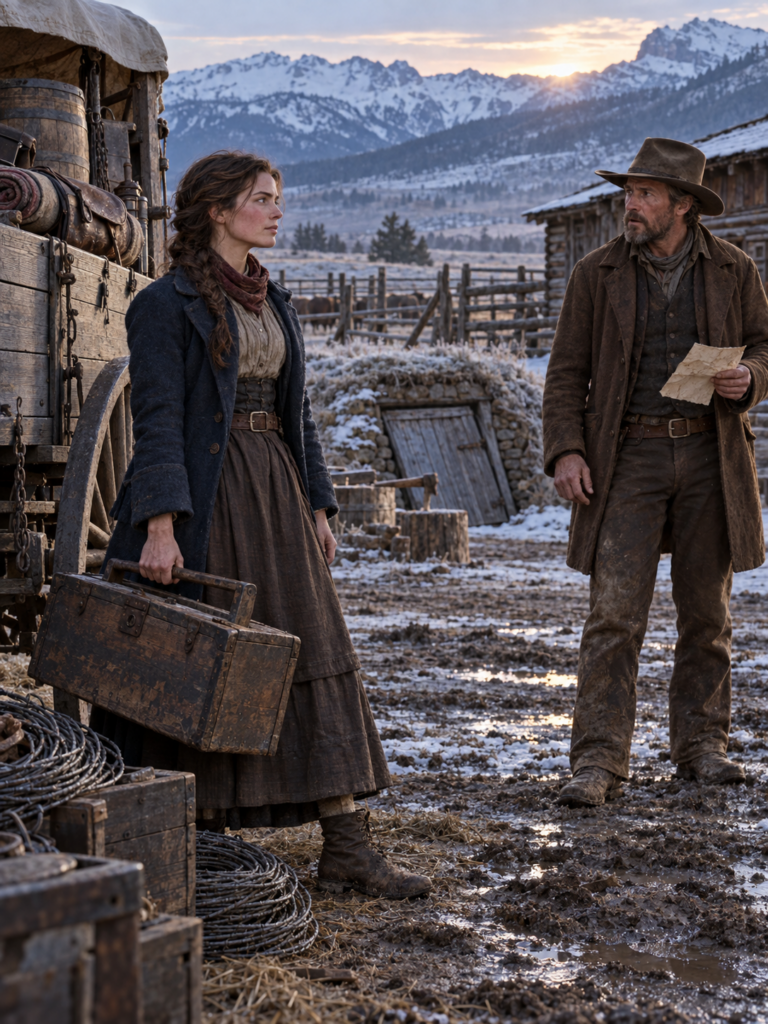
Sarah crossed the yard toward the house, and Abel followed before Trent’s three horses had disappeared below the switchback.
She did not ask whether he was frightened.
She asked, “Where is your original filing?”
“Back bedroom. Document box.”
“Then find it.”
Abel stopped at the kitchen threshold.
Sarah glanced at him.
“What?”
He almost smiled.
“Nothing.”
“You looked like there was something.”
“I’m accustomed to giving the orders on my own place.”
“And?”
“And you gave the right one.”
She opened the kitchen door. “Then we’ve saved time.”
Inside, Abel pulled a wooden box from the upper shelf of the back room. Old receipts, tax papers, livestock bills, correspondence.
The water claim lay beneath them.
He brought it to the table.
Sarah stood opposite him but did not touch the document until he slid it toward her.
Her eyes moved slowly across the page.
“March.”
“Yes.”
“And their filing says the next year.”
“Yes.”
“Then take this to Montrose.”
“County clerk will need to compare them.”
“Go tomorrow.”
Abel looked toward the window. There was stock to water, a trough valve that had begun leaking, and a section of the north line they had planned to inspect.
Sarah read his hesitation correctly.
“I can manage one morning.”
“I know you can.”
“Then don’t stand here inventing a reason I can’t.”
His mouth moved despite himself.
Not quite a smile.
Close.
She tapped one finger beside the recorder’s number.
“This matters more than a fence.”
Abel sat.
For several seconds he looked not at the water filing but at Sarah’s hands resting near it.
Those hands had rehung his cellar door.
Reset posts.
Mended harness.
Repaired a chair he had stopped seeing.
She had arrived intending to trade skilled labor for one season’s wage.
She had never pretended the place belonged to her.
Yet for nearly a month she had protected it as carefully as he did.
“You were right about winter,” he said.
Sarah’s brows drew together. “About what part?”
“That a man shouldn’t wait until the road closes to make a decision for somebody else.”
Her expression changed.
Abel placed both palms flat on the table.
“I want to ask you something. But before I do, your wage remains forty-two dollars. The cabin remains yours. If you want Delta when the season ends, I’ll take you as far as the road allows or help you arrange passage.”
Sarah did not move.
“And if your answer is no,” he continued, “nothing here changes.”
The stove gave a soft iron tick.
Sarah’s attention sharpened.
“All right.”
Abel had faced bad weather, injured cattle, debt years, and two winters in a house where every room reminded him another person had once occupied it.
None of that required the courage of the next sentence.
“I don’t want to hire you another season.”
Sarah’s face went unreadable.
He continued before she could mistake him.
“I want you to consider staying as my partner.”
Her eyes held his.
“Partner how?”
The question required him to say it plainly.
“Marriage.”
Silence.
Abel did not reach across the table.
Did not soften the offer by pretending it meant less than it did.
“I’m not asking because winter is coming. I’m not asking because you’re here and I’m lonely. And I’m not asking you to exchange work for a roof.”
Sarah looked down at the filing between them.
“What are you asking, then?”
“For a life built by two people who both know what this place costs.”
She lifted her gaze.
“And if I want land that belongs to me?”
Abel felt the question strike deeper than he understood.
He answered carefully.
“Then I would need to know exactly what you mean before I promised anything.”
Sarah pushed her chair back.
There was no anger in the motion.
Only decision.
“Good.”
She went to the kitchen door, opened it, and looked toward the cabin.
“I have something you need to know before I answer.”
Abel remained where he was.
She crossed the yard, entered her cabin, and returned carrying the same worn envelope she had used for his supply list.
She placed it beside the water filing.
“My name was not always Kern because I was unmarried.”
Abel said nothing.
Sarah rested two fingers on the envelope.
“I had a husband in Gunnison.”
The room seemed to contract around that sentence.
“He died last spring. There were debts afterward. Enough that the homestead had to be sold.”
Abel’s eyes went to her face.
“That’s why you took orchard work?”
“Yes.”
“And why you came here?”
“At first.”
The last two words changed everything without answering enough.
Sarah drew the envelope back toward herself.
“I will not go from being a laborer on one man’s land to being a wife whose security depends on another man’s goodwill. If I stay, my future has to be more certain than that.”
Abel looked at the old filing, then at the ranch outside his window.
For years he had thought the hardest thing about keeping land was defending it.
Now Sarah had put another choice before him.
He could ask her to remain.
Or he could prove he understood what remaining must cost her.
He picked up the water-right claim, folded it into his coat, and stood.
“Then I’ll go to Montrose in the morning.”
Sarah watched him.
“And after I settle this,” he said, “we’ll talk about what your name would mean on this place before you give me any answer.”
She gave one slow nod.
Outside, the light had begun to fade.
Then Sarah reached for her coat.
“I’m coming with you as far as the north fence. If you’re leaving before dawn, that line gets inspected tonight.”
She opened the door and stepped into the cold, forcing Abel to choose whether to follow her into the work that still had to be done—or remain inside imagining a future he had not yet earned.
Abel took his coat from the peg and followed Sarah into the yard.
She had already lifted the coil of spare wire from beside the barn.
“I can carry that.”
“So can I.”
“I know.”
“Then we’ve settled another matter.”
He caught up beside her.
The last light lay pale across the mesa, and the bare aspens below the east boundary made a dry whisper whenever the wind moved through them.
They walked north without speaking.
Something had altered between them in the kitchen.
Not affection exactly.
Affection had been growing quietly for weeks in cups of tea, repaired hinges, clean fence lines, and the second helping of stew Abel began making without admitting he expected her to join him at noon.
What had changed was the weight of choice.
Sarah had told him what staying could not mean.
Now he had to decide whether the future he wanted could bear the shape she required.
At the north fence she crouched beside a leaning post.
“Ground’s loosened here.”
Abel tested it.
“It’ll hold tonight.”
“It’ll fail once the cattle crowd it.”
He looked at the sky.
“We’ll reset it now.”
They worked until daylight thinned.
Abel dug out the loose earth while Sarah steadied the post. He tamped stone around the base; she tightened the wire. Their hands moved together with the practiced economy of people who had learned one another’s rhythm without discussing it.
When the work was done, Sarah stepped back.
“That will hold.”
Abel looked along the line.
“Yes.”
She wiped dirt from her glove.
“Go to Montrose tomorrow. I’ll feed the horses and move the cattle off the lower draw before noon.”
“You don’t have to prove you can run the place.”
“I’m not proving anything.”
She faced him.
“I’m doing the work I agreed to do.”
That answer followed him all the way back to the house.
Before dawn, Abel saddled his gelding.
Sarah emerged from her cabin carrying a lantern.
She checked the saddle cinch without asking, then handed him a cloth-wrapped piece of bread and dried meat.
“I packed enough if the clerk keeps you.”
“Thank you.”
“Bring back lamp oil if you can.”
Abel almost laughed.
“A man may lose half his water and you’re concerned about lamp oil.”
“A man who keeps his water still needs light after dark.”
He mounted.
Sarah stepped away from the horse.
“And Abel?”
He looked down.
“Don’t agree to anything because somebody in town tells you it will save trouble.”
“I won’t.”
“Good.”
He rode out.
The trip to Montrose took most of the morning. The county office occupied rooms near the center of town, and Abel carried his original filing in beneath his coat as carefully as if it were money.
The clerk compared the recorder’s number, date, and description with the consortium papers Abel had copied before handing them back.
He read twice.
Then he removed his spectacles.
“Your filing is earlier.”
“That’s what I told Trent.”
“The company may dispute particulars. They can hire lawyers to argue over language if they choose. But on the dates you’ve shown me, their claim does not outrank yours.”
Abel felt the tension between his shoulders ease.
“Can I get a certified copy made?”
“You can.”
He paid the fee.
When he left the office, he carried the original secured inside his coat and the copy wrapped separately.
The ranch still had its water.
But that was not the only business that had brought him to town.
He stood on the boardwalk outside the county office for several minutes before turning toward the office where local property instruments could be prepared and recorded.
Sarah had said she wanted land of her own.
Not permission to occupy his.
Not a promise spoken beside a stove.
Something harder to withdraw.
Something written.
Abel asked what would be required to place another owner’s name on his ranch title.
The answer involved documents, signatures, descriptions of the property, and proper recording.
It could be done.
He did not do it that day.
That mattered.
He would not put Sarah’s name on a legal instrument and then carry it home as though the gift itself obligated her to accept the man attached to it.
Instead, he collected the information.
He bought lamp oil.
Then he rode back toward the mesa.
Sarah was on the south flat when he arrived, driving the last of the cattle toward better forage.
She sat her horse easily, one hand low on the reins.
Abel stopped at the edge of the yard and watched her bring the animals through the gap in the fence.
Only after she had closed and latched it did she ride toward him.
“Well?”
“My claim stands ahead of theirs.”
She exhaled.
Once.
No celebration.
No dramatic relief.
“Good.”
“I had a copy certified.”
“Better.”
He dismounted.
“I also asked what would be required to add another owner to the ranch.”
Sarah became very still.
Abel removed his gloves.
“I didn’t sign anything.”
Her gaze sharpened.
“Why not?”
“Because you told me you wanted land of your own. You did not tell me you wanted this land. And you haven’t agreed to marry me.”
Sarah looked toward the house.
Then to the cabin.
Then across the bench.
“That was the correct answer.”
“I thought it might be.”
A faint smile touched her mouth.
“Don’t become proud of yourself.”
“I’ll try not to.”
They put away the horses.
That evening, for the first time, Sarah came into the kitchen for supper without Abel carrying a bowl out to her or formally inviting her.
She stopped beside the repaired chair.
The rung she had fixed held firm.
Abel set stew on the table.
Sarah remained standing.
“There’s something else you should know.”
He waited.
“My husband’s name was Thomas.”
Abel did not flinch from the name.
“He was not cruel.”
That surprised him only because she seemed determined he understand it.
“He worked hard. We both did. We thought effort would be enough.”
She sat.
“When crops failed one year, we borrowed. Then another season went poorly. By the time he died, the debt had grown larger than I knew.”
Abel took the opposite chair.
“Did he hide it?”
“Some of it.”
Her thumb moved along the edge of the table.
“He believed he could fix it before I had to worry.”
There was no bitterness in her voice.
That made the hurt clearer.
“When he died, I learned how little of my own future I had actually understood.”
Abel glanced at the papers he had brought home from town.
Sarah followed his eyes.
“That is why I asked for the cabin to remain mine if I stayed.”
“As a wife.”
“Yes.”
“You think I’d take it from you?”
“I don’t know what either of us becomes ten years from now.”
He absorbed that without offense.
“So you want one place that remains yours.”
“I want one door I can close because it belongs to me, not because you permit it.”
Abel nodded slowly.
“All right.”
She studied him.
“You say that quickly.”
“Should I argue first?”
“I expected you might.”
“I lived two winters in a house where every room belonged to me and none of them felt like enough.”
Sarah’s expression softened.
It was the first time he had spoken so directly of the emptiness after Margaret.
He did not look away.
“My wife died two years ago.”
Sarah waited.
He continued.
“I loved her. I still know where she kept every kitchen thing, though most of them have moved. For the first year I kept expecting to hear her cross the floor.”
His fingers rested near his bowl.
“I stopped repairing small things.”
“The chair.”
“Yes.”
“The garden.”
“Some of it.”
Sarah’s eyes moved around the room.
“And the second chair?”
Abel looked at it.
“That came from the back room.”
“When?”
“The third day you were here.”
Sarah’s mouth shifted.
“I know.”
He looked up.
“I saw you carry it in.”
Neither spoke for several seconds.
Then Sarah said, “I wasn’t trying to replace anybody when I fixed the rung.”
“I know.”
“And I won’t.”
“I know that too.”
Something in the room settled.
Not grief.
Grief did not disappear because another person entered a house.
But for the first time Abel understood that asking Sarah to stay did not require him to erase who had been there before.
And Sarah understood that being offered a future did not require her to pretend Thomas had never existed.
They finished supper.
The next week became colder.
No great storm came, only the ordinary tightening of a Colorado November. Water froze thin around the trough edges at dawn. The cattle grew heavier-coated. The road developed slick stretches where shade held frost.
Sarah continued working.
So did Abel.
They repaired root-cellar shelving together. She measured while he cut. When he suggested placing one shelf higher, she pointed out that she would need to reach it carrying jars.
He lowered it.
They counted feed.
Checked harness.
Moved stacked wood closer to both buildings.
One afternoon Abel found Sarah marking figures on a scrap of paper.
“What’s that?”
“Winter stores.”
“You keeping my accounts now?”
“No.”
She turned the page toward him.
“I’m checking whether you can afford the wage you promised me through thaw.”
He blinked.
“You think I can’t?”
“I think a man with a water concern appearing at his gate should know exactly what leaves his purse.”
He sat beside her.
Together they went through the numbers.
Not because Sarah had become his wife.
Not because Abel had given her authority.
Because he asked what she saw and she told him.
Two days later, Harlow Trent returned alone.
He remained outside the gate.
Abel met him there.
Sarah continued repairing a bridle at the cabin step, close enough to hear but making no show of listening.
Trent’s manner had lost some confidence.
“I understand you produced an earlier filing.”
“I did.”
“The consortium may reconsider the particular parcel.”
“That’s their concern.”
“There may still be an arrangement worth discussing.”
“No.”
Trent glanced past him toward Sarah.
“You intend to run this place as you have been?”
Abel knew what the man meant.
Small ranch.
Limited labor.
Isolated bench.
A widower who had spent the end of summer injured.
“No,” Abel said.
Trent looked interested.
Abel glanced back once.
Sarah had stopped sewing.
He turned again.
“I intend to run it better.”
Trent gave a dry smile.
“With hired help?”
Sarah stood.
Before Abel could answer for her, she walked to the gate.
“That depends,” she said, “on whether I remain hired.”
Trent looked from her to Abel.
Sarah did not offer more.
After the agent rode away, Abel turned.
“You didn’t have to come over.”
“I know.”
“You also didn’t answer his question.”
“It wasn’t his question to have answered.”
Abel considered that.
“No.”
She returned to the cabin step.
That night, Sarah brought a sheet of paper into the kitchen.
She set it beside Abel’s ledger.
“I wrote to the man in Delta.”
Abel’s chest tightened.
“The orchard parcel?”
“Yes.”
He made himself ask, “What did you tell him?”
“That I haven’t decided.”
Abel did not hide his disappointment, but neither did he reach for the letter.
Sarah watched him closely.
“The pass remains open,” she said.
“It does.”
“I can still leave.”
“Yes.”
“And you would let me.”
He frowned.
“Sarah, there is no version of this where I stop you.”
Her shoulders lowered.
That answer mattered more than he had expected.
She sat across from him.
“I need one more thing before I decide.”
“Name it.”
“If I say yes, I want the deed work begun before we marry. Not afterward.”
Abel nodded.
“And the cabin?”
“Yours to use as you choose.”
“My tools remain mine.”
“Yes.”
“I work this ranch as a partner. I do not become the woman who cooks while you decide everything outside.”
“Yes.”
She narrowed her eyes.
“You’re agreeing very fast again.”
“I’ve watched you work for six weeks. Why would I marry the best ranch hand I’ve ever hired and then forbid her from ranch work?”
That surprised a laugh out of her.
A real one.
Abel smiled.
It changed his whole face.
Sarah looked at him for a long moment.
Then she reached into her pocket and withdrew the letter intended for Delta.
She did not tear it.
She laid it on the table.
“I haven’t mailed this.”
Abel said nothing.
“I won’t promise forever tonight.”
“I’m not asking you to.”
“But I’ll ride to Montrose with you tomorrow.”
“For the deed papers?”
“For the deed papers.”
He let out a breath.
Sarah placed her hand over the letter.
“And after I see exactly what I’m being asked to sign, I’ll give you my answer.”
Outside, the road remained open.
For one more day, at least, every direction was still possible.
At first light, Sarah carried her tool chest into the wagon.
Abel came out of the barn and stopped.
For one hard second, seeing that chest where it had been the day she arrived made him think she had changed her mind before he could ask.
Sarah noticed.
“It’s staying in the wagon because I need the awl repaired in town.”
Abel’s shoulders eased.
She looked almost amused.
“You thought I was leaving.”
“I considered the possibility.”
“You said you wouldn’t stop me.”
“I wouldn’t.”
“That doesn’t mean you’d enjoy it.”
“No.”
Sarah climbed onto the wagon seat.
“Good. I’d distrust a man who pretended otherwise.”
They drove toward Montrose with the tool chest behind them and the mesa falling away in pale autumn colors.
Frost silvered the sage.
The aspens had lost their gold entirely.
Above the southern ridge, the higher ground carried snow, but the road itself remained firm.
Sarah watched it carefully.
Abel knew why.
Every mile toward town proved what he had been telling her.
She was not trapped.
By noon they had reached Montrose.
The first stop was not the church.
It was not the house of a minister.
It was the office where Abel had asked how ownership could be changed.
Sarah sat beside him while the property description was read aloud and the procedure explained.
She asked more questions than Abel did.
What exactly would be recorded?
When would her interest take effect?
Could the change be completed regardless of whether she took his name?
Would the cabin and outbuildings fall under the same property description?
What signatures were necessary?
Abel did not interrupt once.
When something was unclear, Sarah asked again.
At last she leaned back.
“That’s what I wanted to know.”
Abel looked at her.
“Do you want to go forward?”
Sarah looked down at her hands.
Those hands had belonged to a girl working orchards, then to a woman building a homestead with Thomas, then to a widow signing away land to settle obligations she had learned of too late.
Then they had carried wages from one place to another.
Mended other people’s property.
Harvested other people’s fruit.
Repaired other people’s fences.
She had told herself there was dignity in good work, and there was.
But dignity and ownership were not the same thing.
She raised her eyes.
“Yes.”
The papers were prepared.
Not as a wedding gift.
Not as payment for marriage.
Not as a trick placed in front of her after vows made retreat difficult.
As a separate choice.
Abel signed first.
Then the clerk turned the instrument toward Sarah.
She read every line.
Abel waited.
When she finished, she picked up the pen.
Her hand did not tremble.
Sarah Kern signed her name.
The clerk sanded the ink.
“There’ll be recording to complete,” he said, “but this can proceed.”
Sarah nodded.
Abel said only, “Thank you.”
Outside, they stood on the boardwalk with town traffic moving past.
A freight wagon rattled down the street.
Somebody led a lame mule toward a stable.
A woman emerged from the dry-goods shop carrying flour.
Life went on around them with complete indifference to the fact that Sarah’s future had altered.
Abel looked at her.
“Do you want dinner before we head back?”
Sarah folded her copy of the document and placed it inside her coat.
“There’s something else first.”
He waited.
She took the unmailed Delta letter from her pocket.
“I want to send this.”
Abel’s stomach tightened, but he nodded.
They walked together to the post office.
Sarah stood at the writing shelf, opened the envelope, and unfolded the page she had written.
Then she crossed out three lines.
Added another.
Folded the sheet again.
Sealed it.
Abel did not ask what it said.
Sarah handed it across the counter.
Only after the clerk placed it with the outgoing mail did she turn.
“You didn’t ask.”
“No.”
“I told him I wouldn’t be leasing the orchard.”
Abel went motionless.
Sarah looked directly at him.
“I am not staying because winter is close.”
“I know.”
“I am not staying because I fear I cannot make a living elsewhere.”
“I know.”
“I have made a living elsewhere.”
“Yes.”
“And I am not staying because you offered me land.”
Abel nodded.
Sarah glanced toward the street.
“When I came to your ranch, I meant to earn forty-five dollars.”
“Forty-two.”
“You bargained.”
“I did.”
“You should have given me forty-five.”
“Probably.”
She nearly smiled.
“I came because the notice was still hanging after every man in Montrose had decided the work wasn’t worth the ride. I thought a ranch desperate enough to wait six weeks might be desperate enough to judge my hands before it judged my sex.”
Abel’s expression tightened.
“I nearly failed that test in the first minute.”
“You recovered.”
“Barely.”
“You asked what I could do.”
“That seemed more useful than asking whether you owned a skirt.”
She laughed softly.
Then the laughter left her face.
“I planned to leave in spring even if the work suited me.”
“Delta.”
“Eventually.”
She turned toward him fully.
“Then I began noticing things.”
“What things?”
“The ranch.”
Abel waited.
“The west line was neglected, but the cattle weren’t. The cellar door sagged, but the hinges you had put on the barn were good. Your kitchen garden had gone bad because you were injured, not because you were lazy.”
Her eyes held his.
“You gave me the cabin without making a show of decency. You told me the wage before asking anything personal. When I said the season ended cleanly, you agreed before you knew whether I was worth the money.”
Abel said nothing.
“You brought tea and left it outside.”
“I thought you might prefer it.”
“I did.”
“And the apple cake?”
“That was because you bought the correct nails.”
He frowned.
“That cake was payment for nails?”
“No.”
Sarah’s smile came then.
“That’s the point.”
Abel looked at her for a long moment.
Then he said, “I began noticing things too.”
“I’m aware.”
“Are you?”
“You moved the second chair.”
He lowered his head with a quiet laugh.
“Yes.”
“You washed two bowls.”
He looked up sharply.
She shrugged.
“The window in my cabin faces the kitchen pump.”
“You watched me wash dishes?”
“I observed evidence.”
“Dangerous habit.”
“It’s kept me alive.”
The humor softened.
Abel’s voice did too.
“I noticed you never entered my house as though being useful gave you the right.”
Sarah’s expression changed.
“I noticed you never entered my cabin as though paying wages gave you the right.”
They stood in the noise of town with the whole future between them.
Sarah looked at him and understood that this was the question she had spent months avoiding.
Not whether she could love again.
Love, she had learned, was not proof against debt, death, secrecy, or loss.
The harder question was whether she could build again without surrendering the part of herself she had fought to recover.
“Abel.”
“Yes?”
“If I marry you, Thomas remains part of my life.”
Abel answered immediately.
“I would expect him to.”
“I may speak of him.”
“You should.”
“I may miss him.”
“Yes.”
“And I will not apologize for that.”
“I’m not asking you to.”
Sarah studied him.
“What about Margaret?”
“I still miss her.”
“Then we understand one another.”
“I believe we do.”
She drew in a slow breath.
“I’ll marry you.”
Abel did not grab her.
Did not kiss her in the middle of the boardwalk.
Did not declare that she was finally his.
He simply looked at her as if the world had become both lighter and more serious.
“Are you certain?”
“Yes.”
“You can change your mind before the vows.”
“I know.”
“After them, if I ever give you cause to regret—”
“Abel.”
He stopped.
“I said yes.”
He nodded.
“All right.”
Sarah held out her hand.
He took it.
They stood like that for several seconds.
Then she said, “Now buy me dinner.”
“Yes, ma’am.”
“Don’t start that.”
He smiled.
“Yes, Sarah.”
They arranged for Reverend Cole to come to the mesa the following Saturday if the road remained clear.
It did.
During the intervening days, nothing about the ranch became magically romantic.
The trough still froze at the edges.
A gate latch still needed replacing.
One steer developed a habit of testing the repaired west fence.
Sarah still slept in the hands cabin.
Abel still slept in the house.
They worked.
That was where the change became visible.
Abel stopped saying “my winter feed” and began saying “the winter feed.”
Sarah caught herself referring to “our south flat.”
Neither mentioned the change.
When they discussed replacing part of the irrigation ditch lining in spring, Abel asked where she would begin.
Sarah drew a rough plan.
When Sarah proposed enlarging one garden plot and using the other for storage crops, Abel disagreed.
They argued for twenty minutes.
Then they walked the ground.
Sarah changed her mind about one section.
Abel changed his about the rest.
It was their first disagreement as future partners.
Nothing broke.
That mattered.
On Friday evening, Sarah carried several dresses from her wagon into the cabin.
Abel saw them.
“Need anything from the house?”
“No.”
He nodded.
Then she said, “Actually.”
He turned.
“The looking glass in the back room. May I borrow it tomorrow morning?”
“It’s yours if you want it.”
“Borrow.”
Abel understood the distinction.
“I’ll bring it over.”
He did.
He left it outside the cabin door.
Saturday came clear and bitterly cold.
Reverend Cole arrived with his deacon, and a woman from a neighboring ranch agreed to serve as witness.
Sarah wore a dark, plain dress beneath her indigo coat.
No elaborate veil.
No flowers carried in from some impossible season.
Her hair was neatly pinned.
Abel wore his best coat and looked uncomfortable in it.
Before the ceremony, Sarah stood alone beside the hands cabin.
The tool chest remained inside.
The door was closed.
Abel approached but stopped several feet away.
“You all right?”
“Yes.”
“You want more time?”
“No.”
He glanced toward the house where the reverend waited.
“Sarah.”
She looked at him.
“The cabin remains yours.”
“I know.”
“I thought I should say it once more.”
Her expression softened.
“And the house?”
“Ours, if you still want it.”
She stepped toward him.
“I do.”
The ceremony was short.
When Reverend Cole asked Sarah whether she took Abel freely, she answered clearly enough for every witness to hear.
“I do.”
When Abel gave his answer, his voice was equally steady.
There was no grand speech afterward.
No crowd.
No celebration beyond coffee, bread, preserved fruit, and the apple cake Sarah had made the evening before.
The neighbor teased Abel that marriage might finally improve his cooking.
Sarah corrected her.
“He cooks well enough.”
Abel looked almost offended.
“Well enough?”
“You over-salt stew when distracted.”
The deacon laughed.
Abel stared at his new wife.
“You’ve been keeping that criticism six weeks?”
“I wanted to be certain of my position.”
That evening, after the visitors had gone, Sarah stood between the house and cabin.
Abel carried the last dishes inside.
Then he returned.
Sarah’s tool chest sat on the cabin step.
He looked at it.
She followed his eyes.
“I’m not moving it.”
“I didn’t ask.”
“The cabin stays my workroom.”
“Yes.”
“My leather tools stay there. My clothes for ranch work too.”
“Yes.”
“I’ll sleep in the house.”
Abel’s face changed, but he did not move toward her.
Sarah stepped closer by her own choice.
“I said I’ll sleep in the house.”
“I heard you.”
“Good.”
She took his hand.
The gesture was enough.
When they entered the kitchen, two chairs stood at the table.
One with the rung Sarah had repaired.
One Abel had carried in from the back room three days after her arrival.
They ate supper there for the first time as husband and wife.
But marriage did not make the ranch hers.
The recorded documents did.
Marriage did not make her labor valuable.
It had already been valuable.
Marriage did not make Abel respectful.
That had been proven in the weeks when he possessed every practical advantage and chose not to use one against her.
Winter came gradually.
The road grew difficult.
Then, for stretches, travel became impractical.
By then Sarah had already chosen.
That distinction remained important to both of them.
Through December they settled into work that belonged to neither one alone.
Abel took most of the predawn feeding because Sarah’s hands stiffened badly in the deepest cold.
Sarah kept the accounts because she was better at catching small waste before it became large waste.
They split wood together when weather allowed.
She repaired leather.
He cooked more often than either of them had expected.
She taught him a better way to pack dried apples against damp.
He showed her which cow would kick if approached carelessly from the left.
The cabin remained Sarah’s.
Sometimes she spent entire afternoons there with the door shut, repairing tack or writing letters.
Abel never entered without knocking.
One day he needed a bridle hanging inside and waited until she answered.
Sarah noticed.
She always noticed.
By February the repaired west fence had survived wind, cattle, and hard cold.
The root-cellar door still swung true.
The chair rung held.
Those small facts came to mean more to Abel than they should have.
Or perhaps exactly as much as they should have.
When spring finally softened the ground, Harlow Trent returned once more.
This time he carried no threatening papers.
He came to discuss the consortium’s interest in purchasing a voluntary share of water.
Abel met him in the yard.
Sarah joined him.
Trent addressed Abel first.
“Would you reconsider a sale?”
Abel looked at Sarah.
Not for permission to speak.
Because the question belonged to both of them.
Sarah said, “We’ve discussed it.”
Trent caught the pronoun.
“And?”
“No,” Abel said.
Sarah added, “Not at the price you offered.”
Trent blinked.
Abel turned his head slightly.
They had not discussed that.
Sarah remained composed.
“The answer to your old offer is no,” she clarified. “If your company ever wants to make another proposal, make it in writing.”
Trent studied her.
“You handle the business now?”
“We both do.”
It was not defiance.
It was fact.
Trent nodded slowly.
Then he mounted and rode away.
Abel waited until he was down the road.
“You might have warned me.”
“Would you have objected?”
“No.”
“Then now you know.”
He laughed.
In April, Sarah walked the garden plots with a spade over one shoulder.
The ground had begun to yield beneath her boots.
Abel followed with stakes.
“Storage crops here,” she said.
“You told me last fall the upper plot drained better.”
“I was wrong.”
Abel stopped.
Sarah looked over.
“What?”
“I wanted to hear it twice.”
She lifted the spade threateningly.
He raised both hands.
“Once is plenty.”
They marked the rows.
At the cabin, her tools hung in order.
At the house, the kitchen no longer looked abandoned between chores.
Not because Sarah had turned herself into a housekeeper.
Because two people now used it.
Abel repaired the stove door.
Sarah replaced the worn curtain.
He built a shelf she designed.
She refused the first version because it blocked too much light.
He rebuilt it.
The second chair stopped feeling like an addition.
It simply belonged.
One evening near the anniversary of Sarah’s arrival, she carried two cups outside.
Abel sat on the chopping block sharpening an axe.
The aspens below the east fence had begun changing again.
Green turning toward gold.
Sarah handed him one cup.
Tea.
He drank it anyway.
“Remember the day I arrived?” she asked.
“You tried to charge me forty-five dollars.”
“I was worth it.”
“You were.”
She sat beside him.
“The notice still in the post office?”
“No. Took it down months ago.”
“Good.”
“Why?”
Sarah looked across the ranch.
The west fence stood straight.
Cattle grazed the south flat.
The cellar held what they had managed to preserve and grow.
Her cabin door was open behind them, the tool chest visible just inside.
“I was thinking about what I came here for.”
“Work.”
“Yes.”
“And what did you find?”
Sarah considered the question.
“Work.”
Abel laughed.
She smiled.
Then she rested her shoulder lightly against his.
“And something worth choosing after the workday ended.”
He set the axe aside.
Neither of them spoke for a while.
Below them, the aspens moved in the evening wind.
The same trees had been gold when Sarah first drove through the gate, convinced she was entering another temporary place.
The same yard had held a sagging cellar door.
The same kitchen had contained a broken chair and a man who had become accustomed to eating alone.
Nothing had been transformed by rescue.
No one had been saved from helplessness.
Sarah had arrived capable of leaving.
Abel had been capable of surviving alone.
That was precisely why their choice mattered.
When darkness began settling across the mesa, Abel stood and carried the cups inside.
Sarah remained a moment longer.
Then she went to the cabin, put away the awl she had been using that afternoon, and shut the door on her workroom.
She crossed the twelve steps to the house.
Abel had already set two bowls on the table.
The old repaired chair waited on one side.
The second chair waited on the other.
Sarah sat.
Abel ladled the stew.
She tasted it.
He watched her.
“Well?”
Sarah considered with exaggerated seriousness.
“Less salt.”
“I’ve improved.”
“Some.”
He shook his head and took his seat.
Outside, frost began silvering the grass exactly as it had the autumn before.
Inside, two people ate at a table neither of them mistook for proof that one belonged to the other.
The proof was in everything that had come before it.
The open road.
The separate door.
The name on the property papers.
The work divided according to skill rather than expectation.
The dead spoken of without jealousy.
The disagreements that did not become threats.
The freedom to go.
The decision to remain.
Sarah looked across the table at Abel.
A year earlier, she had demanded that their arrangement end cleanly in spring unless both chose otherwise.
Spring had come.
The road had opened.
The orchards in the Grand Valley still existed.
Other work could still be found.
Her tools could still fit into the wagon.
That knowledge did not frighten Abel anymore.
It steadied him.
Because every evening she crossed the yard from the cabin to the house, she was choosing again.
And every morning when Abel stepped outside and found her already studying some hinge, fence, account, animal, ditch, or problem that belonged to both of them now, he understood the same thing.
She had stayed.
Not because winter closed the road.
Not because she had nowhere else to go.
Not because a lonely rancher offered shelter.
She stayed because the mesa had become a place where her work, judgment, property, memories, boundaries, and future all had room to exist.
Abel had wanted someone who chose the ranch before desperation made the choice for them.
In the end, that was exactly who answered his notice.
And Sarah, who had spent years working land she could never call her own, had found something better than a place handed to her.
She had found a place she had inspected, repaired, argued over, invested in, legally claimed, and freely chosen.
The cracked chair still held.
The cellar door still swung true.
Her tool chest remained twelve steps away in a cabin whose door was hers to close.
And when the first star appeared over the plateau, Sarah stayed at the table because there was nowhere else she preferred to be.


