Part 1
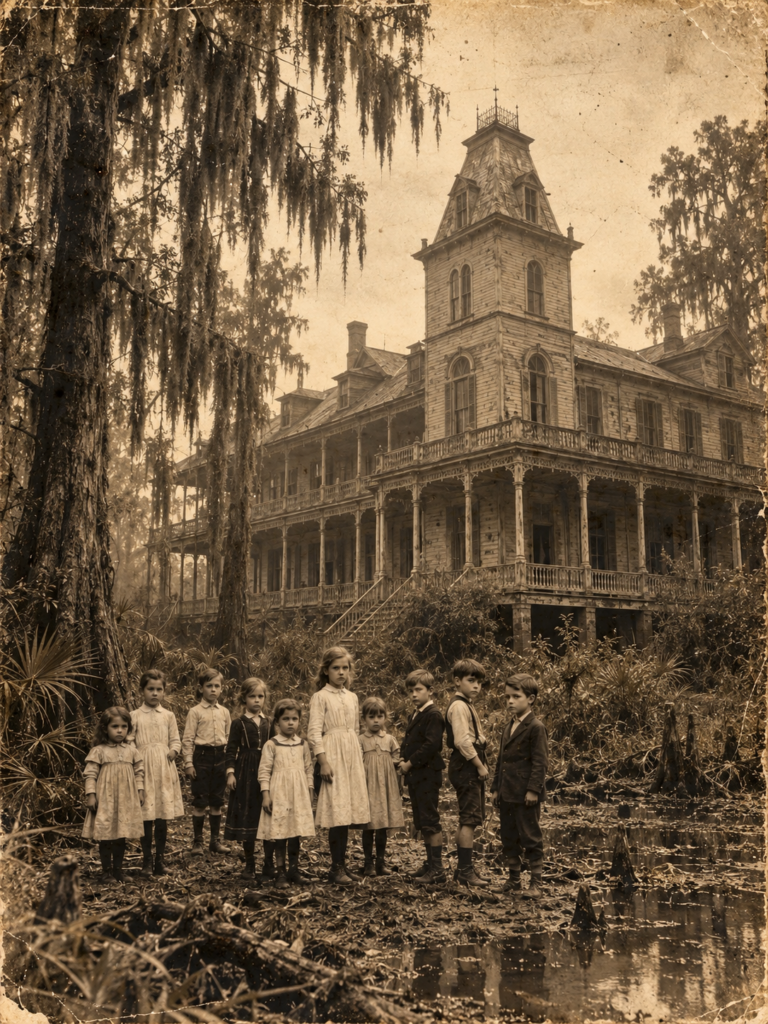
In the summer of 1912, in a Louisiana parish that would eventually disappear from the maps, a nursing sister entered the children’s ward of the Sacred Heart Home sometime after midnight and found a little girl asleep beneath a damp sheet.
The night had been oppressively hot. Even after sundown the marsh held the day’s heat close to itself, and the open windows admitted little more than the smell of black water, cypress, mud, and the faint mineral breath of the ridge on which the hospital stood. Mosquito netting stirred without wind. Somewhere beyond the live oaks, frogs worked steadily in the dark.
The child had suffered for months from consumption.
That evening, however, her fever seemed to have broken.
The sister came to move her nearer the window.
She slipped 1 arm beneath the girl’s shoulders, another beneath her knees, and lifted.
The motion nearly threw both of them backward.
The girl weighed almost nothing.
Not merely less than expected. Not the fragile lightness of a wasted child whose illness had pared flesh from bone. The sister later described it as lifting a folded sheet from a bed.
Yet the child’s body had not withered.
Her arms retained their shape. Her cheeks were not sunken. Her skin was neither dried nor cold. Her hair remained damp from the Louisiana heat.
She appeared to be sleeping.
Only she did not breathe.
There were no bruises on her, no marks at the throat, no blood, no evidence of convulsion. At the corners of her mouth lay a faint dust, nearly white, fine as flour.
The physician called after dawn examined her and wrote consumption on the certificate.
Consumption was a reasonable word in Louisiana in 1912. It explained thousands of deaths. It required no further question.
The girl was placed in a small coffin and carried from the ridge. Like most dead in that country, she was not put beneath the waterlogged ground. She was housed above it in stone.
Nobody weighed the coffin.
Had anyone done so, there would have been no useful place to put the number.
The institution from which she was carried had 2 names. The diocese called it the Sacred Heart Home for Weakly Children. People in the surrounding parish called it the Boisek Sanatorium, after the ridge on which it had been built.
For nearly 40 years it possessed an extraordinary reputation.
Children were brought there coughing blood, burning with fever, too weak to sit upright in the wagon that delivered them. Weeks later, many of them walked down the front steps.
Mothers wrote letters of gratitude.
Some sent money they could not afford.
Others mailed embroidered handkerchiefs, jars of preserves, small medals of saints, or photographs taken months afterward in which a child presumed lost stood stiffly beside siblings, healthy enough to look impatient with the camera.
The sisters preserved those letters in a cedar box.
Taken alone, each letter told a simple story.
A child had been sick.
The child had gone to Boisek.
The child had recovered.
To families in the low country, that was enough.
The sanatorium stood in Sel Parish, deep in the Atchafalaya country, where land and water changed places according to the season. In flood years the bayous widened until fences vanished beneath brown water and boats moved between houses where wagons had traveled a month before. Cypress rose from flooded woods. Spanish moss hung from branches over water black enough to reflect the sky like polished glass.
Dry earth was valuable there.
The highest ground took the form of cheniers, narrow ridges built from shell, roots, old sediment, and the slow accumulation of years.
People built on them because there was nowhere else to build.
They buried their dead aboveground because a grave cut into the ordinary soil might fill with water before a coffin could be lowered.
Among all the ridges in Sel Parish, Boisek was the oldest and highest.
The name was said to mean dry wood.
Nobody could say precisely how long it had been called that.
French families used the name. Families who remembered the language spoken before the French used something very close to it.
Boisek never flooded.
During the great water of 1882, when cattle drowned where they stood and roofs showed above the basin like islands, water reached the foot of Boisek Ridge and stopped.
It circled the rise.
It entered the surrounding woods.
It submerged fields, roads, and graveyards.
The ridge remained dry.
Old residents spoke of seeing herons walking its edge while floodwater stood on every side.
No engineer explained it.
No one in the parish considered explanation particularly urgent.
When something has behaved the same way for longer than anyone remembers, people rarely call it impossible. They call it the way things are.
There was, however, a story.
Grandmothers told it quietly.
Priests told them not to.
According to the story, Boisek stayed dry because something beneath the ridge kept it dry.
A bargain had been made before the parish existed, before the present families arrived, perhaps before French names had been spoken in that part of Louisiana at all.
No version of the story agreed on who had made the bargain.
Every version agreed on its condition.
Dry ground had a price.
The price had once been understood.
The most dangerous thing anyone could do on Boisek Ridge was stop paying.
When the diocese began looking for a site for a children’s sanatorium early in the 20th century, Boisek appeared ideal.
It was high.
It remained above the floods.
The live oaks shaded the crown.
The air was thought healthier than the heavy lowlands.
Engineers went out to survey the building site.
They found foundations already waiting.
Beneath centuries of leaf rot and black soil lay a platform of pale stone.
It was not local brick. It was not the soft regional stone that broke under tools and weathered quickly in humidity. The material was close-grained, bone-colored, extremely hard, fitted in blocks so precise that the point of a knife could not be worked into the joints.
There was no visible mortar.
The platform remained level.
Beside it stood a low gallery of square columns supporting a roof of the same material.
The live oaks around it were ancient.
The gallery appeared older.
No parish record described its construction.
No church record claimed it.
No local family possessed a story explaining who had built it.
The new hospital incorporated the old stone.
That decision was practical.
Good foundations had already been provided.
No one saw reason to waste them.
There was also a stair.
It descended beneath the gallery only a short distance before reaching a chamber below the level at which any ordinary cellar in Sel Parish should have become wet.
It was completely dry.
The walls did not sweat.
No groundwater seeped between the fitted blocks.
No puddle formed on the floor.
The air was cool enough that a person entering from the summer heat felt the change immediately, yet there was none of the dampness associated with underground rooms in the basin.
A sealed jar might have contained more moisture.
This was the first feature of the place that troubled the engineers.
They tested the surrounding soil.
They examined drainage.
They looked for channels through which water might have been diverted.
They found nothing sufficient.
The chamber simply remained dry.
At its center stood a low stone structure.
It resembled a broad, shallow basin cut from the same pale material as the walls. Its surface curved slightly inward and had been worn smooth.
It stood roughly waist high.
Its dimensions were peculiar.
A child could lie comfortably across it.
A groove followed the edge.
Within that groove were notches.
Hundreds of them.
Some were deep and old, softened by time. Others appeared sharper.
Around portions of the rim ran an inscription in a flowing script nobody could identify. Similar characters had been cut over the chamber doorway and elsewhere in the gallery.
Beneath the older writing, a second inscription had been added.
The letters were English.
They were crude compared with the unknown characters above them, as though someone many years later had discovered enough about the chamber to leave instructions.
The words were simple.
Weigh every child at the given hour, and let the stone carry the whole house.
Never let the weighing come up short.
Never lay on a weight that was not freely given.
What the stone is given, it keeps.
What the house owes, the stone takes in the night.
For years the people who kept Boisek obeyed those words without claiming to understand them.
A child suffering from severe illness would be carried into the dry room at an appointed hour.
The surviving accounts do not agree on the exact time.
They agree only that it came in the deepest part of night.
The ward would be dark. Lamps would burn low in the corridors. The marsh beyond the windows would be without traffic, without voices, without anything but insects and water.
A woman who knew the rule would lift the sick child from bed and carry him or her down the worn stair.
Sometimes another keeper came with her.
Often she went alone.
There was no elaborate ritual.
No congregation.
No chanting.
No theatrical mystery.
The child was laid across the shallow stone.
The keeper waited.
A few words were spoken.
Then the child was lifted again, carried upstairs, and returned to bed.
By morning the fever would often be lower.
Within days the wasting stopped.
Weight returned.
Breathing eased.
Children whose lungs had been judged beyond recovery sat up, ate, complained, played, and gradually became themselves again.
The effect was so reliable that the sanatorium’s reputation spread far beyond Sel Parish.
Families who had lost hope came to Boisek.
For a time, hope was justified.
The stone appeared to take illness from the children.
But it did not destroy what it took.
It carried it.
That distinction was the foundation of everything that followed.
According to the keepers, sickness had weight.
Not pounds that could be read on a doctor’s scale, but a weight recognized by the stone.
Every cure entered an account.
Every child relieved of illness increased the burden the stone carried for the house above it.
That burden had to be balanced.
The old keepers had inherited a method for doing so.
At intervals, a living child was laid willingly upon the stone even when no cure was required.
If the giving was honest and the account properly kept, the child suffered no harm.
The child might sleep unusually deeply.
In the morning, the ledger was considered even.
The hospital remained healthy.
The ridge remained dry.
The system, if system it was, demanded neither blood nor death when tended correctly.
It required attention.
It required consent.
It required that those keeping it remember that every gift acquired a corresponding obligation.
The notches around the basin recorded another side of the account.
After a child had been taken, a fresh notch sometimes appeared.
No keeper admitted making it.
No tool marks led toward it.
A woman named Odalie Tibol once attempted to count the entire ring.
She stopped.
For the rest of her life she refused to say what number she had reached.
She would say only that there were too many marks to have been produced by the sanatorium.
Too many even for the parish infirmary that had occupied the ridge before it.
The count reached backward beyond the diocese, beyond the parish, perhaps beyond the first French settlements.
The stone had been keeping accounts longer than anyone then alive.
Odalie knew more about the room than anyone.
She had tended Boisek for decades before the Sacred Heart Home opened.
Before that, another woman had taught her.
That woman had learned from another.
There had been an unrecorded line of keepers, ordinary women of the low country who regarded the dry chamber as another responsibility attached to living where they lived.
They were not an order.
They had no title.
Most had little formal education.
They offered no theory about the age of the stone or the identity of those who built it.
They knew where to stand.
They knew what to say.
They knew when to weigh.
Above all, they knew what not to do.
Odalie reduced the whole matter to a rule that required no theology.
Keep the account even.
Give honestly.
Give little.
Give willingly.
Never place upon the stone a child who has not been freely given to the weighing.
The stone, she said, could tell the difference.
If the account came up short because the keepers failed in their duty, the stone did not wait forever for correction.
It collected.
A child sleeping above might be found at dawn with the substance of the body somehow taken away.
The victim would appear whole.
No blood.
No wound.
No obvious wasting.
Only an impossible absence of weight and the fine pale dust at the lips.
The bed would scarcely show an indentation.
Below, another notch would be waiting.
This was terrible enough.
The second failure was worse.
A child placed upon the stone unwillingly—or placed there not as a voluntary balancing of the account but deliberately offered as payment—was not accepted in the ordinary way.
A forced weight did not reduce the debt.
It enlarged it.
Odalie believed it doubled whatever obligation the keeper intended to settle.
Worse, the act taught the stone something.
The older women called the resulting change the narrowing.
Once fed deliberately with unwilling children, the stone seemed to revise its understanding of what the house was capable of giving.
The account became stricter.
The intervals shortened.
The stone began to call debts that the human keepers believed had already been satisfied.
Eventually it might take without waiting for any acknowledged debt at all.
Odalie explained it in a sentence she repeated many times.
A thing that is fed learns the weight of the house that feeds it.
When Dr. Emil Kazanav arrived in 1912 to become medical superintendent of the Sacred Heart Home, she told him everything she believed mattered.
Kazanav listened.
He wrote portions of the warning in a notebook.
He was not a man easily described as cruel.
That fact mattered.
He was courteous.
He worked long hours.
He wore immaculate white coats.
Mothers trusted him.
Children liked him.
He prayed beside beds.
He remembered names.
He could write letters to grieving parents that sounded genuinely grieved because, by most accounts, he was capable of genuine feeling.
He was also a physician practicing at a time when tuberculosis killed children while doctors watched.
Then he encountered a cure that did not fail.
And he learned its price.
The first decisive break appears to have come during the second winter of the home.
Influenza entered the wards.
The children already weakened by consumption deteriorated quickly.
Too many required the stone.
The account accumulated faster than Odalie could balance it through the small, willing weighings she had been taught to perform.
Then the account collected on its own.
A child was found in bed at dawn.
Unmarked.
Peaceful.
Almost without weight.
Kazanav stood over that body and looked at the crowded ward.
He understood enough of the arithmetic.
If a child would be taken whenever the account became too short, he reasoned, then randomness was itself a form of cruelty.
If someone had to be lost, why allow chance to choose a beloved daughter whose mother came every Sunday?
Why not choose a child whose death would injure fewer people?
The Sacred Heart Home had such children.
Foundlings left at the gate.
Babies whose names had been supplied by sisters.
Orphans from fever years.
Children delivered by families so poor, remote, or broken that nobody returned to visit.
Kazanav began to choose among them.
He did not write that he was killing children.
He wrote of hard mercy.
He wrote of expenditure.
He wrote of saving many at the cost of 1 already near death and alone in the world.
It was the kind of reasoning that becomes cleaner the farther it travels from the person who must pay.
Late at night he carried a friendless child into the dry room.
Not to be cured.
To be spent.
The stone understood the difference.
And the narrowing began.
Part 2
For a while, the results made Emil Kazanav appear correct.
Children continued to recover.
The reputation of Boisek grew.
The sanatorium’s mortality remained sufficiently low that grateful families repeated the same phrase: a miracle on the ridge.
The superintendent knew better than anyone what stood beneath the miracle.
He also learned that secrecy could be managed.
A foundling died and nobody arrived demanding an explanation.
An orphan disappeared into a parish tomb, and no father’s questions followed.
A death certificate could be made ordinary with a few strokes of ink.
Consumption.
Heart weakness.
Sudden chill.
Relapse.
Those words belonged naturally to a children’s sanatorium.
Kazanav’s private ledger used different marks.
Beside certain names appeared small notations indicating that a child had been spent and, in some cases, what benefit he believed the sacrifice had purchased.
One entry concerned a girl named Azelie Fontineau.
Her case revealed what the superintendent had become more clearly than any nameless orphan could.
The Fontineau family lived on the far side of the parish.
They brought Azelie to Boisek in 1921.
She was 8 and deeply ill with consumption.
The stone was used.
She recovered.
Not partially.
Not temporarily.
The girl’s lungs cleared. Her fever vanished. Appetite returned. Before long she looked like a child who had never been sick.
She should have gone home.
Her father, however, had begun to ask questions.
He was literate and careful with figures.
The perfection of Boisek’s reputation bothered him.
A place to which dying children were brought should have possessed more graves than anyone could find.
He began asking about the foundlings.
Where were they buried?
Why did the sanatorium report so many recoveries yet seem to have a quiet, irregular procession of small funerals?
Why were certain children never mentioned again after supposedly being transferred?
No accusation had yet been made.
There was only a father’s patient attention.
Kazanav kept Azelie at Boisek for an additional month, telling her parents she required observation.
Then, 1 night, he carried the healthy girl down the worn steps.
He placed her on the pale stone.
She had already been cured once.
This time she was the payment.
In the morning Kazanav told her parents their daughter had suffered an abrupt relapse.
He spoke softly.
He grieved with them.
He may even have wept sincerely.
The Fontineaus buried what was returned to them.
A father occupied with the coffin of his child stopped investigating hospital accounts.
That was no longer hard mercy.
It was concealment.
Kazanav had discovered that the thing beneath the sanatorium could be aimed.
Another entry concerned a boy known only as the November Child.
He had been left at the gate in cold weather and never received another recorded name.
When he arrived, he was coughing badly enough that nobody expected him to see spring.
He was taken below.
The stone drew out the illness.
Weeks later he had become loud, active, and difficult to keep in bed.
Older girls in the ward taught him letters.
The sisters had to chase him from corridors.
For a brief interval he possessed the ordinary nuisance of health.
Later, when Kazanav wanted another payment, the boy was taken below for a second time.
The first weighing had saved him.
The second spent him.
By morning the November Child was light enough to be carried with almost no effort.
The girls who had taught him his letters were told he had taken a chill.
They mourned.
His cot was removed.
Another patient eventually slept there.
Life in an institution has a terrible ability to close over an empty bed.
Kazanav’s methods remained hidden partly because the people best positioned to notice were the people least empowered to challenge him.
Among them was Sister Colette Arseno of the Sisters of the Marsh Star.
She arrived at Boisek in the 1920s, young enough to seem closer in age to some of the oldest patients than to the physicians who directed the home.
She worked nights.
That placed her where the secret was most visible.
Doctors made morning rounds.
Boards inspected budgets.
Priests said Mass.
Colette was awake when children cried after midnight.
She washed the bodies before dawn.
She changed sheets.
She knew which child asked for water twice every night and which slept with 1 foot outside the blanket.
She also kept a private journal.
At first the notebook contained ordinary observations.
Fevers.
Weather.
A child’s joke.
A small death.
A difficult shift.
Then the entries accumulated.
Patterns emerged.
The children who died unexpectedly were almost always those without families.
The bodies were consistently strange.
The beds showed almost no evidence of having carried their weight.
A white residue appeared at the lips.
Colette wrote of a 6-year-old girl who had been well at the evening round.
The child said her prayers.
Asked for water.
Received a kiss.
Went to sleep.
At first light she was dead.
Colette gathered her into her arms with the ordinary preparation of the body for the weight of a child.
Because that weight was absent, she nearly flung the girl against the corridor wall.
For several seconds she could only stand there holding what looked exactly like a sleeping 6-year-old and weighed hardly more than the sheet around her.
She did not cry.
Later she wrote that tears belonged to grief a person understood.
She had not yet understood what she was carrying.
Under the entry she added another line in smaller handwriting.
She was becoming afraid of the floor.
Once, while carrying another dead child along the corridor, she passed above the sealed portion of the lower level.
Cold rose through the soles of her shoes.
Not ordinary cellar cold.
A concentrated stillness.
She had the distinct impression of something below that had finished 1 act and was waiting for another.
She did not take her suspicions to Kazanav.
She went to Odalie Tibol.
By then Odalie was old and nearly blind. The sanatorium kept her on the ridge partly from affection and partly because nobody knew quite what else to do with a woman who had belonged to Boisek longer than most of the staff had been alive.
She spent afternoons beneath the ancient gallery, rosary moving through her fingers.
Colette told her about the weightless children.
Odalie listened.
Then she explained the dry room.
The rule.
The debt.
The voluntary weighings.
The short account.
The forced weights.
The narrowing.
She also told Colette something had changed.
The stone was warmer than it used to be.
When Odalie was young, the basin remained cold unless it was being used.
Now it sometimes held warmth through the entire night.
Children placed on it recovered more rapidly than before.
Everyone upstairs considered this improvement.
Odalie did not.
The stone was becoming more efficient because it was becoming hungrier.
It had begun taking children on nights when Odalie’s own reckoning showed no debt.
Someone had been feeding it incorrectly for years.
Someone had taught it a new scale.
Colette believed her.
Belief provided no easy remedy.
She was a young nursing sister.
Kazanav was beloved.
The board admired him.
The home saved children.
If she accused the superintendent of sacrificing orphans on an ancient stone beneath the east wing, the likely result was not an investigation.
It was her removal.
Then the friendless children would be left alone.
So she appointed herself their watcher.
On nights when she could, she sat beside whichever patient seemed most vulnerable.
She stayed awake.
She listened.
She watched the door.
She watched the floor.
No child was taken while Colette sat beside the bed.
That discovery did not comfort her.
It meant the thing waited.
It could recognize a vigil.
It preferred an unwatched night.
Outside the sanatorium, another man had begun recording what he could not explain.
Dr. Sustine Perau served as coroner and general physician for that part of Sel Parish.
Because death certificates sometimes required confirmation by a doctor unaffiliated with the home, Perau examined a number of Boisek’s dead.
He continued signing consumption.
He had no recognized alternative.
Privately, in a daybook, he described what he actually saw.
The bodies did not resemble children killed by tuberculosis.
A child dead from advanced consumption should have been wasted.
These children often looked almost healthy.
Their skin retained color.
Muscles remained full.
Faces were peaceful.
Only breathing was absent.
And weight.
Perau recorded lifting an 8-year-old with 1 hand and almost losing control of the body because his muscles had prepared for a load that was not there.
The phenomenon resembled neither dehydration nor decay.
The outward volume of the body remained.
The mass had somehow gone.
Then there was the dust.
Perau found the pale grit between the lips of more than 1 child.
On 1 occasion he touched a small quantity to his tongue.
The taste was mineral.
Ground stone.
He never put that conclusion on a certificate.
He put it in his private book.
For years, therefore, Boisek contained several levels of knowledge.
Kazanav knew what he was doing.
Odalie knew the old rule and suspected it was being violated.
Colette knew children were being taken and guarded those she could.
Perau knew the deaths were physiologically impossible and had no language capable of turning that knowledge into a legal cause.
The board knew the home produced remarkable recoveries.
Families knew their children often came back healthy.
All of these things were true at the same time.
Then Dr. Honor Lain arrived.
He was young.
Modern.
Educated in newer medical methods.
He was also decent.
His decency made what followed possible.
Lain discovered that sick children were being carried into a hidden stone chamber at night.
He saw the basin.
He learned about the prescribed weighing.
He heard old staff speak of debts and accounts.
To him the practice was obvious.
Superstition had embedded itself inside a modern hospital.
Feverish children were being removed from warm beds and placed on cold stone in the middle of the night while adults recited antique instructions.
Worse, the children subjected to the practice seemed disproportionately likely to be orphans and foundlings.
Lain reached a conclusion that was both correct and disastrously incomplete.
The powerless children were being singled out.
He believed the weighing itself was the abuse.
People tried to warn him.
They failed partly because the truth sounded precisely like the superstition he had already decided to abolish.
They spoke of a stone that kept an account.
They warned that stopping payment would kill children.
They insisted the room under the ward could reach upward in the night.
Each warning confirmed his belief that Boisek had preserved something irrational and cruel beneath a charitable institution.
Odalie asked that he be brought to her.
She held his hand.
“Do not seal that room.”
Lain answered gently.
She told him he did not understand what would happen if the weighing ceased.
He told her no child would be harmed by ending a superstition.
She asked him to believe that whatever else he thought of the practice, he must not stop it all at once.
He patted the old woman’s hand.
The modern world, he told her, had finally reached Boisek.
There was nothing left on the ridge for anyone to fear.
Within the week, he ordered the weighing ended.
The chamber was locked.
The staff was forbidden to use it.
Lain informed the board that a barbarous practice had been abolished.
They congratulated him.
That night, the account came due.
At first light, 9 children were found dead in the east ward.
They occupied a single section nearest the room below.
Every body was cool.
Unmarked.
Dry.
Weightless.
Every bed showed almost no depression.
Every mouth carried pale dust.
The stone did not distinguish between orphans and cherished children.
The careful selection had belonged to Kazanav, not to whatever kept the ledger.
When the account stood short and no willing weight was available, proximity became enough.
Among the 9 were children whose families were expected that week.
2 fathers were already traveling toward Boisek.
They arrived carrying small gifts.
Neither man knew that while he had been on the road imagining the visit, his child had been lying in an impossibly undisturbed bed.
The staff gave them explanations.
Sudden chill.
Failure of the heart.
An unforeseen turn.
The fathers left with coffins.
They never learned why their children had died.
Honor Lain did not hide from what he had done.
He entered the ward.
Counted the 9.
Saw the white dust.
He understood.
The realization did not require years.
It came at once.
He reopened the dry room that same day.
With his own hands he carried a willing child down the steps.
His hands shook so badly that another person had to steady the lamp.
Lain laid the child on the stone.
He spoke the old lines he had mocked.
From that night forward, he never again used the word superstition for the weighing.
Years later, when a younger physician dismissed the practice that way, Lain answered that the barbarity had been his.
He had walked into a house whose people were holding something back.
He had thrown open the door because he believed there was nothing behind it.
The lesson did not make Kazanav innocent.
That was the most difficult truth Boisek required.
Lain had been right about the crime.
Friendless children were being selected because nobody would defend them.
Human beings were using the stone to purchase recoveries.
Kazanav had converted an inherited duty into an instrument.
Yet the weighing itself was also the only known restraint on the thing beneath the hospital.
The reformer had identified the horror correctly and chosen the wrong cure.
Both facts had to be held together.
Kazanav survived the deaths of the 9.
He continued as superintendent.
The restored honest weighings reduced the immediate danger, but they did not reverse the narrowing.
Nor did Kazanav stop.
By then the act of spending children had become more than a method.
It had become habit.
Power had accustomed him to the idea that certain lives were available for expenditure.
He continued carrying friendless children downstairs in secret.
The stone continued learning.
Its basin remained warm longer.
The unexplained deaths came more often.
The human keepers would balance the account and nevertheless find a child gone.
Whatever arithmetic had once governed the chamber had widened.
Odalie’s warning had become literal.
The thing had learned the weight of the house.
Then, sometime in the late 1930s, it learned Emil Kazanav.
He went below in the small hours carrying another child he intended to spend.
Sister Colette woke later in the night.
The ward was unnaturally still.
Not merely quiet.
Every child slept deeply.
No coughing.
No crying.
No restlessness.
Colette lay awake in her small room and understood before she rose that the ledger had changed.
At dawn they went below.
The child was alive.
Kazanav was gone.
There was no body.
No blood.
No garment.
Nothing in the chamber suggested a struggle.
On the rim of the basin was a new notch.
It was deeper and larger than those marking the children.
The stone had taken the man who had spent so many others.
For the first time in nearly 30 years, according to the keepers’ calculations, the account stood exactly even.
For 1 night every child in the Sacred Heart Home slept safely.
By the next day, the ledger had begun again.
Part 3
Emil Kazanav’s disappearance did not end Boisek because the system beneath the ridge had never depended on him.
He had corrupted it.
He had enlarged its appetite.
He had taught it cruelty.
But he had not created it.
Sick children still arrived.
The stone still drew illness from them.
Whatever it removed still accumulated.
And what accumulated still had weight.
Honor Lain understood that now.
So did Sister Colette.
Odalie Tibol, old enough to remember the time before Kazanav, lived long enough to see the house return to something resembling the discipline with which she had been raised.
There were no more deliberate spendings.
No calculations about which child could most easily disappear.
The weighings continued.
Small.
Willing.
Regular.
The keepers tried to prevent the account from falling short.
They did not pretend the practice was clean.
They did not call it holy.
They simply knew what happened when it stopped.
Lain carried the memory of the 9 children for the rest of his life.
He did not need anyone to remind him why the door below the east wing could never simply be locked and forgotten.
Colette continued to watch the friendless children.
Odalie eventually died in her chair beneath the pale gallery.
Her instructions for burial were unusually firm.
She was to be taken away from Boisek.
Far away.
Her tomb was to stand where the ridge could not weigh her.
For a time, the sanatorium achieved something close to balance.
It was not innocence.
Too much had happened for that.
It was a group of frightened adults deliberately tending a dangerous obligation because children who knew nothing about it slept above them.
That may have been the nearest Boisek ever came to grace.
There had been outside witnesses.
Most left without understanding what they had seen.
One was a state sanitary inspector named Alcid Bourgeois.
He arrived to perform an ordinary inspection.
He checked drains, kitchens, bedding, ventilation, food storage, water, and cleanliness.
The first 10 pages of his report contained little of interest.
Boisek appeared well managed.
The 11th page changed tone.
Against the objections of staff, Bourgeois had been shown the dry room.
He identified himself in the report as a rational man and public servant.
He made no supernatural claim.
He simply recorded the physical contradictions.
The chamber lay below the local water level.
It was dry.
The fitted stone was of uncertain origin.
The basin bore unrecognized writing and many notches.
Then he admitted something that embarrassed him.
Standing beside the pale stone, he had experienced an overwhelming desire to lie down upon it.
Not curiosity.
Not an impulse to inspect it more closely.
Rest.
The word appears repeatedly in his description.
The stone looked cool.
The chamber was silent.
For several seconds he wanted nothing more than to climb onto the shallow basin, stretch himself along it, close his eyes, and allow whatever was there to carry his weight.
The feeling frightened him badly enough that he left the room.
In the margin of his report he later wrote:
No child should be weighed who is not waited for.
The sentence was underlined 3 times.
His report should have been filed in Sel Parish.
A clerk placed it in the neighboring parish’s records instead.
That mistake preserved it.
In the 1940s, the Sel Parish courthouse burned.
The fire destroyed enormous portions of the local record.
Several years later, a hurricane and flood damaged what remained of the parish so completely that residents scattered and the jurisdiction itself was eventually absorbed into neighboring administrative territory.
Water completed what fire began.
Registers disappeared.
Property files vanished.
Church correspondence was lost.
The surviving Boisek documents endured largely because they had been carried elsewhere, copied privately, misfiled, or kept by people who did not trust official storage.
The parish disappeared more thoroughly than the ridge beneath it.
The sanatorium’s final years were quieter.
Not safer.
Quieter.
The world outside Boisek was changing.
Medicine changed with it.
For decades, tuberculosis had filled sanatoria across the country because doctors possessed little capable of reliably curing it.
Then effective drugs arrived.
The old disease began losing its power.
Children who once would have been sent away for months could be treated more successfully through ordinary medicine.
Sanatoria emptied.
The miracle for which Boisek had once been famous ceased to be necessary.
That should have been good news.
In every ordinary sense, it was.
Parents no longer needed to send a coughing child onto an isolated Louisiana ridge and hope for recovery.
The Sacred Heart Home gradually became obsolete.
Fewer patients came.
The wards thinned.
Staff moved elsewhere.
Then the home closed.
No catastrophe marked the occasion.
No final night of weightless bodies.
No great flood.
No alarm.
Furniture was removed.
Medicines were packed.
Records were boxed.
The last children went home carrying prescriptions created by a world that had finally learned to cure them without a pale stone beneath the floor.
The sanatorium shut its doors because progress had succeeded.
Nobody settling the property appears to have settled the account.
That distinction remained.
The old keepers had always treated the stone’s obligation as independent of human belief.
The account did not vanish because a board dissolved.
A debt did not cease because the service for which it had been incurred was no longer required.
Whatever weight remained on the ledger when the last child left Boisek remained with no keeper to tend it.
Lain grew old.
Colette left or was reassigned.
The Sisters of the Marsh Star withdrew.
Odalie was already dead.
The line of women who had passed the instructions from hand to hand ended not through persecution or deliberate secrecy but through ordinary modernization.
There was nobody left to teach.
The room below the east wing stayed closed.
Eventually people forgot why it was there.
This was perhaps the most unsettling part of the entire history.
Nothing had been defeated.
Nobody discovered a means of destroying the basin.
Nobody identified the script.
Nobody found a final payment that ended the arrangement.
The world merely lost interest.
The hospital had existed because children needed a cure.
Once medicine supplied a better one, the institution vanished, and with it vanished the social structure that had preserved the old duty.
The ridge remained.
The chamber remained.
The stone remained.
The instructions remained carved above a door nobody needed to open.
What the stone is given, it keeps.
What the house owes, the stone takes in the night.
The surviving records never established what, precisely, the thing beneath Boisek was.
Calling it a stone was convenient because stone was what people could touch.
Calling it an account was convenient because debt was the human metaphor closest to its behavior.
But the ridge itself complicated both words.
Boisek’s relationship with water long preceded the hospital.
The dry chamber existed before the sanatorium.
The unknown builders had not discovered the room accidentally and placed a children’s home above it.
They had constructed something deliberate.
The floor.
The gallery.
The stairs.
The basin.
The inscriptions.
The containment, if containment was what it was.
Whoever cut and fitted those blocks understood the marsh.
They built below a water table that defeated ordinary graves and kept the chamber dry for generations.
They worked stone so finely that centuries of moisture did not separate the joints.
They understood weight well enough to make weight the central language of the rule.
They understood that whatever occupied the ridge could be managed but perhaps not removed.
Most important, they understood continuity.
Instructions had been carved where the next keeper would find them.
The original writing was unreadable to later residents.
A later keeper, recognizing that knowledge was being lost, added English.
That simple act suggested that the chain had already broken once.
The ancient builders disappeared.
Another population inherited the structure.
Someone among them learned enough through experience to translate the rule into practical terms.
Then that group also vanished into history, leaving only another generation to continue the duty without understanding its origin.
By the time Odalie received the rule, almost all explanation had been worn away.
She knew the doing.
That was enough.
The old women had preserved function after meaning was lost.
That was why their instructions sounded so bare.
Weigh.
Balance.
Never force.
Do not come up short.
They did not need a cosmology.
The ridge did not care what theory its keeper preferred.
Honor Lain represented the danger of forgetting that distinction.
His mistake was not rationality.
His observations were rational.
He saw powerless children being taken at night.
He saw an archaic ritual.
He discovered that the friendless were disproportionately involved.
He opposed what appeared to be abuse.
Any decent physician might have reached the same conclusion.
What he did not know was that 2 crimes occupied the same room.
The first was ancient and impersonal: an arrangement requiring maintenance.
The second was modern and human: Kazanav’s decision to exploit that arrangement.
Lain attacked both as though they were a single thing.
The human abuse deserved to end.
The maintenance could not safely end with it.
The 9 children died in the gap between those truths.
Kazanav represented another failure.
He knew the rules and therefore considered himself wiser than the people who merely obeyed them.
He believed understanding the mechanism entitled him to improve the bargain.
Odalie had inherited limitations.
He saw inefficiency.
Why allow an unpredictable taking when he could choose?
Why risk a child whose mother waited outside when an orphan occupied a bed down the hall?
Why accept the slow balancing of voluntary weighings if 1 life could buy health for an entire ward?
The reasoning sounded practical because the person doing the arithmetic did not appear in the column marked cost.
Eventually he did.
The large notch on the rim was the final accounting of his method.
Yet even his death solved nothing permanently.
The stone took Kazanav.
The ledger reached balance.
Then sick children continued arriving, and the balance immediately began moving again.
There was no final victory.
Only tending.
That may have been what the first builders understood.
They left behind not a monument but a job.
The distinction is easy to miss after the purpose of a structure has been forgotten.
A gallery becomes architecture.
A dry room becomes an engineering curiosity.
An inscription becomes decoration.
A basin becomes an artifact.
The danger lies in assuming that because the instructions no longer make sense, the obligation described by them has ceased to exist.
Boisek suggested otherwise.
Its keepers survived as long as they remembered that ignorance did not cancel responsibility.
The old women did not know who had made the bargain.
They did not know why a willing weight was different from a forced one.
They could not explain why illness entered the account.
They had no scientific model for why the ridge remained dry.
They performed the work anyway.
They knew the consequences of stopping.
After the sanatorium closed, even that practical knowledge faded.
The remaining buildings deteriorated.
Without children in the wards, there was little reason to maintain them.
Storms worked on the roofs.
Vines entered windows.
Louisiana humidity softened wood and iron.
The ancient stone endured better than the hospital constructed upon it.
That fact had always been true.
The new structure aged around the old one.
The parish around Boisek was altered by flood and administrative change until its former boundaries became matters for old records.
Even the name became unstable in surviving documents, written differently by different clerks and remembered differently by people who had once lived nearby.
The ridge did not require a correct spelling.
It remained high ground.
What remained unknown was the condition of the ledger.
Perhaps the closing of the sanatorium ended the debt because no house remained above it in the sense intended by the rule.
Nothing in the surviving accounts proves otherwise.
Perhaps the last honest keepers left the account balanced.
No final notation survives.
Perhaps the stone’s reach had always been limited to children sleeping in the structure above it, and an empty building left it powerless.
Those are possible readings.
There are darker ones.
The stone had already demonstrated an ability to change its understanding.
It had learned from Kazanav.
The keepers believed repeated forced payments caused the narrowing.
What had once collected only when legitimately owed began taking when the human account appeared even.
That suggested adaptation.
If it could learn the habits of a house, there was no guarantee that closing the house returned it to its original condition.
Odalie had warned that a thing fed in a certain manner eventually learned to expect that manner of feeding.
For decades Boisek taught it the weight of children.
Then, for years after Kazanav disappeared, the honest keepers tried to teach it restraint again.
Whether they succeeded is not recorded.
The final generation simply went away.
No one remained to watch whether the basin stayed cold.
No one remained to inspect the rim for new notches.
No one remained to hear if the dry room sounded different after midnight.
No one remained to know what an unexpected warmth in the stone meant.
And nobody, so far as the surviving papers show, performed a final weighing.
That is where the history becomes silence.
It is tempting to imagine old structures as messages from the past.
Boisek offers a less comfortable possibility.
Sometimes what survives may not be a message.
It may be an instruction.
An obligation.
A machine left operating.
A boundary kept only because generation after generation performs a task whose reason has been forgotten.
The people who built the chamber beneath Boisek were not presented in the surviving record as frightened primitives.
Their work argued against that.
They understood stone.
They understood water.
They knew how to construct a dry chamber where water should have made such a room impossible.
Whatever they encountered beneath the ridge, they did not destroy it.
Perhaps they could not.
They also did not abandon it.
They built around it.
They constrained it.
They wrote rules.
They created a system by which whatever benefit existed could be received without allowing the cost to become catastrophic.
Then they disappeared.
Later keepers inherited technique without explanation.
Still later keepers inherited words without language.
Finally, the modern institution inherited an old room beneath a new hospital and assumed the room belonged to the building rather than the other way around.
For nearly 40 years, children slept above it.
Many lived because of it.
Others died because people misunderstood it.
Some died because a good man refused to believe.
Others died because a bad choice had become convenient to a man regarded as good.
No single moral cleans the history.
The old practice was frightening.
Ending it killed children.
Continuing it under Kazanav killed children.
Using it honestly saved them.
Using it dishonestly changed the thing being used.
The cure and the danger were not opposites.
They were different sides of the same account.
That was why Boisek resisted the simple explanations people attempted to impose upon it.
Superstition was insufficient.
Miracle was insufficient.
Murder was insufficient.
Medicine was insufficient.
Even the word debt only described behavior, not cause.
The clearest statement remained the rough English cut beneath an unreadable language by some keeper whose name had vanished.
Never let the weighing come up short.
Never lay on a weight that was not freely given.
What the stone is given, it keeps.
What the house owes, the stone takes in the night.
By the time the Sacred Heart Home closed, nobody responsible for the property appears to have understood those sentences as practical instructions.
They belonged to the past.
The children were gone.
Tuberculosis could be treated elsewhere.
The ward windows were shut.
The lamps were removed.
The sisters departed.
A key turned in the door.
The ridge returned to quiet.
Below the abandoned east wing, beyond the stair that descended farther into the wet ground than water should have allowed, the pale room remained dry.
At its center stood the shallow basin.
Around the rim were the marks of an account older than the hospital, older than the diocese, older perhaps than anyone who had ever written the name Boisek.
Among those marks was 1 notch deeper than the others.
No living hand admitted cutting it.
No body belonging to Emil Kazanav was ever placed in a tomb.
Above the doorway remained 2 lines of writing.
The older line could no longer be read.
The newer line could.
Whether anyone still goes down there to read it is not contained in the surviving record.
Whether the account was even when the last keeper left is also unknown.
Only the rule remains.
And the ridge, in every account that survives, was always dry.