
Part 1
The morning Elias Vance told Mary Holt to leave his house, he did not raise his voice. He did not strike the table, threaten her, or even pretend to be angry. He simply stood beside the cold fireplace in his parlor, holding a small envelope between two fingers, and informed her that she had become someone else’s responsibility.
Mary was eighteen years old. Her mother had been dead only two months, and the ground above her grave was already frozen hard beneath the mountain winter. There was no other family waiting to welcome Mary, no respectable position arranged for her in town, and no promise that anyone would open a door once she walked out of his.
Elias knew all of that.
He placed the envelope on the mantel and straightened it until its edges lined up neatly with the wood.
“There are twelve dollars inside,” he said. “That should be sufficient for a sensible young woman to make other arrangements.”
Mary looked from the envelope to his face.
“Other arrangements?”
“You are eighteen now. Your mother and I provided for you while you were a child. That obligation has ended.”
His words were delivered with the same measured calm he used when discussing the price of wool or the balance due on a customer’s account.
“I expect you to be packed and gone by noon,” he continued. “The stagecoach passes through Pinewood this afternoon. I suggest you take advantage of it.”
Mary had imagined that this day might come. Since her mother’s funeral, there had been something unmistakable in the way Elias watched her moving through his house. He noticed every extra piece of wood she put on the fire, every candle she burned after dark, every serving of food on her plate.
He had never behaved like a father. Now he had stopped behaving as though she belonged there at all.
Still, hearing the decision spoken aloud left a strange emptiness beneath her ribs.
“Where do you expect me to go?” she asked.
Elias adjusted the cuffs of his shirt.
“That is a matter for you to decide.”
He said nothing else.
Mary stared at him long enough to understand that pleading would accomplish nothing. There would be no sudden kindness, no reconsideration, and no mention of what her mother might have wanted.
She rose from the chair.
“Very well.”
He appeared faintly relieved.
Mary walked out of the parlor, climbed the narrow stairs, and entered the small attic bedroom where she had slept for eight years. The room was barely large enough for its iron bedstead, washstand, and wooden trunk. Frost traced delicate patterns along the window, and a cold draft moved beneath the door.
She sat on the edge of the bed and listened to the house.
Somewhere downstairs, Elias opened his ledger.
The familiar sound of turning pages reached her through the floorboards.
Even now, his accounts mattered more than her future.
But Mary had learned long ago that a person’s worth could not always be measured by what another person chose to see.
She had learned that from Thomas Holt.
Her grandfather had been a carpenter, a quiet, broad-shouldered man whose hands were almost always marked with sawdust, wood stain, or the small cuts that came from honest work.
When Mary’s father died in a logging accident, Thomas had helped raise her. For the first ten years of her life, his workshop had been a second home.
She could still remember its smells: fresh pine shavings, warm lamp oil, damp wool drying beside the stove, and the sweet, clean scent released when a sharp plane passed over seasoned oak.
Thomas never treated her curiosity as an inconvenience.
When she wanted to know why one board split while another held firm, he showed her how the grain ran through the wood. When she asked why a joint needed to fit so precisely, he placed two pieces together and allowed her to feel the difference between a poor fit and a proper one.
“Wood tells you what it wants to do,” he would say. “You just have to learn to listen.”
He taught her how to measure without wasting material, how to drive a nail without splitting a board, and how to recognize a sound piece of timber beneath a weathered surface.
Sometimes, when the weather was too poor for outdoor work, he would sit beside her at the bench and sharpen his tools.
On her eighth birthday, he gave her a small rectangular whetstone.
It was made of novaculite, with one coarser face for shaping a blade and a finer side for giving it a clean edge.
The stone was nothing a wealthy person would have considered a proper present for a little girl.
Mary treasured it.
Thomas had wrapped it in a square of flannel and placed it in her hands as solemnly as if he were giving her something precious.
“A sharp tool is a safe tool, Mary,” he told her. “And a person who knows how to keep their tools sharp can usually find a way to make a living.”
She practiced beneath his watchful eye, learning the angle of the blade, the pressure of her fingers, and the patient, repeated motion that brought a dull edge back to usefulness.
He taught her other things, too: how to prepare a fire when matches were scarce, how to split kindling from dry wood, how to mend a broken handle, and how to make a nourishing meal when the cupboard was nearly empty.
None of those lessons had seemed especially important while she was young.
Then Thomas died of lung fever when Mary was ten.
His workshop was sold. The tools disappeared into the possession of strangers. Before long, her mother married Elias Vance, a merchant whose tidy house stood several miles outside Pinewood.
The marriage changed nearly everything.
Elias disliked disorder, unnecessary noise, and anything that reminded him of the rough life Mary had known with her grandfather.
He considered carpentry unsuitable for a young lady. He regarded her ability to split wood or mend a fence as evidence of unfortunate upbringing rather than useful knowledge.
Mary’s mother tried to keep peace between them. She was a gentle woman who had already endured too much grief, and Mary loved her too deeply to make that burden heavier.
So Mary learned to be quiet.
She scrubbed floors, washed clothes, tended fires, and prepared meals. When something broke, she repaired it before Elias could complain about the expense.
For eight years, her mother grew more tired and fragile, until illness finally took what strength remained.
After the funeral, Mary’s life narrowed to a collection of chores and the knowledge that she was no longer wanted.
Now, as she sat in the attic with an empty bag beside her, she reached into her wooden keepsake box and lifted out her grandfather’s whetstone.
She rubbed a thumb over its familiar surface.
Thomas had been gone for years, yet the stone still carried the shape of his patience.
Mary wrapped it in flannel and slipped it into her pocket.
She packed a change of clothes, her small knife and steel striker from her grandfather’s old kit, and a few other necessities. Finally, she folded her mother’s gray woolen blanket and placed it over her arm.
It was thick enough to provide some warmth, though worn thin at the edges. In places, the wool still carried faint traces of the lavender soap her mother had favored.
Mary pressed her face against it for one brief moment.
Then she stood.
Downstairs, Elias remained in the parlor. The envelope was exactly where he had placed it.
Mary picked it up.
For an instant she considered leaving it behind. But twelve dollars, however contemptuously offered, might be the difference between eating and going hungry.
She put it in her worn leather purse.
“I’m leaving,” she called.
Elias did not rise.
“Close the door properly.”
Mary stepped outside and did.
The latch clicked behind her with a finality no spoken farewell could have matched.
The road to Pinewood stretched five miles through a landscape already surrendering to winter.
Bare branches trembled beneath a low gray sky. Frost clung to the fence rails, and patches of old snow gathered in the deeper ruts along the road.
Mary walked steadily at first, pulling the woolen blanket around her shoulders when the wind cut through her coat.
The purse containing her twelve dollars rested against her hip.
She knew the amount would not last long, but she also knew that standing outside Elias’s house wishing for a different future would not give her one.
By late morning, her fingers ached despite being tucked beneath the blanket.
She passed empty fields, a shuttered barn, and a narrow creek whose edges had frozen into sheets of cloudy ice. The mountains rose beyond the valley, their upper slopes already white.
Pinewood lay among them, a small frontier settlement where loggers, trappers, miners, and merchants came to buy what they needed before returning to the wilderness.
Mary had visited the town with her mother often enough to know its streets.
She had never entered it alone with nowhere else to go.
At the general store, she approached the counter and asked if there was work available.
The proprietor barely looked up from the supplies he was sorting.
“Not this time of year.”
“I can keep accounts, clean, carry stock, mend things. I know how to work.”
“I don’t doubt it. But business slows when the passes close.”
He shook his head.
Mary thanked him and went outside.
At the saloon, she was told there was no opening in the kitchen.
At the livery stable, she offered to clean stalls, feed animals, repair tack, or help with any work that needed doing.
The stable hand looked doubtful.
“We’ve got all the help we need.”
She pointed to a damaged fence rail beside the yard.
“I could fix that before supper.”
“Maybe you could. Doesn’t mean I can pay you.”
By the time she had walked the length of Pinewood’s muddy main street, the afternoon had begun to fade.
She stopped near the boarding house and read the price posted beside the door.
A dollar a night.
Even if she spent nothing on meals, she could afford fewer than two weeks beneath that roof.
Then what?
The town had no work for her now. Spending her little money on a temporary bed would only postpone the same desperate decision.
She remembered hearing men at the store speak of Greenwater, a settlement beyond the western mountain pass.
It was a day’s walk in favorable weather, perhaps longer for someone traveling alone.
Maybe a family there needed help. Maybe a merchant would hire a girl who could keep accounts and work with her hands.
The possibility was uncertain, but it was more than she had found in Pinewood.
Mary bought a small loaf of bread and a piece of hard cheese. She ate a little while standing beneath the overhang of a store, then wrapped the rest for the road.
Before leaving town, she studied the western trail as carefully as she could.
Snow had begun to fall.
At first, it seemed harmless.
Individual flakes drifted between the buildings, vanishing against the wet street. The air smelled of woodsmoke, horses, and the approaching storm.
Mary pulled the blanket closer and started toward the pass.
For an hour, the trail remained clear enough to follow. Wagon ruts showed where travelers had passed recently, and occasional breaks between the pines revealed the gray outline of the ridge ahead.
Then the wind strengthened.
Snow began sweeping across the path in long, pale ribbons. The wagon tracks filled. Trees that had stood separately in the distance became blurred shapes behind the falling white.
Mary quickened her pace.
She told herself that the next rise would reveal a landmark. Perhaps a fence, a camp, or the sheltered opening of a valley.
But when she climbed it, she found only more trees.
The wind struck her full in the face.
She lowered her head and continued.
Within another hour, the trail was gone.
Mary stopped beside a pine and looked back.
She could not see her own footprints.
For the first time, fear settled into her with frightening clarity.
She was alone in the mountains, and darkness was coming.
She considered turning toward Pinewood, but there was no longer any reliable direction to follow. The surrounding trees looked alike, and the wind had begun shifting snow into deep drifts.
She kept moving because standing still seemed worse.
Her boots soaked through.
Every step became harder as the snow deepened. She tried to keep her hands beneath the blanket, but she needed them for balance, grabbing branches and rough trunks as she struggled over buried roots and stones.
Once, she fell to her knees and had to fight to stand again.
Her breathing sounded harsh inside the blanket wrapped around her face.
Somewhere in the storm, the daylight began to disappear.
Mary thought of the warm kitchen in her grandfather’s house, of the sound of his boots crossing the workshop floor, and of her mother brushing her hair when she was small.
The memories came uninvited, as if her mind were searching for warmth wherever it could find it.
She tried not to think about how easily someone could vanish in weather like this.
When she stumbled again, she remained on her knees longer than before.
The snow around her seemed strangely soft.
She could rest for a moment, she thought. Just long enough to breathe.
Then she remembered Thomas telling her about travelers who became sleepy in extreme cold and never woke.
Mary forced herself upright.
“No,” she whispered through stiff lips. “Not here.”
She moved between two heavily laden pines, struggling through snow that reached nearly to her waist.
That was when she saw something dark.
At first, she thought it was a boulder protruding from the hillside.
She blinked snow from her eyelashes and looked again.
There was a line too straight to belong to nature.
A roofline.
A small square of darkness beneath it.
Mary stumbled toward the shape, hardly daring to trust her eyes.
As she drew closer, the outline became unmistakable.
A cabin.
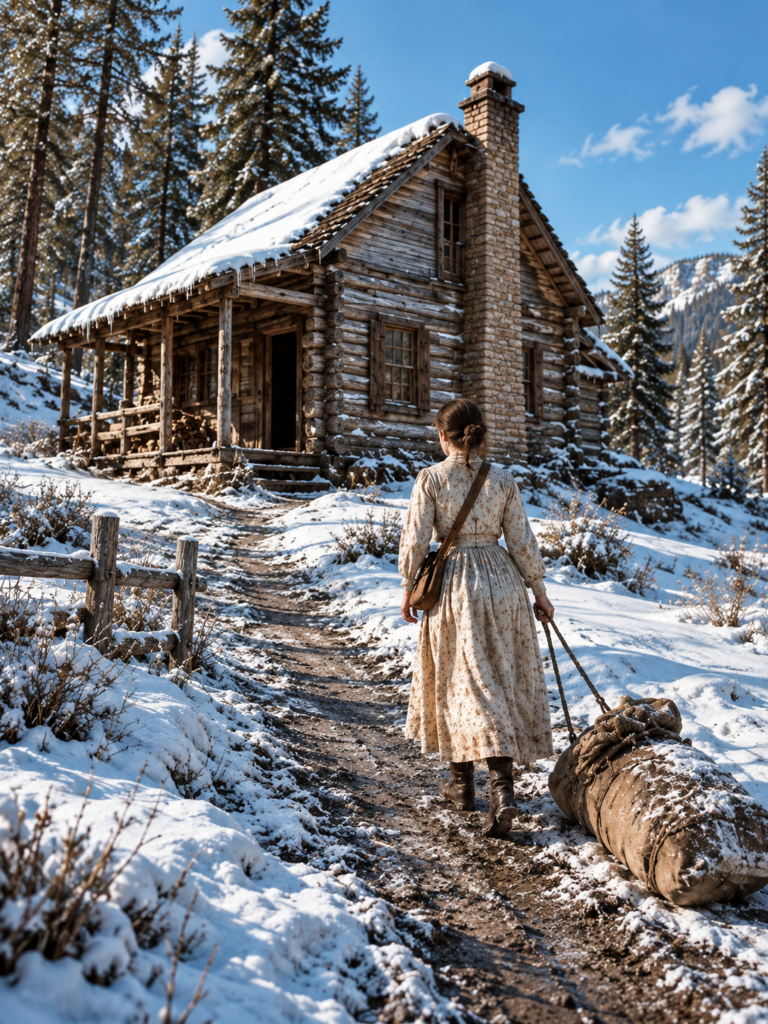
It stood half buried in drifting snow, its log walls dark with age and weather. One shutter hung crooked beside a narrow window. A fieldstone chimney rose above the roof, its upper stones barely visible beneath a heavy cap of snow.
There was no smoke, no light, and no sign that anyone had lived there for years.
Mary did not care.
Even a ruined cabin would be better than the open mountainside.
She struggled toward the front door, dropped to her knees, and began scraping snow away with her hands.
The drifts were packed tightly against the entrance. Her fingers were so cold that she could hardly feel the wood beneath them.
She cleared enough space to reach the latch.
The door would not move.
She pulled again.
Nothing.
The wood had swollen in its frame, and ice sealed the edges.
For several terrible seconds, she fought it with all the strength she had left.
Then she stepped back, breathing hard.
She could not afford to waste the last of her energy on a door that would not open.
She made her way around the wall, using the logs for support, until she reached the window with the broken shutter.
The opening was narrow, but part of the fastening had rotted away.
Mary pushed the shutter aside.
Inside was darkness.
She gripped the sill, hauled herself upward, and forced one shoulder through. Her coat snagged on a splinter, and she twisted painfully to free it.
Then she tumbled onto the cabin floor, bringing a shower of snow after her.
For several moments, she lay motionless.
The wind still roared beyond the walls, but its full force no longer struck her.
That small difference felt miraculous.
She was sheltered.
Now she needed heat.
Mary rose unsteadily and explored the room with outstretched hands.
The cabin was scarcely twelve feet square. Against one wall stood a crude wooden table. There was a broken chair, a three-legged stool, and what remained of a narrow bunk.
Her hand eventually touched cold stone.
A fireplace.
She knelt in front of it, searching the hearth. Old ash and loose debris filled the firebox, but the chimney appeared to have an opening above.
There was no stack of firewood waiting nearby.
She would have to use what she could find.
Mary broke apart the stool, choosing the driest inner pieces for kindling. The chair was damaged already, and she managed to pry several narrow strips from it as well.
She prepared them carefully, making a small nest of splinters and dry material beneath the larger pieces.
Her grandfather had taught her how to start a fire without matches, but he had never promised that it would be easy.
She found a sharp-edged piece of quartz among the hearth stones and took the steel striker from her grandfather’s old kit.
Her hands trembled so violently that she almost dropped it.
She struck steel against stone.
A few sparks flashed and died.
She tried again.
Nothing caught.
The cold had made her movements clumsy. She paused to steady her hands, then tried to shield the tinder from the draft moving through the cabin.
She struck again and again, thinking of Thomas’s voice.
Patience, Mary. Work with what you have.
At last, one spark lodged in a piece of dry punk wood.
A tiny red glow appeared.
Mary bent low and breathed on it gently.
The ember brightened, faded, and brightened again.
She added the thinnest splinter she could find.
A small flame rose.
Mary held perfectly still, afraid that even her breathing might extinguish it.
Then the flame took hold.
She fed it more wood, gradually adding larger pieces until the hearth began filling with firelight.
An uneven orange glow spread across the cabin walls.
Mary stretched her hands toward the warmth.
Pain returned first, sharp and stinging, as feeling slowly crept back into her fingers.
She wanted nothing more than to wrap herself in her mother’s blanket and sleep beside the flames.
But now that she could see the fireplace, she noticed a problem.
The mortar between the hearth stones had crumbled. Several had shifted out of position, and one large flat stone at the base rocked when she touched it with her boot.
If the hearth gave way, burning wood could spill onto the floor.
The cabin had saved her from the storm. She would not risk burning it down.
Mary took a broken piece of chair wood and worked it beneath the edge of the loose stone.
She meant only to lift it, clear away the dirt, and settle it back into a safer position.
Instead, the stone rose more easily than she expected.
Beneath it was a dark rectangular space.
Mary leaned closer.
There was something inside.
She reached down and felt a cold, smooth surface coated in dust.
Metal.
She worked her fingers around the object and slowly lifted it into the firelight.
It was a small tin box, heavier than its size suggested, with a simple latch securing the lid.
For a moment, Mary could only stare.
Someone had hidden this box deliberately beneath the fireplace.
She set it on the floor and opened the latch with the tip of her knife.
The lid resisted before giving way with a faint metallic creak.
Inside lay a small bundle wrapped in oilskin.
Mary unfolded it.
Gold.
Twenty coins, each bearing the profile of an eagle, gleamed in the firelight.
She lifted one into her palm and felt its astonishing weight.
She had been turned out of her home with twelve dollars. Now, in a forgotten cabin in the mountains, she was holding more wealth than she had ever seen.
Beneath the coins was a beautiful hunting knife with a polished antler handle, its blade protected by a thin coating of grease.
Mary lifted it carefully. The handle rested comfortably in her hand, and its balance spoke of skilled workmanship.
Then she noticed something underneath the knife.
A folded sheet of yellowed paper.
She took it out and moved nearer to the fire, where the light was strongest.
Across the top, in a steady old-fashioned hand, someone had written:
To whoever finds this place.
Mary began to read.
Part 2
The letter had been folded for so many years that the creases had begun to turn brittle. Mary opened it carefully, smoothing the yellowed paper against her knee.
The handwriting belonged to someone accustomed to taking his time. Each letter was formed deliberately, with the same quiet care her grandfather had given to the joints of a fine piece of furniture.
The writer introduced himself as Silas Croft.
He had built the cabin in 1848, thirty-two years earlier, and had spent those years living among the mountains as a trapper and hunter.
Mary looked around the little room.
Thirty-two years.
The logs, the fireplace, the wooden table, and even the worn floorboards had once been new. Someone had chosen this place, cut the timber, fitted the walls, and made a life here.
She returned to the letter.
Silas wrote that he was an old man whose time was drawing short. His wife, Eleanor, had died of fever twenty years earlier. The following year, their daughter Rose had died as well.
Rose had been seven.
Mary stopped reading.
She glanced toward the weathered bunk against the wall, trying to imagine a little girl sleeping there while snow fell outside. Perhaps Rose had watched her father work at the table. Perhaps she had waited beside the fire for her mother to finish preparing supper.
The cabin had not always been empty.
It had once held an entire family.
Mary lowered her eyes to the page.
Silas explained that the gold coins had been intended for his daughter. He had saved a portion of what he earned each season, hoping that when Rose grew older, she would have enough money to begin her life with some measure of security.
He had wanted her to have choices.
After losing her, he had found no purpose for the money. He had no surviving family to inherit it, and he had no wish to leave it to bankers in town.
So he had hidden the coins beneath the hearth of the home he built.
Not for a named heir.
Not for a distant relative.
For whoever might one day need the shelter more than he did.
Silas explained that the knife had also been made for Rose. He had intended to teach her the ways of the woods when she was old enough. Its blade was good steel, he wrote, and he hoped whoever found it would keep it sharp.
Near the end of the letter, Mary found the words that affected her most.
I hope this cabin gives you shelter. And I hope this money gives you a choice. That is all a person can ask for.
The final line was simple.
May your fire burn bright.
Mary read the letter again.
Then a third time.
Outside, wind battered the logs and sent loose snow whispering through the gaps in the walls.
Inside, the fire burned steadily.
She thought of the man who had written those words while sitting somewhere in this same little room. He could not have known who would eventually find the box. He could not have known whether the next traveler would be wealthy or poor, young or old, kind or cruel.
He had simply decided that something he could no longer use might help someone else survive.
Mary rested the letter beside the gold.
Her grandfather had left her knowledge.
Her mother had left her a blanket and the memory of being loved.
And now a stranger, dead or departed for all she knew, had left her a chance to begin again.
For a long time, she sat without moving.
She had expected nothing from the world that day except cold and hunger. She had walked away from Pinewood believing that everything she possessed could be carried in one small bag.
Now she was sitting in a cabin that might have become her grave, holding a gift left by a father for the daughter he had lost.
The discovery felt too large to understand.
She picked up the antler-handled knife and examined it more closely.
The blade was sound. The handle was polished smooth where someone had shaped it with patient hands. It reminded her of the care Thomas Holt had taken when making something meant to last.
She could imagine Silas choosing the antler, fitting it, and testing the knife’s balance.
Not because Rose needed it immediately, but because he had expected her to grow up.
Mary swallowed.
Elias Vance had treated her eighteenth birthday as the end of an obligation. Silas Croft had saved money for years to prepare for a daughter’s future that never came.
The contrast was painful.
But it was not the pain Mary wanted to hold on to.
She carefully wrapped the coins again, folded the letter along its old creases, and returned everything to the tin box.
She set the box beside the hearth where she could see it.
The gold could buy tools, food, and perhaps enough supplies to repair the cabin.
The knife could serve her for years.
But neither would mean much if she froze before morning.
Mary turned back to the practical matters before her.
She used more of the broken furniture to feed the fire and made certain the loose hearthstone could not shift into the burning wood. She arranged the remaining pieces within reach, keeping the larger timber for when the fire began to weaken.
Her grandfather had taught her to use materials carefully, and there was no longer anyone to replenish what she wasted.
She moved her wet boots closer to the warmth and spread her mother’s blanket over her shoulders.
Her hands were sore from working in the cold. Several fingertips had cracked, and the skin on her knuckles looked red and swollen.
She warmed them gradually and rubbed them gently as feeling returned.
The pain was unpleasant, but she welcomed it.
It meant she was still alive.
Before lying down, Mary looked once more at the folded letter.
Silas had written it for someone he would never meet.
Yet the words had reached precisely the kind of person he hoped might find them.
Mary imagined what she would say to him if he were sitting across the hearth.
She would thank him for the roof first.
Then for the firewood his abandoned furniture had provided.
Then for the money.
And finally, perhaps, for something she had not realized she needed until she read his letter.
Permission to believe that her life could belong to her again.
She tucked the whetstone into her pocket, settled beneath the gray blanket, and lay close enough to the hearth to feel its warmth.
For the first time since her mother’s death, Mary slept without fearing what the next morning would demand of her.
The storm continued for two days.
When she woke, the wind still drove snow against the cabin. She fed the fire, ate sparingly from her bread and cheese, and studied the shelter in daylight that filtered weakly through the broken window.
The more she looked, the more clearly she saw what needed repairing.
The roof had gaps where old wooden shingles had split or fallen away. A corner of the room was damp from wind-driven snow. Cold air pushed between the logs wherever the chinking had crumbled.
The chimney needed attention, and the window could not survive another serious storm in its present condition.
The floor was uneven, but most of its planks remained sound.
The walls, despite years of neglect, were built from heavy timber that had weathered remarkably well.
Mary ran her hand over the joints, noticing the care with which Silas had fitted the logs.
He had known how to build.
The cabin had not failed because it was poorly made. It had simply been left without anyone to maintain it.
That was a problem she understood.
During the storm, she cleared away debris, sorted the usable pieces of broken furniture, and examined the door from inside. She found that ice and packed snow had forced it tightly into its frame.
Once the weather improved, she could free it.
She also inspected the fireplace again. The loose stone had been positioned with unusual care, leaving space for the box without disturbing the main foundation of the hearth.
Mary replaced it temporarily, keeping the tin box close.
She knew the gold was valuable. She did not know precisely what every coin would buy, and she did not intend to announce her discovery to anyone.
Her grandfather had never been wealthy, but he had taught her one principle about materials and money.
Use what is necessary. Save what remains. Never confuse having something with having permission to waste it.
By the second day, she had made a decision.
She would not continue toward Greenwater.
She would stay.
Not because the cabin was comfortable. It was anything but comfortable.
Not because the mountains were safe. She had already learned how quickly they could become deadly.
She would stay because the cabin offered what Pinewood had not: a place where her labor could matter.
If she repaired the roof, she would sleep beneath a sound roof.
If she sealed the walls, she would keep out the wind.
If she cut wood, she would have warmth.
The work would be hard, but the benefit of that work would belong to her.
When the storm finally passed, Mary stood outside the freed cabin door and stared at the transformed landscape.
The sky was a brilliant blue. Sunlight glittered across deep drifts, and the pine branches bowed beneath their burden of snow.
The air was cold enough to sting her lungs, but the wind had quieted.
She walked a short distance from the cabin and turned to study it from the clearing.
It was small and badly weathered, with a damaged roof and a chimney that leaned slightly at the top.
Yet the structure stood firm.
Smoke rose from its hearth.
Mary felt an unexpected swell of pride.
Yesterday, it had been a forgotten ruin.
Today, someone was living in it again.
She went back inside, lifted the hearthstone, and divided the coins.
Two she would take into Pinewood.
The remaining eighteen she wrapped securely and returned to the hiding place, along with Silas’s letter and the belongings she did not need to carry.
She kept the hunting knife close and made sure the fire was safe before leaving.
The walk back to Pinewood was difficult but no longer desperate.
Mary had a destination, enough daylight to travel carefully, and a clear purpose for every step.
When she reached town, her first stop was the general store.
This time, the person behind the counter was Martha Gable.
Martha was a widow with a stern face, practical manners, and observant eyes. She had managed the store through difficult seasons and knew the difference between someone buying supplies for amusement and someone preparing for serious work.
Mary placed one of the gold coins on the counter.
Martha looked down at it, then up at the young woman standing before her.
“That’s quite a coin.”
Mary kept her voice steady.
“I need some supplies.”
Martha did not ask where the gold had come from.
“What kind of supplies?”
“For repairing a cabin.”
Martha’s eyes moved over Mary’s worn coat, her damaged gloves, and the stubborn expression on her face.
“A cabin?”
“Up in the mountains. The roof leaks. The chimney needs work, and the window is broken.”
“Are you repairing it for someone?”
Mary hesitated.
“No. I’m living there.”
Martha studied her for a moment longer.
Then she reached for a pencil.
“Well, let’s see what you need.”
The conversation that followed was the first practical relief Mary had felt since leaving her stepfather’s house.
Martha listened while Mary described the repairs. They discussed the tools and materials she could obtain, and Mary chose each purchase with care.
She bought a new axe head with a sturdy hickory handle, a crosscut saw, and a froe for splitting wooden shingles.
She purchased a sack of nails, a small keg of black powder for clearing stumps when the need arose, and window glass carefully wrapped in canvas.
For food, she bought two fifty-pound sacks of flour, dried beans, salt pork, coffee, and a large brick of salt.
She also bought a simple Henry rifle and a box of cartridges.
The rifle was not something she regarded lightly.
The mountains contained food and timber, but they also held dangers. Living alone required preparation as well as courage.
Martha watched Mary review her purchases.
“That is a considerable amount of work for one person,” she remarked.
“I know.”
“Have you done much building?”
“My grandfather was a carpenter.”
“Is he helping you?”
Mary shook her head.
“He died when I was ten.”
Martha’s expression softened almost imperceptibly.
“I see.”
She did not ask any more questions.
Mary was grateful.
There were things she could explain when she understood them better herself. For now, she simply wanted to get her supplies home.
The load was far too heavy to carry.
At the livery stable, she found a young man willing to transport her purchases on a pack mule for twenty dollars.
He looked at the tools, the flour sacks, and the bundled window glass before turning to Mary.
“All of this is going up the mountain?”
“Yes.”
“To whose place?”
“Mine,” she answered.
He gave her a doubtful look.
“You’re living up there alone?”
Mary glanced at the mule.
“Can you haul it or not?”
The young man seemed to reconsider the wisdom of further questions.
“I can haul it.”
He did, following her back along the mountain trail.
When the cabin appeared among the trees, he stared at the battered roof and the smoke rising from the chimney.
“You plan on fixing that?”
“That’s why I bought the tools.”
He unloaded the supplies without further comment.
Mary paid him, thanked him, and watched him lead the mule away.
Then she stood in the clearing, surrounded by sacks, tools, and materials, and felt the size of what she had undertaken.
Buying supplies had been the easy part.
Now she had to turn them into a home.
She began with the roof.
A fallen cedar down the creek provided wood for new shakes. Mary studied the grain before splitting it, remembering Thomas’s instructions about allowing the wood to guide the tool.
Using the froe and mallet, she worked the cedar into thin, overlapping pieces.
The labor was slow.
Her first attempts were uneven. Some pieces split too thick; others broke along weak grain and had to be set aside for kindling.
She adjusted her technique and tried again.
By the end of the first day, she had produced a modest stack of usable shingles.
Her back ached, and her hands were blistered.
She slept deeply.
The next morning, she returned to work.
Mary repaired the roof in stages, replacing damaged shakes and securing new ones in overlapping courses so that water would run away from the joints.
She worked carefully whenever she had to climb, aware that a fall could leave her helpless.
She tested each foothold and refused to hurry simply because daylight was fading.
The new cedar smelled sharp and clean.
With every repaired section, the roof looked less like the covering of an abandoned shack and more like something built to last.
Once the worst leaks were addressed, she turned to the walls.
Clay from the creek bed, mixed with dried moss, helped fill the gaps where the old chinking had fallen away.
Mary pressed the mixture into the openings, smoothing it with her fingers and a simple wooden tool.
The work was repetitive, but she soon felt the difference.
The cold drafts that had wandered freely across the floor began to weaken.
At night, the warmth from the fire lasted longer.
She spent a week working on the upper chimney, resetting loose stones with fresh mortar and restoring the damaged portion so smoke could draw safely upward.
It was demanding work, and she approached it with particular caution.
She remembered the first night, when the hearth had seemed barely stable enough to hold a fire.
The chimney was too important to neglect.
At the end of each day, Mary cleaned her tools, checked the fire, and prepared a simple meal.
Sometimes she ate beans beside the hearth while studying the next repair.
Sometimes she was too tired to do anything except sit beneath her mother’s blanket and listen to the wind.
But the exhaustion was different from what she had known in Elias Vance’s house.
There, every chore had reminded her that she was unwanted.
Here, each finished task made her life a little more secure.
The first month passed in a steady rhythm of cutting, carrying, fitting, mending, and learning.
Her hands became rough and calloused. Her shoulders strengthened. She grew accustomed to rising early and measuring the day’s work against the weather.
Mary also began setting simple deadfalls and snares, using skills she had learned as a child.
She did not always succeed.
Some mornings, she returned with nothing.
Other mornings, the mountain rewarded her patience.
She learned where animals traveled and which sheltered areas held useful dry wood. She watched the direction of the wind and paid attention to the tracks left across the snow.
Slowly, the wilderness became less unfamiliar.
Then, one afternoon, she heard the sound of approaching pack animals.
Mary was working near the cabin when she saw a lanky man in his forties coming along the trail with a string of mules behind him.
His coat was weathered, his face deeply lined, and his manner suggested someone accustomed to spending long stretches alone.
He stopped when he saw her.
“Well, I’ll be.”
Mary stood beside her neatly stacked firewood and waited.
The stranger looked from the repaired roof to the cleared path and then to the smoke curling from the chimney.
“I saw smoke from down the trail,” he said. “Thought an old trapper had taken this place over.”
“It’s just me.”
“So I see.”
He removed his hat.
“Name’s Elias Vance. I trade furs through these mountains.”
Mary’s hand tightened around the tool she was holding.
Elias Vance.
For a brief instant, she heard her stepfather’s cold voice telling her that his duty was finished.
The stranger noticed her hesitation.
“Something wrong?”
Mary recovered herself.
“No. Your name just surprised me.”
He nodded, apparently satisfied with that explanation.
He was not the merchant who had cast her out. This Elias Vance was a traveling fur trader, a different man who happened to bear the same name.
His weathered hands, easy patience, and straightforward manner soon made the difference plain.
Mary offered him hot coffee.
He accepted.
They sat near the cabin and talked while the mules rested.
He asked about the roof, the chimney, and the traps she had begun setting. Mary showed him some of her work, and he examined it with the practiced eye of a man who knew the high country.
“You made these yourself?”
“Yes.”
He nodded.
“You have a good hand for it.”
Mary felt a small warmth of pride.
It was the first praise she had received from a stranger in a long time.
Before leaving, the trader offered to carry any furs she prepared to market and bring back supplies she needed from the larger towns below.
“Fair trade,” he said. “You do the work. I’ll see that it reaches buyers.”
Mary considered the offer.
She had learned to be cautious about promises, especially from men who spoke confidently about what they could provide.
But he did not press her, and he did not ask for anything she was unwilling to give.
“I’d appreciate that,” she said.
“Then we’ll see what can be arranged.”
He rose, settled his hat, and prepared his mules.
Before he rode away, he turned back toward the cabin.
“Silas Croft used to live in this country, years ago,” he remarked, looking toward the old structure. “Places like this don’t stay standing unless somebody built them right.”
Mary looked at the walls.
“Someone did.”
The trader nodded and continued down the trail.
She watched until the last mule disappeared among the pines.
Then she returned to her work.
For weeks, the cabin had been the only place in the world where she felt she belonged.
Now, for the first time, someone outside its walls had treated her not as an abandoned girl to be pitied, but as a person capable of doing something worthwhile.
It was a small change.
Mary would come to understand how much such small changes mattered.
Part 3
Martha Gable arrived on a clear afternoon, driving a sturdy buckboard wagon along the mountain trail.
Mary heard the wheels before she saw the wagon. She had been sorting wood beside the cabin and looked up as the horses emerged between the pines.
Martha sat upright on the bench, holding the reins with the confidence of someone who rarely trusted a job to another person when she could do it herself.
Two men accompanied her.
Mary put down the wood and walked forward.
“Mrs. Gable?”
Martha surveyed the clearing.
“Well. Elias wasn’t exaggerating.”
Mary glanced at the wagon.
“Elias?”
“The fur trader. He came through Pinewood and told me about a young woman rebuilding an old cabin in the mountains.”
Martha climbed down and approached the house.
She examined the repaired roof, the sealed walls, and the stacks of neatly cut firewood.
“You’ve been busy.”
“There’s still plenty to do.”
“There always is.”
Martha’s eyes moved toward the chimney, where smoke drifted into the afternoon sky.
“Are you still heating the place with that old fireplace?”
“Yes, ma’am.”
“Then I brought something you need.”
She motioned toward the wagon.
The two men pulled back a heavy canvas covering.
Beneath it sat a small cast-iron wood stove.
Mary stared at it.
The stove was compact, solidly made, and far more efficient than the open hearth she had been relying upon.
She looked at Martha.
“I can’t afford something like that.”
“Who said anything about selling it?”
Mary hesitated.
“Mrs. Gable—”
“A fireplace is good for heat,” Martha interrupted. “But a stove is for living. It’ll hold a fire through the night and give you steady warmth for cooking.”
Mary looked again at the stove.
She imagined waking without having to struggle to revive the dying embers. She imagined baking bread properly instead of making do with whatever she could manage beside the fireplace.
“I don’t know how to thank you.”
Martha adjusted her gloves.
“You could start by showing these men where you want it.”
Mary laughed.
It was a small sound, but it surprised her.
She could not remember the last time laughter had come so easily.
The men unloaded the stove and helped position it safely inside the cabin.
Martha supervised the work with brisk efficiency, making certain the stove was arranged for proper use and that Mary understood how to manage its heat.
When everything was finished, the cabin already seemed different.
The iron stove stood ready for its first fire, solid and reassuring against the rough log walls.
Mary touched its cool surface.
No one had asked Martha to bring it. No bargain had been struck, and no debt had been demanded.
The woman had simply recognized a need and chosen to help.
Later, they sat together with coffee while the men prepared the wagon for the return journey.
Martha looked around the room.
“You’ve done well here.”
Mary shook her head.
“There’s still the window. And I need to improve the furniture.”
“That wasn’t what I said.”
Mary looked at her.
Martha rested her cup on the table.
“I know what it is to have people look at you and decide what you cannot do.”
Mary remained quiet.
“When my husband died, plenty of people had opinions about whether a woman could run his store. Some offered advice. Some offered to buy it for less than it was worth.”
“What did you do?”
“Kept the store.”
Martha smiled faintly.
“And learned to ignore advice from people who had never done the work.”
Mary returned the smile.
She thought of the man who had dismissed her as a useless expense, then of the woman sitting across from her.
One had seen no value in her abilities.
The other had seen enough to make a difficult journey into the mountains carrying a heavy stove.
“I won’t forget this,” Mary said.
Martha stood and reached for her gloves.
“See that you don’t. And see that you use it.”
After the wagon disappeared down the trail, Mary stood in the doorway looking at the stove.
Then she turned toward the hearth.
She thought of Thomas Holt, of Silas Croft, and of Martha Gable.
Three people whose kindness had reached her in different ways.
One had taught her to work.
One had given her the means to begin again.
And one had reminded her that independence did not require refusing every helping hand.
The cabin was becoming more than the place where she had survived a storm.
It was beginning to feel like a home.
Not long afterward, another visitor came through the clearing.
He was an older man with broad shoulders, a weathered face, and hands twisted by years of labor.
His name was Jedediah Stone, a retired carpenter who lived on a small claim several miles down the valley.
He had heard about the young woman working alone at the old mountain cabin and had come to satisfy his curiosity.
Mary was struggling to fit the glass she had purchased into a new window frame.
She had measured the opening carefully and shaped the wood as well as she knew how, but the glass did not sit quite right. Each adjustment seemed to create another problem.
Jedediah watched for a moment.
“That pane giving you trouble?”
“A little.”
He stepped closer.
“Mind if I take a look?”
Mary handed him the tool.
Jedediah studied the frame, tested its fit, and examined the way she had prepared the edges.
Then he began showing her what needed to be changed.
His movements were economical and precise.
He explained how the glass should rest in the frame and how to apply putty so the finished window would shed moisture and resist the cold.
Mary watched every movement.
There was something familiar about the old man’s hands.
Not their shape, but their certainty.
Thomas Holt had worked the same way, measuring with his eyes before trusting his tools, never wasting a movement when a simpler one would do.
Jedediah handed the tool back to her.
“Your turn.”
Mary repeated what he had shown her.
He corrected the angle of her hand and pointed out a place where the putty needed smoothing.
She tried again.
This time, the pane settled neatly into position.
“There,” Jedediah said. “That’s more like it.”
Mary stepped back to inspect the work.
The glass sat straight, its edges properly sealed.
She smiled.
“My grandfather was a carpenter.”
“I thought someone must have taught you.”
“He taught me most of what I know.”
Jedediah examined the frame one last time.
“You’ve got your grandfather’s eye, from the sound of it. But you still need to learn the finish work.”
“I’d like that.”
“Then I suppose I’d better come back.”
He did.
Every few days, Jedediah appeared at the cabin carrying some small piece of advice or offering to show Mary a technique she had not yet mastered.
He never treated her as incapable.
When she made a mistake, he showed her why it had happened. When her work was sound, he said so. And when she wanted to try something herself, he let her.
Mary learned to make tighter joints, smoother surfaces, and more careful fittings.
She began understanding the difference between merely repairing something and finishing it well.
Sometimes their work continued in companionable silence.
At other times, Jedediah told stories about carpentry jobs from years before, about boards that twisted after being cut and houses whose owners demanded perfection while refusing to pay for proper materials.
Mary listened with interest.
His stories reminded her of evenings spent in Thomas’s workshop, when the day’s labor was nearly finished and there was time to talk without hurry.
One afternoon, Jedediah watched her carefully plane a rough board.
“Not bad,” he said.
Mary checked the surface with her palm.
“Grandfather always said you could feel the mistakes before you saw them.”
Jedediah nodded.
“Smart man.”
“He was.”
For a moment, grief passed between the words.
Then Mary returned to the board.
She no longer felt the need to hide every memory that made her sad.
The months passed.
The mountain slowly changed around the cabin.
Snow retreated from the lower slopes, uncovering dark earth and fallen branches. The creek swelled with meltwater, and fresh green shoots appeared where the clearing received the most sunlight.
Spring brought new work.
Mary cleared debris from around the cabin, repaired what the winter had damaged, and continued improving the structure.
She learned to plan tasks according to the weather and the supplies she had available.
When she made a mistake, she repaired it.
When something proved more difficult than expected, she studied it until she understood why.
The gold beneath the hearth remained a source of security, but Mary did not treat it as an excuse to stop working.
She understood something important about Silas Croft’s gift.
The coins could purchase useful things.
They could not cut firewood, keep the stove fed, mend the roof, or make the cabin warm.
They gave her choices, just as he had hoped.
What she did with those choices would determine the life she built.
As the weather improved, Mary became more confident moving through the surrounding woods.
She learned the paths deer favored, the places where birds gathered, and the sheltered areas where fallen timber remained dry.
She prepared furs with increasing care, knowing that good work earned a better return than careless work.
The traveling fur trader, Elias Vance, began visiting regularly.
He brought supplies and news from the towns below, then carried Mary’s prepared furs to market.
Their dealings remained straightforward.
He respected her work, and she respected the risks of his journeys.
Whenever Mary heard his name, she thought less often of the stepfather who had cast her out.
The name was no longer attached to only one memory.
That, too, felt like a small freedom.
Martha Gable continued sending occasional parcels from Pinewood.
Sometimes they contained books.
Sometimes there was a jar of preserves tucked among the practical supplies.
Mary placed the books on a shelf she had made herself, taking them down in the evenings after the work was finished.
The preserves felt like a luxury, something meant to be enjoyed rather than merely used to survive.
She saved them for quiet evenings when she wanted to sit beside the stove and remember that life could hold simple pleasures.
Jedediah helped her build a small, sturdy barn after she acquired two goats.
The barn was nothing elaborate, but it was sound, with careful joints and a roof made to withstand the weather.
As they worked, Mary noticed how much her hands had changed.
The girl who had left Elias Vance’s house with a woolen blanket and a purse of twelve dollars had once feared that she possessed nothing of value.
Now those same hands had repaired a roof, rebuilt a chimney, fitted a window, and helped raise a barn.
Her grandfather’s lessons had not disappeared when his workshop was sold.
They had lived in her all along.
By autumn, people in Pinewood were speaking about Mary Holt differently.
At first, the stories had concerned a poor young woman living alone in a ruined cabin.
Some had pitied her.
Others had doubted she could survive a full winter.
Now the stories concerned her work.
People spoke of her repaired roof, her carefully maintained home, and the furs she traded through the valley.
They no longer referred to her only as the girl in the mountains.
They called her Mary Holt.
To Mary, that mattered more than she would have expected.
Her name belonged to her father and grandfather. It carried memories of people who had loved her long before Elias Vance decided she was an inconvenience.
She had not needed to defeat her stepfather or force him to recognize his mistake.
She had simply continued living.
And with each month, the life she built became stronger than the judgment he had passed upon her.
When the snow returned, a full year had passed since Mary first stumbled upon the forgotten cabin.
The mountains looked much as they had on that terrible night.
Pine branches bent beneath fresh snow. The wind moved through the valley, and the sky sometimes turned the same heavy gray that had frightened her when she was lost.
But inside the cabin, everything had changed.
The iron stove radiated steady warmth.
The roof was sound, the walls sealed, and the window Jedediah had helped her fit framed a clear view of the snow-covered forest.
Fresh bread baked in the stove, filling the small room with a comforting smell.
Mary had prepared it herself from flour purchased with the means Silas had left behind.
She checked the bread, adjusted the fire, and settled into her chair.
Outside, snow continued to fall.
She watched it without fear.
The storm was no longer something she had to outrun.
She had a warm room, food in the cupboard, tools in their proper places, and enough experience to know what needed tending before morning.
On the hand-planed mantel above the old fireplace rested two objects.
The first was her grandfather’s whetstone.
Its gray surface had been worn into a gentle curve by years of sharpening blades. Mary had used it so often that its shape felt as familiar as her own palm.
The second was Silas Croft’s antler-handled hunting knife.
Its blade was clean and carefully maintained, sharpened with the very stone Thomas Holt had given her when she was eight.
Mary sometimes looked at the two objects together and thought about the men who had owned them.
Thomas had known her, loved her, and prepared her for a world he would not live to see.
Silas had never known her at all.
Yet both had provided something she needed.
One had given her the ability to make a living.
The other had given her somewhere to begin.
Mary reached for the whetstone and ran her thumb gently over its worn surface.
She remembered Thomas standing beside his workbench, showing her how to hold a blade.
A sharp tool is a safe tool, Mary.
She could almost hear his voice.
Then she looked at the hunting knife and remembered the words in Silas’s letter.
I hope this money gives you a choice.
Neither man had promised her an easy life.
Neither had offered to remove every obstacle from her path.
But each, in his own way, had trusted that she could build something worthwhile if given the chance.
Mary set the whetstone beside the knife and looked around the room.
The table had been repaired.
The wooden surfaces were clean and smooth.
A shelf held books from Martha. The stove burned steadily. Outside, the little barn stood secure beneath its covering of snow, sheltering the two goats that had become part of her daily life.
There were still things to improve.
There always would be.
But the cabin was no longer a derelict shelter she had entered while fighting for her life.
It was a home shaped by her own hands.
The thought brought back a memory of her first night there.
She remembered the darkness, the numbness in her fingers, and the terror of finding the door frozen shut.
She remembered crawling through the broken window, so exhausted she could barely stand.
She remembered kneeling before the fireplace and struggling desperately to coax one tiny spark into flame.
And then the loose stone.
The heavy tin box.
Twenty gold coins.
A knife intended for a little girl named Rose, who had never lived long enough to use it.
A father’s letter left for the unknown person who might someday need his shelter.
For years, that treasure had rested silently beneath the hearth, hidden from snow, wind, and passing travelers.
Mary wondered how many storms had struck the cabin while the box remained untouched.
How many winters had passed after Silas wrote his letter?
How many times had sunlight entered through the old window and fallen across the empty floor?
She could not know.
She knew only that on the night she had nowhere else to go, the cabin had still been standing.
And someone long gone had left a gift waiting inside it.
Mary rose and opened the stove door to check the fire.
The wood glowed red beneath a thin layer of ash.
She added another piece, closed the door, and listened to the steady crackle.
Her mother would have liked the cabin, she thought.
Not because it was grand or beautiful in the way Elias Vance had valued appearances, but because it was warm and carefully kept.
Thomas would have inspected the window joints and probably found something to correct.
Martha would have approved of the bread.
Jedediah would have tested the furniture with a practiced hand.
And Silas, if he could have seen the cabin now, might have recognized the home he had built so many years earlier.
Mary smiled to herself.
She had entered the mountains believing she had lost everything.
In truth, she had been carrying more than she knew.
Her grandfather’s skill.
Her mother’s love.
The determination that years of quiet hardship had taught her.
And enough courage to take one more step when the snow made every step seem impossible.
The gold had helped her purchase a beginning.
But it was her work, her patience, and the kindness of people who recognized her worth that had turned that beginning into a life.
Outside, the winter wind swept through the pines.
Mary pulled her mother’s gray blanket over her knees and settled beside the stove.
The same blanket had wrapped her shoulders on the day she left Elias Vance’s house.
It had shielded her from the wind as she walked through Pinewood, and it had covered her while she slept on the floor of an abandoned cabin.
Now it kept her comfortable in a home she had rebuilt herself.
For the first time in many years, Mary did not wonder where she would belong.
She already knew.
She looked once more at the whetstone and the knife resting side by side above the fireplace.
Then she turned back to the warmth of the room.
One year earlier, she had been eighteen, homeless, and carrying twelve dollars into a mountain storm.
She had set out looking for work and a place to sleep.
Instead, she had found a forgotten cabin, a stranger’s legacy, and the opportunity to build something no one could have handed to her fully formed.
A home.
A purpose.
A future she could call her own.
The snow continued falling beyond the window, covering the trail through the trees.
Mary Holt sat quietly beside the fire, listening to the mountain settle into evening.
There was bread cooling nearby, wood stacked for the night, and more work waiting for her in the morning.
She was content with that.
The world had once seemed determined to tell her she had no place in it.
But here, beneath the roof she had repaired, surrounded by the ordinary comforts she had earned, Mary had found an answer.
She had not merely survived.
She had made a life.
And whenever she remembered the twelve dollars Elias Vance had given her to disappear from his house, she could almost smile.
It was the best twelve dollars she had ever spent.


