
Part 1
The last horse into the ring at the Dry Creek sale barn looked like something nobody wanted to haul home.
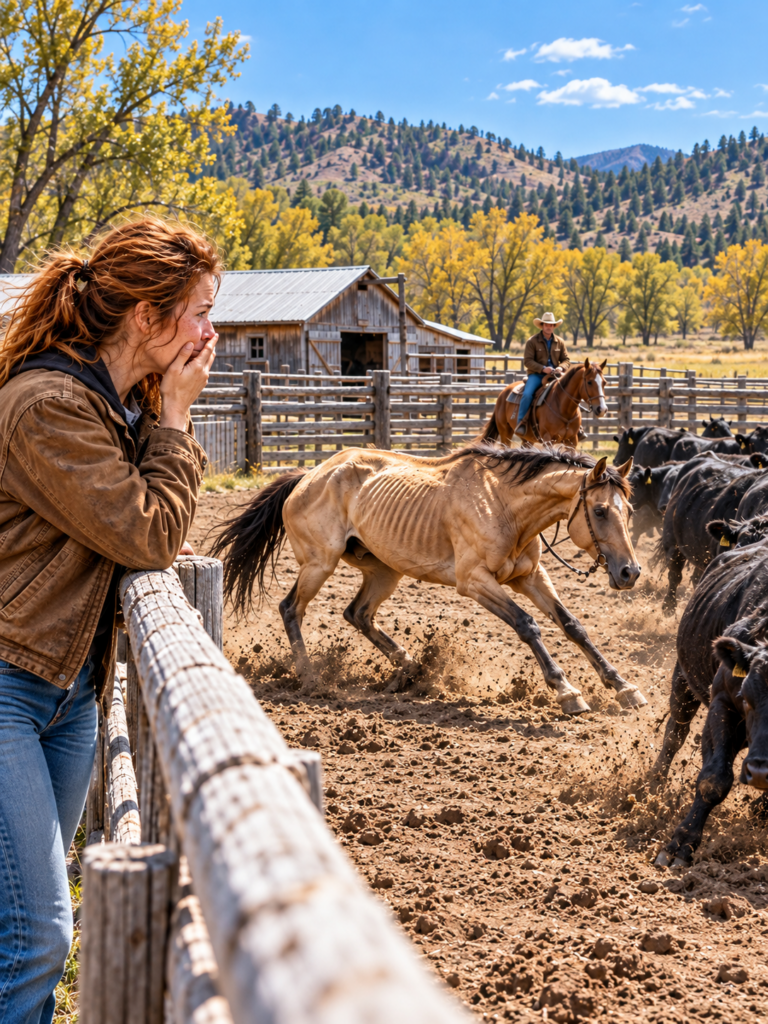
His ribs showed through a coat the color of old dust. His mane hung in hard knots. The points of his hips rose beneath his hide, and one hind foot dragged just enough through the packed dirt to leave a faint line behind him.
The auctioneer asked for five hundred dollars.
Nobody moved.
He dropped to three hundred.
Still nothing.
At one hundred fifty, laughter came down from the good seats.
Marin Holt sat near the back, one hand resting on the auction card in her lap.
She had not driven forty minutes into town to buy a horse. She had come for used ranch equipment: steel panels, a dented water tank, and a roping saddle she hoped would sell cheaply enough to justify the gas.
Cedar Hollow, the small ranch she had inherited from an aunt who had never once asked Marin to explain herself, survived on a budget thin enough that every purchase had to answer for itself.
Marin’s pickup was parked where the gravel lot turned to weeds. Around it stood newer trucks, polished trailers, and rigs worth more than nearly everything Marin owned.
Inside, the sale barn smelled of sawdust, diesel, manure, and spilled molasses feed.
The expensive seats belonged to men who had been sitting in them for years.
Beckett Vanelstein had one boot hooked over the rail. He owned Vanelstein Performance Horses, a breeding and training operation whose better colts sold for prices large enough to make the local paper.
Beside him sat Sterling Harrington of Harrington Cattle Company, a man who seemed to classify everything he encountered according to two questions: what did it cost, and where did it come from?
Between them, they had spent more money that morning than Cedar Hollow had earned in several years.
Marin had gotten her panels.
She had lost the saddle.
She stayed anyway.
The end of an auction interested her more than the beginning. That was when sellers brought in the animals they were tired of explaining.
By the time the buckskin gelding came through the gate, half the crowd had already left.
A tired handler pulled him forward.
The horse did not resist exactly. He simply moved as though every step required a decision.
Someone whistled.
The gelding’s hooves had grown long and flared at the toes. Nobody had shaped them properly in what looked like two seasons. The bad angles shortened his stride behind, particularly on the left.
To almost everyone watching, that was enough.
Old horse. Lame horse. Starved horse. Worthless horse.
Beckett leaned toward another man.
“A fellow would spend more feeding that one than burying him.”
The men around him laughed.
Marin watched the gelding.
She had been watching horses since she was nine years old, first from outside a neighbor’s arena and later from the backs of green colts people paid her almost nothing to ride.
She saw the same wreck everyone else saw.
But she also saw three things that did not belong in the wreck.
The first was that the horse was not afraid.
A badly starved animal in a metal building full of strange people, shouting, gates and movement should have been wound tight. His eyes should have searched for an exit.
This gelding simply stood.
He was exhausted. Marin could see that.
But exhaustion and fear were different things.
Underneath the weakness was a kind of stillness she recognized. It was not surrender. It was control.
Then the handler jerked the lead rope.
The gelding’s head snapped sideways.
A weak, unbalanced horse should have braced against the pull or stumbled.
This one shifted his weight underneath himself, found his balance, and followed the pressure.
Smoothly.
So smoothly that Marin replayed the movement in her mind.
That was not simple patience.
That was education.
The third thing happened when a sorting gate at the rear of the barn swung loose and slammed against a post.
The crack echoed through the building.
The gelding turned.
Not wildly.
He planted, rotated over his hindquarters, and faced the sound in one balanced movement. Then he breathed out and stood still again.
Marin straightened.
A horse that weak should not have been able to make that turn.
More important, an untrained horse would not have known how.
The auctioneer asked for one hundred fifty again.
No hands.
He dropped lower.
Marin lifted her card.
“Sixty.”
A few heads turned.
Nobody raised against her.
Sterling Harrington looked over and smiled.
“Congratulations,” he called. “Cheapest horse in Wyoming.”
More laughter.
The hammer came down.
Sold.
Marin paid in cash with three twenty-dollar bills she had meant to use for diesel.
The transfer paper told her almost nothing.
No registration.
No breeder.
No birth date.
No recorded name.
Someone had written only: buckskin gelding, grade.
When she found him tied in the alley, he turned his head slightly toward her and then let it fall again.
His eye was dull but gentle.
Marin laid a hand against his neck.
He was warm and shivering.
Loading took twenty minutes.
He never truly refused the trailer. He stood at the ramp, smelled it, looked into the darkness, and considered whether the floor would hold him.
Marin did not pull.
She waited.
Eventually, he stepped inside.
Just before she left, a man Marin did not know approached carrying a battered Western saddle.
“Came in with him.”
The leather was scarred, sweat-darkened, and poorly cared for.
Marin tossed it into the bed of her truck.
As she drove away, Beckett glanced toward the road.
“Give it two weeks,” he said.
Marin never heard him.
At Cedar Hollow, she backed the trailer toward the small paddock beside the barn.
The gelding remained inside until he had smelled the ramp, the boards, and the opening.
Again she waited.
Eventually he came out.
That evening Marin named him Dusty.
There was no grand reason.
He looked like something the weather had been working on for years.
She gave him water, a little grass hay, and a three-sided shelter. Then she sat on an overturned bucket twenty feet away and watched him eat.
He took small bites.
Not greedy ones.
Careful ones.
The kind an animal takes when experience has taught it that food appearing once does not mean it will still be there tomorrow.
Dr. Tessa Rowan came Monday morning.
She had been a veterinarian for nineteen years and had developed the level voice of someone accustomed to telling owners facts they would rather avoid.
After examining Dusty, she gave Marin the number first.
“Body condition two out of nine.”
Marin looked at the horse.
“How bad?”
“Bad enough.”
Dusty was severely underweight and mildly dehydrated. His topline had wasted until his spine stood out. His feet were long overdue. Old calluses lay across both sides of his withers, evidence that somebody had ridden him repeatedly under badly fitting tack.
But then Tessa flexed his joints.
She listened to his lungs.
She listened to his heart.
She ran both hands down his legs.
When she straightened, her expression had changed.
“Heart’s clean. Lungs are clear. Joints are quiet.”
She looked again at his legs.
“And there’s a good frame underneath all this.”
Some rescue horses, she explained, were suffering from problems feeding could never correct. Bad structure, destroyed joints, permanent injuries.
Dusty was different.
“This is a well-built horse somebody ran out of money or patience for.”
She pointed a finger at Marin.
“And don’t feed him up.”
Marin frowned.
Tessa explained refeeding carefully. A body deprived for that long could not simply be flooded with grain. Trying to put weight on him too quickly could kill him.
Small meals.
Grass hay.
Plenty of water.
Patience.
His hooves needed to be corrected gradually so his tendons could adjust.
“Ninety days,” Tessa said. “Then maybe you’ll know what you actually bought.”
So Marin waited.
She stopped trying to touch Dusty every time she entered the paddock.
Instead she brought in a folding stool.
She sat with her back partly turned and worked on ordinary things. She repaired a halter. Sorted snaps. Cleaned leather.
On the fourth day, Dusty came to stand six feet behind her.
On the sixth, she felt warm air at the back of her neck.
His nose touched her coat collar.
He breathed against her once, long and slow.
Marin did not turn around.
Two weeks after the auction, he had gained thirty-one pounds.
To anybody driving past, he still looked terrible.
To Marin, thirty-one pounds was evidence.
A neighbor slowed his flatbed near the driveway one afternoon.
“Still alive?”
Marin raised a hand.
“He is.”
The truck continued.
She watched it disappear and heard the sale-barn laughter again.
The whole county seemed to have already decided how Dusty’s story ended.
Then, during the fourth week, six cattle got through a weak place in the fence and wandered into Marin’s hay meadow.
She came running from the shop carrying wire.
The cattle were drifting toward the far gate. If they reached it, she would spend the rest of the day hunting them through forty acres of sagebrush.
Dusty stood in the adjoining paddock.
Marin saw his head come up.
For the first time since she had bought him, the exhausted rescue horse disappeared.
His ears fixed on the cattle.
He moved down the fence.
He did not charge.
He did not kick or squeal.
He simply matched their speed.
Then he edged ahead of the lead cow by exactly enough distance to change her line.
The cow turned.
Dusty stopped.
The cattle settled.
Marin froze in the middle of the yard.
She had seen horses get interested in cattle.
This was different.
Dusty had read the lead animal, chosen an angle, applied pressure, and removed it the instant he got the response he wanted.
Nobody had been on his back.
Nobody had asked him.
He had simply seen a job he knew.
Marin eventually gathered the cattle on foot.
It took more than an hour.
When she returned, Dusty stood at the gate breathing harder than he should have after such a small effort. His ribs still showed.
Marin walked up to him.
This time she placed her forehead against his face.
“Somebody taught you that,” she whispered.
Dusty stood quietly.
“Somebody spent a long time teaching you that.”
That night Marin remembered the battered saddle.
She pulled it down in the shop and turned it under the light.
The saddle was ordinary working tack, heavy and worn.
She checked the skirts, the jockeys, the rigging.
Then she turned over one fender.
Something had been stamped into the leather.
Someone had later tried to grind the mark away.
Marin tilted it toward the light.
She could just make out the surviving characters.
R.C./17.
She photographed them.
A ranch mark?
An inventory code?
A maker’s number?
She had no idea.
But she knew one thing.
People did not normally take sandpaper to harmless information.
By the fifth week, Dusty’s body began revealing what starvation had hidden.
His chest filled.
His neck took shape.
Muscle returned along his back.
The strange shortness in his left hind stride faded as his feet came gradually back toward proper angles.
The apparent lameness the sale crowd had mocked had not been true lameness at all.
It had been neglect.
Marin began doing simple groundwork in the round pen.
Walk.
Stop.
Turn.
Back.
She raised one hand to ask him to change directions.
Dusty turned before the hand reached her shoulder.
She tried something smaller.
A half step toward his hindquarter.
He moved it away exactly one stride.
Marin lowered her shoulder.
Dusty dropped from trot to walk.
She stared at him.
She was not really cueing him.
She was thinking about cueing him, and he was catching the beginning.
A few days later, Wade Kincaid brought a load of grass hay.
Wade was sixty-seven. He had trained horses professionally for more than three decades before his hips forced him out of the saddle.
Most people around Dry Creek now knew him as the man who delivered hay.
The older horsemen remembered more.
Wade had once taken an unknown ranch gelding to a major versatility event in Texas and beaten horses worth dozens of times more.
He had never made much of it afterward.
That afternoon he climbed from his truck, started loosening a strap, and stopped.
Dusty stood in the paddock.
He was doing nothing.
One hind foot rested lightly. His ears were loose.
Wade stared.
“What?”
Marin followed his gaze.
Wade did not answer immediately.
Then he asked, “Turn him loose in the round pen.”
Marin did.
Wade leaned against the rail.
He watched Dusty walk.
Trot.
Change direction.
Stop.
Less than a minute later, Wade looked at Marin.
“Somebody spent years making that horse.”
Marin’s stomach tightened.
“What are you seeing?”
Wade answered like a mechanic describing an engine.
Dusty changed leads behind without throwing his shoulder.
He stopped through his hindquarters instead of bracing on his front end.
He held the same distance from the rail.
When the barn cat crossed nearby, his ears followed it, but his feet never moved.
“Watching and reacting,” Wade said, “are two different jobs. Somebody taught him that.”
Marin looked through the rails.
“What is he?”
Wade stayed quiet.
Finally he said, “Before you decide what that horse is worth, you ought to find out where he came from.”
“Why?”
Wade looked toward Dusty again.
“Because a horse like that doesn’t usually end up at the bottom of a sale sheet with no papers unless somebody lost track of something expensive.”
He returned to unloading hay.
Marin stood beside the trailer, thinking of the letters somebody had tried to erase.
R.C./17.
Part 2
Tessa cleared Dusty for light riding during the seventh week.
Twenty minutes at a time.
Nothing strenuous.
Stop if he came out sore.
The first morning Marin saddled him with her own equipment instead of the old saddle that had arrived with him.
As she tightened the cinch, Dusty’s back went rigid.
He held his breath.
Marin stopped.
She waited.
Several seconds passed.
Dusty exhaled.
His neck lowered.
The tension drained away.
Marin understood.
He had expected the saddle to hurt.
When it did not, he quietly revised his expectations.
The first ride lasted eleven minutes.
Dusty walked down a two-track road and back. Nothing dramatic happened.
The next day Marin added a little trotting.
On the third ride, she followed a fence line.
A calf hidden in tall grass jumped up and bolted.
Marin felt Dusty gather himself before she had fully registered what had happened.
The horse did not spook away from the calf.
He moved toward the place the calf was going to be.
Then he sat back, stopped, and waited.
Finally he glanced over his shoulder toward Marin.
What do you want?
Marin sat with the reins loose.
She had ridden perhaps two hundred horses in her life.
Some had been good.
Several had been very good.
She had never ridden one that seemed to arrive at the answer before she had finished asking the question.
Dusty was not exceptionally fast in the usual sense. A running-bred colt would have beaten him easily over a quarter mile.
His advantage came earlier.
He read situations.
He committed.
A rider’s job was mostly to stay out of his way unless he guessed wrong.
Dusty rarely guessed wrong.
Eight days later, Beckett Vanelstein drove past Cedar Hollow.
He was returning from a bull sale in Riverton and was not taking his usual route.
He slowed because Marin was working a horse in the round pen beside the road.
Horsemen did that automatically.
They noticed movement.
Then Beckett stopped his truck.
Marin turned Dusty across the center of the pen.
The gelding changed direction, dropped his hindquarters, and came back balanced.
Beckett watched.
He had lived in the same valley as Marin for nine years without speaking more than a few dozen words to her.
That afternoon he walked to her fence.
“Twenty-five hundred.”
Marin looked at him.
“For what?”
“The buckskin.”
Dusty stood behind her.
Beckett smiled.
“Cash. I’ll send a trailer.”
“No.”
“You want to think about it?”
“I just did.”
Beckett continued smiling, but Marin noticed that only his mouth was involved.
He returned to the truck.
As he drove away, she saw him look at Dusty in his mirrors.
Once.
Then again.
That bothered her more than the offer.
A man did not study a horse twice because he was trying to help a neighbor unload a rescue.
Beckett wanted Dusty.
And he wanted him before Marin understood why.
By the third month, the horse that had entered the Dry Creek sale barn was nearly gone.
Dusty had gained more than four hundred pounds.
His real color appeared beneath the dead coat: deep buckskin gold, black mane, dark points, and a clean dorsal stripe.
His body had become what Tessa predicted—a square, correct, useful ranch gelding.
But his training remained the strange part.
In October, a ranch three miles east lost a hired man to a broken wrist two days before a four-hundred-pair cattle gather.
Marin volunteered to help.
She took Dusty because he was the horse she had.
Nine riders showed up.
Three had been at the sale in July.
They noticed Dusty before the first hour ended.
He held position on the outside wing of the herd without constant correction.
When the cattle slowed, he shortened.
When they stretched out, he lengthened.
He kept his place as if somebody had drawn a line under him.
Late that afternoon, a dry cow broke hard toward a low place in the fence.
She had thirty yards on the nearest rider.
Marin started to turn.
Dusty was already moving.
He did not chase from behind.
He cut across the angle toward the opening.
He reached the gap first.
Then he stopped in it.
The cow saw him, checked herself, and turned back toward the herd.
Dusty returned to his position.
Six seconds, perhaps.
No rope.
No shouting.
No drama.
But every experienced horseman on that hillside saw what had happened.
And for several moments nobody said anything.
The offers began afterward.
Sterling Harrington arrived one Sunday in a truck whose price probably exceeded several buildings at Cedar Hollow combined.
He was friendly.
He watched Dusty for about a minute and a half.
“Eight thousand.”
“No, thank you.”
“Twelve.”
Marin looked at him.
He had jumped four thousand dollars before she had even finished refusing the first offer.
That told her more than the number.
He was no longer bargaining over the horse in front of him.
He was bargaining over something he believed he knew.
“No.”
Sterling’s expression tightened.
“You paid sixty dollars for him.”
Marin rested both arms on the top fence rail.
“Then you should’ve raised your hand.”
Sterling looked at her.
For once, no answer came.
He left.
Then things became strange.
On Tuesday, a truck from Casper pulled into Cedar Hollow.
The driver had come two and a half hours to see Dusty.
Wednesday brought two more visitors.
By Friday afternoon, four vehicles were lined up near Marin’s fence. A woman in a wool vest photographed Dusty with a professional camera.
Fifteen thousand.
Twenty-two thousand.
Then a man from Nebraska offered thirty thousand dollars.
Marin sat on her porch that night with a notebook.
Dusty was a fine ranch horse.
A very fine ranch horse.
She could imagine twelve thousand.
Fifteen.
Perhaps twenty on exactly the right day.
But nobody drove across a state line carrying thirty thousand dollars for an unknown grade gelding with no papers, no recorded pedigree, no competition record, and no history.
They knew something.
Every one of them knew more about her horse than she did.
She called Wade.
The next morning he came out.
Marin showed him the photograph of the worn stamp.
R.C./17.
Then she showed him another detail she had recently uncovered beneath the longer hair under Dusty’s jaw.
A thin white scar.
Roughly two inches long.
Wade studied it.
Then he asked again, “What did that saddle say?”
“R.C. slash seventeen.”
Wade sat down on his tailgate.
For a moment he looked older.
“There was a place south of Lander,” he said. “Red Canyon Stock Horses.”
Marin said nothing.
“Never a big operation. Thirty head, maybe. Six or seven foals a year.”
Wade remembered the horses because professionals remembered Red Canyon horses.
The ranch had never advertised heavily. It did not need to.
The woman who ran it bred for mind first, bone second, and then spent years putting a foundation on every horse before it left.
People who needed dependable working horses quietly paid attention.
“They marked their tack R.C.,” Wade said. “And the year.”
Marin looked at the photograph on her phone.
“Seventeen.”
“If that’s Red Canyon tack, it means 2017.”
Wade returned home and came back after dark carrying an old cardboard box.
Inside were sale catalogs accumulated across decades.
They searched them at Marin’s kitchen table.
Near the bottom of a thin catalog from autumn 2019, they found six Red Canyon prospects.
The fourth entry showed a buckskin gelding foaled in May 2017.
The photograph was small.
The printing was poor.
But the young horse had the same dark dorsal stripe.
And beneath the left side of the jaw appeared a small white mark.
Marin leaned closer.
The catalog identified him as:
Red Canyon Drift Line.
His dam was described as the best cow mare the ranch had ever raised.
Wade looked at Marin.
She shook her head.
“It isn’t proof.”
He nodded.
“No.”
“A saddle and a picture aren’t proof.”
“No.”
But it was enough to begin looking.
Marin spent the next eleven days doing exactly that.
Red Canyon Stock Horses had closed in 2022.
The woman who had operated the ranch, Eleanor Brandt, had moved to Idaho to live near her daughter after a serious fall and a brutal winter made staying alone impractical.
Marin eventually obtained a phone number through a feed store that had once carried the Red Canyon account.
She called.
An older woman answered.
Marin introduced herself and described the gelding.
There was a long silence on the other end.
Then Eleanor asked a question Marin had not expected.
“When he backs, does he lean just a little left?”
Marin sat straighter.
“Yes.”
Another pause.
“Does he ever put his nose on the back of your collar and breathe?”
Marin closed her eyes.
“Yes.”
Eleanor did not immediately celebrate.
She did not call Drift Line a lost champion or a priceless treasure.
She told Marin something less glamorous.
Red Canyon had failed.
Drought had damaged the ranch.
Hay prices had hurt worse.
Loans remained due whether grass grew or not.
By 2021, the bank was calling.
Eleanor sold nine horses in one month because she needed cash.
Drift Line went to a buyer in Colorado who intended to put him into versatility competition.
It never happened.
That man later needed money and sold him.
The next buyer sold him again.
At some point during the third or fourth transaction, his registration papers stopped traveling with him.
Without papers, his identity became memory.
Then memory disappeared too.
A low-end dealer eventually acquired him in Nebraska for a few hundred dollars.
The horse worked on a feedlot crew.
Hard.
His feet stopped being maintained.
His condition slipped.
Finally he was hauled to Dry Creek and placed at the bottom of a sale sheet where nobody knew his name.
Marin ended the call and sat quietly.
For nearly three months people had spoken as though she had performed some miracle.
She had not.
She had not created Dusty’s ability.
She had not transformed an ordinary horse into an extraordinary one.
She had fed him correctly.
Trimmed his feet gradually.
Given him rest.
Stopped asking when he told her he needed time.
The sixty-thousand-dollar horse had already been inside the sixty-dollar horse.
Nobody at Dry Creek had seen him because they had mistaken his condition for his identity.
That Sunday morning Marin was breaking ice from a water tank when another piece came together.
Beckett.
She called Eleanor again.
This time the older woman remembered him immediately.
Beckett Vanelstein had visited Red Canyon in 2020.
Twice.
He had tried to buy the three-year-old buckskin.
He offered serious money.
Eleanor refused him both times.
Partly because she was not ready to sell.
Partly because she disliked how he handled the colt in the pen.
Marin stood beside the frozen tank after the call ended.
At the Dry Creek auction Beckett had looked straight at Drift Line and failed to recognize him.
Four hundred missing pounds, neglected feet, dead coat, and exhaustion had hidden the horse from a man who once wanted him badly.
But months later, when Beckett happened to drive past Cedar Hollow and saw a healthy buckskin changing direction in a round pen, recognition had started somewhere below certainty.
That explained the twenty-five-hundred-dollar offer.
He had not known yet.
He had suspected.
He had hoped Marin still thought she owned nothing more than a fortunate rescue and would be delighted to make forty times her money.
When Marin refused, Beckett began making calls.
Calls became rumors.
Rumors became questions.
And wealthy buyers began appearing outside Cedar Hollow.
The trucks were not evidence of some mysterious market suddenly discovering Dusty.
They were the wake left behind by one man trying quietly to confirm the identity of a horse he had failed to recognize.
Part 3
Beckett returned on the first Saturday in November.
This time he did not prop himself against the fence.
He came to the gate wearing a clean coat and holding his hat.
He made no jokes.
“I know what you’ve got.”
Marin waited.
“Red Canyon Drift Line.”
Dusty stood farther down the paddock, nosing through hay.
Beckett looked at him.
“I tried to buy him as a three-year-old.”
“I know.”
That surprised him.
His eyes returned to Marin.
“Eleanor tell you?”
Marin did not answer.
Beckett nodded once.
Then he made the offer.
“Forty-five thousand.”
It was enough money to change Cedar Hollow.
That evening Sterling called.
“Fifty.”
Two days later, a performance outfit from Sheridan contacted Marin after independently confirming the horse’s identity through Eleanor and seeing a video recorded at the October cattle gather.
Their offer was sixty thousand dollars.
They would send transportation whenever Marin chose.
Marin wrote the number on the back of a feed receipt.
$60,000.
She laid it on her kitchen table.
The difference between sixty dollars and sixty thousand was almost absurd.
Sixty thousand would pay off the equipment loan.
The well pump was nearing the end of its life. She could replace it.
Two miles of fence needed rebuilding.
She could rebuild all of it.
There would still be enough left to give Cedar Hollow several winters of breathing room.
No midnight arithmetic.
No choosing which repair could survive another season.
No worrying about whether a broken transmission or a veterinary bill would erase the thin margin between continuing and quitting.
Beckett called again.
“That’s a thousand times what you paid.”
His voice carried the confidence of a man who believed arithmetic ended arguments.
And mathematically, he was right.
Marin stood at the kitchen window.
Dusty was in the paddock.
The November afternoon had turned gray.
The gelding stood with one hip cocked and his ears loose.
He had begun doing something in September.
When Marin left the ranch, he watched the road.
When her truck returned, he walked toward the gate before she reached it.
Not frantically.
He simply expected her.
“I’ll call you back,” Marin told Beckett.
She called him on Thursday.
“No.”
There was silence.
“What’s Sheridan paying?”
“It doesn’t matter.”
“It matters if I’m going to beat it.”
“I’m not asking you to.”
She called Sterling next.
No.
Then Sheridan.
No.
Then Nebraska.
No.
She did not make a speech to any of them.
Beckett pushed harder.
“What number changes your mind?”
Marin looked toward the paddock.
“The horse was worth sixty dollars when nobody wanted him.”
Beckett waited.
“He was worth keeping.”
Beckett did not understand.
He assumed she was negotiating.
For the next week he waited for a counteroffer.
None came.
At the end of November, three trucks arrived at Cedar Hollow on the same cold Saturday.
Months earlier, men like these had sat inside a warm sale barn and watched Marin spend sixty dollars on an animal they considered barely worth burying.
Now they stood on the far side of her fence in expensive coats with checkbooks.
“Are you sure?”
“Name a number.”
“What would change your mind?”
Marin could have reminded Sterling about the cheapest horse in Wyoming.
She could have repeated Beckett’s remark about burial costs.
The lines were available.
She chose not to use them.
“I appreciate you coming,” she said. “He’s not for sale.”
No one moved.
Marin rested a hand on the gate.
“I hope you all have a good winter.”
She latched it.
Then she walked toward the barn.
Dusty was on the other side of the fence.
He fell into step beside her.
He walked the whole distance while the three trucks remained parked behind them.
A moment later, one engine started.
Then another.
Then the third.
By the time Marin reached the barn, the road was empty.
What happened afterward surprised her more than the money.
People had heard the story.
A woman had paid sixty dollars for a starving horse at Dry Creek.
The horse turned out to be Red Canyon Drift Line.
Buyers offered tens of thousands.
She refused.
At first, the story brought curiosity.
Then it brought work.
The ranch where she had helped gather cattle hired her for fall shipping.
Another rancher asked her to look at a four-year-old gelding that refused to stand for mounting.
Marin found the problem was not stubbornness so much as expectation. The horse had learned that mounting meant being grabbed, tightened, and rushed.
She spent two afternoons breaking the sequence apart.
Stand.
Wait.
Weight in the stirrup.
Release.
Nothing bad happens.
Again.
The horse improved.
The owner told someone else.
By February, two outside horses were living at Cedar Hollow for training.
Marin had a waiting list, although she felt embarrassed using the phrase.
In March she accepted a job checking heifers during calving season.
The days were brutal.
She rode Dusty through most of them.
By the end of forty days, she had earned enough to rebuild the north fence.
Sometime that spring, Marin understood what the horse had actually given her.
He had not been a lottery ticket.
He had been a door.
People first came to Cedar Hollow because the story interested them.
The sixty-dollar horse.
The sixty-thousand-dollar offers.
The wealthy men at the fence.
But once they arrived, they watched Marin.
They saw how she handled horses.
She did not hurry them because a clock said she should.
She did not punish confusion.
She did not confuse fear with defiance.
She did not ask an animal for work its body was not ready to perform.
People noticed.
The same county that had looked at Dusty in July and decided it understood his value had also looked at Marin for years and made its own assumptions.
Old canvas coat.
High-mileage truck.
Small inherited ranch.
Not much money.
No famous name.
Nothing important happening there.
Dusty had not only exposed what they had missed in him.
He had forced them to look again at the woman holding his lead rope.
The symmetry arrived the following April.
Marin drove into the Dry Creek sale barn on a Saturday because she needed a stock tank and another set of panels.
She parked in almost the same place as before, where the gravel thinned into weeds.
Inside, she chose a bench near the back.
She was not buying a horse.
She told herself that clearly.
She was there for equipment.
At the end of the sale, the crowd thinned.
The auctioneer’s voice flattened with fatigue.
Then the rear gate opened.
A thin gray mare came through.
Her hips showed.
Her head hung low.
Somebody laughed.
Marin felt the sound before she fully heard it.
Flat.
Bright.
Metal walls throwing it back.
For an instant she was in July again.
Dusty’s ribs.
His bad feet.
Sterling’s voice.
Cheapest horse in Wyoming.
Marin’s hand moved toward her auction card.
Then she stopped.
She placed both hands beneath her thighs and watched.
Really watched.
Not because every neglected horse contained a valuable secret.
That was exactly the wrong lesson.
She watched the mare’s weight.
Her eyes.
Her response to the handler.
The way she moved when the gate clanged.
The longer Marin looked, the clearer the truth became.
This was not Dusty.
The mare favored a painful shoulder.
She was frightened.
She did not carry herself with the hidden balance Dusty had shown.
She did not read the room while conserving herself.
She was simply a tired horse in discomfort who needed help.
Possibly more help than Marin had available.
Marin waited.
The price dropped.
She calculated hay.
Space.
Time.
Veterinary work.
Then she lifted her card.
One hundred ten dollars.
Sold.
She bought the mare anyway.
But she did not buy her because she imagined another Red Canyon Drift Line hiding beneath the gray coat.
She bought her knowing exactly what she might be taking home.
There might be no secret history.
No wealthy buyer.
No forgotten pedigree.
No transformation into something valuable on paper.
The mare needed a safe place, and that season Marin had one.
That was enough.
Outside, evening light settled across the parking lot.
Dusty waited inside Marin’s secondhand trailer.
The buckskin gelding who had sold for sixty dollars.
The horse men had laughed at.
The horse whose registration papers disappeared while he passed from owner to owner.
The horse who worked a feedlot until his feet grew long and his body collapsed around his bones.
The horse Beckett Vanelstein once tried to buy as a young prospect, then failed to recognize when neglect disguised him.
The horse who had stood behind Marin’s fence while offers climbed from thousands to tens of thousands of dollars.
Dusty stood quietly as Marin brought the gray mare toward the trailer.
She hesitated at the ramp.
Marin gave her time.
The mare smelled the floor.
Looked into the dark.
Considered whether it would hold her.
Marin felt a small smile pull at one corner of her mouth.
She had been here before.
Eventually the mare stepped inside.
Dusty shifted over without being asked.
Marin secured the divider and closed the trailer.
Across the lot stood the same metal sale barn where, nine months earlier, a room full of experienced people had looked at a starving gelding and decided they knew everything important about him.
They had not been blind.
That was the uncomfortable part.
They had correctly seen his ribs.
His neglected hooves.
His short stride.
His terrible coat.
They had accurately measured the condition he was in that day.
Their mistake was believing his condition was his identity.
They had seen one chapter and assumed it was the whole book.
Marin had only looked a little longer.
Long enough to notice that an exhausted horse was not a frightened horse.
Long enough to see him yield correctly to pressure.
Long enough to watch him turn on his hindquarters when a gate slammed.
Those few seconds had cost her sixty dollars.
Three months later, men with vastly more money, better trucks, bigger ranches, and stronger reputations had stood outside her gate trying to buy back the opportunity they had laughed at.
Marin never sold Dusty.
She did not need to.
He earned his keep in ways no check could measure.
He carried her through calving.
He helped gather cattle.
He brought people to Cedar Hollow.
He gave her work, credibility, and something harder to quantify: proof that careful observation still mattered in a world that preferred quick judgment.
And Marin gave him something too.
Food brought slowly enough not to kill him.
Feet repaired slowly enough not to hurt him.
A saddle that fit.
A rider who listened.
Time.
Mostly time.
She climbed into her old pickup and pulled out of the Dry Creek lot.
The trailer followed behind.
No one laughed.
In the growing dusk, Marin turned toward Cedar Hollow with Dusty and the gray mare riding behind her.
One horse had turned out to possess a history nobody recognized.
The other might never possess anything similar.
That no longer mattered.
Marin understood the lesson now.
It was not that everything abandoned was secretly priceless.
It was not that every broken-looking animal concealed some extraordinary gift.
That kind of thinking could be as careless as dismissing them all.
The truth was narrower.
A horse in the worst season of its life could not tell you the whole story of what it had been.
Neither could a person.
Sometimes poverty looked like incompetence.
Sometimes exhaustion looked like weakness.
Sometimes neglect hid years of education.
Sometimes an animal valued at sixty dollars had once been carefully bred and trained by someone who knew exactly what she was doing.
And sometimes a woman in a worn canvas coat, standing at the back of an auction barn with only sixty dollars to risk, saw something people with far more money had stopped bothering to notice.
Marin did not save Dusty because she knew he was Red Canyon Drift Line.
She saved him before she knew.
That was the part that mattered.
By the time everyone else learned his name, the decision had already been made.


