
Part 1
At seventy-six, Monroe Hatcher believed he had already learned every ordinary way a man could lose something he loved.
He had buried his wife.
He had watched friends disappear one funeral at a time until the people who remembered him young had become fewer than the people who knew him only as an old man. He had sold the little fishing boat he once swore he would keep until he died because the insurance, storage, and repairs had stopped making sense. He had moved into a one-bedroom apartment on the south side of Atlanta where the walls were clean, the rent was manageable, and nothing in the place carried enough history to hurt him.
And somewhere during those years, without anyone ever saying it aloud, Monroe had become the relative people remembered around Christmas.
Then his older sister died.
Alma’s funeral was held beneath a low October sky outside Atlanta. A thin, cold rain tapped against black umbrellas while the preacher spoke about ninety-one years of faith, stubbornness, generosity, and quiet sacrifice.
Monroe stood near the back.
His dark suit was nearly twenty years old. The sleeves rode a little high above his wrists, and the polished shoes pinched his swollen feet. He had considered wearing something more comfortable. But Alma had believed a man ought to dress properly when saying goodbye.
So Monroe stood in the rain with both hands wrapped around the wooden handle of his umbrella and stared at the casket.
His sister was inside.
The last person alive who remembered him as a barefoot boy running through Georgia red clay.
The last person who still called him Monty.
The last person who had seen how lost he became after his wife died and had never made him feel weak for it.
Near the front stood Alma’s grandson, Bennett Crowe.
Bennett was forty-four, successful in a way that always seemed effortless from the outside. His charcoal coat looked expensive. His haircut was sharp. Even in the rain he carried himself like a man accustomed to walking into rooms where people already knew his name.
He delivered the eulogy.
It was beautiful.
Maybe too beautiful.
People wiped their eyes when Bennett spoke about Alma’s devotion to family. He remembered her kindness, her strength, the way she had held people together.
Monroe listened without expression.
He also remembered Bennett missing Alma’s eighty-ninth birthday.
Then her ninetieth.
He remembered that Bennett had visited only twice during the last year of her life.
Monroe had been there nearly every Sunday he could manage.
He had repaired the loose porch railing at her house, replaced smoke-detector batteries, changed lightbulbs she could no longer reach, and sat at her kitchen table while she declared that store-bought peach pie was an insult to peaches everywhere.
None of that sounded important enough for a funeral speech.
Maybe that was why Monroe said nothing.
Three days later, he sat in the office of Alma’s attorney with Bennett in the chair beside him.
The room smelled of old paper and coffee that had been left too long on a warming plate.
Monroe expected nothing.
He had never assumed Alma owed him anything.
The attorney adjusted his glasses and began reading.
Bennett received an Atlanta rental property.
Monroe lowered his eyes.
Of course.
The property was valuable. Bennett understood investments, contracts, tenants, taxes. It made sense.
Then the attorney paused.
“And to my brother, Monroe Hatcher, I leave my house and surrounding property outside Harperville, Georgia, together with all structures, furnishings, records, and contents remaining therein.”
Monroe looked up slowly.
Harperville.
He had not heard the name spoken aloud in decades.
Beside him, Bennett gave a short laugh.
“That old place?”
The attorney continued, but Monroe barely heard the words.
Something had opened in his memory.
A porch under heavy summer heat.
Alma calling him inside before dark.
A dining room.
A massive piece of furniture against one wall.
And a warning delivered with such seriousness that even after nearly seven decades, some part of him remembered the fear in her voice.
Never fool around with that wall, Monty.
Monroe felt cold despite the overheated office.
Until that moment, he had forgotten there was anything unusual about the wall at all.
For four days he tried not to think about Harperville.
He returned to his apartment, heated canned soup, watched television with the volume lower than necessary, and told himself the house was simply another problem.
An old property.
Probably termites.
Bad pipes.
A leaking roof.
Taxes he could not afford.
At his age a man was supposed to be reducing his responsibilities, not inheriting new ones.
But every night his eyes drifted toward the manila envelope from Alma’s attorney.
Finally, he opened it again.
Three keys.
The deed.
A hand-drawn map.
No long explanation.
No sentimental letter.
Only one sentence in Alma’s unmistakable handwriting beneath the map.
Go there before you decide what it’s worth.
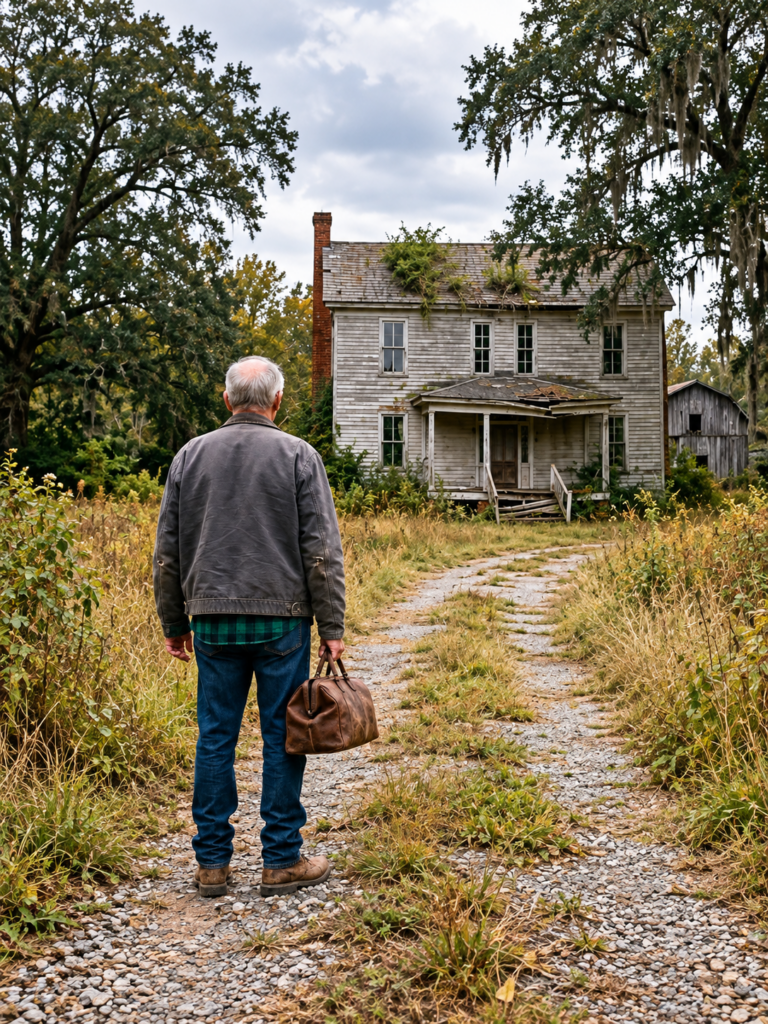
On Friday morning Monroe packed two shirts, work pants, his blood-pressure medication, and the battered leather tool bag he had carried for almost forty years.
Then he drove south.
The farther he went, the emptier the world became.
Shopping centers gave way to subdivisions. Subdivisions gave way to fields. Traffic lights disappeared. Pine woods pressed toward narrow county roads. Autumn had browned the grass, and wind pushed loose leaves across the pavement.
By late afternoon he reached Harperville.
The town looked smaller than memory.
The old gas station was boarded up. The church still stood, though its white paint had faded toward gray. A general store leaned slightly toward the road as though tired from too many years of standing.
People looked at Monroe’s truck when he passed.
Nobody waved.
That bothered him more than he expected.
The Hatcher house stood nearly three miles beyond town.
He almost missed the entrance.
Weeds had swallowed most of the gravel drive, and one side of the wooden gate lay collapsed into a ditch.
Monroe stopped the truck.
For a long time he stayed behind the wheel.
The house rose beneath enormous oak trees, two stories of weathered gray timber and neglect. Vines climbed toward the upper windows. One end of the porch sagged. Behind the house stood an old barn with part of the roof missing.
Monroe stared through the windshield.
“Well, Alma,” he murmured. “You sure left me something.”
The front-door key resisted him.
He worked it back and forth until the lock finally turned.
When he pushed the door open, cool air touched his face.
He had expected mildew.
Rot.
The wet smell of a building dying from the inside.
Instead he found stillness.
Furniture waited beneath white sheets. Framed family photographs lined the hallway. Against one wall stood a grandfather clock, its hands stopped at 2:17.
Monroe paused.
The number tugged at something in him, but the memory would not come.
He spent what daylight remained opening windows and checking the house.
Electricity reached only a few rooms.
The furnace coughed dust and produced no heat.
Water damage stained one upstairs ceiling.
Several porch boards would need replacing.
The plumbing was old.
The roof would eventually demand more money than Monroe wanted to imagine.
But the house did not feel dead.
That surprised him.
Near sunset he stepped into the dining room.
And stopped.
Against the far wall stood a massive walnut bookcase.
His chest tightened.
A memory struck with such force that he could almost smell summer rain.
He was eight years old again.
On his hands and knees beneath that same bookcase, reaching after a lost marble.
Alma—young then, barely more than a girl in his childhood memory—had seized his wrist.
Hard.
Harder than she had ever touched him.
“Monty, you never fool around with this wall. You understand me?”
He had laughed because children laughed when adults frightened them.
Alma had not.
That night Monroe slept on a sofa in the parlor beneath two old quilts.
At exactly 2:07 in the morning, his eyes opened.
Darkness filled the room.
For several seconds he did not know what had awakened him.
Then he heard it.
Click.
Monroe raised his head.
Silence.
He reached for the flashlight beside the sofa.
Click.
This time he knew where it had come from.
The dining room.
He crossed the hallway slowly, every floorboard announcing him.
The flashlight beam swept over the table, chairs, curtains, walls.
Nothing.
Then—
Click.
Behind the bookcase.
Monroe stood still.
His heartbeat felt strangely young in his chest.
He moved closer and placed his hand against the walnut frame.
Cold air slipped over his fingers.
A draft.
He pulled.
Nothing.
Pushed.
Nothing.
Then the flashlight beam caught a tiny reflection near the bottom shelf.
Brass.
Monroe lowered himself painfully onto one knee.
A latch.
So small a person could live in the house for decades without noticing it.
His fingers trembled when he touched the metal.
And for one brief moment, Alma’s warning returned as clearly as though she stood behind him.
Never fool around with this wall.
Monroe almost stopped.
Instead he pressed the latch.
Something deep inside the wall released with a heavy mechanical thud.
The bookcase shifted forward half an inch.
Cold, dry air breathed from the darkness behind it.
Monroe stared.
For the first time since Alma’s funeral, one thing became absolutely clear.
His sister had not left him a worthless old house.
She had left him a question.
And somehow, she had known he would be the one willing to ask it.
Monroe did not open the wall that night.
He told himself his knees hurt.
He told himself crawling into a hidden space after two in the morning when nobody knew where he was ranked somewhere between foolish and suicidal.
Both things were true.
But neither was the real reason.
The truth was that Monroe was afraid.
He returned to the sofa and remained awake until daylight.
By seven he had brewed coffee strong enough to taste like punishment.
Then he went back to the dining room.
The bookcase resisted.
Monroe wedged a pry bar under one corner, leaned his weight into it, and pushed until his shoulders burned.
Slowly, the enormous walnut structure swung outward.
A narrow doorway appeared behind it.
No trim.
No knob.
Only darkness.
Monroe lifted his flashlight.
Wooden steps descended beneath the house.
“All right, Alma,” he muttered. “You wanted me here.”
He went down.
Fourteen steps.
He counted every one.
At the bottom he expected dirt, cobwebs, maybe old jars and broken furniture.
Instead his flashlight found shelves.
Then more shelves.
Then books.
Hundreds of them.
Monroe stopped breathing.
The hidden room stretched beneath the dining room and part of the hallway. Leather-bound volumes filled one wall. Cloth-covered journals filled another. Medical texts were stacked beside boxes of letters tied with ribbon. Old photographs rested in carefully labeled containers.
There was almost no moisture.
No mold.
Someone had designed the space to survive.
A table stood in the center of the room.
On it sat an oil lamp, a pair of reading glasses, and a journal.
Monroe opened it.
The handwriting had faded brown.
September 18, 1894.
He read another page.
Names.
Births.
Illnesses.
Medicines.
Accounts of women traveling throughout the county to deliver babies when doctors would not come.
Another book held remedies.
Another contained correspondence.
Another photographs.
This was not a forgotten family library.
It was a record of people.
Of lives.
Monroe sat in the wooden chair and read for nearly two hours.
With each page, the ruined house above him changed.
It was no longer a burden Alma had handed an old man.
It was a vault.
A place built to remember.
Then he found the blue journal.
It was hidden behind medical books, wrapped in linen and tied with black cord.
The entries were mostly from the late 1950s.
Monroe recognized Alma’s handwriting immediately.
His throat tightened.
Several pages later, a photograph slipped into his lap.
Two figures stood on the porch.
Alma, young.
Beside her, a skinny boy in overalls.
Monroe.
He smiled.
Then he turned the photograph over.
Four words had been written on the back.
He still doesn’t remember.
Monroe’s smile disappeared.
Remember what?
He returned to the journal.
His own name appeared repeatedly.
Then he found an entry dated March 4, 1942.
Monroe froze.
He had not been born until 1948.
Yet there was his name.
Monroe Hatcher.
And beneath it:
When Monroe comes back, he must be shown what we protected.
He stared at the page.
“No.”
There had to be another Monroe.
An uncle.
A cousin.
Someone.
He stood so quickly that the chair fell backward.
His flashlight swept across the far wall.
On the final shelf sat a small wooden box.
Alone.
His name was carved into the lid.
Not written.
Carved.
MONROE.
His hands shook as he lifted the box.
Inside lay a brass key and a sealed envelope.
The paper was newer than everything around it.
Five words appeared in Alma’s handwriting.
For my brother, not Bennett.
Monroe stared at it.
Before he could break the seal, tires crunched over gravel outside.
His head snapped upward.
A car door slammed.
Then another sound.
Footsteps on the porch.
Monroe switched off the flashlight.
He stood in total darkness with Alma’s letter pressed against his chest.
Three hard knocks shook the front door.
Then a voice.
“Uncle Monroe?”
Monroe went cold.
Bennett.
And Monroe had told nobody he was coming to Harperville.
Part 2
Monroe climbed the fourteen steps as quickly as his knees allowed and pulled the bookcase back into place.
Bennett knocked again.
“Uncle Monroe?”
Monroe slipped Alma’s envelope inside his shirt pocket and opened the front door only a few inches.
Bennett stood on the porch in a dark wool coat.
Behind him, a polished SUV sat in the weeds looking absurdly expensive beside the collapsing fence.
Bennett smiled.
“Just checking on you.”
Monroe said nothing.
His nephew’s eyes moved past him.
Down the hallway.
Toward the dining room.
Only for a moment.
But Monroe saw it.
And something inside him tightened.
Bennett had not looked around like a man entering the house for the first time.
His attention had gone directly toward the wall Monroe had opened less than half an hour earlier.
“So,” Bennett said, almost casually. “Find anything interesting?”
Monroe felt Alma’s unopened letter against his chest.
For the first time in his life, he lied to his nephew without hesitation.
“Nothing but dust.”
Bennett stayed less than twenty minutes.
It felt much longer.
He walked through the front rooms commenting on cracked plaster, outdated wiring, warped floors, the leaking roof, the porch.
Every defect seemed to amuse him.
“You know what roofs cost now?”
“More than I’ve got.”
Bennett smiled.
“Exactly.”
Then he removed a folded document from his coat.
“I figured maybe we could save each other some trouble.”
Monroe did not take it.
“What is it?”
“An offer.”
Bennett laid the paper on the dining-room table.
Fourteen thousand five hundred dollars.
Cash.
For the house, barn, acreage, and everything on the property.
Two days earlier Monroe might have signed.
Fourteen thousand five hundred dollars mattered to him.
His savings had dropped below four thousand. His truck needed transmission work. A dentist had been warning him for two years that one of his molars was going to become an emergency if he kept ignoring it.
And the house?
The house needed everything.
Bennett leaned against the table.
“You could go back to Atlanta with money in your pocket and never worry about this place again.”
Monroe looked at him.
“Why do you want it?”
For the first time, Bennett’s smile weakened.
“I don’t.”
“Then why’d you drive all the way down here?”
A pause.
“Investment.”
Monroe nodded slowly.
He had spent most of his life repairing machinery—school buses, boilers, commercial lawn equipment, anything people brought him and insisted was “making some kind of funny noise.”
Machines could not speak.
But they told the truth.
A vibration.
A hesitation.
A sound where no sound belonged.
Bennett’s hesitation did not belong.
“I’ll think about it,” Monroe said.
“Don’t think too long.”
When Bennett’s SUV vanished down the road, Monroe locked the door.
He waited five minutes.
Then twenty.
Only when he was sure Bennett had not returned did he open the bookcase again.
The hidden library no longer frightened him.
It felt protected.
Monroe sat at the table, took Alma’s envelope from his pocket, and opened it.
Six handwritten pages.
The first line nearly broke him.
Dear Monty,
Nobody had called him that since Alma became too weak to speak.
Monroe removed his glasses, pressed his fingers against his eyes, then continued.
Alma wrote that the house had belonged to the Hatcher family for generations.
Women in their family had used it as a place of care, teaching, and refuge. They delivered babies. Treated illnesses. Taught children. Helped families passing through difficult years.
They kept records because many of the people they helped would never appear in official histories.
Then Alma wrote something Monroe had not expected.
I know you believe Bennett deserved the better inheritance.
Monroe stopped.
He kept reading.
I know you’ve spent most of your life believing other people were meant for bigger things than you. That was never how I saw you.
His vision blurred.
Monroe had carried that embarrassment for years.
He had not gone to college.
He had not built a company.
He had never owned a large house.
He had worked.
Repaired things.
Paid bills.
Loved his wife.
And after she died, some years getting through Christmas without falling apart had felt like achievement enough.
Bennett had degrees on office walls.
Monroe had calluses.
Alma continued.
Bennett sees value quickly, but mostly when there is a price attached to it.
You have always seen value in what other people throw away.
Monroe looked around the room.
At the cracked leather.
Faded ink.
Boxes no collector had catalogued.
Then he read the next line.
That’s why it had to be you.
Monroe covered his mouth.
He remembered Alma’s toaster, which she had refused to replace because he could always “make it behave.”
Their father’s old radio, repaired three separate times because she could not bear to throw it away.
Her porch railing.
A kitchen chair.
A broken clock.
Old things had always made sense to Monroe.
You did not discard something because it was old.
You figured out what was broken.
Then you decided whether it could still be saved.
Near the end, Alma explained the 1942 entry.
There had been another Monroe Hatcher.
Their grandfather’s younger brother.
He disappeared in 1943.
Monroe had been named after him.
The old journal was not prophecy.
It was an instruction.
If another Monroe Hatcher ever returned to the house, he was to be shown what the family had protected.
That answer relieved Monroe.
The final paragraph did not.
Bennett asked me about the archive three months before I died.
I never told him where it was.
If he comes looking, do not show him the room until you understand why he wants it.
Monroe read the lines three times.
So Bennett knew.
Not where.
Maybe not exactly what.
But enough.
Monroe examined the brass key from the wooden box.
Three letters were engraved along its edge.
B.R.
He searched among Alma’s papers until he found a rough floor plan.
A small rectangle had been drawn beneath the main level.
Beside it, Alma had written two words.
Behind hearth.
There was only one fireplace in the house.
Monroe climbed upstairs.
Late-afternoon light stretched through the parlor windows.
He knelt before the hearth and examined the bricks.
At first nothing seemed unusual.
Then he noticed one brick near the bottom.
No mortar.
He pulled.
The brick slid free.
Behind it was a keyhole.
Monroe stared at the key in his palm.
The house had already shown him one secret.
Apparently it had another.
He inserted the key.
Turned.
Somewhere behind the fireplace came a dull release.
A section of wood paneling shifted outward.
Behind it was a passage barely wide enough for a man to enter sideways.
Monroe shone his flashlight into the darkness.
“Alma,” he whispered, “how many secrets did you keep in this place?”
The passage sloped down.
At the bottom it opened into a small brick chamber.
No books.
No shelves.
Only a narrow cot, a rusted lantern, two tin cups, a folded wool blanket.
And beside one wall—
A child’s shoe.
Monroe stopped.
Tiny.
Brown leather.
Cracked with age.
One lace still threaded through the eyelets.
He bent but could not make himself touch it.
The room no longer felt like an old-house mystery.
Someone had lived here.
A child had stood where Monroe stood.
Maybe slept on the cot.
Maybe waited in darkness listening to footsteps above.
His flashlight passed over the brick wall.
Scratches.
Names.
Dozens.
Some followed by dates.
Others only initials.
Then one sentence, cut deeper than the rest.
We left before morning. God keep this house.
Monroe sat on the edge of the cot.
He stayed there a long time.
The next morning he drove into Harperville.
The town library occupied two rooms behind the old municipal building.
The woman at the desk wore silver braids and glasses on a chain.
Her name was Odessa Pike.
When Monroe introduced himself, she studied him.
“Hatcher?”
“Yes, ma’am.”
“From the old place on County Seventeen?”
Monroe nodded.
Odessa removed her glasses.
“My grandmother used to talk about that house.”
That sentence kept Monroe in the library nearly three hours.
Odessa showed him county maps, church ledgers, newspaper clippings, property records.
The Hatcher land appeared on maps going back generations.
But there were gaps.
Years missing.
People recorded in church books but nowhere else.
Women described as nurses who had never attended nursing school.
Teachers who had taught from kitchens or church basements.
Families who appeared briefly in Harperville, then vanished from the record.
Monroe told Odessa only part of what he had found.
Not the archive.
Not Alma’s full letter.
Not the hidden chamber.
But he showed her a photograph of one journal page.
Odessa studied it.
“Mr. Hatcher, you need somebody who knows how to handle documents like these.”
“I’m handling them fine.”
She nearly smiled.
“I mean professionally.”
Two days later Dr. Elias Varden arrived from a university in Atlanta.
He was sixty-two, soft-spoken, careful, and carried cotton gloves, magnifying lenses, and enough notebooks to make Monroe immediately suspicious of how complicated the situation might become.
Monroe led him behind the dining-room wall.
Elias descended the stairs.
On the final step, he stopped.
“My God.”
He stood there several seconds.
Then turned toward Monroe.
“How long has this been here?”
“Longer than either one of us.”
For five hours Elias examined only a fraction of the collection.
His excitement changed gradually into disbelief.
“These aren’t just family papers,” he finally said. “You have medical records. Community records. Correspondence. Firsthand material. Some of this may not exist anywhere else.”
Monroe leaned against the table.
“So what’s it worth?”
Elias looked at him.
“In dollars?”
“I don’t know another way people ask that question.”
Elias removed his gloves.
“Some individual pieces could probably bring serious money from collectors.”
Monroe waited.
“But I wouldn’t sell anything yet.”
“Why?”
“Because if what I think I’m seeing is real, breaking this collection apart would destroy the very thing that makes it extraordinary.”
Monroe looked at the shelves.
“What makes it extraordinary?”
“That it stayed together.”
Those words settled into Monroe.
That evening Elias left with permission to contact preservation specialists.
Monroe stood on the porch and watched his car disappear through the trees.
Then, for the first time, he allowed himself to imagine something beyond sale prices and repair bills.
Maybe the house did not have to be sold.
Maybe people could come here.
Learn here.
Maybe Alma’s stories—and the stories of all those names that had nearly vanished—could stay where they belonged.
Maybe Monroe could be useful again.
He walked toward his truck.
A white envelope had been tucked beneath the windshield wiper.
No name.
No stamp.
Inside was a copy of Bennett’s first offer.
$14,500 had been crossed out.
Below it:
$40,000. FINAL OFFER.
Monroe turned the page over.
You don’t understand what you’re sitting on.
He read the sentence twice.
Then looked toward the empty road.
For some reason, he did not feel afraid.
“Oh,” Monroe said softly, folding the paper. “I think I’m beginning to.”
Something changed in him after that.
Not dramatically.
At seventy-six, change did not arrive like lightning.
It came through decisions.
Monroe began waking before sunrise.
He cleared weeds from the front walk.
Replaced two rotten porch boards.
Repaired a broken window.
Scraped old paint from the railing.
His hands ached at night.
Some mornings his back refused to straighten until his second cup of coffee.
Still, he worked.
And gradually Harperville noticed.
Someone left seasoned firewood beside the porch.
A farmer named Clyde Mercer appeared with six eggs and refused payment.
Odessa arrived one Saturday carrying cornbread and preserves.
She took one look at Monroe and frowned.
“You’re getting skinny.”
“I’ve been skinny since 1963.”
“You were younger then.”
Monroe stared at her.
Then laughed.
It came so easily that the sound surprised him.
Elias returned twice that month.
On the second visit he brought a preservation specialist.
Their preliminary conclusion matched his first instinct.
The archive was extraordinary.
Not because every object was financially valuable.
Some were not.
But together the journals, letters, medical notes, photographs, and records formed something far more important than individual collectibles.
They told a connected story.
Generations of people who had barely survived in official records.
The hidden chamber raised even larger questions.
Elias believed it had once been used as a place of refuge.
For whom?
During what exact years?
They did not know.
Monroe preferred honesty.
“I don’t want guesses dressed up like facts.”
Elias nodded.
“Then we keep looking.”
“Exactly.”
For the first time in years, Monroe had something waiting for him tomorrow.
Then Bennett returned.
There was no smile this time.
He found Monroe sanding the porch railing.
“Forty thousand wasn’t enough.”
Monroe kept sanding.
“No.”
“Fifty.”
The sandpaper stopped.
Monroe looked down from the porch.
Bennett stood in polished shoes completely unsuited to the mud.
“Fifty thousand,” Bennett repeated. “You sign today.”
Monroe studied him.
“You told me this place was worthless.”
“I said it was a burden.”
“Funny how expensive my burden keeps getting.”
Bennett’s jaw tightened.
“This isn’t a game, Uncle Monroe.”
Monroe set the sandpaper aside.
“No. It isn’t.”
Bennett climbed the porch steps.
“I know about the records.”
There it was.
Monroe felt no surprise.
“How?”
“Grandma mentioned them years ago. Said there were old family papers somewhere out here.”
“That’s not what I asked.”
Bennett exhaled.
“I found correspondence in her apartment after she went into hospice. I spoke to a collector. He said some documents connected to the property could be valuable.”
Monroe understood.
Bennett had known before the will was read.
He had sat beside Monroe in the attorney’s office and laughed at the house while wondering what might be hidden inside it.
“You knew something might be here.”
Bennett did not answer.
That silence hurt more than Monroe expected.
He looked down at his hands.
Scarred knuckles.
Crooked finger from a school-boiler accident nearly thirty years earlier.
Old hands.
For most of his life, when people were richer, louder, or more educated than him, Monroe had stepped aside.
Peace always seemed easier than proving himself.
But something in him refused now.
“You should go.”
Bennett stared.
“You’re throwing away fifty thousand dollars over dusty books?”
“No.”
Monroe stood.
Slowly.
Painfully.
But upright.
“I’m turning down fifty thousand dollars because they aren’t yours.”
Bennett’s expression hardened.
“You don’t even know what you’re doing.”
Once, those words might have reached the part of Monroe that already believed them.
Now they did not.
“No,” he said. “But I’m learning.”
Bennett shook his head.
“You spent your whole life fixing other people’s broken things. Don’t turn this into some grand purpose just because you’re lonely.”
That landed.
For a moment Monroe said nothing.
Then he nodded.
“You’re right about one thing.”
Bennett waited.
“I was lonely.”
Monroe looked past him.
New lumber lay beside the fence.
Odessa’s preserve jars waited to be returned.
Tire tracks from Elias’s truck crossed the yard.
Clyde had promised to look at the barn roof.
Monroe picked up the sandpaper.
“But I’m not anymore.”
Bennett’s face shifted.
Barely.
“Drive safe,” Monroe said.
And went back to work.
Part 3
That evening Monroe sat beside the fireplace with Alma’s letter across his knees.
He thought of his wife.
His apartment in Atlanta.
The mornings after her death when waking up had felt less like a beginning than a sentence.
There had been days when he opened his eyes and felt disappointed that an entire day still waited to be endured.
He looked around the parlor.
The walls needed paint.
The furnace barely worked.
Rain still found one corner of the upstairs hallway.
The house had not become easy.
His life had not become easy.
But Monroe began to understand that ease had never been what he needed.
He needed to matter to something again.
He reached for a notebook.
On the first page he wrote:
HATCHER HOUSE PROJECT
Below it:
Repair roof.
Protect archive.
Document every name.
Find the truth about hidden chamber.
Open house someday.
Monroe studied the list.
Then added one final line.
Don’t let them be forgotten.
He leaned back.
Wind moved through the oak trees.
The fire settled into red embers.
And for the first time in years, Monroe smiled while thinking about the future.
At seventy-six, he had spent months believing the useful part of his life had ended.
Alma, apparently, had known better.
Sometimes purpose did not disappear when a person grew old.
Sometimes it waited.
Quietly.
In the dark.
By the following spring, no one drove past the Hatcher property without noticing the change.
The weeds were gone.
The porch stood straight again.
Fresh paint framed the windows.
The front door, once swollen gray from rain, had been sanded until the warm grain of the wood showed through.
Monroe refused to replace it.
“Still a good door,” he said whenever anyone suggested otherwise.
The phrase became something of a joke in Harperville.
According to Monroe, almost anything was still good if somebody cared enough to look closely.
The work had grown beyond him.
Clyde Mercer repaired the barn roof with two men from church.
Odessa organized volunteers to clear the grounds.
Elias helped secure preservation funding so the archive could be stabilized without removing it from the property.
That mattered deeply to Monroe.
Universities offered storage.
Private collectors inquired about individual pieces.
One collector mentioned a figure large enough to solve every financial problem Monroe had and leave plenty behind.
Monroe listened.
Then shook his head.
“These words waited here longer than I’ve been alive.”
Elias studied him.
Monroe continued.
“Seems wrong to make them leave now because somebody finally noticed them.”
So the archive stayed.
And Monroe stayed with it.
Research slowly revealed the Hatcher house’s larger history.
Women in the family had delivered babies.
Treated sickness.
Helped people who lacked money or transportation.
Taught children to read.
Preserved letters.
Recorded names.
Kept evidence of lives that otherwise might have disappeared.
The chamber behind the hearth had sheltered people as well.
Some details remained impossible to prove.
At first that frustrated Monroe.
He wanted names.
Dates.
Certainty.
Elias reminded him that history did not always survive intact.
Sometimes all that remained was a shoe.
A scratched sentence.
A photograph.
A name in a ledger.
A fragment did not become meaningless simply because the rest had been lost.
Monroe understood that.
Maybe because his own life, when he looked back on it, seemed built from fragments too.
Forty years of going to work.
A marriage.
A thousand small repairs.
Sunday visits with Alma.
His wife’s hand in his during her final night.
None of it would appear in history books.
No newspaper would record the morning he fixed a school bus before children missed their field trip.
Nobody would preserve the old toaster he repaired because Alma loved it.
There would be no plaque honoring the years he stayed married, paid bills, showed up, kept promises, buried people he loved, and continued getting out of bed afterward.
But perhaps a life did not need to be famous to be important.
The Hatcher House opened to its first visitors on a cool Saturday morning in April.
Monroe rejected the idea of a ribbon-cutting.
He wanted nothing grand.
Twelve folding chairs sat on the lawn.
Coffee steamed from a metal urn into paper cups.
Near the road Odessa placed a hand-painted sign.
HATCHER HOUSE OF MEMORY.
Monroe stood looking at it.
“You all right?” Odessa asked.
He nodded.
Then shook his head.
“Not exactly.”
Because something inside him was coming loose.
Something he had held shut since his wife died.
A small group of middle-school students arrived shortly before ten.
Monroe showed them the restored rooms.
He explained which boards were original.
Which windows had been repaired.
Why the old front door stayed.
Then he led them carefully into the archive.
Their voices dropped naturally when they entered.
Monroe understood.
The room did that to people.
He told them about Alma.
About generations of women who had written names because they feared nobody else would.
About how history often remembered governors, generals, landowners, businessmen.
But ordinary people had lived just as fully.
Loved just as deeply.
Suffered just as much.
And vanished more easily.
One boy lingered near a protected display holding the child’s shoe.
He could not have been older than thirteen.
“Mr. Hatcher?”
“Yes, son?”
“Do you know who wore it?”
Monroe looked at the little cracked shoe.
“No.”
The boy seemed disappointed.
Monroe considered his next words.
“That’s why we keep it.”
The boy looked up.
“Because we don’t know?”
“Because not knowing somebody’s name doesn’t mean they didn’t matter.”
The room went quiet.
Monroe felt Elias watching him.
He did not look back.
Later, after the visitors left, Monroe returned to the porch.
A black SUV stood near the gate.
His stomach tightened.
Bennett stepped from beside it.
He walked slowly up the driveway.
No contract.
No expensive confidence.
No smile designed to suggest he knew more than everyone else.
He stopped at the foot of the porch and looked at the restored house.
“I saw the article.”
Monroe nodded.
Bennett’s eyes moved over the new railing, painted windows, repaired roof.
“You really did it.”
“We did.”
Silence settled between them.
Bennett looked toward the porch floor.
“I was wrong.”
Monroe said nothing.
“I knew Alma had papers out here,” Bennett continued. “I thought if they were worth money, selling them was the sensible thing.”
Monroe waited.
Bennett swallowed.
“You laughed at me,” Monroe said.
Bennett closed his eyes briefly.
“I know.”
The apology did not erase that afternoon in the lawyer’s office.
It did not erase the first insulting offer.
Or the second.
Or the way Bennett had known just enough to manipulate him.
Bennett looked up.
“I’m sorry, Uncle Monroe.”
Monroe had lived long enough to understand something about apologies.
They were almost always smaller than the wounds they were meant to address.
That did not make them useless.
He nudged an empty porch chair with his foot.
“You want coffee?”
Bennett blinked.
“Yeah.”
Monroe nodded toward the house.
“Pot’s inside.”
They sat together while afternoon light crossed the yard.
They did not fix everything.
Monroe knew better than to pretend people could undo years with one conversation.
Some things had to be repaired the same way the house had been repaired.
One board at a time.
One honest piece at a time.
Bennett stayed until late afternoon.
For that day, Monroe decided it was enough.
Near sunset, after his nephew left, Monroe walked through the house alone.
The rooms glowed warm in the final light.
He entered the hidden archive.
Alma’s original letter now rested inside a protective sleeve.
Monroe removed it carefully.
His eyes found the sentence.
That’s why it had to be you.
He read it once.
Then again.
And Monroe Hatcher, who had survived losses by learning how not to cry in front of other people, sat down at the old wooden table and wept.
Quietly.
No one was there to hear him.
Tears moved through the deep lines in his face.
“I understand now, Alma,” he whispered.
For months Monroe had thought he was rescuing her house.
Saving her papers.
Protecting the names she had trusted him to keep.
But the truth was more complicated.
The house had saved something too.
It had given a widower somewhere to be needed.
It had given an old mechanic something he could still repair.
It had given a lonely man neighbors who noticed whether he had eaten.
It had given him mornings worth waking for.
At seventy-six, Monroe had arrived in Harperville believing his meaningful years were behind him.
The world had already told him what old age was supposed to look like.
Less work.
Less responsibility.
Less relevance.
Wait quietly.
Need little.
Take up as little trouble as possible.
But Alma had left him something no bank account could have given him.
Responsibility.
She had trusted him.
Not because he was wealthy.
Not because he had degrees.
Not because he knew how to impress preservation experts or negotiate with collectors.
She trusted him because Monroe understood broken things.
He understood that age and worth were not opposites.
That neglect did not mean uselessness.
That something could be cracked, faded, inconvenient, expensive to maintain—and still deserve saving.
The next morning Monroe woke before dawn.
He made coffee.
Walked outside.
Mist lay low across the fields.
The restored porch boards creaked beneath his boots.
Behind him the windows of the Hatcher house glowed with early light.
Inside rested Alma’s journals.
Photographs.
Letters.
Medical notes.
Lists of births.
Names nearly erased by time.
And beneath those floors waited a tiny worn shoe whose owner might never be known.
Monroe stood beneath the oak trees and listened to birds waking along the fence line.
Months earlier he had arrived here believing the house was the lesser inheritance.
Bennett had received property in Atlanta.
Something easy to value.
Something that produced rent.
Something any banker or appraiser could explain.
Monroe had received peeling paint.
Rotting boards.
Old papers.
A leaking roof.
Responsibility.
But now he knew.
The Hatcher house had never been the lesser inheritance.
It was the greater one.
Not because the documents could be sold for more money.
Not because collectors wanted them.
Not because universities suddenly cared.
But because Alma had left Monroe something that could not be protected by a man who saw only what could be extracted from it.
She had left him a trust.
A duty.
A reason.
As spring moved into summer, more people came.
Researchers.
Schoolchildren.
Families from Harperville.
People who had seen names in local records and wondered whether their grandparents or great-grandparents might appear somewhere in the archive.
Sometimes they did.
A woman from another county found her grandmother’s maiden name in a medical journal.
She cried over three handwritten lines describing a fever, a delivery, and a healthy baby girl.
A retired teacher recognized a family name from an old church ledger.
Another visitor stood for twenty minutes before a photograph without speaking.
Monroe learned something from each one.
Preservation was not about keeping paper alive.
Paper did not know it had survived.
Preservation was about giving the living a chance to meet the dead halfway.
To say:
You were here.
Someone wrote your name.
Someone remembered.
Sometimes Bennett came too.
Not often at first.
He never again mentioned selling the collection.
He helped Elias carry boxes one afternoon.
Another time he repaired a malfunctioning printer and endured Monroe’s observation that he had finally learned to fix something instead of selling it.
Bennett actually laughed.
The relationship did not become perfect.
Monroe did not need it to.
Perfect things had never interested him much.
What mattered was whether something damaged could still hold together.
One evening near the end of summer, Monroe sat on the porch with Odessa.
Cicadas sang from the trees.
The barn roof, newly repaired, caught the last orange light.
Odessa handed him a jar.
“Peach preserves.”
Monroe turned it over.
“Store-bought?”
Odessa looked offended.
He smiled.
“Alma would’ve approved.”
“You miss her.”
Every day, Monroe thought.
Instead he said, “Yeah.”
Odessa leaned back.
“She knew what she was doing.”
Monroe looked through the open doorway toward the dining room.
“Most of the time.”
“You think she knew this place would become all this?”
Monroe considered the volunteers.
Visitors.
Researchers.
Children asking questions.
The archive now properly protected but still exactly where generations of Hatchers had kept it.
“No,” he said eventually.
Odessa raised an eyebrow.
Monroe smiled.
“I think she just knew I’d stay long enough to find out what it could become.”
After Odessa left, Monroe remained on the porch.
A warm light burned inside the house.
The front door stood open.
He remembered arriving months earlier.
The weeds.
The collapsed gate.
The gray boards.
The fear of the hidden wall.
The certainty that his best years were finished.
What surprised him most was how ordinary the transformation had been.
There had been no miracle.
The roof still cost money.
His knees still hurt.
His blood pressure still required pills.
Some mornings grief returned without warning.
Being needed had not made him young again.
Purpose had not erased loss.
It had simply given loss somewhere to go.
Monroe rose and walked inside.
He passed the grandfather clock in the hallway.
Elias had repaired it months ago.
The hands now moved.
The steady ticking filled the house.
Monroe paused.
Once, the clock had been frozen at 2:17.
Now it continued.
He liked that.
Not because the past had vanished.
But because it had not stopped the future.
He entered the archive one final time before bed.
Shelves rose around him.
Alma’s letter rested safely among the records.
Monroe ran a hand lightly across the edge of the old wooden table.
“Still good,” he whispered.
He was talking about the table.
Maybe the house.
Maybe himself.
Outside, the oak branches moved in the warm Georgia night.
Inside, generations of forgotten voices remained where they had waited all those years.
And Monroe Hatcher understood at last that seventy-six had not been the age when his story ended.
It was the age when he finally discovered what his story had been asking him to protect.


