
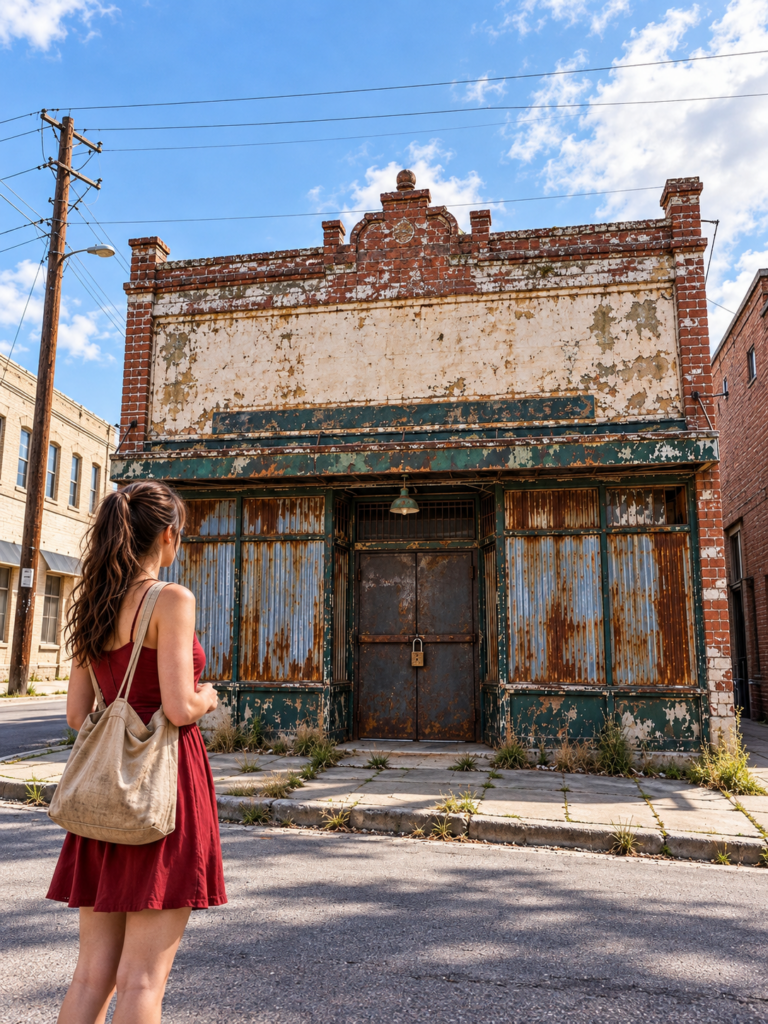
she spent her last nine dollars on a boarded-up pawn shop and the black ledger inside the vault proved her uncle was a murderer
Part 1
The linoleum in the Delaware County Courthouse had been scuffed pale by too many winters of wet boots. Camille Quals sat in the back row with thirty-four dollars and twelve cents in the pocket of her father’s old flannel and a plastic paddle she felt stupid holding. Outside, her 1998 Civic sat on a yellow line with the engine ticking as it cooled. The heater had quit two weeks ago. She had been sleeping in the back seat since the night her uncle’s lawyers finished emptying the house.
Two years earlier she had still been a sophomore. Her father, David, had driven her back to campus after Christmas and told her the only thing that mattered was finishing what she started. Three months later a neighbor called and said David had gone down in the kitchen between the coffee pot and the table. Heart. No warning. By the time Camille reached the house, Adrian was already there with two men in suits and a stack of papers she was not allowed to touch.
Adrian had always been the brother who left early and came back only when something needed signing. After the funeral he stood in the kitchen doorway in a silk tie and told her the estate was gone. Hidden loans. Corporate debt. A trust that somehow no longer bore her name. When she asked for enough to finish the semester he adjusted the knot at his throat and said, “Welcome to the real world, kid. Rent is due.”
She tried the bank. She tried two lawyers who took her retainer and then stopped returning calls. By fall she was parking behind a closed diner and washing her face in the restroom before the morning shift started. The waitress there had mentioned the tax auction one slow afternoon while wiping the counter. Nuisance parcels. Buildings the city wanted off the books so badly they would take nine dollars and wave the back taxes if someone would accept the demolition lien.
Camille had not gone to the auction for a house. She had gone because nine dollars was less than a week of peanut butter and the back seat of the Civic had started to smell like damp cardboard. When the auctioneer called 402 Elm Street the room made a low sound of dismissal. The Rossi place. Boarded since ’99. Roof gone. Black mold. Thirty thousand in demolition if you couldn’t clear it inside a year.
“Starting bid is nine dollars,” the auctioneer said. His voice was flat. “City waves the taxes if you take the deed today.”
No one raised a hand. Camille looked at her own fingers on the paddle. They were shaking from the cold that had settled into the building. She thought of her father standing in the driveway the last morning she saw him, coffee cup in one hand, telling her the car needed oil before she left. She raised the paddle.
The gavel came down. The auctioneer squinted toward the back row and said, “Sold to the young lady for nine dollars. God have mercy on your soul, sweetheart.”
An hour later she stood on the cracked sidewalk in a freezing drizzle that turned the industrial neighborhood the color of wet iron. The brick facade still carried the faded letters: Rossi’s Golden Pawn. Loans. Jewelry. Electronics. The steel shutters were rusted into the frames. The padlock on the reinforced door looked older than she was. The county clerk had given her a heavy iron key. She worked it into the lock until the tumblers gave with a metallic crack that echoed down the empty street.
Inside, the air was still and cold and thick with dust and old paper. Her cheap flashlight cut a narrow yellow path across smashed glass cases and moth-eaten coats. She closed the steel door behind her and slid the deadbolt. The highway noise vanished. For the first time in months the only sound was her own breathing.
She set her backpack on a counter and said, quietly, “I’m a homeowner.”
Part 2
For three days she worked by the weak beam of the flashlight and the gray light that leaked around the shutters. She hauled rotten shelving and broken televisions into a dumpster a construction crew had left across the alley. Her hands blistered. Dust coated the inside of her mouth. At night she slept on a flattened cardboard box behind the counter with her father’s flannel pulled over her shoulders and the deadbolt thrown. The Civic stayed parked in the loading bay where the weeds had grown through the cracked concrete.
On the fourth afternoon she found the guitar. It was inside a black plastic bag under a collapsed shelf in the inventory room, the case latches rusted but still closed. When she opened it the instrument inside was clean. She carried it two towns over to a music store where the owner looked at the serial number, then at her, then back at the guitar. He wrote a check for four thousand dollars and told her not to cash it at the same bank twice.
She bought a small generator, an electric heater, two floodlights, and a bag of hot food. That night she sat on a milk crate in the back office with the heater running and ate pizza while the rain hammered the roof. The blueprints she had found rolled in a desk drawer said the office was twenty feet deep. The room she had measured was fourteen. She stood and knocked along the paneled wall until the sound changed from solid to hollow.
The crowbar took the faux-wood paneling in long splintered strips. Behind it was cinder block, poorly mortared, with a sheet of plywood nailed across a gap in the center. She worked the plywood free in twenty minutes of wet, shaking labor. When it fell, the flashlight beam caught the edge of a massive matte-black steel door set into the original brick. A Mosler. Combination dial. Drop handle. The kind of door banks used when they still expected people to try to burn their way in.
She searched every drawer and coat pocket in the shop and found nothing that looked like a combination. She could not call the city. If they learned there was a vault in a condemned building they would seize it, and Adrian’s friends on the council would buy it for less than she had paid. She needed someone who would open a door and keep his mouth shut.
Henry Cobb’s name was on an old locksmith forum under a post about friction locks. He lived in a trailer park at the edge of the county, seventy-two years old, two packs a day, forty years as a bank vault technician before a divorce and a gambling debt put him out here. Camille drove the Civic through the mud and stood on the metal steps of his trailer with two thousand dollars in an envelope.
“I don’t do off-book work,” he said. His voice was rough from the cigarettes. “Especially not for kids.”
“I’m twenty,” she said. “And it’s my property. I have the deed. Mosler from the twenties. Four-wheel.”
He looked at her for a long moment. Rain dripped off the trailer awning onto the shoulder of her coat. “Those things weigh two tons,” he said. “What are you doing with one?”
“Trying to stay out of the car.”
He took the envelope.
Part 3
Henry arrived after dark with three duffel bags and a magnetic drill press that clacked against the steel when he set it. The generator hummed in the alley. Floodlights turned the back office white and harsh. He ran his fingers over the door the way a man touches something he has not seen in years.
“Copper lined,” he said. “Rossi didn’t want anyone cutting this.” He glanced at her. “You know he ran money for the Moretti people in the eighties.”
“I just need it open.”
“If I hit a glass re-locker the door stays shut until the building falls down,” he said. “My hand can’t shake.”
“Then don’t shake.”
The drill screamed for seven hours. Camille paced the length of the office and jumped every time a car passed on Elm Street. At three in the morning the bit broke through with a soft pop. Henry fed a fiber-optic cable into the hole and watched the brass wheels on a battered monitor while he turned the dial by fractions. When the last wheel set he stepped back and wiped his face with a rag that smelled of oil.
Camille took the chrome handle. The bolts retracted with a low metallic groan. The door swung outward on balanced hinges and the air that came out carried the sharp smell of old coins and paper that had been sealed too long.
The vault was six feet by six, red brick, steel shelving on the left wall stacked with canvas bank bags. She pulled the drawstring on the nearest one. Dull silver poured into her hands—quarters and half-dollars, all dated before 1964. Henry stood in the doorway and whistled once.
“Junk silver,” he said. “Ninety percent. Mob used to keep it because it didn’t leave a paper trail. Two hundred pounds easy. Fifty, sixty thousand melt.”
On the right side an iron lockbox sat open on rotting velvet. Inside were gold Rolexes, diamond bracelets, ruby pendants—the pieces Rossi had never put in the front cases. Beneath them, wrapped in oilcloth, lay a thick black ledger and a gold pocket watch.
Camille picked up the watch first. The engraving on the back read: To David, time is our greatest asset. Love, Dad. She had watched her father tear the house apart looking for it ten years earlier after a break-in. He had never found it.
She set the watch down and opened the ledger. The pages were clean. Dates from 1985 to 1999. Names, amounts, short notes in neat cursive. Mayor Copeland, forty-five thousand, zoning board. Judge Abernathy, twelve thousand, DUI for his son. Near the end, August 12, 1999: Adrian Qualls, one hundred fifty thousand. Seed money for Qualls Realty. Collateral, forged signatures on David Qualls’ trust documents.
The generator hummed. Rain ticked against the shutters. Camille stood with the ledger in both hands and felt the cold of the vault floor through the soles of her boots. Henry’s voice came from the doorway, low and urgent.
“Kid. Put that book away. Somebody’s outside.”
Part 4
Footsteps crunched on the gravel beyond the steel door. A heavy knock rattled the shutters. Adrian’s voice carried through the hollow street, calm and almost kind.
“Camille? It’s your uncle. We saw the lights. Open up. We need to talk about this property.”
Henry had already drawn a short revolver from inside his jacket. He thumbed the hammer back with a soft click. “Three pairs of boots at least,” he whispered. “Don’t answer.”
A crowbar slammed into the shutters. The sound boomed through the empty showroom. Camille grabbed Henry’s arm. “We can’t shoot. If someone dies the police take everything and Adrian’s people make the ledger disappear.”
“Then we need the basement,” he said. “Blueprints said there was a coal chute.”
She dropped the ledger into her backpack, shoved the Patek deep into her pocket, and scooped three handfuls of the watches and bracelets in after it. Henry slung one of the silver bags over his shoulder. They tore the rug back. The trapdoor was flush with the floor, iron ring rusted but still there. Henry hauled it open. The smell of standing water rose from the dark.
Camille went down the narrow ladder first. Henry followed and lowered the door just as flashlight beams swept into the back office above them. Through the cracks in the floorboards she saw white light and heard Adrian’s voice, tighter now.
“Empty the vault. Find the books. Rossi always kept books.”
They waded through two inches of cold water toward the south wall. The coal chute grate was latched from inside, caked with fifty years of rust. Henry put both hands on the bolt and forced it. The scrape was loud. Above them the footsteps stopped.
“Did you hear that?”
Henry shoved the iron door outward. Wet gravel and rain spilled in. Camille threw her backpack up and climbed the slick chute, elbows scraping concrete. She reached back and hauled Henry and the silver bag through the gap. A flashlight clicked on in the cellar behind them.
“They’re outside.”
They ran. The Civic was fifty yards down the alley behind a rotting dumpster. Camille dropped the keys in the mud, found them, and jammed them into the ignition. The engine coughed and died. Adrian and two men came out the front door, lights cutting through the rain. She turned the key again and floored it. The tires spun, caught, and the car fishtailed onto Elm Street as a fist slammed the trunk.
They drove two hours in silence. At a truck-stop diner fifty miles north they sat in a corner booth under fluorescent lights, soaked, the silver bag between Henry’s boots and the ledger open on the table. Camille turned to the last page. A yellowed envelope was taped inside the cover. She peeled it free and read Albert Rossi’s handwriting.
If this book has been found, it means Adrian Qualls finally made his move. He owes the syndicate three million and he knows I am the only one holding the paper. He threatened me yesterday. If I go missing, do not look in the river. Look at the Riverside Commercial Complex. Qualls is pouring the foundation this week. Check the concrete of the north pillar in the subterranean parking garage. I am leaving this ledger in the Mosler as an insurance policy. Let him burn.
Henry read it twice. He coughed into a napkin and said, “You take this to the local precinct they’ll burn the book and put you in the pillar next to him.”
Camille closed the ledger. Her hands were steady. “We’re not going to the local police.”
Part 5
They walked into the federal building in Philadelphia at eight the next morning and refused to leave until a senior agent from organized crime would see them. Special Agent Robert Callahan was gray-haired and unimpressed until Camille set the ledger on his desk and opened it to the final letter. He read it once, then again, and the color left his face.
“You found this in a sealed vault?”
“I have the deed,” she said. “And the combination. My uncle’s men tried to break in last night to destroy it.”
Callahan picked up the phone. By afternoon a federal warrant was signed for the Riverside complex and a ground-penetrating radar unit was on its way. Seventy-two hours later the local stations broke into their broadcasts. Agents took Adrian from his penthouse office while he was still drafting a statement about his troubled niece. Three blocks away, federal engineers cut into the north pillar of the parking garage. Inside the concrete they found the remains of Albert Rossi, gold pinky ring still on the finger.
The indictments moved through the county like weather. Judges, zoning commissioners, police captains. The forged trust documents were entered into evidence. A federal judge reinstated David Quals’ original will. The house, the college funds, the legitimate investments—all of it returned to Camille’s name. She liquidated the silver and the jewelry for seventy thousand dollars, paid the demolition lien, and kept the building.
Six months later the steel shutters were gone. The brick had been sandblasted and repointed. The new sign above the door read Quals and Cobb Vintage Guitars. Camille stood behind the polished counter and tuned the 1968 Stratocaster she had decided not to sell. The shop smelled of lemon oil and coffee. Henry came out of the back office in a clean suit, the Patek on his wrist, and told her the delivery truck had dropped the new amplifiers. He lived in the apartment above the shop now. The trailer was gone.
Camille looked at her hands on the guitar neck. The blisters had healed. Outside, the late-afternoon light was ordinary and clear. She had spent nine dollars on a condemned building because she needed a door that locked. What she found inside it had given her father back his name, given Henry a place that was not a trailer, and given her a counter to stand behind that no one could take. The rain had stopped. The deadbolt on the front door worked smoothly when she turned it. She left it unlocked.


