
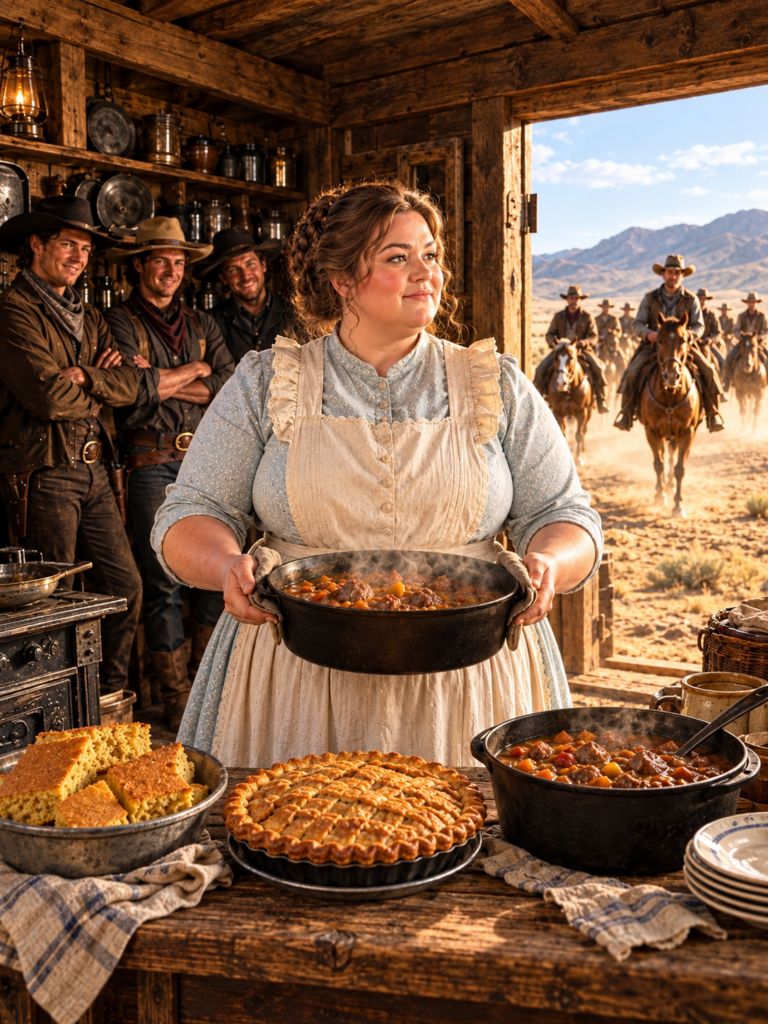
Eleven Cowboys Laughed When She Entered Their Abandoned Kitchen—Then Riders From 40 Miles Away Came Back Just for Her Cooking
Eleven cowboys stood outside a broken-down kitchen in Montana, laughing at the woman who had just arrived to cook for them.
One looked at her round face and broad figure and shook his head.
“That’s our new cook? Lord help us.”
Another tossed two silver dollars onto a fence post.
“Bet you she doesn’t last until Thursday.”
Their foreman laughed.
And the ranch owner, who had hired her, stood nearby without saying a word.
Clara Bellamy heard every insult.
She was twenty-eight years old, had traveled two days in the back of a supply wagon, and carried everything she owned in a canvas bag, a cast-iron pot, and a little wooden box.
She didn’t argue.
She didn’t cry.
She picked up her belongings and walked toward the kitchen.
When she opened the crooked door, the smell nearly knocked her backward.
Old grease. Damp wood. Mouse droppings.
A section of roof had fallen in, one window was broken, and the stove looked as if nobody had cared whether it worked since the previous winter.
Clara stood in the doorway for a long moment.
Then she rolled up her sleeves.
Three weeks later, cowboys were riding forty miles just to eat at that kitchen.
And the same men who had laughed at her were ready to defend her with their lives.
But before Clara could turn the dying cookhouse into the most talked-about stopping place on the Montana cattle trails, someone would sabotage her supplies, destroy her garden, steal her best food, and threaten to ruin the ranch at the worst possible moment.
The man behind it believed he could break her by taking away everything she needed to cook.
He had no idea what kind of woman he was dealing with.
It was September 1887, and the Mercer Cattle Station stood six miles east of a little Montana settlement called Garnet Crossing.
The ranch had once been prosperous.
Its grazing land stretched across open hills and creek-fed valleys, and its cattle carried a brand recognized throughout the region.
But several hard winters, falling cattle prices, and an old bank loan had pushed its owner, Wyatt Mercer, to the edge of financial ruin.
Wyatt was thirty-six.
His face was weathered by wind, his hands scarred by ranch work, and his dark eyes carried the exhaustion of a man who had forgotten what it felt like to sleep without worrying.
He had inherited the ranch after his father’s death.
For eleven years, he’d tried to preserve it.
Lately, every decision seemed to lead to another problem.
Four experienced hands had quit in two months.
The remaining crew was angry, underfed, and beginning to doubt whether the ranch had a future.
Wyatt knew the cookhouse was part of the trouble.
He just hadn’t done anything about it.
Until Clara arrived.
She set her belongings inside the ruined kitchen and walked back into the yard.
“Who’s Mr. Mercer?” she asked.
The foreman, Eli Turner, stepped forward.
“Busy man.”
“I can see that. Where is he?”
Eli stared at her.
“You need something?”
“A roof that doesn’t leak, a stove that works, clean water, and food that hasn’t been left for mice.”
Several cowboys laughed.
Eli folded his arms.
“You’ve been here five minutes.”
“Seven,” Clara replied. “And those are only the problems I’ve found so far.”
Wyatt emerged from the farmhouse before Eli could respond.
“Miss Bellamy?”
“Yes, sir.”
He looked at the cookhouse.
Then at her.
“I didn’t expect you until tomorrow.”
“The supply wagon left Billings early.”
Wyatt nodded.
“I’m afraid the kitchen isn’t in the condition I’d hoped.”
Clara glanced toward the warped roof.
“That would be one way of putting it.”
His mouth tightened.
“The last cook left in March.”
“Because of the stove?”
“Among other things.”
“How long has it been broken?”
“Since January.”
Clara stared at him.
“What have the men been eating?”
“Beans. Salt pork. Sometimes biscuits.”
“Every day?”
“Mostly.”
She looked toward the eleven cowboys standing near the barn.
Their clothes were dusty. Their faces were tired. Two looked younger than twenty.
“And you’re surprised they don’t want to stay?”
Wyatt’s expression changed.
“Miss Bellamy, I hired you to cook.”
“Yes. And that’s exactly what I intend to do. But I need a working kitchen, and you’ve got a crew that hasn’t had a decent meal in months.”
Eli snorted.
“She’s got a lot to say for someone who hasn’t made breakfast.”
Clara looked at him.
“Then perhaps you should let me get started.”
She turned back toward Wyatt.
“I need someone to repair the stove, someone to haul water, and permission to examine the pantry supplies.”
Wyatt stared at her for several seconds.
Then he said, “I’ll send Pete.”
He walked away.
Clara returned to the cookhouse.
Behind her, she heard someone mutter, “She won’t make it a week.”
She pretended not to hear.
But she remembered.
Clara had learned long ago that people mistook softness for weakness.
Her mother had operated a boardinghouse near Billings, serving railway workers, merchants, and cattle drivers.
From the age of nine, Clara had stood on an overturned crate beside the stove, learning to prepare meals from whatever ingredients they could afford.
Her mother always told her, “A good cook doesn’t begin with what she wishes she had. She begins with what’s in front of her.”
When Clara was twenty-two, her mother became ill.
For almost a year, Clara cared for her while keeping the boardinghouse running.
She learned to cook with barely enough flour for breakfast and stretch one chicken into three meals.
She learned which guests paid honestly, which lied about having no money, and which lonely travelers needed conversation more than another serving.
After her mother’s death, the boardinghouse closed.
Clara spent six years moving from one kitchen to another.
In hotels, she was criticized for her weight.
At boardinghouses, she was told she was too outspoken.
One restaurant owner dismissed her after customers began complimenting her food instead of his.
She had become accustomed to being underestimated.
But she had never become accustomed to surrendering.
That afternoon, a nineteen-year-old ranch hand named Pete Doyle arrived with a toolbox.
He took one look at the stove and sighed.
“That’s worse than I thought.”
“Can you repair it?”
“Maybe.”
“Then let’s find out.”
Pete spent two hours clearing ashes, tightening fittings, and replacing a damaged stovepipe section.
Clara cleaned around him.
She scrubbed the shelves.
Discarded spoiled food.
Washed every usable pot.
And found three shriveled potatoes, a string of dried onions, old cornmeal, and a small amount of salt pork.
From her own bag, she added dried sage, a little lard, and half a pound of beans.
Pete finally stood.
“The stove’ll burn now.”
Clara smiled.
“Good. Can you carry water?”
He blinked.
“How much?”
“Enough for soup and cleaning.”
Pete brought four buckets.
Then another two.
By late afternoon, a pot of bean-and-potato soup simmered over the fire.
Clara worked onions into the broth and seasoned it with sage.
She baked cornbread with a little molasses brushed across the top.
It was not an impressive meal by city standards.
But as the rich smell drifted across the yard, cowboys began turning their heads.
Clara found an old iron dinner bell hanging beside the door.
The clapper had rusted into place.
She worked it loose.
Then she rang it.
The sound startled the horses.
Eleven men came toward the cookhouse with expressions ranging from suspicion to amusement.
Eli took his place at the head of the table.
“What’s this supposed to be?”
“Supper,” Clara replied.
He lifted an eyebrow.
“I can see that.”
“Then we’re making progress.”
Pete tried not to laugh.
Clara served the soup and cornbread.
The room fell quiet.
The first man to take a bite was Pete.
He stopped chewing.
Then quickly took another spoonful.
Across the table, an older cowboy everyone called Gus tasted his soup.
His expression softened.
“There’s sage in this.”
“Yes,” Clara said.
“My grandmother used sage.”
“Mine too.”
Gus looked at her for another moment.
Then he returned to eating.
Eli tasted the cornbread.
He didn’t smile.
But he finished his piece and reached for another.
Within minutes, the pan was empty.
Nobody laughed anymore.
When supper ended, Clara cleared the bowls.
She had barely sat down when a young stranger appeared in the doorway.
He carried a dusty bedroll and looked as though he’d been riding all day.
“Ma’am, I’m sorry to trouble you.”
“What is it?”
“I smelled something cooking from the road.”
Clara looked at the nearly empty soup pot.
“You hungry?”
He nodded.
She warmed what remained and gave him the last piece of cornbread.
The young man ate slowly.
When he finished, he set a coin on the table.
“Thank you, ma’am.”
“You’re welcome.”
He looked around.
“What do they call this place?”
“Mercer Cattle Station.”
He nodded.
“I’ll remember.”
After he left, Clara placed the coin on a shelf beside her little wooden box.
It was the first money that kitchen had earned in months.
Wyatt visited later that night.
He knocked before entering.
Clara appreciated that.
“The men ate well,” he said.
“I noticed.”
He almost smiled.
“I suppose you would.”
He looked around the cleaned kitchen.
It still needed repairs, but the stove was warm, the floor was swept, and the room smelled like food instead of neglect.
“The supply wagon goes into Garnet Crossing on Friday,” he said. “Give Eli whatever list you need.”
“I’d rather give it directly to the rider.”
“Eli handles ordering.”
“And apparently nobody handles checking whether the orders arrive.”
Wyatt frowned.
“What does that mean?”
“It means the cornmeal barrel was supposed to contain twenty pounds. There’s barely fourteen.”
He looked toward the pantry.
“How do you know?”
“I weighed it.”
Wyatt remained silent.
Clara folded her arms.
“If you want me to feed your men properly, I need to know what food actually reaches this kitchen.”
He studied her.
Then nodded.
“I’ll send the rider to you.”
As he turned to leave, he stopped.
“Miss Bellamy?”
“Yes?”
“I told you three men had quit.”
“I remember.”
“It was four. The fourth was my best worker.”
Clara looked at him.
“Thank you for telling me.”
He nodded.
Then left.
That night, Clara opened the small wooden box she’d carried from Billings.
Inside was her mother’s handwritten recipe book.
The pages were stained, the leather cover cracked.
Clara gently turned to the first page.
Written in faded brown ink were words her mother had repeated all her life.
Feed a hungry person well, and you’ve given them a reason to face tomorrow.
Clara closed the book.
She looked around the little kitchen.
The broken window.
The crooked door.
The empty shelves.
Then she smiled.
She had no idea yet that the coin sitting beside her mother’s recipe book would become the beginning of something far larger than a ranch cookhouse.
Or that the person most threatened by her arrival was not one of the cowboys.
It was the powerful storekeeper who had been quietly taking money from Mercer Ranch for years.
And he was already preparing to make sure she didn’t stay.
Part 2
By the second week, the men at Mercer Cattle Station had stopped asking whether Clara could cook.
They wanted to know what she was making next.
The change was most obvious at breakfast.
The dinner bell rang at six, but Gus began arriving at five fifty.
He claimed the bunkhouse was too cold.
Clara noticed that he always chose the chair closest to the stove and never missed the first batch of biscuits.
Pete came in early to carry water and split firewood. Sometimes he stayed to watch her cook.
“Why do you put the onions in before the beef?” he asked one morning.
“Because onions need time in the fat to turn sweet.”
“Couldn’t you just throw everything into the pot?”
“You could. You’d still have supper. But it wouldn’t be the same supper.”
Pete considered that.
“My mother always made her stew taste better than anybody else’s.”
“She probably knew the order things needed doing.”
He nodded solemnly.
Clara smiled.
She liked Pete.
He had been the first person on the ranch to help her without being asked twice.
And when others laughed at her appearance, he’d stopped joining in after the first evening.
She suspected he understood what it felt like to be considered unimportant.
But feeding the ranch was only half her work.
Every delivery now went through her little ledger.
She weighed flour.
Counted jars.
Measured beans.
Checked dried meat for spoilage.
And compared every item against the supplier’s invoice.
The results troubled her.
The Mercer ranch was regularly paying for more provisions than it received.
Not enough to be immediately obvious.
A few pounds of flour.
A missing jar of preserves.
A sack of apples that weighed less than its label claimed.
But the shortages were consistent.
And consistency, Clara knew, rarely happened by accident.
One Thursday, she asked Burke, the supply rider, who packed the orders.
“Edgar Hollis’s store,” he replied.
“Does Mr. Hollis weigh the goods himself?”
“His boy usually does.”
“And you watch?”
Burke shifted uncomfortably.
“Never thought I needed to.”
Clara opened her ledger.
“Last week, we paid for twenty pounds of dried apples and received fourteen. This week, the flour was short again.”
Burke frowned.
“Hollis has supplied the ranch for years.”
“I know.”
“He’s a respected man.”
“So was the banker who foreclosed on my mother’s boardinghouse. Respectability doesn’t change arithmetic.”
Burke scratched his jaw.
“What do you want me to do?”
“Watch them pack the orders. And have the quantities weighed before you leave.”
He studied her.
Then nodded.
A few days later, another unexpected development arrived on horseback.
Eight cowboys traveling north along the Yellowstone trail stopped at Mercer Station to water their horses.
Their trail boss, a weathered man named Amos Dale, approached Wyatt’s porch.
“Any chance of supper?”
Wyatt hesitated.
“We’ve got a cookhouse running again.”
Amos raised an eyebrow.
“Good cook?”
Wyatt glanced toward the kitchen.
“The best we’ve had in years.”
Clara heard him.
She didn’t turn around.
But her hands slowed for half a second.
Eight additional men were a challenge.
Her stew had been prepared for the ranch crew, not eighteen hungry cowboys.
Still, she remembered her mother’s advice.
Begin with what’s in front of you.
She added cornmeal dumplings to the simmering beef, used extra onions to deepen the broth, and cooked the remaining apples with cinnamon for dessert.
By sunset, eighteen men sat around the tables.
The cookhouse was warm.
The windows steamed.
And the smell of stew filled the yard.
Amos ate his entire serving.
Then half a second bowl.
Finally, he pushed back his chair.
“Ma’am, that’s the first proper meal I’ve eaten since Cheyenne.”
Clara smiled.
“Glad you enjoyed it.”
He looked toward his crew.
“Who cooked this?”
Pete answered before anyone else.
“Miss Bellamy. She runs the kitchen.”
Amos nodded.
“We’ll be coming back through in six weeks.”
“Then you’ll know where to find us,” Clara replied.
He left money for all eight meals.
By the end of the following week, another two trail riders had stopped.
Then three more.
Word began spreading along the cattle routes.
There was a ranch six miles east of Garnet Crossing where the cook made biscuits that reminded a man of home.
Riders who’d been living on cold beans and hardtack began adding Mercer Station to their routes.
One said he’d heard about Clara’s cooking forty miles away.
Clara carefully placed every coin in a tin and recorded each paid meal.
It was still a small amount.
But the kitchen had become more than an expense.
It was earning money.
And that gave her an idea.
One evening, Wyatt entered the cookhouse while she was writing in her ledger.
“I’ve noticed extra horses at the fence.”
“Travelers paying for supper.”
“How many?”
“Nineteen outside riders over the past two weeks.”
He stared at her.
“Nineteen?”
“Yes.”
He looked toward the shelf where her coins lay in neat stacks.
“You’re running a business.”
“I’m feeding people. The business comes if you decide to make it one.”
Wyatt sat down.
Clara turned the ledger toward him.
She showed him the income first.
Then the expenses.
Then the shortages.
His expression gradually changed.
“How long has Hollis been supplying this ranch?”
“Six years, according to Burke.”
Wyatt studied the figures.
“Are you saying he’s stealing from us?”
“I’m saying we’re paying for food that isn’t arriving.”
He stared at the pages.
“And you checked every delivery?”
“Every one since I arrived.”
Wyatt rubbed his forehead.
For a long time, he didn’t speak.
Then he said, “May I keep this tonight?”
“I’ve already made a copy.”
His eyes lifted.
“You made a copy?”
“I’ve learned that a good ledger sometimes becomes more valuable than the goods it describes.”
Wyatt almost smiled.
But there was something troubled in his expression as he carried the book away.
The next morning, Clara found her little garden destroyed.
She’d planted it along the south wall of the cookhouse.
It wasn’t much.
A few rows of winter onions.
A patch of mint.
Sage transplanted from the creek.
Parsley she’d coaxed out of hard ground by watering it every morning.
Now the plants lay scattered across the dirt.
Someone had deliberately pulled them up.
Clara stood looking at the damage.
For a moment, she thought about her mother.
She remembered a narrow garden behind the boardinghouse, where they had grown herbs during years when buying fresh vegetables was an extravagance.
Her mother used to say, “A kitchen with a garden always has one more chance.”
Clara knelt.
She gathered the sage roots.
Some were damaged beyond saving.
Others remained intact.
She began replanting.
Pete found her an hour later.
“Miss Bellamy?”
She didn’t look up.
“Morning, Pete.”
He stared at the ruined plot.
“Who did this?”
“I don’t know.”
His hands clenched.
“Somebody ought to answer for it.”
“Perhaps. But right now these roots need water.”
He knelt beside her.
Together, they salvaged what they could.
Then Clara told Wyatt.
He examined the damage with a hard expression.
“It’s Hollis.”
“Possibly.”
“I’ll ride into town and ask him myself.”
Clara shook her head.
“Ask him what? Whether he sent someone to ruin my garden?”
Wyatt’s jaw tightened.
“He’s been shorting our supplies. Now this happens.”
“I know what it looks like. But an accusation isn’t proof.”
Wyatt looked at the uprooted plants.
“You expect me to do nothing?”
“No. I expect you to help me prove what’s happening.”
Three days later, Edgar Hollis came to Mercer Station.
He arrived in a polished wagon wearing a fine wool coat.
He was fifty-two, thin, neatly bearded, and known throughout Garnet Crossing as a respectable merchant.
He greeted Wyatt with a warm handshake.
“I hear there’s been a misunderstanding about my deliveries.”
Wyatt invited him into the farmhouse.
Clara watched from the kitchen doorway.
Hollis glanced at her once.
His smile didn’t reach his eyes.
Forty minutes later, Wyatt came into the cookhouse.
“Hollis showed me his records.”
“And?”
“They match the receipts.”
“The receipts Eli signed without checking the weights?”
Wyatt said nothing.
Clara closed her ledger.
“He writes down twenty pounds. Eli signs for twenty pounds. Burke brings fourteen. The papers will match because nobody checks the barrel.”
Wyatt looked uncomfortable.
“He offered us a discount on the next three orders.”
“A discount doesn’t replace missing food.”
“He says it could be a weighing error.”
“Then he shouldn’t object to someone weighing it.”
Wyatt rubbed his jaw.
“He also said something else.”
Clara waited.
“He thinks it’s unusual for a ranch cook to be handling accounts. Says people might wonder who’s actually running Mercer Station.”
There it was.
Hollis wasn’t merely defending his business.
He was attacking Wyatt’s pride.
Clara looked toward the stove.
“What did you tell him?”
“I said I’d review the ordering procedure with Eli.”
She nodded slowly.
She had hoped Wyatt would defend her work.
Instead, he’d allowed a merchant with questionable records to make her competence sound like an embarrassment.
“I see.”
“Clara—”
“Supper’s at six.”
He remained in the doorway.
Then quietly left.
That evening, Eli noticed her expression.
“Mercer backed away from something, didn’t he?”
Clara set his stew in front of him.
“He listened to a man who knows how to make truth sound inconvenient.”
Eli looked down.
After a long silence, he said, “I should’ve checked those weights.”
“Yes.”
He nodded.
“And I should’ve said something when the men laughed at you.”
Clara looked at him.
For the first time, Eli seemed genuinely ashamed.
“I won’t make the same mistake twice,” he said.
She studied him.
Then nodded.
“Good.”
The following Friday, Burke delivered two sacks of flour.
Clara cut open the first one.
She immediately felt something wrong.
The texture was coarse.
Gritty.
A faint sour smell rose from the sack.
She opened the second.
The same thing.
The flour had been mixed with inferior grain and dirt.
Clara called Burke inside.
“Did you see these packed?”
“No, ma’am.”
She held out a handful.
He rubbed it between his fingers.
His face darkened.
“I didn’t know.”
“I believe you.”
Clara recorded the delivery, retained samples, and showed Wyatt and Eli.
This time, Wyatt didn’t hesitate.
“We’re going to town.”
“With the sacks,” Clara said.
“And the ledger.”
Wyatt looked at her.
“And you.”
They rode into Garnet Crossing that afternoon.
Hollis stood behind his store counter when they arrived.
Several customers watched Clara carry in the two sacks.
She placed them on the counter.
Then opened her ledger.
“I’d like you to examine the flour delivered to Mercer Station this morning.”
Hollis smiled tightly.
“Perhaps something happened during transport.”
“Both sacks were sealed when Burke arrived. Please feel what’s inside.”
Hollis hesitated.
Then reached into the first sack.
He withdrew a handful.
His expression changed for one brief second.
Clara saw it.
So did Wyatt.
“This isn’t what we paid for,” she said.
Hollis glanced at the customers.
“An unfortunate packing mistake.”
“Then let’s correct it.”
She opened her ledger.
“Four weeks of shortages. Here are the quantities paid for, and here are the quantities delivered. Burke witnessed the weighing.”
Hollis’s smile vanished.
“Are you accusing me of dishonesty?”
“I’m asking you to provide the goods you’ve charged us for.”
The room was silent.
A woman near the counter leaned forward to inspect the flour.
One of the men by the door muttered, “That’s not fit for baking.”
Wyatt spoke.
“I trust Miss Bellamy’s records. I expect the account corrected.”
Hollis stared at him.
For a moment, his expression became openly hostile.
Then he forced a smile.
“I’ll provide clean flour by Friday. And a credit.”
Clara closed her ledger.
“Thank you.”
Outside, Wyatt stood beside his horse.
“He isn’t finished.”
“No.”
“You knew he’d try something else?”
“I hoped he wouldn’t.”
Wyatt looked at her.
“I should’ve backed you the first time.”
“Yes,” Clara said.
He blinked at her bluntness.
Then gave a small, rueful smile.
“Fair enough.”
They rode home together.
For the first time since Clara arrived, Wyatt didn’t treat her like an employee who needed to be managed.
He spoke to her as though they were solving a problem together.
The change was small.
But Clara noticed.
Two days later, Wyatt received a letter from the Consolidated Range Company in Helena.
It was one of the largest cattle operations in the region.
The company was exploring the purchase of smaller stations or establishing long-term supply partnerships.
Mercer Station had been selected for inspection.
Two representatives would arrive in three weeks.
They would examine the grazing land, herd condition, water sources, finances, and the station’s ability to house and feed traveling crews.
If the inspection went well, Wyatt might secure a contract large enough to stabilize the ranch and refinance its debt.
If it failed, the bank could eventually force a sale.
Wyatt brought the letter to Clara.
She read it carefully.
Then looked up.
“When do they arrive?”
“Twenty-two days.”
“Will they eat here?”
“Yes.”
She nodded.
“Then I need to start preparing tomorrow.”
Wyatt stared.
“That’s your first thought?”
“They’ll remember the food. And they’ll remember whether your men look well fed.”
She began making a list.
A properly cured roast.
Root vegetables.
Corn cakes.
Preserved fruit.
Wild-herb butter.
Wyatt watched her write.
“Clara, if this doesn’t work—”
“It might not,” she replied. “But we’re going to give them the best possible reason to say yes.”
For the next two weeks, Clara worked nearly every waking hour.
She repaired an old smokehouse with Pete’s help and began curing a large cut of beef.
She arranged to buy preserved cherries and wild-plum jam from a widow who lived beyond the eastern ridge.
She expanded the pantry inventory and prepared every dish she could ahead of time.
Wyatt improved the cookhouse roof.
Eli organized the barn.
The men repaired fences, cleaned the bunkhouse, and made sure the water troughs were sound.
For the first time in months, Mercer Station felt like a ranch working toward something rather than merely struggling to survive.
Then Eli brought Clara a warning.
“Hollis knows about the inspection.”
She set down her spoon.
“How?”
“He’s been asking questions around town.”
“And?”
“He’s telling people Wyatt’s lost control of the ranch. Says a cook is running the accounts.”
Clara exhaled slowly.
“Anything else?”
Eli hesitated.
“Someone saw him speaking privately with Gus.”
Clara frowned.
“Gus?”
Eli nodded.
“They say money changed hands.”
The old cowboy had eaten at her table every day.
He’d been one of the first to appreciate her cooking.
And now someone was suggesting he’d accepted money from the merchant who wanted her gone.
Clara didn’t confront him.
She watched.
Gus continued eating quietly, talking little, and carrying out his regular duties.
But three mornings before the inspection, Pete came running into the cookhouse, pale and breathless.
“Miss Bellamy!”
She turned.
“What is it?”
“The smokehouse.”
Her stomach dropped.
She hurried outside.
The smokehouse door stood open.
The fire had been deliberately extinguished.
And the large cut of beef she’d spent twelve days preparing was gone.
So were two jars of preserved fruit.
A small barrel of dried apples.
And several supplies reserved for the visitors’ dinner.
Gus’s bed was empty.
His saddle and belongings were missing.
Wyatt arrived minutes later.
He stared into the smokehouse.
Then turned toward the horse corral.
“I’m riding into Garnet Crossing.”
“Wyatt.”
His fists clenched.
“That man has been stealing from me for weeks!”
“Wyatt, listen.”
“No. I’ve had enough.”
Clara stepped in front of him.
“You’ve got two days before those representatives arrive. Hollis wants you angry. He wants you riding into town accusing him without proof.”
Wyatt stared at her.
“He stole the food we need.”
“Yes.”
“And you expect me to stand here?”
“No.”
She took a breath.
“I expect you to help me cook something better.”
He looked at the empty hook.
“With what?”
Clara turned toward Pete.
“How many rabbits came off the trapline this week?”
“Six, maybe seven.”
“And the root cellar?”
“Half a crate of potatoes. Some carrots.”
“The cornmeal from the widow?”
“Still in the pantry.”
She looked back at Wyatt.
“We have enough.”
He shook his head.
“Clara, this dinner could decide everything.”
“I know.”
He studied her face.
“You’re not afraid?”
“I’m terrified.”
For a moment, the truth surprised them both.
Then Clara continued.
“But being frightened doesn’t make the work disappear.”
She rolled up her sleeves.
“Send Pete for the rabbits. Ask Eli to bring in the vegetables. And find me two men who can keep the firewood coming.”
Wyatt stared at her for one final moment.
Then he turned.
“Pete! Get moving!”
The ranch burst into activity.
Clara walked back into the kitchen.
She opened her mother’s little wooden recipe book.
And found the page she’d been looking for.
At the top, in her mother’s handwriting, were four simple words.
When the roast is gone.
Clara read the recipe.
Then she smiled.
Hollis had taken her finest piece of beef.
But he’d left her the one thing he couldn’t steal.
Everything her mother had taught her.
Part 3
The day before the Consolidated Range inspection, Clara Bellamy stood in the Mercer cookhouse with seven rabbits, half a crate of vegetables, one sack of cornmeal, and no certainty that any of it would be enough.
The smoked beef was gone.
The best preserved fruit had been stolen.
And the man responsible was probably sitting in Garnet Crossing, waiting for news that she’d failed.
Clara opened her mother’s notebook.
The rabbit stew recipe had been written twenty years earlier, when the Bellamy boardinghouse had run out of beef during a winter storm.
Her mother had crossed out the original measurements and written a note beneath them.
Don’t punish what you have because it isn’t what you wanted.
Clara ran her thumb over the faded words.
Then she closed the book.
“Pete!”
The young hand appeared in the doorway.
“Yes, ma’am?”
“Get the biggest stockpot.”
He glanced toward the table.
“Are we making stew?”
“We’re making the kind of supper men remember after they’ve forgotten who sat beside them.”
Pete grinned.
“Yes, ma’am.”
By noon, the rabbits had been dressed and prepared.
Clara browned the meat carefully, then added onions, potatoes, carrots, and dried herbs.
The broth darkened as it simmered.
She mixed cornmeal with hot water, a little fat, and salt, shaping thin cakes that would crisp on the griddle.
From the remaining dried cherries and wild-plum jam, she prepared a dense pudding.
It wasn’t the elegant dinner she’d planned.
But the longer she worked, the more confident she became.
The food smelled like the kind of meal her mother had served during the hardest winters.
Warm.
Comforting.
Honest.
Late that afternoon, Eli entered the kitchen.
He stood near the stove, breathing in the aroma.
“What is that?”
“Rabbit stew.”
“Smells better than beef.”
Clara raised an eyebrow.
“You don’t have to flatter me.”
“Wasn’t planning to.”
He reached for a spoon.
She slapped his hand lightly with a towel.
“Dinner isn’t ready.”
Eli grinned.
For a moment, Clara remembered the man who’d stood beside the barn on her first day, watching the others laugh.
He seemed like a different person now.
Then his smile faded.
“Miss Bellamy, there’s something I need to tell you.”
She stopped stirring.
“What?”
“Gus came back.”
Clara’s stomach tightened.
“Where is he?”
“In the old hay barn. He doesn’t want Wyatt to see him yet.”
“Why?”
Eli looked toward the door.
“Because he says Hollis paid him to take the beef.”
Clara remained silent.
“And?” she asked.
Eli swallowed.
“He says there’s more.”
Clara went to the barn with Wyatt and Eli.
Gus sat on an overturned crate.
His weathered face looked older than it had at breakfast three days earlier.
When he saw Clara, he stood.
“Ma’am.”
She folded her arms.
“Where’s the beef, Gus?”
He lowered his eyes.
“Hollis took it.”
“Why?”
“He wanted the kitchen to fail.”
Wyatt stepped forward.
“You let him buy you?”
Gus flinched.
“I did.”
“How much?”
“Twenty dollars.”
The amount hung in the air.
Twenty dollars was enough to matter to a working cowboy.
But nowhere near enough to justify what he had done.
Wyatt stared at him.
“You’ve worked here eight years.”
“I know.”
“You knew what that dinner meant.”
“I know.”
Wyatt’s voice rose.
“Then why?”
Gus looked at Clara.
His eyes were wet.
“My daughter’s sick.”
The room went quiet.
“She lives outside Miles City. Her husband died last winter. She’s got two little ones and no money for the doctor.”
He rubbed his face.
“Hollis knew. He offered twenty dollars if I’d take the beef and leave the smokehouse open. Said nobody would really get hurt.”
Clara felt anger rise in her chest.
Not just at Gus.
At the man who had found the old cowboy’s weakest place and used it.
“Did you know Hollis was shorting our supplies?” she asked.
Gus shook his head.
“No, ma’am. Not until you started talking about it.”
“Did you help destroy my garden?”
“No.”
He met her eyes.
“I swear that wasn’t me.”
Wyatt looked as if he wanted to throw him out immediately.
But Clara asked another question.
“Will you tell the truth in front of witnesses?”
Gus nodded.
“Anything.”
Wyatt stared at him.
“And you understand you won’t be working here again?”
Gus lowered his head.
“Yes, sir.”
For a long moment, nobody spoke.
Then Clara said, “Eli, take his statement. Have Pete witness it.”
She turned toward Gus.
“I hope your daughter’s all right.”
He looked at her with surprise.
“Thank you, ma’am.”
“But what you did could have cost eleven men their jobs.”
“I know.”
“You’ll have to live with that.”
He nodded.
Clara returned to the kitchen.
She had no more time to spend on betrayal.
The stew needed watching.
The pudding needed checking.
And tomorrow, two men would arrive with the power to change the future of Mercer Station.
That night, Clara barely slept.
She checked the fire every few hours.
She adjusted the simmering pot.
She tested the corn cakes.
And just before dawn, she carried a small cup of broth outside into the cold morning air.
The sky was beginning to pale above the eastern hills.
She stood beside the cookhouse garden.
The sage plants Pete had helped replant were growing again.
Tiny green shoots pushed through the dirt.
Clara touched one gently.
Then she heard footsteps.
Wyatt approached carrying two cups of coffee.
“I thought you’d still be working.”
“I am.”
He handed her a cup.
She accepted it.
They stood together watching the sunrise.
After a while, Wyatt said, “I owe you an apology.”
Clara looked at him.
“For what?”
“The day you arrived.”
She smiled faintly.
“That was quite a day.”
“I stood there while the men laughed.”
“Yes, you did.”
“I thought you’d last a week, maybe two.”
“And now?”
He looked toward the warm light spilling through the cookhouse window.
“Now I can’t imagine how we managed without you.”
Clara lowered her eyes.
Wyatt continued.
“I’ve spent eleven years thinking the only way to save this place was to work harder than everybody else. You’ve shown me that sometimes the problem isn’t how hard we’re working.”
“What is it?”
“That we’re working the wrong way.”
She looked at him.
For the first time, she saw how tired he really was.
Not merely from ranch work.
From carrying responsibility he believed nobody else could share.
“Then don’t make that mistake again,” she said.
He smiled.
“I’ll try not to.”
The representatives arrived shortly after four that afternoon.
Douglas Hale was a heavy-shouldered man in his sixties, with gray hair and watchful eyes.
His younger colleague, Randall Coates, carried a leather ledger and seemed determined to record every detail of Mercer Station.
Wyatt greeted them in the yard.
He showed them the grazing land, cattle, water access, barns, and bunkhouse.
Eli explained the ranch’s labor arrangements.
Pete demonstrated the repaired water system.
The men asked difficult questions.
How much winter feed was available?
How many experienced hands had left?
Could the ranch accommodate larger trail crews?
What would happen if the bank demanded payment?
Wyatt answered honestly.
He didn’t pretend everything was perfect.
He explained the repairs already made and the improvements still needed.
Clara watched from the cookhouse doorway.
She was proud of him.
He looked like a man who had decided that admitting a weakness was better than hiding it.
At six, she rang the dinner bell.
Hale and Coates entered the cookhouse.
The room was warm.
Freshly scrubbed tables stood beneath oil lamps.
The repaired stove glowed.
And the scent of slow-cooked rabbit, onions, and herbs filled the air.
Hale stopped just inside the door.
“Well,” he said, “this smells promising.”
Clara stepped forward.
“Gentlemen, welcome to Mercer Station.”
Wyatt introduced her.
“Miss Clara Bellamy. She manages our cookhouse.”
Coates looked around.
“You’ve made considerable improvements.”
“Thank you.”
They sat.
Clara served the stew in deep bowls, accompanied by crisp corn cakes and herb butter.
For several minutes, nobody spoke.
Hale took one bite.
Then another.
Then he set down his spoon.
“Miss Bellamy.”
“Yes, sir?”
“What did you cook this with?”
“Rabbit, root vegetables, onions, and herbs.”
He looked surprised.
“Rabbit?”
“Yes.”
He tasted the broth again.
“Remarkable.”
Coates reached for another corn cake.
“Did you prepare all this yourself?”
“With Pete’s help and supplies from local growers.”
Wyatt looked at her.
He knew how much that answer left out.
The stolen beef.
The ruined garden.
The deliberate attempts to make her fail.
But Clara wasn’t interested in turning dinner into a complaint.
She wanted the men to taste what Mercer Station could provide.
When the pudding arrived, Hale leaned back and smiled.
“Whoever taught you to cook knew her business.”
“My mother,” Clara said.
“Then she taught you well.”
“Thank you, sir.”
After supper, Coates opened his ledger.
“Mr. Mercer, I’d like to discuss the cookhouse.”
Wyatt nodded.
“Of course.”
Coates looked toward Clara.
“Would Miss Bellamy join us?”
Wyatt glanced at her.
“Absolutely.”
Clara sat at the end of the table.
Coates began asking about supply costs, staffing, food storage, and the number of meals the station could produce.
Clara retrieved her own ledger.
She showed him the records.
The regular ranch meals.
The additional travelers she’d fed.
The money received.
The food costs.
The shortages she’d uncovered.
Coates examined the pages carefully.
“You’ve been recording all this yourself?”
“Yes.”
He looked at Hale.
Then at Wyatt.
“This isn’t simply a cookhouse. It could operate as a reliable provisions stop for cattle crews moving through the region.”
Hale nodded.
“Especially if the food stays this good.”
Wyatt seemed almost afraid to speak.
Coates continued.
“With better sleeping quarters and a dependable purchasing arrangement, you could serve far more riders than you do now.”
Clara leaned forward.
“I believe so.”
“How many?”
“That depends on staffing and supplies. I won’t promise a number until we’ve tested the capacity.”
Coates smiled.
“Good answer.”
Hale stood.
“I’d like another look at the bunkhouse before dark.”
The meeting ended without a decision.
Wyatt walked the visitors outside.
Clara returned to washing dishes.
Pete appeared beside her.
“Do you think they liked it?”
She looked at the empty pudding dish.
“They ate every bite.”
“Does that mean we’re saved?”
Clara smiled.
“It means we did our job.”
The decision arrived the next morning.
Hale and Coates met Wyatt in his study.
Clara was in the kitchen when Pete came running across the yard.
“Miss Bellamy!”
She turned.
“What?”
“Mr. Mercer wants you!”
Her heart began pounding.
She untied her apron and hurried toward the farmhouse.
Wyatt stood beside the desk.
Hale and Coates were preparing to leave.
Hale smiled when Clara entered.
“Miss Bellamy, we wanted you to hear the news.”
She looked at Wyatt.
His expression was unreadable.
Then Coates spoke.
“Consolidated Range intends to offer Mercer Station a three-year supply and lodging agreement, subject to the final written terms and required improvements.”
For a moment, Clara couldn’t breathe.
Coates continued.
“The agreement would provide regular payment for supporting designated cattle crews. There would also be an advance for improvements, secured against the ranch’s performance.”
Wyatt slowly exhaled.
It wasn’t a gift.
And it wasn’t enough to erase every debt overnight.
But it gave him something he’d been missing for years.
A reliable business commitment.
A reason for the bank to keep working with him.
And a future that wasn’t determined solely by cattle prices.
Hale looked at Clara.
“One condition, Miss Bellamy.”
She straightened.
“Yes, sir?”
“We want assurance the cookhouse remains under competent management.”
Wyatt smiled.
“It will.”
Hale held out his hand.
“Then I look forward to eating here again.”
Clara shook it.
“Thank you.”
When the men departed, Wyatt remained standing in the yard, staring at the road.
Clara joined him.
“Well?” she asked.
He laughed.
It startled her.
For weeks, she’d heard him sigh, argue, and issue orders.
But she’d never heard him laugh like that.
“We’ve got a chance,” he said.
She smiled.
“Yes.”
He turned toward her.
“You gave us one.”
Clara shook her head.
“We all worked for it.”
“Perhaps. But you were the first person to believe this place could be more than it was.”
She looked across the ranch.
The repaired cookhouse.
The fenced garden.
The bunkhouse where the men were gathering.
Then she remembered her first day.
The laughter.
The wager.
The crooked door.
The old stove.
“Sometimes,” she said quietly, “all a place needs is someone willing to begin.”
The agreement changed Mercer Station over the following months.
Wyatt negotiated new terms with the bank.
The ranch repaired its lodging facilities.
Eli established better systems for checking deliveries.
And Hollis’s account was subjected to careful review.
Gus’s statement, Burke’s testimony, Clara’s records, and the contaminated flour samples gave Wyatt grounds to pursue repayment for the documented shortages.
Hollis denied deliberately cheating the ranch.
But he eventually agreed to a financial settlement rather than continue a dispute that was damaging his reputation.
Wyatt shifted his purchasing business to other suppliers.
Among them was the widow beyond the eastern ridge whose preserved cherries had helped save the inspection dinner.
Clara insisted the new arrangements include honest weights, written prices, and reliable delivery schedules.
The ranch hired additional kitchen help as paid meals increased.
Pete became Clara’s regular assistant.
He learned to keep the stove temperature steady, count portions, prepare stock, and stretch a meal without making it taste stretched.
When he ruined his first batch of biscuits, he looked ready to disappear.
Clara merely inspected the pan.
“Too much heat.”
“I know.”
“Then you’ll remember next time.”
She handed him a fresh bowl.
“Start again.”
He grinned.
And he did.
Six weeks after the inspection, Amos Dale returned.
This time, he wasn’t bringing eight cowboys.
He arrived with twenty-three.
The horses filled the rail.
The men were tired, hungry, and covered in trail dust.
Amos entered the cookhouse first.
He removed his hat.
“Miss Bellamy.”
“Mr. Dale.”
“Told you we’d be back.”
She smiled.
“So you did.”
He glanced at the tables.
“Can you feed twenty-three?”
Clara looked over his shoulder.
Then she called toward the pantry.
“Pete, get the extra pot.”
Amos laughed.
“That’s a yes?”
“That’s a yes.”
By sundown, every chair was occupied.
The cookhouse rang with conversation.
Men compared cattle prices, argued about weather, and passed dishes of beef stew and cornbread from one end of the table to the other.
One rider said he’d heard about Clara’s biscuits near Miles City.
Another had been told there was a woman at Mercer Station who could make rabbit stew taste better than prime beef.
A third admitted he’d ridden several extra miles just to stop there.
Amos raised his coffee cup.
“To Miss Bellamy.”
The other men lifted theirs.
“To Miss Bellamy!”
Clara stood near the stove, her cheeks warm.
For a moment, she couldn’t speak.
Then Wyatt appeared beside her.
He leaned closer.
“Remember the first day?”
She smiled.
“Unfortunately.”
“Eleven men laughed.”
“Yes.”
“And now twenty-three men are cheering.”
She looked at him.
“Funny what a difference a good supper makes.”
Wyatt shook his head gently.
“It wasn’t just supper.”
She met his eyes.
For a long moment, the noise of the cookhouse seemed to fade.
Then Pete called for another batch of bread, and Clara returned to work.
The following spring, the ranch hosted its first official gathering for cattle crews traveling through the region.
Nearly forty riders arrived over two days.
They slept in the improved bunkhouse, watered their horses, bought provisions, and ate in Clara’s expanded kitchen.
The men who had once laughed at her were now the ones explaining to newcomers why everyone called Mercer Station the best stopping place within forty miles.
And when a young rider made a thoughtless joke about Clara’s weight, Eli Turner stopped him.
“Son,” he said, “that woman kept this ranch alive when most of us couldn’t figure out how to keep ourselves fed.”
The rider looked embarrassed.
Eli continued.
“You’ll show her respect, or you’ll eat somewhere else.”
Clara overheard him.
She didn’t interrupt.
But later that evening, she handed Eli an extra piece of pie.
He glanced at it.
“What’s this for?”
“Good manners.”
He laughed.
“About time I learned some.”
By summer, Wyatt had offered Clara a permanent position managing the cookhouse and provisions business.
The agreement gave her clear authority, a higher wage, and a share of profits from meals sold to traveling crews.
She read every line before signing.
Then Wyatt asked her something she hadn’t expected.
“Would you have supper with me in Garnet Crossing on Sunday?”
Clara raised an eyebrow.
“Are you dissatisfied with the food here?”
He smiled.
“Not at all.”
“Then why drive six miles to eat somewhere else?”
“Because I thought you might enjoy being the person someone cooks for.”
That silenced her.
For years, she’d been valued mainly for what she could provide.
Nobody had thought to ask whether she wanted to sit at a table and be cared for.
She looked at Wyatt.
Then smiled.
“I’d like that.”
Their affection grew slowly over the next year, built on conversations, shared work, and the growing trust between two people who had once expected to face every hardship alone.
Clara didn’t need Wyatt to rescue her.
He didn’t need her to manage his life.
They learned to ask for help without surrendering their independence.
And in the autumn of 1889, beneath the oak tree behind the cookhouse, Wyatt asked Clara to marry him.
She said yes.
Their wedding was modest.
Margaret, the widow who supplied preserves, prepared the flowers.
Pete baked his first successful wedding cake.
Eli stood beside Wyatt.
And Amos Dale arrived with several cowboys who claimed they couldn’t miss the wedding of the woman who had once fed them after a miserable week on the trail.
After the ceremony, Clara returned briefly to the kitchen.
Her mother’s wooden recipe box rested on the same shelf where she’d placed it on her first day.
Beside it was the original coin the hungry traveler had left after eating her soup.
Clara picked it up.
Then she heard footsteps behind her.
Wyatt stood in the doorway.
“Mrs. Mercer?”
She turned and smiled.
“That sounds strange.”
“You’ll get used to it.”
He walked toward her.
“What are you thinking?”
She looked at the little coin.
“I’m thinking about how much changed because one man was hungry.”
Wyatt glanced at the coin.
“And one woman knew what to do.”
Clara closed her fingers around it.
Outside, laughter drifted through the open window.
The ranch was alive with voices.
Horses stood along the fence.
Warm bread cooled on the kitchen tables.
And somewhere beyond the hills, more travelers were making their way toward Mercer Station.
Clara thought about the afternoon she’d arrived.
The broken roof.
The empty shelves.
The eleven men laughing.
She remembered how small she’d felt, standing alone with her canvas bag while everyone waited for her to fail.
If someone had told her then that the cookhouse would become the heart of the ranch, she might not have believed it.
If they’d told her she’d find a home, a livelihood, and a man who respected her, she might have laughed herself.
But she had kept walking.
She had opened the broken door.
She had lit the stove.
And she’d made the first meal.
Years later, travelers would still tell stories about the woman who had transformed Mercer Station.
Some claimed she could make a feast out of nothing.
Others said cowboys rode forty miles just to taste her biscuits.
Both stories were true enough.
But Clara always told them something simpler.
“I didn’t change the ranch because I was extraordinary. I changed it because somebody had to care whether people were fed.”
Then she’d look toward the kitchen, where Pete’s apprentices were learning to cook and the dinner bell was still ringing.
“And because when everyone tells you a place is too broken to save, sometimes the most important thing you can do is walk inside and begin.”
The woman eleven cowboys had laughed at became the reason travelers came from forty miles away.
And the abandoned kitchen they thought was worthless became the place that saved their ranch.
Because sometimes the person everyone overlooks is the one who sees what everyone else has forgotten is worth saving.

