
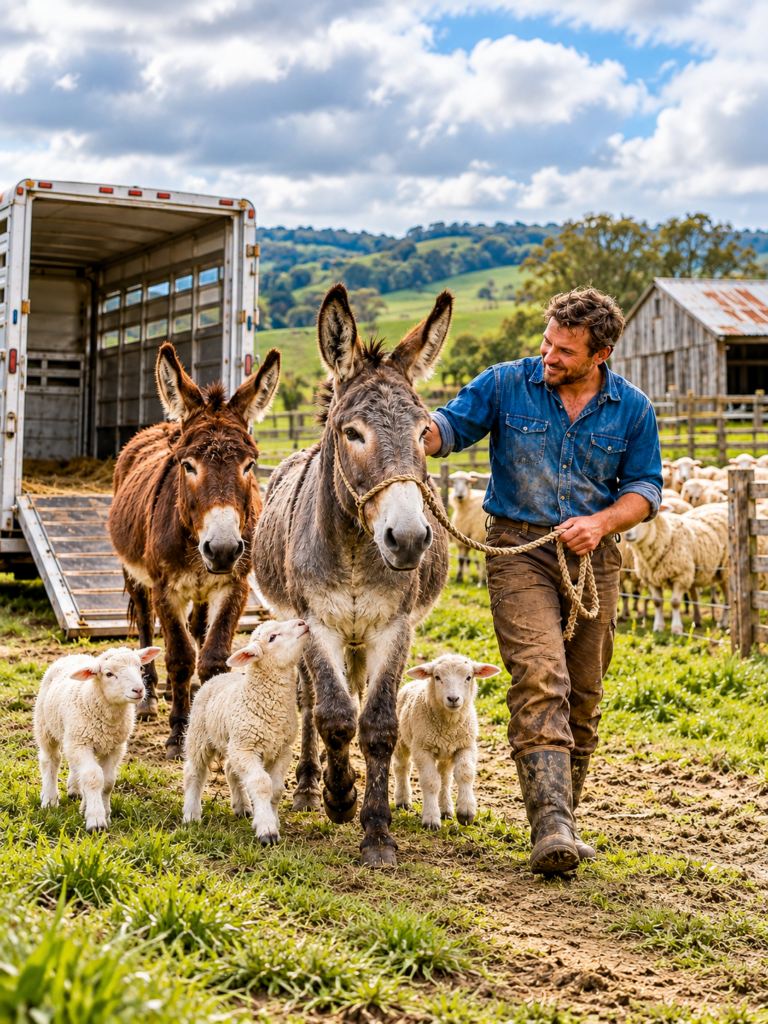
Part 1
By the last Tuesday in September, Nico Etcheverry had buried twenty-three lambs, fallen behind on his ranch payments, and begun to fear that the land his grandfather had spent a lifetime building would be taken away from him.
He was thirty-six years old, with a weather-beaten face, rough hands, and the quiet manner of a man who had learned early that complaining never repaired a fence or filled an empty feed trough.
For most of his life, Nico had believed that hard work could solve almost anything.
Lately, he was beginning to wonder whether that was true.
The latest lamb had disappeared from the creek pasture sometime during the night.
Nico found what remained shortly after nine in the morning, when the September sun had climbed high enough to throw light into the narrow draw below the reservoir.
A few strands of white wool clung to a sagebrush. The dirt was torn up beneath the fence, and twenty feet farther down the slope lay a yellow ear tag.
He bent slowly, bracing one hand against his grandfather’s old sheep hook.
The number was 418.
Nico closed his eyes.
He knew that lamb. A strong twin from one of his best ewes, nearly ready for market. Another three weeks and it would have been loaded onto a livestock truck, bringing in close to three hundred dollars.
Instead, it was gone.
He put the tag in his coat pocket beside the others.
Twenty-three.
At the prices lambs were bringing that fall, the losses amounted to more than six thousand dollars.
That was almost the entire autumn payment on his operating loan.
The bank had already called twice.
Nico stood at the edge of the draw and studied the tracks in the soft ground. There was the same large paw print he had been finding since June, with a split pad on the left front foot.
One coyote, perhaps the leader of a pair, had learned exactly where his sheep spent the night.
It was growing bolder.
And Nico was running out of ways to stop it.
He tightened his grip on the worn ash handle of the sheep hook.
His grandfather, Fermin Etcheverry, had carried that hook for nearly fifty years. The wood was polished smooth where the old man’s palm had rested. Its iron crook had pulled lambs from ditches, hooked stubborn gate chains, and lifted newborns out of spring mud.
Fermin had come from the Basque Country in 1958 with one suitcase and a three-year contract to herd sheep in Wyoming’s Bighorn Mountains.
He had spent his first American winters living in a canvas sheep wagon with two dogs and fifteen hundred ewes.
He saved nearly every dollar.
In 1971, he bought a little ranch beside a creek.
Over the following decades, he added pasture, repaired buildings, planted windbreaks, and turned a struggling patch of Wyoming ground into a place capable of supporting a family.
When Nico’s father died in a ground blizzard on the interstate, Nico was only eleven.
Fermin raised him.
The old man taught him how to turn a frightened flock, repair a broken gate in freezing rain, and tell when a ewe was about to lamb simply by watching the way she walked.
He also taught him something Nico had never forgotten.
“A sheep needs somebody standing between her and the dark,” Fermin used to say.
Back then, Nico thought he understood.
Now, standing above the remains of another lamb, he wasn’t so certain.
A pickup engine interrupted his thoughts.
A silver Dodge rolled to a stop along the county road. A powerful spotlight was mounted above its cab.
Wade Kessler lowered the driver’s window.
Wade was nearly sixty, broad through the shoulders, with a face hardened by wind and a voice that could carry across an auction barn without a microphone.
He ran twenty-five hundred ewes on the neighboring ranch.
For forty years, the Kesslers and the Etcheverrys had shared fence lines, borrowed equipment, and occasionally helped one another through storms.
When Wade’s father died, Fermin had spent nearly two weeks helping him through lambing season without asking for payment.
Wade remembered that favor.
Unfortunately, he also remembered that Fermin had been a better sheepman than almost anyone else in the county.
“How many now?” Wade called.
Nico looked down at the tag in his hand.
“Twenty-three.”
Wade let out a long breath.
“Your grandfather never lost twenty-three lambs in a whole season.”
“I know.”
“Then you know what needs doing.”
Nico said nothing.
Wade leaned against the steering wheel.
“My trapper can set cyanide devices along your side of the ridge. I’ll pay for the whole thing. You won’t owe me a penny.”
“No poison.”
“Nico, those coyotes aren’t going to develop a conscience.”
“I said no.”
“Then get a rifle and sit out there at night.”
Nico stared toward the creek.
“I’ll handle it.”
Wade shook his head.
“That’s what you’ve been saying all summer.”
He waited, then lowered his voice.
“Look, I knew your grandfather. He would have sat out there every night with his rifle across his knees. I used to see his lantern from my kitchen.”
Nico’s jaw tightened.
Wade continued.
“You don’t ride before sunrise. You don’t come to Thursday supper anymore. Half the county thinks you’ve turned into a hermit.”
“I’ve got work.”
“We all have work.”
For a moment, neither man spoke.
Then Wade looked beyond the pasture toward the narrow strip of irrigated creek bottom.
“My offer still stands. Nine hundred dollars an acre for the creek ground. It would take care of your bank trouble.”
“The creek pasture isn’t for sale.”
“You may not have much choice come spring.”
“It’s my land.”
Wade’s expression hardened.
“Then start acting like the man who owns it.”
The Dodge rolled away in a cloud of pale gravel dust.
Nico remained by the fence until the truck disappeared.
Only then did he lower himself onto a flat rock.
His hands were trembling.
He hated that Wade was partly right.
He hated even more that he couldn’t explain why.
Because there was something about Nico Etcheverry that nobody in the county knew.
Something he had concealed for six winters.
Something that had already taken away his evenings, his freedom, and the woman he once intended to marry.
And if the people in town discovered it, Nico feared they would never again trust him to run the ranch his grandfather had left him.
Three days later, he drove eleven aging ewes to the Saturday livestock sale in Buffalo.
The sale barn smelled of sawdust, manure, coffee, and wet wool. Auctioneers shouted numbers through crackling microphones while ranchers stood along the pens discussing hay prices and the coming winter.
Nico sold his cull ewes, folded the cash into an envelope, and slipped it inside his shirt.
He needed that money.
There was propane to buy, a tractor belt to replace, and an appointment with an eye specialist in November.
But as he passed the final row of holding pens, he noticed two donkeys standing in the far corner.
One was brown, sturdy-legged, and alert.
The other was gray and terribly thin, with a nearly white face and ears that seemed too large for her narrow head.
The gray donkey kept her muzzle pressed against the brown one’s side.
Whenever the brown one moved, she followed so closely that their shoulders nearly touched.
Nico stopped.
A cardboard sign hung from the gate.
TWO JENNIES. SOLD AS PAIR.
They were in the kill pen.
Animals sent there rarely found another home. Buyers paid by weight, and older horses and donkeys often disappeared onto trailers headed for slaughter channels.
Nico watched the gray jenny take a hesitant step after her companion.
That winter, he had read a university extension bulletin about livestock guardian donkeys.
A suitable donkey, properly bonded with sheep, could sometimes deter coyotes.
The idea had stayed in the back of his mind.
It wasn’t a guarantee. Donkeys could be unpredictable, and some were poor guardians.
Still, it was something different.
Something that didn’t involve poison.
The brown donkey lifted her head and stared at him.
The gray one merely turned an ear toward his boots.
Nico leaned against the gate.
“Well, girls,” he murmured, “looks like none of us is having a particularly good year.”
The brown donkey stepped closer.
He scratched the long hair between her ears.
The gray one followed the movement, touching her friend’s shoulder with her nose.
Nico looked at his watch.
A little after four.
The kill pen wouldn’t sell until the end of the auction, likely well past six.
He should have left.
He knew that.
Instead, he stayed.
By the time the two donkeys entered the auction ring, evening sunlight was pouring orange through the high windows.
The auctioneer barely bothered describing them.
“Two jennies, sold together. What’ll you give me?”
A heavyset kill buyer raised his hand.
“Two-sixty.”
Nico felt the envelope beneath his shirt.
He raised his own hand.
“Two-eighty.”
Several men turned.
The kill buyer glanced at him, amused.
“Three hundred.”
Nico hesitated.
That was nearly all he had.
He thought of the lambs.
The empty places in the flock.
The bank note.
The grandfather who had brought him up to believe every living creature deserved a fair chance.
“Three hundred ten,” Nico said.
The auctioneer pointed at him.
“Three-ten. Anybody give me three-twenty?”
The kill buyer shrugged.
“Old gray one’s barely worth the diesel to haul her.”
“Sold! Three hundred ten dollars to the sheepman!”
Someone in the upper bleachers called out, “Hey, Nico! Those are the ugliest sheep I’ve ever seen!”
Laughter rolled through the barn.
Nico looked up.
Wade Kessler was sitting near the top row, laughing harder than anyone.
“Maybe they’ll scare the coyotes to death!” Wade shouted.
More laughter.
Nico said nothing.
He took his receipt, walked toward the pens, and began loading the donkeys.
The sun had slipped below the mountain ridge when he finally pulled onto the highway.
At first, everything seemed fine.
The road was familiar. He had driven it hundreds of times.
But as the light faded, the edges of the pavement became indistinct.
The fence posts disappeared.
Then the ditch.
Then the low ridge beyond the road.
His headlights illuminated a narrow patch of asphalt, but the world outside their beams had become a wall of gray.
Nico slowed to twenty miles an hour.
Then fifteen.
Then ten.
His hands tightened around the steering wheel.
He knew what was happening.
He had known for years.
At thirty, a specialist in Billings had diagnosed him with retinitis pigmentosa, an inherited retinal disease that was gradually destroying his sight.
Night vision had been the first thing to go.
Then peripheral vision.
The doctor had warned him that the disease would progress, and that by middle age he might have only a small amount of usable vision remaining.
In daylight, Nico could still read a large ear tag, identify most of his animals, and recognize someone standing in front of him.
After sunset, nearly everything disappeared.
That was why he never checked the sheep before sunrise.
Why he stopped attending evening gatherings.
Why he avoided supper invitations.
Why he had broken his engagement to a schoolteacher named Ellen six years earlier rather than tell her what was happening.
And why he carried his grandfather’s sheep hook everywhere.
It wasn’t merely a keepsake.
It helped him locate uneven ground and obstacles.
The eye specialist had given him a white mobility cane.
It was still wrapped in plastic behind his pickup seat.
Nico had never been able to bring himself to use it in public.
He pulled onto the gravel shoulder and stopped.
The engine idled.
Behind him, one of the donkeys shifted inside the trailer.
Nico looked through the windshield.
Nothing.
He switched on the high beams.
The road remained a vague tunnel with darkness pressing against both sides.
He couldn’t safely continue.
He shut off the engine.
For several minutes, he sat listening to the metal tick as the truck cooled.
Then he took his grandfather’s hook from beside the seat.
“Well, old man,” he whispered, “I finally did something you might not have approved of.”
He had spent his appointment money on two unwanted donkeys.
He had been laughed out of the auction barn.
And now he was stranded eleven miles from home because he couldn’t see the road.
The thought was almost funny.
Almost.
He rested his forehead against the steering wheel.
His grandfather had been the only person who knew the truth.
Fermin had driven him to the specialist. He had listened to the diagnosis and said very little.
On the way home, when Nico had asked what would happen to the ranch, Fermin had answered, “We will learn another way.”
But Fermin was dead now.
There was no we.
Only Nico.
And two animals waiting in a trailer behind him.
He spent the night in the pickup.
The cold crept through the cab before midnight. He wrapped himself in an old coat, waking every hour to listen for trouble from the trailer.
At one point, the gray donkey gave a low, uncertain bray.
The brown one answered.
Nico climbed out carefully, checked their footing and the trailer latch by touch, and spoke quietly through the slats.
“You’re all right. We’ll get home.”
The gray donkey moved toward his voice.
He could hear her breathing.
“Just a few more hours, girl.”
Dawn arrived at twenty minutes to seven.
First the distant mountains emerged, then the fence posts, then the gravel shoulder beneath his tires.
Nico climbed from the cab, stiff and exhausted.
Through the trailer slats, the brown donkey watched him.
The gray one held her head at a strange angle, her eyes fixed somewhere beyond his shoulder.
“Morning, ladies,” he said.
Both sets of ears turned toward him.
He stared at the older donkey a moment longer.
Something about the way she moved troubled him.
But he had slept badly, and the animals were exhausted.
He drove the remaining miles home at a careful pace.
He had no idea that the gray donkey’s secret was almost exactly the same as his own.
And that before the following spring, she would teach him something his grandfather had been trying to explain for twenty-five years.
Part 2
The brown donkey stepped out of the trailer first.
Her legs were stiff from the long ride, but she moved with the confidence of an animal that had traveled strange roads before.
She wore a faded red nylon halter with a small leather tag fastened to the side.
Nico wiped away the dirt with his thumb.
Someone had burned four letters into the leather.
TESS.
He studied the name.
At some point, somebody had cared enough about this donkey to give her a name and make her a tag.
Yet somehow she had ended up in the kill pen.
“Tess it is,” he said.
The gray donkey came down the ramp so close behind her that she nearly stepped on Tess’s heels.
Nico reached for her halter, then realized she didn’t have one.
He looked at her white muzzle and the deep hollows above her eyes.
“You need a name, too.”
He considered several possibilities.
Then he remembered his grandfather’s wife, a small Basque woman who had been dead for almost twenty years.
She had ruled the ranch kitchen with an iron spoon and a louder voice than Fermin’s sheepdogs.
Nico had called her Amona.
Grandmother.
He smiled faintly.
“Amona,” he said. “That’s what we’ll call you.”
The gray donkey lifted her ears.
And just like that, the two unwanted animals had names.
Nico turned them into a small fenced pasture beside the corral, where his ewes gathered each afternoon to drink.
The extension bulletin had recommended introducing guardian donkeys gradually, with a fence separating them from the sheep for the first couple of weeks.
Nico intended to follow that advice.
For the first time in months, he had something resembling a plan.
Tess explored every inch of the enclosure.
She inspected the water trough, nosed through the hay, rubbed against the fence posts, and announced her presence to the sheep with a long, earsplitting bray.
The ewes gathered at the opposite fence, watching her suspiciously.
Amona followed Tess everywhere.
If Tess walked ten steps, Amona walked ten steps.
If Tess stopped to graze, Amona stopped beside her.
If Tess turned suddenly, Amona often bumped into her.
At first, Nico assumed the old donkey was merely nervous.
Then he noticed something else.
Whenever he approached from Amona’s left side without speaking, she startled violently.
Once she stumbled backward hard enough to nearly fall.
“Easy, girl,” he said, holding up his hands. “It’s only me.”
At the sound of his voice, her ears turned immediately toward him.
She settled.
Nico scratched her neck.
“You’re an odd old thing, aren’t you?”
He had known plenty of old animals.
Some developed poor hearing. Others lost teeth or became stiff in their joints. A few grew anxious when separated from familiar companions.
He figured Amona was simply old and frightened.
Perhaps she had been mistreated.
Perhaps she had never lived anywhere without Tess.
Whatever the reason, he could work around it.
He had spent a lifetime working around things.
During the following week, the ranch settled into a new routine.
Each morning, Nico checked the sheep, repaired whatever had broken during the night, and walked the creek pasture searching for tracks.
At midday, he hauled hay or worked on the irrigation gates.
By late afternoon, he returned to the donkey enclosure.
He stood by the fence and talked.
Some days he told the animals about the coyotes.
Some days he complained about the bank.
On other evenings, he spoke about his grandfather.
“You know,” he told them one evening, “the old man used to say there wasn’t a creature on earth that couldn’t teach you something, provided you had enough sense to listen.”
Tess continued chewing.
Amona stood still, her ears turned toward him.
Nico laughed softly.
“Well, at least one of you is listening.”
As the sun slipped behind the ridge, he touched the iron crook of his grandfather’s hook.
He could no longer see the distant fence line clearly.
Soon the near fence posts began disappearing, too.
He went inside.
Every evening followed the same pattern.
Supper at the kitchen table.
An unpaid bill beside his plate.
The radio playing quietly.
Then bed, with the bedroom window open just enough to hear the sheep.
Sometimes he woke after midnight, certain he had heard a coyote.
He would stand on the porch with his flashlight, shining it toward the creek.
The beam revealed a patch of frosty grass and little else.
He knew he should go down there.
He also knew that in the dark, unfamiliar holes, loose rocks, and steep creek banks could put him in serious danger.
So he stood listening.
And hated himself for standing still.
On the ninth morning, Wade Kessler drove into the yard.
He remained behind the wheel.
“My trapper starts working the ridge Monday,” he announced. “We’ll be setting predator devices along my side of the fence. Keep your animals clear.”
Nico leaned on the gate.
“I’ll keep them on my side.”
Wade looked toward the two donkeys.
“Those your famous guards?”
Tess was drinking from the trough.
Amona approached behind her, but when Tess stepped aside, the gray donkey walked directly into the steel tank.
The hollow clang rang across the yard.
Amona backed away, shook her head, and walked into it again.
Wade stared.
Then he began laughing.
He laughed so hard that he leaned against the steering wheel.
“Oh, Lord. Nico, that old thing is blind as a fence post!”
“She’s just old.”
“So is my mother, and she can still find the kitchen sink.”
Nico felt his face warming.
Wade wiped his eyes.
“Three hundred ten dollars. I swear, you couldn’t make this stuff up.”
He started the truck.
“Your grandfather would have a fit.”
The Dodge rolled away.
Nico remained beside the gate.
The remark about Amona had struck him harder than it should have.
Wade had only been talking about a donkey.
He didn’t know anything about Nico.
That was what Nico kept telling himself.
Yet the laughter seemed to follow him into the barn.
On October fifteenth, he opened the gate between the donkey enclosure and the main creek pasture.
Tess stepped through immediately.
She lifted her head, sniffed the autumn air, and trotted toward the flock.
Amona stopped at the opening.
She turned one ear toward Nico, the other toward Tess.
“Come on, old girl,” he urged.
She didn’t move.
Tess brayed from the far side.
Amona’s head jerked toward the sound.
Then she hurried through the gate, nearly colliding with the post.
Nico watched her cross the grass.
She didn’t stop until she reached Tess.
He frowned.
The sheep were grazing half a mile farther up the creek.
The donkeys had shown little interest in following them.
For the first few days, Nico remained hopeful.
The two jennies brayed every evening, and once he found coyote tracks that came down from the ridge, stopped short of the donkeys, and turned back.
That discovery gave him something he hadn’t felt in months.
Relief.
He examined the tracks twice to make certain.
The split left pad was unmistakable.
The coyote had come close.
And something had frightened it away.
“Good girls,” Nico said that afternoon, scratching Tess’s neck. “Maybe this is going to work.”
But six mornings after turning them out, he walked the upper creek pasture and found another yellow ear tag.
Another lamb.
The twenty-fourth.
The split-pad tracks surrounded the remains.
He stood with the tag in his palm until his fingers grew numb.
Then he looked down the pasture.
The sheep had spent the night near the northern fence.
Tess and Amona were still standing by the creek bend, almost a mile away.
They hadn’t followed the flock.
Not once.
Nico returned to the barn without speaking.
He put the new tag in a coffee tin beside the others.
Twenty-four pieces of yellow plastic.
Twenty-four failures.
That afternoon, he telephoned Glenda Voss.
Glenda was sixty-six years old and had been the county’s large-animal veterinarian since before Nico was born.
She was short, broad-shouldered, and practical, with closely cropped gray hair and a brown canvas coat patched at both elbows.
When she arrived, she climbed out of her truck carrying a battered veterinary case.
“Where’s the patient?”
“In the pasture.”
“The famous donkeys?”
Nico looked at her.
Glenda sighed.
“Wade’s been telling everybody.”
“Of course he has.”
They brought both donkeys into the barn aisle.
Glenda examined Amona’s teeth, checked her legs, and listened to her heart.
Then she took a small light from her pocket.
She shined it into the old donkey’s right eye.
Then the left.
Her expression changed.
“Well, now.”
“What?”
“Come look at this.”
Nico moved beside her.
Glenda gently turned Amona’s head toward the light.
“See that cloudy area behind the pupil?”
He leaned closer.
In the center of the old donkey’s eye was a blue-gray haze, like frost spreading across a window.
“Cataracts,” Glenda said. “Both eyes. Advanced. Right one’s worse.”
Nico stared.
“How much can she see?”
“Hard to know exactly without a specialist examination. But from the way she’s moving, probably very little useful detail.”
Glenda lowered the light.
“Watch.”
She moved her hand toward Amona’s face without touching her.
The donkey didn’t blink.
Then Glenda made a sharp sound beside her ear.
Amona startled immediately.
“Her hearing’s doing a lot of the work,” Glenda said. “And so is that brown jenny.”
Nico looked toward Tess.
She was standing directly beside Amona, her nose resting across the gray donkey’s shoulder.
“She’s blind,” Nico whispered.
Glenda nodded.
“Has been for quite a while, I’d say.”
Something tightened in his chest.
He remembered the water trough.
The collisions.
The way Amona panicked when Tess moved away.
The careful, hesitant steps.
Wade laughing.
He had been right.
For once, Wade had seen something Nico hadn’t wanted to recognize.
“Can she be treated?”
“Maybe an equine eye specialist could evaluate whether surgery is an option, but at her age and condition, it’s not a simple matter. She’ll need a safe environment either way.”
Glenda closed her veterinary case.
“How much did you pay for them?”
“Three hundred ten.”
“Together?”
“Together.”
She shook her head.
“Well, somebody made money they weren’t expecting.”
Nico stared at the old donkey.
“What am I supposed to do with her?”
Glenda studied his face.
“That depends on what you want.”
“She’s supposed to guard sheep.”
“Two closely bonded donkeys aren’t always the best choice for that. Sometimes they pay more attention to each other than the flock.”
Nico looked away.
“So I bought the wrong animals.”
“Maybe.”
Glenda rested a hand on Tess’s neck.
“But I’ll tell you something. These two are attached to each other in a way I don’t often see.”
Tess pressed closer to her companion.
“Separate them now, and I wouldn’t count on either one doing well.”
Nico felt an uncomfortable heaviness in his stomach.
There was no practical reason to keep two animals that couldn’t do the job he needed done.
Winter feed would cost money.
The bank would soon come looking for its payment.
And every morning the coyotes were getting a little more confident.
Glenda watched him.
“There is something you could try.”
“What?”
“A bell.”
He looked at her.
“On a donkey?”
“On Tess. Blind horses sometimes learn to follow the sound of a familiar companion. If Amona can track her by hearing instead of keeping her nose against her, she may move around with more confidence.”
Nico considered that.
A bell.
He remembered a set of old brass bells hanging above his grandfather’s workbench.
He hadn’t touched them since the funeral.
“Would it make them guard sheep?”
“Can’t promise that. But it might help the old one move.”
Glenda picked up her case.
Then she held the small light toward Nico.
“Here. Hold this a second.”
She extended it slightly to his left.
Nico didn’t reach for it.
“Nico?”
He turned toward her voice.
Found her hand.
Took the light.
Glenda looked at him carefully.
She didn’t say anything.
But when they stepped outside, the evening shadows had already begun gathering around the buildings.
Nico followed her toward the truck.
Her veterinary case was sitting on the gravel near the passenger door.
He didn’t see it.
His shin struck the box.
He stumbled hard, catching himself against the fender.
Glenda grabbed his arm.
“Easy.”
“I’m fine.”
She didn’t release him immediately.
Then she asked a question that made his blood run cold.
“How long have you had retinitis pigmentosa?”
Nico went completely still.
“What?”
“RP. How long?”
He stared at her.
“I don’t know what you’re talking about.”
Glenda nodded slowly.
“My brother had it.”
The yard was silent except for the creaking of the windmill.
“He hid it for years,” she continued. “Told everybody he was getting clumsy. Stopped going out at night. Wouldn’t let anyone help.”
Nico looked toward the barn.
“He drove a grain truck into an irrigation ditch one evening when he couldn’t see the road. Lucky he lived.”
“I’m not your brother.”
“No,” Glenda said. “You’re not.”
She climbed into her truck.
Before closing the door, she looked at him again.
“It’s a lot of work hiding something like that.”
Nico stood beside the truck without answering.
Glenda started the engine.
“And it’s lonely work.”
She drove away.
Nico remained in the yard until the last usable light had disappeared.
Then he found the porch railing with his hand and went inside.
For the first time since his grandfather died, he wondered whether somebody else might understand what it felt like to lose the world a little at a time.
The following Thursday, Nico drove to town at noon to purchase fence staples.
He stopped at the café across from the livestock sale barn.
He hadn’t been inside for months.
The place smelled of fried potatoes, coffee, and warm pie.
He took a stool at the counter.
Wade was sitting at the round table near the window with three other ranchers.
Nico heard his name before anyone noticed him.
“Three hundred ten dollars,” Wade was saying. “For a blind donkey to chase coyotes.”
Someone chuckled.
“What does Nico say about it?”
“Nico doesn’t say much of anything anymore.”
“Think the donkeys are helping?”
“Sure,” Wade replied. “The coyotes probably die laughing.”
The men burst into laughter.
Then Wade said something that made Nico’s fingers go cold around the counter edge.
“Blind leading the blind.”
Another round of laughter followed.
The waitress placed a cup of coffee before him.
“You want your usual pie, honey?”
Nico could barely look at her.
“No, thanks.”
He put a five-dollar bill beneath the cup.
Then he walked out without drinking the coffee.
At home, he backed his livestock trailer toward the pasture gate.
He shook a bucket of grain.
Tess came first.
Amona followed the sound of Tess’s hooves.
Both animals walked into the trailer.
Nico closed the rear door.
Then he climbed into the pickup and sat behind the wheel.
He could take them back to the sale Saturday.
He might recover some of the money.
He wouldn’t have to buy feed for them through winter.
And Wade would eventually find something else to laugh about.
Nico stared through the windshield at the barn his grandfather had built.
“I can’t do it,” he whispered.
But he didn’t move.
The practical choice was obvious.
Two nearly useless donkeys were a luxury he couldn’t afford.
His ranch was in trouble.
His eyes were getting worse.
He didn’t have time or money for sentiment.
Then he heard a soft thud against the trailer.
He climbed down and walked to the rear.
Amona was standing near the slatted door.
Her ears turned toward his footsteps.
When he came close, she pushed her muzzle through a narrow opening until it touched his coat.
Nico rested his hand against her face.
She stood perfectly still.
He thought of his grandfather driving him home from Billings after the diagnosis.
He remembered saying, “Maybe you ought to sell the ranch before I ruin it.”
And Fermin answering, “Since when did a man become worthless because something happened to his eyes?”
Nico swallowed.
He looked at the gray donkey.
“Well, Amona,” he said quietly, “if I’m sending you away because you’re blind, I suppose I ought to climb into that pen beside you.”
His voice broke.
He stood with his hand against her muzzle for a long moment.
Then he opened the trailer.
Tess walked out first.
Amona hesitated until her friend called, then stepped down after her.
Instead of following Tess to the water trough, she remained beside Nico.
He put his arm around her neck.
“All right,” he whispered. “You can stay.”
He closed the pasture gate.
The two donkeys wandered toward the hay.
And for the first time in six years, Nico cried without bothering to hide it.
Not because the ranch was failing.
Not because the neighbors laughed.
But because he had nearly condemned a helpless animal for the very thing he feared everyone would eventually condemn in him.
That evening, he went into his grandfather’s workshop.
Dust covered the bench.
An old coffee mug still sat beside a rusted tin of fence nails.
A photograph of Fermin and his wife hung crookedly near the door.
Above the workbench, five brass sheep bells rested on a leather strap.
Nico reached up and took them down.
The biggest was almost the size of a coffee cup.
He rubbed the tarnished metal with his thumb.
Then he shook it gently.
A clear, deep sound filled the workshop.
And suddenly, he remembered something he had not thought about in twenty-seven years.
Part 3
Nico had been nine years old the first time his grandfather taught him to listen to sheep bells.
They were moving a flock through the mountains in early October when a thick fog rolled down from the timber.
Within minutes, the sheep disappeared into a wall of white.
Young Nico had panicked.
“Grandpa, we can’t see them!”
Fermin had calmly climbed down from his horse.
He put one hand on Nico’s shoulder.
“Close your eyes.”
“But I can’t see anything already.”
“Then close them.”
Nico obeyed.
For a moment, there was nothing but cold air and the sound of his own frightened breathing.
Then Fermin spoke.
“Now listen.”
Somewhere ahead, a bell rang twice.
Farther to the right, another answered.
Beneath those sounds came the faint rustling of hooves through wet grass.
“That one’s near the creek,” Fermin said.
He pointed without opening his eyes.
“And those three are climbing toward the trees.”
Nico listened harder.
Slowly, he began to hear what his grandfather heard.
The animals hadn’t vanished.
Only the light that revealed them had disappeared.
Fermin squeezed his shoulder.
“In the fog, you learn to hear with your ears, boy.”
Nico had laughed.
“What else would I hear with?”
His grandfather smiled.
“Most people hear with their eyes. They just don’t know it.”
Now, twenty-seven years later, Nico stood in the workshop holding that same brass bell.
He thought of Amona stumbling into the water trough.
He thought of the way her ears turned before her head did.
And he remembered his grandfather standing calmly in the fog.
Perhaps there was another way.
The next morning, Nico cleaned the biggest bell and fastened it securely to Tess’s halter.
Tess shook her head.
The bell rang.
Amona lifted her ears immediately.
Tess took several steps.
The bell sounded again.
Amona followed.
But this time, something was different.
Instead of pressing her nose against Tess’s flank, Amona kept a little distance between them.
She was following the sound.
Nico walked slowly behind the pair.
“That’s it, girl.”
Tess stopped to graze.
Amona stopped, too.
When Tess moved again, the bell guided her companion across the pasture.
For the first time since bringing them home, Nico watched the old gray donkey walk without constantly touching her friend.
It was a small thing.
Barely noticeable to anyone else.
To Nico, it felt like a miracle.
He spent the next several days getting the donkeys accustomed to the bell.
He made certain Tess’s halter fit properly and checked for rubbing.
He scattered small amounts of feed in different areas so the pair had reasons to move.
He kept their route clear of unnecessary hazards while Amona adjusted.
Slowly, she became more confident.
The old donkey still bumped an occasional post.
She still startled at unexpected movements.
But she no longer seemed quite so frightened of the world around her.
One afternoon, Nico stood by the fence as she followed the bell toward the far end of the creek pasture.
Her ears flicked back and forth.
Her feet moved steadily.
He felt something loosen inside his chest.
“Look at you,” he whispered.
The sheep were curious, too.
At first, the ewes avoided the two strange animals.
Then one of the older sheep began grazing near Tess.
Another followed.
By the end of the week, a small group of ewes had started drifting toward the sound of the bell.
Nico watched carefully.
He didn’t know whether the arrangement would last.
He didn’t know whether the donkeys would confront a predator.
But at least the animals were beginning to move together.
Then, shortly after midnight on a bitter November night, the bell woke him.
It wasn’t the slow, familiar ringing of Tess walking through grass.
It was sharp.
Fast.
Violent.
Nico sat upright in bed.
Outside, sheep were running.
He heard hooves striking frozen ground and a ewe bawling near the creek.
Then came Amona’s bray.
It was unlike anything he had heard from her before.
Long, harsh, and furious.
Nico pulled on his coat and boots.
He grabbed his flashlight and hurried onto the porch.
The darkness swallowed the pasture.
He swept the beam toward the creek.
Nothing.
He aimed it farther.
Still nothing.
The bell clanged wildly.
A coyote yipped.
Tess brayed.
Then came a heavy thud, followed by a sharp cry from somewhere down the draw.
Nico gripped the porch railing.
He wanted to run toward the noise.
But the pasture was full of holes, uneven banks, and fences he could not see.
His stomach twisted.
“Come on, girls,” he whispered. “Come on.”
The sounds continued for several seconds.
Then the bell stopped.
Silence spread across the creek bottom.
Nico stood on the porch for nearly an hour.
He listened for the sheep.
He listened for the donkeys.
Once he thought he heard a faint bray.
He couldn’t be sure.
Eventually, the cold drove him inside.
He sat at the kitchen table with his coat still on, waiting for daylight.
At the first usable light, he took his grandfather’s hook and headed down the pasture.
He counted the ewes.
Then he counted them again.
Every ewe was present.
Every lamb.
He walked toward the draw.
The frost had been torn from the ground in a wide circle.
Coyote tracks crisscrossed the dirt.
The familiar split-pad print appeared near the fence.
But the tracks leading back toward the ridge were widely spaced, as though the animal had been running hard.
A tuft of gray fur clung to the lowest strand of wire.
Nico examined it.
Coyote hair.
Then he spotted the donkeys.
Tess stood beside the creek, her head lowered.
The bell hung silent beneath her jaw.
Amona stood a few yards away, positioned between the flock and the mouth of the draw.
Her ears were turning.
There was a long scrape across her shoulder.
Dried blood had darkened the gray hair.
Nico hurried to her.
“Easy, old girl.”
He ran his hand gently down the wound.
It was shallow, but enough to frighten him.
He checked her legs and watched her walk.
She seemed sound.
Amona turned toward his voice and pushed her muzzle into his collar.
Nico put an arm around her neck.
“You fought him, didn’t you?”
The old donkey breathed against his chest.
He looked toward the ridge.
He couldn’t know every detail of what had happened.
But the torn ground, retreating tracks, scattered hair, and injured shoulder told him enough.
The coyotes had come.
The donkeys had confronted them.
And the flock was alive.
Nico rested his forehead against Amona’s neck.
“Thank you,” he whispered.
He said it again because he couldn’t think of anything else.
“Thank you.”
The lamb trucks arrived the following Monday.
Nico shipped twenty-four fewer animals than he had expected.
The payment barely covered what he owed the bank that fall, along with winter hay and propane.
There was no money for a new tractor belt.
No money for the long-overdue porch repairs.
And very little left for the medical appointment he had already postponed.
But the bank received its payment.
The ranch was still his.
That Thanksgiving, Nico ate alone.
He roasted a small chicken, mashed potatoes in a dented saucepan, and opened a jar of green beans from the previous summer.
The kitchen table had once seated six people.
Now only one chair was pulled out.
He glanced toward the empty chair where Fermin used to sit.
“Well, Grandpa,” he said, raising his coffee mug, “we made it through another fall.”
The old refrigerator hummed.
Wind rattled the kitchen window.
From the pasture came the distant sound of a bell.
Nico listened.
Then he smiled.
“Not quite alone, I guess.”
By December, the ewes were regularly bedding near the two donkeys.
Nico watched them gather as the sun disappeared.
Tess would settle near the middle.
Amona remained standing for long periods, ears turning toward every unfamiliar sound.
There were still coyotes on the ridge.
Twice Nico found tracks near the pasture.
But neither time did he find a dead sheep.
He remained cautious.
He reinforced the lower fence near the draw and brought the most vulnerable animals closer to shelter when weather turned severe.
The donkeys were helping, but he knew they could not replace every other precaution.
As the winter deepened, Nico began changing his own habits.
One afternoon, he walked along the fence with his eyes closed.
He placed his gloved hand lightly on the top wire, careful to keep clear of the barbs, and counted the wooden posts.
One.
Two.
Three.
At first, it felt ridiculous.
He was a grown rancher, learning to walk a fence line like a child practicing numbers.
But he kept going.
At the creek crossing, he stopped.
Two hundred twelve posts.
He retraced the route several times in daylight, noting where the ground dipped, where the fence turned, and where stones protruded from the soil.
Then he practiced recognizing the creek by sound.
Water murmured beneath thin ice.
A loose gate hinge squeaked near the southern pasture.
The old ewe with a persistent cough announced herself whenever Nico came close.
And Tess’s bell rang with a different rhythm depending on whether she walked, grazed, or trotted.
Little by little, he began making a mental map of the ranch based on more than sight.
He still used his vision when he could.
But he was beginning to trust his other senses.
At night, he sometimes sat beside the open kitchen window and listened.
The bell moved slowly through the pasture.
A few sheep called softly.
Then everything settled.
Nico imagined his grandfather standing beside him in the mountain fog.
Close your eyes, boy.
Now listen.
One morning in January, Glenda Voss arrived to check Amona’s teeth.
She found Nico beside the creek fence, walking slowly with his eyes closed and counting beneath his breath.
He opened them when he reached the gate.
Glenda was leaning against her truck.
“Morning,” she said.
Nico stopped.
“Morning.”
She raised an eyebrow.
“Counting fence posts?”
He looked embarrassed.
“Something like that.”
“How many?”
“Two hundred twelve from the yard gate to the creek turn.”
Glenda considered him.
“Useful thing to know.”
She didn’t laugh.
She didn’t ask why.
She simply carried her veterinary case toward the corral.
After examining the donkeys, she stood beside Nico and watched the sheep resting in the snow.
Amona was in the middle of the flock.
Tess stood nearby.
The brass bell gave an occasional quiet ring.
Glenda folded her arms.
“Wade’s trapper has taken nine coyotes off the south ridge since Christmas.”
Nico looked at her.
“Has Wade stopped losing lambs?”
“Not altogether.”
She watched Amona shift her weight.
“Removing coyotes can sometimes open territory to others, especially younger animals that don’t know the boundaries. Depends on what’s happening with the local population.”
Nico nodded.
“And that split-footed coyote?”
“Haven’t heard of him getting caught.”
“I still find his tracks.”
“But he’s not getting your sheep.”
“Not lately.”
Glenda smiled faintly.
She looked at Amona.
“That’s the best guardian donkey I’ve seen in a long while.”
“She’s got a good partner.”
“She does.”
Glenda was quiet for a moment.
Then she said, “You’ve both learned something, haven’t you?”
Nico knew she wasn’t only talking about the donkey.
He looked at the creek.
“Some.”
“Ever think about telling people?”
“About my eyes?”
“Yes.”
He rubbed the worn handle of his hook.
“Every day.”
“What’s stopping you?”
Nico gave a small, humorless laugh.
“You’ve met Wade Kessler.”
“I have.”
“He’s got half the county convinced I can’t run this ranch already. If he finds out I can’t see after dark, he’ll have them measuring the place for a sale.”
Glenda studied the snowy pasture.
“Maybe some of them would surprise you.”
“Maybe.”
“And maybe you could use a little help.”
Nico looked at her sharply.
“I’m managing.”
“I didn’t say you weren’t.”
She turned toward him.
“My brother spent fourteen years believing that accepting help meant he’d become helpless.”
Nico said nothing.
“He was wrong, you know.”
Glenda picked up her case.
“There’s a difference between losing your sight and losing your judgment.”
After she drove away, Nico stood beside the corral.
He thought about those words for a long time.
In February, a ground blizzard swept down from the mountains.
For nearly two days, blowing snow reduced visibility to almost nothing.
Even in the middle of the afternoon, the buildings seemed to vanish beyond the yard.
Nico knew better than to wander blindly across the open pasture.
He waited until the worst wind eased, followed a familiar protected route, and used the fence and the sound of Tess’s bell to locate the flock.
The sheep had gathered in the willows along the sheltered creek bank.
Amona stood among them.
Snow covered her back.
Her ears were pointed into the wind.
Nico counted the animals as carefully as he could, then checked again when visibility improved.
Every one was accounted for.
He stood beside Amona, brushing ice from her coat.
“You knew where to bring them.”
She turned her face toward his voice.
He looked up at the mountains.
For the first time since his diagnosis, Nico did not feel quite as defeated by what he could no longer see.
He was still frightened.
He still worried about the future.
But he was learning that the world contained more information than his eyes alone could give him.
And sometimes, the greatest mistake a man could make was believing that needing help made him less worthy of the life he had built.
Part 4
The call from the bank came during the second week of March.
Nico was at the kitchen sink washing mud from his hands when the telephone rang.
He dried them on a towel and picked up the receiver.
“Etcheverry ranch.”
“Mr. Etcheverry? This is Daniel Mercer from Western Plains Bank.”
Nico recognized the young loan officer’s voice.
“Morning, Daniel.”
“I wanted to discuss your operating note.”
Nico looked toward the kitchen table.
The latest statement lay beneath a stack of feed invoices.
“What about it?”
“We’ll need your spring lambing numbers before we can consider renewal in May.”
“You’ll have them.”
“I understand. But given last fall’s losses, the committee is concerned about your predator management.”
Nico’s shoulders stiffened.
“I’m handling it.”
There was a pause.
“Mr. Etcheverry, two donkeys aren’t what the committee would ordinarily consider a complete predator-control plan.”
Nico gripped the telephone.
“They’re not my entire plan.”
“Then we’d appreciate seeing some documentation of the other measures you’re taking.”
“I can do that.”
Daniel hesitated.
“There’s something else.”
Nico already knew he wasn’t going to like it.
“Wade Kessler came in last week.”
The kitchen seemed suddenly colder.
“What did he want?”
“He expressed interest in purchasing part of your creek acreage if restructuring becomes necessary.”
Nico stared at the window.
Outside, the land rolled gently toward the creek, still brown beneath patches of melting snow.
His grandfather had dug the first irrigation ditch there by hand.
Fermin’s wife had planted the cottonwoods.
Nico’s father had built the original hay shed.
Every acre carried a memory.
“That land isn’t for sale,” he said.
“Understood. I’m simply letting you know that an option exists.”
“There’s no option.”
“All right, Mr. Etcheverry.”
Nico swallowed his anger.
“Send me whatever paperwork you need. I’ll give you the numbers after lambing.”
He hung up.
Then he sat at the table for a long time.
It wasn’t only the thought of losing the land that hurt.
It was knowing Wade had gone to the bank without speaking to him.
Wade had eaten at his grandfather’s table.
He had stood beside Fermin at funerals and weddings.
He had accepted the old man’s help during one of the hardest seasons of his own life.
And now he was quietly positioning himself to buy the creek pasture if Nico failed.
The following afternoon, Nico found Wade waiting beside the mailbox.
The silver Dodge was idling.
Wade lowered his window.
“Heard the bank called.”
Nico stopped his pickup.
“Heard you went to see them.”
Wade didn’t deny it.
“I’m trying to keep your grandfather’s place from ending up with strangers.”
“It’s not your place to protect.”
“Somebody has to think ahead.”
“I am thinking ahead.”
“Then why are you gambling everything on a couple of donkeys?”
Nico looked toward the pasture.
Tess and Amona were standing among the ewes.
A few lamb-heavy mothers were resting in the sunshine.
“They’ve done more than you think.”
Wade shook his head.
“You’ve always been stubborn.”
“Learned from the best.”
For a moment, Wade looked almost ashamed.
Then he straightened.
“Your grandfather wouldn’t want the bank taking this place.”
“Neither do I.”
“Then sell me the creek ground while you still have a choice.”
Nico met his eyes.
“No.”
“Nico—”
“This ranch belongs to me. I know what I’m doing with it.”
Wade’s expression hardened.
“Then prove it.”
He drove away.
Nico watched the truck disappear down the road.
The words stayed with him.
Prove it.
He had been trying to prove himself since his grandfather died.
To the bank.
To Wade.
To the neighbors.
Most of all, to the memory of a man who had always seemed capable of handling any problem life put in front of him.
That evening, Nico stood inside the old sheep shed.
He ran his hand along the wooden wall.
Fermin had nailed those boards in place forty years earlier.
Nico remembered standing beside him as a boy, handing up nails one at a time.
“Grandpa,” he had asked, “what happens when you get too old to run the ranch?”
Fermin had laughed.
“Then you’d better know how.”
Nico had promised he would.
Now he rested his forehead against the weathered wood.
“I’m trying,” he whispered.
He wasn’t sure whom he was speaking to.
But he hoped his grandfather could hear him.
The first lambs arrived on April fifteenth.
Spring came slowly to the Bighorns that year.
The mornings were bitter, the afternoons muddy, and thin sheets of ice still formed along the shaded edges of the creek.
Nico set up heat lamps and clean bedding in the lambing shed.
He checked the fencing.
He prepared bottles, disinfectant, towels, and supplies for weak newborns.
He kept a notebook beside the kitchen door and recorded every birth.
Each morning after there was enough light to work safely, he walked the pasture, checking for ewes in labor or lambs struggling to nurse.
He carried his grandfather’s hook.
At the end of every day, he updated the count.
Tess and Amona remained with the flock.
To Nico’s surprise, Amona seemed particularly attentive to newborn lambs.
When a ewe lay down to give birth, the old donkey often remained nearby, listening.
She didn’t crowd the mother.
She simply stood watch.
Sometimes she positioned herself between the resting sheep and the draw where predators had entered the pasture.
Nico couldn’t know whether she understood exactly what was happening.
But he could see that she was calm around the lambs and alert to disturbances.
The ewes had grown accustomed to her presence.
Several preferred to give birth close to where the donkeys stood.
On the morning of April twentieth, Nico watched a young ewe deliver her first lamb beneath a cottonwood.
The newborn struggled to its feet, took three uncertain steps, and collapsed against Amona’s front leg.
Nico held his breath.
Amona lowered her head and sniffed it.
The lamb bleated.
The old donkey remained perfectly still until the ewe came forward and began licking her baby.
Nico smiled.
“You’re getting to be a real grandmother, aren’t you?”
Amona turned an ear toward his voice.
The sight stayed with him all day.
By April twenty-third, he had two hundred six living lambs.
He had not lost a single one to coyotes.
Every morning, he counted with the same anxious care.
Every evening, he wrote the new total in his notebook.
For the first time in months, the figures were beginning to look promising.
If the lambs survived to market, he would have a chance to renew the bank loan and keep the creek land.
But the spring also brought new danger.
Coyotes were raising pups on the ridge.
Food demands increased.
Some nights Nico heard rifles cracking on Wade’s property.
Once he counted seven shots in less than an hour.
The next morning, Wade drove past without stopping.
Nico noticed that his neighbor looked exhausted.
There were deep lines beneath Wade’s eyes, and the truck bed carried several empty feed sacks and a coil of fence wire.
For a moment, Nico considered waving him down.
Then he remembered the bank.
He turned back toward the barn.
Later that afternoon, Glenda stopped by to check a ewe that had developed a fever.
After treating the animal, she and Nico stood beside the pasture gate.
“How many lambs now?” she asked.
“Two hundred six.”
“Losses?”
“None.”
Glenda gave a low whistle.
“That’s quite a turnaround.”
Nico smiled.
“Don’t say it too loudly. I don’t want to tempt fate.”
Glenda glanced toward Wade’s ranch.
“He’s having a rough spring.”
“So I’ve heard.”
“Lost quite a few already.”
Nico’s smile faded.
He didn’t wish that on Wade.
Whatever had happened between them, he knew what it felt like to walk into a pasture and discover another lamb missing.
He knew the weight of those yellow tags in his coat pocket.
“How bad?” he asked.
“Bad enough.”
Nico watched Tess move along the creek.
The bell rang softly.
“He’s got a lot of animals to cover.”
“He does.”
Glenda looked at him.
“You could call him.”
Nico gave a quiet laugh.
“What would I say?”
“Whatever you think needs saying.”
“He doesn’t want advice from me.”
“Maybe not.”
She picked up her case.
“But sometimes people need something they aren’t ready to ask for.”
That evening, Nico stood at the window after washing the supper dishes.
He could still make out the pasture in the remaining daylight.
Tess’s brown shape moved slowly among the sheep.
Amona followed.
A ewe bleated.
The bell rang.
Nico felt a small, unfamiliar peace.
He had no illusions about the future.
His disease was progressing.
The ranch would become harder to run without changes and assistance.
The bank still wanted proof.
And Wade was still waiting to buy the creek bottom.
But for one evening, the sheep were safe.
The barns stood.
The kitchen was warm.
And the ranch was alive.
Before bed, Nico went to the pickup.
He opened the passenger door and reached behind the seat.
His hand found the white cane, still wrapped in its original plastic.
He held it for a moment.
Then he placed it back.
Not yet.
He closed the door and went inside.
At two seventeen the following morning, Amona’s bray woke him.
Nico opened his eyes.
The bedroom was completely dark.
At first, he thought he was dreaming.
Then he heard the bell.
It was clanging furiously.
A ewe screamed near the creek.
Amona brayed again.
The sound was hoarse and urgent.
Nico sat up.
He recognized that cry.
It was the same one he had heard on the November night when the donkeys drove a coyote away.
Only this time, there was something else beneath it.
A thin, weak bleat.
A newborn lamb.
He swung his legs out of bed.
Outside, the moonless night had swallowed the entire ranch.
Nico grabbed his boots, coat, flashlight, and grandfather’s hook.
He opened the front door.
Cold air rushed into the house.
Down in the pasture, the bell was moving fast.
Then came a coyote’s sharp yip.
Another answered.
Two of them.
Nico stepped onto the porch.
He knew what a sensible man would do.
Stay inside.
Call for help.
Wait until there was enough light to see.
But the newborn’s cry came again, thinner this time.
A ewe bawled in terror.
Nico could picture the scene.
A mother in labor.
A newborn unable to run.
Coyotes circling.
And two donkeys trying to protect the flock.
He looked toward the pitch-black pasture.
He could not see the creek.
He could not see the fence.
He could barely distinguish the porch steps beneath his feet.
His heart hammered.
For six winters, he had told himself he was too blind to go into that darkness.
For six winters, he had stood on the porch while danger moved through the pasture below.
And now a lamb was crying.
Nico gripped the hook.
“All right, Grandpa,” he whispered.
He stepped off the porch.
“Show me another way.”
The beam of his flashlight made a narrow pale circle at his feet, though it gave him little useful sense of the ground ahead.
He reached the yard gate by following the fence.
Then he placed one gloved hand along the wire and began counting posts.
Ten.
Twenty.
Thirty.
Behind him, the farmhouse vanished into the night.
At sixty, his sleeve caught on a barb.
The fabric ripped.
He kept walking.
Ninety.
One hundred.
The bell was still clanging.
A coyote yipped again.
Closer now.
One hundred fifty.
Nico’s breath came fast in the cold air.
He could hear the creek ahead.
One hundred ninety.
Two hundred.
Two hundred twelve.
He reached the bend where the fence turned toward the water.
The creek crossing lay a few steps away.
Nico probed the ground with his hook.
He found the bank.
Lowered one boot toward the frozen mud.
And his foot slipped.
He fell hard.
His knee struck a stone beneath the shallow water.
Pain shot through his leg.
The flashlight flew from his hand and splashed into the creek.
Its beam flickered once.
Then went out.
Nico lay in the freezing water, gasping.
The darkness around him became absolute.
He couldn’t see the bank.
He couldn’t see his hands.
He couldn’t see anything.
Across the creek, a ewe screamed.
Then came the newborn’s weak, desperate cry.
Nico reached blindly for his grandfather’s hook.
His fingers found the cold iron.
He pulled himself upright.
His knee throbbed.
Water ran into his boot.
The far bank was somewhere ahead.
And between him and the lambs, two hungry coyotes were moving through the darkness.
Part 5
For several seconds, Nico could do nothing but kneel in the icy creek.
The cold water soaked through his jeans.
Pain pulsed beneath his right kneecap.
He could hear the bell somewhere across the pasture, but he had lost his sense of direction.
The world had become sound, cold, and moving air.
He reached into the darkness with his free hand.
Nothing.
He moved his grandfather’s hook along the creek bed until the iron struck a rock.
Then another.
He used the shaft to feel for the opposite bank.
His heart was pounding so hard that he could hear it in his ears.
“Come on,” he muttered. “Come on, Nico.”
He found a patch of exposed roots and pulled himself toward it.
The bank was steep and slick.
His boot slipped twice.
On the third attempt, he dropped to his hands and knees and crawled upward, dragging the hook behind him.
By the time he reached the top, his palms were burning and his injured knee felt as though someone had driven a nail through it.
He stood slowly.
Held still.
And listened.
The bell was moving to his left.
The ewe’s frightened bawling came from straight ahead.
Then he heard the lamb.
A thin, wet bleat.
Weak.
Close.
Nico tightened his grip on the hook.
He began walking toward the sound.
Every step was deliberate.
He swept the hook in front of him, feeling for holes and rocks.
The crook caught a sagebrush.
He moved around it.
The shaft found a depression in the ground.
He stepped across.
A few yards later, his boot struck a hidden rock.
He fell again.
This time he landed on his shoulder.
For a moment, the pain knocked the breath from his chest.
He lay motionless on the frozen grass.
The sensible thing was to stop.
He had already crossed a dangerous creek in darkness.
He was wet, injured, and disoriented.
If he fell into a deeper ditch or struck his head, no one would know where to look for him until morning.
He knew that.
But then the lamb cried again.
Nico pushed himself upright.
“Hold on,” he whispered.
He took another step.
Then another.
At last, his outstretched hand touched wool.
The ewe jerked away and stamped.
“Easy, girl. Easy.”
Nico recognized her voice.
A young ewe with a raspy, nervous bleat.
She had delivered a single lamb the previous year.
He moved slowly along her side until his hand reached her hindquarters.
Then his fingers found a tiny, wet body in the grass.
A newborn lamb.
Alive.
It struggled beneath his hand.
A second lamb stood shakily nearby, its legs trembling.
Twins.
Nico lowered himself to one knee.
The lamb on the ground was cold and bleeding from a wound along its hind leg.
He could feel the warm blood beneath his fingers.
“Oh, little one.”
He pulled the lamb gently toward him.
The ewe bawled and stepped closer.
Nico used his coat to shield the injured newborn from the freezing wind.
He couldn’t properly assess the wound in the dark, but the lamb was still breathing and trying weakly to move.
That was enough to keep him going.
Then something growled.
Nico froze.
The sound came from his right.
Low.
Close.
A coyote.
He could hear its paws moving through the frozen grass.
He rose carefully, placing himself between the sound and the lambs.
He planted his grandfather’s hook in front of him.
“Get out of here!”
The growling stopped.
For one breath, everything was silent.
Then the coyote moved again.
Closer.
Nico swung the hook toward the noise.
He struck only empty air.
He knew he couldn’t outrun the animal.
He couldn’t even see where it was.
He had no rifle.
Only an old sheep hook, a frightened ewe, and two newborn lambs.
The thought of his grandfather came suddenly and sharply.
Fermin standing on a ridge.
Fermin calling to a scattered flock.
That wild, high shout the old Basque shepherd had used to carry his voice across valleys.
Nico had practiced it as a boy.
He hadn’t made the sound in years.
Now he filled his lungs and shouted.
The cry tore through the darkness.
Long.
Loud.
Almost savage.
The ewe startled.
The coyote hesitated.
Nico shouted again.
His throat burned.
Across the pasture, Amona answered.
Her bray rang out through the night.
Nico turned toward it.
“Amona!”
The bell began moving.
Faster.
He could hear heavy hooves pounding the frozen ground.
The two donkeys were coming toward him.
“Here, girl!” he yelled. “Here!”
A shape brushed the back of his leg.
He spun, swinging the hook.
Missed.
Then Amona came out of the darkness.
He couldn’t see her.
He heard her breathing first.
Then her hooves.
She passed so close that her shoulder knocked him sideways.
The old donkey stopped abruptly.
A coyote snarled.
Amona spun toward the noise and kicked backward with both hind feet.
There was a sharp impact.
A yelp.
Something scrambled away through the grass.
Nico heard Tess bray from the other side of the lambs.
Her bell clanged wildly as she rushed forward.
Another coyote yipped.
Tess pursued it for several strides, then returned toward the flock.
Hooves thundered.
Grass rustled.
Two sets of lighter feet raced toward the draw.
The coyotes were retreating.
Nico stood with the hook raised.
He waited.
Listened.
The yelping grew fainter.
Then disappeared over the ridge.
The bell slowed.
Tess was nearby, breathing hard.
Amona came toward Nico, guided by his voice.
Her muzzle found his chest.
He dropped one hand onto her neck.
She was trembling.
So was he.
For a long moment, the man and the old donkey stood together above the two newborn lambs.
Neither could see the other clearly.
Neither needed to.
Nico pressed his forehead against her face.
“You came,” he whispered.
Amona blew warm air against his coat.
He laughed once.
It was a strange, shaky sound.
“You heard me.”
The ewe moved closer.
One lamb bleated.
Nico lowered himself beside the injured twin again.
He had to get the little animal somewhere warm.
But he was miles from help in the only way that mattered: the darkness made the distance nearly impossible for him to navigate safely while carrying a lamb.
He considered following the fence back.
His knee might hold.
He could carry one lamb inside his coat.
But what about the other?
And the mother?
He was still trying to decide when a bright white light swept across the creek bottom.
Nico turned his head.
An engine approached from the county road.
The beam moved across the pasture.
Up the draw.
Then back.
A silver Dodge rolled through the gate.
Wade Kessler.
The truck stopped a short distance away.
The driver’s door slammed.
“Nico?”
Wade’s voice sounded alarmed.
“Nico, where are you?”
“Over here!”
Boots hurried across the frozen grass.
The light swung toward him.
Wade stopped abruptly.
“Good Lord.”
Nico knew what his neighbor was seeing.
A soaked man standing in a moonless pasture.
Torn sleeve.
Mud-covered jeans.
Blood on his hands.
A sheep hook clutched in one fist.
Two donkeys standing guard.
A ewe hovering over newborn twins.
Wade approached slowly.
“What happened?”
“Coyotes.”
“I saw two running up the draw.”
“They were after the lambs.”
Wade looked down.
“Are they alive?”
“Both. One’s hurt.”
He knelt and directed the spotlight toward the injured twin.
“Leg’s cut. Doesn’t look like it’s bleeding badly now. We need to get it warm.”
Nico nodded.
Wade looked at the dark creek behind them.
“Where’s your flashlight?”
“In the water.”
Wade stared at him.
“You came down here without a light?”
“I had one when I started.”
“Then how in the world did you find them?”
Nico didn’t answer immediately.
Wade stood.
“Nico?”
The beam swept across his face.
Nico squinted.
The bright light was painful, but he couldn’t clearly locate Wade’s eyes within it.
“Turn that down,” he said quietly.
Wade lowered the spotlight.
“What is going on with you?”
Nico gripped the wooden handle of the hook.
For six years, he had imagined this moment.
He had feared the laughter.
The pity.
The whispers in the café.
The bank deciding he was unfit to manage the ranch.
He had rehearsed excuses a hundred times.
But standing beside Amona, with a lamb struggling to breathe against his coat, the excuses suddenly seemed exhausting.
He was tired of hiding.
Tired of pretending he could see things he couldn’t.
Tired of letting the shame make decisions for him.
He drew a long breath.
“I can’t see in the dark, Wade.”
Wade frowned.
“What?”
“I haven’t been able to for years.”
The creek murmured nearby.
Nico continued.
“It’s a disease. Retinitis pigmentosa. The doctor says it’ll keep getting worse.”
Wade didn’t move.
“My night vision’s mostly gone. My side vision’s going, too.”
He swallowed.
“That’s why I never ride before daylight.”
Wade looked at the hook.
“Your grandfather’s stick.”
“Helps me find the ground.”
“The Thursday suppers?”
“Too hard getting home afterward.”
“The mornings you won’t come out until nine?”
“I have to wait until I can see enough to work safely.”
Wade’s expression changed.
The irritation slowly drained from his face.
“How long?”
“Six winters.”
“Does anybody know?”
“Fermin knew. Glenda figured it out.”
Wade looked toward Amona.
The old donkey stood over the injured lamb, her cloudy eyes reflecting the edge of the spotlight.
“And her?”
Nico rested his hand against her neck.
“She’s blind, too.”
Wade made a sound that was almost a laugh.
But there was no amusement in it.
“I said she was blind as a fence post.”
“You did.”
“I said a lot of things.”
“I heard them.”
Wade lowered his head.
For the first time since Nico had known him, the older rancher seemed unable to find the right words.
He looked at the two donkeys.
Then at the mother and her twins.
Then toward the ridge where the coyotes had disappeared.
“My trapper’s got forty predator devices set along my side of the ridge,” he said at last.
Nico waited.
“I’ve still lost thirty-one lambs since the fifteenth.”
Wade cleared his throat.
“How many have you lost?”
“None.”
“None?”
“Not one.”
Wade stared toward the animals.
Amona lowered her muzzle toward the injured lamb.
Tess stood quietly nearby.
The bell gave a single soft ring.
Wade removed his hat.
He held it against his chest.
“Well,” he said, “I’ll be damned.”
Neither man spoke for a moment.
Then Nico bent toward the lamb.
“We need to get these three into the shed.”
Wade replaced his hat.
“Let’s do it.”
Together, they carried the twins to the truck.
They loaded the ewe carefully beside them, using a small panel from the truck bed to help contain her.
Wade drove slowly toward the lambing shed while Nico sat beside him, holding the injured lamb securely in his coat.
The little animal was shivering.
“Stay with us,” Nico murmured.
Wade glanced over.
“You always talk to them like that?”
“Since I was a kid.”
“Your grandfather did, too.”
Nico looked down.
“I know.”
At the shed, they settled the ewe and her twins beneath a properly positioned heat lamp.
Nico dried the chilled lamb with towels while Wade fetched supplies.
They cleaned and dressed the wound as best they could, then called Glenda for guidance.
She answered on the third ring.
After Nico described the injury and the lamb’s condition, she gave them instructions for immediate care and said she would come out at first light to examine it.
By the time the lamb was warm enough to nurse, both men were exhausted.
Nico sat on an overturned feed bucket.
Wade leaned against the door.
The injured twin finally pushed itself toward its mother.
Its small mouth found her udder.
It began to drink.
Nico let out a breath he felt he had been holding for an hour.
“Good,” he whispered. “That’s good.”
Wade watched silently.
Then he spoke.
“You should’ve told me.”
Nico looked up.
“Would you have believed I could still run this place?”
Wade didn’t answer.
That silence told Nico everything.
Finally, Wade sighed.
“I don’t know.”
Nico nodded.
“That’s why I didn’t.”
Wade rubbed a hand across his face.
“Fair enough.”
Outside, the night remained black.
Wade checked his watch.
“Still a few hours until dawn.”
“I know.”
“Come on.”
“Where?”
“Let’s make another round of the creek. See if anything else is hurt.”
Nico reached for his hook.
Wade shook his head.
“Leave the driving to me.”
They climbed into the Dodge.
Wade moved slowly along the pasture, sweeping the spotlight across the ewes.
Nico sat with the window lowered.
The cold wind touched his face.
He listened to the animals as they passed.
A ewe called from the willows.
Another answered.
The bell sounded somewhere to the north.
For a long time, the men rode without speaking.
Then Wade said, “I used to see your grandfather out here every night.”
Nico looked toward him.
“He’d sit on an upside-down bucket with his rifle and that old lantern.”
“I remember.”
“Some nights I’d come down and have coffee with him.”
Nico smiled faintly.
“He always made terrible coffee.”
“Strong enough to strip paint.”
They both laughed.
Then Wade grew serious.
“When he got old, I figured you’d take over exactly where he left off.”
“I tried.”
“I know that now.”
Nico watched the faint outline of the pasture pass beyond the window.
“I kept thinking if I worked hard enough, I could do everything he did.”
Wade waited.
“But I can’t.”
“No,” Wade said quietly. “None of us can do everything he did.”
Nico turned toward him.
Wade kept his eyes on the road.
“Your grandfather was one of a kind. But that doesn’t mean there was only one way to run this ranch.”
The words surprised Nico.
He looked down at the hook resting across his knees.
“I’ve spent six years thinking he would be ashamed of me.”
“For what?”
“For being afraid of the dark.”
Wade shook his head.
“Son, I watched you walk into a pasture full of coyotes tonight when you couldn’t see a thing.”
He paused.
“Whatever else you are, you aren’t a coward.”
Nico turned toward the open window.
He didn’t want Wade to see his eyes filling.
A few minutes later, Wade spoke again.
“I went to the bank because I thought you were letting the place fall apart.”
“I know.”
“I figured if you lost it, somebody who knew the land ought to have it.”
Nico stared ahead.
Wade’s voice grew quieter.
“I told myself I was doing your grandfather a favor.”
“And were you?”
“No.”
The answer came without hesitation.
Wade took a breath.
“I wanted that creek ground. Been wanting it for years. And when I saw you struggling, I made it sound like taking it off your hands was kindness.”
Nico said nothing.
“I owe you an apology.”
The words hung between them.
Wade continued.
“I should have asked what was wrong. I should have offered to help without trying to get something out of it.”
Nico rested his hand against the window frame.
“You could have.”
“I know.”
“Fermin helped you when your father died.”
Wade nodded.
“I remember every day of that lambing season.”
Nico looked toward the creek.
“He never asked you for an acre.”
“No,” Wade said. “He didn’t.”
The eastern sky began changing around five thirty.
First a dull gray strip appeared beyond the mountains.
Then the outlines of the ridge emerged.
By sunrise, the pasture had returned.
Fence posts.
Cottonwoods.
The shallow creek.
The red earth beneath the distant hills.
Nico climbed from the truck and stood in the cold morning light.
Wade joined him.
Together, they began counting.
Wade took the southern section.
Nico worked along the creek.
They called numbers across the pasture.
One hundred eighty-seven.
One hundred ninety-two.
Two hundred.
Two hundred six.
Then they returned to the shed.
The ewe was standing beneath the heat lamp.
Both twins were nursing.
The injured lamb still favored one leg, but it was alert.
Nico checked the wound.
Then he opened his notebook.
He wrote down two numbers.
207.
208.
He took out two yellow ear tags.
Carefully, he marked the newborns.
When the second lamb shook its head indignantly, Wade laughed.
“Got your grandfather’s temper.”
Nico smiled.
“That one probably does.”
They stood watching the twins for a while.
Then Wade took a thermos from his truck.
They drank coffee beside the tailgate while the first sunlight washed across the pasture.
It was bitter and strong.
Almost exactly like Fermin’s.
Wade held his cup in both hands.
“Your grandfather used to tell me a sheep needs somebody standing between her and the dark.”
Nico nodded.
“I remember.”
“I always figured he meant a man with a rifle.”
Nico looked toward the flock.
Amona was standing near the creek.
Tess grazed beside her.
The bell rang gently whenever the brown donkey moved.
Nico smiled.
“He never said you had to see it.”
Wade followed his gaze.
For a long time, he said nothing.
Then he slowly nodded.
“No,” he agreed. “I guess he didn’t.”
That morning, Wade called Daniel Mercer at the bank.
He told the young loan officer he wanted to withdraw his interest in Nico’s creek acreage.
He also told him that Nico had lost no lambs during the first critical stretch of spring lambing, and that the ranch’s predator-control measures deserved to be judged by their results.
Then Wade drove back to Nico’s place.
He found him repairing a loose gate hinge.
“I talked to the bank,” Wade announced.
Nico straightened.
“What did they say?”
“They still want your numbers and a proper plan. Fair enough.”
Nico nodded.
“But I told them you’ve earned the chance to show them what you’ve done.”
“Thank you.”
Wade cleared his throat.
“There’s something else.”
Nico waited.
“Saturday’s the livestock sale.”
“I know.”
“Think you could ride along?”
Nico looked at him.
“Why?”
Wade glanced toward the donkeys.
“Thought maybe I’d see if there’s a suitable jenny for sale. One that might work with my flock.”
Nico laughed.
“You going to let me pick her?”
“I’d be a fool not to listen.”
Then Wade hesitated.
“And I’d rather do the driving.”
Nico understood what he was offering.
Not pity.
Not a lecture.
A way to travel safely.
A way to remain part of the community.
He looked at his neighbor.
“All right,” he said. “You drive.”
Wade nodded.
“Saturday morning, then.”
Before getting into the truck, he stopped.
“Nico?”
“Yeah?”
“I’m sorry about the café.”
Nico stood quietly.
“The things I said,” Wade continued. “I was wrong.”
Nico looked toward the creek pasture.
The sheep were grazing peacefully.
Amona stood among them.
“Just don’t say them again.”
Wade nodded.
“I won’t.”
Over the following weeks, Nico began making changes he should have made years earlier.
Glenda helped him find information about vision rehabilitation services.
He arranged another appointment with his eye specialist.
He installed better lighting around the yard and began marking obstacles and hazardous areas with contrasting materials he could still recognize in daylight.
He organized his tools so they always stayed in the same places.
He accepted help with evening animal emergencies and stopped pretending that driving after dark was something he could safely manage.
He also took the white cane out of its plastic.
At first, he practiced using it around the farmhouse when no one was watching.
He felt awkward.
Embarrassed.
Then he remembered Amona walking confidently behind the ringing bell.
She hadn’t become less of a donkey because she needed Tess.
She had become more capable because she learned how to use the help available to her.
Nico began practicing the proper use of the cane with professional guidance.
He still carried his grandfather’s sheep hook when working with the flock.
But the white cane became another tool, one designed for a different purpose.
He no longer treated it as evidence of failure.
On the first Saturday in May, he took it with him to the livestock sale.
Wade was waiting outside the pickup.
When Nico approached, the older rancher glanced at the cane.
For one terrible second, Nico expected a joke.
Wade simply opened the passenger door.
“Ready?”
Nico smiled.
“Ready.”
They drove to Buffalo together.
At the auction barn, several ranchers stared when Nico walked through the entrance with the cane folded in his hand.
Whispers followed him.
He heard them.
Of course he did.
But Wade walked beside him as though nothing unusual had happened.
When one man asked what was wrong with Nico’s eyes, Wade answered before Nico could speak.
“He’s got a condition that affects his sight.”
The man looked embarrassed.
Wade continued.
“Still running one of the best lamb crops in the county.”
Nico turned toward him.
Wade shrugged.
“Just telling the truth.”
That afternoon, they looked at several donkeys.
Nico helped Wade ask the right questions about temperament, health, and suitability for livestock guarding.
They didn’t choose an animal simply because it was cheap.
They knew better now.
They also knew that no single animal could solve every predator problem.
Before leaving, Nico stopped beside the pen where he had first seen Tess and Amona.
He remembered the laughter.
The envelope of money.
The long dark road home.
How certain he had been that spending three hundred ten dollars on two unwanted animals was the worst decision of his life.
Now, standing in the same barn, he wasn’t so sure.
The bank renewed his operating loan later that month after reviewing the lambing records, financial projections, and the changes he had made to his management plan.
The terms were still demanding.
He would have to watch expenses carefully.
He would have to plan for his deteriorating vision.
He would have to accept assistance with tasks he could no longer perform safely.
But he kept the ranch.
Every acre.
Including the creek pasture Wade had wanted to buy.
There was no sudden fortune.
No mysterious inheritance.
No easy answer that made his disease disappear.
Nico’s eyes continued to worsen.
Some mornings were harder than others.
There were bills to pay, gates to repair, and long nights when fear still crept into his thoughts.
But something had changed.
He was no longer fighting everything alone.
Wade began stopping by on Thursday evenings.
Sometimes they ate supper at Nico’s kitchen table.
Sometimes they sat on the porch drinking coffee and listening to the sheep.
Glenda came out regularly to check on Amona.
And whenever Nico needed a ride into town, he no longer treated the offer as an insult.
The old gray donkey grew stronger through the spring.
Her coat filled out.
Her ribs no longer showed so plainly.
She still couldn’t see properly.
She still followed the sound of Tess’s bell.
But she moved around the pasture with a confidence that would have seemed impossible when Nico first brought her home.
The sheep trusted her.
The newborn lambs rested near her feet.
And the coyotes that had once hunted so freely along the creek became far less successful whenever they approached the protected flock.
One warm evening in June, Nico walked down to the fence after finishing his chores.
The sun was low over the Bighorn Mountains.
The cottonwood leaves flickered silver in the breeze.
The creek ran clear over its stones.
He could still see enough of the near pasture to make out the flock gathered along the bank.
Tess stood near the willows.
Amona was beside her.
Nico leaned his grandfather’s hook against the fence.
For a while, he watched the animals.
Then the sun dropped behind the ridge.
The pasture gradually faded.
The distant trees disappeared first.
Then the far fence.
Then the sheep became indistinct shapes.
It happened almost every evening now.
The world slowly taking back the light.
There had been a time when this moment filled Nico with terror.
He would look toward the darkening pasture and feel the future closing around him.
He would imagine losing the land, losing his independence, losing the last thing that connected him to the people he loved.
But that evening, he didn’t panic.
He closed his eyes.
Listened.
The creek murmured beneath the willows.
A ewe coughed softly.
A lamb answered its mother.
Then came the bell.
A slow, gentle ringing from somewhere near the bend.
Nico smiled.
He knew exactly where Tess was standing.
A few seconds later, Amona gave a quiet bray.
He could hear her moving toward the bell.
Nico rested both hands on the fence.
“Good evening, Amona.”
Her ears turned toward his voice.
She approached the fence carefully, guided by the familiar sounds and the ground she had learned so well.
Nico reached out.
Her soft muzzle found his palm.
He scratched the white hair between her ears.
For a long moment, they stood together as the darkness gathered.
A man who was losing his sight.
An old donkey who had already lost hers.
Both once considered incapable.
Both nearly discarded.
Both learning that their worth had never depended on seeing the world the way others did.
Nico looked toward the mountains, where the last line of sunlight touched the highest peaks.
He thought of Fermin coming to Wyoming with one suitcase.
Of his father driving through that terrible blizzard.
Of his grandmother keeping the kitchen warm.
Of all the people whose work and love had made this place a home.
Then he thought of the night he had almost sold Amona back to the kill buyer.
He had believed he was saving a useless animal.
He understood now that the old donkey had given him something far more valuable in return.
She had shown him that weakness didn’t erase courage.
That needing another creature wasn’t shameful.
And that even when life took away something precious, there might still be another way forward.
Nico placed his forehead gently against her face.
“You know something, old girl?” he whispered.
Amona breathed softly into his hands.
“I think Grandpa would have liked you.”
The bell rang behind her.
Amona lifted her head.
Then she turned and walked confidently toward Tess.
Nico listened to her hooves moving through the grass.
He stayed beside the fence until the sun was gone.
Then he picked up his grandfather’s hook and turned toward the farmhouse, where the porch light glowed and supper waited on the stove.
Behind him, the bell continued ringing.
Slow.
Steady.
Sure.
And for the first time in six winters, Nico Etcheverry walked toward the coming darkness without believing it meant the end of everything he loved.
Because he finally understood what his grandfather had meant.
A sheep needed somebody standing between her and the dark.
And sometimes, that somebody was an old blind donkey.
Sometimes, it was a friend willing to admit he had been wrong.
And sometimes, it was a frightened man who discovered that courage had never required perfect eyesight.
Only the willingness to keep going.
Even when the road ahead could no longer be seen.


