Poverty was often most frightening when it remained organized.
Harness was repaired instead of replaced.
Fence posts leaned.
Barn shingles had been patched with flattened oil tins.
Two windows in the bunkhouse were stuffed with cloth.
Men wore decent boots with cracked leather.
The place had not collapsed.
It had simply been losing one small argument with scarcity after another.
Elias met the wagon in the yard.
He was forty-one, broad-shouldered, weather-darkened, and carried himself like a man who believed fatigue was private information.
“You Mrs. Whitmore?”
“Yes.”
His gaze moved to Nell.
“That your girl?”
“Yes.”
“I wasn’t told there’d be a child.”
Clara looked back at Jasper Vane’s wagon.
The freighter had already begun unloading sacks.
“I wasn’t told children were prohibited.”
“They aren’t.”
“Then we’re both better informed.”
One corner of Jasper’s mouth lifted.
Elias did not smile.
Clara liked him slightly better for that.
Men who smiled while deciding whether a widow was inconvenient usually became expensive later.
“The job is three weeks,” Elias said. “Two hogs were butchered yesterday. Meat needs trimming, salting, packing. Kitchen help where needed. Room and meals included.”
“Wages?”
He named the amount.
Clara countered.
His eyebrow rose.
“You haven’t seen the work.”
“I’ve seen the smokehouse.”
He looked toward it.
The roof sagged.
She continued. “And your salt barrels were left outside under canvas.”
Now he did almost smile.
“Twenty percent more if none spoils.”
“Fifteen.”
“Eighteen.”
“Done.”
He held out his hand.
Her late husband had believed handshakes revealed character.
Clara had learned they mostly revealed grip strength.
Still, she shook.
That afternoon she began with the pork.
The carcasses had been split cleanly, but too much useful fat remained attached to trimmings that another cook might have fed to dogs.
Clara sorted everything.
Belly.
Shoulder.
Jowl.
Back fat.
Bones with enough meat left to matter.
Skin.
Small scraps.
Elias came into the smokehouse while she was arranging cuts.
“You need all those piles?”
“I need you not to touch them.”
“They’re my hogs.”
“Then you are especially well positioned to ruin them.”
He stared.
Nell, sitting on an overturned bucket peeling garlic, lowered her head to hide a smile.
Clara lifted a strip of belly.
“This becomes salt pork. That becomes sausage. The fat becomes lard. Bones become stock. Skin gets scraped and rendered where possible. Trim goes into tomorrow’s beans.”
“Dogs usually get the bones.”
“Dogs cannot sign my wage receipt.”
That time Elias did smile.
Briefly.
Then he stopped when he realized she had seen it.
By the second day, Clara understood the ranch had a problem much larger than two hogs.
She discovered it in the flour.
A fifty-pound sack weighed forty-three pounds.
The next weighed forty-four.
She checked the scale with a ten-pound iron weight from the blacksmith shed.
The scale was imperfect.
Not seven pounds imperfect.
She checked cornmeal.
Short.
Beans.
Short.
Coffee.
Short.
Salt was correct.
Molasses was correct.
Canned tomatoes were correct.
The shortages followed a pattern.
Dry goods shipped in sacks.
Nothing sealed in tins or barrels.
Clara asked Elias for his delivery records.
He gave them reluctantly.
Every invoice claimed full weight.
The supplier was Jasper Vane.
The same freighter who had brought Clara to the ranch.
“Been using Jasper seven years,” Elias said.
“Then you’ve had seven years to become comfortable.”
His eyes cooled.
“That supposed to mean something?”
“It means familiarity is not a measurement.”
He took the ledger back.
“You’ve been here two days.”
“Yes.”
“And Jasper has kept this ranch supplied through floods, two bad winters, and a bridge collapse.”
“Then perhaps the flour is frightened of him and loses weight voluntarily.”
Elias walked out.
Clara watched him go.
Nell whispered, “Mama.”
“What?”
“You’re going to get fired.”
“Probably.”
“Should I unpack?”
Clara looked at the sacks.
“Yes.”
The storm arrived four days later.
By then the pork was curing beneath salt and brown sugar in stone crocks, the lard was rendered into clean white jars, and Clara had stretched the first butchered hog farther than Elias thought possible.
Then the road vanished.
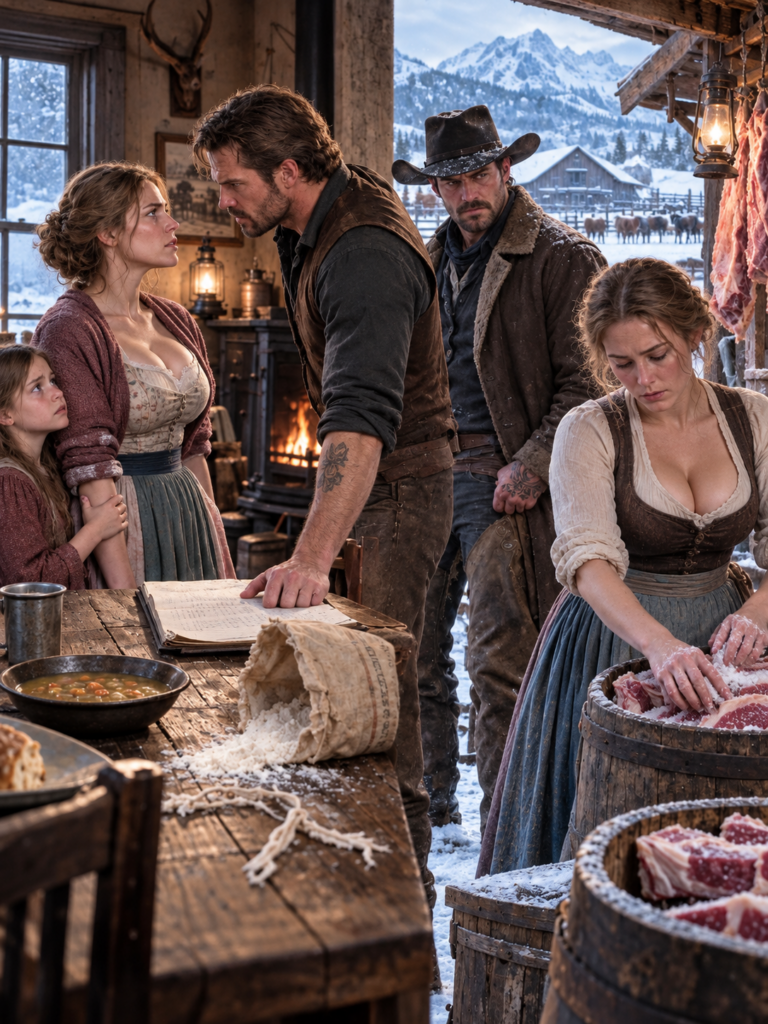
Three expected travelers reached Mercer Ranch barely ahead of the snow.
A husband and wife named Henry and Ruth Keller with two small sons.
A dry-goods salesman called Greer.
And Jasper Vane himself, who had chosen not to risk the mountain pass.
Sixteen mouths.
Possibly for days.
Possibly for weeks.
Clara stood in the pantry that evening with her notebook.
Flour.
Beans.
Cornmeal.
Salt pork.
Lard.
Dried apples.
Onions.
Potatoes.
Oats.
Coffee.
Sugar.
She calculated.
Then recalculated.
Nell sat on a grain bin swinging her feet.
“Is it bad?”
“Not yet.”
“That means yes later.”
Clara looked up.
“Who taught you to listen like that?”
“Papa.”
Of course.
Caleb had been dead three winters and remained inconveniently present in both of them.
Clara closed the notebook.
“We’re going to be careful.”
Nell looked toward the door.
“Will Mr. Mercer be careful?”
“He will once he realizes careful isn’t the same as afraid.”
That first week, nobody complained.
Clara made beef stew thickened with barley instead of flour.
She boiled bones until the marrow surrendered.
She roasted onions beneath meat so their sweetness flavored everything.
She saved bacon drippings.
Stale bread became skillet cakes crisped in pork fat.
Potato peels, scrubbed clean and roasted, appeared beside breakfast eggs.
Dried apple ends and a spoonful of molasses became something close enough to pudding that Daniel ate two bowls and then looked ashamed.
Clara handed him a third.
“You’re twenty-two,” she said. “You’re supposed to be hungry.”
“Ma’am, I could eat a saddle.”
“The saddle has already been allocated.”
He stared.
Then realized she was joking.
Word spread that Clara Whitmore had made a joke.
By supper, the story had improved into a rumor that she had laughed.
She had not.
Even Elias asked.
“Did you?”
“No.”
“Daniel swears you did.”
“Daniel thinks cards are a form of mathematics.”
“They are.”
“Then your ranch has two problems.”
Their conversations began like that.
Not flirtation.
Something safer.
Recognition.
Elias started carrying wood into the kitchen without mentioning it.
Clara began leaving a cup of coffee near his place before dawn.
He never thanked her.
She preferred that.
Gratitude made ordinary kindness feel like a debt.
But the food continued disappearing.
Three pounds of beans.
Coffee.
Cornmeal.
Clara locked the pantry.
Something still disappeared.
She changed where she kept the key.
Still.
One morning she found a flour sack in the cellar with the lower seam turned toward the wall.
She dragged it into the light.
The thread at the bottom was darker.
Almost identical.
Almost.
She had seen the trick before in Missouri.
Open a sack from underneath.
Remove five or six pounds.
Sew it closed.
Deliver it as full weight.
One ranch might never notice.
Ten ranches would make a business.
Clara thought immediately of Jasper.
Then she forced herself to stop.
Numbers were facts.
Suspicions were stories.
Confusing the two could ruin innocent people.
She kept watching.
That was when she began skipping supper.
Not as sacrifice.
At least, that was what she told herself.
She simply had less appetite at night.
And Daniel worked outdoors.
The Keller boys were growing.
Nell needed milk.
Tom Bell had an old injury that worsened in cold weather.
Ruth Keller was quietly giving half her bread to her younger son.
One plate moved more easily than a dozen.
So Clara moved hers.
Five nights.
Then Elias opened the ledger.
And Nell told the truth.
After the accusation, nobody finished supper.
Elias asked everyone except Clara and Tom to leave the dining room.
Nell refused.
Clara let her stay.
Jasper Vane remained by the fire.
Elias noticed.
“This doesn’t concern you.”
Jasper shrugged.
“My freight’s being questioned.”
“Your freight is precisely why it concerns you,” Clara said.
Jasper turned.
Something entered his face so quickly most people would have missed it.
Clara did not.
Recognition.
Then contempt.
Not fear.
That worried her more.
She placed the mismatched threads on the table.
“Several sacks were opened from the bottom and resewn.”
Jasper laughed once.
“That’s your proof?”
“No.”
“Good, because I’ve seen church picnics with stronger evidence.”
Elias said, “Jasper.”
The freighter raised both hands.
“I’m just saying what everybody’s thinking. New woman shows up. Stores go short. Suddenly the sacks are guilty.”
Clara looked at him.
“When did I say the sacks were guilty?”
His smile disappeared.
“You know what I mean.”
“Yes,” Clara said. “I usually do.”
She retrieved her notebook.
“Four months of your deliveries show the same pattern. Flour, beans, coffee, cornmeal. Three to eight pounds under invoice weight per sack.”
“Based on her scale,” Jasper said.
“Based on mine,” Elias answered.
Everyone looked at him.
He had checked.
Clara had not known.
Elias continued.
“I weighed six unopened sacks yesterday.”
Jasper’s face changed again.
This time even Tom saw it.
Elias leaned forward.
“All six were short.”
Jasper stood.
Tom moved between him and the door.
Not threateningly.
Just there.
Jasper looked toward the windows.
There was nowhere to go.
Snow hammered the glass.
“You’re making a mistake,” he said.
“Maybe,” Elias replied. “So we’ll wait until the road opens.”
“For what?”
“To visit your storage yard.”
Jasper laughed.
Too loudly.
“Search whatever you want.”
Clara said, “Not the yard.”
He turned toward her.
She saw it then.
Not guilt.
Fear.
Small.
But real.
“Old South Line shack,” Clara said.
Nobody moved.
Jasper’s eyes narrowed.
Elias looked at her.
She continued.
“Eight miles down the wagon road. Unused since spring. Close enough to your route to unload without bringing stolen goods into town. Far enough from every ranch that nobody sees you stop.”
Jasper’s hand struck the table.
“You lying—”
Tom caught his wrist before the word finished.
Nell flinched.
Clara did not.
Elias’s chair scraped backward.
“Sit down, Jasper.”
For three seconds, Clara believed violence was coming.
Then Jasper sagged.
Not dramatically.
Like a rope had been cut inside him.
He sat.
And began to laugh.
Quietly.
“You think you’ve solved something.”
Nobody answered.
He looked at Elias.
“You want to know why your ranch is starving?”
Clara felt cold move through her despite the stove.
Jasper pointed toward the window.
“Because half the valley is.”
Elias said nothing.
“Feed prices went up. Freight went up. Families owe money from last winter. Men are taking credit they can’t repay. You think you’re special because your name is on six hundred head?”
“Did you steal from me?”
Jasper’s face hardened.
“I took from men who could survive it.”
Ruth Keller had returned unnoticed to the doorway.
She whispered, “My boys couldn’t.”
Jasper looked at her.
For the first time, shame touched him.
But only for a moment.
“I sold the surplus east.”
“Surplus,” Clara repeated.
“Call it what you like.”
“I call food taken from people who paid for it theft.”
“You know what hunger is, widow?”
The word landed badly.
Clara went very still.
Jasper leaned forward.
“You think I did this because I like flour? My wife hasn’t walked without pain in two years. Doctor wants cash. Freight contracts pay late. Banks don’t care about weather. Everybody takes their piece.”
Clara thought of Caleb.
Of his hollow face.
Of the lies people told when desperation became normal.
Her anger did not soften.
Understanding a thing and excusing it were different acts.
“Yes,” she said. “I know what hunger is.”
Jasper opened his mouth.
“That is why I know better than to choose who else should feel it.”
He looked away.
They found the hidden stockpile six days later.
Not because the storm ended.
Because a roof beam in the South Line shack partially collapsed under snow, and Daniel, sent to check fence damage when the weather cleared enough to see twenty yards, spotted canvas beneath broken boards.
Elias, Tom, and two hands went out with sleds.
They returned after dark.
Clara heard the bells first.
She stepped onto the porch.
One sled carried flour.
Another carried beans, coffee, cornmeal, sugar, dried fruit.
Sacks bore marks from seven different ranches and homesteads.
Enough food to alter the entire winter.
Men began shouting.
Someone laughed.
Daniel actually kissed a coffee sack.
Then Tom climbed down from the second sled carrying a smaller wooden box.
He handed it to Elias.
“What is that?” Clara asked.
Elias opened it.
Inside were ledgers.
Not just Jasper’s theft records.
Names.
Families.
Amounts.
Food Jasper had sold back to desperate people whose original shipments he had already skimmed.
Some had paid twice for the same flour.
Ruth Keller sat down on the porch step.
Her husband’s name was in the book.
So was her father’s.
Jasper had not merely stolen from wealthy ranchers.
He had built his profit from people closest to running out.
When Clara returned inside, she found him sitting beside the stove.
Elias had not tied him.
There was no need.
The mountains did the guarding.
Jasper looked up.
“Found it?”
“Yes.”
“My wife know?”
“Not yet.”
He nodded.
Then, after a while, he said, “She didn’t know.”
Clara believed him.
That was the worst thing about truth.
Sometimes the guilty still possessed innocent pieces.
When the road reopened, Elias sent Jasper into Milhaven with Tom and the ledgers.
The county lawman took custody of him.
There was no great public reckoning.
No crowd.
No dramatic confession.
No perfect repayment.
Some food was returned.
Some had already been sold and eaten.
Some money was never recovered.
Several families still lost property that spring.
Justice, Clara decided, was often far less satisfying than stories promised.
Most of the time it looked like paperwork after damage.
Recovering the stolen food did not save Mercer Ranch.
That surprised Elias.
“You’ve got supplies now,” he said one morning.
Clara was slicing the last cured slab of pork.
“We have more supplies.”
“Isn’t that what I said?”
“No.”
He leaned against the kitchen doorway.
“Explain the difference.”
She laid the knife down.
“Your ranch was operating too close to the edge before Jasper stole anything.”
He frowned.
“You’ve got six hundred cattle.”
“And enough winter hay for how many?”
His expression changed.
She continued.
“Your men are eating on credit from spring cattle sales. Repairs are being postponed. Your oldest milk cow is producing less than half what she should. You bought coffee while owing the blacksmith. Your smokehouse roof leaks. The cook before me threw away enough fat in a month to feed two men for a week.”
“You’ve been here twenty-four days.”
“I notice things quickly.”
“I’ve noticed.”
She pushed the pork aside.
“You don’t have a theft problem anymore. You have a margin problem.”
He almost smiled.
“You planning to insult my entire life before breakfast?”
“If there’s time.”
“There isn’t.”
“Then I’ll summarize.”
She stepped toward the pantry.
“You run this ranch as if a good year is normal and a bad year is an interruption. It needs to be run as if the bad year is always somewhere on the road.”
Elias stared at her.
There are certain sentences people resist not because they seem false but because some part of them recognizes the truth immediately.
This was one.
“My father built this place.”
Clara softened.
That had nothing to do with accounting.
“He built it for a different world.”
Elias looked toward the window.
“My father never sold a breeding cow in winter.”
“Maybe your father never had to.”
“He did.”
“And what did it cost him?”
Elias did not answer.
Later Clara learned that Elias’s mother had died when he was fourteen.
Pneumonia.
There had been medicine available in town.
His father had delayed sending a rider because a storm threatened livestock.
By the time someone went, the road had closed.
People carried the economies of their childhood into adulthood like invisible furniture.
They arranged every new room around it.
Elias had built his entire ranch around never admitting something could not be saved.
Cattle.
Buildings.
Contracts.
People.
Clara knew the instinct.
She had married it once.
She had nearly become it herself.
The plan began with one injured steer.
It had gone lame after breaking through river ice.
Elias intended to feed it until spring.
Clara asked how much hay that would cost.
He told her.
She asked its likely sale value if it survived.
He told her.
Then they both sat in silence.
The steer was butchered two days later.
Nothing was wasted.
Clara salted what could be salted.
Smoked strips over applewood.
Rendered fat.
Made broth.
Dried thin pieces near the stove for travel meat.
For three days the ranch smelled rich enough to make men irrational.
Then she changed the meal system.
Breakfast became heavier.
Supper lighter.
Men working outdoors received more fat and starch than stranded guests doing little physical labor.
Coffee was served strong once in the morning instead of weak all day.
A pot of roasted barley drink appeared in the afternoon.
Greer complained.
Clara handed him the coffee ledger.
He stopped.
She put Ruth Keller in charge of bread.
Nell counted potatoes.
Daniel learned to cure meat.
Tom began weighing freight without being asked.
Elias created a reserve pantry and gave Clara the only key besides his own.
“You trust me now?” she asked.
“No.”
She looked at him.
He added, “I trust the system you built. That’s better.”
For some reason, that pleased her more.
Trust in character could become sentiment.
Trust in a system survived moods.
By February, no one was hungry.
Not comfortable.
Not full in the careless summer sense.
But nobody lay awake listening to his own stomach.
The cattle came through thinner than Elias wanted but alive.
Mercer Ranch sold fewer animals that spring.
It also owed less.
The smokehouse roof was repaired before anything else.
A second pantry scale was purchased.
Every freight delivery was weighed in the yard.
And on Clara’s suggestion, Elias formed a purchasing arrangement with four smaller ranches so they could share freight costs without depending on one supplier.
Nobody called it revolutionary.
That was another thing Clara learned.
The changes that saved people rarely looked impressive while they were happening.
They looked like measurements.
Repairs.
Lists.
A woman scraping fat from a pan because two spoonfuls were still food.
In March, the snow began withdrawing from the valley.
First from the southern fence lines.
Then from rooftops.
Then from the wagon road.
Mud replaced ice.
Birdsong returned so suddenly Nell ran outside the first morning she heard it and stood beneath a cottonwood laughing.
Clara watched through the kitchen window.
She had twelve dollars more than she had expected to save.
Elias had paid her beyond the original agreement.
She had refused the first amount.
He added it to her account anyway.
“You stayed five months for a three-week job.”
“I was fed.”
“Apparently not always.”
She gave him a look.
He did not apologize.
He had learned.
There were things Clara no longer allowed people to praise her for.
Starving herself was one.
One evening near the end of March, Elias found her packing.
Not much.
Clara and Nell had arrived with very little.
They would leave with slightly more.
He stood in the doorway of the small upstairs room.
“What are you doing?”
“Packing.”
“I can see that.”
“Then we’re both succeeding.”
“Clara.”
She folded one of Nell’s dresses.
The hem had been let down twice.
“Road should be passable next week.”
“To Helena.”
“Yes.”
He entered the room.
“You don’t have to go.”
She stopped folding.
There it was.
The sentence both of them had been avoiding since January.
Nell was downstairs with Ruth.
The room felt too quiet without her.
Elias leaned against the dresser.
“I need someone to run the kitchen.”
“You need someone to run half your operation.”
“That too.”
“I don’t want to run half your operation.”
“That isn’t what you’ve been doing?”
“No.”
She looked at him.
“I’ve been surviving winter.”
Something in his face closed.
Clara hated that she noticed.
“I could pay you.”
“I know.”
“More than you’ll make starting over in Helena.”
“I know.”
“Nell likes it here.”
“I know.”
He exhaled sharply.
“You’ve got an answer for everything.”
“No.”
She sat on the edge of the bed.
“That’s the problem.”
Elias remained standing.
Clara rubbed her palms together.
This was harder than hunger in a different way.
Hunger narrowed choices.
Safety created them.
“I came here because I wanted enough money to open a small boarding kitchen,” she said. “Not a grand place. Six rooms maybe. Eight eventually. Meals downstairs. I wanted something that belonged to me.”
“This could.”
“No.”
“Why not?”
“Because your name is painted on the barn.”
“That can be changed.”
She looked up.
“Don’t offer me things because you’re afraid of losing me.”
His face went still.
“That isn’t fair.”
“No.”
She swallowed.
“It isn’t.”
Then she told him the truth.
“I like you.”
He said nothing.
“More than is convenient.”
Still nothing.
“I like your ranch. I like Tom pretending he doesn’t care about anybody. I like Daniel cheating Nell at cards and losing anyway. I like waking before everyone else and knowing which board in the kitchen floor is cold under my feet.”
Elias’s mouth moved slightly.
“And that is exactly why I have to leave.”
He frowned.
“That makes no sense.”
“It does to me.”
She looked toward the window.
“Caleb gave everything away.”
Elias knew this story.
Not all of it.
Enough.
“The winter he died, he kept giving me his food. Then Nell’s. He said he’d eaten already. He lied so gently I mistook it for love.”
Elias sat down across from her.
“It was love.”
“Yes.”
She nodded.
“That was the tragedy.”
The words surprised both of them.
Clara continued.
“He loved us until there was nothing left of him except what he’d given away. I hated him for that after he died.”
Elias did not interrupt.
“Then I came here and did the same damned thing.”
“You stopped.”
“Nell stopped me.”
He looked down.
“And you did.”
A long silence.
“I don’t know yet how to love a place without disappearing into what it needs.”
His eyes lifted.
She gave him a tired smile.
“And Mercer Ranch needs quite a lot.”
That earned a quiet laugh.
Then his eyes became serious again.
“What if I asked you to stay for yourself?”
Clara’s throat tightened.
“That’s a better question.”
“And?”
“I don’t know.”
He looked almost angry.
Not at her.
At the existence of uncertainty.
Elias Mercer liked numbers once they had been explained to him.
This had no ledger.
He stood.
“When?”
“Thursday.”
He nodded.
Then he walked to the door.
“Elias.”
He stopped.
She wanted to say something important.
Something that would justify the months behind them.
Something he could carry.
Instead she said, “The new flour supplier is charging you four cents too much per sack.”
He stared at her.
Then he laughed.
Really laughed.
It was the first time she had heard him do it.
She laughed too.
And that was somehow worse than if either of them had cried.
They left Thursday.
Tom loaded their luggage.
Daniel gave Nell a deck of cards.
Ruth Keller, whose family had found work nearby, packed biscuits wrapped in cloth.
Elias drove Clara and Nell to Milhaven himself.
Nobody said much.
Spring had made the valley ugly before it made it beautiful.
Snowmelt exposed broken branches, old manure, collapsed fencing, wagon ruts, dead grass.
But small green shoots were already appearing wherever sunlight reached longest.
At the station in Milhaven, Elias carried Clara’s carpetbag to the platform.
The coach would continue west after noon.
Nell wandered a few yards away to look at horses.
Clara and Elias stood facing each other.
“I suppose this is where people say they’ll write,” he said.
“People say many things near departing coaches.”
“Will you?”
“Yes.”
“You could lie.”
“I keep ledgers.”
He smiled.
Then reached into his coat.
He handed her an envelope.
Clara opened it.
Inside was money.
Too much.
She looked at him sharply.
“No.”
“It’s not charity.”
“Then what is it?”
“Your share.”
“My share of what?”
“The winter.”
She almost became angry.
Then she noticed a folded sheet behind the money.
Accounts.
Savings.
Reduced freight costs.
Sale income from preserved meat.
The actual financial benefit created by her winter plan.
At the bottom, Elias had calculated a percentage.
Clara looked up.
“You’ve been keeping records.”
“I had a competent teacher.”
“This is still too much.”
“No.”
“Elias.”
“You told me feeding people was work. You told me saved waste has value. You told me a system should survive the mood of the person running it.”
She stared at him.
He nodded toward the envelope.
“So I’m following the system.”
Clara felt tears rise unexpectedly.
She hated crying in public.
“Damn you.”
“I’ve heard worse.”
“With this I could rent a kitchen.”
“I know.”
“That was deliberate.”
“Yes.”
She closed the envelope.
The coach driver called for passengers.
Nell ran back.
“Is it time?”
Clara looked at Elias.
“Yes.”
Then she did something she would later remember with embarrassment and no regret.
She stepped forward and kissed him.
Not long.
Not dramatically.
His hand rose toward her waist and stopped before touching.
When she stepped back, both of them looked slightly stunned.
“Well,” Elias said.
Clara cleared her throat.
“Yes.”
Nell rolled her eyes with the exhausting wisdom of children.
The driver called again.
Clara climbed aboard.
Elias lifted Nell after her.
He stood below as the coach started.
Nell waved until the rancher became small behind them.
Clara did not wave.
She watched.
A year later, Mercer Ranch was profitable.
Not rich.
Profitable.
Elias sold eighty fewer cattle and made more money because losses were lower.
Tom Bell required every delivery to be weighed.
Daniel ran the smokehouse.
Ruth Keller baked bread three days a week.
The reserve pantry stayed locked.
A handwritten rule hung beside it.
WHAT WE HAVE IS NOT WHAT WE CAN SPEND.
Nobody knew whether Clara or Elias had written it.
Both claimed the other had.
In Helena, Clara opened Whitmore House with six rented rooms above a kitchen that seated twenty.
The first winter nearly broke her.
Two tenants left owing money.
A stove cracked.
The roof leaked over room four.
Nell caught pneumonia and recovered slowly.
Clara once sat alone at her kitchen table at two in the morning with sixteen dollars between herself and failure.
She considered closing.
Then a freight envelope arrived.
Inside was a letter from Elias.
No money.
She was grateful for that.
Only four pages describing a broken fence, Daniel’s disastrous attempt at sausage, Tom’s opinion that city people had lost the ability to judge weather, and the first calf born during a March snow.
At the bottom he had written:
The ranch survived a woman who refused to let it eat her. I expect your boarding house can do the same.
Clara read the line three times.
Then she put the letter away and went to sleep.
Whitmore House survived.
Barely.
Then better.
Years did what years do.
They repaired some things and damaged others.
Nell grew tall.
Daniel married Ruth Keller’s niece.
Tom developed arthritis and complained about retirement for five years before finally doing it.
Mercer Ranch lost a barn to lightning and rebuilt a smaller one.
Whitmore House expanded from six rooms to nine.
Clara and Elias wrote.
Sometimes every week.
Sometimes months passed.
He visited Helena twice.
She returned to Mercer Ranch three times.
They never married.
Not because they stopped caring.
That would have made the story easier.
There were moments when Clara wondered if she had mistaken fear for independence.
There were moments when Elias wondered if letting her leave had been generosity or cowardice.
They never found a final answer.
Life rarely provides one.
When Nell turned eighteen, she asked her mother directly.
“Did you love him?”
Clara was kneading bread.
She stopped.
“Yes.”
“Do you still?”
Clara resumed kneading.
“That is not always a useful question.”
“It was a simple question.”
“Those are often the dangerous ones.”
Nell waited.
Clara finally smiled.
“Yes.”
“Then why didn’t you stay?”
Clara looked around her kitchen.
The long table.
The shelves.
The stove.
The pantry with its inventory board.
The dining room beyond it where travelers were arguing cheerfully over cards.
Her name painted on the front window.
“I did stay,” she said.
Nell frowned.
Clara touched flour from her hands.
“Just not there.”
That answer did not completely satisfy Nell.
It did not completely satisfy Clara either.
But it was true.
Elias Mercer died many years later with Mercer Ranch still operating.
His will contained no grand romantic revelation.
No secret fortune.
No impossible gesture.
He left the ranch to a nephew who had worked beside him for twelve years.
He left Tom’s widow a small monthly payment.
He left Daniel ownership of the smokehouse.
And to Clara Whitmore he left a leatherbound ration ledger.
Nothing else.
By then Clara’s hair was more silver than brown.
She sat in the kitchen of Whitmore House after everyone had gone to bed and opened the book.
The earliest pages were Elias’s.
Then came hers.
Measurements.
Flour.
Coffee.
Beans.
Cornmeal.
Pork.
Sixteen names.
She found her own.
Five supper portions crossed out.
Beside them, in handwriting that had not been there when she left the ranch, Elias had written one sentence.
She read it once.
Then again.
A person is not saved by becoming the last thing consumed.
Clara sat very still.
For all the years between them, all the letters, all the roads not taken, that was the closest Elias Mercer had ever come to telling her exactly what that winter meant.
She cried then.
Not because she wished she had married him.
Not because she wished she had stayed.
Not even because she regretted leaving.
She cried because some people become part of your life without remaining inside it.
They change the arithmetic.
They alter what you believe you are allowed to keep.
Then they continue down another road.
Clara closed the ledger.
She went to the pantry.
For most of her life, she had counted food before sleeping.
Old habits survived success.
Flour.
Enough.
Beans.
Enough.
Coffee.
Enough.
Sugar.
Enough.
Then she stopped.
On the kitchen table sat the piece of apple pie Nell had brought earlier that evening.
Clara had said she would eat it later.
For once, later had arrived.
She poured a cup of coffee.
Sat down.
Ate the pie.
All of it.
Outside, late winter snow was beginning to fall over Helena.
Somewhere beyond the mountains stood a ranch that had once been starving while everyone believed it was merely having a difficult year.
Somewhere in Clara’s memory stood a man who had hired a widow to salt pork and discovered that survival required more than food.
And somewhere inside Clara remained the woman who had once believed usefulness was the price she had to pay for her place at the table.
She knew better now.
Not perfectly.
People almost never learn the important lessons perfectly.
They learn them repeatedly.
They forget.
They remember.
They fail in familiar ways.
Then, if they are fortunate, someone notices.
Someone pushes a plate back toward them.
Someone counts them among the people worth feeding.
Clara finished her coffee while it was still hot.
Then she turned down the lamp.
THE END.