Nobody told Jeb Calloway that the woman arriving on the Thursday stage would be the kind of quiet that fills a room.
He’d sent for a wife the way a man sends for fence posts, because the ranch needed it, because the books didn’t balance, because Ruth Ann had been gone two years and the house had gone cold in ways that had nothing to do with the Alberta winter.
He’d written to a matchmaking service out of Edmonton, kept the letter short, stated his requirements plainly: capable, willing to work, no complaints about the isolation.
He did not mention loneliness.
He was not the kind of man who mentioned loneliness.
What he got was Millicent Voss.
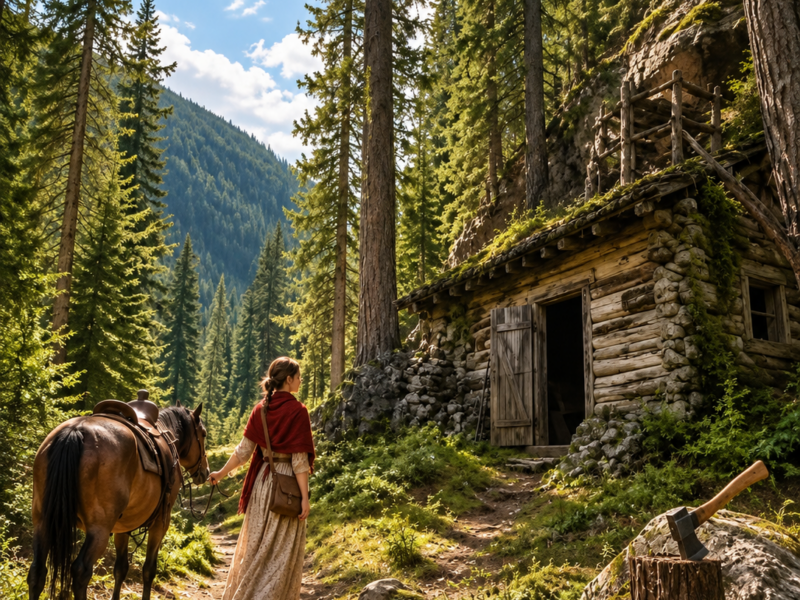
She came down the stage steps carrying one trunk and a canvas bag worn soft at the corners, and she looked at the land the way people who’ve never seen the foothills look at it. Not with wonder exactly, but with a kind of careful attention, like she was memorizing it.
She was broad-shouldered and plain-faced, with dark hair pinned back tight and hands that didn’t match the rest of her. Rough at the knuckles, capable-looking, the hands of someone who’d been working since before she should have been.
Jeb watched her from the other side of the road for a moment before he crossed.
He said his name, she said hers. They shook hands like two people closing a business deal, which was, he supposed, exactly what they were doing.
The drive back to the Calloway spread took forty minutes in the truck.
She spent most of it looking out the window. He spent most of it looking at the road and trying not to notice that she hadn’t said a word about the view.
When they pulled up to the house, she got out before he’d fully stopped, walked to the back of the truck, and lifted her own trunk without waiting for him to offer.
He watched her carry it up the porch steps.
One of his ranch hands, a young man named Saul, was leaning against the fence post near the barn watching, too.
Jeb saw the look on Saul’s face. He’d seen that look before, the kind that meant people were already deciding things.
He didn’t say anything about it.
He showed her to the back room off the kitchen, the one with the window that faced east.
She set her trunk down, looked at the window, and nodded once.
“What time do the men eat?” she asked.
“Half past six. There’s eight of them.”
“Is there a garden?”
“Behind the second outbuilding. Not much in it.”
She nodded again.
“I’ll need to see the pantry.”
He showed her the pantry.
She stood in it for a long time, not touching anything, just looking.
He didn’t know what she was seeing.
He left her there and went back to work.
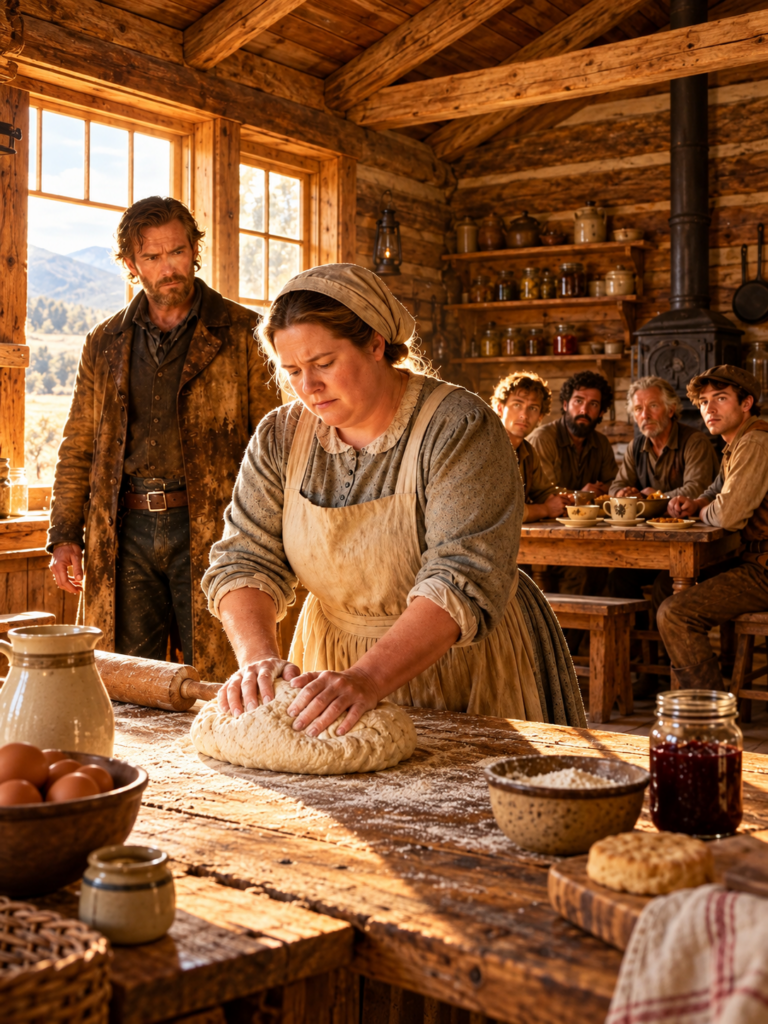
The next morning, Jeb came into the kitchen at quarter past five and found it already lit.
The wood stove was going.
The smell hit him at the door.
Something with onion and dried herbs and bread dough that had been working overnight, yeasty and warm, in a way the kitchen hadn’t smelled since his mother was alive.
Millicent had her back to him.
She was moving between the stove and the counter without hurrying, without waste.
She reached for things without looking for them, which meant she’d spent time the night before learning where everything was.
He poured himself coffee.
She didn’t say good morning, and neither did he.
He watched her for a moment from the other side of the kitchen.
She was cutting salt pork into a pan, the knife moving fast and even, and she had a pot of something simmering already that he didn’t recognize by smell.
“What’s in the pot?” he asked.
“Oat porridge with dried apple and a little maple. The men will want something hot in them before they go out.”
She glanced at the window.
“It’s going to be cold today.”
He hadn’t checked the weather.
He’d been ranching this land for seventeen years, and he hadn’t checked the weather, and she’d been here one night, and she had.
He didn’t comment on that, either.
He took his coffee and went to see to the horses.
Saul was the first one through the door that morning, the way he always was, because Saul believed breakfast was worth being early for.
He stopped just inside the kitchen doorway the same way a man stops when he walks into a room that’s different from the room he was expecting.
He looked at the table, then he looked at Millicent.
“Morning,” he said, cautious.
“Sit down,” she said, not unkindly.
He sat down.
The others came in behind him, Richie and Bo and the Schaefer brothers and old Tuck, who’d been on the Calloway spread longer than anyone could quite remember, and the two seasonal men, Pete Jr. and a Métis boy named Cal, who’d started in August and hadn’t left because nobody had asked him to.
They all came in the way men come into a kitchen that smells like that.
A little slower than usual, a little quieter, heads up.
Millicent put food on the table.
Porridge and bread and the salt pork and eggs and a jar of something dark that turned out to be a berry preserve she’d found at the back of the highest shelf, the kind that had been sitting there long enough to be forgotten.
Tuck picked up the jar and looked at it.
“Where’d you find this?”
“Behind the flour bin,” she said. “It’s still good.”
Tuck opened it, smelled it, put a careful amount on his bread, then a less careful amount.
Then he didn’t say anything for a while because he was eating.
The table went quiet in the way tables go quiet when the food is serious.
Saul finished his porridge and looked up.
“You make this yourself?”
“The preserve? That was here already, but I’ll put some up before the season’s out if there’s time.”
Saul looked at Richie.
Richie looked at his bread.
Nobody said anything.
Jeb came in at quarter to seven, later than the men, the way he always was.
He sat at the head of the table, and Millicent put a plate in front of him without being asked, the same plate she’d put in front of everyone else, which he noted.
No special treatment in either direction.
He ate.
He didn’t say it was good.
He didn’t say anything at all, but he ate everything on the plate, and when he stood up to go, he took his coffee cup to the counter himself, which was not something he had done before.
The second week was when things started shifting, though nobody would have been able to say exactly when or how.
It started small.
Millicent found the vegetable garden in worse shape than she’d let on.
The soil compacted, the beds full of a summer’s worth of neglect, the one cold frame with a cracked pane that had let in frost.
She spent three evenings out there after supper working by the last light, and on the fourth evening Tuck appeared with a replacement pane of glass he’d cut from a piece in the equipment shed and set it into the frame without being asked and without saying why he’d done it.
She thanked him.
He made a sound that might have been “you’re welcome” and went back to the bunkhouse.
The week after that, Cal started leaving firewood stacked outside the kitchen door in the mornings.
Not a lot.
Just enough so she wouldn’t have to cross the yard before the day warmed up.
She noticed.
She didn’t comment on it, which was the right thing to do.
Jeb noticed it all from a distance, the way he noticed most things, quietly, carefully, filing it away.
He watched his men change in small increments around this woman who hadn’t asked them to, who hadn’t been warm at them, or charming at them, or tried to make herself likable.
She’d just cooked the food and learned the schedule and not complained.
And somehow that was enough to do something to men who’d been eating their own mediocre cooking for the better part of two years.
One Thursday, Richie turned down a ride into Pincher Creek with the others.
When Saul gave him a look, Richie shrugged and said he wasn’t hungry for town food.
Saul, to his credit, did not make a big thing of it, but when he told Jeb about it later, leaning on the fence watching the cattle in the south field, Jeb didn’t say anything for a long moment.
Then he said, “She’s a good cook.”
Saul gave him a look that meant more than that, and both of them knew it.
What Millicent knew, and what she had known from the moment she stepped off that stage, was that she was not what anyone had pictured.
She’d learned early, young enough that she couldn’t remember learning it, that she would need to arrive somewhere other than her appearance.
She had a wide face and a fuller build, and she carried weight the way women in her family always had, solidly, without apology.
But she’d watched enough of the world to know that people made up their minds in the first thirty seconds and spent the rest of their time looking for evidence to confirm what they’d already decided.
She couldn’t change the first thirty seconds.
She could change what came after, so she worked.
Not to prove anything exactly.
She was past the age of needing to prove things.
She worked because it was what she knew how to do, because an idle kitchen made her restless, because she understood, practically, without sentiment, that the worth of her presence here would be measured by what the ranch looked like in six months, and she intended for it to look a good deal better.
She did not think much about Jeb Calloway in those first weeks.
She thought about him the way she thought about the wood stove or the water pump, as a feature of the landscape she needed to understand in order to work around.
He was closed in the way a house gets closed when it’s been shuttered too long.
Not hostile, exactly, but sealed.
She didn’t push at that.
She’d learned not to push at things that weren’t ready.
What she did notice was that he was fair.
He didn’t speak poorly of her to the men.
He didn’t make her work harder than she needed to or fence her into the kitchen when there were other things to do.
When she asked for a second shelf in the pantry, he built it himself on a Saturday morning without making a ceremony of it.
When she mentioned that the kitchen flue wasn’t drawing properly, he got up on the roof in the rain.
These were small things, but in her experience, small things were where character lived.
The trouble, when it came, came sideways, the way trouble usually does.
A woman came to the ranch in late October, Agnes Whitmore, from a property three hours north, who’d known Jeb’s late wife Ruth Ann since they were girls together in Fort Macleod.
She arrived for Sunday dinner with her husband and her eldest daughter, and she walked into the house with the ease of someone who’d been welcomed there a long time, and she looked at Millicent in the kitchen and said, pleasantly enough, “Oh, you must be the one from the ad.”
There was nothing cruel in her voice.
That was the particular thing about Agnes Whitmore.
She wasn’t cruel.
She was simply a woman who occupied a room in a way that left little space for others and who spoke with the confidence of someone accustomed to being the most considered woman present.
Millicent said that yes, she was, and kept cutting the carrots.
Agnes stood in the kitchen doorway for a moment, watching.
“Ruth Ann used to do the roast with apricots,” she said. “Jeb loved it.”
“Is that right?” said Millicent.
“I have her recipe somewhere. I could send it.”
“Thank you,” Millicent said. “Though I expect I’ll find my own way with it.”
She said it evenly, without heat, and went back to the carrots, and Agnes Whitmore moved on into the sitting room, and that was that.
Except it wasn’t quite.
At dinner, Agnes told a story warmly, nostalgically, about a harvest supper Ruth Ann had hosted, how she’d made three pies from scratch and the men had cleared them in under ten minutes.
The men who’d been there smiled at the memory.
Jeb didn’t smile exactly, but something in his face softened in a way Millicent had not seen before.
She served the meal.
She cleared the plates.
She watched Agnes Whitmore hold the table easily the way women do when they’ve known a man since before his grief and so feel entitled to a kind of proximity that a new wife cannot claim.
Later, after the Whitmore family had gone, Millicent washed the dishes in the quiet kitchen and looked out the window at the dark yard and thought with the clear, unsentimental clarity she’d always had about herself:
You are not Ruth Ann.
You were never going to be.
That is not the job.
The job was the ranch.
The job was the men eating well and the garden coming back and the household running without friction.
That was the job she’d come to do, and she was doing it.
She dried her hands and went to bed.
November came in hard that year.
The first real cold settled into the valley in the second week of the month and didn’t lift.
The mountains disappeared behind cloud, and the cattle moved restless in the fields, and the men spent more time in the barn and less time anywhere comfortable.
By the third week, the temperature had dropped enough that the morning ride was something men had to brace themselves for, and they came in at midday, if they came in at all, with cold in their bones that took time to shift.
Millicent started leaving a pot on the back of the stove, not as an announcement, not as a gesture.
She just kept a pot going, soup mostly, rotating through whatever she’d put up in the fall, and left a stack of bowls on the shelf beside it and didn’t say anything to anyone about it.
The men found it on their own.
Tuck first, then Cal, then the rest of them, and gradually midday became a thing that happened in the kitchen instead of in the cold.
Jeb came in one Wednesday around noon and found four of his men sitting at the kitchen table with soup and bread and the particular quiet of men who are warm and not in a hurry.
He stood in the doorway for a moment.
Millicent handed him a bowl without asking.
He sat down at the table, not at the head of it.
There wasn’t room, just in the nearest chair between Saul and old Tuck, and he ate his soup.
Nobody made anything of it.
That was what she’d come to appreciate about these men.
They didn’t make things into things.
They just folded new facts into the way things worked and kept going.
When Jeb put his bowl in the sink, he paused at the window.
The sky outside had gone gray and flat.
“More snow tonight,” he said.
“I know,” said Millicent. “I put the extra blankets out this morning.”
He turned from the window and looked at her for a moment.
Not the quick assessing look he’d given her in those first weeks, but something steadier.
She held it for a beat, then went back to the bread dough she was working.
He went back to work.
But that evening, when the men had eaten and the kitchen had gone quiet, he stayed at the table after the others had gone.
He had his coffee, and she was wiping down the counter, and after a while he said, “You knew about the Whitmore visit.”
She didn’t pretend not to know what he meant.
“Agnes mentioned it when she came to help in the fall.”
“Before you and I, before I arrived.”
“She say anything to you?”
“At dinner, a few things.”
He was quiet.
“I’m not troubled by it,” she said.
“I didn’t say you were.”
“No,” she agreed, “you didn’t.”
He turned his cup in his hands.
The stove ticked and settled.
“Ruth Ann was a good woman,” he said, not like he was making a comparison, like he was setting something down he’d been carrying.
“I know,” said Millicent. “From what I hear, she was.”
He nodded once, stood up, put his cup on the counter.
“The east fence needs checking tomorrow. I’ll be out early.”
“I’ll have something ready by five,” she said.
He went to bed.
She stood in the kitchen for a moment after he’d gone, listening to the wind come down off the mountain, and thought that something had shifted between them that she couldn’t quite name yet.
Not warmth, not exactly, but a loosening.
The kind that precedes warmth, if you’re patient enough to wait for it.
Winter settled in for good in December.
The ranch went quiet in the way ranches go quiet in winter, not still, but turned inward, focused on keeping the animals through and keeping the pipes from freezing and keeping the woodpiles stocked.
The work didn’t stop, it just changed shape, and Millicent changed with it.
She started baking on Saturdays.
Nothing elaborate, bread and biscuits and butter tarts, which she’d grown up making in her grandmother’s kitchen in Moose Jaw, and which she did entirely from memory, without measuring, in the way of things you learn young enough that they go into the hands rather than the head.
The first Saturday she put a pan of butter tarts on the cooling rack, Saul came in from the barn and stopped so suddenly that Cal walked into his back.
“Are those…” Saul started.
“Butter tarts,” said Millicent. “They need to cool.”
Saul stood there looking at them with an expression she recognized as the particular expression of a man experiencing a feeling he hadn’t expected.
“My grandmother made butter tarts,” he said.
“Most grandmothers did,” she said. “Sit down.”
He sat down.
She gave him one, slightly warm, and he ate it with the careful attention of someone trying to stay inside a moment.
Cal came around him and looked at the pan.
“Can I sit down?” he said.
They both sat down.
By that afternoon, the butter tarts were gone, and there was a different quality to the way the men moved around the house, easier somehow, less like workers passing through and more like people who live there.
She noticed it.
She filed it away and didn’t say anything about it, because that was how things worked best, quietly, without ceremony, until one day the quiet was just how things were.
January was the month she finally understood Jeb Calloway, not in any large or sudden way.
It was a Thursday evening, cold enough that the windows had iced on the inside, and she was mending a jacket at the kitchen table.
One of Tuck’s, the left sleeve worn through at the elbow, and Jeb came in from checking the cattle and sat down across from her, and instead of getting up again, he just stayed.
He didn’t say anything for a long time.
She kept mending.
The stove put out heat, and the lamp put out light, and outside the wind moved around the eaves.
After a while, he said, “You don’t have to do Tuck’s jacket.”
“I know,” she said.
He looked at it.
“He’ll get a new one from the co-op in the spring.”
“This one fits him. New ones take time to break in.”
She turned the sleeve over and found the underside of the elbow worn thin as well.
“He’s been letting this go for a while.”
Jeb watched her work.
She was aware of it the way you’re aware of weather, not intrusively, just as a condition of the air.
“Can I ask you something?” he said.
“Yes.”
“Why did you answer the ad?”
She kept her eyes on the stitching.
“Because it was honest.”
He waited.
“A lot of them aren’t,” she said. “The ads. They want something, but they write it in a way that lets them pretend they want something else. Yours said what it was. Capable woman wanted for a working ranch. No romance promised.”
She paused.
“I appreciated that.”
“That’s not much to go on.”
“It was enough.”
He was quiet for a moment.
“You weren’t worried about what it would be like coming here?”
She looked up.
“I knew what it would be like.”
He held her gaze.
There was something in his expression she hadn’t seen there before.
Not warmth yet, but the door to warmth standing open a crack.
“I’m not easy to know,” he said.
“Most worth-knowing people aren’t,” she said.
She went back to the jacket.
He sat there a while longer.
When he got up to go to bed, he paused at the edge of the kitchen and said, without turning around, “The fence crew’s coming Tuesday. I’ll need a big breakfast.”
“I’ll have it ready,” she said.
He went to bed.
She finished the jacket and folded it over the back of the chair for Tuck to find in the morning.
And then she sat for a moment in the quiet kitchen with the lamp on and the stove ticking down.
And she thought about what she’d said, “I knew what it would be like,” and whether it was entirely true.
She hadn’t known about the butter tarts and Saul’s grandmother.
She hadn’t known about Cal leaving wood by the door.
She hadn’t known that Tuck, who said almost nothing, would cut glass for a cold frame at dusk without being asked.
She hadn’t known about the way this land looked when the sun came off the mountains in the morning, sharp and cold and so clear it hurt to look at.
She hadn’t known about Jeb Calloway sitting at the kitchen table on a January night and asking a question that was really asking something else entirely.
So perhaps she hadn’t known everything, but she’d known enough to come.
Spring came the way spring comes in Alberta.
Not gently, but with the fierce suddenness of a season that’s been held back too long.
Warm air off the mountains and mud everywhere, and the creek running high and the cattle restless with it.
Millicent put in the garden the last week of May.
She’d been planning it since February, working it out in a notebook she kept on the shelf above the kitchen table.
What would go where, what needed to be started early, what she could put up for the winter that would carry the household further than the pantry had been carrying it when she arrived.
She’d ordered seeds through the co-op in March.
She’d started trays on the south windowsill in April.
She had help she hadn’t asked for.
Cal appeared one morning with a spade and turned the beds over without saying why.
The Schaefer brothers fixed the cold frame properly, not just the glass, but the whole frame, which had been listing to one side since before she’d arrived.
Tuck showed up with a coil of irrigation line he said he’d found in the equipment shed, which she doubted very much but didn’t dispute.
Saul planted the far bed without being asked and got the rows crooked, and she straightened them without comment when he wasn’t watching and didn’t mention it, and he never knew.
Jeb watched all of this from a distance, the way he watched most things.
One afternoon in late May, she looked up from the garden and found him standing at the fence, not working, just watching.
She stayed bent over what she was doing.
After a moment, he opened the gate and came in.
He crouched down beside the nearest bed and looked at the seedlings she’d started, the tomatoes, still tentative, and beside them the squash that was already reaching.
“You know what you’re doing,” he said.
“I grew up gardening,” she said. “My mother’s, and her mother’s before that.”
He touched the soil beside a plant with two fingers, checking the moisture.
“Ruth Ann never… She didn’t have the patience for it.”
Millicent sat back on her heels and looked at him.
He was looking at the garden, not at her.
“Different people, different things,” she said.
He was quiet.
“That’s not a failing,” she said. “It’s just different.”
He looked at her then, and she thought she saw something behind his eyes shift, the last of something he’d been holding in place giving way.
“No,” he said. “I don’t suppose it is.”
He stayed in the garden for another few minutes, looking at what she’d planted, and then he went back to work without saying anything else, which was, she’d come to understand, how Jeb Calloway said most of the things that mattered.
It was June when Saul came in from town and set a newspaper on the kitchen table and said, casual and easy, the way men say things they’ve been thinking about for a while.
“Richie was asking about Moose Jaw. Said you grew up there.”
“I did,” said Millicent.
“He’s got a cousin there. Said it’s a good town.”
“It is.”
Saul leaned against the counter.
He was young enough that he still said things directly without quite knowing he was saying them.
“You miss it?”
She thought about that honestly.
“Parts of it.”
“But you stayed.”
She looked at him.
“Of course I stayed.”
He nodded like she’d confirmed something.
He picked up his coffee and went back out, and she listened to his boots on the porch steps and thought about how much had shifted in eight months without anyone naming it.
How this kitchen had gone from a cold and careful room to a room where men left their jackets on the hooks by the door, where there was always something warm on the stove, where staying an extra few minutes after supper had become a thing that just happened.
She had built that.
Not by being charming or by making herself small or by being anything other than what she was.
She had built it by showing up and being capable and being consistent day after day and letting people come to her on their own time.
It was the only way she’d ever known how to do things.
On a Saturday in late June, she found Jeb at the kitchen table when she came in at first light.
He had coffee already made.
The first time he’d ever made coffee in the morning before she’d gotten there.
And there was a second cup set out.
She poured herself one and sat down across from him.
They drank their coffee.
Outside, the sky was going from dark to the particular shade of gray-blue that preceded the sun.
After a while, he said, “The Whitmore place is selling.”
She raised her eyebrows.
“Agnes’s husband, health trouble. They’re moving to be near their kids in Calgary.”
“I’m sorry to hear that,” she said.
“It’s a good parcel of land. Backs up to ours on the north fence.”
She understood what he was saying.
“You want to buy it.”
“I’ve been thinking on it.”
He turned his cup.
“Would need to expand the operation, more cattle, probably two more hands.”
“More mouths to feed,” she said.
“Yes.”
She looked out the window.
The gray-blue was going gold at the edge.
“You’d want to look at the soil before you decide,” she said. “North-facing land can be stubborn.”
“I know.”
“And the water rights.”
“I know that, too.”
She nodded.
He was quiet for a moment, and then he said without preamble, without ceremony, the way he said things, “I’d want to do it together.”
She looked at him.
He wasn’t looking at her with anything particular on his face, just the usual steadiness, the usual care.
But she’d learned to read him now, learned that what lived behind that steadiness was not coldness, but a kind of caution that came from having cared before and been left holding what care costs.
“I think that’s a good idea,” she said.
He nodded.
They drank their coffee.
The sun came off the mountains and through the kitchen window and put a line of light across the table between them, warm and unhurried, the way light comes when it’s not trying to prove anything, just arriving, just staying, just filling whatever space it finds.