“What condition?”
He pushed another document toward her.
The writing was old.
Brown ink.
Formal script.
She read slowly.
To be delivered to the first surviving woman of my direct blood who reaches lawful adulthood without property of her own and is denied shelter by the household of her father.
Marabel stopped breathing.
At the bottom:
Ambrose Elias Calder, 1807.
She whispered, “He described me.”
“No,” Orson said.
“He described a condition.”
“He died eighty years ago.”
“Yes.”
“He could not have known me.”
“He didn’t.”
“Then why is my name on the notice?”
“Because Rowena spent twelve years proving you were the first descendant who satisfied the terms.”
Marabel looked up sharply.
“Descendant?”
Orson nodded.
“Your mother’s grandmother was Ruth Calder.”
The room seemed to tilt.
“My mother never said that.”
“Perhaps she didn’t know.”
“Rowena did.”
“Yes.”
“What exactly did Ambrose Calder ship?”
Orson hesitated.
That frightened her more than if he had answered immediately.
“Come with me.”
He led her through a rear corridor.
Past locked cages.
Past barrels marked for mountain settlements.
Past a wall of dusty ledgers.
At the end stood a storage room.
Orson unlocked it.
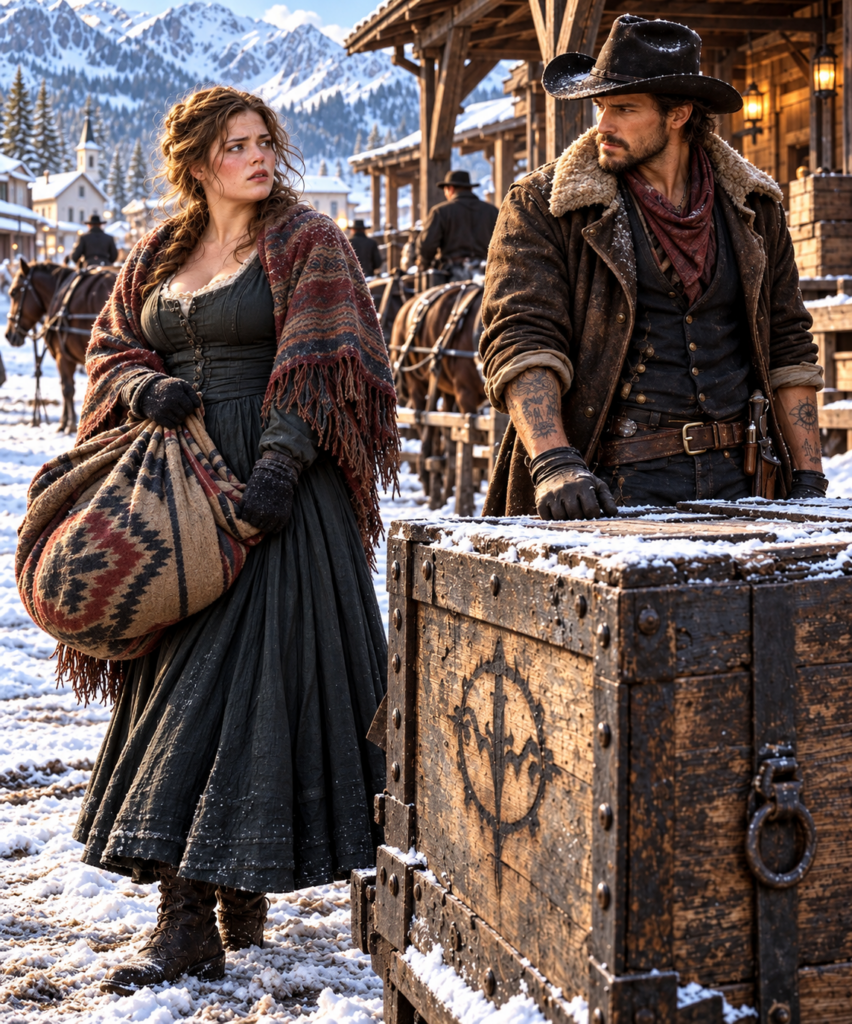
The crate rested beneath a canvas sheet.
Four feet wide.
Iron corners.
Blackened oak.
Old enough that its wood looked almost like stone.
Marabel stepped closer.
And saw the mark burned into the side.
A mountain.
A crooked river.
And beneath it, the initials A.C.
“What was he?” she asked.
Orson did not answer.
“Mr. Vale.”
He exhaled.
“Ambrose Calder was officially a freight runner.”
“Officially?”
“Unofficially, he was the most notorious smuggler who ever used Frostwater Pass.”
Marabel stared at the crate.
“He smuggled what?”
“Whatever people would pay him to move.”
“Whiskey?”
“Sometimes.”
“Gold?”
“Yes.”
“Guns?”
“According to some accounts.”
Her stomach tightened.
“What else?”
“Medicine. Letters. People.”
“People?”
“Families who had debts they could never repay. Workers escaping contracts. Women whose husbands had decided marriage meant ownership.”
Orson paused.
“Calder was not a hero, Miss Daker. Don’t romanticize him. He charged money. Sometimes too much. He abandoned partners when frightened. He lied professionally. He made enemies because occasionally he cheated men who deserved cheating and occasionally he cheated men who didn’t.”
“Then why keep his crate?”
“Because someone paid eighty years of storage in advance.”
Marabel looked at him.
“How?”
Orson gave the crate a troubled glance.
“Twenty-two gold pieces deposited with the original freight house. The storage charges were taken from their value generation by generation.”
“Eighty years?”
“Compound accounting works miracles when nobody steals the ledger.”
She almost smiled.
Almost.
Then Orson said, “There’s something else.”
“What?”
“Three weeks ago, two men came asking whether Ambrose Calder had living descendants.”
The smile died before it formed.
“Who?”
“They work for Roderick Sable.”
Everybody in Frostwater knew that name.
Sable cattle moved across half the western valley.
Sable timber supplied four towns.
Sable money sat behind loans, freight contracts and mortgages.
“What does Roderick Sable want with an eighty-year-old smuggler?”
Orson looked at the crate.
“I was hoping you could tell me.”
Marabel placed her hand against the old wood.
It was cold.
For one absurd second, she imagined she could feel the pulse of eighty years beneath her palm.
Then someone knocked hard at the station’s front door.
Once.
Twice.
Three times.
Orson went still.
“We’re closed,” he called.
A man’s voice answered.
“Mr. Vale, open the door.”
Marabel recognized the voice.
She had heard it once at a livestock auction.
Wade Branick.
Roderick Sable’s range manager.
Orson turned toward her.
Neither spoke.
Branick knocked again.
And this time he said something that made every hair on Marabel’s arms rise.
“I know Gideon Daker’s daughter is in there.”
Orson did not open the door.
He led Marabel through the storage room into a covered loading yard while Branick continued knocking at the front.
“Take the alley to Thorne’s office,” he whispered. “Ask for Imogene Thorne. Tell her Rowena’s chain is active.”
“What chain?”
“She’ll know.”
“What about the crate?”
“You cannot claim it without witnesses.”
“Then get witnesses.”
“Branick is outside.”
Marabel looked at him.
“Which is precisely why I want witnesses.”
Something almost approving moved through Orson’s expression.
“Rowena taught you well.”
“Apparently she expected an examination.”
“She expected worse.”
Twenty minutes later, retired county recorder Imogene Thorne entered the station through the rear door carrying a cane she seemed perfectly capable of walking without.
With her came Leander Shaw.
Marabel knew him by sight.
Thirty-one.
Carpenter.
Repairman.
Broad shoulders, weathered face, light brown hair that never seemed to obey whatever had been used to flatten it that morning.
He looked at the locked front door.
Then the crate.
Then Marabel.
“You’re Gideon Daker’s daughter.”
“Marabel.”
“Rowena talked about you.”
That surprised her.
“What did she say?”
“That someday everybody who thought you were standing in the corner would discover you’d been listening.”
Marabel swallowed.
“That sounds like her.”
They filed the claim.
Every page.
Every witness.
Every seal.
Orson recorded the crate’s condition before Marabel touched it.
Imogene examined Rowena’s twelve-year chain of inheritance and pronounced it cleaner than many courthouse records.
Only then did they break the seal.
Inside were four objects.
Twenty-two gold coins.
A leather tube.
A sealed packet of sworn statements.
And a deed.
Marabel unfolded the deed first.
She read the description twice.
Then a third time.
Four hundred thirty-eight acres in Frostwater Valley.
Not impressive by western standards.
Until she reached the final clauses.
Water rights.
Three underground reservoirs.
Silver Creek.
Brennan Fork.
North Hollow Spring.
Her breath caught.
She unrolled the map from the leather tube.
Blue lines traced invisible water beneath the valley.
Streams.
Aquifers.
Springs.
Drainage routes.
Leander leaned over her shoulder.
“That’s Sable land.”
“Some of it,” Imogene corrected.
“No,” Marabel whispered.
She had spent twelve years learning how property records fit together.
Now the pieces assembled in her head.
“Not some.”
She pointed.
“That parcel belongs to Sable.”
Another.
“That one too.”
Then another.
“And that.”
Orson’s face drained.
Leander understood next.
“He’s been buying everything above the reservoirs.”
Marabel nodded.
“But surface ownership does not automatically include these older water rights.”
Imogene looked at the Calder deed.
“And this deed predates every one of his titles.”
Silence.
Water was more valuable than pasture.
More valuable than timber.
A man could survive losing half his cattle.
He could not survive when someone else controlled the creek.
Marabel looked at the map.
Eleven farms.
Three ranches.
Frostwater itself.
All downstream.
“Roderick doesn’t want Ambrose Calder’s land,” she said.
“No,” Orson replied.
“He wants this deed.”
A fist struck the front door again.
Branick.
Marabel looked at the crate.
“What are the sealed statements?”
Imogene examined the packet.
“Testimony dated 1806.”
“About what?”
“We won’t know unless we break the seal.”
“Should we?”
“Not here.”
Marabel remembered Rowena teaching her that evidence was most vulnerable between discovery and registration.
“Then we don’t open it.”
Leander glanced at her.
“You’ve been homeless for about six hours and somebody just handed you control of half the valley’s water.”
“Not control.”
She carefully refolded the deed.
“Evidence.”
“There’s a difference?”
“There had better be.”
Branick finally left.
That evening, Marabel met Dorian Vetch, an attorney in Millhaven who had built his reputation representing people with more stubbornness than money.
He read the Calder documents until nearly midnight.
When finished, he removed his spectacles.
“Well.”
Marabel waited.
He looked at her.
“You have inherited either a fortune or a catastrophe.”
“Which?”
“That depends on your character.”
“I was hoping it depended on law.”
“So does everyone.”
He tapped the deed.
“The title appears legitimate.”
“The water?”
“Potentially yours.”
“Potentially?”
“Sable will challenge everything.”
“On what basis?”
“Whatever basis costs you the most money.”
She leaned back.
“I have twenty-two gold coins.”
Dorian smiled without humor.
“He has twenty-two lawyers if he wants them.”
Leander, who had driven Marabel to Millhaven because Orson refused to let her travel alone, shifted near the stove.
“So what does she do?”
Dorian looked at Marabel.
“Decide what she wants before Roderick Sable tells her what she wants.”
Roderick arrived the following afternoon.
He did not send Branick.
He came personally.
That frightened Marabel more.
Sable was fifty-two and handsome in the disciplined way of wealthy men who had spent their lives expecting rooms to adjust around them.
He removed his hat when he entered Dorian’s office.
“Miss Daker.”
“Mr. Sable.”
“I’m sorry about the unpleasantness at your father’s home.”
Her eyes narrowed.
“How do you know about that?”
“Small town.”
“It happened yesterday.”
“Very small town.”
Dorian remained behind his desk.
“What do you want, Roderick?”
Sable looked only at Marabel.
“To solve a problem before it becomes expensive.”
He placed a document on the table.
Offer of purchase.
Thirty thousand dollars.
Marabel stared.
Her father’s entire ranch might sell for five thousand in a generous year.
“You’re offering thirty thousand for land you claim belongs to you?”
“I’m offering thirty thousand to prevent ten years of litigation.”
“That’s generous.”
“It is.”
“Why?”
“Because you are young, Miss Daker. You have no property, no husband and, as I understand it, no home.”
Leander’s jaw tightened.
Marabel did not look at him.
Sable continued.
“Thirty thousand dollars buys choices.”
“So does water.”
Something flickered behind his eyes.
There.
Small.
But real.
He had not expected her to understand.
Marabel felt something cold settle into place.
“You knew what was inside the crate.”
Sable smiled.
“I suspected.”
“How?”
“Old family records.”
“Your family?”
“Our families have known of one another for a very long time.”
Dorian said, “Careful.”
But Marabel was already moving.
She placed the sealed testimony on the desk.
“What did Ambrose Calder know about your family?”
For the first time, Roderick stopped smiling.
He stood.
“Thirty thousand.”
“No.”
“Think before answering.”
“I did.”
His eyes rested on her face.
Then on her body.
Then on her worn dress.
It was not desire.
It was accounting.
He saw what Odessa saw.
A large unmarried woman without money.
Somebody who had never been chosen.
Someone who should be grateful when a powerful person offered her value.
“You will regret pride,” he said.
Marabel met his gaze.
“I’ve survived shame. I’m curious to see how pride compares.”
He left.
Dorian waited until the door shut.
“Forty thousand.”
“What?”
“He would have paid forty.”
“That’s not the point.”
“I know.”
“Then why say it?”
“Because refusing money feels different when you know how much of it you refused.”
Marabel looked toward the window.
“What happens now?”
Dorian’s expression hardened.
“Now he stops asking politely.”
The first attack looked like an accident.
One of the retaining pins on Leander’s wagon had been removed.
The wheel came loose halfway back to Frostwater.
Had they been descending the mountain grade instead of climbing it, both might have died.
Leander examined the pin housing.
“Metal didn’t fail.”
“I know.”
“You know wagons?”
“I know scratches.”
He looked at her.
“Someone pulled it.”
“Yes.”
For a long moment the two stood in the snow.
Then Leander said, “You can still sell.”
Marabel turned on him.
“You sound like Sable.”
“No.”
He stepped closer.
“I sound like a man standing beside a wagon somebody tried to break while you were inside it.”
“So I should give him what he wants?”
“I didn’t say that.”
“What are you saying?”
“I’m saying dead people are very generous with the courage of the living.”
That stopped her.
Leander pointed back toward Millhaven.
“Ambrose Calder put something in a box eighty years ago. Rowena spent twelve years preparing you to open it. Neither of them has to sleep tonight wondering whether somebody will put a bullet through the window.”
Marabel felt anger rising.
But beneath it was something more uncomfortable.
Truth.
“You think I’m foolish.”
“I think everybody around you keeps deciding what your life should cost.”
His voice softened.
“I don’t want to join them.”
The anger left as quickly as it came.
They repaired the wagon enough to return slowly.
At dusk, someone was waiting outside the Frostwater Hotel.
Gideon Daker.
Her father.
Marabel stopped.
He looked older than he had two days before.
That irritated her.
Cowardice should not earn a man the dignity of looking wounded.
“Marabel.”
She walked past him.
“Please.”
She stopped.
Not because he deserved it.
Because she wanted to know.
“Did you tell Odessa to put me out?”
His silence answered.
Marabel nodded.
“I see.”
“It wasn’t supposed to happen that way.”
“What way did you imagine?”
“You finding work. A room.”
“You imagined me thanking you?”
“No.”
“Then explain.”
Gideon looked at Leander.
“This is family.”
Marabel laughed once.
A hard sound.
“Family disappeared before breakfast.”
Leander walked inside without another word.
Gideon rubbed his hands together.
“Sable came to me last month.”
Marabel went still.
“What?”
“He knew about your mother.”
“What about her?”
“Her Calder blood.”
“You knew?”
“I knew the name.”
“How long?”
“Since before we married.”
The hurt landed differently from Odessa’s words.
Those had been cruelty.
This was history being rewritten while she stood inside it.
“My mother knew?”
“Yes.”
“And Rowena?”
“Yes.”
“And nobody told me.”
“Your mother wanted you kept out of it.”
“Out of what?”
Gideon looked toward the street.
“Sable.”
He explained.
Twenty-seven years earlier, before Marabel was born, Elise Calder had come to Frostwater carrying a family Bible and one surviving letter from Ambrose.
Roderick’s father, Horace Sable, learned who she was.
He offered Gideon money to persuade Elise to surrender any Calder claim.
She refused.
After Marabel’s birth, Elise made Gideon promise their daughter would never be told unless someone reopened the old freight registration.
“Then Rowena found it,” Marabel whispered.
Gideon nodded.
“Years later.”
“And you?”
“I asked her to leave it buried.”
“Why?”
“Because I remembered Horace Sable.”
“He’s dead.”
“Men teach their sons.”
She looked at him.
“And when Roderick came last month?”
“He offered to clear the ranch debt if I convinced you to leave Frostwater.”
Marabel stared.
Gideon looked ashamed.
She wanted that to satisfy something.
It did not.
“You sold me.”
“No.”
“You exchanged my safety for your debt.”
“I was trying to keep you safe.”
“By making me homeless in January?”
“I thought if you left before the crate was released—”
“How did Sable know Rowena had named me?”
“I don’t know.”
“Did you tell him?”
“No.”
“Did Odessa?”
Silence.
Marabel understood.
“Oh.”
“Marabel—”
“She knew.”
“Only enough.”
“She threw me out because Sable wanted me gone.”
“She thought it would protect the ranch.”
“Our ranch?”
Gideon lowered his eyes.
“Her future.”
There it was.
The arithmetic Odessa understood perfectly.
Marabel had never been part of that future.
She walked toward the hotel door.
Gideon caught her sleeve.
“I’m sorry.”
She looked down at his hand.
He released her.
“I love you,” he said.
Marabel almost wished he had said something cruel.
Cruelty would have been easier.
“I believe you.”
Hope rose in his face.
Then she added, “That doesn’t make what you did safe.”
She went inside.
She cried that night.
Not for the house.
Not for Odessa.
For the terrible adult discovery that someone could love you and still fail you in ways that changed your life.
Love did not always prevent cowardice.
Sometimes it merely made cowardice more painful.
Dorian opened the sealed testimony three days later with Imogene, Orson, Marabel and two independent witnesses present.
Ambrose Calder’s confession was not flattering.
He admitted bribery.
Smuggling.
Fraud against freight companies.
He admitted abandoning a partner named Thomas Wren during a winter pursuit and wrote that the choice had haunted him.
But the final pages concerned Silas Sable, Roderick’s great-grandfather.
Silas had tried to purchase the Calder water rights.
Ambrose refused.
Soon afterward, a surveyor who had mapped the underground springs died in what officials recorded as a riding accident.
Ambrose claimed it was murder.
He had two witnesses.
Their statements were in the packet.
More importantly, Ambrose explained why he had refused to sell.
The water rights were never meant to become a private empire.
Hidden inside the deed was a covenant.
Marabel read it.
Then read it again.
Dorian watched her.
“What?”
She pushed the page toward him.
He read.
“Oh.”
Leander leaned forward.
“What?”
Dorian sat back.
“Miss Daker has not inherited three reservoirs.”
Marabel felt almost relieved.
Then Dorian continued.
“She has inherited trusteeship over them.”
“What does that mean?”
“It means she can manage the water.”
“Sell it?”
“No.”
“Use it?”
“Yes.”
“Profit?”
“Only enough to maintain delivery, according to this.”
Dorian looked at Marabel.
“If this covenant survives legal challenge, the water belongs in perpetuity to the properties historically dependent upon it.”
Leander slowly smiled.
“Sable can’t own it.”
“No.”
“Neither can Marabel.”
“No.”
Marabel stared at the document.
Thirty thousand dollars had disappeared.
Perhaps forty.
The fortune she had refused had never truly been hers.
And unexpectedly, she began laughing.
Not elegantly.
Not softly.
She laughed until tears came.
Dorian looked concerned.
“Are you all right?”
“No.”
She wiped her eyes.
“But I think Ambrose Calder just cheated Roderick Sable eighty years after dying.”
Even Imogene smiled.
The legal hearing took six weeks.
Sable produced his own deed.
It appeared to show Ambrose transferring the water rights to Silas Sable in 1808.
One year after the crate had been sealed.
Dorian looked worried.
Marabel did not.
She studied the page.
Something bothered her.
The paper was plausible.
The handwriting skillful.
The language nearly perfect.
Nearly.
Then she saw the seal.
She remembered Rowena Pike beside the freight window twelve years earlier.
Don’t read only the words.
Why?
Because liars know you’ll read the words.
What should I read?
Everything they forgot was talking.
Marabel asked Imogene for the county seal register.
They compared impressions.
The symbol on Sable’s supposed 1808 transfer included a six-point mountain star.
The county had not adopted that version until 1821.
Thirteen years later.
Dorian looked at her.
“You’re certain?”
Marabel pointed to the old seal register.
“Page forty-three.”
Roderick Sable watched from across the room.
His face changed.
Only slightly.
But Marabel saw it.
The forgery collapsed.
The testimony stood.
The Calder covenant survived.
Yet victory, when it came, did not feel like the stories said it would.
There was no cheering crowd.
Roderick did not collapse dramatically.
He simply became a wealthy man who had lost something he believed he deserved.
That was dangerous enough.
Then spring arrived.
Snow melted quickly in the high country.
Silver Creek swelled.
And someone closed the old North Hollow diversion gate.
Within forty-eight hours, three ranches lost irrigation flow.
Within seventy-two, Frostwater’s lower cistern fell by half.
Everyone knew who had done it.
Nobody could prove it.
Marabel rode with Leander to North Hollow.
They found Branick there with six Sable men.
“You’re trespassing,” Branick called.
Marabel dismounted.
“On what?”
“Sable property.”
“The gate controls Calder trust water.”
“The gate sits on Sable ground.”
“Move.”
He laughed.
Marabel unfolded the old map.
“Open the gate.”
“Or what?”
She looked past him toward the mountains.
Snowmelt had turned the upper reservoir dark and high.
Too high.
Ambrose’s map showed an overflow channel that nobody used anymore.
If the gate remained closed and warm rain arrived, pressure would force water through the western embankment.
Below that embankment lay Sable pasture.
A bunkhouse.
And nearly two hundred cattle.
Leander saw her expression.
“What?”
She pointed.
“If he keeps it closed, the reservoir breaches west.”
“When?”
“I don’t know.”
Thunder rolled over the ridge.
Branick heard.
He looked upward.
Rain began.
Hard.
Leander swore.
“Marabel.”
She had a choice.
Do nothing.
Let Sable’s own sabotage destroy Sable property.
It would prove the danger.
Perhaps ruin him.
Perhaps kill men who worked for him.
Men who had wives.
Children.
Debts.
Men who might not even know why the gate had been closed.
Ambrose Calder had once left a partner behind to save his cargo.
He had spent the rest of his life regretting it.
Marabel looked at Branick.
“Open the gate.”
“No.”
“The western bank will fail.”
He hesitated.
“You’re lying.”
“I’m not.”
Water thundered somewhere beneath them.
Branick looked frightened now.
Marabel stepped toward the gate.
He blocked her.
“If that bank goes,” she shouted over the rain, “your bunkhouse is directly below it!”
That did it.
Two Sable hands turned toward Branick.
One said, “Wade?”
Branick cursed.
“Open it.”
The mechanism resisted after years of neglect.
Leander and three men threw their weight against the wheel.
Metal screamed.
Then moved.
The gate opened.
Water exploded through the channel.
It tore branches loose, flooded part of the lower road and destroyed twenty yards of fencing.
But the reservoir dropped.
The bank held.
Nobody died.
Later, standing soaked beside the roaring channel, Branick stared at Marabel.
“You could’ve let it go.”
“Yes.”
“Sable would’ve lost thousands.”
“Yes.”
“Why didn’t you?”
Marabel looked at the water.
“Because there were men sleeping below it.”
Branick laughed bitterly.
“You think that makes you better than him?”
“No.”
She folded Ambrose’s map.
“I think choosing again tomorrow might.”
Roderick Sable never admitted ordering the gate closed.
Branick left his employment three months later.
The civil judgments forced Sable to sell several western parcels, though he remained richer than almost everyone who disliked him.
Life rarely punished people with satisfying precision.
Gideon Daker lost part of his ranch too.
The debt Odessa believed Sable would erase remained.
Marabel could have saved it.
She had enough from the gold coins and modest trustee fees to help.
She paid one overdue note.
Not all of them.
Gideon came to see her after.
“I don’t deserve that.”
“No.”
“Then why?”
“Because losing everything doesn’t teach everybody the lesson we hope it does.”
He looked at her.
“Will you come home?”
Marabel smiled sadly.
“I have a home.”
“Will you forgive me?”
She considered the question.
“I already understand you.”
“That isn’t what I asked.”
“No.”
He nodded.
She reached across the table and took his hand.
“I don’t know yet.”
That was the last honest thing she could give him.
Odessa never apologized.
She left Gideon the following winter and moved east to live with a widowed cousin.
Marabel received one letter from her.
It contained no admission of wrongdoing.
Only six lines explaining that difficult choices had been made for the preservation of the household.
Marabel read it.
Then used it to start the stove.
Not every relationship deserved restoration.
Some deserved an ending.
Others deserved distance.
Gideon visited once or twice each month.
They drank coffee.
Sometimes they talked.
Sometimes they did not.
Marabel never moved back.
The pencil marks remained on the bedroom doorframe.
Perhaps Odessa painted over them.
Marabel never asked.
Leander built a small office beside Frostwater Station where Marabel kept the trust ledgers.
Every rancher and farmer could inspect them.
Every gallon allocation.
Every repair cost.
Every payment.
Nothing hidden.
The first sign outside read:
CALDER WATER TRUST
Leander hated it.
“Sounds like a cemetery.”
“What would you call it?”
“Water office.”
“That sounds like a place where people complain.”
“They are going to complain.”
He was right.
They complained constantly.
Too much water.
Too little water.
Wrong day.
Broken channel.
Mud.
Fees.
Neighbors.
Cattle.
People turned out to be considerably less grateful after being saved than stories suggested.
Marabel loved the work anyway.
One evening in October, almost a year after the crate arrived, she and Leander sat on the loading platform watching the last freight wagon disappear east.
He handed her an apple.
She took it.
“Are you ever going to marry me?” he asked.
Marabel nearly dropped the apple.
“You’ve never asked.”
“I’ve been considering it.”
“For how long?”
“Seven months.”
“That is an alarming amount of consideration.”
“I’m careful.”
“You fell off a roof in May.”
“That roof was dishonest.”
She laughed.
Then grew quiet.
Leander did too.
“I don’t know,” she said.
“About me?”
“About marriage.”
He nodded.
No wounded pride.
No performance.
That was one of the things she loved about him.
She looked down at her hands.
“I spent most of my life believing being chosen by somebody would prove I was worth keeping.”
“And now?”
“Now I’m suspicious of anything I want for the wrong reason.”
“That sounds inconvenient.”
“It is.”
Leander took a bite of his apple.
After a while, he said, “I can wait.”
She looked at him.
“For an answer?”
“For you to ask yourself the right question.”
Her throat tightened.
She leaned against his shoulder.
He did not turn the moment into a promise.
Life had taught them both to distrust promises made simply because silence felt uncomfortable.
The following spring, Marabel finally visited Rowena Pike’s grave.
She brought no flowers.
Rowena had considered cut flowers foolish.
“Let them grow,” she used to say. “Dead people do not need gardening.”
So Marabel brought the brass compass.
She sat in the grass.
“I opened it,” she said.
Wind moved through the cottonwoods.
“You could have explained more.”
Nothing.
“You could also have mentioned the part where everyone tried to ruin my life.”
Still nothing.
Marabel smiled.
Then she noticed something.
The inner lining of the compass lid was loose.
She worked one fingernail beneath the thin brass plate.
It lifted.
A folded strip of paper had been hidden underneath.
Rowena’s handwriting.
Of course.
Marabel unfolded it.
Only four sentences.
Ambrose believed inheritance meant sending property into the future.
He was wrong.
We send consequences.
What arrives becomes the responsibility of whoever is still alive.
Marabel read it again.
Then looked across the valley.
Water flashed silver through the fields.
Some of those farms belonged to people she liked.
Some belonged to people who had laughed at her weight.
Some had ignored her when she was poor and suddenly discovered politeness once she held the deed.
One belonged to a widow whose children would have gone hungry without the spring allocation.
Another belonged to a man who still called Marabel “that big Daker girl” when he thought she could not hear him.
The water reached both.
That was the difficult thing about fairness.
It was only fairness when you gave it to people you would rather deny.
Marabel folded Rowena’s note.
She thought about Ambrose Calder.
Smuggler.
Liar.
Coward on at least one terrible winter night.
Protector on others.
A man neither good enough to worship nor evil enough to dismiss.
He had not sent a treasure through eighty years.
He had sent an unfinished decision.
Rowena had not prepared Marabel because she believed Marabel was special.
She had prepared her because she believed competence mattered more than charm, and because someone had finally noticed that the large quiet girl standing near the freight counter was listening.
Her father had loved her and failed her.
Odessa had rejected her and never regretted it.
Roderick Sable had lost and remained wealthy.
Leander loved her, but love had not magically cured her fear of depending on someone.
Nothing had arranged itself neatly simply because justice had won one argument.
Maybe that was why the valley looked more beautiful now.
It was real.
Marabel stood.
She placed the compass in her pocket instead of leaving it on the grave.
“No,” she said.
“You gave it to me.”
She began walking back toward Frostwater.
Halfway down the hill she saw Leander waiting beside the road with two horses.
He raised one hand.
She raised hers.
He did not ask what Rowena had written.
Not yet.
Below them, the old freight station caught the afternoon light.
Inside, Ambrose Calder’s crate sat empty against the wall.
Marabel had refused to throw it away.
People occasionally asked why.
She never had a satisfying answer.
Perhaps because empty things could still tell the truth about what they once carried.
Perhaps because she remembered arriving in Frostwater with thirteen dollars, two dresses and nowhere to sleep.
Perhaps because a box could wait eighty years and still change a life in a single afternoon.
Or perhaps because Marabel understood something now that she had not understood the morning Odessa closed the door behind her.
Being unwanted in one house did not mean there was no place in the world that required you.
Sometimes the thing that looked like abandonment was only the brutal moment before responsibility found your address.
She reached Leander.
He handed her the reins.
“Ready?”
Marabel looked once more at Rowena’s grave.
Then toward the valley.
“No,” she said.
Leander smiled.
“Good enough.”
They rode home anyway.
THE END.