Part 1
The first thing Nancy noticed was the sound.
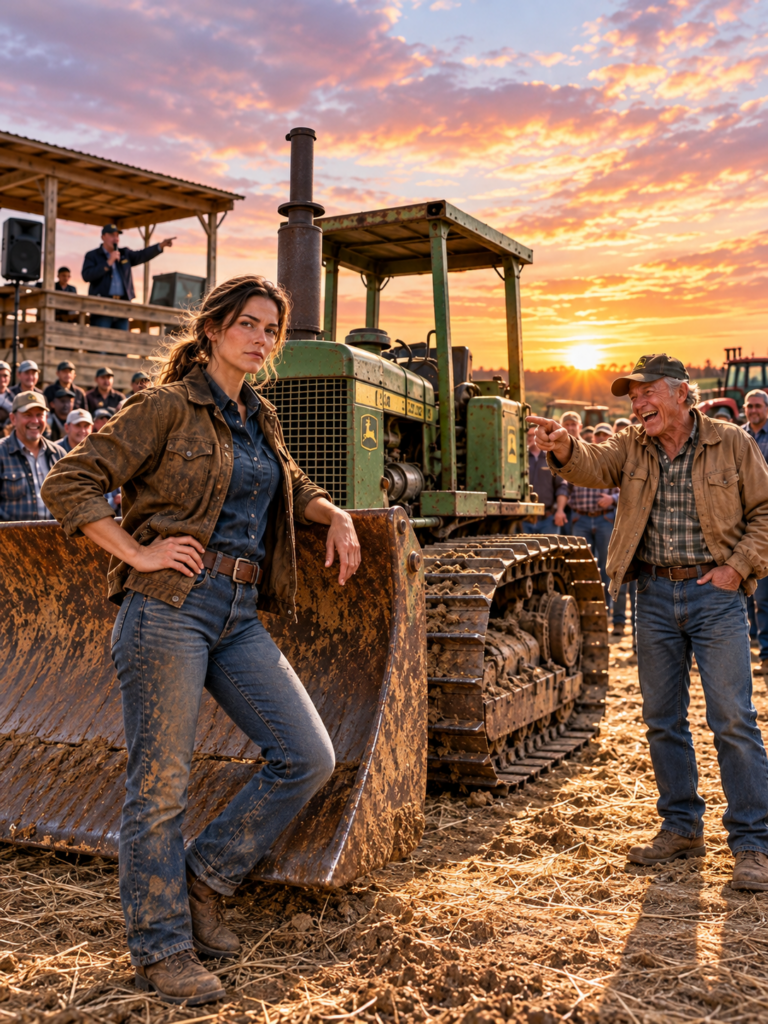
Not the diesel engine’s deep, uneven knocking, though that was loud enough to turn heads across the auction yard. And not the laughter coming from the men gathered beside the old John Deere crawler.
It was the sharp metallic clank that came from beneath the machine whenever its left track turned.
The crawler had traveled barely a few yards before the operator brought it to a stop. Its faded green paint was scratched down to bare steel in places. The blade had been worked hard for years, and the vinyl seat was split open along one side. Mud had dried in thick layers around the undercarriage, hiding more than it revealed.
To most of the men watching, the machine looked like an expensive mistake waiting for a buyer.
To Nancy, it looked like a question nobody had bothered to answer.
“Thinking about buying that junk Deere, rookie?”
The remark came from somewhere behind her.
Nancy didn’t turn. At thirty years old, she had spent enough time around broken equipment and men who doubted her judgment to know that responding to every remark was a poor use of daylight.
“Not before I hear it run,” she answered.
A man standing near the auction truck shook his head.
“Hear that knock? Rod bearing, I’d say.”
“Sounds sharper than that,” Nancy replied. “Could be an injector.”
Howard Treadwell stood beside the crawler with his hands planted on his hips. At seventy-two, he had the weathered face and unhurried movements of a man accustomed to running his own farm and expecting things to be done his way.
“That wreck wouldn’t haul one of my silage wagons,” he said.
Nancy finally looked at him.
“How many need hauling?”
Howard gave a short laugh.
“Haul twelve loads in two days, and I’ll pay you two thousand dollars.”
“Put it in writing,” Nancy said. “I’ll haul all twelve.”
Something changed in the crowd.
The men who had been laughing quieted. Even the auctioneer lowered his microphone as he watched the exchange.
Howard studied Nancy for a long moment.
She was wearing a faded canvas work jacket, scuffed boots, and gloves with grease darkening the seams. Nothing about her suggested that she had come to the sale with money to waste. She had the stillness of someone who preferred to think before speaking.
Howard looked from her to the crawler, then toward the distant pasture behind his barn.
He had another proposition.
“You want something in writing?” he asked.
“I want us both to know exactly what we’re agreeing to.”
Howard pointed toward a dark tangle of brush running beyond the barn and across the lower edge of his property.
“See that old fence line?”
Nancy followed his gesture.
The line was nearly invisible beneath thorn bushes, saplings, dead limbs, and years of tangled growth. What had once been a clear boundary between fields now looked like a long, uneven wall of briars.
“One mile,” Howard said. “I’ve got a fence crew coming Monday morning. They need that whole line opened so they can work.”
Nancy said nothing.
“Clear it by Sunday night, and that Deere is yours.”
She glanced at the crawler.
“And if I don’t finish?”
“You walk away with nothing.”
Behind Howard, someone gave a low whistle.
It was an ugly bargain, at least on the surface. The machine might be worth a great deal if it could be made dependable. It might also consume days of labor, a considerable amount of repair money, and every spare hour Nancy had before the weekend ended.
Worse, she would be betting her work on a crawler that had already frightened away the other buyers.
But Nancy wasn’t looking at the scratched blade or the ruined seat.
She was remembering what had happened during the demonstration.
When the left track began sagging, one of the workers had taken a grease gun to the track adjuster. As grease entered the assembly, the front idler slowly moved forward, drawing tension back into the chain.
For a little while, the track looked almost normal.
Then the slack returned.
Nancy had watched fresh grease appear beneath the adjuster housing.
The other men had been looking at the loose track.
She had been looking at why it wouldn’t stay tight.
Vernon Stokes, a contractor whose opinion carried considerable weight around local equipment sales, had taken one look and declared the entire undercarriage finished.
Nobody had challenged him.
Several buyers simply walked away.
Nancy knew Vernon could be right. Worn pins, ruined rollers, and damaged components could turn an old crawler into a bottomless repair bill. She also knew that a leaking adjuster could make otherwise serviceable tracks look far worse than they were.
The difference was not something she could settle by arguing beside an auction truck.
She needed tools, proper measurements, and time.
“That fence crew arrives Monday?” she asked.
“First thing.”
“And I have until Sunday night?”
“That’s what I said.”
Nancy looked down the length of the overgrown boundary once more.
“Then I want the job limits written down. Both end posts. How wide the passage has to be. And what I’m expected to remove.”
Howard narrowed his eyes.
“You planning to argue over every thorn bush?”
“No. I’m planning to make sure we agree when the work is finished.”
One of the men chuckled, but Howard didn’t.
He understood contracts. He had spent too many years buying, selling, and working land not to recognize why she was asking.
He turned to the auctioneer.
“Pull the Deere from bidding. We’re settling this another way.”
A few minutes later, Howard returned from the office trailer with paper in his hand.
Nancy read the agreement carefully.
She made sure it identified the two boundary posts, the required clearance for the arriving fence crew, and the work itself: brush and fallen limbs within the agreed corridor, not standing timber outside the route.
If she completed the clearing by Sunday night, the John Deere crawler would become hers.
If she failed, she would receive nothing for her labor.
Howard signed first.
Nancy took the pen and signed beneath him.
For a moment, the only sound between them was the auctioneer beginning to call bids on a hay baler farther down the yard.
Howard folded his copy.
“You’re going to need more than confidence.”
Nancy looked toward the Deere’s sagging left track.
“I know.”
Then she added, almost to herself, “I’m going to need that adjuster to hold.”
The auction continued as though nothing remarkable had happened.
People moved on to the next tractor. The crowd thinned around the old crawler. Men who had laughed at Nancy’s decision found other things to discuss.
Howard remained where he was.
“Still time to change your mind,” he said.
Nancy crouched beside the left front idler.
The ground beneath the adjuster was damp with fresh grease. She touched the dark streak with one gloved finger and studied where it disappeared into the housing.
“Not until I know what’s causing this.”
“You really think you can fix it?”
“I think I know where to start looking.”
Howard gave a noncommittal grunt.
He wasn’t a fool. He knew enough about machinery to recognize a loose crawler track as a serious problem. He had also been around long enough to distrust anyone who promised an easy repair without opening a single component.
Nancy didn’t promise him one.
By late afternoon, a neighbor who hauled heavy equipment had arrived with a lowboy trailer and a winch.
Nancy helped secure the loose track before loading the Deere. She wasn’t about to drive it up steep ramps with a chain that could climb off a sprocket without warning.
The crawler was pulled aboard carefully.
Steel chains tightened against its frame.
Howard watched from beside his pickup as the battered machine was prepared for the trip to Nancy’s shop.
“You’ve got a lot of work between now and Sunday,” he called.
Nancy checked the last tiedown.
“I’ve noticed.”
She didn’t look back when the truck pulled out.
Her thoughts were already moving through the possible failures hidden beneath the Deere’s caked mud.
Nancy’s shop was a plain working building with a low roof, stained concrete, and tools collected over years of repairing county road equipment.
There was no polished sign out front.
The workbench had scratches worn into it from heavy steel parts, and the walls held rows of wrenches, clamps, and equipment that looked older than some of the machines still working in the county.
Inside that familiar space, the John Deere seemed much larger than it had at the auction.
Its blade nearly filled the open area near the shop entrance. The broad tracks carried the smell of old grease and packed earth, and the faded hood showed scars earned long before Nancy had ever seen it.
She walked around the crawler once, studying the undercarriage from several angles.
The left chain hung lower than it should.
She knew what could happen if that track came loose under load. A crawler that lost a chain in open ground was trouble enough. Losing one beside a ditch or on a slope could turn the repair into something far more dangerous.
Nancy pulled an old service manual from the shelf and spread it across her workbench.
The diagram of the track adjustment system was simple enough in principle.
Grease pressure moved the front idler forward, tightening the track. Seals held that pressure. If they failed, the idler could retreat and the chain would gradually loosen.
But the diagram also reminded her how many other parts could create similar symptoms.
Worn bushings.
Damaged rollers.
A bent component.
A failing recoil assembly.
She wrote each possibility on a piece of cardboard.
Then she wrote one more word.
Leak.
She circled it.
The stain beneath the crawler was evidence, not proof. A leaking seal might explain the loss of pressure, but it wouldn’t necessarily explain everything.
Nancy closed the service manual only after checking the procedures she would need.
The clock had moved past supper.
She looked toward the machine.
Every hour spent repairing it would come out of the time she needed to clear Howard’s fence line.
But taking a damaged crawler into a mile of rough, thorn-covered ground would cost her considerably more if something broke.
There was no shortcut worth taking.
Thursday morning arrived before sunlight reached the shop windows.
Nancy had already positioned the crawler securely and begun scraping hardened mud away from the left track assembly.
The work was slow and dirty.
Packed clay came loose in stubborn chunks. Old grease clung to the steel beneath it. She worked methodically until the adjuster housing was clean enough to show where the newer grease had escaped.
The trail led behind the seal.
That confirmed her suspicion, but it didn’t yet tell her why the seal had failed.
Nancy positioned her light closer and reached for a wrench.
Then she stopped.
Her scraper had caught against something rough on the exposed section of the adjuster rod.
She cleaned the metal with a rag.
A narrow band of rust pits emerged beneath the grime.
Nancy moved the light until it shone directly across the surface.
Most of the pitting was shallow.
One mark was rough enough to catch her fingernail.
She stared at it for several seconds.
“There you are.”
The old seal traveled across that section of the rod. Every time the damaged surface passed against the sealing lip, it could wear or cut the rubber. Replacing the seal without addressing the rod would leave the underlying problem untouched.
The Deere might hold its tension in her shop and lose it again halfway through Howard’s pasture.
She wasn’t interested in that kind of repair.
Nancy consulted the service manual again, relieved the adjuster pressure with the machine properly supported, and left the heavy recoil spring assembly undisturbed.
That spring held forces she had no reason to disturb for the work she was doing.
Once the damaged sealing components were removed, she laid them carefully on a clean board.
The old seal was hard.
When she bent it between her fingers, a split opened along one edge.
There was no mystery about whether it had been sealing properly.
She set it beside the fresh replacements she had obtained from a farm equipment supplier and turned her attention to the rod.
The condition of that surface would determine whether the repair could succeed.
She cleaned away the corrosion, then worked carefully on the shallow roughness. After each pass, she checked the metal again. The goal wasn’t to remove enough steel to make the rod look pretty. It was to restore a smooth sealing surface without damaging its dimensions.
If the corrosion had formed a deep groove, she would have needed another solution.
Fortunately, the damage had not gone that far.
By early afternoon, Nancy had fitted the new seals and reassembled the adjuster.
She inspected the visible recoil components, checked the assembly, and began pumping grease into the adjuster.
Slowly, the front idler moved forward.
The slack came out of the chain.
Nancy stopped pumping and watched.
A minute passed.
Then another.
No fresh grease appeared.
She wiped the housing clean, waited, and checked it again.
Still dry.
For the first time since the auction, she allowed herself a small smile.
But the machine hadn’t earned her confidence yet.
She climbed into the torn seat, started the diesel, and listened as the engine settled into its familiar heavy knock.
Then she eased the crawler across the firm ground behind the shop.
Forward.
Reverse.
A broad turn.
The left track remained tight.
Nancy circled again, this time crossing a shallow ridge in the yard.
No clank.
No sudden slack.
The crawler was moving as it should.
Then, during another turn, she noticed the chain traveling slightly toward the side of the front idler.
The smile disappeared.
She stopped the machine immediately.
From the ground, the problem was easier to see.
The track tension was holding, but fresh scuff marks showed where the chain had rubbed against the idler.
One problem was solved.
Another had been hiding behind it.
Nancy knelt beside the track as afternoon light stretched across the yard.
She wiped the idler clean and studied the uneven contact marks.
The chain wasn’t wandering randomly. It was being guided sideways by something that wasn’t sitting square.
She checked the mounting bolts and measured the position of the idler carriage against the track frame.
The difference was small.
Small enough that a person looking at the crawler from a few feet away might never notice.
But every turn placed enormous strain on that assembly. A little misalignment could become a serious problem when the blade was pushing against heavy brush.
Nancy continued inspecting until she found a guide plate hidden beneath another layer of old mud.
The plate had worn thin.
Over time, it had allowed the idler carriage to shift sideways. Months of operation with a loose track had polished a bright groove into the surrounding steel.
She leaned back on her heels.
Now she understood why Vernon had condemned the machine.
From the outside, the symptoms had looked like a completely worn-out undercarriage.
But they came from two problems working together.
The adjuster had lost pressure.
The worn guide had allowed the idler to drift out of alignment.
Repairing one without the other would have left the crawler vulnerable to another failure.
Nancy went inside and searched her drawers of labeled steel stock.
She found a plate of suitable thickness and set it on the workbench.
She cut and fitted a replacement guide, carefully checking its position and clearance against the service information.
When everything sat square, she tightened the fasteners and measured again.
Then once more.
The readings agreed.
Outside, the sun was already sinking toward the trees.
She could have called the repair finished.
The Deere had crossed the yard without throwing a track. Its adjuster was holding pressure. The machine sounded stronger than it had at the auction, even with its familiar engine knock.
But Nancy knew better than to confuse one good test with a reliable machine.
She checked the track tension again and climbed aboard.
The diesel started.
She drove forward, reversed, turned across uneven ground, and lowered the blade against a shallow pile of loose dirt.
The crawler pushed steadily.
She backed away, turned, and repeated the test.
No clank came from beneath her boots.
She shut down the engine and inspected the left idler.
The chain was centered.
The tension remained steady.
She checked the opposite side, then returned to the repaired assembly for one final look.
Only then did she put away her tools.
The shop clock read well past supper.
Nancy stood in the doorway, looking at the machine as it cooled in the gathering darkness.
She had spent nearly an entire day repairing the Deere and had not cleared a single foot of Howard’s mile.
Friday morning would be the first time the crawler worked against real brush, uneven soil, and whatever years of neglect had left hidden along that old fence.
She looked at the dark line of the tracks.
The Deere might be ready.
Whether the ground would let her finish was another question entirely.
Part 2
Friday morning came cold and gray.
Mist hung low over the pastures behind Howard Treadwell’s barn, settling between the fence posts and softening the outline of the distant tree line.
Nancy arrived before sunrise.
The lowboy trailer stood beside the gate with the John Deere secured on its deck. The driver was already loosening the transport chains when she climbed down from her pickup.
She walked straight to the crawler’s left track.
The tension had held overnight.
She checked the idler carriage, studied the repaired adjuster, and inspected the chain before allowing the driver to finish preparing the machine for unloading.
Howard appeared from the direction of the farmhouse carrying a thermos.
He stopped a few feet away.
“Looks different without that track hanging off it.”
“That’s generally how I prefer them.”
Howard took a drink of coffee.
“You sure it’s ready?”
Nancy looked beyond him toward the overgrown fence.
“Ready to find out.”
He studied her for a moment.
“Long way to go.”
“I measured it when we signed.”
That earned the faintest suggestion of a smile.
But neither of them said what they were thinking.
The crawler might be repaired, yet Nancy still had to get one mile of abandoned fence line ready before the crew arrived Monday.
And she had never seen most of the ground she was supposed to clear.
Nancy walked the first stretch before starting the machine.
She carried a length of bright cloth and marked the agreed working width on the old posts.
The boundary wasn’t straight.
It bent around a rise, dipped through lower ground, and disappeared behind a stand of oaks. Multiflora rose covered sections of the old fencing, and fallen branches lay among the briars.
There were groundhog holes, shallow ditches, and the remains of posts that had rotted at ground level.
Any one of them could catch a track.
Nancy stopped beside a half-buried post and worked it loose enough to see where it lay.
A crawler blade could push an astonishing amount of brush, but it couldn’t distinguish between harmless growth and a hidden object that might damage the undercarriage.
She wanted to know what she was driving into.
By the time the trailer was unloaded, the eastern sky had begun turning pale gold.
Nancy climbed aboard the Deere.
She checked the controls and started the engine.
The diesel rattled awake, then settled into its steady working rhythm.
Howard stood beside his pickup near the barn, watching.
Nancy eased the crawler toward the first wall of thorn bushes.
The blade met the growth with a dry crackling sound.
Branches bent, snapped, and gathered into a rolling heap before the steel.
For a moment, the bushes seemed unwilling to move. Then their roots and tangled stems began giving way, and the crawler advanced.
Nancy kept the blade raised just enough to take the brush without stripping away the good topsoil beneath it.
Howard’s new fence crew needed access, not a trench running across the pasture.
She pushed a manageable pile toward an opening outside the marked corridor, backed onto cleared ground, and approached the next section.
The old Deere turned smoothly.
Its tracks moved in the same deliberate rhythm.
No metallic clank followed.
Nancy listened anyway.
She knew the sounds of a crawler under load. The engine changed its note when the blade gathered too much material. The tracks made different noises when soil packed beneath them or when one side met resistance.
She paid attention to all of it.
Twice that morning, she stopped to check the repaired idler and pull tangled vines away from the track frame.
Each inspection cost time.
Each one also reassured her that the machine was still holding together.
Near midmorning, the first bend in the boundary finally appeared.
Nearly a quarter mile of brush had been flattened, gathered, or moved beyond the corridor.
Nancy shut down the engine and climbed off.
She stood with one boot resting against the crawler’s track and looked back toward the barn.
For the first time, there was daylight through a section of fence line that had been hidden for years.
Howard drove along the newly opened edge of the pasture and stopped beside her.
“Well,” he said, getting out, “you got farther than I figured.”
Nancy wiped her forehead with her sleeve.
“The easy part was supposed to go first.”
Howard followed her gaze.
Beyond the bend, the land descended into a shaded hollow.
Dark soil showed through the grass.
Water glistened in shallow depressions.
A fallen oak lay across the old boundary, its trunk partly buried in years of leaves and vines.
The brush had been troublesome enough on dry ground.
Soft earth was another matter.
Howard stared toward the hollow.
“My contractor wouldn’t even take a truck through there after a rain.”
“Then I’m not taking a crawler through blind.”
She returned to her toolbox and brought out a steel probe.
Howard watched as she walked the hollow, testing the ground in several places.
The center was soft. When she pressed the probe down, it entered the soil with little resistance.
Closer to the upper edge, however, the ground was firmer.
Nancy made several more checks before marking a narrow approach along that side.
She didn’t need to drive through the deepest mud if the higher ground would allow her to reach the brush from an angle.
Back at the Deere, she raised the blade slightly.
The crawler crept forward.
Instead of pushing straight into the hollow, she worked along its upper edge, taking smaller cuts from the thicket and moving the material toward solid ground.
Twice the tracks slipped against damp clay.
Each time, Nancy backed onto firmer soil and changed her approach.
She refused to force the crawler through a place where it was beginning to lose traction.
The work was much slower than the morning’s first quarter mile.
By noon, sweat had dampened the shirt beneath her canvas jacket, and the fallen oak still blocked the route ahead.
Nancy stopped the Deere on stable ground.
She climbed down and walked to the trunk.
The tree was too large to move safely as a single piece. Its branches had become tangled with vines, and parts of the trunk rested unevenly against the ground.
She cleared enough growth to understand how the wood lay, then carefully cut the trunk and limbs into manageable sections.
Only when the pieces could be moved without pulling against standing growth did she return to the crawler.
One section at a time, the Deere pushed the wood away from the marked passage.
The blade scraped against bark.
Mud shifted beneath the tracks.
The diesel worked harder, its low note deepening as the machine carried the load.
Nancy kept her movements controlled.
She wasn’t going to win the machine by destroying it.
When the last section of oak lay outside the corridor, she backed up and checked the left track.
The links rose around the idler and returned squarely into place.
No slack.
No sideways drift.
No clank.
She rested one hand against the warm steel housing.
“Keep doing that,” she murmured.
Then she climbed aboard again.
Late Friday afternoon, Nancy reached a weathered post near the halfway point of the mile.
The sun was dropping behind the ridge, throwing long shadows across the newly opened path.
She had spent nearly the entire day working.
Her arms ached from the manual cutting, and her shoulders were stiff from operating the crawler over uneven ground.
Behind her, the cleared corridor wound from Howard’s barn through the hollow and past the fallen oak.
Ahead of her, the brush grew taller and denser.
Howard arrived just before sunset.
He stepped from his pickup and looked over the passage Nancy had made.
For several moments, he said nothing.
Then he walked around the crawler and looked down at its left track.
“Still on there.”
Nancy leaned against the side of the machine.
“That’s usually where I like to keep it.”
Howard laughed.
It was the first time his amusement seemed directed at something other than her chances of failing.
But the expression faded when he looked farther down the fence line.
Beyond the last cleared post, the briars rose nearly to shoulder height. Dead vines hung from young trees, and rusted wire disappeared beneath thick growth.
“You’ve got the worst stretch coming.”
Nancy followed the old fencing with her eyes.
“Looks that way.”
“That fence has been down a long time.”
“How long?”
“Long enough I stopped thinking about what was under it.”
Nancy didn’t like the sound of that.
Years of abandoned wire could be more dangerous to the Deere than the bushes themselves.
A strand hidden beneath the leaves could wrap around the tracks or catch beneath the blade. Broken posts could turn into wedges. Rusted fencing could drag loose material into the machine before she had time to react.
Howard glanced at the sinking sun.
“You’re still on the clock.”
“I know.”
“You’ve got Saturday and Sunday.”
Nancy looked toward the tangled stretch ahead.
She wanted to finish before Sunday.
Not because Howard had demanded it, and not merely to prove the auction crowd wrong.
She wanted to leave herself a margin for the things that went wrong when a person had no time left to fix them.
She reached for her tools.
“Tomorrow,” she said, “we find out what’s hiding in there.”
Saturday dawned with a pale ribbon of light above Howard’s eastern pasture.
Nancy had slept poorly.
Each time she closed her eyes, she could picture the wall of briars waiting beyond the halfway post.
She arrived before the farmhouse kitchen light came on.
The crawler stood where she had left it, its blade coated with dried mud and crushed leaves.
She checked the left track before anything else.
Still tight.
The idler was centered, and the repaired guide showed no sign of movement.
She cleaned packed debris from around the track frame, checked the machine, and then walked ahead with wire cutters hanging from her belt.
She hadn’t gone far when she found the first obstruction.
A broken cedar post lay beneath a mat of vines.
Nancy pulled the growth aside.
Three strands of rusty barbed wire stretched low across the route.
One disappeared beneath the soil.
Another led toward a tree whose trunk had grown around an old fence staple.
She stood still and imagined what would have happened if she had driven the crawler forward without checking.
The blade might have caught the post, pulling the wire tight.
From there, a loose strand could have been dragged beneath a moving track.
A single careless pass might have ended the entire job.
Nancy walked back to the Deere but left the engine silent.
For the next hour, she worked by hand.
She cut sections of wire loose, pulled them clear of the vines, and carried them beyond the working corridor.
She coiled the lengths where no track or truck tire would find them.
Some pieces came free easily.
Others were trapped beneath roots or wound around broken posts.
Thorns caught her jacket.
One sharp cane tore a narrow line across her glove.
The sun climbed steadily while the visible line of clearing barely changed.
Nancy checked her watch, then kept working.
By the time she finally started the Deere, her back was already sore.
The blade pushed into the cleared tangle and rolled a heavy mass of rose canes toward an open patch beyond the fence.
The machine worked beautifully.
It was almost infuriating.
The crawler could move more brush in a minute than Nancy could clear by hand in an hour.
But every few yards, another piece of rusted wire appeared.
Every time, she stopped.
Engine off.
Climb down.
Find the wire.
Cut it.
Pull it clear.
Climb back aboard.
Start again.
She could feel the morning disappearing.
Near ten o’clock, Howard’s pickup bounced along the opened path.
He stopped when he saw the coils of wire piled beside a stump.
He stared at them.
“That fence has been down twenty years.”
Nancy stood with her cutters in one hand.
“You forgot some of it was still here.”
“Looks like I forgot most of it.”
She gestured toward the Deere.
“Your crawler hasn’t forgotten how to work. I’d like to keep it that way.”
Howard looked at the machine, then toward the distant corner that was still invisible behind the brush.
He seemed less interested in whether Nancy could operate it now.
The problem was whether she could finish the mile.
“Fence crew calls me tonight,” he said. “They’ll want to know whether to bring their trucks Monday.”
“Tell them to bring them.”
He turned toward her.
“You sound awfully sure.”
Nancy looked down the tangled corridor.
She wasn’t sure.
There was too much she couldn’t see.
Her muscles were tired, the morning was slipping away, and the last stretch might contain worse hazards than anything she had found so far.
But she knew the Deere was working.
She knew the repairs were holding.
And she knew she would accomplish nothing by standing beside Howard’s pickup discussing the possibility of failure.
She hooked the cutters back onto her belt.
“Better get moving, then.”
The next several hours demanded more patience than strength.
Nancy followed the old fence line through blackberry canes and dead brush, cutting wire whenever she found it.
The crawler advanced in short sections.
Some stretches opened quickly.
Others seemed to conceal a new obstruction every time the blade touched the growth.
Near noon, Nancy felt a hard jolt beneath the seat.
She pulled back immediately.
The blade had struck a buried fence post lying crosswise against an old stump.
Its base was tangled in roots and wire.
She shut down and climbed off.
A stronger push could have driven the post toward the crawler’s tracks.
Nancy knelt beside it, cleared the wire, and worked the broken timber loose.
It took nearly forty minutes before she could move the obstruction safely aside.
By then, her hands were trembling slightly with fatigue.
A church bell sounded in the distance.
She realized she hadn’t eaten since before dawn.
Howard arrived a short while later carrying a jug of water and a paper sack.
He set both on the tailgate of his pickup.
“You’re not going to finish faster if you fall over.”
Nancy looked at the sack.
Inside was a ham sandwich and an apple.
For once, she didn’t argue.
She drank deeply, then ate standing beside the pickup while looking down the fence line.
Howard studied the open corridor.
“How far?”
“Past halfway. Not three quarters yet.”
He looked at his watch.
“You know tomorrow’s still part of the deal.”
“I know.”
“Then why are you driving yourself this hard?”
Nancy swallowed another bite.
“Because I don’t know what’s waiting in the last quarter mile.”
Howard glanced toward the bushes.
He didn’t have an answer for that.
After lunch, Nancy changed her method.
Instead of pushing long, tangled heaps forward, she opened shorter sections, walked them to check for wire, and moved smaller loads sideways into the pasture.
The Deere had to reverse and turn more often, but it stopped wasting power against piles that only became harder to control as they grew.
The work began moving faster.
Every turn tested the repair.
Every load tested her patience.
And each time she climbed down, the left track remained where it belonged.
By midafternoon, Nancy reached a crooked white marker post.
She shut down the crawler and stepped onto the newly cleared ground.
Through a gap in the growth, she could finally see the far corner of Howard’s field.
The sight should have been encouraging.
Instead, she stood staring.
A quarter mile remained.
And the thicket between her and the last post was thicker than anything she had faced all weekend.
Part 3
The last quarter mile began with a wall of tangled growth taller than Nancy’s shoulders.
Wild grape vines stretched between young hickories, binding the saplings together. Dead branches lay suspended in the tangle, and thick stems twisted around one another until it was difficult to tell what belonged to which tree.
Somewhere beyond that barrier stood the final corner post.
Nancy rested her cutters on the Deere’s running board and walked the route again.
She found stones hidden beneath fallen leaves and a shallow wash where rainwater had carried soil downhill.
A straight push would drive the blade toward the ground. The crawler might climb over the uneven section, but it could just as easily catch a track on a buried obstruction.
She studied the slope, then returned to the machine.
The diesel started with its familiar heavy knock.
Nancy raised the blade slightly and approached the outer edge of the thicket.
Instead of trying to break through the center, she took narrow sections from the side, shaving away the tangled growth and pushing each load toward the open pasture.
The work was deliberate.
The blade caught a wall of vines, bending the stems until they snapped free. The tracks gripped the dry rise, and the machine advanced a few more feet.
She backed out and approached again.
Gradually, the opening widened.
The Deere handled the work without complaint.
Nancy could still remember Vernon Stokes standing beside it at the auction.
That whole undercarriage is finished.
He had sounded certain.
And he hadn’t been entirely unreasonable.
The loose track, the grease escaping beneath the adjuster, and the clanking from the idler had suggested a machine that was nearing the end of its useful life.
But Nancy had learned something through years of mechanical work.
A symptom could point toward several different failures. The expensive explanation wasn’t always the correct one.
The rusted adjuster rod had damaged the seal. The failing seal had allowed pressure to escape. The worn guide had permitted the idler carriage to shift sideways.
None of those problems had made the crawler young again.
They had simply prevented it from doing work it was still capable of doing.
A heavy grape vine suddenly stretched tight across the blade.
Nancy eased off the controls.
The vine was attached to a standing sapling beside the corridor. Another push could bend the tree toward the crawler and bring it down across the machine.
She shut off the engine.
Climbing down carefully, she moved clear of the tensioned growth and cut the vine loose.
Only after the obstruction was safely removed did she climb back aboard.
Her shoulders ached.
The muscles across her back felt as stiff as the canvas jacket she wore.
But when she looked through the widening gap, she could see more open ground ahead.
She started the diesel again.
Late afternoon sunlight turned the pasture gold.
Howard appeared near the far edge of the clearing, walking where his pickup could no longer follow.
He stopped beside a section Nancy had just opened and looked back along the route.
For a moment, neither of them spoke.
The old fence line had been hidden beneath brush for so long that Howard had almost forgotten what the land looked like without it.
Now he could see the slope of the pasture, the shadows beneath the oaks, and a pale strip of disturbed grass winding toward the distant barn.
“Never thought I’d see daylight through here again,” he said.
Nancy remained seated on the Deere.
“Don’t count it yet.”
Howard looked toward the last stretch.
Then he nodded and moved out of her way.
Nancy worked another hour.
Short pushes.
Careful turns.
Frequent checks for hidden obstacles.
At last, the distant corner post appeared between two stands of saplings.
She felt a brief surge of relief.
Then she saw what stood between her and the finish.
A dense knot of dead limbs and thorn vines was packed against the final gate opening.
An old hedge stump held part of the growth in place. A leaning section of fence crowded the opposite side.
There was barely enough room for the blade.
Nancy slowed the crawler and stopped.
She could have forced her way forward.
The Deere was strong enough to push much of the brush through the gap.
But doing so would create a pile directly in the entrance the fence crew needed Monday morning.
She would reach the final post without leaving a usable passage.
And the agreement wasn’t simply to reach the end.
It was to clear the route.
Nancy shut down the diesel and climbed off.
Howard watched from several yards away.
She walked around the pile, using a hooked stick to pull the vines aside.
Beneath them were broken wooden rails and another length of rusted wire.
She cut the wire, coiled it, and carried it beyond the path.
Then she dragged the rails away, one at a time.
Her gloves had become stiff with dirt.
When she straightened, her hands trembled.
Howard said nothing.
Earlier in the week, he might have offered an opinion about what she ought to do. He might have pointed at the machine or reminded her how little time she had remaining.
Now he simply waited.
Nancy found a patch of firm earth beside the hedge stump, just wide enough to allow a careful turn.
She studied the approach from the ground.
Then she returned to the Deere.
The engine came to life.
She raised the blade and eased into the outer edge of the brush.
A small pile rolled away from the gate.
She backed out.
Turned.
Approached again.
The next load moved clear.
A thorn branch caught against the blade and snapped toward the hood.
Nancy stopped the machine, shut it down, and cleared the branch before continuing.
She had come too far to let impatience make the final decision.
Another careful pass opened more of the entrance.
Through the settling dust, the last post appeared.
It stood alone against the western sky.
Nancy stared at it for a second.
Then she made one final pass, shaving the remaining brush from the agreed corridor.
The blade pushed the last loose pile away from the opening.
She reversed onto firm ground, lowered the blade, and shut down the engine.
Silence settled over the pasture.
Nancy climbed off the machine and crouched beside the left idler.
The track was centered.
The tension was holding.
After two days of difficult turns, uneven ground, and heavy blade loads, the repaired assembly was still doing exactly what it was supposed to do.
She touched the steel, then slowly stood.
Behind her, Howard called out.
“Is that the end?”
Nancy walked through the gate opening.
She turned and looked back.
The cleared corridor stretched across his property, past the old fence posts, through the hollow, around the fallen oak, and toward the distant barn.
Brush lay in piles outside the marked passage.
The old wire was removed from the working route.
The gate stood open.
“That’s the end,” she said.
Howard started toward her, but Nancy raised a hand.
“Walk it before you say so.”
He stopped.
She met his eyes.
“I want you to know exactly what you’re getting.”
Howard looked from Nancy to the open fence line.
Then he reached into his pocket for his truck keys.
“All right.”
He turned toward his pickup.
“Let’s see what you finished.”
Howard drove slowly along the newly opened corridor.
Nancy followed in the Deere, keeping enough distance between the machines to watch where his truck went.
The pickup moved past the first fence post.
Its tires crunched over dry stems and gravel.
At the hollow, Howard stopped and climbed out.
He studied the route Nancy had chosen along the firmer upper ground.
The brush was piled away from the passage, leaving room for the fence crew to approach without driving into the soft center.
Farther along, he inspected the fallen oak.
Nancy had cut the trunk into manageable sections and moved them clear.
He found the coils of old wire beside the boundary, safely away from the route.
He checked the wider turns and the stretches where the corridor passed between posts.
Then he reached the final gate.
He parked the pickup and walked the last portion on foot.
Nancy shut down the crawler and waited.
For the first time all weekend, she had nothing left to repair, cut, carry, or push.
That should have been a relief.
Instead, her thoughts kept returning to the contract.
Howard could still find something she had overlooked.
A stump too close to the passage.
A pile of brush in the wrong place.
Some obstruction that would force Monday’s workers to stop before they could begin.
She had spent two days imagining what it would feel like to own the Deere.
Now, with the work finished, she tried not to think about it.
Howard walked slowly back toward her.
His expression was difficult to read.
He looked down the cleared line once more, then shook his head.
“Fence post to fence post,” he said.
Nancy stood straight.
“Just like we wrote down.”
“Just like we wrote down.”
She glanced toward the gate.
“Will your crew get through?”
Howard looked over his shoulder.
“They’ll have room for everything they need.”
He approached the Deere and rested one hand on its faded hood.
For a while, he studied the old machine without speaking.
At the auction, he had treated it as something barely worth hauling home.
Now the same crawler stood beside a mile of cleared fence line.
Its paint hadn’t improved.
Its seat was still torn.
Its tracks were still old.
But the machine had done the work.
Howard glanced down at the undercarriage.
“How much new steel did you put under this thing?”
“Not much.”
“New tracks?”
“None.”
He looked surprised.
Nancy crouched and pointed toward the left front idler.
“The adjuster was leaking pressure. The seal had failed because the rod was pitted where it needed to seal. I repaired the sealing surface and replaced the seals.”
She moved her hand toward the guide.
“This plate was worn thin. It let the idler carriage shift sideways. I fitted a replacement and brought it back into alignment.”
Howard studied the assembly.
“That was all?”
“That was what needed fixing.”
He looked at the old track again.
Nancy stood.
“The tracks are worn. I never said they weren’t. But worn doesn’t always mean finished.”
Howard ran a hand over his jaw.
Then he looked out across the pasture.
“Sunday was the deal,” he said.
Nancy followed his gaze toward the setting sun.
“It’s Saturday.”
For a moment, Howard held her eyes.
Then he smiled.
“Then I guess you’re early.”
They drove back to the farmhouse.
Howard brought out the agreement they had signed at the auction and spread it across the kitchen table.
The room smelled faintly of coffee. Through the window, Nancy could see the battered green crawler standing near the yard.
Howard read through the original terms.
The two end posts.
The agreed passage width.
The deadline.
The transfer of the machine after completion.
Everything was exactly as Nancy remembered it.
Howard took out a bill of sale and began filling in the details.
Nancy watched his pen move across the page.
When he reached the price, he entered the completed clearing work as payment in full.
Then he signed.
He pushed the paper toward her.
“There you go.”
Nancy didn’t reach for the pen immediately.
She read every line.
Howard waited without complaint.
When she was satisfied, she signed her name.
For a moment, she remained seated, looking at the completed document.
She had signed many repair invoices and work orders before.
This one felt different.
A few days earlier, the John Deere had been a machine nobody wanted to bid on.
Now, because of a contract, a difficult repair, and nearly two days of labor, it belonged to her.
Howard slid the keys across the table.
“Take care of her.”
Nancy picked them up.
“I will.”
Outside the window, the crawler stood in the fading light, its worn blade still marked with the dirt from Howard’s fence line.
She looked at it for a long moment.
It was no longer something she was trying to earn.
It was hers.
Saturday evening was settling over the farm when the lowboy trailer returned.
The driver began preparing the equipment for loading while Nancy checked the crawler one more time.
She had folded the signed bill of sale carefully and placed it inside her jacket.
Howard stood near the porch, watching the preparations.
Then another pickup turned into the yard.
Vernon Stokes climbed out.
He had come to collect a cultivator he had purchased at the auction, but he stopped when he saw the Deere.
He stared at it.
“That crawler’s still running?”
Nancy looked up.
“Sure is.”
Vernon approached, his gaze moving over the machine.
At first, he seemed to be looking for evidence of a major rebuild.
Then he noticed the dust and fresh scratches on the blade.
“What’s it been doing?”
Nancy pointed toward the pasture.
“Cleared the whole mile.”
Vernon turned.
The open fence line was visible beyond the barn, a strip of cleared ground cutting through what had once been dense brush.
He looked back at the machine.
Then he crouched beside the left track.
“You put new tracks on it.”
“Same tracks.”
Vernon frowned.
He studied the links and rollers, then the left front idler.
Nancy explained what she had found.
The leaking adjuster.
The damaged sealing surface.
The failed seals.
The worn guide plate that had allowed the idler to shift.
Vernon listened without interrupting.
When she finished, he examined the repaired assembly again.
For several moments, he said nothing.
Finally, he straightened.
“I would’ve priced a complete undercarriage replacement.”
Nancy nodded.
“I know.”
Vernon looked toward the cleared pasture.
“That’s why I walked away.”
“That’s why you thought it was finished.”
He turned back toward her.
She wasn’t smiling at his expense.
She wasn’t looking for an argument.
The machine had already made the point.
Howard came down from the porch.
“She finished Saturday,” he told Vernon. “A full day before she had to.”
Vernon looked at Nancy.
Then he gave a small, respectful nod.
He didn’t try to excuse his earlier judgment.
He didn’t insist that the machine would fail later or that she had simply been lucky.
He had seen enough to know she had found something he missed.
“Good work,” he said.
Nancy returned the nod.
“Thank you.”
There was no applause.
No crowd had gathered to watch Vernon admit he was wrong.
The auctioneer wasn’t there to announce the result.
Nancy didn’t need any of that.
She had wanted a working crawler.
She had repaired one.
And now she had the papers proving it belonged to her.
The lowboy driver finished preparing the trailer and stood ready to guide the loading.
Nancy climbed into the Deere’s worn seat.
She looked down at the left track one last time before turning the key.
The diesel caught and settled into its familiar knock.
The old machine vibrated beneath her boots.
She eased it forward under the driver’s direction.
The tracks climbed the ramps steadily.
No clank came from the idler.
No chain wandered toward the edge.
When the crawler reached its position on the trailer, Nancy stopped and shut down the engine.
She climbed off and helped the driver secure the machine for transport.
The chains tightened.
The blade rested against its support.
The battered Deere was going home.
Nancy stood beside the trailer and looked once more across Howard’s pasture.
She could still make out the route she had cleared.
The first easy stretch near the barn.
The shaded hollow where the ground had threatened to swallow the tracks.
The fallen oak.
The rusted fencing hidden beneath twenty years of thorns.
The final gate where she had nearly run out of room to turn.
Every section had demanded something different from her.
The machine had supplied the power, but power alone hadn’t solved those problems.
She had needed to listen, inspect, measure, cut, reconsider, and sometimes stop when every tired muscle in her body wanted to push forward.
That was what Vernon hadn’t seen at the auction.
The Deere’s loose track had looked like the end of its working life.
Nancy had noticed the grease.
She had followed a small clue to a failed seal, then discovered the worn guide that had been hiding behind it.
The repair hadn’t been effortless.
Neither had the mile.
But both had been possible.
Howard approached the trailer before she left.
He looked up at the crawler, then at Nancy.
“Didn’t think you’d finish,” he admitted.
“I know.”
“Didn’t think that old thing had a mile left in it, either.”
Nancy glanced toward the worn green hood.
“It had more than that.”
Howard smiled.
“I believe you.”
He offered his hand.
Nancy shook it.
There was nothing left to settle between them.
He had made a bargain in front of an auction crowd.
She had fulfilled it.
And he had kept his word.
When the truck finally pulled away, Nancy watched Howard’s farmhouse disappear behind the trees.
Her hands ached, her boots were muddy, and she could feel every hour of the past two days in her shoulders.
The crawler rattled softly against its secured chains as the trailer traveled down the gravel road.
She thought of the auction yard and the men who had laughed when she asked for the broken Deere.
She thought of the damaged adjuster rod beneath its coating of grease.
And she thought of the final fence post standing alone against the Saturday evening sky.
The old John Deere wasn’t new.
It would need maintenance, careful operation, and honest attention for as long as she owned it.
Nancy understood that better than anyone.
She wasn’t bringing home a perfect machine.
She was bringing home a machine whose problems she understood, whose strength she had tested, and whose remaining working life she had earned the right to use.
The trailer rolled on toward her shop.
Behind it lay one mile of open fence line.
Ahead of it lay whatever work the old Deere would do next.
And for Nancy, that was more than enough.