
Part 1
The first time Mave Cole understood how little her grandfather appeared to value her, she was sitting in a lawyer’s office wearing a coat with frayed sleeves, listening to her brothers inherit fourteen million dollars.
The second time came less than ten minutes later, when she discovered what Harrison Cole had left her instead.
A condemned farmhouse.
Forty acres of nearly useless land.
And eighty thousand dollars in unpaid property taxes.
Across the polished mahogany conference table, her eldest brother, Declan, laughed.
Not loudly. He was too polished for that. He covered his mouth with one hand, as though the sound had slipped out accidentally.
But Mave saw his eyes.
He was enjoying every second.
Her other brother, Bryce, leaned back in his leather chair, smiling with the comfortable satisfaction of a man whose future had just become considerably more expensive.
Mave sat nearest the door.
She had kept her olive-green canvas jacket on throughout the meeting. The coat had come from a military surplus store three years earlier, back when she still believed she would eventually have enough money to replace it.
She had never gotten around to buying another.
There had always been medications to collect. Groceries to purchase. Utility bills to keep from going overdue.
And Harrison.
Always Harrison.
At the head of the table, Mr. Hayes adjusted his reading glasses and studied the will.
The attorney was a thin, gray-haired man who looked as though he had spent his entire professional life delivering news people didn’t want to hear.
“We’ll dispense with the standard formalities,” he said. “Your grandfather left specific instructions concerning how his estate should be distributed.”
“Good,” Declan said, glancing at his watch. “I have a flight to Chicago at four.”
Mave looked down at her hands.
Her knuckles were cracked. The skin around her fingernails had split in several places, leaving narrow red lines that stung whenever she washed dishes.
Three years of caring for a dying man had done that.
She had once worked at a bakery. She remembered the smell of warm bread before sunrise, the pleasant exhaustion of finishing a shift, and the small satisfaction of bringing home a paycheck she could spend however she liked.
Then Harrison’s health collapsed.
Someone needed to stay with him.
Someone needed to supervise his medications, clean his apartment, prepare food he frequently refused to eat, and turn him in bed when he became too weak to move himself.
Declan had visited twice.
Bryce had sent a fruit basket.
Mave had given up nearly three years of her twenties.
She had not done it because Harrison was kind.
He wasn’t.
He had built Cole Logistics through ruthless bargains, relentless work, and a willingness to grind competitors into the dirt. Illness had not softened his personality.
He complained about the temperature of his coffee. He criticized the way Mave folded towels. Sometimes he refused to speak for entire afternoons, only to summon her the moment she tried to rest.
Yet she had stayed.
Someone had to.
Mr. Hayes began reading.
“To my eldest grandson, Declan Cole, I leave the entirety of Cole Logistics, including its fleet, warehouses, and operating capital.”
Declan straightened.
The attorney continued.
“‘It’s a machine. Try not to break it.'”
A smug smile appeared on Declan’s face.
Cole Logistics was Harrison’s empire. Its trucks crossed state lines every day. Its warehouses occupied valuable commercial land, and its contracts connected businesses throughout the region.
Declan had spent years talking about what he would do when he finally controlled it.
Now he did.
“To my second grandson, Bryce Cole,” Hayes continued, “I leave the brokerage accounts, the Cayman trust, and the property on Lake Washington.”
Bryce lowered his phone.
“‘Sell it or live in it. I don’t care,'” Hayes read.
Bryce smiled.
“Good man.”
Mave felt something tighten beneath her ribs.
She had never wanted a logistics company. She had no interest in stock portfolios or luxury lakefront real estate.
She wanted enough money to pay her medical debt.
Maybe enough to rent a little house with a reliable furnace.
More than anything, she wanted to wake up one morning without an alarm reminding her that someone needed pills, breakfast, or help getting out of bed.
Hayes turned another page.
“To my granddaughter, Mave Cole…”
For the first time, the attorney hesitated.
He removed his glasses.
“I leave the property off Highway 119 in Oak Hills, including the farmhouse, outbuildings, and surrounding forty acres.”
Mave waited.
Hayes said nothing more.
“The farm?” she asked.
“Yes.”
“The old farm?”
“I’m afraid so.”
She stared at him.
“Harrison hasn’t lived there in twenty years.”
“I understand.”
“The main barn was condemned. The house barely has a roof. Nothing grows there anymore.”
Hayes lowered his eyes.
“There is also an outstanding property-tax lien.”
“How much?”
“Approximately eighty thousand dollars.”
The words seemed to move slowly across the table.
Mave heard them individually, but together they made no sense.
“Eighty thousand?”
“The property itself is fully paid off,” Hayes explained. “However, the unpaid taxes remain an issue that must be resolved.”
She looked from the attorney to her brothers.
Declan was grinning.
Bryce shook his head, amused.
Mave had spent three years keeping Harrison alive, and he had rewarded her with a financial obligation she couldn’t possibly pay.
“He left me a debt,” she said.
Nobody contradicted her.
Declan rose from his chair and buttoned his tailored charcoal jacket.
“Look on the bright side, Mave. Country living. Fresh air. Very rustic.”
“Shut up, Declan.”
His smile vanished.
“Don’t be bitter. You knew how he felt about you.”
She looked at him.
“He never forgave Mom for leaving his son,” Declan continued. “You were always her favorite. He held that against you.”
Mave said nothing.
“You thought if you played nursemaid long enough, he’d give you a payout. You gambled. You lost.”
Something inside her went very still.
“You visited him twice.”
“And?”
“He asked about you.”
Declan shrugged.
“Then he should’ve left me a note.”
He took out his wallet, removed a checkbook, and wrote something with an expensive silver pen.
Then he slid the check across the table.
“Ten thousand dollars. Find a lawyer. File whatever paperwork you need. Let the county take the farm, and buy yourself a decent used car.”
Bryce chuckled.
“That’s generous.”
Declan picked up his briefcase.
“Come on. Drinks are on me.”
The brothers walked out together.
Their expensive shoes clicked across the polished floor, and then the office door closed.
Mave remained seated.
The check lay in front of her.
Ten thousand dollars.
Three years of missed opportunities, interrupted sleep, and unpaid labor, reduced to a gesture of charity from a brother who couldn’t remember the last time he had helped her.
She picked it up.
For a moment, her fingers trembled.
Then she tore it in half.
And tore it again.
The pieces fell onto the table.
Mr. Hayes watched quietly.
“Mave,” he began, “you don’t have to make a decision today.”
“Give me the deed.”
He studied her.
“The property may be more trouble than it’s worth.”
“Probably.”
“There’s a real possibility you’ll lose it.”
She stood.
“Then I guess I’ll have something else in common with Grandpa.”
The drive to Oak Hills took Mave through towns that seemed to have been abandoned one business at a time.
Gas stations stood empty beneath rusting signs. Storefronts were covered with plywood. Old factories loomed beyond weeds that had forced their way through parking lots.
Her Subaru Outback rattled over patched pavement.
She passed miles of dark timber before reaching a gravel driveway marked by a leaning iron mailbox.
The house stood at the end.
It was worse than she remembered.
The two-story Victorian farmhouse had once been white. Now the paint had peeled away, exposing gray wood scarred by rain and harsh winters.
The porch sagged. Several windows were cracked. Long strands of dead vines clung to the siding.
The enormous barn leaned to one side, its roof partially collapsed.
Beyond it stretched forty acres of brown, exhausted land.
Mave shut off the engine.
Silence surrounded the car.
She could hear the wind moving through dead grass.
“So this is it,” she murmured.
She climbed out, pulled her jacket tighter, and approached the house.
The front door resisted her key.
She shoved it with her shoulder until the swollen wood gave way.
The smell inside was almost unbearable.
Dust, mouse droppings, stale moisture, and rotting wood.
Old furniture stood beneath discolored sheets. The wallpaper curled near the ceiling.
When Mave pressed the light switch, nothing happened.
She tried the kitchen faucet.
A wheezing sound came from the pipes, followed by a few drops of rusty water.
Then nothing.
She checked her phone.
Her bank account held fifty-four dollars.
No job.
No working utilities.
No savings.
And eighty thousand dollars due before the county could move to seize the property.
She sat on the kitchen floor with her back against a cabinet.
For three years she had told herself that caring for Harrison was the right thing to do.
She had endured his anger, his stubbornness, and the terrible loneliness of watching someone slowly die.
And at the end, he had apparently decided to punish her for it.
“Why?” she whispered.
The empty kitchen offered no answer.
That night, she dragged an old mattress into the living room and wrapped herself in her coat.
Cold air slipped through the windows.
She slept in short, miserable stretches, waking whenever an unfamiliar noise came from the walls.
By morning, her sadness had hardened into something less helpless.
Anger.
If the county was going to take the farm, she would at least learn what remained on it.
Maybe there was something she could sell.
An antique table. Copper wiring. Old machinery.
Anything.
She began inside the farmhouse.
The closets held ruined clothing and cardboard boxes filled with worthless household junk.
She found broken plates, a television from the 1990s, and drawers filled with receipts so faded they were almost unreadable.
Nothing that would pay the taxes.
By noon, her hands were blistered.
She moved outside.
The barn contained rusted tools buried beneath fallen boards. Rain had ruined nearly everything.
She was turning back toward the house when she noticed the tractor shed.
It stood beyond a grove of dead elm trees.
Unlike the farmhouse, it appeared strangely intact.
The little building was made of cinder blocks, with an industrial steel roof.
Its walls were ugly but solid.
And its heavy steel doors were wrapped in a thick chain secured by an enormous padlock.
Mave stopped walking.
Harrison had abandoned the property two decades ago.
The farmhouse was practically open to the weather. Anyone could have walked into the barn.
Why, then, had someone gone to so much trouble to secure an empty tractor shed?
She approached the doors.
The lock was heavy, modern, and far more expensive than anything else she had seen on the property.
She pulled on the chain.
It didn’t move.
Mave went back to her Subaru and opened the rear compartment.
Inside her emergency toolkit, she found a crowbar and a pair of bolt cutters.
The cutters barely marked the lock.
She tried the crowbar next.
Wedging it against the steel door handle, she braced one boot against the cinder-block wall and pulled with everything she had.
The metal groaned.
Her shoulders burned.
She repositioned the bar and tried again.
A sharp crack split the air.
The handle broke loose.
Mave stumbled backward, catching herself before she fell.
The chain dropped into the weeds.
For several seconds, she stood there panting.
Then she pulled open the door.
The hinges shrieked.
Inside, she found an empty room.
No tractor.
No farming equipment.
Not even a workbench.
But the floor was extraordinary.
Instead of rough concrete or packed earth, it consisted of a smooth slab of reinforced industrial concrete.
Perfectly level.
Almost spotless beneath its thin coat of dust.
Mave crossed the room slowly.
The building felt wrong.
The farmhouse had been allowed to rot, yet someone had spent a fortune constructing this shed.
At the rear wall, a heavy canvas tarp hung from bolts.
She pulled it aside.
An electrical panel stood behind it.
The wiring looked commercial-grade, with thick conduit disappearing directly into the concrete.
Beside the panel was a steel lever held upright by a safety pin.
Mave stared at the equipment.
“What were you doing out here, Grandpa?”
Harrison hated wasting money.
He wouldn’t replace a perfectly usable spoon. He kept old receipts in shoeboxes and complained whenever the heating bill increased.
Yet he had built something beneath this forgotten farm that looked as though it belonged in an industrial facility.
She opened the electrical panel.
The main breaker was off.
She pushed it upward.
For a moment, nothing happened.
Then a low vibration traveled through the floor.
Mave stepped back.
The hum deepened.
Dust shifted across the concrete.
Slowly, she noticed a nearly invisible square seam appearing in the middle of the room.
Ten feet by ten feet.
She looked at the steel lever.
Then at the floor.
Her mouth went dry.
She removed the safety pin.
The metal felt cold in her fingers.
With both hands, she pulled the lever downward.
A mechanical hiss filled the shed.
The concrete square began to move.
Mave stumbled backward as the center of the floor descended into darkness.
It wasn’t a floor.
It was an elevator.
A massive freight platform disguised beneath reinforced concrete.
The machinery carried it down into a shaft lined with steel.
Cold air rose from the opening.
Far below, something heavy settled with a muted metallic thud.
Mave stood at the edge, staring downward.
Whatever Harrison had hidden beneath his land, he had taken extraordinary measures to keep the world from finding it.
She ran back to her car.
In the glove compartment, she found a heavy flashlight.
When she returned, she directed the beam down the shaft.
The platform rested approximately fifty feet underground.
A steel ladder ran along one wall.
Mave looked toward the farmhouse.
Then back into the opening.
For the first time since the reading of the will, she felt something besides humiliation.
She felt curiosity.
And beneath that, a dangerous flicker of hope.
She climbed down.
The metal rungs were painfully cold.
Every movement echoed in the enclosed space.
At the bottom, she stepped onto the elevator platform and turned toward a short concrete corridor.
At its end stood an enormous gray steel door.
Four heavy locking bars crossed its surface.
Beside it, a keypad sat dark.
Mave examined the bars.
They had already been disengaged.
The door was not locked.
She rested one hand against the steel.
Harrison had sealed the shed aboveground, hidden the shaft beneath concrete, and built a vault fifty feet below a dying farm.
Yet he had left the final door ready to open.
As though he had expected someone to find it.
Someone willing to come this far.
Mave gripped the handle.
The door resisted.
She planted both boots firmly, leaned backward, and pulled.
With a deep metallic groan, it swung outward.
She stepped through.
Her flashlight illuminated shelving that disappeared into the darkness.
She found a switch near the entrance.
Overhead lights flickered, buzzed, and finally came alive.
Mave dropped the flashlight.
It struck the concrete and cracked.
She barely noticed.
The underground chamber stretched across thousands of square feet.
Rows of heavy steel shelves occupied the space.
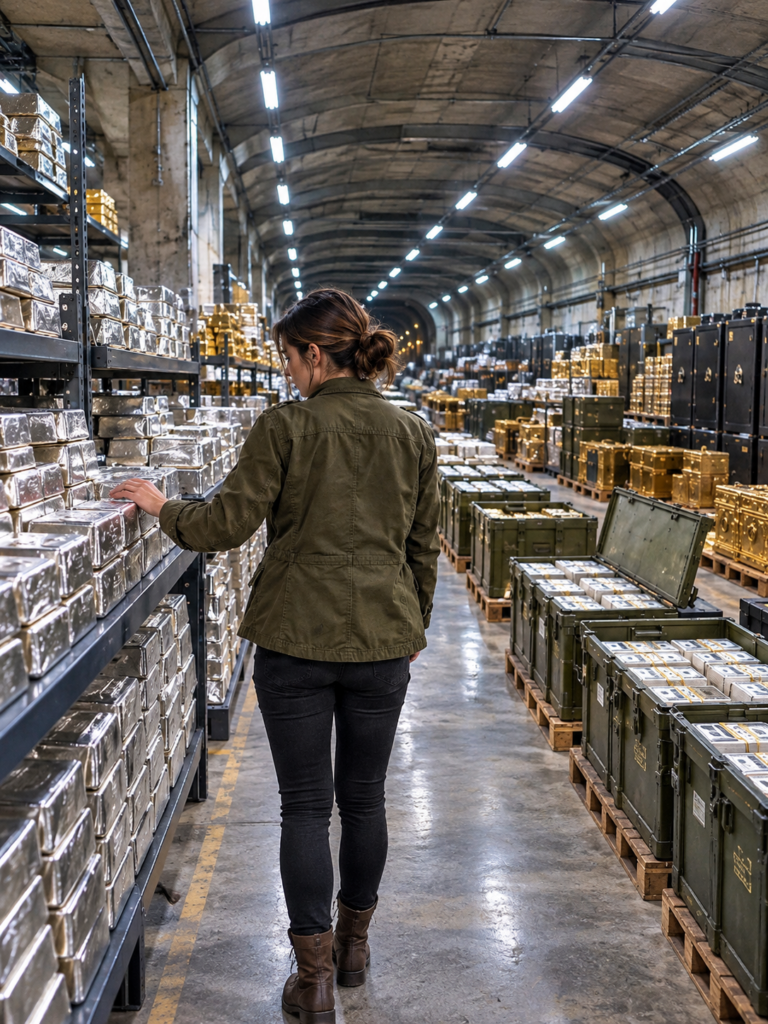
On the nearest shelves sat enormous gray bricks.
She approached one and touched its surface.
There was a stamped mark on the metal.
U.S. ASSAY OFFICE — .999 FINE SILVER.
She tried lifting it.
The weight shocked her.
One brick required both hands.
Then she looked along the shelf.
There were dozens.
Beyond them, hundreds more.
She turned slowly.
Wooden pallets held stacks of heavy olive-drab cases.
She opened one after cutting its plastic seal with a utility knife from a nearby workbench.
Inside lay vacuum-sealed bundles of hundred-dollar bills.
She opened another.
The same thing.
Another.
More cash.
Row after row of cases filled with old, carefully preserved currency.
At the far end stood metal safe-deposit boxes, removed from what appeared to have once been a bank.
Above them, velvet-lined trays displayed old American gold coins.
Pre-1933 gold eagles.
Mave reached toward one, then pulled her hand away.
The quantity was beyond anything she could comprehend.
It wasn’t fourteen million dollars.
It was far more.
Silver, gold, currency—enough wealth to overwhelm the inheritance her brothers had celebrated.
Harrison had built a second fortune.
Then he had buried it.
She wandered between the shelves, struggling to connect what she saw with the grandfather she remembered.
The man who watered down his coffee rather than buy another can.
The man who wore the same coat for fifteen years.
The man who had left her an apparently worthless farm.
At the back of the bunker, a scarred wooden workbench stood beneath a hanging lightbulb.
On it rested a bottle of cheap scotch, an empty tumbler, and a white envelope.
Mave stopped.
Her name was written across the front.
She recognized the handwriting immediately.
Sharp, slanting, impatient letters.
She opened the envelope.
The letter began without affection.
Mave,
If you’re reading this, you didn’t sell the farm to the first developer who came along.
Declan would have sold the place before Tuesday. Bryce wouldn’t even have driven out to look at it.
Your brothers believe wealth is a number on a screen. They trust bankers, markets, and whatever a man in a nice suit tells them.
I know better.
Money is weight. Money is metal, concrete, and dirt.
Mave slowly sat on a nearby stool.
She continued reading.
Harrison explained that Cole Logistics was burdened with aging trucks, expensive loans, unfunded obligations, and problems Declan had never bothered to understand.
Bryce’s financial inheritance was equally vulnerable, tangled in leverage and market risk.
They had received everything they admired.
And much of it was hollow.
Meanwhile, Harrison had spent decades converting enormous portions of his fortune into physical assets that he concealed beneath Oak Hills.
Cash.
Gold.
Silver.
An underground reserve unknown to the financial world.
The letter carried his familiar contempt for taxation and financial oversight. He described the fortune as money existing outside the system, and urged Mave to bring it into use discreetly.
But it was the next lines that made her stop breathing for a moment.
I watched you take care of me for three years.
You never asked me for a dime.
I know you hated me sometimes. You had every reason.
But you stayed.
Your brothers don’t know how to struggle for anything. You do.
They got the paper. You got what’s real.
Build your life. Let them have their empire.
Harrison.
Mave stared at the signature.
She read the letter again.
Then once more.
Her grandfather had known exactly what he was doing.
He had deliberately left her the farm.
He had trusted her to discover the hidden fortune and keep it.
But he had also left her to believe, even if only briefly, that the years she had sacrificed meant nothing.
She remembered his harsh voice calling from the bedroom.
His impatience when she couldn’t understand what he wanted.
His refusal to thank her for small kindnesses.
Even dying, Harrison had not known how to express love without turning it into some brutal test of endurance.
Mave folded the letter carefully.
She didn’t forgive him.
Not then.
Perhaps she never would.
But when she looked out across the steel shelves, something inside her shifted.
For years, other people had determined the shape of her life.
Harrison’s illness.
Her brothers’ indifference.
Doctors’ appointments.
Bills.
Exhaustion.
Now she stood fifty feet underground with enough wealth around her to change every one of those circumstances.
She returned to the open case.
Inside lay bundles of hundred-dollar bills.
Mave removed a single note and held it beneath the bright light.
Benjamin Franklin stared back at her.
For the first time in three years, she smiled.
Then a second thought struck her.
She couldn’t simply walk into a bank with a fortune nobody knew existed.
She couldn’t explain millions of dollars in unrecorded assets by showing a cashier her grandfather’s handwritten letter.
And she still owed eighty thousand dollars in property taxes.
The money was real.
The problem was getting it into the world aboveground without losing everything.
Mave looked toward the open vault door.
Harrison had left her a fortune.
He had also left her one final problem to solve.
And this time, she would have to solve it alone.
Part 2
By the following morning, Mave had stopped thinking about what she could buy.
She was thinking about what she could lose.
She returned to the bunker before sunrise, carrying a notebook she had found in the farmhouse kitchen.
For hours, she walked between the shelves, trying to understand what Harrison had accumulated.
The silver alone represented an enormous investment. The gold coins were valuable individually, and there were more than she could count in a day.
The cash presented a different problem.
Some of the hundred-dollar bills were old enough to have been circulating before she was born.
The packaging was unusual. The quantities were staggering.
And the wealth existed without the kind of clear records that ordinary banks, accountants, and government agencies would expect.
Harrison had spoken of it as freedom.
Mave saw the danger immediately.
She imagined walking into the county courthouse with eighty thousand dollars in cash and trying to explain how a nearly penniless woman had obtained it overnight.
Questions would follow.
Then investigations.
Then possibly claims against the inheritance itself.
She thought of Declan and Bryce.
If they discovered what was beneath Oak Hills, neither would accept that their grandfather had deliberately left it to her.
They would fight.
And they had money, lawyers, and the confidence of men who had never seriously considered losing.
Mave closed her notebook.
Before she could build a future, she needed to protect the land.
October gave way to November.
Mave lived like someone who had found nothing.
She continued sleeping on the old mattress. She used cheap supplies to clean the farmhouse and spent as little as possible on food.
But she began making long, exhausting trips away from Oak Hills.
Among the stored assets, she had found a canvas bag containing smaller silver coins. She took modest quantities to dealers willing to evaluate and purchase them, traveling through Ohio and Pennsylvania.
She also began converting portions of Harrison’s stored currency into forms she hoped would be less conspicuous when used for the tax payment.
It was a slow, anxious process, and she was constantly aware that unusual financial activity could attract scrutiny rather than eliminate it.
Every time someone examined a bill too closely, her stomach tightened.
Every time a clerk asked an innocent question, she heard an accusation.
She had inherited more wealth than she could count, but she was still buying gas with trembling hands and eating peanut-butter sandwiches beside her aging Subaru.
Her life had changed completely.
From the outside, nothing had changed at all.
The farmhouse remained cold.
The roof still leaked.
Her clothes remained stained and worn.
At night, she checked the locks twice.
An old pump-action shotgun Harrison had left in a closet rested near her mattress. Its presence didn’t make her comfortable. It reminded her how vulnerable the isolated property was.
She slept badly.
Sometimes she dreamed that she heard the tractor-shed doors opening.
Sometimes she dreamed of the concrete platform sinking without her permission.
By the second week of November, she had accumulated dozens of money orders. She continued until she had enough to satisfy the county’s demand.
On a rainy Tuesday, she entered the county assessor’s office carrying a thick envelope.
The clerk behind the counter wore heavy glasses and an expression of practiced indifference.
“Can I help you?”
“I need to pay the delinquent taxes on a property.”
“Parcel number?”
Mave handed over the paperwork.
The clerk typed, examined the screen, and frowned.
“Oak Hills farm?”
“That’s right.”
“Eighty thousand dollars.”
“I know.”
The clerk looked at her frayed sleeves.
“Are you making a partial payment?”
“No.”
Mave opened the envelope.
She placed the money orders on the counter.
The clerk stared at them.
“All of these?”
“One hundred and six.”
“Where did you get this money?”
Mave had prepared herself for the question, but hearing it still made her throat tighten.
“Family. Friends. Help from people who didn’t want me to lose the property.”
The clerk looked unconvinced.
“These will need to be counted and verified.”
“Then count them.”
Mave stood at the counter while the woman worked.
Forty-five minutes passed.
The office telephone rang several times. Someone came in to ask about a tax assessment. A printer jammed behind the desk.
Mave barely noticed.
She watched the papers moving through the clerk’s hands.
Every minute felt like another opportunity for something to go wrong.
Finally, the clerk returned with a receipt.
She pressed a red stamp against it.
PAID IN FULL.
Mave accepted the paper.
“That’s it?”
“That’s it.”
She walked outside before allowing herself to look at it again.
Rain struck the hood of her Subaru.
Inside the car, she locked the doors, placed the receipt on the passenger seat, and leaned her forehead against the steering wheel.
She didn’t cry.
She simply breathed.
The county would not seize the farm over that unpaid balance.
The tractor shed remained hers to protect.
The fortune was still underground.
For the moment, she had won.
But she knew the problem had only become larger.
Harrison had left her wealth without an ordinary financial history.
She needed a source of income that existed openly in the world.
Something modest.
Something she could actually operate.
Something no one in her family would consider worth investigating.
In early December, she found a struggling laundromat in a strip mall three towns away.
The machines were old. Several required repairs. The waiting chairs had torn plastic seats, and the owner kept handwritten records in a battered binder.
He wanted forty thousand dollars for the business.
Mave negotiated the price to thirty-two thousand.
The owner, a tired man preparing to retire to Florida, was glad to find a buyer.
Mave arranged the purchase using funds she had gradually assembled and deposited. She understood that the financial history behind those funds was vulnerable to questions, but she was determined to turn her inheritance into something she could manage.
The laundromat gave her an actual business to run.
She learned which machines swallowed coins, which dryers overheated, and why a leaking pipe could destroy an entire day’s earnings.
She cleaned lint traps, handled customer complaints, replaced damaged parts, and recorded the real work of keeping the doors open.
At the same time, she continued trying to bring Harrison’s unrecorded cash into circulation through the business.
She told herself she was only making use of what he had left her.
But she knew the distinction between an inheritance and legitimate business revenue could not be erased merely by placing money in a deposit bag.
The arrangement was risky.
Still, the laundromat began producing real income.
By January, she had enough regular business activity to make repairs to the farmhouse.
She hired a local contractor to fix the roof.
On the morning the workers arrived, Mave watched them unload ladders and roofing materials from their truck.
For a moment, the sight almost overwhelmed her.
A roof.
Such an ordinary thing.
Three years earlier, a dependable place to sleep had felt like a distant luxury.
Now she could afford one.
She didn’t replace the Subaru.
She didn’t buy jewelry.
She didn’t move into a city apartment or fill her closets with expensive clothing.
She kept the same olive-green coat.
And she kept working.
The people around Oak Hills knew her as Harrison Cole’s granddaughter, a woman who had inherited a dying farm and was doing her best to save it.
Mave intended to keep it that way.
Forty stories above downtown Seattle, Declan Cole was discovering that his inheritance was not what he had believed.
The conference room at Cole Logistics had floor-to-ceiling windows and a long mahogany table.
Beyond the glass, rain blurred the city skyline.
On the wall, a projected financial report displayed columns of red numbers.
Declan stared at them.
“Explain it again.”
Across the table sat Miller, the company’s chief financial officer.
He had worked for Harrison for twenty years.
He looked exhausted.
“The trucks,” Miller began. “They’re in much worse condition than we understood.”
“How much worse?”
“Forty-two have been flagged by the Department of Transportation. They’re sitting in the yard because they can’t legally operate until the issues are addressed.”
“Then replace them.”
Miller’s expression tightened.
“With what money?”
Declan looked up.
“We own warehouses. We have contracts. We have credit.”
“Our credit lines are maxed out.”
“That’s impossible.”
“Your grandfather borrowed heavily against the warehouses three years ago. He said the money was for expansion.”
“What expansion?”
“There wasn’t one.”
Declan went still.
Miller continued.
“Interest payments are consuming our operating cash flow. He also deferred noncritical fleet maintenance for seven years.”
Declan loosened his tie.
“And the union?”
“They walked away from negotiations.”
“Why?”
“Harrison promised a five-percent pension increase. The funding was never provided.”
Declan stared at him.
“You’re telling me the company doesn’t have the money?”
“I’m telling you it hasn’t had the money for some time.”
Declan rose from his chair.
The empire he had admired since childhood suddenly looked different.
He had inherited the trucks.
But many were unusable.
He had inherited the warehouses.
But they were heavily leveraged.
He had inherited contracts.
But contracts meant little without the ability to deliver freight.
He had inherited a business that required enormous sums of money merely to survive.
His phone vibrated.
Bryce.
Declan ignored the call.
His younger brother had problems of his own.
The brokerage accounts and Cayman trust had appeared to be a fortune until a sudden twelve-percent decline in the technology sector triggered margin calls.
Bryce had discovered that the assets were heavily leveraged.
He was now selling the Lake Washington property to cover obligations he hadn’t known existed.
Both brothers had inherited wealth.
Neither had inherited much freedom.
Declan turned to Miller.
“Harrison wasn’t stupid.”
“No.”
“He didn’t accidentally forget to maintain trucks or fund pensions.”
Miller hesitated.
“There’s something else.”
He placed a folder on the table.
“I asked a forensic accountant to review historical transactions.”
Declan opened it.
The pages contained years of financial activity, reaching back to 1995.
Consulting payments.
Shell companies.
Equipment write-offs.
Transfers through contractors whose records were difficult to trace.
“How much?” Declan asked.
“We can’t establish a final figure.”
“Estimate.”
Miller swallowed.
“Tens of millions.”
Declan slowly lowered the folder.
His grandfather had not simply mismanaged the company.
He had been extracting its value for decades.
“Where did it go?”
“We don’t know.”
“Offshore?”
“We haven’t found it.”
“Property?”
“Nothing that accounts for the money.”
Declan moved toward the windows.
He remembered Harrison’s old apartment, the cheap scotch, the hatred of banks, the refusal to trust investments he couldn’t physically touch.
And he remembered the will.
Mave.
The farm.
Forty acres of apparently worthless land.
He turned.
“Miller, get me the deed history for Oak Hills. Property records, tax records, geological surveys. Everything.”
“Declan, the union is threatening a strike.”
“Forget the union.”
“The company—”
“The old man buried it.”
Miller stared at him.
Declan grabbed his jacket.
“He buried the money.”
Spring arrived at Oak Hills beneath gray clouds.
Snow melted into thick mud.
Mave was scrubbing the kitchen floor when she heard tires on the gravel driveway.
She stopped.
Nobody visited the farmhouse.
The mail carrier left envelopes at the road.
She wiped her hands on her jeans and looked through the window.
A black Range Rover stood outside.
Declan climbed out.
His suit still looked expensive, but the man wearing it did not look nearly as confident as he had at the lawyer’s office.
Dark circles marked his eyes.
His shoulders seemed narrower.
He stepped directly into a muddy puddle, ruining his polished shoes.
Mave watched him approach.
She knew immediately that something was wrong.
She opened the door and stepped onto the sagging porch.
“You’re lost,” she called. “The country club is about four hundred miles that way.”
Declan looked up.
“Hello, Mavy.”
“Don’t call me that.”
He forced a smile.
“Can I come in?”
“No.”
“It’s cold.”
“The heat’s broken. Say what you came to say.”
Declan looked around.
His eyes moved across the house, the collapsed barn, and the distant trees.
For one terrible moment, his gaze rested in the direction of the tractor shed.
Mave kept her expression blank.
“You haven’t done much with the place,” he remarked.
“I don’t have fourteen million dollars, Declan.”
“You paid the taxes.”
“Yes.”
“How?”
She shrugged.
“People helped me. I’ve been working.”
He nodded slowly.
“I came to make you an offer.”
Mave crossed her arms.
“What kind of offer?”
“I want to buy the farm.”
The wind moved across the porch.
Mave felt her pulse quicken.
“Why?”
“It’s family land. Grandpa bought it when he was young. It shouldn’t be allowed to fall apart.”
She almost laughed.
“That’s interesting. At the lawyer’s office, you told me to surrender it to the county.”
“I was grieving.”
“You were laughing.”
Declan ignored that.
“I know developers. I could turn this place into something useful.”
“How much?”
“Five hundred thousand dollars. Cash.”
Mave stared at him.
Five hundred thousand dollars for a property he had described as worthless.
He knew something.
Perhaps he had discovered Harrison’s missing money. Perhaps he had only guessed that it was connected to Oak Hills.
But he would never offer half a million dollars for forty acres of dead soil unless he believed something valuable was hidden there.
“I’m not selling.”
“Don’t be ridiculous.”
“I’m not selling, Declan.”
“One million.”
Mave felt the number land between them.
A million dollars.
He had increased his offer in seconds.
She stepped down from the porch.
“If you can afford a million dollars for a dead farm, why do you look like you haven’t slept in a month?”
His smile disappeared.
“The company is in trouble.”
“That’s unfortunate.”
“Harrison drained it.”
She said nothing.
“He moved tens of millions out of Cole Logistics. He left us a dying business and investments tied up in debt.”
“Maybe you should call a financial adviser.”
“Where is the money?”
Mave met his eyes.
“What money?”
“Don’t lie to me.”
He moved closer.
“He hid it here. I know he did.”
She could smell his expensive cologne.
“There’s nothing here but mice, mud, and a house with a bad roof.”
“Then sell it.”
“No.”
“I’ll split whatever we find.”
“I said no.”
Declan stared at her.
For a moment she saw the brother she remembered from childhood—the boy who always expected someone else to move out of his way.
Then his expression hardened.
“I have lawyers, Mave.”
“Congratulations.”
“I can challenge the will. I can argue Grandpa wasn’t competent when he signed it. I can claim you manipulated him while he was dying.”
Her hands curled at her sides.
“You know that isn’t true.”
“I know I can keep you in court for years.”
He gestured toward the farmhouse.
“Look at this place. You can’t afford a legal fight. I’ll bury you in fees until you have no choice but to sell.”
Mave looked past him.
Beyond the dead grass stood the tractor shed.
Fifty feet beneath it rested the fortune Declan wanted.
She thought about the nights she had spent turning Harrison in bed.
The mornings she had washed his clothes.
The afternoons she had listened to him complain while Declan enjoyed his own life.
And now this man had come to take the one thing Harrison had deliberately left her.
“Get off my land.”
Declan blinked.
“Mave—”
“Get off my land. And don’t come back uninvited.”
He gave a humorless laugh.
“You think you can scare me?”
“I’m telling you to leave. If you send someone onto this property in the dark, don’t assume I won’t defend myself.”
Something in her voice made him hesitate.
He studied her for several seconds.
“This isn’t over.”
Mave turned toward the house.
“Drive carefully. The mud’s deep.”
She closed the door behind her.
Only then did she allow herself to tremble.
Declan knew enough to be dangerous.
And he wasn’t going away.
Three weeks later, a process server arrived with a thick packet of legal documents.
Declan was contesting Harrison’s will.
He was seeking an injunction that would freeze the property while the dispute continued.
He also demanded an environmental and geological survey of the entire forty acres.
Mave read the paperwork twice.
Then she saw what frightened her most.
The requested survey could involve ground-penetrating radar.
She went outside and looked toward the tractor shed.
A scan might identify the underground chamber.
Once its existence became known, the fight would no longer be over an abandoned farm.
It would be over everything beneath it.
She had thirty days before the court considered the survey request.
Thirty days to find a way to stop Declan.
For three nights, she barely slept.
She sat in the bunker surrounded by silver bars and cases of currency, reading documents beneath fluorescent lights.
She had enough wealth to change her life a hundred times.
But money by itself wasn’t an argument a judge would accept.
And the questionable financial history of Harrison’s fortune could expose her to risks far worse than her brother’s lawsuit.
She considered hiring attorneys.
She considered moving the contents of the bunker.
She considered leaving the farm altogether.
Then she remembered the expression on Declan’s face when he had described his company’s financial problems.
She remembered Harrison’s letter.
The aging trucks.
The loans.
The warehouses pledged as collateral.
Declan was attacking her through the legal system because he believed she lacked the resources to resist.
But he had a vulnerability of his own.
He needed his company’s creditors to keep supporting him.
Mave looked down at the silver bar resting on the workbench.
She had spent months trying to think like a woman protecting a piece of land.
Perhaps she needed to think like someone who controlled a fortune.
She packed a canvas duffel bag.
Into the bottom she placed approximately forty pounds of the old gold coins.
She covered them with dirty sweatshirts and work boots.
Then she drove toward Chicago.
She wasn’t going there to ask Declan for mercy.
She was going to find out whether she could buy the one thing he couldn’t afford to lose.
Part 3
Chicago rose around Mave in towers of glass and steel.
She parked her battered Subaru three blocks from the offices of Croft and Sterling, a private wealth-management firm that catered to clients with complicated financial affairs.
She had driven six hours with forty pounds of gold concealed beneath dirty clothing.
Now she stood on the sidewalk outside a building whose entrance looked more expensive than the farmhouse she had inherited.
Her coat was stained.
Her boots were scuffed.
Her hair was tied back with an ordinary elastic band.
She carried the duffel bag through the revolving doors.
Inside, polished marble reflected the overhead lights.
A receptionist glanced up.
“May I help you?”
“I need to speak with Richard Croft.”
“Do you have an appointment?”
“No.”
“Mr. Croft doesn’t accept walk-ins.”
Mave placed the bag on the floor.
It landed with a heavy metallic sound.
The receptionist looked down.
“Ma’am, I really must insist—”
“Tell Mr. Croft I have a liquid-asset problem.”
The woman hesitated.
Mave continued.
“And tell him I’m willing to pay a twenty-percent premium for discretion.”
The receptionist disappeared into an office.
A few minutes later, a tall man in a dark suit approached.
He looked at Mave, then at the bag.
“I’m Richard Croft.”
“Mave Cole.”
“What can I do for you, Miss Cole?”
She unzipped the duffel.
Croft’s expression changed.
Not dramatically.
He was too experienced for that.
But his eyes sharpened.
“Where did you get those?”
“They’re part of an inheritance.”
“Do you have documentation?”
“I have a will, a property deed, and a very complicated situation.”
He considered her answer.
Then he glanced toward the reception desk.
“Come with me.”
Croft’s office overlooked downtown Chicago.
The furniture was immaculate. A large abstract painting hung behind his desk.
Mave sat opposite him while he examined the coins.
He tested their authenticity and weight, studying the old American markings.
“These are substantial assets,” he said.
“I know.”
“And you have more?”
“Yes.”
“How much more?”
She looked directly at him.
“Enough that I need someone who understands how wealthy people protect what they own.”
Croft studied her.
“Most wealthy people begin by hiring attorneys and accountants.”
“My brother is already using attorneys to try to take my property.”
Croft leaned back.
“Now we’re getting somewhere.”
Mave explained Harrison’s death, the will, the farm, and Declan’s challenge.
She did not describe every item in the underground vault.
She didn’t need to.
Croft understood that there was more at stake than the contents of the duffel bag.
Over the following two weeks, he organized a structure through which Mave could conduct large financial transactions.
A holding company was established in Wyoming.
Its name was Oak Hills Development LLC.
Through Croft’s network of private brokers, a portion of the gold was liquidated, including transactions involving European buyers.
The proceeds moved into commercial accounts controlled through the new company.
Croft handled the documents and arrangements. Mave understood that the process depended on financial representations and records she had not independently verified.
But by the end of the month, Oak Hills Development had approximately eight million dollars in available capital.
Mave stared at the account statement.
Eight million.
No one in the reception area would ever have guessed it belonged to the woman in the frayed olive coat.
Croft expected her next instruction to involve her brother’s lawsuit.
“I can recommend litigation counsel,” he told her. “You’ll want a serious probate defense team.”
Mave shook her head.
“Not yet.”
He frowned.
“Miss Cole, you are facing a court proceeding.”
“I know.”
“And your brother is requesting access to the property.”
“I know that too.”
“Then what exactly do you want to do?”
She opened a folder and placed it on his desk.
Inside were the financial details she had gathered about Cole Logistics.
“I want you to investigate the company’s debt.”
Croft examined the pages.
“The logistics business?”
“Yes.”
“Your brother owns it.”
“That’s right.”
“What am I looking for?”
“Loans. Secured debt. Missed payments. Anything the banks are worried about.”
Croft began reading.
After several minutes, he looked up.
“Miss Cole, this company is in serious trouble.”
“I know.”
“The strike has damaged its revenue. The collateral is heavily encumbered. It appears they’ve missed consecutive loan payments.”
“Two.”
“Possibly more by the time we finish.”
Mave folded her hands.
“Can we buy the debt?”
Croft leaned back.
“The loans?”
“Yes.”
“Why would you want distressed debt from a failing company?”
“Because the loans are secured against its warehouses and other assets.”
He studied her.
“If you acquire a controlling position among its major creditors, you could have considerable influence over restructuring.”
“How much?”
“That depends on the agreements, the collateral, and the banks’ willingness to sell.”
“Find out.”
Croft hesitated.
“Are you trying to save the company?”
“No.”
“Then why buy it?”
Mave thought about Declan standing in the mud outside her farmhouse, offering a million dollars for land he had laughed at.
She thought about his promise to ruin her in court.
“I don’t need his company,” she said. “I need him to leave mine alone.”
Croft closed the folder.
For the first time since meeting her, he smiled.
“I understand.”
The banks were nervous.
Cole Logistics was losing money while its trucks remained idle and labor disputes disrupted operations.
The company had missed two consecutive payments on major loans.
Its lenders faced the prospect of a drawn-out default and uncertain recoveries.
Croft negotiated the purchase of key distressed loans at steep discounts to their stated value.
The transactions were completed through Oak Hills Development.
By the time Declan learned what had happened, Mave’s company controlled the principal debt position that threatened his business.
The warehouses and fleet that Declan had celebrated inheriting were now collateral for obligations held by an entity Mave controlled.
He still occupied the executive office.
He still had the title.
But his company’s survival depended on the cooperation of someone he did not know.
At least, not yet.
Mave returned to Ohio without buying anything for herself.
She slept in the farmhouse.
She checked on the laundromat.
She wore her old clothes.
And she waited.
Two days before the hearing concerning the requested survey, someone crossed the fence at Oak Hills.
It was two in the morning.
Rain fell in freezing sheets, striking the ground hard enough to turn the driveway into a stream of muddy water.
Mave had been expecting another move from Declan.
She had watched the property closely since receiving the lawsuit.
That night, she noticed a flashlight near the roadside fence.
A heavyset man wearing dark clothing climbed through a broken section and moved toward the tractor shed.
Mave was sitting on the hood of her Subaru.
Her olive jacket was soaked.
Across her lap lay Harrison’s old pump-action shotgun.
She stood as the man approached.
Then she worked the action.
The sharp metallic sound cut through the rain.
The man froze.
Mave switched on a powerful spotlight connected to a car battery.
White light flooded the grass.
The trespasser threw up one hand to shield his eyes.
“You’re on private property,” Mave called.
“I didn’t know anyone lived here.”
“Then you should have stayed on the road.”
He took a step backward.
Mave kept the shotgun pointed away from herself, her posture rigid.
“Turn around. Leave. And tell whoever hired you that this land isn’t for sale.”
The man hesitated.
“Lady, I don’t want trouble.”
“Then go.”
He retreated toward the fence.
Mave watched until he disappeared into the darkness.
Only then did she lower the gun.
She stood motionless while rain ran down her face.
She had never imagined becoming someone who guarded an abandoned tractor shed in the middle of the night.
But Harrison’s fortune had brought her to this point.
And Declan had apparently decided that the law wasn’t moving quickly enough.
The next morning, her phone rang.
Declan.
She answered while making instant coffee.
“You’ve lost your mind,” he said.
“Good morning to you too.”
“You pulled a gun on a man.”
Mave looked out the kitchen window.
“Someone trespassed on my property after two in the morning.”
“Do you understand how serious that is?”
“Are you admitting you hired him?”
Declan fell silent.
“Because I have his license-plate information,” she continued. “And I’ve already filed a police report.”
“You think you’re untouchable?”
“No.”
“By Friday, the judge is going to grant my injunction. I’ll have that land surveyed, and if there’s anything under it, I’ll find it.”
Mave stirred her coffee.
“Check your email, Declan.”
“What?”
“Your corporate inbox.”
“Why?”
“Ask Miller to look at the latest communication from your creditors.”
“What are you talking about?”
“Read it. Then call me back.”
She ended the call.
Her hands were steady.
She set the telephone on the counter.
Fourteen minutes later, it rang again.
Mave answered.
For several seconds, Declan said nothing.
She could hear him breathing.
Finally, he spoke.
“Who is Oak Hills Development?”
His voice sounded unfamiliar.
Thin.
Uneasy.
Mave looked toward the barn.
“Your company’s new creditor.”
Silence.
“That isn’t funny.”
“I’m not joking.”
“The banks sold the loans.”
“Yes.”
“Oak Hills Development bought them.”
“Yes.”
“Do you have any idea what they’re threatening to do?”
Mave glanced at the rainwater dripping from the repaired roof.
“They’re exercising their contractual rights following your defaults.”
“They can take the warehouses.”
“I know.”
“They can seize the collateral. They could force us into liquidation.”
“I know that too.”
Declan breathed heavily.
Then his voice changed.
“It’s you.”
Mave said nothing.
“It’s you, isn’t it?”
He sounded almost sick.
“You found it.”
She closed her eyes briefly.
“You found Harrison’s money.”
“Declan—”
“You found it, and you used it to buy the company’s debt.”
“Yes.”
He cursed.
She waited.
For once, he didn’t know what to say.
The silence between them felt larger than the one that had followed the reading of Harrison’s will.
Finally, Declan spoke again.
“Mave, please.”
She stared at the peeling wallpaper.
It was the first time in years she had heard her brother say that word to her.
“Please what?”
“Don’t destroy the company.”
“Why not?”
“It’s our family’s legacy.”
“Your company, Declan. Grandpa gave it to you.”
“He built it over his entire life.”
“And you threatened to take the only thing he gave me.”
“We can work something out.”
“You already offered me money.”
“I didn’t know—”
“You didn’t know I could fight back.”
He said nothing.
Mave remembered his ten-thousand-dollar check.
The way he had slid it across the table as if he were doing her an enormous favor.
She remembered tearing it apart.
She remembered sleeping in a freezing farmhouse while her brothers celebrated their inheritance.
“You told me I gambled and lost,” she said.
“Mave, I was angry.”
“You told me Grandpa hated me.”
“I shouldn’t have said that.”
“You threatened to bury me in court until I couldn’t afford groceries.”
“I know.”
“And now you want me to rescue you?”
A long silence followed.
Then Declan whispered, “Yes.”
Mave felt no satisfaction in hearing it.
At least, not as much as she had expected.
She was exhausted.
For months, she had lived with the fear that someone would discover the vault and take away the first real chance at independence she had ever possessed.
She wanted it to end.
“Here’s what you’re going to do,” she said.
Declan listened.
“Withdraw the probate challenge. Withdraw the injunction. Give up the request for a survey.”
“Mave—”
“I’m not finished.”
She continued.
“You’ll sign a legally binding agreement waiving future claims to the Oak Hills property. Your attorneys will prepare it, and mine will review it.”
Declan swallowed audibly.
“And in return?”
“Oak Hills Development will restructure your debt.”
“What kind of restructuring?”
“A ten-year extension of the principal, with a flat interest rate.”
He breathed out.
“You’d do that?”
“Under those terms.”
“Then the company survives?”
“If you fulfill the agreement and keep up your obligations, you’ll have the opportunity to keep operating.”
Declan was quiet.
“You’ll still own the loans,” he said.
“Yes.”
“So you’ll control whether the company survives.”
Mave looked at her reflection in the dark kitchen window.
The frayed coat hung from a nail beside the door.
A dirty pair of boots stood beneath it.
Nothing about her looked powerful.
But power had never been about appearances.
“Then you understand why you should leave me alone.”
Declan’s voice broke slightly.
“You’re really going to hold this over me?”
“You were willing to take my home.”
“It was just business.”
“Then consider this business.”
Neither spoke for several seconds.
Finally, Declan asked, “Do we have a deal?”
Mave looked down at Harrison’s letter lying on the kitchen table.
“No more lawsuits about my farm. No more investigators. No more coming onto my land.”
“Agreed.”
“And don’t mistake this for forgiveness.”
There was a pause.
“I understand.”
“Then have your attorneys send the paperwork.”
“We have a deal,” Declan said.
Mave ended the call.
For several minutes, she remained standing beside the kitchen counter.
She had done it.
The brother who inherited the empire had agreed to stop trying to take her farm.
Not because he suddenly respected her.
Not because he had become kinder.
But because she now held something he needed.
The balance of power had finally changed.
That afternoon, the rain stopped.
Weak sunlight broke through the clouds and touched the wet grass around the farmhouse.
Mave stepped outside.
She walked past the collapsed barn, following the familiar path toward the tractor shed.
The earth was soft beneath her boots.
The air smelled of wet pine and soil.
At the shed, she removed the heavy padlock she had installed after discovering the vault.
The steel doors opened with their usual protest.
Inside, the reinforced concrete floor looked completely ordinary.
Nothing about the building suggested what rested fifty feet beneath it.
She could have descended again.
She could have stood among the silver bars, opened the cases of currency, and reminded herself of the fortune she now possessed.
But she didn’t.
She remained at the entrance.
For years, she had believed money meant having enough to stop worrying about bills.
Then she had discovered that possessing wealth did not automatically mean being able to use it safely.
Now she understood something else.
Even the largest fortune could become a prison if every decision were governed by fear of losing it.
The farmhouse roof had been repaired.
The laundromat was operating.
The immediate tax lien had been paid, although future property taxes and the complicated financial issues surrounding Harrison’s assets still remained.
Declan had agreed to withdraw his challenge.
Bryce was occupied with the consequences of his own inheritance.
There were still risks ahead.
The underground fortune’s origins and financial treatment had never been fully resolved. Mave knew that a holding company and an agreement with her brother could not eliminate every legal or financial question.
But the land was no longer defenseless.
And neither was she.
She thought about Harrison.
The hard voice.
The cheap scotch.
The endless complaints.
The old man who had forced her to spend the best years of her young adulthood caring for him, then left her with an inheritance that looked like one last act of cruelty.
She wondered whether he had ever intended to explain himself before he died.
Whether, somewhere beneath all his bitterness and suspicion, he had understood what his carelessness had cost her.
His letter had acknowledged her sacrifice.
It had not given those years back.
No amount of gold could do that.
Mave would never pretend that his final gift made him a good grandfather.
But she could accept what he had left without excusing the way he had treated her.
She could use it to build a life that belonged to her.
A life where she was not somebody’s unpaid caretaker.
Not a poor relation waiting for charity.
Not the sister expected to accept whatever her brothers decided she deserved.
She looked around the tractor shed one final time.
Then she stepped outside and pulled the steel doors closed.
The lock clicked into place.
Beyond the grove of elm trees, the farmhouse stood beneath the clearing sky.
Its roof was no longer leaking.
Its windows caught the afternoon light.
For the first time since arriving at Oak Hills, Mave could imagine making the place into a real home.
Perhaps one day the fields would recover.
Perhaps the barn could be rebuilt.
Perhaps she would wake on a quiet morning, make coffee, and spend the entire day doing exactly what she wanted.
Not because someone needed her.
Not because she had to prove her worth.
Simply because the day was hers.
She began walking back toward the house.
Her boots were still muddy.
Her jacket was still frayed.
Fifty feet beneath her, the silver remained untouched in the dark.
Harrison Cole had taken three years of her life.
He had left her a farm everyone believed was worthless.
He had allowed her brothers to laugh while she sat humiliated in a lawyer’s office.
But when Mave reached the porch and looked back across the forty acres, she understood the strange truth of what had happened.
For years, she had felt buried beneath other people’s expectations.
Buried beneath obligation, exhaustion, and the conviction that no matter how hard she worked, she would never have enough.
Harrison had made her believe that the farm was one more burden she would have to carry.
Instead, beneath that broken land, he had hidden the means for her to stand on her own.
She had not used the fortune to buy a mansion or a yacht.
She had used it to protect the one place no one believed was worth saving.
And she had turned the wealth hidden beneath that place into leverage powerful enough to stop the brother who tried to destroy her.
Mave smiled faintly.
For all his cruelty, Harrison had been right about one thing.
Her brothers understood what wealth looked like.
She understood what it could do.
And standing on the porch of the farmhouse, watching the last clouds drift away, Mave finally found the words for what her grandfather had done.
He hadn’t buried her.
He had planted her.


