
Part 1
The old root cellar had been locked for nearly fifty years, and the first thing Dessa Lindquist noticed about its door was that someone had taken the trouble to leave a message.
Not a warning, exactly.
Not a name or a date.
Just four words, written twice on a little paper tag that had faded almost to the color of the wood beneath it.
Not yet. Not yet.
The tag hung from the latch by a piece of kitchen string. Rain had softened its edges, and the handwriting was so faint that Dessa had to tilt it toward the afternoon light to make out the words.
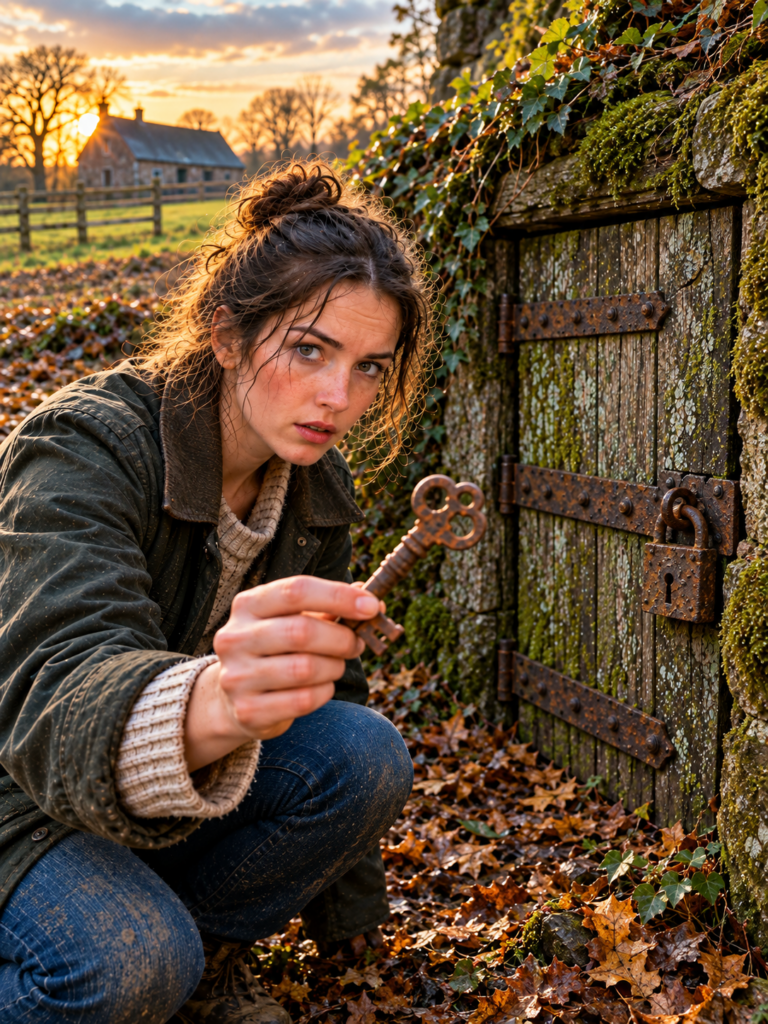
She stood on the muddy slope behind her farmhouse, holding a small brown key between her thumb and forefinger.
The key had been hidden inside an old tin of buttons.
Whoever had put it there had wanted it found eventually. That much seemed clear. But the tag on the cellar door suggested something else: that for many years, someone had been waiting for a particular moment to arrive.
Dessa looked at the rusted padlock.
She was forty-four years old, had worked as a hospice nurse for nineteen years, and thought she understood a fair amount about the things people kept hidden.
Still, as she fitted the key into the lock, she could not have guessed what was waiting below the hillside.
Three weeks earlier, she had barely given the cellar a second thought.
She had bought the farmhouse outside Brattleboro, Vermont, because she was tired.
Not ordinary tiredness, the kind that disappeared after a good night’s sleep. She had been carrying something heavier for years, a weariness that followed her from the hospice in Albany into her car, into the grocery store, and home to her quiet kitchen.
For nineteen years, she had helped people through the final weeks of their lives.
She had adjusted pillows, measured medication, washed hands that could no longer hold a cup, and sat beside people who had stopped pretending they weren’t afraid.
She had learned that some people wanted music near the end. Others wanted silence. Some became talkative after years of saying very little.
And again and again, she had heard people speak about the same kinds of unfinished business.
A brother they had stopped calling.
A daughter they had hurt.
A father whose apology never came.
A letter they had written and never mailed.
People seldom talked about the furniture they had owned or the things they had bought. They talked about the people who weren’t there.
Dessa was good at listening. Her patients had trusted her with feelings they sometimes couldn’t tell their own families.
But after so many years, she had begun to feel as though her life belonged to other people’s last days.
She needed a place where the mornings did not begin with a medical chart and the evenings did not end with someone else’s grief.
So when she saw the listing for a small farmhouse in the hills outside Brattleboro, she drove north almost without planning it.
The house stood back from a narrow country road, surrounded by fields that had begun returning to grass and brush. Its white paint had weathered to a soft gray in places. The porch steps were worn, and one corner of the roof would eventually need attention.
Behind the house, the ground sloped toward a line of trees.
It was not the sort of property anyone would mistake for a showplace.
Dessa liked it immediately.
She liked the irregular floors, the deep windowsills, the smell of old wood, and the quiet that seemed to settle around the building even when the wind moved through the bare branches outside.
She made an offer before she had even seen the kitchen.
When the town clerk, Carol Bisby, heard that, she raised an eyebrow.
“Most people at least want to know whether the stove works.”
“I’ve used worse stoves,” Dessa said.
Carol laughed.
She was a brisk, kind woman who seemed to know everybody in the area. She handled the paperwork with the practical efficiency of someone who had spent a long career answering questions about property lines, tax records, and families who couldn’t agree about either.
The farmhouse had belonged to Josephine Haas.
Josephine had died that January at ninety-six years old.
She had no husband, no children living nearby, and nobody on hand to fight over the furniture. The house had remained full of the things she had collected and used throughout her long life.
Carol described her with an expression that was equal parts affection and bewilderment.
“She was a strange one,” she said.
Dessa looked up from the paperwork.
“Strange how?”
“Lovely woman. Generous as anything. Every August she’d can peaches and hand out jars to half the county. You couldn’t visit Josephine in late summer without leaving with something to carry home.”
“That doesn’t sound strange.”
“No, that part wasn’t.” Carol hesitated. “It was the cellar.”
“What cellar?”
“The old root cellar behind the house. Built into the hill.”
Dessa remembered noticing the doors during her first walk around the property. They had been nearly hidden by moss and overgrown grass.
“Something wrong with it?”
“Not that I know of. But Josephine wouldn’t let anybody near it.”
“Anybody?”
“Nobody. Not the plumber, not the census man, not me. And I tried.”
Carol smiled at the memory.
“She could be very firm when she wanted to be.”
“Did she say why?”
“Just told me it wasn’t time.”
Dessa waited for more, but Carol shrugged.
“That was Josephine. She didn’t believe she owed anyone an explanation.”
On the drive back to Albany, Dessa thought about the cellar for a few minutes.
Then she forgot about it.
People who lived alone for a long time developed habits that other people found difficult to understand. She had seen that often enough in her nursing work.
Perhaps Josephine had stored things there that she didn’t want disturbed. Perhaps the steps were unsafe. Perhaps she simply liked having one place on her property that belonged to her alone.
Dessa had no particular desire to pry into the life of a dead woman.
She had enough work ahead of her.
The house was still crowded with Josephine’s belongings.
There were spools of thread arranged by color in the sewing room, their loose ends tucked neatly beneath the winding. Kitchen drawers held rubber bands, handwritten recipes, and utensils worn smooth from decades of use.
In a cupboard, Dessa found church bulletins from the nineteen-sixties.
Seed packets rested in a narrow wooden drawer, each labeled in the same tidy, slanting handwriting.
The words were practical.
Beans.
Marigolds.
For next spring.
That last label made Dessa stop.
Josephine had been ninety-six when she died, and she had still been setting something aside for the following year.
Dessa returned the packet to the drawer.
She didn’t have the heart to throw it away.
For the first few weeks, she worked slowly through the house, deciding what to keep, what to donate, and what had become too damaged to save.
She washed the kitchen windows. She cleared the pantry. She opened the closets and let the smell of old wool and cedar drift into the rooms.
She began to recognize Josephine’s handwriting before she could always read it.
Sometimes she caught herself talking to the woman whose home she now occupied.
“Why did you keep six of these?” she asked one morning, holding up a stack of nearly identical dish towels.
Another time, after finding a jar of bent nails in a drawer, she said, “You really didn’t throw much away, did you?”
There was no answer, of course.
But the house no longer felt entirely like a stranger’s.
On a rainy Tuesday in March, Dessa began clearing the sewing room.
The window was spotted with rain, and the gray sky made the room seem smaller than it was. A worktable stood against one wall, with drawers beneath it and a collection of boxes stacked along the floor.
Dessa had already sorted through fabric scraps, needles, and several decades’ worth of buttons when she came across a round metal tin.
It was heavier than she expected.
When she shook it, the contents rattled.
She carried it to the table and lifted the lid.
Inside were hundreds of buttons.
Some were plain brown or black. Others were glass, brass, or mother-of-pearl. A few looked as though they had been cut from coats that had gone out of fashion before Dessa was born.
She tipped the tin gently.
Buttons scattered across the tabletop, rolling into little clusters and slipping toward the edges.
Then something made a different sound.
A single, sharp click against the metal lid.
Dessa paused.
She turned the tin over, shook it again, and examined the bottom.
Nothing.
Then she looked inside the lid.
A small brown key had been taped to the metal.
Beside it was a folded scrap of yellowing paper.
The tape was brittle, and she loosened it carefully with her fingernail.
The key came free.
Dessa unfolded the paper.
There was no date and no signature.
Only one sentence.
For Ruth, or for whoever is kind enough to wonder.
Dessa read it once.
Then again.
Then a third time.
She sat at the sewing table with the note in front of her and listened to the rain tapping against the window.
Ruth.
The name meant nothing to her.
Carol had never mentioned a Ruth, and Dessa had found no explanation among the household papers she had sorted so far.
But the second half of the sentence troubled her in a way she couldn’t quite explain.
Or for whoever is kind enough to wonder.
It sounded less like an instruction than a request.
Dessa thought about the root cellar.
The rusted lock.
The woman who had refused to let anyone inside.
And that odd phrase Carol had repeated.
It wasn’t time.
She held the key up to the light.
It was small, its surface darkened by age, but it was still solid.
Without making any real decision, she put on her boots, pulled a raincoat over her clothes, and stepped outside.
The rain had eased to a mist.
Behind the house, the hillside was soft with thawing mud. Dessa walked carefully down the slope, passing the old fruit tree that stood beyond the porch.
Its branches were bare, twisting against the cloudy sky.
Farther down, partly swallowed by the hill, was the cellar.
The door sat crookedly inside a stone frame.
Moss had grown over the hinges, and damp leaves collected along the bottom edge. The padlock was so corroded that its original color was almost impossible to distinguish.
A faded paper tag hung from the latch.
Dessa turned it over and read the four words.
Not yet. Not yet.
She stood looking at the message.
Whatever Josephine had been protecting, she had protected it fiercely.
Dessa could have walked away. She could have decided that some things were best left alone.
But she was holding a key hidden with a note addressed not only to Ruth but also to anyone willing to wonder.
And Dessa had spent too many years watching people die with unfinished sentences still inside them.
She put the key into the lock.
It went in, but it would not turn.
She tried again, applying more pressure.
Nothing.
The padlock had been hanging there for so long that its moving parts seemed to have become one piece of rusted metal.
Dessa went back to the house, found a can of oil, and returned.
She sprayed the lock, worked the key gently, and waited.
Then she tried again.
At first there was only resistance.
Then something shifted.
The lock gave with a dull, tired clunk.
Dessa held it in her hand for several seconds.
The moment felt strangely important.
A door that had remained closed through changing seasons, through decades of ordinary life, through Josephine’s old age and eventual death, was finally unlocked.
Dessa pulled at the handle.
The hinges protested with a long metallic screech.
She pulled harder.
The door moved inward, revealing stone steps descending into darkness.
Cold air rolled up from below.
Dessa expected the smell of mildew, damp earth, and rotting wood.
Instead, she smelled something faintly sweet.
Sugar.
Fruit.
A trace of summer preserved in the air.
She went back for a flashlight.
When she returned, she stood at the top of the steps and pointed the beam downward.
The light reached a packed dirt floor.
She descended slowly.
The cellar was small, perhaps ten feet across, with stone walls and a ceiling low enough that she had to duck.
The floor was nearly clean.
Against every wall stood wooden shelves.
And on those shelves, row after row, stood glass jars.
Hundreds of them.
Dessa moved the flashlight across the room.
Some jars held fruit that still appeared golden in the dim light. Others had darkened with age. Dust covered the lids, and the labels had yellowed, but the rows remained remarkably orderly.
She stepped closer.
On the first jar she read:
Peaches, August 1976.
Beside it:
Peaches, August 1977.
Then:
Peaches, August 1978.
She moved along the shelf, following the dates.
Year after year.
The handwriting grew slightly different as the decades passed. In later years, some of the letters were less steady, but the labels remained clear enough to read.
Dessa stepped back and looked around.
The cellar was not simply a place where Josephine had stored food.
It was a calendar.
Nearly fifty years of summers lined up behind glass.
Dessa thought of Carol describing the jars Josephine had given to neighbors every August.
She had made peaches for other people.
But here, beneath the hill, she had kept another collection.
Dessa could not understand why.
Why preserve so many jars?
Why keep them where nobody could see them?
Why lock them away for half a century?
She followed the beam of her flashlight toward the lowest shelf.
There, beneath the rows of glass, sat two wooden boxes.
The first had a simple metal latch.
Dessa crouched and lifted it.
Inside was a stack of envelopes bound together with a faded blue ribbon.
She set the flashlight beside her, tilted its beam toward the box, and lifted the bundle carefully.
Every envelope bore the same name.
Mrs. J. Haas.
Brattleboro, Vermont.
The handwriting was not Josephine’s.
It was rounder, quicker, with letters that leaned slightly forward.
Dessa examined the first postmark.
December 1976.
The next envelope had been mailed in December 1977.
Then 1978.
1979.
She continued through the stack.
The years changed, but the recipient did not.
Every December, somebody had written to Josephine Haas.
And Josephine had kept every envelope.
Dessa noticed something else.
The flaps were still sealed.
None of the letters had been opened.
She counted them slowly.
Forty-six.
The last postmark was from December 2021.
Dessa lowered the bundle into her lap.
Forty-six Christmas seasons.
Forty-six opportunities to open an envelope.
Forty-six times Josephine had apparently chosen not to.
The second wooden box contained something different.
A smaller stack of papers, folded into thirds, each one addressed in Josephine’s handwriting to a single name.
Ruth.
Dessa looked again at the bundle of unopened envelopes.
Then at the pages in the second box.
The shape of the mystery began to change.
She had come looking for the reason Josephine guarded a cellar.
Instead, she had found evidence of a conversation that had been waiting almost fifty years to happen.
She unfolded the first page.
The ink had faded, but most of the words remained readable.
Ruth,
It is August and the peaches are in. I made a jar for you the way you used to help me. I know you will not read this. I do not even know where to send it. But I said some things the day you left that I would take back if I could.
The tree is still here.
I will keep your jar until you come home.
Dessa read the letter again.
Then she stopped.
She did not need a name written at the bottom to understand what she was holding.
Ruth was Josephine’s daughter.
She had left home long ago.
And Josephine had spent year after year making peaches for a daughter she believed might never return.
Dessa looked around the cellar.
Each row of jars suddenly seemed different.
They were not forgotten preserves or the accumulated habits of an elderly woman.
They were a mother’s attempt to keep a promise after she had lost the courage to repair what had broken.
Dessa sat down on the cold stone steps.
The air around her was still.
In her lap lay forty-six unopened letters from the daughter Josephine had been waiting for.
And beside them were Josephine’s own letters, written year after year, never sent.
For decades, both women had been reaching toward one another.
Neither had known the other was still reaching back.
Dessa looked at the date on the earliest envelope.
December 1976.
Whatever had happened that year had lasted almost an entire lifetime.
And if Ruth was still alive, she might have spent all those years believing that her mother had never wanted to hear from her again.
Part 2
Dessa had seen plenty of families torn apart by arguments that began over ordinary things.
Property.
Money.
A decision about where someone should live.
A few words spoken in anger, followed by years in which nobody wanted to admit that those words had done any damage.
But sitting in Josephine Haas’s cellar, Dessa found herself struggling to understand how a disagreement could last long enough for a mother and daughter to grow old without one another.
She had no right to assume what either woman had felt.
She knew only what the objects around her could prove.
Someone had written forty-six letters to Josephine.
Josephine had not opened them.
Josephine had written letters of her own to Ruth and kept them hidden with the jars of peaches.
And the first of those letters contained an apology that had never reached the person who needed to hear it.
Dessa carefully returned the unopened envelopes to their wooden box.
She did not break their seals.
Whatever those pages contained, they belonged to the woman who had written them and the mother who had never found the courage to read them.
Josephine was gone now.
But Ruth might still be somewhere.
Dessa looked through the other folded pages.
Some were so faint that she had to move the flashlight closer.
Others were still readable, their sentences spread across the paper in Josephine’s precise handwriting.
They were not dramatic letters.
Most had little to say about the argument that had divided the family.
Josephine wrote about the weather. She mentioned a cat. She described a difficult winter and the death of a neighbor.
Some pages were short enough that they could have been written in a few minutes.
Yet each one had been folded, addressed to Ruth, and placed inside the box.
Dessa tried to imagine Josephine carrying the pages down to the cellar.
Perhaps she wrote them at the kitchen table after putting the peaches away.
Perhaps she waited until the house was quiet.
Perhaps she meant to find an address someday and send them all.
Dessa could not know.
What she did know was that Josephine had preserved those pages when she could have burned them, torn them up, or thrown them away.
She had wanted something about her love for Ruth to survive, even if she could not bring herself to say it aloud.
Dessa took the first letter back out.
But I said some things the day you left that I would take back if I could.
That sentence was more revealing than any long explanation might have been.
Josephine had known she was wrong about something.
Or at least she had known that she had caused pain.
The older woman had lived almost half a century after writing those words.
She had endured winters, watched neighbors grow old, tended a fruit tree, and continued putting up peaches every August.
Yet she had never found a way to send that apology.
Dessa looked at the rows of jars.
There were so many that they seemed to fill the cellar with a quiet insistence.
One jar would have been a keepsake.
A few jars might have been a habit.
But year after year, decade after decade, the careful repetition had become something else.
Josephine had built a place where she could continue behaving as though Ruth might come home.
Every August, another jar.
Every August, another letter.
And whenever a new December envelope arrived, another chance to answer that went unused.
Dessa stood up.
She carried the two boxes into the farmhouse, set them on the kitchen table, and called Carol Bisby.
Carol answered with her usual brisk greeting.
“Carol, it’s Dessa Lindquist.”
“Well, hello. How’s that old house treating you?”
“It’s keeping me busy.”
“I imagine it is.”
Dessa looked toward the window.
Beyond the wet glass, the hill where the cellar sat had already begun disappearing into the evening gray.
“I found something today,” she said.
There was a slight pause.
“What kind of something?”
“In the root cellar.”
Carol did not answer immediately.
“You got it open?”
“Yes.”
“Goodness.”
Dessa waited.
“I found jars of peaches. Hundreds of them, I think. They go back to 1976.”
“That sounds like Josephine.”
“There are letters too.”
“Letters?”
“From someone named Ruth.”
The line became quiet.
Dessa could hear a faint rustle of paper at Carol’s end, then nothing for several seconds.
When Carol spoke again, her voice had lost its briskness.
“Ruth.”
“You know her?”
“I remember a Ruth.”
“Was she Josephine’s daughter?”
“Yes.” Carol paused. “Yes, she was.”
Dessa sat down.
“I wasn’t sure if you knew about her. You never mentioned her when we talked about the house.”
“Well, that’s because Josephine never mentioned her either.”
“Never?”
“Not to me. Not once.”
Carol seemed to be searching through memories she had not visited in many years.
“I was just a girl when Ruth left. That was the summer of 1976.”
Dessa looked at the first envelope on the table.
The dates matched.
“What happened?”
“There was a terrible argument about the back field. Something about selling it. Josephine wanted to keep the land, and Ruth wanted to go to college out west.”
“Do you know exactly what they fought about?”
“No. I heard bits and pieces, the way children do when adults think they aren’t listening. But I never heard what was actually said.”
“Did Ruth leave right after?”
“She left that summer. That’s what I remember.”
“And she never came back?”
“I never saw her again.”
Dessa touched the edge of the blue ribbon.
“Josephine kept letters from her,” she said. “Forty-six of them.”
Carol made a small sound.
“Forty-six?”
“One every December, starting in 1976.”
“Well.”
“She didn’t open them.”
Another silence.
“Not one?”
“Not one.”
Dessa heard Carol exhale.
“That poor woman.”
“Which one?” Dessa asked.
Carol had no immediate answer.
When she finally spoke, she sounded older.
“Both, I suppose.”
After they ended the call, Dessa remained at the kitchen table.
Outside, the rain had stopped.
She thought about the back field.
Land could mean different things to different people.
To someone who had spent much of her life caring for a home, it might represent security, history, or the labor that had kept a family together.
To a young woman eager to leave Vermont for college in the West, the same land might look like an obstacle.
Dessa did not know whether Ruth had wanted it sold to pay for school or whether the argument had been part of some larger disagreement.
Carol had not known.
The letters did not explain it.
Dessa resisted the temptation to invent an answer.
Whatever had happened, the facts were painful enough.
A daughter had left.
A mother had said something she regretted.
Neither had managed to put things right.
For almost fifty years.
Dessa had known patients who carried bitterness until the last weeks of their lives. Some clung to old grievances even when the person they blamed was long gone.
Others wanted desperately to make peace but could no longer remember a telephone number or locate an address.
Sometimes the problem was pride.
Sometimes fear.
And sometimes people had spent so long living with silence that breaking it felt more frightening than continuing it.
She wondered whether Josephine had ever carried one of Ruth’s envelopes to the kitchen table, intending to open it.
Had she sat where Dessa was sitting now?
Had she held the paper in her hands, feeling how thin it was, wondering what her daughter had written?
Maybe she had feared an accusation.
Maybe she had feared forgiveness.
Or perhaps she was simply afraid of finding out that too many years had passed.
The envelopes offered no explanation.
Their seals remained intact.
But Dessa could not stop thinking about the first letter Josephine had written.
I will keep your jar until you come home.
Ruth might have spent her whole adult life believing that nothing was waiting for her in Vermont.
The next morning, Dessa returned to the kitchen table with a notebook.
She began examining the unopened envelopes more carefully.
She wanted to find Ruth without disturbing the words inside them.
The return addresses told a quiet story of movement across Oregon.
The oldest letters came from Eugene.
Later envelopes bore Portland addresses.
The most recent was mailed from Hood River.
Dessa wrote the places down in order.
Eugene.
Portland.
Hood River.
The addresses changed, but the handwriting remained recognizable.
Some of the envelopes had darker ink than others. Some stamps had faded almost beyond recognition. The older paper had softened along the corners.
She tried to picture the woman who had written them.
In 1976, Ruth had been young enough to be leaving home for college.
By the time she mailed the last letter in 2021, she would have been an older woman.
Had she married?
Had she raised children?
Had she built the sort of life she had imagined when she left Vermont?
Dessa did not know.
The unopened envelopes held the answers to some of those questions, but reading them would have felt like taking something that wasn’t hers.
Instead, she copied the latest return address into her notebook.
For several minutes she stared at it.
What right did she have to contact Ruth?
She was a stranger who had bought Josephine’s house.
She had never met the mother, never seen the daughter, and knew only a few details about an argument that had happened fifty years earlier.
What if Ruth had finally made peace with the silence?
What if hearing from Vermont caused more pain than relief?
Dessa thought of the note inside the button tin.
For Ruth, or for whoever is kind enough to wonder.
Josephine had left the key where somebody might eventually find it.
Not necessarily Ruth.
Anybody willing to wonder.
Perhaps this was exactly the situation she had imagined.
Dessa took out a clean sheet of paper.
She decided the letter should be short.
She would not presume to explain Josephine’s feelings, and she would not insist that Ruth respond.
She would simply say that she had purchased the farmhouse outside Brattleboro, that the previous owner had been Josephine Haas, and that she had discovered some belongings that appeared to concern Ruth.
If the letter reached the right person and Ruth wanted to know more, she could contact her.
Dessa read what she had written.
It sounded too formal.
She tried again.
Then she worried that the second version sounded too familiar.
Finally, she settled on something straightforward and kind.
She folded the page, addressed the envelope to the most recent Oregon address, and mailed it.
Walking away after posting it was harder than she expected.
The letter might never reach Ruth.
She might have moved.
She might not want to reply.
She might not even be alive.
Dessa could do nothing about any of those possibilities.
But at least one letter connected to that farmhouse had finally been sent with the hope that someone would read it.
Back at the house, she turned her attention to the cellar.
The jars troubled her for a different reason.
She had worked in healthcare long enough to know that food preserved decades earlier could not be trusted simply because its container looked undamaged.
She had no intention of opening a jar and tasting the contents.
Still, she wanted to know whether the collection could be kept safely.
She called the county extension office and explained what she had found.
A food safety specialist named Mr. Adeyemi came out to examine the cellar.
He followed her down the stone steps, keeping his hands clasped behind his back as he studied the shelves.
For a while he said very little.
Then he turned toward her.
“I have to be honest with you.”
Dessa nodded.
“Please don’t eat any of this. Home-canned food that old isn’t safe, even when the jars look perfect.”
“I wasn’t planning to.”
“Good. Some of the seals may have failed. If they have, the contents could make someone very sick.”
Dessa looked along the shelves.
“Does that mean I should throw everything out?”
“Not necessarily. If you want to preserve the collection, you can leave the intact jars where they are and avoid opening them. They’re safe to look at as long as they’re handled appropriately. Anything broken or leaking needs special care.”
She nodded, relieved.
“I don’t think I could bring myself to throw all of them away.”
Mr. Adeyemi studied the labels.
“These go back a long way.”
“Nearly fifty years.”
He leaned closer to a jar whose label was still legible.
“Who made them?”
“The woman who owned the house before me.”
“She must have been busy every summer.”
“She was making them for her daughter.”
Dessa told him a little about Ruth.
Not everything. Only enough to explain why the jars mattered.
Mr. Adeyemi looked around again.
His expression changed.
“What a thing to make,” he said quietly, “for somebody who never came.”
After he left, Dessa spent a long time examining the earliest jars.
Up close, the collection was less perfect than it had appeared in the flashlight beam on the first day.
Three of the oldest jars had cracked.
The peaches inside had dried to dark, shriveled fragments.
Other jars showed their age in ways that were harder to describe.
The lids had darkened. The glass was cloudy in places. Some labels had become brittle.
Dessa realized that even though Josephine had preserved these things carefully, time had continued working on them.
The cellar had not stopped anything.
It had simply slowed the loss.
She understood that more clearly when she returned to the letters Josephine had written.
The earliest pages were fading.
Some words had become so pale they could barely be distinguished from the paper.
Other lines had disappeared entirely.
Dessa held one sheet under the kitchen light, turning it slightly to see whether the ink would emerge.
A few words became visible.
Others did not.
For years, Josephine had been writing down the things she couldn’t say to her daughter.
Now portions of those words were gone forever.
Dessa felt an urgency she had not experienced when she first opened the boxes.
Until that moment, the letters had seemed like objects from the past.
But they were still being lost.
Slowly, quietly, one faded sentence at a time.
She found a clean notebook and began copying every letter she could read.
She did not change the spelling or improve Josephine’s sentences.
If a word was unclear, she left space.
If a line was missing, she marked the gap.
She wanted to preserve what Josephine had actually written, not what Dessa imagined she might have meant.
Every morning, she worked for a while at the kitchen table.
Sometimes the handwriting came easily.
Sometimes she had to stop after only a few lines because the ink was too faint or because the words carried more sadness than she had expected.
One page mentioned the weather.
Another referred to a cat.
There were remarks about the seasons, the garden, and the people in the community.
Ordinary life had continued around Josephine, whether Ruth was there to see it or not.
The letters did not repeatedly beg Ruth to come home.
That was part of what made them difficult to read.
Josephine often wrote as though she were telling her daughter the little things that had happened since their last conversation.
A conversation that, in reality, had ended decades earlier.
Dessa thought about all the people she had cared for in Albany.
How many had wanted to hear someone tell them about an ordinary morning?
How many would have given anything to know that a parent still thought about them when the fruit came in or the snow began to fall?
There was a tenderness in Josephine’s pages that she had never managed to communicate to Ruth.
But there was stubbornness too.
Nothing had prevented Josephine from opening the letters other than something inside herself.
She had been able to make hundreds of jars of peaches.
She had been able to write her daughter’s name over and over.
She had even been able to admit, on paper, that she wanted to take back the things she had said.
But she had not been able to finish the simplest part.
She had not sent the words.
It took Dessa two weeks to copy everything she could save.
When she finished, she placed the notebook beside Josephine’s original pages.
The stack of unopened envelopes remained tied with its faded blue ribbon.
Dessa handled them as little as possible.
She wondered whether Ruth would ever see them.
April passed into May.
Outside, the fields grew greener, and the fruit tree behind the house began to fill with leaves.
Dessa found herself checking the mailbox more often than necessary.
Whenever the telephone rang, she looked at it with a small surge of hope.
Usually it was an ordinary call.
As the weeks passed, she tried to accept that her letter might have reached nobody.
Then, one day in May, the telephone rang again.
Dessa answered.
“Hello?”
A woman’s voice came through the receiver.
It sounded younger than Dessa had expected.
Careful.
A little tense.
“Is this Dessa Lindquist?”
“Yes.”
“My name is Ann Callaway.”
Dessa reached for the edge of the kitchen table.
“I received your letter,” Ann said.
For a moment, Dessa could not speak.
“The one you sent to Hood River. It was forwarded from my mother’s old address.”
“Your mother?”
“Her name is Ruth.”
Dessa closed her eyes.
“Ruth Haas?”
“Yes.”
“She’s alive?”
“She is.”
Dessa pressed a hand against the table.
After weeks of uncertainty, the answer was so simple that she hardly knew what to do with it.
Ruth was alive.
Somewhere in Oregon, the woman whose name filled the cellar still existed.
“How old is she?” Dessa asked.
“Seventy-two.”
Ann paused.
“But there’s something I should tell you.”
Dessa waited.
“My mother has early memory loss. Some days she’s herself. Some days things aren’t as clear.”
“I’m sorry to hear that.”
“She’s doing all right, but it’s difficult. You never quite know what she’s going to remember.”
“I understand,” Dessa said. “I’ve worked with people who have memory problems.”
Ann seemed relieved to hear that.
“My mother never talked about Vermont,” she said. “Not really. Whenever anybody asked where she grew up, she’d give a short answer and change the subject.”
Dessa looked out the kitchen window.
The old fruit tree stood beyond the porch.
“But last Christmas,” Ann continued, “she said something strange.”
“What did she say?”
“She told me, ‘I wrote to her every year, you know.'”
Ann’s voice grew quieter.
“Then she said, ‘I just never found out if she read them.'”
Dessa looked down at the bundle of envelopes on the kitchen table.
Forty-six letters.
Forty-six Decembers.
A daughter who had kept writing even though no answer came.
“Ann,” she said softly.
“Yes?”
“Your grandmother didn’t read them.”
There was no reply.
Dessa touched the blue ribbon.
“But she kept every one.”
For several seconds, neither woman spoke.
Then Ann asked the question Dessa had been hoping someone would ask ever since she opened the cellar.
“Can you tell me what you found?”
Part 3
Dessa told Ann about the key first.
She explained how it had been taped inside the lid of an old button tin, beside a note addressed to Ruth.
Then she described the cellar, the locked door, and the rows of peaches.
Ann listened without interrupting.
When Dessa mentioned the dates on the jars, Ann asked her to repeat them.
“Starting in 1976?”
“Yes.”
“That’s the year my mother left Vermont.”
“I know. Carol Bisby remembered.”
Ann was quiet.
Dessa explained that Josephine had put aside peaches year after year, apparently making a jar for Ruth each August.
“And she kept them all?”
“She kept the jars in the cellar.”
“All those years.”
“Yes.”
Dessa could hear Ann breathing softly through the telephone.
“There’s something else,” Dessa said.
She told Ann about the second box.
The letters Josephine had written to Ruth.
The pages that had never been mailed.
The ink that was fading.
And the first letter, the one that had made Dessa understand why Josephine had kept the cellar locked.
“Would you like me to read part of it?” Dessa asked.
“Please.”
Dessa opened the box and carefully unfolded the page.
She read the beginning, slowly, allowing the words to speak for themselves.
When she reached the sentence about the things Josephine wished she could take back, Ann made a small sound.
Dessa continued.
The tree is still here. I will keep your jar until you come home.
Then she stopped.
Neither woman spoke for a while.
Finally, Ann said, “My mother never told me that.”
“About the tree?”
“About any of it. She never really told me what happened with her mother.”
Dessa could understand that.
A long estrangement could become part of the structure of a person’s life. After enough years, explaining it meant reopening questions that had been carefully avoided.
“Carol said there was an argument before Ruth left,” Dessa said. “Something about the back field and college.”
“Mom always said she went west for school.”
“That’s what Carol remembered too.”
“But she never explained why she didn’t go back.”
Dessa looked at Josephine’s handwriting.
“I don’t know why either.”
Ann sighed.
“I suppose I thought there must have been something terrible.”
“Something happened that hurt them both,” Dessa said. “Beyond that, I wouldn’t want to guess.”
She knew how tempting it was to turn an old disagreement into a story with one person entirely to blame.
But Josephine’s letters did not permit that kind of certainty.
Whatever the argument had been, Ruth had spent decades writing home.
And Josephine had spent those same decades setting something aside for Ruth.
Their pride, or fear, or inability to find the right words had cost them almost fifty years.
It seemed cruel to simplify that loss now.
Ann asked whether the farmhouse was still standing much as it had been.
Dessa described the porch, the sewing room, the hillside, and the old fruit tree behind the house.
“The tree?” Ann asked.
“It’s still there. It’s blooming this spring.”
“Really?”
“Yes.”
Ann went quiet again.
Then she said, “I wonder whether Mom remembers it.”
Dessa looked out the window at the branches moving in the breeze.
“She might.”
They discussed the possibility of bringing Ruth back to Vermont.
Dessa was careful not to make promises.
She did not know how Ruth would react to the house or whether the memories would be painful.
Ann understood.
“Some days she remembers things from long ago better than what happened yesterday,” she explained. “Other days she gets confused. I don’t want to overwhelm her.”
“Then don’t rush her.”
“But I think she should know.”
Dessa looked at the letters.
“Yes,” she said. “I think she should.”
Before they ended the call, Ann asked whether Dessa could keep the papers safe.
“I will,” Dessa promised.
“And the jars?”
“They’re staying where they are.”
“Thank you.”
Dessa heard something change in Ann’s voice.
Until then, she had been speaking carefully, as though she were discussing a problem that required a sensible answer.
Now she sounded like a daughter trying to understand something about her mother’s life that had been hidden from her for decades.
“I don’t know what this will mean to her,” Ann said.
“Neither do I.”
“But I’m glad you wrote.”
After they hung up, Dessa stayed seated at the kitchen table.
The house around her was quiet.
Josephine’s letters rested beside the notebook in which she had copied them.
The faded blue ribbon lay across the unopened envelopes.
Outside, the afternoon sunlight had reached the old tree.
For the first time since finding the cellar, Dessa knew that Ruth might actually come home.
Not in the way Josephine had imagined, perhaps.
There would be no mother waiting at the kitchen table.
No familiar voice coming from the pantry.
No chance for the two women to sit together and discover how much of their lives they had missed.
Josephine had died before her daughter could return.
Nothing could change that.
But Ruth might still see what her mother had left behind.
And she might learn that the silence had never meant she was forgotten.
Through the rest of May and into summer, Dessa thought often about the woman in Oregon.
She wondered what it felt like to spend almost fifty years believing that your mother had chosen not to answer you.
She wondered how much courage it had taken to keep writing.
One letter a year might not sound like much.
But after five years without an answer, sending another would have required something.
After ten years, perhaps more.
After twenty, it would have been easy to decide that the effort was pointless.
Ruth had continued anyway.
Dessa could not read the sealed pages, but she could recognize the persistence behind them.
Whatever Ruth had written every December, she had wanted her mother to know she was still there.
And Josephine, despite never opening an envelope, had kept the proof.
Dessa sometimes wondered what would have happened if Josephine had opened just one.
Perhaps a single sentence would have been enough to bridge the distance.
Perhaps not.
People could carry so much hurt that even an apology failed to reach them.
Dessa had seen that too.
Still, she wished someone had been there decades earlier to tell Josephine what she herself had learned at so many bedsides.
There was rarely a perfect moment to repair an old wound.
Sometimes all a person could do was speak before the opportunity disappeared.
By July, the farmhouse had begun to look more settled.
Dessa had cleared most of the rooms and put the useful household things in order.
She continued to care for the property without trying to erase every trace of Josephine.
The old seed packets remained in their drawer.
The sewing room was still recognizable.
And the cellar stayed much as she had found it.
Dessa did not scrub away the years or rearrange the shelves.
She left the dated jars in their places.
They were not food anymore, at least not food anyone should eat.
But they had become a record of something that deserved to be preserved.
When she walked past the old tree, she often looked up through its branches.
She tried to picture a younger Josephine standing beneath it during harvest, filling a basket with peaches.
And somewhere nearby, a little girl helping her mother.
The first letter had said Ruth used to help.
That was all Dessa actually knew.
But it was enough to make the tree feel important.
One morning, Ann called again.
She and Ruth were planning the trip.
They would come in August.
Dessa looked at the calendar after they spoke.
August.
The same month in which Josephine had preserved peaches for her daughter, summer after summer.
The coincidence felt almost too precise.
For decades, Josephine had written that Ruth’s jar would be waiting when she came home.
Now Ruth was coming.
And the woman who had made the jars would not be there to see it.
On the morning of their visit, the weather was clear and hot.
Dessa opened the house early.
She checked the path down the hillside and made sure the cellar steps were unobstructed.
Then she went to the cellar door.
She opened it wide and wedged a chair against it so the heavy wooden panel could not swing closed.
Inside, the jars stood in their familiar rows.
The two boxes were ready, with Josephine’s letters and Ruth’s unopened envelopes preserved exactly as they had been found.
Dessa brought a lantern to the entrance so the stone steps and shelves would be easier to see.
She was nervous.
It surprised her.
For nineteen years she had been the person who entered difficult rooms and helped others manage whatever they found there.
Now she was waiting for two women she barely knew, uncertain whether she had done the right thing.
She checked the driveway more than once.
When the car finally appeared, she stepped onto the porch.
Ann was driving.
She parked near the house and got out first.
Then she walked around to the passenger side.
Dessa watched as Ann opened the door and offered her arm to the older woman inside.
Ruth emerged slowly.
She was small, with short white hair and a careful way of placing her feet on the ground.
She held her daughter’s arm as she straightened beside the car.
Dessa had imagined this moment many times.
She had wondered whether Ruth would cry, whether she would recognize the property immediately, whether she would refuse to approach the house.
Instead, Ruth simply stood looking at the farmhouse.
Her expression was difficult to read.
She studied the roof, the windows, and the front porch.
Then she said, “It’s smaller than I thought.”
Ann glanced at Dessa.
Dessa smiled gently.
“It might look different after so many years.”
Ruth continued looking.
There was no sudden rush of memory, no dramatic recognition.
Just an elderly woman standing before the home she had left as a young adult.
Dessa wondered whether Ruth was measuring the house against the one she remembered.
Or whether she was measuring the years that had passed since she last saw it.
She did not ask.
Ann introduced them.
Ruth took Dessa’s hand.
“You’re the one who found everything.”
“Yes.”
“Ann told me.”
Ruth glanced toward her daughter, as if checking that she had remembered correctly.
Ann nodded.
“She found Grandma’s letters, Mom.”
Ruth looked back at Dessa.
For a moment, her face seemed to hold several emotions at once.
Then she said, “I’d like to see them.”
“Of course.”
Dessa led them around the side of the farmhouse.
They walked slowly, allowing Ruth to set the pace.
The heat of the morning had brought out the smell of grass and warm earth. Insects hummed near the field, and the old tree cast a broken pattern of shade across the slope.
As they approached the cellar, Ruth looked toward the open door.
Dessa watched her face.
The older woman’s steps slowed.
Ann kept hold of her arm.
At the top of the stone stairs, Ruth stopped completely.
Nobody spoke.
The lantern cast a soft light down into the small underground room.
Ruth looked at the stonework.
Then at the dark doorway.
Then her gaze moved past the cellar toward the tree behind the house.
Something changed in her expression.
It happened so gradually that Dessa might have missed it if she had looked away.
Ruth began to smile.
“The tree,” she said.
Ann followed her gaze.
“What tree, Mom?”
Ruth pointed.
“Is the tree still there?”
Dessa looked over her shoulder.
“Yes,” she said. “It’s still there. It blooms every spring.”
Ruth’s smile widened.
“I used to climb it.”
Ann looked at her mother with surprise.
“You did?”
Ruth gave a small laugh.
It was a startled, almost disbelieving sound, as though the memory had caught her unprepared.
“She’d shout at me,” Ruth said. “‘You’ll fall and break your neck.'”
She laughed again.
“I never did.”
For a moment, her age seemed to fall away.
Dessa could almost picture the girl Ruth had been, climbing into the branches with the confidence of a child who had never seriously considered that she might fall.
And below her, Josephine calling out a warning that sounded stern but came from love.
The memory was so ordinary.
Perhaps that was why it mattered.
After nearly fifty years of silence, Ruth’s first clear memory of the house was not the argument that had driven her away.
It was her mother worrying that she would fall from a tree.
Ann squeezed Ruth’s hand.
“Do you want to go down?”
Ruth looked into the cellar.
“Yes.”
Dessa moved aside.
She had thought about accompanying them down the steps, explaining the rows of jars, pointing out the boxes, perhaps reading the first letter again.
But standing there, watching Ruth and Ann together, she understood that none of those things was necessary.
She had found the cellar.
She had preserved the letters.
She had written to Ruth.
The next part belonged to them.
“I’ll stay up here,” Dessa said.
Ann nodded gratefully.
Mother and daughter descended into the lantern light.
Dessa remained near the open doorway.
From where she stood, she could see part of the cellar.
Ruth moved slowly along the shelves.
She stopped beside the first rows of jars and leaned closer to examine the labels.
Then she reached out and touched the glass.
“1976,” she said softly.
She moved to the next jar.
“1977.”
Then another.
“1978.”
Her hand rested lightly against the shelf.
Ann stood beside her.
Dessa could not hear every word they exchanged.
At times, Ruth seemed to be speaking more to herself than to her daughter.
She followed the dates, year after year, tracing the passage of time in handwriting that belonged to her mother.
The jars made visible something Ruth had never been able to know.
While she was living in Oregon, while the seasons turned and the years passed, Josephine had still been putting peaches away.
For Ruth.
Dessa watched Ruth bend toward the lower shelf.
There stood the wooden box with the blue ribbon.
Ruth reached toward it.
Then she stopped.
For several seconds she did not move.
Ann spoke quietly.
Dessa could not hear what she said.
Ruth lowered herself carefully onto the stone steps.
Ann brought the box closer.
Ruth lifted the ribbon-tied bundle of envelopes.
Her own handwriting looked back at her.
The addresses she had written.
The stamps she had chosen.
The years she had waited.
Each envelope was still sealed.
Dessa watched Ruth hold them against her chest.
There was no need for anyone to explain what that meant.
Her mother had not answered.
Her mother had not even opened the letters.
But she had kept them.
Every one.
Then Ruth turned toward the second box.
Ann helped her unfold one of Josephine’s pages.
It was the first letter.
The one written in August 1976, not long after Ruth had left.
Ruth sat on the cold stone steps and began to read.
Dessa could see her face bending toward the page.
The cellar was quiet.
Outside, a light breeze moved through the leaves of the old tree.
Dessa stayed where she was.
She knew better than to intrude on that moment.
Ruth was finally reading words her mother had written almost fifty years earlier.
Words Josephine had hidden because she had not known how to send them.
Words that had remained in the darkness long after their author had died.
No conversation could bring back those missing years.
No letter could give Ruth another afternoon with her mother.
But at least she could know now.
She could know that Josephine had regretted what she had said.
That she had remembered their summers together.
That she had kept the tree and the jars and the letters.
That she had not stopped thinking about her daughter.
Dessa waited outside until Ann and Ruth were ready.
She never learned exactly what passed between them in the cellar.
She did not ask.
Some things were too private to turn into a conversation with a stranger, even a stranger who had helped bring them to light.
Later, Ann told her one thing.
After Ruth finished reading the first letter, she had remained sitting on the steps for a long while.
Then she had looked toward the empty shelves and stone walls around her.
She read the final line aloud, softly, in a voice Ann said sounded almost like that of a young girl.
I will keep your jar until you come home.
And Ruth answered.
“I’m here, Mama.”
She paused.
“I’m sorry it took so long.”
Dessa thought about those words many times afterward.
There was no grand reunion.
No embrace between mother and daughter.
No chance for Josephine to hear Ruth’s apology or offer her own.
The house could not restore what had been lost.
But it had held something precious through all those silent years.
And at last, the person it was meant for had come to see it.
Dessa remained at the farmhouse through the autumn.
She did not turn the cellar into a display.
She did not renovate it or put up a sign explaining the story.
She left the shelves as they were.
The jars remained in their rows, their labels facing outward, their colors deepening with age.
She removed the old rusted padlock and kept the cellar door unlatched.
For so long, the entrance had been shut against everyone.
Now it could be opened by anyone who wanted to walk down those steps.
Ruth came back twice more before the snow arrived.
Each visit was quiet.
There was no need for another dramatic discovery.
The secret was no longer a secret.
On the second visit, Ruth and Ann carried a basket to the old tree.
The fruit was nearly gone for the season.
What remained was small, hard, and not quite ripe.
They picked some anyway.
Then they sat together in the grass beneath the branches.
They did not bring the fruit inside.
They did not try to preserve it in jars.
There would be no new shelf waiting in the cellar.
They simply ate a few peaches where they sat, with juice running down their wrists.
It was a small thing.
A mother and daughter sitting outside on a warm day, eating fruit from an old tree.
But for Ruth, the place held a memory of another mother and another summer.
Dessa watched from the porch.
She did not interrupt.
She thought about the woman who had lived in the farmhouse before her.
Josephine Haas, who had handed jars of peaches to neighbors every August and refused to let anyone near her cellar.
Who had carried forty-six unopened letters into the dark.
Who had written an apology in the summer of 1976 and then spent nearly fifty years unable to send it.
Dessa wondered whether Josephine had expected Ruth to return.
Perhaps in the early years she had.
Perhaps every summer, as she washed the fruit and prepared another jar, she imagined hearing a familiar car in the driveway.
Maybe she had pictured Ruth walking into the kitchen as though she had only been gone for a few weeks.
As the years passed, that hope must have changed.
Josephine had grown old.
Her handwriting had become less steady.
Her letters had grown faint.
But she had continued making the jars.
There was something heartbreaking in that persistence.
And something beautiful.
Dessa thought too about Ruth, who had continued mailing letters long after any reasonable expectation of an answer might have disappeared.
Neither woman had known what the other was doing.
One wrote letters that remained unopened.
The other wrote letters that remained unsent.
One carried her hope to the mailbox each December.
The other carried hers into a cellar each August.
For almost fifty years, they had been separated by an argument that the people around them could barely remember.
The field still existed.
The farmhouse still stood.
The tree continued to bloom.
But the two people who had fought about the future never got to share the ordinary years that followed.
Dessa had spent much of her adult life learning that time could be both generous and merciless.
It offered people opportunities to change.
And then, without warning, it stopped offering them.
Josephine had run out of time.
Ruth had not.
Not yet.
Dessa looked toward the cellar door, open now on the hillside.
She remembered the faded paper tag that had once hung from its latch.
Not yet. Not yet.
Those words had protected the cellar for half a century.
They had kept the jars and letters hidden until Josephine was gone.
And perhaps, in the end, the key had been found at the last moment when finding it could still matter.
Ruth’s memories were already beginning to slip away.
Some days she could remember the farmhouse.
Other days she struggled to hold on to ordinary details.
But she had been able to walk into the cellar.
She had touched the jars.
She had seen her own letters.
And she had read the words her mother had left for her.
Dessa hoped those moments would stay with her.
Even if the details eventually faded, perhaps the feeling would remain.
The feeling of knowing she had been loved.
As the afternoon light softened, Ann helped Ruth gather the basket.
They rose from the grass and began walking slowly toward the house.
Ruth glanced back at the tree.
For a moment, she stood looking at it.
Then she smiled.
Dessa watched them return together, the basket hanging between them.
She thought of what the cellar had held all those years.
Two kinds of things.
Fruit that had been meant to be shared.
And words that had been meant to be spoken.
The fruit had grown old. Some jars had cracked, and the peaches inside had darkened or dried beyond saving.
Nothing could make them fresh again.
But the words were different.
Even after all those decades, even after their author was gone, they had still been able to reach the person who needed them.
Josephine had spent nearly fifty years keeping a jar for Ruth.
And when Ruth finally came home, she discovered that her mother had been waiting for her all along.
The peaches had spoiled.
The love inside those unfinished letters had not.


