
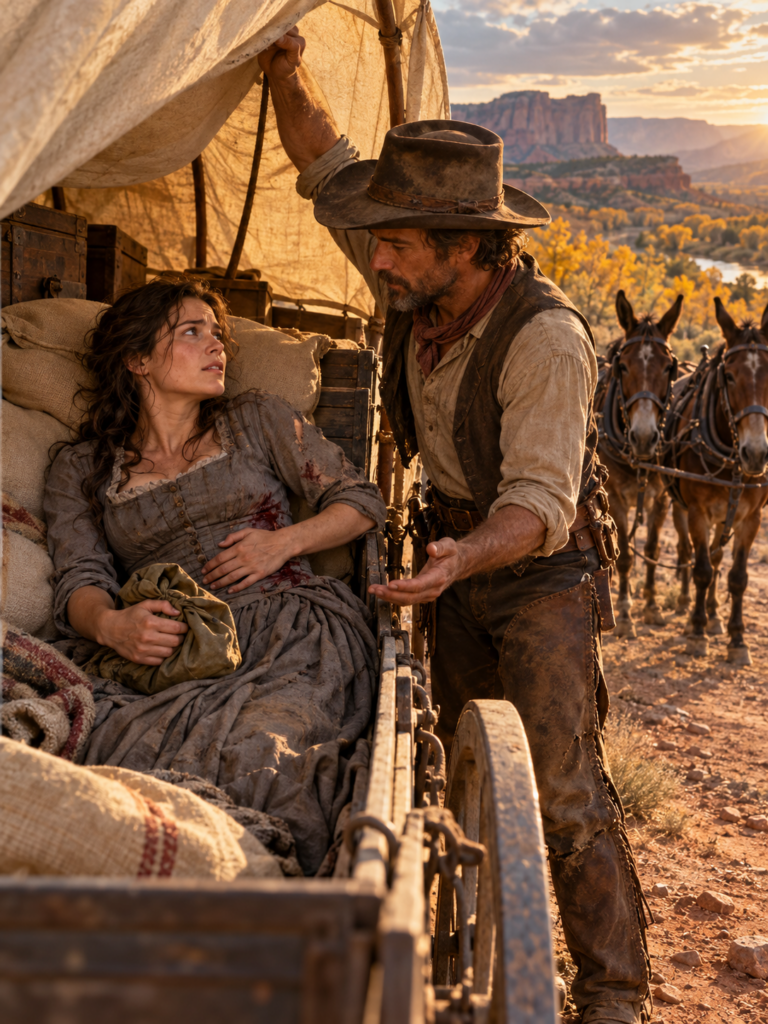
Charlotte’s hand tightened around Ezra’s wrist just as another faint scraping sound came from outside the window.
“Put out the lamp,” she whispered.
Ezra listened for a moment. The sound could have been a branch brushing the siding, but her terror was genuine.
He lowered the lamp flame until the room darkened.
“Stay where you are,” he murmured. “I’ll see what’s moving.”
“No.” Her grip strengthened. “Don’t go outside for my sake.”
“I’m only looking through the kitchen window.”
She released him reluctantly.
Ezra moved through the doorway and waited until his eyes adjusted. Beyond the glass, the juniper branches swayed in the evening wind. One slender limb touched the siding each time the breeze shifted.
No rider stood in the yard.
He returned and raised the lamp.
“Just a branch.”
Charlotte covered her face with one trembling hand.
For the first time, Ezra understood that whatever frightened her had not ended when she reached his wagon.
She expected danger even while lying in a stranger’s bed.
“You called for someone named Whitfield,” he said gently.
Her hand fell.
“Did I?”
“Yes. And another man. Pratt.”
The color seemed to drain from her face.
“Please forget those names.”
“I can’t promise that.”
She looked toward the doorway.
“I ought to leave.”
“You can when you’re strong enough to travel. I won’t prevent it.”
“You don’t understand.”
“That’s true.”
Charlotte studied him, clearly unaccustomed to a man admitting what he did not know.
Then she spoke with painful deliberation.
“Someone was killed near the creek.”
Ezra remained still.
“A man named Elias Whitfield.”
“Did you see it happen?”
Her eyes filled, but her voice stayed steady.
“Yes.”
Outside, the wind worked through the branches.
“Who killed him?”
“I can’t tell you everything tonight.”
“All right.”
“You aren’t going to demand it?”
“No.”
She glanced at the bundle beneath her arm.
“He was looking into something that happened years ago. Something people were made to believe had been settled.”
Ezra remembered her reaction at the survey marker.
“Was it about those boundary lines?”
She stared at him.
That was answer enough to make his chest tighten.
There had been grumbling about creekfront acreage in the valley for years. Certain families insisted that lines had moved after their claims were recorded. Cyrus Aldrich had profited from the disputed ground, but ordinary suspicion was a long way from proof.
“You know Aldrich?” Charlotte asked.
“Everybody around here knows of him.”
“And Jonas Pratt?”
“Aldrich’s foreman.”
She looked down.
Ezra waited.
Finally she said, “Pratt was there when Whitfield died.”
“Did he see you?”
“Yes.”
The single word explained her terror more clearly than any long confession could have.
Ezra pulled the chair beside the bed without crowding her.
“Does he know where you went?”
“I don’t think so.”
“Then we have time to consider what to do.”
Charlotte shook her head.
“I thought that when I got to Cottonwood Flats. I thought I could find one honest man who would carry a message.”
“What message?”
Her gaze moved to the bundle.
“Evidence.”
He looked at it but made no attempt to touch it.
“That what you’ve been guarding?”
“Yes.”
“Then keep guarding it.”
She seemed almost bewildered.
“Aren’t you curious?”
“Plenty. But it’s yours.”
Charlotte swallowed.
“My father was a surveyor. He worked along this creek eight years ago.”
Ezra knew the name Merrick from old conversations among settlers. Suddenly he remembered a drowning that many had doubted.
Before he could speak, Charlotte continued.
“He died trying to put something right. I left because I couldn’t bear living where everyone pretended there was nothing wrong.”
“And now you’ve come back.”
“Because someone else found what he found.”
“Whitfield.”
She nodded.
Ezra understood then that she was not merely fleeing danger. She was trying to carry a dead man’s work somewhere it could still matter.
He set a cup of water within reach.
“You don’t have to tell me more tonight.”
“Then what happens tomorrow?”
“We see how your fever is doing. After that, we’ll talk about where you need to go.”
Charlotte looked toward the window.
“If Pratt finds me here, he’ll come for you too.”
“Maybe.”
“That doesn’t frighten you?”
“It does.”
She turned toward him, surprised by the admission.
Ezra spoke carefully.
“But being frightened doesn’t mean I intend to hand you over.”
Charlotte reached beneath the blanket and pulled out the oilcloth bundle.
She held it between both hands, weighing the choice.
Then she moved it across the mattress toward him.
“If I’m too sick to make the journey,” she whispered, “someone else has to know where this belongs.”
She began unfolding the first corner.
The first fold of oilcloth opened beneath Charlotte’s trembling fingers.
Ezra saw the edge of a small, worn notebook, its cover darkened by years of handling.
But before she could unwrap it completely, her hand began to shake so violently that the bundle slipped against the blanket.
He caught the cloth before it fell.
“Easy,” he said. “You’re working yourself into another fever.”
“I need you to understand.”
“I will listen. But you don’t have to spend every bit of strength tonight.”
Charlotte stared at the notebook.
For eight years she had carried it like a piece of her father’s unfinished life. She had imagined placing it before an honest official, making a clear explanation, and finally hearing someone acknowledge what Aaron Merrick had discovered.
Instead, she was lying injured in a rancher’s spare room, depending upon a stranger whose face she had first seen through a wagon canvas.
She drew the oilcloth closed again.
“Promise me something.”
Ezra waited.
“If anything happens to me, this must reach the proper authorities in Prescott. Not the sheriff here. Not anyone employed by Aldrich.”
“I understand.”
“No, you don’t. Men have died because of these pages.”
“Then I’ll take that seriously.”
His answer contained no grand pledge, but it was spoken with enough weight that she believed he meant it.
He left the bundle in her hands.
“Rest now.”
She slept before he finished lowering the lamp.
By morning, her fever had eased, though her wound remained sore and demanded regular cleaning. Ezra had not forgotten her warning. He knew that an injured woman could not simply mount a horse and ride hard across rough country.
He brought her breakfast and found her sitting against the pillows, studying the closed door.
“You’ve been awake awhile,” he observed.
“I was deciding whether I could reach it without falling.”
“You need something?”
“I need to know whether I’m free to open it.”
Ezra looked at the door, then back at her.
“Of course.”
“Even when you’re outside?”
“Especially then.”
That answer made her look away for a moment.
She had spent two days running from men who treated her life as an obstacle to be removed. Ordinary permission had begun to feel unfamiliar.
During the following days, Ezra tended his mules, two milk cows, and the work of his small ranch while Charlotte slowly recovered. He carried water into her room and left food where she could reach it.
She soon discovered that he was an indifferent cook.
On the first afternoon she felt able to stand, he found her beside the stove, stirring beans while bracing one elbow against the wall.
“You’re meant to be resting.”
“And these beans are meant to be edible.”
“Those two things aren’t connected.”
“They are if I have to smell them burning while I lie in bed.”
He looked from her face to the pot.
“Sit down before you fall down.”
She raised her eyebrows.
“Bring me a chair, and I will.”
He did.
Charlotte watched him pull it beside the stove.
The small exchange mattered more than either acknowledged. She had offered a reasonable solution; he had accepted it instead of insisting on his own authority.
Soon, she could mend the shirt he had sacrificed for bandages and help with small household tasks when she chose. Ezra continued the outdoor work, and in the evenings he told her about the animals, the coming repairs, and the difficulty of keeping a quarter section productive with limited help.
She listened closely.
His life was neither grand nor effortless. The modest house needed maintenance. The mules consumed feed whether the harvest had been good or poor. A rancher could own land and still work from first light until darkness without ever feeling ahead.
Charlotte had known men who spoke of land as though it were merely money.
Ezra spoke of it as something that required tending.
One evening he returned with rain on his shoulders and a painful stiffness in his arm from freeing a wagon wheel caught in a wash.
She noticed the way he struggled to remove his coat.
“Sit down.”
He looked amused.
“Have I become your patient?”
“Only if you want that shoulder to move tomorrow.”
She used her hands to ease the knotted muscles as he sat near the stove.
After several minutes, he said quietly, “You don’t owe me this.”
“I know.”
“Then why?”
“Because you’re hurting and I can help.”
He smiled faintly.
“That sounds familiar.”
She felt herself smile in return.
The familiarity of his company was becoming dangerous in another way.
She had come to the valley to finish her father’s work, not to begin caring whether a rancher remembered to eat his supper.
Three evenings later, her fever returned slightly.
Charlotte sat at the kitchen table with the notebook in front of her and decided that another delay would only make speaking harder.
She began with her father.
Aaron Merrick had worked as a deputy surveyor under the territorial survey administration. Years earlier, he had recorded the section lines around the Verde Basin. When he compared his field measurements with the filed plat, he discovered that the course of the creek had been represented incorrectly.
The changed line placed valuable creekfront acreage within holdings claimed by Cyrus Aldrich rather than within the boundaries of smaller homestead claims.
Her father had intended to challenge the discrepancy.
He traveled toward Prescott with his evidence.
He never arrived.
His body was later found in the creek, and his death was officially treated as an accident.
“I was seventeen,” Charlotte said. “I knew people were lying, but I couldn’t prove it.”
Ezra did not interrupt.
“I left the valley and found work in a lawyer’s office in Flagstaff. For years I told myself I had done the sensible thing.”
She looked down at the notebook.
“Then Elias Whitfield wrote to me.”
The younger surveyor had been hired to check land measurements in preparation for another sale involving Aldrich’s holdings. He discovered the old discrepancy and contacted Charlotte because he believed her father’s field notes might still exist.
“They did,” she whispered. “I kept them all these years.”
She had returned intending to meet Whitfield and help him make the correction official.
Instead, near the old boundary, she found him on the ground.
Jonas Pratt stood nearby holding a rifle.
“He saw me,” Charlotte said. “I ran before he could reach me, but he fired.”
She touched the bandage along her ribs.
“I kept moving until I couldn’t anymore.”
Ezra sat very still.
He finally understood why she had guarded the notebook even while bleeding.
“It proves the boundary records were altered,” she said. “It doesn’t prove who killed my father or Whitfield. But it gives someone honest a reason to investigate.”
“And Aldrich has a land sale coming.”
“Yes.”
“Then he has good reason to fear those pages.”
Charlotte looked at him.
“I need to get them to Prescott.”
“Not while you’re sick enough to faint in the saddle.”
“Then I need another way.”
Ezra leaned back and considered what he knew of the country.
“There is a telegraph station at Beaver Creek. Twelve miles east.”
She became attentive.
“A station with a line to Prescott?”
“Yes.”
“Who runs it?”
“Amos Teal. I know him. He’s not a man Aldrich can easily push around.”
Ezra was careful not to promise more than he knew.
“If we can reach him, he may be able to send word to the federal authorities.”
Charlotte looked at the notebook.
“Pratt will watch the roads.”
“He may.”
“Then we shouldn’t use one.”
Ezra considered the dry country between his holding and the station.
“There are washes, but some are hard on horses.”
Charlotte turned the notebook toward him.
“My father mapped an old creek course through that ground.”
For the next two evenings, they planned together.
Ezra knew where loose shale could cripple a horse and where the rises offered a clear view of approaching riders. Charlotte knew the measurements recorded in her father’s careful hand.
They disagreed over the northern route.
Ezra preferred a wider sweep away from the main wagon road. Charlotte insisted that an old dry wash offered better concealment.
He resisted at first.
Then she placed the notebook between them and traced the changing contours with her finger.
“Look at the ground he measured. Not the road someone drew afterward.”
Ezra studied it again.
She was right.
“The wash,” he said at last.
Charlotte regarded him thoughtfully.
“You can change your mind.”
“Don’t sound so astonished.”
“I’ve known men who would rather lose a horse than admit a woman understood a map.”
“Then those men were fools.”
She laughed, suddenly and warmly.
The sound surprised them both.
By the time her strength had sufficiently returned, they were ready to travel. She still moved carefully and tired sooner than she wished, so they agreed on a measured pace and opportunities to rest.
Before dawn, Ezra brought two saddled horses to the door.
Charlotte emerged carrying the wrapped notebook beneath her coat.
He looked at her.
“If the ride becomes too much, you tell me.”
“And if the route looks wrong, you listen to me.”
He nodded.
“Agreed.”
She mounted with some difficulty, settling herself carefully so the wounded side bore as little strain as possible.
They rode into the dark along the old wash.
For most of the journey, the plan held.
The horses picked their way over firm patches of ground, pausing where Ezra knew the footing was uncertain. Charlotte recognized turns by comparing the land around them with the bearings she had studied.
Neither wasted breath on conversation.
At last they reached scrub oak near Beaver Creek Station.
The corral stood ahead.
Beyond it rose the low station building with its telegraph line.
Charlotte could scarcely believe they had come so close.
Then three riders appeared around the far end of the fence.
The leading horse checked sharply.
Jonas Pratt straightened in the saddle.
Ezra drew his horse alongside Charlotte’s.
Pratt smiled without warmth.
“Miss Merrick,” he called. “You’ve brought me a long way for a little notebook.”
Charlotte felt Ezra’s horse move slightly ahead of hers.
She touched his sleeve.
“Don’t answer for me.”
Ezra glanced back, then gave a small nod.
Pratt waited.
Charlotte rode forward until she could see him clearly.
“I saw what you did to Elias Whitfield,” she said.
His smile disappeared.
“And I intend to tell someone who can do something about it.”
Jonas Pratt’s horse shifted beneath him as Charlotte’s accusation carried across the clearing.
For an instant, the only sound was leather creaking against saddle trees.
Then Pratt gave a short, humorless laugh.
“You’re making a serious charge, Miss Merrick.”
“I watched you shoot an unarmed surveyor.”
“You’ve been sick and frightened. Folks might wonder how clearly you remember.”
“I remember his face. I remember your rifle. And I remember you turning toward me.”
Pratt glanced at the two riders beside him.
“You’ve had a difficult few days,” he said. “Hand over that notebook, and perhaps everybody can get home without more trouble.”
Charlotte kept both hands on the reins.
Ezra sat close enough to intervene, but he made no move to speak over her.
The notebook lay beneath her coat, where she could feel its familiar hard corners against her body.
“No,” she said.
Pratt’s gaze narrowed.
“You understand what you’re risking?”
“I understand what I’ve already lost.”
The foreman looked toward Ezra.
“Colton, this matter never concerned you.”
Ezra answered evenly.
“It concerns me now.”
“You’re putting your place at risk for a stranger.”
“I’m here because a woman was wounded and needed help. The rest I’ve learned since.”
Pratt moved one hand toward his belt.
Ezra’s rifle remained across his saddle, its muzzle angled away. He did not raise it, but neither did he pretend the danger was harmless.
“There’s a station behind you,” he said. “Whatever you plan to do, you’ll have witnesses.”
Pratt looked briefly toward the building.
“You’re a long way from it.”
“Close enough for somebody to hear.”
Charlotte could see the station’s open window. She could not tell whether anyone stood behind it.
The distance suddenly seemed enormous.
Then she remembered the years in which she had allowed other people to decide what her father’s death meant.
She urged her horse forward a few steps.
Ezra’s attention followed her, but he did not try to pull her back.
She stopped where Pratt could see the oilcloth bundle when she brought it from beneath her coat.
“This is what you’re frightened of.”
He fixed his eyes upon it.
“You’ve no notion what those figures mean.”
“I spent years copying legal records, Mr. Pratt. I’ve learned enough to know when a line on paper changes a family’s life.”
His expression darkened.
“If you think waving an old notebook about will bring Aldrich down, you’re badly mistaken.”
“Perhaps it won’t,” she replied. “But it will give an honest surveyor somewhere to begin.”
Pratt leaned forward.
“Last chance.”
From the station came a sudden report.
A shotgun had been fired into the open air.
All five horses startled.
Charlotte caught her reins firmly as a man’s voice rang across the clearing.
“That’s enough!”
Amos Teal stood near the station building, shotgun in hand.
He was an older man with a weathered face and the unhurried movements of someone who understood exactly how little room there was for mistakes.
“I can see you from here, Pratt,” he called. “And I’ve already sent a wire asking for a deputy marshal.”
Pratt’s mouth tightened.
For a moment, Charlotte feared he would choose violence anyway.
Instead, he looked from the station to Ezra, then at the notebook still held against her chest.
“This won’t finish anything,” he said.
Charlotte answered before Ezra could move.
“It finishes my running from you.”
Pratt turned his horse sharply.
The other riders followed him away from the corral.
No one in the clearing spoke until the sound of their horses had faded.
Then Charlotte discovered that her hands were shaking.
She slipped the notebook beneath her coat again.
Ezra brought his horse beside hers.
“You all right?”
“I don’t know.”
“That’s fair enough.”
She looked at the station.
“Let’s get inside before I change my mind about how brave I am.”
He gave her a brief smile.
“You’ve done the hard part.”
“No,” she said. “I’ve done the part that got us here.”
And together they rode the final distance.
Inside Beaver Creek Station, Amos Teal gave Charlotte a chair and brought water while Ezra explained how they had been intercepted.
Charlotte insisted upon speaking for herself.
She told Amos her full name, the circumstances of Whitfield’s death, and why the notebook mattered.
Amos listened without interrupting.
Then he sent another message, giving the authorities in Prescott the essential details and requesting immediate attention.
For the first time since she had returned to the valley, Charlotte knew that someone beyond Aldrich’s local influence had been told what was happening.
It was not safety.
It was not justice.
But it was a beginning.
She remained at the station while the authorities arranged the next steps. Ezra stayed with her at her request, tending the horses and making certain she had food and water.
The journey had aggravated the pain along her ribs, and she needed rest.
The following day, Deputy United States Marshal Ror Howerin arrived to take her statement and examine the evidence.
He did not promise an immediate arrest of every man involved.
He asked questions.
He examined the notebook.
He wanted to know precisely what Charlotte had seen and what she knew only from her father’s notes.
That distinction mattered to her.
She had spent eight years hearing people speak as though suspicion and truth were the same thing whenever it suited powerful men.
She would not make that mistake herself.
“I saw Pratt shoot Whitfield,” she told Howerin. “I did not see my father die. His notebook gives reason to question the land records. I believe the two deaths are connected, but I cannot swear to what I didn’t witness.”
Howerin wrote carefully.
“That is exactly how you ought to tell it.”
He took custody of the notebook, giving her a written acknowledgment of what she had handed over.
When Charlotte saw the bundle pass from her hands into his, she felt suddenly bereft.
For eight years, she had kept those pages close because she did not know where else they belonged.
Now another person carried responsibility for them.
Ezra noticed the way she stared at the empty place on the table.
“You did what you came to do,” he said.
“Not yet.”
“No?”
“Not until someone checks his work.”
Howerin looked up.
“That can be arranged.”
Within the following week, he returned to Cottonwood Flats accompanied by a land-office special agent who examined Aaron Merrick’s measurements against the filed plat and the affected land entries.
The investigation was painstaking.
Every line had to be checked. Every disputed claim carried its own history. Some settlers had papers they scarcely understood, while others had spent years believing they had no grounds to challenge the records.
But the essential discrepancy became harder to deny.
The field notes placed the creek where it had actually run.
The filed plat represented the boundary differently.
And the altered lines favored Aldrich’s holdings at the expense of smaller claims.
The agent documented the contradictions and began the necessary review.
Pratt was eventually taken into custody after warrants were issued in connection with Whitfield’s killing.
The proposed land auction was halted.
Aldrich employed lawyers who argued over records, responsibility, and alleged mistakes.
His wealth did not disappear.
His influence did not vanish overnight.
And Charlotte learned that official scrutiny could advance slowly even after the evidence was plainly on the table.
One evening, she sat outside Ezra’s house while the last daylight settled over the yard.
He came from the barn carrying an empty feed bucket.
“You’re quiet,” he said.
“I’m trying to decide what justice ought to feel like.”
He set the bucket down.
“Have you settled on an answer?”
“I expected relief.”
“And?”
“Mostly I’m tired.”
He sat on the porch step, leaving room beside him.
After a while, she joined him.
“I used to think my father’s death was the reason I couldn’t come home,” she said. “But I was afraid of finding out how much of my life I’d built around leaving.”
Ezra looked across the darkening pasture.
“Flagstaff wasn’t a bad life, was it?”
“No. I had good work. People who treated me decently. I could have stayed there.”
“You still could.”
Charlotte glanced at him.
He meant it.
There was no careful appeal hidden in his words, no attempt to turn his help into a claim upon her future.
She had come to know that about him.
“You’d let me go?” she asked.
“I don’t have the right to keep you.”
“That’s not what I asked.”
He considered the distinction.
“No,” he said at last. “I wouldn’t be glad to see you go.”
Her heart seemed to stop for a moment.
“Why?”
“Because I’ve grown fond of you.”
He spoke without embellishment.
“More than I intended.”
Charlotte looked down at her hands.
The man who had found her bleeding in his wagon had become familiar to her through the smallest things: the way he checked the mules before eating, the careful manner in which he repaired a loose door hinge, the patience with which he listened when she explained a boundary measurement.
She had learned that he could be stubborn, untidy, occasionally too certain that hard work would solve a problem.
He had learned that she disliked being ordered about and that she needed the truth spoken plainly, even when it frightened her.
Neither had become someone else.
But they had changed.
“I can’t make any promise yet,” she said.
“I haven’t asked for one.”
“Good.”
He smiled a little.
“Good.”
She reached over and rested her hand beside his on the porch step.
After a moment, he turned his hand and held hers.
Nothing more was required that evening.
The public hearing took place in the Cottonwood Flats Grange Hall.
Charlotte stood before neighbors who remembered her father, including some who had once advised her to leave his death alone.
She spoke of Aaron Merrick’s survey work, Elias Whitfield’s discovery, and the killing she had witnessed near the creek.
She described the notebook and what the land-office examination had found.
Her voice remained steady, though she kept one hand resting on the edge of the lectern.
At the back of the room, Ezra listened.
He had offered to stand beside her, but she had asked him instead to remain where she could see him among the townspeople.
“I want them listening to me,” she had explained.
“They will,” he answered.
When she finished, old Higgins from the mercantile approached and shook her hand.
“Your father would have been proud, Miss Merrick.”
She thanked him.
A woman whose family had lost creekfront ground began to weep quietly as she took Charlotte’s hands.
Sam Wickham, the fourteen-year-old clerk who had warned Ezra about Pratt’s questions, stood nearby looking as though he had never been so pleased to be part of something important.
Charlotte thanked him too.
“You did a brave thing.”
Sam blushed.
“Mostly I just paid attention.”
“That was enough.”
The hearing did not instantly restore every disputed acre. The examination continued through the winter, and the final review of Aldrich’s claims would take considerably longer.
But the auction remained halted.
The fraudulent boundary could no longer be treated as an unquestioned fact.
Families who had once believed they were powerless now had official grounds for challenging what had happened.
And the investigation into Whitfield’s death no longer depended upon a frightened woman trying to keep ahead of armed men.
That mattered.
For Charlotte, it mattered even more than the satisfaction of watching Aldrich’s representatives struggle to explain the discrepancies.
She had told the truth in the valley where her father had died.
And people had listened.
As the investigation progressed, the review also confirmed something Charlotte had barely allowed herself to hope.
Aaron Merrick’s forty-acre home place had not rightfully passed into Aldrich’s possession.
The boundary correction supported the Merrick family’s claim to the little holding beside the creek.
Its cabin, neglected for eight years, was badly damaged.
Part of the roof had collapsed. The door hung crookedly, and weeds crowded the ground where Aaron had once worked.
But the land remained.
The creek still ran nearby.
Charlotte visited the place on a mild afternoon with Ezra.
They stood before the ruined cabin in silence.
She remembered it differently.
In her childhood, the doorway had seemed taller and the cabin warmer. Her father had sat at a rough table with his survey notes while she worked beside the window.
Now daylight shone through broken roof timbers.
“There’s more to do here than I expected,” Ezra said.
“Yes.”
“Have you thought what you’ll make of it?”
Charlotte looked toward the water.
“I want to bring it back.”
He nodded.
“You could.”
“Not by myself.”
“There’s help to be had.”
She turned to him.
“Would you help me?”
“If you want me to.”
She studied his face.
“Not because you think the place ought to become yours someday.”
“No.”
“Not because you think I’ll have to come live at your ranch.”
“No.”
“Because I want this land to be my home.”
“Then that’s what we’ll work toward.”
Charlotte looked back at the cabin.
For the first time, the ruins seemed less like evidence of what had been taken and more like work waiting to be done.
They began planning repairs.
Ezra offered his carpentry skills and whatever time he could spare from his own ranch. Sam Wickham helped carry materials when his uncle could release him from store duties. Two homestead families who had benefited from the boundary investigation joined them for several days.
Charlotte organized the work, determined what supplies she could afford, and kept careful accounts.
She did not want charity disguised as an obligation.
Those who helped respected that, though they refused to make every neighborly kindness into a debt.
Ezra rebuilt damaged sections of the roof while Charlotte measured boards and marked the pieces that could still be used.
They argued about the position of a shelf.
He insisted one wall offered the strongest support.
She pointed out that it would block the light beside the table.
He considered the room, then agreed to move it.
“You’re doing that more often,” she observed.
“What?”
“Admitting I’m right.”
“Don’t get accustomed to it.”
She laughed.
He watched her for a moment, then returned to work with a smile he could not quite conceal.
Their days acquired a new rhythm.
Ezra still had his own ranch and animals to tend. Charlotte spent her mornings overseeing repairs or clearing the ground near the cabin. When the work allowed, they shared meals, mended tools, and talked about matters that had nothing to do with Aldrich.
They spoke of books she had read in Flagstaff, of Ezra’s years learning to manage livestock, of the difficulties of bringing water and supplies across the valley.
Slowly, they spoke of the future.
One evening, as autumn sunlight caught the new roof boards, Charlotte found Ezra sitting on the porch step.
He had a cup of coffee in his hand.
She sat beside him.
“Do you remember what I said in the wagon?” she asked.
“Some of it.”
“I asked God not to let them find me.”
“I remember.”
“For years, I thought safety meant getting far enough away that nothing from the past could reach me.”
She looked at the notebook lying in her lap. The authorities had returned it after recording and examining what they needed.
“I kept this because it was all I had left of Father’s work. But I never understood that I was keeping a reason to come home.”
Ezra turned toward her.
“Did you find what you came for?”
“Not all of it.”
“What haven’t you found?”
She looked at him.
“The courage to ask you what happens to us now.”
He rested his cup beside his boot.
“I suppose that depends on what you want.”
“I want to live here.”
“I know.”
“I want the freedom to decide how this place is run.”
“It’s your place.”
“And I want to keep the work I’ve learned. The accounts, the records, perhaps helping other families understand their claims.”
“I think you’d be good at it.”
Charlotte looked down, then laughed softly.
“You’re making this rather difficult.”
“How so?”
“Because I was preparing for an argument.”
“Sorry to disappoint you.”
She reached for his hand.
“I want you in my life, Ezra.”
His expression grew still.
“Are you certain?”
“Yes.”
“You don’t owe me anything for bringing you out here that day.”
“I know that.”
“And I won’t ask you to give up this place.”
“I’m not offering it.”
He smiled.
“Then perhaps we understand each other.”
She moved closer.
“Perhaps we do.”
When he kissed her, it was gently, without urgency, and she answered with the certainty of a woman who had finally arrived at a choice she did not need to defend.
They did not announce a wedding.
They did not abandon their separate responsibilities.
They simply began building a shared future in the ways that mattered.
Ezra continued tending his ranch. Charlotte restored her father’s holding and made it useful again, keeping records for herself and occasionally helping neighbors sort their correspondence and land papers.
He came to her place when the day’s work allowed.
She rode to his when she wished.
Sometimes they worked together. Sometimes they worked apart.
And neither mistook distance for rejection.
The creekfront cabin became warm and sound again.
A sturdy roof kept out the rain. The old table was repaired and returned to its place by the window. Charlotte arranged her father’s notebook on a shelf where she could reach it without hiding it.
There were two chairs on the porch now.
One belonged to the woman who had reclaimed her home.
The other was always available to the man who had helped her reach it.
On an evening when the cottonwoods were turning gold again, Ezra arrived with a small parcel of supplies from town.
Charlotte met him at the gate.
“Long ride?” she asked.
“Long enough to appreciate a cup of coffee.”
“Then you came to the right place.”
He followed her toward the porch.
As they passed the old trail, Charlotte glanced toward the west, remembering the wagon, the blood, and her desperate prayer beneath the canvas.
“Something on your mind?” Ezra asked.
She smiled.
“I was thinking about the first day we met.”
“You gave me quite a surprise.”
“I was terrified.”
“I noticed.”
“I thought you might turn me over to Pratt.”
“I didn’t even know who Pratt was.”
“But you knew I needed help.”
“That much was plain.”
She paused beside the steps.
“Why did you do it?”
He looked at her for a long moment.
“Because leaving you there would have been wrong.”
“Only that?”
“That was enough to begin with.”
“And afterward?”
“Afterward I got to know you.”
Charlotte felt the warmth of the evening settle around them.
The answer was simple, but it contained everything that had grown between those first frightened hours and the life they were making.
She took his hand and led him onto the porch.
The repaired cabin stood behind them, solid on its old foundation.
Beyond the trees, the creek followed the course it had always followed, indifferent to the false lines men had once drawn over it.
Charlotte no longer needed to hide her father’s notebook beneath a mattress.
She no longer had to leave the valley to feel free.
And when Ezra sat beside her, there was no debt between them, no promise extracted from gratitude, no claim stronger than the choice they renewed whenever they came together.
She looked toward the western road.
Once, she had prayed not to be found because discovery meant danger.
Now, with her own door behind her and the man she loved beside her, she understood that the life she had been searching for had never required her to disappear.
It had required her to return, speak the truth, and decide for herself where she belonged.
The creek moved quietly through the fading light.
Ezra’s hand rested open beside hers.
Charlotte took it.
And this time, she had nowhere she needed to run.


