
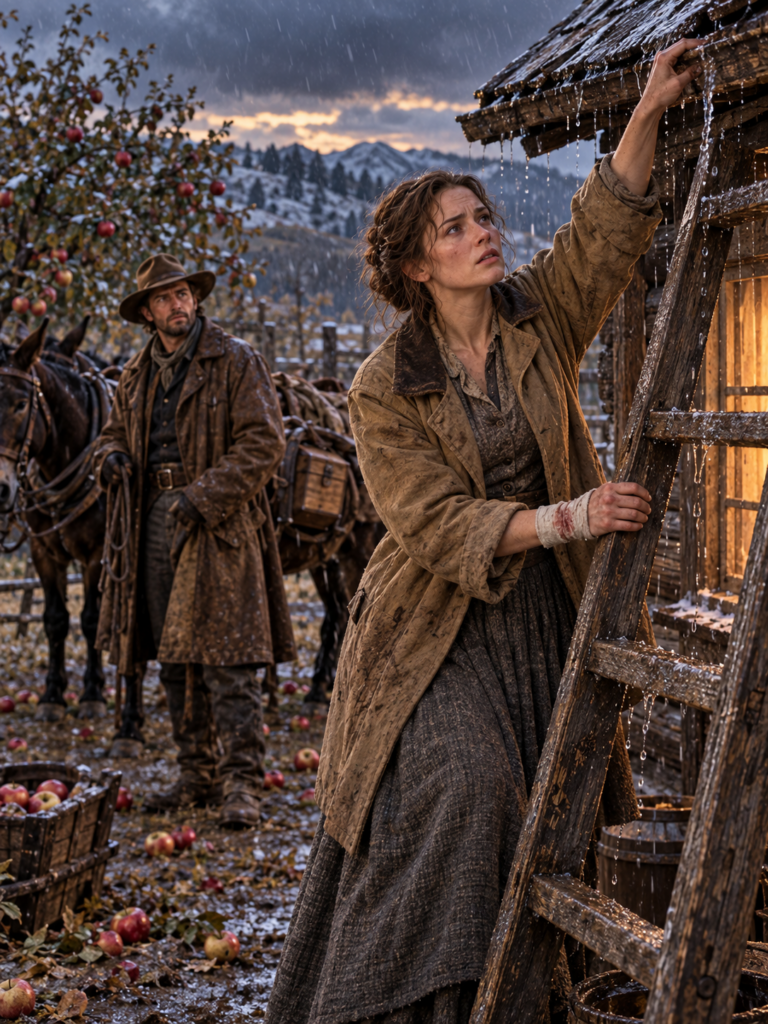
The ladder scraped across the frozen ground, one wooden foot catching in a rut and wrenching Willa’s injured wrist so sharply that she nearly lost her grip.
Ezra stepped forward, then stopped when she raised her good hand.
“I can move it.”
“I believe you.”
He waited until she had freed the ladder herself.
Only then did she nod toward its upper rungs.
“Look at the wood.”
Ezra examined the worn rails. A shallow split ran along one side near the top, and the feet had been worn unevenly by years of use.
“It’s been repaired before,” he said.
“My father trusted that ladder.”
Ezra carefully lowered it to the ground.
“Trust doesn’t make a split rail sound.”
Her eyes flashed.
“I didn’t say it did.”
“No, ma’am.”
She stood beside him, breathing through the pain in her wrist.
Then she pointed toward the barn.
“There’s another ladder hanging along the far wall. My father kept it for the orchard. You may inspect that one.”
They carried it out together.
Ezra tested the rails and rungs, then set it against the barn while he examined its feet.
Willa watched every movement.
Finally she said, “You’ll use that one.”
“If it can be secured properly.”
“And I shall hold it.”
He glanced at her wrist.
“You can help from the ground. But I won’t ask your injured hand to carry weight it cannot manage.”
“That hand belongs to me, Mr. Colton.”
“It certainly does.”
His calm reply unsettled her more than an argument would have.
By midday, they had arranged the tools and examined the soundest sections of the roof from below. Ezra explained that the sagging boards must come off before the new shakes could be laid.
Willa knew that already.
What she had not expected was his insistence that they count the labor honestly.
“If the boards underneath have rotted,” he said, “we’ll need repairs before shingles. Might take longer than the week we’ve written.”
“Then we revise the bargain.”
“Fair enough.”
She had spent months hearing men tell her what she could not do.
This stranger simply told her what the roof required.
It made him difficult to dislike.
That evening, she prepared bread, potatoes, and a little cheese, and placed two plates on the porch table.
Ezra ate at the far end as agreed.
The orchard lay dark beyond the fence.
After a while, he asked, “Were all those trees planted by your father?”
“Every one. Some from nursery stock, some grafted by his own hand.”
“He knew his business.”
“He did.”
She watched Ezra cut his potato.
“He intended to roof the cabin himself.”
Ezra waited.
“He always said there would be time after harvest.”
The words seemed to cost her more than she had intended.
“There’s often more work than daylight,” Ezra answered.
Willa nodded.
But he noticed she had gone pale.
Later, when he returned to the barn, he heard movement near the tools.
Willa stood at the splitting block, trying to work another bolt with her injured wrist.
The first strike fell short.
The second sent the mallet slipping against the wood.
Ezra approached only as far as the doorway.
“Miss Prior, it’s nearly dark.”
“I know what hour it is.”
“That wrist won’t mend if you keep striking with it.”
She turned.
“And the roof won’t mend if I don’t.”
“Then perhaps we ought to let me split tomorrow’s shakes.”
Her face tightened.
“You think I haven’t tried?”
“No.”
“You think I haven’t stood here every day wondering how much wood one woman must split before winter?”
He let her anger spend itself.
Then Willa looked away.
“My father was going to repair that roof in June,” she said.
Ezra stayed quiet.
“He was already gathering his tools.”
Her fingers loosened around the mallet.
“Then something happened.”
Ezra did not ask what.
The silence stretched.
Finally she set the mallet on the block.
“I cannot bear another man climbing that ladder without knowing exactly where his feet will go.”
He understood that this was not merely a preference.
It was fear, held rigidly inside a woman determined not to surrender control of her own home.
“I’ll show you every place I intend to stand,” he said.
She looked at him.
“And if I tell you to come down?”
“Unless coming down would be more dangerous, I’ll come down.”
She swallowed.
For a moment, her expression softened.
Then he said, “There’s something else I ought to tell you.”
Willa waited.
Ezra removed his hat.
“When I came into your yard yesterday, you were standing by that ladder.”
Her face changed.
“You saw me?”
“Yes.”
“What else?”
He could have avoided the question.
Instead, he said, “I heard you asking the Lord to send someone to repair your roof.”
The mallet slid from Willa’s fingers.
It struck the splitting block, bounced once, and fell into the straw.
She stared at him.
“You heard my prayer?”
“Yes, ma’am.”
“And you let me offer you cider as payment?”
“I agreed to a trade you set.”
Her voice broke.
“Did you hear the rest?”
Ezra could not lie.
“Yes.”
Willa stepped backward, reached for the barn door, and began pulling it closed between them.
The barn door moved slowly across Ezra’s view, its iron hinge complaining in the cold.
He did not reach to stop it.
“Miss Prior,” he said, “I’m sorry I didn’t tell you sooner.”
Willa stood with one hand gripping the edge of the door.
“You heard me ask God for help,” she said, “and you decided to become the answer?”
“No.”
“Then what did you decide?”
“That my mules needed shelter. That your roof needed work. And that two people might make a fair bargain.”
“You knew I was desperate.”
“I knew you needed a roof.”
“Those aren’t the same thing?”
“They needn’t be.”
She looked at the man outside her barn, at his hat held against his chest and his boots planted in the straw.
In her experience, help came with strings.
Some men wanted money she did not have.
Others wanted her to admit she could not manage her father’s place.
Even kindness frightened her now, because kindness was difficult to refuse once accepted.
“You heard what I asked not to have to pay,” she whispered.
“I did.”
“And you stayed anyway.”
“I should have told you. I was wrong to keep quiet.”
Her eyes filled, and the sight seemed to anger her.
“You’ve no right to know what I said to God.”
“I know.”
“That was private.”
“Yes.”
“And now I cannot tell whether you came here because you wanted cider or because you pitied me.”
Ezra took a breath.
“I can’t undo hearing you. I can tell you that I don’t expect anything beyond what we agreed.”
She shook her head.
“You don’t understand.”
“Then I won’t pretend I do.”
The answer made her close her eyes.
When she opened them, there was no softness left.
“I want you gone in the morning.”
Ezra stood motionless.
Then he nodded.
“If that’s your decision.”
“And leave the wood.”
“Of course.”
He stepped back.
The barn door closed.
That night, Ezra remained in his wagon, listening to the mules shift on their bedding.
He had never been particularly good at words.
Working animals were easier to understand. A mule told a man when its strength was failing. A broken trace showed precisely where the strain had been.
People were not so simple.
He had thought respecting Willa’s bargain would protect her dignity.
Instead, by withholding the truth of what he had heard, he had made her feel observed in a moment meant for no one else.
He lay awake beneath his blanket.
Sometime after midnight, he heard a sound from the far end of the barn.
Wood striking wood.
The uneven ring of a mallet.
He sat up.
Through the darkness he could just make out movement near the splitting block.
Willa was trying again.
He started to rise, then settled back.
She had asked him to leave.
He would not turn her private grief into another excuse to cross a boundary.
In the morning, Ezra harnessed the mules.
He secured his hay beneath the tarp, checked the wheels, and led the wagon through the gate.
The road was firm where the overnight frost had settled into the ruts.
He had every reason to continue toward Loveland.
But he had also signed a week of work.
Willa had dismissed him, yet the half-finished bargain troubled him.
He stopped a short distance beyond the gate.
There he waited, without bringing his wagon back onto her land.
The sun climbed over the orchard.
At last the cabin door opened.
Willa came down the porch steps wearing her canvas coat. Fresh flannel covered her wrist. Her eyes were red, but her back was straight.
She walked to the gate.
“Are you leaving, Mr. Colton?”
“If you want me to.”
“Why are you sitting there?”
“Because you hired me to do a job. I won’t leave you thinking I abandoned it. But I won’t come back without your permission.”
Her gaze fell to the paper twist still attached to the post.
The dime he had paid for shelter was inside.
“I don’t know how to ask people for what I need,” she said.
“You made yourself clear when you wrote our agreement.”
“That was different.”
“How?”
“Because a bargain allows me to stand upright.”
“Then we’ll keep it a bargain.”
She looked toward the roof.
The north slope was darker than ever. Another cold night had opened a seam in the old tar paper.
Her father had built that house.
Her father had planted those trees.
And since June, every sound of dripping water had seemed like another accusation that she had failed to preserve what he left behind.
“I asked the Lord,” she said. “I didn’t ask you.”
“No, ma’am.”
“I don’t want you staying because you believe you’re obliged by my prayer.”
“Then I won’t.”
She drew a long breath.
“I’m asking now.”
Ezra waited.
“Come back and repair the roof. Under the same terms. Because I need the work done, and because I choose to hire you.”
He nodded.
“All right, Miss Prior.”
She stepped away from the gate.
“And no more surprises about what you’ve heard.”
“No more.”
They returned to work.
For the next two days, the orchard and barn filled with the sounds of steady labor.
Ezra split pine bolts into shakes, using the froe and wooden mallet Willa’s father had kept in the harness room.
Willa gathered apples in canvas sacks, carried them to the press shed, and sorted the best fruit from the bruised.
Her wrist limited her, so they altered the arrangement of the work.
Ezra lifted the heavier baskets when he was free from splitting. Willa taught him to operate the cider grinder and showed him when the crushed pulp was ready for the press.
She knew which apples produced sweetness, which gave a sharp flavor, and which would keep in a cool cellar.
He learned quickly, but not without mistakes.
“You’re turning that crank as if you’re grinding stones,” she told him one afternoon.
He eased his pace.
“Apples complain less than mules.”
“Only because they cannot kick you.”
He looked at her.
This time she smiled openly.
It lasted only a moment.
But the air between them seemed lighter afterward.
At noon, they continued eating on the porch.
Ezra never asked to enter the cabin.
Willa never invited him.
Neither treated the boundary as an insult.
By Thursday, they had pressed several barrels of cider and split enough shakes to begin serious work on the roof.
Yet Ezra noticed that Willa became tense whenever he approached the ladder.
Her eyes followed every movement.
When he moved it, she insisted on knowing where.
When he checked the old roof from the eaves, she stood beneath him, holding her breath.
On Saturday morning, he began removing the failing north-slope covering.
They had secured the sound ladder carefully, setting its feet on firm ground and tying its upper end to solid framing.
Willa stood below, helping with the tools.
Ezra tested the boards before putting weight upon them.
Several had been weakened by years of leaks.
He removed the rotten material and worked back until the wood beneath was sound.
While clearing debris from the gutter trough, his pry bar struck something hard.
Not stone.
Metal.
He loosened a packed layer of leaves and blackened shingle fragments.
A hammer lay beneath them.
Its head was spotted with rust.
Its hickory handle was dark from years of use.
Ezra turned it in his hand.
There were old letters burned into the wood.
A. Prior.
He looked down toward Willa.
She was waiting beside the ladder, her face lifted.
“Miss Prior,” he called. “I’ve found something.”
He descended carefully.
When his boots touched the ground, he held out the hammer handle first.
Willa stared.
For an instant she seemed unable to breathe.
Then her good hand rose to her mouth.
“Where was it?”
“In the gutter.”
She shook her head.
“No.”
Ezra said nothing.
“He had it that morning.”
Her voice had changed.
“He carried it up there with him.”
Ezra kept the hammer extended, allowing her to decide whether to take it.
“June ninth,” she whispered.
That was when he finally understood the date she had mentioned.
“My father was sixty-one,” she said. “He was strong. Careful. He knew every board of that house.”
She took the hammer.
“The roof had been leaking all spring. He said he’d put a little tin over the worst place until we could afford new shakes.”
Her fingers closed around the old wood.
“I was in the orchard. I heard the ladder move.”
She stopped.
Ezra watched her without interrupting.
“It slipped,” she said. “The boards were wet. I didn’t even hear him shout.”
Her eyes moved toward the foot of the wall.
“I found him there.”
The wind moved through the apple trees.
“He was alive when I reached him. He kept asking whether the ladder was all right.”
Willa pressed the hammer against her coat.
“I told him it was.”
Her voice broke.
“I don’t know why I said that. I couldn’t think of anything else.”
Ezra looked at the roof.
The patched boards.
The weakened gutter.
The old ladder they had set aside.
He could picture the accident without needing another word.
Willa lowered her head.
“Afterward, I tried to patch the roof myself. I couldn’t bear bringing another man onto it. It felt as though I was letting someone finish what my father had begun.”
She wiped her face.
“Then in September I slipped from the second rung. That’s how I hurt my wrist.”
Ezra waited.
“I lay there in the yard, and all I could hear was my father asking about the ladder.”
Her tears fell freely now.
“I have been afraid to climb ever since. But I kept doing it because I didn’t know what else to do.”
Ezra looked at the hammer in her hands.
“He meant to repair that roof,” he said quietly.
“Yes.”
“And you mean to finish it.”
“Yes.”
“Then let’s make sure it’s done properly.”
She looked up.
For the first time, there was no anger in her face.
Only grief.
And something more fragile.
Relief.
“But the final ridge course is mine,” she said.
Ezra hesitated.
“Your wrist—”
“I know what condition it’s in. I also know what I need to do.”
He glanced toward the roof.
“You’ll need to wait until the working surface is secure. And we’ll have to find a way you can do it safely.”
“I’ll wait.”
She straightened.
“But you won’t take that last part from me.”
He nodded.
“Then I won’t.”
Sunday passed without roof work.
Ezra mended his harness in the barn while Willa rested her wrist and cleaned her father’s hammer.
That evening, she called him to the porch.
A worn Bible lay between the plates.
The hammer rested beside it on a folded cloth.
“My father read this every night,” Willa said.
She opened to the psalm he had carved above the cabin door.
“Except the Lord build the house, they labor in vain that build it.”
Her voice was steady at first.
Then she reached the words about rising early, sitting up late, and eating the bread of sorrows.
She stopped.
“My father said that verse was a warning. That a person cannot earn rest by working until there’s nothing left.”
Ezra looked at the dark rings beneath her eyes.
“I haven’t slept through a night since June,” she admitted.
“You’ve carried a great deal.”
“I’ve carried what was mine.”
“That doesn’t mean you must carry every piece of it alone.”
Willa looked at him for a long moment.
Then closed the Bible.
“I don’t know if I believe those words anymore.”
Ezra rested his hands on the table.
“You still wanted to read them.”
She nodded.
Beyond the porch, the wind turned northwest.
It carried an unmistakable coldness down from the higher country.
Willa lifted her head.
“The almanac said snow by the tenth.”
Ezra studied the sky.
The clouds above the ridge were thickening.
“It may arrive sooner.”
She stood.
“How much remains?”
“The north slope can be made sound if we begin early and have a full working day. The south still needs attention later, but the worst leaks are above the kitchen.”
Willa looked toward the ladder.
“And the ridge?”
Ezra met her eyes.
“We’ll decide when we get there.”
For a moment, she seemed ready to argue.
Instead, she took her father’s hammer from the table.
“Tomorrow,” she said, “I’ll feed the shakes up to you. You can lay them. And when we reach that ridge, I want you to listen carefully.”
He waited.
“If the weather is still safe, I shall be the one to drive the final nails.”
Ezra looked toward the darkening mountain.
“Then we’ll judge the weather together.”
Willa set the hammer down.
Outside, the first hard gust struck the orchard.
And both of them knew that their week of careful bargaining had come down to the same question.
Would the roof be ready before the snow?
The gust swept dead leaves across the porch and rattled the empty apple baskets beside the press shed.
Willa caught the edge of the tablecloth before it could lift.
Ezra rose and secured the shutters on the exposed side of the house.
Neither spoke of leaving.
By dawn on Monday, they were working.
The north slope had been stripped to its sound timbers, and the damaged sheathing had been replaced. Now the new pine shakes could finally go on.
Ezra worked carefully, beginning at the eaves and overlapping each course so that rain and melting snow would run over the wood instead of beneath it.
Willa kept the supply moving.
She stacked the shakes beneath the ladder, filled a bucket, and sent them upward on a rope.
When her injured wrist complained, she shifted the work to her stronger arm and took shorter loads.
Ezra did not ask her to prove how much pain she could bear.
He simply adjusted his pace.
At noon, she brought bread and cheese into the yard.
They ate standing beside the barn because there was too much to finish and too little daylight.
“How many courses remain?” she asked.
“More than I’d like.”
“Will we finish?”
“If the weather holds.”
She looked northwest.
The clouds were gathering over the foothills.
“My father used to say that weather doesn’t care for a man’s intentions.”
“He was right.”
“He was right about most things.”
Ezra swallowed the last of his bread.
“Was he ever wrong?”
Willa looked surprised.
Then a quiet laugh escaped her.
“He thought a woman couldn’t properly sharpen a scythe.”
“Could you?”
“I learned just to annoy him.”
Ezra smiled.
“What did he say?”
“That I’d spoiled his best argument.”
They returned to work.
By evening, fresh wood covered more than half the damaged slope.
The straight new courses looked almost strange above a house that had worn crooked patches for so long.
Willa stood back to examine them.
For the first time since June, the roof resembled something that could be completed.
Not simply patched.
Finished.
Tuesday morning came beneath a low gray sky.
The wind had teeth.
Willa stepped outside before sunrise, breathed the cold air, and looked toward the ridge.
“Snow before evening,” she said.
Ezra was already fastening his tool apron.
“Then we’d best get moving.”
By nine, Willa had stopped gathering apples.
Every usable hour belonged to the roof.
She fed the rope steadily, bringing up bundles of shakes while Ezra worked along the newly secured boards.
He was tired.
His shoulders ached from splitting and hammering.
The muscles in his hands had stiffened.
But he kept his movements deliberate.
The last place for haste was a slippery roof.
By noon, the sagging section had disappeared beneath straight, overlapping pine.
At two, the first flakes drifted across the orchard.
Willa saw them before Ezra did.
Small white specks moving sideways against the dark barn.
She tightened the rope and sent another bundle upward.
Neither stopped.
At four, Ezra reached the uppermost courses.
The worst of the roof was covered.
Only the ridge finishing remained.
He inspected the working plank and its supports, secured the remaining materials, and descended.
Willa waited beneath the ladder.
In her hand was her father’s hammer.
“The last course,” she said.
Ezra looked toward the sky.
The snowfall was becoming steadier.
“We can wait for a safer spell to finish your part,” he said.
Willa shook her head.
“Not if snow and wind close in tomorrow.”
“I won’t have you hurt because of a promise.”
“And I won’t have you decide for me merely because you’re afraid.”
He looked at her.
She softened her voice.
“I am afraid too.”
That was the first time she had admitted it without trying to cover the words in anger.
“I’ve been afraid every morning since June.”
Ezra glanced at the ladder.
Its feet were set firm and its head securely lashed. He had prepared a supported working position near the ridge, where Willa could reach the final piece without crossing the bare roof.
He examined everything once more.
Then he looked back at her.
“The wood’s beginning to wet,” he said. “We’ll have to be careful. If the wind strengthens or the footing changes, we stop.”
She nodded.
“And you’ll listen if I say I must come down?”
“At once.”
Willa pushed the hammer through her belt and put a few nails into her pocket.
Then she laid her good hand against the ladder rail.
For one moment, she was no longer standing in October.
She was standing in June.
The orchard was green.
Her father was on the roof.
The ladder was sliding.
And she was running toward a sound she would hear in her dreams for months afterward.
Her knees trembled.
Ezra saw it.
He did not tell her to be brave.
He did not remind her how far she had come.
He simply checked the base once more and took his place holding it steady.
“Is it sound?” she asked.
He answered carefully.
“The feet are secured. The top is tied. I’ve tested the rails and rungs. I’ll hold it while you climb, and I’ll stay here until you’re down.”
Willa looked into his face.
Then nodded.
“Very well.”
She began climbing.
One rung.
Then another.
Her boots were stiff with cold.
At the fourth rung, she stopped.
Ezra felt the slight tremor pass through the ladder.
He remained still.
After several breaths, she climbed again.
At the eighth rung, her lips moved.
“Lord,” she whispered, “I’m going up.”
The words were simple.
They were enough.
She reached the supported working position and carefully settled onto it, keeping her weight low.
The ridge lay just within reach.
The last piece of wood waited beside the nails.
Willa took it in her good hand.
It was smooth, pale pine, split from the bolts her father had cut before June.
She fitted it into place.
Then drew his hammer from her belt.
The handle rested against her palm as naturally as it had rested against his.
Her first blow was too light.
She adjusted.
The second struck squarely.
The nail began to seat.
Pain traveled through her wrist when she tried to steady the wood, so she paused and changed her position, using her stronger arm for the work.
Below, Ezra watched without speaking.
Willa drove another nail.
Then another.
Snow gathered on the shoulders of her canvas coat.
The wind pressed against the eaves.
She leaned forward, keeping her balance over the supported plank, and reached the last fastening.
For an instant, her hand refused to move.
She looked at the hammer.
At the ridge.
At the new wood beneath the falling snow.
In her mind she could hear her father asking whether the ladder was all right.
And she finally understood that she had been trying to answer him with every patch, every midnight hour, every painful swing of the mallet.
She had believed that if she could repair enough, work enough, endure enough, the day in June might somehow become less final.
But the roof was not her father.
The ladder was not the accident.
And finishing his work did not mean she had failed him.
She raised the hammer.
One blow.
A second.
The final nail seated firmly.
Willa lowered her arm.
For a long moment, she simply stayed where she was.
Snow settled against her hat.
The wind moved through the orchard.
And the roof beneath her was whole.
“It’s finished,” she whispered.
Then she said it again, louder.
“It’s finished, Papa.”
She closed her eyes.
Tears spilled down her face.
Below, Ezra kept his hands on the ladder.
After a while, Willa looked down.
“Mr. Colton?”
“Yes, ma’am?”
“Keep holding it.”
“I am.”
“I’m coming down.”
She moved carefully toward the ladder, secured the hammer, and began descending.
Her legs trembled as the height increased beneath her.
At the middle rung, one boot slipped on damp wood.
For a terrible instant, her weight shifted outward.
Ezra braced the ladder and caught her as she regained the rung.
The rails held firm.
Willa froze, her cheek against the cold wood.
Her breath came fast.
Ezra looked up.
“You have your footing?”
She nodded, unable to speak.
“Take the next rung when you’re ready.”
She lowered one foot.
Then the other.
At last her boots touched the ground.
She stepped backward against the cabin wall.
Her hands were trembling so badly that she could scarcely unfasten the hammer from her belt.
Ezra stood a little distance away, giving her room.
Willa looked at the ladder.
Then at the new roof.
“It held,” she whispered.
Ezra nodded.
“It did.”
And something unexpected happened.
Willa laughed.
Not because anything was amusing.
Not because her fear had vanished.
She laughed because she had climbed the ladder, finished the roof, slipped, and reached the ground alive.
Because the thing she had dreaded for months had not ended as it once had.
Her laughter broke into tears.
She covered her face.
Ezra waited.
After a while, she lowered her hands.
“Would you put the hammer inside the porch cupboard?” she asked.
“Of course.”
She gave it to him.
The trust in that small gesture was greater than any words she had offered him.
That evening, the snow fell steadily over the orchard.
Willa moved the seven buckets beneath the old ceiling stains.
Then she waited.
One minute.
Five.
Ten.
No water fell.
She touched the bottom of each bucket.
Dry.
She walked into the kitchen and listened.
The house was quiet.
For months, every heavy rain had meant fetching another pan, emptying another bucket, calculating how much more the roof could endure.
Now there was nothing to do.
She stood in the middle of the room, unsure what to make of the silence.
At eight o’clock, she blew out the lamp.
And for the first time since June ninth, Willa Prior slept through the night.
Ezra knew nothing of her dreams.
He slept in the barn with his mules sheltered beside him.
Before dawn, he woke and went into the yard to look at the house.
The new north slope lay beneath a clean blanket of snow.
There were no black tar patches showing through.
No sagging boards.
No dark hollows where water could gather.
He examined the roofline with the cautious satisfaction of a man who had finished difficult work.
He knew the south slope would still need attention when weather and time allowed.
But the failing north side was secure.
The kitchen would stay dry.
Behind him, a door opened.
Willa stood on the porch wearing a clean apron.
Her hair was pinned neatly back.
For once, her face did not carry the exhaustion of a sleepless night.
“The agreement specifies meals on the porch,” she said.
Ezra turned.
“Yes, ma’am.”
She glanced at the snow covering the table.
“And I believe the agreement failed to account for this weather.”
He looked at the porch.
“Seems it did.”
Willa stepped aside.
“Come inside, Mr. Colton. And wipe your boots.”
Ezra removed his hat.
He entered the cabin for the first time.
The room was small and carefully kept.
A stove stood against one wall.
A table occupied the center.
Seven empty buckets were lined beneath the old ceiling stains.
He noticed them immediately.
Willa noticed him noticing.
“I believe I can put those away now.”
“I believe you can.”
She set two plates on the table.
Bread.
Fried apples.
Coffee.
When Ezra had taken his chair, Willa remained standing for a moment.
Then she bowed her head.
“Lord,” she began, “I asked for someone to repair my roof.”
Her voice shook.
“I don’t know whether you sent this man or whether he simply came down the road because his mules needed shelter.”
Ezra lowered his eyes.
“I do know he worked honestly. I know he held the ladder when I couldn’t bear to trust it.”
She swallowed.
“And I know my father prepared the timber before he died. I had forgotten there were still things he’d done for me that I hadn’t yet received.”
A tear fell onto her apron.
“Thank you for the roof. Thank you for the hands that built it. Thank you for my father.”
She paused.
“And thank you that the ladder held.”
“Amen,” Ezra said quietly.
They ate while the stove warmed the room.
After a while, Willa glanced toward the window.
“You’ll be wanting Loveland.”
“The roads may be poor for a day or two.”
“The hay can wait?”
“A little longer.”
“The cider cannot.”
Ezra smiled faintly.
“Then I’d better see to my share.”
“Eight barrels,” she said. “Four for you and four for me.”
“That’s a great deal of cider.”
“It’s exactly what we agreed.”
He raised his hands in surrender.
“I wouldn’t dispute your arithmetic.”
She gave him a look across the table.
“Wise man.”
And for the first time, they laughed together without either one trying to hide it.
Later that morning, they inspected the barrels in the press shed.
Willa checked the bungs and marked which four belonged to Ezra.
He helped shift them toward the wagon.
The snow remained deep enough to make travel awkward, so they waited until the road had settled and the animals could work without unnecessary strain.
During that time, Willa sorted the remaining apples and made plans for what she could still save.
Ezra repaired a loose barn hinge.
Neither treated the extra hours as part of the original bargain.
They simply worked because there was work to be done.
On the last morning, Ezra loaded his four barrels beside the hay.
He checked the harness, tightened the ropes, and led the mules to the gate.
Willa stood beneath the carved lintel.
The same words remained above her head.
Except the Lord build the house.
But she could look at them now without feeling that they accused her.
Her father had not built the place alone.
He had needed timber, labor, weather, patience, and help.
And when the work passed into her hands, she had needed those things too.
Needing another person’s strength had not taken anything from her own.
Ezra finished checking the wagon.
“There’s still work to do on the south slope,” he said.
“I know.”
“Not before the weather clears.”
“No.”
He adjusted his hat.
“In spring, when the thaw comes, I’d like to look at the new roof and see how it has stood.”
Willa looked at him.
“You mean to come back?”
“If you’d welcome it.”
She thought about the question.
Not about what she owed him.
Not about what he might want in return.
About what she wanted.
She wanted the house dry.
She wanted the orchard tended.
She wanted to learn to manage the work her father had once shouldered.
And she wanted, with a surprising and rather frightening certainty, to sit across a table from Ezra Colton again.
“I would welcome it,” she said.
His expression softened.
“Then I’ll come by when the roads are clear.”
She walked down the porch steps.
“And Mr. Colton?”
He turned.
“If the south slope needs replacing, I’ll pay you fairly.”
“I expect you will.”
“And if you’d care for a cup of coffee before discussing business, you needn’t stand in the yard.”
Ezra looked toward the warm kitchen window.
“That sounds agreeable.”
Willa nodded, satisfied.
Then she added, “Though I still expect a man to wipe his boots.”
“I’ll remember.”
He climbed onto the wagon seat.
The mules moved forward.
At the gate, Ezra looked back.
Willa had returned to the porch, but she was not looking at the wagon.
She was looking up at the roof.
The north slope stood straight beneath the snow, the clean pine hidden under white.
She placed her bare hand against the doorframe her father had shaped.
She could remember him here.
Not only falling.
Not only dying.
But laughing beneath the apple trees, sharpening tools in the barn, carrying good timber home, and cutting those careful words above the door.
For the first time in months, the memories did not all lead back to the same terrible morning.
She watched Ezra’s wagon disappear around the bend.
Then she went inside and gathered the seven buckets.
One by one, she washed them, dried them, and put them on the storage shelf.
She kept one near the stove for household use.
The others no longer had a place beneath the ceiling.
That afternoon, Willa opened her father’s Bible.
She read the familiar passage again.
This time she did not read it as a judgment upon everything she had failed to do.
She read it as her father had once intended.
A reminder that a home was not made stronger by refusing rest, and that love was not measured by how much suffering one person could endure without complaint.
When she reached the words about sleep, she closed the book and sat quietly.
Beyond the window, the orchard stood still beneath the snow.
There would be repairs in spring.
Trees to prune.
Apples to grow.
A business to manage.
A roof to watch.
And perhaps a wagon returning along the foothill road when the weather turned warm.
She did not know what might grow between her and the man who had held her ladder.
She had no intention of promising her future in payment for what he had done.
But she knew that she would be glad to see him.
And that, for now, was something she could offer freely.
Willa placed her father’s hammer beside the Bible.
Then she rose, put another piece of wood into the stove, and began preparing her supper.
Outside, snow fell softly upon the little house and the orchard.
Inside, not one bucket waited beneath a leak.
And for the first time since her father died, Willa Prior could sit in the home they had built together and feel that living in it was not a debt she had to repay.
It was a life she was still allowed to have.


