
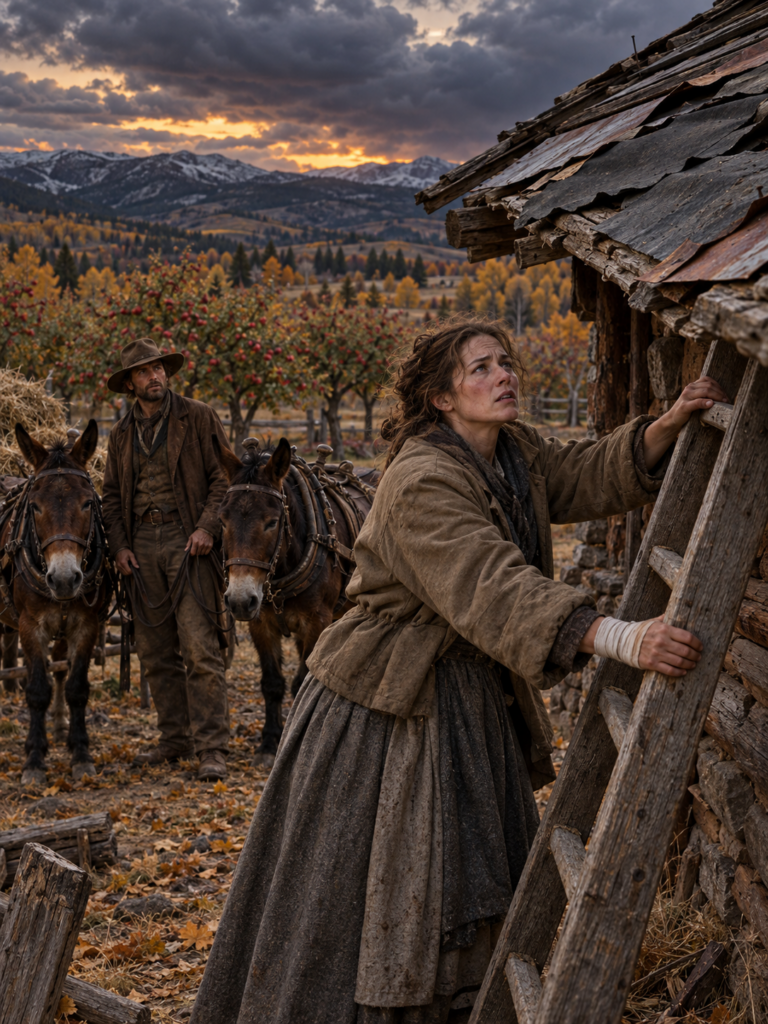
Willa lunged down the steps, reaching for the paper before it could disappear into the rain barrel.
Her injured wrist failed her.
Ezra moved instinctively, caught the fluttering agreement against the barrel, and held it out without unfolding it.
“Here.”
She snatched it back.
For a moment they stood close enough to hear each other breathing.
Then Willa stepped away.
“You needn’t chase every little thing I drop.”
“No, ma’am.”
“Nor mend every trouble you happen to notice.”
“Understood.”
He returned to the barn.
She remained by the porch, looking at the damp paper.
A stranger had just saved their bargain from the water.
She wished that simple act did not embarrass her so much.
By Thursday, they had developed a working understanding.
At dawn Ezra split pine shakes outside the barn. The rhythm of his mallet carried through the orchard.
Willa harvested apples, moving carefully up and down a short picking ladder with one reliable hand.
At midday, they ate on the porch.
Two plates.
Two cups.
A careful distance between their chairs.
He never attempted the house door.
She never invited him inside.
But their conversations slowly grew longer.
She explained which apples stored best through winter, which made sharp cider, and which needed blending for sweetness.
He listened as though her knowledge mattered.
And when she described how her father had grafted a particular row of trees, Ezra asked questions that proved he had been paying attention.
That afternoon she showed him the cider press.
It was an old oak machine with an iron screw and a hand-operated grinder.
She tipped apples into the hopper while he turned the crank.
Golden-brown cider trickled into a bucket.
“Try it,” she said.
He drank.
His eyebrows lifted.
“That’s worth more than I reckoned.”
Willa looked almost pleased.
“My father always gave the first cup to whoever turned the crank.”
“Then I suppose I’ve earned it.”
“Yes.”
He handed the cup back.
“Your turn.”
She stared at it.
Finally she filled it again and took a drink.
“I haven’t shared the first pressing with anyone since June.”
Ezra noticed her expression close.
He did not ask.
Instead, he resumed turning the crank.
Later, as they walked toward the barn, Willa stopped beneath the damaged roof.
“The almanac predicts snow by the tenth.”
Ezra examined the stack of finished shakes.
That left fewer days than the work deserved.
“The north slope needs doing first,” he said.
“I know.”
“And we ought to get started tomorrow.”
She kept her eyes on the ladder.
“Not tomorrow.”
“Miss Prior—”
“I said not tomorrow.”
He fell silent.
Her good hand had closed around her injured wrist.
She seemed less frightened of the coming snow than of something waiting above them.
That evening, she brought supper to the porch and sat opposite him.
For several minutes she ate without speaking.
Then she said, “You’re not the kind of man I expected.”
Ezra looked up.
“What kind was that?”
“The kind who keeps asking what a woman owes him.”
He set down his fork.
There were things a man could leave unsaid because they were nobody’s business.
And there were things silence made dishonest.
“Miss Prior, there’s something I should have told you.”
She stopped eating.
“The evening I came here, you were standing by the ladder.”
“I remember.”
“You had your eyes shut.”
Her face lost its color.
Ezra went on carefully.
“I heard you praying about the roof.”
Willa’s fork touched her plate with a tiny metallic sound.
“You heard that?”
“Yes.”
“How much?”
He could have lied.
He understood, suddenly, that she almost wanted him to.
“All of it.”
Her hand moved into her lap.
Even the orchard seemed still.
“You heard what I said about payment?”
“Yes, ma’am.”
“And you stayed?”
“I did.”
She stood abruptly, pushing her chair against the porch rail.
For several seconds she stared toward the dark trees.
“I thought this was a bargain.”
“It is.”
“You knew I was desperate.”
“I knew you needed a roof. I didn’t know whether you wanted me to be the one to fix it.”
She turned.
“Then why didn’t you say anything?”
“Because I was wrong to listen to something meant for God. And afterward I was afraid telling you would make the bargain feel like an answer you had no right to refuse.”
Her face twisted.
“I’ve asked for help every night since June.”
He said nothing.
“Every night, Mr. Colton. And all I got was more rain.”
A tear ran down her cheek.
She wiped it away furiously.
“I didn’t ask for a stranger to hear me begging.”
“I know.”
“No. You don’t.”
She crossed the porch and opened the screen door.
Ezra rose but did not follow.
Willa kept her back to him.
“Leave in the morning.”
The sentence was quiet.
It was also unmistakable.
Ezra picked up his hat.
“All right, Miss Prior.”
He carried his plate to the edge of the table, then descended the steps.
Behind him, the screen door closed.
A moment later, he heard the wooden bar slide into place.
He stopped beside the ladder, listening to the water dripping inside her house.
Then he turned toward the barn.
For the first time since arriving, he no longer knew whether keeping his promise meant finishing the roof—or obeying the woman who had just ordered him away.
Ezra took another step toward the barn, then stopped.
The roof still needed mending.
But Willa Prior had told him to leave.
He had given his word to do the work, and he had also given his word not to make decisions over her head.
There was no way to honor one promise by breaking the other.
He spent the night among the mules, listening to the faint noises of a house that could not keep out the weather.
Near midnight, he heard something else.
A mallet striking wood.
One blow.
Then another.
Then a long pause.
Willa was splitting shakes.
Alone, in the dark, with an injured wrist.
He sat up, listening.
Every instinct urged him to go and take the tools from her hands.
Instead, he remained where he was.
She had forbidden him the house.
Now she had forbidden him the work.
A man who meant to be trusted had to accept a refusal, even when doing so hurt.
At first light, he harnessed the mules.
He secured his blanket and supper things, checked the wagon wheels, and led the team out through the gate.
Then he stopped in the road.
He could leave now, exactly as she had ordered.
Or he could give her one last opportunity to decide whether their agreement still stood.
He chose the latter.
He waited beside the wagon, reins loose in his hands.
An hour passed.
Sunlight touched the orchard rows, lifting frost from the grass.
At last the cabin door opened.
Willa emerged wearing the same oversized canvas coat. Fresh flannel covered her wrist, and her face was pale with exhaustion.
She walked the length of the yard.
“Are you going, Mr. Colton?”
“If that’s what you want.”
“You were supposed to be gone.”
“You said morning.”
“It is morning.”
“Yes, ma’am.”
She looked at his wagon, already packed.
“Then why are you sitting here?”
“Because you hired me to mend your roof. I won’t leave a job unfinished without making sure that’s truly your decision.”
Her expression tightened.
“I told you to go.”
“You did. And I will.”
“Then go.”
He gathered the reins.
But before he could speak to the mules, she caught the gatepost.
“Wait.”
He turned.
She stared down at the frost beneath her boots.
“I can’t ask you.”
“You already did. You wrote the agreement yourself.”
“That’s different.”
“How?”
Her voice trembled.
“Because I have spent four months trying not to need anybody. If I ask you to stay now, after what you heard, I won’t know whether you’re here because we made a fair bargain or because you pity me.”
Ezra stepped down from the wagon.
He did not approach her.
“Miss Prior, I don’t pity you.”
She looked up sharply.
“You don’t know enough about me.”
“I know you’ve kept an orchard going with one injured hand. I know your barn’s better maintained than half the farms I’ve passed. And I know you wrote down terms fairer than plenty of men would have offered.”
He nodded toward the house.
“I also know I can repair that roof.”
“You think that makes us even?”
“No. I think the agreement makes us even.”
She swallowed.
“And the prayer?”
“Was yours. It doesn’t belong in our bargain.”
Her eyes filled.
She looked away.
After a long silence, she said, “Stay, Mr. Colton.”
He did not move.
She faced him fully.
“Not because you heard me pray. Because I’m asking you myself.”
Ezra nodded.
“Then I’ll unharness the mules.”
For the first time since he’d driven through her gate, Willa smiled without trying to hide it.
It lasted only a moment.
But he remembered it.
***
Saturday morning, Willa held the ladder.
She had spent the previous day helping Ezra prepare what he needed for the roof: carrying sound shakes into the dry barn, sorting nails, and examining the boards that could be salvaged.
The ladder itself troubled her most.
Ezra checked its rails and rungs, set the feet securely, and tied the upper end before putting his weight on it.
Willa watched every movement.
“It’s sound?” she asked.
“I’ve checked it.”
“Check it again.”
He did.
She gripped the rails with her good hand.
“You climb. I’ll hold it.”
Ezra glanced at her wrist.
“Can you manage?”
“Yes.”
“Then I’ll trust you to tell me if you can’t.”
He climbed.
From the ground, Willa watched him remove the old patchwork.
Each sheet of tar paper exposed another failure beneath it.
Some boards were dark with moisture.
Others crumbled under gentle pressure.
He cut out the rotten sections and examined the rafters before replacing anything.
“This was worse than it looked,” he called down.
“I knew it leaked.”
“Water’s been getting beneath the sheathing.”
“How much new timber?”
“Less than I feared. More than I’d hoped.”
She pressed her lips together.
“Can you finish?”
“The north slope, yes. But not by cutting corners.”
“Then don’t.”
Ezra worked steadily.
Near the lower edge, his pry bar struck something solid beneath a mass of old leaves.
He cleared the gutter and found a hammer.
Its iron head was rusted.
Its hickory handle had been worn smooth by years of work.
Near the end, faint initials had been burned into the wood.
A. PRIOR.
Ezra stared at them.
There were many reasons a tool might be left on a roof.
But he had listened to Willa speak of June.
He had watched her hesitate before climbing ladders.
And he had seen the way her father’s unfinished roofing timber lay waiting in the barn.
He carried the hammer down.
Willa looked up when his boots touched the grass.
“What’s wrong?”
“Found something.”
He held out the tool, handle first.
The change in her face was immediate.
She released the ladder.
One hand rose to her mouth.
For a long time she made no sound.
Then she whispered, “Where?”
“In the gutter below the old patch.”
She stared at the initials.
“My father burned those into every tool he owned.”
Ezra said nothing.
“He was forever lending things to neighbors. Said a tool ought to find its way home.”
Her breathing grew uneven.
“That was the hammer he carried up on the ninth of June.”
Ezra waited.
“He was putting another tin patch over the leak.”
She reached for the handle.
Her fingers closed around it.
“He’d been saving wood for a proper roof for nearly two years.”
The words came slowly now.
“First my mother was ill. The doctor had to be paid. Then the note on the north pasture came due. Something always cost more than we expected.”
She looked at the cabin.
“He was sixty-one. Strong enough to do most things himself. Too proud to admit when a job ought to be left to another man.”
A sorrowful little smile appeared.
“I suppose that’s something I inherited.”
Ezra remained beside her.
“That morning I was picking apples. I heard the ladder scrape.”
She closed her eyes.
“Then I heard him fall.”
The hammer trembled.
“I found him beside the porch. He was alive when I reached him. He asked whether the ladder had broken.”
Ezra lowered his gaze.
“I told him it was all right. I couldn’t think of anything else to say.”
Willa looked toward the ladder standing safely against the house.
“He died afterward. And I’ve been afraid of that ladder ever since.”
Now Ezra understood.
The bandaged wrist.
The patched roof.
The anger whenever he mentioned climbing.
And the prayer spoken by a woman who had already lost the person she expected to help her.
“I tried to mend it myself,” she continued. “In September I slipped on the second rung. Sprained my wrist badly enough I couldn’t lift a kettle for days.”
She stared at the hammer.
“I lay there in the yard, remembering what he asked me.”
Ezra wanted to tell her that the accident had not been her fault.
But he knew she had probably heard such words before.
They would not erase what she had seen.
Instead he said, “He left you good wood.”
Willa looked at him.
“And good tools,” Ezra continued. “He intended the roof to be sound. Seems to me we ought to finish what he started.”
A tear slipped down her face.
She made no attempt to hide it.
“Yes,” she whispered.
Then her expression changed.
“But there’s one thing I must do myself.”
“What’s that?”
“The last course of shingles. Along the ridge.”
Ezra looked at the roof.
“You mean to nail them?”
“Yes.”
“With that wrist?”
“By the time you reach the ridge, I may be able to use it better. And if I can’t, I’ll use the other hand.”
He hesitated.
“Miss Prior, that roof is steep.”
“I know.”
“And the ladder frightens you.”
“Every rung.”
“Then why—”
“Because my father meant to finish it. Because I’ve spent four months afraid of the place where he died. And because if I let somebody else do every last thing, I may never be able to look up at that roof without remembering only the fall.”
Her voice grew firmer.
“I won’t climb while it’s unsafe. But when the final course is ready, I want the chance.”
Ezra studied her.
Then he nodded.
“We’ll make sure the footing is sound.”
She held the hammer against her coat.
“And you’ll hold the ladder?”
“Yes, ma’am.”
“You won’t climb up to carry me?”
“Not unless you need help and ask for it.”
She gave a trembling breath.
“Then we’ve another bargain.”
***
On Sunday they set aside the roof work.
Ezra repaired a worn trace on the mule harness while Willa rested her wrist.
That evening she invited him to sit at the porch table after supper.
Between them lay her father’s Bible.
Its leather cover was rubbed pale at the corners.
Beside it rested the cleaned hammer.
Willa opened the book.
“My father carved that verse above the door.”
Ezra looked at the familiar words.
“He read the rest of the psalm nearly every night,” she continued. “I stopped reading it when he died.”
She found the passage and began.
Her voice was quiet, uncertain.
She read of building a house, of labor, of watchfulness, and of sleep given to those who are loved.
Then she closed the book.
“He used to say a man could build until his hands bled and still forget how to rest.”
She looked down.
“I think I’ve been trying to do every job he left behind.”
Ezra rested his forearms on the table.
“That’s more work than one person ought to have.”
“Perhaps.”
“Doesn’t mean the place matters any less if someone helps.”
Willa touched the hammer.
“I know that now. At least, I think I’m learning.”
He did not insist on more.
They sat together until evening darkened the orchard.
Then the wind shifted.
It arrived from the northwest, cutting through their coats with a sharpness that made Willa stand.
She looked toward the ridge.
“Snow.”
Ezra followed her gaze.
“Soon?”
“Tomorrow. Tuesday at the latest.”
He examined the roof.
A great deal remained unfinished.
“If we’re going to save that north slope,” he said, “we’d better use every hour of daylight.”
Willa reached for the folded agreement in her pocket.
She unfolded it and read the line describing his work.
Then she looked at him.
“Tomorrow I’ll stop picking early. You can have both my hands, as much as they’re worth.”
“I’d rather have your good judgment. We’ll need that more.”
She smiled faintly.
He stood to leave.
Before he reached the steps, she spoke again.
“Mr. Colton.”
He turned.
“When you find the last course ready, call me.”
He nodded.
“I will.”
“And don’t nail it without me.”
“I’ve given my word.”
She stepped back into the doorway, the hammer resting in her good hand.
Above her, the old roof moved faintly under the rising wind.
Willa looked up at it.
For the first time in months, she did not look away.
Ezra watched Willa raise her face toward the failing roof.
He could see the old fear in her expression.
But something else had joined it.
Purpose.
She did not stand there because she had stopped being afraid.
She stood there because the work belonged to her now, and she intended to see it finished.
“First light,” Ezra said.
“First light,” she answered.
***
Monday morning brought a sky the color of cold iron.
Ezra began before the sun cleared the eastern hills.
He had secured the ladder and rigged a working plank beneath the lower portion of the roof. From there he could reach the sound structure without putting his weight on the soft old sheathing.
Willa supplied shakes and nails from the ground.
At first she tried carrying armloads, but her injured wrist soon made that impractical.
They changed the arrangement.
She filled a bucket.
Ezra hauled it on a rope.
She prepared the next load while he fixed the shingles in place.
The system worked.
By noon, the ruined northern slope had begun to disappear beneath clean lines of pine.
Willa stood several yards back, studying the result.
“My father would have approved.”
Ezra looked down from his work.
“Of the roof?”
“The way you’re laying it.”
He smiled.
“That’s a comfort. I wouldn’t want him complaining about the job.”
“He would have found something.”
“What?”
“Your nails, perhaps. Or the price of lumber.”
“I’m using his lumber.”
“Then he’d probably complain you hadn’t stacked the scraps neatly enough.”
Ezra laughed.
It was a full, surprised laugh.
Willa had not expected the sound.
For a moment she simply watched him.
He looked different when he laughed.
Not younger, exactly.
Less burdened.
She found herself wondering how often he had reason to do it.
Then she picked up the next bucket of shingles.
“Get back to work, Mr. Colton.”
“Yes, ma’am.”
***
By Tuesday morning, the wind had strengthened.
Clouds hung low over the foothills.
Willa knew that sky.
She had lived beneath it for most of her life.
“Snow by afternoon,” she announced.
Ezra looked at the unfinished ridge.
They had covered most of the north slope, but the highest courses remained.
“Then we’d best waste no daylight.”
They worked without much conversation.
Willa fed the bucket line.
Ezra laid one course after another, securing each shake so rain would run down over the one beneath.
The last of the rotten dip vanished.
The new roof began to look like something that might endure another winter.
At two o’clock, the first flakes appeared.
They were small, dry specks that drifted sideways on the wind.
Willa watched them settle among the apple trees.
She knew a few hours could make all the difference.
“Keep going,” she called.
Ezra did.
The snow thickened.
The daylight took on a strange yellow cast.
By late afternoon, he reached the highest course.
Only the last shingles and the ridge covering remained.
He examined the footing, checked the work already completed, and climbed down.
Willa stood waiting beside the ladder.
Her father’s hammer was tucked beneath her arm.
“We’re nearly done,” he said.
She nodded.
“I can finish the ridge quickly,” he added.
“No.”
“Miss Prior—”
“We agreed.”
He looked toward the sky.
“The wood’s getting wet.”
“I can see that.”
“And your wrist—”
“I can use my left hand if I must.”
Ezra studied her.
Her face was pale.
Snow caught in the loose strands of hair around her temples.
But she stood upright, her boots planted firmly in the damp earth.
“I’m not asking you to carry me,” she said. “I’m asking you to hold the ladder.”
He took a slow breath.
Then he inspected the ladder’s footing once more.
It was secured in the hole he had prepared, its upper rails tied firmly to sound timber.
The working plank was fixed close beneath the ridge so she would not have to cross the open slope.
He checked the ropes and the boards again.
“Come here,” he said.
Willa approached.
He showed her exactly where she could place her weight and where the supporting timber lay.
“If anything shifts, come back down,” he told her. “No shingle’s worth a broken neck.”
“I know.”
“And if your wrist won’t bear it—”
“I’ll tell you.”
She slipped the hammer through her belt.
Then she placed her good hand on the ladder.
For several seconds she did nothing.
Ezra waited.
Finally she asked a question.
“Is it safe?”
He did not dismiss her fear.
He placed his weight against the ladder, tested its secured rails, and met her eyes.
“The feet are set. The top is tied. The plank is sound, and I’ll be here the whole time.”
She swallowed.
“My father asked me whether the ladder was all right.”
“I know.”
“I said yes without checking.”
“You were frightened.”
“I was.”
“You can check this one yourself.”
He stepped aside enough for her to test the lower rung.
Willa pressed against it.
The ladder did not move.
She looked at the ropes.
Then at the roof.
Then back at Ezra.
“Hold it.”
He set his boot firmly against the bottom and gripped both rails.
“I’m holding it.”
Willa began to climb.
The first rung was difficult.
The second was worse.
At the fourth, she stopped.
She could see the place where her father had fallen.
Her breathing grew shallow.
For a terrible moment, she was no longer standing in October snow.
She was back in June sunshine, hearing the scrape of wood against the porch.
She could almost see the basket of apples falling from her arm.
“Miss Prior?”
Ezra spoke softly.
“I’m here.”
She shut her eyes.
Then opened them.
“I know.”
She climbed again.
At the eighth rung, she whispered a prayer.
“Lord, help me keep going.”
It was not a request for a miracle.
Only enough steadiness for the next movement.
She reached the secured plank beneath the roofline.
Slowly, she transferred her weight onto it.
Ezra remained below, watching carefully.
“I’m on,” she called.
“I see you.”
She took a shingle from the prepared stack.
Positioned it.
Checked the overlap.
Then reached for the hammer.
Her first blow landed cleanly.
The second sent pain through her right wrist.
She hissed.
Ezra looked up.
“You all right?”
“Yes.”
But she changed the hammer to her left hand.
Her next blow was clumsy.
Then another.
The nail began to sink.
She worked carefully, using the sound timber for support.
Below, Ezra held the ladder and said nothing.
Willa set the next shingle.
And the next.
Snow collected along her shoulders.
Her fingers stiffened in the cold.
Twice she stopped to flex them.
Once her knee shifted on the damp plank, and she caught herself against the secured support.
She remained motionless until she could breathe properly again.
“You can come down,” Ezra called.
“I know.”
“I’ll finish it.”
“I know that too.”
She looked toward the ridge.
“Let me finish what I can.”
He did not answer.
He understood that she was not trying to prove she needed no one.
She had already asked for help.
She was trying to discover whether she could trust someone to remain beside her while she did something difficult.
That was another kind of courage.
And perhaps a harder one.
The last shingle settled into place.
Willa reached for the prepared ridge covering.
She fitted it carefully and drove the final nails through the fastening points Ezra had marked.
One.
Then another.
The hammer rang against the cold wood.
Then fell silent.
The north slope was finished.
For several seconds Willa stayed where she was.
Snow settled on the new shingles.
Her hands trembled.
She looked along the roofline, from the far gable to the chimney.
No sagging patch.
No exposed boards.
No black tar paper shining through.
Only clean pine and a roofline straight beneath the sky.
She pressed her palm against the wood.
“Papa,” she whispered, “we finished it.”
Tears rolled down her cheeks.
She allowed them.
Then she called down.
“Mr. Colton.”
“Yes?”
“I’m coming.”
“Take the same way back.”
She moved carefully to the ladder.
He held it steady as she placed her boots on the rungs.
One step.
Another.
Halfway down, her boot slipped on a wet rung.
Her body lurched.
The ladder shuddered under the sudden change in weight.
Ezra tightened his grip against the rails, his boot planted against the foot.
Willa caught the rung above with her good hand.
For one terrible heartbeat, neither moved.
Then she found her footing.
The ladder remained secure.
She descended slowly until both boots touched the ground.
Ezra released one rail only after she stood safely beside him.
Willa leaned against the cabin wall.
Her father’s hammer rested in her hand.
She stared at the ladder.
“It held.”
Ezra nodded.
“It held.”
Then, unexpectedly, she began to laugh.
It was a shaken laugh, mixed with tears and relief.
She covered her mouth.
“I thought I would fall.”
“I know.”
“I thought I would hear it happen all over again.”
He stood beside her.
“But you didn’t.”
“No.”
She looked upward.
“The roof is finished.”
“The north slope is.”
“The part that was killing the house.”
“Yes, ma’am.”
She laughed again.
Then her expression softened.
“Thank you for holding the ladder.”
Ezra glanced at the roof.
“Thank you for trusting me with it.”
***
Snow fell through the night.
It covered the orchard rows, the barn, the wagon, and the narrow track leading down toward the road.
Inside the cabin, seven buckets stood beneath the places where water had dripped for months.
Willa left them there.
She was too tired to move them.
At eight o’clock, she extinguished her lamp and went to bed.
For the first time since her father’s death, she slept without listening for water.
Without counting the unfinished jobs.
Without waiting for the morning to prove that she had failed again.
In the barn, Ezra lay beneath his blanket.
The mules breathed warmly in their stalls.
Occasionally the roof timbers creaked in the cold.
He thought about the woman who had climbed into falling snow carrying a hammer her father had once held.
He had met plenty of determined people.
But Willa’s determination was different.
She had learned, somehow, that surviving alone was the same as being strong.
And in the space of one week, she had begun questioning that belief.
Ezra recognized something of himself in it.
He had spent years traveling from one job to another, carrying what he needed in a wagon and keeping his dealings simple.
A delivery.
A payment.
A handshake.
He liked knowing when a job was finished.
He liked leaving before anyone expected more.
At Willa Prior’s orchard, however, he had discovered a kind of work that would remain in his mind long after he had been paid.
He found himself wondering how the roof would look in spring.
And whether she would still set two cups on the porch table.
He did not know what to make of that.
So he listened to the snow and let the question remain unanswered.
***
At sunrise, Ezra walked outside.
The cold caught him sharply.
Snow covered the cabin roof in a smooth white layer.
He studied the northern slope.
It stood straight and even, from eave to ridge.
No water had found a path through.
The house looked smaller beneath the snow.
But no longer defeated.
At seven o’clock the door opened.
Willa stood in a clean apron, her hair pinned neatly back.
She looked at the snow.
Then at the roof.
Then at Ezra.
“The agreement says meals on the porch,” she called.
“Yes, ma’am.”
“The agreement does not mention snow.”
“No, ma’am.”
She hesitated.
Then stepped aside.
“Come inside, Mr. Colton. And wipe your boots.”
Ezra removed his hat.
For a moment he remained where he was.
Willa raised an eyebrow.
“Is something wrong?”
“No.”
“Then come in before breakfast gets cold.”
He crossed the porch.
The cabin was plain.
A stove stood against one wall.
A scrubbed wooden table occupied the center of the room.
A few dishes rested on open shelves.
And along the far wall stood seven metal buckets.
Every one of them was dry.
Ezra looked at them.
Willa followed his gaze.
“I haven’t put them away yet.”
“No hurry.”
“They’ve been there so long I scarcely remember where they belong.”
He smiled slightly.
“Perhaps they could go back to carrying water.”
She looked at him.
Then laughed.
It was the easiest laugh he had heard from her.
She placed bread and fried apples on the table.
Two plates.
Two cups.
But this time there was no measured distance between them.
Before eating, Willa bowed her head.
Ezra lowered his eyes.
“Lord,” she began, “I asked for somebody to repair this roof.”
She paused.
“I don’t know whether you sent anybody. I don’t know how such things work.”
Her fingers rested against the table edge.
“But I know a stranger stopped at my gate with two tired mules. I know he made an honest bargain with me. And I know he held a ladder when I could not hold myself steady.”
Ezra remained still.
Willa swallowed.
“Thank you for the roof. Thank you for my father, who prepared the wood. And thank you that asking for help did not mean giving away what was mine.”
Her voice broke slightly.
“Amen.”
“Amen,” Ezra said.
They ate.
For a while neither spoke.
Then Willa set down her fork.
“You’ll be wanting to reach Loveland.”
“My hay’s already delayed more than I planned.”
“And you’ve four barrels of cider to take.”
“You filled eight?”
“Eight.”
He looked astonished.
“With that wrist?”
“I know how to run a press, Mr. Colton. I merely needed someone to help turn the crank.”
He shook his head.
“Half’s a generous share.”
“It’s the agreed share.”
“You’re certain?”
“I wrote it myself.”
That ended the discussion.
He smiled into his coffee.
Willa watched him over her cup.
Then she asked, “Where will you go after Loveland?”
“Depends on the work.”
“Do you have a place of your own?”
“A wagon, two mules, and a few tools.”
“That’s not what I meant.”
Ezra looked out toward the orchard.
“No house, if that’s what you’re asking.”
“Family?”
“Folks I know in different places. Nobody waiting for me at a particular door.”
Willa considered that.
“Does it suit you?”
“Mostly.”
“And the rest?”
He turned the cup slowly in his hands.
“Sometimes a man likes a road because there’s always somewhere else to go. It saves him deciding where he belongs.”
She looked down.
“That sounds lonely.”
“Sometimes.”
It was the most personal thing he had told her.
She did not rush to comfort him.
Instead, she said, “A person can be lonely while standing in the middle of a house, too.”
He nodded.
“I reckon so.”
Outside, snow slipped softly from an apple branch.
Ezra looked at the room again.
“Your father built a sound place.”
“He did.”
“And you’ve kept it.”
“I’ve tried.”
“More than tried.”
Willa followed his eyes toward the buckets.
“Not everything I’ve done has been sensible.”
“Not everything I’ve done has been either.”
She looked at him.
He continued.
“I should have told you about the prayer sooner.”
“Yes.”
“I didn’t know how.”
“That doesn’t excuse it.”
“No.”
She appreciated that he did not argue.
For a moment she considered the man seated across from her.
He had done a great deal of work.
He had asked for nothing beyond their agreement.
He had accepted her anger.
And when she told him to leave, he had prepared to go.
Those things mattered more than any grand promise.
“You were right about one thing,” she said.
“What was that?”
“The prayer didn’t make the bargain.”
“No, ma’am.”
“But I think it helped me understand why I was so frightened to make one.”
He waited.
She touched her bandaged wrist.
“I thought if somebody helped me, the place would stop being mine in some way. Or that I’d have to thank them for the rest of my life.”
Ezra set down his cup.
“Your father left you an orchard, Miss Prior. Not a debt to every man who knows how to swing a hammer.”
Her expression changed.
For a long moment she could not answer.
Then she smiled.
“That’s the first wise thing you’ve said all week.”
“Then I’d best stop before I spoil my record.”
She laughed.
And this time he joined her.
***
Later that morning, they loaded the cider barrels.
Ezra rolled four into his wagon and secured them beside the hay.
Willa inspected the ropes.
She checked the mules’ harness as well.
It was her way of making sure the bargain ended properly.
When everything was ready, she walked with him to the gate.
Snow reached their ankles.
The road was passable, though slow.
Ezra would need to take care on the descent.
He checked his load one final time.
Then turned to her.
“Miss Prior.”
“Yes?”
“Come spring, when the thaw begins, I’d like to stop by and see whether the roof has held through winter.”
Willa looked up at the white northern slope.
“That would be sensible.”
“I could check the south side too. We didn’t get much done there.”
“That’s true.”
“And I reckon your cider press may need another strong arm by next harvest.”
Her eyes returned to him.
“Are you asking about work next autumn, Mr. Colton?”
“I suppose I might be.”
She thought for a moment.
“The terms would need discussing.”
“Of course.”
“And I would expect a fair bargain.”
“Wouldn’t expect anything else.”
She smiled.
“Then perhaps you’d better come in spring.”
He put on his hat.
“I’d like that.”
Neither reached for the other’s hand.
They had known each other only a little more than a week.
And neither was foolish enough to pretend that one repaired roof had answered every question about the future.
But something had changed.
Willa no longer believed asking for help meant surrendering her independence.
Ezra no longer believed leaving was always the simplest way to keep from being needed.
They stood together beneath the gate’s wooden crosspiece until the mules began shifting impatiently.
“Better be on my way,” he said.
“Before the road freezes harder.”
He climbed onto the wagon.
She moved aside.
“Safe journey, Mr. Colton.”
“Keep that wrist rested.”
“I’ll consider it.”
He smiled.
The wagon rolled slowly down the lane.
At the gatepost, the little folded paper holding his original dime still hung where Willa had tied it on the first morning.
Ezra noticed it.
He left it untouched.
The dime had paid for one night in the barn.
The work had paid for the roof.
Neither man nor woman owed the other anything.
And that, he thought, was why returning might someday mean something.
He looked back once.
Willa stood beneath the carved pine lintel.
One bare hand rested against the doorframe.
The new northern roof rose above her, white and straight under the snow.
Ezra lifted his hat.
She raised her hand.
Then he followed the road toward Loveland.
***
Winter settled over the foothills.
Willa continued running the orchard as the season allowed.
She sorted the remaining apples in the cellar, kept her accounts, and rested her wrist whenever the old injury demanded it.
The house remained dry.
At first, she sometimes woke in the night expecting the familiar sound of water falling into a bucket.
But the silence held.
Gradually she stopped listening.
She put the buckets away.
She oiled her father’s hammer and hung it on its proper nail in the barn.
Sometimes she took it down to repair a loose board or fasten a wooden brace.
Its weight felt familiar.
No longer like an accusation.
She began reading her father’s Bible again in the evenings.
Not every night.
And not always with certainty.
But she read.
By February, she had made a list of work for the coming year.
The orchard rows needed pruning.
A few fence posts required replacing.
The southern roof would need attention before another winter.
She knew what she could manage herself.
She also knew which tasks required another pair of hands.
For the first time, that knowledge did not shame her.
***
When spring reached the foothills, the snow withdrew from the orchard in patches.
Water ran along the road.
The apple trees began showing the first signs of waking.
One clear afternoon, Willa stood in the yard examining the roof.
It had endured the cold.
The northern slope remained straight.
She had just finished counting the sound boards still stacked inside the barn when she heard the distant rattle of wagon wheels.
Two mules approached along the road.
A familiar man sat behind them.
Willa remained very still.
Ezra Colton drew up at the gate.
He stepped down and removed his hat.
“Afternoon, Miss Prior.”
“Mr. Colton.”
He looked at the house.
“Roof appears to have made it.”
“It has.”
“Any leaks?”
“Not one.”
He nodded, genuinely pleased.
“Good.”
For a moment neither spoke.
Then Willa crossed the yard and opened the gate.
“You said you’d come to inspect it.”
“I did.”
“And perhaps the southern slope.”
“If you still want that looked at.”
“I do.”
She glanced toward his wagon.
“Have you eaten?”
“Not since morning.”
“There’s bread inside.”
Ezra looked toward the porch.
Willa met his eyes.
“And before you ask, Mr. Colton, I am inviting you.”
He smiled.
“Then I’d be obliged.”
They walked toward the house side by side.
At the foot of the ladder, Willa paused.
She put one hand on its rail.
For a moment she remembered her father.
The fall.
The fear.
The long months of refusing to ask anybody for help.
Then she looked up at the roof, secure beneath the blue spring sky.
Ezra waited without urging her onward.
Willa released the ladder.
“After we’ve eaten,” she said, “I want you to look at the south side. Then we’ll discuss a price.”
“Fair enough.”
“And there’s something else.”
He stopped.
She looked directly at him.
“You needn’t wait until a roof requires mending to visit.”
The words were simple.
But she had never said anything quite like them to him before.
Ezra held his hat loosely in one hand.
“Would that suit you?”
“Yes.”
He nodded.
“I’d like to come, then.”
She opened the door.
This time, there was no contract between them.
No storm to outrun.
No desperate prayer to interpret.
Only a woman standing in the home she had fought to keep, inviting a man inside because she wanted his company.
And a man accepting without mistaking the invitation for a promise she had not made.
Above them, the words carved by her father remained in the old pine beam.
The house had been built by his hands.
Its roof had been completed by two others.
And its doorway, once guarded so fiercely against the world, stood open.
Willa stepped inside first.
Ezra followed after wiping his boots.
Behind them, the spring wind moved softly through two hundred apple trees.
The roof held.
And for the first time in a very long while, Willa Prior was no longer afraid that the next good thing entering her life would have to be paid for with everything she had.


