
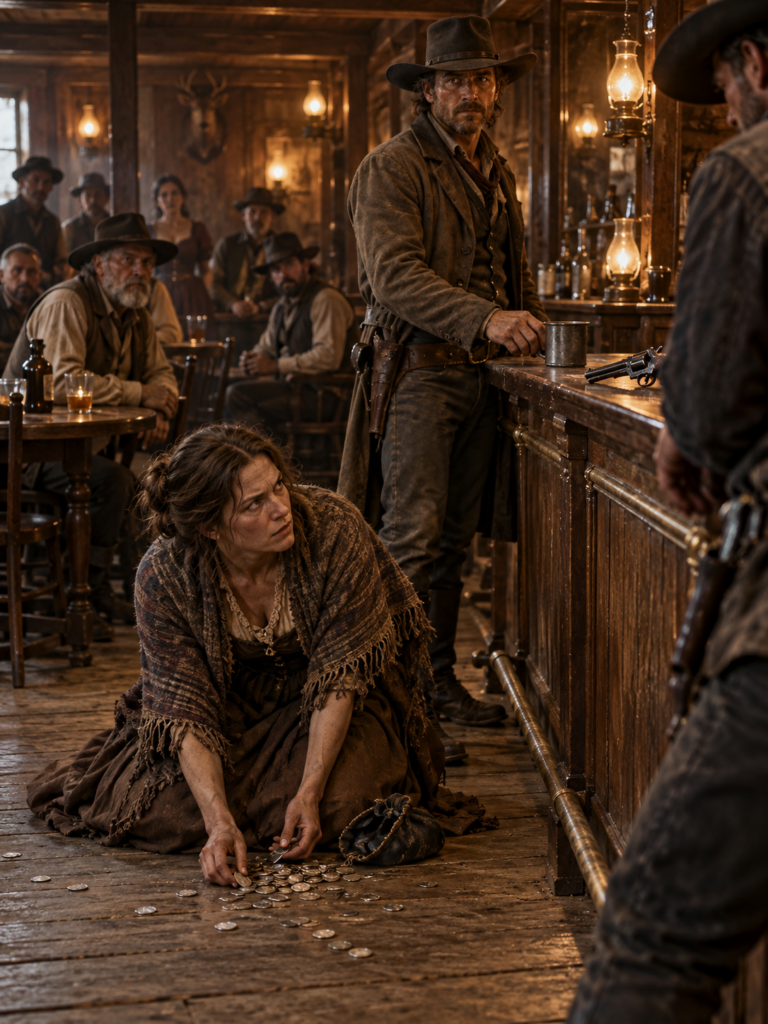
The gunman’s revolver rose another inch.
Jake moved sideways, placing himself out of the weapon’s line without stepping toward the man.
“Put it away.”
The gunman hesitated.
Martha could hear the loose shutter knocking against the saloon wall.
“I asked you something,” the man said. “Cal Morrow your father?”
“Yes.”
A murmur passed through the men watching from the porch.
Even Martha knew the name.
Cal Morrow had been called the fastest gun in Texas. Men still told stories about him years after his death.
Jake looked at the outlaw’s shaking hand.
“That’s enough foolishness for one afternoon.”
The man lowered his revolver.
Jake picked up his reins and continued down the street.
Martha followed, more troubled by what she had learned than she cared to admit.
“You could have killed those men.”
“Yes.”
“Why didn’t you?”
“First fellow let go of his gun. After that, shooting him would’ve been murder.”
She looked at him for a long moment.
Then she resumed walking.
It was nearly an hour before they reached her farm.
The house stood beyond a worn gate, with a barn leaning slightly against the afternoon light. Thirty cattle grazed a tired pasture where the grass had only recently begun to recover.
Jake stopped beside the fence.
“How long since they had proper feed?”
“Long enough.”
“Water?”
“From the creek. It held through the worst of it.”
He examined the cattle without boasting or pretending they were healthier than they were.
“They’re thin,” he said. “But sound.”
“They’re all Daniel left me worth selling.”
“Then we ought to get them ready.”
“For what?”
“An army beef buyer comes through this country.”
“Mr. Beal,” Martha said. “On the twentieth.”
Jake nodded.
“That’s our deadline before Crane’s deadline.”
She stared at the cattle.
For the first time in months, their number suggested something besides another expense.
Then she shook her head.
“Thirty head won’t bring fourteen hundred dollars.”
“Maybe not.”
“Then what’s the point?”
“First we find out what they’ll bring. After that, we know what we’re fighting.”
She disliked how much sense that made.
Jake turned toward the barn.
Martha stopped him.
“One more thing. I decide what happens to this farm.”
He faced her immediately.
“Of course.”
“I mean it. No selling equipment without asking. No borrowing in my name. No promising my cattle to anybody.”
“I heard you.”
“And don’t think because you helped me in town that I owe you anything beyond an honest day’s arrangement.”
Jake removed his hat.
“You owe me nothing, Mrs. Hail.”
Something about the answer unsettled her more than an argument would have.
She showed him the hay, the feed sacks, the watering place, and the stall he could use.
Before supper, Jake repaired the gate that had dragged through the dirt since spring.
She found him tightening the final hinge.
“You didn’t ask permission.”
He stepped back.
“Should’ve. It was catching on the post. I’ll ask next time.”
She tested the gate.
It swung cleanly.
“Thank you.”
At supper, he ate at the far end of the table, answering questions when she asked them and leaving the silences undisturbed.
Martha learned he drank coffee instead of whiskey.
She learned he had ridden west without a fixed destination.
And she learned that mentioning his father could close his expression faster than a slammed door.
When she asked if Cal Morrow had been a good man, Jake looked down at his cup.
“He was a fast man.”
“That wasn’t what I asked.”
“No, ma’am.”
He said nothing more.
After supper, Martha brought a blanket to the barn.
Jake was inspecting the cattle through the open doorway.
“Mr. Morrow.”
He turned.
“You’ll be fed while you work here. That much I can offer.”
“That’s plenty.”
She handed him the blanket.
Then she noticed the worn leather saddle hanging on a peg behind him.
Daniel’s saddle.
The last thing her husband had used on the morning he rode to ask Crane for money.
Martha reached past Jake and lifted it from the peg.
He saw her hands tighten around the leather.
“You fixing to sell that?”
“If it helps save the farm.”
He did not tell her to keep it.
He did not tell her Daniel would have wanted otherwise.
He simply stepped aside and gave her room to carry it toward the house.
At the barn door, Martha stopped.
“Jake?”
“Yes, ma’am?”
“Whatever happened to your father, I don’t want his reputation brought to my land.”
Jake’s expression tightened.
“Neither do I.”
She started toward the house with Daniel’s saddle held against her chest.
But before she reached the porch, she heard Jake call gently behind her.
“Mrs. Hail, there’s one thing you ought to know before we start counting on that buyer.”
She turned.
Jake looked toward the thirty thin cattle.
“If Beal pays his usual price, even every animal you’ve got won’t cover Crane’s fourteen hundred.”
Martha gripped the saddle harder.
“Then we sell what we can,” she said. “And I decide what goes next.”
“Then we sell what we can,” Martha repeated. “And I decide what goes next.”
Jake nodded.
“That’s the arrangement.”
She carried Daniel’s saddle into the house and laid it across the table.
For several minutes she stood beside it, remembering the day Daniel had bought it secondhand, pleased because the stitching was strong and the leather would last another ten years.
It had lasted longer than he had.
By morning, she knew what she would do.
The next day Jake helped her lift the saddle onto a horse, but he did not ask where they were going.
He rode with her as far as the general store, then remained outside while she carried it through the door.
The storekeeper examined the leather carefully.
“Forty dollars.”
Martha had hoped for more.
She knew she would not get it.
“Forty,” she agreed.
When she emerged, Jake saw the empty place across her horse’s back.
He said nothing.
That silence, at least, she appreciated.
They worked the following days from sunrise until the light failed.
Jake handled the heavier repairs and helped keep the cattle moving toward better grass. Martha knew which animals tired easily, which had recovered their appetites, and where the creek still held sufficient water.
He listened when she corrected him.
She listened when he explained how a buyer would judge the herd.
They counted feed together.
They repaired the watering trough.
And every evening, Martha entered their expenses in the small household ledger Daniel had once kept.
The work did not erase the fourteen hundred dollars.
But it gave each day a purpose.
One morning, Jake found her trying to move a stubborn cow through the gate.
He started forward.
“I’ve got her,” Martha said.
Jake stopped immediately.
She adjusted her position, gave the animal room, and brought her through without frightening her.
Jake watched with evident approval.
“She’s less stubborn than I expected.”
“The cow?”
Martha smiled faintly.
“Certainly not me.”
It was the first time he heard her laugh.
He remembered the sound long after they returned to work.
***
On the seventh evening, Martha found Jake sitting outside the barn with his coffee.
He had washed his shirt and hung it over the fence. His sleeves were rolled above his forearms.
She sat on the opposite end of the bench.
“You’ve never told me why you don’t drink whiskey.”
“No use for it.”
“That’s not much of an answer.”
“It’s the one I’ve got.”
Martha considered leaving him alone.
Then Jake set the cup down.
“My father was a gunman before he built his ranch.”
She waited.
“He made money. Enough that people started treating him like a respectable man. But he never quite stopped believing his reputation would protect him.”
“Cal Morrow.”
“Yes.”
“People say no one could beat him.”
“For twenty years, nobody did.”
“What happened?”
“San Antonio. A saloon. He’d had four whiskeys.”
Jake looked toward the darkening pasture.
“A younger man was quicker by half a second.”
Martha drew her shawl closer.
“I’m sorry.”
Jake shook his head.
“My father knew the risk. He’d taken it often enough.”
“Did you love him?”
Jake studied his hands.
“Yes.”
The single word contained more feeling than she had expected.
“He taught you to shoot?”
“He taught me plenty. Not all of it worth keeping.”
They sat quietly.
Then he added, “That’s why I drink coffee.”
Martha looked at the cup between his boots.
Suddenly the small sound it had made against the saloon counter seemed different.
It had not been the gesture of a man trying to start a fight.
It had been the gesture of one determined to stay sober enough to prevent a killing.
***
By the nineteenth, the cattle were as ready as Jake and Martha could make them.
On the twentieth, Mr. Beal arrived.
He was a careful buyer, interested in the animals rather than their owners’ troubles.
He walked the herd, examined their condition, and named his price.
“Thirty-two dollars a head.”
Martha did the multiplication before he finished speaking.
Nine hundred and sixty dollars.
She had thirty head.
She stood with her hands folded, keeping her voice steady.
“Thirty-four.”
Beal shook his head.
“They’re too thin.”
“They’ve held up through drought, and they’ve been properly fed and watered since. You won’t find unsound stock among them.”
“Thirty-two.”
She pressed him again.
He examined another steer, then returned.
“I’m staying at thirty-two, Mrs. Hail.”
Martha wanted to argue.
But she knew the animals could not be made heavier by insisting.
She accepted the price.
When the payment was counted, she added it to the forty dollars from Daniel’s saddle, fourteen from the sewing machine she had sold, and what little remained of her other savings.
She had eleven hundred dollars.
Three hundred short.
Eleven days left.
Beal asked Jake to witness the transaction.
“Your name, sir?”
“Jake Morrow.”
The buyer paused.
“Morrow? Any relation to Cal Morrow?”
“His son.”
Beal looked astonished.
“I bought beef from your father’s ranch for ten years. Heard the place sold for eighty thousand dollars after he passed.”
Martha felt the ground shift beneath her.
Eighty thousand dollars.
She turned slowly toward Jake.
“His ranch sold?”
“Yes,” Jake answered.
“And the money?”
Jake was silent for a moment.
“Mine.”
Martha looked at the proceeds from her cattle.
The worn envelope containing fourteen dollars from her sewing machine.
The forty dollars she had received for the last saddle Daniel had owned.
She thought of Jake working from dawn to dark, drinking her coffee, sleeping in her barn.
“You could have paid Crane the first afternoon.”
Jake did not deny it.
“You told me not one dollar of mine.”
“And you listened?”
“Yes.”
She looked at him in disbelief.
“You watched me sell Daniel’s saddle.”
“I did.”
“My sewing machine.”
“I know.”
“You watched me stand there begging a government buyer for another two dollars a head.”
“I watched you make the best bargain you could.”
Martha’s eyes filled.
She hated that more than anything.
“You should have told me.”
Jake accepted that without defending himself.
“You’re right. I should have.”
“Why didn’t you?”
“Because you said no to the money. I thought telling you would make everything between us about how much I had.”
“And now it isn’t?”
He had no answer.
She stepped away.
“Go, Mr. Morrow.”
“Martha—”
“Please.”
Jake lowered his eyes.
“All right.”
He turned toward his horse.
She watched him tighten the saddle, gather his few belongings, and lead the animal toward the road.
Then she remembered something.
“Jake.”
He stopped.
“You promised thirty days.”
“Yes, ma’am.”
“You’ve given me nineteen.”
He looked back.
“I’ll keep my word.”
She could not bear to hear another word.
“Go.”
He mounted and rode away.
***
That afternoon, Martha took her eleven hundred dollars into town.
The same saloon was crowded.
Crane occupied his familiar chair.
She placed the money before him.
“Eleven hundred. The remaining three hundred by the first.”
Crane counted slowly.
Each note seemed to please him.
Then he swept the money into his drawer.
“That’s for my trouble.”
Martha went cold.
“What?”
“Fourteen hundred due on the first. Same as before.”
“No.”
Crane smiled.
“You heard me.”
“I’ve just paid you eleven hundred dollars.”
“Consider it compensation for the embarrassment your cowboy caused.”
“That’s stealing.”
“Tell the sheriff.”
A few men laughed.
Others looked away.
Crane leaned closer.
“This isn’t about money anymore, Mrs. Hail. The whole town watched a stranger take my men’s guns.”
He glanced toward the door.
“Now they’ll watch me take your farm.”
Martha stood perfectly still.
She had sold every steer.
Daniel’s saddle.
Her sewing machine.
She had nearly nothing left to turn into money.
And Crane intended to take the land anyway.
She looked around the room.
Nobody spoke.
Not the storekeeper.
Not the ranch hands.
Not Gus, who served drinks and kept his own careful count of what Crane was owed.
Martha turned and walked out.
For the first time since Daniel’s death, she felt truly alone.
***
Gus came to her house after dark.
He found her sitting at the table beside the empty ledger.
“He took it, didn’t he?”
Martha nodded.
“All of it.”
“And still wants your farm?”
“Yes.”
Gus sat down opposite her.
For a long time he said nothing.
Then he rubbed both hands over his face.
“I laughed that day.”
Martha looked up.
“In the saloon. When Crane had you counting money off the floor. I laughed with them.”
“I know. I heard you.”
He winced.
“I owe him four hundred dollars. Half the town owes him something. That’s how he’s kept us quiet.”
Martha stared toward the window.
“Then I suppose we’re all fools.”
“Not fools. Frightened.”
“It’s done us about as much good.”
Gus looked at the ledger.
“Where’s Morrow?”
“I sent him away.”
“Then you ought to know he hasn’t gone far.”
She looked up sharply.
“What?”
“He’s camped by the river. Told me he gave you his word for thirty days.”
Martha turned toward the dark window.
“He stayed?”
“He said he would.”
She reached for her shawl.
Gus stood.
“Go home, Mrs. Hail. I’ll bring him.”
But Martha shook her head.
“No. I told him to leave. If I want him back, I’ll ask him myself.”
Gus understood.
He offered to accompany her to the river and remained a respectful distance away while she approached Jake’s camp.
Jake was sitting beside a small fire, cleaning his coffee cup.
He rose when he saw her.
“Martha?”
“He took the money.”
Jake’s expression changed.
“All of it?”
“All eleven hundred. And he says I still owe fourteen hundred.”
Jake looked down at his cup.
“My father had a rule,” he said quietly. “You pay a man like Crane once, you pay him till you die.”
Martha remembered hearing him say it before.
This time she understood.
“You were right.”
“That doesn’t make it easier.”
She looked toward the river.
“I shouldn’t have sent you away.”
“You had reason to be angry.”
“You should have told me about the money.”
“Yes.”
“And I should have listened when you told me Crane wasn’t going to stop.”
He came a step closer.
“I promised thirty days.”
“You did.”
“Then I’ll stay until they’re finished, if you still want the help.”
She met his eyes.
“Don’t leave again.”
His answer was quiet.
“Wasn’t planning on it.”
They rode back together.
At the farm, Gus was waiting with several townsmen.
Martha recognized faces from the saloon.
Men who had laughed.
Men who had watched.
Men who owed Crane money themselves.
Gus removed his hat.
“We talked it over,” he said. “We’re done paying Crane. Every one of us.”
Martha looked from face to face.
“You know what he’ll do?”
“Yes,” Gus said. “That’s why we can’t leave you standing alone.”
“He comes on the first,” Martha told them.
“Then we’ll be here.”
Jake watched her carefully.
He did not speak for her.
Martha stood on her porch and looked at the men.
“I’ll not have anybody killed over my farm.”
Gus nodded.
“Neither do we.”
“Then we stand together. And we tell the truth about every dollar he’s taken.”
They agreed.
As the men dispersed, Jake remained beside the steps.
Martha turned to him.
“Why are you really still here?”
He held her gaze.
“Ask me after Crane comes.”
“That’s not an answer.”
“No,” he said. “But I’ll give you one.”
On the evening of the first, Martha set a lantern in the window.
Gus and the townsmen took their places where they could hear and see what happened.
Jake stood near the porch, his revolver holstered.
Martha remained at her own front door.
Then hoofbeats sounded beyond the gate.
Bodie Crane arrived with his gunmen.
He dismounted slowly.
“Time’s up, Mrs. Hail.”
Martha stepped forward.
“I’m not leaving.”
Crane looked around the apparently quiet yard.
“Then we’ll carry you.”
Jake came into the lantern light.
“I wouldn’t try that.”
Crane stopped.
“Thought you rode out.”
Jake looked straight at him.
“I rode back.”
Crane’s hand moved toward his revolver.
And Martha stepped between them.
Martha stepped between Jake and Bodie Crane.
“Enough.”
Crane’s hand paused at his holster.
Jake remained still behind her.
For a long moment, nobody moved.
The lantern light flickered against Crane’s face.
He looked past Martha.
“Get out of the way, woman.”
“No.”
“This is men’s business.”
“This is my farm.”
She felt Jake shift behind her, but he made no attempt to move her aside.
Crane sneered.
“You’ve got no money left, Mrs. Hail. No cattle. No husband. And no one in this county foolish enough to stand against me.”
A voice answered from the darkness.
“You’re wrong about that.”
Gus stepped into the lantern light.
Behind him came the storekeeper, two ranch hands, and several other men who had spent years lowering their voices whenever Crane entered a room.
Crane glanced around.
“What is this?”
Gus kept his hands away from his weapon.
“Town’s done paying you.”
Crane laughed.
“You owe me four hundred dollars, Gus.”
“I know what you say I owe.”
“And you’ll pay it.”
“No.”
The word hung in the yard.
Others repeated it.
Not loudly.
Not bravely at first.
But unmistakably.
Crane’s face hardened.
“You think this makes you safe?”
“No,” Gus replied. “We know what you’ve been doing. And we’re done helping you do it.”
Crane looked toward Jake.
“You put them up to this?”
Jake shook his head.
“They came themselves.”
“You think your father’s name frightens me?”
“No.”
Crane’s eyes narrowed.
“Then draw.”
Jake did not touch his revolver.
Martha heard the faint movement of the men behind the gate.
She knew some of them carried guns.
She also knew what one careless shot could mean.
Jake looked at Crane’s hand.
“Don’t reach for it.”
“You going to stop me?”
“If I have to.”
Crane glanced at Martha.
She did not move.
Then his attention returned to Jake.
There was a strange hesitation in his eyes.
Jake noticed it.
“Your hand’s shaking again,” he said.
Crane’s mouth tightened.
He started to draw.
Jake moved.
The exchange lasted barely an instant.
Crane’s revolver fell into the dirt.
Jake held his own weapon, pointed low, while Gus and the others stepped forward to keep Crane’s gunmen from reaching for theirs.
No shot was fired.
The men who had terrorized the town found themselves surrounded by the very people they had frightened.
“Let your hands stay where we can see them,” Jake said.
Crane stared at him.
“You can’t do this.”
Gus stepped closer.
“Seems we just did.”
***
They secured Crane and his men before anyone had time to reconsider.
Martha watched Jake check each weapon and place it beyond reach.
He was careful, almost painfully so.
She remembered the story of Cal Morrow.
Four whiskeys.
A younger gunman.
Half a second.
Twenty years of being the fastest man alive, ended in a saloon.
Jake had inherited his father’s skill.
But he was trying very hard not to inherit his father’s ending.
The realization made her chest ache.
Crane twisted against his bonds.
“You can’t hold me on nothing.”
Gus turned toward Martha.
“Got your payments recorded?”
“Yes.”
“Every one?”
“Every dollar I ever paid him.”
“Then fetch your ledger.”
Martha went into the house.
Her hands were shaking now, though no one was laughing.
She opened the ledger and found the entries Daniel had made during the drought.
Seven hundred dollars borrowed.
Payments marked carefully afterward.
No written agreement.
No note granting Crane the farm.
Only the record of money and a promise between men.
When she returned, Gus examined the pages.
“Daniel always kept his accounts straight.”
“He tried.”
Gus looked toward Crane.
“Where’s your paper?”
Crane smiled thinly.
“Paper?”
“The note giving you a claim on this property.”
“Daniel Hail shook my hand.”
“That may speak to what he borrowed,” Gus said. “It doesn’t give you the right to walk onto his widow’s land and take it.”
Crane’s smile disappeared.
“You reckon you’re a judge now?”
“No,” Gus answered. “And neither are you.”
Martha closed the ledger.
Crane had frightened her so thoroughly that she had mistaken his threats for lawful authority.
She thought of all the mornings she had woken worrying about losing the roof over her head.
All the evenings she had counted coins.
The saddle.
The sewing machine.
Her cattle.
The things she had surrendered trying to honor Daniel’s word.
Crane had used that word against her.
And the town had allowed it.
She faced him.
“Daniel owed you seven hundred dollars.”
Crane said nothing.
“He meant to repay you. I meant to finish what he started. You collected more than that, and you kept demanding more because you wanted my farm.”
Crane looked away.
Martha’s voice steadied.
“You’ll never get it.”
Jake turned toward her.
He said nothing.
But something in his expression told her he understood what those words had cost.
***
The prisoners were taken into town and secured under guard until Jake could transport them to the federal authorities.
Crane had long relied on the county sheriff’s unwillingness to act against him.
Gus knew that an outstanding federal warrant and the testimony of the townspeople offered a better chance of seeing the matter pursued outside the county.
Jake intended to take Crane and the two gunmen to the United States marshal in Prescott.
The journey would not be short.
Four days there, he estimated, and another four returning if the weather and horses held.
Before he left, Martha met him at the barn.
Morning light rested on the empty cattle pasture.
She had never seen the land look so spacious or so lonely.
Jake was checking his saddle straps.
“Do you have to be the one who takes them?”
“Somebody has to get them there. Gus will help me on the road.”
She nodded.
“Will Crane come back?”
“That’s for the marshal and the court to settle. But he’ll answer for more than a widow’s unpaid bill if the witnesses stand by what they’ve said.”
“Will they?”
“Gus says they will.”
Martha looked toward the house.
It had been a hard place to keep.
A harder place to keep alone.
But it was hers to decide about, not Crane’s, and not Jake’s.
She turned back.
“How long?”
“Four days there. Four back, most likely.”
“Eight days.”
“If the travel goes well.”
She tried to smile.
“You still owe me an answer.”
Jake gave a small nod.
“I know.”
“Then come back and give it.”
He finished tightening the strap.
“I intend to.”
She stepped closer.
“Jake.”
He looked up.
“Thank you for not making a killing out of this.”
For a moment he appeared unable to speak.
Then he said, “Your farm needed saving. Not another grave.”
Martha reached for his hand.
He let her take it.
Neither made a promise beyond what they could honestly keep.
But when he mounted and rode away, Martha stood by the gate until he disappeared down the road.
***
The town did not transform overnight.
Fear that had ruled for years did not vanish merely because Bodie Crane was gone.
Some people remained cautious.
Some regretted taking part in his cruelties.
Others were eager to speak now that the man could no longer threaten them from his favorite chair.
Gus helped gather the accounts of those who had paid Crane.
The storekeeper admitted how often he had looked away.
The sheriff, confronted by witnesses and the prospect of scrutiny from outside the county, could no longer pretend that Crane’s business was an ordinary matter of collecting debts.
Martha gave an account of her payments and of the eleven hundred dollars Crane had taken without crediting a cent.
She also explained the original seven-hundred-dollar handshake loan.
She did not pretend Daniel had owed nothing.
She wanted the truth recorded correctly.
That mattered to her.
When people suggested Jake had saved the town, she corrected them.
“He stood up first. But the rest of us had to stand up, too.”
She knew what it had cost Gus to acknowledge his own cowardice.
She knew what it had cost the others to appear at her farm.
She did not excuse the laughter in the saloon.
But she did not want fear to keep governing their lives.
For the first time in a long while, people began speaking honestly about what Crane had done.
***
At the farm, Martha worked.
She could not restore thirty head of cattle by wishing.
The pasture stood empty, and the loss of the herd meant the coming months would be lean.
She repaired what she could.
She planted a small garden near the house, using the ground where water remained accessible.
She counted the stores left in the pantry.
She kept the gate mended.
She made plans for another season.
Without the cattle, the work was different.
But she discovered that the farm was still a place from which a living could be rebuilt.
She refused to think of it as merely what Daniel had left behind.
It was also what she had preserved.
One evening Gus rode out with news.
“Crane’s been delivered to the marshal.”
Martha put down the bucket she was carrying.
“And Jake?”
“Making arrangements for the return journey.”
She nodded.
“Good.”
Gus shifted in his saddle.
“Martha, I owe you an apology.”
“You already gave me one.”
“I know. But I’ve been thinking about that day in the saloon.”
“So have I.”
“You shouldn’t have had to kneel in front of us.”
“No.”
He looked ashamed.
“I could have helped.”
“Yes,” she said quietly. “You could have.”
He accepted it.
Then she added, “You did help when it mattered again.”
Gus removed his hat.
“That’s something, I suppose.”
“It is.”
She did not promise him that every hurt was gone.
He did not ask her to.
***
Jake returned on the eighth evening.
Martha heard his horse before she saw him.
She had been putting away the last of the supper things when hoofbeats reached the yard.
She walked onto the porch.
Jake rode through the gate, dusty and tired, his coat carrying the marks of the road.
He dismounted slowly.
For a moment, they simply looked at one another.
Then Martha descended the steps.
“You made it back.”
“Yes, ma’am.”
“Did you get them there?”
“Delivered to the marshal. The testimony and accounts went with them. What the court decides will take longer.”
“And my farm?”
Jake looked toward the house.
“Crane never had a written claim giving him ownership of it. He had threats and men willing to carry them out.”
Martha drew a long breath.
She knew questions about the money he had taken could not be settled by a few words at the gate.
But the immediate danger of Crane arriving to seize her home had ended.
For the first time, she could believe it.
Jake looked at her carefully.
“You’ve been managing?”
“I have.”
“Good.”
He glanced toward the pasture.
“You’ve got plans?”
“Several.”
“Glad to hear it.”
She smiled.
“Coffee?”
He returned the smile.
“I’d be grateful.”
***
They sat at the kitchen table.
Two cups stood between them.
Martha had thought about those cups more than she cared to admit.
The first evening he had eaten in her house, she had placed his at the far end of the table.
Tonight she set it across from her own.
Jake noticed.
He seemed uncertain whether he ought to mention it.
Martha saved him the trouble.
“You said you would answer a question when you got back.”
“Yes.”
“Why did you stay?”
He held his cup without drinking.
“I was riding west when I came through town.”
“I know that.”
“Had money from the ranch. Enough to settle somewhere. Didn’t much care where.”
“Why not?”
He considered the question.
“After my father died, I sold the place. People heard the name Morrow before they heard anything else about me.”
“Some were afraid of you.”
“Some wanted to see how fast I could draw.”
“And others?”
“Wanted something from me because they thought I had money.”
Martha remembered the way she had spoken to him when Beal revealed his inheritance.
Her face warmed.
Jake continued.
“I rode because I didn’t want to spend the rest of my life proving I was either my father or somebody richer than my father.”
“You could have stayed anywhere.”
“Yes.”
“Yet you stayed here.”
He met her eyes.
“When I saw you in that saloon, you were being shamed for trying to do what you believed was right.”
Martha looked down.
“And I watched you refuse to let Crane decide what kind of woman you were. Even after you were frightened. Even after he’d taken almost everything.”
She swallowed.
“You didn’t know me.”
“No.”
“You might have been wrong.”
“Yes.”
“Then why risk it?”
Jake was quiet for a moment.
“At first, because I’d helped make things worse and I owed you some work.”
“And afterward?”
“I liked the work.”
Martha raised an eyebrow.
He smiled.
“I liked how you knew every animal by sight. How you wouldn’t let me mend a gate twice without asking. How you kept the accounts straight even when every entry hurt.”
Her eyes stung.
“I didn’t know you were watching all that.”
“I was.”
He looked toward the empty chair beside the hearth.
“I liked having somewhere to come back to at night. And somebody who could tell me when I was wrong.”
Martha let out a soft laugh.
“That’s not difficult.”
“No. You’ve had practice.”
They smiled at each other.
Then Jake’s expression became serious.
“I stayed because I wanted to know you. Not because you needed rescuing.”
The kitchen was very quiet.
“And now?” she asked.
“Now I’d like to stay because I love you.”
Martha closed her eyes briefly.
The words were simple.
He had not spoken them as a bargain.
He had not told her what she owed or what he could buy.
He had merely told the truth.
When she opened her eyes, he was waiting.
Not demanding.
Not reaching.
Waiting for her answer.
She thought of Daniel.
He had been a good-hearted, frightened man who had tried to save their livelihood during a terrible dry year.
She had loved him.
His death had not erased that love.
But neither had it ended her right to build another life.
She looked at Jake.
“I love you too.”
He bowed his head slightly, as if the words were something precious and almost too large to hold.
Then Martha added, “But there are things we need to settle.”
Jake raised his eyes.
“I expect there are.”
“This farm is mine.”
“Yes.”
“I’ll never have another man use money to decide what I can do.”
“I wouldn’t ask that.”
“And if you stay, I won’t have you sleeping in the barn forever.”
That brought a slow smile to his face.
“No, ma’am?”
“No.”
He waited.
She leaned forward.
“I don’t want a hired hand. I don’t want a man who buys his way into my house. And I don’t want someone who treats me like a burden.”
“What do you want?”
“A partner.”
Jake set his coffee down.
“That’s what I’d like to be.”
Martha held out her hand.
He took it.
For several moments they said nothing.
Then she laughed softly.
“There’s one more thing.”
“What’s that?”
“The next time you have eighty thousand dollars to your name, you might mention it before I sell the furniture.”
Jake laughed.
It was a warm, unguarded sound.
“I reckon I earned that.”
“You did.”
***
They did not rebuild the farm in a week.
Martha would never have believed such a thing possible.
The cattle were gone.
The savings were damaged.
The house needed repairs, and the barn would require attention before another hard season.
But she and Jake had choices.
That was more than she had possessed when she knelt on the saloon floor with twelve dollars.
They talked about each expense before committing to it.
They decided what the farm could support and what needed to wait.
Jake did not use his inheritance to purchase authority over Martha’s home.
When they agreed to use some of his money to restore livestock and improve the property, they made clear records of the contributions and terms.
Martha kept the ledger.
Jake helped repair the barn.
She dealt with the buyers because she had learned not to surrender her judgment merely because a man offered a price.
He dealt with the work he knew best and listened when she knew better.
They disagreed.
Sometimes sharply.
But neither ended an argument by threatening to leave or withdrawing the other’s choices.
On mornings when Jake went out to check the pasture, Martha no longer stood at the window wondering whether he would return.
On evenings when she made decisions about the farm, he no longer acted as though help required him to take control.
The old gate remained in place.
Its hinges were sound.
Whenever Martha saw it swing easily, she remembered the first evening Jake had arrived, when she had insisted he ask before changing anything.
He still asked.
Not because she made him feel unwelcome.
Because the place belonged to them through agreement, not assumption.
***
The town changed, too, though more slowly.
Crane’s prosecution proceeded beyond the reach of the easy influence he had enjoyed locally. The townspeople gave their accounts of the money he had taken, the intimidation he had used, and the threats made against those who questioned him.
Martha did not receive every dollar back in one miraculous payment.
Nor did the trouble of those years vanish.
But the hold he had maintained over the town was broken.
People who had hidden their debts began speaking openly about them.
Gus no longer laughed when a frightened customer was humiliated.
When someone had difficulty paying a bill, the storekeeper learned to discuss it without calling the whole street to listen.
These were small things.
To Martha, they were not small at all.
She had learned how a town could wound a person without raising a weapon.
She was glad to see it learning how not to.
***
One late afternoon, Martha stood outside the house while Jake returned from the pasture.
The light was soft over the repaired fence.
A few cattle grazed where the old herd had once stood.
Not thirty head.
Not yet.
But enough to begin again.
Jake stopped at the gate.
Martha had two cups of coffee waiting on the porch.
He smiled when he saw them.
“Looks like you expected me.”
“I usually do.”
He walked up the steps.
She handed him one cup.
For a moment, neither spoke.
Then Jake glanced toward the road.
“Funny thing.”
“What?”
“I rode into this country looking for a place to settle.”
Martha leaned against the porch post.
“Did you find one?”
He looked at the fields, the barn, the mended gate, and finally at her.
“I did.”
Martha smiled.
“And what made you decide?”
Jake looked down at the coffee she had placed in his hand.
Then back into her eyes.
“A woman who didn’t need my money, a farm worth fighting for, and the first place I’d ever been wanted for myself.”
She reached for his free hand.
He stepped closer.
When he kissed her, it was gentle and unhurried.
There was no saloon watching.
No gunman waiting.
No debt collector demanding that she lower her head.
Only the quiet sound of cattle beyond the fence and two people who had chosen, freely, to build something together.
Much later, they sat beside each other on the porch while the last light faded.
Martha remembered the twelve dollars scattered across the dirty saloon floor.
She remembered the laughter.
The shame.
The sound of a coffee cup touching wood.
She had thought, in that moment, that a stranger was about to make her troubles worse.
Instead, he had shown her something she had almost forgotten.
A man could have power and choose restraint.
He could possess money and refuse to use it as a chain.
He could love a woman without asking her to surrender herself.
And a widow who had nearly lost everything could still decide what kind of future she wanted.
Jake finished his coffee.
Martha held out her hand for the cup.
He gave it to her, then caught her fingers gently.
“Thank you,” he said.
“For what?”
He looked toward the warm light shining through the kitchen window.
“For the coffee.”
Martha laughed and leaned her head against his shoulder.
The gate stood open toward the road.
It could be closed whenever they wished.
And neither of them needed to lock it to make the other stay.

