
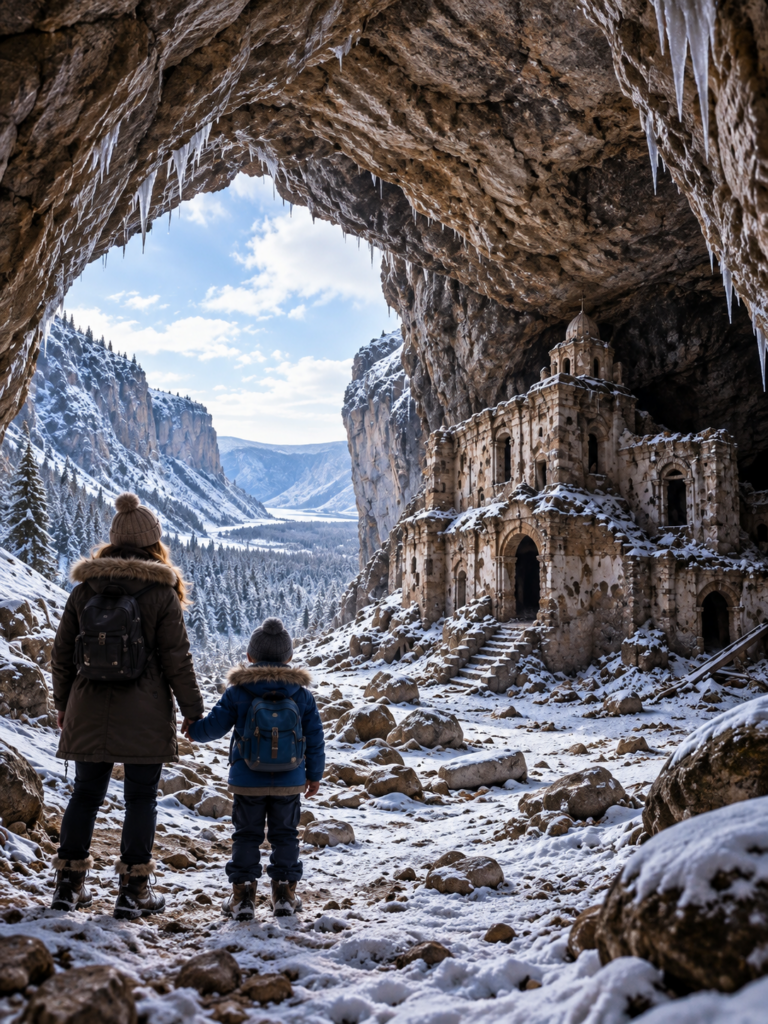
the widow and her son found a forgotten house deep inside the mountain and the papers that finally gave them a place no one could take away
Part 1
Clara Voss stood at the edge of the last place that had almost kept them and watched the dust settle behind the wagon that carried her and Eli away. She was twenty-eight. The boy was seven. Between them they had two canvas bundles, her father’s old farrier tools rolled in oilcloth, and three dollars and ninety cents sewn into the lining of her winter coat. The man who owned the place had paid her what he owed and added two dollars he would not take back. His widowed sister had arrived from the city with three children and no money. There was only one spare room. Clara had known the moment he called her into the harness shop what the answer would be.
Eli sat on the borrowed mule behind the bundles and did not ask where they were going until the buildings were gone behind the cottonwoods. Then he said, “Mama, was it because of me?”
Clara stopped the mule. She turned in the saddle as far as she could. “What if it was only you? They could have kept you.”
The boy’s mouth tightened. She swung down, lifted him off, and crouched on the road so their faces were level.
“Listen to me, Eli. You are not the reason I keep losing places. You are the reason I keep looking for them.”
He looked at her. She put both hands on his face. “One day I will tell you we are staying, and I will know it when I say it.”
She had no idea whether she could keep the promise. But he nodded, and they went on.
The first place on the list the owner had given her needed no hands. At the second the foreman looked at her tools, asked five questions about horses, and said she could start that afternoon. Then he saw Eli. The expression on his face changed. He was not unkind, and that made it heavier. “I have eight men sleeping in one bunkhouse. He can sleep where I sleep. That’s the trouble. There’s nowhere else.”
Clara thanked him and left. Their last chance was a winter camp at the foot of the mountains where a man named Gennady Shukin sometimes hired extra help before the snow. They reached it under a heavy gray sky. Gennady was near fifty, narrow-faced, one shoulder lower than the other from an old break. He listened while Clara told him what she could do. Then he looked at Eli, then at the supplies stacked along the wall of the shack.
“I provision three men,” he said. “The company counts every sack. I can’t feed two more mouths until spring.”
Clara nodded. He rubbed his jaw. “I can feed you tonight. That’s enough. And you can sleep in the harness shed. The stove draws poor, but it draws.”
At supper of beans and salt pork he told her about the drainage north of the ridge, a place called Rowan Hollow. There had been an old holding there once, or maybe only an old hunter’s shelter. He had never seen it. Limestone and pine, cut by a clear creek. No settlements, no reliable roads, no guarantees of anything. But it was the only direction left to point her.
Before dawn Clara wrapped Eli’s feet in two layers of wool and saddled the mule. They climbed north until the trail narrowed on the pass. The country ahead was too broken, and she had no feed to keep a borrowed animal through the winter. She took off the saddle, untied their bundles, left the bridle, and turned the mule south. She slapped its rump. The animal went twenty steps, stopped, and looked back. Eli raised a hand. “Go home.”
The mule flicked one ear and continued down the trail. Clara watched until the trees took it. Then she shouldered one canvas bundle and her father’s roll of tools. Eli carried his blanket, a Bible, and one tin cup. They walked north.
By noon the snow began. By late afternoon Eli stopped asking how much farther. That was when Clara became afraid. He fell once, then again. The third time he sat in the snow and said he was all right in a voice too tired to belong to a child who was all right. She lifted him. They walked another hundred steps. At the end of those hundred steps, where Rowan Creek bent against a wall of pale limestone, she saw the black mouth of a cave. The creek disappeared straight into it. The wind was rising. Less than an hour of daylight remained.
Clara stood with Eli pressed to her side and looked into the mountain. A cave did not mean safety. Outside, death was already closing in. She took Maria’s folding knife from her pocket, then took her son’s hand.
“We’re going in.”
The first part of the cave was narrow enough that the last of the daylight followed them. Farther in the ceiling rose and the wind vanished. Clara found a dry ledge beside the water and stopped long enough to dig a small tallow candle from her father’s tool roll. She struck a match. The candle caught. They went deeper. Thirty steps. Fifty. The creek whispered beside them. Then the cave turned. Eli stopped so suddenly Clara nearly walked into him.
“Mama.”
She raised the candle. At first she saw only dark. Then the flame touched something straight, a vertical edge, the line of a roof, a square of glass that returned one small yellow point of light. Clara took another step. There, deep inside the giant cave, standing on a raised stone ledge as if someone had built it yesterday and then walked away, stood a house. Four walls. A pitched wooden roof. A stone chimney. Two windows. Three steps and a closed front door.
Eli’s hand tightened on hers. “Someone lives there.”
Clara could not answer. Above the door, carved into wood darkened by time, were a woman’s name and a year. She lifted the candle to read them.
Agrafena Rowanina.
The door would not open. Clara pulled the gray latch cord once, heard something lift inside, and put her shoulder to the wood. Nothing. Behind her Eli coughed. It was a small sound, but inside the cave it traveled farther than it should have, sliding over black water and vanishing into the dark above them. She tried again. The candle in her left hand had burned low enough that hot tallow touched her fingers. Melted snow dripped from the hem of Eli’s coat onto the plank step. His face was pale with exhaustion, his lips the color they turned after a person had been cold too long.
If the house was locked, abandoned, unfit, or occupied by someone who did not want strangers inside, Clara would deal with that later. First she needed heat. She pulled the cord harder. The wooden latch lifted with a dry click. This time she leaned her shoulder into the door. It gave, not much, perhaps an inch, then another. The bottom edge had swollen and stuck in the threshold. She had to push slowly and hard until the old wood surrendered with a long scraping sound. From the dark came a smell: dry pine, cold iron, old smoke. No rot. No animals. A house. A real house.
Clara raised the candle. The room was small enough that the light reached almost all of it. Against the left wall stood a cast-iron stove. Against the right a narrow rope bed. Near the back wall a plank table with two straight chairs, and beside it, pushed tight to the wall, a third chair so small Eli could sit on it without his feet touching the floor. On the shelves were tin plates, a coffeepot, two iron skillets, glass jars, a wooden bowl, and a blue clay pot that still had its lid tight. There were pegs for coats, a woodbox, a washbasin, a broom made of bound twigs. Nothing was overturned. Nothing looked done in haste. It seemed less a place left fourteen years ago than a room whose owner had stepped outside and simply not come back for a long time.
Eli stood in the doorway. “Can we go in?”
Clara listened. No breathing but their own. No scratching in the walls. No movement beyond the house. She looked once more at the name carved above the door. Then she stepped across the threshold. The floor held.
“Come in, Eli.”
He followed. Clara closed the door, and the sound of the creek dropped at once to a distant murmur. For the first time since morning there was no wind. Eli stood in the middle of the room with his arms at his sides.
“It’ll be warmer if that stove works.”
Clara set the candle on the table and went to the stove. It was small, black with age. Its iron door was rusted at the corners but sound. A short length of stovepipe rose from the top and entered a tightly fitted stone chimney built against the cave wall. She followed the pipe with her eyes. It did not simply end above the roof. The masonry narrowed and passed into a natural crack in the limestone, a dark vertical throat rising beyond the candlelight. She held her palm to the stove door. She felt a faint draft of air. Whoever had built the house had placed it where the mountain itself could carry the smoke.
She opened the iron door. Inside lay old ash. On the ash lay cedar bark, dry and curled like paper, with pine shavings laid over it and three crossed kindling sticks on top. Prepared. Waiting. Clara looked at it. Someone had laid this fire expecting the next match to be struck, perhaps the next morning, perhaps that same evening. The person had never come back to light it.
Eli came to her. “We can burn it.”
Clara touched the cedar. Dry. She looked in the woodbox. Half full. “Stand back.”
She took out the match case. Two matches left. The first flared. She held it to the cedar bark. For one terrible second nothing happened. Then a thin flame ran along the curled edge. The pine shavings caught. Clara closed the stove door almost all the way, leaving a crack. As the fire strengthened, smoke rose once in a cloud against the roof of the firebox, then vanished into the pipe. The chimney worked. She closed her eyes for a moment. One problem solved. A hundred remained.
In a few minutes the iron began to make a quiet ticking. Eli knelt in front of the stove and held his hands toward it.
“Not too close.”
“I know.”
“You know because I tell you.”
He smiled weakly. That smile was the first thing in the room that made the place feel lived in. Clara took off his wet coat, then his boots. His socks were soaked through. She rubbed his feet hard with the edge of a blanket until color returned to the toes. Then she wrapped them in the driest part of the wool and set him on the small chair. It fit him not almost, but exactly. He leaned back and looked at himself.
“This is a boy’s chair.”
“It’s a small chair.”
“It’s a boy’s chair.”
Clara did not argue. She took off her own boots and set both pairs near the stove far enough that the leather would dry slowly and not crack. Only then did she look the room over properly. Four tin plates, three cups, two spoons, one fork, an enamel coffeepot, a closed kettle, several jars whose seals had clouded with age. She trusted no food simply because it had stood on a shelf. Fourteen years could make dangerous things look harmless. In one jar was salt. In another what looked like dried beans. In a third hard grains of seed corn. In a tin box with a lid lay paper packets, each marked in pencil: Beans. Squash. Turnip. Onion. Those she left alone. From another pot came the musty waxy smell of old rendered fat. When she lifted the lid a fraction of an inch she closed it again at once. Nothing perishable in this house would reach Eli until she knew exactly what it was and how old.
They had their own food for the night. That was enough. Behind the stove she found an axe. Beside it a small iron poker, a shovel, and a sharpening stone. On the opposite side above the bed hung a two-man saw with a removable handle. The house was not decorated. It was prepared. That was a different thing. Clara knew the difference because she had lived among people who had pretty things and people who had useful ones. Agrafena Rowanina belonged to the second.
The bed frame was pine, rope stretched between the rails. At the foot were three wool blankets and a square of canvas. Clara lifted the top blanket. No mouse nests, no droppings, no moth damage she could see. The cave had kept the room dry and almost still. She shook the blanket once. Something under it shifted. Clara froze. Between the second and third blankets lay a flat packet, oiled paper tied with twine, about the size of her mother’s Bible. Eli saw it too.
“What is it?”
“I don’t know.”
On the front, in faded pencil, were the words: For whoever needs this place.
Clara read them twice. Eli slid off the small chair and came closer. “That means for us.”
The question went deeper into her than she wanted. Clara had spent three years avoiding promises. Promises required certainty, and certainty was a luxury for people who owned land.
“I don’t know yet. But we need it.”
That she could say. She carried the packet to the table. The twine was dry and stiff. Clara took Maria’s folding knife from her pocket, opened the blade, and cut it. Inside the oiled paper were three things: a folded letter, a small canvas pouch tied with a leather thong, and a packet wrapped in brown paper and tied with blue thread. Eli reached for the pouch. Clara touched his wrist.
“Wait.”
She opened it herself. Coins spilled onto her palm—silver dollars, half-dollars, smaller coins, and several gold pieces. Clara stared at them. In her whole life she had held gold only twice. She poured the money carefully onto the table and counted. Then counted again. One hundred twenty-two dollars and fifty cents. More money than Clara had ever had at one time. Eli’s eyes widened.
“We’re rich.”
“It looks like money.”
“What’s the difference?”
“Huge.”
She pushed the coins back toward the pouch. Money meant food, shoes, a blanket, travel. It meant choice. But it did not explain why Agrafena Rowanina had left it under the bed for a stranger. Clara opened the brown-paper packet. A ferrotype slid onto the table. The image had darkened with time. A small girl stood beside a wooden chair, one hand on the seat. She wore a light dress. Her hair was smooth and neatly parted. Her expression was serious, the way children’s faces became when they were told not to move. Eli leaned over Clara’s arm.
“How old is she?”
“Three, maybe?”
Behind the photograph lay a lock of dark hair tied with faded blue thread. Clara turned the ferrotype over. On the back was written one word, then two smaller ones beneath it. Raisa, age three.
Clara stopped breathing. Eli looked at her. “Mama.”
She turned the photograph toward the candle. Raisa. Her mother had been Raisa Volkov before she married Savely. Clara knew almost nothing of Raisa’s childhood. Her mother had rarely spoken of it. She said only that she had been raised for a time by an aunt in the mountain country and had gone south with a freighter’s family when she was still a girl. Clara remembered asking once for the aunt’s name. Raisa had gone very quiet, then said, “Some people love you poorly because poorly is the only way they learned.” Clara had been ten. She had not understood. Now her fingers began to shake. Eli noticed.
“She’s someone.”
Clara swallowed. “I think she may be your grandmother.”
“My grandmother Raisa.”
Clara nodded once. The boy took the photograph in both hands as carefully as if it might break from breath. He studied the child. “She doesn’t look like Grandmother.”
“She wasn’t yet.”
Eli kept looking. After a while he said, “She has your eyes.”
Clara sat down on one of the straight chairs. There were moments when the body understood something before the mind was ready to accept it. Her knees understood. Her hands understood. Her breath understood. Her mind was still trying to catch up. She took the folded letter. The paper had yellowed but remained dry. The handwriting was plain and firm.
My name is Agrafena Rowanina. If you are reading this, you have come farther into this mountain than most people ever will, and you probably had a reason. Clara glanced once at the door, then continued. Agrafena wrote that she and her younger brother Nikolai had built the house in the summer of 1864. Nikolai had been ill. Cold wind cut his lungs. Summer dust made him cough blood. A doctor had told Agrafena that one more winter in a wind-blown cabin would kill him. She had known of the cave from a hunting trip years before. In summer it was cool. In winter it was warmer than the open valley. And a natural stone crack above the ledge drew smoke upward. So she and Nikolai had built their house inside. Nikolai lived only six months. Agrafena buried him under a cairn of white stones deeper in the cave. Then she stayed.
The letter continued. Before I came here I raised my sister’s daughter after her parents died. Her name was Raisa. Clara stopped. The room became very quiet. Even the stove seemed farther away. Raisa came to me at three. I was not gentle with her. I mistook feeding a child and a roof over its head for the whole duty of loving it. By the time I understood better she had already learned to fear my silence. When she was eleven I sent her south with a freighter and his wife who had no children of their own. I told myself she would have a kinder life. I never learned whether she did.
Clara covered her mouth with her hand. Eli stood beside her. He did not interrupt now. I have thought of her every year since. If Raisa lived long enough to have children of her own, they may never know my name. I probably deserve that. But this house kept me alive, and a house should not die because the person inside it dies. If you came here cold, use it. If you came hungry, take what is still fit. There are seeds in the jars. Tools in the shed near the cave mouth. An axe behind the stove and enough money for a careful person to weather hardship. Do not confuse the money with an inheritance. The place is the useful thing. Keep it useful if you can. And if someone is with you, be kinder to them than I knew how to be when kindness could have mattered most.
Clara could no longer see the last lines clearly. She blinked. The words steadied. I hope whoever finds this is warm tonight. I hope no child in this house ever wonders whether there is a place for him. Agrafena Rowanina, October 3, 1873.
Clara set the paper down. Eli looked at the small chair, then at the photograph, then at his mother. He said nothing. That made it worse. Clara did not cry in front of him. When Timothy died she had cried behind the barn. Once she had cried at night with her face covered by the blanket. She had learned long ago from Maria that grief could be carried as long as the work got done. But in this moment there was no work for her hands. There was only the photograph of Raisa at three, the letter, the small chair, and Agrafena Rowanina’s sentence about a child wondering whether there was a place for him.
Clara put her forearm on the table. Her face lowered between them. Tears ran silently. For several moments Eli stood beside her. Then he climbed onto the next chair. He leaned against her shoulder. Neither of them spoke. The stove ticked. The creek murmured somewhere beyond the walls. Outside the mountain, snow was covering the trail they had walked and erasing their tracks one by one. When Clara finally lifted her head, Eli was fighting sleep. She wiped her face.
“Come on.”
She spread two of Agrafena’s blankets on the bed and put the third under Eli for softness. He protested when she told him to take the bed. “Where will you sleep?”
“By the stove.”
“No, Eli. There’s room.”
There was not much room, but enough. Clara lay beside him, still in her clothes. Both of them turned half on their sides under the wool. She kept a low fire. The photograph of Raisa stood on the shelf beside Raisa’s Bible. Agrafena’s letter lay under it. The pouch of coins remained on the table. Clara’s three dollars and ninety cents were still sewn inside her coat. Eli’s breathing deepened. Just before sleep took him completely he murmured, “Mama, will we have to leave here too?”
Clara looked across the room at the prepared stove, the small chair, the letter from a dead woman who had once raised her mother, and the house hidden where no one had thought to look for them. She wanted to tell him no. She wanted it so badly the word hurt behind her teeth. But Clara Voss had spent too much of her life learning what happened when hope was taken for ownership. So she stroked his hair.
“Not tonight.”
Eli accepted that. A few moments later he was asleep. Clara stayed awake because on the table beside the candle lay something larger than money and a family secret. Agrafena had written of tools in a shed, a grave deeper in the cave, a place that should remain useful. And somewhere beyond this mountain there had to be an answer to a harder question the letter had not answered. Who, after fourteen years, owned this house?
Part 2
Clara woke to the sound of something striking wood outside the house, once, then again. A slow, heavy knock somewhere beyond the plank wall. She opened her eyes in the dark. The stove had burned down to a red seam around the iron door. Beside her Eli slept with one hand under his cheek. The sound came again. Knock. Clara was off the bed before she had fully decided to move. She took Maria’s folding knife from her skirt pocket, then stopped herself. A knife was comfort. An axe was protection. She crossed the room barefoot, lifted Agrafena’s axe from behind the stove, and stood at the door listening. Nothing. Then the knock and a scrape. Clara let out the breath she had been holding. Not footsteps. Not an animal scratching at the door. Something outside the house was moving in the cave. She waited until silence returned.
Behind her Eli stirred. “Mama.”
“Stay there.”
“What is it?”
“I don’t know yet.”
That answer woke him fully. Clara put two pine logs in the stove, pulled on wool socks and boots, and lit the candle with one of the two matches left in the case. She did not want to use another. Fire meant life. Matches meant fire. But walking into a dark cave with a seven-year-old boy behind her and an unexplained noise ahead was foolishness. She opened the door. Cold cave air touched her face. After the quiet room the sound of the creek seemed louder. Clara raised the candle. Something lay at the bottom of the three wooden steps. A wooden shingle from the roof. It had slipped from the house and fallen onto the limestone ledge. Wind could not reach this deep into the mountain, but dry wood shifted with time, and somewhere above the house a cracked piece had finally come free. Clara looked at the dark line exposed on the roof. One repair. She added it in her mind to the list forming there. Then she looked beyond the house. Morning light had begun to reach into the cave from the distant entrance—gray shapes, more than simple illumination. Snow outside reflected enough brightness that Clara could see farther than she had the night before. The cave was enormous. The house occupied only a small ledge along one wall. Below stretched a wide floor of pale sand and gravel. The creek split around stones, joined again, and flowed. High above, the vault dissolved into shadow. For the first time Clara understood that the house had not been hidden merely by trees or distance. It had been swallowed by the mountain.
Eli appeared behind her, wrapped in one of Agrafena’s blankets. “You said stay there. I stayed until you opened the door.”
Clara looked at him. He looked back. It was close enough to obedience for seven. “Put your boots on.”
He did. They ate one strip of their own jerked beef between them and softened hard bread in hot water. Clara did not touch the old food on Agrafena’s shelves. Salt was salt, and dry seed might still grow, but fourteen years could turn meat, fat, or poorly sealed vegetables into something dangerous without making them look dangerous. She trusted what she knew, not what she hoped. When they finished she stood at the table and named the day’s work aloud: wood, water, food, house. Eli raised one finger. “And me.”
Clara looked at him. “And you.”
“You forgot me. I was a task.”
“You’re several tasks.”
That drew a grin from him. She found two small wooden buckets under the washstand. The creek ran clear over pale gravel, but Clara filled one pot and boiled the water before they drank. Mountain water could look clean and still carry sickness from animals higher up. While the water boiled she checked the wood supply. Agrafena’s box held enough for about four days if Clara was careful. That was not enough. Outside the cave mouth the storm had left six inches of dry snow on the flat. The morning was cold but clear. Clara stood with Eli under the limestone arch and studied the country. The clearing above the creek was larger than she had realized, perhaps half an acre where the ground opened between the rock wall and the forest. Dead stalks and rows under the snow said someone had once worked it. Beyond the clearing grew pines, firs, juniper, and scattered aspen. Several downed logs lay within easy reach. Good. She would not waste strength felling live timber while dry wood lay on the ground.
“I can help.”
“You can gather branches no thicker than your wrist.”
Eli looked at his wrist. “It’s not very thick.”
“Exactly.”
They worked until noon. Clara cut dry limbs from a fallen pine and sawed smaller trunks with the two-man saw she had found hanging in the house. Eli carried branches to a pile at the cave mouth, taking the job seriously. He could not bring much weight, but he could bring persistence. That mattered. After three trips into the cave Clara found an old woodshed built against the limestone beside the house, almost hidden in shadow. Inside remained several split logs, dry enough to ring when struck together. She left them where they lay. Agrafena’s wood. Reserve. First she would burn what she cut herself. By the end of the day her shoulders burned and blisters had begun on both palms. She had not used a two-man saw alone in years. Eli sat on a round of wood finishing the last piece of hard bread.
“Are we staying tonight too?”
Clara drove the axe into the chopping block. “Yes.”
Tomorrow she pulled the axe free. “Yes.”
That was enough for him to count it a victory.
The first week passed in work. Clara repaired the missing shingle with a piece split from straight-grained cedar. She tightened the ropes on the bed. She washed the table and shelves with boiled water. She carried the old pot of rancid fat outside and buried its contents well away from the creek. She sorted the jars into three groups: safe enough to use, seed only, do not touch. The beans were old but completely dry. Clara boiled a small handful long and hard and ate them herself before she let Eli have any. They were not fresh, but they were food. The corn she left for seed. The packets of squash, turnip, bean, and onion she placed inside Raisa’s Bible where mice could not easily reach them.
On the third day Clara and Eli went deeper into the enormous cave. They carried a candle and left the fire in the house banked low. Farther on the creek narrowed and disappeared under a stone wall. At a western bend Eli saw the white stones first. “Mama.” Against the wall lay a cairn of river rock, four feet long, two feet wide, carefully stacked. Clara remembered Agrafena’s letter. Nikolai. She stood at the foot of it with her hands folded. She did not know what Nikolai had believed about God, death, or anything beyond the mountain where he had spent his last winter. So she did not speak for him. She only said, “Thank you for helping build the house.” Eli found a white stone that had rolled aside and put it back in place. Then he pointed deeper past the bend. “There’s another one.”
Clara raised the candle. The second cairn was partly sheltered behind a limestone spur. Smaller. No marker. No name. Clara knew who it was before she reached it. Agrafena. Someone had buried her here after the letter was written. Someone had known enough to lay her beside her brother. That meant someone outside the cave knew the place existed. The thought stayed with Clara.
On the sixth day she found the shed. It stood beyond the cave mouth under a limestone overhang, nearly invisible behind juniper. Inside were a hoe, a shovel, wooden rakes, a hand plow, iron wedges, a broken lantern, lengths of chain, and a small anvil set on an oak stump. Clara stopped at the anvil. She laid one hand on its flat face. The sound of cold iron. Iron. Behind her Eli asked, “Is that for shoes?”
“Yes.”
“Can you use it?”
Clara looked at the roll of Savely Volkov’s tools inside the mountain. “Yes.” For the first time since she had left the last place, the answer came without reservation.
On the twelfth morning Clara heard a mule. She was splitting wood above the creek when the sound reached her. Iron striking stone. One hoof, then another. She set the axe down. “Eli.” He knew her tone. He came at once. “Inside the cave. Stay near the house until I call.” His eyes widened. “Is someone there?”
“Yes. I’ll tell you when I know who.”
She watched until he disappeared under the limestone arch, then wiped her palms on her skirt and waited. Around the bend below the flat came a man leading a dark mule with two canvas panniers. He was past sixty, gray-bearded, lean in the shoulders, wearing an oiled coat with a patch on one elbow. When he saw Clara he stopped. He did not reach for the rifle tied beside the mule’s load. Instead he raised an empty hand.
“Good morning.”
Clara raised hers. “Good morning.”
The man looked past her toward the cave, then at the smoke, a thin gray thread rising from a crack high in the limestone above them. His expression changed, but it was not quite surprise. Something older. “My name is Anton Belov. Clara Voss.” He nodded. “I’ve been wondering who lit Agrafena’s pipe.”
Clara did not move. “You knew her?”
“Knew her better than most. Brought her coffee and needles every fall for thirteen years, when I remembered.”
Clara studied him. “When did you see her last? Alive, I mean.”
“Fall of 1872.”
Her hand tightened slightly. “And after?”
“Spring of 1874.” His eyes went toward the cave. The second cairn. “I built it. Found her sitting in the sun by that rock.” He pointed to the south side of the cave mouth. “Looked peaceful. The letter on the table said she wanted to lie beside Nikolai if anyone cared enough to do it.”
Clara swallowed. “She wrote another letter. For whoever came.”
Anton nodded. Something softened in his face. “Took a long time.”
At that moment Eli appeared at the cave entrance. Despite instructions he kept half his body behind the rock. Anton noticed him, then saw the small chair visible through the open door farther back. For a moment his gaze stayed on it. “What’s the boy’s name?”
“Eli.”
Anton nodded once in his direction. “Good morning, Eli.” Eli did not answer. Clara said, “My mother’s name was Raisa Volkov.”
Anton went still. Not dramatically. Simply completely still. Clara continued. “Raisa was Agrafena’s niece.”
“I know who Raisa was.”
“You met her?”
“Knew of her. Agrafena spoke of her. How often?”
Anton put his hat back on slowly. “Every year I knew her.” Clara felt something shift inside her. Agrafena’s letter had been a private regret. Anton made it history. “She never learned what became of her,” he said.
“My mother lived. She married Savely Volkov. She had me. She died when I was eight.”
Anton looked again toward the house. “Well.” It was the word older men sometimes used when nothing smaller was large enough to hold what they wanted to say. Clara brought out the ferrotype. Anton held it carefully. “That’s her. You sure?”
“Saw that same picture on Agrafena’s shelf for years.” He handed it back. “Her last winter she asked me if I thought a person could apologize to the dead when she didn’t know if they were dead.”
Clara’s fingers tightened on the photograph. “What did you tell her?”
“That I didn’t know.”
Wind came down the valley. Anton’s mule shifted, favoring one hind leg. Clara noticed. “What’s wrong with him?”
“Lost a shoe two days ago.”
“Let me look.”
Anton raised an eyebrow. Clara was already walking to the mule. She ran a hand down the left hind leg, lifted the hoof, and examined the wall. Chipped but sound. The shoe hung crooked on two remaining nails. An old shoe in the pannier. An hour later Clara had the anvil outside in daylight. She straightened the shoe cold, cleaned the hoof, fitted the iron again, and clinched the nail ends with her father’s rasp. Anton watched without helping. When Clara set the leg down the mule stood square. Anton reached into his coat. He gave her a silver dollar. Then from his pannier he took coffee, a small tin of matches, and two pounds of jerked elk. “Dollar for the shoe.” He set the food on the stump. “This because Agrafena would haunt me if I rode off with the coffee knowing a boy was living in her house.”
Eli smiled for the first time since Anton arrived. Before he left Anton agreed to carry a letter south. Clara wrote to the old stockman who had loaned them the mule. She wrote that the animal had been turned loose on the pass, that she and Eli were alive, that they had shelter and were warm. Eli took the pencil afterward and printed his name in uneven letters under Clara’s. Anton folded the sheet carefully. Then, leading his mule, he stopped at the north edge of the clearing. He bent and brushed snow from a limestone marker half buried in the ground. “You seen this?”
Clara had not. On the stone were old survey marks. Anton looked toward the cave, then at the wide valley beyond. “Stock companies file leases all over these lands.” Clara felt the warmth of the silver dollar in her pocket. “Does that include this place?”
“Maybe.”
“Whose land is it?”
Anton looked at the house in the cave. “That,” he said, “you’d better find out before spring.”
That night Eli slept quickly. Clara did not. Agrafena’s letter lay beside the photograph of Raisa. The dollar Anton had paid her rested beside the canvas pouch of old coins. Outside were a garden, an anvil, water, timber, and enough ground to build a life. For twelve days Clara had wondered whether they could survive in the cave. Now she understood that survival had stopped being the only question. The harder one was whether someone could come up Rowan Creek with a paper in his pocket and tell them to leave.
Part 3
A horse came into the cave at a run. First Clara heard iron strike limestone outside, then a man’s shout, then Eli calling her name. She dropped the skillet she was washing and ran for the door just as a bay mare slid across dry gravel under the limestone arch. One rein dragged on the ground. Blood darkened the hair above her left front hoof. Eli was pressed against the cave wall, frozen. Clara caught his shoulder and pushed him toward the house. The animal’s eyes showed white. The mare tried to turn. The trailing rein caught under her front leg. Clara moved before she had time to think. She caught the free rein near the bit, turned the mare’s head toward the wall, and spoke low. “Easy. Easy, girl.” The horse lunged once. Clara stayed with her. Behind them a man ran into the cave.
“Don’t pull her.”
“I’m not pulling.”
He stopped. Clara had already seen the problem. A shoe had shifted sideways and partly torn free. One nail had broken through the wall of the hoof. The mare had panicked when the loose iron struck stone. Clara waited until the animal’s breathing slowed, then looked at the man. “Knife.” He blinked. “What?”
“Cut that rein from under her leg.”
He did it. Ten minutes later the mare stood quietly outside the hidden house while Clara removed the damaged shoe and cleaned the torn edge of the hoof. The man introduced himself as Leonid Hazov, a freighter from the settlement east of the mountains. He had heard that a woman who understood horses lived up Rowan Creek. The phrase stayed with Clara longer than the half-dollar he paid her. A woman up Rowan Creek. Not a widow looking for work. Not a mother needing a room. A woman people came to when something needed doing.
By the middle of February Leonid Hazov was not the only one. Word traveled the way it always traveled in thinly settled country—slowly, until suddenly everyone knew. A sheepman named Kuzma Danilov came with a gelding that had begun to limp after a stretch of frozen ground. A hand from a ranch brought a torn breast collar and traded two pounds of flour for Clara’s repair. A freighter stopped with a driving mare whose hind shoe had worked loose and left a paper sack of coffee and six onions. When Clara refused a second coin he left the food anyway. Clara took what was fair: money when there was money, food when there was food, a promise of work later when there was neither. She kept a small account in pencil on the blank pages at the end of Raisa’s Bible, not because she distrusted anyone, but because Savely Volkov had taught her that memory was good for people and bad for numbers.
Eli grew used to visitors too. He stayed clear of the horses unless Clara called him closer. He carried nails in a tin cup and swept shavings from around the anvil. When someone came up the creek he often stood on the clearing above the cave and announced them before Clara could see who it was: two horses, or Mr. Belov, or once, with unusual importance, someone with bread.
That someone arrived the first week of March. Anton Belov rode in front on his dark mule. Behind him came a woman on a sturdy gray mare, a black hat pinned tight over silver-chestnut hair, two canvas panniers. She was about fifty-five, broad in the shoulders, with a face that looked accustomed to deciding things. She dismounted without help. “Clara Voss?”
“Yes.”
“I’m Serafima Famina.” She looked past Clara toward the cave. Then her eyes filled. “So it’s still standing.”
“You knew Agrafena?”
Serafima made a short sound that might have been a laugh. “Knew her long enough to argue with her.” Apparently that was the right answer. Clara liked her at once. Serafima kept a boarding house in the settlement east of the mountains. She had known Agrafena nearly twenty years and was one of the few Agrafena trusted enough to do regular business with. She unpacked the panniers without ceremony: a roll of unbleached muslin, cotton batting, needles, a cast-iron kettle, carrot seed, radish seed, onion sets wrapped in paper, a small sack of potatoes just beginning to sprout. Then from under everything Serafima brought out a black wool shawl. She held it a moment before she offered it. “This was Agrafena’s.”
Clara did not take it at once. “Why do you have it?”
“She left it with me in the fall of 1873. Said one edge needed hemming and my eyes were better than hers.” Serafima ran her thumb along the mended edge. “She was supposed to pick it up in the spring.” Anton looked away. Serafima put the shawl in Clara’s hands. “It’s waited long enough.”
Clara touched the wool. It was finer and warmer and softer than anything she owned. “I don’t know if I should.”
“You live in her house.” Serafima’s gaze went to the cave. “I expect she’d object a good deal more if the shawl stayed in my cedar chest.”
Eli came outside. He had grown less shy with visitors, though not careless. Serafima looked down at him. “You must be Eli.”
“How do you know?”
“Anton talks.”
Anton snorted. “Once a month. That’s enough if the information is useful.”
Inside the house Serafima stopped when she saw the small chair. Her hand rested on the back of one of the straight chairs. For a while she said nothing. “So she kept it.”
Clara turned the small chair. Serafima nodded. “Agrafena made Nikolai carve the pieces after Raisa left. She said the house looked wrong without something child-sized in it.” Eli was already sitting on it. Serafima looked at him a long time. Clara brought out the ferrotype. Serafima took it and sat at the table. “Raisa. You’re sure?”
“I saw that picture in Agrafena’s room before she ever came to the cave.” She touched one corner, not the face. “She loved that girl.”
“In her letter she said she was hard on her.”
“She was.” Serafima looked straight at Clara. “Both things can be true.”
Clara sat across from her. “My mother never said Agrafena’s name. That doesn’t surprise me. Once she said some people love poorly because poorly is the only way they learned.” Serafima’s expression changed. “Sounds like Raisa understood more than Agrafena ever gave her credit for.” Clara looked at the shelf where Raisa’s Bible stood. For years she had thought her mother’s silence meant the past was forgotten. Now she understood silence could also mean something had never stopped hurting.
Serafima stayed two nights. The first day she and Clara cut muslin for curtains and stuffed a narrow tick with cotton batting for Eli’s cot. The second day they walked the clearing above the creek. Serafima remembered where Agrafena had planted turnips, where the beans went. “Along that side, potatoes. The soil’s deeper there. Don’t put much faith in corn at this height. Agrafena tried twice and complained both years.” Clara smiled. “Sounds like her.”
“She complained about the weather as if it had made a personal decision against her.” They found the old beds under dead grass. Clara began to think about spring. That in itself felt dangerous. Planting seed was a form of certainty. A person did not put seed in the ground unless she expected to stay long enough to harvest it.
On Serafima’s last evening Eli disappeared behind the stove looking for a kindling stick and called, “Mama.” Clara kept sewing. “What?”
“A crack.”
“This house has cracks everywhere.”
“No. A crack in the floor.”
She turned. Eli was on his knees near the back wall. One floorboard beside the stove was raised at one end more than the others. Clara had noticed it before and assumed time had warped the wood. Now Eli pressed one end and the opposite end lifted slightly. Serafima set her needle down. “That wasn’t there before.” Clara crouched. Under the edge were marks from fingers, not accidental damage, a notch for a hand. With Maria’s folding knife Clara pried the board. Beneath it was a shallow space between the joists. Inside lay a rectangular tin box wrapped in oilcloth. Eli whispered, “More money?”
“No.” Clara did not know why she was so sure. Perhaps because Agrafena had already told her not to confuse money with the useful thing. The latch resisted. Serafima eased it with the tip of Clara’s knife. Inside were papers, many folded in stacks and tied. Clara took them out carefully. The first was a receipt from the land office dated September 1868 in the name of Agrafena Rowanina, describing a tract at the mouth of Rowan Creek with section, township, and range. The second was a survey description, then tax receipts for many years. There was also a handwritten agreement allowing a neighboring stock outfit to cross one edge of the property to reach water, signed by Agrafena and two witnesses. At the bottom lay a letter from a clerk in the land office written in 1871. Clara read it twice. Serafima held out her hand. “Give it here.” She read more slowly. “Well. This doesn’t prove everything.” Clara’s heart sank. “But it proves Agrafena wasn’t simply a squatter.” Serafima tapped the papers. “She filed. She paid something. Someone in the office knew she was here.” Anton leaned over the table. “That’s enough to make anyone who tries to run you off sweat over it.” It was less comfort than Clara wanted, but more than she had had a day earlier.
Three mornings later two riders came up Rowan Creek. Neither of them needed a shoe. Clara knew that before they dismounted. Their clothes were too clean for ordinary hands. One carried a leather map case. The older man introduced himself as Edward Proskurin. The younger was Timothy Vlasov. They worked for the northern stock company. Proskurin removed his gloves. “We’re checking spring boundaries.” Clara waited. He glanced at the cave. “Our company has grazing rights over this whole drainage.”
“For cattle?”
“Yes. I haven’t seen them.”
“You will when the snow goes.” His tone was not threatening, which made Clara listen harder. “Rowan Flat is marked as part of our lease.” Clara looked at the house in the cave. “What exactly does that mean?”
“It means no new fences blocking company access, no blocking stock from water, no permanent commercial buildings unless they’re on an established private tract.” Eli stood in the doorway behind her. Clara could feel him listening. She went inside and came back with the tin box. Proskurin examined the land-office receipt and the survey papers. His face tightened. “Where did you get these?”
“In the house. They belonged to Agrafena Rowanina.”
“Yes.” He studied the description again. Timothy Vlasov looked over his shoulder. “That corner description crosses the flat. Maybe.” Proskurin looked at Clara. “I’m not a land lawyer.”
“Neither am I.”
“They may predate our lease.”
“Then your lease may not include this place.”
“It may not.” Clara appreciated that he said it. Then he added, “But these papers don’t show a final patent.”
“What does that mean?”
“It means filing on a tract isn’t always the same as finishing it.” The old fear returned so suddenly Clara tasted metal. “What happens now?”
Proskurin handed the documents back. “You find out whether Agrafena finished her title. We find out exactly what our lease covers. Until then we don’t touch your house.” Clara said nothing. Proskurin looked at the garden ground. “But don’t fence the creek and don’t expand anything until it’s clear.” He put his gloves on. “The spring herd will come within six weeks.”
After the men rode away Eli remained standing beside Clara on the flat. Snow had begun to pull back from dark earth in patches. Water dripped from the limestone. Somewhere down the valley a bird called once, then again. “Mama.” Clara knew the question before he asked it. “Will they make us leave?”
She looked at the papers in her hands. Once she would have told him anything to take the fear from his face. Now she had learned that comfort built on uncertainty did not last. “I don’t know.” His eyes dropped. Clara crouched beside him. “But I know something I didn’t know before. Agrafena tried to make this place legally hers, and I’m going to find out whether she succeeded.” Eli looked at the cave. Through the open door they could see the small chair, his cot, the shelf with the photograph of Raisa, the mark of his height carefully cut on the wall beside the bed. He put his hand in Clara’s. “What if someone has a bigger paper?”
Clara looked at the receipt from the land office, then at her son. “Then we find the truth before they do.”
That evening she did not put the papers back under the floorboard. She set them on the shelf beside Raisa’s Bible and Agrafena’s letter. The money stayed in the canvas pouch. For the first time since she had found them Clara understood that one hundred twenty-two dollars could buy food, shoes, shelter, and miles of road. They could even help them leave in comfort. But the papers could buy them something no journey had ever given: the right to stay.
Part 4
The cattle came earlier than anyone expected. Clara heard them before she saw them. A low rolling sound moved up Rowan Hollow just after sunrise—not thunder and not wind, but hundreds of hooves striking thaw-softened ground somewhere below the bend. Eli ran from the cave mouth. “Mama!” Clara was already on her feet. Three days earlier Edward Proskurin had said the northern herd would not enter the drainage until the lower trail dried. The lower trail, apparently, had dried. Clara looked at the garden beds. The first rows were barely planted. Turnips, onions, potatoes. Beans could wait another week. Serafima Famina had been right about the corn. At this height Clara had decided not to waste Agrafena’s old seed except for a small trial patch against the warm limestone wall. None of it would matter if several hundred head of cattle crossed the flat before the land question was settled.
“Go in the house.”
Eli did not move.
“Now.”
He looked down the creek. “I can help.”
“You can help by doing what I say before I have to say it twice.”
That moved him. Clara took Agrafena’s land papers from the shelf, wrapped them in oilcloth, and put them under her coat. Then she walked to the edge of the flat. The first riders appeared around the bend—four men. Behind them came a living wall of cattle: brown, red, black, horns moving above dust and wet morning breath. The man riding in front was not Edward Proskurin. He was heavier, older, and rode a tall bay horse with a white star on its forehead. He raised one hand. The cattle behind him slowed and the other riders spread out.
“You’re Clara Voss?”
“Yes.”
“Valery Shukin.” The name caught her attention. Kin to Gennady Shukin at the winter camp. “My younger brother.” That explained nothing, but somehow made the world feel smaller. Valery looked past her at the cave. “Edward showed me the papers. Then you know the tract question isn’t settled.”
“I know exactly that.”
He dismounted. He was about fifty-three, broad in the chest, gray beginning at both temples. Not a man who looked eager for a quarrel. That did not mean Clara trusted him. Valery walked to the edge of the worked ground. “You planted this after Proskurin told you not to expand anything.”
“I turned ground Agrafena Rowanina already worked. For you that difference may matter. It may matter to whoever reads the old description.”
Valery studied her. “You always answer that way when you know the answer?”
Behind him the cattle grew restless and began to bunch. One of the riders called that the herd would not hold long. Valery glanced back, then at the creek. “Our lease gives us access to water across this flat. Unless Rowanina’s rights were finished. If they were, we use the old ford below the bend.”
“Why not use it now?”
“Because it adds nearly six miles to the drive.” Six miles. Clara understood. Six miles with several hundred head meant hours of time, tired horses, cattle that strayed, and men paid to move them. The company was pressing not because it hated Clara. It was pressing because land, water, distance, and money had all come together in this one narrow valley. That made the danger more real, not less.
“What happens if you cross here?”
Valery looked at the fresh beds. “We lose part of the garden. Probably all of it. Next time depends on what the papers say.”
Clara crossed her arms. “You told Proskurin you wouldn’t touch the house.”
“I won’t.”
“The garden keeps the house alive.”
Valery’s jaw tightened. He knew she was right. That did not mean he would yield. “How long do you need to prove title?”
“I don’t know.”
“That’s not useful.”
“It’s true.”
A rider called again. Valery turned to him, then back to Clara. “Today I’ll take them around. Relief came too fast for her to trust it. Why?”
“Because trampling a widow’s garden before the documents are read would make me look a fool even if the lease turns out to be ours.” Clara almost smiled. Almost. He pointed at the creek. “But I won’t drive them around all spring. You need an answer. So do I.”
He mounted. Before he turned he looked at the cave entrance where Eli’s face had appeared despite orders. “You have a boy in there.”
“Yes.”
Valery nodded once. Then he rode back to the herd. The cattle turned slowly. For the next half hour Clara watched them climb the lower slope toward the longer ford. Not one hoof touched the garden. That day she made a decision. She could leave. The thought had lived in her since Edward Proskurin first rode in. Agrafena’s money was still in the canvas pouch. One hundred twenty-two dollars and fifty cents. Anton Belov had paid her a dollar. Other work had brought another three dollars in coin along with flour, meat, potatoes, coffee, and lamp oil. Clara still had her three dollars and ninety cents sewn into the coat. Now she had more money than the day she entered Rowan Hollow—enough to take Eli south before the spring roads grew too crowded. Enough to rent a room for a while. Enough to start over.
That evening while Eli slept Clara set the canvas pouch of coins on the table. Beside it she laid the land papers, then Maria’s folding knife, then Raisa’s Bible, then Savely Volkov’s hoof knife. Money. Proof. Memory. Work. Four ways a person might survive. Only one could tell her whether the decision to stay was foolishness. She took the papers.
The next morning Anton Belov carried a letter to Serafima Famina. Clara asked for help finding whoever had kept the old land records for the county. Serafima sent an answer in six days. She knew a former clerk named Khariton Vinogradov who lived beyond the settlement. He had worked with territorial papers years before. More important, he still knew where copies of the old records could be found. Anton returned with Khariton himself. Khariton Vinogradov was seventy if he was a day, thin as a gatepost, wearing glasses that looked too small for his face. He complained about the ride from the moment he dismounted. People built houses in towns for a reason. Then he walked into the cave, saw Agrafena’s documents, and forgot the complaints for nearly an hour. He spread the papers on the plank table. Clara, Serafima, Anton, and Eli watched. Khariton read every line twice. At last he tapped the 1868 receipt. “This shows payment and filing.” Clara leaned forward. “But not title. Not final right.” Khariton raised one finger. “However.” The word filled the room. He opened a second paper Serafima had brought from the settlement. “This is a copy from the government register made in the county office.” He ran a finger down a line. “Agrafena Rowanina’s entry, number right here. Final proof recorded July 1872.”
Clara stared at the paper. “What does that mean?”
“It means she finished the tract.”
Serafima leaned back in her chair. Anton smiled quietly. Clara did not. Not yet. “Where is the patent?”
“Probably issued later in the capital. Could have been mailed, lost, never claimed, or put somewhere you haven’t found. Without it we lose.”
Khariton shook his head. “The register matters. Final proof matters. A government record can establish that the land passed from the public domain into private hands.” Clara looked at the records. “Then Agrafena owned this.”
“Yes.” Immediately a new question followed. “And after she died?” The room went quiet again. Khariton removed his glasses. “That’s harder. Agrafena had no husband, no surviving children. Nikolai died before her. Raisa was her niece, not her daughter. No will has been found.” Clara’s pulse slowed. “Then the property may belong to someone else.”
“It may.”
“To whom?”
“If Agrafena died without a will we look for her lawful heirs.” Serafima said, “Her sister was Raisa’s mother.” Khariton nodded. “Was that sister older or younger?”
“Older.”
“Was she alive when Agrafena died?”
“Long dead. Any other brothers or sisters?” Serafima thought. “None that I know of.” Khariton turned to Raisa. “Was she the sister’s only child?”
“As far as I know.”
“If that can be proved, Raisa could have inherited Agrafena’s share as her nearest surviving relative. If Raisa later died, her share would pass according to her own heirs.” Eli looked from Khariton to Clara. “That’s us.”
Khariton glanced at him. “Possibly.” Clara did not like the word. “How do we prove it?”
“Records. Marriage if there was one, birth, death, people who knew the family, church records if the civil books are poorly kept.”
“There are dates in my mother’s Bible.”
“That helps. It isn’t enough by itself.” Serafima folded her hands. “I can swear Agrafena told me Raisa was her sister’s child.”
“So can I,” Anton said.
Khariton nodded. “Witnesses help.” For the first time Clara let herself breathe out. Not victory. A road toward it. That was enough.
For two weeks the work spread in circles. Serafima searched records in the settlement. Khariton wrote to the land office. Anton rode south to talk to people who had known Savely and Raisa Volkov. Kuzma Danilov came with two mules and spent a day helping Clara repair the old lower fence line around the garden without closing the ford across the creek, only marking the worked ground. Clara protested. Kuzma kept driving posts. “Pay me when my gray gelding loses a shoe.”
“He will.”
“Then we’re already square.”
No one said Clara belonged in Rowan Hollow. They simply behaved as if leaving her alone to lose everything would have been unseemly. That was stronger than words.
Three weeks after Valery Shukin turned the herd he returned with Edward Proskurin. This time no cattle, only two horses and a leather folder. Clara met them outside. Valery dismounted. “Did you get your answer?”
“Part of it.”
“So did we.” Edward opened the folder and took out a new survey map. “The boundary of our lease follows the government register of tracts,” he said. “If Rowanina’s entry was completed before our lease, her tract is excluded.”
“It was completed in 1872.” Clara handed him Khariton’s copy. Edward read it. Then Valery. Neither argued. Valery looked at the garden. “That settles the company’s side.”
Clara blinked. “That easily?”
He shrugged. “We leased land for grazing. We didn’t buy your house.” The word your struck her harder than it should have. “But the inheritance still has to be established. That’s between you and the county. As far as I’m concerned, I don’t care.” He turned to his horse, then stopped. “My bay’s left hind is loose.”
Clara stared at him. Valery’s mouth crooked slightly. “My brother says you know what you’re doing.” Gennady Shukin. The winter camp. The last place that had refused her because it could not take her. Clara looked at Valery’s horse. “Tie him by the juniper.” Valery did. She brought out Savely Volkov’s tools. The shoe only needed resetting. Clara removed it, cleaned the hoof, shaped the iron on Agrafena’s anvil, and nailed it back. Solid. Valery paid the ordinary price. No apologies. No speeches. No charity. That suited Clara.
When he rode away Eli came out of the cave. “Does that mean we stay?”
Clara looked at the house. Not yet, she thought. There were still papers, names, proof. The law moved slower than cattle. But the company would not drive them off. Agrafena’s rights were real. Raisa might have inherited them, and Clara no longer stood alone in front of men who knew more than she did. She crouched beside Eli. “Yes.” The word came out before caution could stop it. Eli studied her face. Clara understood what she had done. For three years she had refused to say the word until she knew for certain. Now she knew enough. “Yes,” she said again. “We stay.”
He did not shout. He did not cry. He simply leaned against her. That day they planted beans. Clara pressed each seed into dark earth with her thumb. Eli worked beside her, measuring the distance between them with the width of his hand because that was how she had taught him. After a while he asked how long they would take to come up if the weather held. “Not long. And we’ll still be here.”
Clara covered another seed. “Yes.”
The boy looked at the row and smiled. For the first time in his life Eli Voss had planted something because he expected to be there when it grew.
Part 5
The letter from the county judge arrived on a Wednesday morning in June, folded twice inside a brown envelope that Anton Belov carried up Rowan Creek under his coat. Clara knew what it was before he said a word. She was shoeing Kuzma Danilov’s gray gelding on the flat beside the cave. Eli held a tin cup of nails and tried very hard not to spill them. The beans had already climbed halfway up the willow stakes. Potato leaves showed dark green against the soil. Turnips stood in even rows where spring snow had lain only weeks before. Anton rode around the bend on his mule and did not wave. That was what frightened her. Clara set the gelding’s hind leg down. “What happened?”
“Nothing yet.” Anton dismounted. He took the envelope from under his coat. “Serafima said I was to put this in your hands and no one else’s.” Eli looked up at once. “It’s about the house.”
Clara wiped her fingers on her apron before she took the letter. It seemed absurd that so little paper could decide so much. Agrafena Rowanina had built the house with her own hands and Nikolai’s. She had buried her brother in the cave. She had lived there through winters. She had paid taxes. She had worked the ground. She had sat under the limestone wall in her last spring and died where she could see the sun. Raisa had grown up to become Clara’s mother. Clara had worked from ranch to ranch. Eli had slept in rooms that belonged to other people. And all of it had somehow narrowed to a few sheets folded inside one envelope.
“Open it,” Eli said.
Kuzma Danilov stayed beside his gelding. “I can leave.”
“No.” Clara’s voice came out firmer than she intended. Kuzma nodded and stayed where he was. Anton took off his hat. Clara broke the seal. The language was official, too official at first. Names, dates, references to sworn statements, county registers, and the estate of Agrafena Rowanina. Clara read slowly once, then again. The government register confirmed that Agrafena had completed title to the tract in 1872. Agrafena had died leaving no husband, no children, and no surviving brothers or sisters. Serafima Famina’s sworn statement and Anton Belov’s testimony established that Raisa had been the only child of Agrafena’s deceased sister. Church records found after weeks of searching in the south confirmed Raisa’s marriage to Savely Volkov and Clara’s birth. A burial record confirmed Raisa’s death. Savely had later died without a will. No other heirs had been found. The county court recognized Clara Voss, surviving daughter of Raisa Volkov, as the lawful heir to the remaining real property of Agrafena Rowanina, subject to final registration and payment of ordinary taxes.
Clara stopped reading. Eli was watching her, but she could not speak. He stepped closer. “Mama.”
Clara lowered the paper. “It’s ours.”
Eli stared at her. The cave. The house. The flat. The ground from the old description. Part of the creek. The chair. Despite the pressure behind her eyes Clara laughed. “Yes. And the chair.”
Eli’s face changed in a way she had never seen before. Not excitement. Not quite relief. Pure, quiet relief. He looked toward the cave as if checking that it was still there. Then he asked, “No one can make us leave?”
Clara looked at the letter again. There would always be taxes, repairs, hard winters, sick horses, failed crops—things no paper could prevent. But no ranch owner could give their room to his sister. No foreman could decide a child did not belong. No company man could move them because he had a larger map. “No,” she said. “Not for someone else’s convenience.”
Eli put both arms around her waist. Clara held him. Over his shoulder she saw Anton looking down at his hat. Kuzma turned to the gelding and pretended to examine the bridle. No one made the moment larger than it needed to be. That was the kind of people Rowan Hollow had given her.
By noon the letter was wrapped in oilcloth and placed in the tin box under the floorboard with Agrafena’s receipts, the survey papers, the clerk’s letter, and the county’s final order. Agrafena’s personal letter she left out. It belonged on the shelf beside the photograph of Raisa and the Bible. Some papers told a person what the law recognized. Others told why any of it mattered.
Summer came slowly to the mountains. Snow remained in shaded crevices long after the valley floor greened. The creek ran full until midday. The water was cold enough to ache in the hands. Clara worked. Horses arrived twice a week, sometimes three times. Word had traveled beyond the settlement. People no longer said a woman lived in Agrafena Rowanina’s old cave. They said, “Take him up to Clara Voss.” Or “Clara can look at that hoof.” Or simply “Ride to Clara’s.” The first time she heard it she pretended not to notice. A freighter stopped below the cave to ask Kuzma Danilov the way. Kuzma pointed up. “Stay with the creek until you reach Clara’s place.” Clara was close enough to hear every word. Clara’s place. For years other people’s names had been directions Clara followed because she needed work. Belozersky. The winter camp. The ranch beyond the ridge. A widow who might need help. A foreman who might allow a boy. Now her own name had become a place people rode to. She never told Kuzma what that meant to her. He probably knew.
Eli changed too, not all at once. He was still quiet with strangers, still watched adults carefully before he trusted them. But he stopped asking whether they would leave. That was the first thing Clara noticed. The second was that he began to accumulate things that were not expensive: a smooth stone shaped like an egg, three hawk feathers, a wooden horse Kuzma had carved badly and denied carving at all, a rusty shoe Clara let him keep after he cleaned it, a fishing line Anton tied for him, a blue marble Serafima brought from the settlement. Before Rowan Hollow Eli had kept almost everything that mattered to him in one canvas bag because packing had always been part of life. Now he left things on the shelf. The first time Clara saw the blue marble left there overnight she looked at it a long time. Only a child who expected to come back left treasures.
At the end of June another rider came up the creek. Eli saw him first. He ran from the garden shouting, “Mama, a mule!” Clara straightened. Her hands were dark with soil. Around the bend rode Oleg Medov, the old stockman who had loaned her the mule after she left Belozersky. And behind his saddle, tied to the lead rope, walked the same brown mule Clara had turned loose on the mountain pass. The animal looked fatter than she remembered. Eli ran halfway across the flat before Clara stopped him. “Go around the horses.” He made himself stop. The mule recognized neither rules nor ceremony. It stretched its neck toward Eli and sniffed his hair. Eli laughed. “You came home.”
Oleg climbed down heavily. “He came back. Clara wiped her hands. I wrote you.”
“I got the letter. He brought himself back close enough. Showed up at Gennady Shukin’s winter camp two days after you left him. Gennady sent him down with a rider.” Clara stroked the mule’s forehead. “I’m glad.”
Oleg took a folded paper from his pocket. “And I got to thinking.” Clara looked at him. “Dangerous habit.”
“Your father used to say the same.” That silenced her. Oleg held out the paper. “I sold you this mule.”
“You didn’t sell it.”
“Paper says I did.” Clara unfolded it. It was a bill of sale like the one Oleg had once written to protect her if anyone asked why she was riding his animal, except this one was new. One brown mule. One dollar. Paid in full. Clara stared at him. “I didn’t pay you.”
“You will.”
“I can pay more than a dollar. I know this mule is worth forty, maybe fifty.”
“Then why?”
Oleg shrugged. “Because I’m seventy-one. Because the animal likes you. Because Savely Volkov pulled a nail out of the frog of my best mare twenty years ago and refused payment when I needed the money more than he did.” He looked at the cave. “And because a woman with land ought to have something besides her feet when her boy gets sick.”
Clara folded the paper. “You knew about the court’s decision.”
“Everybody east of the ridge already knows.”
Eli looked up. “Can we keep him?”
Clara sighed. “We can keep him.”
The boy let out a joyful yell. The mule flinched. Eli apologized to it at once. That evening they ate outside. Serafima had come with Oleg and brought bread, a jar of preserved cherries, and a small round cake sweetened with molasses. Clara looked at the cake with suspicion. “What’s this for?”
Serafima raised an eyebrow. “You think I don’t ask questions?” Clara understood. It was her birthday. She had forgotten it herself. Twenty-nine. They set the table outside on the flat because the evening was warm by mountain standards. Anton came. Kuzma came with his daughter Lyuba. Oleg stayed. No one brought anything grand: a pound of coffee, a jar of beans, a new rasp from Kuzma who claimed he had found it cheap, a piece of blue ribbon for Eli’s fishing hat from Serafima. They ate stew and bread. Eli ate too much cake. The sun dropped behind the limestone ridge and turned the opposite slope gold. One by one the guests rode away. No one stayed long enough for the evening to become something Clara would have to manage. When the last hoofbeats faded down Rowan Creek, Clara carried one of the straight chairs to the edge of the garden. Eli sat nearby whittling a small cedar block with a dull knife while the mule grazed inside the simple pole fence Kuzma had helped build.
Clara put Agrafena’s black shawl around her shoulders. Maria’s folding knife lay in the right pocket of her skirt. Inside the cave Savely Volkov’s farrier tools rested beside Agrafena’s anvil. Raisa’s Bible stood on the shelf beside the ferrotype taken when she was three. Agrafena’s letter lay folded between them. Clara looked at the beds. Potatoes. Turnips. Onions. Beans climbing the stakes. Squash beginning to vine against the limestone wall. Six stalks of Agrafena’s old corn had surprised everyone by coming up. Serafima had laughed when she saw them. Stubborn seed. Clara thought that was fitting.
She sat quietly. She thought of Belozersky and the room given to his sister. She thought of the ranch that could hire a woman but not shelter her child. She thought of Gennady Shukin counting winter supplies. None of them had been villains. That mattered to her now. Sometimes a life broke not because cruel people planned it, but because ordinary people made reasonable choices that left one person standing outside. Clara had spent years being the person outside. No longer.
Eli came over carrying the cedar block. “What’s that?”
He held it up. “It’s supposed to be a horse.”
Clara turned it. It looked like a potato with four legs. “Good horse.”
“You’re lying.”
“A mother gets one lie on her birthday.”
He sat beside her on the grass. After a while he asked, “Did Great-Aunt Agrafena know we were coming?”
“No.”
“Then why did she leave all this?”
“She didn’t leave it for us.”
Eli frowned. “But we got it.”
“She left it for whoever needed it.”
He considered that. “So that was us.”
Clara looked at the enormous black mouth of the cave. “Yes. Not fate. Not exactly. Agrafena once sent Raisa away because she believed she could not give a child the home it deserved. Years later the house Agrafena built after she lost Raisa sheltered Raisa’s daughter and her grandson. There was something in that circle so gentle and unfair and beautiful that Clara no longer tried to decide whether it was accident or grace. She only knew it had happened.
Darkness came slowly. They carried the chairs inside. Eli washed his face, complained about the water, then climbed onto his cot. Clara closed the stove damper. She put away the last piece of birthday cake. Then she noticed her old winter coat hanging on a peg. She had not worn it in weeks. The hem hung a little heavier on one side. Clara smiled. She took it down. Eli watched from his cot. “What’s in there?”
She picked out a few stitches and poured the coins into her palm. Three dollars and ninety cents. The same money she had carried into Rowan Hollow. She had never spent it. Eli sat up. “You still had them?”
“Yes.”
“Why?”
Clara looked at the coins. Once they had been everything that stood between her and complete poverty. Now they seemed almost small—not worthless, never worthless, simply changed. “I kept finding something more useful.” She sewed the money back into the hem, then hung the coat on the peg. Before she put out the lamp she stepped outside once more. The cave rose like a black wall around the small house. One window glowed yellow. Beyond the entrance stars showed above the ridge. The creek ran over pale stone. Young plants stood on Agrafena’s old ground. The mule shifted quietly at the fence. Behind Clara, Eli was already asleep. He had not asked where they would go tomorrow. He had not asked that in weeks.
Clara stood there with the black shawl on her shoulders and finally understood what the miracle was. Not the money. Not the land paper. Not even the impossible house inside the mountain. It was that her son had stopped asking whether there was a place for him. Clara went inside. She closed the plank door, put a log in the stove, turned down the lamp wick. Then she looked once at the photograph of Raisa, Agrafena’s letter, Savely Volkov’s tools, and Maria’s bone-handled knife. Four people who had given her something they would never see fully used. She said their names quietly: Raisa. Agrafena. Savely. Maria. Eli stirred but did not wake. Clara lowered the lamp flame. The house went dark. Outside, Rowan Creek continued its way under the mountain. The beans climbed the stakes in the night. Six stubborn stalks of corn stood against the warm limestone, and a seven-year-old boy slept in a house hidden inside a giant cave under a roof no one could take from his mother simply because someone else needed a room. For the first time in his life Eli Voss knew where he would wake in the morning. Home.

