
Part 1
The laughter started before Walter Hayes had finished counting out his forty dollars.
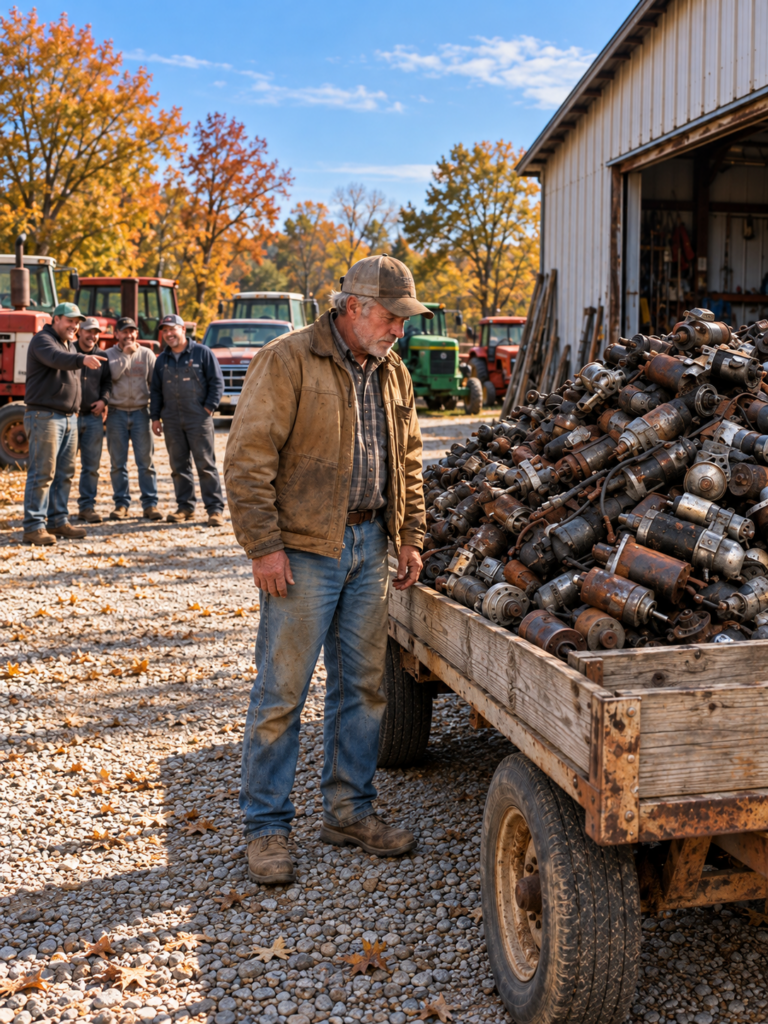
It was a cool autumn morning in rural Missouri in 1990, and the fifty-eight-year-old farmer stood inside a tractor dealership’s storage shed, surrounded by a mountain of greasy, battered starter motors that nobody in the building considered worth saving.
One mechanic had stopped what he was doing just to watch him.
Another leaned against the doorway, wearing the amused expression of a man who had stumbled upon the day’s best entertainment.
Walter placed the last bill beside the others.
Forty dollars.
That was what he had agreed to pay for approximately 270 starter motors.
Every one of them had already been condemned as defective, worn out, or beyond the trouble of repairing.
The mechanic nearest him looked from the money to the pile.
“Walter, you understand what you’re buying?”
Walter glanced toward the shed.
“I believe I do.”
“Those things are junk.”
Walter nodded.
“That’s what you said.”
The mechanic gave a short laugh and turned toward the others.
“He knows they’re junk, and he’s buying them anyway.”
A second mechanic stepped closer, wiping his hands on a shop rag.
“Well, let him have them. Maybe he’ll build himself a house out of starters.”
That brought another round of laughter.
“Two hundred seventy problems,” somebody said.
“More like two hundred seventy paperweights.”
“Could probably make more selling the copper.”
Walter listened without answering.
He had spent more than thirty years working Missouri farmland. In that time, he had watched machinery break at the worst possible moment, seen good equipment discarded because repairs were inconvenient, and learned that a machine’s condition could not always be judged by the grease covering its housing.
He also knew that arguing with men who were enjoying a joke rarely accomplished much.
The mechanics were certain they understood what he had purchased.
Walter wasn’t nearly so certain.
And that was precisely why he wanted the starters.
He folded the receipt, slipped it into his pocket, and walked toward his truck.
“You’re really taking the whole pile?” one of the men asked.
“That’s the arrangement.”
“All of them?”
Walter opened the truck bed.
“All of them.”
The first starter was heavier than it looked. Its casing was stained black with old grease, and a faded marking clung to one side.
He lifted it into the truck.
Then another.
Then another.
The mechanics watched for a while, still exchanging remarks, before gradually returning to their work.
Walter kept loading.
He didn’t move quickly. At fifty-eight, he had learned not to waste strength merely to impress an audience. He worked steadily, choosing his footing, setting each piece of metal down without damaging the truck or his hands.
Some starters had been stacked on top of one another for years. Others were wedged into corners where dust and grease had collected around them.
There were units from John Deere tractors, International Harvester machines, Massey Ferguson equipment, and Ford tractors.
A few still carried grease-pencil markings left by the mechanics who had removed them.
Bad core.
Replace.
No good.
Some were missing small pieces. Some had cracked housings. Others looked almost complete beneath their coating of grime.
To the dealership, they were an accumulation of old repair jobs.
To Walter, they were unfinished questions.
The pile had grown slowly, over more years than anyone working there could easily account for.
When a tractor or combine arrived with a starting problem, the service department had a practical decision to make. A machine sitting inside a repair bay occupied space. A farmer waiting for repairs needed his equipment back. During planting and harvesting, time mattered more than the satisfaction of discovering precisely why an old component had failed.
Sometimes the fastest solution was to remove the starter, install a replacement, and return the tractor to work.
The discarded part went into storage.
A mechanic might mark it for later examination.
Later didn’t always come.
Another breakdown arrived. Another repair had to be completed. Another starter found its way into the shed.
Years passed.
What began as a collection of potentially repairable components turned into a heap of metal nobody wanted to sort.
Eventually, the dealership decided to clear the building and sell the entire lot as scrap.
That was when Walter heard about it.
He hadn’t arrived with a detailed business plan or some certainty that every starter could be restored. He knew better than that. Some machines failed in ways that made repairs unreasonable. Burned armatures, broken housings, ruined electrical components—there were limits to what patience and skill could accomplish.
But he also knew that a mechanic’s decision to replace a starter wasn’t always the same thing as proof that the old starter could never run again.
Those were two very different conclusions.
And the difference interested him.
By the time the last of the starters had been loaded for the trip home, Walter’s clothes carried the smell of oil and old machinery.
One mechanic emerged from the service department and stood watching.
“You know,” he said, “we were going to send that entire mess to the scrap yard.”
Walter secured the load.
“I figured.”
“You’ll spend the rest of your life trying to fix all those things.”
Walter checked the truck once more.
“Maybe.”
The mechanic shook his head.
“You really think you got a bargain?”
Walter considered the question.
“I don’t know yet.”
It wasn’t the answer the man expected.
Walter climbed behind the wheel and drove away.
The dealership disappeared behind him, and the truck carried its heavy, uneven cargo toward the small farm where he had spent much of his adult life.
His place was not a grand operation.
It was a working farm, with the usual demands of land, equipment, weather, and money. There was always something needing attention, always a repair that could be delayed only so long, always a reason to examine a bill before deciding whether the expense was necessary.
People who saw a farmer working his own land sometimes imagined a kind of independence that made financial worries disappear.
Walter knew otherwise.
A working tractor could mean the difference between finishing fieldwork and falling behind.
An unexpected repair could consume money intended for something else.
A machine that sat idle for three days during a critical season could cost far more than the price of the broken component.
He understood those things because he had lived with them.
That afternoon, he began unloading the starters beside his barn.
With each one he moved, the scale of his purchase became clearer.
Two hundred seventy was a number that sounded manageable when spoken across a dealership counter.
Spread across the ground beside a barn, it was something else entirely.
The housings came in different shapes and sizes. Mounting flanges varied. Electrical terminals faced different directions. Some drive ends protruded farther than others.
Even starters made by the same manufacturer were not necessarily designed for the same machine.
Walter stood over the collection for a while.
He had not purchased 270 identical pieces of equipment.
He had purchased 270 separate problems, each with its own history, condition, and possible use.
The mechanics had laughed because they saw the number and the damage.
Walter was beginning to see the work.
The following days brought no sudden discovery, no easy pile of perfectly usable starters waiting beneath the dirt.
Instead, there was cleaning.
There was lifting.
There was sorting.
And there was the slow business of examining equipment that had spent years being treated as worthless.
Walter arranged folding tables inside the barn and divided the starters by manufacturer.
John Deere on one side.
International Harvester nearby.
Massey Ferguson and Ford in their own groups.
He made room for units he couldn’t immediately identify.
Then he began separating them by characteristics that mattered mechanically: voltage, mounting pattern, nose housing, drive gear, and manufacturer number.
He wasn’t interested in arranging them so the barn looked neat.
He wanted to know what he actually owned.
His old friend Earl Benton came to see the work.
Earl was sixty-six, a local mechanic who had devoted most of his working life to repairing farm machinery. He knew the sound of a starter struggling against resistance, the damage that poor electrical connections could cause, and how quickly an apparently minor problem could become expensive when someone chose the wrong replacement.
He stood inside the barn and looked over Walter’s tables.
“That’s a lot of iron.”
Walter was examining a starter housing.
“Sure is.”
“All from the dealership?”
“Every bit of it.”
Earl picked up one of the units and turned it over.
“How much?”
“Forty dollars.”
Earl looked at him.
“For the lot?”
“That’s right.”
Earl set the starter down.
“Well. You won’t have much money tied up in the purchase.”
Walter smiled.
“That’s one way to look at it.”
Earl surveyed the tables again.
“Of course, the purchase might be the cheapest part of this whole business.”
Walter knew what he meant.
Cleaning fluid cost money. Replacement brushes cost money. Solenoids, bushings, and other components could turn a cheap core into an expensive repair if he wasn’t careful.
And then there was the labor.
Time had value on a farm, even when no one wrote a paycheck for it.
Walter wasn’t blind to any of that.
He simply wanted to discover how many of these starters were truly beyond use.
He held one toward Earl.
“This one looks pretty good.”
Earl didn’t bother looking up from the unit he was examining.
“Looking good doesn’t tell you much.”
“Clean housing. Nothing broken that I can see.”
“Still doesn’t tell you whether it works.”
Walter laughed quietly.
“All right. Then we’ll test it.”
For the next two weeks, the barn became something between a repair shop and an investigation.
Walter cleaned the exterior of each promising starter before opening it.
He examined worn brushes and dirty commutators. He inspected armatures for damage and checked solenoids that might have failed because of burned contacts or other faults.
He looked for worn bushings that allowed movement where there should have been alignment.
Some starters had ordinary wear.
Others had suffered serious damage.
A badly burned armature could make an otherwise complete unit uneconomical to restore.
A cracked nose housing might prevent a starter from mounting correctly.
In certain cases, the best use for a failed starter was to supply parts that could save another.
Walter started setting those aside.
There would be a place for donor units.
There would also be a place for scrap.
But the pile of potentially repairable starters grew.
That interested Earl.
He wasn’t surprised to find salvageable machinery among the discarded cores. What impressed him was Walter’s willingness to investigate them methodically instead of assuming every unit would be an easy fix.
A starter that looked clean could have an electrical fault buried inside it.
A filthy starter might need little more than brushes and careful cleaning.
Appearance had very little to do with certainty.
One afternoon, Walter completed his first successful rebuild.
He positioned the starter on his test bench and made the necessary connections.
When he applied power, the motor responded immediately.
It spun smoothly.
There was no ugly grinding sound, no obvious hesitation.
The electrical readings looked right.
Walter watched it run, then shut it down and looked toward Earl.
“Well?”
Earl stepped closer.
“Sounds strong.”
“Current looks good.”
“It does.”
Walter wiped his hands.
“First one.”
For the first time since purchasing the pile, he could hold something that had been marked for disposal and demonstrate that it still had useful work in it.
It was a satisfying moment.
He had expected difficult work, and he had found plenty of it. But now he possessed a tested starter that appeared ready to return to a tractor.
Soon afterward, a farmer purchased that rebuilt unit for an older machine.
Walter believed he had checked what mattered.
The starter’s housing looked right.
Its mounting points aligned.
It appeared to be the proper type for the tractor.
The farmer took it away to install it.
But the starter did not perform correctly.
The motor itself worked. The trouble came when it had to engage the tractor’s flywheel.
The drive gear wasn’t engaging as it should.
A rebuilt starter that spun beautifully on a bench was of little use if it could not turn the engine it was supposed to serve.
Walter had made a mistake.
And the mistake exposed a weakness in his whole approach.
He refunded the farmer’s money that same afternoon.
He offered no argument about the effort he had put into the repair.
The farmer had paid for a working solution, not for Walter’s confidence in his workmanship.
If the starter didn’t do the job, Walter wasn’t going to keep the payment.
Afterward, he returned to the bench.
Earl was there.
Neither man needed to make the failure more dramatic than it was.
Walter had rebuilt an electrical component successfully.
He had failed to establish whether it belonged on that particular tractor.
Those two facts were equally important.
Earl placed two starters beside each other.
“Tell me what you see.”
Walter studied them.
“Same general size.”
“Go on.”
“Mounts look similar. Housings aren’t much different.”
Earl nodded.
“What else?”
Walter leaned closer.
“Not a whole lot.”
Earl turned one of the starters so the drive end faced him.
“Count the teeth.”
Walter reached for his magnifying glass.
He examined the pinion gear and counted carefully.
Then he moved to the other starter.
He counted again.
The numbers were different.
He looked back at the first unit, then at the second.
The starters had appeared nearly identical.
They came from the same manufacturer. Their housings were similar. The mounting patterns were close enough to suggest that one might replace the other.
But their drive gears were not the same.
The difference mattered because a starter had to do more than spin.
Its pinion had to engage the flywheel properly.
The geometry had to be right.
Walter straightened slowly.
“Well, I’ll be.”
Earl said nothing.
He didn’t need to.
Walter had spent days proving that discarded starters could be repaired.
Now he understood that repair was only half the job.
The other half was knowing exactly where each repaired starter belonged.
He picked up his notebook and turned to a clean page.
For a moment, he looked at the two starters again.
Then he wrote:
Looks right isn’t the same as fits right.
He underlined the sentence.
The first lesson had cost him time, labor, and a sale.
The next mistake might cost a farmer something much more valuable.
Walter closed the notebook, looked around at the crowded barn, and understood that the 270 starters were going to demand more than a collection of repairs.
They were going to demand a system.
Part 2
The morning after Walter discovered the difference between those two pinion gears, he returned to the barn with a different idea of what he needed to accomplish.
Until then, he had measured his progress mainly by the number of starters he could bring back to working condition.
A motor that spun properly was a success.
A solenoid that operated reliably was a success.
A damaged unit that surrendered good parts to another repair was useful in its own way.
But the incident with the farmer’s tractor had demonstrated the danger of stopping there.
A repaired starter was not necessarily a usable replacement.
For that, Walter needed certainty about its application.
He looked over the units arranged on the tables.
A starter could be electrically sound and mechanically wrong for the job.
It could carry the correct manufacturer’s name and still have the wrong pinion.
It could bolt into place and fail when asked to engage the flywheel.
The dealership’s discarded pile contained more varieties than he had initially realized.
And if he couldn’t identify them correctly, he wasn’t creating dependable inventory.
He was only exchanging one kind of uncertainty for another.
Walter opened his notebook.
Beside the first properly identified starter, he began recording its specifications.
Voltage.
Direction of rotation.
Mounting bolt pattern.
Nose housing type.
Pinion tooth count.
Pinion diameter.
Shaft length.
Solenoid position.
Manufacturer number.
Tractor application.
The list took up most of the page.
He inspected the starter again, checking each measurement and marking.
Then he created a separate card for it.
The card would stay with the unit as it moved through his rebuilding and storage process.
Before any starter reached the ready shelf, Walter wanted a record that answered two questions.
Was it working properly?
And which machine was it meant to start?
One question without the other wasn’t enough.
The work became slower for a while.
Walter found himself checking details he once might have overlooked.
He compared drive ends and mounting flanges.
He examined identification marks partly obscured by grease.
He studied parts catalogs and repair references.
Old Delco and Prestolite service books became regular companions on the workbench.
Sometimes he found an application quickly.
Other times, a manufacturer’s number led him through several pages of possibilities before he could narrow the answer.
Certain units had markings that were difficult to read.
Some numbers had been obscured by years of dirt, wear, or careless handling.
Walter didn’t invent an answer simply because he wanted to finish a card.
He set uncertain starters aside until he could learn more.
That meant making telephone calls.
He contacted parts counters in neighboring counties, asking about applications for older tractors and starters whose details didn’t seem to match the obvious possibilities.
Sometimes the answer came immediately.
A parts man who had worked with a particular make for years might recognize a manufacturer number Walter had been struggling to identify.
Other times, the person on the other end of the line had to consult a book.
Occasionally, neither man could identify the part with confidence.
Walter learned to accept that.
An incomplete card was better than a confident mistake.
Earl watched the system develop.
One afternoon, he found Walter standing before a row of starters, comparing a card to the unit on the bench.
“Still sorting?”
“Still finding things I missed.”
Earl examined the card.
“You’ve got just about everything on here.”
“Just about doesn’t mean everything.”
Earl smiled.
Walter held up the starter.
“Two of these can look alike until you check the drive end. I don’t intend to sell another one based on what it looks like.”
“Good.”
Walter set the unit down.
“Good isn’t what you said the last time.”
“Last time you told me it looked good.”
Walter gave a small laugh.
“Guess I walked into that.”
Earl had spent enough years in repair work to understand why the cards mattered.
Knowledge held in one man’s head was useful until that man forgot a detail, got interrupted, or reached for the wrong part in a hurry.
A reliable inventory required more than memory.
It required a method that still worked when somebody was tired, busy, or under pressure.
Walter began organizing the shelves accordingly.
Manufacturers were separated first.
Within those groups, he sorted by application family.
Voltage and mounting patterns narrowed the choices further.
Pinion details helped distinguish units that might otherwise be confused.
Every usable starter had a place.
Every place had a card.
The shelves also carried simple condition labels.
Tested.
Ready.
Needs parts.
Donor.
Scrap.
The labels didn’t look impressive.
They weren’t supposed to.
They told Walter exactly what he could offer a customer and what still needed work.
He began to understand that the pile he had purchased contained several different kinds of value.
Some units could be restored and sold.
Others could provide components.
Some had little remaining value beyond scrap metal.
And a few might be particularly important because they belonged to older machines for which a replacement was difficult to obtain.
But those possibilities meant nothing unless he could identify the part accurately and make it available when someone needed it.
By November, cold weather had begun settling over the Missouri countryside.
The days were getting shorter, and farmers still had fieldwork they wanted finished before conditions worsened.
That was when Roland Spearing came into Earl Benton’s repair shop.
Roland had a tractor that wouldn’t crank.
The starter had failed, and the problem had already begun disrupting his work.
He had contacted a dealership two towns away.
They could obtain a replacement, but it wouldn’t arrive for several days.
Several days.
Under ordinary circumstances, that might not sound unreasonable.
A component had to be located, ordered, and delivered.
The parts department had done what it could.
But Roland wasn’t standing in ordinary circumstances.
He still had fall fieldwork waiting.
The weather was changing.
Every day that the tractor remained idle reduced his chances of completing the work when he needed to.
Roland explained the problem to Earl.
Earl listened, then looked toward Walter.
Walter had been helping with the starters and their applications, and Earl knew what was taking shape on the shelves.
Walter looked at Roland.
“What tractor?”
Roland gave him the model.
Walter reached for his notebook.
The pages were filled now with the results of weeks of work: specifications, application numbers, notes from catalogs, and information collected from parts counters.
He turned to the appropriate section.
There was the manufacturer.
Then the application family.
He followed the entries until he found the card he wanted.
He checked the relevant details.
He looked up.
“I believe I’ve got one for it.”
Roland regarded him carefully.
“A new one?”
“Rebuilt.”
“Working?”
“Tested.”
Roland wasn’t interested in whether the replacement had a polished housing or looked new enough to impress someone standing beside a workbench.
He wanted to know whether it would start his tractor.
Walter understood that distinction.
“Let’s make sure it’s the right one,” he said.
He went to the shelves.
For a moment, the scene was almost ordinary.
A man examining an inventory card.
A mechanic watching him select a part.
A farmer waiting for an answer about a broken machine.
But Walter knew what would have happened a few weeks earlier.
He would have walked among a cluttered collection of repaired starters, comparing housings and hoping to recognize a match.
Now he didn’t have to guess.
He went straight to the correct section.
He found the card.
He read the specifications.
Then he lifted down the rebuilt starter.
He had already cleaned it.
Already opened it.
Already inspected and repaired what needed attention.
Already tested its operation.
Most importantly, he had established the correct application.
Roland examined the part as Walter brought it over.
“That’s the one?”
“The specifications match.”
“How long to put it on?”
“Let’s get the old one off.”
The failed starter was removed from Roland’s tractor.
Walter’s rebuilt unit went into place.
The mounting matched.
The connections were made.
Everything that had been checked in the barn now had to prove itself on a working machine.
Less than twenty minutes later, the tractor started.
The engine turned over and came to life.
For a moment, Roland stayed where he was.
He listened to the sound, as if allowing himself to believe that the problem really was finished.
Then he looked at Walter.
“How much do I owe you?”
Walter gave him the exchange price.
It was considerably below the cost of a new replacement from the dealership.
Roland looked toward the tractor again.
“And I don’t have to wait for that other one?”
“No need.”
The transaction was simple.
Roland paid for the rebuilt starter and received a working replacement without waiting several days for a new part to arrive.
He was able to take the tractor home that same morning.
Walter watched him leave.
The successful repair should have felt like vindication.
He had bought discarded starters for forty dollars, and one of them had just returned a working tractor to a farmer who urgently needed it.
But the satisfaction he felt was different from the pride he’d experienced when that first rebuilt motor spun on his test bench.
That first success had been about machinery.
Roland’s repair was about time.
Walter thought about the three days the dealership had told Roland to expect.
Three days of waiting.
Three days with a tractor unable to do its job.
Three days of watching the weather and wondering how much work could still be finished.
For somebody removed from farming, a three-day delay might be an inconvenience on a schedule.
For a small farmer, it could change the shape of an entire week.
Walter knew what happened when work slipped behind.
The equipment eventually returned to service, but the lost days didn’t return with it.
The farmer worked longer to catch up.
Other jobs were delayed.
Bills kept coming whether the tractor was running or not.
That was the part of the problem no one saw when they looked only at the price of a starter.
As Walter returned to Earl’s shop, he understood that the real value of his rebuilt units wasn’t simply the money saved compared with new components.
It was their availability.
A starter sitting on a shelf could represent a tractor that didn’t have to remain idle.
An accurately cataloged replacement could turn several days of uncertainty into a repair completed that morning.
And a farmer who returned to work sooner gained something that could not be recovered once it was lost.
Walter’s forty-dollar purchase had given him a collection of potential repairs.
The notebook had made them identifiable.
Now Roland’s experience showed him what the entire system could become.
Earl found him looking over the cards.
“Thinking about that tractor?”
Walter nodded.
“Three days.”
“What?”
“That’s how long he was going to wait.”
Earl understood.
“Parts aren’t always easy to find for those older machines.”
“No. But we’ve got some of them sitting right here.”
“Some.”
Walter ran a finger along the edge of a card.
“And if we can keep the right ones ready, somebody doesn’t have to lose three days waiting.”
Earl studied him.
“Sounds like you’re thinking beyond selling off that pile.”
Walter looked toward the shelves.
He was.
Until then, he had imagined working through the starters, rebuilding the useful ones, and selling them when someone needed a replacement.
Eventually, the original inventory would diminish.
That had seemed reasonable enough.
But Roland’s failed starter had given him another idea.
The old unit that came off the tractor wasn’t necessarily useless.
It might need brushes, a solenoid, or bushing work.
It might contain components worth saving even if the complete starter could never be restored.
Why should the discarded core simply disappear into a scrap pile somewhere else?
Walter could bring it back into the process.
He began offering an exchange arrangement.
A farmer arrived with a failed starter.
Walter identified the tractor application and checked the inventory for a correctly matched rebuilt replacement.
If one was available, the farmer paid a set exchange price and left with the tested unit.
Walter kept the failed starter.
That core went onto the workbench for examination.
Some could be repaired and returned to the ready shelves.
Others became donors.
A working solenoid from one unit might help save another.
A usable nose housing could replace a cracked one.
A good shaft, suitable field coils, or other sound components could keep another starter from being discarded.
The system didn’t make every old part valuable.
It made it possible to recover the value that remained.
Walter also understood the need for restraint.
A damaged starter wasn’t worth rebuilding merely because he had invested time in opening it.
If the cost of parts and labor exceeded the reasonable value of the finished unit, he needed to make a practical decision.
Some cores belonged in the donor area.
Others belonged in scrap.
But a failed starter no longer had to be the end of the process.
It could become the beginning of the next rebuild.
The arrangement gradually gave shape to the work.
A farmer brought in a broken starter.
A tested replacement went out.
The broken core came back.
Walter examined it, salvaged what was useful, and restored it if doing so made sense.
The shelves were no longer just a collection of machines rescued from a dealership shed.
They were becoming a continuing supply of replacements for the farmers around him.
And every time Walter selected a starter from its proper place, he remembered the first one that hadn’t fit.
The notebook stayed open.
The application cards stayed with their units.
The pinion teeth were counted.
He had learned, at fifty-eight, that repairing a machine required patience.
Keeping somebody else’s machine working required something more.
It required being right.
Part 3
By the time the first winter drew toward its end, Walter Hayes could finally look at the original collection and understand what his forty dollars had purchased.
The results were neither miraculous nor disappointing.
Of the roughly 270 starters he had hauled away from the dealership, about ninety had become usable, tested rebuilds.
Another thirty had been dismantled for donor parts.
The remaining units had gone to the scrap yard.
It was not the kind of result that could be described simply by saying he had turned forty dollars into a fortune.
The work had cost far more than forty dollars.
There had been replacement brushes and solenoids.
Worn bushings that needed attention.
Cleaning supplies and countless hours spent stripping, examining, testing, and rebuilding machinery.
There had been telephone calls, catalogs, application research, and the painstaking process of organizing parts so that a wrong selection would not waste another farmer’s time.
Walter had also learned that some discarded units really were beyond practical repair.
A few housings could not be saved.
Some armatures were too badly damaged.
Others had defects that made their repair uneconomical.
He had not won an argument against every mechanic who had ever marked a starter defective.
He had discovered that the original pile contained a mixture of damaged machinery, recoverable components, and equipment that could still perform useful work.
That distinction mattered.
Ninety tested, correctly identified starters represented something far more useful than 270 unknown pieces of metal lying in a shed.
The number alone didn’t explain the difference.
The system did.
Before Walter purchased them, the starters had been difficult to search, inconvenient to diagnose, and easy to dismiss.
Now the usable ones had been repaired, tested, and matched to applications.
The donor units were separated.
The scrap was gone.
A farmer who needed a starter wasn’t being offered a place in a pile where he might find something that looked right.
He was being offered a checked replacement.
On the shelves, the cards stood where Walter could find them.
He had learned to appreciate the plainness of those cards.
A number written correctly could prevent a costly mistake.
A clearly identified pinion could save time.
A verified tractor application could make the difference between a farmer leaving with a functioning machine and leaving with another problem.
Earl came by as Walter was checking the winter’s remaining inventory.
He looked along the shelves.
“You’ve made quite a change.”
Walter glanced up.
“From what?”
“That mess you unloaded beside the barn.”
Walter followed his gaze.
The transformation was unmistakable.
The tables weren’t covered with random housings anymore.
The remaining starters had their assigned places.
The equipment still looked like working machinery. Even after cleaning and rebuilding, the units carried the appearance of components that had been used, removed, and put back into service.
But the disorder was gone.
Walter held up one of the cards.
“Now I know what I’ve got.”
Earl smiled.
“That helps.”
“Helps quite a bit.”
Earl reached toward a starter and checked the information beside it.
“Funny thing,” he said. “A fellow could look at that pile in the dealership and decide there wasn’t anything worth keeping.”
Walter considered the remark.
“Some of it wasn’t.”
“True enough.”
“But some was.”
Earl nodded.
Walter set the card back in its place.
That was as much explanation as either man needed.
As spring planting approached, farmers began hearing about the rebuilt starters.
The information spread in the ordinary way practical news traveled through farming communities.
Somebody had gotten an older tractor running without paying for a new dealership replacement.
Somebody else had found a part he hadn’t expected anyone nearby to have.
There was a farmer named Walter Hayes who had rebuilt starters available, and if he had the correct one, a broken machine might not have to sit waiting for an order.
Walter didn’t need to make grand promises.
He needed the shelves to contain what the cards said they contained.
One farmer asked whether he had a starter for an older John Deere.
Walter asked for the model.
He checked the notebook.
Then he examined the appropriate shelf.
If a correctly matched unit was ready, he could answer.
Another farmer wanted a replacement for an International Harvester tractor.
Again, Walter asked for the identifying information.
He wasn’t willing to select a starter merely because someone named the manufacturer.
Too many machines shared a badge without sharing identical components.
Sometimes customers were surprised by the questions.
Wasn’t a starter just a starter?
Walter understood why people thought that way.
He had once made a similar mistake himself.
But he knew what could happen when the mounting pattern looked correct and the pinion did not match.
He wanted the tractor model.
He wanted to confirm the application.
Then he wanted to compare the correct details before handing over a replacement.
The method occasionally took more conversation than a customer expected.
It saved the kind of trouble Walter had already experienced.
As spring progressed, the exchange system began proving itself.
A farmer arrived with a failed starter.
Walter checked the application.
If a rebuilt unit was available, the farmer could take it away and return his machine to work without waiting for a replacement to be shipped.
The failed core stayed behind.
Later, Walter dismantled it and assessed what could be reused.
A core that required only brushes might soon reappear as another tested starter.
Another might surrender its solenoid to a unit that had better mechanical components.
Some provided useful housings or internal parts.
Others yielded little.
Walter didn’t force every failure into a success story.
He accepted each core for what it could realistically provide.
But the important change was that inventory no longer moved in only one direction.
A rebuilt starter left the shelf.
A failed starter came back.
The supply began replenishing itself through the same exchanges that helped farmers keep their equipment operating.
By the end of spring, nearly forty of the original ninety rebuilt starters had already gone out.
Each successful exchange demonstrated something Walter had not fully appreciated when he first saw that greasy pile in the dealership shed.
The starter motor was a small part of a much larger problem.
When it failed, the entire tractor could become useless until the issue was resolved.
And when the tractor was needed for fieldwork, every hour mattered.
Walter’s business didn’t need to impress anyone with polished machinery or clever salesmanship.
It needed to work.
Farmers weren’t searching for a beautiful rebuilt starter to admire.
They wanted the engine to turn over.
They wanted to return to their fields.
They wanted a repair they could trust at a price they could manage.
Walter understood those priorities because they were his own.
And then, during planting season, the telephone rang at Earl Benton’s repair shop.
The call came from the same tractor dealership that had sold Walter the 270 condemned starters.
The dealership was having trouble with one of its customers’ older tractors.
The machine needed a starter.
The correct unit was no longer readily available through the usual inventory.
The parts manager had searched the dealership’s catalogs.
He couldn’t find a suitable replacement.
He had contacted suppliers.
They didn’t have one available either.
An obsolete tractor could be especially troublesome that way.
The machine might still be perfectly capable of doing the work a farmer needed, but a failed component could leave it stranded because newer inventory no longer supported it.
The parts manager knew that Earl worked on older farm equipment.
So he called Earl’s shop.
“I’ve got an old tractor here,” he explained. “Needs a starter.”
Earl listened.
The manager gave him the situation.
The dealership had already tried its usual sources.
Nothing.
The customer still needed the machine.
“Any chance you’ve got something that might fit?” the manager asked.
Earl glanced toward Walter.
There was no reason to make the situation dramatic.
The dealership needed a part.
Walter had developed an inventory of rebuilt starters.
Whether he could help depended on the application.
Earl passed the inquiry along.
Walter took the tractor model information and opened his notebook.
He didn’t recognize the application with absolute certainty from memory.
That no longer bothered him.
The notebook existed precisely so he wouldn’t have to rely on memory alone.
He found the manufacturer section.
Then the relevant application family.
He studied the entry.
A possible match appeared.
Walter went to the shelves.
He checked the card beside the starter.
Voltage.
Mounting pattern.
Nose housing.
Pinion specifications.
Manufacturer information.
Tractor application.
He compared the necessary details with the information from the dealership.
Everything matched.
He looked at the starter.
It had already been rebuilt and tested.
The unit was ready.
Walter returned to the telephone.
“Yes,” he said.
The parts manager paused.
“You have one?”
“I do.”
“For that tractor?”
“The application matches.”
There was another pause.
The parts manager had spent his time searching catalogs and calling suppliers. He had reached the point of asking another shop whether an old component might possibly be available somewhere.
Now Walter was telling him the correct part was sitting on a shelf.
“You’re sure?”
Walter looked at the card.
“Tested and ready.”
For a few seconds, neither man spoke.
Walter recognized the dealership.
Of course he did.
He remembered its storage shed.
He remembered the starters stacked in grease and dust.
He remembered counting out forty dollars while the mechanics laughed.
He remembered the jokes about paperweights, scrap copper, and the mountain of problems he was taking home.
Now the same business needed one of the components it had considered worthless.
The reversal was plain enough.
Walter could have reminded the parts manager about the day he bought the pile.
He could have repeated the jokes.
He could have made the moment uncomfortable for the people who had assumed he was foolish.
He had every reason to remember what they said.
But he also remembered Roland Spearing standing beside a tractor that wouldn’t crank.
He remembered the urgency of fieldwork and the cost of losing three days.
Somewhere behind the dealership’s request was another farmer waiting for a machine to be repaired.
The starter on Walter’s shelf could solve that problem.
That mattered more than the opportunity to settle an old insult.
He didn’t ask whether the mechanics remembered him.
He didn’t demand an apology.
He didn’t mention the forty dollars.
He simply arranged to provide the correct rebuilt starter.
The dealership that had once treated those old motors as scrap now had a use for one of them.
And Walter was able to help because he had done the work the dealership hadn’t considered worthwhile.
He had examined it.
Repaired it.
Identified it.
Tested it.
And kept it ready.
After the call, Earl studied him for a moment.
Walter returned the notebook to its place.
“That’s something, isn’t it?” Earl said.
Walter looked up.
“What is?”
“That dealership. Calling here for a starter.”
Walter glanced toward the shelves.
“They needed one.”
Earl smiled slightly.
“From the pile they sold you.”
Walter didn’t deny it.
He remembered the laughter as clearly as Earl imagined he did.
But anger had never been the reason he purchased the starters.
If the dealership had been entirely right about their value, he’d have lost forty dollars and learned an expensive lesson in labor.
If it had been partly wrong, there might be useful machinery worth saving.
That was the possibility he had wanted to investigate.
The answer was now sitting in rows along the wall.
Still, the moment changed something in Walter’s understanding of the work.
The dealership had not been foolish to replace defective starters when customers needed their tractors running.
Rapid replacement was often the practical decision.
Its mistake had come afterward, when every removed unit was treated as though it had no further use.
Walter had built his entire operation around examining that assumption.
The value wasn’t merely hidden in the copper windings, the housings, or the individual mechanical parts.
It was hidden in the work required to turn uncertain scrap into a reliable, available replacement.
The forty dollars had bought him access to that possibility.
Everything valuable afterward had to be earned.
Later that spring, another farmer arrived at Earl’s shop carrying a dead starter.
There was nothing remarkable about the visit.
No crowd gathered.
Nobody came to see the man who had purchased the dealership’s discarded pile.
The farmer simply needed to get his tractor running.
He set the failed starter down and gave Walter the model.
Walter opened the notebook.
He found the corresponding application card.
Then he walked to the proper shelf and brought down a tested rebuilt starter.
He placed it beside the broken unit.
For a moment, the two pieces of equipment sat together on the workbench.
Both were ordinary parts from working farm machinery.
One had reached the point where it could no longer do its job.
The other had once been considered defective too.
It had been removed, set aside, and eventually condemned to scrap with hundreds of similar units.
But somebody had taken the time to examine it.
Somebody had found the repairable faults, replaced worn components, and tested its operation.
Somebody had made certain it belonged on the correct tractor.
Now it was ready to work again.
Walter checked the application details and completed the exchange.
The farmer paid the agreed price.
Walter kept the failed core.
Within an hour, the man’s tractor was running.
He was able to return to his work without waiting days for a new component.
There was no great ceremony in the moment.
To the farmer, it was a repair completed when he needed it.
To Walter, it was another demonstration that the system was doing what he had built it to do.
He watched the farmer leave, then returned to the workbench.
The failed starter remained where the man had set it.
Walter turned it over in his hands.
He couldn’t tell from its exterior whether the unit would be worth rebuilding.
There might be a failed solenoid inside.
The brushes might be badly worn.
A bushing could have deteriorated.
Perhaps the armature was damaged beyond repair.
It was also possible that the component contained useful parts even if the complete starter could not be restored.
He wouldn’t know until he opened it.
That uncertainty no longer troubled him.
It was familiar territory now.
He carried the core back to the repair area and set it where it could be examined.
For a moment, Walter stood in the quiet of the shop, looking over the shelves and the unfinished work.
He thought about how the entire undertaking had begun.
A storage shed at a tractor dealership.
A pile of old starters nobody wanted.
Forty dollars on a counter.
Mechanics laughing at a farmer who was already old enough to know that appearances could be misleading.
Walter had not known, when he drove home with those first loads of discarded machinery, exactly what he would find.
He hadn’t known that ninety of the units would become usable rebuilt starters.
He hadn’t known that thirty others would provide donor components.
He hadn’t anticipated the importance of cataloging pinion gears and mounting patterns so carefully.
He certainly hadn’t expected the dealership to call him for help.
He had simply believed there was a difference between a machine that wasn’t working and a machine that could never work again.
That belief had led him into two weeks of sorting, months of rebuilding, a costly early mistake, and an entirely new way of thinking about inventory.
It had also led him toward something more important than proving that discarded parts could be saved.
He had found a way to shorten the distance between a farmer’s breakdown and his return to work.
For a small farmer, that distance could mean everything.
Walter could not control the weather.
He could not prevent every tractor from breaking.
He could not promise that every old starter could be restored or that the right replacement would always be waiting on his shelf.
But when a suitable rebuilt unit was available, he could offer something dependable.
He could check the application.
He could find the correct starter.
He could hand over a tested replacement and accept the failed core.
Then he could begin the process again.
The dealership had seen 270 problems it no longer wanted.
Walter had seen 270 questions worth examining.
Some answers had been disappointing.
Some had led to scrap.
Others had become parts that kept a different machine alive.
And ninety had become tested starters ready to return to work.
The result was not an overnight fortune.
It was something more useful to the people around him: a practical system built from patience, knowledge, and machinery that had been dismissed too soon.
Walter picked up the failed starter again and prepared to open it.
There was no reason to hurry the diagnosis.
No reason to guess.
No reason to judge the unit before he had seen what was inside.
Somewhere, another farmer would eventually turn a key and hear nothing but a click.
He might have work waiting in the fields.
He might have bills coming due.
He might have only a few good days of weather left.
And when that farmer arrived looking for help, Walter wanted to be able to open his notebook, find the correct card, and walk straight to the shelf.
The laughter from the dealership had long since faded.
What remained was the steady, familiar work of giving worn-out machinery another chance.
And with every starter that left his shelves, Walter Hayes was helping give a farmer something far more valuable.
Another day in the field.


