
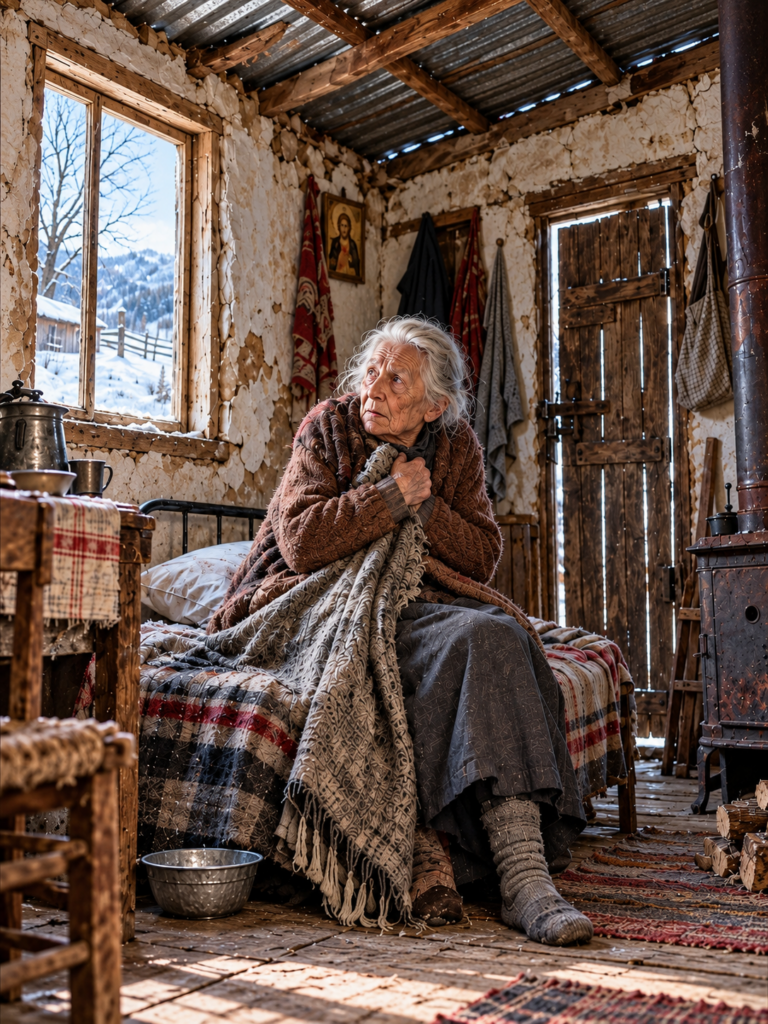
“It’s so cold in here.”
The old woman stood just inside the doorway of the room she had called home for decades and pulled her sweater tighter around herself.
Cold air found its way through the gaps around the wooden door. It moved along the floor, climbed the walls, and settled into the small rooms no matter how hard the stove worked.
Outside, winter had turned the courtyard into mud.
Inside, water had begun finding its way through the failing roof.
Some days it appeared as a dark patch overhead.
Other days it collected enough to drip.
The woman was 90 years old.
Once, she might have climbed onto a stool, moved something heavy, carried timber, patched a crack, or found a neighbor willing to help for an afternoon. Time had changed what her body could manage, but the house had continued aging with her.
Now even ordinary maintenance could become an impossible task.
She looked toward the ceiling.
“Not again.”
The words disappeared into the quiet room.
“I can’t keep doing this alone.”
Her home was small.
Modest.
Old enough that every surface carried evidence of previous repairs.
Nothing about it belonged in a glossy magazine.
The plaster had cracked and loosened in places. The windows no longer sealed properly. The roof had reached the point where another patch would only delay a problem that needed more serious attention.
Yet this was still her home.
It held the routines by which she understood her days.
The bed near the window.
The table where she ate.
The stove that warmed the room.
The kitchen where familiar cups and bowls had their usual places.
The bathroom she crossed carefully.
The door she had opened to visitors for years.
When people talk about an old house needing repair, they often begin with the building.
The roof.
The masonry.
The plumbing.
The windows.
But for the person living inside, a house is rarely just a building.
It is the location of ordinary life.
To leave it can mean losing far more than a damaged wall.
That was why the knock at her door mattered.
At first, she was not sure she had heard it.
Then it came again.
A voice followed from outside.
“Hello?”
She turned.
“Is anyone home?”
Another voice.
“We’re local volunteers. May we help?”
The woman moved toward the door carefully.
The courtyard beyond it was wet and uneven.
The entrance itself had become difficult.
She opened the door.
2 people stood outside.
They had come not to inspect her life from a distance, but to ask whether they could help repair the place where she intended to keep living it.
“Please,” she said.
“Come in.”
They stepped into the cold room.
The problems did not require much explanation.
Cold air could be felt immediately around the old door.
Damage around the walls was visible.
The condition of the roof was impossible to ignore.
Outside, the mud showed how difficult even the approach to the house had become.
The volunteers looked around.
Then one of them said what the woman had needed to hear.
“We’ll repair your roof and fix this door.”
The second volunteer looked toward her.
“You won’t face winter alone.”
For a moment, she said nothing.
Then:
“Thank you.”
Her voice changed.
“I thought no one cared.”
The answer came quietly.
“You’re not alone anymore.”
That promise was not about transforming the house into something unrecognizable.
The goal was not to erase the years.
It was not to replace the cottage with a fashionable interior that might look impressive but feel foreign to the person who lived there.
The work began with a simpler question.
How could this familiar house be made warmer, safer, cleaner, and easier for a 90-year-old woman to live in without stripping away the countryside character she knew?
That question shaped every decision afterward.
The first task was not decorative.
It was preparation.
Before repairs could begin, the team needed space to work safely.
Furniture was moved.
Laundry was collected and set aside.
Tools already in the house were gathered.
Firewood was relocated.
Useful belongings were not treated as rubbish simply because they stood in the way of construction.
Everything that could be saved was moved into storage.
That mattered.
Renovation can become destructive when speed is valued more than memory.
An old chair may look worthless to a stranger.
A curtain may seem replaceable.
A bench may appear too worn.
But the people doing the work understood that the goal was not to empty the woman’s life from the building.
It was to protect what still served her while repairing what no longer did.
Once the rooms and exterior working areas were cleared, the structure could be examined more honestly.
Loose plaster came first.
Sections that no longer adhered properly were removed.
The process exposed the masonry beneath.
There, the condition varied.
Some areas remained sound.
Others showed weakness.
Joints had deteriorated.
Edges had broken away.
Previous repairs had aged.
The team did not remove everything simply because some of it was damaged.
Sound sections remained.
Only the failing areas were opened up enough to be repaired.
Weak joints were renewed.
Broken masonry edges were restored.
The cottage’s original openings stayed where they had always been.
The door remained a door.
The windows remained in their familiar positions.
There was no need to redesign the house into a different shape.
Its form still worked.
Its materials simply needed help.
But the greatest concern was above them.
The roof had protected the cottage for years.
Now it was failing.
Removing the old roofing had to be done carefully.
The sheets came away in sections rather than all at once.
That allowed the team to inspect the timber below as they proceeded.
A roof can look worn from the outside while hiding very different conditions underneath.
Some supporting members may still be sound.
Others may have weakened where moisture entered.
The only responsible approach was to uncover the structure gradually and look.
As sections opened, temporary supports were installed where vulnerable areas needed to remain stable.
The old roof was no longer being trusted to carry loads simply because it had survived until yesterday.
Damaged timber members were removed.
Replacements were fitted.
Connections were checked.
The work was methodical because what would later be invisible was more important than what would later photograph well.
A new roof installed over bad support is only a new surface above an old failure.
The team did not want that.
The chimney also required attention.
It stood through the roof as one of the places where weather could easily find a path inside if repairs were careless.
Before new roofing closed around it, the chimney was repaired.
Loose and deteriorated areas were addressed.
Its connection with the future roof was prepared carefully.
These details would soon disappear under finished materials.
That was precisely why they mattered.
Once a roof is closed, nobody standing in the courtyard sees whether the timber underneath was properly supported.
Nobody sees whether the junction beside the chimney was treated carefully.
Nobody sees the fixings beneath the corrugated sheets.
But those invisible decisions determine whether the woman wakes dry during the next storm.
They determine whether cold moisture returns.
They determine whether one winter of relief becomes many.
Supporting panels were installed.
Then waterproof underlay.
Layer by layer, protection returned above the rooms.
The underlay formed a secondary weather barrier beneath the final roofing.
It was not the surface anyone would admire later.
It was simply there to do its job.
New corrugated roofing sheets followed.
Each section was aligned and secured.
The ridge was completed.
Edge details were formed.
Drainage components were added so water would be directed away instead of being allowed to find random paths down walls and into foundations.
From the courtyard, the change was immediate.
The cottage no longer looked as though its roof was surrendering to the season.
It looked closed again.
Protected.
Complete enough to face rain.
Yet the team did not stop at the visible roofline.
Before exterior walls received their final finish, electrical routes had to be planned.
It made no sense to repair and coat a wall only to cut into it later.
Cables and necessary routes were prepared while surfaces remained open.
That sequence saved damage and created cleaner work.
Only after the hidden systems were dealt with could the walls be closed.
Fresh render covered the repaired exterior masonry.
The uneven patches disappeared behind a new continuous surface.
The cottage began to look coherent again.
But the team waited.
Render needed time to cure.
Finishing too quickly would defeat the purpose of doing the work correctly.
Once the surface was ready, warm cream color went onto the facade.
The choice changed the atmosphere immediately.
The cottage did not become bright in an artificial way.
The cream simply reflected the limited winter light more gently than the tired, damaged exterior had before.
Gray details around the windows gave definition.
The restored stone base grounded the house visually and retained some of the old material character.
It still looked like a countryside cottage.
Only now it looked cared for.
New timber windows were fitted into the original openings.
That decision balanced improvement with familiarity.
The woman did not need a completely different facade.
She needed windows that closed correctly.
Windows that reduced drafts.
Windows that brought daylight inside without making every cold day an argument with the weather.
The new frames provided that while keeping the warmth of timber visible.
The front door received the same attention.
The old door had visible gaps.
Cold entered around it.
The entrance, which should have separated shelter from winter, had become one of winter’s easiest routes inside.
A carefully fitted wooden door restored that boundary.
It opened where the old one had opened.
It belonged to the same familiar entrance.
But when closed, it finally did what a door was supposed to do.
The porch came next.
The landing and steps had worn over time.
For a younger resident, that might have been inconvenient.
For a 90-year-old woman, a damaged entrance could become a daily hazard.
A small uneven surface becomes more serious when balance is not what it once was.
The porch landing was repaired.
The worn steps were restored.
The entrance became not only neater, but easier to approach.
Then the team turned toward the courtyard.
The ground was muddy.
Water and foot traffic had created a surface that could become difficult even in ordinary weather.
In winter, it was worse.
Mud tracked toward the house.
Shoes slipped.
Every journey between gate and door demanded unnecessary attention.
Paving stones would solve the visible problem.
But laying stones directly onto bad ground would only make the improvement temporary.
So the team began underneath.
Muddy material was removed.
Drainage was considered so water would not simply collect below the new surface.
Aggregate was placed.
Then compacted.
This stage took time.
It was also the stage future visitors would never notice.
They would see neat paving.
They would not see what carried it.
But just like the roof, the visible finish only worked because the foundation beneath it had been treated properly.
Once the base was stable, the paving stones were laid.
The courtyard changed from a difficult patch of wet ground into a defined approach to the house.
A person could now walk toward the door without stepping through mud.
That alone changed how the home met the outside world.
With the heavy work nearing completion, familiar things began returning.
Firewood went back into its shelter.
Plants returned.
Curtains appeared behind the new windows.
A bench gave the entrance a place to pause.
Warm exterior lights softened the facade as daylight disappeared.
The house had not been removed from its winter landscape.
The countryside was still cold.
The trees were still bare.
The air still carried the sharpness of the season.
The cottage still belonged to that place.
It simply no longer looked abandoned to it.
The volunteers stood in the courtyard and looked at what had changed.
Roof.
Walls.
Windows.
Door.
Steps.
Paving.
Drainage.
Lighting.
The exterior had been stabilized and made welcoming again.
But the woman did not live on the facade.
Her real daily life happened inside.
That was where the work became more personal.
Part 2
The question inside the cottage was different from the one outside.
Outside, the team could ask what a building needed.
Protection from water.
Stable roof structure.
Reliable drainage.
Weather-tight openings.
Safe access.
Inside, they had to ask what this particular woman needed.
At 90, comfort was not abstract.
It was the distance between the bed and the table.
The ease of reaching the door.
The safety of the bathroom.
The height of a chair.
The warmth near the stove.
The ability to prepare food without fighting damaged cabinets and uneven flooring.
The house had small rooms.
That limited how much could be added.
It also clarified the purpose of the work.
Every piece had to earn its place.
The team did not want to crowd the cottage with furniture that looked generous but made movement harder.
They wanted useful objects.
Clear paths.
Familiar materials.
Enough storage.
Enough warmth.
Enough light.
The countryside character remained important because the woman had not asked for a new identity.
She had asked, in the only way that mattered, for help continuing the life she already had.
The main room carried the greatest number of functions.
It was where she slept.
Sat.
Ate.
Kept warm.
Spent long winter hours.
Before renovation, the room told the story of years of wear.
Damaged plaster surrounded the bed.
Some areas were cracked.
Others were discolored.
The wooden door had gaps large enough for cold air to pass through.
The old window had deteriorated.
Overhead, the ceiling exposed the underside of the failing roof.
What should have felt enclosed did not.
The room leaked weather visually even when no water was falling.
Furniture had been used for a long time.
Bedding showed wear.
Nothing in the room suggested neglect in the sense of carelessness.
It suggested limitation.
Things remained because replacing them was difficult.
Repairs waited because the woman could no longer perform them herself.
The first transformation came from repairing the surfaces.
A room does not have to become luxurious to feel dramatically different.
It needs to become whole.
The ceiling received a timber finish beneath the retained structural beams.
That choice preserved the visual presence of wood while creating a cleaner, enclosed surface overhead.
The beams remained part of the room.
They were not hidden simply because modern construction could have concealed them.
Their presence connected the renovated interior to the cottage’s age.
Below, the walls were repaired and finished in a light tone.
The effect was immediate.
Winter daylight from the window moved farther across the room.
Shadows softened.
The small space felt less compressed.
The floor was renewed in wood.
That brought warmth visually and physically.
Together, the timber ceiling, visible beams, clean walls, and wooden floor created a quiet background.
Not empty.
Not sterile.
A background for the woman’s own life.
The bed remained under the window.
That position was familiar.
It also made sense.
Daylight reached the bed.
The woman could look outside without having to cross the room.
Fresh white bedding replaced the worn linens.
The change was simple but powerful.
White made the bed look clean and inviting.
Then came a red plaid blanket.
Its color brought the room back toward countryside warmth.
Nothing about it felt like a hotel.
The pattern was familiar enough to belong in a cottage.
Its red tones connected to the woven rug and surrounding timber.
The room still felt lived-in.
That was the goal.
Comfort without removing character.
The dining table and chairs remained close to the sleeping area.
In a larger house, separating functions into different rooms might seem desirable.
Here, separation would have been impractical.
The woman needed to move comfortably between activities without crossing unnecessary distance.
She could rise from bed.
Sit at the table.
Eat.
Rest.
Reach the door.
All within a compact space.
Furniture placement therefore mattered more than the amount of furniture.
The team left enough room around the bed.
Enough room near the chairs.
Enough passage toward the door.
Nothing forced her to squeeze sideways between objects.
That kind of detail rarely receives attention in photographs.
For an elderly resident, it can define whether a room feels easy or exhausting.
On the opposite side of the room, the wood stove became the natural focus.
The stove represented more than appearance.
It was warmth.
Winter survival.
The center of the room on the coldest days.
Firewood was kept nearby so she would not need to carry it farther than necessary.
The fire gave the room a glow the new wall color reflected softly.
But heating with a stove also required care.
The team paid attention to the flue.
The area around the stove needed appropriate clearance and protection.
Warmth only improves a home when it is delivered safely.
The finished room did not look transformed into a different social class or lifestyle.
It looked like the same woman’s room after someone had finally repaired what had been making it hard to live there.
The bed was still modest.
The table was still simple.
The stove was still a wood stove.
But the room was dry, clean, light, warm, and organized around the person using it.
That made the change feel larger than decoration.
From there, attention moved toward the kitchen.
Before renovation, the kitchen’s problems were visible immediately.
Cabinet doors were damaged.
Some no longer aligned properly.
Work surfaces were worn.
The window had broken glazing.
Dark staining around the cooking area suggested years of smoke, moisture, heat, and use.
The floor was uneven.
That final problem mattered especially.
A kitchen requires constant small movements.
Turning.
Carrying hot objects.
Reaching.
Stepping between sink, counter, table, and stove.
An uneven floor introduces risk into every one of those movements.
The renovated kitchen did not abandon its basic layout.
The L-shaped arrangement remained.
That was intentional.
The woman already understood the room.
She knew where the sink belonged.
Where cooking happened.
Where the table sat.
A renovation for an older resident does not automatically improve life by moving everything.
Sometimes familiarity is its own form of accessibility.
The improvement came from making the existing arrangement work properly.
Wooden cabinets created enclosed storage.
Their finish continued the warm material language found in the other room.
Pale countertops brightened the work surfaces.
They reflected daylight.
They also made the preparation areas visually easier to understand.
The farmhouse sink remained beneath the window.
It was a natural position.
Daylight fell where washing and food preparation happened.
The woman could stand at the sink and look outside.
That small visual connection to the yard mattered in a house where winter might keep her indoors for long periods.
The window itself was renewed.
No broken glass.
No cold gaps.
Light without weather.
Around the counters, ordinary kitchen items returned.
Cutting boards.
Wooden spoons.
Ceramic containers.
Cookware.
These objects did not exist to decorate a photograph.
They gave the room purpose.
An unused kitchen can look perfect.
A useful kitchen contains evidence of use.
Open shelves held selected household items.
Not too many.
A small room can become visually and physically crowded quickly.
The shelves provided access without overwhelming the walls.
The cooking stove remained on the right.
The dining table stayed nearby.
That created a short, practical route between preparation, cooking, and eating.
Bowls and cups were set out.
Not ceremonially.
Simply ready.
The entire kitchen communicated the thing the volunteers wanted most.
This room was prepared for tomorrow morning.
And the morning after that.
For soup.
Tea.
Bread.
Washing dishes.
Sitting down to eat.
For ordinary life.
The renovation was not meant to create one impressive reveal and then become inconvenient.
It had to survive repetition.
The woman might make the same breakfast many days in a row.
She might place the same cup beside the same bowl.
She might sit in the same chair.
That was success.
The kitchen did not need to entertain strangers.
It needed to serve her.
The bathroom presented a different challenge.
Before work began, it carried some of the most troubling signs of age in the house.
Tiles were cracked.
Fixtures were stained.
Glazing had deteriorated.
Damp had marked surfaces.
A bathroom combines water and movement, which makes neglect more serious.
For a 90-year-old woman, the room could not be approached only as a cleaning project.
It needed to support the way her body moved now.
The renovation therefore focused on simplicity and practical safety.
Beige tiles covered the floor and lower portions of the walls.
The color kept the space calm.
Light enough to prevent the small room from feeling closed.
Warm enough to avoid the harshness of an institutional bathroom.
The renewed sink, toilet, and shower were arranged clearly.
Nothing elaborate.
Everything understandable at a glance.
That matters when a room is used several times every day.
Then came the additions that might be overlooked by anyone more interested in decoration.
Grab bars.
One beside the toilet.
Others around the shower area.
They were not ornamental.
They were installed because stability matters.
A young person may enter a shower, turn, bend, and step out without thinking.
At 90, the same sequence can require deliberate balance.
Water makes surfaces less forgiving.
A grab bar can turn a dangerous movement into a controlled one.
The shower seat mattered for the same reason.
Standing for the entire duration of washing should not be a requirement for basic hygiene.
The seat gave the woman the option to sit.
That one detail acknowledged the reality of her body without reducing her independence.
She could care for herself with less risk and less exhaustion.
The shower curtain kept the arrangement straightforward.
No heavy visual structure.
No complicated enclosure.
The wooden-framed mirror and window maintained continuity with the other rooms.
Above, exposed ceiling beams remained visible.
Again, the cottage did not become a collection of disconnected renovated spaces.
Materials spoke to one another.
Wood.
Warm neutral color.
Simple fittings.
Useful objects.
Familiar forms.
Across the 3 main spaces, the same principle repeated.
Repair what had failed.
Preserve what still mattered.
Add support where age had created new needs.
Do not mistake novelty for improvement.
The volunteers stepped back repeatedly during the work.
Not to admire.
To check.
Could she walk from bed to table comfortably?
Could she reach what she needed in the kitchen?
Was the stove area safe?
Could she use the bathroom with more confidence?
Did the house still feel like hers?
These were better questions than whether the rooms looked expensive.
They also required restraint.
Every renovation contains the temptation to add.
Another cabinet.
Another decorative object.
Another piece of furniture.
Another modern feature.
In this cottage, sometimes the better decision was subtraction.
Space itself was useful.
A clear path beside the bed.
Open floor in front of the sink.
Enough turning room in the bathroom.
An uncluttered approach to the door.
At 90, space could function like another piece of equipment.
It allowed movement.
It reduced risk.
It made daily routines less tiring.
As the interiors came together, the transformation began to feel less like construction and more like return.
The woman’s belongings came back selectively.
Curtains softened the windows.
Textiles returned warmth to the rooms.
Furniture was placed where it served her rather than where it simply filled space.
The house slowly stopped being a work site.
It became a home again.
Only better prepared for the winter outside.
Part 3
Winter had never left.
Throughout the renovation, cold remained beyond the walls.
The courtyard dried only as weather allowed.
The landscape stayed muted.
Bare branches framed the cottage.
Air moved sharply through the countryside.
That continuity mattered because the story of the house was never about defeating winter.
No renovation can change the season.
It can only change what the season means inside.
Before the work, winter entered almost everywhere.
Through the door.
Through failing windows.
Through the roof.
Across damaged surfaces.
Through mud that made reaching the entrance difficult.
Even ordinary cold became a burden because the house was no longer able to separate the woman from it.
Afterward, winter remained visible through the new timber windows.
But now it was outside.
That was the difference.
The roof closed properly over the rooms.
Water was directed away.
The repaired chimney rose through a carefully finished roof junction.
The walls were rendered.
The cream facade reflected pale winter light.
Gray window surrounds gave shape to the openings.
The stone base remained visible.
The door fitted.
The porch landing was sound.
The steps no longer announced years of wear with every approach.
The courtyard paving created a dry route to the entrance.
Under those stones, compacted aggregate and drainage work remained unseen.
Above, supporting panels and waterproof underlay remained hidden beneath corrugated roofing.
Inside walls, electrical routes disappeared.
Much of the most important work was no longer visible.
That was as it should be.
Good renovation often hides its own difficulty.
A visitor arrives later and sees a cottage that feels simple.
They do not see temporary roof supports.
They do not see damaged timber being removed.
They do not see loose plaster on the ground.
They do not see muddy material dug out of the courtyard.
They do not see volunteers moving furniture into storage.
They see the result.
A house standing quietly.
That quiet is earned.
Firewood returned to its shelter outside.
For an elderly woman dependent on a stove, firewood is not decoration.
It is winter preparation.
The shelter kept it organized and accessible.
Plants returned near the house.
Their presence softened the repaired facade.
Curtains appeared behind the windows.
A bench stood near the entrance.
Warm lights came on as daylight faded.
The same countryside cottage that had looked vulnerable now looked inhabited again.
Welcoming.
Not luxurious.
Cared for.
Inside, the final details became more intimate.
Fresh bedding waited beneath the window.
The white fabric brightened the sleeping area.
The red plaid blanket lay across the bed.
The woven rug helped connect that color to the room.
Timber above.
Timber below.
Light walls between.
The dining table stood nearby.
Nothing blocked the path.
A chair could be pulled out without requiring the bed to be moved.
The door could be reached without turning sideways.
The woman could live in the room instead of navigating it.
The wood stove glowed.
Firewood waited close by.
The room had a center again.
For years, the stove had probably been one of the most important objects in the cottage.
The renovation did not replace that with a decorative fireplace simply because it might look newer.
The existing way of living remained visible.
Only now the environment around it supported comfort rather than fighting it.
The kitchen told the same story.
Its L-shaped arrangement remained recognizable.
Wooden cabinet doors closed properly.
Pale worktops offered clear preparation space.
The farmhouse sink beneath the window looked toward the winter outside.
Cutting boards waited.
Wooden spoons stood ready.
Ceramic containers held small household necessities.
Open shelves displayed only enough to remain useful.
The cooking stove on the right was part of the daily sequence.
Table nearby.
Bowls.
Cups.
A place to sit.
A room prepared not for a special event but for an ordinary meal.
That was perhaps the most meaningful result.
The woman did not need a ceremonial home that looked wonderful for a single day.
She needed a home where making breakfast tomorrow was easier than it had been yesterday.
In the bathroom, the transformation was even quieter.
Beige tile.
Clean fixtures.
A working shower.
Mirror.
Window.
Exposed beams above.
But beside the toilet was a grab bar.
Around the shower, more support.
Inside it, a seat.
Those additions carried the clearest statement of the entire project.
The house had been repaired for a specific human being.
Not for an imaginary buyer.
Not for social media.
Not for a young family.
For a 90-year-old woman.
Someone whose routines mattered.
Someone whose body deserved consideration.
Someone who should not have to choose between remaining in the home she loved and living safely.
That was why keeping the cottage familiar mattered so much.
The easiest solution from the outside might have been to say she should move somewhere newer.
Somewhere designed for older residents.
Somewhere maintenance belonged to someone else.
But leaving a long-term home carries its own costs.
Familiar objects disappear from context.
Distances change.
Neighbors change.
Sounds change.
Morning light enters from a different direction.
A person must learn another kitchen.
Another bathroom.
Another route from bed to door.
For some people, that move is right.
For this woman, the volunteers were trying to see whether another answer could work.
Repair the place she already knew.
Support her there.
Give the old house enough strength to continue protecting the person who had protected it for years.
That approach required respect for both age and independence.
Age meant acknowledging what had become difficult.
Independence meant not using those difficulties as an excuse to take decisions away from her.
A grab bar did not say she was helpless.
It said she should have something solid to hold.
A shower seat did not say she could no longer bathe herself.
It gave her a safer way to do it.
A repaired courtyard did not say she should stop going outside.
It made going outside easier.
A better door did not lock the world away.
It kept winter out when she wanted it out.
The house became a collection of such decisions.
Small in isolation.
Powerful together.
The volunteers remembered how the project had begun.
Cold air.
A leaking roof.
Mud.
A woman saying she could not keep doing this alone.
That sentence had contained more than frustration.
It contained the exhaustion of being responsible for problems beyond one’s physical capacity.
A damaged house creates work.
For someone younger, that work may be inconvenient.
For someone 90 years old and alone, it can become a constant reminder of everything she can no longer repair.
The roof is leaking.
The door needs fixing.
The step is worn.
The window is broken.
The courtyard is muddy.
Each problem waits.
Each problem asks for money, strength, tools, transportation, or help.
When no help comes, the problems begin to feel like verdicts.
Perhaps that was why her earlier words had been so simple.
“I thought no one cared.”
The volunteers could not change every part of being 90.
They could not make winter warm.
They could not reverse time.
They could not guarantee that the woman would never need help again.
What they could do was prove that her needs were visible.
The roof mattered because she slept beneath it.
The door mattered because she crossed it.
The courtyard mattered because she walked through it.
The kitchen mattered because she fed herself there.
The bathroom mattered because dignity often depends on being able to care for your own body safely.
The bed mattered because rest matters.
The table mattered because meals matter.
The warm light outside mattered because a home should look like someone is expected to return.
That understanding changed how the finished cottage felt.
From the road, it might look like an attractive renovation.
Cream walls.
Gray trim.
Timber windows.
A neat roof.
Stone base.
Paved courtyard.
Plants.
Bench.
Warm lights.
But appearance was only the outer layer.
The deeper transformation lived in ordinary actions.
Opening the front door and not feeling cold air rush around its edges.
Walking across the courtyard without stepping into mud.
Hearing rain strike the roof without looking up for a drip.
Sitting beside the stove in a room where warmth could finally stay.
Moving from bed to table without dodging unnecessary furniture.
Preparing food on a usable counter.
Washing dishes beneath a sound window.
Taking a shower while sitting when standing became tiring.
Reaching for a grab bar without embarrassment.
Sleeping beneath a finished ceiling.
Waking in a room that still looked like home.
Those are not dramatic moments.
They are the substance of independence.
On the final day, the volunteers returned items to their places.
Not exactly where everything had been before.
Some things belonged somewhere safer now.
Some had been cleaned.
Others had been replaced because they were too damaged to serve.
But the rooms began to recognize themselves.
The woman recognized them too.
Her belongings existed inside renewed spaces.
The renovation did not erase her history.
It framed it more gently.
She could see familiar household objects against clean walls.
Old habits had room inside new repairs.
That balance is difficult.
Renovation often celebrates contrast.
Before and after.
Broken and perfect.
Dark and bright.
Old and new.
But human life does not divide so easily.
The woman herself was not a before condition waiting to become new.
She was 90.
Her age was not damage.
Her routines were not flaws.
The aim was never to make her life look younger.
It was to support the life she had.
The cottage followed the same principle.
The retained beams remained because age could be beautiful when structurally sound.
Timber remained visible.
Country textures remained.
The red plaid blanket did not pretend the room was a city apartment.
The farmhouse sink did not disappear.
The wood stove remained central.
The house was repaired without being forced to deny where it came from.
Outside, evening settled over the winter landscape.
The new lights glowed beside the entrance.
Through the window, the bed was visible beneath fresh bedding.
The table stood ready.
The stove cast warmth.
The kitchen held bowls and cups.
The bathroom waited clean and practical.
Everything seemed quiet.
The kind of quiet that, at the beginning, had felt like isolation.
Now it felt different.
The woman stood inside the doorway.
Months or years of deterioration could not be forgotten simply because the work had ended.
She knew what the house had been like.
She remembered cold near the door.
Water above.
Mud outside.
She knew what it meant to look at a repair and understand she could not do it herself.
That knowledge remained.
But so did another memory now.
A knock.
“Hello?”
“Is anyone home?”
“We’re local volunteers.”
“May we help?”
The beginning had been that simple.
No announcement.
No promise of luxury.
Just people standing outside asking permission to care.
She had answered:
“Please, come in.”
Everything followed from there.
The team repaired the roof.
They fixed the door.
Stabilized structure.
Repaired masonry.
Protected the chimney.
Installed underlay.
Fitted corrugated sheets.
Completed the ridge, edges, and drainage.
Prepared electrical routes.
Rendered the walls.
Finished them in warm cream.
Defined the windows in gray.
Restored the stone base.
Installed timber windows.
Fitted the wooden door.
Repaired the porch.
Improved the steps.
Removed mud.
Prepared drainage.
Compacted aggregate.
Laid paving.
Returned firewood.
Plants.
Curtains.
A bench.
Warm lights.
Then inside, they repaired the room where she slept.
Finished the ceiling in timber beneath retained beams.
Renewed the walls.
Renewed the floor.
Prepared the bed.
Placed the table.
Kept space clear.
Made the stove area useful and safe.
They renewed the kitchen while keeping its familiar arrangement.
Cabinets.
Counters.
Sink beneath the window.
Cooking area.
Shelves.
Everyday tools.
A table ready for ordinary meals.
They repaired the bathroom.
Tiles.
Fixtures.
Shower.
Grab bars.
Seat.
Simple features designed around the actual woman who would use them.
None of those tasks alone explains the transformation.
Together, they say something larger.
She mattered.
Not abstractly.
Not as a symbol of old age.
As a person.
Her particular bed mattered.
Her route to the bathroom mattered.
Her firewood mattered.
Her ability to cook mattered.
The draft around her door mattered.
The mud outside her entrance mattered.
Her wish to remain in her own home mattered.
That was why the finished cottage felt warm even before the stove was lit.
Care had become physical.
It existed in timber, mortar, tile, underlay, paint, paving, glass, handles, rails, bedding, and light.
The volunteers had not solved loneliness with construction.
No roof can do that.
But they had answered one lonely sentence with action.
“I thought no one cared.”
Now the house itself carried the reply.
The roof said someone cared whether she stayed dry.
The new door said someone cared whether she stayed warm.
The paved courtyard said someone cared whether she could reach her own entrance safely.
The bathroom said someone cared whether she could continue caring for herself.
The kitchen said someone expected her to keep preparing meals.
The bed said someone expected her to rest comfortably.
The light beside the door said someone expected her home.
Outside, winter continued.
Cold air moved across the countryside.
Rain would return.
Snow might come.
Mud would form beyond the paved courtyard.
The season had not changed.
The woman had not become younger.
But inside the cottage, the balance between her and winter had changed.
A bed was ready.
A table was set.
The stove could warm the room.
The roof held.
The door closed properly.
The bathroom offered support.
The kitchen waited for tomorrow’s meal.
A 90-year-old woman who had looked around her damaged house and said she could not keep doing it alone no longer had to.
The transformation began with 2 volunteers knocking on her door.
It ended with a home that remained hers.
Familiar.
Modest.
Warm.
And cared for.
Not because someone decided she needed a different life.
Because someone finally saw the life she already had and decided it was worth protecting.


