
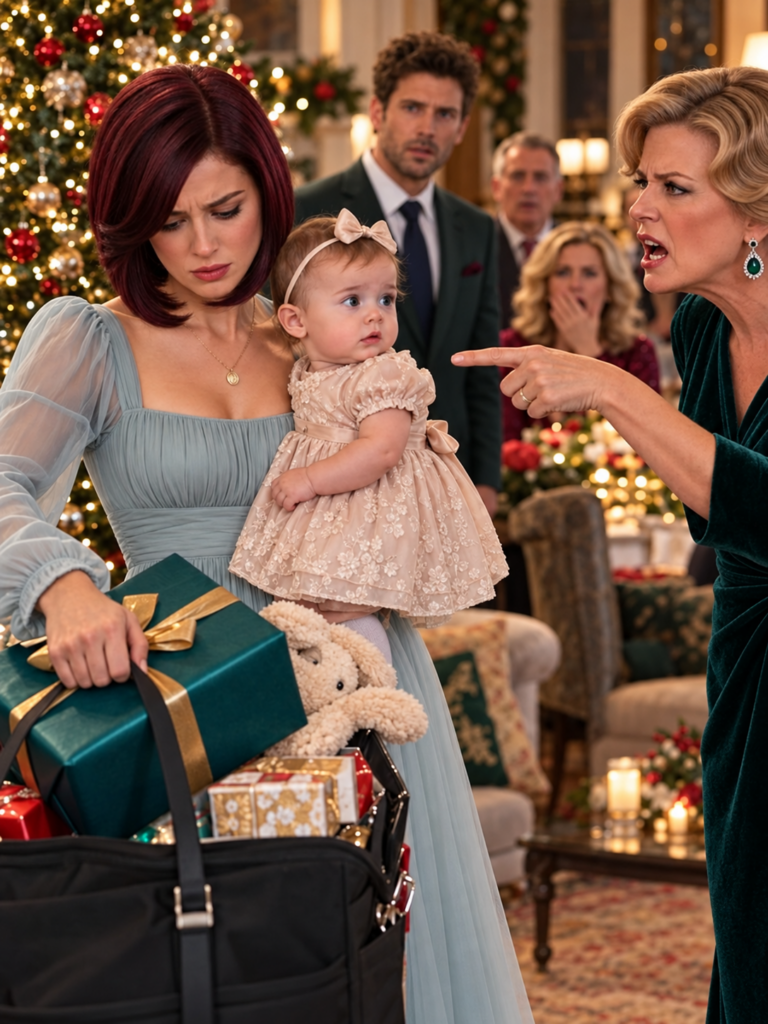
Part 1
For several seconds after I spoke, nobody moved.
The dining room was filled with the kind of silence that makes you notice things you would normally ignore.
The refrigerator humming in the kitchen.
The grandfather clock ticking near the hallway.
The faint rustle of wrapping paper beneath my shoes.
My mother, Diane Whitaker, stood at the head of the table with a serving spoon still in her hand.
She had been smiling less than a minute earlier.
Now her mouth hung slightly open.
“Rebecca,” she said, “put those presents down.”
I didn’t answer.
I bent beside the Christmas tree and found another package addressed to my daughter.
To Emma, Love Grandma and Grandpa.
The handwriting was unmistakably hers.
Perfectly slanted letters.
A little gold star beside Emma’s name.
My mother could make anything look beautiful from the outside.
That had always been one of her greatest talents.
“Rebecca, you’re embarrassing yourself.”
There it was.
Not an apology.
Not concern for the baby.
Concern about how I looked.
My husband, Daniel, stood near the doorway holding Emma against his chest.
Our daughter had begun fussing, her tiny fingers gripping the collar of his Christmas sweater.
Daniel rubbed her back.
“We’re leaving, Diane,” he said.
My mother looked at him sharply.
“This is between me and my daughter.”
“Not when you’re talking about mine.”
I had never heard Daniel speak to her in that tone.
Neither had she.
My older brother, Steven, finally pushed back his chair.
“Come on, Becca. Mom didn’t mean it the way it sounded.”
I straightened.
“Then tell me how it was supposed to sound.”
He opened his mouth.
Nothing came out.
I looked at the people around the table.
My father sat motionless.
My aunt Patricia was staring at her napkin.
Steven’s wife, Melissa, had one hand over her mouth.
And my mother stood beneath the crystal chandelier, looking offended that anyone had challenged her.
Only minutes earlier, she had examined Emma in front of everyone and said she looked like a child who hadn’t been properly nourished.
Then she had suggested my pregnancy complications might have been avoided if I had listened to her advice.
My daughter had been born seven weeks early.
She had spent twenty-six days in neonatal intensive care.
There were nights when I slept in a chair beside her incubator because going home felt impossible.
There were mornings when I stood in the hospital shower and cried so hard I had to sit on the floor.
And there had been one terrible afternoon when a monitor alarm sounded and three nurses rushed toward my daughter before anyone could explain what was happening.
My mother knew all of that.
She knew because I had called her from the hospital.
She knew because she had visited.
She knew because she had stood beside me while I stared at my daughter through the clear plastic wall of an incubator.
Yet here she was, telling a room full of relatives that perhaps I hadn’t been careful enough.
“She’s healthy,” I said.
My voice sounded strange.
Quiet.
Almost unfamiliar.
“Emma is healthy. Her doctors are pleased with her progress. She doesn’t need to be bigger to deserve your kindness.”
Mother folded her arms.
“Good heavens. I never said she didn’t deserve kindness.”
“You said she looked underfed.”
“I said she looked small.”
“You said I should have been more responsible during my pregnancy.”
“I was expressing concern.”
“No. You were assigning blame.”
My father finally spoke.
“Rebecca, perhaps we could all calm down.”
I turned toward him.
“Dad, did you hear what she said?”
He looked uncomfortable.
“Your mother’s worried about the baby.”
That was when something inside me settled.
Not broke.
Settled.
Like a door finally closing after years of swinging back and forth.
I understood that nobody at that table was going to rescue me from this conversation.
They had watched my mother do versions of this my entire life.
They had watched her criticize my appearance, my grades, my career, my marriage, and now my child.
They had learned to survive by looking away.
I had learned to survive by pretending it didn’t hurt.
But Emma was beginning to cry.
And I suddenly couldn’t imagine teaching her the same lesson.
I turned to Daniel.
“Let’s go.”
He nodded immediately.
I collected the diaper bag from the hallway closet.
My mother followed me.
“Rebecca, don’t be ridiculous. Dinner hasn’t even been served.”
I slipped Emma’s winter hat over her soft brown hair.
Mother stepped closer.
“You’re going to ruin Christmas over one comment?”
I looked directly at her.
“No. You ruined Christmas when you decided my daughter was something you could criticize for an audience.”
Her expression hardened.
“You have become terribly sensitive since having that baby.”
I reached for my coat.
“And you have become far too comfortable hurting people and calling it honesty.”
For a moment, I thought she might slap me.
She didn’t.
Instead, she glanced back toward the dining room.
Everyone was listening.
Her cheeks flushed.
“Fine,” she said. “Take your things and go. But don’t expect me to come crawling after you.”
I lifted the gift bags.
“I don’t.”
Daniel opened the front door.
Cold Pennsylvania air swept across the hallway.
Behind me, my mother called my name one final time.
This time, I didn’t turn around.
We drove through streets decorated with colored lights and inflatable snowmen.
Emma cried for the first five minutes.
Then she fell asleep.
I watched her in the little mirror attached to the back seat.
Her eyelashes rested against her cheeks.
Her mouth was slightly open.
She looked so peaceful that I almost started crying again.
Daniel glanced at me.
“You okay?”
“No.”
He nodded.
“That’s fair.”
I pressed my hands together in my lap.
“Did I overreact?”
“No.”
“Because everyone looked at me like I was crazy.”
“Everyone looked surprised.”
“Steven thinks I’m dramatic.”
“Steven thinks avoiding conflict is the same as solving it.”
I gave a small, humorless laugh.
Daniel reached across the console and took my hand.
“Rebecca, your mother blamed you for Emma being born early. In front of your family. On Christmas Day.”
“I know.”
“Then stop putting yourself on trial for leaving.”
I looked away before he could see my eyes filling.
It was easier for him to say.
Daniel had grown up in a family where disagreements were occasionally loud but rarely cruel.
His mother could be stubborn.
His father forgot birthdays.
His sisters argued about everything from recipes to football.
But apologies happened.
People admitted when they were wrong.
Nobody collected someone’s vulnerabilities and saved them for a future argument.
I had grown up believing every family worked like mine.
You stayed pleasant.
You didn’t contradict your mother.
You never made private problems public.
And if someone hurt you, you forgave them quickly enough that nobody else became uncomfortable.
It wasn’t until I married Daniel that I realized how exhausting those rules were.
When we reached home, he brought the presents inside while I carried Emma upstairs.
I changed her into soft cotton pajamas.
Her left foot kicked happily when I removed the tights beneath her Christmas dress.
“You’re glad to be home, aren’t you?” I whispered.
She smiled.
I sat in the rocking chair with her against my chest.
For several minutes, I simply held her.
I remembered the first night I had been allowed to hold her in the hospital.
A nurse named Angela had carefully moved wires and adjusted the tubing before placing Emma against my skin.
I had been terrified of hurting her.
Angela had smiled.
“She knows you,” she’d said. “Listen to how she’s settling.”
And Emma had settled.
Her tiny breathing had become regular.
Her fingers had curled against me.
That memory still lived in my body.
So did the fear.
I looked down at her now.
“You never have to earn being loved,” I whispered.
Then I began to cry.
Not because of what my mother had said.
At least, not entirely.
I cried because it had taken becoming someone’s mother to understand how much I had accepted from my own.
My phone started ringing at seven that evening.
Mother.
I ignored it.
At seven-fifteen, she called again.
At seven-thirty, a message arrived.
I hope you’re pleased with yourself. Your father barely touched his dinner.
Then another.
Everyone was very upset.
And another.
I suppose we’re not allowed to worry about our granddaughter anymore.
I placed the phone facedown.
At eight, Steven called.
I almost didn’t answer.
Then I remembered how he had looked at the table.
Not angry.
Uneasy.
As though he wanted the problem to disappear without requiring anyone to do anything.
“Hey,” I said.
“Hey, Becca.”
He cleared his throat.
“Listen, I know today was rough.”
“That’s one way to describe it.”
“Mom’s really upset.”
“I imagine she is.”
“She keeps saying you misunderstood her.”
I waited.
“And Dad thinks maybe everyone could just apologize and move forward.”
“Everyone?”
“Well, you know what I mean.”
“No, Steven. I don’t.”
He sighed.
“Can we not do this?”
“Do what?”
“Turn Christmas into some huge family crisis.”
I looked toward the staircase.
Emma was asleep.
Daniel was cleaning the kitchen.
Our house was quiet.
For the first time all day, nobody was criticizing anything.
“Steven, when you were fourteen, Mom told your baseball coach you weren’t playing because you were lazy.”
He was silent.
“You had a fractured wrist. You remember that?”
“That was years ago.”
“And when you got divorced from Allison, she told people you couldn’t keep a wife because you were too passive.”
“Rebecca.”
“She does this to everyone. She says the cruelest thing she can think of, and afterward we all pretend she meant well.”
He exhaled sharply.
“She had a difficult childhood.”
“So did we.”
That stopped him.
I hadn’t intended to say it.
But once the words came out, I couldn’t take them back.
“Look,” I continued, “I’m not asking you to choose sides. I’m asking you to stop pretending nothing happened.”
Steven didn’t answer immediately.
Then he said something I would remember for months.
“You know how she gets when she’s scared.”
I frowned.
“Scared of what?”
Another silence.
“Forget it.”
“Steven.”
“I just mean she worries. That’s all.”
He changed the subject.
I let him.
But after we hung up, his words stayed with me.
My mother had been frightened when Emma was born.
I knew that.
Yet fear didn’t explain why she seemed determined to make me feel guilty.
And I couldn’t shake the uncomfortable suspicion that there was something my family wasn’t telling me.
The next morning, Daniel found me sitting at the kitchen table with a notebook.
“What are you writing?”
“Things I remember.”
He sat across from me.
I had filled almost three pages.
Not just Christmas.
My eighth birthday, when Mother told everyone I was becoming too chubby for my party dress.
The school concert where she corrected my singing afterward instead of congratulating me.
The day I graduated college and she asked why I hadn’t received academic honors.
The morning of my wedding, when she suggested I lose five pounds before the photographs.
Daniel read silently.
He looked up.
“You never told me half of this.”
“I didn’t think it was worth mentioning.”
“Why?”
I stared at my notebook.
“Because she always said I was remembering things wrong.”
He closed it gently.
“Maybe you should talk to somebody who isn’t part of your family.”
“A therapist?”
“Maybe.”
I almost made a joke.
Then I remembered how frightened I had felt while holding Emma after Christmas dinner.
Not frightened of my mother exactly.
Frightened that I might someday hear her voice coming out of my own mouth.
“I think I should,” I said.
That afternoon, I wrote my mother a message.
I told her I would not discuss Christmas until she could acknowledge what she had said without blaming my reaction.
I explained that Emma’s body, development, and medical history were not appropriate subjects for public commentary.
And I said we would be taking some time away from family visits.
I read it three times.
Then sent it.
Her response arrived immediately.
So I’m being punished for loving my granddaughter.
I put the phone away.
Ten minutes later, another message appeared.
You really should consider how much stress you’re putting on everyone.
I didn’t answer.
For once, silence belonged to me.
Three days later, Melissa came to our house.
She arrived carrying a casserole in a foil pan.
Steven’s wife had never been particularly close to me.
She was kind, practical, and usually careful about getting involved in Whitaker family arguments.
But she looked unusually nervous as I invited her inside.
“I hope this isn’t strange,” she said.
“Showing up with food? Never.”
She smiled weakly.
We sat at the kitchen table.
She admired Emma, who was sitting in her high chair banging a plastic spoon against the tray.
Then Melissa looked at me.
“Rebecca, I need to tell you something.”
My stomach tightened.
“What?”
She rubbed her thumb over the handle of her coffee mug.
“Your mother has been talking about Emma’s birth for months.”
I frowned.
“Talking how?”
Melissa hesitated.
“She told several people you weren’t following your doctor’s instructions during your pregnancy.”
For a moment, I couldn’t understand the sentence.
“What?”
“She said you kept working too much. That you weren’t taking things seriously. That she warned you something bad could happen.”
I stared at her.
Emma dropped her spoon.
Neither of us moved to retrieve it.
“Who did she tell?”
Melissa looked miserable.
“Your aunt. Some cousins. Steven heard it more than once. I think she mentioned it at church too.”
I felt something cold move through me.
Not sadness.
Not yet.
Disbelief.
“She knew that wasn’t true.”
Melissa nodded slowly.
“I thought so.”
“I was on modified activity for the last two weeks. Daniel drove me to every appointment. My obstetrician said the complications weren’t caused by anything I did.”
“I know.”
“My mother came to one of those appointments.”
Melissa looked down.
“Rebecca, I’m sorry.”
I pressed my hand over my mouth.
Suddenly Christmas made terrible sense.
The uncomfortable faces.
The people looking away.
My father’s silence.
Steven’s awkward attempts to smooth things over.
They hadn’t just heard my mother’s accusation for the first time.
They had been hearing it for months.
Christmas was simply the first time she had said it openly in front of me.
And I had walked into that house believing everyone was celebrating my daughter’s first holiday.
Instead, some of them had arrived already carrying a story in which I was responsible for the most frightening experience of my life.
Melissa reached across the table.
“I should’ve told you sooner.”
I looked at her.
“Why didn’t you?”
“Because every time Diane said something, Steven told me not to get involved. He said you were still sensitive about the birth.”
Her eyes filled.
“And I convinced myself telling you would only hurt you.”
I looked at Emma.
She had found another toy.
She was chewing its rubber corner and smiling.
A child who knew nothing about the people discussing her as though she were evidence of her mother’s failure.
I swallowed.
“Thank you for telling me now.”
Melissa nodded.
“There’s something else.”
She took out her phone.
“Your mother sent a message to our family group this morning.”
I had left that group after Christmas.
Melissa turned the screen toward me.
The message was long.
My mother wrote that she was heartbroken by my behavior.
That I had become emotionally unstable after Emma’s birth.
That she feared Daniel was encouraging me to isolate myself from family.
And that she hoped everyone would pray for us rather than encourage my anger.
Near the bottom was a sentence that made my hands tremble.
I have always tried to protect Rebecca from the consequences of her own decisions.
I read it twice.
Then a third time.
My mother wasn’t apologizing.
She was building a defense.
And she was doing it with the very people I had spent my life trying not to disappoint.
For the first time, I understood that our Christmas argument was no longer just about one cruel remark.
My mother had created a version of my life that other people believed.
And if I wanted my daughter to grow up differently, I would have to stop letting that version stand.
Part 2
I didn’t call my mother that afternoon.
I wanted to.
I wanted to demand to know how she could sit beside me in the hospital, hold my hand while I cried, and then tell relatives that I had caused my own daughter’s suffering.
But Daniel stopped me from making the call.
Not because he wanted me to stay quiet.
Because he had watched me pace the kitchen for nearly an hour, rehearsing arguments against someone who could turn almost any conversation into evidence that she was the victim.
“Before you call her,” he said, “decide what you actually want from the conversation.”
I stared at him.
“I want her to admit she’s lying.”
“Okay.”
“And I want her to stop.”
“Okay.”
“And I want everyone to know she lied.”
He nodded.
“Those are three different things.”
I hated that he was right.
He pulled out a chair.
“Let’s figure out which parts are under your control.”
That night, we wrote another list.
Not memories this time.
Boundaries.
We wouldn’t discuss Emma’s health with relatives who treated it as gossip.
We wouldn’t accept surprise visits.
We wouldn’t respond to messages that insulted or blamed us.
And until my mother took responsibility for her behavior, she would not have unsupervised access to our daughter.
Daniel looked at the final sentence.
“Are you comfortable with that?”
I studied it.
My mother had never actually babysat Emma.
Not once.
During the first months after the hospital, I had been too anxious to leave her.
Later, I had simply found excuses.
I suddenly understood why.
Even before Christmas, I hadn’t trusted my mother to be gentle with my daughter when I wasn’t there.
“Yes,” I said.
“I am.”
New Year’s Eve brought freezing rain.
The trees along our street looked dipped in glass.
We had planned a quiet evening at home.
Daniel was making soup.
Emma was crawling across the living room rug in pursuit of a stuffed rabbit.
At four-thirty, someone knocked.
Through the front window, I saw my mother’s car.
She stood on our porch carrying a bakery box and a red gift bag.
My stomach tightened.
Daniel came up behind me.
“You don’t have to answer.”
I looked through the glass again.
My mother was wearing the cream wool coat she reserved for special occasions.
Her silver hair was perfectly styled.
Even standing alone in the cold, she looked as though she expected to be received.
I opened the door but left the storm door closed.
“Mom.”
She smiled carefully.
“Happy New Year’s Eve.”
“What are you doing here?”
“I brought something for Emma.”
She lifted the gift bag.
“And your favorite lemon cake.”
I didn’t reach for either.
“We asked for some space.”
Her smile faltered.
“Rebecca, surely you don’t intend to carry this into another year.”
“I intended to spend tonight with my husband and daughter.”
She glanced past me.
“Is Daniel there?”
“Yes.”
“Could I speak to him?”
“Why?”
“Because perhaps he’ll be more reasonable.”
I felt my jaw tighten.
“Mom, this isn’t Daniel’s decision. It’s mine.”
She sighed.
“I suppose you’ve decided I’m some kind of monster.”
“No.”
“Then let me see my granddaughter.”
“Not today.”
Her expression changed.
Not dramatically.
Just a slight narrowing of her eyes.
“I raised you.”
“I know.”
“I sacrificed a great deal for you.”
“I know.”
“And this is how you treat me?”
I opened the storm door just enough to step onto the porch.
The cold made my eyes water.
“Mom, I know you raised me. But that doesn’t mean you get to hurt me indefinitely.”
She looked away.
“I’ve already said I was sorry.”
“You said you were sorry I got upset.”
“What’s the difference?”
I stared at her.
It was such a simple question.
And somehow it explained thirty-five years.
“The difference is that one takes responsibility for what you did. The other makes my reaction the problem.”
She was quiet.
Then I asked the question I’d been carrying since Melissa’s visit.
“Why have you been telling people I caused Emma’s premature birth?”
My mother’s face went still.
“What?”
“Melissa told me.”
Her eyes hardened.
“Melissa should mind her own business.”
“Did you say it?”
“I said you were under a great deal of stress.”
“Did you tell people I ignored medical advice?”
She shifted the bakery box.
“I don’t remember my exact words.”
“Mom.”
“Rebecca, people were asking questions. I had to say something.”
“You could have said Emma came early and the doctors took good care of us.”
She pressed her lips together.
“Things are rarely that simple.”
“They were that simple.”
She looked at me for a long time.
Then she said quietly, “You don’t understand how frightening that experience was for me.”
I almost laughed.
Not because it was funny.
Because my mind couldn’t make room for the audacity of it.
“For you?”
“Yes, for me. I thought I might lose my granddaughter.”
“I thought I might lose my daughter.”
Her eyes filled with tears.
“And I couldn’t do anything about it.”
For one brief moment, her expression changed.
There was something beneath the anger.
Fear.
Raw and old.
But before I could respond, she straightened.
“I suppose you’ve forgotten that I was there for you.”
“No,” I said. “I haven’t forgotten.”
“Then perhaps you could show a little gratitude.”
I stepped back toward the door.
“Not by pretending you didn’t hurt me.”
“Rebecca—”
“We’re done talking today.”
I went inside.
Through the glass, I watched her stand on the porch for another minute.
Then she carried the cake and the gift bag back to her car.
When I turned around, Daniel was holding Emma.
He hadn’t interrupted.
He hadn’t needed to.
“How are you?” he asked.
I watched my mother’s taillights disappear.
“Sad.”
He nodded.
“But not confused.”
In January, I began seeing a therapist named Dr. Helen Morris.
Her office was on the second floor of a small medical building near the library.
There was a blue armchair beside the window and a box of tissues that I stubbornly ignored during our first appointment.
I told her about Christmas.
Then about my childhood.
Then about my mother’s visit on New Year’s Eve.
Dr. Morris listened without interrupting.
Eventually she asked, “What happens inside you when your mother is displeased?”
I considered the question.
“I feel like I need to fix it.”
“Even when you’ve done nothing wrong?”
“Especially then.”
She nodded.
“And what would happen if you didn’t?”
I gave a weak laugh.
“Apparently she would tell everyone I was unstable.”
Dr. Morris smiled gently.
“That may be what she does. But I’m asking what you’re afraid it means about you.”
I looked at the floor.
The answer came slowly.
“That I’m a bad daughter.”
There it was.
The sentence I had been running from since Christmas.
I could be a good wife.
A good teacher.
A good friend.
A good mother.
And still feel like a failure because one woman thought I hadn’t behaved correctly.
Dr. Morris asked me to think about whose approval I was using to measure my worth.
I wanted to say I already knew.
But knowing something intellectually and believing it emotionally were different things.
Over the next several weeks, I began noticing things I had never questioned before.
How often I apologized when someone else was rude.
How uncomfortable I became when people disagreed with me.
How I explained ordinary decisions as though I needed permission.
And how quickly I searched for my own mistake whenever someone treated me badly.
The work was exhausting.
But slowly, I began to see my mother’s criticism for what it was.
Not guidance.
Not wisdom.
Not even honesty.
It was a habit of controlling uncertainty by assigning fault.
And I had spent my entire life volunteering to carry that fault.
In late January, my father asked to meet me for breakfast.
He called on a Thursday evening.
“I’d like to see you,” he said.
“Is Mom coming?”
“No. Just us.”
We met at a diner near the highway.
My father, Walter, had worked as an electrician for forty years.
He was a quiet man who could repair almost anything but rarely knew what to do with emotional problems.
When I was little, he fixed broken bicycle chains, loose cabinet doors, and malfunctioning Christmas lights.
But when my mother made me cry, he usually told me to be patient.
I loved him.
I also resented him.
Both feelings sat beside me in the booth that morning.
He ordered coffee and eggs.
I ordered toast I barely touched.
For several minutes, we talked about ordinary things.
His neighbor’s new truck.
The weather.
Emma’s latest attempts to stand.
Then he set down his cup.
“Your mother isn’t doing well.”
I braced myself.
“Dad, I don’t want another lecture about how I upset her.”
“I’m not here to lecture you.”
He looked tired.
Older than I remembered.
“She cries most evenings.”
“I’m sorry she’s hurting.”
He nodded.
“But I need you to understand something. I didn’t make this happen.”
“I know.”
“She did.”
He lowered his eyes.
I waited.
Finally, he said, “I should’ve spoken up on Christmas.”
The admission startled me.
He rubbed his forehead.
“I heard what she said. I saw your face. And I did what I’ve always done.”
“Nothing.”
“Yes.”
The word was barely audible.
He looked out the window.
“I kept thinking if everyone stayed calm, things would pass.”
“They always passed for you, Dad. I was the one she kept criticizing.”
He swallowed.
“I know.”
I had waited years to hear those words.
And now that they were here, I didn’t know what to do with them.
He reached into his coat pocket and removed a folded envelope.
“I found something when I was looking for our old insurance papers.”
He slid it across the table.
Inside was a faded photograph.
A young woman stood outside a brick hospital holding a bundled infant.
She looked exhausted.
But unmistakably happy.
It was my mother.
I recognized her eyes immediately.
She couldn’t have been more than twenty-three.
I turned the photograph over.
Written in blue ink were the words:
Diane and Matthew. October 1984.
I stared at it.
“Who’s Matthew?”
My father closed his eyes briefly.
“Your brother.”
I looked up.
“My what?”
He took a breath.
“Your mother had a baby before Steven was born.”
The diner seemed to become very quiet.
“Why have I never heard this?”
“Because he died.”
I looked at the photograph again.
The baby was wrapped in a pale blue blanket.
Only part of his face showed.
“He was born too early,” Dad continued. “Twenty-nine weeks. Back then, they couldn’t do as much as they can now.”
My throat tightened.
“How long did he live?”
“Eleven days.”
I stared down at the picture.
Eleven days.
My mother’s first child had lived eleven days.
And nobody had ever told me he existed.
Dad’s voice became rough.
“She was devastated.”
“Of course she was.”
“Her mother wasn’t very kind about it.”
I looked at him.
“What did Grandma say?”
He hesitated.
Then reached into the envelope and handed me a second piece of paper.
It was a photocopy of a letter.
The handwriting was unfamiliar.
The paper had yellowed with age.
I read the first paragraph.
My grandmother had written that my mother should not dwell on what happened.
That some women were simply not strong enough to carry healthy babies.
And that next time, perhaps she would take better care of herself.
My hands went cold.
Those words.
The accusation.
The cruelty disguised as instruction.
They were almost exactly what my mother had said to me on Christmas.
I looked up at my father.
“She heard this after her baby died?”
He nodded.
“Her mother blamed her. And Diane believed it for years.”
I looked back at the letter.
Suddenly I understood why my mother had become so frightened when Emma was born.
Why she obsessed over weight.
Why she counted ounces.
Why she kept asking whether I had followed every medical instruction.
But understanding wasn’t the same as forgiving.
I folded the letter carefully.
“Dad, this is awful.”
“I know.”
“But why didn’t she tell me?”
“She couldn’t talk about Matthew. Not without falling apart.”
“And why didn’t you?”
He looked ashamed.
“I thought I was respecting her wishes.”
I slid the photograph back across the table.
“She lost a baby and nobody helped her grieve.”
“That’s right.”
I stared at him.
“And instead of admitting how scared she was when Emma arrived, she decided I must have done something wrong.”
He said nothing.
I looked at the letter again.
It felt like discovering an old crack beneath the foundation of a house.
The damage had been there long before I was born.
But I was still the one living inside it.
For two days, I said very little.
Daniel found the photograph on our kitchen counter.
He examined it.
“She looks like you.”
“I know.”
He sat beside me.
“How are you feeling?”
“Like I don’t know who my mother is.”
I told him everything my father had said.
About Matthew.
The hospital.
The letter.
The eleven days.
Daniel listened.
Then he asked, “Does knowing this change what you need from her?”
I thought carefully.
“No.”
He nodded.
“But it changes how you see her.”
“Yes.”
I rested my forehead in my hands.
“I feel terrible for her.”
“That’s understandable.”
“And I feel angry that she put the same thing on me.”
“That’s understandable too.”
I looked at him.
“What kind of person knows how devastating those words are and says them to her own daughter?”
Daniel didn’t answer immediately.
Then he said, “Someone who never learned what to do with the pain.”
That night, I took the photograph upstairs.
I sat beside Emma’s crib and studied the young woman holding her baby.
For the first time, I saw my mother as someone who had once been frightened and helpless.
Someone who had asked for comfort and received blame.
Someone who might have spent decades trying to make the world safe by criticizing everything she couldn’t control.
I cried for Matthew.
I cried for the young mother who had lost him.
And I cried for myself.
Because whatever had happened before I was born, I had still been a little girl who deserved gentleness.
In February, I wrote my mother a letter.
Not a text message.
Not an angry email.
A real letter, on paper, because there were things I needed to say without interruption.
I told her I knew about Matthew.
I told her how sorry I was.
I explained that I understood why Emma’s premature birth might have awakened terrible memories.
But I also told her that those memories did not give her permission to blame me.
I wrote about Christmas.
About the stories she had spread.
About how frightened I had been in the hospital.
And I told her the deepest wound wasn’t that she had criticized me.
It was that she knew exactly what my fear looked like and had used it against me.
I ended the letter with a simple request.
If she wanted to rebuild our relationship, she needed to stop defending herself and begin telling the truth.
She needed to acknowledge what she had said.
Correct the false story she had told relatives.
And find help for the grief she had been carrying.
I mailed it on a Tuesday.
She didn’t respond.
Wednesday passed.
Then Thursday.
On Friday, my father called.
“Your mother got your letter.”
I sat down.
“Okay.”
“She knows I told you about Matthew.”
“Is she angry?”
“Very.”
I closed my eyes.
“She says I betrayed her trust,” he continued.
“I’m sorry you’re caught in the middle.”
“Rebecca, I put myself in the middle years ago.”
That surprised me.
He sighed.
“I spent so long trying not to upset her that I stopped asking whether my silence was hurting anyone else.”
I pressed the phone against my ear.
“Have you told her that?”
“Yes.”
“What did she say?”
He gave a tired laugh.
“She didn’t like it.”
I smiled sadly.
“No. I imagine not.”
Then his voice changed.
“Your mother called the church office this morning.”
I frowned.
“Why?”
“She’s arranged a family dinner for Sunday. She wants everyone there.”
My stomach dropped.
“Everyone?”
“Your aunt. Steven and Melissa. The cousins.”
“Why?”
He was quiet.
Finally, he said, “She wants to explain what happened at Christmas.”
I stared at the wall.
My mother had spent weeks telling people I was unstable.
Now she wanted an audience.
Again.
For a moment, I felt fourteen years old.
Standing in the kitchen while she listed my mistakes.
Hoping that if I kept my voice calm, she might eventually stop.
Then I looked toward the living room.
Emma was sitting beside Daniel, laughing as he stacked colorful blocks for her to knock down.
My fear didn’t disappear.
But it no longer made the decision for me.
“Dad,” I said, “tell her I’ll come.”
There was a pause.
“Are you sure?”
“Yes.”
“But Emma won’t.”
I looked at my daughter.
“She’s not attending another family gathering where people discuss her like she’s a problem.”
My father agreed.
And as I hung up, I understood that Sunday might cost me whatever remained of my relationship with my mother.
But I was finished letting her tell my story for me.
Part 3
Sunday afternoon arrived with heavy gray clouds and the threat of snow.
Daniel’s mother came to our house to watch Emma.
Before we left, she hugged me tightly.
“You don’t have to prove anything to anybody,” she said.
I nodded.
“I know.”
But part of me still felt as though I was preparing for an examination I had spent my whole life failing.
Daniel drove.
I held a small folder on my lap.
Inside were copies of medical notes from my pregnancy, a written statement from my obstetrician explaining that my complications were not caused by neglect, and screenshots of the family messages my mother had sent.
I had no intention of putting my private medical history on display unless it became necessary.
But I wanted the facts with me.
Not because I needed strangers to certify I was a good mother.
Because I was no longer willing to let another person’s accusations go unanswered.
When we reached my parents’ house, the driveway looked much as it had on Christmas.
Steven’s SUV.
Patricia’s sedan.
My father’s pickup.
The same row of white lights still hung along the porch.
My mother opened the door.
She looked tired.
Her makeup was lighter than usual.
“Rebecca,” she said.
“Mom.”
Her eyes moved to Daniel.
Then past us.
“Where’s Emma?”
“With Daniel’s mother.”
A flicker of disappointment crossed her face.
But she didn’t argue.
That alone felt unfamiliar.
Inside, everyone was gathered around the dining table.
There was coffee.
A plate of cookies.
A casserole dish that nobody seemed interested in touching.
My aunt hugged me.
Steven gave me an awkward smile.
Melissa squeezed my hand when nobody was looking.
My father pulled out a chair.
Daniel sat beside me.
Mother remained standing.
“I asked everyone here,” she began, “because Christmas was very painful for our family.”
My stomach tightened.
She clasped her hands.
“I think there have been a lot of misunderstandings.”
I felt Daniel’s knee gently touch mine beneath the table.
Mother continued.
“I made some remarks that Rebecca took very personally.”
There it was.
The familiar turn.
The suggestion that the problem was my interpretation.
I raised my hand slightly.
“Mom.”
She stopped.
“I came here because Dad said you wanted to explain what happened. If this is going to be another discussion about how sensitive I am, we can leave now.”
Steven shifted in his chair.
My aunt looked down.
Mother’s face reddened.
“I haven’t finished.”
“Then please finish without blaming me for being hurt.”
The room became still.
My mother looked at me for a long moment.
Then she glanced toward my father.
He didn’t rescue her.
He simply waited.
Something changed in her expression.
She sat down.
And for the first time I could remember, she began again.
“At Christmas,” she said slowly, “I criticized Emma’s size.”
I watched her carefully.
“I suggested that Rebecca might have caused the early birth by not taking proper care of herself.”
Her voice trembled.
“That was wrong.”
Nobody moved.
She swallowed.
“And it wasn’t true.”
My eyes burned.
Mother looked at the relatives seated around the table.
“I also told several of you that Rebecca ignored medical advice. I had no evidence of that. I knew her doctors were pleased with the care she received.”
My aunt Patricia lifted her head.
“Diane, you told me Rebecca kept working against medical advice.”
“I know.”
“You said she was too stubborn to listen.”
Mother nodded.
“I did.”
“Why?”
My mother stared at her hands.
For several seconds, she couldn’t speak.
Then she said, “Because I was scared.”
I felt myself stiffen.
She raised her eyes.
“That’s not an excuse. I know it isn’t.”
She looked at me.
“When Emma was born, I saw her in that incubator and I couldn’t stop thinking about Matthew.”
My aunt’s hand flew to her mouth.
Steven looked confused.
“Who’s Matthew?”
My father turned toward him.
“Your older brother.”
The silence that followed was different from the silence at Christmas.
This wasn’t people pretending not to hear.
This was people hearing something they had never been allowed to know.
My mother began to cry.
She told us about the hospital.
About holding her baby for the first time.
About how his hand had wrapped around one of her fingers.
About the eleven days she and my father spent hoping he would survive.
And about the moment a doctor told them there was nothing more that could be done.
Her voice broke.
“I never got over it.”
My father reached for her hand.
She looked toward him, then continued.
“My mother told me I hadn’t been careful enough. I spent years believing there was something I could have done.”
I watched her face.
For once, she wasn’t trying to look composed.
She looked like a woman telling the truth at great personal cost.
“When Rebecca had Emma,” she said, “I was terrified. I couldn’t stand the thought that something terrible could happen again for no reason.”
She paused.
“So I started looking for one.”
My throat tightened.
Mother looked directly at me.
“I made your pregnancy into a lesson about being careful because I couldn’t accept that sometimes people do everything right and still suffer.”
I wiped my cheek.
“And when Emma got better, you kept blaming me anyway.”
“Yes.”
“Why?”
She lowered her eyes.
“Because admitting you hadn’t done anything wrong meant admitting Matthew might not have been my fault either.”
Nobody spoke.
It was the first time my mother had said his name without whispering it.
I thought about that young woman in the photograph.
Standing outside a hospital with a baby she would soon lose.
I thought about my grandmother’s letter.
And I thought about my own daughter, alive and thriving, whose tiny body had become a place for generations of fear to settle.
I took a breath.
“Mom, I am sorry about Matthew.”
She nodded, crying.
“I truly am.”
“I know.”
“But I cannot spend the rest of my life carrying guilt to make your grief feel understandable.”
She covered her mouth.
“I know.”
“And Emma will not carry it either.”
My mother nodded again.
This time, she didn’t argue.
After that, the conversation became harder.
Not louder.
Harder.
Because there were no more vague apologies.
No more pretending everything could be fixed with a hug.
My aunt admitted she had believed the story my mother told her.
Steven confessed that he had heard it repeatedly and never challenged it.
Melissa apologized again for staying silent.
And my father told the family that he had watched my mother turn fear into criticism for years.
He said he loved her.
But he could no longer pretend that loving her required everyone else to absorb her pain.
Mother listened.
Sometimes she cried.
Once, she tried to explain herself and stopped halfway through.
“You’re right,” she said instead.
I had never heard those words from her so often.
Eventually, she turned toward me.
“What can I do?”
I had expected the question.
I had also spent weeks learning that I didn’t need to answer it in a way that made her comfortable.
“First, I need you to understand that an apology doesn’t mean everything goes back to normal.”
She nodded.
“Second, I need you to stop discussing Emma’s health with other people.”
“Of course.”
“And my parenting. And our private family decisions.”
“Yes.”
I took a breath.
“If you criticize her body, compare her to other children, or suggest she’s somehow less than she should be, the visit ends.”
Mother nodded again.
“And if you tell people things about me that aren’t true, I won’t quietly correct them behind closed doors while you continue spreading them publicly.”
“I understand.”
I looked at the folder in front of me.
Then pushed it aside.
“I brought medical records because I thought I’d have to prove myself.”
My voice shook.
“But I shouldn’t need to.”
Mother looked at the folder.
Then at me.
“No,” she whispered. “You shouldn’t.”
I left the folder closed.
That mattered more than I expected.
For months, I had imagined standing before the family with papers in my hands, proving that I had followed every instruction.
But sitting there, I realized something.
I could have done everything differently during my pregnancy and still deserved kindness.
I could have made a mistake and still deserved dignity.
My mother’s cruelty was not justified by whether I had been a perfect patient.
The truth mattered.
But so did the fact that I was a person, not a problem to be corrected.
When the gathering ended, my mother asked whether we could talk alone.
Daniel looked at me.
I nodded.
He went to help my father clear the dishes.
Mother and I moved into the small sitting room beside the front hallway.
It was the room where she kept family photographs.
School portraits.
Graduation pictures.
Wedding photographs.
Steven holding his children.
Me standing beside Daniel in my wedding dress.
But now there was another picture on the mantel.
The photograph of my mother holding Matthew.
Someone had placed it in a simple wooden frame.
I stopped.
“Mom.”
She followed my eyes.
“Your father brought it out yesterday.”
I stepped closer.
“You put it here?”
She nodded.
“I thought maybe it was time.”
I looked at the young woman in the picture.
“He’s beautiful.”
Mother began crying again.
“He was.”
For a while, we stood quietly.
Then she said, “I called a counselor.”
I turned toward her.
“What?”
“Your father helped me find someone who works with grief.”
I said nothing.
“I had my first appointment on Friday.”
Something tightened in my chest.
Not pain this time.
Relief, perhaps.
But cautious.
Careful.
She looked embarrassed.
“I spent most of the appointment crying.”
“That’s okay.”
“I told her about Matthew.”
I nodded.
“And I told her about you.”
My eyes filled.
She stepped closer but didn’t touch me.
“Rebecca, I don’t expect you to trust me because I said the right things today.”
I swallowed.
“Good.”
She smiled sadly.
“I suppose I earned that.”
“Mom, I don’t want to punish you.”
“I know.”
“I want to stop being afraid of you.”
The words came out before I could soften them.
Her expression collapsed.
For a moment, I regretted saying them.
Then I remembered the little girl standing in front of a mirror while her mother inspected her appearance.
The teenager hiding a report card because she knew the first question would be about the one grade that wasn’t perfect.
The new mother sitting beside an incubator, already blaming herself for something the doctors said she hadn’t caused.
I looked at my mother.
“I’m not afraid you’re going to hit me or throw me out. I’m afraid that every happy thing I bring you will become another thing you find wrong with me.”
She put a hand over her heart.
“Oh, Rebecca.”
“That’s how I’ve felt for years.”
She cried silently.
Then she did something she’d almost never done.
She let the truth remain in the room.
She didn’t defend herself.
She didn’t tell me I was exaggerating.
She didn’t ask me to comfort her.
Finally, she said, “I’m sorry I made being my daughter feel that way.”
It was the apology I had wanted for most of my life.
And it hurt to hear it.
Because I believed she meant it.
But believing her sincerity didn’t mean I knew what would happen next.
Before we left, she asked if I would bring Emma for a visit soon.
I considered it.
“Maybe in a few weeks.”
Mother nodded.
“I’ll wait.”
And she did.
Our first visit happened in March.
Not at my parents’ house.
Not in a room full of relatives.
At a small park beside the public library.
It was a chilly Saturday morning.
Emma wore a yellow jacket and tiny knitted mittens.
My mother arrived early with two cups of coffee.
She stood beside a bench when she saw us approaching.
For a moment, her eyes fixed on Emma.
Then she looked at me.
“May I say hello?”
I nodded.
She crouched near the stroller.
“Hello, sweetheart.”
Emma stared at her solemnly.
Then smiled.
My mother smiled back.
No remarks about her size.
No commentary about her cheeks.
No advice about feeding.
Just a grandmother greeting her granddaughter.
We walked slowly around the pond.
Mother asked about my work.
She listened when I answered.
She asked Daniel how his new project was going.
And when Emma reached for a fallen leaf, Mother waited while I decided whether to let her touch it.
Such small things.
Things other families might never notice.
But I noticed every one.
At the end of the visit, Mother said, “Thank you for coming.”
I looked at her.
“It was nice.”
Her face brightened.
Then she hesitated.
“Would you like to come for lunch next week?”
I felt the familiar pressure to say yes.
To reward good behavior.
To make everything comfortable again.
But I wasn’t ready.
“Let’s do another park visit first.”
Mother nodded.
“All right.”
No sigh.
No accusation.
No wounded speech about how much she had sacrificed.
Just acceptance.
On the drive home, Daniel squeezed my hand.
“How did it feel?”
I thought for a moment.
“Strange.”
“Good strange or bad strange?”
“Hopeful strange.”
He laughed softly.
“I’ll take that.”
Change did not happen in a straight line.
I wish it had.
I wish I could say my mother apologized once, started counseling, and never made another hurtful remark.
But that wasn’t how decades of habits disappeared.
In April, she came to our house for coffee.
Emma was sitting on the floor playing with nesting cups.
Mother watched her for a while.
Then said, “Shouldn’t she be standing more by now?”
My whole body tightened.
For one moment, I was back at Christmas.
But Mother stopped herself.
She closed her eyes.
“I’m sorry.”
I waited.
“That sounded like criticism.”
“Yes.”
She nodded.
“May I try again?”
I folded my hands.
“Okay.”
She looked at Emma.
“I’m curious about what she’s learning. Tell me what she’s enjoying lately.”
I exhaled.
And for the first time, I could feel the difference between someone pretending to change and someone practicing it.
I told her about Emma’s fascination with wooden blocks.
About how she loved music.
About how she clapped whenever Daniel sneezed.
Mother laughed.
And the moment passed without anyone being wounded.
Later, as she put on her coat, she said, “I never realized how often I ask questions that sound like accusations.”
I gave a small smile.
“I did.”
She looked ashamed.
“I know.”
Then she hugged me.
Not because the problem was magically solved.
Because she had acknowledged it.
By May, my mother had been attending counseling for nearly four months.
She had also begun talking openly with my father about Matthew.
They visited the cemetery together for the first time in years.
They found the little box containing his hospital bracelet and the cards relatives had sent after his birth.
My father told me that for decades, my mother had avoided photographs of newborn babies in hospitals.
She couldn’t bear the sight of incubators.
When Emma was born, she had walked into the neonatal unit and felt as though she were twenty-three again.
I understood that.
What mattered was that she was finally learning how to talk about it.
One afternoon, she called me.
“Rebecca, can I tell you something about your brother?”
“Of course.”
She was quiet.
Then she said, “He had the longest fingers.”
I smiled.
“Really?”
“Yes. The nurses all commented on them.”
She laughed through tears.
“And he hated having his feet touched.”
We talked for nearly half an hour.
It was the first conversation I could remember having with my mother in which she spoke about something painful without turning it into a lesson.
She didn’t tell me what I should have done.
She didn’t compare our experiences.
She simply told me about the baby she had loved.
And I listened.
After we hung up, I looked at Emma sleeping in her crib.
I thought of Matthew.
I thought of the years my mother had spent believing she failed him.
And I wished someone had told her long ago what I was finally learning myself.
Sometimes terrible things happen without anyone deserving blame.
Sometimes love cannot prevent suffering.
And sometimes the strongest thing a parent can do is refuse to pass old pain to the next generation.
Summer brought more visits.
Short afternoons became family lunches.
Lunches became evenings on our patio.
My mother learned to ask before offering advice.
She stopped posting photographs of Emma without permission.
She stopped comparing her to Steven’s children.
And when other relatives made comments about her appearance, Mother began speaking up.
At a Fourth of July barbecue, my aunt Patricia watched Emma toddle across the grass and remarked that she still looked awfully small for her age.
Before I could answer, Mother said, “She’s growing exactly as her doctor expects. Isn’t she wonderful to watch?”
Patricia blinked.
Then smiled.
“She certainly is.”
I looked across the table at my mother.
She met my eyes.
Neither of us said anything.
But I knew what the moment meant.
She wasn’t simply avoiding criticism herself.
She was refusing to let the old family pattern continue around her granddaughter.
That mattered.
Not because it erased Christmas.
But because it proved she remembered what happened.
And wanted to behave differently.
On Emma’s first birthday, we held a small party in our backyard.
There were paper butterflies hanging from the fence.
A strawberry cake.
A bubble machine Daniel had purchased against my better judgment.
Emma spent most of the afternoon trying to catch the bubbles.
My mother sat on the grass beside her in linen pants that quickly became stained green.
At one point, Emma grabbed a handful of frosting and smeared it across Mother’s cheek.
Everyone laughed.
Mother laughed hardest.
“Oh, you little rascal,” she said.
Emma squealed.
Then pressed another frosting-covered hand against her grandmother’s nose.
I stood near the patio door watching them.
Daniel came beside me.
“Something on your mind?”
I smiled.
“Last Christmas, I couldn’t imagine this.”
He looked toward the lawn.
Mother was wiping frosting from her face while Emma laughed.
“Neither could I.”
I rested my head against his shoulder.
“I’m still scared sometimes.”
“Of what?”
“That everything will go back to how it was.”
He nodded.
“Maybe some days will be harder than others.”
“I know.”
“But you’re different now too.”
I looked at him.
He smiled.
“You know you can leave.”
I laughed softly.
It was such a simple statement.
And such an enormous one.
I knew I could leave.
I knew I could say no.
I knew disagreement didn’t make me cruel.
I knew love didn’t require me to hand someone unrestricted access to my peace.
That knowledge had changed the shape of my life.
By autumn, Emma was walking confidently and attempting words.
She called Daniel “Da.”
She called our dog “Buh.”
And she called my mother “Nana.”
The first time it happened, we were sitting in my living room.
Mother was reading Emma a picture book.
Emma reached toward her and said the word as clearly as she could.
“Nana.”
My mother froze.
Then looked at me.
“Did she just—”
I smiled.
“Yes.”
Her eyes filled.
Emma said it again.
“Nana.”
Mother covered her mouth.
For a moment, she looked overwhelmed.
Then she gathered herself.
“Hello, sweetheart,” she whispered.
Emma climbed into her lap.
I watched them together.
I felt happy.
And, to my surprise, sad.
Because this was the grandmother my daughter could have had from the beginning.
This was the mother I had needed.
Someone who could enjoy a child without correcting her.
Someone who could receive love without controlling it.
Someone who could simply sit in a room and be grateful.
I had to grieve the years I hadn’t received that.
Even while appreciating what was beginning now.
My therapist had warned me that healing could feel that way.
Joy and sadness existing together.
Neither one canceling out the other.
As December approached, the question of Christmas returned.
Daniel brought it up one evening while we were washing dishes.
“Your parents invited us for Christmas dinner.”
“I know.”
“How do you feel about it?”
I dried a plate.
“Nervous.”
“Understandable.”
I thought about my mother’s behavior over the past several months.
She had respected our rules.
She had continued counseling.
She had corrected relatives when they repeated old rumors.
And perhaps most importantly, she had stopped treating every boundary as a personal rejection.
Still, Christmas had been the place where everything broke open.
I wasn’t certain I wanted to return.
“What if we go for a few hours?” I suggested.
Daniel nodded.
“Drive separately if you want. Leave whenever we’re ready.”
I laughed.
“You really love having an escape plan.”
“Married you, didn’t I?”
I hit him lightly with the dish towel.
He grinned.
Then his face softened.
“Rebecca, you don’t owe them Christmas.”
“I know.”
“And going doesn’t mean you have to forget last year.”
“I know.”
I looked toward the living room.
Emma was sitting in front of a small wooden puzzle, determined to fit a star into the wrong opening.
She frowned.
Tried again.
Then turned the piece and pushed it into place.
Her face lit up.
I watched her for a moment.
“I think I’d like to go,” I said.
“Why?”
“Because this time it would be a choice.”
Daniel nodded.
“Then we’ll go.”
Christmas morning arrived cold and bright.
There was snow along the edges of the driveway.
Emma wore a soft green sweater with a little embroidered reindeer.
Comfortable pants.
Warm boots.
No elaborate dress.
No bow arranged for photographs.
She looked like a happy toddler who had already eaten half a cinnamon roll.
When we pulled into my parents’ driveway, my heart began beating faster.
Daniel noticed.
“You okay?”
I looked at the house.
The white lights.
The wreath.
The familiar curtains.
A year earlier, I had walked out of that front door holding my daughter and wondering whether I had destroyed my family.
Now I knew I hadn’t.
I had simply refused to let the old rules continue.
“I’m okay,” I said.
Daniel squeezed my hand.
We walked to the door together.
My mother opened it before we knocked.
She wore a burgundy sweater and dark jeans.
Her eyes immediately filled with tears.
“Merry Christmas.”
“Merry Christmas, Mom.”
She crouched in front of Emma.
“Hello, sweetheart.”
Emma grinned.
“Nana!”
Then she ran into Mother’s arms.
My mother hugged her carefully.
She looked up at me.
“May I pick her up?”
I nodded.
“Of course.”
She lifted Emma.
And for a moment, I saw two Christmases at once.
The old one.
My mother standing beneath the chandelier, criticizing a baby who had survived a frightening beginning.
And this one.
My mother holding that same child with gratitude instead of judgment.
The difference wasn’t magic.
It wasn’t time.
It wasn’t that Emma had grown bigger or become easier to admire.
The difference was that my mother had finally begun taking responsibility for her words.
And I had learned to protect my peace whether she changed or not.
Inside, the house smelled of cinnamon and roasted turkey.
Steven’s children were opening board games.
Melissa was helping in the kitchen.
My father sat by the fireplace untangling a string of lights he’d insisted on saving.
Everything looked familiar.
But I no longer felt like a little girl waiting to be evaluated.
I felt like a mother who had chosen to visit.
A daughter who could love without surrendering herself.
A woman who knew where the door was.
After dinner, my mother asked me to come into the sitting room.
She had something to show me.
On the mantel was the photograph of Matthew.
Beside it stood a small wooden frame containing a picture of Emma from the hospital.
She was lying in her incubator, wearing a knitted pink hat.
I hadn’t seen that photograph in months.
The sight of it still made my chest ache.
My mother stood beside me.
“I used to look at pictures like this and only see everything that could go wrong,” she said.
I nodded.
She touched Matthew’s frame gently.
“When I look at them now, I try to remember what was there besides the fear.”
I looked at her.
“What do you remember?”
She smiled sadly.
“How much I loved him.”
Then she looked at Emma’s photograph.
“And how much you loved her.”
I felt tears gathering.
Mother took a breath.
“I’ve been thinking about something I said to you last Christmas.”
I waited.
“When I blamed you for Emma being born early, I wasn’t just being frightened. I was being cruel.”
My throat tightened.
She continued.
“I don’t want to hide behind my past. Matthew deserves to be remembered with love. He doesn’t deserve to be used as an excuse for hurting you.”
I nodded slowly.
“Thank you for saying that.”
She looked toward the living room, where Emma was laughing with Daniel.
“I used to think being a good mother meant making sure my children never made mistakes.”
She smiled faintly.
“Now I think I spent so much time looking for mistakes that I missed the people right in front of me.”
I wiped my eyes.
“You missed some things.”
“I know.”
“But you’re here now.”
Mother reached for my hand.
“Do you think you’ll ever forgive me?”
I considered the question.
A year earlier, I might have rushed to reassure her.
I might have promised that everything was fine.
I might have accepted the responsibility for making her feel better.
But I didn’t need to do that anymore.
“I think I’m learning how,” I said.
She nodded.
“That’s enough.”
And for once, it was.
Later that evening, snow began falling.
The family gathered in the living room.
Emma sat on the rug surrounded by wrapping paper, trying to fit a toy rabbit into an empty gift box.
My father was laughing.
Steven was helping his youngest son assemble a train set.
Melissa brought out mugs of hot chocolate.
Mother sat beside Emma.
Not directing her.
Not correcting her.
Just watching.
At one point, Emma struggled to close the box.
She tried twice.
Then three times.
Mother leaned forward slightly.
I saw the old instinct cross her face.
The desire to instruct.
To improve.
To make everything easier by telling someone exactly what to do.
But she stopped.
She waited.
Emma turned the box around, pushed the lid into place, and clapped for herself.
My mother clapped too.
“There you go, sweetheart.”
I watched from the sofa.
It was such a small moment.
Most people wouldn’t have noticed it.
But I did.
Because a year earlier, my mother would have taken the box, shown Emma the proper way, and called it helping.
Now she let my daughter discover something for herself.
And she celebrated without needing to take control.
Daniel sat beside me.
He followed my gaze.
“She’s really trying,” he whispered.
I nodded.
“She is.”
He slipped his arm around my shoulders.
I leaned against him.
Through the window, snow collected along the porch railing.
The same porch I had walked down the previous Christmas with tears burning in my eyes.
The same porch where my mother had stood on New Year’s Eve holding a cake she thought might make everything disappear.
The same porch where, over the course of a long winter, we had slowly learned how to speak to each other without turning love into an obligation.
I knew we weren’t guaranteed a perfect future.
My mother would probably make mistakes.
So would I.
There would be uncomfortable conversations.
There might be days when old habits resurfaced.
But something fundamental had changed.
My mother was learning that fear did not give her permission to wound the people she loved.
I was learning that another person’s pain did not obligate me to accept mistreatment.
And Emma was growing up in a family where those lessons could be practiced openly.
Not hidden beneath politeness.
Not covered by holiday decorations.
Not pushed aside until the next argument.
When it was time to leave, my mother helped Emma put on her coat.
She straightened one sleeve.
Then looked at me.
“Is this okay?”
I smiled.
“It’s perfect.”
She laughed.
And for once, the word didn’t feel like a standard any of us had to meet.
It was simply a moment.
A good one.
At the front door, Emma reached for her grandmother.
“Nana!”
Mother hugged her.
Then she hugged me.
“Thank you for coming,” she whispered.
I held her for a moment.
“Thank you for giving us a reason to.”
Outside, Daniel started the car while I buckled Emma into her seat.
She was sleepy and warm, holding the little stuffed rabbit my mother had given her.
I looked back at the house.
My mother stood in the doorway.
My father beside her.
The porch light shone across the snow.
For most of my life, I had mistaken keeping the peace for being loved.
I thought a good daughter stayed quiet.
I thought forgiveness meant pretending nothing happened.
And I thought walking away from family meant losing home.
But that Christmas, as I watched my mother wave goodbye without asking us to stay longer, I finally understood.
The Christmas I walked out hadn’t destroyed our family.
It had interrupted a pattern that might otherwise have reached my daughter.
My mother had done the difficult work of confronting her past.
I had done the difficult work of protecting our present.
Neither of us could recover the years already lost.
We couldn’t undo Matthew’s death.
We couldn’t erase my childhood.
We couldn’t take back those terrible words spoken over Christmas dinner.
But we could decide what came next.
I climbed into the passenger seat.
Daniel smiled at me.
“Ready to go home?”
I looked at Emma sleeping in the back.
Then at the house where I had once felt so small.
“Yes,” I said.
And as we drove away beneath the falling snow, I realized home was no longer a place where I had to be careful not to disappoint someone.
Home was where my daughter could grow without fear of being measured.
Where I could speak without apologizing for having a voice.
And where love, if it wanted to remain, had to learn how to be kind.


