
Part 1
The first thing I noticed was the smell of roasted turkey.
Not my turkey, of course. I hadn’t cooked a Thanksgiving turkey in four years. The last one I’d made was for my husband’s final holiday, when he still had enough strength to stand beside the kitchen counter and complain that I was putting too much sage in the stuffing.
The second thing I noticed was my son’s face.
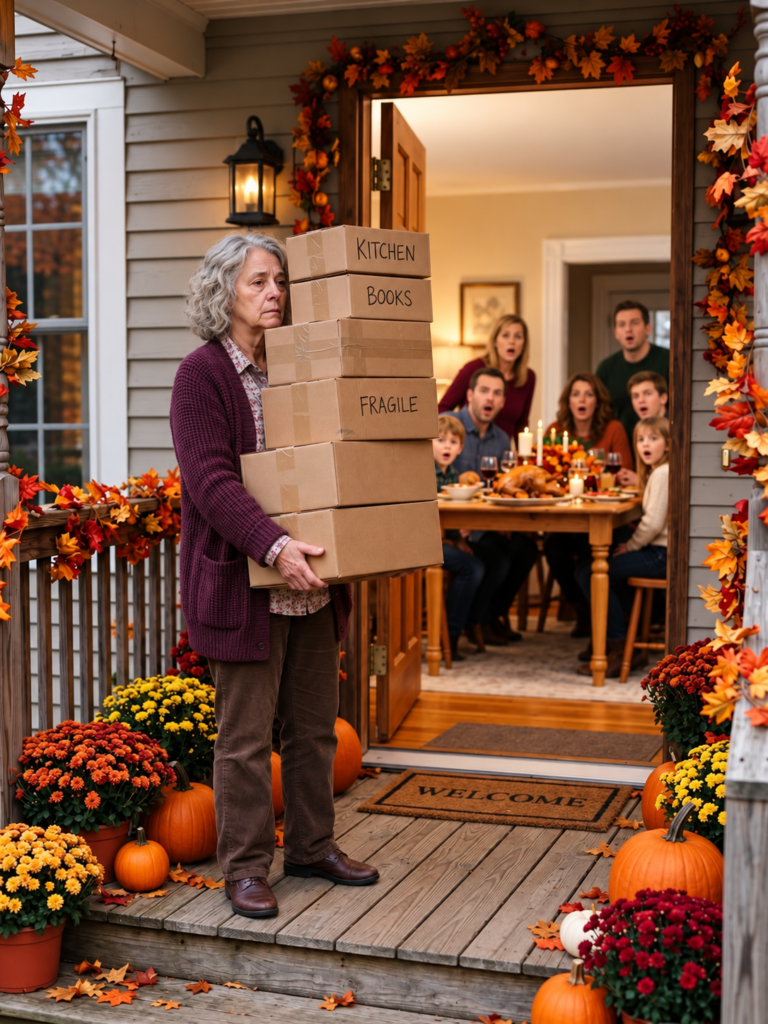
Daniel stood in the doorway of his beautiful two-story house, staring at me as though I’d arrived from another country without telling him.
“Mom?”
He looked at the four white bakery boxes balanced in my arms. Then his gaze moved to the delivery van parked at the curb.
“Why are you here?”
There was no anger in his voice.
That almost made it worse.
Because if he’d been angry, I could have been angry right back. Instead, he sounded genuinely bewildered, as though his mother standing on his doorstep on Thanksgiving morning was something he had never considered possible.
“Good morning, sweetheart,” I said. “Your pies are here.”
For several seconds, he didn’t move.
Behind him, I could hear dishes clattering, children laughing, and a woman’s voice asking whether somebody had remembered to put the cranberry sauce in the refrigerator.
A man’s deep laughter followed.
It was a familiar laugh.
I recognized it immediately as belonging to my late husband’s younger brother.
Uncle Walter.
A man I had not seen at Thanksgiving for three years.
Daniel glanced over his shoulder.
“Mom, I don’t understand.”
“I know,” I said quietly. “That’s why I came.”
I shifted the boxes against my hip.
“Would you mind letting me inside? These are getting heavy.”
He stepped aside.
And I walked into the house where my family had been celebrating without me.
My name is Eleanor Whitcomb. I’m sixty-nine years old, a widow, a mother, a grandmother, and a woman who has spent most of her life believing that families should make room for one another.
I had never imagined that one day I would need a delivery uniform and a stack of receipts to prove I belonged to mine.
That Thanksgiving morning, I wore black trousers, sensible shoes, and a navy wool coat I’d bought for my husband’s funeral.
Underneath, my bakery apron was folded neatly over my sweater.
My hands smelled faintly of cinnamon and butter.
I’d been awake since four.
But none of that explained why the sight of my son’s dining room nearly brought me to my knees.
The table was enormous.
It stretched from one end of the dining room to the other, covered with a cream-colored tablecloth, polished silverware, and arrangements of orange roses.
There were place settings for sixteen people.
Sixteen.
Daniel had told me only four days earlier that he and his wife were keeping Thanksgiving small.
“Just something quiet at home, Mom. Nothing special.”
I’d replied that I understood.
I always understood.
That had become my role.
The understanding mother.
The undemanding widow.
The grandmother who didn’t complain when visits were canceled or phone calls became shorter.
But standing in that doorway, looking at sixteen beautifully arranged places, I understood something else.
I had been excluded deliberately.
And somebody had made sure it stayed that way.
“Eleanor?”
A woman rose from the far end of the table.
Margaret Bennett, my daughter-in-law’s mother, was holding a linen napkin.
She looked at me with genuine surprise.
“Good heavens. What are you doing delivering food?”
Before I could answer, my granddaughter Emma came running around the table.
“Grandma!”
At twelve, she was all long legs and flying brown hair.
She collided with me so enthusiastically that I nearly dropped the top box.
“Careful, honey,” I said, laughing despite myself.
She wrapped both arms around my waist.
“You came! Daddy said you weren’t coming!”
The room became quieter.
Not completely silent.
Not yet.
But I felt conversations slowing.
I looked down at Emma.
“Did he?”
She nodded.
“Mom said you didn’t like big family dinners anymore.”
Across the room, my daughter-in-law froze.
Vanessa was standing near the kitchen entrance holding a glass pitcher of iced tea.
She wore an elegant green dress, her blonde hair pinned perfectly behind her head.
For eleven years, I had watched her turn ordinary family gatherings into events that looked as though they belonged in magazines.
There were matching napkins, coordinated flowers, printed menus, and carefully selected music.
She was very good at creating beautiful tables.
I had finally begun to realize she was equally good at deciding who could sit at them.
“Eleanor,” she said, forcing a smile. “What a surprise.”
I looked at her.
“Yes,” I replied. “I imagine it is.”
Her eyes dropped to the bakery boxes.
“You work at Millbrook’s?”
“For twelve years.”
“Twelve?”
“That’s right.”
She blinked.
I could almost see her thinking backward through every Thanksgiving order, every telephone conversation with the bakery, every time she had praised the pumpkin pie without knowing whose hands had made it.
I carried the boxes to a sideboard.
The apple pie went down first.
Then the pumpkin.
Then the chocolate pecan.
Finally, the sweet potato pie, made from a recipe that had belonged to my grandmother.
As I placed the last box down, I saw the dish.
White porcelain.
A narrow blue border.
Two little handles shaped like curled leaves.
It stood between the mashed potatoes and the green bean casserole, filled with glossy brown gravy.
My breath caught.
It wasn’t expensive.
It wasn’t rare.
But my husband, Thomas, had bought it for me at an antique fair during our first married summer.
We had only forty dollars left in our checking account that week.
He had spent six on the gravy boat because I’d admired it.
“Every proper Thanksgiving needs a boat,” he’d said.
For forty-three years, that dish had sat at our holiday table.
And now it sat here.
In a house where I supposedly didn’t want to celebrate.
I reached into my coat pocket.
But before I could take out the receipts, I heard Daniel behind me.
“Mom, can we talk in the kitchen?”
I turned.
His expression had changed.
He was looking from me to Vanessa, sensing something was wrong but not yet understanding what.
“We can talk right here,” I said.
Vanessa set the pitcher down.
“Eleanor, perhaps this isn’t the best time.”
I studied her face.
That sentence was so perfectly Vanessa.
There was always a better time.
A more appropriate setting.
A reason not to have an uncomfortable conversation.
For three years, I had accepted those reasons.
Not today.
“When would be the best time?” I asked.
She pressed her lips together.
“It’s Thanksgiving.”
“Yes,” I said. “I noticed.”
I took three folded receipts from my pocket.
And that was when my son finally started looking frightened.
Not because of what I had said.
Because of what I could prove.
To understand those receipts, you need to understand the woman I had been before my husband died.
Thomas and I met at a church picnic in Ohio when I was nineteen.
He was twenty-two, working at his father’s hardware store and driving an old blue Chevrolet that needed a push to start on cold mornings.
He had kind eyes, terrible handwriting, and the habit of laughing at his own jokes before reaching the punch line.
We married two years later.
We weren’t wealthy, but we had a happy life.
We raised Daniel in a narrow yellow house with a white porch and a backyard large enough for tomatoes, two apple trees, and a swing Thomas built himself.
Every Thanksgiving, I cooked for whoever needed a place.
One year, there were twenty-one people.
Another year, seven.
We hosted college students who couldn’t travel home, elderly neighbors whose children lived far away, and once a newly divorced schoolteacher who cried through dessert because she wasn’t accustomed to being treated kindly.
Thomas always said an extra chair cost nothing compared to the loneliness it might prevent.
I believed him.
I still do.
When Daniel married Vanessa, I welcomed her.
She was efficient, ambitious, and very different from me.
I preferred mismatched serving dishes and handwritten recipes. Vanessa liked matching collections, professional catering, and schedules printed weeks ahead.
But different didn’t mean bad.
I admired her energy.
I praised the meals she prepared.
When Emma was born, I stayed with them for six days, washing tiny clothes, cooking soup, and getting up at night whenever Vanessa needed help.
I never wanted to become the mother-in-law everyone complained about.
So I practiced restraint.
I asked before visiting.
I didn’t offer parenting advice unless invited.
I complimented the new furniture, even when I missed the old family photographs that had once filled Daniel’s house.
Little by little, I made myself easier to accommodate.
Then Thomas became ill.
It began with a cough he couldn’t shake.
Within months, we were spending more time at doctors’ offices than at home.
He died seventeen months after his diagnosis.
The last words he spoke clearly were about Daniel.
“Make sure the boy remembers to call you.”
I laughed through my tears.
“He’s forty, Thomas.”
“He’ll always be the boy.”
After the funeral, the house seemed impossibly large.
His boots remained beside the back door.
His reading glasses sat near his chair.
Some evenings, I found myself setting out two mugs for tea.
I couldn’t bear the silence, so I accepted more shifts at Millbrook’s Bakery, where I’d worked part-time for years.
The bakery belonged to a married couple, Frank and Susan Miller.
They’d known Thomas and me for decades.
When I asked for full-time hours, Susan didn’t question me.
She simply put her hand over mine.
“We always need good hands in the kitchen.”
The work saved me.
There was comfort in tasks that had clear beginnings and endings.
Measure flour.
Cut butter.
Roll dough.
Fill crusts.
Bake until golden.
Nobody at the bakery expected me to stop missing my husband.
Nobody told me it was time to move forward.
They simply let me work.
Daniel visited regularly during that first year.
Vanessa came with him sometimes.
They helped sort Thomas’s belongings.
On one Saturday, Vanessa brought large plastic storage bins and labels.
She moved through the house with her usual efficiency.
“Eleanor, you’ll feel so much better once everything has a proper place.”
I wasn’t sure that was true.
But I let her help.
Daniel carried boxes to the attic.
Vanessa organized the dining room cabinets.
Emma, then eight, sat on the floor arranging old photographs.
At the end of the day, Vanessa took two boxes of extra serving pieces home.
“Just to keep them safe while you’re reorganizing,” she said.
I thanked her.
It was almost three months before I noticed the gravy boat was missing.
I called Daniel.
He said he’d check.
A week passed.
Then another.
Eventually, he told me Vanessa thought it might have gone to the donation center with other kitchen items.
I cried after hanging up.
Not because of the value of the dish.
Because I remembered Thomas holding it in that summer sunshine, looking so proud of his six-dollar purchase.
But I didn’t accuse anyone.
Grief had exhausted me.
I told myself it was only a dish.
I was about to learn how wrong that sentence could feel.
The first Thanksgiving invitation never came.
Daniel called in November and said they were having a quiet holiday.
I asked whether he wanted me to bring anything.
He hesitated.
“Actually, Mom, Vanessa thinks it’s best if we keep things simple this year.”
I imagined the three of them eating together.
Perhaps Emma had a school project.
Perhaps Vanessa was tired.
Perhaps my son wanted to spend a holiday alone with his wife and daughter.
I understood.
I roasted a small chicken.
Made mashed potatoes.
Opened a can of cranberry sauce.
At six that evening, Daniel sent me a text.
Happy Thanksgiving, Mom. Love you.
I stared at it for a long time before replying.
Love you too. Give Emma a kiss.
I didn’t know that by six o’clock, twenty-seven people had already eaten Thanksgiving dinner in his house.
I didn’t know my brother-in-law Walter had been there.
Or that Vanessa’s parents had attended.
Or that several of Daniel’s friends had brought their families.
I certainly didn’t know my gravy boat had been placed in the center of the table.
I learned those things the following spring.
Emma had started posting photographs on a family photo-sharing account.
My neighbor Ruth, who was much better with technology than I was, helped me open it.
We sat at my kitchen table drinking coffee while she showed me how to scroll.
There were photographs of Emma’s school play.
Pictures of a birthday party.
Then Thanksgiving.
I saw the table first.
The candles.
The flowers.
The turkey.
And people.
So many people.
I counted faces twice.
When I recognized Walter standing behind Daniel, my chest tightened.
Walter had been Thomas’s best man.
He lived forty minutes away.
He had always celebrated Thanksgiving with us until Thomas died.
He hadn’t called me that year.
I looked more closely.
There was the gravy boat.
My gravy boat.
Ruth noticed my expression.
“Eleanor? Honey, are you all right?”
I nodded.
I didn’t trust myself to speak.
That evening, I sat alone at the kitchen table and looked at the photographs again.
I could have called Daniel.
I could have demanded explanations.
But I kept thinking about the way he’d sounded when telling me they wanted a quiet holiday.
So certain.
So casual.
As though a holiday without his mother had become the natural order of things.
I closed the photographs.
And said nothing.
The second Thanksgiving was much the same.
Another phone call.
Another quiet-holiday explanation.
Another dinner alone.
That year, I learned Vanessa had begun ordering holiday pies from Millbrook’s Bakery.
It was sheer coincidence.
I was sorting bakery order slips when I recognized her name.
Vanessa Whitcomb.
Four pies.
Delivery requested.
Guest count: twenty.
I stared at the slip.
Twenty guests.
I asked Susan whether the order could be assigned to me.
She shook her head.
“You’re our best pastry baker, Eleanor. I need you here.”
So I stayed.
I made Vanessa’s pies.
I rolled the crusts, filled them, baked them, and packed them.
I even added extra cinnamon to the apple filling because Daniel had loved it that way since childhood.
On Thanksgiving Day, I ate soup at home.
That was the year I began saving the receipts.
I didn’t have a plan.
I simply knew there were things I could no longer convince myself I was imagining.
And when the third year came, I was ready to pay closer attention.
The Tuesday before Thanksgiving, Vanessa’s order arrived again.
Four pies.
Sixteen guests.
Delivery at ten on Thanksgiving morning.
There was a note in the special instructions.
Please make sure the sweet potato pie has extra nutmeg. My family loves that recipe.
I read those words three times.
My family.
The recipe was mine.
It had been written on a stained index card by my grandmother in 1952.
I’d made it for Daniel every Thanksgiving of his childhood.
Vanessa had asked me for the recipe during her first year of marriage.
I remembered standing beside her in my kitchen, explaining how to roast the sweet potatoes instead of boiling them because it made the filling richer.
She’d laughed and said, “No wonder Daniel says nobody makes pie like his mother.”
Now she was ordering it from a bakery where his mother worked.
For a family dinner his mother wasn’t invited to attend.
I put down the order slip.
Susan came into the kitchen carrying a sack of flour.
“Everything all right, Eleanor?”
“Yes,” I said.
Then I surprised both of us.
“Actually, Susan, I’d like to make Thursday’s deliveries.”
She frowned.
“You hate driving the van.”
“I know.”
“And you’ll have to be here before sunrise.”
“I already will be.”
She studied me.
“You sure?”
I looked at Vanessa’s handwriting.
“Very.”
Susan didn’t ask why.
She simply handed me the delivery schedule.
I wrote my name beside the Whitcomb address.
Then I went home and opened the little wooden recipe box Thomas had made me for our twentieth anniversary.
Inside were three years of order slips.
And something else.
A photograph of Thomas holding our gravy boat.
He was standing at our old dining room table, smiling, wearing the faded green sweater Emma used to call his Christmas sweater.
I ran a finger over his face.
“I think I’m finally going to do something,” I whispered.
Of course, the photograph didn’t answer.
But I could almost hear his voice.
Well, Eleanor, make sure you do it properly.
I closed the box.
And on Thanksgiving morning, I baked four perfect pies.
Part 2
The receipts lay on the sideboard between the pumpkin and pecan pies.
Nobody at Daniel’s table seemed certain what they were supposed to do.
Vanessa was the first to recover.
“Eleanor,” she said softly, “I’m sure there’s some misunderstanding.”
It was a carefully chosen word.
Misunderstanding.
Not lie.
Not deception.
Not three years of deliberate exclusion.
Daniel looked at her.
“What misunderstanding?”
Vanessa gave a little laugh.
“You know how your mother feels about large gatherings since Thomas passed. We’ve talked about this.”
My son turned toward me.
“Mom, I thought you didn’t want to come.”
I felt something inside me shift.
For three years, I’d believed my son preferred celebrating without me.
Apparently, my son believed I had chosen to stay away.
We stood only a few feet apart.
Yet I suddenly understood how completely we had been separated.
“Daniel,” I said, “who told you that?”
He blinked.
“What?”
“Who told you I didn’t want to come?”
His gaze moved toward his wife.
Vanessa’s hands tightened around the back of a chair.
“Eleanor, please.”
I kept my eyes on Daniel.
He swallowed.
“Vanessa said she’d called you.”
“Did she tell you what I said?”
“Yes.”
“What did I say?”
He looked uncomfortable.
“That you weren’t ready. That being around everyone reminded you too much of Dad.”
I held his gaze.
“And you believed that?”
His face reddened.
“Well, yes.”
“Did you ever ask me?”
He opened his mouth.
Then closed it.
The answer was written across his face.
No.
He had not asked.
Not once.
I took a long breath.
“Sweetheart, I have waited three years for you to invite me to Thanksgiving.”
The words came out quietly.
Not because I wasn’t angry.
Because I knew if I raised my voice, I might start crying.
Daniel’s expression changed.
He looked at Vanessa again.
“Did you invite her?”
She said nothing.
“Vanessa.”
“Daniel, this isn’t fair.”
“What isn’t fair?”
“Doing this in front of everybody.”
From the far end of the table, Margaret Bennett spoke.
“Answer your husband.”
Vanessa turned sharply.
“Mother, please stay out of it.”
Margaret folded her napkin.
“I would very much like to stay out of it. Unfortunately, you’ve spent three years telling me Eleanor prefers to be alone, so I appear to be involved already.”
The room went still.
Vanessa looked trapped.
I hadn’t wanted a room full of people watching her embarrassment.
But I wasn’t going to rescue her from the truth.
Not this time.
Daniel turned back to me.
“Mom, why didn’t you tell me?”
For a moment, I wanted to defend myself.
I wanted to explain how hard it had been after Thomas died.
How every telephone call from my son felt precious.
How I had been afraid of becoming one more burden in his life.
Instead, I answered plainly.
“Because you never asked why I wasn’t coming. And after a while, I was afraid I already knew.”
He looked away.
That was when Walter stood.
He was nearly seventy-five now, heavier than I remembered, with the same wide shoulders Thomas had.
“Eleanor,” he said, his voice rough, “I owe you an apology.”
I stared at him.
Walter rubbed his forehead.
“I should’ve called you myself.”
“You knew I wasn’t invited?”
He looked at Vanessa.
“I knew what I was told.”
“What were you told?”
He hesitated.
“That the holidays were too painful for you. That you didn’t want reminders of Thomas.”
I could hardly believe it.
“Walter, Thomas was your brother.”
“I know.”
“Did you really think I’d rather sit alone than hear stories about him?”
His eyes filled.
“No,” he admitted. “I suppose I didn’t think hard enough.”
I looked around the table.
These people had known me for years.
Some had eaten in my home.
Some had watched me care for Thomas.
Some had come to his funeral.
Yet they’d all accepted the story that I preferred to be alone.
And nobody had questioned it.
The realization was almost as painful as Vanessa’s deception.
Then Emma asked a question.
“Grandma, did you spend Thanksgiving by yourself?”
I looked down at her.
“Yes, sweetheart.”
“All three times?”
“Yes.”
Her mouth trembled.
“But we had so much food.”
There was no accusation in her voice.
Only confusion.
A child trying to understand why adults could have sixteen plates on a table and still leave somebody hungry for company.
I reached for her hand.
“It’s all right, honey.”
But she shook her head.
“No, it isn’t.”
And for the first time that morning, I couldn’t disagree.
Daniel wanted to move the conversation into his office.
I agreed, partly because Emma was becoming upset and partly because I could feel myself shaking.
Vanessa followed us.
Margaret stayed with Emma.
Inside the office, Daniel closed the door and faced his wife.
“Tell me exactly what happened.”
Vanessa sat on the edge of a leather chair.
I remained standing beside the bookcase.
Family photographs covered one shelf.
There was Daniel graduating from college.
Daniel and Vanessa on their wedding day.
Emma as a baby.
A Christmas photograph of the three of them wearing matching pajamas.
Not one picture included me.
There used to be a photograph of Thomas and me holding Daniel on his first birthday.
I wondered where it had gone.
Vanessa looked down at her hands.
“I thought Eleanor needed space.”
Daniel shook his head.
“That isn’t what you told me.”
She sighed.
“You have to understand how things were after your father died.”
I stiffened.
There it was.
Thomas’s death.
The convenient explanation for everything.
She continued.
“Your mother was grieving. Every time we visited, the house was full of memories. She barely smiled. She didn’t seem interested in anything we were doing.”
I stared at her.
“Vanessa, my husband had just died.”
“I know.”
“After forty-five years of marriage.”
“I know that, Eleanor.”
“Then what exactly did you expect me to look like?”
She pressed her lips together.
Daniel moved to the window.
“Why did you tell me she didn’t want to come?”
Vanessa’s voice became thin.
“Because I thought it would be easier.”
“For who?”
No answer.
He turned.
“For you?”
Vanessa looked at him.
And something in her expression changed.
The careful hostess disappeared.
For the first time, I saw a woman who was tired, defensive, and frightened.
“Yes,” she said.
The admission surprised us both.
“It was easier for me.”
Daniel stared at her.
She began speaking quickly.
“Every holiday at Eleanor’s house was about your father. Every tradition was already established. Every dish had a story. Every decoration meant something. I tried for years to make our own family traditions, but you always compared everything to how your mother did it.”
Daniel frowned.
“I didn’t—”
“Yes, you did.”
Her voice cracked.
“You told me her stuffing was better. Her pies were better. Her gravy was better. Even the way she folded napkins was apparently better.”
I felt a sharp ache in my chest.
I’d never known she carried those resentments.
Vanessa wiped her eyes.
“When we finally started hosting, I wanted one holiday that felt like mine. One holiday where I wasn’t standing in somebody else’s kitchen being reminded that I was doing things differently.”
I was quiet.
It didn’t justify what she’d done.
But it explained something.
I remembered how many times I’d corrected her cooking without meaning to.
How often Daniel praised my food in front of her.
I could imagine feeling inadequate.
But I couldn’t understand turning that insecurity into three years of lies.
“You could have told me,” I said.
Vanessa looked up.
“Would you have listened?”
The question hurt because I couldn’t immediately answer.
I thought about our earliest holidays.
The way I’d insisted the turkey should rest for twenty minutes.
The way I’d shown her how to thicken gravy.
The way I’d rearranged her serving dishes once because I thought the table looked crowded.
Small things.
Things I considered helpful.
Perhaps she had experienced them differently.
“I hope I would have,” I said.
She gave a bitter little laugh.
“Well, I didn’t think so.”
Daniel moved away from the window.
“None of that explains why you lied to me.”
Vanessa looked at him helplessly.
“Because I knew you’d invite her anyway.”
The room became completely silent.
There it was.
The truth she’d been trying to avoid.
She had not forgotten.
She had not misunderstood.
She had made a choice.
And then made the same choice again.
For three years.
Daniel sat down slowly.
I could see him struggling to recognize the woman he’d married.
Or perhaps struggling to recognize the husband he had become.
I knew he loved Vanessa.
I had never doubted that.
But love was not supposed to require pretending your mother had disappeared.
He looked at me.
“Mom, I’m so sorry.”
I nodded.
“I know you are.”
“No, I mean—”
“I understand.”
He looked miserable.
But I wasn’t finished.
“There is one more thing.”
Vanessa closed her eyes.
I reached into my coat pocket and unfolded the photograph of Thomas.
The one showing him holding the gravy boat.
I placed it on Daniel’s desk.
“Do you remember this?”
Daniel leaned forward.
His expression softened.
“Dad’s gravy boat.”
“Our gravy boat,” I corrected gently.
He looked up.
“I wondered where that went.”
I kept my eyes on Vanessa.
“So did I.”
Daniel followed my gaze.
“Vanessa?”
She didn’t answer.
He sat very still.
“You told me it was donated.”
Her face drained.
I felt my heartbeat in my throat.
For a brief moment, I wondered whether she’d admit everything.
But instead, she whispered, “I didn’t steal it.”
I hadn’t used that word.
Not once.
Vanessa’s explanation came slowly.
During the sorting after Thomas’s funeral, she’d found the gravy boat wrapped in a dish towel inside a cabinet.
She liked it.
It matched the blue border of her own dinner plates.
She’d put it into a box intending to ask whether she could have it.
Then she’d taken the box home.
Months passed.
When Daniel asked about the dish, she panicked.
She told him she thought it had been donated.
Later, when she began hosting Thanksgiving, she brought it out because it was beautiful.
And because Daniel liked seeing something that reminded him of his father.
I listened without interrupting.
The story might have been true.
It might also have been the version she could bear to confess.
Either way, the dish had remained in her home after she knew I wanted it back.
“I asked about it,” I said.
Vanessa nodded.
“Yes.”
“Daniel told you I was looking for it.”
“Yes.”
“And you said nothing.”
Tears rolled down her cheeks.
“No.”
I folded the photograph.
“Then you knew it belonged to me.”
She nodded.
Daniel rubbed his face.
“Vanessa, why?”
She looked at him with an expression I had never seen before.
“Because once I started lying, I couldn’t figure out how to stop.”
That sentence stayed with me.
Not because it excused her.
Because I believed it.
I had spent three years avoiding an uncomfortable conversation.
She had spent three years hiding from one.
We had both allowed silence to grow.
The difference was that my silence had wounded me.
Hers had wounded everyone.
Daniel stood.
“Mom, you should take it home.”
Vanessa flinched.
I looked at him.
“I intend to.”
“I’ll get it.”
He reached for the door.
But I stopped him.
“Daniel.”
He turned.
“I want to go back out there.”
His expression tightened.
“Mom, maybe we should—”
“No.”
I didn’t raise my voice.
“I didn’t come here to hide in your office while everyone pretends nothing happened.”
He looked at the floor.
I continued.
“I came because I wanted you to know why your mother wasn’t at your table. Now you know. And I want to sit with my granddaughter for Thanksgiving.”
His eyes filled.
I took a breath.
“Unless that’s still a problem.”
He shook his head immediately.
“No, Mom.”
“Then let’s go.”
We opened the office door.
And found Emma waiting in the hallway.
She was holding something behind her back.
Her cheeks were wet.
“Grandma,” she whispered, “I need to show you something.”
In her hand was a small envelope.
The paper had been folded and unfolded so often that the corners were soft.
Across the front, in a child’s uneven handwriting, were the words:
For Grandma Eleanor.
I stared at it.
Emma looked frightened.
“I made it two years ago.”
I took the envelope.
Inside was a little card decorated with orange leaves.
There was a drawing of a turkey wearing a pilgrim hat.
Underneath, she’d written:
Dear Grandma,
Please come to Thanksgiving. I want you to sit next to me. We can make the pumpkin pie together.
Love, Emma.
I read it twice.
Then again.
My eyes blurred.
“Why didn’t I get this, sweetheart?”
Emma twisted her fingers.
“Mom said she’d mail it.”
Behind me, Daniel made a quiet sound.
I turned toward him.
His face had gone pale.
Emma continued.
“I found it last week in the drawer with the old Christmas cards. I thought maybe you didn’t answer because you didn’t want to come.”
I knelt in front of her.
At my age, kneeling wasn’t easy.
But I needed to be at eye level.
“Oh, honey.”
She looked down.
“Did you not want to come?”
I shook my head.
“I would’ve come in a heartbeat.”
“Really?”
“Really.”
Her eyes filled again.
“But Mom said—”
“I know.”
I pulled her into my arms.
I held her tightly and felt the thin, uncertain shoulders of a child who had spent two years believing her grandmother hadn’t answered an invitation.
Of all the things I’d learned that morning, this was the one I hadn’t expected.
Not the lies.
Not the missing serving dish.
Not the crowded table.
A little girl had tried to include me.
And someone had made sure her invitation never arrived.
I looked over Emma’s shoulder.
Vanessa stood in the doorway.
Her hand covered her mouth.
Daniel stared at her.
“Did you hide that too?”
She began crying.
“I forgot about it.”
Emma pulled away from me.
“No, you didn’t.”
Everyone froze.
My granddaughter’s voice was small.
But unmistakably certain.
“I asked you twice whether Grandma got my card. You said she was busy.”
Vanessa didn’t answer.
Daniel closed his eyes.
I rose slowly, one hand against the wall.
I suddenly felt every one of my sixty-nine years.
For three years, I’d thought the worst part of this story was being forgotten.
Now I understood that my granddaughter had been taught to believe I was the one doing the forgetting.
And I didn’t know how to forgive that.
Part 3
When we returned to the dining room, Margaret Bennett was standing beside the sideboard.
She had arranged the pies on serving plates.
The guests were speaking in subdued voices.
Walter was staring at an untouched glass of water.
Margaret looked up at us.
One glance at Emma’s face was enough.
“What happened?” she asked.
Nobody answered immediately.
Then Emma walked toward her grandmother on Vanessa’s side.
“I invited Grandma Eleanor,” she said.
Margaret frowned.
“What do you mean, sweetheart?”
“I made her a card. But Mom didn’t send it.”
Margaret’s gaze moved to her daughter.
“Vanessa?”
Vanessa shook her head.
“Please, Mother.”
Margaret straightened.
“I asked you a question.”
My daughter-in-law looked around the room.
For the first time, the gathering she’d organized so carefully seemed beyond her control.
Every candle was in place.
Every plate matched.
The flowers were perfect.
But the story holding the family together had fallen apart.
Daniel stepped beside me.
“Vanessa has been telling Mom we weren’t hosting Thanksgiving. She’s been telling us Mom didn’t want to come.”
There were murmurs around the table.
Walter lowered his head.
Margaret closed her eyes briefly.
When she opened them, she looked at Vanessa.
“How long?”
Vanessa whispered, “Three years.”
Margaret sat down.
For a long moment, she said nothing.
Then she spoke so quietly everyone had to listen.
“I raised you to be better than this.”
Vanessa began crying harder.
“I know.”
“No,” Margaret replied. “I don’t think you do.”
Frank, Vanessa’s father, placed a hand over his wife’s.
He had always been a quiet man, content to let Margaret handle most family matters.
But now he looked at Daniel.
“Son, did you really never call your mother yourself to invite her?”
Daniel swallowed.
“No, sir.”
“Why not?”
My son looked at me.
Then at the place settings.
“I thought Vanessa had handled it.”
Frank nodded slowly.
“That’s what happens when good people stop checking things that matter.”
I didn’t know whether he meant Daniel, Vanessa, or himself.
Perhaps all three.
I looked at the empty end of the table.
There were sixteen chairs.
Every one had a neatly folded napkin.
I thought about my little kitchen at home, where I’d spent the previous Thanksgiving eating soup beside a photograph of Thomas.
I thought about the card in my pocket.
And I realized I hadn’t come all this way simply to expose my daughter-in-law.
I had come to reclaim the part of my life I’d allowed other people to define.
“May I say something?” I asked.
Everyone turned.
I moved toward the head of the table.
The gravy boat sat in front of me.
I touched one handle.
Its porcelain was warm from the gravy inside.
“My husband and I celebrated forty-three Thanksgivings together,” I began. “Some were happy. Some were difficult. There were years when money was tight, years when someone was sick, and years when people came to dinner carrying troubles they didn’t know how to put down.”
I looked at Walter.
“Thomas used to say the table wasn’t finished until everyone had somewhere to sit.”
Walter smiled sadly.
“He did.”
“I never expected Daniel and Vanessa to do things exactly the way we did. They’re entitled to their own traditions. Their own home. Their own family life.”
I paused.
“But I didn’t expect to be removed from the family to make room for those traditions.”
Vanessa lowered her head.
I continued.
“I’ve spent these last three years believing my son didn’t want me here. And now I’ve learned my son believed I didn’t want to be here.”
I turned toward Daniel.
“We both accepted a story that neither of us bothered to question.”
He nodded, tears shining in his eyes.
“I know, Mom.”
“I’m not proud of my silence either.”
Then I looked at Vanessa.
“But there’s a difference between being afraid to ask a question and preventing other people from hearing the answer.”
She covered her face.
I allowed the silence to settle.
Then I lifted the gravy boat.
“This belonged to Thomas and me. I’d like to take it home.”
Margaret nodded.
“Of course.”
I set it beside the bakery boxes.
“And I would like one more thing.”
Daniel stepped forward.
“Anything, Mom.”
I shook my head.
“Don’t say anything unless you mean it.”
He stopped.
I looked at him carefully.
“Next Thanksgiving, if you want me here, call me yourself. Don’t send a message through anybody. Don’t assume. Ask me.”
He nodded.
“I will.”
“And if I say yes, believe me.”
“I will.”
Emma raised her hand, as though we were in a classroom.
“Can I ask something?”
I smiled through my tears.
“Of course.”
“Can Grandma stay today?”
The room was silent.
Daniel looked at me.
“Mom, please stay.”
I searched his face.
“Do you want me to?”
His voice broke.
“More than anything.”
For the first time that morning, I believed him completely.
So I nodded.
“All right.”
Emma clapped her hands.
“I saved you a seat!”
I looked toward the table.
There was no extra chair.
No unused place setting.
Emma hurried toward the kitchen.
“I’ll get one!”
Walter stood immediately.
“I’ll help.”
Within minutes, they brought out a wooden chair from the breakfast nook.
Margaret found another plate.
Frank brought silverware.
Emma insisted on placing my napkin herself.
It was pale orange, folded into a little triangle.
Nothing matched quite perfectly anymore.
The additional chair crowded Daniel’s end of the table.
Someone had to move the flower arrangement.
A serving dish was pushed aside to make space.
For the first time since I’d arrived, the dining room looked like a real family gathering rather than a photograph.
And I loved it.
Dinner began nearly an hour late.
Nobody complained.
Daniel carved the turkey while Walter made an old joke about how Thomas always cut slices too thick.
I laughed.
I couldn’t help it.
Thomas had insisted that thin turkey slices were an insult to the bird.
Walter tried to imitate his brother’s voice.
He wasn’t very good at it.
But hearing someone talk about Thomas without lowering their voice felt wonderful.
Emma sat beside me.
She told me about her science class, her best friend Lucy, and a boy who kept putting rubber spiders in the girls’ lockers.
I listened.
Really listened.
I had missed so much.
When the sweet potato pie was served, Emma took one bite and widened her eyes.
“Grandma, this tastes like the pie you used to make!”
I smiled.
“That’s because I made it.”
She blinked.
“You made all of these?”
“All four.”
She looked at the boxes.
“Every year?”
“Yes.”
Her eyes grew enormous.
“But Mom ordered them from Millbrook’s.”
“I work at Millbrook’s.”
She stared at me.
Then burst out laughing.
“Grandma! You’ve been making our Thanksgiving pies this whole time?”
I nodded.
That laugh did something to the room.
It broke a tension none of us had known how to release.
Walter chuckled.
Margaret smiled.
Even Frank shook his head in amazement.
Daniel put down his fork.
“Mom, why didn’t you tell us?”
I looked at him.
“I suppose I wanted you to ask what I was doing with my days.”
He lowered his eyes.
It wasn’t meant as punishment.
It was simply true.
After Thomas died, Daniel often asked whether I was eating properly or taking my medication.
He asked whether the furnace worked and whether I needed someone to shovel the driveway.
He worried about practical things.
But he rarely asked what made me happy.
He didn’t know I had become Millbrook’s head pastry baker.
He didn’t know Susan had trusted me with the holiday recipes.
He didn’t know I’d trained three younger employees.
He didn’t know that sometimes, on Saturdays, people came from two counties away for my pies.
The knowledge seemed to embarrass him.
And perhaps it should have.
But I had my own failures to consider.
I’d spent so much time trying not to burden my son that I’d stopped telling him about my life.
We had allowed our conversations to shrink into weather reports and reminders.
He didn’t know much about me anymore.
And I didn’t know much about him.
That realization was painful.
It also gave us somewhere to begin.
After dinner, Vanessa approached me in the kitchen.
The others were clearing dishes or watching football in the living room.
Emma had gone upstairs to retrieve a drawing she wanted to show me.
I was wrapping the gravy boat in clean dish towels when Vanessa entered.
She stood in the doorway for several seconds.
“Eleanor?”
I kept folding.
“Yes?”
“Could we talk?”
I looked at her.
She seemed smaller than she had that morning.
Her makeup had been washed away.
A strand of hair had fallen loose beside her cheek.
For once, she looked like a woman who had been crying instead of a woman who never allowed anything to go wrong.
“We can,” I said.
She stepped inside.
“I don’t know where to start.”
“Start wherever you can tell the truth.”
She nodded.
Her eyes filled again.
“I was jealous of you.”
The admission surprised me.
“Of me?”
“Yes.”
I almost laughed.
I thought of the little house I lived in, the aching joints, the empty bedroom, the long evenings when I watched television simply to hear another voice.
“What on earth did I have that you wanted?”
She looked at me.
“Daniel’s admiration.”
I stopped wrapping.
She continued.
“When we first married, he talked about you constantly. How you managed the house. How you worked when money was tight. How you cared for his father. How you always knew what to do.”
I shook my head.
“Vanessa, he was your husband.”
“I know.”
“His love for me didn’t take anything away from his love for you.”
“I understand that now.”
I wasn’t certain she did.
Not fully.
But I could see she wanted to.
She moved toward the table.
“When Thomas died, everything became harder. Daniel worried about you constantly. Every holiday, he wanted to do something to make you feel better. And I felt like no matter what I planned, the holiday would always belong to the memory of your marriage.”
I considered her words.
There was sadness in them.
And resentment.
And something like shame.
“I was wrong,” she whispered. “I know I was wrong.”
“Yes,” I said.
She flinched slightly.
I didn’t soften the answer.
“Vanessa, you were wrong in ways that hurt more people than me.”
She nodded.
“I know.”
“You hurt Daniel.”
A tear fell.
“I know.”
“You hurt Emma.”
She covered her mouth.
“And you let that little girl believe her grandmother didn’t love her enough to answer an invitation.”
Vanessa began sobbing.
“I never meant for it to go that far.”
I waited until she could look at me again.
“Intentions matter,” I said. “But so do consequences.”
She wiped her cheeks.
“I don’t expect you to forgive me today.”
“Good,” I replied. “Because I don’t know if I can.”
She nodded.
Then she did something unexpected.
She reached into the pocket of her dress and pulled out a small folded piece of paper.
“I wrote this before I came in.”
She placed it on the counter.
It was a short apology.
Not dramatic.
Not particularly eloquent.
She acknowledged lying about the invitations, keeping the gravy boat, and failing to send Emma’s card.
She acknowledged that she’d tried to control the family because she felt insecure.
At the bottom she’d written:
I will not ask anyone to pretend this didn’t happen.
I read the note.
Then folded it.
“Thank you,” I said.
She looked relieved.
But I wasn’t finished.
“Vanessa, I won’t participate in a family where invitations have to pass through you.”
She nodded.
“I understand.”
“If Daniel wants to see me, he can call.”
“Yes.”
“If Emma wants to visit, you and Daniel can decide together whether it’s practical. But she deserves honest answers.”
“Of course.”
“And the gravy boat stays with me.”
Despite her tears, she gave a tiny, embarrassed smile.
“I wouldn’t dream of asking for it.”
I looked down at the porcelain.
“It’s only a dish,” I said.
Vanessa shook her head.
“No. I think I finally understand it isn’t.”
I wrapped it carefully.
For the first time, I believed she might.
Daniel walked me to the van shortly after four.
The afternoon sky had turned gray.
Cold wind moved through the bare branches along the street.
He carried the gravy boat while I held my coat closed against the chill.
For a while, neither of us spoke.
Then he stopped beside the van.
“Mom?”
“Yes?”
“I’ve been a terrible son.”
I looked at him.
“No.”
He frowned.
“Mom, don’t make excuses for me.”
“I’m not.”
I took the wrapped dish from his hands.
“You have been a careless son. That’s different.”
He gave a broken little laugh.
“Is that supposed to make me feel better?”
“No. It’s supposed to give you something to fix.”
He looked at me for a long moment.
Then he nodded.
“I can do that.”
“I hope so.”
He reached for my hand.
I let him hold it.
His fingers were warm.
For a moment, I remembered his tiny childhood hand wrapped around mine as we crossed the street to elementary school.
So much time had passed.
Yet he was still my son.
And I still loved him.
Love had never been the question.
Trust was.
“Can I come over Sunday?” he asked.
I considered it.
“For what?”
He smiled faintly.
“Coffee. Maybe lunch. Maybe you can tell me about the bakery.”
I raised an eyebrow.
“You don’t have any idea what I do there, do you?”
He looked ashamed.
“Not really.”
“Well, then,” I said, “you’d better bring an appetite.”
He hugged me.
Not the quick, distracted embrace I’d received at recent visits.
A real hug.
The kind that made me remember what it felt like to have family without needing to ask permission.
When he stepped back, his eyes were wet.
“I love you, Mom.”
“I love you too.”
I put the gravy boat on the passenger seat.
Before climbing into the van, I looked toward the front door.
Emma stood on the porch waving both arms.
I waved back.
Behind her stood Vanessa.
She didn’t wave.
But she nodded.
I nodded in return.
It wasn’t forgiveness.
Not yet.
It was recognition.
Something had changed.
And all of us would have to decide what to do with that change.
Daniel arrived Sunday at eleven-thirty carrying two grocery bags and a bouquet of yellow chrysanthemums.
The flowers made me smile.
Thomas used to buy chrysanthemums every autumn.
Daniel remembered.
We cooked lunch together.
Nothing fancy.
Tomato soup, grilled cheese sandwiches, and a little apple crisp left over from the bakery.
At first, the conversation was awkward.
He asked about work.
I told him about Susan’s plans to expand the kitchen.
He asked how long I’d been managing the pie orders.
I told him.
He looked astonished.
“You’re basically running the pastry department.”
I laughed.
“Not basically. I am.”
He shook his head.
“I had no idea.”
“I know.”
Later, we sat at my kitchen table with coffee.
Daniel looked toward the dining room.
The gravy boat was back in its cabinet.
He could see it through the glass.
“Dad really loved that thing,” he said.
I smiled.
“He loved anything that gave him an excuse to tell a story.”
Daniel laughed.
Then he became serious.
“Mom, I need to tell you something.”
I waited.
“Vanessa and I are going to counseling.”
I was surprised.
“Are you?”
He nodded.
“We have a lot to work through.”
I said nothing.
He continued.
“I don’t know how she convinced herself what she was doing was acceptable. And I don’t know why I made it so easy for her.”
I looked at my hands.
“People sometimes believe what makes life comfortable.”
He nodded.
“I think that’s exactly what happened.”
Then he looked directly at me.
“But I should’ve called you.”
“Yes,” I said.
He took a breath.
“I should’ve asked you myself.”
“Yes.”
“And when you weren’t there, I should’ve wondered why.”
I reached across the table.
He took my hand.
“Yes, sweetheart.”
We sat together quietly.
I didn’t tell him everything would be fine.
I didn’t promise the past three years no longer mattered.
But for the first time in a long while, I felt that we were telling each other the truth.
That was enough for one Sunday.
The following Saturday, Emma came to the bakery.
Her parents dropped her off at eight in the morning.
Susan had agreed to let her join me for a supervised baking lesson before the shop opened to customers.
She arrived wearing a pink winter coat and carrying a notebook.
“Grandma, I wrote down questions.”
I laughed.
“Of course you did.”
We spent two hours making sweet potato pie.
I showed her how to cut chilled butter into flour.
How to handle dough without overworking it.
How to press the crust into the dish using the side of her thumb.
She listened seriously.
When we began preparing the filling, she asked about the extra nutmeg.
“Is that a secret ingredient?”
I smiled.
“Not really. Your great-great-grandmother always used a little more because she said holidays should smell like something special.”
Emma wrote that down.
Then she asked, “Did Grandpa Thomas like helping you?”
I laughed.
“He liked tasting more than helping.”
She giggled.
“Daddy says Grandpa used to make bad jokes.”
“The very worst.”
“Tell me one.”
I thought for a moment.
Then I repeated one of Thomas’s old Thanksgiving jokes.
Emma groaned.
“Grandma!”
I laughed so hard I had to put down my rolling pin.
She grinned.
“That’s terrible.”
“That’s exactly what I used to tell him.”
We kept working.
At one point, Emma became quiet.
She pressed the edge of the crust with careful fingers.
“Grandma?”
“Yes, sweetheart?”
“Are you still mad at Mom?”
I stopped.
She kept looking at the dough.
I considered my answer carefully.
“I am still hurt by what happened.”
She nodded.
“Does that mean you don’t love her?”
I shook my head.
“People can hurt us and still be part of our family. Loving someone doesn’t mean pretending they never did anything wrong.”
She thought about that.
“Is that why Daddy keeps saying everybody needs time?”
I smiled sadly.
“Yes.”
Emma made another careful impression in the crust.
Then she asked, “Will you come to Christmas?”
I looked at her.
“Has someone invited me?”
She grinned.
“Daddy said he’s calling you himself tonight.”
I laughed.
“Then I suppose I’ll have to answer the phone.”
She looked pleased.
We finished the pie just before eleven.
One side of the crust was thicker than the other.
The edge had a few uneven places.
But it was hers.
And it was beautiful.
When Daniel arrived, Emma carried the pie to him as though it were something precious.
“Dad, look what Grandma taught me!”
He admired it.
Then he looked at me.
“Mom, Christmas dinner. Noon. At our house. Will you come?”
I folded my arms.
“Are you asking me directly?”
He smiled.
“Yes, ma’am.”
“Then yes.”
Emma cheered.
Daniel hugged me.
And for the first time, Christmas felt like something I could look forward to rather than endure.
The weeks that followed weren’t perfect.
Vanessa called twice.
The first conversation lasted only ten minutes.
The second lasted nearly half an hour.
She asked about the bakery.
She told me she’d started counseling on her own as well as with Daniel.
She apologized again.
I listened.
I didn’t rush to reassure her.
But I answered her questions honestly.
When she asked whether I might someday feel comfortable coming to their house without worrying about being excluded, I told her the truth.
“I don’t know yet.”
She accepted that.
And I respected her more for accepting it.
Margaret began calling me occasionally too.
We discovered we both liked old detective novels and disliked television commercials that were louder than the programs.
She invited me to lunch.
We went to a little diner halfway between our homes.
There, over chicken salad sandwiches and coffee, she said something I hadn’t expected.
“I should have questioned my daughter years ago.”
I looked at her.
“You didn’t know.”
“No,” she said. “But I suspected something wasn’t right.”
She stirred her coffee.
“I believed it was easier to stay out of it.”
I understood that impulse better than I wanted to.
Margaret looked up.
“Eleanor, I’m sorry.”
I reached across the table and touched her hand.
“Thank you.”
That was all either of us needed to say.
Walter called as well.
He invited me to dinner with him and his wife.
We spent an evening talking about Thomas.
For once, nobody warned me that remembering my husband might upset me.
We laughed.
We cried a little.
Walter showed me a photograph of the two brothers fishing when they were teenagers.
I had never seen it.
He gave me a copy.
I placed it beside Thomas’s photograph on the mantel.
Little by little, my life began to feel connected again.
Not because everything had been repaired.
But because people had started reaching across the distance.
And I had started reaching back.
Christmas arrived with a light snowfall.
I woke at five, as usual, although the bakery was closed.
Old habits are stubborn.
I made coffee, opened the curtains, and watched snowflakes settle on the porch railings.
Thomas had loved snowy Christmas mornings.
He would have stood beside me with his mug, predicting three inches and complaining about having to shovel.
Then he would have gone outside happily because he liked being useful.
I missed him terribly that morning.
But the missing felt different.
It was no longer mixed with quite so much loneliness.
At nine, I began preparing the sweet potato pie.
Emma had asked me to bring one.
I also packed a small container of homemade whipped cream.
Then I opened the china cabinet.
The gravy boat stood on its familiar shelf.
I lifted it gently.
The blue border had faded in two places.
There was a little chip beneath one handle from an accident years ago.
I ran my finger along the porcelain.
For a moment, I could almost see Thomas standing in front of me.
Young again.
Grinning.
Proud of the bargain he’d found at that long-ago antique fair.
I wrapped the dish in soft towels.
And carried it to the car.
At eleven-forty-five, I pulled into Daniel’s driveway.
He had cleared the snow from the sidewalk.
A small detail.
But one that made me smile.
Before I could ring the bell, the door opened.
Emma stood there in a red sweater.
“Grandma!”
She hugged me.
Then looked at the bag in my hand.
“Is that the pie?”
“Yes.”
“And the gravy boat?”
“Yes.”
She grinned.
“Good. Daddy said we need to make room.”
I followed her inside.
The dining room looked different from Thanksgiving.
There were fewer decorations.
The tablecloth was plain white.
The flowers were small.
And at the place nearest the window, beside Emma’s chair, was a handwritten card.
Grandma Eleanor.
I stopped.
Daniel came out of the kitchen.
“Merry Christmas, Mom.”
I pointed at the card.
“What’s this?”
He smiled.
“Your seat.”
I looked at him.
He stepped closer.
“Emma made the card. Vanessa set the table. I made sure there was a chair.”
I laughed softly.
“That’s quite a team effort.”
Vanessa appeared behind him.
She wore a simple blue sweater.
Her expression was nervous but sincere.
“Merry Christmas, Eleanor.”
“Merry Christmas, Vanessa.”
She looked at the wrapped dish.
“Would you like to put that in the center?”
I hesitated.
Then nodded.
“Yes. I would.”
Together, we carried the gravy boat to the dining table.
I unwrapped it.
Vanessa moved a small candle arrangement aside.
Emma stood on tiptoe, watching.
I placed the white porcelain dish in the center.
Exactly where Thomas would have put it.
Then I looked around the room.
Walter sat near the fireplace telling Frank a story.
Margaret was helping Emma straighten napkins.
Daniel had returned to the kitchen to check the roast.
Vanessa was pouring water into glasses.
Nobody looked at me with pity.
Nobody acted as though my presence were a special favor.
I was simply there.
One of the family.
When we sat down, Daniel stood to carve the roast.
He rolled up his sleeves.
The movement was so familiar that my breath caught.
Thomas had done exactly the same thing for forty-three years.
Daniel picked up the carving knife.
Then looked at me.
“Dad always said there was only one proper way to carve a holiday roast.”
I smiled.
“He said many things.”
Daniel laughed.
“Most of them were questionable.”
Walter grinned.
“Especially his jokes.”
Emma leaned toward me.
“Grandma, tell the turkey joke.”
I groaned.
“Oh, honey, you don’t want that.”
“Yes, I do!”
So I told it.
Badly.
Just as Thomas would have.
Everyone laughed.
Not because the joke was funny.
Because sometimes laughter is how love survives.
Later, when dessert was served, Emma announced that she wanted to become a baker.
Daniel looked at me.
“I think you’ve created a monster.”
I smiled.
“A very talented monster.”
Vanessa tasted the sweet potato pie.
She looked at Emma.
“Did you help make this one?”
Emma shook her head.
“Grandma made it. But I know how now.”
Vanessa turned toward me.
“Would you be willing to teach me sometime?”
The question surprised me.
For a second, I saw the young woman who had stood in my kitchen years earlier, trying to learn the family recipes while I kept offering corrections.
I remembered what she had said on Thanksgiving.
How she’d felt compared.
How she’d wanted something of her own.
I thought carefully before answering.
“Yes,” I said. “But maybe you can teach me something too.”
She smiled tentatively.
“I make a pretty good lemon cake.”
I raised an eyebrow.
“Do you?”
“Daniel says it’s the best he’s ever had.”
I looked at my son.
He lifted both hands.
“I’m staying out of this.”
We laughed.
And the conversation moved on.
It wasn’t a miraculous reconciliation.
Vanessa and I still had work to do.
Daniel still needed to earn back the trust he’d carelessly neglected.
I still needed to learn that asking for what I wanted wasn’t the same as becoming a burden.
But that Christmas afternoon, we had begun doing those things.
Not perfectly.
Not all at once.
But together.
When I left that evening, Daniel carried my coat to the door.
Emma insisted on helping wrap the gravy boat.
Vanessa handed me a container of leftover roast.
Margaret kissed my cheek.
Walter promised to call before New Year’s.
I stood on the porch for a moment, looking at the snow.
Then Daniel came beside me.
“Mom?”
“Yes?”
“Thank you for coming.”
I smiled.
“Thank you for asking.”
He nodded.
“I should’ve asked years ago.”
“Yes,” I said gently. “You should have.”
He looked down.
Then I touched his arm.
“But you asked this time.”
He smiled.
And that was enough.
I drove home with the gravy boat secured on the passenger seat, cushioned by my good wool coat.
At the next red light, I glanced toward it.
Such a small thing.
White porcelain.
Faded blue trim.
A chipped handle.
It had crossed decades of ordinary life.
Forty-three years of marriage.
A funeral.
Three Thanksgivings without me.
One morning of painful truth.
And finally, a Christmas where my chair had been waiting.
When I reached home, I put the dish back in the china cabinet.
I placed Emma’s first handwritten invitation beside my recipe box.
I kept the three bakery receipts too.
Not because I wanted to punish anyone.
But because I had learned something important.
Silence can be mistaken for agreement.
Patience can become surrender.
And love, no matter how deep, still needs honesty to survive.
The following morning, I went to Millbrook’s Bakery before sunrise.
Susan had left the holiday orders on the counter.
There were twenty-three pies to prepare before noon.
I tied my apron.
Washed my hands.
Measured the flour.
Cut the butter.
And began pressing dough into the first pie plate.
Outside, the world was still dark.
Inside, the ovens were warming.
For twelve years, I’d worked in that kitchen without most customers knowing my name.
I used to think being invisible was something a woman my age simply learned to accept.
Not anymore.
My son knew where I worked.
My granddaughter knew how to make my pie.
My daughter-in-law knew I would no longer accept a place in the family defined by someone else’s convenience.
And I knew something about myself that I’d almost forgotten.
I was not a burden waiting to be invited into other people’s lives.
I was a mother, a grandmother, a widow, a baker, and a woman who had given love generously without ever losing the right to receive it.
That morning, as I pressed the final edge of a crust, my phone lit up on the counter.
A message from Daniel.
Morning, Mom. Emma wants to know if we can all come to your house for New Year’s dinner. And I was wondering if you need anything from the grocery store.
I smiled.
Then typed back.
You can all come at five. Bring potatoes. And Daniel?
His reply appeared almost immediately.
Yes, Mom?
I looked toward the window, where the first pale sunlight had begun touching the snow.
Bring an extra chair. Walter might come too.
A moment later, my phone rang.
It was my son.
He was laughing.
“Mom, how many people are you inviting?”
I laughed with him.
“As many as want to come, sweetheart.”
And for once, nobody needed to explain why there should be room at the table.


