
Part 1
The first thing Abigail Hartwell Pembroke learned about her husband’s estate was that a man could be robbed without ever seeing the hand that took his money.
The second was that the man doing the robbing might be invited to dinner.
She discovered both truths on a suffocating July afternoon in 1818, twelve days after marrying Nathaniel Pembroke, Duke of Bell Haven.
There were no guests in the dining room that afternoon. No silver laid out, no candles burning, no music drifting from the adjoining drawing room. Abigail sat alone at the long mahogany table with an account book open before her and a narrow strip of paper she had found tucked inside its binding.
On the paper were six names.
Beside each name stood an amount in pounds and shillings.
And beside those figures, written in a different hand, were six smaller amounts.
Abigail had spent enough years examining shipping accounts beside her father to recognize the meaning.
Someone was recording two versions of the same transaction.
She had encountered the trick before.
It had destroyed her family.
“Your Grace?”
She looked up.
Thomas, the young underbutler, stood in the doorway holding a folded note.
“Mr. Crowell asks whether you require the household accounts any longer.”
Abigail rested her hand upon the book.
“Does he?”
“He says the business office needs them returned before evening.”
“Then he shall have them before evening.”
Thomas hesitated.
She noticed.
“Is there something else?”
“The Italian masons have come to the servants’ entrance again, ma’am. Mr. Pettis sent them away.”
“Why?”
“They were asking about their wages.”
Abigail looked down at the six names.
They were Italian names.
“Tell Mr. Pettis that I wish to speak with those men tomorrow morning.”
Thomas’s eyes widened slightly.
“Mr. Crowell generally handles such matters.”
“Then Mr. Crowell shall have one less burden upon his shoulders.”
Thomas lowered his head.
“Very good, Your Grace.”
When he departed, Abigail unfolded the narrow paper once more.
At the bottom was a notation almost hidden by a smear of ink.
M.T.P. — adjustments approved.
Three letters.
They might have meant nothing.
Yet something about them troubled her.
She placed the paper inside her own notebook, closed the ledger, and stood.
At that moment, the connecting door opened.
Nathaniel entered with his riding gloves in one hand.
He was thirty-six, tall and broad-shouldered, with dark hair already touched by gray near his temples. He wore his authority without ostentation, as though he had inherited not a title but a burden he did not believe anyone else should carry.
His eyes moved from Abigail to the closed accounts.
“You have been working.”
“Only a little.”
“Mrs. Pell tells me you reorganized the linen stores yesterday.”
“They required reorganization.”
“And inspected the kitchens.”
“They required inspection.”
“And questioned the steward about the dairy accounts.”
“Those required an explanation.”
A faint movement touched his mouth.
It was not quite a smile.
“You seem determined to discover everything wrong with Bell Haven before the month is out.”
“I would prefer to discover what is right with it.”
He studied her.
Abigail was accustomed to being studied. Since her father’s disgrace, people had examined her as though misfortune might leave some visible stain upon a woman’s face.
Nathaniel was different.
He looked at her as if he were trying to solve a question.
Their marriage had been arranged through circumstances neither of them had expected.
His estate needed the commercial connections her late uncle’s surviving firm could provide. Abigail needed the security of a respectable position, and the opportunity to recover papers concerning the accusations that had ruined her father.
Neither had pretended to be in love.
Nathaniel had offered her a home, his name, and his protection.
She had promised loyalty, discretion, and every skill she possessed.
They had not yet discovered what those promises might cost.
“I shall be in Richmond tomorrow,” he said. “There are matters concerning the Italian agreement.”
“The delegation is arriving Thursday?”
“Yes. Ferretti, Marchetti, their associates, and several interested landowners. Senator Caldwell will attend.”
Abigail remained still.
“And Miss Caldwell?”
Nathaniel’s expression changed almost imperceptibly.
“Vivien will undoubtedly accompany her father.”
“I see.”
He laid his gloves on the table.
“Is that a difficulty?”
“Why should it be?”
“Because you have heard the rumors.”
Abigail met his eyes.
“I have heard that Miss Caldwell was once expected to become Duchess of Bell Haven.”
“People expected many things.”
“And you?”
“I expected my father to leave this estate solvent.”
She had not anticipated the answer.
Nathaniel looked away first.
“The expectations of our families have rarely been reliable guides.”
For a moment, the distance between them seemed smaller.
Then he picked up his gloves.
“Do not exhaust yourself preparing for Thursday. Mrs. Pell can manage the arrangements.”
“I know.”
“Abigail.”
She looked at him.
“You need not prove your place here to anyone.”
She wondered whether he understood how impossible that assurance was.
A woman who had grown up listening to respectable gentlemen call her father a criminal did not cease proving herself merely because a duke gave her his name.
But she only said, “Thank you, Nathaniel.”
He departed.
She waited until his footsteps faded.
Then she opened her notebook and wrote three letters beneath the copied wage figures.
M.T.P.
Below them she wrote a name she had not spoken in years.
Meridian Trade Partners.
And for the first time since arriving at Bell Haven, she felt something colder than uncertainty.
She felt recognition.
Abigail’s father had not died in prison.
People frequently assumed he had.
The truth was less dramatic and, to Abigail, far more cruel.
Edmund Hartwell had survived his trial, his conviction, and three years of confinement. He had endured the confiscation of his property, the collapse of his business, and the public humiliation of being called a dishonest man by those who had once praised his integrity.
He had died six months after his release, in a rented Philadelphia room overlooking an alley.
His daughter had been sitting beside him.
“Documents,” he had whispered.
She remembered the word because he had said it with such effort.
“Do not trust what they tell you a document means. Read what it says.”
She had promised him.
It was the last promise he had asked of her.
Her father had worked as a shipping clerk and translator. He knew English, French, Italian, Portuguese, and enough of several regional dialects to negotiate with merchants who believed foreigners could never truly understand them.
When Abigail was a child, he had taught her at his desk.
By twelve she could read commercial Italian.
By sixteen she could distinguish a Genoese freight agreement from a Neapolitan customs declaration.
And by twenty-three she knew that the language of honest commerce could be made to conceal extraordinary dishonesty.
Her father’s ruin had begun with altered cargo manifests, fraudulent insurance claims, and a signature he swore he had never written.
Three days before his arrest, someone had slipped an unsigned letter beneath his office door.
Most of it was written in ordinary Italian.
One sentence was in a coastal dialect Abigail had been unable to understand at the time.
Her father had believed the letter was a warning.
His attorneys called it meaningless.
The prosecution called it an attempt to fabricate doubt.
After his death, Abigail had studied until she understood the troublesome sentence.
The signature is already on the paper.
A strange warning.
A terrifying one.
It suggested that the forged evidence had existed before the supposed offense was even discovered.
But she had never found the author.
Nor the company that had orchestrated her father’s destruction.
Not until she saw three familiar letters in an account book at Bell Haven.
The following morning Abigail went to the eastern works before sunrise.
The estate’s Italian masons were building a stone channel intended to carry water from a tributary toward the lower fields. Nathaniel hoped the irrigation improvements would support vineyards and orchards under the proposed commercial arrangement.
Twelve men were at work.
Their supervisor, Pettis, had not yet arrived.
A broad-shouldered mason near the waterwheel straightened when he saw her.
“Good morning,” she said in Italian.
Several men stopped working.
The mason replied cautiously.
“Good morning, Signora.”
“I am Abigail Pembroke.”
“We know.”
“Then perhaps you will tell me your name.”
“Luca Moretti.”
He was younger than she had expected, perhaps twenty-nine, with weathered hands and watchful brown eyes.
Abigail opened her notebook.
“I have a question concerning your pay.”
The men exchanged glances.
Luca wiped his hands on his trousers.
“Mr. Pettis handles the pay.”
“I know. That is why I am asking you.”
She showed him the copied figures.
“Your contract specifies twelve shillings weekly. You are receiving seven.”
“Some weeks six.”
“Why?”
“We owe the company for our passage.”
“Was that debt explained when you signed?”
“No.”
“Have you seen an account of it?”
“No.”
Abigail closed her notebook.
“What would happen if you refused these deductions?”
Luca’s expression became guarded.
“We would be sent away.”
“To where?”
He looked toward the other men.
“We do not know.”
She understood then that the matter was larger than missing wages.
These men had crossed an ocean under contracts they could not fully enforce. Their passage, housing, and employment had been arranged by the same men who now claimed they owed money.
Their lack of English made them dependent.
Their lack of local connections made them vulnerable.
And Bell Haven, under Nathaniel’s own authority, had become part of the machinery that held them there.
“Do you have copies of your contracts?” she asked.
“Some.”
“Bring them to me.”
Luca did not move.
“Why would you help us?”
The question was neither rude nor grateful.
It was practical.
Abigail respected it.
“Because someone has made two sets of figures where there should be one.”
He watched her.
“And because,” she continued, “my father once lost everything to men who did the same.”
Luca studied her a moment longer.
Then he nodded.
“Tomorrow. Before the supervisor arrives.”
As Abigail turned to leave, he spoke again.
“Signora?”
“Yes?”
“Do you know the name Meridian?”
Her hand tightened around the notebook.
“What do you know of it?”
“Only that the men who arranged our journey used that name before they changed it.”
She looked back.
“Changed it to what?”
“Atlantic Agricultural Commerce.”
Abigail felt the morning air turn suddenly thin.
Atlantic Agricultural Commerce was the firm negotiating with Nathaniel.
And its representative, Signor Marchetti, would be seated at her dinner table the following evening.
The dinner at Bell Haven was meant to display wealth, harmony, and confidence.
Abigail arranged it to display all three.
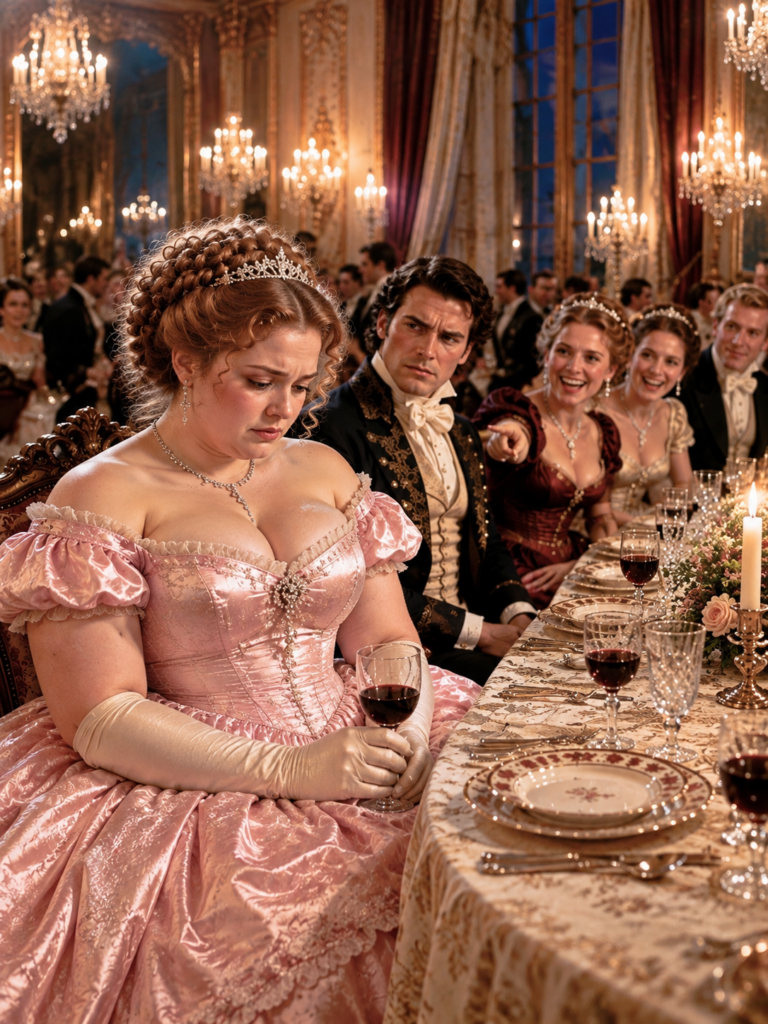
Twenty guests filled the dining room beneath chandeliers whose candles softened the stern portraits on the walls. White roses stood in silver bowls. Crystal glittered beside porcelain imported during Nathaniel’s grandfather’s lifetime.
The Italian delegation had been seated among the Virginians rather than isolated at one end.
Abigail had prepared small cards identifying the dishes in both English and Italian.
Conte Ferretti appeared delighted.
“A considerate touch, Your Grace.”
“My father’s business brought many foreign visitors to our table,” she replied. “He believed guests should never be made strangers merely because of language.”
Marchetti, seated nearby, looked up.
“Your father was in trade?”
“He was.”
“How interesting.”
His smile was practiced.
She knew immediately that he had recognized her name.
Vivien Caldwell arrived shortly afterward.
She was beautiful in the disciplined manner of a woman who understood precisely what beauty could purchase. Her dark green gown was expensive without appearing extravagant. Her manner toward Nathaniel suggested a familiarity no amount of politeness could entirely disguise.
“My dear Nathaniel,” she said, offering her hand. “Your home has never looked lovelier.”
Nathaniel greeted her courteously.
“Vivien, may I present Abigail?”
Miss Caldwell examined the new duchess.
“So this is the lady who has taken us all by surprise.”
“I hope pleasantly,” Abigail said.
“Naturally.”
Vivien’s eyes traveled briefly over Abigail’s blue silk gown.
It was borrowed from a cousin.
The alteration at the shoulder was almost invisible.
Almost.
Dinner began.
For the first hour Abigail believed she had succeeded.
The guests complimented the food. Ferretti spoke optimistically of imported grapevines. Nathaniel discussed river transport and future contracts.
Yet Abigail noticed details.
Marchetti repeatedly checked a folded packet in his coat.
Silas Crowell, Nathaniel’s business agent, watched him whenever he believed no one was looking.
Senator Caldwell and Ferretti spoke in low voices about river access.
And Vivien smiled whenever Abigail was addressed, as though waiting for the moment her new position would become too heavy to bear.
That moment arrived during the second course.
Vivien leaned toward Marchetti and began speaking in Italian.
“She is rather plain, isn’t she?”
Marchetti glanced toward Abigail.
“Plain enough. The dress improves her.”
“I believe it was borrowed.”
A younger member of the delegation laughed.
“A dock clerk’s daughter wearing borrowed silk at a duke’s table.”
Vivien concealed a smile behind her glass.
Marchetti continued.
“Her father had a rather unfortunate reputation in Philadelphia.”
“Fraud, was it not?”
“Among other things.”
“And now his daughter has married well.”
“Poverty can make people extraordinarily obedient.”
Vivien looked down the table.
“She certainly understands that she has been fortunate.”
Abigail remained perfectly still.
She had been answering a question from an elderly landowner about preserving peaches.
She finished her answer.
She even smiled.
Then the younger Italian merchant spoke again.
He used an old Genoese expression, something about a completed signature and a document prepared in advance.
Marchetti laughed.
Only briefly.
But Abigail heard it.
Every syllable.
The sound of the dining room seemed to recede.
She was no longer beneath chandeliers in Virginia.
She was in her father’s office in Philadelphia, staring at a folded warning written in ink that had faded to brown.
The signature is already on the paper.
She turned her head.
“Signor Marchetti.”
She spoke in Italian.
The merchant looked up.
Abigail placed her glass beside her plate.
“Would you repeat what you have just said concerning my father?”
Marchetti blinked.
Vivien’s smile froze.
“I beg your pardon?”
“In Italian,” Abigail replied pleasantly. “The language you were using a moment ago.”
Conversation faltered around the table.
Abigail looked from one face to another.
“You described me as plain. You observed that my gown was borrowed. You suggested that my father’s disgrace had made me grateful enough to accept any place offered to me, and obedient enough never to question the man who offered it.”
A heavy silence settled.
Vivien lowered her glass.
Marchetti attempted a smile.
“Your Grace, there has been a misunderstanding.”
“Then perhaps you will explain it.”
“I am afraid your knowledge of Italian—”
“My knowledge of Italian,” Abigail interrupted softly, “is sufficient to distinguish an insult from a compliment.”
No one moved.
Even the servants seemed to have become part of the furniture.
She looked toward Vivien.
“Miss Caldwell, I shall not object to the language you choose at my table. But I would ask that you not use it as a curtain behind which to speak of my dead father.”
Vivien flushed.
Abigail turned back to Marchetti.
“And there is one other matter.”
The merchant’s smile disappeared.
“Your associate used a particular Genoese phrase.”
She repeated it.
The younger man’s face changed.
Not greatly.
But enough.
Abigail noticed the sudden stillness of his fingers around the stem of his glass.
“That phrase,” she continued, “appeared in a letter delivered to my father shortly before he was accused of falsifying shipping documents.”
Marchetti set down his fork.
“I cannot imagine what relevance—”
“Neither can I. Yet I find it interesting that a warning concerning a fraudulent signature should contain the same unusual expression used this evening by a representative of the company now negotiating with Bell Haven.”
Silas Crowell shifted in his chair.
Abigail saw him.
She understood that she had said more than she intended.
But there was no withdrawing the words.
She changed to English.
“I make no accusation. I merely wish everyone present to understand that I intend to examine the commercial documents associated with this agreement before my husband signs anything further.”
Senator Caldwell cleared his throat.
“Surely these matters are best left to gentlemen experienced in commerce.”
Abigail looked at him.
“My father was experienced in commerce, Senator.”
The old man stiffened.
“And that experience did not protect him from men who understood the usefulness of a dishonest document.”
Nathaniel rose.
All conversation ceased.
He stood at the head of his own table, regarding the guests who had insulted his wife in a language they believed she could not understand.
Then he said, with unmistakable calm:
“My wife has asked a reasonable question. I suggest it be answered.”
Marchetti’s face darkened.
“There is nothing to answer.”
“Then there should be nothing to fear from an examination.”
Nathaniel did not raise his voice.
He did not need to.
“The signing of the agreement will be postponed until my wife and I have reviewed the supporting papers.”
The declaration struck the table more forcefully than any shouted accusation.
Silas Crowell’s expression hardened.
Senator Caldwell looked furious.
Vivien stared at Abigail as though seeing her for the first time.
And Marchetti’s eyes revealed something far more dangerous than embarrassment.
Fear.
Abigail understood then that the secret which had followed her father to his grave was not buried in Philadelphia.
It had crossed the Atlantic.
It had entered Bell Haven beneath the protection of wealthy men.
And she had just told those men that she knew where to begin looking.
Part 2
Nathaniel came to Abigail’s room shortly after midnight.
She was sitting by the window, still wearing her dinner gown, with an old letter spread across her lap.
The house had gone quiet.
Outside, cicadas sounded among the trees, and a distant thunderstorm flickered beyond the river.
He knocked upon the open connecting door.
“May I come in?”
She nodded.
He entered carrying a candle.
For a moment neither spoke.
Then he said, “I owe you an apology.”
Abigail looked up.
“For what?”
“For allowing guests beneath my roof to treat you as though you were beneath them.”
“You did not understand what they were saying.”
“I understood enough.”
His answer unsettled her more than a defense would have.
He placed the candle on the table.
“I believed myself a reasonably attentive host. Tonight I discovered that I was so concerned with protecting my business arrangements that I failed to protect the dignity of my wife.”
Abigail folded the letter.
“I am capable of defending my own dignity.”
“I saw that.”
There was no condescension in his voice.
“But you should not have needed to do so alone.”
She looked away.
No one had said such a thing to her before.
After her father’s trial, even sympathetic acquaintances had advised patience, silence, and restraint.
They had praised her courage while quietly requesting that she demonstrate less of it.
Nathaniel pulled a chair toward the table.
“What did you recognize tonight?”
Abigail hesitated.
She had guarded her father’s letter for years.
A dozen people had dismissed it. Some had laughed. Others had suggested that grief had turned her imagination toward conspiracy.
She had promised herself she would never again expose it to someone unwilling to understand.
Yet Nathaniel had postponed a commercial agreement that might rescue his estate.
He had done so without knowing whether she possessed more than a suspicion.
She unfolded the paper.
“My father received this three days before his arrest.”
Nathaniel took it carefully.
He read the Italian passages, then her English notes.
“The writer knew there was a forged signature.”
“Yes.”
“And believed your father was being prepared as the scapegoat.”
“Yes.”
“Who sent it?”
“I never discovered.”
Nathaniel studied the faded ink.
“Why was he accused?”
“Several insured cargoes were listed as lost at sea. The vessels had arrived elsewhere and sold their goods privately. Someone altered the manifests to make those disappearances appear legitimate.”
“And your father’s signature?”
“Appeared on the translations certifying the losses.”
“But he denied signing them.”
“He denied it until the day he died.”
Nathaniel looked toward her.
“And you believed him.”
“I knew him.”
“People can disappoint those who know them.”
Her face tightened.
“Do you think he lied?”
“No.”
The answer came immediately.
She stared at him.
Nathaniel laid the letter on the table.
“I think a man who forged commercial papers once might do so again. And I think the people seated at our table tonight were considerably more alarmed than innocent men ought to have been.”
Abigail felt the first painful stirrings of hope.
“You would help me?”
“I have already made the agreement dependent upon our investigation.”
“You may lose it.”
“I may.”
“You may lose the estate.”
His expression grew grave.
“That possibility existed before you spoke tonight. I was simply too trusting to recognize it.”
Abigail was silent.
Then she told him about the workers.
The false wage records.
The unexplained debts.
Luca Moretti.
And the three letters she had copied from the household accounts.
M.T.P.
Nathaniel listened without interrupting.
When she finished, he stood.
“Silas has managed these affairs for four years.”
“I know.”
“My father’s creditors recommended him.”
“That may be important.”
“Abigail, he has had complete access to Bell Haven’s financial records.”
She met his eyes.
“Then we should examine records he did not prepare for your inspection.”
Nathaniel looked at her for a long moment.
Then he extended his hand.
“Come to the study.”
The business office at Bell Haven occupied two rooms beyond the library.
Silas Crowell kept them locked.
His explanation had always been that commercial documents required careful protection from servants, careless visitors, and damp air.
Nathaniel had accepted the arrangement.
He accepted it no longer.
The iron key turned reluctantly.
Inside, the air smelled of leather, dust, and sealing wax.
Abigail began with the correspondence cabinets.
Nathaniel opened the lower drawers of the writing desk.
For the next three hours they worked beneath candlelight.
They found unpaid supplier invoices that had never appeared in the monthly summaries.
They found payments transferred through intermediary companies.
They found references to Meridian Trade Partners.
And finally, hidden among ordinary property valuations, Abigail discovered seven separate instruments pledging portions of Bell Haven’s river frontage as security for debts Nathaniel had never authorized.
He examined them one by one.
“These are not my signatures.”
“They resemble yours.”
“They are not mine.”
Abigail turned the last document toward the light.
“Look here.”
Beneath the signature stood the name of an attorney.
Edwin Fenwick.
Nathaniel recognized it.
“Fenwick represents Senator Caldwell.”
The silence that followed was terrible.
Abigail looked down at the papers.
“The men arranging your commercial agreement also hold claims against your land.”
“And if the agreement fails?”
“They may insist upon repayment.”
“If I cannot repay?”
“They acquire the river frontage.”
Nathaniel sat heavily.
For the first time Abigail saw him without the protective composure that seemed almost part of his title.
He looked like a man who had discovered that the floor beneath his home had been hollowed out while he slept.
“My father did everything he could to ruin this estate,” he said quietly. “I believed I had spent ten years repairing the damage.”
Abigail did not comfort him with false assurances.
“You repaired what you could see.”
He gave a bitter smile.
“And trusted Silas to guard what I could not.”
She moved closer.
“Trust is not foolishness when someone has worked to deserve it.”
“It becomes foolishness when one refuses to examine the evidence.”
“My father trusted the wrong men.”
Nathaniel looked at her.
“And I have repeated his error?”
“Perhaps.”
He absorbed that.
Then he reached for another ledger.
“Very well. We shall be more careful from now on.”
It was nearly dawn when Abigail found a letter from Fenwick dated nine days earlier.
Its language was obscure, full of phrases concerning liability, settlement, and labor adjustments.
But one sentence was clear.
The prepared declaration shall be produced following the necessary incident.
Abigail read it twice.
“What incident?”
Nathaniel leaned over her shoulder.
She pointed.
He frowned.
“A declaration from whom?”
“Perhaps the workers.”
“But why would a settlement require an incident?”
She looked toward the window.
Morning light was entering the gardens.
Far beyond the house stood the eastern masonry works.
And beyond those, a wooden storehouse containing tools, records, and imported materials.
Her stomach tightened.
“I think we should send someone to the workers immediately.”
They were too late.
The storehouse burned before noon.
Flames rose above the fields in a violent orange column. Smoke swept across the irrigation works. Men ran with buckets from the river, but by the time the fire was extinguished, the building and its contents were destroyed.
Pettis claimed he had seen Luca Moretti near the storehouse shortly before the fire.
Another man supported his statement.
The sheriff arrested Luca that afternoon.
Nathaniel returned from the scene grim-faced.
Abigail met him in the hall.
“He did not do it.”
“We do not yet know who did.”
“I know who benefits.”
Nathaniel removed his hat.
“So do I.”
He handed her a paper recovered from a nearby shed.
It was a fragment of a labor register.
The visible entries concerned deductions from the Italian workers’ wages.
Someone had attempted to burn it.
Someone else had removed it before the fire reached that building.
“Who found this?” Abigail asked.
“Thomas.”
Her eyes widened.
“He was helping with the water buckets. He saw Pettis carrying papers toward the storehouse before the alarm was raised.”
“Will he testify?”
“He says he will.”
“Then we must go to the sheriff.”
“We shall.”
Nathaniel paused.
“But there is something else.”
He showed her a receipt bearing Luca’s name.
It stated that the mason had accepted responsibility for certain unpaid travel charges.
Abigail studied the handwriting.
“That is not Luca’s signature.”
“His mark appears at the bottom.”
“Then someone has put his mark on a document he may not have understood.”
Nathaniel’s expression darkened.
“How can you tell?”
“Because the Italian phrasing is wrong.”
She explained that the document used terms from a banking agreement rather than a worker’s declaration.
The errors were not ordinary mistakes.
They suggested that one English legal instrument had been adapted into an Italian form by someone more concerned with enforceability than accuracy.
“They are manufacturing his consent,” she said.
Nathaniel looked toward the windows.
“And if they can make him responsible for the fire, they can make the labor debts his obligation.”
“While presenting the dispute as settled.”
He turned to her.
“Then we must obtain every original contract.”
Abigail reached into her pocket.
“Luca gave me copies before the fire.”
Nathaniel stared.
“You have them?”
“Several.”
She hesitated.
“There is something I should have told you earlier.”
He waited.
“I spoke with Silas about the wage discrepancies before the dinner.”
Nathaniel closed his eyes briefly.
“When?”
“Three days ago.”
“What did you tell him?”
“Enough to know that I was investigating.”
He opened his eyes.
“Abigail.”
“I know.”
“Did you mention Luca?”
“Not by name.”
“But he could have discovered who spoke with you.”
“Yes.”
She expected anger.
Instead Nathaniel pulled out a chair.
“Sit down.”
She did.
He sat opposite her.
“Why did you approach Silas before coming to me?”
The question hurt because she knew he deserved an answer.
“Because I did not know whether you would choose the truth if it threatened your estate.”
He did not move.
She continued.
“Men assured my father they believed him. They praised his honesty. They promised to stand beside him. And when their own money or reputations became endangered, they disappeared.”
Nathaniel watched her quietly.
“I did not want to discover that about you.”
“By giving me no opportunity to prove otherwise?”
She looked down.
“Yes.”
He was silent for some time.
Then he said, “That was unfair.”
“I know.”
“But perhaps understandable.”
She raised her head.
“I am not asking you to excuse it.”
“Good. Because we cannot afford to make the same mistake again.”
He held out his hand across the table.
“Whatever we discover, we discover together.”
Abigail took it.
His fingers closed around hers.
It was the first time either had touched the other without the formality of their wedding vows.
Neither withdrew immediately.
Vivien Caldwell came calling the next afternoon.
Abigail received her in the small drawing room.
Vivien wore pale yellow instead of the green silk she had displayed at dinner. She looked tired, though her posture remained immaculate.
“I have come to apologize,” she said.
Abigail waited.
Vivien sat.
“What I said at dinner was cruel. I knew you might understand more than the others believed, but I thought the possibility too remote to matter.”
“A curious measure of whether cruelty is acceptable.”
Vivien accepted the rebuke.
“Yes.”
Abigail regarded her carefully.
“Why did you do it?”
For the first time, Vivien appeared uncertain.
“I expected to marry Nathaniel.”
“I know.”
“For many years it was understood.”
“Was it understood by Nathaniel?”
Vivien looked away.
“That is the question I should have asked long ago.”
The admission was unexpected.
Abigail remained silent.
Vivien folded her hands.
“I was angry that you had taken a place I imagined belonged to me. And I was ashamed of being angry at a woman who had done nothing to injure me.”
“Yet you injured me.”
“Yes.”
Abigail studied her.
She recognized genuine embarrassment.
She also recognized fear.
“There is something else, Miss Caldwell.”
Vivien stiffened.
“Your father is associated with Meridian Trade Partners.”
The color left her face.
“Why do you say that?”
“Because his attorney’s name appears on property instruments associated with the company.”
Vivien’s eyes moved toward the door.
“Those are business matters.”
“They may also be criminal matters.”
“My father is a senator.”
“A title does not make a forged signature genuine.”
Vivien rose abruptly.
Abigail remained seated.
“Miss Caldwell, I am not asking you to condemn your father without evidence.”
“Then what are you asking?”
“Whether you are willing to tell me the truth about what you know.”
Vivien stood motionless.
Finally she said, “I know that my father has been trying to acquire Bell Haven’s river landing for years.”
Abigail felt her pulse quicken.
“Why?”
“Because it is the only practical deep-water access between two stretches of privately held riverbank.”
“And Nathaniel would not sell?”
“Never.”
“Then your father needed another means of acquiring it.”
Vivien said nothing.
Abigail stood.
“Did you know about the labor contracts?”
“No.”
“The forged debts?”
“No.”
“The plan to accuse an innocent man of arson?”
Vivien stared at her.
“Arson?”
Abigail saw genuine shock.
She explained what had happened.
As she spoke, Vivien’s composure deteriorated.
When Abigail finished, the other woman moved slowly toward the window.
“My father introduced Marchetti to Nathaniel,” she whispered.
“Yes.”
“And Silas Crowell?”
“Was recommended through your father’s associates.”
Vivien pressed her fingertips against the window frame.
“I thought they were arranging a marriage.”
Abigail frowned.
“What?”
“My father believed Nathaniel would eventually have to accept financial assistance. He intended to offer it upon the condition that Nathaniel marry me.”
Abigail looked at her.
“And when Nathaniel married someone else?”
Vivien turned.
“Father was furious.”
The room was very still.
“Was the agreement arranged before our marriage?” Abigail asked.
“Most of it.”
“Then the scheme may have begun as an effort to control whom Nathaniel married.”
Vivien lowered her eyes.
“And become something worse.”
Abigail approached her.
“Your father has documents we need.”
Vivien looked up sharply.
“You are asking me to betray him.”
“I am asking you to decide whether loyalty requires protecting every wrong a person commits.”
Vivien’s face tightened.
“He is my father.”
“I know.”
Abigail’s voice softened.
“I know exactly how much that means.”
For a long time neither woman spoke.
Then Vivien said, “There is a locked cabinet in his Richmond office.”
“What is inside?”
“I do not know. But Fenwick has delivered papers there twice this month, and Father told the servants no one was to enter.”
“Could you find out?”
Vivien drew a slow breath.
“Perhaps.”
Abigail waited.
Finally Vivien straightened.
“I cannot promise anything.”
“I would not ask you to promise what you cannot give.”
Vivien moved toward the door.
At the threshold she stopped.
“Abigail?”
“Yes?”
“I truly am sorry.”
Abigail considered her.
“I believe you.”
Vivien appeared grateful.
But Abigail continued.
“An apology is a beginning, Miss Caldwell. What you do next will tell me whether it means anything.”
For three days Bell Haven existed beneath a peculiar silence.
Silas Crowell continued his duties as though nothing had happened.
Pettis supervised the masons with increasing severity.
Marchetti demanded that the commercial agreement proceed.
And Senator Caldwell sent a letter informing Nathaniel that further delay might be interpreted as an act of bad faith.
Nathaniel answered that he would not sign disputed documents.
Meanwhile Abigail worked.
She compared the original labor contracts to the revised accounts.
She interviewed the masons individually, using Thomas as a witness whenever possible.
She assembled a list of unauthorized deductions and identified three documents that appeared to carry copied signatures.
Then a new document arrived.
It came in the leather satchel of Alderman Ross, a commercial magistrate from Richmond, accompanied by Senator Caldwell’s attorney, Fenwick.
They were received in Nathaniel’s study.
Abigail stood beside her husband.
Ross opened the satchel.
“We have obtained a voluntary confession from the Italian laborer, Luca Moretti.”
Abigail felt cold.
Nathaniel extended his hand.
“Let me see it.”
Ross presented the papers.
“It establishes that Moretti caused the fire through negligence and accepts responsibility for the resulting loss.”
“And his wages?”
“Applied against his obligations, naturally.”
Abigail looked at the document.
The Italian original occupied two pages.
The English translation occupied three.
She read them both.
Then she looked up.
“This is not a confession.”
Ross blinked.
“I beg your pardon?”
“The Italian document is a petition.”
She laid the pages upon Nathaniel’s desk.
“It requests review of the worker’s outstanding wage claims. It refers to the fire only as an event requiring investigation.”
Fenwick smiled thinly.
“Your Grace, commercial translation is a specialized discipline.”
“Yes,” Abigail replied. “It is.”
She pointed to a paragraph in the English text.
“These sentences do not exist in the Italian original.”
Ross leaned forward.
“Which sentences?”
“Those acknowledging responsibility for the fire, accepting the travel debt, and releasing the employer from outstanding wages.”
Fenwick’s smile faded.
Abigail continued.
“The petition Luca believed he was signing has been represented as an admission of guilt.”
Silas Crowell, standing near the doorway, spoke for the first time.
“Mrs. Pembroke’s linguistic abilities are undoubtedly impressive, but she is not a sworn commercial translator.”
“No,” Abigail said. “I am not.”
Ross straightened.
“Then perhaps we should obtain an independent opinion.”
“I would welcome one.”
Marchetti entered before anyone could respond.
He had evidently been waiting outside.
“An independent opinion is unnecessary,” he declared. “The duchess has misunderstood a regional expression.”
He pointed to a word in the second paragraph.
“She has interpreted this term as an obligation when it means an agreement.”
Abigail examined it.
He was correct.
The archaic abbreviation had a narrower meaning than the one she had initially supplied in her notes.
For one terrible instant she remembered her father’s courtroom.
The judges.
The lawyers.
The careful men who used one small mistake to convince everyone that an entire defense was unreliable.
She felt the old fear rise.
Then she placed her hand flat upon the desk.
“You are correct about that word, Signor Marchetti.”
He looked startled.
“It is more accurately translated as an agreement.”
Fenwick’s expression brightened.
Marchetti turned triumphantly toward Ross.
“You see?”
“Yes,” Abigail said. “We have established that I chose one imperfect English equivalent.”
She raised the two documents.
“Now I ask you to show me where the Italian petition states that Luca Moretti set fire to the storehouse.”
Marchetti’s smile vanished.
“Your Grace—”
“Please. The sentence is clearly present in the English version. Show us its Italian equivalent.”
He said nothing.
Abigail waited.
The silence lengthened.
“Perhaps,” she continued, “you can show us the words by which he agrees to surrender his unpaid wages.”
Marchetti looked at Fenwick.
Fenwick looked at Ross.
Neither spoke.
Nathaniel stepped forward.
“Gentlemen, until an independent examination is completed, this document will not be accepted as evidence on my estate.”
Ross looked increasingly uncomfortable.
Fenwick gathered the papers.
“You are challenging an official proceeding.”
“I am challenging a false translation,” Nathaniel answered.
Marchetti’s face became hard.
“You do not understand the commercial consequences of this decision.”
Nathaniel looked directly at him.
“I am beginning to understand them very well.”
The visitors departed without obtaining their signatures.
But they left something behind.
As Ross closed his satchel, a folded slip of paper fell to the carpet.
Thomas retrieved it after the men had gone.
It was a receipt for a transfer of documents between Fenwick’s office and Senator Caldwell’s private residence.
The transfer had been made two days before the storehouse fire.
Abigail read the description.
Declaration — labor incident — Moretti.
She looked at Nathaniel.
The confession had been prepared before the fire.
Now they could prove it.
That evening a letter arrived from Vivien.
It contained no greeting.
Only one sentence.
Come to the old chapel tomorrow before sunrise, and bring no one associated with my father.
Abigail showed it to Nathaniel.
He read it.
“She has found something.”
“Or someone has persuaded her to bring us somewhere isolated.”
Nathaniel looked at her with a faint smile.
“You are becoming suspicious of everyone.”
“I find the habit useful.”
“We shall go together.”
At dawn they rode to the abandoned chapel beyond Caldwell’s property.
Vivien waited beneath the broken bell tower.
Her gown was mud-stained.
Her face looked as though she had not slept.
In her hands she held a leather portfolio.
“I found the cabinet,” she said.
Abigail dismounted.
Vivien handed her the portfolio.
Inside lay correspondence between Senator Caldwell, Fenwick, and Meridian Trade Partners.
There were instructions concerning the acquisition of Bell Haven’s river landing.
References to Silas Crowell.
And a series of letters discussing the use of labor disputes to create additional claims against Nathaniel’s property.
Nathaniel turned a page.
His expression went rigid.
“This is my father’s handwriting.”
Abigail looked up.
“What?”
He held out a letter dated seven years earlier.
It authorized Meridian to acquire certain shipping interests in Philadelphia.
The document contained the name Edmund Hartwell.
Abigail recognized her father immediately.
She scanned the page.
Then another.
The signatures were genuine.
The arrangement was real.
Nathaniel’s father had invested in the very company associated with her father’s downfall.
And the final letter contained a sentence that caused Abigail’s breath to catch.
The Hartwell difficulty has been resolved. The translator will bear responsibility, and the remaining partners shall suffer no exposure.
She stared at the words.
For three years she had searched for the people who destroyed her father.
Now she held proof that Nathaniel’s family had profited from the scheme.
Nathaniel read the letter.
The color drained from his face.
He said nothing.
Vivien stepped back.
“I did not know.”
Abigail barely heard her.
She looked at the man she had begun, against every instinct, to trust.
“Your father knew.”
Nathaniel’s voice was low.
“Yes.”
“Your family benefited.”
“It appears so.”
“My father lost everything.”
Nathaniel met her eyes.
“I know.”
Something in Abigail broke.
Not because Nathaniel had lied.
He had not.
But because the past had reached into the one place where she had begun to believe she might be safe.
She stepped away.
“Abigail—”
“Do not.”
He stopped.
She held the letter tightly.
“Your father knew what was done to mine.”
Nathaniel did not deny it.
And in the gray light beneath the ruined chapel tower, Abigail understood that the mystery she had spent years pursuing was no longer separate from her marriage.
The truth could clear her father’s name.
It could also destroy her husband’s.
Part 3
Abigail did not return to Bell Haven with Nathaniel.
She rode in Vivien’s carriage to a small inn on the Richmond road and remained there for two days.
Nathaniel did not follow.
He sent a letter the first evening.
She did not open it.
On the second morning, Vivien came to her room carrying breakfast.
“You cannot avoid him forever.”
“I am not avoiding him.”
“Then what are you doing?”
“Thinking.”
Vivien placed the tray on the table.
“About leaving?”
Abigail looked toward the window.
“About what loyalty means when the truth requires you to condemn someone you love.”
Vivien sat opposite her.
“I have been considering much the same question.”
“And what have you decided?”
“That loving my father does not require me to become him.”
Abigail turned.
Vivien’s face was drawn, but her voice was steady.
“He knew innocent men were being cheated. He knew people would suffer. Perhaps he convinced himself that commerce requires harsh decisions. Perhaps he never cared. I cannot change what he has done.”
“No.”
“But I can decide whether I help him continue.”
Abigail looked at the unopened letter on the table.
“And Nathaniel?”
Vivien followed her gaze.
“He is not his father.”
Abigail’s eyes filled unexpectedly.
“I know that.”
“Then perhaps the question is whether he knows it.”
At Bell Haven, Nathaniel spent those two days examining his father’s private correspondence.
He found evidence of financial involvement with Meridian.
He found payments disguised as investments.
He found letters showing that the elder duke had known Edmund Hartwell was innocent.
But he found something else.
His father had begun to fear the company he had helped establish.
Six years earlier, shortly before his death, he had attempted to withdraw his remaining investments.
Meridian refused.
The company’s partners retained copies of documents implicating him in the Philadelphia fraud.
They threatened exposure.
And so Nathaniel’s father had continued paying.
That was the origin of several mysterious debts Nathaniel had inherited.
He had believed them gambling obligations.
Now he understood they were payments made to conceal an older crime.
The discovery did not absolve his father.
It made the crime worse.
The elder duke had known the truth.
He had possessed opportunities to expose it.
Instead he had paid to preserve his name.
Nathaniel read the letters until his eyes burned.
Then he wrote to Abigail.
I cannot undo what my father did.
I cannot ask you to forgive him, nor can I ask you to protect his memory.
But I will not repeat his choice.
If clearing your father’s name requires the public ruin of mine, I shall give you every document I possess.
He signed it simply.
Nathaniel.
Abigail opened his letter the following morning.
She read it once.
Then again.
When she finished, she folded it carefully.
“Have Thomas prepare the carriage,” she told the innkeeper’s wife.
She returned to Bell Haven before noon.
Nathaniel was waiting in the library.
He stood when she entered.
For a moment they faced each other across the polished floor.
“I read your letter,” she said.
He nodded.
“I meant every word.”
“I know.”
She approached the desk.
On it lay three piles of documents.
He had organized the evidence by date and company.
Even in crisis, Nathaniel remained painfully methodical.
“My father committed a crime,” he said.
“Yes.”
“He permitted an innocent man to suffer for it.”
“Yes.”
Nathaniel looked at her.
“I cannot ask you to regard him kindly.”
“I do not.”
“I understand.”
Abigail placed his letter beside the evidence.
“But I did not marry your father.”
Nathaniel went very still.
She continued.
“And I did not marry the title he left you. I married a man who came to my room after his guests insulted me and apologized for not defending me sooner.”
His expression changed.
“A man who listened when I told him my father was innocent. A man who went to the sheriff because I said Luca Moretti had been falsely accused.”
“Abigail—”
She shook her head.
“Let me finish.”
He fell silent.
“You may lose money because of this. You may lose the estate. People who have called you honorable may decide that your father’s conduct stains your own.”
“I know.”
“Are you prepared for that?”
Nathaniel answered without hesitation.
“Yes.”
Abigail looked at him for a long moment.
Then she reached for his hand.
“Then I will stand beside you.”
He closed his fingers around hers.
Neither spoke.
The distance that had stood between them since their wedding did not disappear through some dramatic declaration.
It yielded quietly.
Through a decision.
Through the knowledge that both understood the cost.
Nathaniel lifted her hand and pressed it to his lips.
“Together,” he said.
“Together.”
They needed more than correspondence.
Senator Caldwell’s letters established intent.
The forged documents suggested conspiracy.
But the case would become far stronger if they could show that the supposedly independent commercial witnesses had been paid to support false claims.
Thomas provided the next clue.
The young underbutler had been frightened since the fire, though he had continued his duties with outward composure.
One evening he asked to speak privately with Abigail.
She received him in the morning room.
“Your Grace, I think I may know the man who accused Luca.”
“The witness?”
“Yes.”
“What do you know?”
Thomas swallowed.
“He came to the stables three nights before the fire.”
“Why?”
“He said he was looking for employment.”
“And?”
“Mr. Pettis met him. They spoke behind the carriage house.”
“Did you hear them?”
“Only part.”
Abigail leaned forward.
“What part?”
“Mr. Pettis said the man would be paid after he gave his statement.”
Thomas looked ashamed.
“I thought it was some ordinary arrangement. I did not understand.”
Abigail’s heart quickened.
“Would you tell this to a magistrate?”
Thomas looked toward the window.
“My father works the south fields, ma’am. My mother lives in one of the estate cottages.”
“I know.”
“If Mr. Crowell loses his position, perhaps we shall all be turned out.”
Abigail understood the fear.
She also understood how men like Silas and Caldwell depended upon it.
She stood.
“Thomas, no one will lose their home because they tell the truth.”
“Can you promise that?”
Abigail hesitated.
The old instinct rose: to offer reassurance because the boy needed it.
But her father had taught her that promises were debts.
She would not incur one lightly.
“I can promise that Nathaniel and I will do everything within our power to protect you. I cannot promise that telling the truth will cost nothing.”
Thomas studied her.
Then he nodded.
“I will testify.”
It was the courage of an ordinary young man.
And it would matter enormously.
The hearing took place in Richmond twelve days later.
It was not a grand trial beneath a magnificent dome.
It was conducted in a crowded municipal chamber with tall windows, wooden benches, and the oppressive heat of a Virginia summer.
Two magistrates presided.
The sheriff stood near the door.
Merchants, landowners, laborers, and curious townspeople filled the room.
Senator Caldwell occupied the front bench.
Beside him sat Fenwick.
Marchetti and Silas Crowell stood together near the witness table.
Abigail entered with Nathaniel.
Conversation subsided.
She wore the gray dress that had belonged to her mother.
It was modest, unfashionable, and entirely her own.
Nathaniel noticed.
He offered his arm.
She took it.
Vivien was already seated near the front.
She had come despite her father’s command that she remain at home.
Luca Moretti sat behind her with the other Italian workers.
He looked pale but determined.
The proceedings began with the commercial dispute.
Fenwick argued that Bell Haven had entered binding obligations with Meridian and that Nathaniel’s attempt to withdraw constituted a breach of good faith.
He presented the financial instruments.
He presented the labor settlement.
He presented Luca’s supposed confession.
Then Nathaniel rose.
“Before these documents are accepted, I ask that their authenticity be examined.”
Fenwick looked impatient.
“On what grounds?”
“Forgery.”
The room stirred.
Nathaniel laid the original correspondence upon the table.
“These instruments contain signatures that were not made by me. They reference debts I never authorized. And they were prepared by parties who stood to acquire my land if those debts could not be paid.”
Fenwick began to object.
Nathaniel continued.
“I also submit letters from my late father’s private papers establishing Meridian Trade Partners’ involvement in previous fraudulent commercial transactions.”
Senator Caldwell’s face hardened.
The magistrate looked up.
“Your father’s involvement, Your Grace?”
Nathaniel did not flinch.
“Yes.”
The room became very quiet.
“My father knowingly participated in arrangements that resulted in the conviction of an innocent shipping clerk, Edmund Hartwell of Philadelphia.”
Abigail closed her eyes briefly.
She had imagined hearing those words for years.
Yet when they were finally spoken, she felt no triumph.
Only the terrible weight of how long the truth had been buried.
The magistrate leaned forward.
“You understand the significance of your statement?”
“Entirely.”
“And you are willing to testify to it under oath?”
“I am.”
Nathaniel took the oath.
Then he placed his family’s disgrace before the court.
He did not defend it.
He did not diminish it.
He did not attempt to make himself appear heroic for exposing it.
He simply answered every question.
And Abigail loved him more profoundly in that hour than she had believed possible when they married.
The following witnesses changed the direction of the hearing.
Thomas testified about the unknown man at the carriage house.
Another servant confirmed seeing Pettis carry documents toward the storehouse shortly before the fire.
Luca presented copies of the original Italian labor contracts.
Abigail explained the differences between the signed petition and the English confession.
This time there was an independent translator present.
An elderly Genoese merchant named Bellini, whose reputation in Virginia commercial circles was beyond dispute.
He reviewed both documents.
He examined the contested abbreviation.
Then he turned to the magistrates.
“Her Grace is correct.”
Marchetti moved sharply.
Bellini continued.
“The Italian original contains no admission that the signatory caused the fire. It contains no agreement to surrender the wages owed to him. Those claims appear only in the English text.”
Fenwick objected.
Bellini ignored him.
“The discrepancy is not an innocent matter of regional vocabulary. Whole sentences have been inserted.”
The senior magistrate looked toward Marchetti.
“Can you explain this?”
The merchant’s face was rigid.
“I did not prepare the translation.”
“Who did?”
“That was handled by our legal advisers.”
Fenwick stood.
“This is improper speculation.”
Abigail rose.
“Then perhaps Mr. Fenwick can explain why the declaration was recorded in his correspondence two days before the fire.”
She handed the receipt to the court clerk.
The magistrate examined it.
He looked at Fenwick.
“Two days before?”
Fenwick said nothing.
Abigail laid the earlier letter beside it.
“The correspondence refers to a planned incident after which a prepared declaration would be produced. The confession now before the court was described before the event it purports to explain.”
The magistrate read the papers carefully.
Then he looked toward Luca.
“Mr. Moretti, did you knowingly confess to causing the fire?”
Bellini translated the question.
Luca stood.
“No, sir.”
“Did you agree to surrender your unpaid wages?”
“No, sir.”
“Then why did you place your mark upon the petition?”
Luca took a breath.
“Because I was told it would help me recover what the company owed.”
Bellini translated.
The magistrate turned slowly toward Fenwick.
“That is a serious discrepancy.”
Abigail remained standing.
“There is one more matter.”
She removed a narrow paper from her portfolio.
It was her father’s letter.
The original anonymous warning.
“The company represented in these proceedings is connected to an earlier fraud in Philadelphia. This letter warned my father that a document bearing his signature had already been prepared.”
She turned toward Marchetti.
“At a dinner in my home, your associate used the same unusual expression found in this letter.”
Marchetti stared at her.
“Many people use old expressions.”
“Certainly.”
Abigail nodded.
“But remarkably few use them while discussing fraudulent commercial signatures.”
She placed another document beside it.
A letter from Senator Caldwell’s cabinet.
The same phrase appeared in its margin.
This time it was accompanied by a notation identifying the person responsible for preparing the false contracts.
R. Ricci — translation and certification.
The young merchant from the dinner table was seated near the back.
His face turned white.
Abigail faced him.
“Signor Ricci, did you prepare the English version of Luca Moretti’s petition?”
He did not answer.
Marchetti spoke sharply in Italian.
Ricci flinched.
Abigail turned toward the magistrates.
“May the witness be directed not to receive instructions from another party?”
The magistrate ordered Marchetti to remain silent.
Ricci looked toward the door.
Then toward Luca.
Finally he whispered something Bellini could barely hear.
“I was told the men would be paid.”
The magistrate leaned forward.
“Speak clearly.”
Ricci swallowed.
“I translated the documents.”
“Who instructed you?”
He hesitated.
Marchetti’s expression became murderous.
Ricci stared at his hands.
“Mr. Fenwick.”
The room erupted.
The magistrate called for order.
Fenwick rose, furious.
“This is an outrageous falsehood.”
Ricci began to tremble.
“They gave me the English sentences. I was told to attach them to the Italian petition. I said the meanings were different.”
“And what were you told?” the magistrate demanded.
Ricci looked at Fenwick.
“That no one who mattered would read both.”
Silence followed.
It was the kind of silence Abigail remembered from her father’s courtroom.
Only this time it belonged to the men who had relied upon being believed.
Senator Caldwell attempted to leave before the hearing concluded.
Vivien rose from her seat.
“Father.”
He stopped.
She stood in the aisle, pale but composed.
“Please stay.”
His face reddened.
“This does not concern you.”
“It concerns everyone whose trust you used.”
“You do not understand business.”
Vivien looked directly at him.
“Perhaps not. But I understand that you knew Nathaniel would never sell you his river landing, so you arranged to acquire it through debts he had never agreed to.”
Caldwell’s expression hardened.
“Be careful.”
Vivien’s voice shook.
Yet she continued.
“I have spent my life being careful. I have been careful not to ask what your business partners did. Careful not to examine the money that paid for my gowns. Careful not to disturb the picture you wished the world to see.”
Tears stood in her eyes.
“I will not be careful about this.”
Caldwell looked at her as though she had struck him.
For a moment Abigail felt pity for them both.
Not because the senator deserved protection.
But because she understood what it meant to watch the name of a parent change forever.
The magistrates ordered the relevant business records secured and directed that the allegations of forgery, false testimony, arson, and commercial fraud be referred for further criminal proceedings.
The disputed labor confession was rejected.
The alleged debt instruments were suspended from enforcement pending examination.
Luca was released from the accusations arising from the falsified confession.
The workers’ unpaid wage claims were recognized as requiring independent accounting.
And the court ordered that the original evidence concerning the Philadelphia fraud be preserved and transmitted to the proper authorities.
It was not the clean, instantaneous victory of a theatrical tale.
No bell rang.
No official declaration erased the suffering of years.
Abigail’s father remained dead.
The wages remained unpaid until recovered.
Bell Haven’s finances remained dangerously uncertain.
And the men responsible still had the opportunity to defend themselves in further proceedings.
But something essential had changed.
For the first time, the written record contained the truth.
The immediate aftermath was difficult.
Silas Crowell was removed from his position.
Pettis disappeared before the sheriff could question him again.
Fenwick faced investigation.
Marchetti’s commercial affairs in Virginia were halted while the disputed records were examined.
Senator Caldwell resigned from his position on the regional trade committee as inquiries into his financial dealings widened.
Bell Haven lost the promised investment in its vineyards.
Several creditors demanded reassurance.
And Nathaniel discovered that exposing his father’s dishonesty had frightened away certain families who once proudly called themselves his friends.
One evening, after another exhausting meeting with creditors, he found Abigail in the library.
She was studying a map of the river frontage.
He stood behind her.
“We may have to sell the northern woodland.”
She nodded.
“I know.”
“And delay the vineyards.”
“Probably.”
“And reduce the household staff.”
Abigail turned sharply.
“No.”
Nathaniel raised an eyebrow.
“Abigail—”
“The servants did not commit these frauds.”
“No. But the estate cannot spend money it does not possess.”
“Then we must find another way.”
He looked at the map.
“What do you suggest?”
She pointed toward the eastern irrigation works.
“The water channel is nearly complete.”
“Yes.”
“The workers are skilled.”
“Very.”
“And we have nearly a hundred acres of land that remain poorly cultivated because there is no reliable irrigation.”
Nathaniel studied her.
“You are suggesting we complete the works ourselves?”
“Without Meridian. Without Caldwell. Without an outside company controlling the labor contracts.”
“With what money?”
She reached for the account book.
“The estate owns timber we can sell responsibly. We have grain contracts that can be renegotiated. And if we delay the ornamental improvements planned for the main house, we could redirect those funds.”
Nathaniel looked incredulous.
“You intend to sacrifice the new ballroom?”
“I have never been especially fond of ballrooms.”
He laughed.
It surprised them both.
The sound was warm, unguarded, and entirely unlike the restrained gentleman who had received her as his bride.
Abigail smiled.
“Besides, the present ballroom is adequate.”
“It is forty years old.”
“So am I, almost, by the standards of certain members of Virginia society.”
“You are twenty-six.”
“And already considered unsuitable by half your acquaintances.”
Nathaniel took her hand.
“Then half my acquaintances possess remarkably poor judgment.”
He drew her closer.
For a moment the estate’s debts, its scandals, and the uncertainty of the future seemed very far away.
“You have changed this house,” he said.
Abigail shook her head.
“I have only opened a few books.”
“No.”
He touched her cheek gently.
“You have made me see that a house is not saved by preserving its appearance. It is saved by deciding what must never be sold.”
She regarded him.
“And what must never be sold?”
He answered quietly.
“The people who trust us. The truth. The right to look one another in the eye.”
Then he kissed her.
Not as a duke claiming a bride.
Not as a gentleman fulfilling a marital obligation.
But as a man who had finally learned that love was less about possessing certainty than choosing someone through uncertainty.
And Abigail, who had spent so many years defending herself against disappointment, allowed herself to believe him.
By September, Bell Haven had begun to change.
The Italian masons remained, this time under new agreements reviewed in both languages and witnessed independently.
Their wages were recorded publicly in the estate books.
Luca Moretti accepted the position of master mason.
When Nathaniel offered him the appointment, Luca asked whether the title carried authority to refuse unsafe work.
Nathaniel considered the question.
“Yes.”
“And to question the accounts?”
“Certainly.”
Luca looked at Abigail.
“Then perhaps this is a different kind of agreement.”
She smiled.
“I should hope so.”
The irrigation works were completed before the first autumn frost.
Water entered the lower fields through a channel built of pale stone.
The estate’s accounts remained strained, but the harvest was better than expected.
Several neighboring landowners, impressed by the quality of the masonry, began negotiating directly with Luca and his workers rather than through foreign trading agents.
For the first time since arriving in America, the men possessed bargaining power.
They could accept work.
They could refuse it.
They could insist upon payment according to the terms they understood.
Abigail considered that a greater victory than any speech she had made in a courtroom.
The Philadelphia proceedings moved slowly.
Documents had to be authenticated.
Former officials questioned.
Surviving witnesses located.
But early in October, a letter arrived bearing the seal of the reviewing authorities.
Abigail received it at breakfast.
Nathaniel watched as she broke the wax.
She read the first page.
Then the second.
Her hands began to tremble.
“Abigail?”
She could not answer.
He came around the table.
She held out the letter.
The review had concluded that substantial evidence supported Edmund Hartwell’s claims of forged signatures and manipulated shipping records.
A formal petition to correct the record of his conviction had been accepted for further action.
The authorities had not yet completed every legal step necessary to reverse the judgment.
But they had acknowledged that the evidence on which he had been condemned was profoundly compromised.
His innocence was no longer merely his daughter’s insistence.
It had become a matter documented by surviving records and supported by the testimony of those involved.
Abigail folded the letter.
For years she had imagined this moment.
She had imagined shouting.
Crying.
Laughing at the memory of every person who had told her to abandon the matter.
Instead she sat very still.
Nathaniel knelt beside her chair.
“Your father would be proud.”
She shook her head slowly.
“He would be angry that it took so long.”
Nathaniel smiled sadly.
“Then perhaps he would be both.”
Abigail looked down at the letter.
“He will never know.”
Nathaniel took her hand.
“No. But those who come after him will.”
The tears came then.
Not violently.
Not with the desperation of her younger grief.
They came quietly, as though some long-closed door within her had finally opened.
Nathaniel held her.
And for the first time since her father’s death, Abigail did not feel that defending his memory was a task she must carry alone.
Vivien Caldwell returned to Bell Haven in late October.
She arrived without the elaborate carriage or attendants she had once considered essential.
Her father remained under investigation.
Several families had ceased inviting her to their gatherings.
She had moved into a modest house belonging to an aunt.
Abigail received her in the morning room.
For a time they discussed ordinary matters.
The weather.
The harvest.
The roads after recent rain.
Then Vivien looked toward the stack of books upon Abigail’s desk.
“What are those?”
“Grammar books.”
“Italian?”
“Some. French and Portuguese as well.”
Vivien picked one up.
“Why so many?”
Abigail smiled.
“I am thinking of opening a small schoolroom.”
“For the estate children?”
“For anyone whose work or circumstances would improve through reading, writing, or languages. The workers have asked whether lessons might be arranged for their families. Some of our servants have expressed interest too.”
Vivien considered this.
“Who would teach?”
“At first, I would.”
“And Nathaniel approves?”
“Nathaniel suggested using the west wing. It has better light.”
Vivien gave a small laugh.
“I cannot imagine the old duke permitting servants to study in his west wing.”
“Then perhaps it is fortunate the old duke is no longer making the decisions.”
Vivien grew quiet.
After a moment she said, “May I help?”
Abigail studied her.
“With the schoolroom?”
“Yes.”
“What could you teach?”
Vivien looked faintly offended.
“Music. French. Penmanship. History.”
Abigail raised an eyebrow.
“And humility?”
Vivien laughed unexpectedly.
“That is a subject in which I have only recently begun my education.”
Abigail joined her.
It was the first uncomplicated laughter they had shared.
“Then perhaps,” Abigail said, “we shall all learn something.”
By November, the schoolroom was ready.
Tables stood beneath the west-facing windows.
Shelves held books in English, Italian, and French.
Slates lay beside chalk and carefully trimmed quills.
Luca helped build the benches.
Thomas carried the books.
Mrs. Pell supervised the cleaning and announced, with her usual severity, that children would not be permitted to damage the curtains.
Vivien arrived twice weekly to teach music and French.
Abigail taught reading, writing, and commercial arithmetic.
Nathaniel occasionally joined them, though he insisted that the estate children had more need of her instruction than of his.
One evening he stood in the doorway and listened as Abigail explained the importance of comparing figures in an account.
“Numbers are useful,” she told her pupils. “But you must learn to ask who wrote them, why they wrote them, and whether they agree with the evidence before you.”
A young boy raised his hand.
“Can numbers lie, Your Grace?”
Abigail considered him.
“Numbers themselves do not lie.”
“Then what does?”
“Sometimes the people who arrange them.”
The boy frowned thoughtfully.
Nathaniel smiled from the doorway.
When the lesson ended, he waited until the children had departed.
“You are teaching them to become suspicious merchants.”
“I am teaching them not to become helpless ones.”
He crossed the room.
“An important distinction.”
She gathered the slates.
“Did you come to inspect my work?”
“I came to invite my wife to supper.”
“Then I hope she is expected to dress properly.”
“Her husband has become remarkably indifferent to such matters.”
Abigail laughed.
He took the books from her arms and placed them upon the desk.
Then he noticed a small framed object hanging above the fireplace.
It was her father’s letter.
Not the original.
A careful copy.
Beneath it Abigail had written an English translation of the warning that had begun her search.
The signature is already on the paper.
Nathaniel regarded it.
“An unusual decoration for a schoolroom.”
“It is a reminder.”
“Of what?”
“That understanding a language can be the difference between surrendering your future and defending it.”
He looked toward her.
“And of your father?”
“Always.”
Nathaniel took her hand.
They stood together in the fading light.
Outside, the last leaves had fallen from the oaks.
The fields beyond the house were brown and quiet.
Bell Haven was poorer than it had been when Abigail arrived.
Its commercial ambitions were more modest.
Its old reputation had suffered.
Yet the estate was no longer being slowly consumed by hidden debts.
Its workers knew the terms of their employment.
Its household accounts could be inspected.
Its children were being taught skills once reserved for those fortunate enough to inherit them.
And its duke had learned that honor could not be preserved through silence.
That winter, Abigail and Nathaniel held another dinner.
It was smaller than the gathering that had changed their lives.
There were no senators.
No financiers seeking control of the river.
No guests invited merely because their names appeared in the right social registers.
Luca Moretti attended with his wife, who had recently arrived from Italy.
Thomas dined with the family at Nathaniel’s insistence.
Vivien came carrying a small book she had purchased for the schoolroom.
Mrs. Pell accepted a seat only after declaring that the kitchen could not possibly function without her personal supervision.
Conversation flowed between English and Italian.
Some spoke both languages easily.
Others stumbled.
Everyone was helped.
At one point Luca told a story in Italian about his first winter in Virginia, when he had mistaken an enormous pumpkin for a vegetable grown only to feed horses.
The table erupted in laughter.
Abigail translated for those who had not understood.
Nathaniel watched her with quiet affection.
Then Luca raised his glass.
“To Her Grace.”
Abigail shook her head.
“No speeches.”
“One small speech,” Luca insisted.
He stood.
“When I came to this country, I did not understand its laws or its language. I thought men with money could write any words they pleased and make those words the truth.”
He paused.
“Then a woman came to the stoneworks and asked to see my wages.”
Several guests smiled.
Luca continued.
“She did not promise to save us. She promised to read.”
Abigail lowered her eyes.
“That was the beginning,” Luca said.
He lifted his glass higher.
“To the lady who read what others hoped would remain unread.”
The guests drank.
Abigail looked toward Nathaniel.
He lifted his own glass.
But he did not speak.
He merely smiled at her.
And she understood.
Twelve days after their marriage, she had stood at this same table beneath the gaze of people who believed her plain, powerless, and easily managed.
They had mocked her father’s poverty.
They had mistaken her silence for ignorance.
They had believed that a woman dressed in borrowed silk could be humiliated without consequence.
They had been wrong.
Yet the most important thing Abigail had gained was not the destruction of her enemies.
It was something they had never imagined she possessed the power to build.
A home where truth was not an inconvenience.
A marriage in which belief became action.
A future in which knowledge belonged to more than the wealthy and titled.
When the meal ended, Nathaniel offered her his arm.
They walked together through the corridor toward the west wing.
The schoolroom door stood partly open.
Inside, one candle remained burning upon a desk.
Abigail entered and carefully shielded the flame with her hand.
Nathaniel followed.
“Shall I extinguish it?”
She looked around the room.
The books.
The clean slates.
The benches made by the hands of men who had once been cheated of their wages.
The framed warning that had survived her father’s disgrace.
And the little window overlooking the dark Virginia fields.
“Not yet,” she said.
Nathaniel stood beside her.
They remained there for a moment, watching the small, steady flame.
Once, Abigail Hartwell had believed her life’s purpose was to prove that her father had spoken the truth.
She had succeeded in bringing that truth into the light, though the work of securing its full recognition continued.
But she understood now that vindication alone could never restore the years he had lost.
What she could do was ensure that his lessons survived.
That other people learned to read the papers placed before them.
That no one beneath her roof would be made powerless merely because they spoke a different language.
And that a title inherited from the past need not dictate the character of the future.
Nathaniel slipped his hand into hers.
“Are you happy?” he asked.
Abigail looked toward him.
The question surprised her.
She had spent so long fighting for justice that happiness had seemed an indulgence to be considered afterward.
Now afterward had arrived.
Not perfectly.
Not without grief.
But truly.
“Yes,” she said.
And smiled.
“Yes, Nathaniel. I believe I am.”
Outside, the winter wind moved through the bare branches.
Beyond the western windows, the river continued its patient journey toward the sea.
And inside Bell Haven, the candle burned a little longer.
Not because anyone was afraid of the darkness.
But because, at last, the house had become a place where people were learning how to see.


