
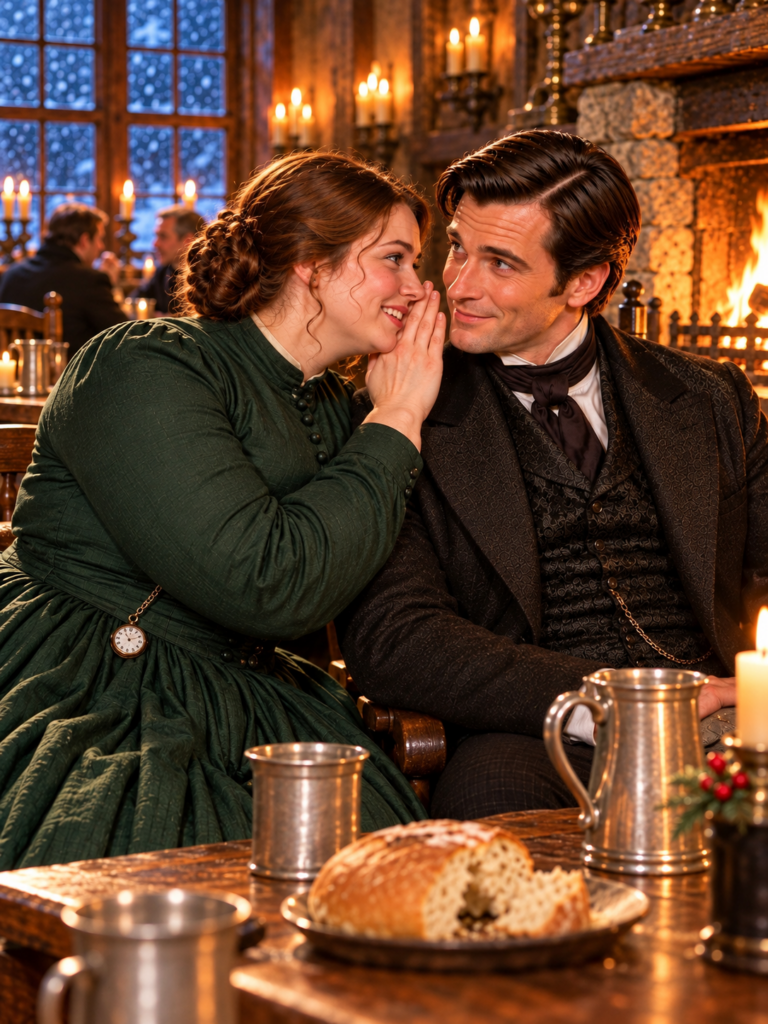
Part 1
“The Duke of Ravenshire must be eighty years old by now.”
The gentleman sitting across the hearth paused with his coffee halfway to his lips.
He was thirty-four.
For several seconds, he said nothing. Then he lowered his cup and regarded the young woman opposite him with an expression of the most careful consideration.
“Eighty?” he repeated.
“At the very least.”
“And what leads you to that conclusion?”
“The usual evidence. An enormous house, an ancient title, an estate that occupies half the countryside, and a complete absence of anything interesting said about its owner.”
The gentleman looked toward the fire.
“I see.”
“I imagine him sitting alone in a cold drawing room, surrounded by portraits of dead relatives, complaining about the weather and refusing to replace the furniture.”
“That sounds rather uncomfortable.”
“For the furniture, certainly.”
The gentleman laughed.
It was a quiet, unexpected sound, and Eleanor Whitcomb looked at him with mild surprise.
He had not seemed a man particularly inclined toward amusement.
Outside the Fox and Lantern Inn, a December blizzard had swallowed the North Yorkshire road. Snow crowded against the lower windowpanes, the wind rattled the shutters, and the narrow track leading toward the market town of Bellwick had disappeared beneath a drifting sheet of white.
Eleanor had arrived two hours earlier after the coach carrying her north had suffered a broken axle.
The coachman had examined the damage, muttered several words unsuitable for polite company, and announced that no blacksmith would venture into the storm before morning.
Eleanor had accepted this news with greater composure than the coachman expected.
At twenty-six, she had already learned that indignation seldom repaired broken machinery.
She had gathered her small traveling case, her leather account book, and the basket of provisions her mother had packed that morning. Then she had followed the innkeeper’s lantern through the snow.
The stranger had been sitting by the hearth when she entered.
He was tall, dark-haired, and dressed in a wool coat of excellent quality, though without the ornamentation favored by gentlemen eager to advertise their fortunes.
His face was composed rather than handsome in any obvious fashion. There was something watchful about his gray eyes, and his hands bore the faint marks of a man who occasionally used them for purposes other than signing documents.
He had risen when Eleanor entered.
He had offered her the chair nearest the fire.
Most importantly, he had not attempted to entertain her with an account of his accomplishments.
Eleanor appreciated that last consideration immensely.
Now, however, she was beginning to enjoy his conversation.
“Perhaps,” the gentleman suggested, “the Duke is simply a private man.”
“Perhaps. But privacy and dullness are not mutually exclusive.”
“Nor are age and wisdom, I suppose.”
“Certainly not. Though I have met several old gentlemen whose age was their only achievement.”
The stranger smiled again.
“Then the Duke should consider himself fortunate never to have met you.”
“Oh, I suspect he would survive the experience.”
“Barely, perhaps.”
Eleanor laughed, surprising herself.
The innkeeper, Mr. Edwin Pritchard, entered with a fresh pot of tea. He glanced at the gentleman, then at Eleanor, and appeared to decide that whatever conversation was taking place required no assistance from him.
He placed the tray on the table.
“Will there be anything else, Your—”
The gentleman gave him a brief look.
Mr. Pritchard stopped.
“Anything else, sir?”
“No, thank you.”
The innkeeper withdrew, his expression almost painfully neutral.
Eleanor noticed nothing.
She was examining the faded wooden sign above the mantelpiece.
Its gold lettering was still legible beneath decades of smoke.
By Appointment to His Grace, the Duke of Ravenshire.
“There,” she said, pointing. “You see? Even this inn belongs to his history.”
“The present Duke’s grandfather granted that appointment.”
“Then perhaps my estimate of eighty was conservative.”
The stranger bent his head.
For a moment, Eleanor thought he might be coughing.
In fact, Nathaniel Ashcombe, Eleventh Duke of Ravenshire, was trying very hard not to laugh.
He had inherited the title eleven years earlier, following the sudden death of his father.
Since that day, strangers had treated him as though he had been born wearing a coronet.
Men flattered him before he spoke. Women carefully measured their smiles. Servants apologized when he entered rooms in which they had every right to be.
He had grown accustomed to discovering what people wanted from him long before discovering who they were.
Yet here sat a young woman with snow-damp skirts and a plain traveling dress, informing him that he was probably eighty years old and exceptionally boring.
And she was sharing her supper with him.
Eleanor opened her basket, removed a loaf of bread, and divided it with a small knife.
“Have you eaten?”
“Not recently.”
“Then take this.”
She handed him the larger half.
He accepted it.
“You are very generous.”
“Not especially. You look hungrier than I am.”
It was the sort of straightforward statement Nathaniel had not heard in years.
He looked at the bread in his hand.
“Thank you, Miss—”
“Whitcomb. Eleanor Whitcomb.”
“Mr. Vale,” he replied after the smallest hesitation.
It was an old family name, one that belonged to his mother’s ancestors.
He did not think of it as a lie until afterward.
“And what takes you north, Miss Whitcomb?”
“Employment.”
“What kind?”
“Accounts. Records. Debts. The correction of mistakes made by men who are quite certain they have made none.”
Nathaniel raised an eyebrow.
“A demanding occupation.”
“Only when the men become involved.”
He laughed again.
She explained that she had been engaged by Walter Fenwick, a wool merchant in Bellwick whose business had become entangled in years of disorderly bookkeeping.
The letter offering her employment had been polite, if somewhat doubtful.
Mr. Fenwick had apparently assumed that the experienced bookkeeper recommended to him as E. Whitcomb was a middle-aged gentleman.
Eleanor had not corrected the misunderstanding.
“I prefer to be judged after my work has been examined,” she said.
“That seems reasonable.”
“It is astonishing how often reasonable things offend people.”
Nathaniel studied her.
“And you are quite certain you can repair Mr. Fenwick’s accounts?”
“No.”
He seemed surprised.
“No?”
“I have not examined them properly. Certainty before evidence is a poor habit.”
She spoke without pride, simply stating a principle.
Then she reached into her pocket and withdrew a silver watch.
It was old, the casing scratched and its chain repaired with a small brass link.
She opened it, compared its hands to the clock on the inn wall, and smiled.
Nathaniel noticed.
“Is something amusing?”
“It is two minutes slow.”
“Does that amuse you?”
“Every day.”
“Why not have it repaired?”
Her expression changed.
Not dramatically. There was no sudden sorrow, no theatrical silence.
But Nathaniel saw her thumb move gently across the worn silver.
“It belonged to my father,” she explained. “He was a solicitor in York. He said the watch was not slow. The rest of the world was unnecessarily hurried.”
“A remarkable defense of faulty machinery.”
“He was very good at arguments.”
“I imagine he was.”
“He died three years ago.”
Nathaniel said nothing.
Eleanor closed the watch.
“He left debts behind. Nothing dishonest. Illness can be expensive, and pride often prevents sensible arrangements. My mother sold the house. I took over some of his office work. Eventually, I discovered that I was rather better at keeping accounts than most of the men who had taught me.”
“And now you are traveling north.”
“Yes.”
“To begin again?”
She considered the question.
“To continue,” she answered. “Beginning again suggests that everything before has been lost. I don’t believe that.”
Nathaniel looked at the silver watch.
He understood then why she had smiled at its imperfection.
The watch was not valuable because it kept accurate time.
It was valuable because, in some small and stubborn way, it continued to keep her father near.
He looked toward the windows, where snow pressed against the glass.
“My father died when I was twenty-three,” he said.
Eleanor’s face softened.
“I am sorry.”
“He left me a great many responsibilities.”
“Were you prepared?”
“Not remotely.”
“Then perhaps we have something in common.”
Nathaniel nodded.
“Perhaps we do.”
They remained beside the fire until the inn clock struck ten.
When Eleanor rose, Nathaniel stood.
“I wish you success with your wool merchant.”
“And I wish you a safe journey, Mr. Vale.”
She paused beside the staircase.
“May I offer one final observation?”
“Please.”
“If you ever meet the Duke of Ravenshire, tell him he should make himself useful. There is no reason a man ought to spend eighty years merely possessing things.”
Nathaniel bowed gravely.
“I shall endeavor to pass along your advice.”
She disappeared upstairs.
The instant her door closed, Mr. Pritchard emerged from behind the counter.
“Your Grace.”
Nathaniel held up one hand.
“Not a word.”
The innkeeper’s mouth twitched.
“Very good, Your Grace.”
“And, Pritchard?”
“Yes?”
“Do I look eighty?”
Mr. Pritchard examined him with professional seriousness.
“Not by candlelight, Your Grace.”
Nathaniel laughed so loudly that the innkeeper nearly dropped the glass he was polishing.
It was the first time anyone at the Fox and Lantern had heard the Duke of Ravenshire laugh like that.
By morning, the worst of the storm had passed.
Eleanor was downstairs before sunrise, examining the papers Mr. Fenwick had sent with her letter of employment.
Nathaniel found her at a table near the hearth.
She had spread the records in careful rows.
Beside them stood her silver watch.
“Good morning, Miss Whitcomb.”
“Good morning, Mr. Vale.”
“Are those the troublesome accounts?”
“A preliminary selection.”
“And?”
“They are either the work of a criminal genius or a very confused honest man.”
“Which do you suspect?”
“The latter.”
“Why?”
“Because the mistakes are consistent. Dishonesty usually conceals itself. Confusion is often quite proud of its methods.”
He smiled.
Then he noticed a figure she had circled.
“Why does that payment appear twice?”
Eleanor looked up sharply.
“An excellent question.”
“Have I interrupted?”
“On the contrary. You may have earned your breakfast.”
They bent over the papers together.
Nathaniel understood enough about estate finances to recognize that she was tracing the relationship between advances paid to wool suppliers and the later delivery of finished cloth.
Her explanations were clear, precise, and utterly free of condescension.
After several minutes, he realized she was testing his understanding just as carefully as he was testing hers.
It pleased him more than he expected.
Then the stable door opened.
A groom entered, bowed, and announced that a horse had arrived from Ravensmere Hall.
“For His—”
“Mr. Vale,” Nathaniel said smoothly.
The groom hesitated.
“Of course, sir.”
Eleanor looked from one man to the other.
Ravensmere Hall was the seat of the Duke of Ravenshire.
She remembered every uncharitable observation she had made the previous evening.
She also noticed the groom’s deference.
When Nathaniel returned to the table, her manner had become slightly more formal.
“You work for the estate?”
“In a manner of speaking.”
“Then I owe you an apology for my remarks about its owner.”
“Why?”
“Because I was speaking without knowing the man.”
Nathaniel regarded her.
“That is true.”
Eleanor blinked at his frankness.
Then he added, “But you were also entertaining, and I fear I encouraged you.”
“Most unfairly.”
“Entirely.”
She gathered her papers.
“I hope your master is less ancient than I have imagined.”
Nathaniel’s eyes brightened.
“He has moments of surprising energy.”
“Then perhaps there is hope for him.”
They parted outside the inn.
Eleanor climbed into the repaired coach.
Nathaniel stood beside the stable yard, watching until the carriage disappeared into the whitening distance.
He told himself he would probably never see her again.
Yet that evening, back at Ravensmere Hall, he found himself examining the estate’s wool contracts with unusual interest.
Three days later, Eleanor Whitcomb arrived at Walter Fenwick’s office on King Street.
The merchant was a stout, anxious man in his fifties, with ruddy cheeks and the expression of someone who had been trying to remember an important appointment for several years.
He stared at Eleanor.
“Miss Whitcomb?”
“Yes.”
“I was expecting—”
“A bookkeeper?”
“Well, naturally, but—”
“Then your expectations have been satisfied.”
He coughed.
She placed her leather notebook on his desk.
“May I examine your ledgers?”
Within an hour, Mr. Fenwick had forgotten his disappointment.
Within three days, he had become worried that he was paying her too little.
By the end of the first week, Eleanor had discovered why his accounts refused to balance.
His former clerk had maintained three separate systems: one for outstanding debts, one for payments received, and a third for private adjustments known only to himself.
No money had been stolen.
But entries had been duplicated, postponed, and transferred without explanation.
Eleanor produced a report identifying the errors and proposing a single method for recording transactions.
Mr. Fenwick read it twice.
Then he removed his spectacles.
“My dear Miss Whitcomb, you have accomplished in six days what three gentlemen failed to do in six months.”
“That is because the gentlemen assumed someone was stealing from you.”
“And you did not?”
“I prefer not to accuse people until the numbers require it.”
Mr. Fenwick rose and shook her hand.
From the adjoining room, his senior clerk, Leonard Briggs, watched with reluctant admiration.
He had originally considered Eleanor a temporary inconvenience.
He was beginning to fear she might become indispensable.
Then, on a bitter morning in January, the bell above the office door rang.
Mr. Fenwick hurried forward.
His cheerful greeting dissolved into alarm.
“Your Grace!”
Eleanor’s pen stopped.
From the front room came a familiar, composed voice.
“Good morning, Fenwick. I hope I have not arrived at an inconvenient time.”
The pen slipped from Eleanor’s fingers.
She looked toward the doorway.
The gentleman from the Fox and Lantern stood beneath the lintel in his dark wool coat.
Mr. Vale.
Except he was not Mr. Vale.
And the wool merchant was bowing to him.
Deeply.
Nathaniel met her eyes.
For the first time since their meeting, he looked distinctly uncertain.
“Miss Whitcomb,” he said.
Eleanor rose slowly.
She remembered the fire.
The bread.
The conversation.
The eighty-year-old Duke.
Then she looked at Walter Fenwick.
“Mr. Fenwick,” she asked in a perfectly controlled voice, “would you kindly tell me who our visitor is?”
The merchant looked horrified.
“Why, Miss Whitcomb, this is His Grace, Nathaniel Ashcombe, Duke of Ravenshire.”
Silence settled over the room.
Nathaniel inclined his head.
Eleanor stared at him.
And then she said the one thing he had never expected.
“Thirty-four,” she murmured.
The Duke looked startled.
Eleanor folded her hands.
“Not eighty.”
Part 2
Nathaniel had faced creditors, angry tenants, parliamentary officials, and a distant cousin who once threatened to challenge his inheritance.
None had made him feel quite as uncomfortable as Eleanor Whitcomb did while standing beside her desk.
Walter Fenwick looked between them.
“Do you know one another?”
“We have met,” Nathaniel answered.
“At an inn,” Eleanor added.
“During a snowstorm.”
“Where His Grace neglected to mention an important detail.”
Fenwick went pale.
“Miss Whitcomb—”
“It is quite all right,” Nathaniel said.
But Eleanor was not looking at her employer.
She was looking at him.
“And Mr. Vale?”
“A family name.”
“Yours?”
“My mother’s.”
“How fortunate that you found one available.”
Nathaniel almost smiled.
Almost.
“I owe you an apology.”
“Yes,” she said. “I believe you do.”
Mr. Fenwick appeared to wish the floor would open beneath him.
Nathaniel looked at the merchant.
“Would you permit us a moment?”
Fenwick departed so quickly that he struck his elbow against the doorframe.
The room became quiet.
Eleanor waited.
Nathaniel removed his gloves.
“I had no intention of deceiving you when we first began speaking.”
“You merely continued after you discovered the opportunity.”
“That is fair.”
“Did you find my ignorance amusing?”
“Not your ignorance.”
“Then what?”
“Your honesty.”
She studied him.
He continued.
“You did not ask what I owned. You did not inquire about my family. You offered me half your supper and told me plainly what you believed. I had nearly forgotten what such conversation felt like.”
Eleanor’s anger diminished, though it did not disappear.
“You could have told me the truth the following morning.”
“I should have.”
“Why didn’t you?”
Nathaniel hesitated.
“Because I was afraid everything would change.”
“And so you allowed me to continue believing something false.”
“Yes.”
It was a simple admission.
Eleanor appreciated it more than any elaborate excuse.
She sat.
“Very well. You are forgiven.”
Nathaniel released a breath.
“Thank you.”
“Provided you never again introduce yourself to me under an assumed name.”
“You have my word.”
“Good. Now, Your Grace, I understand you have business with Mr. Fenwick.”
He glanced at the open ledger.
“As a matter of fact, I do.”
Ravensmere Hall purchased substantial quantities of finished wool from Fenwick’s merchants.
Nathaniel had come to discuss a spring contract involving blankets and heavy cloth for estate workers.
But after the contract was settled, he found himself returning to Eleanor’s desk.
“May I ask your opinion of something?”
“If it concerns these accounts.”
“It does.”
He indicated a column of figures.
“What happens if the spring shearing is delayed three weeks?”
Eleanor examined the totals.
“The merchants in Leeds would expect delivery on the original date.”
“Precisely.”
“Then Mr. Fenwick would either buy wool at a premium elsewhere or fail to meet his obligations.”
“And which course would you recommend?”
“Neither. I would renegotiate the delivery dates now, while no one has yet suffered a loss.”
Nathaniel nodded.
“That is what I hoped you would say.”
Eleanor looked up.
“Did you?”
He smiled.
“Perhaps I was curious whether your talent extends beyond rescuing damaged accounts.”
“It extends to preventing new ones.”
That answer stayed with him.
Over the following weeks, Nathaniel returned to the office several times.
His visits were always accompanied by some legitimate question concerning estate purchases, transport costs, supplier terms, or the price of wool.
Yet Leonard Briggs began to notice that His Grace rarely required more than a few minutes with Walter Fenwick.
He spent considerably longer speaking with Miss Whitcomb.
Briggs told no one directly.
He merely observed, in the hearing of the office messenger, that the Duke seemed extraordinarily interested in bookkeeping.
By the following afternoon, half of King Street had reached conclusions.
Eleanor ignored the whispers.
She had more important matters to consider.
What troubled her was not the gossip but the possibility that her work might become secondary to her acquaintance with Nathaniel.
She had labored too hard to establish herself.
She would not become an amusing novelty in the life of a wealthy gentleman.
One evening, after the other clerks had departed, she remained at her desk reconciling a difficult account.
Snow fell softly beyond the windows.
At nearly eight o’clock, someone knocked.
Nathaniel stood in the doorway.
“I saw your light.”
“I am working.”
“I suspected as much.”
“Then you understand why I cannot receive visitors.”
“Perfectly.”
He made no attempt to enter.
“I shall be at the Fox and Lantern for supper. If you finish your work and would care for some company, there will be a chair beside the fire.”
Eleanor looked at him.
“And if I do not?”
“Then I hope your figures behave themselves.”
He bowed and left.
She remained still for several moments.
Then she returned to her calculations.
An hour later, when the final figures balanced, she closed the ledger, fastened her coat, and walked through the snow.
The Fox and Lantern was warm and nearly empty.
Nathaniel was waiting beside the hearth.
The chair opposite him had been left unoccupied.
Mr. Pritchard arrived with two cups of coffee and immediately retreated.
Eleanor sat.
“You have an unusual talent, Your Grace.”
“For what?”
“Waiting without making a performance of it.”
Nathaniel considered this.
“I have often found that waiting is more effective when the other person is free to disappoint you.”
She looked down at her coffee.
“An unusual philosophy for a duke.”
“Perhaps I am an unusual duke.”
“You certainly have an unusual sense of humor.”
He smiled.
For a while they spoke of ordinary things.
Then Eleanor asked about Ravensmere.
Nathaniel described an estate that had belonged to his family for generations, with farms, mills, cottages, woodland, and a small village clustered around an old stone church.
He spoke of drainage problems in the lower fields, tenants who struggled through wet winters, and the cost of repairing roofs before spring rains.
Eleanor listened with increasing interest.
“You know the details,” she observed.
“I try to.”
“Most owners would leave such matters to their stewards.”
“My steward does most of the daily work. But responsibility does not disappear merely because a man hires someone competent.”
She studied him over the rim of her cup.
For the first time, she began to understand something about Nathaniel Ashcombe that his title did not explain.
He was not merely wealthy.
He considered himself answerable for what his wealth allowed him to influence.
Several days later, an official letter arrived at Walter Fenwick’s office.
Ravensmere Hall required a review of its accounts with the merchant before renewing a significant supply agreement.
The task was entrusted to Eleanor.
She completed the examination without favor.
A few entries required correction. A debt previously thought overdue had actually been settled. A disputed shipment had been recorded under the wrong date.
Her final report showed that Fenwick’s business was sound.
Nathaniel came to collect it.
He read the document carefully.
“You have saved him a considerable sum.”
“I have shown him where his money was already going.”
“Which is frequently the more useful achievement.”
Then he asked a question that changed the direction of her life.
“Have you ever considered managing the finances of a large estate?”
Eleanor looked up.
“I have considered it often.”
“Would you consider Ravensmere?”
She was silent.
Nathaniel continued.
“My land steward, Edmund Harcourt, is a good man. He knows every farm, every tenant, every boundary, and every ditch on the estate. But the financial records have become confused through years of different clerks using different methods.”
“And you wish me to untangle them.”
“Yes.”
“What authority would I have?”
“As much as the work reasonably requires.”
“What salary?”
“A fair one.”
“That is not a figure.”
He laughed.
“No, Miss Whitcomb. It is not.”
She folded her hands.
“I would need to inspect the ledgers before discussing the position.”
“Of course.”
“And I would not accept special treatment because we are acquainted.”
“I would be disappointed if you did.”
She studied him for a long moment.
“Then send me the accounts.”
Two days later, a heavy wooden chest arrived at her lodgings.
Inside were ten years of records from Ravensmere Hall.
Eleanor spent three evenings examining them.
The books were disorganized, but the underlying finances were more disciplined than she expected.
Year after year, money had been allocated to cottage repairs, drainage, livestock, and agricultural improvements.
Many of these expenses produced no immediate financial return.
Yet they prevented hardship that would otherwise become more expensive later.
Then she discovered the school payments.
Every quarter, without interruption, a fixed amount had been sent to support the village school.
The payments continued during poor harvests.
They had been increased twice.
No revenue was recorded against them.
Eleanor checked the entries repeatedly.
The figures told a story.
Someone at Ravensmere had decided that the education of poor children mattered enough to remain protected when other expenditures were reduced.
She found herself thinking of Nathaniel beside the inn fire.
Of the bread he had accepted without embarrassment.
Of the attention he gave when others spoke.
She wrote him a letter.
It contained her proposed salary, the terms of her authority, a timetable for reorganizing the accounts, and the assistance she would require from the steward.
At the bottom, she added a single question.
Why has the village school’s allowance never been reduced?
Nathaniel’s answer arrived the following morning.
He accepted her professional terms.
Beneath his signature, he had written:
Because a child should not lose the chance to learn merely because his father’s harvest has failed.
Eleanor read the sentence twice.
Then she placed the letter beside her father’s watch.
For the first time, she wondered whether the man she had mocked at the inn might prove far more remarkable than any gentleman she had imagined.
She accepted the position.
Walter Fenwick was distressed to lose her, but he understood.
“You have been here scarcely two months,” he complained.
“Long enough to put the books in order.”
“And just when I had become accustomed to their being so.”
He shook her hand warmly.
“Make certain His Grace pays you properly.”
“I have already done so.”
Fenwick laughed.
“Then I pity his steward.”
On a clear February morning, Eleanor returned to the Fox and Lantern with her traveling case.
She expected an estate carriage.
Instead, Nathaniel arrived personally.
He stepped down into the courtyard and approached her.
“You came yourself,” she said.
“I did.”
“Was there business in Bellwick?”
“None whatsoever.”
She regarded him.
“Then why?”
“Because I wanted to.”
It was said without embarrassment.
Eleanor felt warmth rise unexpectedly to her cheeks.
Nathaniel held out his hand to help her into the carriage.
She accepted it.
During the journey north, they passed white fields, leafless trees, and farms nearly buried beneath snow.
After several miles, Nathaniel looked toward her.
“Miss Whitcomb, may I ask you something that has nothing to do with accounts?”
“You may ask.”
“May I hold your hand?”
Eleanor considered him.
There was no presumption in his expression.
Only hope.
She placed her hand in his.
For the remainder of the journey, they sat in companionable silence.
Ravensmere Hall appeared on a ridge above the valley.
It was a great stone house assembled over centuries, with an old central tower, Tudor wings, and later additions built in a more restrained style.
Eleanor had expected grandeur.
She found it.
But she noticed other things first.
The stable paths had been cleared.
Smoke rose from the tenants’ cottages.
The roofs appeared well maintained.
Even the small footbridge across the frozen stream had been repaired.
Nathaniel watched her.
“What do you think?”
“It is better cared for than I expected.”
“Not beautiful?”
“Certainly beautiful. But beauty is not much comfort to someone whose roof leaks.”
He smiled.
“I shall remember that.”
Her office occupied a room in the east wing, where three tall windows overlooked the winter gardens.
A large oak desk stood beneath the windows.
Shelves carried rows of ledgers.
A fire burned in the grate.
Eleanor set her father’s watch on the desk.
Then she began examining the records.
Edmund Harcourt arrived shortly afterward.
He was a broad, weathered man in his late fifties, with muddy boots and a skeptical expression.
He had managed Ravensmere’s land for twenty years.
The appointment of a young woman from Bellwick had not pleased him.
“Miss Whitcomb.”
“Mr. Harcourt.”
“I understand you wish to change the accounts.”
“I wish to understand them first.”
He grunted.
She opened her notebook.
“I have seventeen questions.”
Harcourt stared at her.
“Seventeen?”
“To begin with.”
His skepticism deepened.
Then she asked about the acreage under direct cultivation.
He answered.
She asked which farms had suffered flooding during the previous five winters.
He answered that too.
By the seventh question, he had pulled up a chair.
By the eleventh, he was drawing maps.
Within an hour, he was speaking to her as though they had worked together for years.
Nathaniel found them surrounded by documents and arguing cheerfully about the cost of drainage repairs.
He stood unseen in the doorway for several seconds.
Then he turned away, smiling.
His mother was waiting in the morning room.
Lady Margaret Ashcombe was a dignified widow with silver hair, sharp eyes, and very little patience for foolishness.
“Well?” she asked.
“Miss Whitcomb has been here three hours.”
“And?”
“Harcourt has given her all seventeen answers.”
Lady Margaret smiled.
“Then I imagine she is exactly what this house requires.”
Nathaniel sat opposite her.
“You have not met her.”
“I have read her letters.”
“That is hardly the same thing.”
“No,” Lady Margaret agreed. “But the woman who noticed the school expenditure before she noticed the silverware has already earned a favorable introduction.”
She paused.
“Your cousin Adelaide disagrees.”
Nathaniel sighed.
Lady Adelaide Wycliffe had spent much of her life treating family rank as an occupation.
She had written twice since hearing of Eleanor’s appointment.
Both letters contained warnings about unsuitable influences and the danger of allowing ambitious young women into positions of confidence.
“Adelaide believes every appointment should be approved by a committee of dead ancestors,” Nathaniel said.
“Then she must be deeply disappointed that they never answer her letters.”
Nathaniel laughed.
His mother studied him.
“You like this Miss Whitcomb.”
“Yes.”
“More than you have liked anyone in a long while.”
He did not answer.
Lady Margaret looked toward the window.
“Then be careful, Nathaniel.”
He straightened.
“Of what?”
“Of forgetting that affection does not erase the difference between a master and someone he employs. If she is as proud of her independence as her letters suggest, you must never make her wonder whether refusing you would cost her the life she is building.”
Nathaniel remained quiet.
He knew his mother was right.
That evening, Eleanor worked late in the east office.
At half past nine, Nathaniel appeared carrying a tray with supper.
“You missed dinner,” he said.
“I was occupied.”
“I gathered.”
He placed the tray on a side table.
“May I stay?”
“Provided you do not interfere with my work.”
“I shall endeavor to behave.”
He settled into the chair beside the fireplace with a book.
Eleanor resumed her calculations.
For nearly an hour, neither spoke.
When the fire burned low, Nathaniel rose and added wood.
When her lamp flickered, he adjusted the wick.
He did these things without announcing them.
Eleanor noticed.
She had spent much of her life explaining why she deserved to be taken seriously.
Here was a man who simply allowed her the space to do her work.
At last she closed the ledger.
“May I ask about the school?”
Nathaniel put aside his book.
“Certainly.”
“How many children attend?”
“Thirty-one at present.”
“And the teacher?”
“Mrs. Ellison. She receives a proper salary. My mother insisted upon it.”
“Wise of her.”
“Most people considered the expense unnecessary.”
“And you?”
“I considered it the most necessary expense on the estate.”
Eleanor looked toward the open accounts.
“Why?”
Nathaniel was silent for a moment.
Then he spoke.
“When I inherited Ravensmere, I discovered that several tenant families could not read the notices they were asked to sign. They depended upon someone else to tell them what they were agreeing to.”
“That is dangerous.”
“Yes.”
“So you opened the school.”
“My mother began the work. I continued it.”
“And you protected its funding.”
“I tried.”
Eleanor rested her fingers on the silver watch.
“My father believed that every person should understand the documents that govern his life.”
“Then we would have agreed.”
“I think you would.”
For a while, they sat quietly.
Outside, the snow drifted past the dark windows.
Then Nathaniel spoke.
“Eleanor, there is something I must tell you.”
She looked up.
He had never used her Christian name before.
“I did not employ you because I wished to keep you near me.”
“I know.”
“I employed you because Ravensmere needs your abilities.”
“I know that too.”
“But I cannot pretend that my feelings for you have remained professional.”
The room seemed suddenly still.
Nathaniel continued carefully.
“I have looked forward to your company since the evening at the inn. At first, I believed it was merely because you amused me. Later, because I admired your judgment. But somewhere along the way, I discovered that an ordinary day seemed incomplete without hearing what you thought of it.”
Eleanor said nothing.
He leaned forward.
“I love you.”
The words were simple.
They required no ornament.
Eleanor looked down at her hands.
Nathaniel continued.
“I know I am your employer. I know what a refusal might appear to cost you. So I want you to understand that your position, your salary, and your authority here are secure, whatever your answer may be.”
She looked at him then.
“And if I never return your affection?”
“I shall be disappointed.”
“And my work?”
“Will remain yours.”
She searched his face.
“You would truly allow me to remain?”
“Eleanor, I fell in love with the woman who argued over wool shipments and refused to accept a number without examining it. Why would I want to destroy the very qualities that drew me to her?”
Her eyes filled unexpectedly.
She looked away.
“I have spent years fighting to be useful on my own terms.”
“I know.”
“I will not surrender that.”
“I would never ask you to.”
She drew a slow breath.
“Then I must think.”
“Of course.”
“I cannot give you an answer tonight.”
“I have asked for your heart, not an account that must be balanced before midnight.”
She smiled faintly.
Nathaniel rose.
“Good night, Eleanor.”
“Good night, Nathaniel.”
After he left, she remained by the fire.
For the first time in years, she did not open another ledger.
Instead, she took her father’s watch into her hands and listened to its steady ticking.
She thought of the man who had offered her a chair by the fire.
The man who had listened while she mocked his title.
The man who had repaired cottages before their roofs failed and funded a school because children deserved the power to read.
Then she considered the question that frightened her most.
Could she love him without losing herself?
By morning, she believed she knew the answer.
But before she could give it, a letter arrived from Lady Adelaide Wycliffe.
It was addressed not to Nathaniel, but to Eleanor.
And its contents threatened to change everything.
Part 3
Lady Adelaide’s letter was written in the elaborate hand of a woman accustomed to having her opinions preserved.
Eleanor read it once.
Then again.
It contained no outright insult.
That would have been too crude for Lady Adelaide.
Instead, it offered sympathy for Eleanor’s circumstances and concern for her future.
It suggested that young women of modest means sometimes misunderstood the kindness of powerful gentlemen.
It observed that the Duke of Ravenshire had duties to his family and position.
And it advised Eleanor to consider whether continuing her employment at Ravensmere might invite an embarrassment that could have been avoided through a quiet resignation.
At the bottom was an offer.
Lady Adelaide would personally arrange a position for Eleanor with a respectable solicitor in London.
The salary would be generous.
The appointment would begin immediately.
Eleanor placed the letter on her desk.
For several minutes, she said nothing.
Then she opened her account book and returned to work.
By luncheon, however, Lady Adelaide herself had arrived.
Nathaniel was away inspecting storm damage at one of the outlying farms.
Lady Margaret was visiting the village school.
The visitor therefore found Eleanor alone in the east office.
Lady Adelaide entered without waiting to be announced.
She was a tall woman in a dark traveling gown, with an expression of elegant disapproval.
“Miss Whitcomb.”
“Lady Adelaide.”
“I trust you received my letter.”
“I did.”
“And?”
“I have not accepted your offer.”
Lady Adelaide looked around the office.
“My dear, you must understand that this arrangement cannot continue indefinitely.”
“Which arrangement?”
“This extraordinary intimacy between yourself and my cousin.”
Eleanor closed the ledger.
“If you have a concern about my work, I would be pleased to hear it.”
“Your work is not the point.”
“Then I fear you have come to the wrong office.”
Lady Adelaide’s cheeks colored.
“You are clever. I grant you that. But cleverness does not alter social realities.”
“No,” Eleanor agreed. “It merely makes them easier to examine.”
“You cannot seriously imagine that Nathaniel intends to marry you.”
Eleanor felt the words strike.
She had expected them.
That did not make them painless.
“I have made no such claim.”
“Good. Then perhaps we understand one another.”
Eleanor rose.
“Lady Adelaide, my employment here was offered because I am capable of performing it. His Grace and I have become friends, but any discussion of my personal life belongs to me, not to his relatives.”
“You speak boldly for someone in your position.”
“I speak plainly because my position deserves no apology.”
Lady Adelaide stared at her.
Eleanor continued.
“If you believe my accounts are faulty, you may request an examination. If you believe my professional terms are improper, I will show you the agreement. But if you have come solely to remind me that my father was a solicitor and not a duke, I assure you that I have never forgotten it.”
There was a long silence.
Then Lady Adelaide turned.
“You are making a grave mistake.”
“Perhaps,” Eleanor said. “But it will be mine to make.”
The door closed behind her.
Eleanor stood beside the desk until the sound of the carriage faded.
Then she sat down.
Her hands were trembling.
She disliked that.
But she would not pretend she had felt nothing.
Later that afternoon, Nathaniel returned.
He found the letter lying beside the open ledger.
Eleanor had deliberately left it there.
He read it.
His expression hardened.
“She had no right.”
“No,” Eleanor said. “She did not.”
“I shall write to her immediately.”
“Please don’t.”
Nathaniel looked up.
“She insulted you.”
“She attempted to persuade me to resign. She failed.”
“That does not excuse her behavior.”
“Nor does it require you to fight a battle I have already finished.”
He was silent.
Eleanor stepped closer.
“There is something you must understand. I do not want to become another responsibility you feel obliged to protect. I want to stand beside you.”
Nathaniel’s anger softened.
“I would prefer that too.”
“Then let me speak for myself.”
He nodded.
“I am sorry.”
“Why?”
“Because my position has brought this upon you.”
Eleanor looked at him for a long moment.
“Your position has brought me an excellent office, complicated accounts, and an opportunity I have wanted all my life.”
“And Adelaide.”
“Yes. But no employment is without inconvenience.”
He laughed despite himself.
She smiled.
Then her expression became serious.
“Last night, you asked me a question.”
Nathaniel became still.
“I did.”
“I have considered it.”
He took a breath.
Eleanor crossed the room and stood before him.
“When my father died, I made myself a promise. I would never allow my circumstances to determine my worth. I would earn my living, make my decisions, and never become dependent upon another person’s approval.”
“You have kept that promise.”
“Yes.”
She looked into his eyes.
“And I intend to keep it.”
Nathaniel nodded slowly.
“I would expect nothing less.”
“But I have come to understand that independence does not require solitude.”
He said nothing.
Eleanor continued.
“I thought, for a long time, that loving someone meant surrendering part of oneself. I have watched women become smaller because the men beside them required it.”
His face changed.
“I would never—”
“I know.”
The words quieted him.
“That is precisely why I can answer you.”
She held out her hand.
“Yes, Nathaniel.”
He stared at her.
Then he took her hand.
“Eleanor?”
“Yes,” she repeated, smiling now. “I will marry you.”
For several seconds, he seemed incapable of speech.
At last he raised her hand to his lips.
“Thank you.”
She laughed softly.
“That is a rather formal answer.”
“I had prepared several speeches.”
“And?”
“I appear to have forgotten every one of them.”
“Then I recommend beginning again when you recover.”
He drew her gently into his arms.
She rested her head against his shoulder.
Outside, the winter sky had begun to brighten.
For the first time, Ravensmere Hall seemed less like an inheritance Nathaniel had been appointed to guard and more like a home he had chosen to share.
Yet there remained another matter Eleanor wished to settle before any announcement was made.
The following morning, she asked Nathaniel and Edmund Harcourt to meet her in the east office.
On the desk lay three ledgers, a map of the lower farms, and a neatly written proposal.
Harcourt eyed the papers suspiciously.
“Another seventeen questions?”
“Only one this morning.”
“Then I am relieved.”
Eleanor pointed to the map.
“The lower fields have flooded six times in twelve years.”
Harcourt nodded.
“Bad ground. Worse drainage.”
“The estate has spent substantial sums repairing the same damage repeatedly.”
“True enough.”
“I propose a permanent drainage scheme.”
Nathaniel examined the map.
“What would it cost?”
Eleanor gave him the figure.
Harcourt whistled.
“That is a considerable undertaking.”
“Yes,” Eleanor said. “But the repairs already made over the past twelve years have cost nearly as much. And the tenants have lost crops, time, and income that never appear properly in the estate accounts.”
She passed Nathaniel a second sheet.
“This is the estimated cost of continuing as we are.”
He studied it.
Then he looked up.
“And this?”
“The cost of solving the problem.”
Harcourt leaned forward.
For an hour, the three examined the plans.
They discussed labor, materials, the slope of the land, the position of existing ditches, and the possibility of spreading the work over several seasons.
At last Harcourt sat back.
“Well, I’ll be.”
Eleanor raised an eyebrow.
“Is there an objection?”
“An objection? No. I have been arguing for better drains for twenty years.”
“Then why were they never built?”
“Because every time I asked, someone wanted to know what the expense would be. No one ever asked what the flooding was already costing us.”
Nathaniel looked at Eleanor.
She met his eyes.
That was the moment he understood that her work at Ravensmere would matter long after the excitement of their marriage had faded.
She was not simply bringing order to his ledgers.
She was changing the way the estate understood its obligations.
He approved the plan.
Harcourt left carrying the maps, already muttering about surveyors and the quality of the soil.
Nathaniel remained.
“You have made him a happy man.”
“I hope the tenants will be happier.”
“They will.”
She straightened the papers.
“Then I should like your approval on one further matter.”
Nathaniel smiled.
“Another expenditure?”
“Not precisely.”
“What, then?”
“Our marriage.”
He went very still.
Eleanor continued with impeccable seriousness.
“I have been considering the practical consequences.”
“Have you?”
“Yes. I intend to continue managing the estate accounts.”
“Certainly.”
“I shall require the same professional authority.”
“Agreed.”
“And I do not intend to spend every afternoon receiving visitors merely because someone thinks a duchess ought to do so.”
“An excellent policy.”
She narrowed her eyes.
“You are agreeing rather easily.”
Nathaniel took her hand.
“Eleanor, I have waited eleven years to meet someone who wishes to understand Ravensmere as deeply as I do. I am not about to discourage her.”
She studied him.
Then she smiled.
“Very well. I believe we have an agreement.”
“May I kiss my future wife?”
“You may.”
He did.
It was a quiet kiss, warm and unhurried, made all the sweeter by the certainty that neither had been required to become someone else in order to receive it.
The announcement of their engagement traveled across the county with astonishing speed.
Walter Fenwick sent a letter containing six lines of congratulations and a stern reminder that Eleanor was not to neglect her health.
Leonard Briggs enclosed a carefully written note expressing his approval of the match and his hope that the estate books were now arranged to her satisfaction.
Mr. Pritchard, upon hearing the news, polished every glass in the Fox and Lantern and declared the occasion worthy of opening a particularly fine bottle from his cellar.
Lady Margaret embraced Eleanor when they met.
“My dear,” she said, “I have wanted my son to find a woman who understands him.”
Eleanor smiled.
“I am still learning.”
“Then you are already better suited to the task than most.”
Lady Adelaide sent no congratulations.
Instead, she wrote to Nathaniel accusing him of allowing sentiment to overcome duty.
Nathaniel responded in three sentences.
He informed her that his engagement was a settled matter, that Miss Whitcomb’s character was beyond reproach, and that any future correspondence insulting his fiancée would be returned unread.
Then he went to the east office and asked Eleanor whether the drainage surveyors had arrived.
She looked up.
“They are expected tomorrow.”
“Good.”
He placed Lady Adelaide’s letter in the fire.
Eleanor watched it burn.
“Was that necessary?”
“Not particularly.”
“Then why did you do it?”
“Because I thought it might give me pleasure.”
“Did it?”
“A little.”
She smiled and returned to her work.
By the end of February, the financial reorganization of Ravensmere was complete.
Every farm account followed the same method.
Every tenant’s payment could be traced.
Repair expenses were recorded against the properties they benefited.
The school fund was given a permanent place in the estate’s annual plans rather than treated as a charitable afterthought.
Harcourt, who had initially viewed Eleanor’s arrival as a threat to his authority, now carried a small notebook in which he recorded expenditures according to her instructions.
He claimed the system was unnecessarily tidy.
Then he began defending it against anyone who suggested otherwise.
The village school gained six additional pupils.
The first drainage surveys were completed.
And the contract with Walter Fenwick was renewed on terms that benefited both the merchant and the estate.
Eleanor found satisfaction in these achievements that no engagement announcement could diminish.
Nathaniel knew it.
He delighted in it.
Their wedding took place in March, when the snow had begun to retreat from the hedgerows and the first pale green shoots appeared along the southern walls.
The village church was small and ancient, built of gray stone with a narrow tower.
There were no grand processions from London.
No elaborate display of jewels.
No gathering of fashionable acquaintances who knew the Duke better by reputation than by friendship.
Instead, the pews filled with people who knew him through his actions.
Farmers came with their wives.
Estate workers stood beside the villagers whose cottages they maintained.
Mrs. Ellison, the schoolteacher, attended with several of her older pupils.
Edmund Harcourt wore a new coat that made him uncomfortable and tried not to show how pleased he was.
Mrs. Beatrice Henshaw, the cook who had known Nathaniel since childhood, wept before the ceremony began.
Walter Fenwick arrived from Bellwick with Leonard Briggs, who appeared to have spent the entire morning ensuring that his collar was properly arranged.
Mr. Pritchard closed the Fox and Lantern for the first time anyone could remember.
He insisted that an establishment with such a distinguished connection to the happy couple could not remain open for ordinary business on their wedding day.
Eleanor’s mother stood beside her in the vestry.
She held her daughter’s hands.
“Your father would have been proud.”
Eleanor’s eyes filled.
“Do you think so?”
“He was proud when you learned your first column of figures. He was proud when you refused to let him correct a sum until you had found your own mistake.”
Her mother smiled through tears.
“He would have been impossibly proud today.”
Eleanor took the silver watch from her pocket.
It was still two minutes slow.
“I wish he could have been here.”
Her mother touched her cheek.
“So do I.”
When the church bell rang, Eleanor placed the watch safely inside her gown.
Then she walked toward the altar.
Nathaniel waited beside the minister.
He wore a dark formal coat and a quiet expression that altered completely when he saw her.
Lady Margaret noticed.
She smiled.
In all the years since Nathaniel had inherited the dukedom, she had never seen him look so unguardedly happy.
Eleanor approached.
Nathaniel took her hand.
Neither spoke until the ceremony began.
Their vows were simple and solemn.
They promised loyalty through prosperity and hardship, through health and sickness, through whatever years remained to them.
The promises carried weight because both understood that love was not a perpetual moment of happiness.
It was a series of choices.
Some ordinary.
Some difficult.
Some made when no one was watching.
When the ceremony ended, Nathaniel kissed his wife.
Outside, the church bells rang over the thawing valley.
The village children scattered petals along the path.
Mr. Pritchard removed his hat and declared that he had always expected the match.
Leonard Briggs insisted he had suspected it from the very first visit to Fenwick’s office.
Walter Fenwick told him to stop talking nonsense.
Harcourt shook Nathaniel’s hand with such force that the Duke nearly lost his balance.
And Lady Margaret embraced Eleanor as though she had always belonged to the family.
Lady Adelaide did not attend.
She learned of the wedding afterward and was reportedly furious that a solicitor’s daughter had become Duchess of Ravenshire.
But no one at Ravensmere had much time to consider her feelings.
Spring brought work.
The lower fields required surveying.
The school needed a new classroom.
Repairs delayed by the winter storms had to be completed.
And the accounts, however carefully organized, still demanded daily attention.
By April, Eleanor Ashcombe, Duchess of Ravenshire, was back at her desk in the east office each morning.
She wore simpler dresses for work than society might have preferred.
Her sleeves were occasionally marked with ink.
Her notebook remained full of small, precise figures.
And her father’s watch still stood beside the open ledgers, two minutes behind the hour.
One bright morning, Nathaniel entered carrying two cups of tea.
Eleanor did not look up immediately.
“Good morning, Your Grace.”
“Good morning, Your Grace.”
He set one cup beside her.
“May I trouble you with the drainage figures?”
“After I finish this column.”
“Certainly.”
Nathaniel settled into the armchair beside the window.
He waited.
The room was warm.
Beyond the three tall windows, the gardens were beginning to bloom.
Snow remained only in thin patches beneath the northern walls, and sunlight stretched over fields that would soon be green.
Eleanor finished her calculations.
Then she closed the ledger and turned toward him.
“I have been thinking about the night we met.”
Nathaniel smiled.
“An unfortunate evening for my dignity.”
“You mean the night I accused the Duke of Ravenshire of being eighty years old?”
“Among other things.”
“I also called him dull.”
“You did.”
“And lonely.”
“You were remarkably thorough.”
She laughed.
Nathaniel leaned back.
“Have you reconsidered your opinion?”
“Part of it.”
“Only part?”
“I was wrong about your age.”
“That is encouraging.”
“And about your being dull.”
“I am relieved.”
She looked toward the hills beyond the estate.
“But I was right about something else.”
“Which was?”
“I compared you to the hills.”
Nathaniel remembered.
“You said I was as permanent and uninteresting as the surrounding landscape.”
“Not quite.”
“Very nearly.”
Eleanor smiled.
“I have come to understand the comparison differently.”
He watched her.
“The hills remain,” she said. “They shelter the valley. They take the worst of the weather. They hold the roads and fields in their places, even when no one thinks to thank them.”
She turned back to him.
“You are like that, Nathaniel.”
His expression softened.
“You give people something firm beneath their feet. You make the difficult things possible without asking everyone to admire you for it.”
He did not answer.
She reached across the space between them and took his hand.
“I thought wealth was the only remarkable thing about you.”
“And now?”
“Now I know that what matters is what you choose to do with it.”
Nathaniel looked down at their joined hands.
“Then I hope I shall continue making the right choices.”
“You won’t always.”
He laughed.
“No?”
“Certainly not. You have already made several terrible ones.”
“Such as?”
“Allowing a complete stranger to believe you were eighty.”
“A regrettable error.”
“And adopting a false name.”
“An even worse one.”
“And asking her to marry you before discovering whether she had any intention of remaining a bookkeeper.”
Nathaniel smiled.
“I believe I knew the answer to that last question.”
“Yes,” Eleanor said softly. “I believe you did.”
She opened her watch.
The hands were two minutes slow.
Nathaniel glanced at it.
“Have you ever considered repairing that?”
“Never.”
“Your father would approve.”
“He would.”
She closed the case and placed it beside her ledger.
Then she looked toward the fields, where the first workers were gathering near the new drainage trench.
“We shall need to inspect the lower farms this afternoon.”
“Shall we?”
“Yes. I want to see whether the ground is suitable for the second channel.”
“Then I shall have the carriage prepared.”
“Not the carriage. We can walk.”
“It is nearly three miles.”
“An excellent distance for a man of eighty.”
Nathaniel laughed.
The sound filled the east office, traveled into the corridor, and made a passing footman smile.
Eleanor rose from her desk.
Nathaniel held out his hand.
She took it.
Together they walked toward the door, leaving the ledgers neatly arranged and the cups of tea unfinished beside the window.
Outside, the last snow was melting from the hills.
The streams ran clear.
The village school bell rang across the fields, calling thirty-seven children to their lessons.
And on the oak desk in the east office, an old silver watch continued its steady ticking, keeping time in the imperfect way its first owner had loved.
Two minutes slow.
Yet somehow, in the life Eleanor and Nathaniel had chosen together, nothing that truly mattered had arrived too late.


