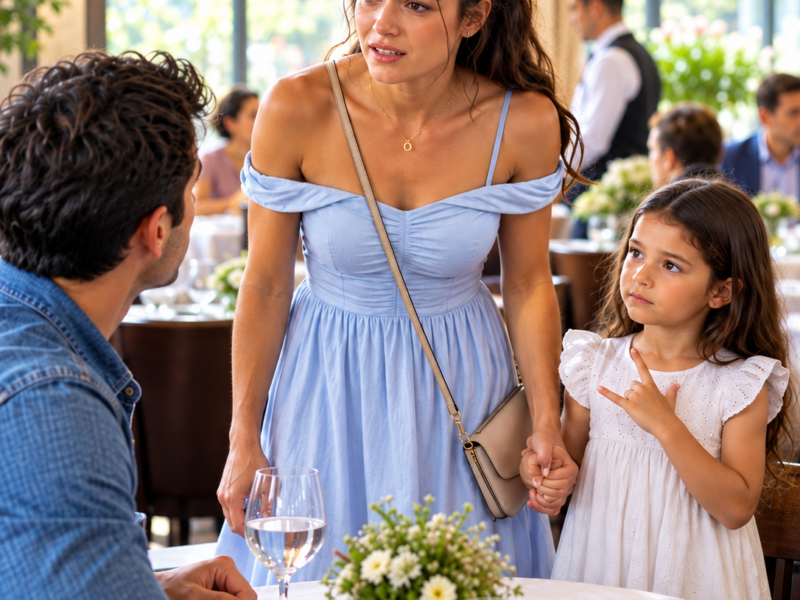
Caleb reached the hotel door just as Gerald Briggs lifted his hand to stop Mae from walking away.
“Mrs. Harding,” Briggs said, “you can’t put this off indefinitely.”
Mae kept Clara close beside her.
“I told you I would consider the offer.”
“You’ve had time enough.”
“I haven’t agreed to sell.”
Briggs looked irritated.
“You have a mortgage coming due and pasture standing empty. Sentiment won’t satisfy your lender.”
Clara pressed closer to her mother.
Caleb stepped onto the boardwalk, but stopped several paces away.
Mae had already seen him.
For a moment their eyes met.
Then she turned back to Briggs.
“My answer remains the same. I’ll speak with the bank before making any decision.”
Briggs noticed Caleb.
“Something you need, Morrow?”
“Just leaving the hotel.”
“Then I won’t keep you.”
Mae’s expression warned Caleb not to intervene.
He understood.
Briggs replaced his hat.
“You know where to find me when you’re ready to discuss a sensible price.”
He walked away.
Mae released a breath.
Clara looked up.
“Mama, why does that man want our field?”
“Because it borders his property.”
“Can’t he find another field?”
Mae didn’t answer.
Caleb stood quietly until she turned toward him.
“I’m afraid you’ve witnessed an unpleasant conversation.”
“I’ve heard worse.”
“Mr. Briggs is persistent.”
“I’ve noticed.”
She glanced toward the street.
“My husband died, and suddenly every man within ten miles began telling me what I ought to do with his land.”
“Is the property in your name?”
“Yes.”
Caleb nodded.
“Then the decision is yours.”
The words were simple.
Mae looked at him as if he had said something unexpected.
“Most people don’t put it that way.”
“Seems the plainest way.”
Clara reached toward his pocket.
“Did you bring Button?”
Caleb produced the carving.
“She’s been behaving herself.”
“Good.”
Mae’s smile faded as she studied the little dog.
“Mr. Morrow, I shouldn’t have let Clara involve you in our troubles.”
“She hasn’t.”
“You heard what Mr. Briggs said.”
“Enough to know he’s made an offer.”
“He’s made several.”
“And you don’t want to accept.”
“No.”
“Then perhaps there is another way.”
Mae looked at him sharply.
“I won’t ask you for money.”
“I haven’t offered any.”
“Or charity.”
“Nor that.”
Her shoulders relaxed slightly.
Caleb glanced toward Clara, who was holding Button up to inspect the tiny carved ears.
“What did your husband use that eastern pasture for?”
“Daniel wanted to graze cattle there. He’d started making arrangements before he became ill.”
“Has the grass been cut or used since?”
“Only lightly.”
Caleb considered that.
“Good ground might have value besides what Briggs is offering for the land itself.”
Mae studied him.
“What do you mean?”
“Grazing.”
“For whose cattle?”
“That’s what we’d need to find out.”
She folded her arms.
“I know very little about running a cattle operation.”
“You know your property?”
“Every acre.”
“You know what the bank requires?”
“To the last dollar.”
“Then you’ve already got part of what matters.”
For the first time that afternoon, Mae seemed uncertain in a different way.
Not frightened.
Interested.
“Are you suggesting I become a cattlewoman?”
“I’m suggesting we examine whether you could earn money from the pasture without selling it.”
“Why would you help?”
Caleb looked down at the wooden dog in Clara’s hands.
“Because you ought to know the value of what you own before deciding whether to part with it.”
Mae regarded him steadily.
“I won’t accept an arrangement where you make the decisions and I merely sign papers.”
“Wouldn’t ask you to.”
“And I’d need to understand every cost.”
“Of course.”
She nodded slowly.
“Then perhaps you could come by one afternoon.”
“Gladly.”
Clara brightened.
“Can Buck come?”
“He generally travels with me.”
“Good. I want to meet him.”
Caleb smiled.
Mae gave directions to the Harding property and suggested a time.
As he turned toward his horse, Clara hurried beside him.
“Mr. Caleb?”
“Yes?”
“Will you really come?”
He looked at the child.
“I said I would.”
She thought for a moment.
“Some grown-ups say things and don’t do them.”
Caleb’s expression softened.
“Then you’ll have to judge me by whether I show up.”
Clara nodded.
“I will.”
Mae watched him mount.
For the first time in months, she had heard someone speak of her pasture as an opportunity rather than a burden.
Yet the problem remained.
The mortgage still had to be paid.
Briggs was still waiting.
And a single conversation with a kindly cattleman could not settle a debt.
Caleb gathered his reins.
“Mrs. Harding, before I come out, there’s one thing you should understand.”
“What is it?”
“A grazing arrangement may bring money. But it won’t be worth much unless the land can hold stock safely.”
Mae looked toward the road leading home.
“The east fence needs work.”
“How much?”
“More than I can afford to ignore.”
Caleb nodded.
“Then we’ll begin there.”
Mae tightened her grip on Clara’s hand and turned toward the road, already calculating how many days remained before the bank demanded its payment.
Mae kept counting those days as she walked home with Clara.
The mortgage was not a distant worry. It was an amount written in her account book, circled twice in pencil, with a deadline approaching faster than she could earn the money.
After Daniel died, she had managed the household through sewing, careful spending, and whatever small income the holding could provide.
But the eastern pasture had remained mostly unused.
Daniel had intended to bring cattle onto it.
Mae had kept hoping she might eventually fulfill that intention.
Gerald Briggs preferred a different future.
His adjoining holding would grow considerably if he acquired hers, and his offers had become more insistent as her financial position weakened.
She understood the advantage to him.
What she hadn’t known was whether keeping the land could offer an advantage to her.
That evening, she opened Daniel’s old account book.
Clara sat beside her with Button.
“Is Mr. Caleb going to buy our house?”
“No, sweetheart.”
“Is Mr. Briggs?”
“Not if I can help it.”
Clara looked relieved.
“Good. I like our house.”
“So do I.”
“Papa liked it.”
Mae’s pencil stopped.
“Yes,” she said softly. “He did.”
Daniel had not been a wealthy man, but he had loved the land with an enthusiasm Mae sometimes still heard in her memory.
He had shown her where cattle might graze, where fencing would need strengthening, and which parts of the eastern field held the best grass.
Then illness had interrupted their plans.
After his death, those unfinished plans became painful to examine.
Mae had spent so much effort keeping the house standing that she had nearly forgotten how to make the land produce an income.
Now she returned to the figures.
Not because a stranger had promised to rescue her.
Because he had asked a practical question she could answer.
***
Caleb arrived on the appointed afternoon.
Buck carried him up the narrow lane, and Clara spotted the horse before Mae heard the hoofbeats.
“He’s here!”
She ran toward the porch.
Mae emerged carrying her account book.
Caleb dismounted near the gate.
Clara stared at Buck.
“He looks like a Gerald.”
Caleb blinked.
“What?”
“Gerald.”
“His name’s Buck.”
“I know. But Gerald suits him.”
Mae closed her eyes.
“Clara has been naming things again.”
Caleb looked from the horse to the girl.
“Perhaps Buck and I should be consulted.”
Clara considered that unreasonable.
“Why?”
Mae laughed.
The afternoon became serious once they reached the eastern pasture.
Caleb rode slowly along the boundary while Mae walked the accessible portions with him, pointing out sections Daniel had repaired and places where the rails had weakened.
They discussed water, grazing capacity, fencing costs, and how stock might be brought onto the property.
Caleb did not pretend the land could support an unlimited herd.
Nor did he promise the arrangement would pay the mortgage.
“There may be an opportunity,” he said, “but we’d have to know what a cattleman would pay and what improvements you’d need before making a bargain.”
Mae opened her notebook.
“I want the costs first.”
“That’s where I’d start.”
They examined the figures together at the kitchen table.
Clara placed Button between them.
“She wants to help.”
Caleb looked solemnly at the little dog.
“Can she do arithmetic?”
“No.”
“Then she’d best leave the accounts to your mother.”
Mae smiled.
For several hours, they compared the possible income from grazing against the costs of readying the pasture.
Caleb mentioned a cattleman near Cheyenne who might need additional ground for stock.
“I can ask whether he’d consider an agreement,” he said.
“I’d want to negotiate the terms myself.”
“I’d expect you to.”
“And any advance would have to be large enough to matter.”
“Agreed.”
Mae looked down at the calculations.
“What if it doesn’t work?”
“Then you’ll know before you’ve spent money you can’t recover.”
She closed the book.
It was the first plan anyone had offered her that did not begin with surrendering the property.
***
Caleb came back several times.
Sometimes they inspected fencing.
Sometimes they revised the proposed grazing arrangements.
He spoke with the Cheyenne cattleman and brought Mae the information she needed to decide whether the agreement would serve her interests.
Mae studied the terms, raised questions, and refused to commit until she understood the obligations.
The work was demanding, and the mortgage deadline remained uncomfortably close.
Yet Caleb’s visits began carrying another kind of meaning.
Clara watched for him.
She brought Button to meet him every time.
She asked questions about horses, cattle, fences, and whether cowboys slept with their boots on.
He answered patiently.
When he didn’t know an answer, he said so.
Mae noticed that most of all.
He never pretended to know everything merely to impress a child.
And he never treated Clara as an inconvenience.
One afternoon, he came to repair a weak section of fencing.
Clara was playing near the house.
Mae was carrying tools from the shed when she heard her daughter call out.
“Mama, look!”
She turned.
Clara had climbed a ladder that had been left beside the building during earlier maintenance.
The child had gone farther up than she could comfortably descend.
She was gripping the rungs, frightened by the distance to the ground.
Mae dropped the tools.
“Clara, don’t move!”
Caleb heard her shout.
He came around the corner and stopped beneath the ladder.
Clara looked down at him.
“I’m stuck.”
“I can see that.”
Her lower lip trembled.
“I don’t like it.”
“Then we’ll get you down.”
He steadied the ladder first, checking its footing.
Then, after telling Clara exactly what he intended, he climbed carefully until he could help her descend.
Mae remained below, hardly breathing.
The movement was slow.
Clara cried once when her foot missed a rung.
Caleb spoke calmly.
“I’ve got you. One step at a time.”
At last he lifted her safely to the ground.
Mae gathered her daughter into her arms.
Clara buried her face against her mother’s neck.
Caleb stepped away.
His hands were trembling.
Mae saw.
“You were frightened.”
“Yes.”
“Of the ladder?”
“Of what might happen to her.”
Clara reached for him.
“I’m sorry.”
Caleb crouched.
“You mustn’t climb where you can’t get down safely.”
“I know.”
“Will you promise me?”
“Yes.”
He nodded.
“Then we’ll call that settled.”
Mae watched him.
He had not shouted.
He had not made Clara feel foolish.
And after the danger passed, he had been honest enough to admit his fear.
That evening, when she thanked him, he shook his head.
“Any man there should have helped.”
“Perhaps,” Mae said. “But you’re the one who did.”
***
The negotiations with the Cheyenne cattleman advanced.
Mae learned that the pasture could be used under terms that allowed her to retain ownership and receive income rather than sell outright.
The proposed arrangement included an advance that could be applied toward the approaching mortgage payment.
There would still be responsibilities.
Fences had to be sound.
Stock had to be managed properly.
And neither Mae nor Caleb could afford careless assumptions.
But the figures showed a possible way forward.
Mae insisted on reviewing the agreement herself.
Caleb respected that.
He offered explanations where she needed them, then let her weigh the decision.
At a church gathering, Clara brought Button to show him.
Caleb stood near the fence, awkward among the families and neighbors.
Clara arrived with the wooden dog held high.
“She’s come to church.”
“Has she?”
“She needs to learn to behave.”
Caleb examined the carving.
“She seems quiet enough.”
“That’s because you’re here.”
Mae, watching from nearby, felt her heart shift.
For weeks she had told herself that Caleb was merely helping with the land.
But her daughter had begun counting him among the people she trusted.
And Mae found herself looking toward the road on afternoons when he was due.
Not because the fence needed work.
Because she wanted to see him.
***
Six weeks after their first meeting at the hotel, Caleb sat with Mae on the porch.
The evening light stretched across the yard.
Buck waited near the barn.
Clara played inside, occasionally appearing at the window.
Caleb set down his coffee.
“Mae, may I ask you something?”
“Of course.”
“Does my coming here make things harder for you?”
She looked at him.
“What do you mean?”
“Clara’s taken a liking to me. I know that. I wouldn’t want her hopes to become a burden you never chose.”
Mae’s fingers tightened around her cup.
He had not demanded a place in her family.
He was asking whether his presence was welcome.
“I haven’t quite decided what all this means,” she admitted.
Caleb nodded.
“I understand.”
She studied his face.
“Do you want to stop coming?”
“No.”
The answer was immediate.
He seemed surprised by his own certainty.
“I’d like to keep seeing you and Clara. If that’s what you want.”
Mae felt warmth rise in her cheeks.
“You’re welcome here.”
He smiled.
“That’s good to hear.”
“And if you wanted to visit when nothing needed fixing?”
“I’d like that very much.”
She glanced toward the window.
“Clara is listening.”
“I suspected.”
“She’ll have opinions.”
“She always does.”
Mae laughed.
Then she told him that Clara had renamed Buck.
“Gerald,” she said.
Caleb stared.
“Gerald?”
“Apparently.”
“The butter churn’s called Gerald.”
“I’m aware.”
“Why does that child name everything Gerald?”
“I wish I knew.”
Their laughter carried across the porch.
For a moment, Mae felt younger than she had in years.
Later, after Caleb rode home, she sat alone beneath the darkening sky.
She thought of Daniel.
She remembered the plans they had made, the cattle he had wanted to raise, and the love that had once filled their home.
She did not want to lose those memories.
But she was beginning to understand that loving someone new would not require forgetting the man she had lost.
***
The following Monday, Gerald Briggs came riding into the yard.
Caleb’s horse was tied beside the barn.
Briggs noticed immediately.
Mae met him on the porch.
“Mrs. Harding.”
“Mr. Briggs.”
“I hear you’re making arrangements concerning the pasture.”
“I am.”
“With Caleb Morrow’s assistance?”
“He’s advised me.”
Briggs glanced toward the barn.
“Managing livestock requires considerable knowledge.”
“I’ve been learning.”
“And money.”
“I’ve accounted for that.”
“My offer remains available.”
Mae stood straighter.
“I won’t be accepting it.”
Briggs stared.
“Mrs. Harding, your mortgage doesn’t disappear because you’ve made a few plans.”
“No.”
“Cattle prices fluctuate.”
“I know.”
“Your husband understood those risks.”
“Yes,” she said. “He did.”
Briggs looked toward the eastern field.
“That land would suit my holding.”
“I imagine it would.”
“And I’ve offered you a fair opportunity to be rid of the burden.”
Mae looked directly at him.
“You’ve offered me less than the land is worth because you believed I had no other choice.”
His face tightened.
“I’ve made my offer in good faith.”
“You may consider it so. I don’t.”
He glanced toward the barn again.
“Has Morrow encouraged you to speak this way?”
“No.”
“Then what has changed?”
Mae looked at the house, the fields, and the place where Clara had been playing that morning.
“I discovered what I can do with the land without selling it.”
Briggs replaced his hat.
“You may regret refusing.”
“Then that regret will be mine to bear.”
He rode away.
Mae remained on the porch until he disappeared.
Only then did she sit.
Her knees were shaking.
Caleb came from the barn a few minutes later.
“Everything all right?”
“I think so.”
He sat on the step below her.
Mae told him what had happened.
He listened.
When she finished, he said, “You handled it.”
She looked down at him.
“You aren’t going to tell me what I should have said?”
“No.”
“Why not?”
“Because you said what needed saying.”
Mae felt tears rise unexpectedly.
“I used to believe strength meant doing everything alone.”
Caleb waited.
“After Daniel died, I thought asking for help meant admitting I couldn’t keep what we’d built.”
“And now?”
“Now I think asking for help and surrendering control are two entirely different things.”
Caleb nodded.
“They are.”
Mae looked toward the empty chair beside her.
“Would you sit here?”
He rose.
“Gladly.”
For the first time, they sat side by side without account books, fence plans, or mortgage papers between them.
The silence was easy.
Then Mae reached for his hand.
Caleb turned toward her.
Neither spoke.
But when his fingers closed gently around hers, Mae knew something important had changed.
***
As autumn moved toward winter, the grazing agreement proceeded.
The promised advance was applied to the mortgage payment.
Mae kept the documents with her household accounts and continued preparing the pasture for the cattle arrangement.
The danger of losing the property had eased, though there was still work and debt to manage.
Caleb continued helping with practical matters.
But he no longer needed a repair to justify every visit.
Sometimes he came for supper.
Sometimes he sat by the stove while Clara described Button’s adventures.
Sometimes he and Mae simply talked until the lamp burned low.
Clara remained delighted.
She had decided long ago that Caleb belonged in her world.
One evening she informed him that Button required a blanket.
Caleb carved a thin wooden covering for the toy.
Clara examined it critically.
“Blankets are supposed to be soft.”
He nodded.
“That’s a fair objection.”
She kept it anyway.
By December, the Harding house felt different.
Daniel’s photograph remained in its place.
Mae still spoke of him.
Clara still remembered him.
But the house no longer seemed held together solely by memory and determination.
There was laughter again.
There were footsteps approaching the porch that Mae welcomed.
And there was a man who had learned that the finest part of his day was no longer the silence of his own home.
One Thursday afternoon, Caleb rode into the yard without tools.
Clara ran to meet him.
Mae appeared on the porch.
She noticed his nervous expression.
“Caleb?”
He removed his hat.
“There’s something I’d like to ask you.”
Clara stood beside him, clutching Button.
Mae looked from one to the other.
“What have you two been discussing?”
“Nothing,” Clara said immediately.
Caleb looked toward the fence.
Mae smiled.
“You’re doing that thing again.”
“What thing?”
“Looking at something that doesn’t need fixing because you don’t know how to begin.”
He drew a breath.
Then he looked directly at her.
“Mae, would you consider becoming my wife?”
The yard fell silent.
Clara’s eyes grew enormous.
Mae stood very still.
Caleb continued quietly.
“Not because of the mortgage. Not because Clara wants it. And not because either of you owes me anything.”
He lowered his hat.
“I love you both. But whether we make a family together has to be your decision.”
Mae stepped down from the porch.
Her eyes filled.
Then she asked the question she had been carrying for months.
“And what place would Daniel have in that family?”
Caleb looked toward the house.
Through the open doorway, he could see the small table where Daniel Harding’s photograph had stood during every one of his visits.
“The place he’s always had,” he answered.
Mae swallowed.
“He was Clara’s father.”
“I know.”
“She remembers him.”
“Then she should keep remembering.”
“And I still love him.”
Caleb’s expression softened.
“I wouldn’t think much of you if you could simply put away a good man’s memory because somebody new came along.”
Mae looked down.
“That isn’t what I meant.”
“I know what you meant.”
He stepped closer but stopped before reaching for her.
“I don’t want to take Daniel’s place. He had a life with you that belongs to the two of you. I’m asking whether there’s room for another life, one we might build together.”
Mae’s tears slipped down her cheeks.
For a long moment, she couldn’t speak.
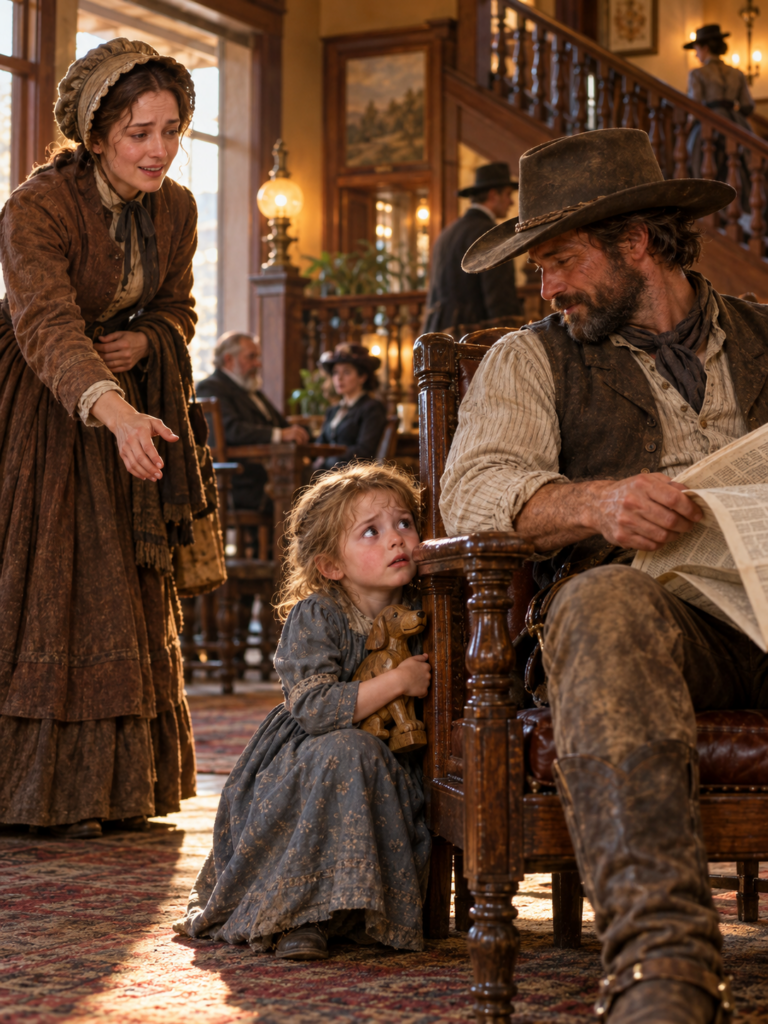
She remembered the frightened little girl in the hotel.
The wooden dog.
The awkward cattleman who had lowered his newspaper and listened to a child as though her words mattered.
She remembered the afternoons spent studying pasture costs, the insistence that she understand the cattle agreement, and the way Caleb had stepped back whenever she needed to make her own decisions.
She remembered Clara stranded on the ladder.
How carefully he had helped her down.
How honestly he had admitted being afraid.
And she remembered the simple pleasure of sitting beside him without needing an excuse.
“Caleb,” she whispered, “I didn’t think I could love another man.”
He waited.
“I thought that if I did, it would mean Daniel mattered less.”
“And now?”
“Now I know that isn’t true.”
Clara shifted impatiently.
“Mama?”
Mae glanced down.
“Just a moment, sweetheart.”
The child frowned.
“It’s an important question.”
Caleb nearly laughed.
“Yes,” he agreed. “It is.”
Mae looked back at him.
“You understand that the Harding place remains mine?”
“Of course.”
“And I’ll continue managing it.”
“I’d expect nothing else.”
“And Clara won’t be required to call you Papa.”
“No.”
Mae searched his face.
“Even if she never does?”
“Even then.”
From beside the water barrel, Clara made an indignant sound.
“I will if I want to!”
Mae laughed through her tears.
“Clara Harding, were you supposed to be listening?”
The child ignored the question.
She marched toward Caleb with Button tucked beneath her arm.
“Are you asking Mama to marry you?”
“I am.”
“Then why are you both talking so much?”
Caleb stared at her.
Mae began to laugh.
“Because it matters, Clara.”
“Well, I think she should say yes.”
Mae crouched beside her daughter.
“Sweetheart, I know you love Caleb.”
“I do.”
“And you know I love your papa.”
Clara nodded.
“That doesn’t go away.”
“I know.”
Mae brushed a loose strand of hair from the child’s forehead.
“But marriage is something grown people must decide because they want to share their lives, not because they’re frightened or because somebody tells them to.”
Clara considered this.
Then she turned toward Caleb.
“Do you want to share your life?”
“Very much.”
She looked at Mae.
“Do you?”
Mae raised her eyes to Caleb.
“Yes,” she said softly.
Caleb stood motionless.
Mae rose.
“Yes, Caleb. I want to marry you.”
He let out the breath he had been holding.
For a moment, the weathered cattleman looked too astonished to speak.
Then his face broke into a smile so open and joyful that Mae felt her heart turn over.
Clara squealed.
She rushed between them and thrust Button into Caleb’s hands.
“Hold her!”
He caught the wooden dog.
Mae reached for his hand.
“Clara chose you long before I understood what was happening,” she murmured.
Caleb glanced at the girl, who was now demanding to know whether weddings involved cake.
“And you?”
Mae smiled.
“I took a little longer.”
He leaned down.
“I’m glad you came to the same conclusion.”
She kissed him.
Clara immediately announced that Button wanted a kiss too.
Caleb laughed.
And the laughter traveled across the eastern pasture, over the land Mae had once feared she would lose.
***
The engagement did not change the practical arrangements Mae had worked so hard to establish.
She kept her accounts.
The grazing agreement remained hers to manage.
Caleb continued to advise and help where they had agreed he would, but he did not take control of the Harding property.
They discussed money, responsibilities, and where they would live after the wedding.
Sometimes those discussions were difficult.
Caleb had spent years accustomed to deciding everything in his own household.
Mae had spent years afraid that depending upon someone else would cost her independence.
They had to learn how to share decisions without either person disappearing inside the other’s life.
Their first disagreement concerned repairs.
Caleb wanted to replace several weakened fence sections before the next grazing season.
Mae believed they could manage part of the work with less expense.
They spread the figures across the kitchen table.
Caleb explained the risk of delaying the repairs.
Mae showed him what the household could afford without leaving the winter accounts too thin.
In the end, they agreed to repair the worst sections first and plan the remainder around the livestock arrangements.
Clara listened from beneath the table.
When they finished, she emerged with Button.
“Are you still getting married?”
Mae stared at her.
“Of course.”
“You sounded cross.”
Caleb crouched beside her.
“People can disagree and still care for each other.”
Clara studied both adults.
“Even about fences?”
“Especially about fences,” Mae said.
Caleb laughed.
It was a lesson they would return to often.
Neither marriage nor affection would make difficult choices disappear.
But they could make those choices together.
***
Spring arrived slowly in Wyoming.
Snow retreated from the pasture edges.
The earth softened beneath the fences.
Small wildflowers began appearing in sheltered patches of ground.
Mae’s wedding dress was simple and carefully made.
She prepared it with the same attention she gave her best sewing work, though Ruth insisted on helping with the finishing.
Clara appointed herself flower girl.
She took the appointment with enormous seriousness.
She inspected flowers.
She practiced walking across the kitchen without dropping them.
And she insisted that Button must attend the ceremony.
“Button introduced you,” she told Caleb.
“I thought you introduced us.”
“Button helped.”
“That she did.”
The wedding took place on a Saturday in April.
Neighbors gathered at the church.
Caleb wore his best coat, newly brushed and carefully fitted.
Mae arrived with Clara beside her.
For one quiet moment before the ceremony, Mae stood alone near the window.
She held Daniel’s photograph.
The man in the picture looked young.
Younger, she realized, than Caleb looked now.
She remembered Daniel standing beside her in the eastern pasture, describing the future he hoped to build.
He had wanted cattle moving across that grass.
A secure home.
A daughter growing up with room to roam.
They had shared those hopes before illness changed everything.
Mae touched the frame.
“I kept our home,” she whispered.
Her eyes filled.
“And she’s happy.”
She looked toward the churchyard, where Clara was showing Button to an indulgent neighbor.
“I think you’d be glad.”
Mae replaced the photograph carefully among her belongings.
She was not putting Daniel away.
She was carrying his memory forward.
Then Ruth appeared at the doorway.
“It’s time.”
Mae took a breath.
And went to meet Caleb.
***
Clara entered the church carrying wildflowers in one hand and Button beneath her other arm.
She walked slowly, concentrating so fiercely that several guests struggled not to smile.
At the front, she stopped beside Caleb.
He held out his hand.
She took it.
The little girl stood there proudly while Mae walked down the aisle.
Caleb watched his bride approach.
He had never imagined that an afternoon spent reading a newspaper in a hotel could lead to this moment.
He remembered Clara hiding beside his chair.
The little wooden dog.
The frightened mother searching through the room.
And how quickly he had become concerned for people who had been strangers only minutes before.
Now those same people were the center of his life.
The minister spoke.
Caleb made his promises.
Mae made hers.
Their vows were not promises that hardship would never return.
Both knew better.
They promised faithfulness, honesty, and the willingness to share the work of whatever life brought.
When the ceremony ended, Clara clapped before anyone else.
Then she demanded to be lifted.
Caleb swung her onto his shoulders.
She laughed in delight.
“I’m taller than Mama!”
“You certainly are.”
“Is this what being tall feels like?”
“Something like it.”
Clara surveyed the churchyard.
“I like it.”
Across the gathering, Mae watched them.
Caleb turned toward her.
Their eyes met.
The happiness in his expression was unmistakable.
Mae smiled.
For years she had feared that accepting another man’s love would erase the life she had shared with Daniel.
Instead, she had found someone willing to honor it.
***
The first year of their marriage demanded plenty of ordinary labor.
The Harding property still needed careful management.
The grazing arrangement brought income, but also responsibilities.
Cattle required water, sound fences, and attention.
Weather and market conditions had to be considered.
Caleb brought knowledge earned through years of cattle work.
Mae brought her understanding of the property, practical economy, and careful accounts.
Neither could do everything alone.
Together, they became more capable.
When Caleb suggested a change to the pasture arrangements, Mae asked questions until she understood the reasoning.
When Mae raised concerns about spending, Caleb listened rather than dismissing them.
Sometimes they disagreed.
Sometimes one was right and the other wrong.
Sometimes the best solution was something neither had considered alone.
At the end of long days, they returned to a house where Clara would inevitably have a story to tell.
Often the story involved Button.
Sometimes it involved Buck, whom she continued to call Gerald despite Caleb’s objections.
At last he surrendered the argument.
One afternoon, Mae heard him leading the horse toward the barn.
“Come along, Gerald.”
She appeared at the doorway.
“I thought his name was Buck.”
Caleb gave her a weary look.
“It was easier to change the horse’s name than Clara’s mind.”
Mae laughed until tears came.
Those were the moments that made their life feel rich.
Not extravagant gifts.
Not grand promises.
The simple freedom to be themselves in a home where affection no longer had to be guarded.
***
Caleb never demanded that Clara forget Daniel.
When she wanted to hear about her father, Mae told stories.
She spoke about his laughter, his kindness, his hopes for the eastern pasture, and the way he had carried Clara when she was very small.
Caleb listened.
Sometimes he asked questions.
He wanted Clara to know that remembering Daniel brought him no offense.
One evening, the girl sat on the porch between them.
“Papa Daniel wanted cows in our field?”
“He did,” Mae answered.
“Now we’ve got cows.”
“Cattle grazing there, yes.”
Clara considered this.
“Would he be happy?”
Mae looked toward the pasture.
“I believe he would.”
Clara leaned against Caleb’s arm.
“And are you happy?”
Caleb looked down at her.
“Very.”
“Good.”
She seemed satisfied.
But after a moment, she added, “I think I’m lucky.”
Mae touched her hair.
“Why?”
“Because I had one papa who loved me, and now I have another.”
Caleb’s eyes filled.
He didn’t speak immediately.
Then he put an arm around her shoulders.
“I think I’m the lucky one.”
Mae watched them in the evening light.
She understood then that her daughter had not been asked to divide her heart.
Love had simply found another place within it.
***
Years passed.
Clara grew taller.
The chores she could manage changed as she grew older, and her questions grew more difficult to answer.
She learned about the land from Mae.
She learned about cattle from Caleb.
She learned that money had to be counted carefully, agreements understood, and promises kept.
Button remained with her through childhood.
The little wooden dog darkened with age.
Its edges grew smooth from years of handling.
One ear eventually broke.
Caleb offered to repair it.
Clara refused.
“She’s old,” she explained.
“So am I,” Caleb said.
“You aren’t missing an ear.”
“Not yet.”
Mae laughed.
Clara placed Button on the shelf beside Daniel’s photograph.
Neither object seemed out of place.
One represented the father who had loved her first.
The other represented the man who had entered their lives through a small act of kindness.
Together, they told the story of the family she had been fortunate enough to know.
***
In later years, visitors sometimes asked Caleb how he and Mae had met.
He never began with the mortgage.
He rarely mentioned Gerald Briggs, whose offer had long since become an unpleasant memory rather than an immediate threat.
Instead, Caleb would smile and glance toward Clara.
“My wife didn’t find me first,” he’d say.
“Her daughter did.”
Mae would shake her head.
“He makes it sound as though Clara arranged the whole thing.”
“Didn’t she?”
Clara, now old enough to recognize the humor, would laugh.
“I had help.”
“From whom?” Caleb asked.
She would point toward Button.
And everybody would smile.
Yet beneath the laughter lay something none of them had forgotten.
Mae had not kept her home because a wealthy stranger appeared and paid her debts.
She kept it because she worked, studied her options, negotiated a useful agreement, and refused to sell when she found a better path.
Caleb had not earned a family by rescuing a child once or offering money to a widow.
He earned their trust through consistency, honesty, patience, practical work, and respect.
And Clara had not chosen between her fathers.
She had been allowed to love them both.
That mattered.
It mattered as much as the land itself.
***
One September afternoon, years after the day in the Wyoming hotel, Mae found Caleb sitting on the porch with an old newspaper.
Clara had left Button on the nearby table.
Caleb picked up the carving.
He studied the crooked little head and its missing ear.
Mae stepped outside.
“Thinking about something?”
He smiled.
“The first time I saw this dog, it was nothing but a piece of wood I was trying to finish.”
“You gave it away.”
“Didn’t have much choice.”
Mae sat beside him.
“She was a determined child.”
“She still is.”
He turned the carving over.
“I thought I was having an ordinary afternoon.”
Mae rested her hand on his.
“So did I.”
He looked toward the eastern pasture.
Cattle grazed peacefully beyond the fence.
The house stood warm and sound.
The land remained in the family.
“Clara frightened you terribly that day,” he said.
“She did.”
“And then she frightened me.”
Mae laughed softly.
“How?”
“By deciding I ought to be part of her life before I’d made sense of my own.”
Mae leaned against him.
“She always did move quickly.”
Caleb slipped his arm around her.
“What about you?”
“I needed time.”
“And did you find what you were looking for?”
Mae considered the question.
She thought of Daniel.
Of years of grief and uncertainty.
Of the mortgage papers that had once threatened everything she held dear.
Of a quiet cattleman who had offered advice without demanding control.
Of Clara laughing from his shoulders outside the church.
And of the many seasons they had spent building a life shaped by both memory and hope.
“Yes,” Mae whispered.
“I found it.”
Caleb kissed her forehead.
They sat together as the light softened over the Wyoming fields.
On the table beside them, the little wooden dog rested near the folded newspaper.
It was a small, imperfect thing.
One ear was broken.
The wood had darkened.
But nobody had ever suggested throwing it away.
Because it reminded them that a life could turn upon an act so ordinary that the person performing it never imagined its importance.
A lonely cattleman had offered a frightened child a wooden toy.
A widow had found someone willing to listen.
A little girl had discovered that a promise could be trusted.
And three people, each carrying a different kind of loss or loneliness, had made a home where no one had to surrender the past to belong to the future.
Caleb looked at Button one last time.
Then he looked at Mae.
“Funny thing,” he said.
“What?”
“I spent years thinking I liked living alone.”
Mae smiled.
“And now?”
He glanced toward the open door, where the familiar sounds of family life carried through the house.
“Now I can’t imagine why I ever thought silence was better than coming home.”
Mae took his hand.
Beyond the porch, the grass moved beneath the September breeze.
And the little wooden dog remained on the table, a reminder that sometimes the beginning of a family is not a grand declaration or a heroic rescue.
Sometimes it is a frightened child asking a stranger to keep her secret.
And a good man deciding that listening matters more than being left alone.