The kitchen door clicked shut behind Richard, leaving Helena alone with a man who looked more frightened than angry.
“You heard me,” he said.
Helena dried her hands on a clean cloth.
“I heard enough to know the conversation wasn’t meant for me.”
His grip tightened around his hat.
“Did you tell William?”
“No.”
“Father?”
“No.”
Richard looked away.
Helena considered him carefully.
“If you want to know whether I intend to carry private words around this ranch, the answer is no.”
His shoulders loosened slightly.
“Thank you.”
“But I won’t pretend I didn’t hear them.”
That brought his eyes back to hers.
She continued, “You sounded unhappy, Mr. Callaway.”
“Men say things when they believe they’re alone.”
“Yes. Sometimes those are the things they most need to say to somebody.”
His expression hardened.
“I don’t require pity.”
“Then it’s fortunate I haven’t offered any.”
Richard stared at her.
For a moment, she thought she had offended him.
Then he gave a short, humorless laugh.
“You’re not easily frightened.”
“Not by a conversation.”
He looked toward the window.
“You don’t understand what you heard.”
“Perhaps not.”
“Father took me into this family when I was a boy. William was born into it.”
Helena remained quiet.
“Thirty-two years, and Thomas has never treated me as anything but a son.”
Richard’s voice became rough.
“But I still catch myself expecting someone to tell me I’ve mistaken kindness for belonging.”
Helena felt an ache of recognition.
For three years, she had cared for her mother. She had known precisely where she was needed every waking hour.
Then suddenly she had been needed nowhere.
“After Mother died,” she said, “I couldn’t bear entering her room. It felt wrong to have a future when hers had ended.”
Richard listened.
“But the house didn’t become less mine because she was gone. I simply didn’t know how to live in it differently.”
He lowered his hat.
“That isn’t quite the same thing.”
“No,” Helena admitted. “But I think I understand something of the fear.”
They stood in silence.
Then Richard said, “William belongs here without thinking.”
“Perhaps,” Helena replied. “But that’s not something he’s done against you.”
Richard’s face changed.
She saw that her words had reached somewhere he preferred to keep guarded.
Before he could answer, footsteps sounded in the passage.
William called, “Helena? Father wants to know whether there’s any coffee left.”
Richard immediately reached for the door.
Helena stepped aside.
“There’s a fresh pot.”
William entered, smiling.
He looked from Helena to Richard.
“Have I interrupted something?”
“Only a conversation,” she answered.
Richard moved past him.
“Nothing important.”
Helena watched him leave.
She knew that was untrue.
But it was not her truth to announce.
Over the following weeks, spring settled warmly across the Bitterroot Valley.
Helena’s kitchen became the quiet center of the ranch.
The men ate better.
The stores were managed carefully.
Thomas no longer appeared at every meal wearing the expression of someone preparing for disappointment.
William continued finding reasons to linger.
One morning he asked whether Helena ever thought of anything besides bread.
“Often,” she answered.
“Such as?”
“How much longer you’ll stand in my doorway instead of going to work.”
He laughed.
“Then I ought to leave you in peace.”
“You ought.”
He remained where he was.
Helena found herself smiling into the mixing bowl.
What she felt for William was becoming difficult to dismiss as mere gratitude.
He asked about her mother.
Listened to her answers.
Remembered small details without making a performance of remembering them.
He also respected her work.
He never assumed that because she was employed by his father, her time belonged to him.
Richard grew quieter.
He still came to meals.
Still worked diligently.
Still thanked Helena whenever she prepared something he particularly enjoyed.
But she noticed how often he looked away when William entered the kitchen.
And she began to fear that the older brother was suffering more than he allowed anyone to see.
One evening in May, William appeared after supper while she finished wiping the worktable.
“I’ve been meaning to ask you something.”
Helena raised her eyes.
“Go on.”
“There’s a northern meadow where the wildflowers are blooming. I thought you might enjoy seeing it.”
She felt unexpected warmth rise into her cheeks.
“When?”
“Sunday morning. If you’d like.”
A faint movement came from the hallway.
Richard stood just beyond the doorway.
His face had gone still.
Helena had not known he was there.
She looked back at William.
“I would like that.”
William smiled.
“Then it’s settled.”
Behind him, Richard turned away.
Helena caught the sound of his boots crossing the passage.
She watched the empty doorway a moment longer than she intended.
On Sunday morning, she came downstairs in her neat traveling coat.
William was outside saddling two horses.
The mountain air was cool, the sky clear, and the northern meadows were already bright beneath the rising sun.
He helped her check the saddle before mounting his own horse.
“Ready?”
Helena smiled.
“Yes.”
They rode north.
Behind them, Richard stood in the stable doorway, watching until the two riders disappeared beyond the pasture.
He knew precisely what William intended.
And for the first time in thirty-two years, the thing he feared losing was not land, inheritance, or the Callaway name.
It was a woman who had never promised to belong to him.
In the stable, Richard slowly closed his hand around the unused bridle hanging beside him.
Richard’s fingers tightened around the bridle until the leather creaked.
Beyond the stable doors, William and Helena were already riding toward the northern meadow.
Richard could still see them between the fence posts.
William turned in his saddle to say something.
Helena laughed.
Even from that distance, Richard recognized the ease between them.
He looked down at the bridle.
It needed no repair.
Neither did the saddle beside it.
Yet he carried both to his workbench, because work had always been the surest way to silence thoughts he could not bear to examine.
He had known William would ask Helena to ride with him.
He had seen the interest growing from the moment she entered the ranch kitchen.
William was never difficult to read.
When he admired someone, he showed it.
When he enjoyed a conversation, he returned to it.
Richard had spent a lifetime envying that ease without acknowledging the envy.
Now it felt unbearable.
He was thirty-six years old.
For thirty-two of those years, Thomas Callaway had been his father.
The arrangement had begun after Richard lost his parents as a small boy. Thomas and Eleanor had taken him into their household, raised him, and given him the Callaway name.
They had never called him a burden.
Never asked him to earn his place.
When William was born, they had introduced the younger child as Richard’s brother without hesitation.
The boys had shared work, mischief, meals, and the same stern expectations.
Yet some small part of Richard remained convinced that William possessed something he himself could never claim.
An unquestioned right to stay.
No amount of reassurance had entirely quieted that fear.
He had spent years working harder than anyone demanded, hoping usefulness might become proof enough.
Then Helena Marsh arrived.
She had not asked him to prove anything.
She had simply listened.
That morning near the stable, when he believed nobody could hear, he had spoken to a horse about the shameful uncertainty he carried.
Helena had heard him.
And she had not looked at him differently afterward.
For a little while, that had been enough to make him hope.
Now, watching her leave beside William, Richard felt ashamed of the hope itself.
He placed the bridle on the bench.
Then he began polishing a buckle that was already clean.
Farther north, the meadow opened beneath the Bitterroot Mountains.
Wildflowers spread across the slopes in patches of yellow, white, and pale purple.
Helena slowed her horse.
“Oh, William.”
He grinned.
“I thought you’d like it.”
She looked toward the distant ridge.
“I haven’t seen anything quite like this.”
“The flowers don’t last long. The meadow’s here all year, but spring makes a fine argument for visiting.”
Helena laughed.
They rode to a gentle rise above the creek and dismounted.
William secured the horses where they could graze.
Helena walked a little way through the flowers, careful not to crush them unnecessarily.
For three years, her journeys had been determined by medicine, errands, laundry, and her mother’s needs.
For three weeks after the funeral, she had moved as though she were still listening for a voice that would never call her name again.
Now she stood beneath an immense Montana sky with nowhere she was required to be for several hours.
The realization made her unexpectedly emotional.
William noticed.
“Have I brought you somewhere you don’t like?”
She shook her head.
“No. Quite the opposite.”
He waited.
“It’s been a long time since I went somewhere only because I wanted to.”
William’s smile softened.
“Then perhaps we ought to make a habit of it.”
She turned toward him.
“Perhaps.”
They walked toward the ridge.
He told her about the ranch, the years his father had spent building it, the dry season that had nearly ruined them, and the work Richard had done to keep the operation going.
Helena listened.
“You admire your brother.”
“Of course.”
“You don’t always seem to understand him.”
William glanced at her.
“Richard?”
“Yes.”
He thought for a moment.
“He’s a better man with cattle than I am. Better at keeping accounts, too. But he’s always been hard on himself.”
“Have you ever asked him why?”
William frowned.
“I suppose I assumed he’d tell me if something was wrong.”
Helena looked toward the mountains.
“Not everybody knows how.”
William considered that.
Then he changed the subject, sensing she was speaking of something she did not wish to explain.
For that, she was grateful.
At the top of the slope, they stood in the sunlight.
William took off his hat.
“Helena, there’s something else I wanted to ask.”
She looked at him.
“I’d like to call on you properly.”
Her breath caught.
He continued before she could answer.
“Not because you work for Father. That arrangement belongs between you and him. I mean I’d like to know you as a woman I admire.”
She studied his face.
“You’ve thought about this?”
“Quite a bit.”
“And if I said no?”
“I’d be disappointed. Then I’d behave myself and let you go about your work.”
She smiled.
“That’s a reasonable answer.”
“I practiced several. This one seemed best.”
Helena laughed softly.
For the first time since her mother’s death, the idea of a future did not feel like a betrayal of the past.
“Yes, William.”
He looked almost startled.
“Yes?”
“You may call on me.”
His smile was immediate and wonderfully unguarded.
He reached for her hand.
She gave it willingly.
They stood together among the flowers while the horses grazed below.
It was the beginning of a courtship that unfolded slowly over the following weeks.
William found small, ordinary ways to show Helena that her company mattered.
He rode with her on Sunday mornings when her duties allowed.
He talked with her about the family’s history, the ranch, and her mother’s years as a schoolteacher.
He learned that Helena could remember recipes without writing them down and that she disliked being treated as though her competence made her incapable of sorrow.
She discovered that his cheerful manner concealed a serious devotion to the ranch and to the people who depended on it.
He never asked her to stop working merely because he was courting her.
And when she needed solitude, he respected it.
Thomas watched the relationship developing with quiet satisfaction.
He was fond of Helena.
She had restored order to the household and brought a warmth to the kitchen that reminded him of Eleanor without imitating her.
He believed William had chosen well.
What Thomas did not recognize was the strain building in his elder son.
Richard saw the exchanged smiles.
The conversations that continued after a meal was finished.
The way William looked for Helena whenever he entered a room.
He saw Thomas’s pleased expression.
And every observation fed a conviction Richard had carried since childhood.
William received the things that naturally belonged to a son.
Richard was merely permitted to share them.
He knew this was unjust.
He knew Thomas loved him.
He knew Helena had given him no reason to believe she wanted him instead of William.
Yet the resentment persisted.
It was less a jealousy of romance than a jealousy of certainty.
William had never seemed to question his welcome in the world.
Richard questioned his every day.
In June, Thomas called both sons into his office.
A neighboring holding of eighty acres, known as the Henderson land, had become available following its elderly owner’s death.
The tract bordered the eastern side of the Callaway Ranch and included access to a useful creek tributary.
Thomas wanted to purchase it.
The price was reasonable, but acquiring it would require them to sell some spring cattle earlier than planned and postpone the sons’ wages until later in the season.
William agreed after examining the figures.
Richard also agreed.
He understood the land’s value.
Better water access would strengthen the ranch for years.
But after the meeting, he remained alone beside the account books.
Thomas had explained the purchase as an investment for the family.
An inheritance both sons would eventually share.
The will already provided for equal treatment.
Richard knew that.
He had read it.
Still, he found himself imagining a future in which William possessed the land and the woman he loved, while Richard continued standing at the edge of other people’s happiness.
The thought should have embarrassed him into honesty.
Instead, it made him angry.
A few days later, he encountered Harlan Cooper, who operated the neighboring Grayson holding.
Cooper had a habit of repeating anything he heard, especially if it sounded like information he ought not possess.
Richard knew this.
He spoke anyway.
“William’s been discussing the Henderson tract.”
Cooper raised an eyebrow.
“On his own?”
Richard looked toward the road.
“He’s been handling the negotiations.”
That much was true.
William had been speaking with the estate representative on the family’s behalf, with Thomas’s full knowledge.
Richard simply left that part unsaid.
Cooper drew his own conclusion.
Then he shared it with others.
Within days, the suggestion that William was acquiring the Henderson property independently reached the county recorder and, eventually, Thomas himself.
At supper, Thomas raised the matter calmly.
“William, I heard an interesting account of our land purchase.”
William looked puzzled.
“What account?”
“That you’ve been making arrangements without consulting me.”
William set down his fork.
“Father, you’ve approved every step.”
“I know.”
“Then who said otherwise?”
Thomas looked across the table.
Richard lowered his eyes.
Helena noticed the movement.
A cold uneasiness settled in her stomach.
William explained the negotiations.
Thomas accepted his explanation without hesitation.
The matter appeared finished.
But Richard watched his brother’s easy vindication with bitterness.
Why had Thomas immediately believed William?
Why had he not asked whether Richard knew something different?
He ignored the obvious answer.
Because William had told the truth.
The rumor did not halt the purchase.
Thomas clarified the family’s intentions with the Henderson estate.
The negotiations continued.
Richard should have let the matter end.
Instead, his resentment deepened.
One evening, alone in the office, he wrote a short anonymous note to the estate representative staying in Millbrook.
He suggested that the Callaway finances were less secure than they appeared.
He mentioned the early sale of cattle and delayed wages.
Then he hinted that the estate might be wise to consider another buyer.
Richard stared at the paper before sealing it.
He knew exactly what he was doing.
This was no harmless complaint.
He was trying to interfere with the family business because he could not bear the thought that William would receive another good thing.
He sent the note anyway.
The consequences arrived quickly.
The Henderson representative contacted the bank in Missoula to verify the Callaways’ financial position.
The inquiry delayed the purchase.
Another rancher from a distant county expressed interest.
Thomas was forced to produce records and assurances for a transaction that had previously been proceeding without difficulty.
For two weeks, the old rancher worked to defend his family’s reputation.
William grew frustrated.
Richard grew increasingly miserable.
Helena watched the household change.
Breakfast became quieter.
Thomas spent longer hours in his office.
William returned from business meetings with his mouth set in an unfamiliar line.
Richard worked without stopping, as though exhaustion might erase what he had done.
One evening Helena found him standing alone near the kitchen table.
“You haven’t eaten properly,” she said.
“I’m not hungry.”
“Then perhaps you should sit for a moment.”
He looked at her.
“You’re kind, Helena.”
She regarded him.
“I’m not always.”
“I know.”
He almost smiled.
Then his expression closed.
“Richard,” she said carefully, “whatever is troubling you, keeping it to yourself doesn’t seem to be helping.”
He looked away.
“There are things a man can’t put right merely by speaking.”
“No,” she agreed. “But there are things he can’t begin to put right without it.”
He left without answering.
The following day, Thomas received word from the Missoula bank.
The inquiry had contained a peculiar detail about the planned early cattle sale.
The wording was almost identical to something Richard had said during the family discussion.
Thomas returned home with a terrible suspicion.
He made no accusation at supper.
But when he looked across the table at Richard, the older son understood.
His father knew.
Before dawn the next morning, Thomas entered the stable and found Richard standing beside a stall.
“The note sent to the Henderson representative,” Thomas said, “was yours.”
Richard’s hands went still.
There was no use pretending.
“Yes.”
Thomas stared at him.
“You nearly cost this family eighty acres we’ve been working to acquire honestly.”
“I know.”
“You damaged our standing with the seller. You made your brother appear dishonest. You made me spend two weeks proving our accounts were sound.”
Richard could not raise his head.
“Why?”
The single word was worse than anger.
Richard gripped the edge of the stall door.
Then, at last, he said aloud the thing he had spent most of his life hiding.
“Because I’ve never believed I belonged here as much as William.”
Thomas stood motionless.
Richard swallowed.
“I know what you’ve told me. I know what’s written in your will. But some part of me keeps thinking he’ll always be your real son, and I’ll always be the boy you were good enough to take in.”
Thomas’s face tightened with pain.
“Richard.”
“I’ve hated myself for thinking it. And I hated him for never having to.”
He finally looked at his father.
“I was jealous of him. Of the land. Of Helena. Of how certain he is that everything he loves is his to love.”
The stable was silent except for the shifting horses.
Thomas stepped closer.
“You are my son,” he said firmly. “You have been since the day your mother and I brought you home.”
Richard’s eyes filled.
Thomas continued.
“You did not have to earn your place then. You do not have to earn it now.”
“I know.”
“Then why did you do this?”
Richard’s voice broke.
“Because I’ve never been able to believe you enough to stop being afraid.”
Thomas looked at him for a long moment.
Then he said, “Being afraid doesn’t excuse what you’ve done.”
“No.”
“You’ll tell William the truth. You’ll apologize to the Henderson representative. And you’ll help repair the harm you’ve caused.”
Richard nodded.
Thomas’s voice softened.
“But we’re going to find a way to speak honestly in this family. I won’t have you spend another twenty years believing you’re standing outside your own home.”
Richard wiped his face.
For the first time since Helena arrived, he felt that silence might no longer protect him.
It had nearly destroyed the very place he feared losing.
Two hours later, he entered the kitchen.
Helena looked up from the bread she was shaping.
“Richard?”
He stood in the doorway.
“I need to tell you something.”
She set down the dough.
He told her the truth.
The jealousy.
The rumor.
The anonymous note.
His father’s discovery.
And the shame of hurting the brother who had always treated him as family.
Helena listened.
She did not excuse him.
When he finished, she said, “You have to tell William.”
Richard lowered his head.
“I know.”
“He deserves the truth from you.”
“Will he forgive me?”
“I can’t answer that.”
Richard looked toward the door.
“What if he doesn’t?”
“Then you’ll still have done what was right.”
He remained silent.
Helena added gently, “You cannot ask another person to trust you while keeping the part of yourself that hurt him hidden.”
Richard nodded.
He looked around the kitchen.
The shelves were orderly.
The bread rested beneath a cloth.
The room that had once belonged to Eleanor Callaway still carried evidence of her thoughtful arrangement.
“Mother used to bake on Thursdays,” he said.
“Eleanor?”
“Yes.”
Helena smiled faintly.
“She must have been a good woman.”
Richard looked surprised.
“You never knew her.”
“No. But I can see how carefully she planned this kitchen. She wanted the people working here to have what they needed.”
He looked toward the familiar shelves.
For years he had believed himself merely tolerated in that house.
Yet the kitchen had been arranged by a woman who had spent thirty-two years making him meals, caring for him, and calling him her son.
He had never doubted her love when she was alive.
Only his right to keep it after she was gone.
Richard turned toward the passage.
“William is in the yard.”
Helena nodded.
“Then go to him.”
He stepped out of the kitchen and walked toward the brother he had betrayed.
Richard crossed the yard slowly.
William was standing near the barn, examining a length of fencing that had been set aside for repairs.
He glanced up when Richard approached.
“Morning.”
Richard stopped several feet away.
“Will, I need to tell you something about the Henderson purchase.”
William looked at his face.
Something in Richard’s expression made him put the fencing down.
“Go on.”
Richard had spent much of his life choosing silence over the possibility of humiliation.
Now every instinct urged him to turn away.
Instead, he remained where he stood.
“The story Cooper repeated was mine.”
William frowned.
“What story?”
“That you were negotiating for the Henderson land on your own.”
William stared at him.
“You told Cooper that?”
“Yes.”
“Why?”
Richard swallowed.
“Because I wanted him to think you were acting without Father’s approval.”
The younger man’s expression changed.
Richard continued before courage deserted him.
“And I sent the anonymous note to the estate representative in Millbrook.”
William took a step backward.
“You?”
“Yes.”
“The note that delayed the sale?”
“Yes.”
“The one that made Father produce our accounts to the bank?”
Richard nodded.
For several seconds, William said nothing.
Then he looked away, his jaw tight.
“I spent two weeks wondering who wanted to interfere with us.”
“I know.”
“I thought it was another buyer.”
Richard lowered his eyes.
“It was me.”
William turned back.
“Why would you do that to Father?”
The question struck harder than any accusation Richard had imagined.
“To Father?” Richard repeated quietly.
“To all of us.”
“I know.”
William’s voice rose.
“No, Richard, I don’t believe you do. We’ve worked this place together for years. You knew what those eighty acres would mean for the cattle. You knew how hard Father was trying to settle the purchase.”
Richard nodded.
“And still you did it.”
“Yes.”
William ran a hand over his face.
“Was it about the money?”
“No.”
“Then what?”
Richard looked at his brother.
For the first time, he did not try to make the explanation sound reasonable.
“I was jealous of you.”
William stared.
“Of me?”
“Of everything you’ve never had to question.”
Richard looked toward the farmhouse.
“Father took me in. Mother raised me. They gave me their name, their home, their work.”
“I know. We grew up together.”
“But you were born here.”
William’s expression shifted.
Richard continued.
“You never had to wonder whether they would have loved you if someone else hadn’t died first.”
The words seemed to drain the air from the yard.
William stood very still.
Richard went on.
“I’ve spent thirty-two years waiting for someone to remember I wasn’t born a Callaway. And when Helena came, and I saw how you looked at her, I convinced myself that was another thing life would give you without hesitation.”
William looked at him.
“Helena?”
Richard nodded.
“Yes.”
The younger man glanced toward the house.
“She never promised you anything.”
“I know.”
“Did you ever tell her how you felt?”
“No.”
“Then you cannot hold either of us responsible for something you never allowed us to understand.”
Richard closed his eyes.
“You’re right.”
William’s anger had not disappeared.
But beneath it was something else.
A grief he had never expected to feel.
For as long as he could remember, Richard had been the steady one.
The brother who repaired what broke.
The brother who could judge a horse’s temperament before anybody else approached it.
The brother who worked until the day’s tasks were finished, no matter how late the hour.
William had admired him.
He had never understood that Richard’s endless work was sometimes driven by fear.
“You should have told me,” William said.
“I know.”
“Twenty years ago, if that’s how long you’ve felt it.”
“I didn’t know how.”
William turned toward the pastures.
They had shared that ground since childhood.
Every fence, creek crossing, barn beam, and worn trail held some memory of their work together.
Yet they had managed to live side by side without speaking honestly about what mattered most.
Finally William said, “I’m angry with you.”
“You should be.”
“I don’t know how long that’ll last.”
Richard nodded.
“But you’re still my brother.”
Richard looked up.
William’s face was strained.
“That doesn’t mean the harm is gone. It means I intend to find some way to get past it, if you’ll do your part.”
“I will.”
“Then start by telling the Henderson representative exactly what you did.”
“I intend to.”
William looked at him for another long moment.
Then he picked up the fencing again.
“We’ve still got work.”
Richard stood uncertainly.
William glanced back.
“Well? Are you going to help?”
The older brother crossed the yard.
They worked together in strained silence.
It was not forgiveness.
Not yet.
But for Richard, it was the first honest morning he had spent beside William in years.
Inside the farmhouse, Helena heard them speaking occasionally through the open kitchen window.
Their voices were quieter than usual.
Once, William’s rose sharply.
Then Richard answered in a low, steady tone.
Helena did not go outside.
The conversation belonged to the brothers.
She had offered Richard a listening ear when he needed one.
But she would not become the keeper of his secrets or the person responsible for repairing every wound.
That work was his.
Later, William entered the kitchen.
He sat at the table without making his customary remarks about the smell of fresh bread.
Helena poured him coffee.
He wrapped both hands around the cup.
“Richard told me everything.”
She sat opposite him.
“I know he intended to.”
“He said you knew some of it.”
“I knew how he felt about belonging here. I learned the rest only this morning.”
William nodded.
For a while, he stared at the coffee.
“I told you once that I was usually right about people.”
Helena remembered their morning among the wildflowers.
“Yes.”
“I think I’ve been wrong about the man I’ve known longest.”
She reached across the table and placed her hand over his.
“You knew your brother was loyal and capable. You didn’t know he was frightened.”
“Perhaps I should have.”
“You might have asked more questions. He might have answered. Neither of you can change the years already gone.”
William looked toward the door.
“I’m going to ask now.”
Helena smiled gently.
“And listen?”
“Yes.”
“That will matter.”
He turned his hand beneath hers.
“Are you disappointed in me?”
“For what?”
“For failing to see it.”
“William, I don’t expect you to know every thought in another person’s heart.”
He looked at her.
“I do expect you to treat people honestly,” she added. “You have.”
He exhaled slowly.
“What he did was wrong.”
“Yes.”
“And I won’t pretend otherwise.”
“I wouldn’t ask you to.”
He squeezed her hand.
She felt the warmth of his palm and recognized something she had come to treasure.
With William, kindness did not demand that she disregard truth.
He could be hurt.
He could be angry.
He could still choose to act with care.
It was one of the reasons she loved him.
The realization settled in her quietly.
She loved him.
Not merely his laughter or his attentiveness.
Not merely the freedom she felt when he took her riding.
She loved the man who would face a painful truth about his brother and still make room for him at the table.
She did not say it that morning.
There was time.
And she wanted the words to come when they belonged entirely to the two of them.
Richard traveled to Millbrook to meet the Henderson estate representative.
He went alone.
He explained that the anonymous note had been his.
He acknowledged that its suggestions about the Callaway finances were misleading.
And he apologized for interfering with an honest negotiation.
The representative was not pleased.
Richard had not expected him to be.
He listened while the man described the trouble caused by the inquiry and the competing offer that had nearly displaced the Callaways.
Richard accepted responsibility.
He did not ask to be excused because he had been unhappy.
He did not speak of his childhood fears.
Those fears were real.
But they did not justify misleading others.
The representative eventually agreed to continue the transaction.
Thomas supplied the remaining records needed to confirm the family’s position.
The competing offer was not accepted.
By the end of the summer, the Henderson tract became part of the Callaway holding.
The eighty acres were valuable, especially for the water access they provided.
But the greater change within the family was less visible.
Thomas began speaking to Richard more directly.
Not only about land and cattle.
About the years they had shared.
About Eleanor.
About what it had meant to raise two sons and watch them become men.
Some conversations were difficult.
Richard admitted that he had often mistaken his own fear for evidence of other people’s intentions.
Thomas admitted that he had assumed repeated assurances were enough.
Neither could change the past.
But they could stop using silence to protect themselves from it.
William also changed.
He began asking Richard’s opinion rather than merely expecting him to offer it.
When disagreements arose, he did not treat Richard’s reserve as proof that all was well.
And Richard began learning that speaking honestly did not necessarily cost him the respect of those he loved.
The process was uneven.
There were mornings when resentment returned without warning.
There were evenings when shame made Richard want to withdraw.
But he no longer pretended those feelings were facts.
One morning he stood in the kitchen while Helena prepared bread.
“The voice doesn’t stop,” he admitted.
She looked at him.
“The one that says I don’t belong.”
Helena continued kneading the dough.
“Does it still sound convincing?”
“Sometimes.”
“And other times?”
He considered that.
“Other times I remember Father telling me the truth.”
She nodded.
“That’s something.”
Richard watched the bread beneath her hands.
“You were the first person I told.”
“I remember.”
“I wish I’d spoken years ago.”
“So do I.”
He gave her a small, surprised smile.
She added, “But I think you’ll find the truth useful whenever you choose to speak it.”
Richard nodded.
Then he returned to his work.
Helena watched him leave, grateful that their friendship no longer depended upon the things he refused to say.
In August, the purchase of the Henderson land was completed.
The property records reflected Thomas’s intention that both sons share in the family’s holding.
Richard had asked that the arrangement be made clear.
For the first time, he looked at the written record without searching for some hidden condition.
It did not cure a lifetime of uncertainty.
But it gave him something solid to remember when old fears returned.
Thomas placed his hand on Richard’s shoulder.
“There,” he said. “Not because you needed proof to become my son. Because it’s past time you stopped doubting what has always been true.”
Richard lowered his eyes.
“Thank you, Father.”
Thomas nodded.
Then he pointed toward the door.
“Now go see whether William has remembered to finish the south fence.”
Richard almost laughed.
“He hasn’t.”
“Then some things remain exactly as they were.”
By September, the Callaway Ranch had settled into a new season of work.
The land was secure.
The brothers were rebuilding their trust.
And Helena had begun to imagine a future at the ranch that did not depend upon the employment agreement she had accepted in April.
She and William continued their Sunday rides whenever their duties allowed.
Sometimes they returned to the northern meadow.
Sometimes they took quieter trails along the creek.
They spoke of ordinary things.
Good horses.
Poor weather forecasts.
The stubborn habits of Thomas Callaway.
And the recipes Helena refused to write down because she had learned them at her mother’s side.
William delighted in teasing her about the bread.
Helena delighted in reminding him that a man who couldn’t distinguish baking powder from flour should not offer too many opinions about a kitchen.
But beneath their humor was an understanding that had become increasingly certain.
Helena no longer felt that she was borrowing happiness from another person’s life.
She had work she valued.
Friends she trusted.
A place she had helped restore.
And a man who saw her as more than the capable woman who kept his household running.
William loved the part of her that had survived loss.
He loved the courage with which she had begun again.
He loved her quick wit, her practical intelligence, and the way she could stand quietly beside someone without trying to fill every silence.
And he had begun to think seriously about marriage.
Not because the ranch needed a cook.
Not because his father wanted a daughter-in-law.
Because he wanted Helena beside him long after the seasons changed.
He waited until October to ask her.
On a cold, clear morning, they rode north along the same trail they had followed in May.
The wildflowers were gone.
The meadow was brown beneath the autumn wind.
High on the mountains, a thin covering of early snow marked the coming winter.
Helena stopped her horse.
“It looks entirely different.”
William dismounted.
“It does.”
“You promised me flowers the first time.”
“I promised to show you the northern meadow. The flowers were a fortunate addition.”
Helena laughed.
He came beside her horse and offered a hand as she dismounted.
When her boots touched the ground, he did not immediately release her fingers.
She looked up.
Something in his expression made her heart begin to pound.
“Helena,” he said, “I’ve spent a good deal of time thinking about what I wanted to say here.”
“Have you?”
“Yes. Unfortunately, thinking hasn’t made me especially eloquent.”
She smiled.
“Then don’t be eloquent.”
William looked toward the empty meadow.
“When I first brought you here, I wanted to show you something beautiful.”
“You did.”
“I didn’t know that I’d spend the rest of the ride looking at you more than the flowers.”
Helena lowered her eyes.
He continued.
“You came to this ranch when you were grieving. You’d spent years putting someone else’s needs before your own. I know how much courage it took to begin again.”
Her fingers tightened around his.
“I’ve loved every Sunday we’ve spent together. I’ve loved the way you speak your mind, the way you laugh when you don’t mean to, and the way you’ve made this place feel alive again.”
William paused.
“But there’s something I want you to understand.”
She looked at him.
“I don’t want you to marry me because the ranch is your home now. I want you to have a choice. If we marry, you’ll have your own place in every decision that concerns us. You needn’t surrender your work or the things you’ve learned to do well.”
Helena felt tears gather.
He smiled nervously.
“I suppose what I’m trying to say is that I love you, Helena Marsh.”
The wind moved through the dry grass.
“Will you marry me?”
She looked at the hills.
In May they had been covered with flowers.
Now the same ground stood quiet beneath a colder sky.
The meadow had changed.
But the beauty of the place had not disappeared.
She thought of her mother.
Of the long nights beside her bed.
Of the small life she had carried in a carpetbag to the Callaway Ranch.
And of everything that had grown since.
“I love you too,” she whispered.
William’s face softened.
“Yes,” she said. “I’ll marry you.”
He laughed in astonished happiness and drew her into his arms.
Helena held him.
For a long moment, they stood together in the October wind.
Then William kissed her.
There was nothing hurried about it.
Nothing uncertain.
It was a promise freely given and freely accepted.
When they returned to the ranch, Thomas needed only one look at their faces.
“Well,” he said.
William grinned.
“Well.”
Thomas turned toward Helena.
“Are congratulations in order?”
She smiled.
“Yes, sir.”
The old rancher embraced her.
Richard stood near the doorway.
His eyes moved from Helena to William.
For a moment, the old ache stirred.
Then he looked at his brother’s happy face and recognized that another person’s joy was not a subtraction from his own life.
He stepped forward.
“Congratulations,” he said.
William held out his hand.
Richard took it.
Then the brothers embraced.
Helena watched them, her eyes bright.
The wedding took place in November, on the first Saturday after the autumn ranch work was finished.
The little church in Millbrook was filled with familiar faces.
Thomas offered to accompany Helena down the aisle.
She accepted.
He did not pretend to replace the family she had lost.
He simply offered the steady support of a man who had come to love her as part of his own.
Helena wore a simple dress that she had helped prepare.
She carried herself with the same quiet composure she had shown on the day she first arrived at the ranch.
But her expression was different.
The guarded grief had softened.
The woman who once feared she might have no future now walked toward a man she had chosen to share it with.
Richard stood as William’s witness.
Helena had asked him herself.
He had seemed startled.
“Wouldn’t you rather have someone else?”
“No,” she answered. “I asked you.”
He had looked down at his coffee.
Then he nodded.
“I’d be honored.”
At the ceremony, Richard stood beside his younger brother.
This time he did not feel that William’s happiness was evidence of his own exclusion.
He was there because he belonged.
When the vows were spoken, Helena’s voice remained clear.
William’s voice shook slightly.
Thomas pretended not to notice.
Afterward, in the cool November light outside the church, Richard found Helena standing near the steps.
“Helena.”
She turned.
“Yes?”
He hesitated.
Then said, “Be good to him.”
She smiled.
“I intend to.”
Richard nodded and started toward the wagon.
“Richard?”
He stopped.
“He intends to be good to you as well.”
For a moment, he looked toward the mountains.
“He already has been.”
Helena understood.
Not every wound disappears because the people who caused it have spoken honestly.
Sometimes what changes is the willingness to hear the truth when someone offers it.
Richard returned to the wagon where Thomas waited.
William came to Helena’s side.
“Ready, Mrs. Callaway?”
She laughed softly at the unfamiliar name.
“I believe I am.”
He offered his arm.
She took it.
And together they walked toward the life they had chosen.
The following spring came gently to the valley.
The northern meadows turned green.
Wildflowers returned to the hills.
The Henderson land became part of the everyday rhythm of the ranch, its water and grazing grounds serving the cattle whose care had occupied the family for so many years.
The transaction that had nearly divided the Callaways now stood as a reminder of the truth they had learned at considerable cost.
A family could own land together and still fail to understand one another.
The work of belonging required more than shared property.
It required honesty.
Trust.
And the courage to speak before resentment became action.
By then, Helena had been married to William for six months.
She still loved the kitchen.
She still supervised the bread.
She still knew precisely where every pan belonged.
But she no longer worked there as a woman who had nowhere else to go.
She worked there because the room was part of the life she loved.
One Thursday morning, William entered before breakfast was ready.
He spoke before crossing the threshold.
“Something smells excellent.”
“It’s bread.”
“I know.”
“Then your powers of observation are improving.”
He approached the worktable and reached toward a loaf that had just come from the oven.
Helena caught his hand.
“William Callaway, don’t you dare.”
He withdrew his fingers too late.
“Ow.”
From the table, Richard looked up from his coffee.
“You’ve been married six months. I’d have expected you to learn something by now.”
William shook his hand.
“Marriage hasn’t improved my judgment.”
Thomas appeared in the doorway.
“Nothing else has either.”
Helena laughed so hard she had to put down her bread knife.
William stared at his father.
Richard began laughing too.
It was an open, unguarded sound.
One Helena had heard only a handful of times during her first year at the ranch.
Now it filled the kitchen.
Outside, beyond the garden and the newly repaired southern fence, cattle moved slowly into the spring pasture.
The mountains stood blue against the morning sky.
The stove warmed the room.
Coffee steamed in four cups.
And the Callaway family sat together around a table that had once held far more silence than conversation.
Helena looked at the men before her.
Thomas, who had built the ranch and spent decades loving two sons without understanding how differently they experienced that love.
William, whose cheerful certainty had matured into greater patience and attention.
Richard, who still sometimes fought the old voice telling him he did not belong, but who had learned to answer it with the truth instead of believing it without question.
And she thought of herself.
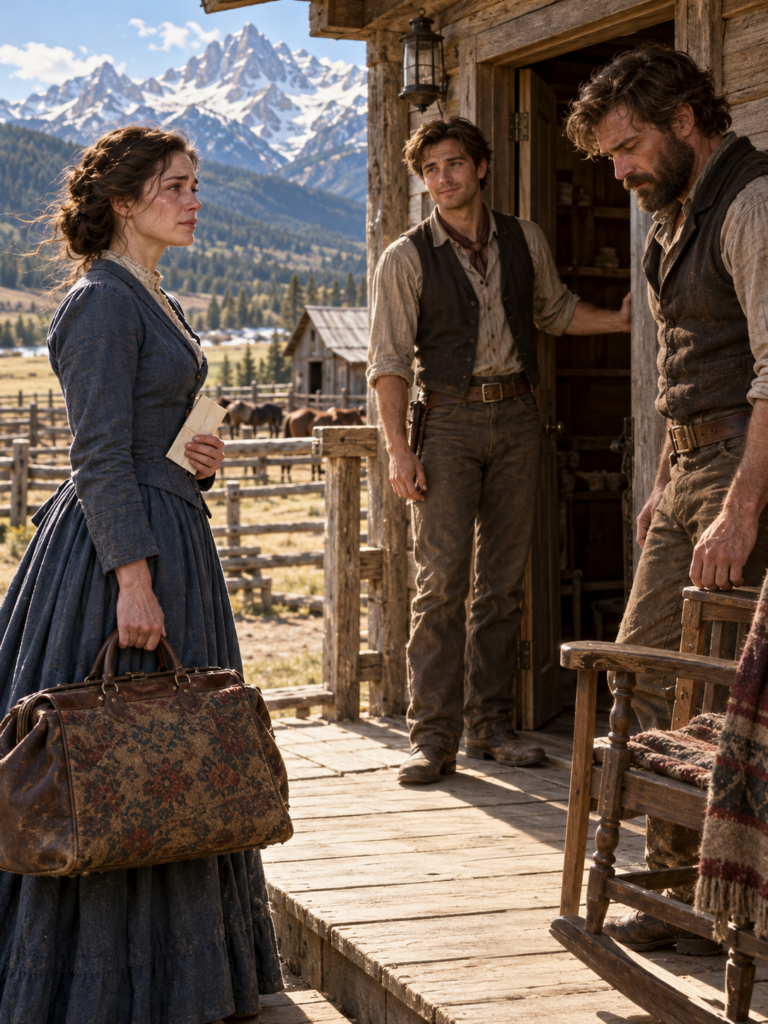
The woman who had arrived the previous April carrying a carpetbag, a minister’s letter, and the exhausted dignity of someone who had spent years caring for another person.
She had come seeking employment.
She had found honest work.
Then companionship.
Then love.
But she had also found something she had not expected.
A family willing to admit it was imperfect and to begin repairing what had been broken.
Later that morning, William joined her at the kitchen window.
Beyond the garden, spring sunlight rested upon the grass.
He slipped an arm around her waist.
“Thinking about something?”
Helena leaned against him.
“The northern meadow.”
“The flowers?”
“Yes.”
He smiled.
“We’ll ride there Sunday.”
“I’d like that.”
He kissed her temple.
She watched Richard crossing the yard beside Thomas, the two men discussing work as they walked toward the barn.
“William?”
“Yes?”
“Do you remember what you told me the first time we rode north?”
“I said several exceptionally clever things.”
She laughed.
“You said you were usually right about people.”
He sighed.
“I was hoping you’d forgotten that particular remark.”
“I haven’t.”
He considered the men outside.
“I’m trying to become better at understanding them.”
“You have.”
He drew her closer.
Beyond the window, the ranch stretched toward the mountains, its pastures greening under the spring sun.
Helena smiled.
“I think you were right about one thing.”
“What was that?”
“That I would love the meadow.”
William looked down at her.
“And?”
She turned in his arms.
“That I’d want to keep coming back.”
He kissed her gently.
In the room behind them, Richard was calling for another cup of coffee, and Thomas was complaining that someone had moved the sugar.
Helena laughed and turned toward the stove.
The ranch would require work tomorrow.
And the day after.
There would be hard seasons, difficult decisions, and disagreements that no amount of affection could prevent.
But the household had learned a better way to face them.
No one needed to earn his place twice.
No one needed to disappear behind his usefulness.
And Helena no longer needed to measure her future only by what she could do for others.
She had chosen William.
He had chosen her.
Richard had begun choosing honesty instead of fear.
And Thomas had learned to speak the love he once assumed his sons already understood.
The flowers in the northern meadow would bloom and fade with every passing year.
But the home they were building depended on something that could outlast the changing seasons.
Not perfect people.
Not an absence of sorrow.
Not even the land itself.
It depended upon the ordinary courage of a family willing to tell the truth, forgive without denying harm, and keep choosing one another.
Helena Marsh had come to the Callaway Ranch looking for work.
And somewhere between bread rising in the kitchen, wildflowers on a Montana hillside, and two brothers learning what it meant to belong, she had found a life that was finally her own.