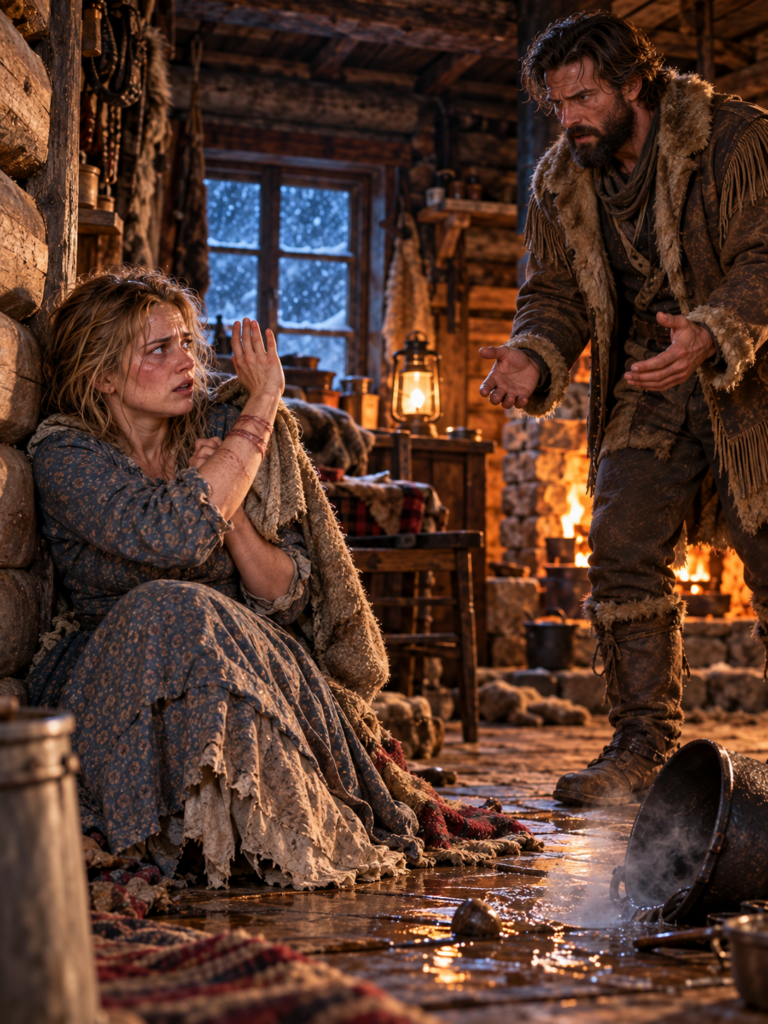
Eve pulled Jud’s hand away and released him immediately, as though touching him without permission might bring another punishment.
He remained on one knee.
“All right,” he said.
Her breathing was ragged.
“I didn’t mean—”
“You don’t need to explain.”
He moved back far enough to leave the path to the door clear.
Eve dragged her damaged sleeve over her shoulder. Her hands were trembling so violently that she could barely manage the cloth.
Jud looked toward the hearth.
He had seen men injured by traps, horses, falling timber, and difficult winters.
These marks were different.
Someone had hurt her repeatedly.
But seeing the evidence did not give him the right to demand her story.
“Are your legs still burning?”
Eve nodded.
“Keep cooling them. There’s clean cloth on the bench. We’ll cover them loosely afterward.”
She glanced at the floor.
“I spoiled your water.”
“I can fetch more.”
“And your supper.”
“I’ve gone hungry before.”
She watched him suspiciously.
“Are you angry?”
Jud considered the question.
“Yes.”
Her shoulders rose.
“Not with you,” he added.
He looked toward the broken pot.
“I’m angry I brought you here without asking enough questions. Angry I spoke to you like you were another piece of camp equipment.”
Eve said nothing.
He rose slowly.
“There’s no debt to work off here. I’ll still see you’re fed and sheltered. If you want wages for camp work, we’ll settle them fairly.”
Her eyes followed him across the room.
“What happens if I cannot work?”
“You’ll still have supper.”
She looked down again.
That simple answer seemed harder for her to believe than anything else he had said.
Jud gathered the spilled utensils and set them aside.
He could repair the handle in daylight.
For now, he wanted the floor dry before someone slipped.
But when he reached for the rag, Eve caught his sleeve.
“Don’t tell Hyram.”
Jud stopped.
“Tell him what?”
“About my arms.”
He turned to face her.
“Why would I?”
“Men talk. He hears things.”
“Not from me.”
Her grip loosened.
She swallowed.
“He was not the first.”
Jud felt his chest tighten.
“The first what?”
“The first man who said I owed him.”
Outside, wind drove loose snow against the shutters.
Jud waited.
Eve looked toward the little canvas sack beneath her bed.
“He let me sleep behind the saloon because I had nowhere else. He said I could repay the room with work.”
“Did you agree?”
“I worked.”
“That isn’t what I asked.”
She lifted her eyes.
“No. I never agreed to belong to him.”
Jud looked down at his hands.
He remembered Hyram’s smug expression when accepting the pelts and gold.
He remembered how easily he himself had begun giving Eve orders.
He had not meant to frighten her.
But intention had not made his words harmless.
“Tomorrow,” he said, “we’ll talk about what work you want to do and what share of the winter earnings is fair.”
“Why?”
“Because you’ve been keeping this camp running.”
“That was the arrangement.”
“An arrangement somebody else made doesn’t mean you were treated fairly.”
Eve looked bewildered.
He reached toward the basin, then stopped.
“May I set more water beside you?”
She nodded.
He moved carefully, placing the pitcher within reach.
For a while, they spoke only about the burns.
Then Eve asked, “Would you let me leave?”
“Yes.”
“Now?”
Jud glanced toward the snow-covered window.
“Not safely tonight. The lower trail’s dangerous in this weather. But when travel is possible, I’ll help you reach a place you choose.”
She considered him.
“And if I stay?”
“We’ll decide what that means together.”
The answer seemed to exhaust her.
She leaned back against the wall.
Jud sat by the hearth and kept his distance.
After several minutes, Eve spoke again.
“Before Hyram, there was a man named Wade.”
Jud looked up.
She stared at the fading fire.
“He said I could never get far enough away.”
Her voice became almost inaudible.
“Once, I believed him.”
Jud felt the urge to ask what Wade had done, where he lived, and whether he still searched for her.
But Eve was trembling again.
She had already said more than she intended.
So he asked only one question.
“Do you believe him now?”
Eve studied her scarred hands.
“I don’t know.”
The admission hung between them.
Jud rose to add another log to the hearth.
Then, before he could turn back, Eve reached for her canvas sack, withdrew a small wrapped bundle, and began untying the cord.
“There’s something I kept from him,” she said.
Her fingers paused at the last knot.
“If I show you, you must promise not to take it away.”
Jud turned from the hearth and looked at the small bundle resting in Eve’s lap.
“I won’t take it,” he said.
She watched him carefully.
“You promise?”
“Unless it places you in immediate danger, it stays yours.”
Her fingers worked the final knot loose.
Inside the cloth lay a small bone-handled knife.
The blade was worn but carefully maintained.
Jud recognized that it had been sharpened many times.
“You carried that from Bitter Creek?”
Eve nodded.
“Before Bitter Creek.”
He waited.
“I used it once when a man would not let me leave.”
Jud felt the room grow terribly quiet.
“Wade?”
She nodded again.
“He lived through it. I thought I had killed him. Hyram said he could hide me.”
“And Wade?”
“He promised he would find me.”
Jud pulled out the chair opposite her but did not sit until she nodded.
“Does Hyram know you still have the knife?”
“No.”
“Then keep it where you want.”
Eve stared at him.
She seemed to expect another question.
A demand.
Some accusation about what sort of woman carried a weapon.
None came.
Jud merely looked toward the window.
“If Wade comes this far, we’ll need to know. Until then, you don’t have to tell me more.”
The tension in her shoulders eased slightly.
She wrapped the knife again and returned it to her sack.
That night, Jud repaired the pot handle while Eve rested her burned legs.
He prepared supper himself.
It was poorly seasoned and the beans were harder than they should have been.
Eve ate anyway.
When he apologized for the meal, she almost smiled.
“You cook like you are angry with the food.”
Jud looked at his plate.
“Usually I am.”
The faintest laugh escaped her.
He had not heard her laugh before.
He discovered he wanted to hear it again.
But he did not ask.
The storm arrived three days later.
Snow covered the windows, buried the woodpile, and turned the surrounding trees into pale shapes barely visible through the blowing white.
Jud could not travel his usual trapline.
The mountain had reduced their world to one room, an outdoor store of firewood, and the narrow path he kept open for necessities.
He checked Eve’s burns each day only when she asked for help.
They were painful but began to improve.
When she could stand comfortably, she returned to some of the work around the cabin.
This time, the arrangement was different.
They agreed that she would manage food preparation and the smaller hides while Jud handled the long trapline and heavier outdoor work.
Both would maintain their own belongings.
Both would share the earnings according to their labor and supplies.
And neither would be ordered about as though one owned the other.
Jud was clumsy at discussing such matters.
Eve insisted upon clarity.
“Half the winter proceeds after necessary costs?” she asked.
“Half.”
“Even if I cannot do everything you do?”
“You’re doing work that lets me stay longer on the line. It counts.”
“And the cabin?”
“Mine to maintain. Yours to live in while you choose.”
She considered that.
“Then I want a place where I can keep my things without anyone searching them.”
Jud indicated the shelf near her bed.
“That shelf’s yours.”
He did not touch its contents again.
Their days took on a more natural rhythm.
Sometimes Eve talked while cooking.
Sometimes Jud answered with a few words.
He told her where the creek ran beneath the ice.
He showed her how to recognize the tracks of foxes, martens, and deer.
She learned the difference between a serviceable hide and one damaged beyond value.
When Jud returned with wet gloves, Eve knew how to dry them without ruining the leather.
When her fingers became sore from stitching, he took over carrying water.
Ordinary work began removing the fear that months of silence had left untouched.
But the mountains did not become gentler simply because the cabin had.
One night during the storm, a heavy sound came from the front wall.
Jud woke immediately.
Something was scraping against the timber.
Eve sat upright near the stove.
“What is it?”
Jud listened.
Another impact shook the door.
He rose and looked through the narrow window.
A massive grizzly stood outside in the driving snow, awake during winter and searching for food.
Jud’s expression tightened.
“Move away from the door.”
Eve obeyed, taking shelter behind the heavy table.
The bear struck the outer wall again.
Jud reached for his rifle.
Before he could secure it, the damaged latch gave way beneath the animal’s weight.
The door burst inward.
Snow swept across the floor.
The rifle slipped from Jud’s grasp.
The bear lunged into the opening, filling it with dark fur and a terrible growl.
Jud stumbled against the table.
He drew his revolver.
The animal struck at him, tearing through his sleeve and cutting his forearm.
Eve had already moved toward the fallen rifle.
She knew firearms.
That much Jud learned in the next terrible seconds.
She brought the weapon to her shoulder, waited until she had a clear line away from Jud, and fired.
The report filled the cabin.
The bear recoiled.
Eve fired again.
This time the animal collapsed across the broken threshold.
Jud stood motionless, his revolver still in his hand.
Eve lowered the rifle.
Her face had turned white.
For one moment she appeared perfectly calm.
Then her knees gave way.
Jud crossed toward her, stopping before he reached her shoulder.
“Eve?”
She looked up.
The rifle lay safely on the floor beside her.
“I thought it would kill you.”
“It nearly did.”
Her breathing broke into uneven gasps.
Jud knelt beside her.
“You saved me.”
She looked toward the animal, then at the blood running from his arm.
“You’re hurt.”
“Not badly, I hope.”
She pushed herself upright.
“Let me see.”
Jud sat at the table while she examined the cuts.
They were not deep enough to require immediate stitching, but they needed careful cleaning and watching.
Eve brought clean water and bandages.
Her hands steadied as she worked.
“Where did you learn to shoot?” Jud asked.
She kept her eyes on the cloth.
“Wade taught me.”
Jud said nothing.
“He thought it was amusing to teach me something dangerous while reminding me I could never use it against him.”
Her fingers stopped.
“Eventually, I did.”
Jud looked at the bone-handled knife resting at her belt.
“The night you escaped?”
“Yes.”
She tied the bandage.
“I had tried to leave before. He caught me. I believed the next time would be my last chance.”
Jud studied her face.
“You don’t have to explain any more tonight.”
Eve sat opposite him.
“But I want you to know something.”
He waited.
“I didn’t stay with Hyram because I trusted him. I stayed because he knew enough people to keep Wade from finding me. Then he began counting my food and lodging as a debt.”
Jud lowered his gaze.
“And I brought you away by paying that claimed debt.”
“Yes.”
“I should have asked what you wanted.”
“You asked if I wanted to leave.”
“But not where you wanted to go.”
Eve considered that.
“No.”
He looked at her.
“I’m sorry.”
She accepted the words quietly.
Then she looked toward the broken door.
“We have a bigger problem before morning.”
Jud followed her gaze.
Snow was blowing through the opening.
The door could be braced temporarily, but the latch needed repair.
Together they moved the heavy table and fitted a sturdy piece of timber across the damaged frame.
The work took longer because Jud’s arm was sore.
Eve measured the placement and held the timber while he secured it.
Neither could have managed the task as easily alone.
When they finished, the cabin was cold.
The hearth had nearly gone out.
Eve restored the fire while Jud gathered the remaining supplies.
By dawn, they had a repair strong enough to keep out the wind until the weather eased.
Outside lay the dead bear.
Inside were two exhausted people who had survived the night by depending upon one another.
The following morning, they dealt with the animal before scavengers could reach it.
The hide, meat, and fat became valuable additions to their winter stores.
Eve proved skilled with a knife, working steadily beside Jud.
He noticed how easily she adjusted her grip and how carefully she handled the hide.
“You’ve done this before.”
“At the mining camps.”
“You worked with animals?”
“Sometimes. Whatever work was needed.”
He did not press further.
That afternoon, Jud opened his ledger and made a careful account of the season’s pelts and stored supplies.
He showed Eve each entry.
“Forty-two beaver pelts. Twelve fox hides. The grizzly hide. Enough meat and fat to carry us through if we use it carefully.”
She examined the figures.
“What’s the value?”
“Depends what the traders offer in spring.”
“And half will be mine?”
He nodded.
“Half the net proceeds, as agreed.”
She looked at him a long while.
“No one has ever paid me fairly.”
Jud closed the ledger.
“Then somebody should have started sooner.”
He placed a bone-handled working knife on the table.
“This one’s smaller than the one you carry. Better for the fine work.”
Eve picked it up.
“A gift?”
“Yes.”
“No condition?”
“None.”
She turned the handle in her palm.
“Thank you.”
Her smile was brief but unmistakable.
Jud realized that the woman who once flinched at every sudden movement was beginning to let herself live.
And the change mattered to him more than the winter’s profits.
But five days later, his injured arm became swollen and painful.
He tried to dismiss it.
By evening, he had a fever.
By midnight, he could barely remain awake.
Eve checked the wound and saw redness spreading beyond the bandage.
She knew enough to recognize grave danger.
There was no physician within easy reach.
The trail remained buried.
She could only keep the wound clean, maintain warmth, offer water, and do everything possible to prevent the cabin from becoming another danger.
For several days, Jud drifted between restless sleep and fevered confusion.
Eve worked without pause.
She fetched water.
Split kindling.
Prepared broth.
Checked the roof and woodpile.
When Jud woke disoriented, she spoke firmly but gently.
“You’re in the cabin. You’re sick. I am here.”
Sometimes he recognized her.
Sometimes he did not.
On the third night, he moved suddenly while dreaming and struck her cheek with his elbow.
Eve staggered backward.
For a terrible moment, old memories flooded her.
Then she looked at his feverish face.
He was not threatening her.
He was barely conscious.
She stepped away until she could breathe steadily again.
Then she returned with fresh water.
She did not pretend the injury was nothing.
But she knew the difference between an accidental blow from a delirious man and deliberate cruelty.
On the fifth morning, Jud opened his eyes.
The cabin was warm.
His arm remained painful, but the fever had begun to ease.
Eve slept in a chair beside the hearth.
A bruise darkened one side of her face.
Jud stared at it.
“Eve.”
She woke immediately.
“Water?”
He nodded.
She handed him a cup.
He drank slowly.
Then he looked at her cheek.
“Did I do that?”
“You were feverish.”
He closed his eyes.
“I’m sorry.”
“I know.”
He swallowed.
“You kept me alive.”
She looked toward the fire.
“I did what I could.”
Jud glanced around the cabin.
Fresh wood stood stacked beside the stove.
The dishes were clean.
Their remaining food had been carefully divided.
For days, she had carried the work he could not perform.
When he looked back at her, his eyes were wet.
“Thank you.”
Eve lowered her gaze.
Then she smiled faintly.
“Get well, mountain man. The traps won’t check themselves.”
Jud laughed weakly.
Recovery came slowly.
He could not return to his long trapline immediately.
Eve began checking the short, familiar route near the cabin when the weather allowed.
She followed the marks he had shown her.
She brought back what she could manage.
Jud handled the lighter indoor tasks while his strength returned.
For the first time, their work was truly shared without either pretending that one person’s labor mattered more.
By March, the snow began softening beneath the midday sun.
The creek cracked open.
Birds returned to the timber.
Jud could walk farther, though his wounded arm remained weak.
Eve had begun to believe that spring might bring something other than another escape.
Then, while checking the eastern trapline, she found a bootprint beneath a spruce.
It had a square heel.
And beside the heel was a narrow drag mark left by a spur.
She knew that mark.
She had watched the same spur scrape across the floors of Wade’s mining camp.
Eve stood motionless.
The memories returned with sickening clarity.
The scars on her wrists.
The knife.
His voice promising he would find her.
She left the trapline immediately and hurried toward the cabin.
By the time she reached the door, she could barely breathe.
Jud looked up from the table.
“Eve?”
She clutched the doorframe.
“There’s a man on the eastern trail.”
He rose.
“Did you see him?”
“His tracks.”
“Could be a traveler.”
She shook her head.
“No.”
Jud waited.
Her voice dropped to a whisper.
“Wade.”
Jud’s expression changed.
Eve gripped the bone-handled knife at her belt.
“He found me.”
Then, for the first time, she told Jud what Wade had been threatening ever since she escaped.
And when she finished, Jud reached for his traveling pack.
“We need to decide what to do before he reaches the cabin.”
Jud opened his traveling pack and laid it on the table.
Eve stood beside the door, watching him gather food, spare clothing, and the supplies they would need away from the cabin.
Her face tightened.
“You’re sending me away.”
Jud looked up.
“No.”
“Then why are you packing?”
“Because that print may mean Wade’s coming, and this cabin has one door and little room to escape.”
He set down the pack.
“We have to choose a safer place to wait.”
Eve looked toward the window.
“He doesn’t travel alone.”
“How many men?”
“I don’t know. Sometimes two. Sometimes more.”
Jud considered the narrow trail.
“Wade knows your past. He doesn’t know this mountain as I do.”
“That won’t stop him.”
“No. But we don’t have to let him choose where to confront us.”
Eve moved closer.
“I won’t go back to him.”
Jud met her eyes.
“You aren’t going back to him.”
He stopped himself.
Then he spoke more carefully.
“I’ll help you keep your freedom. Whatever we do next, you have a say in it.”
Eve looked at the pack.
She was frightened.
But she was no longer the silent woman who had traveled from Bitter Creek without once asking where she was being taken.
“What choices do we have?”
Jud pointed toward the mountains beyond the eastern window.
“There is a rock shelf above the deadfall. We can watch the approach from there without being seen from the main trail.”
“And if he comes?”
“We try to learn how many men he has and whether they intend to pass through. If they come after us, we defend ourselves.”
Eve thought of the pistol Wade always carried.
The scar she had left near his neck.
The way he had spoken of women as goods to be delivered and exchanged.
“He came this far for me,” she said. “He will not turn around because you ask him.”
Jud nodded grimly.
“Then we need to be prepared for that.”
They left before dawn.
The climb was difficult.
Late winter snow remained deep among the shaded trees, and Jud had not fully recovered his strength.
Eve insisted that they stop whenever his breathing became too labored.
He accepted the need without argument.
When they reached the rock shelf, they settled behind fallen timber where they could see the eastern draw.
The cold worked steadily through their clothing.
They shared a wool blanket and ate small pieces of dried meat.
For hours, nothing moved below them.
Then birds erupted from the trees near the lower trail.
Jud shifted closer to the opening between the logs.
“Someone’s coming.”
Three riders emerged from the timber.
The first wore a heavy buffalo coat.
The second carried a rifle across his saddle.
The third rode a black gelding and wore a dark coat that seemed far too fine for mountain travel.
Eve recognized him immediately.
Wade.
Even at that distance, she knew the way he sat in the saddle.
Her stomach tightened.
Jud glanced at her.
“Is that him?”
“Yes.”
His voice remained steady.
“Then we know.”
Below, the riders stopped where Eve’s tracks had been left in the snow.
One man dismounted and examined the trail.
Eve watched through the gap in the timber.
“They’ll find the cabin.”
“Likely.”
“And then?”
Jud did not answer with a boast.
“We’ll have to keep our distance and see whether they’ll leave.”
The men began moving forward.
Soon the lead rider raised his head toward the ridge.
Jud leaned closer.
“Stay down.”
But the horse beneath the first rider had already turned sideways, revealing the man’s rifle.
A shouted word carried through the trees.
Then a shot cracked toward the rock shelf.
Splinters flew from the fallen timber.
Jud pulled Eve lower.
“They’ve seen us.”
The exchange that followed was confused and brief.
Jud fired to keep the armed riders from advancing.
One horse fell in the snow, leaving its rider struggling clear.
Another man abandoned his mount and moved toward the timber.
Wade disappeared among the trees to the west.
Jud understood the danger.
If the men climbed the ridge from different directions, the rock shelf would become a trap.
He looked at Eve.
“Can you hold this place?”
“Yes.”
“I need to see whether Wade’s moving around us.”
“Don’t go far.”
“I won’t if I can help it.”
She caught his sleeve.
“Jud.”
He looked back.
“Don’t leave me here thinking you’ve gone to settle my past without me.”
His face softened.
“I’m trying to keep us both alive.”
She released him.
“Then come back.”
He nodded.
And moved into the timber.
Eve remained behind the fallen logs.
The cold seemed sharper without him beside her.
Below, the rider who had escaped the fallen horse dragged himself toward the trees.
The third man appeared farther west, rifle in hand.
He began climbing toward the rock shelf.
Eve watched him.
When he raised his weapon toward her shelter, she fired.
The man fell into the snow.
She could not tell whether he was dead.
She only knew that he no longer advanced.
A moment later, shots rang out from the western timber.
Eve turned.
Jud.
She waited.
Another shot.
Then silence.
The fear that seized her was stronger than anything she had felt since Wade’s tracks appeared.
She called Jud’s name.
No answer came.
Eve understood the risk of leaving her protected position.
But she also knew he could be injured somewhere out of sight.
She checked the rifle and began moving carefully downhill, using the trees for cover.
Snow slid beneath her boots.
Branches caught her coat.
At the bottom of the slope, she heard a faint groan.
She rounded a boulder.
Jud sat against a tree, one hand pressed to his thigh.
Blood darkened his trousers.
His revolver lay in the snow nearby.
“Jud!”
She hurried toward him.
His face changed.
“Eve, behind you!”
She turned.
Wade stepped from behind the boulder.
The sight of him struck her like a blow.
The dark beard.
The cold eyes.
The familiar cruel smile.
He raised his revolver.
“Well,” he said. “You’ve made yourself difficult to collect.”
Eve kept her rifle between them.
“I’m not going anywhere with you.”
Wade glanced at Jud.
“Your new keeper?”
“No one keeps me.”
Wade laughed.
“That’s a pretty thought.”
He moved closer.
Eve tried to keep the rifle steady, but he struck the barrel aside before she could bring it properly to bear.
The weapon fell into the snow.
Wade seized her coat and shoved her backward.
She landed hard, struggling for breath.
Behind him, Jud tried to reach his revolver.
Wade turned his own pistol toward the wounded trapper.
Eve moved before she had time to think.
She caught Wade around the knees, driving him off balance.
His shot went into a tree.
They fell together into the snow.
Wade was heavier.
He forced her beneath him.
His hands closed around her throat.
For an instant, Eve was back in the mining camp.
She remembered trying to leave.
The ropes.
The threats.
The terrible certainty that she would never be free.
Then she felt the bone handle of the knife at her belt.
Jud had given it to her after recognizing that her work, her choices, and her future belonged to her.
She had kept it close ever since.
Now she drew it to defend her life.
The struggle was brief and desperate.
When it ended, Wade lay motionless in the snow.
Eve rolled away from him, coughing, her throat burning.
She stared at the man who had haunted her for so long.
He would never threaten her again.
But there was no triumph in the sight.
Only shock.
And a sudden, painful awareness that Jud was still bleeding.
She forced herself upright.
“Jud!”
He was slumped against the tree.
His eyes were closed.
Eve hurried to his side.
She pressed cloth against the wound, trying to slow the bleeding.
“Stay with me.”
He stirred faintly.
“Eve?”
“I’m here.”
“Are you hurt?”
“Not badly.”
He tried to lift his head.
“Wade?”
“He can’t hurt me anymore.”
Jud closed his eyes again.
Eve felt tears sliding down her face.
“Don’t you leave me now.”
He opened his eyes slightly.
“Not planning to.”
But his voice was weak.
And she knew that plans meant very little against blood loss and cold.
She worked with every skill the winter had taught her.
She kept pressure on the wound.
She gathered what supplies she could reach.
She found a way to move him with a makeshift drag, stopping often to check his breathing and the bleeding.
The journey back toward the cabin was slow, exhausting, and dangerous.
By the time they reached shelter, Eve could barely stand.
She got Jud into his bunk and built up the fire.
His injury required attention beyond what she could confidently provide, but the mountain trails and lingering snow made reaching a physician difficult.
For days, she cared for him while watching for any chance of safer travel or outside help.
She cleaned and changed dressings, kept him warm, brought water, and prepared what food he could manage.
The injury remained serious.
Jud was weak from blood loss and pain.
But gradually he became more alert.
His condition steadied.
And as the snow retreated farther from the lower trail, the possibility of reaching help improved.
By late April, Jud could stand for short periods with a walking stick.
His injured leg was stiff and unreliable.
He knew he might carry a limp for the rest of his life.
Eve did not pretend otherwise.
She simply adjusted their work.
She handled more of the outdoor tasks while he recovered.
He repaired equipment at the table and helped prepare meals.
When Eve returned from checking the shorter trapline, he had usually managed to set water heating and food cooking.
The first time she found him bent over the stove, she stopped in the doorway.
“What are you doing?”
“Cooking.”
She looked at the pot.
“Are you certain?”
Jud gave her an offended look.
“Been eating my own cooking since before you came.”
“That explains a great deal.”
He laughed.
She laughed with him.
And the sound filled a room where silence had once felt like a punishment.
Spring came slowly to the high valley.
The snow melted from the cabin roof.
The creek swelled with runoff.
Green grass returned beneath the pines.
One afternoon, Jud stepped onto the porch with his walking stick.
He stood watching Eve work at a stretched beaver hide beside the shed.
She wore her old calico dress beneath a heavier work apron.
Her hair had grown out unevenly, and she had begun tying it back.
Her arms were stronger.
Her movements more confident.
The old scars remained.
But she no longer concealed every inch of them.
She noticed him watching.
“You ought to rest that leg.”
Jud leaned on the railing.
“I’ve rested it half the winter.”
“Then perhaps you can rest it another hour.”
He smiled.
“Yes, ma’am.”
Eve set down her scraper and approached the porch.
“The traps?”
“Checked.”
“The wood?”
“Enough for supper.”
“The stew?”
“Cooking.”
She raised an eyebrow.
“Without burning?”
“That’s a cruel question.”
She smiled and climbed the steps.
Jud looked toward the valley.
“Pass should be open soon.”
Eve nodded.
“Yes.”
“I’ll need to take the furs down to Bitter Creek.”
Her smile faded slightly.
He continued.
“Half the earnings are yours, as we agreed.”
“I remember.”
“It’s enough to make a start elsewhere.”
She studied his face.
“Are you asking me to leave?”
“No.”
He shifted his weight.
“I’m telling you that you can.”
Eve looked out across the mountains.
For months, freedom had seemed like something she could only gain by running.
First from Wade.
Then from Hyram.
Then from the fear that any man offering shelter would someday demand more than she wished to give.
Now she stood beside someone who had learned to let her choose.
Jud continued.
“I can help you reach Denver. Or another town. Wherever you think you’ll be safe.”
“Would you want me to go?”
He looked at her.
“No.”
The answer came quietly.
“I’d miss you.”
Eve felt something move inside her chest.
Not fear.
Not obligation.
Something gentler.
She reached for the porch railing.
“What would you miss?”
Jud looked toward the cabin.
“The sound of you moving about in the morning.”
She smiled faintly.
“The way you argue over how much salt belongs in supper.”
“Because you use too much.”
“Perhaps.”
He continued.
“The way the place feels lived in. The way you ask questions I ought to have answered long ago.”
His eyes met hers.
“And I’d miss knowing you’re here.”
Eve rested her hand beside his.
“You don’t have to lose those things.”
He remained still.
“What are you saying?”
“I’m saying I don’t want to go to Denver.”
He watched her carefully.
“Because of me?”
“Partly.”
She looked toward the clearing.
“Because I have work here. Because I know these trails now. Because this winter, I learned I could make a life beyond what those men decided I was worth.”
Jud said nothing.
“And because I want to see what we might build next.”
He lowered his eyes.
“I haven’t always treated you right.”
“No.”
The honesty of her answer made him look up.
“You frightened me when I first came,” she continued. “You told me to stay out of your way. You spoke as though you could send me back down the mountain whenever I displeased you.”
Jud nodded.
“I remember.”
“But you changed.”
He swallowed.
“So did you.”
Eve smiled.
“I became more myself.”
He considered that.
“Maybe you did.”
She stepped closer.
“I’ll stay, Jud. But not as your campkeeper.”
“Then as what?”
She looked toward the cabin.
“Your partner. In the work. In the decisions. In whatever future we choose.”
Jud’s face softened.
“I’d like that.”
“And next winter,” she added, “you do half the cooking.”
He laughed.
“Half?”
“At least.”
“What if we have guests?”
“Then you had better learn not to burn the beans.”
He shook his head, smiling.
“Deal.”
Eve placed her hand over his on the railing.
He did not reach for her without asking.
Instead, he turned his palm upward.
She threaded her fingers through his.
They stood together, watching the spring sunlight move down the distant slopes.
Later that season, the sale of the furs gave Eve her first substantial money that no one could claim as payment for an invented obligation.
Jud counted it with her at the table.
She kept her share in her own possession.
They discussed repairs to the cabin, provisions for the next winter, and how the workload would change if Jud’s leg remained weak.
Nothing was decided without both of them speaking.
When they went to Bitter Creek, Eve stayed close to Jud out of choice, not fear.
Hyram saw them from outside his saloon.
For a moment, he looked as though he might call out.
Eve stopped and faced him.
“The debt you claimed is finished,” she said.
Hyram glanced toward Jud.
Eve continued before either man could speak.
“And I will never work under an arrangement like that again.”
Her voice did not tremble.
Hyram looked away.
She walked on.
Jud remained beside her, letting her words stand.
That evening, back in the cabin, Eve placed her money and the small bone-handled knife inside the wooden box beside her bed.
The knife no longer needed to remain constantly beneath her hand.
She knew where it was.
That was enough.
Jud was stirring supper.
Eve watched him for a moment.
“You remembered the salt.”
He looked over his shoulder.
“I’ve been instructed.”
She laughed.
Outside, the mountains were darkening beneath the evening sky.
The wilderness remained dangerous.
Winter would come again.
Their work would never be easy.
But the cabin was no longer a place where a frightened woman moved silently to avoid anger.
Nor was it a place where a solitary man believed every human connection must become a burden.
There were two chairs at the table.
Two voices discussing tomorrow’s work.
Two people with the right to disagree.
And when Jud held out a bowl of stew, Eve accepted it without lowering her eyes.
He sat beside her.
After a few spoonfuls, he asked, “How is it?”
She considered solemnly.
“Better.”
“High praise.”
“Don’t let it go to your head.”
Jud smiled.
Eve smiled back.
Years of suffering could not be undone by one kind man, one winter, or one decision to stay.
The scars remained part of her history.
But they no longer decided every moment of her future.
The life she had chosen was neither a debt nor a reward.
It was something she and Jud would have to keep building through honest work, respect, and the willingness to change.
And on that quiet spring evening, while the hearth burned steadily and the mountains settled into darkness, Eve understood what freedom had finally given her.
Not merely a place to hide.
A place where she could stand in the light.
A place where her voice mattered.
A place she was free to leave—and freely chose to call home.