Part 1
“Dad, are we going to have electricity tonight?”
Leo Bennett stopped halfway through tying his son’s shoelace.
Six-year-old Toby sat on the edge of their worn sofa, swinging one leg while his father knelt in front of him. His little sneakers had once flashed blue and red every time he walked. Now both batteries were dead, and the left shoe had a small hole near the toe.
“Of course we are, buddy.”
Toby studied him with the uncomfortable seriousness children sometimes developed when they had heard too many grown-up conversations.
“Because the paper said final notice.”
Leo’s fingers tightened around the lace.
He had thought he’d hidden that envelope beneath the grocery advertisements.
“That’s just something the electric company sends when they’re being impatient.”
“Like when Mrs. Donnelly tells us to pay the rent?”
Leo looked up.
“Exactly like that.”
Toby considered this.
“Adults are impatient a lot.”
“More than you know.”
The boy smiled, satisfied, and returned to the Spider-Man coloring book balanced on his knees.
Leo stood slowly, pressing his hand against his lower back.
The apartment was cold.
Not dangerously cold, but the kind of cold that crept through old windows and stayed in the walls long after the radiator had stopped pretending to work.
Outside, November rain ran down the glass in crooked lines.
The building across the alley looked almost identical to theirs: old brick, rusting fire escapes, and windows glowing with the lives of families trying to make another month work.
Leo glanced at the kitchen counter.
Three envelopes waited beside a half-empty box of cereal.
Electricity: $147.82.
Rent: $1,425.
A doctor’s bill from Toby’s winter bronchitis: $286.
His checking account held $42.18.
And the refrigerator contained two eggs, half a gallon of milk, some wilted carrots, and a package of hot dogs he had been stretching into three different dinners.
He turned his phone facedown before Toby could see the banking app.
Three years earlier, when Sarah was alive, they had never been wealthy.
But they had managed.
Sarah worked long shifts as a nurse. Leo taught beginner piano lessons and played weddings, hotel lounges, and private events.
They had a budget.
They had plans.
They had a woman who could make a bad day feel survivable by walking through the door and saying, “Okay, tell me what happened.”
Then, one rainy Thursday, a driver ran a red light.
Sarah never came home.
After the funeral, Leo discovered that grief did not pause the bills.
It did not care whether a father slept.
It did not help him answer a little boy asking why Mommy’s coat was still hanging by the door.
He stopped performing original music after that.
He played songs other people requested.
Songs that could be measured in hourly rates and tips.
Nothing more.
His phone vibrated against the counter.
JIMMY CALLING.
Leo answered.
“Please tell me you’re calling with a job.”
“Actually, I am.”
Jimmy Calder, an aging pianist who had spent thirty years playing everywhere from cruise ships to hotel bars, sounded breathless.
“I twisted my ankle getting off the subway. Doctor says no pedals, no walking around, no anything for at least a week.”
“That’s rough.”
“Rough doesn’t cover it. I’ve got the Mercer Holdings lobby shift this morning. I can’t get there.”
Leo looked toward the clock.
7:12 a.m.
“Jimmy, I can’t find childcare on twenty minutes’ notice.”
“Bring Toby.”
“To a corporate office?”
“He’s a good kid. He’ll sit beside the piano. I already told the staffing coordinator you were covering. They need somebody from eight until ten.”
Leo rubbed his forehead.
“How much?”
“One-fifty.”
The number seemed to brighten the room.
One hundred and fifty dollars.
Enough to stop the electricity from being disconnected.
Enough to buy groceries and breathe for a few days.
“You’re sure they’re okay with the kid?”
“Security knows. Just keep him out of the way.”
Leo stared at his son.
Toby had started coloring a superhero’s cape green.
“Okay,” Leo said. “Send me the address.”
Jimmy exhaled.
“You’re saving me, Leo.”
“Just promise you won’t try dancing on that ankle.”
Jimmy laughed.
Then his voice softened.
“Seriously. Thank you. They can replace me in a heartbeat if I miss too many shifts.”
Leo knew that feeling.
“Get better, old man.”
He ended the call.
Toby looked up.
“Are we going somewhere?”
“Yep.”
“Somewhere fun?”
Leo took his coat from the hook.
“Somewhere with the fanciest piano you’ve ever seen.”
Toby’s eyes widened.
“Fancier than ours?”
Leo glanced at the battered Yamaha keyboard standing against the living room wall.
A thin layer of dust covered its black casing.
“Buddy, I think this piano costs more than our whole apartment.”
“Can I touch it?”
“Absolutely not.”
“What if I use one finger?”
“Still no.”
“What if it’s my pinky?”
Leo laughed for the first time that morning.
“Get your backpack.”
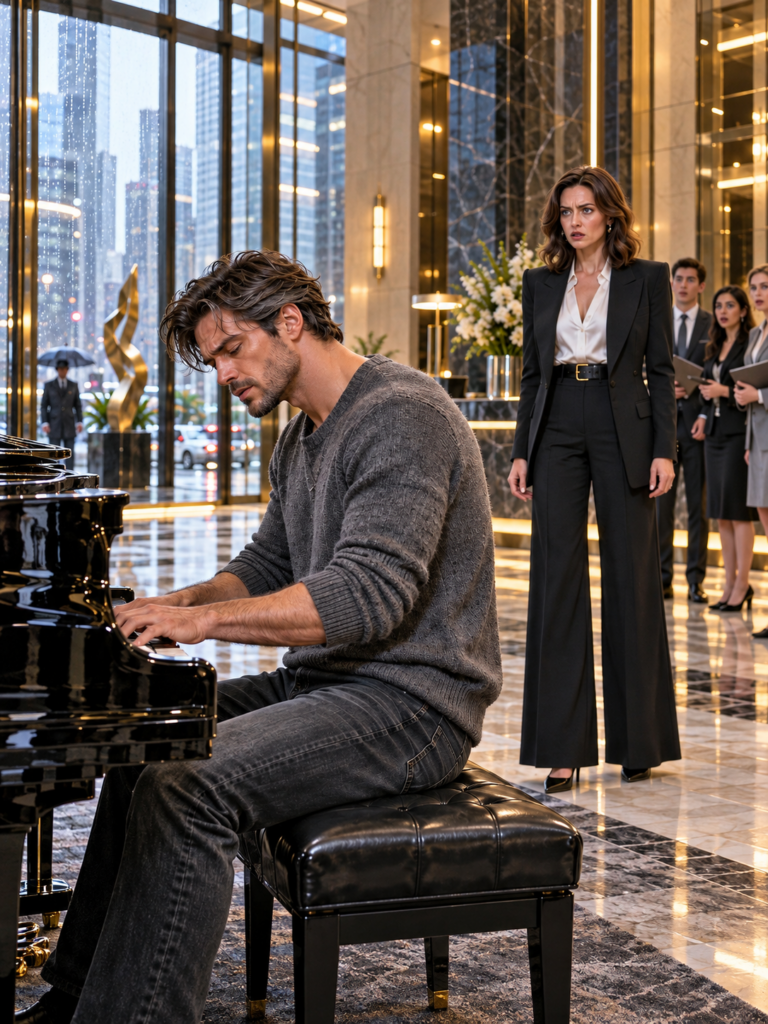
The lobby of Mercer Holdings looked less like an office building and more like a palace built by people who considered ordinary human problems a design flaw.
Italian marble covered the floors.
Steel pillars climbed toward a ceiling of glass.
Massive arrangements of white orchids decorated the reception desks.
Every person who entered seemed dressed for a photograph.
Leo stood just inside the revolving doors, rainwater dripping from his old gray coat.
Toby pressed close against his leg.
“Dad,” he whispered, “is this where the president lives?”
“No. But I think whoever owns it could probably buy the president a pretty nice house.”
A security guard behind the desk looked up.
His name tag read FRANK.
“Can I help you?”
“I’m Leo Bennett. Covering for Jimmy Calder on the piano.”
Frank glanced at Leo’s sweater, his faded jeans, then Toby.
“Right. Jimmy called.”
He checked a clipboard.
“Piano’s over there. Don’t leave the kid wandering around. Executive traffic gets heavy after eight.”
“Understood.”
Frank handed him a temporary visitor badge.
Leo noticed the older guard shifting his weight and wincing slightly.
“You okay?”
“Bad knee. Comes with being sixty-two and pretending you’re still forty.”
Leo smiled.
“Know the feeling.”
Then he led Toby toward the grand piano.
It was a black Steinway.
Perfectly polished.
Beautiful enough to make Leo hesitate before touching it.
For a moment, he remembered who he had once hoped to become.
At twenty, he had dreamed of concert halls.
At twenty-one, he had spent entire nights composing.
At twenty-two, a young woman named Audrey had sat beside him on a mattress in a leaking apartment, insisting he would someday play Carnegie Hall.
He pushed the memory away.
“Okay, Tobes. Right here.”
He arranged Toby’s crayons beside the bench and placed the coloring book on the clean marble floor.
The boy settled down obediently.
“Can you play the dinosaur song?”
“Not today. Today we’re playing boring grown-up music.”
“Why?”
“Because boring grown-up music pays the bills.”
Toby nodded solemnly.
“Then play really boring.”
Leo nearly laughed.
He adjusted the bench, stretched his stiff fingers, and began a gentle jazz standard.
The sound filled the enormous lobby.
People passed without looking.
A woman in a navy suit checked her watch.
Two lawyers argued quietly beside the elevators.
A young intern hurried through the revolving doors carrying four coffees and almost dropped them when her badge slipped from her hand.
Leo played on.
For the next thirty minutes, he became exactly what the company had hired him to be.
Background music.
Invisible.
At 8:43, a small commotion interrupted his concentration.
Near the security desk, a cleaning cart tipped sideways.
A bucket struck the marble with a sharp clatter, and dirty water spread across the floor.
An older cleaner, perhaps in her late sixties, froze with both hands against the cart.
“Oh, no,” she whispered.
A young executive stopped just short of the puddle.
“Seriously?”
The woman hurried to straighten the bucket.
“I’m so sorry, sir.”
“Someone could break their neck.”
“I know. I’m sorry.”
Her hands shook.
Leo watched from the piano.
The executive stepped around the water and disappeared into an elevator.
The cleaner crouched painfully, trying to gather fallen supplies.
Frank called for a maintenance worker, but the man was occupied near the loading dock.
Leo glanced at the clock.
He was on the job.
He was supposed to keep playing.
Then he noticed the cleaner struggling to lift the heavy bucket with one hand while pressing the other against her back.
He stopped.
“Toby, stay here.”
He walked across the marble floor.
“Ma’am, let me help you.”
She looked startled.
“No, no. You’re working.”
“So are you.”
He took the bucket, carried it to the utility closet, and returned with a mop.
“This happens to everybody,” he said.
The woman shook her head.
“Not in front of the executives.”
“Especially in front of executives. They have terrible timing.”
She gave a nervous little laugh.
They cleaned the spill together.
Her name was Mrs. Alvarez.
She had worked at Mercer Holdings for eleven years.
Her husband was recovering from a stroke, and she had recently taken extra shifts to cover medications that insurance would not fully pay for.
She didn’t tell Leo all of that.
Not yet.
She only thanked him and tried to give him a crumpled five-dollar bill for helping.
Leo gently pushed it back.
“Keep it.”
“Please. I interrupted your work.”
“Then consider it a break my fingers needed.”
From across the room, Frank watched the exchange.
So did a woman standing beside the private elevator bank.
She wore a charcoal suit and carried a slim leather briefcase.
Her dark hair was pulled into a neat knot.
Two assistants stood behind her, waiting for instructions.
The woman said nothing.
She watched Leo return to the piano, sit beside his little boy, and reach for the keys again.
Then her phone rang.
She turned away.
And Leo, unaware that anyone important had noticed him, began to play.
Audrey Mercer was not accustomed to stopping.
At forty, she controlled a corporate empire valued in the billions.
She had built it from a consulting firm operating out of a rented office, expanding through software licensing, commercial property, and strategic acquisitions.
Her photograph appeared in business magazines.
Her decisions moved stock prices.
She had been called brilliant, ruthless, visionary, arrogant, and impossible.
She considered most of those descriptions accurate.
That morning, she was already irritated.
The proposed telecom merger had stalled.
Her CFO had requested another meeting.
A charity gala organizer wanted her to approve a ridiculous floral budget.
And someone had put an eight-thirty appointment on her calendar without permission.
“Reschedule the financial committee,” Audrey said, moving toward the security gates.
Her assistant, Rachel, hurried beside her.
“They’ve already assembled.”
“Then they can practice patience.”
“Ms. Mercer, the board wants an answer before noon.”
“The board can have an answer when the numbers make sense.”
She stepped through the gate.
Then the music changed.
One low chord sounded from the grand piano.
Audrey stopped.
The chord hung in the air, dark and strangely familiar.
Then came two quiet notes.
A pause.
A soft descending phrase in the right hand, delicate as rain against a window.
Her stomach tightened.
No.
It wasn’t possible.
The melody continued.
Audrey’s entire body went cold.
She knew that song.
Not because she had heard it on the radio.
Not because it belonged to some famous composer.
She knew it because fifteen years earlier, in a cramped Brooklyn apartment with peeling wallpaper and a leaking ceiling, a young man had written it for her.
Only for her.
And nobody else was supposed to know it existed.
“Ms. Mercer?”
Rachel nearly collided with her.
Audrey did not answer.
The memory came with painful clarity.
A mattress on the floor.
A cheap keyboard purchased from a pawnshop.
Rain dripping into a plastic bucket.
A twenty-year-old Leo Bennett sitting cross-legged at the instrument, his hair falling into his eyes.
“What are you playing?” she had asked.
“Something I’m writing.”
“What’s it called?”
He had looked over his shoulder and smiled.
“I haven’t named it yet.”
“Then name it after me.”
“You’d like that, wouldn’t you?”
“Obviously.”
He had laughed.
Then he played the melody.
It began with sadness.
Not hopelessness.
Something more complicated.
Fear mixed with the stubborn courage of wanting someone to stay.
When he finished, he left the final chord unresolved.
“That sounds unfinished,” Audrey had said.
“It is.”
“Why?”
Leo had reached for her hand.
“Because I don’t know how our story ends yet.”
She had kissed him.
And promised she would never leave.
Eleven months later, she had packed two suitcases in the middle of the night.
She had left a note on the kitchen counter.
I’m sorry, Leo. I need a different future.
Then she disappeared.
Now, fifteen years later, the song was drifting through the lobby of her own corporate headquarters.
Audrey pushed past her CFO.
“Cancel my nine o’clock.”
Rachel blinked.
“But the merger—”
“Cancel it.”
She began walking toward the piano.
Every step felt heavier than the last.
She saw a little boy sitting on the floor, coloring.
Then she saw the pianist.
His shoulders were broader.
His hair had early gray at the temples.
His sweater was old.
His posture carried a fatigue no twenty-year-old could understand.
But the movement of his fingers was unmistakable.
Audrey stopped several feet behind him.
Leo played with his eyes closed.
He didn’t know she was there.
He didn’t know that every note was tearing open a wound she had spent fifteen years pretending had healed.
The music swelled.
And then, just as Audrey remembered, it ended on the same unresolved chord.
Silence.
Leo opened his eyes.
He slowly lowered his hands.
“Where did you learn that?”
The question came out sharper than Audrey intended.
Leo turned.
For an instant, neither moved.
He stared at the woman standing before him.
The tailored suit.
The expensive earrings.
The immaculate makeup.
He recognized her eyes before anything else.
“Audrey?”
She swallowed.
“Leo.”
He stood.
The movement was slow, almost defensive.
“What are you doing here?”
Audrey stared at him.
“I own this building.”
Leo looked toward the massive corporate logo above the reception desk.
MERCER HOLDINGS.
He gave a short, humorless laugh.
“Of course you do.”
“Leo, I—”
“Dad?”
Toby came running over, clutching his coloring book.
“Can we go home now? I’m hungry.”
Audrey looked down.
The little boy had Leo’s dark hair.
His eyes were wide and curious.
He held his father’s hand without hesitation.
“Your son?” she whispered.
Leo stepped closer to Toby.
“Yes.”
Audrey glanced at the worn sneakers.
The faded backpack.
The small hand wrapped around Leo’s fingers.
Something painful moved across her face.
“Are you married?”
Leo’s expression changed.
“No.”
She waited.
He looked away.
“My wife died three years ago.”
Audrey’s lips parted.
“Oh, Leo.”
“Don’t.”
One word.
Flat and final.
He bent to gather Toby’s crayons.
“We’re leaving.”
Audrey stepped forward.
“Please don’t.”
Leo stopped.
The word surprised him.
Audrey Mercer had never begged anyone for anything.
Not even when they had been young and terrified and desperately in love.
“Give me ten minutes,” she said.
“Fifteen years wasn’t enough?”
She flinched.
The lobby had fallen unusually quiet.
Her assistants stood near the security gates, pretending not to watch.
Frank remained behind his desk.
Mrs. Alvarez had stopped pushing her cleaning cart.
Audrey looked at the little boy, then at Leo.
“Somewhere private.”
Leo shook his head.
“I only came here to earn one hundred and fifty dollars.”
“I know.”
“No, Audrey. You don’t.”
He took his son’s hand.
But before they reached the doors, Toby stopped.
“Dad?”
“What, buddy?”
“Is she sad?”
Leo looked back.
Audrey stood motionless beside the grand piano.
For the first time in years, she had no idea what to say.
Part 2
Leo had intended to leave.
He had even reached the revolving doors before Toby tugged his sleeve again.
“Dad, the lady looked like she was going to cry.”
“Sometimes grown-ups get upset.”
“Did you play a sad song?”
Leo glanced toward the lobby.
Audrey was still standing beside the piano.
Her assistants had withdrawn to a respectful distance.
She looked smaller than he remembered.
Not physically.
Something about the way she held her hands.
As though all the money in the world had failed to teach her what to do with them.
“Yeah,” Leo said quietly. “I guess I did.”
He looked down at his son.
“Want to see the city from really high up?”
Toby’s entire face brightened.
“Like an airplane?”
“Not quite.”
Leo turned around.
Audrey looked up immediately.
“Ten minutes,” he told her.
She nodded.
“Ten minutes.”
The private elevator rose so smoothly that Toby barely noticed they were moving.
He pressed his nose close to the glass.
“Dad! The cars look like toys!”
“Don’t lean on it.”
“Are we going into the clouds?”
“Almost.”
Audrey stood behind them.
She watched Leo adjust Toby’s backpack strap.
Watched how he kept one hand near the boy whenever the elevator moved.
It was the kind of tenderness she remembered from another lifetime.
Leo had once held the door for elderly neighbors.
He had carried groceries up five flights of stairs for Mrs. Rosenberg without accepting a dollar.
He used to give away piano lessons to children whose parents couldn’t afford them.
Audrey had loved those things about him.
Until she began resenting how little they helped pay the rent.
The thought made her chest tighten.
The elevator doors opened.
Audrey’s office occupied the top floor.
Glass walls revealed a sweeping view of Manhattan.
The furniture was elegant and impersonal.
Expensive paintings hung in perfect alignment.
There were no family photographs.
No birthday cards.
No personal souvenirs.
Toby walked toward the windows.
“Wow.”
Leo remained near the door.
Audrey set down her briefcase.
“Would you like something to drink?”
“Water,” Leo said.
“Toby?”
“Do you have apple juice?”
Audrey hesitated.
“I can have someone get you some.”
Toby considered that.
“Water’s okay.”
Audrey pressed the intercom.
“Rachel, could you bring three waters and some snacks?”
Then she turned toward Leo.
“Sit down.”
“I’d rather stand.”
Audrey let out a slow breath.
“Still stubborn.”
“Still giving orders.”
For a moment, their eyes met.
The faintest trace of the people they used to be passed between them.
Then it was gone.
Audrey walked to her desk.
“I never expected to see you again.”
“Funny. I stopped expecting it about fourteen years ago.”
“Leo.”
“What do you want, Audrey?”
She looked toward Toby, who had found a blank notepad and was drawing beside the window.
“I want to know what happened.”
“To me?”
“Yes.”
Leo laughed softly.
“That’s a pretty big question for ten minutes.”
“You were going to be a concert pianist.”
“I was going to try.”
“You had talent.”
“Talent doesn’t buy diapers.”
“You could have kept composing.”
“I could have done a lot of things.”
Audrey crossed her arms.
“You’re angry.”
Leo stared at her.
“I’m not angry because you became successful.”
“I didn’t say that.”
“I’m angry because you vanished.”
She looked away.
“You know why I left.”
“No. I know what your note said.”
Audrey closed her eyes.
She could still remember writing it.
Her hand had shaken so badly that she ruined the first sheet of paper.
She had told herself she was making the responsible choice.
That she couldn’t build a future with a man who treated every rejection from a record label as temporary.
That she couldn’t spend her life choosing between rent and groceries.
She had grown up hearing landlords pound on doors.
She had watched her mother count quarters for laundry.
She had slept in a car one winter after her father’s business collapsed.
Poverty frightened her in a way Leo had never fully understood.
She had loved him desperately.
But she had loved the idea of safety too.
And eventually, fear had won.
“I was scared,” Audrey said.
Leo shook his head.
“So was I.”
“You don’t understand what I grew up with.”
“I knew exactly what you grew up with. You told me.”
“No,” she said, her voice tightening. “I told you the stories. I never told you how it felt waking up every morning convinced that everything could disappear.”
Leo stared at her.
“Then you should’ve told me.”
The simplicity of the statement seemed to defeat her.
He continued.
“You could’ve said, ‘Leo, I can’t live like this anymore.’ You could’ve asked me to get another job. You could’ve told me you hated that apartment.”
“I didn’t hate the apartment.”
“You hated being afraid.”
Audrey lowered her eyes.
“Yes.”
Leo stood quietly for a moment.
Then he said something she wasn’t prepared to hear.
“I would’ve chosen you.”
She looked up.
“What?”
“If you’d asked me to stop chasing record deals and find something steady, I would’ve done it.”
“Leo, music was your life.”
“You were my life, too.”
Audrey’s face crumpled.
He stepped back.
“But you never gave me the chance to prove it.”
The office fell silent.
Across the room, Toby continued drawing.
Rachel arrived with water, juice, and a small tray of sandwiches.
Audrey thanked her and motioned toward Toby.
“Would you like one?”
The boy looked at his father.
Leo nodded.
“Go ahead.”
Toby took half a sandwich.
Then, noticing there were several left, he picked up another and carried it toward Leo.
“Dad, you didn’t have breakfast.”
Leo’s expression softened.
“I’m okay, buddy.”
“You said breakfast is important.”
“I did say that.”
“Then you should listen to yourself.”
Audrey watched as Leo accepted the sandwich.
The boy returned to the window, pleased.
Something about the exchange left her aching.
It wasn’t the poverty.
It was the way Toby trusted his father.
The way Leo tried to hide how hungry he was.
The way a small child had already learned to notice when someone else was going without.
Audrey looked down at her untouched water.
“Who was his mother?”
“Sarah.”
“What was she like?”
Leo’s gaze moved toward his son.
“Kind.”
Audrey waited.
“She was a nurse. The kind who stayed after her shift to sit with patients who didn’t have visitors.”
His voice softened.
“She loved terrible television. Burned toast. Sang off-key. Made Toby laugh so hard he’d get hiccups.”
A faint smile appeared.
Then faded.
“She died in a car accident three years ago.”
Audrey pressed her lips together.
“I’m sorry.”
“I know.”
“Do you have family helping?”
“My sister’s in Ohio. She calls. Jimmy helps when he can. But mostly it’s us.”
Toby looked over.
“Me and Dad are a team.”
Leo smiled.
“That’s right.”
Audrey had negotiated deals worth hundreds of millions of dollars without blinking.
Now she found herself struggling to respond to a six-year-old describing two people surviving together.
She walked to her desk and opened a drawer.
Inside lay a checkbook.
Leo noticed immediately.
“Audrey.”
She kept writing.
“Please. Don’t make this difficult.”
He stared at the paper she handed him.
Fifteen thousand dollars.
Enough to clear his debts.
Enough to replace the failing keyboard.
Enough to take Toby somewhere nice and maybe sleep through the night without worrying.
For one dangerous second, he imagined accepting it.
Then he looked at Audrey.
She was watching him with the tense expectation of someone who had spent years solving problems by signing checks.
He handed it back.
“No.”
“Leo, it’s nothing to me.”
“Exactly.”
Her face tightened.
“That came out wrong.”
“I know what you meant.”
“Then take it.”
“No.”
“Your son shouldn’t have to struggle because of your pride.”
Leo flinched.
Audrey immediately regretted the words.
But he had already stepped away.
“Don’t do that.”
“I’m trying to help.”
“By making me feel like I failed him?”
“No.”
“Then don’t use him to make me accept money from you.”
Audrey stared at him.
“I never said you failed.”
“You didn’t have to.”
He called Toby.
“Pack up, buddy.”
The boy slipped his crayons into his backpack.
Audrey followed them toward the door.
“Leo, please.”
He stopped.
“Do you want to know what happened after you left?”
She nodded.
“I spent six months trying to figure out what was wrong with me.”
A tear slipped down her cheek.
He continued.
“I stopped writing music for a while. Took whatever work I could find. Eventually, I met Sarah. She didn’t ask me to become famous. She just wanted me to come home for dinner.”
Audrey listened without moving.
“And when she died, I learned something.”
“What?”
“You can’t buy your way out of losing somebody.”
He glanced toward the check in her hand.
“And you can’t buy your way back into their life, either.”
He opened the door.
Toby waved.
“Bye, piano lady.”
Audrey tried to smile.
“Goodbye, Toby.”
The doors closed.
Audrey stood in the silence for a long time.
Then she looked down.
Toby had left a drawing on the rug.
A black piano.
A man playing it.
A little boy standing beside him.
And in one corner, a woman with long hair watching.
Beneath the picture, in crooked letters, Toby had written:
Daddy’s song.
Audrey sat down on the floor.
For the first time in fifteen years, she cried without trying to stop herself.
By two that afternoon, the merger was dead.
The boardroom fell silent when Audrey announced her decision.
Her CFO, Daniel Price, adjusted his glasses.
“I’m sorry. Did you say withdraw the offer?”
“Yes.”
“We’ve spent eight months on this acquisition.”
“And the valuation doesn’t justify the risk.”
“The board won’t be pleased.”
“The board rarely is.”
Daniel leaned forward.
“Audrey, are you feeling all right?”
She looked at the financial projections filling the screen.
Usually, numbers soothed her.
They had clear rules.
Clear consequences.
Numbers didn’t leave notes on kitchen counters and disappear.
But today she couldn’t focus.
She kept seeing the worn gray sweater.
The little boy who shared his sandwich.
The trembling hands of the man who had once believed in her without reservation.
“We’re done,” she said.
She stood and walked out.
Rachel followed.
“Ms. Mercer?”
Audrey stopped at the elevators.
“The pianist who covered Jimmy’s shift this morning.”
“Yes?”
“Make sure Jimmy is paid for the booking and Leo Bennett receives his full fee directly. No deductions.”
“Of course.”
“And Rachel?”
“Yes?”
“Find out whether the cleaning staff have the equipment they need.”
Rachel blinked.
“I’m sorry?”
“The older woman who spilled the bucket this morning. Her cart looked damaged.”
“I’ll ask facilities.”
Audrey nodded.
Then she added, “And tell them I don’t want anyone disciplined for a spill.”
Rachel made a note.
Audrey entered the elevator.
As the doors closed, she caught her reflection in the polished metal.
She looked exactly as she always did.
Perfect suit.
Perfect hair.
Perfect composure.
But inside, something fundamental had shifted.
That evening, Leo stood in a grocery store calculating the price of milk.
Jimmy had sent the money.
One hundred and fifty dollars.
After paying the overdue electricity bill, Leo had just enough left for bread, eggs, pasta, and a few other essentials.
The store’s fluorescent lights hummed overhead.
Toby held a box of dinosaur-shaped chicken nuggets.
“Dad?”
“Yeah?”
“These are on sale.”
Leo checked the tag.
$6.99.
He looked into the cart.
Milk.
Bread.
Eggs.
Generic pasta.
A bag of frozen vegetables.
He mentally added the totals.
“Maybe next time.”
Toby nodded and returned the box without arguing.
That hurt more than if he’d complained.
They reached the register behind an elderly woman wearing a faded blue coat.
She had several groceries on the conveyor belt: soup, bread, oatmeal, bananas, and a small package of chicken.
When the cashier announced the total, the woman opened her wallet.
She counted bills slowly.
Then coins.
Her cheeks turned pink.
“Oh dear.”
The cashier waited.
The woman removed the chicken.
“Without that, please.”
The new total appeared.
She counted again.
Then removed the bananas.
Leo looked at Toby.
The boy was watching quietly.
The woman gave an embarrassed little laugh.
“I thought my deposit had cleared. Apparently not.”
The cashier was patient.
“Take your time.”
But the woman looked close to tears.
Leo checked his wallet.
He had twenty-three dollars in cash.
Money he had planned to keep for the subway and emergencies.
He hesitated.
Then stepped forward.
“Ma’am?”
The woman turned.
“Let me get the chicken and bananas for you.”
Her expression changed immediately.
“Oh, no, young man. I couldn’t.”
“Please. It’s okay.”
“That’s very kind, but—”
“My son and I are celebrating something today.”
Toby looked up, confused.
Leo continued.
“I got a little extra work. We’d like to share the good luck.”
The woman glanced at Toby.
“Are you sure?”
Leo nodded.
“Absolutely.”
He paid.
The woman thanked him three times.
When she finally left, Toby looked at his father.
“Dad, what are we celebrating?”
Leo smiled.
“Having a pretty good kid.”
Toby grinned.
“That means me?”
“Unless there’s another one hiding in the cart.”
The boy laughed.
Then he grew thoughtful.
“Was that lady hungry?”
“I think she needed a little help.”
“Like when Jimmy helped us?”
“Yeah.”
Toby reached for his father’s hand.
“Then it’s good we helped her.”
Leo looked toward the store doors.
“Yeah, buddy. It is.”
They walked home in the rain.
Leo carried the groceries in one hand.
Toby held his other.
Neither noticed the black town car parked across the street.
Audrey had not intended to follow Leo.
That was what she kept telling herself.
She had asked Jimmy for his address after explaining that Toby had left something behind.
She genuinely wanted to return the drawing.
But her driver had reached the neighborhood early, and Audrey had spotted Leo and Toby through the grocery store window.
She had asked him to stop.
For several minutes, she sat in the back seat watching them.
She saw Leo put the chicken nuggets back.
Saw him check his wallet.
Saw the elderly woman at the register.
And then she watched him give away money he clearly did not have to spare.
Her driver, Charles, glanced at her through the mirror.
“Ma’am?”
Audrey didn’t answer.
She watched Leo kneel to adjust Toby’s hood before stepping into the rain.
The boy laughed at something his father said.
Leo laughed with him.
Audrey leaned back against the leather seat.
Fifteen years.
She had spent fifteen years telling herself that Leo was irresponsible.
That he didn’t understand money.
That kindness without financial security was naïve.
Yet here he was.
Exhausted.
Struggling.
Trying to keep his son warm.
And still stopping to help someone else.
She turned toward the window.
“Charles?”
“Yes, Ms. Mercer?”
“Have you ever made a decision you thought was necessary, then spent years wondering whether it was actually cowardice?”
Charles considered the question.
“My brother and I didn’t speak for nine years after our father’s funeral.”
Audrey looked up.
“What happened?”
“Argument over the house.”
“Who was right?”
Charles smiled faintly.
“Doesn’t matter much now. He died before I apologized.”
The car grew quiet.
Audrey looked down at the drawing in her lap.
“I’m sorry.”
Charles nodded.
“Me too.”
After a moment, he asked, “Where to, ma’am?”
Audrey watched Leo and Toby disappear into their apartment building.
“Home.”
But when the car started moving, she changed her mind.
“No. Wait.”
Leo was halfway through stirring macaroni when the apartment buzzer sounded.
He frowned.
Nobody visited without calling.
The buzzer rang again.
Toby looked up from his coloring book.
“Is it Mrs. Donnelly?”
“I hope not.”
Leo pressed the intercom.
“Hello?”
A familiar voice answered.
“It’s Audrey.”
His hand froze.
He stared at the speaker.
“You’ve got to be kidding me.”
“Can I come up?”
“No.”
“Leo.”
“Audrey, we said everything that needed saying.”
“I have something Toby left behind.”
Leo exhaled.
He knew she could have mailed it.
He knew the drawing was an excuse.
He also knew it was raining hard enough to soak someone in thirty seconds.
He pressed the door release.
“Third floor.”
A minute later, she appeared at the top of the stairs.
Her expensive coat was damp.
Her heels were wet.
A strand of dark hair had escaped her carefully arranged hairstyle.
She looked utterly out of place.
Leo stood in the doorway.
“You really don’t understand the word no, do you?”
“Not always.”
“You should practice.”
Audrey almost smiled.
Then she glanced past him.
The apartment was small.
The wallpaper peeled near the kitchen.
An old radiator clanked beneath the window.
Toby sat cross-legged on the rug eating macaroni from a plastic bowl.
He looked up.
“Piano lady!”
“Hi, Toby.”
“Did you come to hear Dad play?”
Audrey’s expression softened.
“I’d like that.”
Leo gave her a warning look.
“She’s just dropping something off.”
Audrey reached into her bag.
She handed Toby the drawing.
“You forgot this.”
The boy’s face lit up.
“My picture!”
He took it and hurried toward the refrigerator, where several other drawings were held up by mismatched magnets.
“Dad, can we put it here?”
“Sure, buddy.”
Toby attached the drawing beside a photograph of his mother.
Audrey saw the photograph.
A woman with bright eyes and an open smile held a toddler against her shoulder.
Leo stood beside them, laughing.
Sarah.
Audrey looked away.
Leo noticed.
“Can we talk outside?”
Audrey nodded.
He stepped into the narrow hallway and pulled the door nearly closed behind him.
“What are you doing?”
Audrey gripped the handle of her handbag.
“I wanted to see you.”
“You saw me this morning.”
“That wasn’t enough.”
“It’s going to have to be.”
She hesitated.
Then said, “I saw you at the grocery store.”
Leo went still.
“You what?”
“I was nearby.”
“You followed me?”
“I went to return the drawing.”
“And then you sat outside watching my life?”
Audrey looked embarrassed.
“Yes.”
Leo stared at her in disbelief.
“That is not okay.”
“I know.”
“You can’t just show up wherever you want because you own half of Manhattan.”
“I know.”
“You don’t know, Audrey. You haven’t been told no in so long that you think other people’s boundaries are suggestions.”
She lowered her head.
He had expected an argument.
Instead, she whispered, “You’re right.”
His anger faltered slightly.
Audrey continued.
“I saw you help that woman.”
Leo sighed.
“Don’t.”
“You barely had enough for your own groceries.”
“You don’t know what I had.”
“I saw you put food back.”
He looked away.
“You shouldn’t have been watching.”
“No,” Audrey said. “I shouldn’t.”
The hallway fell silent.
Then she spoke again.
“When we were young, I used to think you gave too much.”
Leo said nothing.
“I remember you buying groceries for Mrs. Rosenberg when our own refrigerator was almost empty.”
“She was eighty-four.”
“I know.”
“And she had arthritis.”
“I know.”
“She couldn’t carry things upstairs.”
Audrey nodded.
“And I was furious with you because we’d been saving for a security deposit.”
Leo folded his arms.
“You had every right to be concerned.”
“But not to make you feel ashamed of being kind.”
He looked at her.
She continued.
“I used to think the world would punish us for caring about people who couldn’t give us anything back.”
“Sometimes it does.”
Audrey’s eyes filled.
“And you still do it.”
Leo let out a tired breath.
“I’m not some kind of saint, Audrey. I get angry. I lose patience. Sometimes I snap at Toby and hate myself afterward. I’m late paying bills. I make bad decisions.”
He paused.
“But the woman needed groceries.”
Audrey looked at him for a long time.
Then she whispered, “I missed you.”
Leo closed his eyes.
Those three words carried fifteen years of weight.
“Audrey.”
“I know I don’t deserve to say it.”
“It’s not about deserving.”
“Then what is it?”
He opened his eyes.
“Sarah died three years ago.”
Audrey nodded.
“You know what I learned after that?”
She waited.
“Missing someone doesn’t mean you get them back.”
Her face tightened.
“I know.”
Leo moved toward the door.
“I have to put Toby to bed.”
Audrey stepped aside.
“Okay.”
For the first time that day, she didn’t ask him to stay.
She turned toward the stairs.
Then paused.
“Leo?”
He looked back.
“I didn’t leave because I stopped loving you.”
He stood very still.
“I left because I was terrified that loving you wouldn’t be enough to keep us safe.”
A long silence stretched between them.
Finally, Leo said, “You should’ve trusted me enough to tell me.”
Audrey nodded.
“I know.”
She walked downstairs.
Leo remained in the hallway until he heard the building door close.
The next morning, Leo woke to find Toby sitting beside his bed.
“Dad?”
He opened one eye.
“Why are you awake at six?”
“I have a question.”
“Can it wait until coffee?”
“No.”
Leo sat up.
“Okay.”
Toby twisted the edge of his pajama shirt.
“Do you love the piano lady?”
Leo stared at him.
“Where did that come from?”
“You look sad when she leaves.”
Children were dangerous observers.
Leo rubbed his face.
“It’s complicated, buddy.”
“Like fractions?”
“Much worse.”
Toby considered that.
“Mommy loved you.”
Leo swallowed.
“Yeah. She did.”
“Can people love more than one person?”
Leo looked toward the photograph of Sarah on his dresser.
He remembered the life they had built.
The ordinary happiness.
The arguments over laundry.
The nights she fell asleep against his shoulder.
He looked back at Toby.
“Yes,” he said softly. “They can.”
Toby nodded.
Then he crawled beneath the blanket beside his father.
“Good. Because I love you and Mommy and Jimmy.”
Leo wrapped an arm around him.
“That’s a lot of love.”
“And maybe the piano lady.”
Leo smiled faintly.
“You barely know her.”
“She looks lonely.”
The words struck harder than Toby could understand.
Leo kissed the top of his son’s head.
“Go back to sleep.”
But he remained awake long after the boy drifted off.
Two days later, Leo received a call from an unfamiliar number.
“Mr. Bennett?”
“Yes?”
“This is Rachel Thompson, executive assistant to Audrey Mercer.”
Leo sat up straighter.
“What happened?”
“Nothing urgent. Ms. Mercer would like you to come to headquarters tomorrow morning.”
He frowned.
“Why?”
“There is a professional matter she’d like to discuss.”
“Professional?”
“Yes.”
Leo glanced at his keyboard.
He had been worried that Jimmy might lose his regular job because of the unusual performance in the lobby.
“Is Jimmy in trouble?”
“I can’t discuss the details over the phone.”
His stomach sank.
“What time?”
“Ten o’clock.”
Leo hesitated.
Then agreed.
After hanging up, he stared at the phone.
He had a bad feeling.
The last time Audrey Mercer had brought him into her office, she had tried to give him money he couldn’t accept.
Now she wanted another meeting.
About something professional.
Leo looked at the stack of bills on the kitchen counter.
He couldn’t afford to lose Jimmy’s friendship.
Or Jimmy’s work referrals.
And he certainly couldn’t afford to be dragged into some corporate dispute.
The next morning, after dropping Toby at school, Leo returned to Mercer Holdings.
Frank greeted him at the security desk.
“Mr. Bennett.”
“Morning.”
“Top floor. They’re expecting you.”
Leo frowned.
“Do you know what this is about?”
Frank shook his head.
“Only that Ms. Mercer asked me to make sure you came straight up.”
Leo boarded the private elevator.
As it climbed, he felt the same uneasy pressure in his chest that he used to feel before important auditions.
Only this time, he wasn’t trying to impress anyone.
He was trying to protect the few things he had left.
The doors opened.
Rachel waited outside.
“Good morning, Mr. Bennett.”
“Morning.”
She led him down a glass hallway.
At the far end stood two heavy wooden doors.
Rachel opened them.
Leo stepped inside.
Audrey stood beside a conference table.
But she wasn’t alone.
A silver-haired woman sat beside the company’s director of employee programs.
A man from the corporate events division had a folder open in front of him.
And resting against the far wall was a framed photograph of a concert grand piano.
Leo stopped.
“What is this?”
Audrey looked up.
“Thank you for coming.”
He glanced around the room.
“Am I being investigated?”
“No.”
“Is Jimmy losing his contract?”
“Absolutely not.”
“Then why am I here?”
Audrey took a slow breath.
“Because there’s something I need to tell you.”
And for the first time since they had met again, Leo noticed that she looked genuinely nervous.
Part 3
“Before you say anything,” Leo began, “I need you to understand something.”
Audrey waited.
“I don’t want charity.”
“I know.”
“And I don’t want a job invented just because you feel guilty.”
The silver-haired woman beside the table looked from Leo to Audrey.
Audrey nodded.
“I know that, too.”
“Then what exactly is happening?”
She motioned toward the empty chair.
“Please sit. This will take more than ten minutes.”
Leo hesitated.
Then sat.
Audrey introduced the others.
“This is Evelyn Hart, chair of our community arts foundation. Martin Ellis oversees corporate events and employee engagement. And Susan Park directs our education partnerships.”
Leo glanced at each of them.
“Okay.”
Evelyn smiled.
“Mr. Bennett, thank you for coming.”
He nodded politely.
Audrey remained standing.
“Three years ago, Mercer Holdings created a foundation to support arts education in underserved neighborhoods. We funded equipment, sponsored performances, and made donations to public schools.”
Leo waited.
“We’ve done some good work. But recently I realized we were spending more time photographing ourselves giving money away than understanding whether the programs were actually reaching the children who needed them.”
Evelyn nodded.
“That was a conversation we’d already begun having with the board.”
Audrey continued.
“We’re redesigning the program. More direct teaching. Smaller community partnerships. Paid instructors. Better access for working families.”
Leo looked at the folders.
“And?”
Martin slid a sheet of paper across the table.
“We’re looking for someone to lead a pilot music program.”
Leo read the heading.
COMMUNITY MUSIC INITIATIVE.
PILOT PROGRAM DIRECTOR.
His eyes moved to the salary line.
$68,000 annually.
Health benefits.
Paid leave.
Retirement contributions.
A modest instrument budget.
He looked up sharply.
“No.”
Audrey didn’t appear surprised.
“Leo—”
“No. Absolutely not.”
Evelyn leaned forward.
“Mr. Bennett, perhaps you should hear the full proposal.”
“I don’t need to.”
He slid the paper away.
“I know what this is.”
Audrey said quietly, “Then tell me.”
“You saw my apartment. You saw my groceries. You heard about Sarah. Now you’ve decided to fix me.”
“No.”
“Then why am I being offered a sixty-eight-thousand-dollar salary by a company I’ve never worked for?”
“Because we need someone who understands music education.”
“Find someone with a degree in nonprofit management.”
“That’s what we were planning to do,” Evelyn said.
Leo turned toward her.
The older woman adjusted her glasses.
“And frankly, I was skeptical when Audrey suggested you.”
He blinked.
Evelyn continued.
“I told her I wasn’t interested in hiring an old friend of hers. This foundation has real responsibilities. We can’t use it to settle personal debts.”
Audrey stood quietly.
Leo looked between them.
“Then why am I here?”
“Because we reviewed your qualifications.”
Evelyn opened another folder.
“You taught at the Bedford Community Center for four years.”
Leo nodded cautiously.
“Before it closed.”
“You organized free weekend lessons for neighborhood children.”
“They needed something to do.”
“Several of your former students went on to music programs in high school.”
He looked down.
“I heard about a couple.”
“We contacted your former supervisor. She remembered you very well.”
Leo said nothing.
Evelyn turned a page.
“We also spoke to the director of a youth arts nonprofit where you’ve volunteered occasionally.”
“Only when they need a pianist.”
“She said you never turn down a child who wants to learn.”
Leo’s throat tightened.
He hadn’t thought anyone noticed those afternoons.
To him, they were simply hours he could spare.
Evelyn continued.
“You have performance experience, teaching experience, and an understanding of the obstacles facing families who cannot pay private lesson fees.”
She closed the folder.
“We aren’t offering you a position because your life has been difficult. We’re inviting you to interview because your experience is relevant.”
Leo looked at Audrey.
“And you arranged all this?”
“I asked them to consider you.”
“Why?”
Audrey paused.
Then answered carefully.
“Because I heard you play.”
He looked away.
“And because I watched you help someone in the lobby when you thought nobody important was looking.”
Leo frowned.
“Mrs. Alvarez?”
“Yes.”
Audrey continued.
“You stopped your performance to help her. You treated her like a person instead of an inconvenience.”
Leo shrugged.
“Anyone would’ve done that.”
“No,” Evelyn said gently. “Not everyone does.”
Audrey glanced at Leo.
“I also learned that you covered Jimmy’s shift because you were worried he’d lose his contract.”
“He was injured.”
“And you needed the money yourself.”
Leo’s jaw tightened.
Audrey raised a hand.
“I’m not bringing that up to embarrass you. I’m telling you because a program that works with vulnerable families needs someone who understands what dignity looks like.”
Leo stared at the table.
For several seconds, nobody spoke.
Finally, he said, “You talked to Jimmy?”
Audrey nodded.
“And my old supervisor?”
“Yes.”
He let out a shaky laugh.
“God, Audrey. You really don’t do anything halfway.”
For the first time that morning, she smiled.
“No.”
Then her expression grew serious.
“But I also know I crossed lines before. And I’m sorry.”
Leo looked up.
She continued.
“I should not have followed you or shown up at your home without permission. That wasn’t fair. I won’t do it again.”
Something in her voice made him listen.
“And this opportunity is separate from us,” she added. “If you decline it, that’s the end of it. If you accept an interview, you’ll go through the same process as the other candidates. You won’t report to me.”
Evelyn nodded.
“The final hiring recommendation will come from our program committee.”
Leo looked down at the salary again.
His mind began calculating automatically.
Rent.
Electricity.
Groceries.
Health insurance.
School supplies.
Maybe a dentist appointment he had postponed.
Maybe a new pair of sneakers for Toby.
Maybe an emergency fund.
Maybe the luxury of walking into a supermarket without adding every item in his head.
The possibilities were almost frightening.
Then came another thought.
What if he wasn’t good enough?
He had been playing background music for so long that the idea of being responsible for something meaningful seemed absurd.
Evelyn watched him quietly.
“You don’t have to decide today.”
Leo gave a small, tired smile.
“Good.”
She handed him a business card.
“Think it over. If you’re interested, contact me directly.”
He tucked the card into his pocket.
Then looked at Audrey.
“Can I talk to you alone?”
She nodded.
“Of course.”
The others gathered their folders and left.
The conference room door closed.
Leo stood.
Audrey waited.
“You really think I can do this?”
She looked surprised.
“Yes.”
“Not because you feel bad?”
“Not because I feel bad.”
He stared at the floor.
“I haven’t taught regularly in years.”
“Then you’d need to prepare.”
“I’ve never run an entire program.”
“Then you’d need support.”
“I could fail.”
“Yes,” Audrey said.
Leo looked up.
She continued.
“You could. And if the committee hires you, you’ll have a probationary period, performance goals, and people who expect you to do the work.”
He gave a faint laugh.
“That’s reassuring.”
“I thought you’d prefer the truth.”
“I do.”
Audrey stepped closer, then stopped, leaving space between them.
“Leo, I’ve spent fifteen years surrounded by people who tell me whatever they think I want to hear.”
He waited.
“When I heard you play, I remembered that you were one of the few people who never did.”
“Except when I told you that you were being an idiot.”
She smiled sadly.
“You did that often.”
“Usually when you deserved it.”
“Usually.”
For a moment, they shared a quiet laugh.
Then Audrey looked down.
“I can’t undo what happened.”
“No,” Leo said. “You can’t.”
“And I don’t expect this opportunity to change how you feel about me.”
He studied her.
“You don’t?”
“No.”
She swallowed.
“I hope you’ll take it because you want the work. Not because of me.”
Leo looked through the windows at the city below.
The streets were crowded.
Taxis moved between buildings.
People hurried under umbrellas.
Somewhere across the river, his apartment waited with its unpaid bills and rattling radiator.
He thought of Toby.
Then of the battered keyboard.
Then of the music he had stopped writing because surviving had consumed every part of him.
Finally, he said, “I’ll interview.”
Audrey’s shoulders relaxed.
“Good.”
“But I want one thing understood.”
“What?”
“If they hire me, I earn every dollar.”
She nodded.
“Agreed.”
“And you stay out of the hiring decision.”
“Agreed.”
Leo reached for his coat.
Audrey watched him.
“Leo?”
He turned.
“I’m proud of you.”
The words hit him unexpectedly.
He looked away for a moment.
Then nodded.
“Thank you.”
The interview took place the following Tuesday.
Leo borrowed a suit jacket from Jimmy.
It was slightly too large in the shoulders.
Toby inspected him before school.
“You look like a teacher.”
“That’s the idea.”
“Are you nervous?”
“A little.”
Toby held up his small fist.
“Mommy used to say you just have to be brave for ten seconds.”
Leo froze.
Sarah used to say that before difficult things.
Before blood tests.
Before auditions.
Before their first attempt at putting Toby on a bicycle.
“Yeah,” Leo said softly. “She did.”
Toby smiled.
“Then do ten seconds.”
Leo bumped his fist.
“I’ll try.”
The interview lasted nearly two hours.
The committee asked about curriculum design, student attendance, budgets, background checks, safeguarding procedures, and how he would measure progress.
Leo stumbled over one question about administrative reporting.
He admitted he had never managed a department budget.
But when Susan asked how he would teach a child who couldn’t afford an instrument, his answer came immediately.
“First, I’d stop assuming every child has a quiet place to practice.”
The committee looked at him.
Leo continued.
“I’ve taught kids who shared bedrooms with three siblings. Kids whose parents worked nights. Kids who couldn’t practice because the only keyboard in the house had broken keys.”
He leaned forward.
“You don’t start by telling those kids they need more discipline. You find a way to make practice possible.”
Susan smiled.
“How?”
“Open practice hours. Loaner keyboards. Group lessons. Short assignments they can do without instruments. And you build relationships with parents who are already overwhelmed.”
“What about children who aren’t naturally talented?”
Leo shook his head.
“Most children aren’t prodigies.”
“Then what’s the goal?”
He paused.
“To help them discover that they can learn something difficult.”
The room grew quiet.
Leo continued.
“Music taught me patience. It taught me that failing at something doesn’t mean you’re finished.”
He looked down briefly.
“And sometimes, it gives a kid somewhere to put feelings they don’t know how to explain.”
Evelyn made a note.
That evening, when Leo came home, Toby ran toward him.
“Did you do the ten seconds?”
Leo laughed.
“About a thousand times.”
“Did it work?”
“I think so.”
“Did you get the job?”
“Don’t know yet.”
Toby considered this.
“Can we have pancakes anyway?”
Leo glanced at the refrigerator.
They had flour.
One egg.
A little milk.
“Yeah, buddy. We can have pancakes.”
Ten days later, Leo received the offer.
He sat on the edge of his bed reading the email three times.
The committee had approved him.
The pilot program would begin in January.
He would receive a six-month contract, with an evaluation for a permanent appointment based on enrollment, program delivery, and budget performance.
The salary was exactly as advertised.
Benefits began after the standard eligibility period.
There was no special bonus.
No secret million-dollar gift.
No impossible promise.
Just work.
Steady, meaningful work.
And a chance to begin again.
Leo read the message once more.
Then covered his mouth with his hand.
For a moment, he couldn’t move.
He thought about the overdue electricity bill.
The days he had lied to Toby about being hungry.
The exhaustion of pretending everything was fine.
Then he called Jimmy.
The older pianist answered on the second ring.
“Tell me you got it.”
Leo laughed.
“You knew?”
“Evelyn called me for another reference.”
“You could’ve warned me.”
“And ruin the surprise?”
Leo leaned forward, his eyes burning.
“I got it, Jimmy.”
Jimmy was quiet for a moment.
Then he said, “Sarah would be so proud of you.”
Leo closed his eyes.
He couldn’t speak.
Jimmy let the silence sit.
Then, in a deliberately gruff voice, he added, “Now you can finally buy me lunch instead of stealing my gigs.”
Leo laughed through his tears.
“Deal.”
The first practical change came before the new job even began.
Leo called the electric company and arranged a payment plan for the remaining balance.
He spoke to Mrs. Donnelly about catching up on rent.
He repaired the loose cabinet door in the kitchen instead of ignoring it.
And he bought Toby a pair of sturdy winter sneakers.
Nothing extravagant.
Just blue shoes that fit properly.
Toby stared at them in the store.
“Dad, these are really for me?”
“Unless you think they’ll fit my feet.”
The boy laughed and immediately tried them on.
He ran down the aisle.
“They’re fast!”
Leo watched him, smiling.
For months, he had felt as though every financial decision was a choice between two necessary things.
Now, for the first time in years, there was a little room to plan.
Not freedom from every worry.
But room to breathe.
That night, after Toby fell asleep, Leo uncovered the old Yamaha keyboard.
Dust drifted into the lamplight.
He sat down.
Pressed middle C.
The note sounded thin through the aging speaker.
But it was still in tune.
He played a scale.
Then another.
And for the first time in months, he played something nobody had paid him to perform.
Audrey did not call him.
She wanted to.
More than once, she found herself staring at her phone.
But she remembered what Leo had said about boundaries.
So she let the hiring committee do its work.
She let Leo make his own decisions.
And she began making changes to her own life.
At first, they were small.
She started leaving the office before eight.
She stopped scheduling meetings over lunch.
She called her mother.
The conversation was awkward.
They hadn’t spoken properly in nearly six months.
Her mother lived in a modest apartment in Connecticut and never understood why Audrey worked so hard when she already had more than enough money.
“Are you sick?” her mother asked.
“No.”
“Did something happen with the company?”
“No.”
“Then why are you calling on a Wednesday?”
Audrey smiled sadly.
“Because I wanted to hear your voice.”
Her mother was silent.
Then said, “Well. That’s a nice change.”
Audrey laughed.
She began visiting on Sundays.
She also spent an afternoon with the facilities director reviewing staff schedules and equipment needs.
The cleaning carts were outdated.
Several employees were working split shifts that made transportation difficult.
One staff member had repeatedly requested a replacement mop press that never arrived.
Audrey approved a modest equipment upgrade and asked HR to review how frontline employee concerns were handled.
Mrs. Alvarez received a new cart.
When Rachel told Audrey, the CEO nodded.
“Good.”
“And the employee assistance office is helping her review the benefits available for her husband’s care.”
Audrey looked up.
“Was she eligible before?”
“Yes. She hadn’t known about the program.”
Audrey leaned back.
That bothered her more than she expected.
An existing benefit was useless if employees couldn’t access it.
“Make sure everyone gets the information,” she said.
Rachel smiled.
“Already underway.”
Audrey returned to her work.
But she did not forget the lesson.
There were people inside her company whose names she had never learned.
People who kept the building running while executives moved through the lobby without seeing them.
For fifteen years, Audrey had measured success by expansion.
Now she was beginning to ask what success meant to the people who worked for her.
The first time Leo invited Audrey to see him again, it was December.
He sent a short message.
There’s a holiday concert at the community center on Saturday. I’m accompanying a few kids. Toby wants you to come.
Audrey stared at the screen.
Then typed:
I’d love to.
She deleted it.
Typed again:
Thank you for inviting me. What time?
Then she laughed at herself.
She could negotiate with hostile investors without hesitation.
Apparently, inviting herself into Leo Bennett’s life required more courage.
The concert began at four.
Audrey arrived at three-forty-five.
She wore a simple dark green sweater and black trousers.
No security entourage.
No assistants.
No chauffeur waiting at the curb.
Inside, the community center smelled of coffee, pine garlands, and freshly baked cookies.
Folding chairs filled the multipurpose room.
Children hurried around carrying sheet music.
Parents took photographs.
Someone was struggling to attach a crooked paper star above the stage.
Audrey stood near the back, uncertain where to go.
Then a small voice called her name.
“Piano lady!”
Toby came running toward her.
His new blue sneakers squeaked against the floor.
Audrey crouched.
“Hi, Toby.”
“You came!”
“I said I would.”
He grinned.
“Dad’s playing three songs. I’m playing one.”
Audrey blinked.
“You are?”
“Only with one finger.”
“That still counts.”
He leaned closer.
“Dad says I have rhythm.”
“I’m sure you do.”
Toby took her hand.
“Come sit with us.”
He led her toward the second row, where Jimmy sat with his injured ankle propped on a folding chair.
The older man looked at Audrey.
For a moment, she expected suspicion.
Instead, Jimmy smiled.
“You must be Audrey.”
She hesitated.
“Yes.”
“I’m Jimmy.”
“I know.”
He chuckled.
“Leo talks about you.”
Audrey’s heartbeat quickened.
“He does?”
Jimmy looked toward the stage.
“Not as much as he used to.”
Audrey wasn’t sure how to answer.
Then Jimmy added quietly, “Just don’t make the same mistake twice.”
She looked at him.
He gave her a gentle smile.
“That’s all.”
The concert was far from perfect.
One little girl forgot her melody and began crying.
A teenage boy played the wrong chord three times.
The microphone squealed.
A paper decoration fell off the wall.
Nobody cared.
Parents cheered.
Children smiled.
And Leo sat at the upright piano beneath the stage lights, guiding each performer through the difficult moments.
Audrey watched him.
He looked different here.
Not richer.
Not younger.
Just alive in a way she hadn’t seen since they were twenty.
When a little boy froze halfway through his piece, Leo leaned toward him.
“Take your time.”
The boy whispered, “I forgot.”
“That’s okay.”
“What do I do?”
“Find the first note you remember.”
The boy stared at the keys.
Then pressed one.
Leo smiled.
“There you go.”
Slowly, the child continued.
Audrey felt her throat tighten.
She had watched Leo play in tiny bars when nobody listened.
She had watched him perform for an audience of three in the corner of a restaurant.
She had once believed his talent was wasted because it hadn’t made him famous.
Now she understood how wrong that had been.
Near the end of the concert, Toby climbed onto the bench.
His feet didn’t reach the pedals.
Leo sat beside him.
“Ready, buddy?”
Toby nodded.
Together, they played a simple holiday melody.
Toby used one finger for the highest notes.
He made two mistakes.
On the third, he stopped and looked toward the audience.
Audrey smiled at him.
Jimmy gave him a thumbs-up.
Leo whispered something.
Toby nodded.
Then they finished.
The applause was louder than anything Audrey had heard all evening.
Toby jumped down from the bench and ran straight toward her.
“Did you hear me?”
Audrey knelt.
“Every note.”
“I messed up.”
“So did your dad when he first learned.”
Toby looked skeptical.
“Dad?”
Leo approached, laughing.
“Oh, absolutely. I used to be terrible.”
“No way.”
“Ask Jimmy.”
Jimmy called from his chair.
“Still is sometimes!”
Everyone laughed.
Then Toby tugged Audrey’s sleeve.
“Are you coming for pizza?”
Audrey looked at Leo.
He smiled faintly.
“There’s a place around the corner.”
She hesitated.
“Only if it’s okay.”
Leo looked at his son.
Then back at Audrey.
“Yeah,” he said. “It’s okay.”
Dinner was ordinary.
And because it was ordinary, Audrey found it extraordinary.
They sat in a small pizza restaurant with red vinyl booths and paper placemats.
Toby insisted on extra cheese.
Leo ordered a large pizza and three waters.
Audrey offered to pay.
Leo raised an eyebrow.
She paused.
Then smiled.
“Sorry. Habit.”
“We can split it.”
“Deal.”
Toby told a long, confusing story about a classmate who had accidentally glued his sleeve to a paper turkey.
Audrey laughed so hard she had to cover her mouth.
Leo watched her.
For the first time since their reunion, he wasn’t looking at a billionaire CEO.
He was looking at Audrey.
The girl who once laughed at his terrible jokes.
The girl who danced barefoot in their tiny kitchen.
The girl who had been afraid of losing everything because she had grown up with so little.
Later, when Toby became busy drawing on the placemat, Audrey looked at Leo.
“You seem happy.”
He considered that.
“I’m getting there.”
“That’s good.”
“How about you?”
She looked down at her glass.
“I’m learning.”
“Learning what?”
“That not everything needs to be a problem I solve.”
Leo smiled.
“That must be difficult.”
“Excruciating.”
He laughed.
Then Audrey grew quiet.
“I visited my mother.”
Leo looked surprised.
“Really?”
“Three Sundays in a row.”
“Wow.”
“I know. Apparently, she still thinks I don’t eat enough.”
“Some things never change.”
Audrey smiled.
Then she said, “I’ve been thinking about something.”
Leo waited.
“When I left, I told myself I was choosing a future.”
“You were.”
“But I was also running away from the idea that a future could be uncertain.”
He nodded slowly.
“I think we were both too young to understand what we were afraid of.”
Audrey looked up.
“You were afraid?”
“Of course.”
“Of what?”
Leo hesitated.
“Of not being enough for you.”
Her expression softened.
“You were.”
“Maybe. But I didn’t know it.”
He looked toward Toby.
“And after Sarah died, I got afraid all over again. Afraid of failing him. Afraid of losing work. Afraid of letting myself care about someone and having to survive losing them, too.”
Audrey listened.
“I don’t know how to do this,” he admitted.
“Do what?”
“Whatever this is.”
Audrey looked down at her hands.
“Neither do I.”
He gave a small smile.
“That’s a first.”
She laughed quietly.
Then she reached across the table.
Not far.
Just enough for her fingers to rest near his hand.
Leo looked at them.
After a moment, he turned his hand over.
Their fingers touched.
Neither said anything.
Across the table, Toby looked up from his drawing.
“Are you guys holding hands?”
Leo immediately pulled back.
Audrey blushed.
Toby grinned.
“That’s what people do when they like each other.”
Leo cleared his throat.
“Eat your pizza.”
Toby took an enormous bite.
Then smiled through the cheese.
“I knew it.”
January brought cold weather, early sunsets, and the beginning of Leo’s new job.
The program started with eighteen students.
By February, there were twenty-seven.
The foundation leased classroom space at two community centers and purchased a collection of refurbished keyboards.
Leo worked long hours building lesson plans, coordinating schedules, and learning the administrative responsibilities he had been honest about not knowing.
It was harder than he’d expected.
Some days, he came home exhausted.
He worried about budgets.
He spent hours resolving transportation difficulties.
He had to explain to one disappointed parent why the program couldn’t offer private lessons to every child.
But the work mattered.
One afternoon, a ten-year-old girl named Mia arrived late.
Her mother apologized.
The bus had broken down.
Mia’s backpack was torn.
Her hands were cold.
Leo sat beside her at the keyboard.
“Rough day?”
She nodded.
“Want to talk about it?”
“No.”
“Want to play?”
She nodded again.
So they played.
For twenty minutes, the room filled with the hesitant sounds of a child discovering that she could make something beautiful.
At the end, Mia looked up.
“Can I come back next week?”
Leo smiled.
“That’s the plan.”
When she left, he sat alone at the keyboard.
He thought about Sarah.
About Audrey.
About Toby.
About the fifteen years he’d spent believing his music had failed because it hadn’t brought him fame.
He looked around the classroom.
The battered music stands.
The pencil marks on the sheet music.
The small keyboards arranged in rows.
It wasn’t Carnegie Hall.
But it was something real.
And for the first time in a long time, Leo felt proud of the life he was building.
Spring arrived slowly.
The apartment radiator stopped clanking quite so often.
Toby’s school sent home a note praising his reading progress.
Leo paid his bills before they were due.
He even began setting aside a small amount each month for emergencies.
Audrey became part of their lives gradually.
She came to some of Toby’s school events.
She helped him decorate cupcakes one rainy Sunday and somehow managed to get frosting on her expensive watch.
She learned that six-year-olds asked questions with no respect for corporate authority.
She learned that Leo hated the way she stacked plates before putting them in the dishwasher.
She learned to ask before making decisions that affected someone else.
And Leo learned things, too.
He learned that Audrey sometimes woke at three in the morning convinced she had forgotten something important.
That she still hated thunder.
That she kept an old photograph of her mother in her desk drawer.
That beneath fifteen years of ambition, the frightened girl he had once loved had never entirely disappeared.
They argued occasionally.
Not loudly.
But honestly.
Once, Audrey offered to replace Leo’s aging car.
He refused.
She became frustrated.
He became defensive.
The conversation ended badly.
The next day, Audrey apologized.
“I offered because I worry about you and Toby,” she said. “But I should have asked whether you wanted help.”
Leo nodded.
“And I shouldn’t have treated every offer like an accusation.”
They sat quietly.
Then Leo smiled.
“Besides, I’m saving up for something.”
“What?”
“A car that starts every time.”
Audrey laughed.
“A bold ambition.”
“I dream big.”
They didn’t solve every problem.
They didn’t need to.
They were learning how to stay in a room when conversations became uncomfortable.
For both of them, that was new.
One Friday evening in April, Audrey arrived at Leo’s apartment carrying a paper bag.
Toby ran toward her.
“Did you bring cookies?”
“Good evening to you, too.”
“Did you?”
“Yes.”
He cheered.
Leo appeared from the kitchen.
“You’re spoiling him.”
“I brought oatmeal raisin.”
Toby stopped.
“Those aren’t real cookies.”
Audrey laughed.
“Apparently I’ve made a terrible mistake.”
They ate dinner together.
Leo had cooked spaghetti.
Toby insisted on showing Audrey a science project involving a cardboard volcano.
By eight-thirty, he was asleep.
The apartment grew quiet.
Audrey sat on the sofa.
Leo stood beside the keyboard.
He had been working on something for weeks.
She had noticed.
Occasionally, she heard him playing unfamiliar passages when she arrived.
He always stopped when she entered the room.
Tonight, he turned toward her.
“Can I play you something?”
Audrey smiled.
“Of course.”
He sat down.
Placed his fingers on the keys.
Then began the melody.
The same song.
Two low notes.
The gentle cascade in the right hand.
The familiar ache of a promise made in a Brooklyn apartment fifteen years earlier.
Audrey stopped breathing for a moment.
She knew every phrase.
Every pause.
Every imperfect turn.
But as Leo reached the final passage, something changed.
He continued.
The music moved beyond the old unresolved chord.
It became softer.
Warmer.
Not cheerful exactly.
But hopeful.
The ending did not erase the sadness that came before it.
It simply allowed the melody to keep moving.
Audrey closed her eyes.
When the final notes faded, Leo turned toward her.
“What do you think?”
She remained silent.
“Audrey?”
She opened her eyes.
They were wet.
“You finished it.”
Leo nodded.
“Yeah.”
“After fifteen years.”
He looked at the keys.
“I tried a few times. Nothing ever sounded right.”
“What changed?”
He considered the question.
Then looked toward the hallway where Toby slept.
“I think I finally understood something.”
“What?”
“A song doesn’t have to end where you thought it would.”
Audrey looked at him.
For a long moment, neither spoke.
Then she moved beside him on the bench.
“Can you teach me?”
Leo smiled.
“You used to hate practicing.”
“I was young and foolish.”
“You were impatient.”
“Still am.”
He laughed.
Then guided her hand toward the keys.
“Start here.”
She pressed a note.
Wrong one.
Leo winced dramatically.
“Wow.”
Audrey slapped his arm.
“Don’t start.”
“That’s going to take years to fix.”
She laughed.
Then tried again.
This time, the note was right.
They played together.
Slowly.
Awkwardly.
Laughing whenever she made a mistake.
And somewhere between the wrong notes and the quiet laughter, the years separating them began to feel less like an impossible distance.
A few months later, Leo and Toby returned to the Mercer Holdings lobby.
Not for a temporary shift.
Not because the electricity was about to be disconnected.
Leo was there to accompany several students from the foundation’s music program at an employee family event.
Toby carried his backpack.
His shoes were newer.
His coloring book was tucked inside.
Frank greeted them with a broad smile.
“Look who’s back.”
Toby waved.
“Hi, Frank!”
Mrs. Alvarez passed through the lobby with her new cleaning cart.
She stopped when she saw Leo.
“Mr. Bennett!”
“Good morning.”
She smiled.
“I heard about your program. My granddaughter wants to sign up.”
“Bring her by next week.”
“I will.”
Toby tugged his father’s sleeve.
“Dad, can I see the big piano?”
Leo looked toward the polished Steinway.
The instrument gleamed beneath the morning sunlight.
“Sure.”
They walked over.
Leo sat on the familiar bench.
Toby stood beside him.
For a moment, Leo remembered the first morning.
The rain.
The overdue bill.
The one hundred and fifty dollars he desperately needed.
The little boy whose shoes no longer lit up.
The woman who had stopped in the middle of her empire because she heard a melody she thought was lost forever.
So much had changed.
And yet, the important things remained.
Toby still wanted to be close to his father.
Leo still loved music.
And kindness still mattered more when nobody was watching.
“Dad?”
“Yeah?”
“Can you play our song?”
Leo smiled.
“Our song?”
“The one you played when we came here before.”
Leo looked across the lobby.
Audrey had just stepped through the security gates.
She wore a simple navy suit.
Her hair was down.
She stopped when she saw them.
For a moment, nobody moved.
Then Toby waved enthusiastically.
“Piano lady!”
Audrey laughed.
Several employees turned.
She didn’t care.
She walked toward them.
Leo placed his fingers on the keys.
And began to play.
The melody filled the lobby.
It sounded familiar.
Sad in places.
Hopeful in others.
But now, when Leo reached the final passage, he did not leave it unfinished.
He played every note.
Audrey sat beside Toby.
The boy slipped his hand into hers.
“Dad says he wrote that song for you.”
Audrey looked at Leo.
“Did he?”
Toby nodded.
“It’s pretty.”
Audrey smiled.
“Yes,” she whispered. “It is.”
Then the boy looked up at her.
“Are you going to stay?”
Audrey’s smile faded.
The question was innocent.
But it reached into a part of her heart that had been waiting fifteen years to answer.
She looked at Leo.
He was still playing.
He didn’t stop.
He didn’t rescue her from the question.
He simply watched her with quiet, patient eyes.
Audrey squeezed Toby’s hand.
“Yes,” she said softly. “I’d like to.”
Toby grinned.
“Good. Because Dad makes really good pancakes.”
Leo laughed.
“That’s the selling point?”
Toby nodded seriously.
“And he doesn’t burn them anymore.”
Audrey laughed through the tears gathering in her eyes.
Leo turned back to the piano.
He played the final chord.
Warm.
Steady.
Complete.
But the most important change wasn’t in the music.
It was in the people listening.
A man who had once believed he had lost his future.
A woman who had spent fifteen years afraid of loving someone more than she could control.
And a little boy who had never stopped believing that kindness could bring people together.
The last note faded.
Leo lifted his hands.
Audrey reached for one of them.
This time, he took hers without hesitation.
Outside, the city continued its endless rush.
The elevators opened and closed.
Employees hurried to meetings.
Phones rang.
Business carried on.
But for a few quiet seconds beside an old grand piano, nobody was in a hurry.
Because sometimes, the most beautiful part of a song isn’t how it begins.
It’s discovering, after years of silence, that there is still music left to play.
The End.