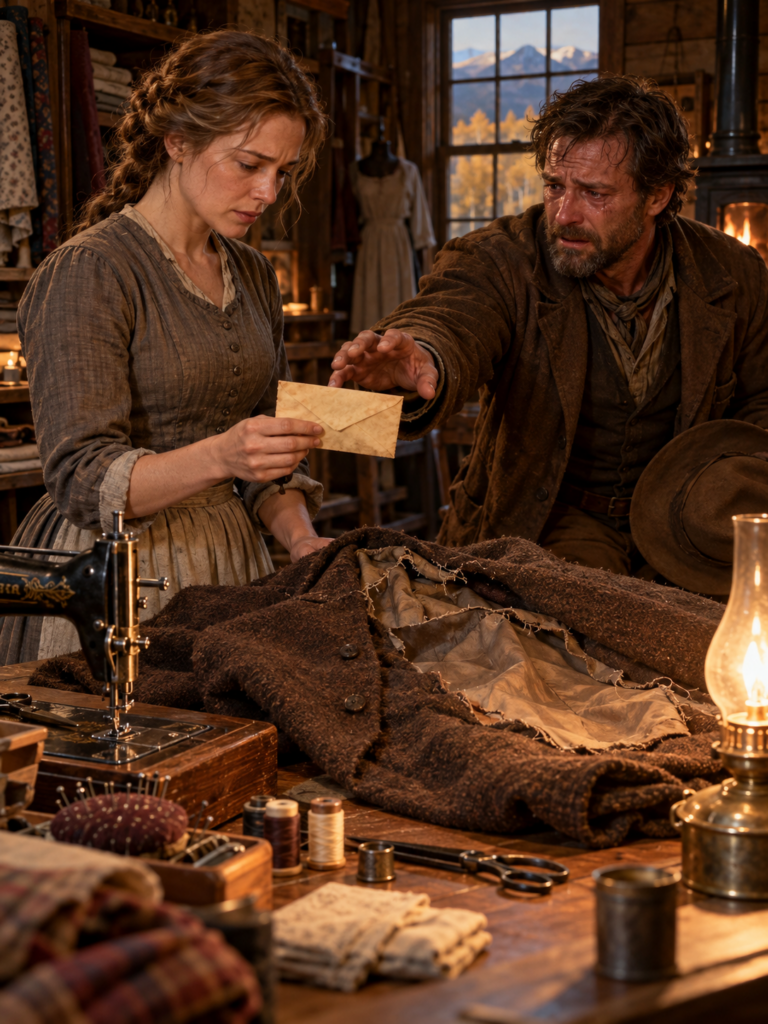
As Greta released the envelope, Warren’s fingers closed around it with such uncertainty that the paper nearly slipped between them.
He caught it against his palm.
Then he looked at the name.
His name.
Written in Mary Ann’s unmistakable hand.
“She wrote this?”
Greta answered gently.
“I believe so.”
“Where did you say you found it?”
“Behind the pocket lining. Someone stitched it there carefully.”
Warren touched the repaired seam of the coat.
“My wife did her own mending.”
He stopped.
Greta watched him recognize what that meant.
Mary Ann had hidden the letter deliberately.
She had sewn it into the one garment Warren was least likely to give away.
And she had left it where he might discover it only when he was ready to handle her belongings again.
“She must have known,” he murmured.
“Known what?”
Warren shook his head.
“I don’t know.”
He stared at the envelope.
For three years, he had kept Mary Ann’s coat locked inside a cedar chest.
He had never searched its pockets.
Never lifted the lining.
Never imagined that his wife might have left something for him to find.
Now the past rested in his hands.
“Would you mind staying a little while?” he asked.
Greta glanced toward her buggy.
“I can.”
“There’s coffee. Cyrus can bring some.”
“Thank you.”
Warren nodded, but he did not move immediately.
His thumb traveled over the envelope’s worn edge.
Then he looked at Greta.
“You’re certain you didn’t read it?”
“The seal was intact when I found it. It still is.”
He studied her face.
“Most people would have been curious.”
“I was.”
“Yet you left it alone.”
“It wasn’t addressed to me.”
Something moved across his expression.
A kind of gratitude too complicated for words.
He turned toward the porch.
Greta followed several steps behind, carrying the repaired coat.
Warren sat at the far end of the porch, beneath the shade of the roof.
Greta laid the coat on the bench beside him.
Then she moved toward the steps, allowing him the privacy to decide what came next.
He broke the seal carefully.
His hands trembled.
Inside was a folded sheet of paper.
He opened it.
For several seconds, he seemed unable to begin.
Then his eyes moved across the first line.
“My dear Warren…”
His breath caught.
Greta turned toward the pasture.
She would not watch a man receive the last words of his dead wife as though they were entertainment.
The wind stirred the willow trees.
Somewhere behind the barn, cattle shifted against a fence.
Warren read on.
The letter spoke of Cheyenne.
Of the journey he had made while Mary Ann was ill.
Of the cattle sale that had kept him away from her bedside.
Greta did not know those details.
But she saw his shoulders stiffen.
Then he whispered something.
“No…”
He read another line.
His hand pressed against his forehead.
“Oh, Mary Ann.”
Greta remained where she was.
Cyrus approached carrying coffee.
He saw Warren’s face and stopped.
Greta shook her head slightly.
The foreman set the cups beside her.
Then he removed his hat.
Neither spoke.
Across the porch, Warren lowered the letter.
His eyes were wet.
For years, he had believed that his absence during part of Mary Ann’s final illness had been a failure he could never repair.
He had traveled to Cheyenne to complete a cattle sale.
The northern pasture depended upon the money.
Mary Ann herself had insisted he go.
But he had spent three weeks away while her strength diminished.
When he returned, she survived only five more days.
He had counted those days ever since.
Now he looked at the letter again.
Greta could not hear everything he whispered.
But she heard enough.
“She knew…”
He pressed the page against his chest.
“She knew I blamed myself.”
For a long while, the porch remained silent.
Then Warren stood.
He walked toward Greta, still holding the letter.
“Miss Linden?”
She rose from the step.
“Yes?”
He struggled to speak.
“There’s something in this letter I never expected to hear from her.”
Greta waited.
His voice broke.
“She says I have been punishing myself for doing what she asked.”
Greta felt her throat tighten.
Warren looked toward the ranch house.
“Three years. I’ve spent three years believing I failed her.”
“Mr. Callaway…”
He raised his eyes.
“And she left this for me because she knew I might.”
The wind caught the corner of the paper.
Warren tightened his grip.
Then his expression changed.
He looked again at the final lines, as though they were asking something of him that he had not yet found the courage to do.
Greta stepped aside, giving him room to return to the bench.
But Warren did not sit.
Instead, he carefully unfolded the letter once more, drew a long, unsteady breath, and began reading the final paragraph aloud.
Warren’s voice faltered on the first sentence.
He steadied the page with both hands.
Then he tried again.
“Don’t take the happiest years we shared and turn them into a reason never to be happy again.”
The words hung between them.
Greta stood motionless.
Warren swallowed.
“She says love doesn’t disappear because life goes on.”
His voice cracked.
“She says I should leave room for whatever goodness may still come.”
For a moment, he stared down at the page.
Then he began to cry.
Not loudly.
Not helplessly.
His grief seemed to come from some place where he had kept it carefully buried beneath years of work, responsibility, and self-reproach.
Greta did not reach for him.
She knew little about Warren Callaway beyond what the town knew.
She had no right to assume that her touch would comfort him.
So she remained beside the porch steps.
Present.
Quiet.
Willing to stay.
Cyrus moved away without a word, leaving the coffee on the railing.
Eventually Warren folded the letter.
He pressed it carefully between his palms.
“She wrote this before she died.”
Greta nodded.
“That’s what it appears.”
“She must have known I wouldn’t open the chest.”
“Perhaps she hoped you would someday.”
He looked toward the house.
“I put that coat away the morning after the funeral. I couldn’t bear seeing it hanging where she’d always left it.”
“That must have been difficult.”
“It was easier than looking at it.”
He gave a weary smile.
“That sounds foolish, doesn’t it?”
“No.”
Greta glanced toward the coat.
“People aren’t foolish for needing time.”
Warren studied her.
“You’ve said almost nothing about the letter.”
“It belongs to you.”
“Even though you found it?”
“Especially because I found it.”
He looked down again.
“Thank you.”
Greta shook her head.
“Your wife wrote the words. I only brought them home.”
Warren regarded the sealed envelope, now opened.
“But you let them remain hers until I could read them.”
That was something Greta understood.
Ownership.
The right to decide.
The quiet dignity of possessing something without another person’s interference.
Perhaps that was why she had left the envelope untouched.
Perhaps that was also why Warren’s gratitude affected her more than she expected.
She departed that afternoon after accepting one cup of coffee.
Cyrus helped her harness the buggy horse.
Pepper followed her to the gate and attempted to seize the hem of her skirt.
“She’s taken a liking to you,” Cyrus observed.
“I was warned.”
“Not enough, evidently.”
Greta laughed.
As she drove toward Alder Creek, she thought about the man on the porch.
For years, she had regarded Warren Callaway as another prosperous rancher whose life had been shaped by responsibilities unfamiliar to her.
Now she knew something else.
He had been carrying a burden that his wife had tried to lift before her death.
And he was only beginning to understand that he might set it down.
Three days later, Warren appeared at her shop carrying a loaf of bread.
Greta looked up from the sewing machine.
“Mr. Callaway.”
“Miss Linden.”
She examined the loaf.
“Is that payment?”
“No.”
“A bribe?”
“No.”
“Then what is it?”
Warren hesitated.
“I thought you might enjoy it with your coffee.”
Greta set down her scissors.
“You’ve already thanked me.”
“I know.”
“Several times.”
“I know that too.”
She looked at him for a moment.
Then she smiled.
“Well, I suppose refusing perfectly good bread would be wasteful.”
They shared it beside the worktable.
Warren asked whether she had known Mary Ann.
“Only slightly,” Greta replied. “I remember seeing her at church.”
“Was she wearing the brown coat?”
“Yes, I believe she was.”
He smiled.
“She wore that thing everywhere.”
“Then it must have been a good coat.”
“She used to say it kept her warm whenever I wasn’t nearby to complain about the weather.”
Greta laughed.
Warren did too.
Then he stopped, astonished by the sound.
It had been a long time since mentioning Mary Ann had brought him uncomplicated pleasure.
Greta noticed but did not comment.
The following Monday, Warren returned with an order.
“Shirts,” he announced.
“How many?”
“Fifteen.”
Greta lifted her eyebrows.
“Fifteen?”
“Two apiece for six hands, and three for the new men we’ll take on in spring.”
“That is a substantial order.”
“Cyrus says the catalog shirts aren’t holding up.”
“Cyrus seems to have strong opinions.”
“On everything.”
Greta calculated the labor and the cost of material.
“Eighty cents apiece, plus the cloth.”
Warren nodded.
“Fair enough.”
He did not offer extra money.
He did not ask for a discount.
He accepted her price as the price of skilled work.
Greta appreciated that more than he knew.
The following Saturday she traveled to Callaway Springs to take measurements.
Cyrus stood upon a wooden box with his arms spread while she checked his sleeve length.
“I’d like it recorded that I was a handsome man before ranch work ruined me.”
Warren leaned against a post.
“You were never handsome.”
“I was memorable.”
“That’s certainly true.”
Greta nearly laughed with a pin between her lips.
She removed it hastily.
Cyrus looked triumphant.
“There. I’ve made the seamstress smile.”
“You’ve made her fear for her safety,” Warren replied.
Then he laughed.
A full, unguarded laugh.
He stopped as if surprised.
Greta smiled and returned to her measurements.
Something had begun changing at Callaway Springs.
Not quickly.
Not dramatically.
But Warren no longer seemed determined to inhabit every room of his life alone.
The shirt order required five weeks.
During those weeks, Warren found increasingly questionable reasons to visit town.
He needed buttons.
He wanted to ask about a cuff.
Cyrus had requested a different collar.
One afternoon he arrived merely to confirm that the measurements were correct, although Greta had already cut every shirt.
She looked at him over her sewing machine.
“Mr. Callaway, are you inventing errands?”
Warren considered denying it.
Instead, he said, “A few.”
Greta laughed.
After that, Thursday afternoons became their accustomed time for coffee.
Warren spoke about Mary Ann.
Not as a saint.
As a woman.
He told Greta about the church picnic where he had dropped an entire slice of pie while trying to impress her.
About Mary Ann’s habit of humming when she worried.
About the time she threw a biscuit at Cyrus after he complained too loudly about breakfast.
Greta told him how she had arrived in Wyoming at eighteen.
How the seamstress who was meant to employ her had died.
How she had kept the shop operating through the first winter by repairing anything people were willing to bring.
“Fourteen years,” Warren said one afternoon.
“Fourteen.”
“And you’re still renting the building?”
“For the present.”
“Do you plan to buy it?”
“I do.”
“How much does Pettibone want?”
“Nine hundred dollars.”
Warren whistled softly.
“How close are you?”
“Close enough that the money remains my business.”
He laughed.
“Fair answer.”
Then Greta surprised herself.
“Four hundred and ten.”
Warren looked impressed.
“That’s considerable saving.”
“Six years of it.”
“You could borrow the rest.”
Her expression changed.
“From a bank?”
“Possibly.”
“Then the bank would own the part I haven’t paid for.”
“That’s one way of looking at a loan.”
“It’s the way I look at it.”
Warren studied her.
“Is owing someone always a terrible thing?”
Greta met his eyes.
“Is being owed something always an innocent thing?”
He considered that.
“No,” he admitted.
She returned to her sewing.
But the conversation remained with him.
By November, Warren had begun to understand that Greta’s independence was not pride for its own sake.
It was something she had built with fourteen years of labor.
Something as important to her as his ranch was to him.
Then Mr. Pettibone raised her rent.
Two dollars a month.
Greta mentioned it while finishing the final shirt.
Warren immediately straightened.
“I’ll speak to him.”
“No.”
“He can’t keep raising the rent whenever he pleases.”
“Warren.”
He stopped.
“I said no.”
“I only meant to help.”
“I know.”
Her needle paused.
“That’s the trouble. You see something difficult, and you decide to repair it before asking whether the person living with it wants your intervention.”
Warren went silent.
Greta’s frustration carried her one sentence too far.
“Did you do that with Mary Ann? Decide what was best for her without asking?”
The moment the words left her mouth, she regretted them.
Warren’s face changed.
“I’m sorry,” she said quickly.
He looked away.
Then, after a long silence, he answered.
“She used to tell me much the same thing.”
Greta swallowed.
“I had no right to bring her into this.”
“You were angry.”
“That doesn’t excuse it.”
“No,” he said gently. “But I ought to listen to what you were trying to tell me.”
He took a breath.
“May I ask you something?”
“Yes.”
“Would you allow me to lend you the rent increase? Properly written down, with repayment terms you’d approve?”
Greta felt herself stiffen.
Warren raised one hand.
“You can refuse.”
She studied him.
“No, thank you.”
He nodded.
“All right.”
That was all.
No argument.
No wounded pride.
No attempt to persuade her that refusing his money meant refusing his kindness.
Greta looked down at the unfinished shirt.
Then she said quietly, “Thank you for asking.”
Warren smiled.
“You’re welcome.”
It was the first time a man’s offer of assistance had left her feeling more independent rather than less.
Two days later, Mr. Pettibone entered her shop carrying news that threatened everything she had worked toward.
A textile company wanted to purchase the entire block.
Pettibone had received an offer for the building.
Greta stood behind her cutting table.
“But you promised I could buy it.”
“I promised to sell if you had the money.”
“I’ve been saving for six years.”
His expression was apologetic.
“I know.”
“When?”
“March first. That’s when they’ll want the papers settled.”
Greta stared at him.
Four months.
Four months to produce the balance of a nine-hundred-dollar purchase.
“I’ll give you until then,” Pettibone said. “If you can pay, I’ll honor our arrangement.”
After he left, Greta closed the shop door.
For the first time in years, she looked at the metal cashbox beneath her table and felt afraid.
Four hundred and ten dollars.
A lifetime of careful decisions.
And suddenly it seemed terribly small.
When Warren arrived that Thursday, he found her sitting beside the machine without working.
She told him everything.
He listened.
Then he asked one question.
“What do you want to do?”
Greta looked up.
“I want to buy my shop.”
Warren nodded.
“Then that’s what we should work toward.”
She almost smiled.
“We?”
“I can help you think, if you’ll allow it. The decision stays yours.”
For a moment she studied him.
Then she brought out the account books.
They reviewed orders, expenses, and the work she could realistically complete before March.
Greta decided to accept advance deposits on spring dresses, increase her winter commissions, and prepare records showing what the shop earned.
She would approach the bank if necessary.
But she would do it herself.
Warren respected that decision.
He never touched her books without permission.
He never offered to buy the building behind her back.
And when she became tired, he asked whether she wanted assistance rather than deciding for her.
Their affection deepened in the ordinary hours.
But in December, a careless conversation nearly drove them apart.
At the harvest social, Greta stepped into the back room to collect a pitcher.
Two women were speaking near the coat rack.
“Warren Callaway seems taken with that seamstress.”
“It’s been three years. A man like him must be lonely.”
“Well, someone has to fill Mary Ann’s place.”
Greta stopped.
One woman laughed softly.
“At least he found someone practical enough to run the household.”
Greta stood with her hand on the pitcher.
The words struck at the deepest fear she carried.
Not that Warren still loved Mary Ann.
She respected that love.
But that perhaps he wanted any capable woman who might make the empty rooms less painful.
Perhaps Greta Linden, who had spent fourteen years becoming her own person, would disappear into the title of another man’s wife.
She set the pitcher down.
Then she left through the side door.
On Monday, her shop remained closed.
Tuesday morning, Warren found the front curtain drawn.
He knocked.
Nothing.
He knocked again.
The curtain lifted an inch.
“Greta?”
“Go home, Warren.”
“May I come in?”
“No.”
He considered the answer.
“Then I’ll remain out here a little while.”
“It’s cold.”
“I’ve a coat.”
“It might snow.”
“Then my hat will get wet.”
Despite herself, Greta almost laughed.
She opened the door.
“What do you want?”
“To know whether I’ve done something to hurt you.”
Her eyes filled unexpectedly.
“I heard them.”
“Who?”
“At the social. The women talking about Mary Ann. About me filling her chair.”
Warren’s expression softened.
Greta folded her arms.
“I didn’t spend fourteen years becoming independent just to be regarded as a replacement for someone else.”
“You’re not.”
“How do you know?”
He opened his mouth.
She continued before he could answer.
“I found her letter. I was the first person you spoke to about it. How can I know you love the woman I am, rather than the relief of having someone there when you were finally ready to live again?”
Warren did not answer immediately.
He stood in the doorway, turning his hat slowly in his hands.
At last he said, “You don’t know.”
Greta looked away.
“Not yet,” he added.
She looked back.
“I can’t prove something like that in a single speech.”
His voice was steady.
“But I can tell you what I know.”
She waited.
“I came back to your shop because you left Mary Ann’s letter unopened.”
Greta’s eyes shone.
“Because you can tell me no, and because you’ve taught me to hear it.”
He drew a breath.
“Because you laugh at Cyrus and improve his appearance by making him shirts that fit.”
Greta gave a small, unwilling laugh.
“And because I can speak my wife’s name with you without feeling I’m betraying either her or you.”
His voice grew quieter.
“I don’t need you to become Mary Ann.”
He looked directly at her.
“I’m beginning to hope there’s room in my life for someone who is entirely Greta.”
For a long moment, neither moved.
Then Greta stepped aside.
“You may come in.”
Warren entered.
Nothing was settled that morning.
And perhaps that was the most important thing of all.
He did not demand an answer to his feelings.
He gave her time.
The Thursday visits continued, but without pressure.
They spoke about the shop, winter orders, the ranch, and Cyrus’s endless complaints.
Greta found herself watching how Warren behaved when she disagreed with him.
He listened.
He asked.
He learned.
And slowly, she began to believe that he saw her not as the answer to his grief, but as a woman whose company he wanted even when she required nothing of him.
On the first Sunday of January 1887, Warren visited Mary Ann’s grave alone.
Snow rested across the little headstone beneath the cottonwood.
He brushed it away with his glove.
For three years, he had spoken to her mostly in his thoughts.
Now he said something aloud.
“There’s a woman in town.”
The wind moved through the branches.
“She’s stubborn.”
He smiled faintly.
“You’d like that.”
He remained beside the grave for a long while.
Then his expression grew serious.
“I thought loving someone else meant I had to stop loving you.”
He shook his head.
“I think I was wrong.”
When Warren rose, he carried the memory of Mary Ann with him.
But for the first time, he was no longer using that memory as a reason to remain alone.
He rode into Alder Creek.
Greta was working at her machine when she heard a knock.
She opened the door.
Warren stood outside holding his hat in both hands.
“Greta,” he said, “there’s something I need to ask you.”
She looked at his face.
Then at his trembling hands.
And she understood that this time, whatever he had come to say, he meant to say it without hiding behind gratitude, grief, or an ordinary Thursday errand.
Greta stepped back from the doorway, but Warren remained on the threshold.
“You’re trembling,” she said.
“A little.”
“Is something wrong at the ranch?”
“No.”
“With Cyrus?”
“No.”
“Then come inside before you freeze.”
Warren obeyed.
He stood beside the sewing table, looking unusually uncertain.
Greta removed the thimble from her finger.
“Well?”
“I had a speech prepared.”
“That sounds dangerous.”
“I’ve forgotten most of it.”
“That may be for the best.”
He laughed once.
Then his face grew serious.
“I loved Mary Ann.”
Greta nodded.
“I know.”
“I’ll always love her.”
“I know that too.”
“For a long time, I thought that meant there was no honest room left in my heart for anyone else.”
He swallowed.
“But I was wrong.”
Greta stood very still.
Warren took one careful step toward her.
“I love you, Greta.”
Her hand tightened on the edge of the worktable.
“Not because you found the letter. Not because you can repair a coat. Not because this house needs someone to sit in it.”
His eyes met hers.
“I love the woman who built this shop from almost nothing. The woman who argues with me when I’m foolish. The woman who has taught me that offering help isn’t the same as deciding for someone.”
Greta blinked hard.
“And I love the way you can spend twenty minutes insulting Cyrus’s taste in shirts without once losing your dignity.”
She laughed through sudden tears.
Warren smiled.
“I don’t want to take away your work. I don’t want to decide how you live. And I don’t want you to spend your life competing with someone who isn’t here.”
He held out his hand.
“I want to ask if you would consider marrying me.”
Greta stared at him.
The sewing machine stood silent behind her.
Outside, a wagon rolled slowly along Front Street.
For fourteen years, she had guarded her independence as carefully as she guarded her earnings.
She had watched other women accept arrangements made in kindness, only to discover that kindness could become authority when money changed hands.
She had promised herself she would never become dependent on someone else’s approval.
And now Warren Callaway was standing in her shop asking for the one thing she had never expected to want.
A life shared with another person.
Not a life surrendered.
Shared.
“I have conditions,” she said.
Warren nodded immediately.
“I expected you might.”
“I will keep working.”
“Of course.”
“And I intend to own this building.”
“I know.”
“My name will remain on the business.”
“As it should.”
She took a breath.
“And Mary Ann stays.”
Warren looked at her.
“Her photograph remains in the house. Her name isn’t something we whisper because it makes people uncomfortable.”
His eyes filled.
“Greta…”
“She helped make you the man standing in front of me. I won’t pretend she didn’t.”
Warren lowered his head for a moment.
When he looked up, he could barely speak.
“Thank you.”
Greta moved closer.
“There’s something else.”
“Anything.”
“You must ask before trying to solve every problem I have.”
A faint smile appeared.
“I’ll spend the rest of my life practicing.”
She held out her hand.
“Then yes.”
Warren stared.
“Yes?”
“I’ll marry you.”
He reached for her carefully.
She stepped into his arms.
For a long while, they held one another beside the sewing table.
Across the street, a familiar voice broke the silence.
“ABOUT TIME!”
Greta pulled away laughing.
Warren closed his eyes.
“Cyrus.”
The foreman stood beside his horse, grinning broadly.
“I’ve been waiting since September.”
Warren shook his head.
“I’m going to dismiss that man.”
“No, you aren’t,” Greta replied.
Warren smiled.
“No. I suppose I’m not.”
But their engagement did not solve Greta’s greatest practical problem.
March first was approaching.
Mr. Pettibone still intended to sell the building if she could not purchase it.
And Greta still lacked hundreds of dollars.
Warren offered to help her review her plan.
He did not offer to purchase the property in his own name.
By February, Greta had increased her savings through winter orders, shirt commissions, and advance payments on spring dresses.
She had four hundred and ninety dollars.
Better than before.
Still nowhere near enough.
One morning, she took her records to the bank.
Alone.
The banker examined six years of carefully maintained accounts.
He studied the orders she had already accepted.
He questioned her about expenses, cloth purchases, and expected income.
Greta answered every question.
She had prepared the figures herself.
She knew exactly what the business earned.
She knew what it could reasonably repay.
The banker was surprised by the consistency of her records.
Greta was not.
She had spent fourteen years making certain the numbers were correct.
Meanwhile, Mr. Pettibone had begun to reconsider the certainty of the textile company’s proposal.
He knew Greta.
He knew she had maintained the premises responsibly.
And he knew selling to her for cash before March would avoid further delay.
After several discussions, he agreed to accept eight hundred and sixty dollars.
Greta returned to the bank.
This time, she negotiated a loan for the remaining amount, secured by the shop and its income.
She did not pledge Warren’s ranch.
She did not ask him to sign.
The obligation was hers.
So was the business.
The afternoon the arrangements were completed, Greta stood inside her shop holding the papers.
For several minutes, she could only look around.
The cutting table.
The shelves of thread.
The treadle machine beside the front window.
The marks in the floorboards where years of work had worn away the finish.
It was hers.
Not merely the tools.
Not merely the customers.
The place itself.
When Warren arrived, she handed him the news.
“I bought it.”
He looked at her.
“All of it?”
“With a loan I’ll pay from the business.”
“And the terms?”
“Terms I can manage.”
He smiled.
“Is this what you wanted?”
Greta felt tears gather.
“Yes.”
“Then congratulations, Miss Linden.”
She laughed.
“Miss Linden?”
“Well, I thought I should say it properly while I still can.”
Greta stepped into his arms.
“You’ve learned something, Warren Callaway.”
“Slowly.”
“Very slowly.”
He kissed her forehead.
“But thoroughly, I hope.”
They married on the final Saturday of April 1887.
Greta wore a pale gray silk dress she had made herself.
It was elegant without being extravagant.
Cyrus stood beside Warren as best man and delivered a speech so long and disorderly that several guests began laughing before he reached the middle.
The foreman protested that heartfelt remarks were not supposed to be interrupted.
Warren reminded him that he had been interrupted for years.
Greta laughed so hard she nearly lost the pin securing her hat.
The ceremony was simple.
The vows were not.
Warren promised honesty, fidelity, and a lifetime of learning to listen.
Greta promised love and partnership without surrendering the independence that had shaped her.
Neither promised an easy future.
They promised to meet it together.
The following morning, Warren showed Greta through the ranch house.
Most rooms were familiar from her earlier visits.
The front room held a heavy table, worn chairs, and a portrait of Mary Ann on the mantel.
Greta noticed that Warren had left it exactly where it had always stood.
She smiled.
Then he asked a question.
“Which room would you like for your sewing?”
Greta glanced toward the eastern side of the house.
“That one.”
Warren grew quiet.
“The room with the morning light?”
“Yes. It would be perfect for cutting cloth.”
He hesitated.
“That was the room where Mary Ann spent her final illness.”
Greta looked toward the doorway.
For a moment, neither spoke.
Then Warren asked, “Would you rather choose another?”
Greta considered it.
“No.”
“Are you certain?”
She looked around the room.
“The window is beautiful.”
“She liked that window.”
“Then perhaps we have something in common.”
Warren’s expression softened.
Greta touched the wooden sill.
“A room doesn’t have to hold only one story.”
He nodded.
Together they moved a broad worktable beneath the east-facing window.
Greta continued operating her Front Street shop, traveling into Alder Creek three mornings a week.
She hired seventeen-year-old Dory to assist with orders and learn the trade.
The young woman proved capable and quick with measurements.
Greta discovered she enjoyed teaching almost as much as sewing.
At home, Warren learned that his new wife occasionally scolded the sewing machine when its thread tangled.
Greta discovered that Warren snored.
Pepper followed her through the house and developed a troubling interest in her skirts.
Cyrus declared that the household had become far too cheerful for honest ranch work.
Then he began appearing for supper more often.
Ordinary life returned to Callaway Springs.
And the ordinary parts became precious.
There were arguments over schedules.
Long days during cattle work.
Evenings when Greta arrived home exhausted from the shop.
Mornings when Warren worried over water and grazing.
But neither carried every burden in silence.
When he wanted to help, he asked.
When she needed assistance, she learned she could request it without surrendering authority.
Their marriage grew through those small acts.
Then, one early summer evening, Greta set down her fork at supper.
“Oh.”
Warren looked up.
“What is it?”
“Nothing.”
He studied her.
“Greta.”
“Pass the salt.”
He passed it.
She looked at him.
And then she began laughing.
Before he could ask another question, tears filled her eyes.
Warren rose immediately.
“Are you unwell?”
“No.”
“Then what is it?”
She reached for his hand.
“I believe we’re going to have a baby.”
Warren stood motionless.
For years, he had believed that fatherhood might never be part of his life.
Now Greta sat before him, smiling and crying at once.
He knelt beside her chair.
“Are you certain?”
“As certain as I can be.”
He rested his forehead against her hand.
For a moment, he said nothing.
Then he laughed through tears.
Greta touched his hair.
But joy did not come alone.
Warren remembered Mary Ann’s illness.
He remembered helpless nights and the terror of losing someone he loved.
As Greta’s pregnancy progressed, he found himself worrying over every sign of fatigue.
Sometimes he asked too many questions.
Sometimes he hovered.
Greta loved him.
But one evening, she took both his hands and made him sit.
“Warren, I know you’re afraid.”
He looked ashamed.
“I try not to show it.”
“You don’t need to hide it.”
She paused.
“But I need a husband beside me, not a man who believes he can prevent every hardship by watching me breathe.”
Warren lowered his eyes.
“You’re right.”
“We’ll do what we can. We’ll call the doctor when we need him. And we’ll face the rest together.”
He nodded.
Then he kissed her hands.
“I can do that.”
In November, Greta opened the wardrobe and took down Mary Ann’s brown coat.
It had remained carefully preserved since the day she returned it to Warren.
The repaired lining was still sound.
The fabric was heavy and warm.
She carried it to the table.
Warren found her examining the seams.
“What are you planning?”
“Something I wanted to ask you about.”
He smiled.
“That sounds familiar.”
Greta laid the coat flat.
“The wool is good.”
“It is.”
“And there’s more cloth here than a small child would need.”
Warren’s expression changed.
Greta continued carefully.
“If the baby is a girl, I’d like to make her a little winter coat from this one.”
Warren stood silent.
She immediately looked up.
“But only if you’re comfortable with it.”
He stepped closer.
His fingers touched the familiar brown wool.
For a moment, he seemed to be standing again in the room where he had folded the coat after Mary Ann’s funeral.
Then he smiled sadly.
“She hated waste.”
Greta waited.
“She’d have liked that.”
“Are you sure?”
Warren nodded.
“Yes.”
Greta turned back a small portion of the lining.
“And this part…”
She showed him the section where the envelope had been concealed.
“I thought I might preserve it inside the new coat.”
Warren’s eyes filled.
“The place where you found the letter.”
“Yes.”
He touched the stitches.
“A pocket inside a pocket.”
Greta smiled.
“Something like that.”
Warren leaned down and kissed her cheek.
For the first time, the old coat was becoming more than a relic of loss.
It was becoming part of a future Mary Ann had hoped Warren would allow himself to have.
In February 1888, Greta went into labor.
The hours were long.
Dory came from town to help.
The doctor arrived before noon.
Cyrus spent so much time pacing the hall that Dory finally ordered him outside to split firewood.
“I’ve already split enough for three winters,” he protested.
“Then make it four.”
Warren remained near Greta whenever his presence was wanted.
He brought water.
Adjusted pillows.
Held her hand.
Listened to the doctor’s instructions.
And when he was asked to step outside, he obeyed.
But waiting was difficult.
Behind the closed door, Greta cried out.
Warren went still.
Old memories rose with terrible force.
A sickroom.
A doctor.
The helplessness of hearing pain and knowing he could not command it to stop.
He placed both palms against the wall.
Then he whispered Greta’s name.
Not because he believed repetition could change fate.
Because it was the only word he could manage.
Late that afternoon, a thin cry came from the bedroom.
It stopped.
Warren’s breath caught.
Then it came again.
Louder.
Stronger.
Angrier.
A baby’s cry.
The doctor opened the door.
“Mr. Callaway.”
Warren could barely move.
“You may come in.”
Greta lay against the pillows, pale and exhausted.
But she was smiling.
Beside her rested a small bundle with dark hair.
“A girl,” she whispered.
Warren approached slowly.
He knelt beside the bed.
Greta guided his hand toward their daughter.
The baby’s tiny fingers closed around one of his.
Warren began to cry.
For years, he had believed that the happiest part of his life belonged entirely to the past.
Now another life rested before him.
New.
Small.
Frighteningly precious.
“What shall we call her?” he asked.
Greta looked at him.
“Mary Ann.”
Warren stopped breathing for a moment.
“Greta…”
“If you’d like.”
His eyes filled.
She smiled.
“Molly for everyday. Mary Ann when she’s old enough to know she’s in trouble.”
Warren laughed through tears.
“Are you certain?”
“Yes.”
He leaned forward until his forehead touched hers.
“Thank you for loving her too.”
Greta placed her hand against his cheek.
“There’s room, Warren.”
He understood.
There was room for the woman he had lost.
Room for the woman who had chosen him.
And now room for the daughter whose life had begun with a love neither of them had expected.
The years unfolded.
Greta paid down the shop loan and eventually brought Dory into the business as a partner.
The Front Street establishment became known for reliable work and careful craftsmanship.
Warren continued operating the ranch, with Cyrus complaining loudly about the growing noise inside the house.
But the foreman spent nearly every evening there.
Molly grew into a determined little girl.
A son, Owen, arrived in 1891.
A second daughter, Bertie, followed in 1894.
The house became crowded with books, sewing baskets, muddy boots, and unfinished conversations.
Molly wore the little brown coat each winter until she outgrew it.
Years later, Greta altered it again for a younger cousin.
The original pocket lining remained sewn inside.
No longer a hiding place.
A remembrance.
Mary Ann’s portrait remained in the front room.
Every spring, the family visited her grave beneath the cottonwood.
Greta never treated the visits as competition with the life they shared.
She understood that a family could honor the people who had shaped it without making its present smaller.
In July 1890, Wyoming entered the Union as a state.
Greta cast her ballot, continuing the political participation women in the territory had already known for years.
Cyrus announced that statehood would make little difference to stubborn cattle.
Warren agreed that the cattle seemed unlikely to take an interest.
And life went on.
By the spring of 1896, Molly was eight.
One evening after supper, she entered the front room with the solemn expression of a child preparing to ask something important.
Warren sat reading beside the lamp.
Greta was repairing a sleeve.
“Papa?”
Warren closed his book.
“Yes, sweetheart?”
“Will you tell me about Mary Ann?”
Greta’s needle stopped.
Warren looked at his daughter.
“What would you like to know?”
Molly clasped her hands behind her back.
“Why did you give me her name?”
Warren glanced at Greta.
She smiled encouragingly.
He held out his arms.
“Come here.”
Molly climbed onto his knee.
For a while, he told her stories.
About a church picnic and a dropped piece of pie.
About a young woman who hummed when she worried.
About a game of checkers Mary Ann never seemed to lose fairly.
About a frozen creek and a winter afternoon when she had laughed so hard that she spilled coffee down the front of his coat.
Molly listened with complete attention.
Then Warren told her about Mary Ann’s illness.
He explained that she had died before Molly was born.
He told her how he had loved her.
And how, afterward, he had struggled to believe he deserved to be happy.
Molly looked puzzled.
“Why?”
Warren took a breath.
“Because sometimes people blame themselves for things they couldn’t have prevented.”
“Did you?”
“Yes.”
“How did you stop?”
He looked across the room at Greta.
“Your mother helped me.”
Greta laid down her sewing.
“Not by myself,” she said.
Warren smiled.
“That’s true.”
He told Molly about the brown coat.
The torn lining.
The hidden envelope.
And the seamstress who found a letter but refused to read what did not belong to her.
Molly stared at Greta.
“You found it?”
“I did.”
“Where is it now?”
Warren opened the drawer beside his chair.
Inside lay a carefully preserved envelope.
Its paper had yellowed with age.
The folds were soft from being opened and closed over the years.
Warren held it up.
“Would you like to hear what she wrote?”
Molly nodded.
Greta moved her chair beside them.
Warren unfolded the page.
And he read.
He read Mary Ann’s words about Cheyenne.
About the cattle sale.
About the responsibility they had shared.
He read how she had known he would blame himself, and how she wanted him to understand that he had not abandoned her.
He read her memories of their marriage.
The small, ridiculous moments that had made them happy.
And finally, he read her wish that Warren would never turn their love into a reason to stop living.
His voice faltered at the final lines.
Even after ten years, certain words could reach the places where grief had once settled.
When he finished, Molly remained quiet.
Then she looked at Greta.
“Did she know about Mama?”
Warren shook his head.
“No, sweetheart.”
Molly frowned.
“Then how did she know you’d love somebody again?”
Greta considered the question.
“I don’t think she knew who it would be.”
Warren held his daughter closer.
“She knew only that I ought to leave room for another good thing to happen.”
Molly thought about that.
Then her face brightened.
“Well, it did.”
Warren smiled.
“Yes.”
She reached for Greta’s hand.
“Tomorrow we should tell her.”
Greta blinked.
“Tell whom?”
“Mary Ann. That it worked.”
For a moment, nobody spoke.
Then Warren laughed softly through tears.
“I believe we should.”
The following morning, the family walked to the little grave beneath the cottonwood.
Pepper accompanied them.
Cyrus followed twenty paces behind, insisting he was merely examining the nearby fence.
No one believed him.
Molly carried flowers.
Owen and Bertie followed their parents through the grass.
At the grave, Molly placed the flowers carefully.
Then she looked at the stone.
“Thank you,” she said.
Warren closed his eyes.
Greta took his hand.
There was no great speech.
No need for one.
The years that followed brought their share of hardship and happiness.
Warren grew older tending the ranch.
Greta continued working in the shop she had fought so long to own.
Dory became her trusted partner.
The children grew into lives of their own.
And through every season, the old letter remained in the Callaway home.
It was not locked away as a forbidden treasure.
It was not displayed as something too sacred to touch.
It remained a part of their history.
Like the photograph on the mantel.
Like the brown coat Greta had repaired.
Like the sewing machine that had earned her independence.
Like the grave beneath the cottonwood, where the family went with flowers and stories rather than fear.
Warren never stopped loving Mary Ann.
He never needed to.
Greta never became her replacement.
She never wished to.
Instead, they built a marriage in which love was not measured by what had been forgotten.
It was measured by what both people freely gave.
By a man learning to ask before helping.
By a woman learning that accepting affection did not require giving up her own name or work.
By ordinary evenings and honest disagreements.
By children who knew the family had begun long before they were born.
And by an old coat that had once been shut inside a cedar chest because its owner could not bear the memory it carried.
Years later, Warren sometimes stood at the east-facing window while Greta worked at her sewing table.
He would watch the light fall across her hands.
The same hands that had once found a letter inside a hidden pocket.
The same hands that could have opened it.
But had not.
That small act of honesty had done what years of solitude never could.
It had allowed him to hear the words his first wife had left.
And, in time, to recognize the woman who was helping him build the rest of his life.
One evening, Greta looked up and found him watching.
“What is it?” she asked.
Warren smiled.
“Nothing.”
“Warren.”
He laughed.
“Just thinking.”
“That’s usually when trouble begins.”
He crossed the room and took her hand.
“I was thinking how fortunate I am.”
Greta glanced toward the old brown coat, now preserved in the wardrobe, and the letter resting safely in the drawer.
Then she looked at her husband.
“You know,” she said, “I only meant to repair a torn lining.”
Warren squeezed her hand.
“I know.”
“I didn’t know what I would find.”
“Neither did I.”
She smiled.
“Would you have believed any of it, back then?”
He looked around the room.
At their books.
At the photographs.
At the evidence of years lived together.
Then he shook his head.
“No.”
Greta waited.
Warren brought her hand to his lips.
“But Mary Ann believed there might still be happiness waiting.”
His voice softened.
“And you were brave enough to let me discover it for myself.”
Outside, evening settled across Callaway Springs.
The ranch buildings stood quiet beneath the Wyoming sky.
And in the house where a man had once believed love could belong to only one chapter of his life, there was room for every chapter that had followed.
The letter had never asked him to forget.
Only to keep living.
And at last, Warren Callaway understood.
Love had not required an empty place.
It had made room.