
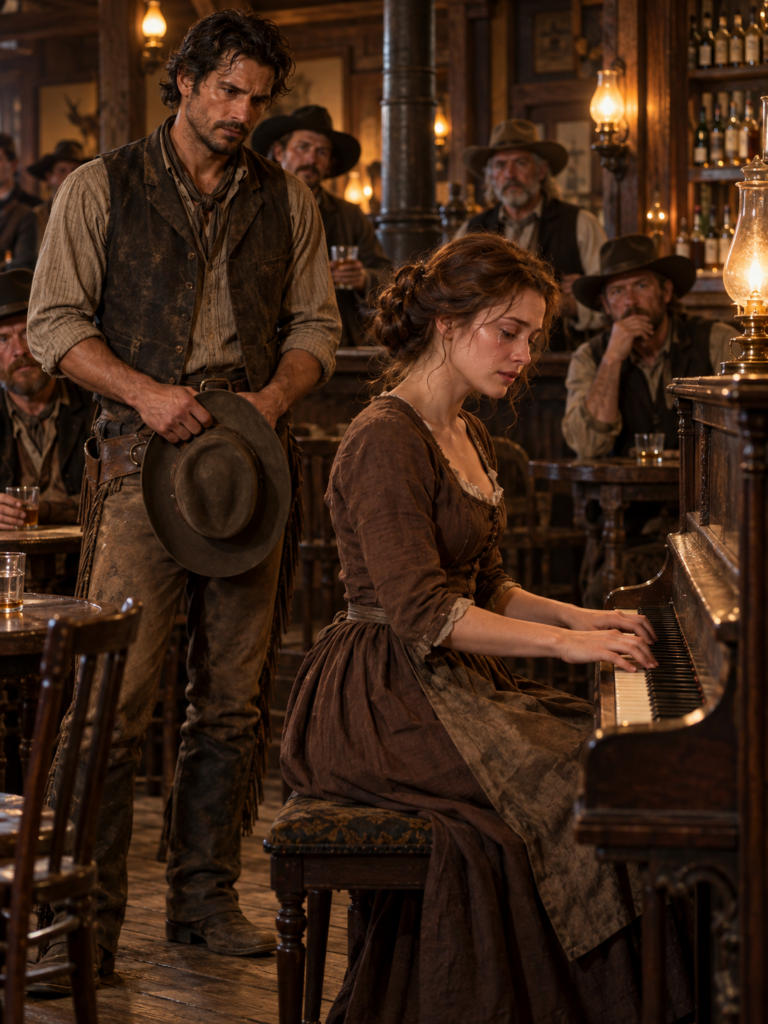
Warren moved between the cattleman and Corinne before the man’s outstretched hand could close around her sleeve.
“Give her room,” he said.
The man blinked, his smile fading.
“I only wanted to congratulate her.”
“Then let her hear it without stopping her.”
The cattleman withdrew his hand.
Corinne stood perfectly still, one palm pressed against the swinging kitchen door.
For a moment Warren feared that his intervention had merely brought her more attention.
He stepped back.
“You can go,” he told her. “Nobody’s asking for another song.”
She looked at him.
There was a strange expression in her eyes, something between gratitude and anger.
“Nor should they,” she whispered.
Then she disappeared into the kitchen.
The swinging door rocked once and settled.
Behind Warren, conversation returned in uncertain fragments.
“Where did she learn that?”
“Did you see her hands?”
“That woman has been carrying plates for eight months!”
Danny approached the piano and pressed a single key, as though testing whether it remained the same instrument.
“I couldn’t play like that if I had another twenty years,” he admitted.
Otis set his cleaning rag aside.
“Then perhaps everyone can stop calling her simple.”
Nobody answered him.
Warren remained near the kitchen door.
He had meant to ask one question.
Instead, he had exposed something Corinne had carefully kept private.
That knowledge troubled him far more than the laughter had.
At last Otis approached.
“She won’t want company tonight.”
“I reckon not.”
“You didn’t mean harm.”
“That doesn’t mean I did right.”
Otis regarded him for a moment, then returned to the bar.
Beyond the kitchen door, Corinne stood over a basin of cooling wash water.
Her hands were trembling.
She plunged them into the water, but the sensation of the piano keys remained.
Three years.
She had gone three years without playing the piece she had written for Thomas.
She had believed distance would make the memories quieter.
Instead, one evening had brought them rushing back.
She remembered Thomas leaning over her shoulder as she worked on the composition, teasing her about correcting a passage nobody else would notice.
She remembered promising he would hear the finished music at their engagement celebration.
And she remembered the fever that had taken him three weeks before that celebration could happen.
Corinne gripped the edge of the basin.
She had not played his piece for him.
Tonight she had played it for strangers who had laughed at the very idea that she possessed any talent.
It felt like a betrayal she could not explain.
A soft knock sounded against the kitchen doorframe.
“Corinne?”
Warren’s voice.
She drew a breath.
“I’m working.”
“I know.”
“Then what do you want?”
“To apologize.”
That surprised her enough to turn.
He remained outside the doorway.
“I shouldn’t have asked in front of everyone,” he said. “I thought you deserved a chance to show them they were wrong. I didn’t consider whether you wanted that chance.”
Corinne stared at him.
Most men she had encountered would have defended themselves.
Warren simply waited.
“You made me remember something,” she said finally.
His expression changed.
“Something painful?”
“Yes.”
“I am sorry.”
She looked down at her wet hands.
For a moment, she considered telling him everything.
Instead, she said, “I wrote that music.”
Warren did not immediately speak.
“The piece you played?”
She nodded.
“For someone who never got to hear it.”
The words seemed to drain the strength from her.
Warren lowered his eyes.
“Then I understand why you were crying.”
“No,” she said, not unkindly. “You understand a little.”
He accepted the correction.
“Yes, ma’am. A little.”
From the saloon came the distant scrape of chairs and the sound of men preparing to leave.
Corinne drew a towel across her hands.
“I don’t want them asking me to play again.”
“I’ll not ask.”
“And I don’t want questions about where I came from.”
“Then I won’t ask those either.”
She searched his face for impatience.
There was none.
“Why did you notice me?” she asked.
Warren considered his answer.
“Because every time Danny played a wrong note, you looked as though somebody had stepped on your foot.”
Despite everything, Corinne almost smiled.
“Danny steps on a great many feet.”
“That he does.”
A quiet breath escaped her.
Then footsteps approached from the saloon.
Otis appeared at the doorway holding a folded piece of paper.
“Corinne,” he said carefully, “one of the gentlemen has written down the name of that piece. He wants to know where he can buy the music.”
Her expression changed.
“It isn’t published.”
“That’s what I told him.”
Otis hesitated.
“But there may be others asking. After tonight, I doubt this town will leave the matter alone.”
Corinne looked toward the closed kitchen door.
She had come west so no one would know her name.
Now she had given them a reason to remember it.
She took the paper from Otis and unfolded it, studying the unfamiliar man’s attempt to describe her music.
Then, without speaking, she carried it to the kitchen stove and held one corner near the flame.
Warren watched the edge blacken.
“Corinne—”
She turned the burning paper over the stove, letting the ashes fall safely onto the coals.
“I will not have strangers claiming a piece that belonged to him.”
But even as the last fragment disappeared, she knew the greater danger remained.
The music was already out in the world.
And she could not burn away what people had heard.
The last ash settled among the stove coals.
Corinne stood motionless, the heat touching her face, while Warren remained beside the kitchen doorway.
He knew enough now to understand that the music had belonged to a part of her life she could barely bear to remember.
He did not know who the man had been.
He did not ask.
“I ought to get back,” he said.
Corinne turned.
“Are you angry?”
“About what?”
“That I burned the paper.”
“It was yours to burn.”
She studied him for a long moment.
Then something in her expression softened.
“Good night, Mr. Mercer.”
“Good night, Miss Ashworth.”
He left without looking back.
For the first time that evening, Corinne felt she could breathe.
Yet the following morning brought exactly what Otis had predicted.
Dry Creek had discovered that the quiet woman who scrubbed its saloon tables possessed a talent beyond anything the town had expected.
And Dry Creek intended to talk about it.
The general-store keeper’s wife stopped Corinne near the flour barrels to ask where she had studied.
Two cattlemen offered awkward apologies for laughing.
A woman who had never spoken to her before remarked that it must be wonderful to have such a gift.
Corinne thanked her politely and continued walking.
The questions were almost worse than the insults.
An insult required little response.
Admiration came with expectations.
By the end of the week, she had been asked to play at three gatherings, perform for a visiting family, and teach the bank clerk’s daughter.
She refused every invitation.
Otis supported her without argument.
“She has a job here,” he told anyone who pressed him. “The piano is her own business.”
Danny, meanwhile, surprised everyone.
He had spent the first evening after her performance staring gloomily at the instrument.
Corinne found him there before opening time.
“Are you angry with me?” she asked.
Danny looked astonished.
“For what? Playing better than I do?”
She folded her arms.
“That seems reason enough for some men.”
“Then it’s fortunate I’m not so easily offended.”
He struck a clumsy chord.
“I reckon my employment is safe, seeing as you’ve turned down every request to replace me.”
“I don’t want your job.”
“Good. I’m rather attached to it.”
She almost smiled.
“And for what it’s worth,” Danny added, “I’ve never heard anything quite like what you played.”
Corinne lowered her gaze.
“Thank you.”
Then she went back to work.
Warren continued visiting the saloon whenever cattle business brought him into Dry Creek.
He did not mention the performance again.
That was perhaps the strangest thing of all.
Most men would have tried to turn their knowledge into familiarity.
Warren simply ordered coffee, paid for it, and spoke when she seemed inclined to speak.
Sometimes they discussed the weather.
Sometimes the price of feed.
Sometimes nothing at all.
Then, one evening after closing, Corinne approached his table.
“I suppose you believe you’re being considerate.”
Warren looked up.
“About what?”
“Not asking questions.”
“I thought that was what you wanted.”
“It was.”
He waited.
She folded her cleaning cloth carefully.
“People are curious about me. They want to know what happened. You don’t seem curious at all.”
“I’m curious,” he admitted.
“Then why don’t you ask?”
“Because wanting to know something doesn’t mean I’m entitled to an answer.”
Corinne looked at him with an expression he could not immediately read.
“That’s a peculiar way to live.”
“It’s served me reasonably well.”
“Has it?”
Warren glanced at the empty chair opposite him.
“Not always.”
She sat.
And for the first time, she began to tell him where she had come from.
Boston.
A wealthy family.
A childhood spent practicing scales beneath the watchful eyes of instructors who considered every mistake a personal failure.
There had been beautiful rooms, elegant gatherings, and music that never seemed to end.
She had loved the piano.
Truly loved it.
That was the part she feared people would misunderstand.
Her past had not been entirely miserable.
Some of it had been extraordinarily beautiful.
And Thomas had been the most beautiful part.
His name came quietly.
“We were engaged for two years.”
Warren remained still.
“I wrote that composition for him. It was meant to be a surprise at our engagement celebration.”
She touched the rim of her coffee cup.
“He died of fever three weeks before I could play it.”
The room seemed to grow quieter.
Warren removed his hat and set it beside his chair.
“I’m sorry.”
Corinne nodded.
“For a time, everyone was sorry.”
She looked toward the piano.
“Then they became impatient.”
Her mother had begun discussing another suitable marriage within a year.
There were families to consider, expectations to satisfy, a future to arrange.
Nobody said Thomas should be forgotten.
They simply behaved as though remembering him had become inconvenient.
“I couldn’t bear it,” Corinne confessed. “Every room held something of him. Every song seemed to belong to a time I could never recover.”
“So you came west.”
“I came far enough that nobody could tell me what my life ought to become.”
Warren considered her words.
“And has it helped?”
She glanced around the saloon.
“At first, I thought so.”
He waited.
“Now I’m not certain whether I found peace or merely became very good at hiding.”
Warren’s expression softened.
“Those aren’t always the same thing.”
“No,” she agreed. “They aren’t.”
He did not offer to cure her unhappiness.
He did not say Thomas was gone and she must move forward.
Instead, he asked whether she wanted more coffee.
Corinne laughed unexpectedly.
“Yes,” she said. “I believe I do.”
Their friendship developed in ways neither had anticipated.
One quiet evening, Corinne decided to teach him a simple sequence on the piano.
It was meant as a harmless amusement.
Warren proved spectacularly untalented.
“No,” she said, stopping his hand. “That is entirely the wrong note.”
“It sounded close.”
“It sounded as though someone dropped a horseshoe on the floor.”
“That seems harsh.”
“Accurate, though.”
He tried again.
This time he struck two incorrect notes.
Corinne pressed her lips together.
Warren glanced at her.
“Go ahead.”
“I haven’t said anything.”
“You’re thinking a great deal.”
She burst into laughter.
Not the careful, polite sound he had heard from her before.
Real laughter.
Warm and unguarded.
Warren looked at her with such open pleasure that she became quiet.
“What?”
“Nothing.”
“Mr. Mercer.”
“I like hearing you laugh.”
Color rose into her cheeks.
She looked down at the keyboard.
“Then you might continue practicing. At this rate, I shall have ample reason.”
Their evenings grew easier after that.
Warren told her about the ranch, the unending work, the cattle that possessed no regard for sensible arrangements, and the men who worked beside him.
She learned that he was respected in Dry Creek not because he demanded attention, but because he kept his promises.
When he asked her to accompany him to the general store one afternoon, she agreed.
The storekeeper greeted Warren warmly.
Another rancher tipped his hat.
A delivery boy asked whether Warren had managed to settle an account from the previous month.
He had.
Corinne noticed the ordinary trust surrounding him.
“You’re well liked,” she observed as they walked back toward the saloon.
“I pay what I owe and try not to trouble people unnecessarily.”
“That is rarer than you think.”
Warren looked at her.
“You’ve known too many people who did otherwise.”
“Perhaps.”
He did not press.
That evening, after Otis had locked the front door, Corinne found Warren standing beside the piano.
“May I ask you something?” he said.
“You usually do.”
“Would you dance with me?”
She blinked.
“There isn’t any music.”
“I noticed.”
“Then how do you propose we dance?”
“Poorly, most likely.”
He offered his hand.
Corinne looked at it.
There was no audience.
No elaborate drawing room.
No expectation that she should perform perfectly.
She placed her hand in his.
They moved slowly across the empty floor.
Warren stepped on her foot almost immediately.
“I’m sorry.”
“You are a danger to respectable dancing.”
“I’ve never claimed otherwise.”
He stepped on her foot again.
She laughed.
“You manage cattle better than women.”
“Cattle don’t complain about my dancing.”
“Cattle possess very poor musical judgment.”
He turned her carefully.
For one brief moment, she rested a little closer.
Warren did not tighten his hold.
He simply followed her movement.
And Corinne realized something that frightened her more than she expected.
She was happy.
Not because Thomas had become less important.
Not because she had forgotten him.
Because there was room in her heart for another feeling.
The realization stayed with her.
When Warren spent four days at his ranch attending to pressing work, she found herself pouring his usual morning coffee before remembering he would not come.
By the fourth morning, she no longer pretended the habit meant nothing.
Then, roughly a month after the piano performance, a traveling salesman passing through Dry Creek recognized her.
He had seen her years earlier at musical gatherings in Boston.
He spoke to Otis before Corinne had an opportunity to stop him.
“Ashworth,” he said. “I knew I recognized her. She used to play in some very fine houses.”
Corinne heard the name from across the room.
Her stomach tightened.
The salesman stayed only briefly.
But before leaving, he wrote to an old acquaintance in the East, a music instructor who had once known her circle.
Corinne did not discover the letter until after it had gone.
For the first time since arriving in Colorado, the distance she had placed between herself and Boston felt uncertain.
Warren noticed her uneasiness.
“Something troubling you?”
“A man recognized me.”
He listened as she explained.
“He may have written to people who knew me before.”
“Would that be unwelcome?”
“I don’t know.”
It was an honest answer.
And perhaps the first time Corinne admitted that her old life did not contain only things she wished to escape.
That autumn, a letter arrived.
It had been forwarded through several addresses before reaching her.
The envelope bore the name of an esteemed Eastern musical institution.
Inside was an invitation.
One of her former teachers, having learned she was alive and well, had helped arrange an opportunity for her to return to professional music.
She could teach.
She could perform.
She could reclaim the career everyone once believed she would pursue.
Corinne read the letter three times.
Then she carried it to the table beside the piano.
Warren was waiting there with his coffee.
She placed the letter before him.
“Read it.”
He did.
Slowly.
Carefully.
Then he folded it and looked at her.
“If that’s what you want,” he said, “you ought to go.”
Corinne felt a sharp, unexpected hurt.
“Is that all?”
Warren frowned.
“What else should I say?”
“I don’t know.”
She stared at him.
“Something that tells me whether my leaving matters to you.”
He did not answer immediately.
And in that silence, Corinne began to fear that she had misunderstood everything between them.
Then Warren reached for his hat, removed it from the table, and held it tightly between his hands.
“Corinne,” he said, “I need to tell you something I should have said long before tonight.”
Corinne remained seated while Warren stared at the hat in his hands.
For a man who could negotiate cattle prices without hesitation and face a difficult season without complaint, he looked unusually uncertain.
“I’ve been trying so hard not to interfere with your life,” he began, “that I reckon I’ve made a poor job of telling you what you mean to mine.”
Corinne did not move.
Warren looked up.
“I don’t want you to leave.”
Her breath caught.
“I’d miss you every morning I came to town. I’d miss your laughter when I make a fool of myself at the piano. I’d miss having someone to talk with who notices the things other people overlook.”
He paused.
“And I’d miss you for reasons I haven’t quite learned how to say.”
The saloon was quiet around them.
Corinne looked down at the letter.
“Then why did you tell me to go?”
“Because wanting you here and believing I have a right to keep you here are two very different matters.”
She studied his face.
“You could have told me that.”
“I know.”
“You made it sound as though it wouldn’t cost you anything.”
“That was foolish of me.”
He smiled faintly.
“I’ve spent a good many years thinking a man ought to keep his wants to himself rather than burden someone else with them.”
“Even when silence becomes its own burden?”
Warren nodded.
“I’m beginning to see that.”
Corinne looked toward the piano.
Eight months earlier, she would have found the offer almost impossible to resist.
A place in an esteemed musical institution.
Professional respect.
The opportunity to perform before audiences that understood every phrase she played.
It was the future her childhood had been arranged around.
Yet somewhere along the way, something had changed.
She had begun giving lessons to two young girls from Dry Creek.
They came in the mornings before Otis opened the saloon.
At first, she had agreed to teach them only because their families asked so earnestly.
Then she found herself looking forward to their arrival.
The girls possessed little training and less patience.
But when one finally mastered a difficult sequence, her face lit with a joy Corinne had not seen in the grandest drawing rooms of Boston.
Otis had moved a small table near the piano to make room for their lessons.
Danny had offered to help tune the instrument.
Nobody had asked Corinne to become a celebrated performer.
They had simply made room for her music.
And she had begun to love teaching.
“There is something you don’t know,” she told Warren.
He raised his eyebrows.
“I’ve started giving lessons.”
“To whom?”
“Two girls from town.”
His expression brightened.
“Is that so?”
“They come before the saloon opens. Otis lets us use the piano.”
“How long?”
“A little while now.”
“And you’ve enjoyed it.”
She smiled.
“More than I expected.”
Warren nodded as though this were an important fact worth considering carefully.
“It would be a shame to lose something you love.”
Corinne looked at the letter.
“The institution would offer me things Dry Creek never could.”
“I expect it would.”
“Better instruments. More accomplished students. The chance to perform again.”
“Those are considerable things.”
“And if I stay?”
“Then you stay because there’s a life here you want. Not because a cattleman would be lonely without you.”
She lifted her gaze.
“Would he?”
“Terribly.”
For a moment, neither spoke.
Then Corinne laughed softly.
“I wish you would stop being so careful.”
Warren smiled.
“I believe I’m learning.”
In the days that followed, the letter remained on Corinne’s small table.
She could not bring herself to put it away.
Nor could she decide to accept.
Every morning she taught her two pupils.
Every evening she worked at the saloon.
And in the hours between, she considered what it meant to choose a future.
Her family had once chosen almost everything.
Her education.
Her appearances.
The people she was expected to know.
Even after Thomas died, they had believed the next chapter of her life ought to be arranged by someone else.
Coming west had been her first truly independent decision.
But it had also been a decision made in pain.
She had chosen what she wanted to escape.
Now she was being asked what she wanted to build.
Those were not the same question.
One afternoon, she sat beside the piano after the girls had gone home.
Danny was repairing a loose hinge on his music stool.
“You look troubled,” he observed.
“I’ve received an offer from the East.”
“A musical offer?”
“Yes.”
“A good one?”
“An excellent one.”
Danny set his tool down.
“Then why the long face?”
Corinne smiled faintly.
“Because I don’t know whether I want it.”
Danny considered this.
“Well, that’s inconvenient.”
“Very.”
“Do you want my advice?”
“I suspect you’ll give it anyway.”
“Only if asked.”
She turned toward him.
“Very well.”
He looked around the saloon.
“When I first heard you play, I thought I’d never amount to anything at this piano.”
“That wasn’t my intention.”
“I know. Then I realized you could play circles around me and still didn’t want my chair.”
He tapped the instrument.
“Maybe the important question isn’t where they want you to play. Maybe it’s what kind of music you want to spend your days making.”
Corinne regarded him thoughtfully.
“That is surprisingly wise.”
“I have my moments.”
He returned to the hinge.
“Don’t tell Otis. He’ll expect more of me.”
Corinne laughed.
That evening, she played alone for a few minutes after closing.
Not Thomas’s composition.
Something new.
A melody she had begun to hear while watching her pupils struggle through their lessons.
It was simple.
Almost playful.
She stopped, dissatisfied with one passage, and began again.
The sound startled her.
For years, composing had seemed impossible.
Every new melody felt like an intrusion upon Thomas’s memory.
Yet this one belonged to neither her childhood nor her grief.
It belonged to a small town in Colorado.
To two young students who approached the keys with bright, determined faces.
To Otis making room for their lessons.
To Danny’s cheerful humility.
And perhaps, in a quieter way, to Warren.
She played until the lantern burned low.
When she finally stopped, she realized she was smiling.
The night before the train she would need to take eastward, Warren found her sitting at the piano.
The letter lay folded beside her.
He approached without speaking.
Corinne shifted to make room on the bench.
“Have you decided?” he asked.
“Not entirely.”
“Then I suppose you’ve a long night ahead.”
She looked at him.
“Would you come to the station tomorrow?”
“If you want me there.”
“I do.”
He sat beside her.
She touched one of the keys.
“Do you remember the first night you asked me to play?”
“I remember the whole town laughing.”
“I was furious with you.”
“I suspected as much.”
“And afterward, I thought I’d made a terrible mistake.”
Warren lowered his eyes.
“I’m sorry I put you before them that way.”
“I know.”
She played a quiet chord.
“For a long time, I thought the music was the part of my life that had hurt me. But it wasn’t. Losing Thomas hurt. Being told how to grieve hurt. Feeling that my future had become something for other people to arrange hurt.”
Warren listened.
“The music was never the enemy.”
She looked toward the empty tables.
“I had to come all this way to understand that.”
He rested his hands on his knees.
“Then perhaps you can carry that understanding back east.”
“Perhaps.”
They sat quietly.
After a moment, Corinne turned to him.
“If I stay, Warren, I need you to know something.”
“Tell me.”
“I don’t want to spend the rest of my life being known as the woman you discovered at a piano.”
He nodded.
“I wouldn’t want that either.”
“I want my work to matter. I want to teach. I want to write music. I want people to know my name because of what I choose to make, not because of who stands beside me.”
“Then that’s the life you ought to have.”
She hesitated.
“And I want you in it.”
Warren went very still.
“Corinne—”
“I haven’t decided where that life will be,” she said gently. “But I wanted you to know.”
He took a breath.
“Then I’ll tell you something too.”
She waited.
“I’d rather be part of a life you’ve chosen than the reason you gave one up.”
Corinne looked at him for a long time.
Then she reached for his hand.
He held it carefully.
No music played.
For a little while, neither needed any.
The following morning, the train whistle sounded across Dry Creek.
Passengers gathered on the platform.
Steam drifted above the locomotive.
Baggage handlers called to one another while the conductor prepared for departure.
Warren stood near the station entrance.
He had arrived early.
He wore his ordinary ranch clothes and held his hat in one hand.
Every few moments, he looked toward the street.
Then he heard the final boarding call.
Still no Corinne.
He stepped back to let the last passengers pass.
When the train began to move, he watched it gather speed.
He did not call out.
He did not run after it.
He had promised himself that whatever Corinne chose, he would respect her decision.
The train rounded the bend beyond town.
And Warren turned toward the saloon.
Inside, Corinne stood by the front window.
Her valise rested beside the wall.
She had packed it the previous night.
Then, before dawn, she had unpacked it.
The decision had come not as a sudden revelation, but as a simple understanding.
She did not want to return to the life others had designed for her.
She wanted to continue the one she had begun designing herself.
Not because she feared Boston.
Not because Warren had asked her to stay.
Because Dry Creek held something she had created with her own hands.
She watched the last carriage disappear.
Then she moved away from the window.
When Warren entered a few minutes later, he stopped at the sight of her.
“Corinne?”
She looked at him.
“I missed my train.”
His expression changed.
“Was that intentional?”
“Yes.”
He took another step, then stopped.
“Are you certain?”
She smiled.
“I’ve spent the night considering every reason to go.”
“And?”
“There were good reasons.”
“I know.”
“But there were better reasons for me to stay.”
Warren looked at the packed valise.
“Your music?”
“My music.”
She stepped closer.
“My students.”
He nodded.
“My work.”
Another nod.
“And a man who has spent an unreasonable amount of time learning to play four notes badly.”
Warren smiled.
“I believe I’ve improved to five.”
“Then I’m obliged to remain and supervise your education.”
He laughed.
Corinne reached for his hand.
“I am staying because I want this life, Warren. But I also want you.”
His smile faded into something deeper.
“Then I’m a fortunate man.”
He raised her hand toward his lips, waiting for the small answering movement that told him she welcomed it.
She gave it.
And for the first time in years, Corinne felt no need to explain her happiness to anyone.
The months that followed brought changes to the saloon.
Corinne began teaching more regularly.
What had started with two young girls grew to four pupils, then six, then a dozen.
Otis moved a table and some chairs to make the mornings more comfortable.
Warren helped bring in supplies and arrange the space when he was in town.
Danny continued playing most evenings, but now he sometimes announced one of Corinne’s compositions.
“She wrote this herself,” he would say proudly, as though he had personally supervised every note.
The townspeople learned to listen differently.
Some still remembered their laughter that first Thursday night.
A few had apologized.
Corinne accepted their apologies without pretending the hurt had never happened.
But she no longer allowed their earlier judgment to define her.
She had learned something from teaching.
A person could make a mistake and improve.
A wrong note did not have to ruin the whole piece.
Within the next few years, the little school grew into a modest but respected place where children from nearby communities could receive musical instruction.
Otis and Warren helped establish a proper room behind the saloon.
It had enough space for lessons and small recitals.
Corinne made the decisions about the teaching.
She selected the music, arranged the schedule, and determined what her students needed.
Warren offered help without confusing support with authority.
He had his ranch.
She had her school.
And the future they imagined made room for both.
In the spring following her decision to remain in Dry Creek, Warren asked Corinne to marry him.
He did it privately, in the quiet saloon where their friendship had begun.
There was no elaborate speech.
He simply told her he loved her and asked whether she would choose to share her life with him.
Corinne did not answer immediately.
Instead, she asked him a question.
“If I marry you, will you still sit through my students’ recitals?”
“Every one I can.”
“Even when they play badly?”
“Especially then. I’ll feel among equals.”
She laughed.
Then she said yes.
Their wedding took place in the saloon that spring.
Otis arranged the room.
Danny saw that the piano was ready.
The townspeople who had once laughed at Corinne’s silence gathered to celebrate the woman they had finally learned to appreciate.
But Corinne had not composed her wedding music to impress them.
She had written it for herself.
As she walked toward Warren, the melody she had prepared filled the room.
It was warm and hopeful.
There were traces of sorrow in it, because sorrow was part of her life.
But it was not governed by sorrow.
Warren watched her approach.
When she reached him, he offered his hand.
And she took it freely.
Their marriage did not remove every difficulty.
Ranch work still demanded Warren’s attention.
Corinne’s lessons required time and patience.
There were busy seasons when they saw less of each other than they liked.
There were disagreements about ordinary matters.
Warren sometimes returned to his old habit of keeping worries to himself.
Corinne learned to tell him when his silence left her guessing.
He learned to speak before she had to ask.
Together, they built a marriage in which neither life disappeared inside the other.
As the years passed, the music school became a source of pride for Dry Creek.
The two girls Corinne had first taught grew into confident young musicians.
At their first formal recital, Corinne sat near the front, listening with tears in her eyes.
Warren leaned toward her.
“Are you all right?”
She nodded.
“Perfectly.”
He smiled.
“Thought so.”
She watched the girls finish their piece.
They had made small mistakes.
One had rushed the middle passage.
The other had nearly lost her place.
But they had continued.
And when the last note sounded, Corinne stood to applaud.
The pride she felt was unlike anything she had known in the drawing rooms of Boston.
She was no longer performing to prove she deserved admiration.
She was watching others discover the courage to make music of their own.
Years later, their daughter began approaching the piano with the same eager curiosity.
Her small feet could not reach the pedals.
Yet she loved to sit beside Corinne and find simple melodies.
Warren sometimes stood in the doorway, listening.
“She plays like you,” he remarked one afternoon.
Corinne watched their daughter working carefully through a tune.
“No,” she said gently. “She plays like herself.”
Warren smiled.
Corinne rested a hand on the piano.
“I’ve only given her a place where she can begin.”
He understood.
He had learned over the years that love was not the art of deciding another person’s future.
It was making room for that person to discover it.
Sometimes, after the lessons ended and the saloon lamps burned low, Warren still asked Corinne to dance.
There was not always music.
He still lacked grace.
She still teased him about it.
And he still took her hand with the same careful affection he had shown in that quiet room years before.
On one such evening, Corinne stopped beside the old piano before joining him.
She touched the keys lightly.
For a moment, she remembered Thomas.
She remembered the young woman in Boston who had written a piece of music with all the hope she possessed.
She remembered the grief that followed.
And she remembered the Thursday evening when she had sat before strangers who expected her to fail.
Thomas had remained part of her story.
So had the woman she had been.
But neither had prevented the life that came afterward.
Warren extended his hand.
“Dance with me?”
Corinne smiled.
“Without music?”
“You’ve always said I have no sense of it anyway.”
“That has never changed.”
“Then I reckon we’re well suited.”
She crossed the room and placed her hand in his.
Behind them, the piano stood quiet.
Ahead of them lay the familiar floorboards of a place that had witnessed her first hesitant return to music, her first unguarded laughter, and the beginning of a love she had been free to choose.
Warren drew her gently into the dance.
Corinne followed, smiling when he missed a step.
Once, the entire town had laughed because a silent saloon worker dared approach a piano.
Now she had a home, a school, music of her own, and a family who understood that her gifts belonged to her.
And whenever she sat down to play, she remembered that first question.
Not because a rancher had discovered who she truly was.
But because, on that evening, she had finally begun discovering how much of herself she was ready to reclaim.
The last note of the past had never been the end of her music.
It had only been the beginning of another song.


