Part 1
The email that ended Clare Vance’s career arrived at 2:14 on a Thursday afternoon.
There was nothing remarkable about its appearance. No urgent red lettering. No invitation to speak privately with a supervisor. Just a routine message from Human Resources, written in the careful, bloodless language of corporate restructuring.
After eight years of managing and optimizing international supply chains for a Seattle logistics company, Clare had become an unnecessary expense.
Her position was being eliminated.
She read the message three times, looking for some indication that the decision might be temporary. Then she looked around the office. The same overhead lights hummed above the same rows of desks. Somewhere behind her, a printer began feeding paper into a tray. Someone laughed at a conversation she couldn’t hear.
The ordinary world had continued without interruption.
Clare closed the spreadsheet on her monitor.
For eight years, she’d spent most of her waking hours finding ways to move shipping containers around the world with fewer delays and lower costs. She could identify inefficiencies in transportation networks spanning three continents. She knew how to forecast inventory bottlenecks six months before they occurred.
Yet she hadn’t been able to predict the most important disruption in her own life.
By four o’clock, everything she’d accumulated at her desk fit inside one cardboard box.
She carried it into the elevator without saying goodbye to anyone.
Outside, Seattle was doing what Seattle did best. Rain drifted through the afternoon streets, collecting on windshields and darkening the sidewalks. Clare stood beneath the building’s awning for a moment, watching people hurry toward buses and parking garages.
Eight years.
That was how long it had taken to build a career.
And less than an afternoon to lose it.
Three weeks later, Clare was sitting at the kitchen table of an apartment she could no longer afford.
She was thirty-four, unmarried, deeply in debt from a master’s degree, and discovering that the professional credentials she’d considered her greatest protection offered very little comfort when her income disappeared.
Her laptop was open to a spreadsheet.
The numbers hadn’t improved since yesterday.
Rent. Utilities. Insurance. Student loan payments. Groceries. A credit card balance she’d promised herself to eliminate before the end of the year.
Every calculation produced the same conclusion.
Without another job, she was running out of time.
She’d submitted applications. Updated her résumé. Written carefully enthusiastic messages to former colleagues who responded with sympathy and promises to keep an eye out.
But sympathy didn’t cover rent.
By the third week, she had begun looking around her apartment and mentally assigning prices to things she’d once bought without much consideration.
The extra chair could go.
The television might bring something.
Her coffee table was probably worth less than the trouble of selling it.
On Tuesday afternoon, a letter arrived from Montana.
The envelope had been forwarded twice. Its corners were bent, and the return address belonged to a county clerk’s office she’d never heard of.
Clare almost placed it with the unopened bills.
Then she noticed her full name printed across the front.
Inside was a brief legal notice informing her that her maternal aunt, Helen Vance, had died two months earlier.
Clare sat down.
She hadn’t seen Helen in years.
In fact, most of what Clare knew about her aunt came from the things other family members said when Helen wasn’t present.
Helen had been a gifted botanist in the late 1970s, a woman with a promising university career ahead of her. Then, for reasons nobody in the family seemed to understand, she’d abandoned the possibility of a tenured academic position and purchased a remote piece of land in the Bitterroot Mountains near the Idaho border.
At first, relatives described her decision as eccentric.
Later, they called it foolish.
Eventually, the word crazy began appearing in conversations.
Clare remembered her mother discussing Helen with a weary shake of her head.
“All that education,” she would say. “All that potential. And she threw it away to live in the dirt.”
There were occasional letters during Clare’s childhood, always brief and usually containing observations about weather, plants, or the changing seasons.
Helen never seemed particularly interested in discussing the things other adults considered important.
Careers. Investments. Promotions.
By the time Clare was old enough to think seriously about her future, her aunt had become little more than an uncomfortable family story.
A brilliant woman who had chosen isolation over achievement.
And now she was dead.
Clare unfolded the second page.
Helen had never married and had no children. Her estate had been left entirely to Clare, her only living niece.
For one brief, foolish moment, hope stirred.
An inheritance.
Maybe, somehow, this was the answer to her financial problems.
Then she read the property description.
Five acres of rocky mountain land.
One structure officially classified as an agricultural outbuilding.
No residence listed.
No business assets.
No investment accounts identified in the estate summary.
The assessed property value was barely enough to purchase a decent used car.
Clare stared at the page.
Five acres of frozen rock in the middle of nowhere.
That was what her aunt had left her.
She looked at the numbers on her laptop, then back at the letter.
Even an inheritance, apparently, could arrive as another problem.
Still, property had value. Someone might want the land for hunting, recreation, or a summer cabin. Perhaps a neighbor would purchase it.
Her mind began building a plan.
Drive to Montana. Inspect the property. Photograph whatever structure stood there. Find a local real estate broker and sell it for whatever the market would bear.
If she was lucky, the money might carry her through a few more months while she searched for work.
Two days later, Clare packed her Honda Civic with winter clothing, food, a flashlight, printed maps, and a bag of things she thought she might need in the mountains.
She arranged to break her apartment lease and left her keys with the building manager.
As she drove east out of Seattle, she felt no particular excitement.
This wasn’t an adventure.
It was an attempt to salvage what remained of her financial stability.
The farther she traveled, the more the landscape seemed to resist her plans.
The damp, moderate winter of the Pacific Northwest gave way to snow-covered mountains and bitterly cold air.
By the time she turned off the main Montana highway, snowbanks rose nearly three feet along the road.
The pavement became gravel.
The gravel became a narrow dirt track, deeply rutted and partially buried beneath packed snow.
Her GPS lost its signal.
Clare pulled onto the shoulder, unfolded her paper map, and checked the coordinates she’d copied from the county documents.
According to the map, she was still going the right way.
That was difficult to believe.
She passed through dense stands of lodgepole pine, her tires occasionally slipping on ice.
There were no houses. No mailboxes. No distant lights suggesting that another person lived anywhere nearby.
She thought about turning around more than once.
Then the trees began to thin.
The road curved along the mountainside and opened into a small, south-facing valley.
Clare eased her Honda forward and stopped.
At first, she couldn’t understand what she was looking at.
There was no farmhouse.
No ordinary barn.
No conventional cabin.
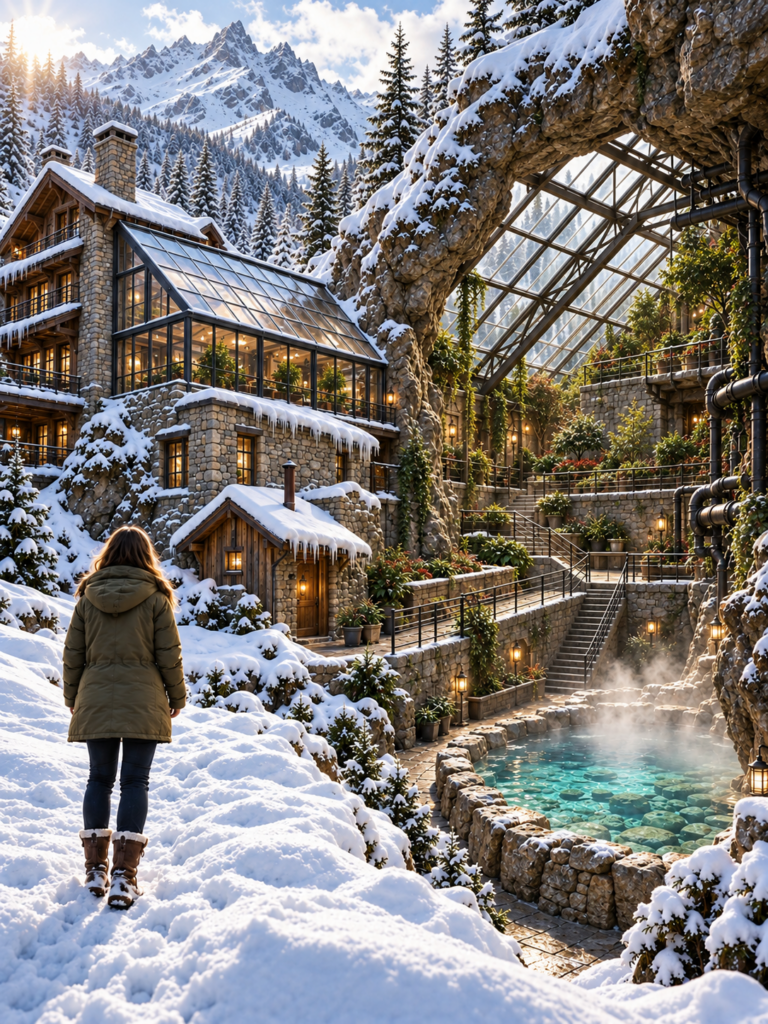
Instead, a massive structure of fieldstone and weathered timber stood embedded directly into the mountainside.
Its walls were thick and imposing, as though someone had built a fortress and then persuaded the mountain to swallow half of it.
The roof sloped sharply downward beneath a heavy blanket of snow.
Beside the stone structure stood a tiny wooden cabin with a narrow chimney extending above its roof.
Clare switched off the engine.
The silence settled around her almost immediately.
Not the familiar quiet of a suburban street at night, but something heavier and older.
She stepped outside.
Cold air struck her cheeks hard enough to make her eyes water.
“Good grief, Helen,” she murmured.
The place looked less like an inheritance than a survival experiment.
She walked toward the cabin, boots crunching through old snow.
The brass key included with the county paperwork fit the front door.
Inside, everything was spare but carefully maintained.
A narrow cot stood against one wall. There was a small kitchenette with a hand-pump sink, shelves holding mason jars and worn books, and a wood stove positioned where it could warm most of the room.
No television.
No comfortable sofa.
No evidence that Helen had ever cared about making her home resemble the ones featured in magazines.
Clare set down her bag and inspected the walls.
They were solid.
The cabin was clean.
But the cold had settled into the wood so deeply that even the air seemed reluctant to move.
She found a supply of split firewood stacked outside beneath a small porch overhang and carried several pieces inside.
Lighting the stove took longer than she’d expected.
Her fingers had grown stiff, and she couldn’t remember the last time she’d started a fire without turning a thermostat or pressing a button.
When the flames finally caught, she crouched in front of the stove and watched them spread across the wood.
Her first conclusion remained unchanged.
This property wasn’t somewhere she could reasonably live.
Whatever sentimental value Helen had placed on it, the land needed to be sold.
Clare would take photographs tomorrow, make inquiries in town, and leave as soon as the roads allowed.
She was reaching for another piece of firewood when she noticed something she’d overlooked.
A door stood in the far wall of the cabin.
Unlike the exterior entrance, this one was made of heavy vertical oak planks bound together by thick strips of dark iron.
A large iron hook secured it from the inside.
Clare stared at it.
The door apparently led into the enormous stone structure she’d seen outside.
Probably an old storage area, she thought.
Maybe Helen kept agricultural equipment there.
She took her flashlight, lifted the hook, and pulled.
The hinges resisted.
She placed one foot against the floorboards and pulled harder.
The door moved with a deep wooden groan.
Then warm air touched her face.
Clare stopped.
She had expected freezing air. The smell of damp timber. Maybe the mustiness of something abandoned for years.
Instead, a mild, humid current drifted through the doorway.
It smelled of dark soil, wet stone, leaves, and a faint mineral sharpness she couldn’t identify.
She held out her hand.
The warmth was real.
“What on earth?”
She pulled the door wider and stepped across the threshold.
Her flashlight illuminated a broad stone landing.
Beyond it, the floor dropped away.
Clare moved forward cautiously, directing the beam downward.
Stone terraces descended into an enormous excavated chamber built directly into the hillside.
There were three levels, each lined with raised planting beds constructed from stone and cedar.
At the lowest level, perhaps fifteen feet below her, a broad flat growing area stretched toward the rear wall.
And the rear wall wasn’t really a wall.
It was the mountain itself.
Clare raised her flashlight.
Above her was a steeply pitched roof made of thick, industrial double-paned glass.
Most of it was buried beneath snow, but several exposed sections reflected the faint winter light.
She understood the shape of the building then.
The massive roof she’d seen outside wasn’t covering a barn.
It covered an underground greenhouse.
A walipini.
She’d come across the concept before: a growing space excavated into the earth to take advantage of natural insulation and solar warmth.
But this wasn’t an ordinary pit greenhouse.
Its scale was extraordinary.
Someone had designed the structure with an almost obsessive understanding of engineering, temperature control, and growing conditions.
Clare descended the stone steps.
The farther she went, the warmer the air became.
She unzipped her winter coat.
Then she removed her gloves.
At the bottom, she could feel moisture gathering along her hairline.
Outside, temperatures were well below freezing.
Inside this hidden chamber, the air felt close to sixty degrees.
She swept the flashlight across the growing beds.
The soil was dark, loose, and carefully prepared, though nothing appeared to be growing in most of them.
Along the back wall ran a network of thick black metal pipes.
They emerged near a large stone basin in the center of the lowest terrace, curved around the planting beds, and disappeared into the mountain.
Clare approached the basin.
It was filled with perfectly clear water.
A thin ribbon of steam drifted above the surface.
She reached out and dipped two fingers into it.
The water was hot.
Not lukewarm.
Hot.
She looked from the basin to the pipes, then toward the stone walls.
Slowly, the explanation assembled itself in her mind.
Helen had found a natural geothermal hot spring within the mountain.
She had tapped that source and built a system of pipes that circulated thermal water through the greenhouse, transferring heat into the surrounding stone and soil.
The mountain’s enormous thermal mass stored that warmth.
During the day, sunlight entered through the sloped glass roof, adding solar energy to the system.
At night, the warmed stone and water protected the growing beds from freezing.
It was a sophisticated combination of passive solar design, geothermal energy, and thermal storage.
And it appeared to be functioning without anyone tending it.
Clare stood absolutely still.
The faint movement of water through the pipes was the only sound.
All those years, her family had believed Helen was living in poverty and isolation because she’d abandoned a promising scientific career.
But this place wasn’t the work of a woman who’d given up on science.
It was the work of someone who had spent decades practicing it.
She looked again at the three terraces.
The precisely arranged beds.
The insulated glass.
The pipes disappearing into solid rock.
Her aunt hadn’t walked away from her abilities.
She had brought them here.
And built something nobody else in the family had bothered to understand.
That night, Clare slept in the little wooden cabin with the heavy interior door left slightly open.
Warm, humid air drifted into the room, softening the cold that still lingered around the stove.
For the first time in weeks, she fell asleep without mentally calculating her remaining savings.
The following morning, sunlight woke her.
She dressed, crossed the cabin, and opened the oak door.
The greenhouse had transformed.
Snow was beginning to slide from the steep glass roof in heavy sheets.
Bright shafts of winter sunlight poured into the chamber, illuminating the stone terraces and casting long geometric shadows across the empty planting beds.
Clare walked down the steps and felt the warmth gathering around her.
By late morning, the interior temperature had climbed toward seventy degrees.
In the far corner of the lowest terrace, she discovered Helen’s desk.
It was a sturdy old piece of furniture, its surface crowded with leather-bound notebooks.
Clare opened one.
The pages were filled with narrow, precise handwriting.
Dates.
Temperatures.
Water-flow measurements.
Soil pH readings.
Solar angles.
Notes about the response of specific plant varieties to changing light levels.
She turned another page.
Then another.
There were decades of observations.
Helen had recorded how much thermal water the greenhouse needed during extreme cold snaps.
She’d measured which planting beds warmed most quickly when the morning sun reached the glass.
She’d documented methods for protecting young plants during periods of heavy snowfall.
And she’d written detailed instructions for growing vegetables during the darkest months of winter.
Clare sat at the desk and read until her coffee grew cold.
She’d spent her career studying complex systems.
This was a complex system.
But unlike the enormous logistics networks she’d managed in Seattle, every element here could be seen, touched, measured, and understood.
Water entered a pipe.
Heat moved through stone.
Sunlight warmed the soil.
Plants grew.
The simplicity of its purpose was almost overwhelming.
She opened another notebook and discovered a carefully written planting schedule for January.
Next to several crop names were references to a seed collection stored near the stairs.
Clare found the collection in a cool, dark alcove.
Hundreds of small glass vials stood neatly organized on shelves, each labeled with a plant name and growing instructions.
There were hardy winter greens, mâche, claytonia, specialized spinach varieties, and even a winter tomato Helen had spent years selectively breeding for low-light conditions.
Clare held one tiny vial up to the light.
The seeds inside looked insignificant.
Small, dry fragments that could have been swept away without anyone noticing.
But Helen’s notebooks suggested that, under the right conditions, they could produce fresh food even when the mountains outside were locked in ice.
Clare returned to the desk.
She thought about Seattle.
The apartment she’d surrendered.
The unanswered job applications.
The exhausting possibility of spending the next several months begging another corporation for permission to earn a living.
Then she looked at the planting beds.
The inheritance she’d planned to sell suddenly presented a different possibility.
She didn’t have to decide everything today.
She could stay a few weeks.
Learn how the system worked.
Plant something.
See what happened.
If she failed, the land could still be sold.
But she couldn’t leave without trying.
That afternoon, Clare exchanged her winter coat for an old work shirt she found among Helen’s belongings and began preparing the middle terrace.
The work was harder than she’d expected.
She loosened soil, removed accumulated debris, checked the water valves, and compared the arrangement of the beds with diagrams in Helen’s notebooks.
Her back began to ache.
Dirt worked its way beneath her fingernails.
Several times she stopped to reread instructions, afraid of adjusting something important incorrectly.
By evening, she had prepared only a fraction of the available growing space.
She was exhausted.
But the exhaustion felt different.
It came from doing something real with her own hands.
Over the following days, she established a routine.
Every morning, she checked temperatures and inspected the water circulation.
She adjusted insulating blankets over portions of the glass roof when the nights turned especially cold.
She followed Helen’s planting schedule as closely as she could, resisting the temptation to substitute her own guesses for thirty years of recorded experience.
Then she waited.
The first week passed without anything visible happening.
Clare checked the beds so often that she began to feel ridiculous.
She knew seeds didn’t grow faster because someone stared at the soil.
Still, she looked.
On the fourteenth morning, she noticed a tiny disturbance in one of the rows.
She knelt down.
A pale green shoot had broken through the dark earth.
A few inches away, another was emerging.
And another.
Clare sat back on her heels.
They were hardly impressive. Tiny leaves, no larger than her fingernail, stood in a row of damp soil.
But she’d prepared that bed.
She’d monitored the temperature.
She’d adjusted the water and protected the seeds through freezing nights.
For eight years, her successes had appeared as percentages on a computer screen.
Now they were living things.
She touched the soil beside one of the shoots, careful not to disturb it.
Outside, the mountains were still buried beneath snow.
Inside, spring had begun.
And for the first time since losing her job, Clare felt that her future might contain something other than another desperate attempt to return to the life she’d known.
Part 2
By the middle of February, the greenhouse no longer resembled the empty stone chamber Clare had discovered weeks earlier.
The middle terrace had become a dense, vibrant stretch of green.
Rows of spinach spread broad, healthy leaves across the soil. Delicate claytonia crowded the edges of the beds. Mâche formed compact clusters, and the other winter greens grew with a vigor Clare still found difficult to believe.
Outside, the Bitterroot Mountains remained frozen beneath deep snow.
Inside, sunlight filtered through the glass ceiling and fell across plants that looked as though they belonged to an entirely different season.
Every morning, Clare descended the stone steps before breakfast.
She checked the water temperature. Examined the leaves for signs of stress. Recorded observations in a fresh notebook she had placed beside Helen’s.
She was no longer simply following instructions.
She was beginning to understand them.
When the outside temperature fell sharply, she noticed how the thermal water circulated through the pipes and helped the stone retain warmth. On brighter afternoons, she watched the temperature rise as sunlight reached the terraces.
The greenhouse was an intricately balanced system, but it wasn’t mysterious anymore.
Its logic was becoming familiar.
One morning, Clare realized that several rows were ready for harvesting.
She crouched beside the claytonia and ran her fingers gently beneath its leaves.
The greens were fresh, crisp, and remarkably healthy.
Helen’s planting notes suggested that careful harvesting would allow continued production rather than requiring the entire bed to be cleared.
Clare fetched a clean container and began cutting.
By noon, she had filled several insulated coolers with vegetables.
She carried them into the cabin and stood looking at the harvest.
It was more food than she could reasonably eat.
And the next planting would eventually produce more.
For the first time, Clare considered what the greenhouse might provide beyond personal survival.
There were restaurants in the valley below.
Restaurants that probably depended on produce trucked long distances through winter weather.
Fresh local greens in February might be worth something.
She checked the contents of the coolers, placed them in her Honda Civic, and drove down the mountain.
The trip took nearly an hour.
She passed snow-covered fields, scattered homes, and stretches of road where plows had pushed dirty ridges of ice along the shoulders.
Eventually, she reached a small valley town.
Clare drove slowly along its main street, looking for a restaurant that seemed likely to care about locally grown produce.
She stopped outside a farm-to-table establishment called the Ironwood.
Its windows were warm with afternoon light, and the dining room appeared carefully maintained.
Clare almost kept driving.
She had no experience selling vegetables.
She knew how to negotiate transportation contracts, evaluate supplier performance, and analyze distribution costs.
But walking into a restaurant with a cooler full of greens and asking someone to buy them felt strangely intimidating.
She switched off the engine.
Then she reminded herself that embarrassment wasn’t expensive.
Failure to find income was.
She carried one cooler inside.
A member of the staff directed her toward the owner, a man in his late forties named Marcus.
He emerged looking distracted, his attention apparently divided between several problems demanding immediate solutions.
“Can I help you?”
Clare introduced herself.
“My name’s Clare Vance. I’m Helen Vance’s niece. I have some winter greens I thought you might be interested in.”
Marcus glanced at the cooler.
“Winter greens?”
“Yes.”
“Locally grown?”
“Up in the mountains.”
He gave her a skeptical look.
“In February?”
Clare nodded.
“Unless you’re bringing them in from California, most things growing around here are frozen solid.”
“I know how it sounds,” she said. “But would you look at them?”
Marcus hesitated.
Then he shrugged.
“All right.”
Clare opened the cooler.
For a moment, he said nothing.
His expression changed as he examined the contents.
He reached inside, lifted a leaf of claytonia, and inspected it closely.
Then he tasted it.
The slight frown disappeared from his face.
He took another leaf.
“Where exactly did you grow this?”
“On my aunt’s property. There’s a greenhouse built into the mountain.”
Marcus looked up.
“Helen’s sunpit?”
The name surprised her.
“You knew about it?”
“I’d heard rumors.” He examined another handful of greens. “People said she could grow vegetables through the winter. I never knew whether to believe them.”
“It’s real.”
“I can see that.”
He set the leaf down and looked at the open cooler again.
“How much do you have?”
“This much for now. There should be another harvest next week.”
Marcus asked a few questions about the varieties and their growing conditions.
Clare answered as best she could.
She explained the geothermal heating, the protected planting beds, and Helen’s careful development of crops suited to low winter light.
She didn’t pretend to know everything.
When Marcus asked something she couldn’t answer, she admitted it.
But the produce spoke for itself.
The leaves were crisp and flavorful, far removed from the tired winter greens he was accustomed to receiving after long-distance transportation.
After a short conversation, Marcus bought the entire cooler.
He paid Clare in cash.
She stood outside the Ironwood afterward, holding several hundred dollars in folded bills.
It wasn’t a fortune.
It wouldn’t eliminate her student debt or restore her old salary.
But it was money she’d earned from something she had grown.
No supervisor had approved her performance.
No corporate office had calculated her productivity.
No client halfway around the world had demanded a revised spreadsheet.
She had taken seeds, soil, water, warmth, and time and turned them into food someone wanted to buy.
The simplicity of the transaction made her smile.
She placed the money carefully inside her wallet and drove back into the mountains.
During the following month, a pattern developed.
Clare continued supplying the Ironwood, and Marcus quietly introduced her to two other chefs in the surrounding area.
Both were interested in obtaining fresh local produce during a season when nearly everything came from far away.
Clare expanded her planting into the upper terrace.
She began organizing harvest days around her trips into town and used her old logistics skills to coordinate the modest deliveries.
The work was familiar enough to feel manageable, but different enough to be satisfying.
There were still schedules to maintain.
There were still practical problems to solve.
But the objective was no longer to move imaginary containers across a digital map while someone else’s profits increased.
She was growing food.
She was delivering it.
And the money came directly back to her.
For the first time in her adult life, her expenses seemed less threatening than her income.
The property carried no mortgage.
Geothermal energy provided the greenhouse’s heat without a fuel bill.
The mountain supplied the water the system needed.
She still had taxes, supplies, vehicle expenses, and her outstanding debts to consider, but living on the property cost a fraction of what she’d spent in Seattle.
She learned to prepare simple meals in Helen’s tiny kitchenette.
She read the old botanical texts on the cabin shelves in the evenings.
Some nights, she sat at the desk in the greenhouse, copying observations from Helen’s notebooks and comparing them with the conditions she’d recorded that day.
The more she learned, the more she understood the scale of her aunt’s achievement.
Helen hadn’t built the greenhouse through a lucky accident.
Its stability was the result of years of observation, experimentation, mistakes, corrections, and persistence.
Clare sometimes wished she’d spoken with Helen more often.
There were questions she wanted to ask now.
Why had she chosen this land?
How had she discovered the geothermal spring?
What had she felt the first winter the system worked?
And had she known that the family regarded her life’s work as a failure?
Clare had no answers.
Only the notebooks.
And the extraordinary structure surrounding her.
By late March, the snow began to retreat.
The road up the mountain became a mixture of mud, melting ice, and exposed gravel.
Water trickled through shallow channels beside the track.
Clare welcomed the change.
The increasing sunlight made the greenhouse easier to manage, and the long cold weeks were finally loosening their grip on the valley.
She had begun to believe that her life might remain this simple.
Then, one afternoon, an expensive SUV came slowly up the drive.
Clare noticed it through the cabin window.
The vehicle was large and polished, with tires that looked more accustomed to paved roads than muddy mountain tracks.
It stopped near the stone building.
A man stepped out.
He wore a costly outdoor jacket and clean boots that seemed oddly inappropriate for the conditions.
He surveyed the property before approaching the cabin.
Clare went outside.
“Can I help you?”
The stranger smiled.
“Miss Vance?”
“Yes.”
“David Sterling. I’m with a land acquisition company representing a luxury wellness development in the valley.”
He offered his hand.
Clare shook it.
Sterling spoke in the confident, polished manner of someone accustomed to obtaining meetings and closing negotiations.
He explained that a high-end thermal spa and resort was being developed roughly twenty miles down the valley.
His company was interested in acquiring certain nearby properties.
Clare looked past him toward the SUV.
“I’m not sure why you’d be interested in this place.”
Sterling smiled again.
“Actually, your property is particularly interesting.”
She invited him inside the cabin, though she kept the conversation near the entrance.
The interior door leading to the greenhouse was partly open.
Sterling’s attention moved toward it immediately.
Clare noticed.
He asked whether he could see the structure.
She hesitated, then stepped aside enough for him to look through the doorway.
Warm air drifted into the cabin.
Beyond the stone landing, the growing terraces extended beneath the glass roof.
Sterling didn’t spend much time examining the plants.
His gaze moved past them toward the basin at the lowest level.
Steam rose gently from its surface.
He seemed satisfied by what he saw.
“Your aunt was quite an interesting woman,” he said.
“She was.”
“We’ve studied this area carefully. Your property sits over the headwaters of one of the deepest geothermal veins in the county.”
Clare said nothing.
“Your aunt secured the associated water rights in 1981. Those rights could be extremely useful to our development.”
Now she understood why he had come.
He wasn’t interested in the vegetables.
Or the greenhouse.
He wanted the hot water flowing through the mountain.
Sterling opened a slim leather folder and produced a document.
“We’d like to purchase the property, including the water rights.”
He named a figure.
Clare stared at him.
It was a substantial amount of money.
Enough to pay off her student loans.
Enough to purchase a modest condominium in Seattle.
Enough to live comfortably for a while as she searched for another professional position.
A few months earlier, she’d have considered such an offer the answer to every problem in her life.
Now she found herself looking through the open doorway.
Sunlight fell across the planting beds.
She could hear water moving quietly through the stone basin.
She thought about her mornings tending the crops and her afternoons delivering fresh food into town.
Then she imagined surrendering the property.
Returning to Seattle.
Renting or buying another apartment.
Sending résumés to companies where she would once again depend on someone else’s decision about whether her work was valuable.
The offer could solve her financial problems.
But it would require her to abandon the first life she’d built that actually felt like her own.
Clare handed the paper back.
“I’m not interested in selling.”
Sterling appeared momentarily surprised.
Then his expression returned to its professional calm.
“Miss Vance, this is a very generous offer.”
“I understand.”
“The assessed value of this property is nowhere near what we’re prepared to pay.”
“I know.”
“Then perhaps you should think about it before making a decision.”
“I’ve thought about it.”
His smile remained, but something in his eyes became colder.
He looked toward the greenhouse again.
“You’re currently running a commercial agricultural operation in an old structure. I assume you’ve looked into the county’s current regulations?”
Clare felt a slight tightening in her stomach.
“What regulations?”
“Water usage. Commercial permits. Environmental compliance. Regulations have changed quite a bit since your aunt’s time.”
He paused.
“It would be unfortunate if the county decided to take a closer look.”
Clare studied him.
He hadn’t raised his voice.
He hadn’t said he would cause any trouble.
But the meaning was unmistakable.
“Thank you for your offer, Mr. Sterling,” she said. “The property isn’t for sale.”
She opened the cabin door.
Cold wind swept inside.
Sterling looked at her for another moment, then returned the document to his folder.
“Of course. If you reconsider, you know how to reach us.”
Clare watched his SUV descend the muddy road.
Only after it disappeared among the trees did she close the door.
For several minutes, she remained standing beside the wood stove.
She told herself he was bluffing.
The greenhouse had operated for decades.
Helen had lived here undisturbed.
Surely a legitimate agricultural operation couldn’t be destroyed because a wealthy developer wanted its water supply.
But Sterling had sounded very certain.
Two weeks later, a letter arrived from the county assessor’s office.
It concerned a reassessment of the property’s classification.
Clare read the notice twice.
The timing felt too precise to be accidental.
Not long afterward, an inspector from the Department of Water Resources drove up the mountain.
He carried a clipboard and explained that his office had received an anonymous complaint alleging unauthorized geothermal water use.
Clare led him into the greenhouse.
The inspector walked slowly through the terraces, studying the pipes, the stone basin, and the rows of thriving vegetables.
His initial expression of routine professionalism gave way to obvious curiosity.
He asked when the system had been constructed.
Clare explained what she knew.
He asked how much water was being circulated.
She showed him Helen’s records.
He asked whether she was using the greenhouse for commercial production.
“Yes,” she admitted. “I sell the vegetables to three restaurants.”
He wrote something on his clipboard.
Clare didn’t like the way he stopped asking questions after that.
Eventually, he looked up.
“I’m sorry, Miss Vance.”
Her stomach dropped.
“What is it?”
“This facility doesn’t appear to have the modern commercial permits required for this level of agricultural use.”
“It’s been operating for decades.”
“I understand that.”
“My aunt built it. She secured the water rights.”
“Water rights and commercial operating permits aren’t necessarily the same thing.”
He glanced around the greenhouse.
“Under the current regulations, we’d also need an appropriate environmental impact survey for this geothermal use.”
Clare stared at him.
The inspector didn’t seem pleased with what he was saying.
But he continued.
“Without the necessary documentation, I have to issue a cease-and-desist order for commercial agricultural use of the water.”
Clare heard the words but struggled to process them.
“You’re telling me I can’t grow food here?”
“I’m telling you that you can’t continue using the geothermal system for commercial agriculture without establishing the appropriate authorization.”
“The system has been running since before I was born.”
“That may be true. But I have to enforce the rules as they stand.”
She looked toward the pipes.
Nothing about them had changed.
The water still circulated.
The greenhouse still maintained a stable temperature.
The plants were healthy.
But suddenly her ability to earn a living from them was threatened.
The inspector explained the basic compliance requirements before leaving.
Clare listened, growing increasingly discouraged.
Environmental surveys. Permit applications. Professional reviews. Possible legal challenges.
The cost could run into tens of thousands of dollars.
Money she didn’t have.
After he drove away, she walked back into the greenhouse.
The growing beds seemed painfully beautiful.
Her plants hadn’t done anything wrong.
The system wasn’t new.
And Sterling’s interest in the property had appeared immediately before the complaints and official scrutiny.
She couldn’t prove he was responsible.
But she understood the pattern.
A developer with substantial financial resources wanted land she refused to sell.
Now the regulatory process was threatening the small business that allowed her to remain there.
The easiest solution would be to accept Sterling’s money and leave.
She sat on the stone steps.
The old panic returned, familiar and unwelcome.
It was the same feeling she’d experienced in Seattle when the termination email arrived.
The sudden realization that decisions made by people far more powerful than herself could dismantle everything she’d worked to create.
She remained there for a long time.
Then she looked toward Helen’s desk.
Her aunt had been a scientist.
A meticulous one.
Every change in water temperature had been recorded.
Every experiment documented.
Every planting cycle preserved in notebooks.
Helen had spent more than thirty years building and refining this place.
Clare found it difficult to believe that she’d ignored the legal foundation of her own work.
Perhaps the answers were somewhere among those records.
That evening, Clare began searching.
She pulled notebooks from the shelves and stacked them across the desk.
Most contained agricultural observations.
Others included records of maintenance, water flow, construction details, and correspondence connected to Helen’s research.
Clare read until her eyes ached.
She wasn’t looking for instructions on growing winter vegetables anymore.
She was looking for evidence.
A permit.
A letter.
A document explaining how the greenhouse had been allowed to operate for so long.
Hours passed.
Outside, the wind moved through the trees.
Inside, the geothermal system continued its steady work.
At around two in the morning, Clare was kneeling beside the desk, reaching into the bottom drawer, when she noticed something unusual.
A narrow strip of metal was visible beneath the drawer’s wooden base.
She pulled the drawer completely out.
Then she lowered herself to the floor and shone her flashlight underneath the desk.
Bolted to the underside was a small metal lockbox.
Clare touched it.
It was solid.
And locked.
She searched through the drawer for a key.
Nothing.
She checked the other drawers.
Still nothing.
At last, she went outside to the tool shed and returned with a heavy pry bar.
She worked its edge beneath the lockbox lid.
The metal resisted.
She repositioned the bar and tried again.
With a sharp crack, the fastening gave way.
Clare opened the lid.
There were no seeds inside.
No money.
No jewelry.
Only carefully folded documents, some protected by aging envelopes.
She carried the box to the desk and emptied its contents.
The first pages were official legal filings.
Several bore seals and signatures.
And across the top of one document was a date.
1984.
Clare leaned closer.
Beneath the date was a reference to the geothermal agricultural research station on Helen Vance’s property.
Her tired eyes moved down the page.
Then she reached for the next document.
Whatever her aunt had hidden beneath that desk, it appeared to be connected to a fight over the property that had taken place decades before Clare ever arrived.
And as she began reading, she realized Helen might have left behind something far more valuable than the land itself.
Part 3
Clare spread the documents across Helen’s desk and began reading them in chronological order.
The first set concerned a dispute in 1984.
According to the records, county officials had challenged Helen’s geothermal operation decades earlier.
The precise circumstances weren’t completely clear, but the surviving correspondence suggested that questions about land use and water access had emerged at a time when other interests were seeking control over valuable local resources.
Clare felt a growing sense of recognition.
Someone had tried to interfere with the greenhouse before.
Her aunt hadn’t responded by abandoning the property.
She had responded with paperwork.
A substantial amount of it.
Clare turned another page.
There were references to a state university, geological research, agricultural experiments, and the geothermal characteristics of the mountain.
Helen had worked with a university geologist to formally document the greenhouse as a geothermal agricultural research station.
The arrangement was far more sophisticated than Clare had anticipated.
The university had been interested in studying subterranean thermal agriculture, particularly the ability to maintain productive growing conditions in severe winter climates.
Helen’s property offered an unusual opportunity.
A naturally occurring source of geothermal heat.
A carefully engineered underground greenhouse.
And a botanist willing to conduct systematic, long-term observations.
The agreement established a formal research relationship.
Helen would provide data about temperatures, water circulation, soil conditions, and agricultural production.
The university’s involvement helped support the property’s classification as a research facility rather than an ordinary commercial greenhouse.
Clare continued reading.
Then she found the provision that made her sit forward.
The 1984 filings included a special educational agricultural exemption associated with the property.
It recognized the existing geothermal operation and protected its continued use under the grandfathered arrangement described in the documents.
The exemption was attached to the property rather than being limited to Helen personally.
That meant it could pass to a successor owner.
Clare read the passage again.
Then she found the condition.
The protection would continue so long as the qualifying agricultural activity had not ceased for more than twelve consecutive months.
Twelve months.
She placed one hand on the desk and stared at the page.
Helen had been dead for only two months when the notice reached Seattle.
And Clare had restarted active planting shortly after arriving.
But the critical question wasn’t simply when she had planted her first seeds.
It was whether the property records could establish that the agricultural operation had continued without a disqualifying interruption.
She looked at the leather-bound notebooks stacked beside her.
Daily temperatures.
Water-flow measurements.
Soil readings.
Planting schedules.
Harvest notes.
Thirty years of meticulous documentation.
Clare began opening them, searching backward through the entries.
There were records from the previous winter.
And the winter before that.
Entries from the year before Helen died.
Then the final notebook.
Helen’s handwriting remained precise nearly to the end.
Clare found measurements and observations recorded during the week of her aunt’s death.
She stopped turning pages.
For a moment, she pictured the older woman sitting at this very desk, recording the temperature of the water while the rest of the world went about its business.
Helen had continued her work until the final days of her life.
Even when no family members were nearby to appreciate it.
Even when the greenhouse’s value was recognized by almost nobody outside her small circle of research contacts.
Clare looked back at the legal documents.
The records didn’t merely demonstrate how the greenhouse functioned.
They helped establish its continuous use.
And Clare had additional evidence.
The planting records she’d kept since arriving.
The receipts from the Ironwood.
The sales to the other restaurants.
Documentation showing that she had carried the work forward.
Suddenly, Sterling’s warning seemed less powerful.
He’d known about the water rights granted in 1981.
His company had evidently investigated the property closely enough to identify the geothermal resource beneath the mountain.
But he hadn’t mentioned the research station classification.
Or the 1984 filings.
Clare wondered whether he’d missed them.
The legal protection appeared under the university research arrangement rather than the ordinary county tax classification.
Someone searching only the more obvious property records might not immediately understand what Helen had established.
Clare set the documents in a neat stack.
She felt exhausted, but the fear that had kept her awake was giving way to something more useful.
A plan.
She wasn’t a lawyer.
She couldn’t know whether the filings would withstand every possible challenge.
And she knew that a document found in a lockbox wasn’t automatically proof that the county had to accept her position.
But these weren’t handwritten promises or informal family notes.
They were original legal records bearing official seals, supported by decades of continuous research data.
It was enough to take to the county.
She glanced at the clock.
It was well past two in the morning.
The greenhouse remained warm.
The plants rested quietly beneath the dark glass roof.
Clare gathered the most important documents into the leather folder Helen had used to store them.
Then she closed the notebooks.
For the first time since the inspector’s visit, she believed she might have a genuine way to defend the property.
The next morning, she drove into town.
The trip seemed longer than usual.
Every rough section of the road reminded her how much depended on a stack of aging papers.
If she was wrong about their meaning, the greenhouse might still face a costly permitting process.
If the county rejected them, she might have to choose between selling the property and pursuing a legal fight she couldn’t afford.
She parked outside the county clerk’s office and carried the folder inside.
At the counter, Clare explained that she’d received a cease-and-desist order involving geothermal water use on her inherited property.
Then she placed the documents on the counter.
“I believe these records establish an exemption,” she said.
The clerk examined the first page.
Clare pointed to the university agreement, the original sealed filings, and the relevant property provisions.
She showed the continuity requirement.
Then she presented the logbooks documenting Helen’s agricultural research through the week of her death.
Finally, she produced her own planting records and the receipts from the Ironwood.
The clerk looked through the material more carefully.
After a while, the county attorney was called.
He arrived, introduced himself, and began examining the documents.
Clare stood across from him, trying to remain calm.
She had spent years presenting operational data to skeptical managers and clients.
This felt similar in one respect.
She couldn’t afford to lose her argument by becoming emotional.
So she explained the evidence in order.
Helen had secured geothermal water rights in 1981.
The university research arrangement and associated exemption had been formally established in 1984.
The property had been used for qualifying agricultural research and production for decades.
The original owner had maintained detailed logs until shortly before her death.
And Clare, as the successor owner, had continued the agricultural operation.
The attorney read the records.
He made two telephone calls to the state capital.
Clare couldn’t hear the complete conversations.
She sat in a chair near the counter, watching people enter and leave the office while her future was discussed over the telephone.
At last, the attorney returned.
He had the documents in his hand.
“Miss Vance,” he said, “these records appear to be in order.”
Clare stood.
“Does that mean the greenhouse is protected?”
He glanced down at the filings.
“The exemption remains valid under the terms documented here. Your evidence supports continued qualifying agricultural use.”
She waited.
“As long as the conditions are maintained, the existing geothermal agricultural operation is covered by that grandfathered arrangement.”
Clare released a breath she hadn’t realized she was holding.
“And the cease-and-desist?”
“We’ll address the enforcement action in light of these records. There’s no basis to continue it on the grounds previously cited.”
She looked at him.
“So I can keep growing?”
“Within the terms of the exemption, yes.”
The attorney’s expression suggested that he didn’t particularly enjoy finding an old provision capable of complicating a modern regulatory process.
But he appeared satisfied that the documents were legitimate.
Clare thanked him.
She carefully gathered the original records and placed them back into the folder.
Outside, the afternoon sunlight seemed unusually bright.
She stood beside her Honda for a moment, looking toward the mountains.
Helen had anticipated a problem that wouldn’t fully emerge until decades after the original dispute.
She hadn’t merely constructed a greenhouse capable of surviving Montana winters.
She had helped establish the legal framework that allowed her work to survive changes in regulation and ownership.
The stone walls protected the plants from the weather.
The documents protected the operation from another kind of pressure.
And together, they had preserved the future Clare had nearly sold.
A week later, David Sterling returned.
His SUV moved slowly up the muddy drive and stopped in front of the cabin.
Clare was sitting on the porch with a cup of herbal tea.
The herbs had been grown in the greenhouse.
She watched Sterling step out.
He looked as immaculate as before.
He carried the same polished confidence and a slim leather folder.
“Miss Vance,” he said pleasantly.
“Mr. Sterling.”
“I thought I’d stop by and see whether you’ve had time to reconsider our proposal.”
“I have.”
He smiled.
“Good. I understand there have been some complications with the county.”
Clare took a sip of tea.
“Those have been resolved.”
Sterling paused.
“I’m sorry?”
“The county dropped its inquiry.”
His expression became more guarded.
“I wasn’t aware of that.”
“The property is protected under an educational agricultural exemption. It was established through a state university research arrangement in 1984.”
Sterling didn’t answer immediately.
Clare continued.
“The exemption applies to the geothermal agricultural operation and passes with the property, provided the qualifying agricultural use continues.”
She watched him absorb the information.
“My aunt kept the necessary records for decades. The county confirmed that the protection is still valid.”
Sterling glanced toward the stone structure.
For the first time, he seemed uncertain how to proceed.
“That’s an unusual arrangement,” he said.
“It is.”
“Our legal team will have to review it.”
“You’re welcome to.”
His eyes moved toward the heavy oak door visible beyond the cabin entrance.
Clare wondered whether he was calculating what the water supply might have been worth to the resort.
Whatever number he’d attached to it, the opportunity was slipping away.
After a brief silence, Sterling opened his folder.
“We’re prepared to reconsider our original offer.”
Clare said nothing.
“We could double it.”
She looked at him.
Double.
The amount was enormous by the standards of her life.
She could eliminate every outstanding debt.
She could purchase a comfortable home.
She could return to Seattle without the financial anxiety that had shadowed her for years.
There would be no need to worry about whether the next harvest was successful.
No need to maintain aging pipes or drive mountain roads in a snowstorm.
No need to wake before sunrise to monitor a system built by a woman the rest of the family had dismissed.
For a moment, Clare considered the offer simply as a number.
The analytical part of her mind understood its significance perfectly.
It was enough money to buy a very different life.
Then she looked toward the greenhouse.
The morning sunlight was reaching the glass.
Inside, three terraces of vegetables were growing in soil that remained warm despite the lingering mountain cold.
Her aunt’s notebooks rested on the desk.
The hot water continued its quiet circulation beneath the stone.
Clare thought about what selling would actually mean.
Sterling wasn’t offering to preserve the greenhouse.
He wanted the geothermal resource.
The elaborate system Helen had spent decades constructing would become irrelevant to his development plans.
The plants would disappear.
The water would be redirected toward a luxury resort.
And Clare would lose the one place where she’d learned to live without constantly measuring her worth against someone else’s expectations.
She turned back to Sterling.
“No, thank you.”
He stared at her.
“Miss Vance, we’re talking about a considerable amount of money.”
“I know exactly how much money we’re talking about.”
“Then I don’t understand.”
She set her cup on the porch railing.
“A few months ago, I would have accepted your first offer without thinking twice.”
Sterling waited.
“I’d lost my job. I was drowning in debt. I thought this property was worthless.”
She looked toward the valley.
“When I first drove up here, I was planning to take photographs and sell everything as quickly as possible.”
“And now?”
“Now I know what my aunt built.”
Sterling gave a small, impatient movement of his head.
“That may have sentimental value, but sentiment doesn’t pay bills.”
Clare almost smiled.
He sounded like the people she’d worked with in Seattle.
People who believed every decision could be reduced to a figure in the right column of a spreadsheet.
“You’re right,” she said. “Sentiment doesn’t pay bills.”
He looked encouraged.
“But my greenhouse does. And I don’t need what you’re offering.”
His expression hardened.
“Everyone has a price.”
Clare shook her head.
“Not for this.”
She stood and picked up her cup.
“The land isn’t for sale, Mr. Sterling.”
For several seconds, he remained beside the SUV.
Then he closed the folder.
“I see.”
Clare opened the cabin door.
“Have a safe drive back down the mountain.”
She went inside without waiting for a response.
Through the window, she watched him stand motionless for a moment before returning to his vehicle.
The SUV turned around and disappeared down the muddy track.
Clare remained by the window until it was gone.
Then she walked through the cabin and opened the heavy oak door.
Warm air moved across her face.
The greenhouse spread before her, quiet and productive.
Nothing about it had changed.
The pipes still carried thermal water.
The growing beds still held healthy plants.
The sunlight still moved across the glass roof.
But something in Clare had changed.
She’d been offered more money than she’d ever possessed.
And she’d refused it.
Not because she failed to understand its value.
But because she had finally learned to recognize the value of something else.
Over the months that followed, Clare settled into the life she’d chosen.
She continued growing vegetables through the changing seasons.
She maintained the geothermal system, gradually learning to recognize small variations in temperature and water flow before they became serious problems.
She repaired what needed repairing and kept Helen’s careful records up to date.
Her relationship with the three restaurants remained steady.
Marcus continued purchasing winter greens for the Ironwood, and the two other chefs ordered what they needed as harvests became available.
There were opportunities to expand.
More restaurants could have been approached.
Additional planting beds could have been pushed into constant production.
Clare knew how to develop a larger operation.
Her professional experience made it easy to imagine increased output, more customers, and higher revenue.
But she also understood what that growth would demand.
More trips into town.
More schedules.
More obligations.
More pressure to produce.
She’d spent eight years watching organizations pursue growth as though it were the only measure of success.
She didn’t want to recreate that system in the mountains.
So she made a deliberate choice.
She would supply her three existing clients.
She would produce enough to cover taxes, supplies, necessary expenses, and a comfortable, modest life.
She would continue maintaining the property and honoring the conditions of its agricultural exemption.
And she would leave herself time to enjoy the place Helen had built.
It wasn’t a decision she could have understood during her years in Seattle.
Back then, choosing not to expand would have seemed like wasting potential.
Now she recognized it as choosing a different definition of enough.
When her second winter arrived, Clare was no longer a frightened newcomer struggling to light a wood stove.
She knew how to prepare the cabin for heavy snow.
She knew which sections of the mountain road became treacherous first.
She knew when to draw the insulating blankets across the greenhouse roof and how to adjust the water circulation when temperatures plunged.
She could recognize the faint differences in the sounds the pipes made as the outside cold intensified.
She understood the growing beds almost as intimately as she once understood the spreadsheets on her office computer.
And she no longer resented the physical labor.
It anchored her days.
Morning inspections.
Soil preparation.
Harvesting.
Deliveries into town.
Evenings with Helen’s notebooks.
The predictable rhythm gave her something her old life had never provided.
A sense that she was working with a system rather than struggling endlessly against one.
One evening in deep January, a blizzard moved into the mountains.
The storm arrived with fierce winds and heavy snow.
By nightfall, the trees beyond the cabin were barely visible.
The temperature dropped toward twenty degrees below zero.
Wind struck the stone structure with enough force to make the timber around the cabin creak.
Clare checked the stove, secured the exterior door, and walked into the greenhouse.
The contrast was extraordinary.
Outside, the mountains were disappearing beneath snow and darkness.
Inside, the air remained warm and humid.
The temperature held near sixty-five degrees.
Thermal water murmured through the basin at the lowest terrace.
The thick stone walls retained the accumulated heat.
Above, the glass roof was buried beneath a heavy insulating blanket of snow.
Clare descended the steps and walked between rows of healthy winter vegetables.
She stopped beside a tomato plant and touched one of its broad green leaves.
It was firm and alive.
Beyond the stone walls, the world was frozen.
But here, beneath the mountain, the growing season continued.
Clare sat at Helen’s desk.
The old leather notebooks occupied their familiar place.
Beside them lay the newer records she’d begun keeping herself.
The two collections formed a continuous history.
Helen’s work.
Then hers.
She opened one of the older notebooks and examined a page written decades earlier.
Her aunt had recorded a winter temperature, a water-flow rate, and an adjustment to the insulating blankets.
Nothing dramatic.
Just a practical observation intended to help the next day’s work.
Clare looked around the greenhouse.
For years, the family had treated Helen’s departure from university life as proof that she’d wasted her gifts.
They imagined a lonely woman living in a crude mountain cabin, far from the achievements she might have enjoyed.
But Helen had built a research station that operated through some of the harshest winters in the country.
She had developed planting methods and crop varieties suited to extreme conditions.
She had engineered a geothermal heating system, documented its performance for decades, and established a legal defense that preserved its continued operation.
And she had done all of it without seeking approval from the people who thought she had failed.
Clare finally understood something that had escaped her during the years she’d spent chasing promotions and professional recognition.
Helen hadn’t necessarily rejected success.
She had rejected the idea that other people were entitled to define it for her.
Clare closed the notebook.
She thought about that Thursday afternoon in Seattle.
The termination email.
The cardboard box.
The rain against the office windows.
At the time, losing her position had felt like losing the foundation of her entire identity.
She’d believed her future depended on finding another company willing to employ her.
Then a letter from Montana had arrived, offering what appeared to be five acres of worthless rock and an abandoned agricultural building.
She had nearly sold it without understanding what stood inside.
Nearly traded it for a few more months of security in the world she’d left behind.
And then she’d opened a heavy iron-bound door.
That single act hadn’t magically solved her problems.
She’d still had to learn how to cultivate the soil.
Still had to work through exhaustion and uncertainty.
Still had to sell her produce, defend the property’s rights, and decide what kind of life she wanted.
The greenhouse had given her an opportunity.
But she’d had to choose what to make of it.
Now, as the blizzard battered the mountain, Clare sat in the warm stone chamber and listened to the water moving through Helen’s pipes.
She didn’t have a prestigious job title.
She didn’t own an expensive house.
She wasn’t managing a department or pursuing another promotion.
But she had work she understood.
Food she could grow.
A home she could maintain.
Enough income to live without the constant fear that had dominated her life in Seattle.
And, perhaps most importantly, she had the freedom to decide what happened next.
She looked toward the oak door at the top of the stairs.
It was the same door she’d opened on her first freezing evening in Montana.
Back then, she’d been searching for something she could sell.
Instead, she’d discovered something worth keeping.
Clare reached for her pen and opened her own notebook.
She wrote down the greenhouse temperature, the conditions outside, and the steady flow of geothermal water through the system.
Then she added a brief observation about the healthy tomato plants on the lowest terrace.
The entry was ordinary.
Nothing more than another record in a long sequence of records.
But that was the point.
Tomorrow, the greenhouse would still need tending.
The plants would still need care.
The water would still flow.
And Clare would still be here.
Outside, the blizzard continued.
Inside, life went on.
Her family had called the mountain property worthless.
They’d believed Helen had wasted her life hiding away from the world.
But Clare knew better now.
Her aunt hadn’t built a refuge because she was incapable of succeeding elsewhere.
She had built a place where success meant something different.
A place where intelligence served a practical purpose, where work produced something living, and where enough could truly be enough.
Clare rested her hand on the old wooden desk.
For thirty years, Helen had protected this small piece of the world from cold, isolation, and those who wanted to take it from her.
Now it belonged to Clare.
Not merely because a legal document had transferred ownership.
But because she’d learned how to care for it.
She switched off the desk lamp and stood.
The geothermal water continued its steady movement through the pipes, warming the earth beneath her feet.
Above the glass roof, snow fell heavily against the mountain.
Clare climbed the stone stairs and returned to her cabin.
Behind her, the greenhouse remained warm.
The structure held.
And for the first time in her life, so did she.