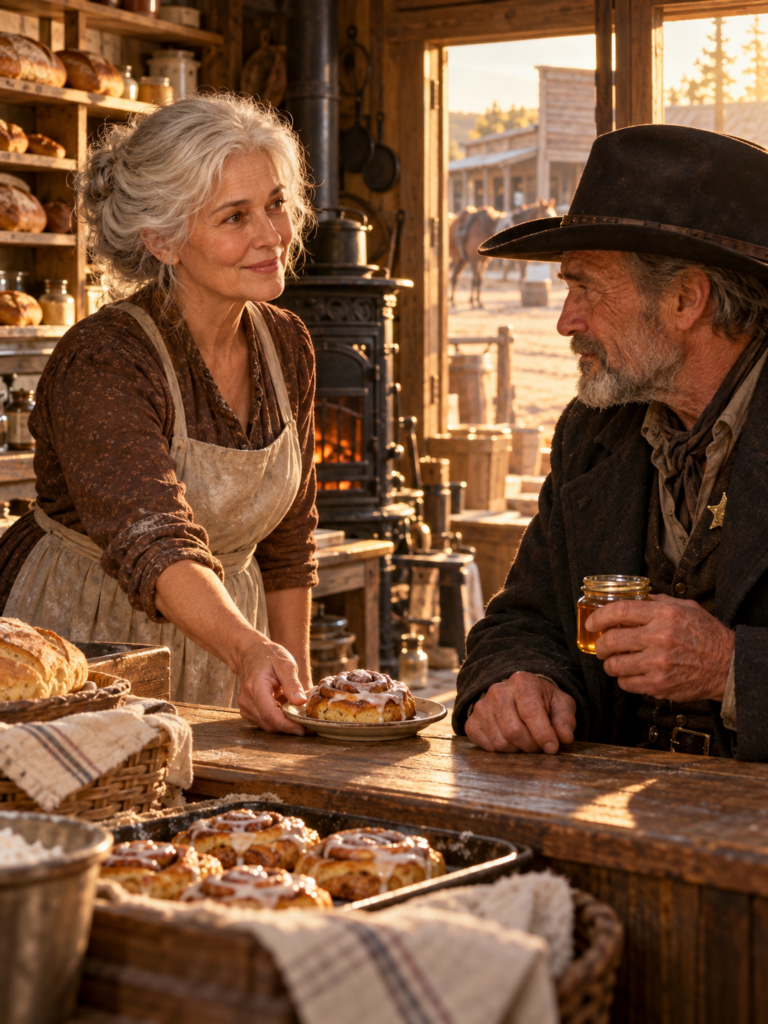
Margaret stepped closer, her flour-dusted fingers resting against the counter.
“I did not come to Silver Creek looking for someone to run my affairs,” she said.
Walter released the stool.
“I hadn’t supposed you did.”
“Good. Because I’ve already had three men explain how much flour I ought to buy, two inquire whether my son approved the purchase, and one offer to manage my money.”
She folded her arms.
“I intend to bake bread, pay my bills, and make my own mistakes if necessary.”
Walter regarded her seriously.
“Sounds reasonable.”
Her eyes narrowed slightly.
“That’s all you’ve got to say?”
“Would you like an argument?”
“No.”
“Then we’d better leave it there.”
For a moment, Margaret simply stared.
Then she laughed.
It was a warm, surprised sound.
“Sit down, Mr. Hayes.”
He took his usual stool.
She poured his coffee.
Neither mentioned the honey jar resting on a shelf behind the counter, but Walter noticed that she had cleaned it carefully and placed it where she could reach it.
Over the following weeks, the seven o’clock visit became an arrangement neither had formally proposed.
Walter came Tuesday through Saturday.
He ordered black coffee.
Margaret placed a cinnamon roll before him.
Sometimes he paid before eating.
Sometimes she was too busy to collect his money until he left.
Their conversation grew in small, unhurried pieces.
She asked which banker understood small businesses.
He told her.
She wanted to know whether the lumber merchant delivered what he promised.
Walter gave an honest assessment.
When she asked about the town’s winter trade, he explained which months were slow and which brought ranch hands into Silver Creek with wages to spend.
In return, he learned that Margaret had been baking since childhood.
Her grandmother had taught her to judge bread by touch and smell.
She preferred grinding cinnamon herself.
And she could detect an overworked dough before it reached the oven.
Walter listened.
He enjoyed listening.
There had been very little in his house worth listening to for years.
One Thursday, Margaret asked why he had retired.
He looked into his coffee.
“My wife died.”
Margaret’s hands stilled.
“I’m sorry.”
“Eleanor. Her name was Eleanor.”
Margaret nodded.
“My husband’s name was George.”
“I heard.”
“Pete?”
“Pete.”
She sighed.
“That man could spread news through a locked door.”
Walter’s mouth twitched.
“He means well.”
“Most people do. Doesn’t keep them from talking.”
He watched her move a fresh loaf to the cooling shelf.
“How long were you married?”
“Twenty-eight years.”
He nodded.
“Twenty-two for us.”
Silence settled between them.
It was not uncomfortable.
Margaret finally said, “George used to tell me I’d open a bakery someday.”
“And now you have.”
“Now I have.”
Walter looked toward the morning sunlight.
“Eleanor used to tell me I wouldn’t know what to do with myself if I ever retired.”
“Was she right?”
“For a while.”
“And now?”
He considered his empty plate.
“Now I seem to have somewhere to go in the mornings.”
Margaret turned away before he could see her entire smile.
But somebody else had begun noticing those mornings.
Her son Daniel.
At thirty-two, Daniel Collins had already lost his father, watched his mother struggle through three years of widowhood, and persuaded himself that he understood what she needed.
He arrived at the bakery one Wednesday with his work coat still dusty from the lumberyard.
Walter was seated at the counter.
Margaret was pouring coffee.
Daniel stopped inside the doorway.
His eyes went straight to Walter.
“Mr. Hayes.”
“Daniel.”
“Mama, could I speak with you?”
“You are speaking with me.”
“In private.”
Margaret placed a cinnamon roll on a plate.
“Sit down and eat before you decide what needs discussing.”
Daniel sat.
He did not touch the roll.
Walter kept his attention on his coffee.
He understood the young man’s rigid shoulders better than Daniel might have believed.
Fear often arrived dressed as authority.
And this particular fear was not difficult to recognize.
Daniel had already buried one parent.
He did not want another man entering his mother’s life only to leave her grieving again.
Walter had no intention of making the boy his enemy.
When he finished his coffee, he laid his payment beside the plate.
“Good morning, Mrs. Collins.”
“Good morning, Walter.”
Daniel watched the exchange.
Walter turned toward him.
“Good to see you, son.”
Then he opened the bakery door.
Behind him, he heard Daniel push back his stool.
“Mama, we need to talk about that man.”
Walter stepped onto the boardwalk, pulling the door closed behind him.
He had no idea how much that conversation would cost them—or how soon Margaret’s son would need the help of the very man he distrusted.
The bakery door clicked shut behind Walter.
Through the glass, he could see Daniel sitting stiffly at the counter while Margaret stood opposite him.
Walter could not hear their words.
He did not need to.
For twenty-three years, he had earned his living recognizing the difference between a man preparing for trouble and a man already frightened by it.
Daniel Collins was frightened.
Walter adjusted his hat and walked home.
He would not make matters worse by demanding a place in Margaret’s family before she had decided what place, if any, she wanted him to occupy.
Inside the bakery, Daniel folded his arms.
“How long has he been coming here?”
“Several weeks.”
“Every morning?”
“Most mornings.”
“Why?”
Margaret wiped her hands on her apron.
“Because I sell excellent cinnamon rolls.”
“Mama.”
“Daniel.”
He leaned forward.
“He’s been living alone for years. He’s retired. He doesn’t have much to occupy him.”
“Those are observations, not accusations.”
“I’m not accusing him.”
“Then what are you doing?”
Daniel looked away.
His mother waited.
Finally, he said, “I don’t want you getting hurt.”
Margaret’s expression softened.
But her voice remained firm.
“Neither do I.”
“Then you’ll be careful?”
“I have been careful all my life. I don’t intend to stop now.”
He looked toward the door.
“You’re beginning to care about him.”
Margaret did not deny it.
“I enjoy his company.”
“That isn’t what I asked.”
“No. It isn’t.”
She placed his untouched cinnamon roll closer.
“Eat your breakfast, Daniel. Then go to work.”
He recognized the end of the conversation.
He did not like it.
But he ate.
***
Daniel began visiting the bakery three mornings each week.
He sat two stools away from Walter.
He talked to his mother about lumber deliveries, business accounts, and the weather.
Walter answered when spoken to.
Otherwise, he drank his coffee.
Sometimes Daniel arrived early enough to occupy the stool Walter preferred.
On those mornings, Walter simply chose another.
Margaret noticed.
She noticed everything.
One morning, after Daniel had gone to the lumberyard, she followed Walter toward the door.
“He’s making this difficult.”
Walter stopped.
“He’s your son.”
“That doesn’t give him the right to govern my life.”
“No, ma’am.”
She studied him.
“You could tell him that yourself.”
“I could.”
“Why don’t you?”
Walter looked toward the sunlight on the boardwalk.
“Because he wouldn’t hear it from me yet.”
Margaret considered that.
“You’re a patient man.”
“Not always.”
“With him, you are.”
Walter rested one hand on the doorframe.
“He’s afraid you’ll lose someone again.”
Her eyes filled slightly.
“I know.”
“I know what that fear can do to a man.”
“Does that mean I should let him decide everything?”
“Not at all.”
Walter met her gaze.
“That’s between you and Daniel. I’m not going to make you choose between your son and a fellow who likes your baking.”
Her lips moved toward a smile.
“Is that all you like?”
He hesitated.
“No.”
The answer hung between them.
Margaret lowered her eyes.
“Thank you for not pushing.”
“You’ve had enough people doing that.”
He went home.
That evening, sitting on his porch, Walter thought about Eleanor.
She had been capable, outspoken, and stubborn about matters that counted.
She had once told him he could investigate a town until sunset but still fail to notice when his own wife wanted him home for supper.
He smiled at the memory.
Margaret was different.
Her humor was sharper.
Her ambitions belonged to her.
She wanted a business she had built herself, not a household in which another person decided the shape of her days.
Walter admired that.
He had spent five years preserving a quiet life around Eleanor’s absence.
Now he found himself wondering whether a different kind of life might be possible without betraying the first.
He did not yet know the answer.
***
Summer brought more customers to Margaret’s bakery.
Ranch workers came for breakfast.
Families bought fresh loaves.
The smell of cinnamon became as familiar on Silver Creek’s main street as the sound of wagon wheels.
Margaret kept careful accounts.
Her business was modest but sound.
She did not ask Walter to manage it.
Sometimes she asked his opinion about a particular person or transaction.
Sometimes she ignored his advice.
He found that he liked a woman who could do both.
Daniel gradually stopped watching every exchange between them, although his visits remained frequent.
Then, in November, a Wells Fargo agent passed through town asking questions about a future shipment of gold coin.
Walter heard of it through old acquaintances.
The company expected to send funds through Silver Creek the following summer to a mining operation north of town.
Walter noted the information.
He was retired.
The routes and escorts were no longer his responsibility.
Still, old habits persisted.
He remembered that the receiving bank would have knowledge of the shipment arrangements.
Silver Creek Savings Bank was managed by Harlon Briggs.
Walter had never trusted Briggs.
The banker was respected in town.
He had donated the church clock and served on the council.
But during Walter’s years as sheriff, several troubling matters had ended in ways that benefited Briggs.
A mining claim dispute.
A cattle operation acquired cheaply after its owner fell into difficulties.
Financial transactions Walter had never satisfactorily explained.
None had provided enough evidence for a charge.
Walter had learned to distinguish suspicion from proof.
He did not confuse the two now.
He put the matter aside.
Or tried to.
***
The following July, the Wells Fargo shipment finally arrived.
Three thousand dollars in gold coin was being transported toward the mining operation.
The escort passed through Silver Creek on Thursday.
Two miles north of town, armed men stopped the shipment.
One Wells Fargo employee was shot.
The gold disappeared.
By Friday morning, the town was talking of nothing else.
Walter heard the news from Pete, who arrived at his porch with an expression Walter remembered from his sheriffing days.
“Tom Harker’s made an arrest.”
Walter set down his coffee.
“Who?”
Pete hesitated.
“Daniel Collins.”
Walter stared at him.
“Margaret’s boy?”
“That’s the one.”
“On what evidence?”
“Two men say they saw him near the north road when the robbery happened.”
Walter asked their names.
Pete supplied them.
One worked for Harlon Briggs.
The other owed the banker a considerable debt.
Walter’s expression did not change.
“What does Daniel say?”
“Says he was traveling near the road on lumberyard business. Says he didn’t see any robbery.”
“Where’s Tom holding him?”
“County jail.”
Pete shifted uneasily.
“Folks are saying Margaret’s taking it badly.”
Walter looked toward the bakery.
Its door was closed.
For the first time in months, the scent of cinnamon had not greeted him that morning.
He thanked Pete.
Then he went inside.
In the back room stood the chest where he kept the belongings of his former life.
His old badge lay in a drawer.
Beside it rested his revolver.
Walter looked at both.
He had not wanted to be sheriff again.
He still did not.
But a young man was sitting in jail on testimony Walter had reason to question.
And that young man’s mother was the first woman in five years to make him look forward to sunrise.
He closed the drawer and returned to the kitchen.
Whatever he did next had to be done properly.
Suspicion would not free Daniel.
Evidence might.
***
Margaret came to his house that evening.
She wore her good coat, the one usually reserved for church.
Her white hair had been pinned hastily.
Her eyes were reddened but dry.
Walter opened the door before she could knock again.
“Come inside.”
She stepped into the kitchen.
For a moment, she simply stood there.
Then she sat at the table.
Walter put water on the stove.
He did not ask her to stop worrying.
He knew better.
“Tom says two men saw Daniel near the robbery,” she began.
“I heard.”
“Daniel says he was nowhere near the men who took the gold.”
Walter sat opposite her.
“Being near a road doesn’t establish robbery.”
“They say he had the opportunity.”
“Opportunity isn’t proof of guilt.”
Margaret gripped her gloves.
“I know my son can be stubborn. I know he makes judgments about people he doesn’t understand. But he isn’t a thief.”
Walter considered her words.
“I know something about the witnesses.”
She looked up.
He explained their connections to Harlon Briggs.
One man’s employment.
The other’s debt.
Margaret listened carefully.
“Are you saying Briggs arranged the robbery?”
“I’m saying the testimony deserves a closer look.”
“Can you prove Daniel is innocent?”
“Not yet.”
She lowered her eyes.
“I came because I thought you might know what to do.”
Walter was quiet.
Then she said the part that hurt her most.
“Daniel hasn’t treated you fairly.”
“No.”
“He’s been trying to keep you away from me.”
“I know.”
“And I’m asking you to help him.”
Walter reached across the table.
He did not take her hands.
He placed his open palm beside them, leaving the choice to her.
Margaret covered it with her own.
“I’ll look into it,” he said.
Her breath caught.
“Thank you.”
“But Margaret, I won’t promise an answer I haven’t earned. Tom is sheriff now. Any investigation must be handled through him.”
“I understand.”
Walter squeezed her hand gently.
“And Daniel deserves the truth, whatever it turns out to be.”
She nodded.
“Yes.”
After she left, Walter opened the back-room drawer again.
He cleaned the old revolver, more from habit than expectation of needing it, and left it secured.
He examined the badge Eleanor had once polished for him.
Then he put it away.
He could investigate without pretending he still held the office.
The next morning, he visited Tom Harker.
“I’d like to speak with your prisoner,” Walter said.
Tom regarded his former superior.
“Margaret sent you?”
“She asked for help.”
“And you’re asking my permission?”
“You’re sheriff.”
Tom nodded.
“Then come inside.”
***
Walter began with Daniel.
The young man looked exhausted.
His confidence had suffered badly during his first night behind bars.
When Walter entered, Daniel rose.
“Mr. Hayes.”
“Sit down.”
Daniel obeyed.
“I didn’t do it.”
“Then tell me where you were.”
Daniel explained the lumberyard errand that had taken him toward the north road.
Walter listened without interruption.
He asked about the time, the route, and anyone who might confirm the journey.
Daniel answered as carefully as he could.
At last, he looked down.
“Why are you doing this?”
“Because your account needs to be checked.”
“Even after the way I’ve treated you?”
Walter paused.
“That doesn’t change what the law ought to do.”
Daniel swallowed.
Walter stood.
“I’ll speak with Tom again after I’ve followed what you’ve told me.”
As he reached the door, Daniel said, “Mr. Hayes?”
Walter turned.
“Please tell my mother I’m all right.”
Walter looked at the young man behind the bars.
“I will.”
***
By Saturday, the wounded Wells Fargo employee, Jesse Calder, had regained consciousness.
Walter visited him with Tom’s knowledge.
Calder was weak, but he remembered a detail that had not appeared in the first report.
The robbers had known precisely where the escort would slow along the route.
Not merely which road the shipment would take.
The specific point.
That information had been included in arrangements known to the transport company and the receiving bank.
Walter took careful notes.
Next, he visited the debtor who claimed to have seen Daniel.
They talked on the man’s porch.
Walter did not threaten him.
He asked how matters stood with the bank.
The man’s evasions told Walter where to press further.
When Walter asked whether his debt had recently been altered, the man lost his composure.
He would not immediately admit to lying.
But his story began to unravel.
The second witness presented a different problem.
He was a bank employee.
His account placed Daniel near the robbery site at a time Walter believed could be disproved.
Walter spoke with the employee’s wife, a woman he and Eleanor had known for many years.
She told him her husband had been in Abilene that Thursday afternoon.
If the dates and travel could be established, his account could not be true.
Walter shared the information with Tom.
Together, they examined the discrepancies.
Then Walter turned his attention toward Briggs’s property.
Someone had to move the stolen gold.
Gold coin was heavy.
Transport required time, equipment, and concealment.
Walter observed disturbed ground behind the property and newly cut boards in an equipment shed associated with the bank.
He also overheard two men discussing a hurried movement of crates.
None of it was enough alone.
Together with the unreliable witnesses and the precise knowledge of the shipment route, it gave Tom grounds to seek further lawful investigation.
Walter had already sent word requesting a judge’s attention to the matter.
When he laid his findings before Tom on Sunday evening, the younger sheriff studied them for a long time.
“Briggs sits on the town council,” Tom said.
“I know.”
“He donated the church clock.”
“I can read the clock.”
Tom looked up.
Walter’s expression remained grave.
“A man’s public generosity doesn’t answer a question about stolen gold.”
Tom nodded slowly.
“I’ll need proper authority to search.”
“Yes.”
“And if we find nothing?”
“Then we keep looking.”
Tom set the papers down.
“You always were better at these things than you admitted.”
Walter shook his head.
“You learned the work well enough to know what needs doing.”
Tom studied him.
“Will you stay involved?”
“As a witness and an old man with a good memory.”
For the first time that evening, Tom smiled.
Walter left the office and walked toward the bakery.
The lamps were still burning inside.
Margaret was closing for the night.
She saw him through the window and opened the door.
He stopped on the boardwalk.
“I have reason to think the witnesses against Daniel aren’t telling the truth,” he said.
Margaret pressed one hand against her chest.
“But we still need to establish what happened.”
She nodded.
“Will Tom listen?”
“He already has.”
Margaret looked toward the distant jail.
“And Daniel?”
Walter stepped closer.
“He isn’t forgotten.”
She reached for his hand.
For a moment, the old sheriff felt the warmth of her fingers and remembered how empty his kitchen had been before she arrived.
Then the distant town clock struck the hour.
Walter looked toward the jail.
The next decision belonged to Tom Harker and the judge.
But the truth was finally moving.
And somewhere behind those barred windows, Daniel Collins was about to discover just how much a man he had distrusted was willing to do for him.
Daniel Collins sat on the edge of his narrow jail cot, listening to the footsteps outside his cell.
When Tom Harker appeared, the young man’s face tightened.
“Has something happened to my mother?”
“No.”
Tom unlocked the outer door and entered with a folded paper in his hand.
“Your mother is safe.”
Daniel breathed out.
“Then what is it?”
“The witnesses against you aren’t standing quite so firm as they were.”
Daniel looked up.
“Because of Walter Hayes?”
Tom considered the question.
“Because we examined the evidence again. Walter helped us see where to look.”
Daniel lowered his eyes.
He had spent months making his dislike of Walter perfectly plain.
Now the retired sheriff was working to establish the truth about a crime Daniel had not committed.
He could not understand it.
Nor did he know what to do with the gratitude beginning to rise inside him.
***
Judge Whitfield arrived on Tuesday.
Tom Harker presented the inconsistencies in the witnesses’ accounts, the information supplied by Jesse Calder, and the reasons for suspecting that the stolen gold had been handled through property associated with Harlon Briggs.
The judge authorized the necessary search.
By Wednesday afternoon, officers had discovered evidence connecting Briggs and his associates to the stolen shipment.
The debtor who had accused Daniel withdrew his false testimony and admitted that pressure connected with his debt had influenced him.
The bank employee’s claimed whereabouts proved unreliable.
The investigation exposed a scheme far more serious than a banker making an unkind remark about a retired lawman’s visits to a bakery.
Briggs had known details of the gold shipment.
He had used that knowledge to help arrange its robbery.
And when Daniel happened to be near the north road, he had become a convenient man to accuse.
Tom arrested Briggs.
Daniel was released.
The criminal case would still require further proceedings.
But the evidence no longer supported keeping Margaret’s son behind bars.
He stepped onto the boardwalk outside the jail in the afternoon sunlight.
For a moment, he simply stood there.
He could hear ordinary life continuing around him.
A wagon creaked along the street.
Someone called from the general store.
The church clock struck the hour.
Silver Creek had not stopped moving while Daniel sat in jail.
But his own life felt altered.
He looked toward Margaret’s bakery.
Then he began walking.
***
Walter was seated at the familiar stool when Daniel entered.
Black coffee.
One cinnamon roll.
The same counter where the young man had once sat with folded arms, determined to discover what Walter wanted from his mother.
Margaret stood behind the counter.
She looked up as her son entered.
For an instant, all three remained motionless.
Then Margaret hurried around the counter.
Daniel embraced her.
She held him fiercely.
Walter turned toward the window, giving them what privacy he could.
When they separated, Daniel wiped his face with his sleeve.
His mother touched his cheek.
“Have you eaten?”
“No, Mama.”
“Then sit down.”
She returned behind the counter.
Daniel approached the stools.
He sat two places from Walter.
For several moments, neither man spoke.
Then Daniel shifted one stool closer.
“Mr. Hayes.”
“Walter will do.”
Daniel looked at the counter.
“I know what you did.”
“Tom Harker did his job.”
“He told me where the information came from.”
Walter drank his coffee.
Daniel tried again.
“I’ve been making things difficult for you since the day I first saw you sitting here.”
“That you have.”
“I thought you were after something.”
Walter looked at him.
“I was after breakfast.”
Daniel gave a brief, unwilling laugh.
“And my mother’s company.”
“Yes.”
The younger man’s expression grew serious.
“I was afraid she’d be hurt again.”
Walter set down his cup.
“I know.”
“You didn’t know how bad it was after Father died. She hardly slept. For months she’d sit with his things, trying to decide what to keep.”
Daniel swallowed.
“I thought if I kept everyone away, perhaps she wouldn’t have to go through that again.”
Walter considered his words.
“You can’t keep every sorrow away from somebody you love.”
Daniel stared at the counter.
“I know that now.”
“You can be there when the sorrow comes.”
“Like you were for her?”
Walter did not answer immediately.
“I tried.”
Daniel nodded.
Then he looked directly at him.
“I’m sorry.”
Walter accepted the apology without making the young man suffer through a speech.
“All right, Daniel.”
Margaret set a fresh cinnamon roll before her son.
Her hands were steady, but her eyes were shining.
Daniel picked up the roll.
This time, he ate it.
And for the first time, the three of them sat together without anyone waiting for a quarrel.
***
After Daniel’s release, Margaret returned to her work with renewed determination.
The bakery had suffered during the days of his arrest.
People had been curious.
Some had been sympathetic.
A few had been cautious.
But Silver Creek was a practical town, and Margaret’s bread was good.
Customers returned.
Walter came every morning.
Daniel began appearing on Wednesdays.
Not to supervise his mother.
Not to inspect Walter.
Simply to drink coffee.
Sometimes the men discussed lumber prices.
Sometimes Walter told stories about the early days of Silver Creek.
Sometimes they sat in companionable silence.
Margaret noticed that Daniel no longer watched every expression that passed between her and Walter.
One Wednesday, after Daniel had left for the lumberyard, she placed a second cinnamon roll before Walter.
“What’s this for?”
“Because I felt like it.”
“I’ve already paid.”
“Then consider yourself fortunate.”
He studied her.
“Your son seems easier in his mind.”
“He is.”
“And you?”
Margaret leaned against the counter.
“Better than I’ve been in a long while.”
Walter nodded.
She looked at him.
“You’ve changed something in this town.”
“Tom handled the case.”
“That isn’t what I meant.”
Walter understood.
He had spent years living as though his usefulness had ended when he placed his badge in a drawer.
The Briggs affair had shown him that his experience still had value.
But it was Margaret who had reminded him that being useful was not the same as being alive.
He looked at the roll.
Then at her.
“Would you care to have supper with me Sunday?”
She smiled.
“I suppose that depends.”
“On what?”
“Whether you intend to cook.”
“I can manage three dishes.”
“Only three?”
“Three I’ve survived on for years.”
She laughed.
“Then perhaps I’d better bring something.”
Walter smiled.
“I was hoping you might.”
***
September came with cooler mornings.
Margaret had owned the bakery for nearly half a year.
Its windows glowed before sunrise.
The shelves filled with bread, biscuits, pies, and the cinnamon rolls that had become a quiet tradition in Walter’s life.
He had grown accustomed to seeing her white hair framed by the morning light.
He had also grown accustomed to leaving her shop with a feeling he had once believed belonged permanently to his past.
Hope.
He had not stopped loving Eleanor.
There were mornings when a familiar scent, a line in an old book, or the sound of rain against the windows brought back the ache of losing her.
He still remembered the last week of her life with painful clarity.
But Margaret had never asked him to put those memories away.
She had loved George.
She understood.
One Sunday evening, sitting on Walter’s porch, they spoke openly about the people they had lost.
“Eleanor was fond of roses,” Walter said.
Margaret glanced toward the bare patch of earth beside the steps.
“Did you grow them for her?”
“She grew them. I mostly managed to keep from trampling them.”
Margaret laughed softly.
“George couldn’t tell a good piecrust from a poor one, but he ate every pie I made as though it were the finest thing in Texas.”
Walter smiled.
They sat quietly.
Then Margaret said, “Sometimes I think people expect grief to finish before anything new can begin.”
Walter looked at her.
“Has yours finished?”
“No.”
“Mine neither.”
She rested her hand upon the arm of her chair.
“But I don’t believe George would have wanted me to spend the rest of my life waiting for a day that cannot return.”
Walter reached for her hand.
“Eleanor wouldn’t have wanted that for me either.”
Their fingers intertwined.
For a long time, they watched the sunlight fade over Silver Creek.
Neither tried to make their earlier marriages smaller to give the present more room.
They had loved before.
They could love again.
Both truths belonged to them.
***
On a Thursday morning in September, Walter finished his coffee and rose from his usual stool.
Margaret was wiping the counter.
The bakery was nearly empty.
He held his hat in both hands.
“Margaret.”
She looked up.
“Yes, Walter?”
“I’ve something to ask.”
“That sounds serious.”
“It is.”
She set down the cloth.
Walter looked at the woman whose bakery had brought cinnamon through his kitchen window that first April morning.
He remembered standing on her boardwalk, holding a jar of honey he had been saving for no particular reason.
He remembered her telling him to sit down.
He remembered Daniel’s crossed arms.
The empty bakery on the morning of the arrest.
The warmth of her hand across his kitchen table.
And the extraordinary fact that he now had somewhere he wanted to be every day.
“I’d like to marry you,” he said.
Margaret stared at him.
Then her eyes brightened.
“Yes.”
Walter blinked.
“I haven’t quite finished asking.”
“I know.”
“Margaret, I thought perhaps we ought to discuss—”
“We can discuss whatever you like afterward.”
He laughed.
She came around the counter.
Walter took both her hands.
“Are you certain?”
“Very.”
“I don’t want you giving up the bakery.”
“I wasn’t planning to.”
“Or feeling obliged to move everything into my house.”
“Good. Because I’ve no intention of closing a business I only just opened.”
He smiled.
“Then we’ll arrange matters as we please.”
Margaret lifted her face.
“That sounds like a sensible beginning.”
He kissed her gently.
And for the first time in years, Walter Hayes felt no need to apologize to his own heart for being happy.
***
They married in October.
Silver Creek Church was filled with people who had known Walter as sheriff, known Eleanor as his wife, and watched him walk alone for five years after her death.
Others had become devoted customers of Margaret’s bakery.
Some knew George only from the stories she told.
Daniel stood beside his mother.
He wore his best coat.
His expression was serious, but no longer guarded.
When Walter entered the church, Daniel stepped toward him.
“Morning, Walter.”
“Morning, Daniel.”
Daniel hesitated.
“She looks happy.”
Walter glanced toward the room where Margaret was preparing.
“I hope so.”
Daniel extended his hand.
Walter took it.
“Thank you for being good to her,” Daniel said.
Walter held the young man’s gaze.
“She deserves that.”
“I know.”
They shook hands.
It was not a promise that Daniel would become Walter’s son.
It was an acknowledgment that they cared for the same woman and no longer needed to stand on opposite sides of her happiness.
Margaret wore a blue dress she had purchased in Abilene for an occasion that had never arrived.
Now the occasion had found her.
When she entered the church, Walter stood straight.
His good coat fit a little more snugly than it once had.
His hands were weathered.
His hair was gray.
But his eyes followed her with the same astonishment he had felt the first time she placed a cinnamon roll in front of him.
He thought briefly of Eleanor.
Of the years they had shared.
Of the years they had lost.
Then Margaret reached him.
She placed her hand in his.
And Walter understood that loving this woman did not take a single thing away from the woman he had buried.
He could honor the past without refusing the future.
They exchanged their vows.
Daniel smiled.
Margaret squeezed Walter’s hand.
And outside, the church clock donated by Harlon Briggs continued keeping time, indifferent to the fact that its benefactor now faced serious charges.
Later, the town council considered removing it.
In the end, they decided the clock itself had committed no offense.
Walter approved.
He had always liked a sensible decision.
***
Marriage did not make Walter and Margaret abandon the lives they had built.
The bakery remained Margaret’s.
She kept her accounts.
She purchased flour, negotiated with suppliers, and decided which goods to offer.
Walter’s old house remained next door.
They made their home there, while the bakery continued operating as her business.
Every morning, Walter came through the connecting stretch of boardwalk at seven.
Sometimes he carried wood.
Sometimes he helped with a delivery.
Sometimes Margaret told him she needed neither and directed him to his stool.
He obeyed with the dignity of a man who had commanded an entire county but recognized higher authority behind a bakery counter.
She still made cinnamon rolls.
He still drank black coffee.
The only difference was that he no longer had to cross an empty kitchen to reach her.
On Wednesday mornings, Daniel joined them.
At first, he came for half an hour.
Later, sometimes for an hour.
He talked about the lumberyard, the town, and eventually a young woman he had begun noticing at the general store.
Margaret listened with visible interest.
Walter wisely kept his opinions brief.
Daniel learned to appreciate this.
Their friendship grew without requiring either man to pretend the earlier conflict had never happened.
Walter never resumed the sheriff’s office.
Tom Harker remained sheriff and handled the legal proceedings arising from the Briggs affair.
Walter occasionally offered advice when asked.
He did not miss the daily burdens of the badge.
He had found other work worth doing.
***
The following autumn, Margaret and Walter sat together on the porch after supper.
A cool Texas breeze moved along the boardwalk.
The bakery was closed.
The last customers had gone home.
From the neighboring building came the lingering fragrance of bread baked that afternoon.
Daniel had visited earlier.
He had stayed longer than usual and spoken freely about his plans.
Margaret watched him walk toward the lumberyard before returning to her chair.
“He’s going to be all right,” she said.
Walter nodded.
“I believe so.”
She looked at him.
“Did you always know?”
“No.”
“Neither did I.”
For a moment, she considered the man beside her.
“Can I ask you something?”
“Of course.”
“When Eleanor died, did you think you would ever be happy again?”
Walter was silent.
He looked toward the street.
Five years ago, he had sat on this same porch alone.
He had watched the empty building next door gather dust.
He had filled his days with small chores that kept him occupied but gave him nothing to anticipate.
He had believed his life would continue in that narrow pattern until it ended.
“No,” he finally answered.
Margaret reached for his hand.
“And now?”
Walter turned toward her.
“Now I am.”
She looked down at their joined hands.
“So am I.”
For a while, neither spoke.
There was no need.
The silence no longer meant loneliness.
It meant comfort.
A quiet house waiting behind them.
A bakery next door.
A grown son who could come and go without fear.
And the privilege of having someone beside them when the evening arrived.
Walter thought about the first morning he had smelled cinnamon through his window.
He had nearly ignored it.
He could have stayed inside.
He could have poured his coffee, eaten his plain breakfast, and continued the life he had carefully arranged around absence.
Instead, he had taken a jar of honey from the cupboard.
The last of the honey he had been rationing.
At the time, he had believed it was something he ought to save.
Now he understood that keeping something forever was not the same as enjoying it.
Margaret shifted closer.
“You’ve gone quiet.”
“Thinking.”
“About what?”
“That honey jar.”
She laughed.
“The one you brought before I opened?”
“Yes.”
“I still have it.”
He looked at her.
“You do?”
“In the cupboard. I use it for measuring small things.”
Walter smiled.
“Seems fitting.”
Margaret followed his gaze toward the bakery.
“Why did you bring it?”
He thought carefully.
“I’d spent so long keeping things because I didn’t know when I’d want them again.”
“And?”
“That morning, I finally wanted to give something away.”
Margaret’s eyes softened.
She leaned against him.
Walter put his arm around her shoulders.
Across the street, a lantern was extinguished.
The town grew quiet.
And Walter Hayes, who had once mastered the art of surviving alone, discovered how little effort it took to sit beside someone he loved.
***
Years later, people in Silver Creek would remember Walter and Margaret as the older couple who seemed to have belonged together from the beginning.
They remembered his stool at the end of the bakery counter.
Her cinnamon rolls.
Daniel’s Wednesday visits.
The porch where the retired sheriff and the baker sat watching the evening settle over town.
Most never knew how close Walter had come to remaining inside his house that first morning.
They did not know how carefully he had rationed the honey.
How frightened Daniel had been of losing his mother.
How much courage Margaret had needed to purchase a bakery after George’s death.
Or how a man who had spent twenty-three years protecting other people had struggled to believe there could still be a place for him in someone’s life.
But Walter remembered.
And Margaret remembered.
On certain mornings, before the bakery opened, she would place a warm cinnamon roll before him and say, “Sit down, Mr. Hayes.”
He would lower himself onto his usual stool.
“Coffee ready?”
“Nearly.”
He would smile.
“Then I reckon I’ll stay.”
She would reach across the counter and touch his hand.
And the man who had once believed his heart had finished its work would look at his wife and understand that some of life’s most important beginnings arrive without a grand announcement.
Sometimes they arrive with the smell of cinnamon.
A stranger’s kindness.
A jar of honey.
And the simple courage to walk next door.
Walter had spent five years learning how to live without reaching for someone who was gone.
Now, each morning, he reached for Margaret’s hand.
And it was there.
Warm.
Real.
Freely given.
The bakery door opened at seven.
The coffee was ready.
And Walter Hayes was home.