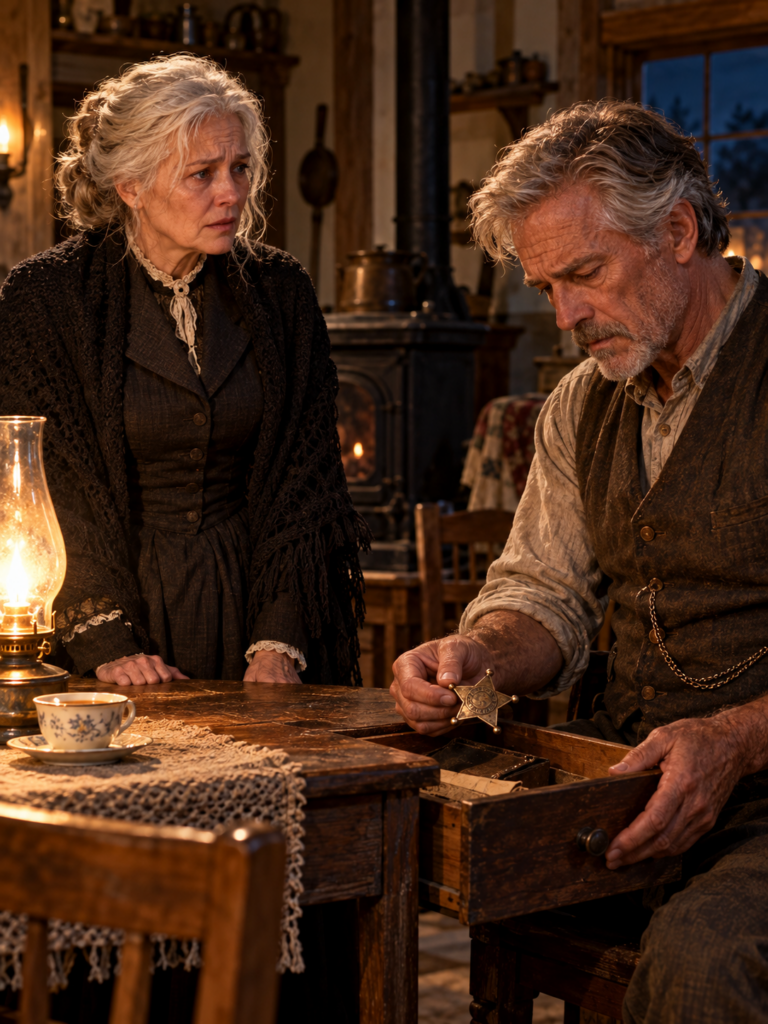
The drawer slid open with a dry scrape, exposing the things Walter had kept out of sight for five years.
His old sheriff’s badge lay beside a carefully maintained revolver.
Margaret stopped at the doorway.
“Walter?”
He lifted the badge, turning it beneath the lamplight.
For twenty-three years, that small piece of metal had represented his authority to investigate, arrest, and protect the people of Silver Creek.
Now it represented something more difficult.
A life he’d abandoned when grief made duty unbearable.
“I’m not sheriff anymore,” he said.
“I know.”
“Tom Harker holds that office. If I’m to help Daniel, I’ll do it without pretending otherwise.”
Margaret stepped closer.
“Then why take it out?”
Walter stared at the badge.
“Because I need to remember the man who knew how to do this work.”
He set it on the table and left the revolver in the drawer.
Margaret exhaled.
“Daniel won’t make this easy.”
“I don’t expect him to.”
“He believes you’re trying to replace his father.”
“I’m not.”
“I’ve told him that.”
Walter closed the drawer.
“He’s afraid, Margaret. Fear can make a decent man act poorly.”
She looked at him with wet eyes.
“You’re being kinder to him than he’s been to you.”
“Kindness doesn’t require agreement.”
They returned to the kitchen.
Walter drew a chair closer and asked Margaret to begin again.
This time, he interrupted when a detail required attention.
Where had Daniel been working that morning?
Who had sent him along the north road?
When had the witnesses supposedly seen him?
What had Tom actually told her, and what had she heard secondhand?
Margaret answered carefully.
Where she wasn’t certain, she said so.
Walter appreciated that.
The accusation placed Daniel near the road on the afternoon of the robbery.
But the witnesses’ account, as Margaret understood it, did not establish that Daniel had handled the gold, met the robbers, or participated in the ambush.
It established only that two men claimed to have seen him in the vicinity.
“Tom will have had reasons for making the arrest,” Walter said.
“Then what can you do?”
“Find out whether those reasons survive a closer examination.”
Margaret pressed her palms against the table.
“And the banker?”
Walter looked at her.
“What about him?”
“You went quiet when I mentioned those witnesses.”
“One earns his wages from Briggs. The other owes him money.”
“Do you think Briggs arranged this?”
“I’ve suspected him of dishonest dealings before. Suspicion isn’t proof.”
“But you know where to start.”
“Yes.”
For a moment, the kitchen fell silent.
The clock on the mantel marked another minute.
Margaret looked toward the window, beyond which her bakery stood dark.
When she’d come to Silver Creek, she’d expected trouble.
A new business carried risks.
Customers might not come.
Flour might cost more than anticipated.
She might discover that the independence she wanted demanded more work than she could provide.
She had accepted all of that.
But she’d never imagined standing in a former sheriff’s kitchen, begging for help while her son sat accused of armed robbery.
“I should have spoken to Daniel more firmly,” she whispered.
Walter looked up.
“About what?”
“About you. About the way he’s behaved.”
“That’s between you and him.”
“He’s thirty-two years old. I shouldn’t have to explain that I’m entitled to choose my own company.”
“No,” Walter agreed. “You shouldn’t.”
She looked at him steadily.
“And I’m not asking you to rescue Daniel so I’ll owe you anything.”
“I wouldn’t accept such a bargain.”
“Good.”
A faint, exhausted smile touched her mouth.
“Because I’m far too old to begin letting men make my decisions.”
Walter almost smiled himself.
“I gathered that when I saw you hanging your bakery sign.”
She sat a little straighter.
Then she reached across the table and covered his hand.
“I came because I trust you.”
The words unsettled him more than she could have known.
He had spent years believing that the useful part of his life had ended with his career.
But Margaret wasn’t asking him to become the old sheriff again.
She was asking him to use what remained of the man he’d always been.
“I’ll see the injured guard first,” he said. “If he’s able to speak.”
“Tomorrow?”
“Tomorrow morning.”
“And Daniel?”
“I’ll speak with Tom before I promise anything to him.”
Margaret released his hand.
He noticed how exhausted she looked.
“You’re welcome to rest here a while.”
“My dough needs preparing before dawn.”
“Then I’ll walk you home.”
She stood.
At the door, she paused.
“Walter, there is one more thing.”
He waited.
“If Daniel is innocent, someone has taken advantage of his being near that road.”
“That’s possible.”
“And whoever arranged it knows exactly where my son is tonight.”
Walter felt the familiar chill of an investigation becoming more serious than its first appearance.
He looked toward the darkened bakery.
Margaret was right.
If someone had deliberately directed suspicion toward Daniel, the young man’s arrest was not simply a mistake.
It was useful to someone.
Walter reached for his coat.
“Go home and lock your door. I’ll come by in the morning.”
Margaret stepped onto the porch, then turned back.
“Promise me you won’t put yourself in danger just because I asked.”
“I promise I’ll be careful.”
She nodded and started across the narrow space between their buildings.
Walter watched until her bakery door closed.
Then he returned to his kitchen, unfolded a sheet of paper, and wrote down the names of the two witnesses.
Beside them, he added one more.
Harlon Briggs.
He stared at the three names.
For twenty-three years, he’d suspected the banker of exploiting men who couldn’t afford to oppose him.
Now one of those men might hold the key to an innocent man’s freedom.
Walter took his hat from the peg, opened his front door again, and stepped into the street.
Before morning, he needed to speak to Tom Harker.
And for the first time in five years, he was walking toward the sheriff’s office instead of away from it.
Walter crossed the street and continued toward the sheriff’s office, his boots sounding against the wooden boardwalk.
Silver Creek was almost deserted.
A few lamps burned behind curtained windows. Somewhere near the livery stable, a horse shifted restlessly in its stall.
Walter knew the route so well that he hardly needed the light.
For twenty-three years, he’d walked these streets at every hour.
He’d escorted frightened witnesses home, settled disputes between neighbors, and brought accused men through the jailhouse door.
But he’d never expected to return because a woman who sold cinnamon rolls had asked him to save her son.
A lamp burned in the sheriff’s office.
Walter knocked.
Tom Harker opened the door himself.
He was older than the eager deputy Walter remembered, with more gray in his hair and the tired expression of a man carrying a difficult responsibility.
“Walter?”
“Evening, Tom.”
“Something wrong?”
“I’ve heard about Daniel Collins.”
Tom’s face tightened.
“I wondered whether you would.”
“May I come in?”
Tom stepped aside.
Inside, the office looked much as Walter remembered it.
The desk stood near the window.
The small iron stove occupied its familiar corner.
Behind the office, the jail cells were separated by a heavy interior door.
Walter could hear movement beyond it.
He knew Daniel was there.
“Margaret came to see you?” Tom asked.
“She did.”
Tom sighed.
“She’s taking this hard.”
“She has reason.”
“I haven’t enjoyed arresting her son, Walter.”
“I know you haven’t.”
Tom pulled out a chair.
“Then you know I had evidence.”
“Two witnesses.”
“Both willing to give statements.”
“One works for Briggs.”
Tom frowned.
“And?”
“The other owes Briggs a sizable debt.”
Tom rested his hands on the desk.
“Are you saying their testimony is false?”
“I’m saying I’d like to learn whether it is true.”
Tom studied him.
After a long silence, he nodded.
“You can talk to the wounded Wells Fargo guard when the doctor permits it. But don’t interfere with my prisoners or witnesses.”
“I won’t.”
“And Walter?”
“Yes?”
“Don’t make promises you can’t keep.”
Walter looked toward the jail door.
“I’ve never been much inclined to.”
He left without asking to see Daniel.
There was no sense beginning with a confrontation that would satisfy neither man.
Besides, Walter had learned long ago that frightened people sometimes mistook immediate action for useful action.
He wanted facts.
By morning, he had a plan.
The wounded Wells Fargo guard, Jesse Calder, lay in the doctor’s rooms with a bandaged shoulder and a pale face.
Doc Elum warned Walter that the man remained weak.
“Don’t tire him.”
“I’ll be brief.”
Calder opened his eyes when Walter entered.
“I know you,” he murmured.
“Walter Hayes. Used to be sheriff.”
“I remember.”
“Were you awake during the robbery?”
“Most of it.”
“Then I’d like you to tell me what happened.”
Calder spoke slowly.
The escort had followed the planned road north.
The thieves had chosen a narrow stretch where the travelers were expected to slow their pace.
They had arrived prepared.
There had been little confusion and no apparent uncertainty about where to wait.
Walter asked whether the attackers had simply been fortunate.
Calder shook his head.
“They knew.”
“Knew what?”
“The stopping place. Our route. The time we’d be there.”
“Who had that information?”
“Company men. The receiving bank.”
Walter leaned forward.
“Harlon Briggs’s bank?”
Calder nodded.
Walter thanked him and rose.
At the door, the wounded man called after him.
“Sheriff?”
Walter turned.
“I’m not sheriff anymore.”
“Then whoever is should look hard at the men who knew our route.”
Walter held his gaze.
“I intend to tell him.”
Outside, Walter stood for several moments in the sunlight.
This was the first solid reason to question the story against Daniel.
If the robbers possessed confidential route information, their connection might lead somewhere other than a lumberyard worker seen nearby.
But Walter needed more.
He went next to the man indebted to Briggs.
The fellow lived in a modest house toward the edge of town.
Walter had known him for years.
They sat together on the porch, speaking first about ordinary matters.
Weather.
Work.
The difficulty of keeping a household solvent.
At last, Walter mentioned the debt.
The man’s eyes shifted.
“What about it?”
“Has Briggs offered to ease the payments?”
The man said nothing.
Walter watched his face.
“Did the arrangement change around the time you agreed to testify?”
“You’re asking dangerous questions.”
“I’m asking whether your statement was bought.”
The man stood abruptly.
“I saw Daniel Collins.”
“Where?”
“On the north road.”
“Doing what?”
“Riding.”
“With the robbers?”
“No.”
“Carrying the gold?”
“No.”
“Then what did you actually see?”
The man stared at the porch boards.
Walter waited.
Finally, he answered in a voice scarcely above a whisper.
“I saw him on the road that day. I didn’t see the robbery.”
Walter felt the investigation shift.
“Is that what your statement says?”
The man swallowed.
“Not exactly.”
“Then you need to tell Tom Harker the truth.”
The witness looked frightened.
“Briggs could ruin me.”
Walter didn’t dismiss the fear.
He knew perfectly well that the banker held power over people who owed him money.
But he also knew that an innocent man could remain imprisoned because another man lacked the courage to correct a lie.
“I won’t pretend it will be easy,” Walter said. “But Daniel Collins shouldn’t pay for your debt.”
The man sat down heavily.
Walter left him with time to consider.
The second witness presented a different difficulty.
He worked at Briggs’s bank and had made a direct statement placing Daniel near the robbery route.
Walter approached his wife, a woman who had known Eleanor years before.
He didn’t ask her to betray her husband.
He asked whether she knew where he’d spent the afternoon in question.
She looked troubled.
“Why?”
“Because his statement puts him somewhere I have reason to question.”
She hesitated.
Then she explained that her husband had traveled to Abilene and was not near the north road when the robbery occurred.
Walter asked whether she would tell Sheriff Harker.
“I don’t want him arrested.”
“Neither do I. I want the truth established.”
She looked down at her hands.
“Then I’ll tell Tom what I know.”
Walter left with another piece of the story.
One witness had overstated what he saw.
The other appeared to have lied about being present at all.
Neither fact proved Briggs had arranged the robbery.
But both weakened the accusation against Daniel.
Walter returned to the bakery late that afternoon.
Margaret was closing the shutters.
She looked at him immediately.
“Did you learn anything?”
“Enough to know there are serious problems with the witnesses.”
Her hand tightened on the shutter.
“Then Daniel—”
“May be innocent, as you believe. But I still have work to do.”
She closed her eyes.
For a moment, Walter feared she might collapse.
Instead, she drew a steady breath.
“Come inside.”
He followed her into the bakery.
The afternoon’s bread had mostly sold.
A few rolls remained behind the counter.
She set one before him and poured coffee.
“You’ve hardly eaten.”
He looked at the plate.
“How did you know?”
“Because I know what you look like when you forget to.”
Walter smiled faintly.
He sat on his usual stool.
Margaret remained standing.
“I want to help,” she said.
“You already have.”
“By asking you?”
“By trusting me enough to ask.”
“That’s not what I mean.”
She sat opposite him.
“Daniel’s the one who knows his movements that afternoon. You need to hear his account, don’t you?”
“Yes.”
“Then perhaps I should tell him to stop acting like a stubborn child and answer your questions.”
Walter nearly laughed.
“That might be useful.”
Margaret leaned forward.
“And Walter, I won’t have you investigating this simply because you think I expect it.”
“I know.”
“Do you?”
He regarded her.
For five years, he’d avoided the work he’d once loved because every difficult case reminded him of the life he couldn’t return to afterward.
Now he understood that he had mistaken grief for the end of his usefulness.
“I want to find the truth,” he said.
She nodded.
“Then I’ll help however I can.”
The following morning, Margaret asked Tom Harker for permission to speak with Daniel.
She insisted that he answer Walter’s questions honestly.
Daniel resisted at first.
“Mother, he’s not the sheriff.”
“No,” Margaret said. “He’s the man trying to discover why you’re in jail.”
Daniel looked away.
“I didn’t do it.”
“Then tell him what you know.”
Walter listened while Daniel explained that he’d traveled along the north road on lumberyard business.
He had been there.
He had no reason to deny it.
But he hadn’t encountered the gold shipment or seen the attack.
Walter asked careful questions about his route and timing.
Daniel answered, first reluctantly, then with increasing seriousness.
At last, Walter stood.
“Thank you.”
Daniel stared.
“That’s all?”
“For now.”
“You believe me?”
“I believe your account deserves checking.”
Daniel looked disappointed.
Walter understood.
But he would not offer reassurance unsupported by evidence.
At the jail door, Daniel spoke again.
“Mr. Hayes.”
Walter turned.
“I know I haven’t been decent to you.”
“That’s true.”
Daniel lowered his eyes.
Walter waited.
Then the younger man said, “I don’t know why you’re doing this.”
Walter considered his answer.
“Because whether you like me has nothing to do with whether you deserve a fair hearing.”
Daniel said nothing.
But the expression he wore afterward was not the one Walter had grown accustomed to seeing across the bakery counter.
Walter spent the rest of the weekend pursuing the remaining questions.
A substantial quantity of gold coin could not disappear without being moved or concealed.
The thieves would need transport.
The receiving arrangements would require coordination.
Walter examined the accessible ground behind Briggs’s property and observed unusual disturbances.
He learned that fresh crating lumber had been brought into a bank equipment shed.
He heard enough from two of Briggs’s men to suspect that the gold had been transferred after the robbery.
None of those discoveries alone established guilt.
Together, they formed a direction.
Walter wrote a careful account of what he’d learned.
He distinguished between what he’d personally observed, what witnesses had told him, and what remained speculation.
He also arranged for word to reach Judge Whitfield, anticipating that Tom would need lawful authority to search the bank’s premises.
When Walter arrived at the sheriff’s office on Sunday evening, Tom was bent over his desk.
Walter placed the notes before him.
“I believe Daniel Collins has been accused on unreliable testimony.”
Tom read.
His expression changed gradually.
He read the statements twice.
Then he leaned back.
“You’ve been busy.”
“I’ve had reason.”
Tom looked at the report from Jesse Calder.
“The robbers knew the stopping place.”
“Apparently.”
“And the bank possessed that information.”
“Yes.”
He read the notes concerning the witnesses.
“One had his debt adjusted?”
“That’s what he indicated. He needs to be questioned formally.”
“And the bank employee?”
“His wife places him away from the road. Her account needs checking.”
Tom studied the remaining pages.
“Fresh lumber. Disturbed ground.”
“Possible indications that something was moved. Not proof of what.”
Tom sat silently.
Finally, he looked up.
“Briggs is on the town council.”
“I know.”
“He has friends.”
“I know that too.”
“He’ll fight this.”
“Then make certain you do the work properly.”
Tom looked toward the jail.
“I arrested Daniel because the evidence presented to me appeared credible.”
“That doesn’t make you dishonest.”
“No. But if the evidence is false—”
“Then you have a duty to correct the mistake.”
Tom nodded slowly.
Walter recognized the expression.
It was the look of a good lawman confronting a difficult choice and deciding that difficulty didn’t alter his obligation.
“I’ll need a warrant,” Tom said.
“Yes.”
“And the judge.”
“I’ve already sent word asking him to come.”
Tom looked sharply at Walter.
“You anticipated this?”
“I anticipated the possibility.”
For the first time that evening, Tom smiled.
“You’re still the same old sheriff.”
Walter shook his head.
“No. You’re the sheriff.”
He tapped the notes.
“And this is your investigation now.”
Tom rose.
He extended his hand.
Walter took it.
“I’ll do what I can,” Tom said.
Walter nodded.
“That’s all anyone can ask.”
But as he turned toward the door, Tom spoke once more.
“Walter?”
“Yes?”
“If this leads where you think it does, Briggs may finally answer for something you’ve suspected for twenty years.”
Walter paused.
He thought about old grievances and cases that had ended without satisfactory proof.
Then he thought about Daniel Collins sitting behind a locked door.
“I don’t want an old score settled,” Walter said. “I want the right man held responsible.”
He walked out into the evening.
Behind him, Tom Harker gathered the evidence that could free Daniel.
And for the first time since Eleanor’s death, Walter felt certain that returning to the work he understood did not mean abandoning the memory of the woman he’d loved.
He reached the bakery just as Margaret opened the door.
She searched his face.
“What happened?”
Walter removed his hat.
“Tom is going to seek the warrant.”
“And Daniel?”
“He’s still in custody.”
Margaret’s expression fell.
Walter stepped closer.
“But there’s a real chance that will change.”
She drew in an unsteady breath.
“How soon?”
“As soon as the court can examine what we’ve found.”
Margaret reached for his hand.
He held it.
Then she looked up with tears in her eyes.
“Walter, when this is over, there’s something I need to tell you.”
He remained very still.
“About Daniel?”
“No,” she whispered.
“About us.”
Walter looked at Margaret’s hand resting in his.
For a moment, the investigation, the missing gold, and even Daniel’s imprisonment seemed to retreat behind the meaning of that single word.
Us.
He had spent five years avoiding it.
Not the word itself, but everything it implied.
Another person waiting.
Another person’s fears mattering as much as his own.
The possibility of finding happiness again, knowing perfectly well that happiness could be lost.
Margaret seemed to understand his silence.
“I’m not asking you to answer anything tonight,” she said.
Walter looked into her amber eyes.
“Then what are you asking?”
“That when Daniel is safe, we speak honestly about what we’ve become to each other.”
He nodded.
“I’d like that.”
She squeezed his hand before releasing it.
“Good. Because I have no intention of pretending you’re merely a customer who happens to enjoy my cinnamon rolls.”
Walter smiled.
“They are very good cinnamon rolls.”
“I know.”
“And the coffee.”
“Also very good.”
He replaced his hat.
“Then I’d best come back tomorrow and make certain the quality hasn’t declined.”
“You do that, Walter Hayes.”
He walked home smiling.
The following days tested that small new happiness.
Judge Whitfield arrived after receiving the request to review the evidence.
Tom Harker presented the statements Walter had collected and requested authority to search areas connected with the bank.
The judge listened carefully.
He did not treat Walter’s reputation as proof.
He did not accept suspicion simply because an experienced former sheriff had held it for years.
He asked what the wounded guard knew.
He examined the conflicting witness accounts.
He considered the reported movement of lumber and the unusual disturbance behind the Briggs property.
Then he authorized the necessary search.
Tom Harker led it.
Walter did not wear his old badge.
He stood aside and allowed the man who held the office to perform its duties.
The distinction mattered to him.
For years, he’d believed returning to any part of his old life required becoming the sheriff again.
Now he understood that his experience could serve the town without taking another man’s authority.
The search brought new discoveries.
Fresh crating materials matched the kind of containers that could have been used to move the stolen gold.
The evidence strengthened the suspicion that someone connected with the bank had arranged for the shipment to be intercepted and its contents concealed.
More importantly, the first witness could no longer maintain his story.
Under formal questioning, confronted with the contradiction between his account and the other evidence, he admitted that he had not seen Daniel participate in the robbery.
He had seen Daniel traveling along the road.
Nothing more.
He also acknowledged that his debt to Briggs had become part of the pressure surrounding his statement.
The second witness’s account failed when his supposed presence near the robbery was challenged by testimony establishing his absence.
Tom investigated the contradictions thoroughly.
By Wednesday afternoon, Daniel Collins was released.
Harlon Briggs was taken into custody while the authorities continued assembling the case against him and those involved in the theft.
The banker who had once presided over Silver Creek’s affairs from behind a polished desk now faced accusations that could not be settled through influence or a quiet financial arrangement.
Walter did not celebrate the arrest.
He had waited too many years for evidence against Briggs to mistake accusation for conviction.
The case would require further testimony, examination, and proceedings.
But Daniel was free.
And for Margaret, that was the only victory that mattered that afternoon.
She was behind her bakery counter when the door opened.
Daniel stepped inside.
For an instant, she simply stared.
Then she came around the counter so quickly that the towel in her hands fell to the floor.
“Daniel.”
He caught her in his arms.
“I’m all right, Mama.”
She held him tightly.
Walter sat on his usual stool near the window.
He looked away, allowing mother and son their moment.
There was no need to make himself the center of it.
After a while, Daniel released his mother.
He looked around the bakery.
Then he saw Walter.
The former sheriff lifted his coffee cup in greeting.
“Afternoon, Daniel.”
Daniel stood very still.
For months, he’d resented this man’s presence.
He’d watched Walter arrive each morning, sit near the window, and speak to his mother with an ease Daniel found threatening.
He’d believed the retired sheriff wanted to occupy a place that belonged to his father.
Now he understood how badly he’d misjudged him.
Daniel approached the counter.
Two empty stools separated him from Walter.
He sat.
Margaret watched them both, but she said nothing.
Walter finished his coffee.
Daniel looked down at his hands.
“I know what you did.”
Walter set down his cup.
“Tom Harker did his duty.”
“Because you brought him the evidence.”
“Because the evidence needed examining.”
Daniel shook his head.
“You could have stayed out of it.”
“Yes.”
“You had every reason to.”
Walter studied him.
“Did I?”
Daniel swallowed.
“I haven’t exactly welcomed you here.”
“No.”
“I made that clear.”
“You did.”
“And you helped me anyway.”
Walter leaned back slightly.
“Daniel, I’ve known men I didn’t particularly care for who nevertheless deserved the protection of the law.”
The younger man gave a humorless laugh.
“That’s not much of a compliment.”
“It wasn’t intended as one.”
For a moment, they looked at each other.
Then Walter’s expression softened.
“Your mother believed you. Tom needed evidence. I knew how to look for it.”
Daniel glanced toward Margaret.
She was rearranging a tray of bread that required no rearranging at all.
He knew she was listening.
“I didn’t want her hurt again,” he said quietly.
Walter nodded.
“I know.”
“After Father died, she hardly knew what to do with herself. She kept working, kept saying she was fine, but she wasn’t.”
Walter listened.
“Then she started talking about opening a bakery. I thought it was too much. She was leaving everything familiar.”
“She had a right to try.”
“I know that now.”
Daniel rubbed his hands together.
“When I saw you sitting here every morning, I thought she was making herself dependent on somebody again.”
Walter glanced toward Margaret.
“Your mother’s more capable than either of us.”
Daniel almost smiled.
“She’d agree with that.”
“She’d be right.”
The younger man fell silent.
Then he said something Walter hadn’t expected.
“I was afraid she’d love you.”
Walter held his gaze.
“And then?”
“And then you’d die, or leave, or something else would happen. And I’d have to watch her go through losing somebody again.”
Walter felt the weight of those words.
He understood them.
Too well.
“You can’t keep someone safe from grief by keeping them away from happiness,” he said.
Daniel looked down.
“No. I suppose you can’t.”
Margaret stopped rearranging the bread.
Walter continued.
“Your father mattered. Nothing your mother chooses now can change that.”
Daniel nodded.
“And neither can anything she feels for me,” Walter added.
The bakery grew very quiet.
Margaret slowly turned toward them.
Daniel looked at Walter.
“So you do care for her.”
Walter met his eyes without hesitation.
“Very much.”
The young man took a long breath.
He appeared to consider all the answers he’d been prepared to receive.
Then he moved one stool closer.
“Could I call you Walter?”
“You certainly may.”
Daniel nodded.
“Walter.”
Margaret came around the counter carrying a fresh cinnamon roll.
She placed it before her son.
“Eat.”
Daniel looked at it.
“I’m not a child, Mama.”
“Then stop letting your breakfast grow cold like one.”
Walter smiled into his coffee.
Daniel took a bite.
It was the first cinnamon roll he’d eaten while sitting beside Walter without trying to make either of them uncomfortable.
The three remained together for a long while.
They spoke about the investigation, about Daniel’s work at the lumberyard, and about the trouble the banking scandal would cause Silver Creek.
Then they spoke about ordinary things.
Bread orders.
Lumber prices.
The condition of the road after recent rain.
Walter discovered he enjoyed talking with Daniel when the younger man wasn’t trying to drive him away.
Daniel discovered that the former sheriff could be dryly amusing when given half a chance.
Margaret listened, astonished by how natural the conversation gradually became.
She had spent months trying to prevent one relationship from damaging another.
Now both men were finally recognizing that she had room in her life for them.
That evening, after Daniel left, Walter helped Margaret close the bakery.
She wiped the counter while he returned the stools to their places.
“You’ve made a friend,” she observed.
“I wouldn’t rush to conclusions.”
“He called you Walter.”
“He did.”
“He ate the cinnamon roll.”
“I noticed.”
“And he stayed nearly an hour.”
Walter smiled.
“He’s a decent young man.”
“He’s stubborn.”
“I’ve encountered the trait before.”
She gave him a pointed look.
“I believe you possess some of it yourself.”
“Only when necessary.”
Margaret laughed.
The sound filled the bakery, warm and clear.
Walter stopped moving.
She noticed.
“What?”
“Nothing.”
“Walter.”
He looked toward the window.
“For a long time, I thought I’d never hear laughter in my house again.”
Her expression softened.
“That’s a lonely thing to believe.”
“It was.”
She came closer.
“You don’t have to believe it anymore.”
He looked at her for a long moment.
Then he took her hand.
“Margaret, I’d like to speak about what you said the other evening.”
“About us?”
“Yes.”
She glanced toward the bakery door.
“Then perhaps you’d better sit down.”
He pulled out his usual stool.
She sat beside him rather than behind the counter.
For the first time, the familiar arrangement changed.
Walter realized he’d come to love the mornings here long before he’d admitted that he loved the woman who made them worth rising for.
“Eleanor and I were married twenty-two years,” he said.
“I know.”
“She was a remarkable woman.”
“I believe that.”
“When she died, I couldn’t imagine loving anyone again without feeling I’d somehow failed her.”
Margaret listened without interrupting.
Walter looked down at their joined hands.
“I know that isn’t reasonable.”
“Grief doesn’t always concern itself with what is reasonable.”
He smiled sadly.
“No. It doesn’t.”
She was quiet for a moment.
“George and I had a good marriage,” she said. “Not a perfect one. We argued. We worried. We disagreed about things that seem ridiculous now.”
Walter looked at her.
“But I loved him,” she continued. “And when he died, I thought the part of my life that belonged to marriage had ended.”
“What changed?”
“I did.”
Her answer was simple.
She glanced around the bakery.
“For three years, I tried to understand who I was without being George Collins’s wife. I discovered that I still wanted to work, to build something, to be useful.”
“And you chose this place.”
“I chose a bakery in a town that needed one.”
Walter smiled.
“Silver Creek is fortunate.”
“So am I.”
She looked directly into his eyes.
“But I didn’t come here looking for another husband, Walter.”
“I know.”
“And I won’t give up my bakery.”
“I would never ask you to.”
“Nor will I have Daniel deciding whether I’m old enough to manage my own affairs.”
“I’d say you settled that question years ago.”
Margaret laughed softly.
Then she grew serious.
“I’ve come to care for you. More deeply than I intended.”
Walter’s breath caught.
She continued before he could speak.
“But I want you to understand something. I don’t need you to replace George. And I won’t try to replace Eleanor.”
Walter felt an unexpected easing in his chest.
“That’s exactly what I needed to hear.”
“Then perhaps we’re both getting better at saying the important things.”
He lifted her hand and kissed it.
“I love you, Margaret.”
She looked at him with shining eyes.
“I love you too.”
Neither rushed to say anything else.
The bakery smelled faintly of cinnamon and warm bread.
Outside, the evening light softened over Silver Creek.
Walter realized that the peace he felt did not come from forgetting Eleanor.
It came from accepting that the life they’d shared remained real, even as a new part of his life began.
He leaned toward Margaret.
She met him halfway.
Their first kiss was gentle, unhurried, and filled with the particular tenderness of two people who understood what love could cost.
When they separated, she smiled.
“You waited a remarkably long time to do that.”
“I’m sixty-three. I’ve developed cautious habits.”
“I noticed.”
“Does that trouble you?”
“Not especially.”
“Good.”
“Though I expect you to improve.”
He laughed.
And for the first time in five years, Walter Hayes went home thinking not about the silence waiting inside his house, but about the woman he would see the following morning.
By September, their companionship had become an ordinary and welcome part of Silver Creek.
Walter continued visiting the bakery.
Margaret continued managing it with the same confidence she’d shown while hanging the sign.
Daniel came in more often.
He and Walter gradually found a comfortable way of speaking to each other.
Sometimes they discussed the investigation.
Sometimes they argued mildly about town affairs.
Often, they simply sat with their coffee.
The distance between them had shortened to a single stool.
Meanwhile, the case against Harlon Briggs continued.
Tom Harker worked with the authorities to establish the full sequence of events surrounding the stolen shipment.
More testimony was gathered.
The bank’s affairs received closer scrutiny.
The matter would occupy the courts and the town for months.
Walter remained available when his knowledge was useful, but he did not reclaim the sheriff’s office.
He had no desire to.
He’d discovered something important.
Being retired did not mean being finished.
But neither did being useful require sacrificing the life he’d begun to enjoy.
One Thursday morning in September, Walter arrived at the bakery a little later than usual.
He carried no honey jar.
Only his hat.
Margaret looked up.
“You’re late.”
“Yes.”
“Something wrong?”
“No.”
“Then why do you look so serious?”
Walter removed his hat.
“Margaret, there’s something I’d like to ask.”
She set down the towel she was holding.
“Go ahead.”
He took a breath.
“I’ve been a fortunate man twice in my life.”
She waited.
“I loved Eleanor. I thought losing her meant I’d already received all the happiness a man could reasonably expect.”
Margaret’s expression softened.
“Then you opened this bakery,” he continued. “And I began remembering what it felt like to want tomorrow to arrive.”
Her eyes brightened.
Walter stepped closer.
“I know we’re not young. I know we’ve each buried someone dear. And I know you’ve built a life here that belongs to you.”
“Yes.”
“I don’t want to change that. I only want to share what years we have ahead.”
He reached for her hand.
“Margaret Collins, would you marry me?”
She smiled before he finished.
“Yes.”
Walter blinked.
“You might let a man finish asking.”
“I’ve listened to you talk about weather and coffee for months. I know when you’ve reached the important part.”
He laughed.
She put her arms around him.
“And yes, Walter Hayes. I would be very pleased to marry you.”
They were married in October at the Silver Creek church.
Margaret wore a blue dress she’d purchased in Abilene years earlier, saving it for an occasion that had never arrived.
Walter wore his best coat.
Daniel stood proudly beside his mother.
Tom Harker attended, along with Pete from the general store and neighbors who had watched the unlikely courtship unfold.
Above them, the church clock donated by Harlon Briggs continued marking the hours.
The town council had discussed removing it because of the banker’s disgrace.
In the end, they left it in place.
It was a useful clock.
And the clock itself had committed no crime.
Walter found the decision sensible.
Margaret found his opinion amusing.
When she reached him at the front of the church, Walter took both her hands.
He thought of Eleanor.
He remembered the woman who had once told him that helping people was not simply his profession, but part of his nature.
He thought she’d have understood why he’d helped Daniel.
And he believed she would have wanted him to live the years still before him rather than spend them proving the depth of his grief.
Margaret looked at him with quiet confidence.
She wasn’t asking him to erase his past.
She was inviting him into a future.
He held her hands and made his promises.
She made hers.
And when the ceremony ended, Silver Creek celebrated two people who had discovered that love did not become less meaningful simply because it arrived later in life.
After the wedding, they made an arrangement that suited them perfectly.
Margaret kept the bakery.
Walter kept the house next door.
Their marriage joined their lives without requiring Margaret to surrender her business or Walter to abandon his familiar home.
He helped with the bakery when she wanted assistance.
She joined him at home in the evenings.
The two buildings became parts of a shared household, each retaining something of the life its owner had built before the marriage.
Walter continued taking coffee at the counter in the mornings.
Margaret continued serving customers, managing orders, and deciding when a loaf had reached precisely the right point in the oven.
And Daniel continued appearing on Wednesday mornings.
He usually sat one stool from Walter.
It was an arrangement that suited them.
He did not call Walter his father.
Walter did not ask him to.
They shared something different.
A respect built through an argument neither had won, an injustice neither could ignore, and a woman both loved enough to reconsider their assumptions.
Silver Creek eventually moved beyond the shock of the bank investigation.
The proceedings against Briggs took time, and the town found new subjects for conversation.
Walter followed the developments with interest, but not obsession.
The years of suspicion no longer occupied his every thought.
He had done what he could.
Tom Harker had done his duty.
Daniel had been cleared.
And Walter’s life had become too full to spend every evening looking backward.
One autumn evening the following year, Walter and Margaret sat together on their porch.
The bakery had closed for the day.
The faint scent of baked bread lingered in the air.
Silver Creek settled gradually into dusk.
Daniel had visited that morning and stayed far longer than usual.
He had mentioned a woman employed at the general store.
Margaret had responded with carefully restrained encouragement.
Walter had wisely said very little.
Now Margaret smiled to herself.
“What?” Walter asked.
“Daniel.”
“What about him?”
“I think he’s taken an interest in someone.”
“So I gathered.”
“He’s trying terribly hard to pretend he hasn’t.”
“That sounds familiar.”
Margaret looked at him.
“Does it?”
Walter glanced toward the bakery.
“I once spent several mornings pretending I came next door only because the cinnamon rolls were good.”
“They are good.”
“Very.”
“But that wasn’t the whole reason.”
“No.”
She reached for his hand.
He took it.
“He’s going to be all right,” she said.
Walter looked out over the quiet street.
“Yes. I believe he is.”
Margaret studied his face.
“And you?”
He turned toward her.
“Am I what?”
“Going to be all right?”
The question carried five years of grief.
Twenty-three years of service.
A badge put away.
A house that had been painfully quiet.
And a new life neither had expected to find.
Walter considered his answer.
Then he smiled.
“I already am.”
Margaret’s eyes shone.
“So am I.”
They remained on the porch as the evening deepened.
Across the yard, the bakery windows caught the last amber light.
The sign Margaret had once nailed above the entrance still hung straight.
Inside were the counter, the stools, the ovens, and the familiar place where Walter had sat on his first visit with a small jar of honey.
He remembered that morning clearly.
The smell of cinnamon.
The open doorway.
A woman who had informed him that she wasn’t ready to serve customers.
A plate placed before him anyway.
He’d been saving the honey because it was the last of what he had.
He had no idea that carrying it next door would begin changing his life.
For five years, Walter Hayes had believed he was finished with surprises.
He’d learned how to eat alone.
Sleep alone.
Work alone.
He’d mastered the practical arrangements of an existence that asked very little of him beyond endurance.
Then Margaret Collins arrived in Silver Creek.
She hadn’t come to rescue him.
She’d come to open a bakery.
She’d wanted work of her own, a future she could shape, and a reason to greet the morning with purpose.
Walter hadn’t gone next door seeking another wife.
He’d simply smelled cinnamon and decided to investigate.
Those small choices had been enough to begin.
The rest had required patience.
The courage to speak honestly.
The willingness to recognize fear without surrendering to it.
And the understanding that loving someone new did not diminish the love that came before.
Walter looked at Margaret beside him.
Her white hair gleamed faintly in the evening light.
Her hand rested comfortably in his.
She noticed him watching.
“What are you thinking?”
“That I nearly stayed inside that first morning.”
She smiled.
“You wouldn’t have.”
“I might have.”
“Then you would have missed the best cinnamon roll in Texas.”
“I would.”
“And the coffee.”
“That too.”
She leaned against his shoulder.
“Fortunately, you came over.”
Walter kissed her forehead.
“Fortunately.”
They sat quietly.
Not because there was nothing to say.
But because the silence no longer needed filling.
Tomorrow, Margaret would rise early to prepare the dough.
Walter would wake to the smell of cinnamon.
He would put on his coat and walk next door, where the coffee would be ready and the stool near the window would be waiting.
And afterward, they would return together to the house that had once held only memories.
The old sheriff had not recovered the life he lost when Eleanor died.
Neither had Margaret recovered the years she’d shared with George.
They had made something new without pretending the old love had never existed.
A marriage.
A business that continued to prosper.
A son who had learned to welcome rather than resist.
A porch where evening conversation replaced lonely routine.
And a home where neither person had to surrender their independence to know they belonged together.
Walter gently tightened his fingers around Margaret’s.
She answered with the same quiet pressure.
Beyond the porch, Silver Creek’s church clock sounded the hour.
Walter listened without counting.
For once, he wasn’t measuring the passage of time by what had been taken from him.
He was thinking about the morning still to come.
And about the woman who would be waiting next door, with cinnamon in the oven, coffee on the stove, and another ordinary day they would be fortunate enough to share.