Thomas pressed the paper flat against the table before Evelyn could stop him.
The worn sheet was creased so deeply that its corners had begun to tear.
Jonathan did not touch it.
“What is that?” he asked.
“The notice from the sale of our farm,” Thomas answered. “I thought you should see it before you agree to let us stay.”
Evelyn felt the old humiliation rise.
“Thomas, that isn’t necessary.”
“It is to me, Mama.”
The boy’s voice shook, but he continued.
“I don’t want Mr. Reed thinking we left because we wouldn’t work.”
The kitchen fell silent.
Samuel lowered his bread. Henry stared at the paper. James looked between the grownups, frightened by a conversation he had heard too often.
Jonathan pulled out the chair beside Thomas.
“Sit a moment.”
Thomas remained standing.
“My father borrowed money after the harvests failed,” he said. “Then he got sick. Mama tried to pay what was owed, but there wasn’t enough.”
Jonathan looked at Evelyn.
“Your husband died?”
“Last autumn. The fever.”
Something moved behind the farmer’s eyes.
He looked at the paper for a long moment.
Then he gently pushed it back toward Thomas.
“You don’t need to prove your father was an honest man.”
Thomas’s jaw tightened.
“People acted as though owing money made him dishonest.”
“People can be wrong.”
The words were quiet.
But Thomas finally sat.
Evelyn folded the notice and placed it inside her own bundle.
“I appreciate that, Mr. Reed. But there is something else.”
Jonathan waited.
“If my boys work here, I want their wages accounted for. I won’t have them grow up believing food and a bed must be purchased by giving every waking hour.”
“Agreed.”
“And they need rest.”
“They will have it.”
“And if this arrangement ends, I need time to find another place.”
Jonathan considered the matter.
“Thirty days’ notice from either side, unless there’s a serious reason it can’t continue. We can put the terms on paper.”
Evelyn looked at him in surprise.
“You would do that?”
“A spoken agreement ought to mean something. Writing it down won’t hurt.”
Henry had been listening intensely.
“Could you put down which jobs we do, too?”
Jonathan glanced toward him.
“That’s sensible.”
Henry sat a little taller.
A faint smile touched Evelyn’s lips.
She had spent so long defending her children that hearing their questions taken seriously felt almost unfamiliar.
Jonathan stood and fetched another plate.
“You’ll need proper supper before we discuss much more. Then I’ll show you the rooms.”
He gave Evelyn the choice of preparing what remained in the kitchen or letting him cook. She chose to help, and they worked side by side, Jonathan tending the stove while she found potatoes and a little salt pork.
It was an ordinary meal.
Yet the boys ate as though the food belonged to a celebration.
Afterward, Jonathan led them upstairs.
The two rooms faced the fields. Their beds were narrow, their furniture simple, and the windows needed cleaning.
But there were four walls, doors that closed, and places for every boy to sleep.
James walked to the nearest window.
“Look, Mama. You can see the barn.”
Evelyn looked around.
Two rooms.
Five people.
A temporary agreement with a man they had met less than two hours earlier.
It was more than they had possessed that morning.
And far less certainty than her children desperately wanted.
Jonathan lingered at the doorway.
“These rooms are yours while you’re here. I’ll knock before coming in.”
“Thank you,” Evelyn said.
He nodded and turned to go.
But Thomas called after him.
“Mr. Reed?”
Jonathan stopped.
“Yes?”
“If we’re going to work for you, can we start tomorrow?”
“After breakfast.”
“The south fence?”
“Among other things.”
Thomas nodded, satisfied.
Jonathan went downstairs.
Evelyn watched him disappear, then gathered her sons around her.
“We need to remember something,” she told them.
James frowned.
“What?”
“This is Mr. Reed’s home. We must respect it. And however kind he’s been, we must never forget to prepare for the day we might have to leave.”
“But he said we could stay,” Samuel protested.
“He said we could work here.”
Thomas understood first.
His expression darkened.
“You don’t want us getting too comfortable.”
Evelyn looked at the little room, at the worn bundles lying beside the beds, at four boys who had already lost one home.
“I want you to be happy,” she whispered. “I just don’t know yet whether it’s safe.”
James reached for the iron key she still held.
“Then can we at least lock our door tonight?”
Evelyn placed it in his palm.
“Yes, sweetheart.”
James crossed to the door and turned the key in the lock.
And as the small metal bolt slid into place, Evelyn realized that the sound she had hoped would comfort her had awakened the fear she carried most deeply.
Her children were beginning to believe they belonged somewhere again.
The key clicked once more as James tested the lock, then he turned toward his mother with a small, triumphant smile.
“Nobody can put us out tonight,” he said.
Evelyn crossed the room and rested her hand against his cheek.
“Not tonight.”
She wished she could have said forever.
But forever had become a word she no longer trusted.
That first night, while her sons slept, Evelyn remained awake beside the upstairs window.
Beyond the glass, the prairie lay beneath a pale moon. Jonathan’s barn stood dark and still. Farther away, fields stretched into the distance, their boundaries difficult to distinguish in the dim light.
She wondered how one man had managed so much land alone.
And why the simple sound of six people gathering at his table had seemed to trouble him.
By morning, she would begin learning the answers.
Jonathan was already outside when the boys came downstairs.
A pot of coffee stood near the stove, along with oats he had prepared for breakfast.
Evelyn found him at the barn studying a section of broken fencing.
“Good morning, Mr. Reed.”
“Morning, Mrs. Carter.”
She looked at the tools arranged nearby.
“Do you always begin before daylight?”
“Most days.”
“Then I’ll need to know when you expect breakfast.”
He glanced at her.
“I don’t expect you to rise at my hour.”
“That wasn’t my question.”
For a moment, his expression was almost amused.
“Half past five would suit the work.”
“Then half past five it is. Provided we finish supper early enough for the boys to sleep.”
“Fair enough.”
She examined the fence.
“Is it as bad as it looks?”
“Worse in places.”
“Good,” she said.
Jonathan raised an eyebrow.
“Good?”
“My boys need work they can see the results of. Repairing something broken will suit them better than wondering whether they’ve done enough.”
He looked toward the house, where Thomas was already trying to organize his brothers.
“You know them well.”
“They’re my children.”
The answer was plain, but Jonathan heard the pride beneath it.
He nodded.
“Then we’d better put them to good use.”
The first weeks brought more changes than Jonathan anticipated.
Thomas worked beside him with a seriousness that seemed almost excessive for fifteen.
He listened closely, remembered instructions, and noticed things Jonathan had grown accustomed to overlooking.
One afternoon, while they were checking the cattle, Thomas stopped beside a nervous young cow.
“She’s acting differently.”
Jonathan watched the animal.
“What do you see?”
“She keeps moving away from the others. And she’s restless.”
Jonathan studied the cow again.
“Good observation. Keep an eye on her. She may be getting ready to calve.”
Thomas’s face brightened.
“My father said I noticed things.”
“Your father taught you to pay attention.”
“He taught me plenty.”
Jonathan placed a hand briefly on the fence rail beside him.
“I expect he did.”
Thomas said nothing more.
But he stood a little straighter for the rest of the afternoon.
Samuel approached work differently.
He could turn nearly any task into a contest.
While replacing fence rails with Henry, he declared that whoever finished last would have to carry water to the chickens the following morning.
Henry objected that Samuel had chosen the easier stretch.
Samuel insisted there was no such thing as an easy fence.
Their argument grew loud enough for Jonathan to hear across the field.
He walked over, examined both sections, and said, “Henry’s right.”
Samuel looked offended.
“How?”
“Your posts were already straight.”
Henry laughed so hard he nearly dropped his hammer.
Samuel demanded another contest under fairer conditions.
Jonathan allowed it, provided they finished the work properly.
By supper, both boys were tired, dirty, and cheerful.
James, meanwhile, wanted desperately to keep pace with his brothers.
During his second week, Jonathan found him struggling to drag a heavy feed sack across the barn floor.
The boy’s face was bright red with effort.
“James.”
“I’m almost there.”
“Put it down.”
“But Thomas said—”
“Thomas isn’t asking you to carry that.”
James stopped.
Jonathan lifted the sack and set it aside.
“There’s no shame in doing work suited to your strength.”
“I don’t want to be useless.”
Jonathan crouched so they were closer to eye level.
“You’re eleven. You’ve got years ahead of you to grow strong. Right now, I need someone who can remember which water buckets are clean and whether the chickens have been fed.”
“I can do that.”
“I thought you might.”
James considered this.
“Could I learn more when I’m bigger?”
“As much as you’re willing to learn.”
The boy smiled.
And Jonathan discovered, somewhat to his surprise, that he looked forward to hearing James’s footsteps coming toward the barn each afternoon.
Inside the farmhouse, Evelyn had begun to recognize another kind of work.
The kitchen was orderly, but it did not feel lived in.
Pots hung exactly where they belonged. Plates stood neatly stacked. The shelves were clean, yet something about their arrangement suggested they had remained unchanged for years.
She understood why when Jonathan entered one morning and stopped beside the cupboard.
Evelyn had moved a small ceramic bowl while cleaning.
He stared at the empty place.
“Where’s the blue bowl?”
She turned.
“I washed it. It’s drying by the sink.”
He looked relieved so quickly that she almost missed it.
“I see.”
“Does it belong somewhere particular?”
He stood silently.
Then he said, “My wife always kept it there.”
Evelyn lowered the cloth in her hand.
“I didn’t know.”
“No reason you should.”
“Would you rather I put it back?”
“Yes, please.”
She did.
And for the next several days, she took care to preserve the small arrangements that mattered to him.
She could make the house comfortable without erasing whoever had lived there before.
That understanding became important one evening after the boys had gone upstairs.
Jonathan was sitting at the kitchen table with a cup of coffee.
Evelyn was mending one of Samuel’s shirts.
“Your wife must have loved this house,” she said.
He looked at the blue bowl.
“She did.”
“Was her name Margaret?”
Jonathan raised his eyes.
“How did you know?”
“Henry found the name written inside an old sewing basket. I told him not to disturb anything.”
Jonathan stared into his coffee.
“Yes. Margaret.”
Evelyn waited.
“She died six years ago,” he said at last. “Our baby girl died that same week. Fever took them both.”
The needle stopped in Evelyn’s hand.
“I’m so sorry.”
He nodded once.
“Afterward, I kept thinking there would come a morning when it didn’t feel quite so empty.”
“Did that morning ever come?”
“I stopped looking for it.”
His answer settled heavily between them.
Evelyn thought of William.
The familiar weight of his absence.
The children growing without him.
The way grief could make an ordinary piece of furniture feel unbearably important.
“I still sometimes reach for my husband’s coat when I see clouds gathering,” she confessed. “He always kept it by the door.”
Jonathan looked at her.
“Do you?”
“Yes. Then I remember he isn’t there to put it on.”
He set down his cup.
For the first time since she had arrived, he did not look away from her sadness.
They sat together quietly.
Neither tried to explain away the other’s loss.
And neither felt quite so alone.
Over the following weeks, the house acquired sounds Jonathan had nearly forgotten.
Boots thumped on the stairs.
Samuel made jokes over breakfast.
Henry asked questions that began with crops and ended somewhere in the mysteries of weather and soil.
James practiced whistling while carrying water.
Evelyn filled the kitchen with the smell of bread, stews, and vegetables from the garden.
She also began keeping careful household accounts.
Jonathan had never been careless with money, but doing everything alone had left him little time for detailed planning.
Evelyn noticed how much flour was being used, which supplies were running low, and how much food needed storing before autumn.
One evening she placed a small ledger beside his supper plate.
“I’ve been keeping track of what we use.”
Jonathan opened it.
The figures were neat and clear.
“This is useful.”
“I thought it might be.”
“You’re better at this than I am.”
“I’m more practiced at making small amounts last.”
He studied the pages.
“Would you be willing to help with the farm accounts as well?”
Evelyn looked up.
“You’d trust me with them?”
“I’ve seen what you can do.”
Something warm moved through her chest.
Trust was becoming harder to dismiss as mere kindness.
Then, in early summer, the storm came.
It arrived late in the afternoon, when the sky turned an unnatural dark gray and the wind began bending the grasses almost flat.
Jonathan saw it approaching from the west.
He called Thomas from the barn.
“Get the doors secured.”
Thomas ran.
Samuel and Henry helped move the cattle toward shelter while Evelyn brought James inside to collect the lanterns and prepare dry blankets.
The first hard gust struck the barn before everyone was ready.
One door slammed against its frame.
Jonathan caught the edge and shouted for Thomas.
The boy seized the other side.
Together they struggled to secure it.
Rain poured down in sheets.
The cattle grew frightened, pressing against fences already weakened by years of wear.
Then a section of the south fence gave way.
Samuel shouted.
Henry grabbed the nearest gate.
Jonathan and Thomas hurried toward the broken stretch with tools and spare rails.
Mud sucked at their boots. Wind tore at their coats.
“Hold that post steady!” Jonathan called.
Thomas braced it with both hands.
The boy’s arms trembled.
“Don’t let go!”
“I won’t!”
Inside the yard, Evelyn kept James beside her, carrying lanterns where the others could see.
She refused to let the youngest boy venture into the worst of the wind.
Instead, she directed him to keep the sheltered doorway lit while she brought dry rope and blankets where needed.
It took hours to secure what they could.
By the time the strongest winds had passed, everyone was soaked and exhausted.
But the barn still stood.
The cattle were contained.
And the family had held together through the worst of the storm.
Near midnight, Jonathan found Evelyn sitting on the porch steps.
James had fallen asleep against her shoulder.
Jonathan sat beside them.
“Your boys worked hard tonight.”
“They’ve had practice doing more than boys should have to do.”
Jonathan looked at the sleeping child.
“He’s a good lad.”
“All four are.”
“I know.”
For a while, they listened to rain dripping from the roof.
Then Evelyn said, “I don’t think I’ve properly thanked you.”
“You’ve worked for everything you’ve received.”
“Not everything.”
Jonathan looked at her.
She met his eyes.
“You’ve given them a place where they can be children again.”
He seemed unable to answer.
Evelyn continued softly.
“Thomas doesn’t spend every morning wondering where we’ll sleep. Samuel laughs now. Henry has someone willing to answer his endless questions. And James…”
She looked down at her youngest.
“He stopped asking whether we were going to be sent away.”
Jonathan’s expression changed.
The words had reached somewhere he had kept closed for years.
“They’re welcome here,” he said.
Evelyn wanted desperately to believe him.
But the next thought frightened her.
Welcome was not the same as secure.
And happiness could make the prospect of losing everything almost unbearable.
As the summer passed, her fear grew alongside her affection.
Jonathan became part of the boys’ daily lives.
He taught Thomas to recognize changes in livestock behavior.
He challenged Samuel’s endless boasting about his fence repairs.
He listened patiently while Henry explained which fields might benefit from different planting decisions.
And he taught James to whistle.
One evening, the little boy finally managed a clear note.
“I did it!”
Jonathan grinned.
“That you did.”
James tried again, producing a sound only slightly more musical than a squeaking hinge.
Then he looked up.
“My papa used to whistle.”
Jonathan’s smile softened.
“Did he?”
“I don’t remember it very well. Thomas does.”
The boy studied him seriously.
“I’m glad you showed me.”
Jonathan could not speak for several seconds.
The child had offered him a place in his life without asking him to replace anyone.
And Jonathan understood how much he had begun to love the family living under his roof.
One evening, he found Evelyn on the porch.
The sky was pink above the prairie.
The boys were already in bed.
“I’ve been thinking,” he said.
“That sounds dangerous.”
He smiled faintly.
“I don’t believe you came here by accident.”
Evelyn looked toward the lane.
“I spent most of that last day believing I was leading my children toward nothing.”
“You came to the right place.”
“Did I?”
Jonathan turned toward her.
“Yes.”
She wanted to take comfort in the certainty of his answer.
Instead, the fear she had been carrying finally found its voice.
“Jonathan, there’s something I need you to understand.”
He waited.
“When William died, I learned how quickly a family can lose everything it thinks is safe. The land was ours until it wasn’t. The house was ours until strangers came to measure it for sale.”
She drew a slow breath.
“I promised myself I would never put my sons in that position again.”
Jonathan frowned.
“You’re not in that position here.”
“Aren’t we?”
He looked surprised.
Evelyn continued.
“This is your farm. Your house. Your decision. If tomorrow you decided you no longer needed us, where would we go?”
“I wouldn’t do that.”
“I believe you mean it.”
“Then what’s troubling you?”
“Believing isn’t the same as knowing.”
Jonathan sat back.
She could see him struggling with her words.
He had given them work, wages, shelter, and kindness.
But she was asking him to understand something that kindness alone could not solve.
“I’m not asking you to leave,” he said.
“I know.”
“I don’t want you to.”
Her heart gave an unexpected ache.
“That makes it harder.”
He looked toward the darkened house.
“Tell me what would help.”
“Time,” she answered. “And knowing that my children will not lose everything again because I trusted the wrong promise.”
Jonathan nodded slowly.
“Then I’ll keep showing you what my word means.”
It was not a grand declaration.
He made no impossible vow.
He offered only the continued work of ordinary days.
And Evelyn understood that he was giving her the one thing she might eventually learn to trust.
But by autumn, that promise would face a much harder test.
The harvest demanded every capable hand.
Thomas worked alongside Jonathan from morning until evening, earning his wages through careful, steady labor.
Samuel and Henry managed smaller tasks, sometimes arguing over methods but usually completing their work with surprising efficiency.
James helped with chores appropriate to his age and received his first full day’s pay for a day of work Jonathan considered fairly worth it.
He carried the folded money around for hours.
At supper, he placed it carefully beside his plate.
“That’s mine,” he announced.
Samuel grinned.
“Don’t spend it all on sweets.”
“I wasn’t going to.”
“What will you buy?”
James thought for a moment.
“Maybe nothing yet.”
Jonathan looked at him with quiet approval.
“Saving is a good habit.”
The harvest proved the strongest Jonathan had gathered in six years.
The barn held more grain than he had expected.
The repaired fences stood firm.
And for the first time in a long while, the farm no longer looked like a place barely maintained by one exhausted man.
Standing beside the filled barn one evening, Jonathan turned to Evelyn.
“I couldn’t have done this without you and the boys.”
She surveyed the results of months of effort.
“Then we’ve done well by our bargain.”
He shook his head.
“It isn’t just a bargain to me anymore.”
Evelyn’s breath caught.
Jonathan looked directly at her.
“Somewhere along the way, I stopped thinking of you as hired help.”
She said nothing.
“I think of you and those boys as family.”
The words touched the deepest, most vulnerable place in her heart.
Because she felt the same.
Because the boys already did.
And because she knew that if she let herself fully believe this house belonged to them, losing it would break something she had only just begun to mend.
She clasped her hands tightly.
“Jonathan, I think it’s time the boys and I looked for a place of our own.”
His expression went still.
“After everything we’ve built here?”
“Because of everything we’ve built here.”
He stared at her.
Evelyn forced herself to continue.
“I care about you. More than I intended. And the boys love you. But I can’t let them believe this is permanently their home when none of us truly knows what our future here will be.”
Jonathan looked at the barn, the repaired fences, and the fields they had worked together.
Then he turned back toward her.
“Are you saying you want to leave?”
Her eyes filled.
“I’m saying I don’t know how to stay without being afraid.”
For a long moment, he said nothing.
Then he stepped closer, stopping far enough away that she could still turn toward the house.
“Evelyn, before you make that decision, there’s something I ought to ask you.”
She looked up.
Jonathan’s voice was unsteady in a way she had never heard before.
“Would you consider making a life here with me—not as someone depending on my kindness, but as someone whose place beside me I would spend the rest of my days honoring?”
Evelyn stared at Jonathan, scarcely able to believe what he had asked.
The autumn air moved softly through the barnyard.
Behind him stood the farmhouse where her children slept.
Beyond it lay the fields that had given them work, food, and a sense of purpose.
For months, she had fought against allowing herself to call any of it home.
And now the man who owned it was asking her to imagine staying for the rest of her life.
“Jonathan,” she whispered, “do you understand what you’re offering?”
“I think I do.”
“Then you also need to understand what you’re asking me to risk.”
He nodded.
“I’m listening.”
She looked down at her hands.
They were roughened by work. Tiny scars crossed two fingers where the needle had slipped during long evenings of mending.
For years, those hands had helped keep a home.
Then she had watched that home disappear despite every sacrifice she made.
“I loved William,” she said quietly.
“I know.”
“He was a good husband and a good father. But we lived with so little room for misfortune that when he died, everything fell apart.”
Jonathan waited.
“I spent months thinking I should have done more. Saved more. Understood the debt better. Asked questions before the bank came.”
“You did what you could.”
“Perhaps. But my children paid the price.”
Her voice trembled.
“Thomas believes he has to stand between us and every danger. Samuel makes jokes whenever he’s frightened. Henry studies everything because he thinks knowing enough might help him prevent another disaster.”
She looked toward the house.
“And James still sleeps with his belongings close enough to reach in the dark.”
Jonathan’s face changed.
He had seen James carefully folding his clothes beside his bed each evening.
He had never understood why.
Evelyn continued.
“That is what losing our home did to them.”
A long silence followed.
Then Jonathan said, “I can’t give back what was taken from them.”
“I know.”
“And I can’t make it so none of us ever loses anything again.”
She looked at him.
“But I can tell you what I intend,” he said. “I want this to be a place where those boys can grow without fearing that a mistake or a bad harvest means they’re suddenly unwanted.”
Evelyn swallowed.
“And what happens if you change your mind about me?”
He did not recoil from the question.
“Then I would still have an obligation to treat you fairly. Whatever comes between us, I wouldn’t use the roof over your sons’ heads against you.”
She studied him.
“You make that sound simple.”
“It isn’t simple. That’s why we ought to make proper arrangements rather than depend on my saying so.”
He glanced at the house.
“We already put wages and notice in writing. If we’re discussing a future together, we’ll discuss the farm accounts, what belongs to each of us, and how decisions are made. You’ll have your own say in them.”
Evelyn’s eyes filled again.
Not because he had offered her a handsome declaration.
Because he had listened to the actual fear beneath her words.
He was not asking her to trade independence for romance.
He was asking whether they could build something that respected both.
“Why us?” she asked.
Jonathan looked surprised.
“What do you mean?”
“You could have hired workers. You could have remarried years ago. Why are you asking me and my four boys to become your family?”
He turned toward the field.
For a while, Evelyn thought he might not answer.
Then he spoke.
“When Margaret died, I thought the whole useful part of my life had gone with her.”
Evelyn stood quietly.
“Our little girl was hardly old enough for me to know what kind of person she might have been. I kept thinking about all the things I would never teach her. How to hold a hammer. How to plant a garden. How to tell when a summer storm was coming.”
He paused.
“After they were buried, the farm was the only place left where I could remember them as they had lived.”
Evelyn felt her chest tighten.
“So I stayed,” he continued. “And after a while, I stopped wanting anything I might lose.”
He looked at the barn.
“I let the work become my whole life. I told myself I was doing well enough.”
“You kept the farm going.”
“Barely.”
“You were grieving.”
“For six years.”
“There isn’t a proper length of time for grief.”
“No,” he said. “But there came a time when I was using it as a reason not to open my door to anything else.”
His eyes returned to hers.
“Then you came walking up that lane with four boys and more courage than provisions.”
A small, unwilling smile touched Evelyn’s lips.
“We certainly didn’t have many provisions.”
“And you looked at this place as though it might still be worth something.”
“It was worth something.”
“I’d almost forgotten.”
He drew a breath.
“Your boys didn’t replace the family I lost. And you haven’t taken Margaret’s place. But you’ve shown me that being faithful to what I had doesn’t mean refusing what I might still have.”
Evelyn looked away.
She could no longer hide behind the argument that he was merely lonely.
He was speaking of a future he had considered impossible.
And he was offering it without pretending the past could be erased.
“I need to ask something else,” she said.
“Anything.”
“If we stay, I don’t want my children made to feel they’re being given a favor every day.”
“They won’t be.”
“Thomas must be allowed to finish growing up. He’s carried too much responsibility already.”
Jonathan nodded.
“Agreed.”
“And Samuel and Henry must have time for their lessons and their foolish contests.”
“I should hope they keep the contests. The fence work goes faster.”
She laughed unexpectedly.
Jonathan smiled.
“And James?” he asked.
Evelyn wiped her eyes.
“James needs to know he can be eleven.”
“I can see to that.”
“No, Jonathan. We both can.”
The word both hung between them.
He looked at her with such tender astonishment that she almost stepped into his arms.
Almost.
But there was still one thing she needed to settle.
“I won’t decide tonight.”
Jonathan nodded immediately.
“Then don’t.”
“I need to speak to my boys. And I need time to be certain I’m saying yes because it’s what I want, not because I’m afraid to go elsewhere.”
“That’s fair.”
She took a slow breath.
“And if I decide we should leave?”
His face tightened.
But he answered.
“I’ll help you find honest work and a safe place. Whatever you decide about me, you’ve earned your wages and my respect.”
Evelyn looked at him for a long time.
Then she offered her hand.
Jonathan took it.
Neither spoke.
For the first time in eight months, Evelyn felt that her next decision might be made from hope rather than desperation.
They walked back toward the house together.
The following morning, Evelyn gathered her four sons around the kitchen table.
Jonathan was outside tending the animals.
She had asked him to give them time alone.
Thomas immediately noticed her serious expression.
“Are we leaving?”
Evelyn’s heart clenched.
“Not today.”
James gripped the edge of his chair.
“Are we going to?”
“That’s what I want to discuss with you.”
Samuel frowned.
“Did something happen?”
“Mr. Reed has asked whether we’d consider staying here permanently.”
The boys stared at her.
Henry spoke first.
“Would we still work?”
“Of course.”
“Would we still have our rooms?”
“Yes, if we agree on how things will be.”
Samuel leaned forward.
“Would he still teach us?”
Evelyn smiled faintly.
“I expect he would.”
Thomas remained silent.
She turned toward him.
“What are you thinking?”
He looked down.
“I think Papa would have wanted us to have a place where you weren’t worried all the time.”
Evelyn felt tears gather.
“Your father wanted you all safe and loved.”
Thomas nodded.
“Mr. Reed looks after us.”
“He does.”
“He doesn’t treat us like we’re trouble.”
“No.”
“And he lets me do real work without acting like I already ought to know everything.”
Evelyn reached for his hand.
“You don’t need to know everything, Thomas.”
“I know.”
He hesitated.
“Since coming here, sometimes I forget to worry.”
His admission nearly undid her.
Samuel spoke next.
“I like it here. Even when Mr. Reed says my fences aren’t straight.”
Henry immediately interrupted.
“They aren’t.”
“They’re straighter than yours.”
“No, they aren’t.”
“Enough,” Evelyn said, laughing despite herself.
Then she turned toward James.
The little boy was staring at his folded hands.
“James?”
He looked up.
“If we stay, will we have to stop talking about Papa?”
Evelyn’s breath caught.
“Oh, sweetheart. Of course not.”
“Because I like Mr. Reed. But I still miss Papa.”
She moved around the table and knelt beside him.
“You can love people who are here and still love the ones you’ve lost.”
James considered this carefully.
“Does Mr. Reed know?”
“I think he does.”
“Can I ask him?”
“Yes.”
That afternoon, James found Jonathan repairing a piece of harness near the barn.
He stood beside him until Jonathan looked up.
“Something on your mind?”
James nodded.
“If Mama says we can stay, are you going to be our father?”
Jonathan set down his tool.
The question deserved more care than any answer he had given that day.
“Your father was William Carter,” he said gently. “Nothing can change that.”
James looked relieved, though still uncertain.
“But would you be like a father?”
Jonathan studied the boy.
“If you wanted me to, I’d do my best to look after you and teach you what I can.”
James nodded slowly.
“I think I’d like that.”
Jonathan’s throat tightened.
“Then I’d be honored.”
James looked at the harness.
“Can we still practice whistling?”
Jonathan smiled.
“I reckon we’d better. You’re not quite good at it yet.”
James gave an indignant whistle.
It came out surprisingly clear.
Jonathan laughed.
“Well, perhaps you’re getting there.”
From the farmhouse window, Evelyn watched them.
And something inside her began to settle.
She realized she had spent months searching for absolute safety.
The kind no bank could threaten.
The kind no death could interrupt.
The kind no broken promise could destroy.
But life had already taught her that such safety did not exist.
What could exist was a partnership built on honesty, shared decisions, and the willingness to keep showing up.
She had not found someone who could guarantee nothing painful would ever happen again.
She had found someone who refused to make her face it alone.
Still, she did not rush.
During the following weeks, she and Jonathan discussed the future in practical terms.
They went over the farm accounts together.
She insisted that the boys’ earned wages remain properly recorded and that a portion of the farm’s income be set aside to protect their future.
Jonathan agreed to seek advice on documenting arrangements that would give her and the children a secure position within the household.
They discussed the work each person could reasonably manage.
They talked about the coming winter.
They talked about the cost of feed, repairs, and provisions.
They even disagreed.
When Jonathan proposed taking on too much fencing before the cold weather, Evelyn pointed out that the expense would leave them short of funds for other needs.
He argued the fences could not wait.
She brought out the ledger.
He studied her figures.
Then he sighed.
“You’re right.”
Evelyn looked at him in amusement.
“Would you mind saying that again?”
“I’d rather not.”
She laughed.
And Jonathan realized that being challenged by someone who cared about the farm was far better than making every decision alone.
They began preparing for winter with a different understanding.
Not his farm and her household.
Their work.
Their plans.
Their shared responsibility.
One late autumn evening, Jonathan found Evelyn standing beside the kitchen table.
She was looking at the six chairs.
“What is it?” he asked.
She ran her fingers along the back of one.
“When we first arrived, I thought this table was much too large for one man.”
“It was.”
“Did Margaret choose it?”
Jonathan nodded.
“We bought it because she thought we’d eventually need the space.”
Evelyn looked at him gently.
“She must have been hopeful.”
“She was.”
For a moment, neither spoke.
Then Evelyn said, “I think she’d be glad people were eating at it again.”
Jonathan’s eyes grew bright.
“I hope so.”
Evelyn turned toward him.
“Jonathan, I’ve made my decision.”
He became very still.
She approached him.
“I don’t want to leave.”
He drew a breath.
“Are you certain?”
“Yes.”
“Because of the boys?”
“Partly.”
She smiled.
“Because they’re happy here. Because the farm needs us. Because I believe we can make a secure and honest life together.”
She paused.
“And because I’ve come to love you.”
Jonathan closed his eyes for a moment.
When he opened them, he looked like a man afraid to trust his own happiness.
“Evelyn…”
“I haven’t forgotten William,” she said softly. “I never will.”
“I wouldn’t ask you to.”
“And I know you haven’t forgotten Margaret or your daughter.”
“Never.”
She reached for his hand.
“But perhaps remembering them doesn’t mean we have to spend the rest of our lives alone.”
Jonathan held her hand carefully.
“I love you,” he said. “And those boys have become dearer to me than I ever thought anyone could again.”
Evelyn stepped closer.
This time, she did not hesitate.
He kissed her gently.
There was no grand declaration afterward.
No promise that sorrow would never return.
Only two people standing in a kitchen where supper would soon be ready, choosing to face whatever came next together.
Several evenings later, Jonathan gathered the family around the table.
He looked unusually nervous.
Samuel noticed immediately.
“Something wrong with the cattle?”
“No.”
“Did the barn door break again?”
“No.”
Henry leaned forward.
“Are we short on grain?”
“Nothing of the sort.”
James looked worried.
“Is somebody leaving?”
Jonathan glanced at Evelyn.
She smiled encouragingly.
“No one is leaving,” he said.
Then he turned fully toward her.
“Evelyn, we’ve spoken about the farm, the boys, and the future. But there’s one thing I haven’t properly asked.”
He stood.
Evelyn rose slowly.
Jonathan took her hand.
“Would you marry me?”
The kitchen went utterly silent.
Even Samuel seemed unable to find a joke.
Jonathan continued.
“Not because you need a roof. Not because I need workers. I want to marry you because I love you, and because I believe we can make a good life together.”
Evelyn’s eyes filled.
“You’ve already given me reasons to trust you,” she said. “Not in one promise, but in hundreds of ordinary days.”
She smiled through her tears.
“Yes, Jonathan. I’ll marry you.”
James let out a delighted shout.
Samuel clapped so loudly that Henry complained he was making too much noise.
Thomas remained seated, looking at Jonathan with an expression too serious for his age.
Then he stood and approached him.
“Mr. Reed?”
“Yes, Thomas?”
The boy held out his hand.
Jonathan took it.
“My father would have liked you.”
Jonathan’s face changed.
He swallowed hard.
“Thank you, son.”
Thomas’s eyes shone.
It was the first time Jonathan had called him that.
Neither man attempted to disguise what the moment meant.
That winter, Evelyn Carter and Jonathan Reed were married in a modest ceremony at the farmhouse.
The four boys stood with them.
A few neighbors came carrying pies, jars of preserves, and warm wishes.
The house was crowded with voices.
Samuel and Henry spent much of the afternoon whispering jokes to one another.
James cried openly, then insisted that something had gotten into his eye.
Thomas tried to maintain his dignity until Evelyn embraced him.
Then even he had to look away.
Jonathan wore his best coat.
Evelyn wore a carefully mended dress, plain but clean, with her hair arranged as neatly as her trembling hands would allow.
There was no display of wealth.
No grand procession.
Only the simple dignity of two adults making a promise they understood.
When the ceremony ended, Jonathan looked toward the four boys standing beside Evelyn.
For six years, he had believed the most meaningful part of his life lay behind him.
Now four young faces looked back at him, waiting to discover what the future might hold.
He did not imagine replacing their father.
He hoped to honor the trust they had freely given him.
That evening, the entire family gathered around the table.
Evelyn asked everyone to bow their heads.
They gave thanks for food, shelter, the work of their hands, and the people they had loved and lost.
They gave thanks for the people still sitting beside them.
When the prayer ended, Jonathan looked around.
Six places were filled.
Six plates waited.
Six voices soon rose in conversation.
He remembered the first afternoon Evelyn had stood on his porch.
Her worn shoes.
The bundles in the boys’ hands.
The exhaustion she had struggled to conceal.
The courage it had taken to ask a stranger for help without surrendering her dignity.
He had thought he was offering employment.
He had not understood how much those five travelers would give him in return.
Spring eventually returned to Nebraska.
The fields were prepared again.
The fences stood straighter.
Thomas continued learning the work of managing cattle and crops.
Samuel learned that speed meant little if a job needed doing twice.
Henry grew more confident in his understanding of the land.
James became a remarkably enthusiastic assistant, particularly whenever a task could be accompanied by whistling.
Evelyn continued managing the household and keeping a close eye on the farm’s accounts.
Jonathan worked beside her, listening when she disagreed, asking for her judgment, and remembering that being a husband did not mean holding every decision in his own hands.
They made mistakes.
There were hard days.
Some seasons brought better yields than others.
The boys argued, grew, and changed.
The farm required endless labor.
But the work no longer belonged to one lonely man.
And the burden of caring for four growing sons no longer rested entirely on one exhausted mother.
Years passed.
Thomas became a capable young man who could look across a field and recognize what needed doing.
Samuel never entirely lost his habit of turning work into a contest.
Henry kept asking questions, though his questions became harder for anyone to answer.
James mastered the whistle Jonathan had taught him and eventually became fond of teaching it to others.
The farmhouse changed gradually.
New repairs replaced old neglect.
The kitchen shelves held Evelyn’s carefully kept supplies alongside the familiar belongings Margaret had once arranged.
The little carved wooden bird remained on its shelf.
Evelyn never asked Jonathan to put it away.
Instead, she dusted it with the same care she gave every other treasured object in the house.
One day, years after the wedding, Jonathan found her holding it.
“I started that for my daughter,” he said.
Evelyn turned toward him.
“I thought it might have been hers.”
“I never finished the wings.”
He took the carving gently.
For a long moment, he studied the unfinished wood.
Then he returned it to the shelf.
“I think I’ll leave it as it is.”
Evelyn nodded.
“Then that’s how it should stay.”
She understood.
Some things did not need to be completed to remain precious.
Some losses could not be repaired.
And some rooms could fill with laughter again without erasing the sorrow they had once held.
The years also softened Evelyn’s old fear.
She continued to insist upon careful records and sensible provisions.
She never forgot what could happen when debt exceeded a family’s means.
But she no longer slept each night imagining strangers coming to take the house.
The life she and Jonathan had built rested on work, affection, shared judgment, and commitments made plain.
It was not free of uncertainty.
It was theirs.
On a warm evening several years after their marriage, Jonathan and Evelyn sat together on the porch.
The western sky glowed above the fields.
From the barn came the voices of their sons, now older, arguing cheerfully about a job that could almost certainly have been finished sooner without the discussion.
Jonathan smiled.
“Do you remember the first time you came up this lane?”
Evelyn looked toward the gate.
“I remember every step of it.”
“You looked ready to fall over.”
“I felt ready to.”
“And you still managed to stand there telling me what your boys could do.”
“I was afraid you’d turn us away.”
Jonathan shook his head.
“I nearly did.”
She looked at him in surprise.
“Did you?”
“Not because I didn’t want to help. Because I hadn’t allowed anyone into this house for so long that I’d forgotten what to say.”
Evelyn smiled gently.
“You found something useful to say.”
“I told you I had a farm I couldn’t run alone.”
“And I told you I had four children and nowhere to go.”
He reached for her hand.
“I thought we were talking about work.”
“So did I.”
For a while, they sat in comfortable silence.
Then Jonathan looked toward the kitchen window, where the evening light fell across the broad wooden table.
“Funny thing,” he said. “All those years I believed I was keeping this place going by myself.”
“You did keep it going.”
“Only just.”
“But you kept it here long enough for us to find it.”
Jonathan turned toward her.
“And you walked three miles farther than you thought you could.”
Evelyn laughed softly.
“I would have walked three more if I had to.”
“I know you would.”
He squeezed her hand.
And she realized that was one of the things she loved most about him.
He understood her strength.
He did not love her because she had once been helpless at his door.
He loved the woman who had kept four children moving across an uncertain road, who had insisted on honest terms when she possessed almost nothing, who had helped restore a farm without surrendering her judgment, and who had chosen him only after she knew she could choose otherwise.
And she loved him not because he had rescued her.
She loved the man who had listened.
Who had made room.
Who had learned to laugh again.
Who had loved her sons without asking them to forget their father.
Who had opened his house to five strangers and, day by day, learned how to make them his family.
Inside, the evening meal was nearly ready.
James called from the doorway.
“Mama! Are we eating soon?”
“Very soon.”
“Samuel says he’s starving.”
“Samuel says that every evening,” Jonathan called back.
James grinned.
“He’s worse tonight.”
“Tell him to wash his hands. All of you.”
James disappeared into the house, whistling as he went.
Jonathan listened to the familiar tune.
Then he looked at Evelyn.
“He’s getting better at that.”
“Better than you, I think.”
“Now, that’s a serious accusation.”
She laughed.
He rose and offered his hand.
Evelyn took it.
Together they crossed the porch toward the open door.
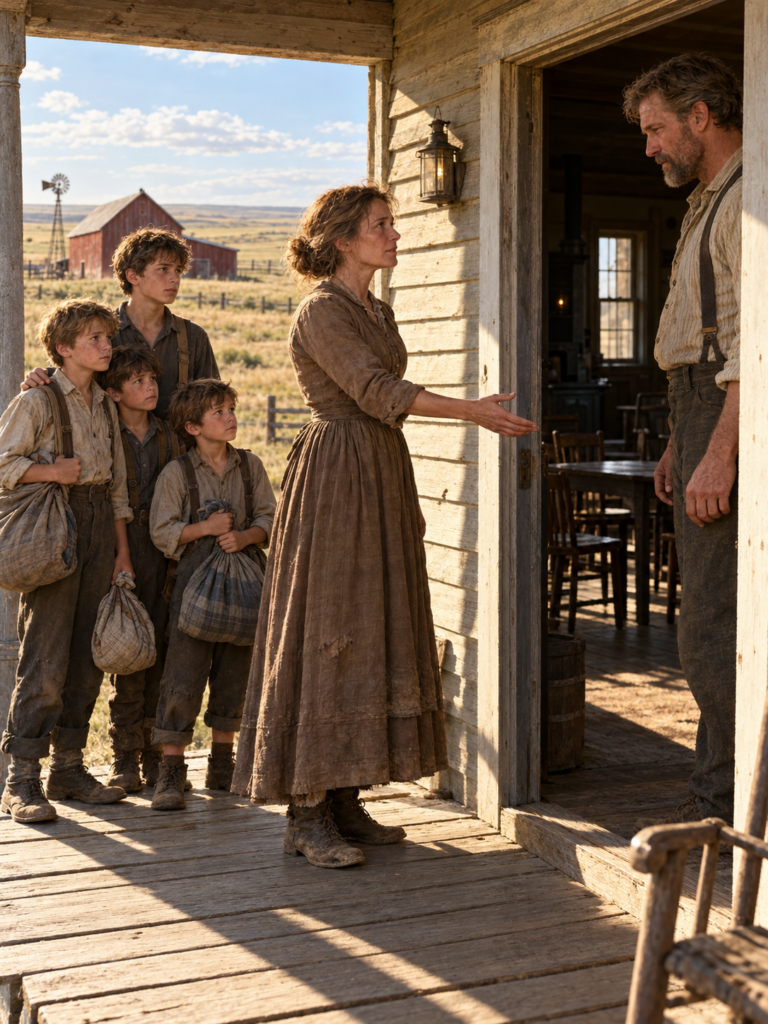
Years earlier, she had stood before that same doorway with four frightened children and no certainty about tomorrow.
Now she crossed its threshold as a woman who had helped build the life waiting inside.
The kitchen was warm.
The table was set.
The boys were gathering.
And as Jonathan pulled out Evelyn’s chair, she paused to look at the five faces around her.
They had all lost something that could never be returned.
William would never walk through the door.
Margaret and her little girl would never sit at the table.
Those absences remained part of their lives.
But grief had not been the end of their story.
The family had learned to carry it together.
Evelyn sat.
Jonathan took his place beside her.
Six chairs stood around the table.
All six were filled.
And when they bowed their heads before supper, Evelyn remembered the day she had arrived with nothing but her four boys and the determination to keep them safe.
She had asked for a chance to work.
Jonathan had offered one.
Neither had understood that the most important thing they would build together was not a profitable farm, a repaired fence, or a comfortable house.
It was a home where no one had to prove they deserved to belong.
A home where the people they had lost could still be remembered.
A home where love was given freely and promises were supported by the work of every passing day.
And once, long ago, it had all begun with an exhausted widow standing at a lonely farmer’s door, finding the courage to say she had nowhere left to go.
The farmer had opened that door believing his own life had little left to offer.
Yet the answer he gave her had carried more truth than either understood.
He needed help caring for his land.
She needed a place where her family could begin again.
What neither knew then was that, together, they were capable of giving one another something far greater.
Not a life without hardship.
Not a future without loss.
But a family willing to remain, work, remember, and love.
And in the house that had once been unbearably silent, there was no longer a single empty place at supper.