
Part 1
The first thing Ethan Miller heard was laughter.
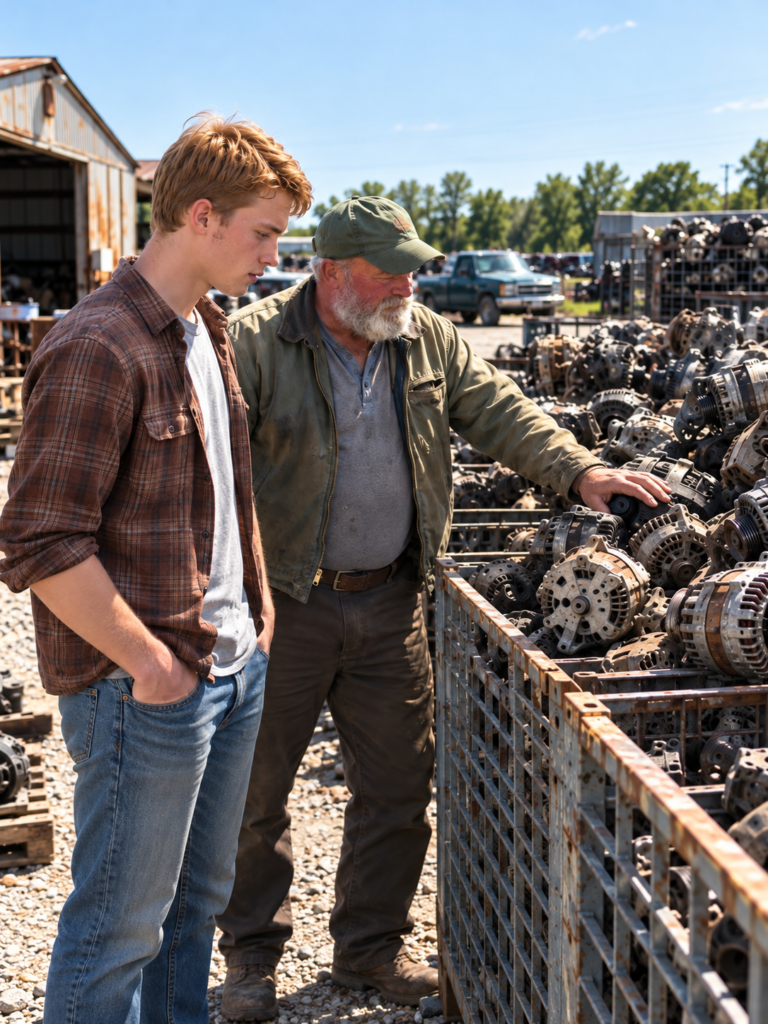
It came from three grown men standing behind a farm equipment salvage yard in western Iowa, where the October wind blew through the rusted skeletons of old tractors and rattled the loose tin on the workshop roof.
Ethan stood beside his father’s faded blue pickup truck, holding four twenty-dollar bills.
He was seventeen years old.
And he was about to spend nearly every dollar he had on eight hundred broken alternators.
Ray Dawson, the salvage yard owner, looked at the money, then at the enormous pile of greasy metal stacked against the back wall.
“Son,” Ray said, scratching his gray beard, “you do understand these things are junk, don’t you?”
Ethan nodded.
“Yes, sir.”
“Some of ’em have been sitting out here ten years. Half probably wouldn’t charge a flashlight. The rest might be good for nothing but melting down.”
“I understand.”
A mechanic named Carl Jensen stepped out of the shop, wiping his hands on a stained red rag.
“What’s going on?”
Ray pointed toward Ethan.
“This boy just offered me eighty dollars for every dead alternator behind the building.”
Carl stared.
Then he laughed so hard he had to lean against a tractor tire.
“Eight hundred of them?”
“That’s right,” Ethan answered.
“Kid, you ain’t buying a business. You’re buying eight hundred headaches.”
Another mechanic shook his head.
“I wouldn’t haul that mess home if Ray paid me eighty dollars.”
The men laughed again.
Ethan looked at the pile.
There were cracked aluminum housings, rust-covered pulleys, broken mounting brackets, damaged wiring terminals, and machines so thickly coated with old grease that their original paint had disappeared.
But Ethan wasn’t looking at the dirt.
He was looking at the metal beneath it.
He was looking at part numbers.
Mounting patterns.
Copper windings.
And possibilities.
Ray held out his hand.
“Last chance, son.”
Ethan placed the money in his palm.
“I’ll take them.”
What none of those men knew was that Ethan wasn’t buying those alternators because he thought he was smarter than everyone else.
He was buying them because of something his father had told him years earlier.
Something that had become more important as their family farm slipped closer to being lost.
And something that would eventually lead Ethan to a discovery hidden among eight hundred pieces of discarded metal.
A discovery that would bring an old farmer to tears.
But on that cold Saturday morning, all Ethan knew was that he had just spent his savings on a mountain of machinery that nobody wanted.
And there was no turning back.
The Miller family lived six miles outside the little town of Ash Creek, Iowa, where the roads ran straight between harvested cornfields and grain elevators rose above the horizon like enormous gray monuments.
Their farmhouse had once been painted bright white.
Now the paint peeled around the porch columns, and the steps sagged slightly under the weight of anyone who walked across them.
The house wasn’t beautiful anymore.
But it was home.
Ethan’s father, Daniel Miller, had spent thirty-two years repairing agricultural machinery.
He knew the sound of a failing bearing before most mechanics could identify the machine it came from.
He could rebuild a starter motor, repair a tractor transmission, or diagnose an electrical fault with an old multimeter and more patience than most people possessed.
And he had taught his son everything he knew.
When Ethan was fourteen, Daniel had given him a battered red toolbox.
The paint was chipped.
One drawer stuck halfway open.
The socket set was incomplete.
But Ethan had treated it like a Christmas present.
Daniel had placed the toolbox on the kitchen table and said, “There’s something you need to understand about broken things.”
Ethan had looked up.
“What?”
“Most people look at something that doesn’t work and decide it has no value.”
Daniel opened the drawer, revealing a scattered collection of wrenches.
“But a good mechanic asks a different question.”
“Which is?”
“What’s actually wrong with it?”
Ethan had remembered those words.
He remembered them when he found an abandoned lawn mower beside a county road and got it running with a cleaned carburetor.
He remembered them when he bought six discarded starter motors for five dollars and repaired two.
And he remembered them when his father came home one evening with an envelope from the bank.
That envelope changed everything.
Daniel had inherited forty-three acres from his own father.
It wasn’t enough land to make the family wealthy, but it had helped them survive.
For years, they rented most of it to a neighboring farmer while Daniel worked full-time at an agricultural repair shop.
Then medical bills came.
Ethan’s mother, Margaret, had undergone surgery two winters earlier.
Although she recovered, the costs had drained their savings.
A poor harvest reduced the farm’s rental income.
Daniel’s hours at the shop were cut.
And by September, the bank was warning them about overdue payments.
Ethan had discovered the problem accidentally.
He’d come downstairs one night to get a glass of water and found his parents sitting at the kitchen table.
His mother was crying quietly.
His father had a stack of papers spread before him.
“How much time?” Margaret whispered.
Daniel rubbed his forehead.
“Until the end of winter, maybe. If I can’t catch up.”
“And then?”
Daniel didn’t answer.
He didn’t have to.
Ethan stood in the dark hallway, listening.
For the first time in his life, he understood that the farmhouse, the barn, the workshop, and the little stretch of ground where his grandfather had taught him to drive a tractor might not belong to them much longer.
The next morning, Ethan began looking for ways to earn more money.
Not pocket money.
Not spending money.
Real money.
He repaired lawn mowers after school.
Cleaned salvaged machinery.
Sold used tractor brackets to farmers.
He learned how to photograph parts, identify their numbers, and list them online.
Some weeks he earned twenty dollars.
Others, fifty.
Once, he made nearly two hundred dollars selling refurbished starter motors.
But it wasn’t enough to help the family substantially.
Then he heard that Ray Dawson wanted to clear a large pile of old alternators from his salvage yard.
Ethan went to look.
And saw what everyone else had ignored.
Getting eight hundred alternators home proved harder than buying them.
Some were small automotive units.
Others came from older tractors, combines, trucks, irrigation engines, and farm equipment that hadn’t been manufactured in decades.
Even with the heavy-duty pickup, Ethan couldn’t safely transport everything in one load.
Ray allowed him to make several trips.
By late afternoon, the garage at the Miller farm was crowded with crates and metal parts.
The concrete floor disappeared beneath greasy alternators.
Ethan’s mother came outside carrying a basket of laundry.
She stopped in the driveway.
“Ethan?”
“Hey, Mom.”
She stared at the truck.
“What’s all that?”
“Alternators.”
“How many?”
Ethan hesitated.
“Eight hundred.”
Margaret lowered the basket.
“Eight hundred?”
“Yes, ma’am.”
She looked at him for several seconds.
“Please tell me somebody paid you to haul those away.”
“No, ma’am.”
Her expression changed.
“Ethan, how much?”
“Eighty dollars.”
She closed her eyes.
“Ethan Miller.”
“I know how it sounds.”
“Do you?”
He stepped closer.
“Mom, I think I can make something out of them.”
Margaret looked toward the old garage.
Then toward the farmhouse where the bank notices were sitting in a drawer beside the refrigerator.
She sighed.
“Honey, I know you’re trying to help.”
Ethan said nothing.
“But we can’t afford to lose money right now.”
“I know.”
Her voice softened.
“I just don’t want you carrying problems that belong to your father and me.”
Ethan looked down.
For a moment, the courage he’d felt at the salvage yard began to fade.
Then the back door opened.
Daniel stepped onto the porch.
“What’s going on out here?”
Margaret pointed at the mountain of metal.
“Your son bought a junkyard.”
Daniel walked toward the truck.
He lifted one alternator.
Turned the pulley.
Checked the mounting holes.
Looked through the vents.
Then he inspected another.
And another.
Finally, he turned toward Ethan.
“You paid eighty dollars?”
“Yes, sir.”
“For all of them?”
“Every one.”
Daniel rubbed his chin.
Then, unexpectedly, he smiled.
“Well, son. At ten cents apiece, you don’t have to rescue very many to get your money back.”
Margaret stared at him.
“Daniel, don’t encourage him.”
Daniel laughed quietly.
“I’m not encouraging him. I’m telling him to get organized.”
He set the alternator down.
“Because if you’re going to do this, Ethan, you’re going to do it right.”
That evening, father and son cleared the old garage.
They moved boxes of Christmas decorations into the attic.
Stacked firewood against the outside wall.
And pushed Daniel’s unused woodworking bench toward the window.
Together, they built three long sorting tables.
On one, Ethan painted the words:
COMPLETE UNITS.
On the second:
REBUILDABLE CORES.
On the third:
PARTS AND SCRAP.
By midnight, the garage smelled of sawdust, penetrating oil, and old machinery.
Daniel stood beside his son, surveying the work.
“You understand this might take months?”
Ethan nodded.
“And you might discover half of them aren’t worth fixing.”
“I know.”
Daniel rested one rough hand on his shoulder.
“Then remember something.”
Ethan looked up.
“Don’t let what you hope they’re worth interfere with what they’re actually worth.”
Ethan nodded again.
At the time, he thought his father was talking about alternators.
He would later realize that Daniel had been talking about something much larger.
Part 2
By the end of the first week, Ethan’s hands were covered with tiny cuts.
Grease stained the creases of his fingers.
His shoulders hurt from lifting heavy units onto the workbench.
And the garage looked worse than when he started.
Every alternator seemed to reveal another problem.
A cracked case.
A seized bearing.
A ruined regulator.
A damaged rotor.
A mounting ear broken clean off.
Some units were so badly corroded that Ethan couldn’t remove the bolts without snapping them.
He began keeping a notebook.
Each alternator received a number.
He recorded visible damage, identification markings, electrical test results, and possible applications.
At first, the notebook felt like progress.
Then the numbers began troubling him.
Eight hundred alternators.
Forty-three promising units after seven days.
And only a handful that appeared capable of working without significant repairs.
He began wondering whether Carl had been right.
One afternoon, his best friend Noah Bennett stopped by.
Noah stood in the garage doorway, looking at the tables.
“Good grief.”
Ethan didn’t look up.
“What’s wrong?”
“Dude, it smells like somebody buried an auto parts store and dug it up again.”
Ethan smiled weakly.
Noah walked between the tables.
“How many have you fixed?”
“Fixed or identified?”
“Fixed.”
“Seven might be usable.”
Noah stared.
“Seven?”
“That’s after the first round of cleaning and inspection.”
“Out of eight hundred?”
“Yeah.”
Noah let out a low whistle.
“Man, you could’ve bought a decent used phone with eighty dollars.”
Ethan continued scrubbing corrosion from an aluminum housing.
“Maybe.”
“Or taken a girl to dinner.”
“Probably.”
“Instead, you’re spending your senior year playing with dead tractor parts.”
Ethan put the brush down.
“You finished?”
Noah noticed the change in his voice.
“Hey, I’m just kidding.”
“Everybody’s kidding.”
The garage became quiet.
Noah looked at his friend.
“What’s really going on?”
Ethan hesitated.
He hadn’t told anyone about the bank.
He didn’t want the neighbors whispering that the Millers were losing their farm.
But he’d known Noah since kindergarten.
Finally, he sat on an overturned bucket.
“My parents are having trouble with the mortgage.”
Noah’s smile vanished.
“How bad?”
“Bad enough.”
“Ethan…”
“I thought if I could build something that actually made money, maybe I could help.”
Noah looked around the garage again.
This time, he saw something different.
He saw the notebook.
The organized shelves.
The labeled plastic bags.
The carefully arranged tools.
And his friend sitting beside a table full of broken machinery, trying to shoulder a burden that most seventeen-year-olds wouldn’t even understand.
Noah pulled another bucket over.
“What do you need me to do?”
Ethan looked up.
“What?”
“Well, somebody’s got to clean this junk while you figure out what’s worth selling.”
Ethan laughed.
“You just called it junk.”
“Doesn’t mean I can’t help.”
For the next three hours, they worked together.
And for the first time since buying the pile, Ethan didn’t feel entirely alone.
Autumn settled over Iowa.
Cornfields turned brown.
Frost appeared on pickup windshields.
The wind grew sharper.
And Ethan’s little business began attracting attention.
Not all of it was kind.
At school, a boy named Travis Cole began calling him “Scrapyard Miller.”
Another student asked whether Ethan planned to build a spaceship from old tractor parts.
Ethan tried to ignore them.
But one Friday afternoon, Travis cornered him near the parking lot.
“Hey, Miller. Heard you bought eight hundred broken alternators.”
Ethan kept walking.
“That’s right.”
“What’s the plan? Sell them back to the junkyard for a dollar?”
Several boys laughed.
Ethan stopped.
He turned toward Travis.
“Maybe I’ll fix a few.”
Travis grinned.
“Sure. And maybe I’ll buy a private jet.”
Ethan wanted to answer.
He wanted to tell them about the repairs he’d already completed and the customers he’d contacted.
But he remembered something his father often said.
“Arguments don’t repair machinery.”
So Ethan climbed into the truck and drove home.
He worked until nearly midnight that evening.
Not because he wanted to prove Travis wrong.
Because the electric bill was due.
The first customer arrived on a rainy Tuesday.
His name was Mike Peterson, a tractor mechanic who specialized in equipment from the 1960s and 1970s.
Mike walked into the garage wearing muddy boots and a brown canvas jacket.
“Your dad says you might have an alternator that’ll fit an old Ford tractor.”
Ethan wiped his hands.
“What model?”
Mike explained.
Ethan opened his notebook.
Then he went to a shelf where several cleaned units stood in neat rows.
“I’ve got one that looks like the right mounting arrangement.”
Mike examined it.
“Does it work?”
“Not sure yet.”
Mike frowned.
“Son, I can’t pay for something that might leave a farmer stranded.”
“I wouldn’t ask you to.”
Ethan carried the alternator to his test bench.
He inspected the wiring and connections, checked the mechanical condition, and mounted it to the testing setup Daniel had helped him assemble.
The first reading looked uncertain.
Ethan adjusted the test conditions and checked the connections.
Then he ran the test again.
The output rose into the expected range.
The bearing was quiet.
The pulley ran smoothly.
Mike leaned closer.
“Well, I’ll be.”
Ethan shut down the test.
“I’d still want you to verify the fitment.”
Mike nodded.
“Fair enough.”
He turned the alternator in his hands.
“How much?”
Ethan swallowed.
“Seventy-five dollars.”
Mike looked at him.
“Seventy-five?”
“Yes, sir.”
Mike considered the price.
Then he nodded.
“If it fits and performs like that on the tractor, you’ve got yourself a sale.”
They agreed on the terms, and Mike handed over the money.
When the mechanic left, Ethan stood in the garage holding three twenty-dollar bills, a ten, and a five.
Seventy-five dollars.
From one alternator.
A single piece of the enormous pile that had cost him eighty.
He hurried into the house.
His mother was standing at the kitchen sink.
“Mom.”
She turned.
“What’s wrong?”
“Nothing.”
He placed the money on the counter.
She stared at it.
“Where’d that come from?”
“One of the alternators.”
She looked at him.
“One?”
“One.”
Margaret picked up the bills.
Then she looked toward the garage.
Her eyes filled with tears.
“Oh, Ethan.”
He smiled.
“I told you there might be something out there.”
She pulled him into a hug.
For a moment, he felt like a little boy again.
Then she stepped back and pressed the money into his hand.
“Put this toward your business.”
“Mom—”
“Listen to me. If this is going to work, you’ve got to keep enough money to buy the parts you need.”
He started to protest.
But she shook her head.
“Your father and I will handle the house. You handle what you’re building.”
Ethan looked at the money.
He knew the family needed it.
And he knew she did too.
That was the hardest part.
Because sometimes loving someone meant accepting that you couldn’t solve all their problems at once.
The next month brought progress.
Ethan identified seventy-nine units worth further testing.
Several were suitable for rebuilding.
Others contained useful components.
A few belonged to older tractor models with replacement parts that were increasingly difficult to find.
That last discovery caught his attention.
Modern automotive alternators were everywhere.
But an alternator with an uncommon housing, specific mounting arrangement, or original identification plate could be far harder to replace.
The value wasn’t necessarily in the metal.
It was in the match.
One evening, Daniel came into the garage carrying two mugs of coffee.
He gave one to Ethan.
“How’s the empire?”
Ethan smiled.
“About as big as this garage.”
Daniel looked at the shelves.
“Getting organized.”
“I’m trying.”
He handed his father the notebook.
Daniel read several pages.
Then stopped.
“You’ve got all the part numbers recorded?”
“Whatever I can still read.”
“And customer applications?”
“Those too.”
Daniel raised his eyebrows.
“You’re learning.”
Ethan took a sip of coffee.
“Dad?”
“Yeah?”
“Do you think I can actually make something out of this?”
Daniel looked at the rows of machinery.
He could have offered easy encouragement.
He could have promised that everything would work out.
Instead, he chose the truth.
“I think you can build a business if you understand what customers need and don’t promise what you can’t deliver.”
Ethan nodded.
Daniel continued.
“But don’t tie your whole future to one pile of scrap.”
“I won’t.”
“And son?”
“Yeah?”
“Don’t forget you’re still seventeen.”
Ethan frowned.
“What does that mean?”
“It means you’re allowed to have a life outside this garage.”
Ethan looked toward the farmhouse.
Then back at his father.
“I know.”
But they both understood that Ethan didn’t entirely believe it.
Because the bank’s final warning had arrived that morning.
And neither of them knew whether the family would still be living on Miller land by spring.
Part 3
The first snow came early.
By mid-November, the fields lay beneath a thin white covering, and the wind found every crack in the old garage walls.
Ethan hung heavy blankets over the worst gaps and borrowed a small workshop heater from a neighbor.
It wasn’t much.
On some mornings, his fingers were so stiff that he had trouble turning small screws.
But he kept working.
Before school, he checked online inquiries.
After classes, he cleaned parts.
In the evenings, he tested units, researched interchange references, and packaged orders.
Noah helped whenever he could.
Daniel inspected difficult repairs.
Margaret kept a little ledger of the money coming in and going out.
Slowly, the garage became something more than a place to store machinery.
It became a family effort.
And then Walter Brooks called.
Walter was sixty-eight years old and owned a small agricultural repair shop two counties away.
He specialized in tractors that younger mechanics often refused to touch.
Ethan answered the phone after dinner.
“Hello?”
“Am I speaking to the Miller boy who’s been buying old alternator cores?”
“Yes, sir.”
“This is Walter Brooks. Your father gave me your number.”
“How can I help you?”
“I’m looking for some older agricultural units. A dozen, maybe more, depending on what you’ve got.”
Ethan nearly dropped the phone.
“Twelve?”
Walter chuckled.
“Don’t get excited yet, son. I need the right ones.”
The following Saturday, Walter arrived in a battered green truck.
He walked through the garage slowly, studying the shelves.
Ethan watched him pick up one alternator after another.
Walter examined castings.
Mounting ears.
Shafts.
Identification plates.
Then he stopped at a dusty unit near the back of the second shelf.
“Where’d you get this?”
“Part of a salvage lot.”
Walter turned it over.
“Do you know what it fits?”
Ethan checked his notebook.
“I found a possible match in an old agricultural reference book.”
Walter nodded.
“Good. Most people wouldn’t bother looking.”
He placed it on the bench.
Then he selected three more.
For nearly an hour, the two examined parts together.
Walter explained which older tractors were difficult to maintain, which original assemblies had become scarce, and why farmers sometimes preferred repairing a familiar machine rather than replacing it with one they couldn’t afford.
Ethan listened carefully.
When they finished, Walter set four alternators aside.
“I can use these.”
Ethan opened his mouth.
“How much would you be willing—”
“Four hundred and twenty dollars for the lot.”
Ethan stared.
“Four hundred and twenty?”
Walter smiled.
“That’s what I said.”
“Are you sure?”
Walter gave him a sharp look.
“Son, don’t talk a customer out of buying something he needs.”
Ethan flushed.
“Sorry, sir.”
They completed the sale with a written receipt and a clear description of the units’ conditions.
Walter counted out the money.
Ethan placed it carefully in the cash box.
As the older mechanic prepared to leave, he stopped at the door.
“Can I give you some advice?”
“Yes, sir.”
“Don’t fall in love with the idea that everything old is valuable.”
Ethan nodded.
“Some things are just scrap,” Walter continued. “What makes you useful is knowing the difference.”
He pointed toward the notebook.
“And knowing exactly what you’ve got.”
After Walter drove away, Ethan sat on his stool for a long time.
Four hundred and twenty dollars.
From four units.
For the first time, he began to understand that the real opportunity wasn’t simply repairing equipment.
It was solving problems.
Problems that other people had decided weren’t worth the trouble.
Three weeks later, an old farmer named Harold Whitcomb arrived at the Miller place.
He drove a dusty Chevrolet pickup with a cracked dashboard and an American flag decal fading on the rear window.
Harold was seventy-six.
He moved slowly, favoring his right knee.
His hands were broad, with swollen knuckles and scars that spoke of decades spent working outdoors.
He carried a worn alternator wrapped in an old feed sack.
“Are you Ethan?”
“Yes, sir.”
“Your father said you might be able to help me.”
Ethan held the door open.
“What have you got?”
Harold placed the alternator on the table.
Ethan carefully unwrapped it.
The housing was weathered.
The pulley showed rust.
The terminal connections needed attention.
But the assembly was largely complete.
“What did it come off?” Ethan asked.
Harold looked through the garage window.
“An old tractor.”
“What kind?”
Harold told him.
Ethan nodded.
“Doesn’t sound too unusual.”
Harold rubbed his palms together.
“It was my daddy’s.”
Something in his voice made Ethan stop.
Harold looked down at the alternator.
“My father bought that tractor back when I was a young man. Used it on our place for nearly forty years.”
Ethan said nothing.
“He plowed with it. Pulled wagons. Hauled hay. Taught my brother and me how to work the fields.”
Harold smiled faintly.
“Had a stubborn clutch. Daddy always said you had to ask her nicely.”
Then his smile disappeared.
“My father passed on a good while back.”
“I’m sorry, sir.”
Harold nodded.
“My wife passed six years ago. My brother moved south. My boys got families of their own.”
He ran one finger along the edge of the old alternator.
“That tractor’s been sitting in the shed nearly ten years.”
Ethan looked at him.
“Are you restoring it?”
“Trying.”
“Planning to sell it?”
Harold shook his head.
“No.”
“Then what are you hoping to do with it?”
The older man swallowed.
“There’s a little field behind my house. About four acres. My daddy planted corn there every spring.”
He paused.
“I thought maybe, before I’m too old to climb onto that tractor again, I could put in one more crop.”
The garage became very quiet.
Outside, snow began drifting past the window.
Harold continued.
“I don’t want anything fancy. Don’t care if the paint’s faded or the seat’s torn. I just want to hear that engine running and see the old thing move across the field.”
Ethan looked down at the alternator.
“Have you tried replacing it?”
“Been looking. Everything I find is either wrong or costs more than I can justify.”
He sighed.
“I thought maybe somebody could repair this one.”
Ethan examined the assembly.
There were no obvious signs that it was beyond repair.
But he knew better than to promise success.
“I can take a look.”
Harold’s eyes brightened.
“You think there’s a chance?”
“Yes, sir. I think there’s a chance.”
“What do I owe you?”
“Let me figure out what’s wrong first.”
Harold reached into his coat.
Ethan shook his head.
“No need to pay anything today.”
The old farmer hesitated.
“Son, I don’t expect charity.”
“I know.”
“Then why—”
Ethan looked at the old alternator.
“Because I want to see if I can get it working.”
Harold studied him for a moment.
Then he nodded.
“Fair enough.”
He extended his hand.
Ethan shook it.
And neither of them knew that this small repair would change the way the boy understood his business.
The alternator was more troublesome than Ethan expected.
He cleaned the housing.
Inspected the rotor and stator.
Replaced worn components.
Checked the regulator.
Repaired a damaged electrical connection.
Then he tested it.
The output was wrong.
He checked his wiring.
Ran another test.
Still wrong.
By the second evening, frustration was beginning to overwhelm him.
He sat on the garage floor, staring at the workbench.
Daniel came in carrying an armful of firewood.
“Problem?”
Ethan nodded.
“I thought I had it.”
Daniel placed the wood beside the heater.
“What happened?”
“Output’s still wrong.”
“Checked the regulator?”
“Twice.”
“Connections?”
“Three times.”
Daniel sat beside him.
For several moments, neither spoke.
Then Daniel said, “Tell me why this one matters.”
Ethan looked up.
“What?”
“You’ve had difficult repairs before. Why are you taking this one so hard?”
Ethan stared at the old alternator.
“Because it belongs to his dad.”
Daniel nodded.
“And?”
“Because the old man’s been trying to get his tractor running for years.”
Daniel waited.
“And because…” Ethan’s voice softened. “Because I think he misses the way things used to be.”
Daniel looked at his son.
For a moment, he saw the little boy who had once followed him through the workshop carrying an oversized wrench.
Then he smiled.
“Well, son. Missing somebody doesn’t fix an electrical problem.”
Ethan laughed weakly.
“No, sir.”
“But it might give you a good reason to find the problem.”
They returned to the bench.
Together, they traced the circuit again, this time without assuming that any previous check had been conclusive.
Near midnight, Ethan found an overlooked fault in a connection.
He corrected it.
Then set up another test.
The machine hummed.
The pulley turned.
The meter responded.
And this time, the output stabilized where it should.
Ethan stared at the reading.
Daniel leaned closer.
“Well?”
Ethan grinned.
“It’s charging.”
Daniel smiled.
“Then you’d better call Harold.”
The old tractor had been sitting beneath a dusty canvas sheet in Harold’s machine shed.
When Ethan and Daniel arrived, Harold was waiting beside it.
He had swept the dirt floor.
Opened the big sliding doors.
And pulled the canvas away.
The tractor’s paint was faded almost to gray.
Its rear tires were weathered.
The seat had several cracks.
But beneath the dust, there was something unmistakably dignified about it.
A machine that had spent decades earning its place on the farm.
Ethan installed the repaired alternator while Daniel checked several other systems that needed attention.
They made sure the tractor was safe enough for a controlled test.
Harold stood nearby, watching.
After the preparations were complete, Daniel climbed onto the tractor.
He checked the controls.
Then started the engine.
It coughed.
Turned.
Caught.
And settled into a rough, steady rumble.
Harold took one step backward.
For several seconds, he didn’t move.
The sound filled the shed.
It echoed against the rafters.
It rolled out through the open doors into the cold December air.
And the old farmer began to cry.
Ethan had never seen a grown man of Harold’s age cry like that.
Not loudly.
Not dramatically.
Just tears moving down weathered cheeks as he stared at the machine.
“My daddy…” Harold whispered.
He stopped.
Wiped his face.
Then tried again.
“My daddy used to start her every morning before sunrise.”
Daniel shut down the engine.
Silence returned.
Harold stepped forward and placed one hand against the tractor’s hood.
For a long time, he stood there without speaking.
Finally, he looked at Ethan.
“Son, I don’t think you understand what you’ve given me.”
Ethan swallowed.
“I just fixed the alternator, sir.”
Harold shook his head.
“No.”
He looked at the tractor again.
“You gave me back a sound I thought I’d never hear.”
And in that moment, standing in a cold machine shed beside an old farmer who had lost almost everyone he loved, Ethan understood something he’d never learned from a repair manual.
A machine could be made of metal.
But the reason somebody wanted it working could be made of memories.
Part 4
By January, Ethan’s business was bringing in money more consistently.
Not enough to make the family wealthy.
Not enough to solve every problem.
But enough that his mother began leaving a light on in the garage when he was working late, and his father sometimes came home from the repair shop with customers’ phone numbers written on scraps of paper.
Word spread slowly through the farming community.
A retired mechanic needed a particular bracket.
A restoration enthusiast needed an original housing.
A small tractor shop wanted several rebuildable cores.
Ethan learned that the most important skill wasn’t making a broken alternator look new.
It was being accurate.
When he didn’t know whether something worked, he said so.
When a customer needed a part he didn’t have, he didn’t invent a substitute.
When a repair cost more than replacing the unit, he told the owner.
Those decisions occasionally cost him a sale.
But they brought customers back.
Walter Brooks became one of his strongest supporters.
Mike Peterson recommended him to other mechanics.
Even Ray Dawson began setting aside unusual electrical components instead of throwing everything into the scrap bins.
Still, the family had a problem that hard work alone hadn’t solved.
The mortgage.
One cold evening, Ethan came into the kitchen and found his father sitting beside the stove.
An open letter rested on the table.
Daniel looked older than he had just a few months earlier.
Ethan stopped.
“Bad news?”
Daniel folded the paper.
“The bank wants us to come in.”
“When?”
“Thursday.”
Ethan sat down.
“How far behind are we?”
His father hesitated.
“Dad, please.”
Daniel looked toward the window.
“Far enough that we’re going to have to make some decisions.”
Ethan felt his stomach tighten.
“I’ve got some money saved.”
“I know.”
“I can put it toward the payments.”
Daniel shook his head.
“You’re not using everything you’ve earned to cover a debt your mother and I took on.”
“But it’s our home.”
“I know what it is.”
“Then let me help.”
Daniel looked at him.
“Ethan, listen.”
His voice wasn’t angry.
It was tired.
“There’s a difference between helping your family and trying to save everybody all by yourself.”
Ethan stared at the table.
Daniel reached across and placed one hand over his son’s.
“You’re doing something good out there. Something real. Don’t destroy it because you’re scared.”
Ethan swallowed.
“What if we lose the farm?”
Daniel didn’t answer immediately.
The kitchen clock ticked above the refrigerator.
Finally, he said, “Then we’ll still be a family.”
Ethan looked up.
“And we’ll figure out the rest together.”
Those words should have comforted him.
Instead, they made him more determined.
Because he could hear the fear Daniel was trying to hide.
The following morning, Ethan returned to the last unsorted section of alternators.
There were still dozens stacked in battered wooden crates behind the garage.
Many were so badly damaged that he’d postponed examining them.
One crate contained several units that appeared almost beyond recognition.
Rust had eaten through parts of their casings.
Identification tags had disappeared.
Two had broken mounting ears.
Ethan began sorting them one by one.
He was halfway through the crate when he noticed an unusual mounting bracket.
It belonged to a dirty alternator buried beneath three others.
At first glance, it looked ordinary.
The pulley was rust-covered.
The housing was streaked with old oil.
One terminal had broken off.
But the bracket wasn’t like those on most of the units he’d handled.
It had a distinctive shape.
Ethan picked it up.
Turned it over.
Then carried it to the workbench.
He wiped the housing with a rag.
A faint identification plate emerged beneath the grime.
Most of the lettering was unreadable.
But part of the number remained.
Ethan copied it into his notebook.
Then searched through an old agricultural parts manual.
Nothing.
He tried another reference.
Still nothing.
After nearly an hour, he found a similar illustration in a book his father had brought home from the repair shop years earlier.
Ethan leaned closer.
The mounting arrangement matched.
The housing shape matched.
The shaft configuration appeared correct.
And the incomplete identification number was consistent with an obsolete agricultural application.
He sat back.
“Well, I’ll be.”
He went online and searched for restoration discussions about the equipment.
After comparing references, he found a message from a small restoration shop in Nebraska.
The shop had been searching for an alternator of that particular type for nearly a year.
Ethan read the message twice.
Then called the number listed on the shop’s website.
A man answered.
“Prairie Heritage Restoration.”
“Hello, sir. My name’s Ethan Miller. I’m calling from Iowa.”
“What can I do for you?”
“I think I might have an alternator you’re looking for.”
The man paused.
“What alternator?”
Ethan described it.
There was silence.
Then the man said, “Where did you find that?”
“In a salvage lot.”
“Is the identification plate still there?”
“Part of it.”
“Can you send pictures?”
“Yes, sir.”
“Send everything you’ve got. The mounting bracket, housing, rear connections, all of it.”
Ethan took photographs.
Sent them.
Then waited.
Twenty minutes later, the phone rang.
“Ethan?”
“Yes, sir.”
“This is Martin from Prairie Heritage.”
“Hello.”
“Those pictures are interesting.”
Ethan gripped the phone.
“Do you think it’s the right one?”
“I think it’s very possible.”
“Really?”
“But we’re going to need to verify the details.”
“Of course.”
Martin paused.
“Son, do you understand why we’re interested?”
Ethan hesitated.
“Because it’s hard to find?”
“Because we’re trying to restore a machine for a family that’s spent years searching for the correct components.”
Ethan glanced toward the alternator.
Martin continued.
“There aren’t many usable originals left. A modern replacement could sometimes be adapted, but the owners want the restoration as close to authentic as possible.”
Ethan looked at the damaged housing.
It seemed almost ridiculous.
Something everyone at the salvage yard had dismissed could help preserve a rare piece of agricultural history.
“What’s it worth?” Ethan asked.
Martin didn’t answer immediately.
“That depends on whether the essential components are usable.”
Ethan nodded, although the man couldn’t see him.
“I understand.”
“If you can confirm it’s rebuildable and the identification checks out, we may be able to make you an offer.”
After the call, Ethan sat motionless for several minutes.
Then he picked up the alternator again.
He knew better than to assume it was valuable simply because somebody wanted it.
But he also knew something else.
He’d almost thrown it into the scrap bin.
Over the next several evenings, Ethan carefully inspected the unit.
The bearings were rough.
The regulator needed attention.
Several electrical components required testing.
The housing was dirty but intact.
The mounting bracket was sound.
And the original internal arrangement was largely preserved.
He documented everything.
Then he called Martin.
“I think it’s rebuildable.”
“Good.”
“I’ve got photographs of the internal components.”
“Send them.”
Martin examined the information and discussed it with the restoration shop’s lead mechanic.
The next day, he made an offer.
Three hundred and fifty dollars for the rebuilt unit, subject to final verification.
Ethan read the message several times.
Three hundred and fifty dollars.
For an alternator that had cost him approximately ten cents as part of the original lot.
He accepted the offer.
But he didn’t celebrate immediately.
He knew that the unit still needed to meet the agreed requirements.
And the repair would take careful work.
For several nights, he worked beside his father, testing components and documenting the rebuild.
When the job was finished, they performed another controlled test.
The results were good.
The restoration shop reviewed the documentation, confirmed the arrangement, and completed the purchase.
Ethan packed the alternator carefully.
He included the test results and identifying information.
Then he drove to the shipping counter.
As the box disappeared behind the counter, he thought about the men laughing at him behind Ray Dawson’s shop.
He imagined Carl asking whether he still thought he had bought eight hundred opportunities.
Ethan smiled.
Then he went home.
Because the most important decision of his young life was still waiting.
On Thursday morning, Ethan accompanied his parents to the bank.
The branch manager, a woman named Susan Hartley, greeted them in a small office with beige walls and a framed photograph of the town’s original courthouse.
Daniel placed their financial statements on the desk.
Margaret sat beside him, holding her purse with both hands.
Susan reviewed the documents carefully.
The situation wasn’t hopeless.
But it was serious.
The family needed a workable plan to address the overdue balance and demonstrate that future payments would be manageable.
Ethan listened as his father explained his employment situation.
Then his mother spoke about their reduced expenses and the steps they’d already taken.
Finally, Ethan opened his own folder.
“I’ve been running a parts business,” he said.
Susan looked up.
“A parts business?”
“Yes, ma’am. Mostly used and rebuilt agricultural electrical components.”
He placed his records on the desk.
Sales.
Expenses.
Inventory.
Invoices.
And a simple breakdown of the money the business had earned.
Susan studied the papers.
“How old are you, Ethan?”
“Seventeen.”
She looked toward Daniel.
Then back at Ethan.
“And you’ve been keeping all these records yourself?”
“Yes, ma’am. My mom helps me check the numbers.”
Margaret smiled faintly.
Susan turned another page.
“This is impressive.”
Ethan felt his face grow warm.
“Thank you.”
“But I want to be clear,” she continued. “Revenue from a small new business can be irregular. We need to look at actual income, expenses, and what the household can reliably afford.”
Ethan nodded.
“I understand.”
The discussion continued.
Nobody promised an easy solution.
Nobody erased the debt.
But the Millers left the office with a path forward: a proposed repayment arrangement, subject to the bank’s review and approval, supported by Daniel’s income, changes in household spending, and a carefully limited contribution from Ethan’s profits.
Outside, Margaret stopped beside the pickup.
She looked at her son.
“You didn’t have to come in there.”
Ethan shrugged.
“I wanted to.”
Daniel put one hand on his shoulder.
“You did well.”
Ethan looked toward the bank.
“Do you think they’ll approve it?”
Daniel took a breath.
“I don’t know yet.”
It wasn’t the answer Ethan wanted.
But for the first time in months, the family had a realistic plan rather than only fear.
And sometimes, that was where hope began.
Part 5
Six months after he first drove into Ray Dawson’s salvage yard, Ethan Miller finished processing the last of the eight hundred alternators.
It was a bright spring morning.
The snow had melted.
The fields were beginning to green.
And the old garage looked nothing like the chaotic mountain of broken machinery that had filled it the previous autumn.
Shelves lined the walls.
Small components sat in labeled drawers.
Rebuildable cores occupied one section.
Tested units sat separately from untested inventory.
A shipping table stood near the door.
And above the workbench hung a hand-painted wooden sign that Noah had made.
MILLER FARM PARTS.
Ethan stood beneath it holding his final inventory sheet.
Eight hundred alternators.
Every one accounted for.
Some had become working units.
Some had been sold as rebuildable cores.
Others had supplied valuable components.
And the rest had gone to appropriate scrap recycling.
Not every purchase had been successful.
Some repairs had cost more than expected.
Several units had turned out to be beyond economical repair.
Ethan had made mistakes.
He’d learned from them.
And slowly, those lessons had become the foundation of a real business.
He opened his financial ledger.
Total sales over six months:
$8,940.
He stared at the number.
It seemed impossible.
He remembered counting out four twenty-dollar bills at the salvage yard.
He remembered Carl laughing.
He remembered his mother standing in the driveway, looking horrified.
He remembered freezing nights in the garage, seized bearings, broken bolts, failed tests, and parts nobody wanted.
Then he turned to the expense pages.
Replacement components.
Cleaning supplies.
Shipping costs.
Tools.
Testing equipment.
Transaction fees.
The original eighty-dollar purchase.
His profit was far smaller than total sales.
But after covering the documented expenses, the business had still earned several thousand dollars.
Enough to reinvest.
Enough to contribute something meaningful to the household.
And enough to make Ethan believe that the garage might someday become a proper repair and parts shop.
He closed the ledger.
Then walked into the farmhouse.
His father was at the kitchen table reading the newspaper.
Margaret was cutting apples beside the sink.
“Well?” Daniel asked.
Ethan placed the ledger on the table.
“Finished.”
Daniel lowered the newspaper.
“All eight hundred?”
“Every last one.”
His father opened the book.
Read the final summary.
Then slowly removed his glasses.
“Well, I’ll be darned.”
Margaret came over.
“What?”
Daniel turned the ledger toward her.
She studied the figures.
Then covered her mouth.
“Ethan…”
He smiled.
“It worked.”
His mother shook her head.
“Look at what you did.”
Ethan glanced toward the window.
The old garage stood beyond the yard.
The place where his father had taught him to hold a wrench.
Where his grandfather had repaired tractors.
Where he had spent countless evenings trying to understand machinery that everyone else had abandoned.
“I had help,” he said.
Daniel nodded.
“Yes, you did.”
Then his father stood and held out his hand.
Ethan looked at it.
“Dad?”
Daniel’s eyes were bright.
“I’m proud of you, son.”
They shook hands.
But Daniel didn’t let go.
He pulled Ethan into an embrace.
And for a few seconds, neither of them spoke.
The bank approved the family’s repayment arrangement later that spring.
The house was not suddenly free of debt.
Daniel still had to work.
Margaret still watched the household budget carefully.
Ethan still had school to finish.
But the immediate threat of losing the farm had eased, and the family had a schedule they believed they could maintain.
They celebrated with a Sunday dinner.
Roast chicken.
Mashed potatoes.
Green beans.
And Margaret’s homemade apple pie.
No expensive restaurant.
No grand announcement.
Just three people around an old kitchen table.
Daniel raised his glass of iced tea.
“To hard work.”
Margaret smiled.
“To family.”
Ethan lifted his glass.
“And to broken alternators.”
They laughed.
For the first time in many months, the laughter felt easy.
A week later, Carl Jensen drove into the Miller yard.
Ethan was working in the garage when the old mechanic stepped through the doorway.
Carl looked around.
“Well, would you look at this.”
Ethan turned.
“Afternoon, Carl.”
Carl walked slowly past the shelves.
He studied the labeled drawers.
The organized inventory.
The clean workbench.
The shipping station.
Then he looked at the wooden sign.
MILLER FARM PARTS.
He chuckled.
“Fancy operation you’ve got here.”
Ethan smiled.
“Still pretty small.”
Carl picked up a rebuilt alternator.
“Tested?”
“Yes, sir.”
“Warranty?”
“Depends on the unit and application. I put the terms on the invoice.”
Carl raised his eyebrows.
“Listen to you.”
He set it down.
For a moment, his expression became serious.
“Ray told me what you did with that old pile.”
Ethan said nothing.
“Eight thousand something in sales?”
“Eight thousand nine hundred and forty.”
Carl whistled.
“Good grief.”
He looked toward the garage door.
Then back at Ethan.
“I remember telling you that you were buying eight hundred problems.”
Ethan grinned.
“I remember.”
Carl rubbed his chin.
“Well, I guess I owe you an apology.”
“No need.”
“Yes, there is.”
Carl extended his hand.
“I was wrong about you.”
Ethan shook it.
“Thank you.”
Carl looked at the shelves again.
“But I’ll tell you something, kid.”
“What’s that?”
“Your business ain’t really about alternators.”
Ethan frowned.
“What do you mean?”
“It’s about knowing what somebody needs when everybody else has quit looking.”
Ethan thought about Walter Brooks.
Mike Peterson.
The rare unit that had gone to Nebraska.
And Harold Whitcomb standing beside his father’s old tractor.
Slowly, he nodded.
“I think you’re right.”
Carl smiled.
“Course I’m right. I’m old.”
They both laughed.
The most important moment came two weeks later.
Harold Whitcomb called on a warm Saturday morning.
“Ethan?”
“Yes, sir?”
“You busy?”
“Not too bad.”
“Well, I was wondering if you and your daddy might come out to the farm.”
“Something wrong with the tractor?”
“No, son.”
Harold paused.
“Just the opposite.”
Ethan heard a smile in the older man’s voice.
“Bring your mother, too, if she’s free.”
An hour later, the Miller family turned onto Harold’s gravel driveway.
The old farmer stood near the barn wearing a clean denim shirt and his battered brown cap.
He waved as they approached.
Ethan climbed out of the truck.
“Morning, Mr. Whitcomb.”
Harold smiled.
“Come on. I want to show you something.”
He led them past the machine shed and along a dirt path toward the back field.
The grass was green.
Birds sang from the fence posts.
A warm breeze carried the smell of freshly turned soil.
When they reached the field, Ethan stopped.
Four acres of earth had been carefully prepared.
Straight rows stretched toward a line of trees.
The old tractor stood beside the gate.
Its faded paint glowed softly in the sunlight.
Harold rested one hand against the hood.
“Planted corn last week.”
Daniel looked across the field.
“Looks good, Harold.”
The old man nodded.
“Wasn’t easy.”
He smiled.
“My knee complained the whole time.”
Margaret laughed softly.
Harold turned toward Ethan.
“But I got it done.”
Ethan looked at the rows.
“That’s wonderful, sir.”
Harold reached into his pocket.
He pulled out a small, folded photograph.
The edges were worn.
The colors had faded.
He handed it to Ethan.
In the picture, a younger Harold stood beside the same tractor.
Next to him was an older man wearing overalls and a wide-brimmed hat.
Both were smiling.
“That’s my daddy,” Harold said.
Ethan studied the photograph.
“He looks like you.”
Harold laughed.
“Poor man.”
Then his expression softened.
“That picture was taken the spring he taught me to plant this field.”
Ethan looked from the photograph to the freshly worked soil.
Harold continued.
“For years after he died, I couldn’t bring myself to get rid of that tractor.”
He swallowed.
“People told me to sell it for scrap.”
He looked toward the machine.
“Said I was foolish keeping something that didn’t run.”
Ethan felt something tighten in his chest.
Harold smiled faintly.
“But I couldn’t do it.”
He turned to Ethan.
“And then your father told me about a boy who thought broken things weren’t always worthless.”
Nobody spoke.
Harold reached out and placed one trembling hand on Ethan’s shoulder.
“Son, I’ve got grandchildren older than you.”
His voice shook.
“And I want you to understand something.”
Ethan nodded.
“When you’re my age, people start acting like everything you’ve done belongs to the past.”
Harold looked toward the field.
“They talk about what you used to be. What you used to know. What you used to be able to do.”
He paused.
“Sometimes you start believing them.”
The breeze moved softly through the grass.
Harold’s eyes filled.
“But when that old tractor started up again, I remembered something.”
He looked at Ethan.
“I’m still here.”
Ethan swallowed.
Harold continued.
“I can still plant a field.”
He took a breath.
“I can still make something grow.”
For a long moment, nobody spoke.
Then Harold squeezed the boy’s shoulder.
“You didn’t just help me repair an old machine.”
His voice broke.
“You helped me remember that my life isn’t finished.”
Ethan blinked hard.
He had spent months measuring the value of alternators in dollars.
Ten cents.
Seventy-five dollars.
Four hundred and twenty.
Three hundred and fifty.
Eight thousand nine hundred and forty.
But standing beside Harold Whitcomb’s newly planted field, he realized that none of those numbers could measure what had happened here.
The tractor was running.
The field was planted.
And an old man who had been quietly surrendering to loneliness had found a reason to wake before sunrise again.
That summer, Ethan graduated from high school.
He wasn’t the richest student in his class.
He didn’t have an expensive car.
And he hadn’t earned enough money to retire his parents or buy a mansion.
But he had something that mattered more to him.
A business built with his own hands.
A reputation earned through honest work.
And the knowledge that his parents’ farmhouse would still be waiting when he came home.
He continued expanding Miller Farm Parts, but he did it carefully.
He inspected inventory before buying it.
He researched part numbers.
He tracked expenses.
He learned from experienced mechanics.
And when customers brought in equipment that wasn’t worth repairing, he told them the truth.
He also learned to put his tools down sometimes.
To eat dinner with his parents.
To visit friends.
To enjoy being young.
Because his father had been right.
A person could work hard without carrying the entire world alone.
One evening, Ethan found Daniel sitting on the back porch.
The sun was sinking behind the cornfields.
Crickets chirped near the fence.
The old garage stood with its doors open, warm light spilling across the driveway.
Daniel looked toward the building.
“Remember the day you brought all that junk home?”
Ethan laughed.
“Mom almost fainted.”
“She came pretty close.”
They sat quietly for a while.
Then Daniel said, “Can I tell you something?”
“Sure.”
“I was scared that day.”
Ethan turned.
“Of the alternators?”
Daniel shook his head.
“No. Of what you were trying to do.”
Ethan waited.
“I knew you’d heard us talking about the mortgage. I knew you were trying to help.”
Daniel looked down at his hands.
“And I was afraid you’d spend your whole life believing it was your job to fix every problem.”
Ethan stared across the yard.
Daniel continued.
“I’m proud of what you built. But I’m even prouder that you learned when to ask for help.”
Ethan smiled faintly.
“Still learning.”
His father nodded.
“We all are.”
They watched the evening settle over the farm.
Finally, Ethan said, “You know what I keep thinking about?”
“What’s that?”
“That old tractor of Harold’s.”
Daniel smiled.
“He’s been using it every week.”
“I know.”
Ethan paused.
“All those people at Ray’s yard saw eight hundred broken alternators.”
“And?”
Ethan looked toward the garage.
“I saw parts I might be able to save.”
Daniel nodded.
“But I didn’t know what they really meant to people until Harold came along.”
His father considered that.
Then said, “That’s what happens when you learn to see the person behind the repair.”
The porch fell quiet.
Somewhere beyond the fields, a tractor engine rumbled along a distant county road.
Ethan listened.
He thought of the day he’d stood before a mountain of broken machinery with eighty dollars in his hand.
He remembered how foolish he’d felt when everyone laughed.
And how frightened he’d been that his small gamble might fail.
Now he understood that the greatest thing he’d discovered inside those eight hundred alternators wasn’t copper.
Or aluminum.
Or even a rare component worth hundreds of dollars.
It was the knowledge that something could still have purpose long after the world decided it was finished.
A worn-out tractor could return to the field.
A struggling family could find its footing.
An old farmer could discover that tomorrow still held something worth waking up for.
And a seventeen-year-old boy could build a future from the things other people had thrown away.
Years later, when customers asked Ethan how Miller Farm Parts had started, he would smile and tell them about the eighty dollars, the eight hundred broken alternators, and the men who’d laughed at him in a salvage yard.
But he always ended the story the same way.
“Everybody thought I was buying scrap.”
Then he’d glance toward the photograph of Harold standing beside his father’s tractor, which he kept framed above the workbench.
And he’d say:
“Turns out, sometimes the most valuable things are the ones somebody else has stopped believing in.”


