
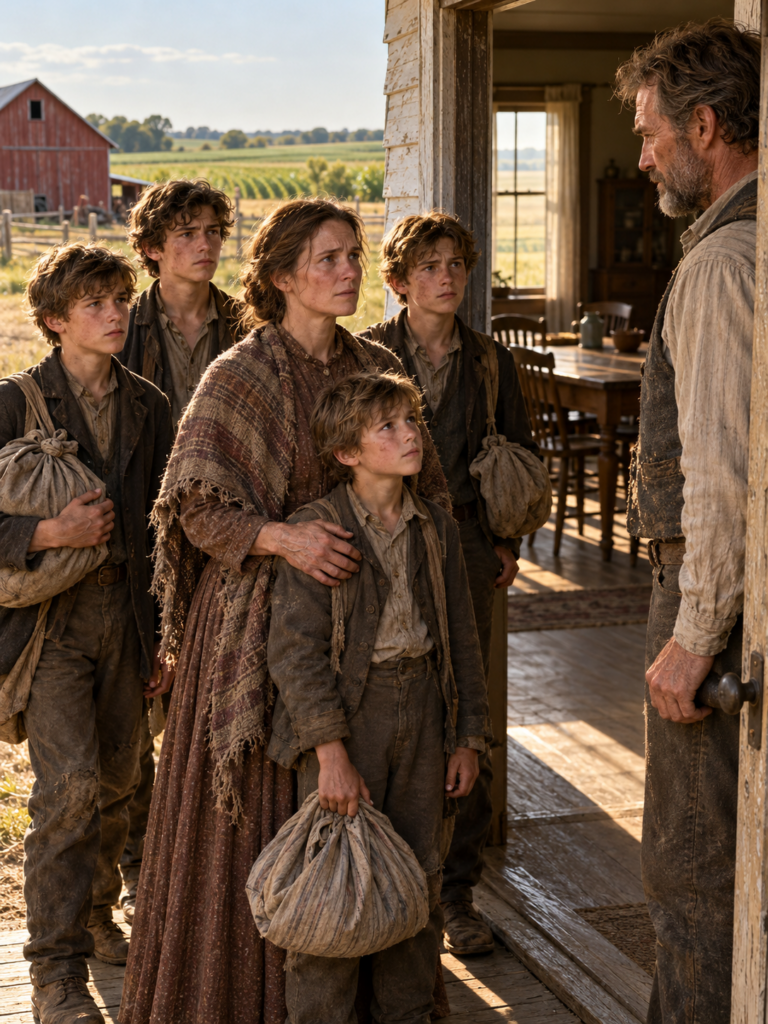
Jonathan caught the back of the chair before Thomas could pull it away from the table.
The boy froze.
For one terrible second, Evelyn thought they had already made a mistake.
Thomas straightened.
“Sorry, sir. I wasn’t fixing to damage anything.”
Jonathan’s hand remained on the chair.
His eyes were not on Thomas.
They were fixed on the empty place beside the head of the table.
Then, slowly, he released it.
“You haven’t done anything wrong.”
He pulled the chair out himself.
“Sit down. All of you.”
James climbed into the nearest seat with an exhausted sigh. Henry set down his bundle. Samuel glanced uncertainly at his mother.
Thomas remained standing until Evelyn nodded.
Jonathan brought water from the kitchen.
He returned with bread, cold meat, and a crock of preserved fruit.
Evelyn looked at the food, then at the man placing it before her children.
“Mr. Reed, we haven’t earned supper yet.”
“You’ve walked three miles today, haven’t you?”
“Yes.”
“Then I reckon you’ve earned the right to sit while you eat.”
There was no smile in his voice, but neither was there pity.
Evelyn accepted the plate.
The boys ate with the careful hunger of children trying to remember their manners.
James was halfway through his bread when he noticed Jonathan had not sat down.
“Aren’t you eating?”
“In a moment.”
“There’s a chair.”
Jonathan looked at the empty place beside Evelyn.
For the briefest instant, pain passed across his face.
Then he sat.
Nobody spoke for several minutes.
The sound of six people eating filled a room that had known only one for years.
At last Samuel looked up.
“This is the best bread we’ve had since we left Uncle’s place.”
“Samuel,” Evelyn warned.
Jonathan glanced at the loaf.
“Bought it yesterday. You’ll have better bread when your mother starts baking.”
Evelyn almost smiled.
“You’re putting a great deal of faith in my cooking.”
“Can’t be worse than mine.”
James giggled.
Jonathan looked surprised by the sound.
Then something extraordinary happened.
The corner of his mouth moved.
Not quite a smile.
But close.
After supper, Jonathan showed them upstairs.
The two rooms were furnished, though the air had the stillness of spaces seldom entered.
Evelyn ran her fingers over a clean quilt.
“You’ve kept everything in good condition.”
“Didn’t see a reason to let it spoil.”
“Even when nobody was using it?”
Jonathan looked toward the window.
“Things can be worth keeping.”
His answer told her enough to leave the matter alone.
The boys chose their beds with more excitement than Evelyn had seen in weeks.
James sat down on a mattress and pressed both palms into it.
“Can we really sleep here?”
“For now,” Evelyn answered.
She wanted to promise more.
But promises were dangerous things when a family had already lost so much.
Later, she found Jonathan downstairs beside the table.
The lamps were lit, and the chairs had been pushed back into place.
“I’d like to settle our arrangement tomorrow,” she said. “Properly. What work is needed, what the boys can safely do, and what wages we can put aside.”
Jonathan nodded.
“That’s fair.”
“And if you ever decide this arrangement no longer suits you, I need time to find another place.”
He studied her face.
“You’ve had a hard road.”
“I’ve had a road that taught me not to depend on promises.”
There was a long silence.
Then Jonathan said, “Six years ago, there were three people living in this house.”
Evelyn looked at the table.
He continued without looking at her.
“My wife was Margaret. We had a little daughter.”
His voice faltered.
“Fever took them both in the same week.”
Evelyn stood motionless.
Suddenly the extra chairs made sense.
So did the closed room.
“I’m sorry,” she whispered.
Jonathan nodded once.
“Afterward, I couldn’t bear to move much of anything.”
He ran a thumb along the table’s worn edge.
“Wasn’t expecting anyone to need those chairs again.”
Upstairs, James called for his mother.
Evelyn turned toward the staircase.
But Jonathan spoke before she reached it.
“Mrs. Carter?”
She looked back.
“I can offer honest work. I can offer wages. And I can promise you won’t be turned out without warning.”
His gaze shifted toward the ceiling, where four tired boys were finding beds.
“But there’s something you ought to understand.”
“What is it?”
“I haven’t known how to be part of a family in six years.”
Evelyn held the stair rail.
Then she did the only thing she knew how to do.
She climbed the stairs to her children, carrying his confession with her, and began deciding whether a house still holding so much grief could ever become a safe home for her sons.
Evelyn climbed the stairs slowly, her hand sliding along the wooden rail while Jonathan’s final words followed her.
He had not known how to be part of a family in six years.
She wondered whether a man who understood his loneliness so plainly might be better company than one who pretended he had never been hurt.
James was already beneath his quilt when she reached the bedroom.
“Are we staying, Mama?”
“For the present.”
“Do you think Mr. Reed likes us?”
“I think Mr. Reed is kind enough to give us a chance.”
James considered that.
“Papa used to say a chance was sometimes more useful than money.”
Evelyn sat beside him.
Her husband William had said many things she still carried.
Some comforted her.
Others reminded her how quickly a secure life could disappear.
“Your father was right about that.”
James closed his eyes.
For the first time in many nights, Evelyn did not have to worry where her boys would sleep tomorrow.
That alone was a blessing.
But she knew shelter and belonging were not the same thing.
And she had no intention of confusing them again.
***
The following morning began before sunrise.
Jonathan was already outside when Evelyn came downstairs.
She found flour, a cooking stove, preserved fruit, eggs, and enough provisions to prepare a proper breakfast.
The kitchen was orderly, though its arrangement struck her as strangely untouched.
Copper pots hung from hooks. Crockery stood in careful rows. A faded cloth covered a narrow shelf beside the window.
Someone had once taken great care arranging that room.
Jonathan had preserved the arrangement without making much use of it.
Evelyn moved only what she needed.
By the time the boys came down, biscuits were baking and coffee simmered on the stove.
Jonathan entered carrying a pail of fresh water.
He stopped when the smell reached him.
“Something burning?”
Evelyn turned.
“Biscuits.”
He glanced toward the stove.
“Mine usually burn.”
“These aren’t yours.”
Samuel laughed.
Jonathan set the water down.
Then, to Evelyn’s surprise, he smiled.
It was a small expression, almost reluctant.
But it changed his whole face.
They ate together at the six-place table.
Before anyone touched the food, Evelyn bowed her head.
“Would you mind if we said grace?”
Jonathan’s hand stopped beside his cup.
For a moment, she feared she had stepped too close to an old wound.
Then he lowered his head.
“No, ma’am.”
Their prayer was short.
Evelyn thanked God for food, work, shelter, and another morning.
When she finished, Jonathan remained quiet a few seconds longer.
Then he reached for a biscuit.
By the time breakfast ended, he had eaten three.
***
Their agreement took shape that afternoon.
Jonathan explained which fields needed tending, which fences had been neglected, and how the cattle required careful watching.
Thomas listened closely.
Samuel and Henry argued over who could repair a fence faster.
James announced that he could lift anything his brothers could.
Jonathan regarded him.
“Can you?”
“Nearly.”
“Then perhaps we’ll begin with something you can lift comfortably.”
The older boys laughed.
James frowned.
Jonathan crouched beside him.
“Small jobs done properly matter as much as large ones done badly.”
James considered this.
“What kind of jobs?”
“Gathering eggs. Carrying small tools. Helping your mother. Fetching what I ask for.”
“I can do those.”
“Then we’ll get along.”
Evelyn watched the exchange.
She had expected a farmer in need of labor.
She had not expected a man who could correct a frightened child without shaming him.
They agreed on modest cash wages for the work, with food and lodging included, and a portion put aside regularly.
Evelyn insisted that her earnings be counted separately.
Jonathan accepted without argument.
“Your work has value,” he told her. “You ought to know what that value is.”
The words stayed with her long after the conversation ended.
***
The weeks passed, and Reed Farm began to change.
Thomas discovered he had a natural gift for handling cattle.
He could recognize agitation in an animal before it became dangerous, and Jonathan soon trusted his judgment.
One afternoon, while they were tending a restless young cow, Jonathan watched Thomas approach with a calm voice and careful movements.
“You’ve got a good eye,” he said.
Thomas tried not to look pleased.
“My father used to tell me that.”
“Sounds like he knew his son.”
Thomas lowered his head.
For several moments, neither spoke.
Then Jonathan asked him to help inspect the next section of fence.
He did not press the boy to say more.
Thomas appreciated that more than he could have explained.
Samuel and Henry became inseparable in their competition over farm chores.
They repaired rails, hauled manageable loads, and learned to recognize which work demanded patience rather than speed.
More than once, Jonathan had to remind them that a properly secured fence was better than one completed quickly.
Henry began asking about the soil.
Why did one field yield more than another?
Why was a certain patch left resting?
Why did Jonathan plant one crop where another had grown before?
Jonathan answered as best he could.
Soon he found himself looking forward to the questions.
James followed him during evening chores.
He learned to carry water without spilling half of it and to recognize when a small task was worth doing carefully.
One afternoon, Jonathan found him struggling with a feed sack much too heavy for him.
The farmer took the load.
James protested.
“Thomas says we’re all supposed to earn our keep.”
“And you do.”
“Not as much as they do.”
Jonathan set the sack down.
“You’re eleven. You’ve got time enough to grow stronger.”
James looked doubtful.
Jonathan placed a smaller pail in his hands.
“Here. This is work I need done. Think you can manage it?”
James straightened.
“Yes, sir.”
“Then you’ve got a useful job.”
That evening, Evelyn found her youngest son describing the accomplishment as though he had saved the harvest single-handedly.
She did not correct him.
***
The house changed more quietly.
Evelyn made bread several mornings a week.
She mended work clothes, kept supplies in order, and planned meals so that the pantry lasted without needless waste.
She also began keeping careful accounts of household spending and the wages earned by her family.
Jonathan showed her what the farm produced and what it cost to operate.
At first, their conversations were practical.
Seed.
Feed.
Repairs.
The price of necessary supplies.
Then, little by little, they began speaking of other things.
Evelyn told him how Thomas had learned to read his father’s moods from the sound of his boots.
How Samuel had always used jokes to comfort his younger brothers.
How Henry remembered every field they had passed on their journey.
How James had been too young to understand death fully, but old enough to miss the familiar sounds of his father’s presence.
Jonathan listened.
Sometimes he asked questions.
Sometimes he sat with his coffee cooling untouched.
One evening, Evelyn found him staring at the little shelf beside the kitchen window.
“Margaret arranged those pots,” he said.
Evelyn set down the cloth in her hands.
“I thought they looked as though someone had put care into them.”
“She liked things where she could find them.”
“So do I.”
Jonathan looked at her.
“I noticed you haven’t moved them.”
“I wasn’t certain you’d want me to.”
He considered that.
“You may arrange the kitchen as you need.”
Evelyn smiled faintly.
“I don’t need to erase her work to make room for mine.”
Something in Jonathan’s expression softened.
He looked toward the closed room beyond the hall.
But he did not open it.
And Evelyn did not ask him to.
***
Early summer brought a violent storm.
The sky darkened before evening, and wind swept across the fields hard enough to send dust flying ahead of the rain.
Jonathan saw the danger first.
He called Thomas toward the barn.
Samuel and Henry helped bring the smaller livestock into shelter, while Evelyn kept James with her, carrying lanterns and dry cloths where they were needed.
The wind rose suddenly.
A barn door slammed against its fastening.
Jonathan and Thomas struggled to secure it, their boots sliding in the mud.
Then a section of fencing gave way.
The sound of splintering wood cut through the rain.
“Thomas! Hold that post!”
Jonathan ran toward the damaged stretch.
Thomas followed, bracing himself against the gusts.
The fence threatened to collapse farther if they could not secure it.
Together they worked through the worst of the wind, using the materials at hand to hold the broken section until proper repairs could be made.
Back near the house, Evelyn directed Samuel and Henry toward safer work once the animals were secured.
James stood beside her, gripping a lantern.
His face was pale, but he obeyed every instruction.
By the time the storm began moving east, all six were soaked, muddy, and exhausted.
The barn remained standing.
The livestock were sheltered.
The fields had taken a beating, but the damage could be assessed in daylight.
Jonathan found Evelyn on the porch.
James had fallen asleep against her shoulder.
The farmer sat beside them and carefully shifted the boy into a more comfortable position.
“Your sons worked well tonight,” he said.
Evelyn brushed wet hair from James’s forehead.
“They’ve had to learn more responsibility than I ever wished for them.”
Jonathan looked toward the barn.
“Thomas is becoming a capable hand.”
“He was always a good boy.”
“Still is.”
Evelyn turned toward him.
“Thank you, Jonathan.”
“You’ve no need to thank me.”
“I do. Not just for the roof. For how you’ve treated them.”
He looked at James.
“I was glad they were here tonight.”
She studied him.
“Because they helped save the farm?”
Jonathan shook his head.
“Because I wasn’t alone when it mattered.”
The words were spoken so quietly she might have missed them beneath the last rumble of thunder.
But she heard.
And something inside her answered.
***
After the storm, James began following Jonathan even more faithfully.
One evening, he heard the farmer whistling while repairing a piece of tack.
“Can you teach me that?”
Jonathan nodded.
“Come here.”
James tried.
The first attempt produced nothing.
The second sounded like a frightened mouse.
By the tenth, Samuel was laughing from the doorway.
James refused to give up.
Finally, a thin clear note emerged.
“I did it!”
Jonathan grinned.
“You certainly did.”
James lowered his eyes.
“Papa used to whistle.”
Jonathan’s smile faded into a gentler expression.
“I expect he was good at it.”
“I don’t remember it very well.”
“Then perhaps Thomas can tell you more about the songs he knew.”
James nodded.
For a while, the two sat together practicing.
Later, Evelyn watched from the porch.
Jonathan had once told her he no longer knew how to belong to a family.
Yet there he sat, teaching a fatherless boy a skill that could never replace his father but could preserve something tender about remembering him.
She realized then that Jonathan was not merely allowing the family into his house.
He was slowly allowing them into his life.
That knowledge brought warmth.
It also brought fear.
Because every day the boys became more attached to this man and this land.
And Evelyn knew better than anyone how devastating it could be to lose a home that felt permanent.
***
Late one evening, when the boys had gone upstairs, she spoke.
“Jonathan, there’s something I need to tell you.”
He set aside his coffee.
“I’m listening.”
“When William died, I learned how little security I truly had.”
Jonathan said nothing.
“The farm was our home. We had worked for it. We had raised our children there. But the mortgage didn’t care about any of that.”
She folded her hands tightly.
“When his income stopped, everything began slipping away.”
“I understand.”
“I’m not sure you do.”
The words came more sharply than she intended.
Jonathan waited.
Evelyn continued.
“This farm belongs to you. These rooms belong to you. Our food, our shelter, even much of our work depends upon your willingness to keep us here.”
“You’ve earned your place.”
“That isn’t the same as knowing we can keep it.”
He looked down.
For once, no immediate answer came.
“I don’t intend to send you away,” he said at last.
“I believe you.”
“Then what troubles you?”
“That believing a good man isn’t the same as having a future I can protect for my sons.”
Jonathan was quiet for a long moment.
Then he nodded.
“That’s a fair distinction.”
Evelyn looked up.
He continued.
“I can’t undo what happened to your family. And I won’t pretend my word alone can put those fears to rest.”
“Then what can?”
“Perhaps time. And arrangements that don’t depend on your having to guess my intentions.”
She was grateful he understood.
But neither of them yet recognized how severely that question would test them.
For by autumn, the farm would prosper beyond anything Jonathan had managed in six years.
And on the very evening he finally admitted that Evelyn and her boys had become his family, she would tell him something that threatened to empty his house all over again.
She was beginning to think they should leave.
Evelyn’s decision to leave did not come from a sudden quarrel.
It grew from the very happiness she had begun to feel.
That was what frightened her most.
By autumn, Reed Farm no longer looked like the tired holding she had approached with four hungry boys in the spring.
The damaged fences had been repaired.
The fields had been better tended.
The barns were orderly.
The harvest was the strongest Jonathan had brought in since the year he lost Margaret and their daughter.
And the farmhouse, once so painfully quiet, now rang with arguments, laughter, footsteps, and the familiar noises of six people sharing a life.
Evelyn loved those sounds.
She loved them more than she dared admit.
But she could not forget another house that had once been full of voices.
A house lost to debt.
A home her sons had believed would always be theirs.
***
Harvest demanded almost everything the family could give.
Thomas worked beside Jonathan from early morning until evening, learning to judge the land as carefully as he already judged animals.
Samuel and Henry worked with determined efficiency, finding time to tease one another even when their hands were sore.
James, now more confident in his abilities, insisted on contributing every task his strength allowed.
Jonathan began setting aside wages for all four boys, carefully distinguishing the older boys’ heavier responsibilities from the smaller work James performed.
One evening, after a particularly demanding stretch of harvesting, he called James aside.
The boy approached nervously.
“Did I do something wrong?”
Jonathan handed him a folded banknote.
“No. You’ve done well.”
James opened it.
His eyes widened.
“All this?”
“Your proper day’s pay.”
James stared.
“Like Thomas?”
“For the work you earned today.”
The boy looked at his brothers.
Then he looked at his mother.
Evelyn saw his face fill with a pride that had little to do with the money itself.
For months, James had worried that he was too young to help.
Now he held proof that his efforts mattered.
He carefully folded the note and tucked it away.
“I’ll save it,” he announced.
“That’s sensible,” Jonathan said.
James considered the farmer.
“You’re a good man, Mr. Reed.”
Jonathan appeared uncertain how to answer.
Finally, he rested a hand briefly on the boy’s shoulder.
“So are you, James. You’re growing into one.”
Evelyn turned toward the window before anyone saw the tears in her eyes.
***
The final accounting of the harvest brought good news.
They had gathered more than Jonathan had expected, and the improvements made throughout the season promised better work in the years ahead.
One afternoon, he and Evelyn stood inside the barn, looking at the carefully stored produce and supplies.
Jonathan rested his hands on his hips.
“I couldn’t have managed half of this alone.”
“You’ve said that before.”
“And I mean it more every time.”
Evelyn smiled.
“Then perhaps the Carter family has proved useful.”
Jonathan looked at her.
“Useful?”
She heard the change in his voice.
“I didn’t mean—”
“Evelyn, I stopped thinking of you as hired help a long time ago.”
Her smile faded.
He continued slowly.
“Thomas knows this farm nearly as well as I do now. Samuel and Henry have brought life into work I used to dread. James follows me like a shadow, and half the time I find myself looking for him when he isn’t there.”
His eyes met hers.
“And you…”
He paused.
“You’ve made this house a place I want to come back to at the end of the day.”
Evelyn felt her heart tighten.
“Jonathan.”
“I know what our agreement was. I haven’t forgotten it. But I won’t pretend that’s all this has become.”
He looked toward the farmhouse.
“You’re my family, Evelyn. All five of you.”
For a moment, she could not speak.
The words were everything she had quietly begun to hope for.
And everything she was terrified of losing.
At last, she lowered her gaze.
“I think it’s time the boys and I found a place of our own.”
Jonathan stood motionless.
He looked as though she had struck him.
“After everything we’ve just said?”
“Because of everything we’ve just said.”
“Evelyn, I don’t understand.”
“I know.”
She walked toward the barn doorway, needing air.
Jonathan followed, leaving enough distance that she did not feel cornered.
The late-afternoon sun lay across the fields.
Evelyn looked at the land her sons had come to love.
“Thomas talks about next spring as if he’ll certainly be here. Henry keeps making plans for the fields. Samuel says the barn needs another workbench. And James…”
Her voice broke.
“James asked me last night whether we would ever have to leave home again.”
Jonathan’s expression changed.
“What did you tell him?”
“That I didn’t know.”
“Evelyn—”
“I couldn’t lie to him.”
She turned.
“When William died, I told those boys we’d be all right. When the bank began asking for payment, I told them we’d find a way. When our home was sold, I said we’d build another life.”
She swallowed.
“I kept making promises because I thought a mother was supposed to have answers.”
Jonathan listened without interrupting.
“And then we came here. You opened your door. You gave us honest work, a roof, and kindness. I will always be grateful.”
“You don’t owe me gratitude for treating you decently.”
“I know. But I’m afraid, Jonathan.”
He stepped closer, then stopped.
“Of me?”
“No.”
The answer came immediately.
“Of needing you. Of letting the boys need you. Of having them believe this place is theirs when it still depends upon one man’s permission.”
Jonathan looked toward the house.
For six years, he had feared becoming attached to anyone again.
Now he stood beside a woman who feared the same thing for different reasons.
His grief had taught him to close doors.
Hers had taught her that an open door could be taken away.
Neither fear was foolish.
Neither could be cured by telling the other to stop feeling it.
***
Jonathan did not ask Evelyn to change her mind that afternoon.
Instead, he told her he needed to think.
She appreciated his restraint.
Yet the distance between them at supper felt unbearable.
The boys sensed something was wrong.
Thomas watched his mother.
Samuel tried a joke that earned only a small smile.
Henry asked a question about the coming planting season, and Jonathan answered it with his usual patience.
James seemed most troubled of all.
After supper, he lingered beside Evelyn.
“Mama, have I done something?”
She knelt before him.
“No, sweetheart.”
“Mr. Reed seems sad.”
“He’s thinking about something important.”
“Are we leaving?”
Evelyn could not bring herself to answer quickly.
James looked toward the kitchen.
“I like it here.”
“I know.”
“I liked our old home too.”
“So did I.”
He looked at her for a long time.
“Can a person love two homes?”
Evelyn felt tears rise.
“Yes, James. I think a person can.”
The boy nodded thoughtfully.
“Then maybe loving this one doesn’t mean we forgot the other.”
She embraced him.
And for the first time, she understood that protecting her sons from loss could not mean forbidding them to love anything they might someday lose.
Still, love alone would not provide security.
That part of her fear remained real.
***
Later that night, Jonathan found Evelyn sitting at the kitchen table with her household accounts.
A lamp burned between them.
He placed a chair opposite hers.
“May I sit?”
“Of course.”
He sat.
For a while, neither spoke.
Then he said, “I’ve been thinking about what you told me.”
Evelyn set down her pencil.
“I hope you know I never meant to hurt you.”
“I know.”
He looked at his hands.
“After Margaret and our little girl died, I told myself this farm was all I had left.”
His voice was steady, though his fingers tightened.
“I kept their things where they’d been. I kept the house running. I planted, harvested, and worked because there was work to do.”
He raised his eyes.
“But I stopped expecting anything good to happen beyond the next day’s chores.”
Evelyn waited.
“I suppose I thought wanting another family would mean I hadn’t loved the first one enough.”
She shook her head gently.
“Love doesn’t work that way.”
“I know that now.”
He glanced toward the closed room.
“I’ve been afraid to let the house change because I believed change meant leaving them behind.”
Evelyn looked around the kitchen.
Margaret’s pots still hung near the stove.
Her careful arrangement of the shelves remained visible beneath Evelyn’s own small adjustments.
Nothing had been erased.
The house had simply begun to live again.
“Jonathan,” she said, “I never wanted to take Margaret’s place.”
“I would never ask you to.”
“Or your daughter’s.”
His eyes glistened.
“I know.”
He drew a breath.
“You and the boys aren’t replacing anyone. You’re people I have come to love for yourselves.”
For the first time, the word was spoken plainly between them.
Love.
Not as a demand.
Not as a debt.
As an admission.
Evelyn looked down at the accounts.
“I love you too.”
Jonathan’s breath caught.
“But that doesn’t make my fear disappear.”
“No,” he said. “It doesn’t.”
He reached toward the papers but did not touch them.
“Tell me what you need.”
The question mattered more than any promise he had made before.
Evelyn considered it carefully.
“I need the boys to know they have a secure place. I need the wages we’ve earned to remain ours. I need a say in decisions that affect this household. And I need to know that loving you will not mean losing the ability to stand on my own feet.”
Jonathan nodded.
“Those are reasonable things.”
“I also need you to understand that I loved William. I always will.”
His expression softened.
“As I will always love Margaret.”
They sat together in the quiet.
Then Jonathan spoke.
“Perhaps we’ve both been expecting a new life to cancel out the old one.”
Evelyn nodded.
“Perhaps.”
He leaned back.
“I want you to stay. But I won’t ask you to stay on nothing more than my good intentions.”
“What are you saying?”
“I’m saying we should put our working arrangements properly in order. Your earnings, the boys’ earnings, and what each of us has contributed. And we should talk plainly about the future of this farm.”
Evelyn studied him.
“And if I still decide to leave?”
His answer took effort.
“Then I’ll help you settle what you’re owed. You and the boys won’t leave empty-handed.”
The words reached a part of her that romantic declarations never could.
He was offering her a choice he might personally suffer from.
And that made his love more believable.
***
During the following days, Jonathan and Evelyn made careful plans.
They reviewed the money earned through the harvest, the farm’s needs, and the amounts Evelyn wished to keep in savings for her sons.
Jonathan agreed that they would consult one another on household spending and major farm decisions.
He did not dismiss her knowledge simply because much of it had been learned inside a kitchen or from surviving hard times.
Evelyn, in turn, listened when Jonathan explained the costs of seed, feed, repairs, and maintaining the land.
Their discussions were not always easy.
She sometimes wanted more certainty than the farm’s income could provide.
He sometimes assumed she understood matters he had handled alone for years.
But whenever they disagreed, they returned to the table and worked through the figures.
It was a different sort of courtship from anything Evelyn had expected.
They were learning whether they could build a life together when neither of them was obliged to surrender judgment to the other.
Jonathan made one other change.
He began speaking more freely of Margaret and their daughter.
Not constantly.
Not as though grief were a story that needed repeating.
But when a memory came naturally, he no longer pushed it away.
One evening, he told the boys how Margaret had insisted upon keeping the garden neat even when the wind scattered dirt across every path.
Samuel laughed.
“Sounds like Mama.”
Evelyn gave him a warning look.
Jonathan smiled.
“She might have liked your mother.”
Evelyn looked down at her sewing.
“I believe I would have liked her.”
For the first time, Jonathan could remember Margaret with gratitude that did not immediately turn into pain.
***
One cool evening, James approached Jonathan as he worked near the barn.
“Mr. Reed?”
“Yes?”
“Would you be very sad if we left?”
Jonathan put down his tool.
“Yes, James. I would.”
The boy looked at his boots.
“I’d be sad too.”
Jonathan sat on a low bench.
“But whatever your mother decides, she has good reasons.”
James frowned.
“Can’t you ask her to stay?”
“I have.”
“Then ask harder.”
Jonathan almost laughed.
“Sometimes asking harder isn’t the answer.”
“Then what is?”
“Making sure the person you love has a real choice.”
James considered that with the serious expression he sometimes wore when trying to understand grown-up matters.
“Did Mama choose to come here?”
“She chose to knock on my door.”
“And did you choose to let us in?”
“I did.”
James looked toward the farmhouse.
“Then maybe you can both choose again.”
Jonathan sat very still.
Out of the mouth of an eleven-year-old boy had come the simplest explanation of something he and Evelyn had spent weeks struggling to understand.
A home was not made secure merely by one person opening a door.
It became a home when the people inside could choose, together, to keep it open.
***
A few evenings later, Jonathan asked Evelyn to walk with him along the porch.
The air had grown colder.
Autumn was slipping toward winter.
Inside, the boys were arguing cheerfully about who had done the hardest work that day.
Evelyn pulled her shawl closer.
Jonathan stood beside her, looking out over the darkening fields.
“I’ve something to ask you.”
She turned.
“I don’t want to make you feel obliged,” he said.
“You’ve never made me feel that.”
“I hope not.”
He took a breath.
“When you first arrived, I saw a woman who needed shelter and four boys who needed work they could manage. I believed I could offer something useful.”
“You did.”
“But I didn’t understand what I needed.”
Evelyn watched him.
“I needed people to share the work. To disagree with me. To sit at my table. To make me remember that living is more than getting through another day.”
His voice deepened.
“I needed you, Evelyn.”
Tears gathered in her eyes.
Jonathan continued.
“I love your boys. I love this place again because they’ve helped me care for it. And I love you.”
He turned fully toward her.
“I’d like you to be my wife.”
Evelyn’s hand rose to her mouth.
“But I won’t ask you to marry me out of gratitude, or because you’ve nowhere else to go,” he added. “We’ll make proper provision for you and the boys, and you needn’t answer tonight.”
She searched his face.
“And if I say yes, what happens to the woman who came here determined to stand on her own?”
Jonathan’s answer was quiet.
“I hope she stays exactly that determined.”
Evelyn laughed through her tears.
He smiled.
“I don’t need someone to obey me, Evelyn. I need someone who’ll tell me when I’m wrong, work beside me, and share whatever good or hardship comes.”
“And the boys?”
“They’re part of the question. I wouldn’t have you without them.”
Evelyn looked through the window.
Thomas was helping James mend a torn strap.
Samuel and Henry were laughing over something at the table.
Six months earlier, those boys had approached this house afraid of being turned away.
Now their voices filled it.
She turned back to Jonathan.
“I need to speak with them.”
“Of course.”
“And I need to be certain I’m choosing this because I want it. Not because I’m frightened of another road.”
Jonathan nodded.
“Take whatever time you need.”
She reached for his hand.
For several moments, they stood without speaking.
Then Evelyn said, “I think I already know my answer.”
But she wanted to make it with a clear heart.
***
That night, she gathered her sons in their bedroom.
Thomas sat on the edge of his bed, serious as ever.
Samuel leaned against the wall.
Henry stopped examining a small piece of farm equipment.
James climbed beside his mother.
Evelyn looked at all four of them.
“I want to ask you something important.”
Thomas spoke first.
“Are we leaving?”
“I haven’t decided that.”
The boys exchanged worried glances.
“Mr. Reed has asked me to marry him.”
Silence followed.
Then Samuel sat upright.
“He has?”
Henry’s mouth fell open.
James looked delighted, then uncertain.
Thomas said nothing.
Evelyn took her eldest son’s hand.
“Thomas, I especially want to hear what you think.”
He looked at the floor.
“Do you love him, Mama?”
“Yes.”
“Does he treat you well?”
“Yes.”
“And will you still be able to make your own decisions?”
Evelyn felt a fierce tenderness for the boy who had spent months trying to protect everyone.
“Yes. We’ve spoken about that very carefully.”
Thomas nodded.
“Then I think Papa would want you to be happy.”
Evelyn’s eyes filled.
Samuel cleared his throat.
“Does this mean Mr. Reed might be our stepfather?”
“It could.”
Henry considered the matter.
“Would we still work here?”
“If that’s what we all choose, and if the work continues to suit us.”
James suddenly climbed into her lap.
“Then say yes, Mama.”
She smiled.
“Why?”
“Because he already acts like he loves us.”
No one laughed.
The truth was too plain.
Thomas finally spoke.
“Mama, we miss Papa. We always will. But I don’t think loving Mr. Reed means we love him any less.”
Evelyn drew her sons close.
For so long, she had believed that keeping them safe meant preparing for every possible loss.
Now she understood that they also deserved the chance to build something worth keeping.
And they were old enough to tell her they wanted it.
***
The next morning, Evelyn found Jonathan beside the barn.
He was repairing a latch, absorbed in his work.
She watched him for a moment before speaking.
“Jonathan?”
He straightened.
“Good morning.”
“I’ve given your question some thought.”
He placed the tool carefully aside.
Evelyn smiled.
“More thought than you probably needed me to.”
“That’s for you to decide.”
She stepped closer.
“When I came to your door, I had nothing secure to offer my boys but my determination to keep them together.”
Jonathan listened.
“You gave us work. A roof. Time to recover. And you gave the boys a chance to feel useful without making them carry burdens they were too young to bear.”
Her voice softened.
“But what made me love you wasn’t any of that alone.”
“What was it?”
“You listened when I told you I was afraid. You didn’t ask me to trust you simply because you had been kind. You took my fear seriously enough to change how we arranged our lives.”
Jonathan’s eyes shone.
Evelyn took his hand.
“I want to stay. Not because I have no other choice.”
She drew a steadying breath.
“Because I choose this farm, this life, and you.”
For a moment, Jonathan seemed unable to speak.
Then he asked, very quietly, “Does that mean yes?”
Evelyn laughed.
“Yes, Jonathan Reed. I’ll marry you.”
He opened his arms but waited.
She stepped into them.
Their embrace was gentle, made precious by everything they had survived separately and everything they now hoped to share.
When they finally drew apart, Jonathan looked toward the house.
“Have you told the boys?”
“They knew before you did.”
He raised an eyebrow.
“All four?”
“All four.”
A shout came from the kitchen window.
“We heard that!”
Samuel.
Then Henry’s laughter.
And James, shouting louder than anyone:
“Does this mean he’s really staying with us?”
Jonathan threw back his head and laughed.
A full, unguarded laugh that carried across the yard.
Evelyn had never heard anything more beautiful.
***
They married that winter in a small ceremony at the farmhouse.
The neighbors came with pies, preserves, and good wishes.
The boys wore their best clothes.
Thomas stood beside Jonathan before the ceremony.
For a long moment, neither spoke.
Then Thomas offered his hand.
Jonathan shook it.
“I wanted to say something,” Thomas began.
“Go ahead.”
Thomas looked toward the room where his mother was preparing.
“My father was a good man.”
Jonathan nodded.
“I believe that.”
“I think he would have liked you.”
Jonathan swallowed.
“I would have been honored to know him.”
Thomas’s grip tightened.
“Thank you for looking after Mama.”
Jonathan shook his head.
“Your mother has looked after all of us, Thomas. We’re fortunate to have her.”
The boy smiled.
When Evelyn entered the room, the sight of her four sons standing together nearly overwhelmed her.
She had worn an ordinary but carefully prepared dress.
There was nothing extravagant about the ceremony.
No grand display.
No wealth.
Only friends, family, and a promise made freely.
Jonathan took Evelyn’s hand.
They spoke their vows in voices steady enough to be heard.
And when they were pronounced husband and wife, James began crying.
Samuel leaned toward him.
“What’s wrong with you?”
“Nothing.”
“You’re crying.”
“Something got in my eye.”
Henry grinned.
“Must have got in both.”
James wiped his cheeks.
“I don’t care.”
Neither did anyone else.
Afterward, neighbors crowded around the table, exchanging stories about the farm.
One older farmer looked toward Jonathan.
“Six years you spent trying to keep this place going alone. Then one widow and four boys arrive, and suddenly your fences are standing straighter than mine.”
Jonathan glanced at Evelyn.
“Took the right family,” he said.
Evelyn gave him a look.
“And a great deal of work.”
The guests laughed.
Jonathan squeezed her hand.
“That too.”
***
Marriage did not make farm work easier overnight.
There were still hard mornings.
Crops still depended upon weather.
Cattle still demanded care.
Clothing still wore thin, and money still had to be managed with caution.
But the household now faced those difficulties together.
Evelyn continued keeping accounts and overseeing the household, while taking part in decisions about planting, purchases, improvements, and the money they put aside.
Jonathan managed the fieldwork and livestock with the help of the boys, consulting Evelyn whenever choices affected the whole family’s future.
Their marriage did not mean that Evelyn abandoned the independence she had fought to regain.
It meant she could exercise it beside a man who respected it.
They took care to put their financial arrangements on a firmer footing and to protect the savings earned by Evelyn and her sons.
There was no grand fortune.
No sudden inheritance.
Only the ordinary security that grows when people tell one another the truth, understand their responsibilities, and plan for hardship rather than pretending it cannot come.
Thomas continued learning the management of cattle and fields.
Samuel and Henry grew stronger and more capable, though their tendency to compete never entirely disappeared.
James remained Jonathan’s companion during evening chores.
And sometimes, as the sun lowered over the fields, the two could be heard whistling the same simple tune.
Evelyn never tired of that sound.
It reminded her of William.
It reminded her of how much her youngest boy had feared forgetting his father.
And it reminded her that remembrance could be passed forward without keeping the present empty.
***
The farmhouse changed slowly over the years.
More shelves were built.
A worn chair was repaired.
The kitchen became busier.
The garden flourished under careful tending.
The upstairs rooms filled with the ordinary belongings of growing boys.
Jonathan eventually opened the door to the room he had kept closed since Margaret and their daughter died.
He did not do it because Evelyn asked.
He chose the moment himself.
Evelyn stood beside him in the hall.
“You don’t have to,” she said.
“I know.”
He turned the handle.
The room held a few small possessions, carefully preserved.
Jonathan stood inside for some time.
Evelyn remained near the doorway.
At last, he picked up a small keepsake that had belonged to his daughter.
His hands trembled.
“She was so little,” he whispered.
Evelyn stepped closer.
“Would you like to tell me about her?”
For the first time in years, he did.
He spoke of Margaret’s joy when their daughter was born.
Of tiny fingers.
Of the brief, precious days before illness came.
He cried.
Evelyn did not try to stop him.
When he was ready, they carefully put the keepsake away again.
Some things remained private.
Some memories continued to hurt.
But the room was no longer something Jonathan feared entering.
Later, it became a place where the family’s belongings could be stored and ordinary work could be done.
Not because the past had been forgotten.
Because the house had room for both memory and life.
***
Years later, when the Carter boys were older and the farm more firmly established, Jonathan sometimes told visitors about the day Evelyn came to his door.
He never made himself the hero of the story.
He spoke of the exhausted woman on the porch.
The four boys carrying bundles.
The quiet courage it took to ask a stranger for work.
And the answer he had given without realizing how much it would mean.
“She told me she had four children and nowhere to go,” he would say. “I told her I had a farm I couldn’t manage alone.”
Then he would smile toward Evelyn.
“Turns out we were both telling the truth about what we lacked.”
Evelyn would usually add something about the neglected fences.
Or the terrible bread he had made before she arrived.
And everyone would laugh.
But she understood the deeper truth.
They had not saved one another through a single generous act.
They had done it through hundreds of ordinary choices.
A meal shared.
A child’s work recognized.
A frightened confession heard without judgment.
A boundary respected.
A chair pulled out.
A promise supported by action.
A difficult conversation finished instead of abandoned.
There had been no moment when grief disappeared forever.
William remained part of Evelyn’s memories.
Margaret and her daughter remained part of Jonathan’s.
The family they built did not erase those they had lost.
It gave their love somewhere new to live.
***
One spring afternoon, long after that first desperate journey, Evelyn stood at the same farmhouse doorway where she had once knocked with trembling hands.
The fields stretched green beneath the open Nebraska sky.
The barn had been repaired and painted.
Laughter drifted from the yard.
Jonathan came to stand beside her.
“What are you thinking about?”
She looked down the road.
“That day we arrived.”
He followed her gaze.
“You looked ready to turn around and walk another twenty miles rather than ask for help.”
“I might have, if the boys hadn’t been so tired.”
“You were brave.”
“I was frightened.”
“Most brave people are.”
She smiled.
“Do you remember what I said?”
“Every word.”
“And what you said?”
“Every word of that too.”
She slipped her hand into his.
“I thought you were offering us a temporary place to survive.”
“I thought I was hiring help.”
They exchanged a quiet smile.
Inside, the dining table stood ready for supper.
The chairs were worn now.
Not from neglect.
From years of use.
Their surfaces bore scratches from everyday meals, work, lessons, laughter, and conversations that sometimes lasted long after the lamps had been lit.
Jonathan looked through the doorway.
“Six years I kept that table mostly empty.”
Evelyn rested her head lightly against his shoulder.
“And then?”
He squeezed her hand.
“Then five people came up my road and reminded me what it was for.”
Together, they went inside.
Evelyn took her usual chair.
Jonathan sat beside her.
The boys joined them, older now, each carrying some part of the life that had been rebuilt on that land.
Before supper, Evelyn bowed her head.
The family followed.
She thanked God for the food before them, for the work of their hands, for those they remembered, and for the home they had been given the courage to build together.
When she finished, Jonathan looked around the table.
He remembered the years of silence.
The untouched chairs.
The closed door.
The loneliness he had once mistaken for the rest of his life.
Then he looked at Evelyn.
At Thomas.
Samuel.
Henry.
James.
And understood that the greatest change had not been the repaired fences, the successful harvests, or even the marriage that had united them.
It was that everyone at the table knew they belonged there.
Not because they had nowhere else to go.
Not because they owed anyone for being rescued.
But because they had worked, trusted, remembered, forgiven, and chosen one another.
Evelyn had reached his doorstep believing she had nothing left but four sons and the determination to protect them.
Jonathan had opened that door believing his own story was already over.
Neither had been right.
For the house that once held six empty chairs had become a home where no one needed to earn the right to be loved.
And the door that had opened for five weary strangers remained open to the family they had freely chosen to become.


