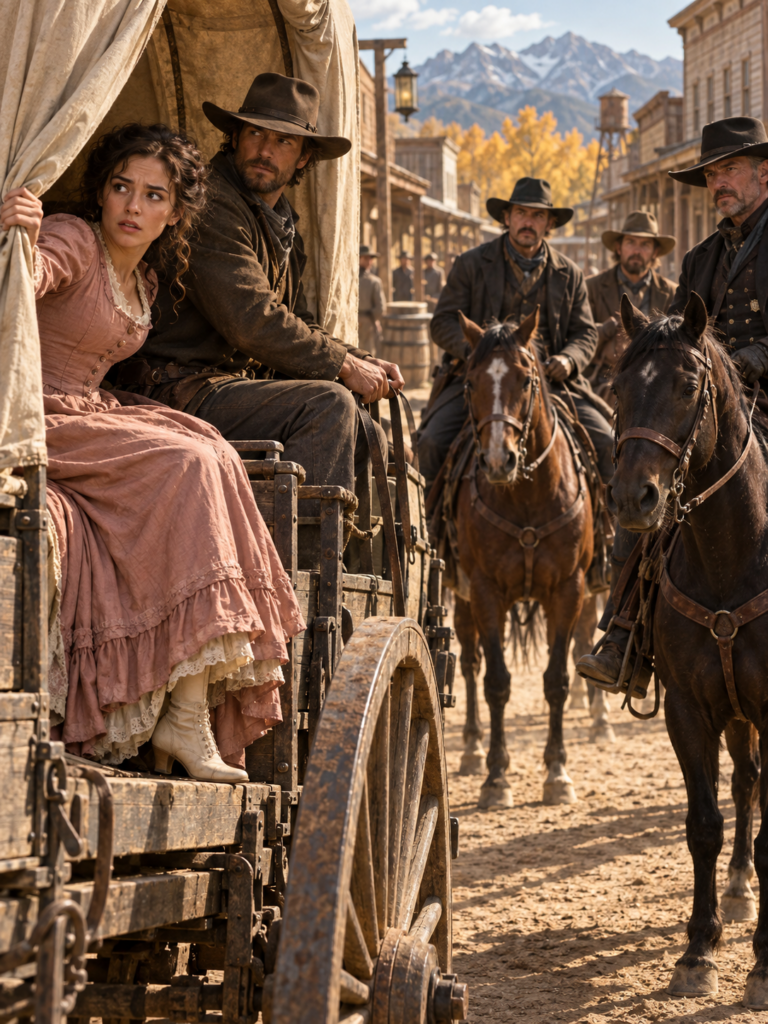
The wagon lurched across the rocks, throwing Rosemary against Elias’s shoulder.
He caught the reins with both hands while she seized the side rail.
“Careful,” he warned.
“I’m trying.”
The horse strained uphill. Behind them, the distant riders disappeared below the ridge, but Elias knew they might find the turning.
“There’s a narrow stretch ahead,” he said. “If we get through before they’re on the rise, they may miss us.”
Rosemary looked at the uneven track.
“Then let me help you watch the wheels.”
She shifted away from him, braced herself, and watched the left side as they crossed the worst ground.
When a wheel approached a deep rut, she called a warning.
Elias corrected the line.
Together, they brought the wagon onto firmer earth.
Only then did Rosemary release the rail.
“You’ve driven wagons before,” Elias observed.
“My grandfather had a small place outside Red Willow. I spent summers helping him.”
“That explains why you aren’t screaming.”
“I considered it.”
Despite everything, Elias almost smiled.
They traveled another mile before stopping where the road curved behind a stand of pines.
The horse needed breathing room.
Elias climbed down, checked the harness, and offered Rosemary water from his canteen.
She drank slowly.
“Tell me about Pike,” he said.
She looked toward the lower valley.
“He lent Mother money when sewing work became scarce. At first, the payments seemed manageable. Then the figures began changing.”
“Interest?”
“Yes. More than she understood she’d agreed to.”
“Did Pike explain it?”
“He explained only what he wanted her to believe.”
Elias looked at her.
“And the wedding?”
“His suggestion. He said he would cancel the debt if I married him.”
She spoke steadily, but her fingers trembled around the canteen.
“I thought I was saving Mother’s property. Then I realized he wanted the property all along.”
“What property?”
“A little parcel south of town. My grandfather left it to her. There’s a creek running through it.”
Elias’s expression sharpened.
“Pike owns the adjoining land.”
“Yes.”
“And he’d gain access to that creek through your parcel.”
Rosemary nodded.
“He says Mother’s debts put the land in danger. I don’t know whether that’s true. But I know the sums in those papers aren’t what she was promised.”
Elias thought for a moment.
“Where are the original notes?”
“With Pike, I believe.”
“Then we’ll need someone who can examine them properly.”
“We?”
He looked at her.
“You didn’t ask me to solve your affairs. I know that. But I can help you find someone who understands the papers.”
Rosemary’s eyes searched his face.
“Why would you?”
“Because you should be allowed to decide whether to marry a man without somebody holding your mother’s land over your head.”
For a moment, she couldn’t speak.
Then she handed the canteen back.
“I have two papers with me,” she admitted. “I managed to take them before I ran.”
“Keep them safe.”
“You don’t want to see them?”
“When you’re ready.”
She studied him for several seconds.
“You’re a peculiar man, Mr. Ward.”
“Been told worse.”
“My mother used to say a person’s character shows when he’s offered power over somebody weaker.”
“What would she have thought of me?”
“I haven’t decided.”
“That seems fair.”
The moment nearly became laughter.
Then Elias looked toward the northern sky.
The blue had been disappearing behind a thick gray bank.
He knew those mountains well enough to dislike what he saw.
“We need to move.”
Rosemary followed his gaze.
“Snow?”
“Could be before dark.”
“How far to your ranch?”
“Too far if that weather catches us here.”
He pointed toward the climbing road.
“There’s an old line cabin ahead. We can shelter there if we must.”
“Does it have supplies?”
“Wood. A fireplace. A roof, last time I checked.”
“Then that’s where we should aim.”
They returned to the wagon.
As Elias gathered the reins, Rosemary removed a small sewing kit from her bag.
He frowned.
“What are you doing?”
“Your coat cuff is torn. It’s catching on the harness buckle.”
“That can wait.”
“Not if it catches while you’re handling the horse.”
She worked quickly, securing the loose fabric with a few rough stitches.
When she finished, Elias flexed his wrist.
The cuff no longer snagged.
“Thank you,” he said.
Rosemary tucked away her needle.
“You’ve been doing the driving. I thought I might do something useful.”
“You already did. You watched the wheel.”
The simplicity of his answer unsettled her more than praise would have.
They climbed higher.
The temperature fell.
Wind stirred the pine branches, carrying the sharp scent of approaching snow.
At the next ridge, Elias saw the distant line cabin, its dark roof just visible below the trees.
He also saw the first white flakes drifting across the trail.
“Hold on,” he said.
Rosemary gripped the seat.
The horse began descending toward shelter.
Then a gust struck the wagon broadside, whipping the canvas loose.
Rosemary caught the flapping edge before it could frighten the horse.
“Elias!”
“Keep hold of it!”
The wind pulled hard against her arms.
She leaned across the seat, grabbed the loose strap, and fought to draw it tight.
The cabin stood less than a quarter mile away.
But snow was already thickening between them and the trees.
Elias steadied the horse.
Rosemary pulled the strap through its buckle.
And as the first heavy curtain of snow swept across the trail, she forced the buckle closed.
The buckle caught just as another blast of wind struck the wagon.
Rosemary held it a moment longer to be certain, then dropped back onto the seat, breathing hard.
“It’s secured!”
Elias nodded without taking his eyes from the narrowing road.
“Good work.”
Ahead, the line cabin was vanishing behind blowing snow.
The horse wanted to turn away from the wind.
Elias kept a steady hand on the reins, urging rather than whipping it.
The final stretch took longer than either expected.
By the time the wagon reached the cabin, snow was gathering in the folds of Rosemary’s dress and across Elias’s shoulders.
They worked quickly.
Elias led the horse beneath the adjoining lean-to and secured it with feed and water. Rosemary carried two blankets and a sack of provisions into the cabin while he checked that the animal was settled.
Inside, the single room smelled of cold stone and dry timber.
There was a fireplace, one chair, a narrow bed, and a rough table beneath the window.
Not much.
But it was shelter.
Elias knelt before the hearth and arranged the kindling.
“There’s more wood stacked behind the cabin,” he said.
Rosemary put down the provisions.
“I’ll get some.”
“Not in those shoes. I’ll bring it.”
She looked down at the ruined cream buttons and mud-stained leather.
“Then I’ll see about supper.”
He glanced up.
“You don’t need to do that.”
“I know.”
That answer made him pause.
She gave him a small, tired smile.
“But we’ve both had a long day. And I can cook.”
Elias returned to the fire.
“Then I’ll be grateful for supper.”
She found a pan, cut salt pork into small pieces, and set it over the warming flame.
They ate as darkness settled.
Outside, the storm moved through the trees with a sound like distant wagons crossing a wooden bridge.
Rosemary sat near the hearth with a blanket over her shoulders.
Elias placed another blanket on the bed.
“You take that,” he said.
“Where will you sleep?”
“By the fire.”
“It’s your cabin.”
“It’s a place I use when I’m working the upper range. Tonight it can serve both of us.”
She looked at the bed.
Then at the door.
“I want to make something clear, Elias.”
He waited.
“I agreed to pretend to be your wife because I was desperate. That was all I meant by it.”
“I understood.”
“And I won’t have you thinking I owe you anything beyond my thanks.”
He met her eyes.
“You owe me neither marriage nor affection, Rosemary. If the road had been safe, I’d have taken you wherever you asked.”
The tightness in her chest eased.
“Thank you.”
“Get some rest.”
For the first time since morning, she believed she might sleep.
But before she lay down, she took two folded documents from her bag.
“One is Mother’s will,” she said. “The other is a letter Pike wrote concerning her accounts.”
Elias examined neither until she placed them in his hand.
By firelight, they studied the papers together.
The will named Rosemary as beneficiary of her mother’s property.
The other paper was more troubling.
It appeared to be a copy of instructions Pike had sent concerning the handling of interest charges.
Elias read it twice.
“I can’t say what a court would make of this.”
“I know.”
“But it gives you a reason to demand a proper examination of the accounts.”
Rosemary leaned forward.
“You believe me?”
“I believe the paper deserves an answer.”
It wasn’t a declaration that everything would turn out well.
It was something better.
It was a promise not to mistake power for truth.
The storm continued through the night.
By morning, the sky had cleared enough for travel.
Elias made sure the horse was fed and rested before they moved on.
They reached the Ward ranch around noon.
Rosemary stepped down from the wagon and looked at the place that would become her winter refuge.
The house was larger than she’d expected.
It stood against a broad sweep of land where cattle grazed beyond rough fences. A barn and several working sheds occupied the sheltered side of the yard.
The buildings were plain but maintained.
Nothing about them suggested wealth.
Everything suggested steady labor.
Near the porch lay a kitchen garden carefully covered for the cold months.
“Someone takes care of this place,” Rosemary said.
“Someone has to.”
She looked at the garden beds.
“You grow your own vegetables?”
“My brother started them.”
“Where is he?”
Elias’s expression changed.
“He died four years ago.”
Rosemary turned toward him.
“I’m sorry.”
He nodded.
“He was the one who came west with the plans. I came later to help.”
“And now you run it alone?”
“Mostly.”
There was something in that word she did not yet understand.
Inside, the house was tidy and practical.
Elias showed her the kitchen, the sitting room, and a small bedroom at the back.
“My brother used this room,” he said.
Its bed was neatly made. A wooden chair stood beneath the window. The curtains had faded, and one hem hung loose.
“You can have it while you stay.”
Rosemary set down her bag.
“Can I close the door?”
“Of course.”
“And no one comes in without asking?”
Elias regarded her with an expression almost wounded by the need for the question.
“No one.”
She nodded.
“Then this will do.”
He left her to unpack.
When she opened her mother’s Bible and laid it on the table beside the sewing kit, the room began to feel less borrowed.
That evening they discussed what came next.
Elias offered to take her to another settlement when the roads permitted.
Rosemary considered it.
“I want to stay until the matter with Pike can be properly examined,” she said. “But I don’t want to spend the winter doing nothing.”
“You don’t need to earn your shelter.”
“I’d still like useful work.”
Elias thought of the animals.
“There’s a mare in the east stall. She strained her foreleg recently. I’ve been tending it, but an extra pair of hands would help.”
Rosemary looked up.
“I know a little about horses.”
“You do?”
“My grandfather taught me.”
“Then come see her tomorrow.”
It was the beginning of an arrangement neither had imagined.
A week later, the mountain pass closed under early November snow.
Winter settled over the ranch.
Days became measured by work.
The cattle required feed and water. Fences needed checking when the weather allowed. Wood had to be cut and carried. The horse barn needed constant attention.
Rosemary helped with whatever she was able to do safely.
The mare was wary of strangers, but Rosemary approached her calmly, spoke softly, and waited for the animal to accept her touch.
Elias watched from the stall doorway.
“You’ve done this before.”
“I told you.”
“You said a little.”
“I didn’t want you thinking I knew everything.”
“Why not?”
“Because people expect a woman to prove herself twice when she claims she can do a man’s work.”
Elias considered that.
Then he handed her the clean cloth he had brought.
“Tell me what you need.”
The mare recovered slowly.
So did Rosemary.
At first she startled whenever riders passed in the valley. She avoided the front windows on days when the road was visible.
Elias noticed.
He never demanded an explanation for her fear.
Instead, he told her when neighbors were expected and kept her informed whenever he intended to go beyond the ranch.
Gradually, she stopped listening for approaching horses during supper.
She began looking forward to the mornings.
The kitchen curtains were repaired.
The loose porch railing was made secure with Elias’s help.
A damaged harness received careful stitching.
And on days when ranch work kept Elias outdoors until dark, Rosemary left short notes on the kitchen table.
The mare’s leg is improving.
I put the coffee near the stove.
There is stew enough for supper.
At first, Elias answered only in words.
Then he began leaving notes of his own.
More wood beside the porch.
The mare ate well.
Don’t wait supper if I’m late.
The first time Rosemary found one asking whether she needed anything brought in from the barn, she read it twice.
It was such a small kindness.
But Pike had always spoken of what she was supposed to give.
Elias kept asking what she needed.
Through December and January, the ranch changed.
Not because Rosemary made it prettier, though she did bring warmth to corners that had stood unchanged for years.
It changed because Elias began including her in decisions.
When supplies ran low, they planned together.
When the mare needed attention, he trusted her judgment.
When repairs required another pair of hands, he asked for help instead of assuming the work belonged to him alone.
And when Rosemary proposed that they keep separate written records for the ranch’s purchases and sales, he agreed.
She had watched her mother’s accounts become a trap.
She would never again trust important figures merely because a powerful man said they were correct.
Elias listened as she explained.
Then he brought her his own ledgers.
“Show me how you’d do it.”
That winter, they learned the difference between sharing a house and building a life.
They also learned how frightening it could be to want something that neither dared name.
In late January, Elias found Rosemary seated beside the kitchen fire, sewing the torn lining of his work coat.
“You needn’t do that,” he said.
“I know.”
“You’ve got your own things to mend.”
She smiled.
“Do you intend to say that whenever I do something for you?”
“Only when I think you feel obliged.”
Rosemary put down the coat.
“Elias, I don’t.”
He stood in the doorway, uncertain.
“I don’t do these things because you rescued me,” she continued. “I do them because this house matters to me.”
For a long moment, he said nothing.
Then he stepped forward, took the coat gently from her hands, and set it aside.
“This house mattered to my brother,” he said. “After he died, I thought keeping everything as he’d left it was the same as keeping faith with him.”
Rosemary listened.
“I didn’t know what else to do,” Elias admitted. “So I kept working.”
“And now?”
He glanced at the repaired curtains.
“Now I think he might have wanted somebody to live here.”
Their eyes met.
Neither looked away.
But before either could speak further, the sound of horses reached them from beyond the barn.
Not one horse.
Several.
Elias crossed to the window.
Six mounted men were coming up the ranch road.
Rosemary rose from her chair.
She recognized the man riding at their center before he reached the gate.
Ambrose Pike.
He had found her.
And this time, there was no wagon canvas behind which she could hide.
Elias turned from the window.
“Rosemary, you can stay inside.”
She looked toward the road.
For four months she had lived in fear of this moment.
Now she reached for the folded paper she had kept close since Red Willow.
“No,” she said. “He came here because of me. I’m going to answer him.”
She placed the paper inside her dress, straightened her shoulders, and walked toward the front door.
Elias followed, but he did not stop her.
Outside, six riders halted in the snowy yard.
Pike looked up at the porch.
And Rosemary opened the door.
The door swung outward, letting a blade of February cold into the warm hallway.
Rosemary stepped onto the porch.
Snow lay across the yard, broken by hoofprints. The six horses breathed white into the morning air.
Ambrose Pike sat at their center.
He had not changed since October.
His heavy coat was well made. His gloves were spotless. His expression held the same patient confidence Rosemary remembered from every conversation in which he had informed her what she owed and what he intended to do about it.
“Rosemary,” he called.
She kept one hand on the porch railing.
“Mr. Pike.”
“Come down. We have unfinished business.”
Elias stepped outside behind her.
He wore his ordinary work coat.
He had not fetched a rifle or revolver.
“Morning, Pike.”
Pike looked at him.
“Ward. I believe you know why I’m here.”
“I expect you’ll tell me.”
Pike’s mouth tightened.
“This woman entered into an agreement with me. She disappeared on the day we were to marry. I have been remarkably patient.”
Rosemary felt the old anger rising beneath her fear.
“An agreement made because you threatened Mother’s property.”
Pike gave a weary shake of his head.
“Your mother borrowed money. I did not create her misfortune.”
“No,” Rosemary answered. “You took advantage of it.”
One of the riders shifted.
Pike’s expression hardened.
“The debts remain. Whatever sentimental stories you’ve been telling Ward will not alter the accounts.”
Elias moved down one step.
“Then there ought to be no objection to an honest examination of them.”
“I have no intention of discussing my business with you.”
“That’s your choice. But Rosemary isn’t leaving here on your orders.”
Pike looked beyond him toward the house.
“You cannot conceal her forever.”
Rosemary stepped forward.
“He isn’t concealing me.”
Elias glanced back at her.
She descended two steps until she stood beside him.
“I’ve been here of my own choosing,” she said. “And I’m not going anywhere with you.”
Pike studied her, apparently surprised that the girl he had pressured in Red Willow now spoke without asking permission.
“You’re making a serious mistake.”
“I made my mistake when I believed marrying you was the only way to save what Mother left me.”
“The property is exposed to lawful claims.”
“Then we’ll have those claims examined.”
Pike leaned forward.
“With what money?”
Rosemary felt that question like a strike.
It was the one he had used repeatedly in Red Willow.
He knew she possessed little cash.
He knew her mother’s sewing business had provided no great savings.
He knew that an inexperienced young woman might be frightened by proceedings she couldn’t afford.
And he had counted on her fear.
But she was no longer standing alone in her mother’s workshop.
Nor was she entirely without evidence.
She reached inside her dress.
Pike watched the movement.
Rosemary drew out a worn, folded paper.
“Do you remember this?”
He did not answer.
She opened it carefully.
It was a copy of a letter bearing Pike’s name, written to a creditor in Cheyenne several years earlier.
The letter described how particular interest figures should be represented in correspondence and how higher charges would be collected against the outstanding balance.
Rosemary had found it among her mother’s papers shortly before fleeing Red Willow.
Her mother had apparently kept it without fully understanding how valuable it might become.
Rosemary had not understood either.
Not until she began comparing the figures.
“My mother was told one rate,” Rosemary said. “Your instructions refer to another.”
Pike’s face changed slightly.
“That document is private correspondence.”
“So you recognize it?”
“I recognize an attempt to turn business arrangements into accusations.”
Rosemary held it higher.
“Then you won’t object when someone with authority examines it.”
Pike looked at Elias.
“Have you put these ideas in her head?”
“No,” Elias said.
Rosemary answered before he could continue.
“I read the figures myself.”
Pike stared at her.
She went on.
“Mother kept notes beside the account statements. I compared what she believed she owed with what you demanded.”
“You understand very little about lending.”
“I understand that she paid money you repeatedly told her wasn’t enough.”
Pike opened his mouth.
But Rosemary had not finished.
“And I understand that you’ve been trying to turn the debt into a marriage, because the marriage would put you in a position to gain the land you wanted.”
A silence settled over the yard.
The riders looked at their employer.
Pike’s voice grew colder.
“You have no proof of any scheme concerning that land.”
“Perhaps not enough by itself,” Rosemary replied. “But I have something that should be investigated.”
Then she told him what she had not yet revealed to Elias.
“Sarah Wren has another copy.”
Pike went still.
Rosemary saw it.
For the first time since she had known him, he looked uncertain.
Sarah Wren had been her mother’s closest friend.
She was a seamstress in Red Willow, a careful woman who rarely spoke without purpose and who had kept some of Rosemary’s mother’s papers for safekeeping.
After Rosemary reached the Ward ranch, she had written to Sarah through a trusted neighbor, asking her to preserve everything connected to Pike’s dealings.
Sarah had replied that she possessed the second copy and would help place it before the proper authorities.
The letter had been sent on toward the territorial authorities, along with a statement prepared with Reverend Cole’s assistance.
Rosemary had told Elias about the correspondence.
She had not known whether Sarah’s effort would bear fruit.
Now, seeing Pike’s reaction, she understood that it had already done something important.
It had taken the evidence beyond his immediate reach.
“Sarah sent the copy with a statement,” Rosemary said. “You cannot make both disappear by taking this one.”
Pike looked around the yard.
His men were silent.
One had lowered his eyes.
Another shifted his horse away from the porch.
“You’ve made a foolish accusation,” Pike said.
“Then answer it before the proper authorities.”
“Ward,” Pike said sharply, turning toward Elias. “You have no standing to interfere with a private matter.”
Elias regarded him steadily.
“I have every right to decide what happens on my ranch. Rosemary has every right to speak for herself.”
Pike gestured toward her.
“She agreed to be my wife.”
“She withdrew that agreement,” Elias replied.
“A promise is a promise.”
“Marriage isn’t a debt you can collect by sending armed men.”
Pike’s face darkened.
For a moment, Rosemary feared he might order his riders forward.
Then another voice came from the road.
“Everything settled here, Ward?”
Three men had appeared beyond the gate.
Tom Henderson rode in front, with the Hargrove brothers close behind.
They were neighboring ranchers who had noticed Pike’s party traveling toward the Ward property.
Six riders moving together through the winter hills had attracted attention.
Tom looked from Pike to Rosemary.
“We saw company headed this way. Thought we’d check whether anything was needed.”
Elias nodded.
“Appreciate it.”
Pike turned in his saddle.
He was now facing a rancher who knew him, a young woman holding written evidence, three neighboring men who could witness what happened, and his own hired riders who had begun to reconsider their willingness to remain involved.
The calculation had changed.
Rosemary saw it happen in his face.
For years, his influence had depended upon people being too frightened or isolated to oppose him.
Here, the matter was no longer private.
And the evidence was already beyond the ranch.
“This is not finished,” he said.
Rosemary folded the paper.
“It may not be finished today. But it will not end with me marrying you.”
Pike stared at her.
Then he turned his horse toward the gate.
His riders followed.
Not hurriedly.
Not together.
One by one, as though each had arrived at his own decision to leave.
Rosemary watched until they disappeared along the white road.
Only then did she realize her hands were shaking.
Elias stood beside her.
“You did well.”
She tried to answer.
No words came.
Instead, she looked down at the letter in her hands.
“I thought I would faint.”
“You didn’t.”
“I wanted to run.”
“But you stayed.”
Rosemary gave a fragile laugh.
“Only because I was frightened he’d be more pleased if I ran.”
Elias smiled.
Then he reached toward her hand, stopping short.
“May I?”
She placed her trembling fingers in his palm.
His hand closed gently around hers.
Across the yard, Tom raised an arm in farewell.
Elias thanked the men for coming.
They rode away.
The ranch returned to its ordinary winter silence.
But everything between Elias and Rosemary had shifted.
She had faced the man who once controlled nearly every choice she believed she possessed.
And she had done it without surrendering control of her future to another man.
That mattered more than either of them could yet say.
***
The legal matter did not resolve overnight.
That was something Rosemary understood from the beginning.
She and Elias could not simply declare Pike dishonest and expect the property records to change.
Letters had to be received.
Documents had to be compared.
People who knew the original transactions had to give their accounts.
And the claims against her mother’s estate required proper examination.
For weeks, Rosemary continued receiving information through Sarah and Reverend Cole.
The inquiry uncovered irregularities in Pike’s lending arrangements, including discrepancies between the terms described to borrowers and the sums later demanded.
Other people began speaking about similar dealings.
What had once seemed like one seamstress’s unfortunate debt proved part of a larger pattern of questionable charges.
By March, Pike had left the territory.
His departure did not automatically settle every account, but it weakened the influence he had exercised over those who feared challenging him.
The authorities continued examining his affairs.
Rosemary’s mother’s property remained the central concern for her.
She wanted the little creekside parcel not because it was valuable to Pike, but because her grandfather had worked it and her mother had loved it.
She wanted the freedom to keep it, use it, or sell it without coercion.
Elias never urged her toward one choice.
Even when he began realizing how deeply he wished she would remain.
Spring approached gradually.
The snow withdrew from the lower pastures.
The mare Rosemary had tended was sound again.
One morning, Elias found Rosemary standing in the barn doorway watching the animal move.
“She looks well,” he said.
“She is well.”
“You ought to be proud.”
Rosemary turned.
“I am.”
He smiled.
Then the smile faded slightly.
“The pass will open before long.”
“I know.”
“There’ll be places you can go.”
“Yes.”
He rested one hand against the doorframe.
“I could take you to Cheyenne if you wanted. Or back to Red Willow when the papers are settled. Sarah could help you find work.”
Rosemary regarded him closely.
“You’ve thought about this?”
“A fair amount.”
“Have you thought about what you want?”
Elias looked toward the mare.
It was easier to talk about livestock.
Always had been.
A horse might need food, water, shelter, or rest. Those needs were plain.
A heart could want something with such force that admitting it felt dangerous.
He finally answered.
“I want you to have choices.”
“That wasn’t quite what I asked.”
“No.”
She waited.
Elias took off his hat.
“I don’t want you staying because the roads were closed or because I took you out of Red Willow.”
“I know.”
“I don’t want you believing you must repay me.”
“I know that, too.”
He looked at her.
“Then I suppose there’s something I ought to say when I can manage it properly.”
Rosemary stepped closer.
“Elias, you can manage it now.”
He looked down at the hat in his hands.
“I’ve spent four years keeping this place alive because my brother left it to me. I fed the cattle, fixed the fences, kept the house standing.”
He paused.
“But I stopped thinking about what any of it was for.”
Rosemary listened without moving.
“When you came, you changed things I hadn’t known needed changing. And it wasn’t the curtains or the porch or the work.”
He raised his eyes.
“It was that there was someone I wanted to come home to.”
The barn was very quiet.
Elias continued.
“I can take you anywhere you wish in April.”
Rosemary swallowed.
“But?”
“But I don’t know how I’d return to that house afterward and bear the sound of it empty again.”
For a long moment, Rosemary said nothing.
Then she stepped forward and took his hat from his hands.
She hung it on a peg beside the door.
“You’ve spent all winter worrying that I might feel obliged to stay,” she said.
“Yes.”
“And I’ve spent all winter wondering whether you wanted me here only because I happened to arrive.”
He stared at her.
“Rosemary—”
“Let me finish.”
He closed his mouth.
“I know what it means to be needed for something a man wants. Pike wanted the property. He thought I would be an easier road to it.”
Her voice softened.
“But you never asked me to give up anything to remain here. You gave me a door I could close. You trusted me with the mare. You listened when I spoke. You made room for me without asking me to become someone smaller.”
Elias’s eyes shone.
“I never wanted you smaller.”
“I know.”
She drew a breath.
“And I want to stay.”
He stood perfectly still.
“Not because I’m frightened. Not because the pass is closed. Not because you saved me.”
“Then why?”
Rosemary smiled through her tears.
“Because I love you, Elias Ward. And I believe I could build a good life here with you.”
For a moment, he seemed unable to believe she had said it.
Then he crossed the small distance between them.
“May I kiss you?”
“Yes.”
He touched her cheek.
The kiss was gentle and brief.
But it carried the weight of months spent learning how to trust one another.
When they parted, Rosemary rested her forehead against his.
“I have one condition.”
“Name it.”
“The room at the back stays mine until we decide together what comes next.”
Elias smiled.
“It already is yours.”
“And if we marry, I intend to have a say in the ranch accounts.”
“You’ve been having one since December.”
“Then you won’t object.”
“Not unless you start charging me for every mistake I’ve made.”
She laughed.
He kissed her forehead.
Outside, the mare stamped impatiently.
Neither of them hurried away.
***
In April, Rosemary received the news she had been longing to hear.
The examination of her mother’s account had undermined the charges Pike had relied upon, and the claim threatening her inherited land had been cleared through the proper process.
Her ownership was confirmed.
The little creekside parcel was hers.
She stood at the kitchen table with Sarah’s letter in her hands.
Elias watched her read it.
Then read it again.
“It’s yours,” he said.
“Yes.”
“What will you do with it?”
Rosemary looked out at the garden.
“I think I’ll keep it.”
He nodded.
“You could make something of it.”
“Perhaps someday.”
She folded the letter.
“But I want it to remain mine.”
“Then it should.”
She crossed the room and embraced him.
He held her until she was ready to step away.
Her choice to remain at the ranch was now something more than a declaration made during a long winter.
She had property.
She had opportunities.
She had somewhere else she could go.
And she still chose Elias.
A few days later, as the pass opened and travel became possible, they began making plans.
They spoke of marriage without turning it into an obligation.
They discussed the ranch, the household, and Rosemary’s wish to retain her mother’s land.
Elias agreed that any future they built must leave each of them with a voice in its decisions.
Rosemary promised to keep her property in her own name.
He never asked otherwise.
The wedding was set for May.
They traveled to Red Willow in the same wagon that had carried her away.
This time, Rosemary sat openly beside him.
There were no pursuers on the road.
No hurried turns into back alleys.
No need to hide beneath the blankets.
The wagon held supplies for the journey, and in a carefully wrapped parcel lay a simple cream-colored dress Sarah Wren had made.
Rosemary had refused elaborate decoration.
“I want a dress I can wear again,” she had told Sarah.
Sarah laughed.
“You’ve become entirely too practical.”
“I learned from a rancher.”
“Then perhaps the rancher ought to learn something from you.”
“He has.”
Sarah embraced her.
“Your mother would be proud.”
Rosemary closed her eyes.
For a moment, grief and happiness occupied the same space.
She wished her mother could see her.
Not merely getting married.
But standing upright in the life she had chosen.
***
The church in Red Willow filled with neighbors and friends.
Tom Henderson attended with the Hargrove brothers.
Reverend Cole performed the ceremony.
Sarah sat near the front, wearing the pleased expression of a woman who had helped preserve the evidence that gave a young woman her freedom.
Elias waited at the front of the church.
He wore a clean dark coat, polished boots, and the same solemn expression Rosemary had seen when he first considered whether to help her.
But there was something different about him now.
His shoulders were easier.
His eyes were warm.
He no longer looked like a man enduring the world alone.
When Rosemary walked toward him, he reached for her hand.
She gave it freely.
The promises they spoke were plain.
To remain faithful.
To care for one another.
To share hardship without surrendering kindness.
To make a home in which neither would be afraid to tell the truth.
And when Elias placed the ring on her finger, Rosemary remembered her first sight of him beside the wagon.
A stranger with a dusty coat and a guarded face.
A man who could have handed her over to Pike’s riders.
Instead, he had listened.
He had offered help.
Then, during a long Wyoming winter, he had taught her something she had almost stopped believing.
Love could make a person safer without making her less free.
When they stepped outside, sunlight lay across the churchyard.
Sarah embraced Rosemary and whispered, “Your mother would have liked him.”
Rosemary glanced toward Elias, who was speaking with Tom.
“He’s a good man.”
“He is.”
“And sometimes,” Rosemary added, smiling, “he’s terribly stubborn.”
Sarah laughed.
“Then you’ll make a fine pair.”
Elias looked over at the sound.
Rosemary held out her hand.
He came to her without hesitation.
They returned to the ranch along the road where their story had begun.
But there was no pretense between them now.
***
The years that followed were not without hard seasons.
Cattle still needed tending in bitter weather.
Fences still broke.
Supplies still ran short at inconvenient times.
There were arguments about expenditures, work, and the occasional stubborn animal.
Sometimes Elias worried too much and spoke too little.
Sometimes Rosemary insisted on finishing a task long after she should have rested.
They learned to recognize those habits and speak before resentment could settle.
The ranch remained a working place.
But it became a shared one.
Rosemary kept the accounts, helped plan purchases, and took part in decisions about the land and animals.
Elias continued the outdoor work he knew best, while teaching her what she wanted to learn.
She taught him how to keep records that could be understood by someone besides the man who wrote them.
He learned to leave room for another person’s methods.
Together they tended the garden his brother had begun.
They repaired the porch.
They added shelves in the kitchen.
And on the table, beside the coffee pot, they continued leaving notes whenever one was away at work.
The mare is doing well.
I’ll be late from the north pasture.
There’s bread wrapped by the stove.
I love you.
That last note appeared one morning in Elias’s handwriting.
Rosemary kept it.
Not because the words were extraordinary.
But because he had once been a man who struggled to say what he felt even when someone stood directly in front of him.
Now he could leave love on a kitchen table without fear of being foolish.
One autumn afternoon, some years after their wedding, Elias brought the wagon into the yard after a trip to Red Willow.
Rosemary stepped onto the porch.
The aspens were golden.
The air held the same sharp promise of winter as the day they had met.
Elias climbed down and reached for the supplies.
Rosemary approached the covered back of the wagon.
She placed one hand on the canvas.
Then she smiled.
“Do you remember finding me in here?”
He looked at her.
“Rather clearly.”
“I was certain you would turn me over to Pike.”
“I nearly asked you to get out.”
“Why didn’t you?”
Elias considered the question.
“I didn’t know what had happened. But I knew you were frightened, and the men coming after you were in no hurry to explain themselves.”
Rosemary touched the canvas.
“I asked you to pretend.”
“You did.”
“You were very convincing.”
He smiled.
“I was terrified.”
She laughed.
“You never looked it.”
“I was worried about the horse, the riders, the road, and the fact that a strange woman had just called me darling.”
Rosemary laughed harder.
Elias stepped closer.
“And I was worried I’d make the wrong choice.”
“But you didn’t.”
He shook his head gently.
“I made the best choice I could with what I knew.”
Rosemary looked toward the house.
Smoke curled from the chimney.
The garden beds had been prepared for the coming cold.
The repaired porch railing shone in the late sunlight.
Through the kitchen window, she could see the table where they had exchanged notes through their first winter together.
She thought of her mother’s little parcel of land near Red Willow, still hers to keep.
She thought of the woman she had been in that wagon.
Frightened.
Exhausted.
Certain the world was full of people who would use her fear against her.
Then she looked at Elias.
“You know what I remember most?”
“What?”
“You never asked me to become your wife after that day.”
He smiled.
“I hoped you might want to.”
“But you waited.”
“You had a life to choose.”
Rosemary slipped her hand into his.
“And I chose this one.”
He raised her fingers to his lips.
Then they carried the supplies into the house together.
The wagon remained standing in the autumn light, its canvas shifting gently in the breeze.
Once, a frightened young woman had hidden beneath that covering and asked a stranger for a few minutes of protection.
She had not been searching for love.
She had been searching for a way out.
And the rancher who found her had not been searching for a wife.
He had been trying to get home.
Yet through a long road, a difficult winter, patient work, and the courage to let one another choose, they had discovered something neither could have demanded.
A home was more than the place a person returned to.
It was the place where being loved never required pretending.
And Rosemary Ward never had to pretend again.