
Part 1
The first thing Harold Briggs did when he arrived that August morning was look up at the hillside.
The second was look at me.
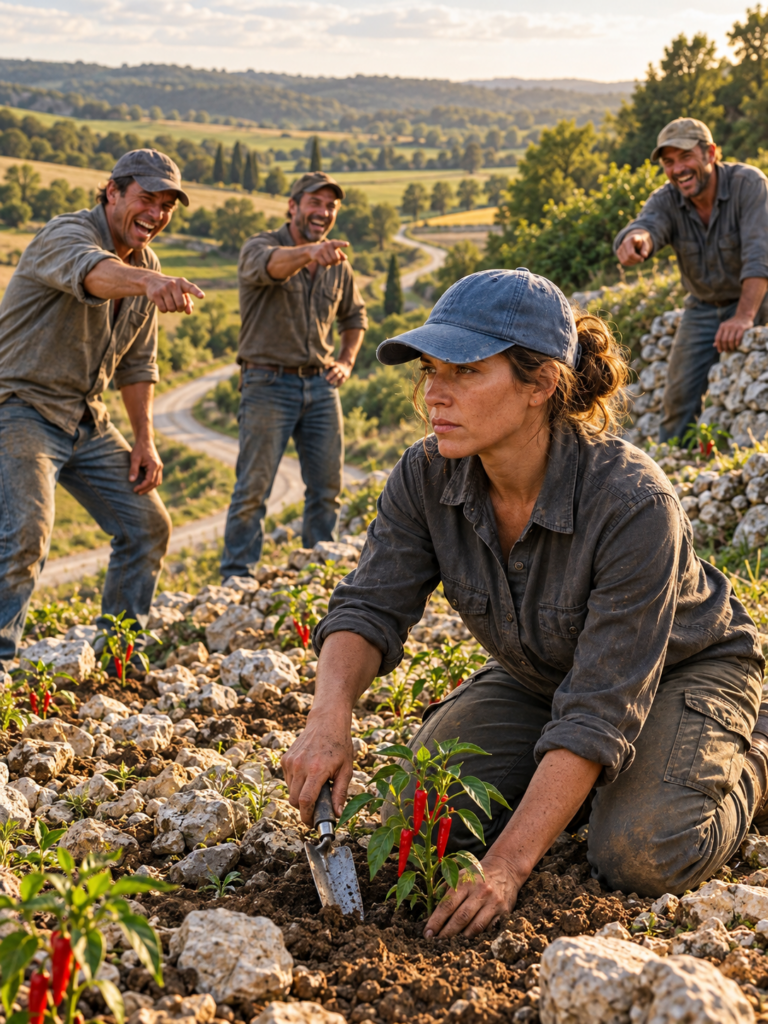
He stood beside his county extension truck on the gravel road below Caldwell Ridge Farm, his clipboard tucked beneath one arm, his shoes planted on ground that had never given him any trouble. Above him, under a hard Tennessee sun, I was kneeling between two slabs of limestone with a cayenne pepper seedling in my hand.
There were 339 more waiting to be planted.
Harold didn’t call out immediately. He watched me lower the seedling into a narrow pocket of soil, straighten its roots, and press the dirt firmly around the stem. Then I reached for the cord I’d marked with red thread every eighteen inches and measured the distance to the next planting spot.
The rock beneath my knees was already hot enough to burn through my work pants.
It was August of 1979. Harold was forty-eight years old, had served fourteen years as Putnham County’s agricultural extension agent, and carried the kind of authority that came from having advised three generations of farmers who knew him by name.
Five years earlier, he had signed an official assessment declaring that same hillside unsuitable for commercial crop production.
I knew his reasons almost as well as he did.
Thin soil. Exposed limestone. Too much slope. Equipment couldn’t get up there. Too much risk of frost.
His report was in a manila folder in our kitchen, signed in blue ink at the bottom of the last page.
I had read it nine times.
And now the man who had written it was watching me put my savings into the very ground he had advised us to abandon.
“Ruth Ellen,” he finally called.
I turned my head.
“You understand what you’re risking up there?”
“Yes, sir.”
He glanced toward the rows of seedlings waiting in the shade.
“All three hundred and forty?”
“That’s the plan.”
Harold looked back at the exposed rock.
He hadn’t come to insult me. I knew that much. He was the kind of man who took his work seriously, and I had given him every reason to believe I was making an expensive mistake.
But I had spent too much time preparing to stop because his expression suggested I should.
I pressed my dibble bar into the next patch of earth.
The iron point struck stone.
I shifted it two inches to the left and tried again.
That time it went down.
What Harold couldn’t have known, standing there on the road, was that the decision had begun seven years earlier, when my father came down that same hill and discovered he would never be able to work it again.
My daddy, Earl Caldwell, had never been gentle with himself.
For thirty years, he had climbed that slope with tools across his shoulders and come down carrying whatever the land had given him. He worked in rain, wind, and summer heat, hauling firewood, seed, and harvest sacks along a path that grew steeper each year as his body grew older.
He had never complained much.
When a job needed doing, he did it.
When there was another job waiting, he started that one.
By October of 1972, his back had finally reached a place stubbornness couldn’t carry him past.
Three herniated discs.
The doctor at the Veterans Administration clinic in Cookville didn’t soften the news. Daddy could keep working the level ground, carefully, but there would be no more climbing steep slopes or carrying loads over uneven terrain.
If he ignored that advice, he risked spending the rest of his life unable to move without pain.
I remember the day he came home from the appointment.
He sat at the kitchen table without removing his work jacket. His boots were still dusty. Mama put coffee in front of him, and he looked through the window toward the hillside.
Neither of them spoke for a long while.
Finally, Daddy said, “Well, I reckon the hill’s going to have to look after itself.”
He tried to make it sound like a joke.
Mama didn’t laugh.
That hillside had been part of how he understood himself. Taking it away felt almost like telling him he wasn’t a farmer anymore.
But we still had forty acres of bottomland, and somebody had to keep them producing.
That somebody was my mother.
Dorothy May Caldwell was forty-four then. She had spent twenty years learning a farm that most men in Putnham County assumed she only helped maintain.
She knew which field stayed wet after a June storm. She knew when the corn needed water and which section would show stress first. She knew what a fair buyer paid, which scales were worth trusting, and how long our money would last when a harvest came in short.
She kept those things mostly to herself.
Not because she lacked confidence.
Because in that part of Tennessee, a woman could know a great deal about farming and still find people more comfortable when she let a man do the talking.
When Daddy stopped working the hill, Mama simply took charge of what remained.
She hired help when we could afford it and did the work herself when we couldn’t. She handled the accounts, scheduled the planting, and made decisions with a quiet efficiency that left little room for argument.
Daddy never had to announce she was running the place.
She already was.
The abandoned slope slowly disappeared beneath sumac, weeds, and young scrub cedar. The old working path grew narrow. Rain loosened stones that rolled downhill and collected along the fence.
For two years, nobody saw much reason to climb it.
Then, in 1974, Harold Briggs came out to assess it.
The county extension service was conducting an inventory of marginal agricultural land. Our south slope qualified for inspection, and Harold spent two hours measuring the grade, photographing exposed stone, studying the soil, and recording the area’s weather risks.
He was thorough.
That was one thing nobody could fairly take from him.
Three weeks later, the report arrived by certified mail.
I can still picture the white envelope with the state seal in the corner.
Mama opened it at the kitchen table.
The conclusion was plain enough.
The limestone lay too close to the surface. Much of the hillside had insufficient topsoil for conventional annual crops. The grade exceeded fifteen percent in portions of the assessment, creating difficulties for mechanized farming. At that elevation, frost could arrive late enough to destroy vulnerable plants.
The recommendation was to allow the hill to return to natural vegetation or establish native ground cover.
No productive commercial use was anticipated.
Mama read every page, folded the report, and filed it away.
She didn’t argue.
She had forty acres to keep alive, bills to pay, and a husband who was still trying to make peace with the fact that he couldn’t climb a hill he had worked most of his adult life.
I was twenty years old that year, finishing agricultural production studies at Tennessee Tech while working weekends at a dried-pepper processing facility in Sparta.
When Mama mentioned the report in a letter, I didn’t give it much thought.
I had seen that hill all my life.
It was difficult ground.
Harold hadn’t told us anything we didn’t already believe.
At least, that was what I thought then.
I finished my certificate program in 1976 and went to Nashville.
For the next two years, I worked in quality control at a food-grade spice processing plant near Antioch. The work wasn’t glamorous. I inspected shipments, reviewed processing standards, checked moisture and quality records, and learned why two sacks of peppers that looked nearly identical could sell for very different prices.
That was where I began to understand the thing Harold’s assessment had never considered.
A crop’s value wasn’t always determined by how much land could produce.
Sometimes, it depended on what the land made different.
I noticed the price difference first.
Cayenne from parts of the Middle Tennessee hill country regularly commanded more money than peppers grown on broad, level farms in Georgia or Arkansas.
The premium could run thirty to forty percent above the reference price for ordinary cayenne.
At first I assumed it was a matter of reputation.
Then I started asking the buyers.
“What’s special about the hill-country peppers?” I asked one afternoon.
A man who had been sorting spice shipments for longer than I had been alive rubbed a dried pod between his fingers.
“Flavor,” he said.
I waited.
He smelled the crushed pepper before answering again.
“Heat’s got character to it. You can tell the difference.”
The technicians had more specific explanations.
Soil composition. Elevation. Drainage. Temperature variation. The way certain traditional varieties responded to growing conditions that might be unfavorable for crops bred to produce large quantities of uniform fruit.
And the more I listened, the more often I thought about our abandoned slope.
Caldwell Ridge sat in the same hill-country zone.
Its rocky south-facing ground had precisely the conditions that made conventional farming difficult.
I began wondering whether those same conditions might be useful for something else.
One researcher lent me a technical bulletin from the University of Tennessee Agricultural Experiment Station dealing with peppers grown in upland environments.
I carried it home and read it until the pages began to soften at the corners.
The bulletin described the thermal behavior of exposed limestone.
Rock absorbed solar heat during the day and slowly released that heat after sundown. Under the right conditions, the immediate air around a rocky slope could remain several degrees warmer than exposed ground nearby.
Two or four degrees didn’t sound like much.
But if a late frost dropped open-field temperatures below freezing, those degrees could determine whether a plant survived.
Then there was the pepper itself.
The variety I wanted wasn’t one of the commercial hybrids advertised in seed catalogs.
Older farmers around Putnham County called it Tennessee Mountain Cayenne.
It was an open-pollinated pepper that local growers had maintained for generations, saving seeds from plants that performed well in the uplands.
The variety had adapted to conditions that could be hard on standard cayenne grown in warmer, flatter regions.
You couldn’t simply order a thousand plants from a national supplier.
The seed survived in old tins, exchanged between neighbors, and through the county Farm Bureau’s seasonal seed exchange.
I started asking where I could find it.
By the time I left Nashville in 1978, I had saved some money and accumulated a notebook full of calculations.
I was twenty-four years old.
I came home with two suitcases, the knowledge I’d gathered at the spice plant, and an idea I hadn’t yet shared with my parents.
The first morning after I returned, I climbed the hillside.
It had been years since I’d walked the upper section carefully.
The slope ran about a quarter of a mile along the ridge, climbing roughly 130 feet from bottom to crest. Much of it was steep, with some sections reaching an angle of twenty-five degrees.
Limestone broke through the surface everywhere. In some places, only eight inches of compacted earth rested above the bedrock. Elsewhere, there were narrow pockets of deeper soil trapped between stone.
The most important detail was the hillside’s southeast exposure.
Sunlight reached it early and stayed on the rock for much of the day.
I crouched beside a pale slab and laid my palm against it.
Even in the afternoon, the stone held warmth.
And for the first time, I stopped thinking of that heat as one more reason the hill was difficult to farm.
I began thinking of it as something we could use.
Over the next month, the kitchen table became my office.
I spread out Harold’s assessment, the university bulletin, planting-density recommendations, price records from Nashville, and sheets of calculations.
I divided the hill into three sections based on the density of exposed rock and the depth of usable soil.
I estimated how many plants each section might support, how much labor hand planting would require, and what it would cost to buy transplants from a grower in White County.
The labor cost worried me most.
No tractor could prepare that hillside properly. No mechanical planter could find a root pocket between two slabs of limestone.
Every seedling would have to be planted by hand.
I calculated the worst reasonable returns I could justify from the market prices I knew. Then I calculated the better ones.
Both scenarios suggested the original investment could be recovered during the second production year.
By the third year, income from the hillside, measured against its usable acreage, could surpass what we earned from our bottomland corn.
I checked the arithmetic again.
Then again.
One evening after supper, I laid everything out for Mama.
She listened while I explained the limestone, the sun exposure, the frost risk, the mountain cayenne variety, and the buyers willing to pay more for an intensely flavored regional pepper.
Daddy sat nearby, listening without interrupting.
I showed Mama the expenses.
Then the projected returns.
Then the pages showing how the different growing zones would be planted.
When I finished, she studied the county report lying beside my notebook.
“What about this?” she asked.
“Harold assessed it for the kinds of crops people normally grow with equipment,” I said. “What I’m talking about won’t require a tractor on the hill.”
“That doesn’t mean the risk isn’t real.”
“No, ma’am.”
“You’re certain you’ve accounted for that?”
“As carefully as I know how.”
She looked at the calculations again.
I could hear the radio playing softly in the other room.
Finally, she put a hand on my shoulder.
“Then you’d better get started before somebody else figures it out.”
That was my mother’s way.
She wasn’t giving me a promise that everything would work.
She was telling me that if I had done the thinking, I needed to do the work.
In May of 1979, I took my notebook to Harold Briggs.
His office in Cookville smelled of paper, coffee, and the dust that came in with farmers’ boots.
I placed the university bulletin on his desk alongside his original assessment.
He listened patiently while I explained the plan.
Then he opened my notebook and worked through the numbers.
For a moment, I thought the calculations might interest him.
Instead, he leaned back in his chair.
“Ruth Ellen, experimental research and commercial farming aren’t the same thing.”
“I understand that.”
“The conditions in that bulletin were studied under controlled circumstances. You haven’t established that your hillside will behave the same way.”
“I’ve measured the rock exposure and the slope orientation.”
“But not the actual temperature differential.”
“Not yet.”
He tapped the report.
“And the frost history isn’t theoretical. It’s documented. One bad season could wipe out your investment.”
He didn’t raise his voice.
He wasn’t mocking me.
That almost made it harder.
Harold was offering advice he genuinely believed would protect my family.
“I’d stay with the bottomland,” he said. “You’ve got ground there that works. I wouldn’t risk your savings on a hill we already assessed as unsuitable.”
I thanked him.
Then I drove home and spent another evening reviewing everything.
I wasn’t interested in proving Harold wrong merely because his conclusion hurt my pride.
If the project failed, it would be Mama and Daddy who had to live with what I’d lost.
So I contacted the researcher whose name appeared on the university bulletin.
I asked three specific questions about limestone heat retention, hill orientation, and the elevation of our property.
He answered them carefully.
The conditions I described were consistent with the research.
It wasn’t a guarantee.
But it was enough to justify trying.
I placed the order for 340 Tennessee Mountain Cayenne transplants.
They arrived in a borrowed pickup one Wednesday morning in August.
My cousin Paty helped me unload them.
She had been widowed that spring and was living at the farm. She never made a speech about wanting to help. When she learned what I planned to do, she simply started preparing for the work as though her involvement had been settled all along.
We carried the growing trays onto the shaded porch.
Some plants stood twelve inches tall, others closer to eighteen. Their roots were contained in the growing medium, their leaves fresh from the early-morning trip.
I separated the strongest plants for the upper slope, where the soil was thinnest and the rock most exposed.
The smaller plants would go into deeper pockets farther down.
On the first day, I climbed the hill carrying wooden stakes and a hand maul.
The temperature in the bottomland reached ninety-four degrees.
Up on the limestone, it felt hotter.
I marked roughly four hundred possible planting positions across the three sections, moving stakes whenever the rock beneath them offered no sufficient depth for roots.
I finished covered in dust and sweat.
The next morning, I began planting.
Every hole had to be considered separately.
Sometimes the dibble bar slipped between the rocks almost easily.
Other times I worked ten minutes to find sixteen inches of usable root depth.
On the third day, Harold arrived with a young technician.
They stood on the gravel road watching me.
Harold pointed toward the upper slope.
“That section has less than ten inches of soil in most places,” he called. “The roots will be restricted. They’ll suffer moisture stress when it turns dry.”
I moved a stone aside and checked the gap beneath it.
“You could try twenty or thirty plants on the lower section,” he continued. “At least then you’d limit the risk.”
I settled another transplant into place.
He waited for an answer.
When I didn’t offer one, he began explaining the assistance programs available for marginal farmland.
I knew he was trying to help.
But I’d already made the decision he was attempting to talk me out of.
Eventually, he and the technician returned to the truck.
Before leaving, Harold lowered his window.
“That assessment wasn’t written to cause your family trouble, Ruth Ellen. I wrote what the evidence supported.”
I stood up and wiped my forehead with my sleeve.
“I know you did, Mr. Briggs.”
His truck rolled away.
Paty was coming up the hill with a bucket of water from the cistern.
“What did the county man want?” she asked.
I took the bucket.
“Same thing he wanted in May.”
“And what’s that?”
“For me to plant fewer peppers.”
Paty looked across the unfinished rows.
Then she lifted the next bucket and started climbing.
By the fourth afternoon, I had blisters beneath my gloves and scrapes along both knees. Every muscle in my back ached from bending over rocks that seemed determined to fight me.
But the seedlings were in the ground.
All 340.
That evening, Mama had pinto bean soup waiting on the kitchen table and a glass of sweet tea beside my chair.
I ate without saying much.
Outside the window, the hillside lay in the fading light.
For the first time in years, something besides sumac and scrub cedar was growing there.
I wanted to believe I had done the hardest part.
I hadn’t.
Because in a small farming county, planting something unusual on impossible ground didn’t just put your money at risk.
It gave everybody else something to watch.
And by the time my last seedling was settled, four men had already begun waiting for the hill to prove me wrong.
Part 2
The first to make a habit of visiting was Orville Pucket.
Orville was seventy-three years old, owned more land than anybody else in Putnham County, and had been raising corn, tobacco, and cayenne since before Harold Briggs was born.
He understood the hill country in ways no university textbook could teach.
He also believed that once a piece of land had demonstrated its limitations, a sensible farmer respected them.
One morning, he pulled up near the foot of our slope with his son-in-law, Jean.
I was working along the upper section, checking the soil around the newest transplants.
Orville got out of his truck and examined the hillside.
“Well, I’ll be,” he said. “Earl Caldwell’s girl went and planted peppers in the rock pile.”
Jean stood beside him with his hands on his hips.
“Looks that way.”
Orville pointed his chin toward the upper rows.
“Walter Sims tried something like that across the hollow back in fifty-eight. Lost the whole crop to a Good Friday frost.”
Jean shook his head.
“That ground won’t hold moisture long enough anyhow.”
I could hear every word.
They knew I could hear them.
I kept checking the plants.
Orville wasn’t cruel. He had made his living through droughts, failed crops, hard winters, and market prices that sometimes barely paid the cost of harvesting. To him, my decision looked like youth refusing to learn from experience.
The second regular visitor was Bobby Ray Tatum.
Bobby Ray was forty-two and operated a cayenne farm on the creek-bottom fields of a neighboring cooperative property.
He knew peppers.
That was why I listened when he spoke, even when I disagreed.
One Saturday, he stopped beside me on the gravel road.
“Ruthie, I think a whole lot of you,” he said. “And I don’t want you to take this the wrong way.”
I waited.
“That hill’s going to eat every dollar you’ve put into it.”
He looked genuinely troubled.
“Peppers need moisture. Those rocks aren’t going to hold it. Then you’ve got the frost to worry about.”
“I’ve accounted for the moisture conditions.”
“On paper.”
“With field measurements, too.”
“Not through a whole growing season.”
He was right about that.
I couldn’t claim to have measured a growing season that hadn’t happened yet.
“I suppose we’ll find out,” I said.
He rubbed his chin.
“That’s an expensive way to find out.”
The third doubter, of course, was Harold.
Even when his county rounds didn’t officially require a stop at our farm, I began noticing his truck along the road.
Sometimes he spoke.
Sometimes he walked a few yards from the truck, studied the slope, and wrote something on his clipboard before leaving.
Once he brought the same young technician who had watched me planting.
The technician crouched beside a row and examined the soil while Harold looked up toward the exposed rock.
I didn’t interrupt them.
If Harold wanted measurements, I wanted measurements too.
The fourth was my cousin Dale Caldwell.
Dale was twenty-eight, a cousin from my father’s side, and carried the memory of a failed farming venture like a weight nobody else could see.
Two years earlier, he’d borrowed money through a Farm Service Agency loan to establish a greenhouse tomato operation.
A whitefly infestation had destroyed the crop during the first season.
He lost the investment before he had a chance to recover much of anything.
Afterward, Dale developed a strong opinion about farming experiments.
They were foolish, he believed, unless a person had enough money to survive losing everything.
“I know how this goes,” he told me.
We stood beside the porch while Paty washed dirt from a row of buckets.
“You spend money getting it started. Then you spend more trying to save it. By the time you admit it isn’t going to work, you’re too far in to get out.”
“I’m sorry that happened to you, Dale.”
“I’m telling you because I don’t want it happening to you.”
I believed him.
That was the strange thing about those four men.
None of them needed me to fail.
Not really.
Orville trusted the lessons of old farming ground. Bobby Ray trusted what eighteen years of raising cayenne had taught him. Harold trusted his technical assessment. Dale trusted the painful education he’d paid for with borrowed money.
Each man had reached a conclusion that made sense within his own experience.
What they didn’t know was whether that conclusion applied to the crop I was growing under the conditions I had chosen.
And until the hillside produced evidence, neither did I.
So I made a decision.
If I couldn’t stop the opinions, I could at least gather information better than opinions.
I began keeping a field notebook in a way that left as little room for guessing as possible.
At three locations on the hillside, I installed minimum-temperature thermometers. I recorded their readings every two weeks and compared them with the county weather station.
I established five fixed soil-sampling points on the hill and five corresponding points on the bottomland. Each was identified by a code, and the hillside locations were marked with red-painted steel rebar.
Every sample went into a labeled bag with the date, depth, and location recorded.
Every two months, I sent those samples to Tennessee Tech’s soil-testing laboratory.
I also selected twenty plants in each of the three growing sections and marked them with colored yarn.
I measured their height, stem diameter, and development, recording changes from one observation to the next.
It was slow work.
Some days I wanted to finish my chores and sit on the porch without looking at another number.
But the notebook became the one place where nobody’s reputation carried any weight.
A reading was a reading.
A measurement didn’t care who had predicted it.
Paty took an interest in the records.
On Sunday mornings, after the farm work allowed us a little time, she’d sit with me at the kitchen table and compare the entries.
She was particularly good at noticing patterns I’d missed.
“Your upper rows are behaving differently again,” she said one Sunday, tracing a column with her finger.
“They always behave differently.”
“Not in exactly the same way.”
I leaned closer.
She was right.
The upper section, where the soil was thinnest and the limestone most exposed, showed more pronounced differences than I had expected.
Some of the plants were growing more slowly than those below. Their response to water was different. The nighttime temperatures around them were different too.
We didn’t have enough evidence yet to decide whether that would help or hurt the eventual pepper harvest.
But it was worth following.
And I had learned at the spice plant that the most valuable information wasn’t always the information that confirmed what you already believed.
By February of 1980, word of the project had reached a university researcher.
His name was Dr. James Whitfield.
He was forty-one years old, held a doctorate in upland production systems from the University of Kentucky, and was working with the University of Tennessee Agricultural Experiment Station.
A colleague had mentioned my hillside records during a research meeting in Knoxville.
Dr. Whitfield came to Caldwell Ridge wearing work clothes rather than a suit.
That impressed Daddy immediately.
The doctor didn’t begin by asking me to explain why I thought I knew more than the county agent.
Instead, he asked permission to walk the hill.
“Take all the time you need,” I told him.
He spent nearly two hours examining the three sections.
He collected soil samples, checked the rock exposure, and measured conditions using his own instruments.
I watched him from below for part of the morning.
He moved slowly and carefully, sometimes remaining in one place for several minutes before writing in his notebook.
When he returned, we sat beneath the old cedar at the base of the hill.
“May I see your records?” he asked.
I handed him the notebook.
He turned the pages without speaking.
After twenty minutes, he closed it and laid one hand on the cover.
“You’ve been consistent with the measurements.”
“I wanted to know whether the temperature difference was real.”
“It’s unusually consistent for a working limestone hillside.”
I tried not to let my relief show.
“Does that mean the peppers are going to produce?”
He gave a small shake of his head.
“It means the temperature measurements deserve further attention. Commercial yield is a different question.”
That answer made me trust him more.
He hadn’t come looking for a success story.
He was interested in understanding what was happening.
“Would you mind if I visited monthly this year?” he asked.
“Not at all.”
He smiled.
“Good. There’s something worth studying here.”
After he left, I stood at the kitchen sink looking through the window toward the hillside.
Mama came in and set a clean dish towel on the counter.
“Well?” she asked.
“He wants to come back.”
“To tell you you’re making a mistake?”
“No, ma’am.”
She followed my gaze.
“Then I guess you’d better keep that notebook where he can find it.”
The real test arrived less than two months later.
Early April had brought a spell of warm weather.
The pepper plants were showing tender new growth, and the days were mild enough to make it tempting to believe winter had finally let go.
Then the forecast changed.
Cold air moved into the county on April 9, 1980.
By sundown, the sky had cleared and the wind had weakened, the kind of conditions that could allow nighttime temperatures to fall sharply.
I checked the thermometers before dark.
Paty helped me make sure the water containers and measuring equipment were secured.
Down in the bottomland, the evening air felt colder than it had at the house.
I climbed to the upper section before returning inside.
The limestone still held some of the day’s warmth.
That warmth was the heart of my entire calculation.
But I couldn’t make it remain there by wishing.
That night, I slept badly.
I kept thinking about the report.
Late frost risk.
The warning that Harold had repeated so many times.
If my measurements were wrong, I might wake up to find the newest growth damaged across the whole hillside.
At daybreak, I pulled on my boots and went outside.
The air was bitter enough that my breath showed.
I passed the cedar tree and climbed the path toward the nearest thermometer.
The reading stopped me.
Thirty-three degrees Fahrenheit.
I checked the instrument again.
Then I walked to the other measurement points.
The temperature readings supported what I was seeing.
The pepper plants had survived.
I crouched beside one and examined its newest growth.
No blackened leaves.
No collapsed stems.
No obvious frost injury.
I stayed there longer than I needed to, looking from the plant to the pale rock surrounding it.
Later, the county weather station’s recorded minimum came in.
Twenty-eight degrees.
Five degrees colder than the reading I’d taken among the upper limestone rocks.
The difference was within the range suggested by the earlier research, allowing for the particular conditions of that night.
The hillside had held enough heat to keep the plants from suffering the damage I’d feared.
Down on the creek-bottom fields, Bobby Ray’s cayenne hadn’t been so fortunate.
The frost burned vulnerable new growth and delayed development by roughly three weeks.
By his own estimate, it cost him a quarter of his projected yield that season.
I was sorry for his loss.
I knew what that kind of setback could do to a farm’s accounts.
But I couldn’t deny what the numbers showed.
The ground Harold considered the greater frost risk had protected my crop during the very event he had warned me about.
I opened the notebook and recorded the date, temperature, weather-station comparison, and condition of the plants.
I didn’t write a single word about Harold.
There was no need.
The measurements said more than an argument ever could.
When Dr. Whitfield returned, he examined my records and checked the plants himself.
He asked how I’d positioned the thermometers and whether I had moved any of them before recording the minimum temperatures.
I explained everything.
He studied the readings for a long while.
Finally, he said, “That’s a useful field observation.”
I nearly laughed.
After months of wondering whether I had thrown away my savings, useful field observation was about the most encouraging phrase I could imagine hearing from a scientist who chose his words as carefully as Dr. Whitfield did.
But the frost was only one problem.
The thin soil still concerned the others.
Orville continued stopping by, often with Jean.
Even after seeing the plants survive the cold, he maintained that a dry summer would prove the hillside’s weakness.
“Rock don’t hold water,” he reminded me one morning.
“No, sir. Not the way deep soil does.”
“Those peppers will suffer for it.”
“Possibly.”
He glanced at me.
“You don’t sound worried.”
“I am worried.”
“Then why aren’t you doing something about it?”
I looked toward the upper rows.
“Because I’m trying to understand what kind of stress the plants can tolerate before I decide what needs changing.”
Orville considered that answer.
He didn’t agree.
But he didn’t laugh either.
The summer brought plenty of work.
Paty hauled water from the cistern while I monitored establishment and growth. We maintained the planting spaces by hand, kept the access path clear, and recorded the differences between the three hillside zones.
I watched the plants in the shallowest soil more closely than any others.
Their growth was not identical to the lower sections.
Some were shorter, and they behaved differently when moisture was scarce.
Yet they continued developing.
And the more I observed them, the more I began to suspect that the same limitations reducing their size might be affecting the character of the peppers they produced.
By March of 1981, Dr. Whitfield was no longer the only university researcher interested in our farm.
He brought Dr. Sandra Morse, a food scientist from the University of Tennessee who had spent twelve years studying traditional capsicum varieties across Tennessee, Kentucky, and the western Carolinas.
Dr. Morse arrived carrying sampling supplies, a field notebook, and a camera fitted with a close-up lens.
She was quiet and precise.
She didn’t ask me to explain what I hoped the hillside would prove.
She wanted to see the plants and the evidence.
I led her to the path and explained the three growing sections.
Then I stepped aside.
She walked the hill alone for nearly two hours, examining plant and fruit characteristics, choosing sampling locations, and recording observations.
When she finished, she joined me beneath the cedar tree.
She spread her notes across her knees.
“Your upper section is particularly interesting,” she said.
“Because of the rock?”
“Because of what the plants are producing under those conditions.”
Her analyses showed that cayenne associated with the upper section had a capsaicin concentration approximately thirty-eight percent higher than comparable Tennessee Mountain Cayenne grown on bottomland.
I looked at her.
“Thirty-eight percent?”
“That’s what the measurements indicate.”
She showed me the results.
The difference mattered because capsaicin was the compound responsible for a pepper’s heat.
Plants growing in fertile, consistently moist soil could put more resources into vigorous growth and larger fruit.
Under moderate water and soil limitations, certain cayenne varieties could develop a different balance between fruit size and pungency.
Our upper section had less usable soil, faster drainage, and more exposure to limestone than either of the other zones.
Those were the conditions Harold had identified as weaknesses.
And now they appeared to be associated with the very quality that specialty buyers valued most.
I remembered the man at the spice plant in Nashville crushing a dried pod between his fingers.
Heat’s got character to it.
He hadn’t known the technical explanation.
But he’d recognized the difference.
Dr. Morse turned another page.
“The important question now is whether you can produce consistent commercial quantities at a premium price.”
“I’ve been working toward that.”
“Dr. Whitfield tells me you’ve kept records since the beginning.”
“Yes, ma’am.”
She looked toward the upper hillside.
“Would you be interested in helping write a research paper about traditional upland cayenne production?”
I felt a momentary rush of disbelief.
Two years earlier, the county agent had advised me to plant a few experimental peppers at most.
Now a university scientist was asking me to contribute to a paper.
But I wasn’t finished proving the business case.
“I’d rather complete the third year’s commercial data,” I told her. “Then we’ll know what the market actually pays.”
Dr. Morse nodded.
“That’s a reasonable approach.”
When she left, I went back up the hill.
The plants growing among the densest limestone suddenly looked different to me.
Not because they had changed.
Because I had begun to understand why they might be valuable.
The autumn of 1981 brought the first complete commercial harvest from the hillside.
By then, the difference between the upper and lower growing sections was visible.
The upper-zone pods tended to be smaller than peppers raised on rich bottomland soil. But they developed an unusually deep red color, and when dried, their fragrance was powerful.
Dr. Morse had described that aroma as characteristic of the traditional Tennessee Mountain Cayenne variety.
I carried samples to three buyers.
One was at the regional produce market in Cookville.
Another was a specialty spice distributor I knew through my work near Antioch.
The third was a Nashville buyer Dr. Whitfield had helped me contact.
Each buyer handled the dried peppers in much the same way.
They examined the color, crushed a pod to judge its texture, and smelled the released aroma.
Each eventually offered a price.
Thirty-four percent above the USDA reference price for standard cayenne that season.
I had estimated a differential close to that figure while sitting at Mama’s kitchen table years earlier.
Now it was no longer a projection.
The actual offers supported my conservative financial scenario.
I came home with the buyers’ figures written down, placed them beside my old calculations, and spent an hour comparing the pages.
Paty pulled out a chair.
“Well?” she asked.
“They offered thirty-four percent above the reference price.”
She blinked.
“All three?”
“All three.”
She leaned across the table and looked at the numbers.
Then she sat back.
For a moment, neither of us spoke.
Finally, she said, “We ought to show your mama.”
I wanted to.
More than anything, I wanted her to see that the money I had put into the hillside wasn’t simply disappearing into rock and weeds.
But the person who changed the farm’s future wasn’t one of the three buyers.
He arrived because of Orville Pucket.
For more than a year, Orville had been taking a closer interest in my notebooks than he was willing to admit.
He’d begun asking occasional questions about the pepper quality and what the university researchers were finding.
Sometime that fall, he mentioned our hillgrown cayenne to a business associate named Warren Hatch.
Warren operated an artisan hot-sauce business in Nashville and supplied restaurants in Nashville and Chattanooga.
For years, he’d been looking for a reliable source of traditional Tennessee Mountain Cayenne.
He could buy small quantities from individual growers, but the supply was inconsistent. The quality varied, and he couldn’t count on getting enough pepper of the same character from season to season.
Then Orville told him about Caldwell Ridge.
Warren drove to our farm one Thursday in November without calling ahead.
He was a practical-looking man who spoke plainly and seemed more interested in the hillside than the story behind it.
After introducing himself, he asked whether he could walk the growing areas.
“Of course,” I said. “I’ll show you where—”
“I’d prefer to see it on my own first, if you don’t mind.”
That caught me off guard.
But I pointed him toward the path.
He climbed slowly, stopping in each section to examine the harvested plants and the pods still remaining.
He spent the longest time at the upper slope.
From the porch, I watched him bend beside one plant, stand again, and move toward another.
He had the patient manner of someone trying to judge whether what he’d heard could be trusted.
When he came down, we sat beneath the cedar tree.
He took off his hat and rested it on his knee.
“Orville told me your peppers have a different character from the standard cayenne I’ve been buying.”
“The lab measurements support that.”
“I’ve seen the samples.”
He glanced up the hill.
“What interests me is that you can keep the quality separate from the bottomland product.”
“Yes, sir. I’ve tracked the three zones since planting.”
He nodded.
“That’s important.”
Then he made an offer I hadn’t expected.
A purchase contract covering three seasons.
A fixed-price arrangement with annual adjustments and payment within fifteen days of delivery.
The price would recognize the special quality of the hillside crop.
But he had one condition.
The peppers grown on the slope had to be marketed separately under the Caldwell Ridge Hillgrown designation.
No mixing them with conventional bottomland cayenne.
No losing the distinction that made them valuable.
“People are buying the pepper,” Warren said, “but they’re also buying where it comes from. This ridge is part of what makes it worth more.”
I looked back toward the rows.
For two years, I had been fighting to prove the hill could produce something at all.
Now a buyer was telling me the hill’s identity was something I needed to protect.
Three weeks later, Warren returned with the contract.
We signed it at the kitchen table.
Paty witnessed the signatures.
Mama sat beside me, her hands resting on the wood while she read through the agreement one last time.
When everything was finished, Warren shook my hand and gathered his papers.
I walked him to the door.
After his truck disappeared down the lane, I returned to the kitchen.
Mama was still sitting at the table.
“What’s the matter?” I asked.
“Nothing.”
But there was something different in her expression.
She looked at the contract, then toward the hillside outside the window.
“Your daddy worked that ground a long time,” she said quietly.
“I know.”
“He always thought there had to be something more we could do with it.”
She touched the edge of the paper.
“I wish he could’ve worked up there beside you.”
I sat down across from her.
So much of what I’d done had begun with watching Daddy lose the work he loved.
Now the hill was producing income again, not because we had found a way to make it behave like level farmland, but because we had finally chosen a crop that suited its unusual conditions.
For the first time, we had a contract that recognized that difference.
I should have felt finished.
Instead, I found myself thinking about Harold Briggs.
He had been measuring farms for almost twenty years.
He had warned me honestly, repeatedly, that I was risking everything.
And now the evidence was beginning to show that his report had missed something important.
I wondered what he would say when he finally understood it.
I didn’t have long to wonder.
Because the following autumn, Harold came back to Caldwell Ridge.
This time, he left his clipboard behind.
Part 3
Harold arrived on a cool morning in the fall of 1982.
I was near the bottom of the hillside, checking the last rows before we weighed the harvested peppers for delivery to Warren Hatch.
The crop had developed beautifully that season.
Up on the upper section, some of the plants stood more than four feet tall. Deep-red cayenne hung in dense clusters, and the air carried the dry, sharp fragrance that Warren’s buyers had come to recognize.
The limestone was still visible everywhere.
We hadn’t buried it beneath truckloads of imported soil or tried to turn the slope into something it wasn’t.
The peppers grew among the rocks, exactly where I had believed they could.
I heard a vehicle coming down the gravel road and looked up.
Harold’s extension truck stopped near the cedar tree.
He climbed out alone.
There was no young technician with him.
And no clipboard.
He closed the truck door and stood looking up the hillside.
I returned to tying the mouth of a burlap sack, expecting him to call out when he was ready.
But he didn’t.
He stood there for a long time.
Later, I realized it had been close to fifteen minutes.
He looked up toward the upper rows, where the cayenne had developed its richest color. Then he studied the lower section, where the soil was deeper and the plants grew differently.
He turned toward the bottomland cornfields, already cut for the season.
Finally, he looked back at the hillside.
I could guess what he was seeing.
Two kinds of agricultural ground, side by side.
One suited to conventional farming.
The other suited to something neither of us had fully understood when he wrote his assessment.
Eventually, he walked toward me.
“Morning, Ruth Ellen.”
“Morning, Mr. Briggs.”
He removed his cap.
“I wonder if I might ask you something.”
“Of course.”
He glanced toward the top of the hill.
“Would you be willing to walk up there with me? I’d like you to explain what you’ve done.”
I rested the sack against my leg.
For a moment, I remembered him standing on that same road three years earlier, warning me that the limestone wouldn’t hold moisture and the spring frost could destroy my crop.
I remembered the university bulletin lying open on his desk.
The twenty or thirty plants he’d advised me to try instead of 340.
The offers of assistance if my investment failed.
All those memories passed through my mind while he waited for an answer.
“I’m finishing the weigh-in,” I told him. “It’ll be about an hour.”
He nodded.
“I can wait.”
And he did.
He sat beneath the old cedar while we finished our work.
When I was free, I walked over and led him up the path.
We began in the lower section, where the soil pockets were deeper.
I showed him the spacing, the locations of the sampling points, and the plants I’d monitored since the beginning.
Then we climbed higher.
The steeper ground made Harold slow his pace.
At the middle section, I stopped and pointed out the exposed limestone that absorbed heat during the day.
I explained the temperature measurements, including the frost of April 9, 1980.
“Twenty-eight degrees at the county station,” I reminded him.
“I remember.”
“Thirty-three here.”
He studied the rock.
“And no frost damage.”
“None that I observed.”
He nodded slowly.
Farther up, I showed him the upper planting area.
The soil was still thin. The drainage was still fast. The rock remained close to the surface.
None of the physical limitations described in his report had disappeared.
“The plants here don’t produce the biggest pods,” I said. “But the heat concentration is higher. Dr. Morse measured the difference.”
“Thirty-eight percent.”
I looked at him.
He had remembered the number.
“Yes, sir.”
He reached toward a ripe pod but stopped short of touching it.
“And the buyers are paying for that quality?”
“That’s what Warren’s contract is based on.”
Harold stood quietly for a while.
Then he looked downhill toward the truck.
“I assessed this property for the kinds of crops we normally evaluate.”
“I know.”
“I was looking at the disadvantages.”
“They were real disadvantages for most crops.”
He turned back toward the cayenne.
“But not necessarily for this one.”
“No, sir.”
There were several things I could have said.
I could have reminded him that he’d watched me work under a hundred-degree sun while predicting failure.
I could have asked how many times he intended to visit before admitting I had been right.
But I didn’t want to humiliate Harold.
He had come asking to understand.
That mattered more than making him apologize.
We spent the rest of the walk talking about plant density, moisture stress, and what the tests had shown.
When we returned to the cedar tree, his truck was still parked exactly where he’d left it.
He put on his cap.
“Thank you for showing me.”
“You’re welcome.”
He looked toward the hillside once more.
Then he drove away.
There was no dramatic announcement afterward.
No gathering of neighbors.
No public declaration that the county agent had been wrong.
But something important had changed.
Harold had stopped treating the hill as a problem already settled by an old document.
He was willing to look at it again.
And the following year, he had even more reason to reconsider.
In January of 1983, the University of Tennessee Agricultural Experiment Station published a regional research bulletin containing a case study of Tennessee Mountain Cayenne production on limestone uplands in Putnham County.
Dr. James Whitfield and Dr. Sandra Morse had compiled three years of observations from the Caldwell Ridge project.
The case study addressed the hillside’s temperature behavior, the reduced frost risk associated with the limestone microclimate, the higher capsaicin concentration found in peppers grown under moderate stress, and the premium prices obtained in the specialty market.
It wasn’t simply a story about one successful harvest.
It brought the scientific measurements and commercial results together.
The researchers had documented how land considered unsuitable for conventional production could support a valuable specialized crop when its environmental characteristics matched the crop’s requirements.
A copy arrived at the Putnham County Extension Office in February.
Harold called me the same day.
“Ruth Ellen, I’ve read the bulletin.”
“Yes, sir?”
“I’d like to bring you a copy.”
He arrived that afternoon carrying the publication.
On its cover, he’d written a note in his own handwriting.
He told me that the research had been possible because of the measurements I’d taken and the decision I’d made to test the hillside under real farming conditions.
I read his note twice.
Then I looked at him.
“Mr. Briggs, could I ask you to do something for me?”
“Certainly.”
“The next time somebody brings you a rocky hillside to assess, will you ask what they intend to grow before deciding the ground isn’t worth farming?”
He was silent.
I continued.
“Your report told us what the hill couldn’t do. But it never asked what we wanted it to do.”
Harold looked down at the bulletin.
For once, he didn’t reach for a technical explanation.
“You’re right,” he said.
He let the words stand for a moment.
“That was an error in my process. I should have asked.”
I felt something loosen inside me.
For years, I had carried that report around in my mind almost as heavily as Daddy had carried sacks down the hillside.
It had been an official judgment about land our family had spent decades trying to work.
Now the man who had written it understood the difference between saying the land was unsuitable for a familiar kind of farming and saying it had no productive purpose at all.
“Thank you, Harold,” I said.
He nodded.
We talked about the bulletin for a little while longer.
Then he went back to his office.
The hillside remained exactly where it had always been.
But the way people looked at it was changing.
Orville Pucket was the first neighbor to act on what he’d learned.
That following spring, he planted Tennessee Mountain Cayenne on a rocky slope of his own property.
He got the transplants from the nursery bed I had established at Caldwell Ridge, where I’d been saving seed from the strongest plants in the upper section.
I helped him choose planting locations that gave the roots sufficient depth.
He listened more carefully than I would have expected from a man who had once stood on the road comparing my efforts to a failed farm experiment from 1958.
At one point, he straightened and looked down across his land.
“Reckon I’ve spent a fair number of years walking past ground I ought to have examined better,” he said.
I smiled.
“So have most of us.”
That summer, Bobby Ray Tatum came to the farm alone.
He arrived on a weekday afternoon and found me working near the equipment shed.
He didn’t waste much time on conversation.
“Ruthie, I owe you something.”
I set down what I was carrying.
“What’s that?”
“An apology.”
I looked at him.
“The rock and the thin soil did what you said they would. I’ve seen the figures. I was wrong.”
He looked uncomfortable, and I knew the admission hadn’t come easily.
“Bobby Ray,” I said, “you told me what you believed was true.”
“Didn’t make it right.”
“No. But you were working with what you knew. What we knew was incomplete.”
He looked toward the hillside.
“Never thought I’d see peppers worth more because they grew in poorer ground.”
“Neither did I, until I started listening to the buyers.”
He gave a quiet laugh.
“Guess there’s always something left to learn.”
In November, Dale Caldwell came by with questions of his own.
He wanted to know how much the transplants cost, what it took to establish the plants, how we handled water, and how I’d arranged the purchase contract.
I showed him the records.
I didn’t promise him that my results could be repeated on every rocky slope.
His greenhouse failure had taught both of us that farming offered no guarantees.
But I explained the growing system as carefully as I could.
The following year, Dale planted a hillside crop.
Watching him try again meant almost as much to me as watching the other men change their minds.
He’d spent years believing one failed experiment proved that all unusual farming ideas were too dangerous to attempt.
Now he was willing to examine evidence and take a measured risk again.
The greatest institutional change came in 1986.
Harold Briggs joined Dr. Whitfield and Dr. Morse in publishing a technical extension guide for evaluating Middle Tennessee limestone uplands for Tennessee Mountain Cayenne production.
The guide included a procedure for measuring the heat-retention effect of limestone slopes.
That procedure hadn’t been part of the county’s conventional assessments before my project.
In his introduction, Harold acknowledged the field observations I’d conducted at Caldwell Ridge between 1979 and 1982.
He described how the measurements had helped verify under actual production conditions what university research had predicted.
I read the acknowledgment sitting at the same kitchen table where I’d once laid out my calculations for Mama.
Outside, the hill was green and productive.
I thought about how different things might have been if I’d put Harold’s assessment back in the folder in 1978 and never opened my notebook.
No measurements.
No research paper.
No guide.
No reason for other farmers to reconsider rocky ground they’d already given up on.
Yet I also knew that none of it had been accomplished alone.
Mama had trusted my preparation.
Paty had hauled water, helped gather measurements, and eventually taken responsibility for maintaining the field records with a thoroughness that surpassed mine.
Dr. Whitfield and Dr. Morse had brought expertise I didn’t possess and tested the results carefully.
Even Harold, once he recognized the limitations of his original assessment, had helped turn what we’d learned into something useful to other growers.
The farm continued operating under the Caldwell Ridge Hillgrown designation.
Our agreement with Warren Hatch was renewed four times.
The cayenne from the upper section remained the most valuable portion of the hillside crop, prized for its intensity and distinct character.
The rows that had been hardest to plant were producing the peppers for which buyers were willing to pay the highest premium.
And Mama kept walking the hill.
By then, she had developed a habit of going up early in the morning, coffee cup in hand, before the rest of the farm was fully awake.
She moved slowly along the path between the three growing sections, occasionally touching a leaf or examining the developing peppers.
The morning light struck the limestone at an angle, turning the exposed rocks pale gold.
Wrens and cardinals had begun visiting the growing areas as the plants established enough foliage to provide shade and shelter.
Sometimes I watched Mama from the porch.
I thought about the years when she’d managed the bottomland while Daddy sat below the hill he could no longer work.
I thought about the report arriving in its official envelope, declaring that no productive use was anticipated.
And I wondered whether she’d believed in my plan from the beginning or simply understood how badly I needed to try.
One morning, I caught up with her near the upper section.
We walked the rest of the way together.
At the highest point, we stopped and looked down across the bottomland toward the distant ridges near the White County line.
Mama sipped her coffee.
For a while, neither of us spoke.
Then she said, “Your daddy would’ve laughed at that county report.”
I looked at her.
“He might have.”
“No.” She smiled faintly. “He would have. Not because he knew anything about these peppers, mind you.”
She turned toward the rows.
“But because somebody tried to tell him that hill had nothing left to give.”
I followed her gaze.
The plants stood among the limestone, their leaves moving gently in the morning air.
Mama took another sip of coffee.
“That’s why you went up there, isn’t it?”
I didn’t answer immediately.
For years, I’d explained the business case to everyone who asked.
The microclimate.
The premium market.
The soil conditions.
The old regional pepper variety.
All those things were true.
But Mama was asking about something deeper.
I remembered Daddy sitting at the kitchen table in 1972, staring out the window after the doctor told him he couldn’t climb the hill anymore.
I remembered the way he’d tried to make a joke of losing work that had defined his life.
And I remembered how helpless I’d felt watching him realize he would have to leave the slope behind.
“Yes, ma’am,” I said.
Mama nodded.
She had known all along.
We stood together until the sunlight reached farther across the upper rows.
Then we started back down.
The original 1974 assessment remained in the manila folder with our farm documents.
I never threw it away.
In 1986, while the technical guide was being prepared, I took it out for Dr. Whitfield to examine.
He read the report carefully, page by page.
When he finished, he set it on the table.
“It’s a thorough assessment based on what they understood at the time,” he said.
I waited.
“The trouble isn’t that he measured the wrong things.”
“What is it, then?”
“He never established which crop the farmer intended to grow.”
I looked at the pages lying between us.
That was the whole difference.
Harold had measured the rocks correctly.
He had recorded the thin soil and the steep grade. He had recognized the frost risk associated with the location. His concerns about conventional farming had been legitimate.
But he had treated those characteristics as proof that the hillside offered no commercial opportunity.
He hadn’t considered that another crop, grown with another method and sold to another market, might respond to those same conditions differently.
For years, the report had seemed like a verdict.
Now I could see it for what it was.
An answer to a question that hadn’t been complete.
I folded the document and returned it to the folder.
There was no reason to destroy it.
It belonged to the farm’s history as surely as the planting records, the university bulletin, and the contract bearing Warren Hatch’s signature.
Whenever I looked up at the hillside afterward, I could still picture that first August morning.
Harold standing on the road with his clipboard.
Paty carrying water from the cistern.
My knees pressed against hot limestone.
The iron point of my dibble bar striking rock until I found a place deep enough for roots.
Three hundred and forty seedlings.
Three hundred and forty individual decisions to keep working when it would have been easier to stop.
I hadn’t made the hillside fertile in the conventional sense.
I hadn’t changed the angle of the slope or removed the bedrock.
I had learned what the ground was capable of producing, then found a market that valued it.
My father had given more than thirty years of labor to that ridge.
My mother had held the farm together when he could no longer climb it.
And when the official report said there was nothing worth growing on the hill, I had chosen to test that conclusion rather than accept it as the final word.
The real victory wasn’t that Harold admitted his mistake.
It wasn’t the premium price, the purchase contract, or even the research that followed.
It was seeing the same hillside my father had been forced to abandon become useful again, without pretending it was anything other than what it had always been.
Rocky.
Steep.
Thin-soiled.
Difficult.
And, for the right crop, extraordinarily valuable.
The county assessment had measured the land and found its limitations.
But the assessment was never the land itself.
And the land had never needed to read it.


