
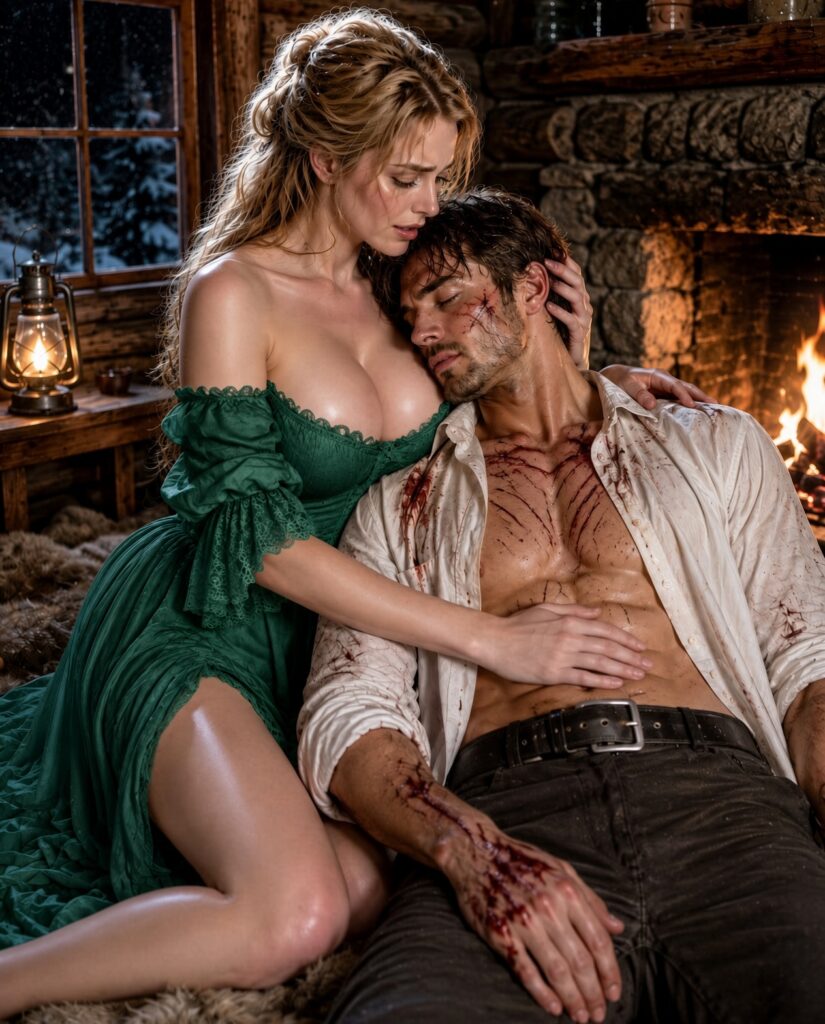
It Hurts… Please Stop”—The Frightened Bride Whispered, But the Mountain Man Did Something She Never Expected**
“It hurts,” Josie whispered, frozen beneath the heavy furs as she waited for her new husband to become angry. “Maybe we can try again tonight… please.” But instead of punishing her, Caleb Hayes quietly moved away.
Josie stared at him in disbelief.
Only hours earlier, she had married the enormous, scarred mountain man and followed him into his isolated cabin. She had expected their arrangement to be simple, even if frightening.
Caleb had paid her train fare from Chicago.
He had given her shelter, food, and his name.
And Josie believed she knew what he expected in return.
Before coming west, she had been an orphaned textile worker breathing cotton dust every day and watching her meager wages disappear into rent. When Caleb’s marriage offer arrived, she had nowhere else to go.
So she accepted.
Now, lying rigid in his bed, she expected anger when she disappointed him.
Instead, Caleb pulled the wolf fur over her shoulders.
Without another word, he crossed the cabin and sat beside the fire.
He never touched her again that night.
The following evening, Josie’s fear returned when Caleb told her to leave the supper dishes.
She glanced nervously toward the bed.
But Caleb wasn’t looking at it.
He opened a wooden chest and removed a small amber bottle and a strip of clean cloth.
“Sit.”
Josie hesitated.
Then Caleb gently took her hand.
Only then did she realize he had noticed the blister on her thumb from when she had burned herself against the stove that morning.
He cleaned the injury carefully and wrapped it.
Then his eyes met hers.
“You don’t need to fear the bed,” he said.
Josie swallowed.
“But the contract—”
“I paid for a wife,” Caleb said quietly. “Not a prisoner.”
He released her hand.
“Not tonight. Not tomorrow. Not until you’re ready.”
For the first time since arriving in the mountains, Josie looked at him without seeing the frightening stranger she had married.
Something had changed.
Over the next three weeks, Caleb never broke his promise.
Then the first great snowstorm struck.
Wind hammered the cabin while snow piled across the roof. Caleb climbed outside to clear the dangerous weight as Josie struggled to hold the door against the gale.
Suddenly, a massive frozen sheet broke loose.
It crashed down.
Caleb disappeared beneath the snow.
“CALEB!”
Josie plunged outside.
Snow reached her waist as she clawed desperately through the drift with her bare hands.
Then a hand burst through the snow and caught her wrist.
Together they fought their way back into the cabin.
Soaked.
Shivering.
But alive.
As Josie watched Caleb trembling beside the fire, she finally understood what had happened to her.
She wasn’t afraid of belonging beside this man anymore.
**She was afraid of losing him.**
Weeks later, their food stores began running dangerously low.
Caleb left before dawn with his rifle.
Hours passed.
Then Josie heard a single gunshot echo somewhere beyond the mountain.
After that came silence.
Afternoon faded into darkness.
Caleb still hadn’t returned.
Josie placed a lantern in the window and waited beside the door, listening to the wind.
At last, heavy footsteps scraped across the porch.
“Caleb?”
The door slowly opened.
Josie’s breath stopped.
Caleb stood there barely able to remain upright, his clothing stained with blood.
He tried to take one more step.
Then his knees buckled.
“Caleb!”
Josie rushed forward as the mountain man collapsed into her arms.

**The Cabin on the North Fork**
Josie rushed forward as the mountain man collapsed into her arms.
He was heavier than she expected even half-conscious, all bone and work and the wet wool of his coat. Blood had soaked through the left side of his shirt and down his thigh. The smell of it—iron and pine pitch and something animal—filled the small entry. She got her shoulder under his arm and dragged him the last three steps to the hearth because the bed was too far and she was not strong enough to pretend otherwise.
“Caleb. Stay with me. Caleb.”
His eyes opened, unfocused, the pale winter color of river ice. “Bear,” he said, or she thought he said. The word came out broken. “Got the shot. Then the slope.”
She did not ask for the rest. She cut the shirt away with the same knife he used for kindling. The wound was a long, ragged tear across the ribs, not a clean hole. Claw, she realized. The bear had reached him after the shot, or during it. Lower, on his thigh, a second gash where he had fallen or been thrown against rock. She packed both with the cleanest cloth she had, the same kind he had used on her blistered thumb three weeks earlier, and bound them tight while her hands shook so hard the knots looked like a child’s.
He did not make a sound until she tightened the rib bandage. Then a low breath left him, more surprise than pain.
“Don’t you dare,” she whispered. “You told me I didn’t have to fear the bed. You don’t get to leave me alone in this cabin after that.”
His mouth twitched. It might have been an attempt at a smile. Then he slept, or lost consciousness; she could not tell the difference and did not care as long as his chest kept rising.
The night became a series of small, necessary acts. She kept the fire high. She melted snow because the water bucket had frozen at the edges. She changed the cloths when they soaked through. She talked because silence made the wind outside sound like something with teeth.
She told him about the textile mill in Chicago, the way cotton dust lived in the lungs until girls coughed blood into their sleeves and were told it was only the season. She told him about the letter that had arrived with a ticket and a description that mentioned height and a scar and “steady habits.” She told him she had stood on the platform in a dress that did not fit and looked for a man who might be kind and found instead a man who looked like the mountain itself had decided to walk.
Caleb did not answer. He burned and then grew cold and then burned again. Once, near morning, he gripped her wrist with surprising strength and said, “Josie. Door.”
She checked the bar. It was still down. When she came back he had already sunk again.
By the third day the fever broke.
He woke clear-eyed and furious at his own weakness. Josie had learned, in the weeks before the storm, that Caleb Hayes treated injury the way some men treated debt: as a personal insult. He tried to sit up. She put a hand on his uninjured shoulder and did not move it.
“You will tear it open.”
“The meat—”
“Is hanging. I found the cache. I cut what we needed. I am not a fool, Caleb. I grew up where food disappearing meant someone went hungry until the next wage.”
He looked at her for a long time. The scar that ran from his temple into his hairline—the one she had noticed first on the church steps and tried not to stare at—stood white against the fever flush that was finally fading.
“You went outside.”
“The bear was dead. You made sure of that. The slope was the only thing that nearly finished the work.”
He exhaled through his nose, a sound that in another man might have been a laugh. “Sit.”
She sat. He took her hand, turned it, and looked at the thumb he had bandaged weeks ago. The blister had healed to a pink shine.
“You have good hands,” he said, as if noting the weather. “Steady.”
Josie did not know what to do with the compliment, so she busied herself with the broth. When she brought the cup he let her hold it while he drank, which told her more about the pain in his ribs than any grimace would have.
The storm lasted eleven days.
They learned the shape of each other in that closed, firelit space the way people learn a language they did not expect to need. Caleb could not hunt and would not allow her to try the high ridges alone, so they stretched what they had: beans, the last of the flour, the bear meat she had hauled in pieces and frozen in the lean-to, tea that tasted of pine because the real leaves had run out. He taught her to set a snare from the doorway using a long pole. She taught him that bread could be stretched with mashed beans if a person was not proud.
At night she slept on her side of the bed because he had given her that side the first evening and had not asked for it back. He slept sitting up against the wall for the first week so he would not roll onto the wound. Sometimes she woke and found him watching the fire, not her, as if the flames required guarding.
On the eighth night she said, “You can lie down. I will wake if you need the bandage.”
He considered it the way he considered every change—slowly, without waste. Then he eased onto his back. The furs rustled. Josie lay still, counting her own breath, until his settled into the deeper rhythm of real sleep. She did not touch him. She did not need to. The fact of him remaining in the room was enough.
When the wind finally dropped, the world outside had been remade. Snow stood higher than the windows. Caleb, still moving like a man who remembered every claw mark, dug a path to the woodpile and the necessary outbuilding. Josie followed with the lantern even though he told her to stay in. She had discovered, during the hours he was missing, that staying in while he was out felt like waiting for a second collapse.
They did not speak of that afternoon on the porch. They did not need to. She had felt his weight leave his knees. He had felt her arms take it.
February came in bitter and bright. The wound on his ribs closed to a tight, ugly seam. The thigh healed faster. He began splitting wood again, shorter sessions, while she watched from the doorway and hated how her stomach dropped every time the axe rose.
One afternoon he paused, rested the axe, and said without looking at her, “You still think about Chicago?”
“Sometimes. The noise. The way the air never moved.”
“And the letter. Would you answer it again?”
Josie wrapped her shawl tighter. The question was not casual. Nothing he asked was casual.
“I answered it because I had no other door,” she said. “I would answer it now because I know what is on this side of it.”
Caleb nodded once. He split another log. The sound carried across the buried meadow like a shot.
That night he did not sit by the fire after supper. He stood by the bed and waited until she looked up from mending.
“I am going to say this once, and then I will not say it again unless you ask.” His voice was the same quiet he had used when he wrapped her thumb. “I wanted a wife because a man can live alone on this mountain until he cannot. I did not want a frightened girl in my bed to prove I had paid the fare. If you never want the rest of it, you still have my name and this roof and whatever food I can put on the table. That was the contract I meant. The other kind can wait until you are the one who opens the door.”
Josie set the mending down. Her throat felt tight in a way that had nothing to do with cold.
“And if I am the one who opens it?”
“Then I will still go slow.” A faint, almost unwilling warmth moved through his face. “I am a large man. I know what that looks like to someone who has been hungry and cornered. I will not be the next thing that corners you.”
She crossed the small space between them. She did not touch him yet. She only stood close enough to feel the heat that always came off him, even in winter.
“I was afraid of the dark on the train,” she said. “I was afraid of the preacher who married us in five minutes. I was afraid of you because you were the first person in years who could have hurt me and chosen not to, and I did not know what to do with that. I am not afraid of the dark anymore. I am not afraid of you. I am afraid of the morning you walk out for game and the mountain keeps you.”
Caleb’s hand rose, stopped, and then settled—light as snow—against the side of her neck. His thumb rested at the hinge of her jaw. He waited.
Josie leaned into the contact.
It was not a kiss, not yet. It was the first time she had moved toward him without calculating the nearest exit. He let out a breath that sounded like something finally set down.
“All right,” he said. “Then we will be careful with mornings too.”
They were.
March brought a thaw that was a liar; the snowmelt flooded the creek and then froze again overnight. Caleb tracked a small deer on the fourth clear day and brought it home without incident. Josie learned to render fat and smoke strips. She learned the names of the peaks he pointed to from the ridge. She learned that he had a brother who had died in a logging accident ten years earlier and a mother who had written once from Ohio and then stopped. He learned that she still sometimes woke reaching for a sister who had been sold west by an uncle when Josie was twelve and never seen again.
They did not make a ceremony of grief. They simply set it on the table with the stew and let it sit until it became part of the room.
The first time they came together it was April, and the creek was loud with runoff, and Josie had spent the day planting the first cautious rows in the plot he had dug on the south side of the cabin. She came inside smelling of wet earth. Caleb was mending a harness by the window. She watched his hands—those large, scarred, precise hands—and thought of the night he had moved away from her instead of taking what the law said was his.
She went to him, took the leather from his fingers, and said, “I am ready. Not because I owe you. Because I want to know what it is like when I am not afraid.”
He searched her face the way he searched a trail for sign. Then he stood, taller than the room seemed built for, and kissed her with a patience that made her eyes sting.
What followed was not the thing she had imagined on the train, all force and transaction. It was slow, and sometimes awkward, and once she laughed because his beard tickled and he looked so startled by the sound that she laughed again. When it hurt she said so. He stopped, adjusted, asked if she wanted to continue. She did. Afterward he held her as if she might still vanish, and she fell asleep to the sound of his heart under her ear and the creek running high outside.
In the morning he was already at the stove. Coffee. The good skillet. He glanced over when she sat up, and the look on his face was not triumph. It was something quieter and more dangerous: relief.
“Still here,” she said.
“Still here,” he answered.
Summer on the North Fork was short and fierce. They put up hay in the high meadow. Josie learned to shoot the rifle well enough that Caleb stopped standing between her and every unfamiliar sound. A surveyor passed through in July and told them the railroad talk had started again farther south; Caleb listened, thanked the man, and did not change a single plan. Their life was not made of towns.
In September Josie missed her courses. She waited two weeks to be sure and then told him while they were stacking the last of the wood. Caleb went still in the way he did when a storm was deciding its path. Then he sat down on the chopping block as if his knees had remembered the porch.
“A child,” he said.
“If it holds.” She had seen enough mill girls lose them early to know better than certainty.
He reached for her hand, the same careful reach he had used on her burned thumb, and pressed his mouth to her knuckles.
“Then we will be careful with mornings,” he said, “and with winters, and with whatever else the mountain sends.”
The child held.
She was born in April, a year after the night Josie had crossed the room and taken the harness from his hands. The labor was long. Caleb did not leave the cabin. He had sent word down-valley for a woman who midwifed, but the pass was still uncertain, and in the end it was the two of them again, as it had been in the storm. When the girl cried, Josie wept and Caleb laughed that same startled, unused laugh she had heard the night the snow sheet nearly killed him.
They named her Hannah, after no one in particular, only because the name sounded like a place a person could rest.
Years later, when travelers asked how a Chicago mill girl had come to live at the edge of the tree line with a man who looked carved from the same granite as the peaks, Josie would sometimes tell the short version: a letter, a ticket, a winter.
The longer version she kept for the quiet hours after Hannah slept.
It began with *it hurts, please stop*.
It continued with a man who moved away.
It became a life because he had meant the second contract more than the first: not a prisoner, not a transaction, only a wife, when she was ready, and a partner in the work of not dying on a mountain that did not care whether they lived.
On winter nights when the wind hammered the roof the way it had the night the snow came down, Josie still reached across the bed. Caleb’s hand found hers without fail. Down the loft ladder Hannah breathed the easy breath of a child who had never known cotton dust or a locked mill gate.
Josie had boarded a train believing she was selling the last thing she owned.
She had arrived to discover that some men paid the fare in order to give something back.
The mountain had tried, more than once, to take him.
She had gone into the drift with bare hands and pulled.
She would do it again.
That was the marriage. Not the five minutes before the preacher. The years after the door closed and neither of them opened it to leave.


