
He Ordered a Bride to Save His Ranch—Then the Scarred Woman Stepped Off the Train and Saved His Dying Cattle
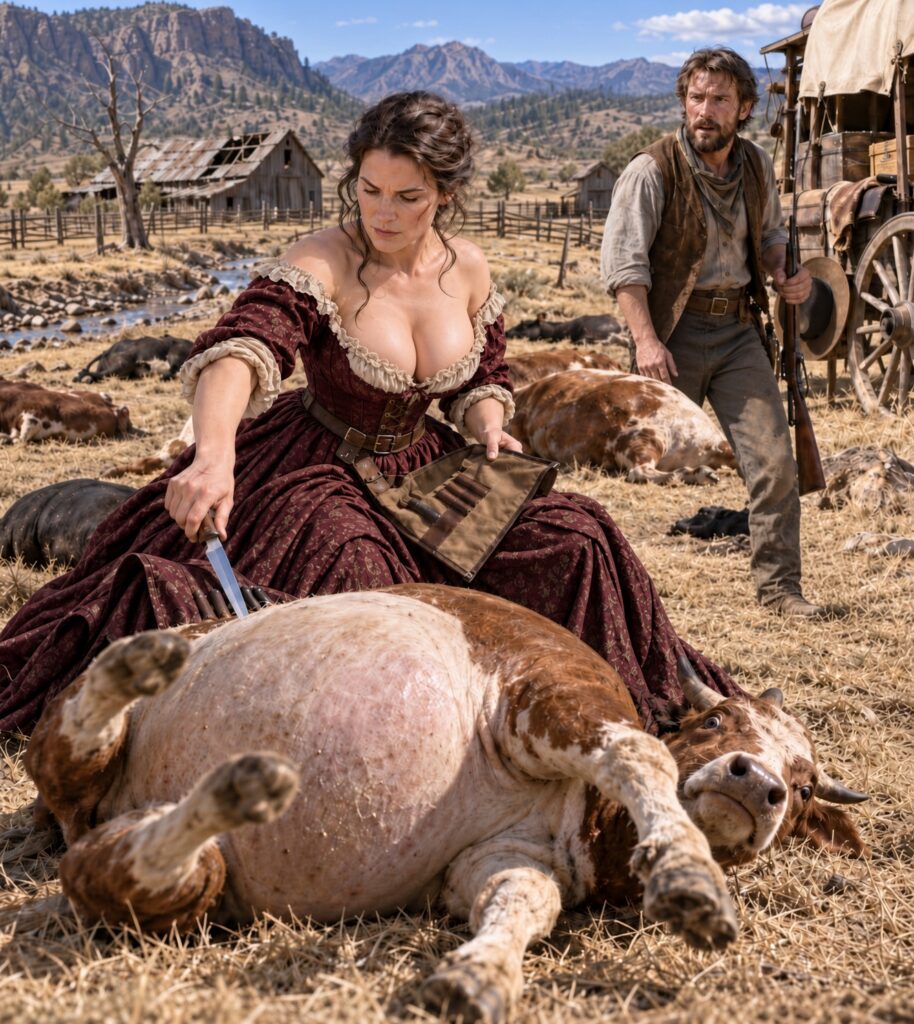
Six cattle lay dying in the lower pasture when Cora Jenkins arrived at Broken Spur Ranch, and while Wade Callahan reached for his rifle, she stopped him and asked for his sharpest knife. **“They’re still breathing,” she said. “That means they’re alive.”** Then she asked him to find her a hollow tube.
Wade had expected his mail-order bride to arrive frightened, uncertain, and perhaps already regretting the decision to marry a stranger.
He had not expected Cora to step down from the train carrying a canvas trunk in one hand and a butcher’s roll in the other.
She was tall and broad-shouldered, with a scar across one knuckle and another running along her jaw. She studied Wade for several quiet seconds before saying,
“You look worse than your photograph.”
For the first time in months, Wade nearly laughed.
He had forgotten what that felt like.
Three months earlier, when he placed the advertisement seeking a wife, Broken Spur Ranch had eighty-three cattle, enough water, and a chance of surviving another season.
Now the creek was nearly dry.
The barn roof leaked.
One wall had begun to lean.
And the herd had fallen from eighty-three animals to fifty-nine.
The bank had already sent two letters.
If Wade could not make his payment, they could take the ranch before October.
He decided Cora deserved the truth before she made another mile with him.
At the wagon, he finally said, “I have nine dollars and forty cents left after paying your fare.”
Cora looked at him.
Wade waited for anger.
Instead, she climbed into the wagon.
“You aren’t angry?” he asked.
“I worked fifteen years in the Chicago stockyards,” she replied. “I’ve eaten beans three meals a day and been grateful there were beans.”
Wade glanced at her.
Then she asked, “Do you still want a wife?”
He swallowed.
“Yes.”
“Then drive.”
Three hours later, they reached Broken Spur.
Cora had barely stepped down from the wagon when she saw the lower pasture.
Six cattle were lying on the ground.
One steer kicked weakly, its belly swollen tight.
Wade’s expression changed instantly.
“Bloat.”
He moved toward the barn.
“These cattle are all I have left.”
He reached for his rifle.
Cora caught his sleeve.
“They’re still breathing.”
“Barely.”
“That means alive.”
She opened her butcher’s roll and looked toward the pasture with the calm concentration of someone who had seen frightened animals and desperate men before.
Then she held out her hand.
“Give me your sharpest knife.”
Wade stared at her.
“You know what to do?”
Cora looked at the swollen steer.
“I know what happens if we stand here arguing.”
She pointed toward the barn.
“Find me a hollow tube.”
For the first time since Wade had met her, he realized something important.
**Cora Jenkins had not come west because she was helpless.**
She had come because she knew how to survive.
And now, with the last cattle of Broken Spur Ranch dying in the pasture, Wade was about to discover exactly what fifteen years in the stockyards had taught her.

Cora did not wait for Wade to decide whether he trusted her.
She was already moving.
“Tube,” she repeated.
Wade ran.
By the time he returned from the barn with a narrow length of copper tubing, Cora was kneeling beside the worst steer.
The animal’s sides were distended so severely the skin seemed stretched over a barrel.
Its eyes rolled.
Foam clung to its mouth.
Wade had seen bloat before.
He also knew how often the animals died once they reached this stage.
Cora took the tube.
“Hold his head.”
“What are you doing?”
“Trying the safer way first.”
Wade dropped beside her.
The steer thrashed weakly.
Cora worked with astonishing calm, passing the tube carefully while Wade restrained the animal.
For several terrifying seconds, nothing happened.
Then trapped gas rushed through the tube with a sound like wind escaping a bellows.
Wade stared.
The steer’s swollen side began, slowly, almost impossibly, to soften.
Cora did not smile.
“Next one.”
They worked until sunset.
Two responded to tubing.
One required a more desperate intervention Cora explained in clipped, practical words.
Another had already gone too far.
Wade buried that animal the following morning.
But five survived.
Five.
When the final steer managed to get its feet beneath it, Wade stood in the pasture with his shirt soaked in sweat and his hands trembling.
Cora cleaned her knife in a bucket of water.
“You saved them.”
She glanced toward the herd.
“No.”
“You did.”
“They survived.”
“That’s the same thing.”
“It isn’t.”
She rolled the knife back into its leather wrap.
“In the stockyards, you learn not to claim too much credit for what decides to keep breathing.”
Wade studied her.
The scar along her jaw caught the last light.
It began below her ear and curved toward her chin.
He had noticed it at the train station.
He had tried not to stare.
Now he wondered what kind of life left a woman able to kneel beside dying cattle without shaking.
“You should wash up,” he said.
Cora looked down at her ruined dress.
“You have water?”
“Some.”
“That sounded expensive.”
“It is.”
“Then give me half a basin.”
Wade almost protested.
Instead, he nodded.
Because after three hours at Broken Spur, Cora Jenkins understood his situation better than most men who had known him ten years.
The house was worse than Wade had admitted.
Cora discovered that before supper.
The kitchen roof leaked in two places.
One bedroom window had been stuffed with cloth where the glass had cracked.
The stove smoked if the wind blew from the east.
The pantry contained beans, flour, salt, half a sack of potatoes, coffee, and one jar of peaches Wade had apparently been saving for the end of civilization.
Cora stood with her hands on her hips.
“This is all?”
Wade leaned against the doorway.
“There’s bacon.”
“Where?”
“I ate it yesterday.”
She looked at him.
“That explains why you look guilty.”
“I was hungry.”
“So am I.”
“I can butcher—”
“No.”
He frowned.
“No?”
“You have fifty-eight cattle left.”
“Fifty-nine.”
“One died.”
His jaw tightened.
“Fifty-eight.”
“You are not eating your mortgage.”
Wade stared at her.
Then she pulled the beans from the shelf.
“We eat these.”
“For supper?”
“Yes.”
“What about tomorrow?”
“More beans.”
“And after that?”
She lifted the flour.
“We become adventurous.”
For the second time that day, Wade almost laughed.
This time he actually did.
It surprised both of them.
Cora paused.
“There.”
“What?”
“You look less dead when you do that.”
The laugh vanished.
Wade looked away.
Cora noticed.
She noticed everything.
But she did not ask.
Not yet.
They ate beans at a table built by Wade’s father.
The silence between them was not uncomfortable.
Just unfamiliar.
Wade had spent three years eating alone.
Before that, his younger brother Thomas had lived on the ranch.
Before Thomas left for Colorado.
Before their father died.
Before Wade began measuring every season by how much less he owned at the end of it.
Cora scraped the bottom of her bowl.
“When do we marry?”
Wade nearly choked.
“What?”
“You advertised for a wife.”
“I know what I advertised for.”
“I traveled nearly a thousand miles.”
“I paid the fare.”
“With your last nine dollars.”
“Nine dollars and forty cents.”
She gave him a look.
“Yes. Your fortune.”
Wade set down his spoon.
“I thought you might want time.”
“To decide?”
“Yes.”
“I decided before I boarded the train.”
“You didn’t know me.”
“You didn’t know me.”
“That’s different.”
“Why?”
Wade opened his mouth.
Nothing came.
Cora leaned back.
“You wanted someone who could cook, keep house, maybe help with accounts.”
Wade said nothing.
“You expected a thin woman in a bonnet who would blush when you looked at her.”
“I never said thin.”
“You thought it.”
He almost smiled.
Cora continued.
“You also assumed she would need you.”
Something in her voice changed.
Not bitterness.
Experience.
Wade studied her.
“And you don’t?”
“I need land.”
There it was.
Clean.
Unromantic.
Honest.
“Why?”
Cora looked toward the dark window.
“Because I spent fifteen years killing animals that belonged to other men so those men could grow rich.”
She folded her hands.
“I don’t want to die in Chicago renting one room over a butcher shop.”
Wade listened.
“I want something that stays where I put it.”
She looked back at him.
“A garden. A table. Maybe chickens.”
“That’s not much.”
“It is when you’ve never owned anything.”
Wade felt the words.
He understood them.
Broken Spur was failing, but it was still his.
He had never considered how miraculous that might look to someone who had possessed nothing.
“And a husband?” he asked.
Cora’s eyes met his.
“If he is decent.”
Wade swallowed.
“And if he isn’t?”
“I know how to use knives.”
He stared.
Cora’s mouth twitched.
“I’m mostly joking.”
“Mostly?”
“Eat your beans.”
They married two days later.
The preacher in town looked from Wade to Cora three separate times as if expecting one of them to flee.
Neither did.
Cora wore the same brown dress she had arrived in, cleaned as well as the ranch water allowed.
Wade wore his least damaged shirt.
The preacher’s wife served them coffee afterward.
Then they drove home in silence.
Halfway back to Broken Spur, Wade said, “You can have the bedroom.”
Cora looked at him.
“Where will you sleep?”
“Barn loft.”
“No.”
“I’ve slept there before.”
“You have a house.”
“Technically.”
“And now a wife.”
Wade gripped the reins tighter.
Cora noticed.
“You’re frightened of me.”
“No.”
“You look like a man about to face a firing squad.”
“I’m trying to be respectful.”
“You can respect me from your side of the bed.”
He nearly dropped the reins.
Cora looked forward.
“I married you, Wade.”
“I know.”
“I don’t expect you to behave like I’m made of glass.”
His voice lowered.
“I don’t know what you expect.”
She was quiet for a moment.
Then she said, “Neither do I.”
That was the first honest thing either of them had said about the marriage.
It became the beginning.
Cora did not save Broken Spur with one miracle.
She saved it with questions.
Why were the cattle grazing the lower field?
Why had Wade stopped rotating pasture?
Why was the western trough unused?
Why were the weakest animals mixed with the strongest?
Why was the creek nearly dry when the old well still had water?
Wade’s answers became increasingly defensive.
“The pump broke.”
“Fix it.”
“I don’t have the parts.”
“Make them.”
“I’m not a blacksmith.”
“You own a forge.”
“It belonged to my father.”
“Did the forge stop working when he died?”
He stared at her.
She stared back.
Three days later, Wade repaired the pump using scrap iron, leather, and profanity.
The western trough began filling again.
Cora separated the thinner cattle.
She mixed salt and minerals from supplies Wade had stopped using because he thought he couldn’t afford to replace them.
“You’re feeding money to cows,” he complained.
“I’m keeping money alive.”
She inspected the pasture plants.
Asked about every death.
Made him describe symptoms.
Two animals had not died from drought at all.
They had likely eaten toxic weeds after being forced into overgrazed ground.
Cora found the patch.
They fenced it off.
Within ten days, the herd stopped declining.
Within three weeks, several animals began gaining weight.
Wade started looking at Cora differently.
Not like a bride.
Not yet.
Like a storm that had decided to organize his life.
One morning he found her on the barn roof.
“What are you doing?”
“Fixing it.”
“Get down.”
“No.”
“You’ll fall.”
“I worked above slaughter chutes while twelve-hundred-pound steers tried to crush men for a living.”
“That doesn’t make this safe.”
She drove another nail.
“It makes your argument unimpressive.”
Wade climbed the ladder.
He reached the roof.
Cora did not look at him.
“There’s another hammer.”
He sat beside her.
For twenty minutes they worked without speaking.
Then Wade noticed her left hand had gone still.
Cora was looking toward the east pasture.
“What?”
“Riders.”
Three men.
Wade shaded his eyes.
His expression darkened.
“Bank.”
Cora looked at him.
“The bank rides in groups?”
“Mr. Harlan does when he wants to make sure someone feels small.”
The riders entered the yard.
At their center sat Everett Harlan.
The bank manager.
A narrow man with clean cuffs and a clean conscience, at least in his own estimation.
He looked up at Wade and Cora on the roof.
“Callahan.”
“Harlan.”
“I need a word.”
“Have one from there.”
Harlan’s mouth tightened.
Cora continued hammering.
Wade climbed down.
She followed.
Harlan looked at her.
“And this is?”
“My wife.”
Harlan’s eyebrows lifted.
“Ah.”
That single sound contained more insult than some speeches.
Cora wiped her hands on her skirt.
“You’re the banker.”
“I am.”
“You sent the letters.”
“I did.”
“Then we should talk.”
Harlan looked amused.
“I’m here to speak with your husband.”
Cora turned to Wade.
“Does he own the debt or do we?”
Wade hesitated.
“We do.”
Cora looked back at Harlan.
“Then you’re speaking with both.”
One of Harlan’s companions smirked.
Harlan did not.
“The payment is twenty-two days overdue.”
“How much?”
“Three hundred and eighty dollars.”
Cora’s expression did not change.
Wade looked at her.
He had not told her the exact number.
“Interest?”
“Accruing.”
“What happens October first?”
Harlan smiled thinly.
“The bank exercises its rights under the note.”
“You take the ranch.”
“If necessary.”
Cora glanced around.
“How much is Broken Spur worth?”
“Less every week.”
“That wasn’t my question.”
Harlan studied her.
“Perhaps twelve thousand with livestock.”
Wade stiffened.
“That’s low.”
“It’s realistic.”
Cora asked, “And the outstanding debt?”
“Four thousand nine hundred.”
She nodded slowly.
“So you want to take twelve thousand dollars of property over a missed three-hundred-eighty-dollar payment.”
“That is how secured lending works.”
Cora looked at Wade.
“You have a copy of the note?”
“Yes.”
“Good.”
Harlan frowned.
“What are you planning?”
Cora smiled.
“Learning how secured lending works.”
The loan papers revealed something Wade had missed.
Not because it was hidden.
Because he had been desperate when he signed.
The bank could accelerate the loan after repeated delinquency.
But only after written notice and a specified cure period.
Harlan’s letters had threatened foreclosure.
They had not properly accelerated the note.
Which meant Wade had more time than Harlan wanted him to believe.
“How did you know to look?” Wade asked.
Cora sat at the kitchen table with the papers spread around her.
“In Chicago, every foreman I ever worked for lied when he thought a worker couldn’t read.”
“You think Harlan lied?”
“I think he hoped you wouldn’t read carefully.”
Wade rubbed his face.
“I read it.”
“You panicked while reading it.”
“That’s different?”
“Very.”
She tapped the page.
“We need three hundred eighty dollars before the cure period ends.”
“We have fourteen dollars.”
“Twenty-three.”
“What?”
“I sold six chickens.”
He stared at her.
“When did we have chickens?”
“We had nine.”
“Where?”
“Behind the shed.”
“I thought those were wild.”
Cora slowly looked at him.
Wade closed his mouth.
She continued.
“We need three hundred fifty-seven dollars.”
“In nineteen days.”
“Yes.”
“Impossible.”
“No.”
He laughed without humor.
“You always say that.”
“Because impossible is lazy.”
That irritated him.
“You think I haven’t tried?”
Cora’s eyes hardened.
“I think you’re tired.”
He went silent.
“I think you spent so long watching this place fail that eventually failure started feeling like weather.”
Wade stood abruptly.
“You’ve been here less than a month.”
“Yes.”
“You don’t know what I’ve done.”
“No.”
“My father died owing money.”
Cora said nothing.
“My brother left.”
Still nothing.
“I lost half the calf crop two winters ago.”
His voice rose.
“I watched cattle freeze standing up. I hauled water through summer. I sold my mother’s piano. I sold equipment. I slept in the barn during calving season for six straight weeks.”
Cora remained seated.
“And now you arrive and tell me I’ve been lazy?”
“I said impossible is lazy.”
“It sounded the same.”
“It wasn’t.”
Wade stared at her.
Cora’s voice softened.
“You are not lazy.”
That stopped him.
“You are exhausted.”
He looked away.
“Those aren’t the same thing either.”
Something broke in him then.
Not dramatically.
His shoulders simply lowered.
For years nobody had given him permission to call what he felt exhaustion.
Men like Wade were supposed to work.
Then work harder.
Then die.
Cora gathered the papers.
“So.”
He looked at her.
“How do we make three hundred fifty-seven dollars?”
For the first time, he answered differently.
“I don’t know.”
Cora nodded.
“Good.”
He frowned.
“Why is that good?”
“Because now we can find out.”
The answer came from beef.
Not cattle.
Knowledge.
Cora had spent fifteen years learning every part of an animal.
Not only how to butcher.
How to preserve meat.
Render fat.
Salt hides.
Use bones.
Make sausage.
Reduce waste.
Broken Spur had six old steers that would not survive another winter and were worth little at auction.
Cora proposed slaughtering two and selling the meat directly in town.
Wade stared at her.
“We’re ranchers.”
“So?”
“We sell cattle.”
“You sell ownership of cattle to men who make money from everything inside them.”
She pointed toward one steer.
“Why don’t we keep the profit?”
“Because we don’t have a butcher shop.”
“I am a butcher shop.”
They slaughtered the first steer three days later.
Cora worked with terrifying efficiency.
Wade helped.
By evening, nearly nothing had been wasted.
Steaks.
Roasts.
Salt beef.
Sausage.
Tallow.
Hide.
Bones for soup.
Cora sent Wade into town with samples.
He returned with orders.
The hotel wanted beef twice weekly.
The mining camp fifteen miles north wanted preserved meat.
Three families ordered sausage.
The town doctor wanted bones for broth.
Even the saloon owner bought tallow candles because they were cheaper than the supplier from Denver.
Within twelve days, they had made two hundred and eleven dollars.
Wade counted the money three times.
Cora watched.
“It doesn’t multiply if you stare.”
“I’m checking.”
“You checked.”
“I’m checking the checking.”
She smiled.
He looked up.
Something happened.
A small thing.
But neither of them ignored it.
Wade reached across the table.
His rough fingers touched the scar on her knuckle.
Cora went still.
“How?”
She pulled her hand back.
The warmth disappeared.
Wade immediately regretted asking.
“You don’t have to tell me.”
“No.”
Her face had closed.
He nodded.
“All right.”
That should have been the end of it.
But later that night, Cora lay beside him without sleeping.
Wade could tell by her breathing.
After nearly an hour, she said into the darkness:
“A hook.”
He turned his head.
“What?”
“The scar.”
He waited.
“Stockyard hook slipped.”
“That one?”
“The hand.”
He looked toward her silhouette.
“And your jaw?”
Silence.
Long enough that he thought she would not answer.
Then:
“A man.”
Wade’s body tightened.
“Who?”
“My foreman.”
He said nothing.
“If a woman worked faster than a man, he hated her. If she worked slower, he said she didn’t belong.”
Her voice remained flat.
“One night he had whiskey in him.”
Wade’s hands clenched beneath the blanket.
“He cut you?”
“He tried to do worse.”
Wade turned toward her.
Cora continued.
“I stopped him.”
“How?”
A pause.
“I told you I know how to use knives.”
Wade felt something cold.
“Did you kill him?”
“No.”
“Did you want to?”
“Yes.”
The honesty struck him.
“What happened?”
“He lost two fingers.”
Wade blinked.
Cora rolled onto her side.
“He told everyone I attacked him.”
“Did they believe him?”
“Some.”
“What happened to you?”
“I lost my job.”
“But you stayed fifteen years?”
“That happened last winter.”
Now Wade understood.
Why she answered the advertisement.
Why she came west.
Why she carried a butcher’s roll like another woman might carry jewelry.
“You weren’t running from Chicago.”
Cora looked at him.
“No.”
“You were leaving because you were done.”
“Yes.”
He reached toward her.
Stopped.
Cora saw.
Then she closed the distance herself.
She took his hand.
Placed it against the scar along her jaw.
Wade touched it as gently as if the skin were still wounded.
“You don’t have to be afraid of me,” she whispered.
“I’m not.”
“You look afraid.”
“I’m afraid of hurting you.”
Her eyes changed.
“That’s different.”
“Yes.”
Cora held his gaze.
Then she kissed him.
It was not graceful.
Their noses collided.
Wade laughed against her mouth.
Cora whispered, “Don’t ruin this.”
“I’m trying.”
“Try quieter.”
The second kiss was better.
They made the payment with two days to spare.
Cora placed three hundred eighty dollars on Harlan’s desk.
The banker looked at the money.
Then at her.
“I admit I’m surprised.”
“That sounds unhealthy.”
Harlan ignored it.
“You’ve bought yourself another month.”
Cora smiled.
“We bought exactly what the note says.”
His eyes narrowed.
Wade laid a copied page of the loan document on the desk.
Harlan glanced at it.
For the first time, the banker looked irritated rather than amused.
“You’ve been busy.”
Cora said, “I can read.”
“So can I.”
“Then this should go quickly.”
They left with a receipt.
Outside, Wade stopped on the boardwalk.
“What?”
Cora looked at him.
He kissed her.
Right there.
In public.
Cora froze.
Two women across the street stared.
The barber leaned out his doorway.
Wade stepped back.
“What?”
“You kissed me.”
“You’re my wife.”
“That hasn’t stopped you being nervous for six weeks.”
“I’m improving.”
Cora tried not to smile.
Failed.
Then a voice behind them said:
“Cora?”
Everything inside her stopped.
Wade saw the change instantly.
A man stood near the feed store.
Heavyset.
Dark vest.
Gray bowler.
Two fingers missing from his right hand.
Cora went pale.
Wade did not need to ask.
The foreman.
The man from Chicago.
He smiled.
“Found you.”
His name was Silas Rourke.
He had traveled west not for revenge.
At least that was what he claimed.
He stood in the street with one hand tucked near his coat.
“I only want what you stole.”
Cora’s jaw tightened.
“I stole nothing.”
Silas laughed.
“You took company records.”
Wade looked at her.
Cora’s expression gave him the answer.
“What records?” he asked quietly.
Silas smiled.
“There. Husband didn’t know.”
“Go home, Silas.”
“Oh, I will.”
His eyes moved toward Wade.
“After she gives back the ledger.”
Wade’s stomach tightened.
Cora said nothing.
Silas stepped closer.
“She ever tell you why she really left?”
“She told me enough.”
“No.”
Silas grinned.
“She found out the packing company was buying diseased cattle cheap, mixing the meat, changing inspection stamps, and selling it anyway.”
Wade looked at Cora.
Her face remained still.
Silas continued.
“She copied shipping books.”
Cora’s voice dropped.
“Because people got sick.”
“They bought meat.”
“Children died.”
The street seemed to quiet around them.
Silas’s smile vanished.
“You think anybody cares?”
“I do.”
“You think your little ranch changes anything?”
“No.”
Cora stepped toward him.
“But the records might.”
Silas’s hand moved.
Wade drew first.
His revolver appeared between them.
“Take your hand out slow.”
Silas stared at him.
“You’d shoot a man over a woman you ordered from a newspaper?”
Wade’s voice became very calm.
“I’d shoot a man reaching for a gun in front of my wife.”
The word landed differently now.
My wife.
Cora looked at him.
Silas slowly removed his hand.
Empty.
For the moment.
“Fine.”
He backed away.
“But I’m not leaving without those papers.”
Cora said, “Then you’ll die old in Wyoming.”
Silas’s eyes hardened.
He walked away.
Wade waited until he disappeared.
Then he turned.
“You have records?”
“Yes.”
“Where?”
“In my trunk.”
He closed his eyes.
“You brought evidence of a criminal scheme into my house?”
“I mailed copies to a newspaper before I left.”
Wade opened his eyes.
“That’s your defense?”
“I thought it was good.”
“Cora.”
“What?”
“You could have told me.”
“You were already losing the ranch.”
“So?”
“I didn’t want to bring another problem.”
Wade stared at her.
Then he laughed once.
“What?”
“You arrived and saved six cattle.”
“Five.”
“You rebuilt our water system.”
“You rebuilt it.”
“You saved the mortgage payment.”
“We did.”
“And now I find out you came carrying evidence against men selling poisoned beef.”
Cora crossed her arms.
“You’re angry.”
“Yes.”
“At me?”
Wade stepped closer.
“At the idea you thought I’d rather not know.”
Her expression changed.
Slowly.
“I’m your husband.”
He said it again.
Not as ownership.
As promise.
“If trouble is coming to this ranch because of you, then it’s our trouble.”
Cora’s eyes glistened.
She looked furious about it.
“Don’t make me cry in the street.”
“Then wait until we get home.”
The newspaper story appeared nine days later.
Cora’s records had arrived.
So had copies sent to federal inspectors.
The Chicago packing company denied everything.
Then two former workers came forward.
Then a physician.
Then another buyer.
Within weeks, the story was larger than Cora.
Silas Rourke became a wanted witness.
He disappeared.
For a time.
Broken Spur kept working.
Summer moved toward autumn.
The herd stabilized at fifty-two after Wade sold several older animals.
The direct meat business grew.
Cora proposed building a smokehouse.
Wade said they couldn’t afford it.
Cora pointed at a collapsed shed.
They dismantled it and built one anyway.
The hotel signed a winter contract.
The mining camp doubled its orders.
By September, Wade paid the bank on time.
Harlan looked disappointed.
Cora enjoyed that enormously.
Then rain came.
Not much.
But enough.
The creek rose three inches.
Grass returned in patches.
One evening, Wade stood on the porch watching cattle move across the western pasture.
Cora joined him.
“We might make it.”
He looked at her.
“Might?”
“You’ve infected me with pessimism.”
He smiled.
Then he put his arm around her.
She leaned against him.
For several quiet minutes, they simply watched the land.
Wade thought of the advertisement.
He had written it after drinking terrible coffee at midnight.
Rancher, thirty-seven, seeks practical woman willing to marry and make a life in Colorado Territory. Hard work. Modest means. Honest intentions.
He had nearly torn it up.
Instead, he mailed it.
Months later, Cora stepped off a train looking nothing like the woman he imagined.
She was stronger.
Sharper.
Harder.
And somehow gentler in places she hid.
He kissed the top of her head.
Cora said, “What are you doing?”
“Thinking.”
“Dangerous.”
“I ordered a wife because I thought the ranch needed someone to cook.”
She looked up.
“Poor judgment.”
“Yes.”
“What did you get?”
Wade smiled.
“A partner.”
Cora’s expression softened.
Then a rifle shot cracked from the darkness.
Wood exploded beside Wade’s head.
Cora dragged him down.
“Inside!”
A second shot shattered the porch window.
Wade grabbed his rifle from beside the door.
Cora’s face had gone cold.
“Silas.”
Another shot hit the wall.
From the barn.
Wade crawled toward the side window.
“I’ll circle around.”
“No.”
“I know this land.”
“So do I.”
“Cora.”
She grabbed the butcher knife from the kitchen block.
Wade stared at her.
“That man has a rifle.”
“He also has to come inside if he wants the ledger.”
“Stay here.”
“No.”
Their eyes locked.
Then Wade understood.
He could not protect Cora by ordering her to become smaller.
That was what men had done her whole life.
He nodded.
“Back door.”
Together they moved.
Silas had expected fear.
Instead, he found an empty house.
Wade circled behind the chicken shed.
Cora moved through the smokehouse.
A shadow slipped toward the kitchen.
Silas.
He entered through the broken window.
Cora followed.
By the time Silas realized she was behind him, her knife was pressed against his coat.
“Drop it.”
He laughed softly.
“You won’t.”
Cora’s hand did not shake.
“I already took two fingers.”
His smile vanished.
The rifle lowered.
Then Wade appeared in the doorway.
“Put it down.”
Silas looked between them.
Slowly, he dropped the gun.
Sheriff Bell arrived twenty minutes later.
Wade had sent a ranch hand from the neighboring property for help after the first shot.
Silas was arrested.
In his saddlebag, they found letters from the packing company offering him money to recover or destroy Cora’s records.
That ended everything.
Not quickly.
But completely.
The company collapsed under investigation.
Several men were indicted.
Newspaper editors wrote Cora’s name.
She hated that.
A reform group in Chicago sent her a letter calling her courageous.
She threw it in the stove.
Wade retrieved it before it burned.
“Why?”
“I don’t need strangers telling me who I am.”
“No.”
He folded the letter carefully.
“But someday you might want proof that they finally believed you.”
Cora looked at him.
Then she let him keep it.
October came.
The day the bank had once threatened to seize Broken Spur passed quietly.
Wade rode into town and made another payment.
Harlan stamped the receipt.
“You’ve had a fortunate year.”
Wade looked at him.
“No.”
Harlan frowned.
“No?”
Wade folded the receipt.
“I had a good wife.”
He left before Harlan could answer.
Back at the ranch, Cora was standing beside the lower pasture.
The same pasture where six cattle had been dying the day she arrived.
Now calves grazed beside their mothers.
The grass was still thin.
The fences still needed work.
The barn still leaned.
Broken Spur was not suddenly wealthy.
It was simply alive.
Cora turned when Wade approached.
“Well?”
“Paid.”
She smiled.
“All of it?”
“Monthly payment.”
“So not all.”
“Woman, allow me one moment.”
She laughed.
Wade dismounted.
He reached into his coat.
Cora narrowed her eyes.
“What?”
He held out a small object.
A key.
She stared.
“The house?”
“Already yours.”
“The barn?”
“Door doesn’t lock.”
“Then what?”
He pointed toward the smokehouse.
Cora looked.
Above the door hung a new wooden sign.
CALLAHAN & JENKINS PROVISIONS
She turned slowly.
“You put my name on it.”
“Half the business is yours.”
“We’re married.”
“Yes.”
“You didn’t need to.”
“Yes.”
She frowned.
“Why?”
Wade took her scarred hand.
“Because I want there to be something in this world with your name on it that no man can tell you was only his.”
Cora stopped breathing.
Fifteen years in Chicago.
Rented rooms.
Company knives.
Company floors.
Company wages.
Men deciding whether she worked.
Whether she belonged.
Whether she was believed.
Now her name stood carved into cedar over a building on land she had helped save.
Her eyes filled.
Wade smiled.
“You can cry.”
“I could also hit you.”
“That’s less romantic.”
She laughed through the tears.
Then kissed him.
The following spring, Broken Spur produced thirty-seven healthy calves.
The creek filled after a late storm.
Wade repaired the barn wall.
Cora expanded the smokehouse.
They hired two workers.
Then three.
By summer, their meat was sold in four towns.
Cora insisted they inspect every animal before slaughter.
No sick cattle.
No hidden disease.
No shortcuts.
Ever.
A buyer once offered them more money if they ignored a questionable steer.
Cora told him to leave.
Wade stood behind her smiling.
“What?”
She asked later.
“Nothing.”
“You’re smiling.”
“I enjoy watching businessmen discover you.”
Years passed.
The ranch never became an empire.
It became something better.
Reliable.
Profitable.
The bank note shrank.
The house improved.
There were curtains Cora pretended not to care about.
A garden she cared about enormously.
Chickens Wade continued to claim were impossible to count.
And eventually, one small boy with Cora’s stubborn jaw and Wade’s serious eyes.
When their son was old enough to ask about the scars on his mother’s face and hand, Cora did not hide the truth.
She told him scars meant something happened.
Not that someone was ruined.
Then she told him about the cattle.
Six animals lying in the lower pasture.
His father reaching for a rifle because he believed the only mercy left was ending their suffering.
And his mother asking for a knife.
The boy always interrupted there.
“Were you scared?”
Cora would think about it.
Then answer honestly.
“Yes.”
“Then why did you do it?”
“Because scared and helpless aren’t the same thing.”
Wade would hear that from across the room and smile.
Because that was Cora.
She had never been helpless.
Not in Chicago.
Not on the train.
Not beside dying cattle.
Not when the bank came.
Not when Silas returned with a rifle.
The world had simply spent years mistaking scars for weakness.
And Wade had almost made the same mistake.
He had ordered a bride because he believed Broken Spur needed someone.
Someone to cook.
Someone to keep house.
Someone to stand beside him while he fought to save what remained.
Instead, the scarred woman who stepped off that train had taught him something far more important.
A ranch could be rebuilt.
A herd could recover.
Debt could be paid.
Boards could be replaced.
Pastures could grow again.
But survival did not begin with land or money.
It began with the refusal to declare something dead while it was still breathing.
Years later, Wade kept the copper tube from that first afternoon hanging inside the barn.
Visitors sometimes asked why.
He always gave the same answer.
“My wife saved five cattle with that.”
Cora would correct him from somewhere nearby.
“They saved themselves.”
Wade would shake his head.
“No.”
Then he would look at her.
At the scar along her jaw.
At the woman who had traveled west carrying one trunk, a butcher’s roll, and almost nothing else.
And he would say:
“She just knew they weren’t finished yet.”
Cora always pretended the words did not affect her.
But Wade knew better.
Because, in the end, those dying cattle had not been the only thing at Broken Spur that still had breath left in it.
The ranch had.
Wade had.
And perhaps, after everything Chicago had taken from her, Cora had too.
All three had simply needed someone stubborn enough to look at what appeared ruined and say:
“They’re still breathing.”
And then refuse to give up.


