
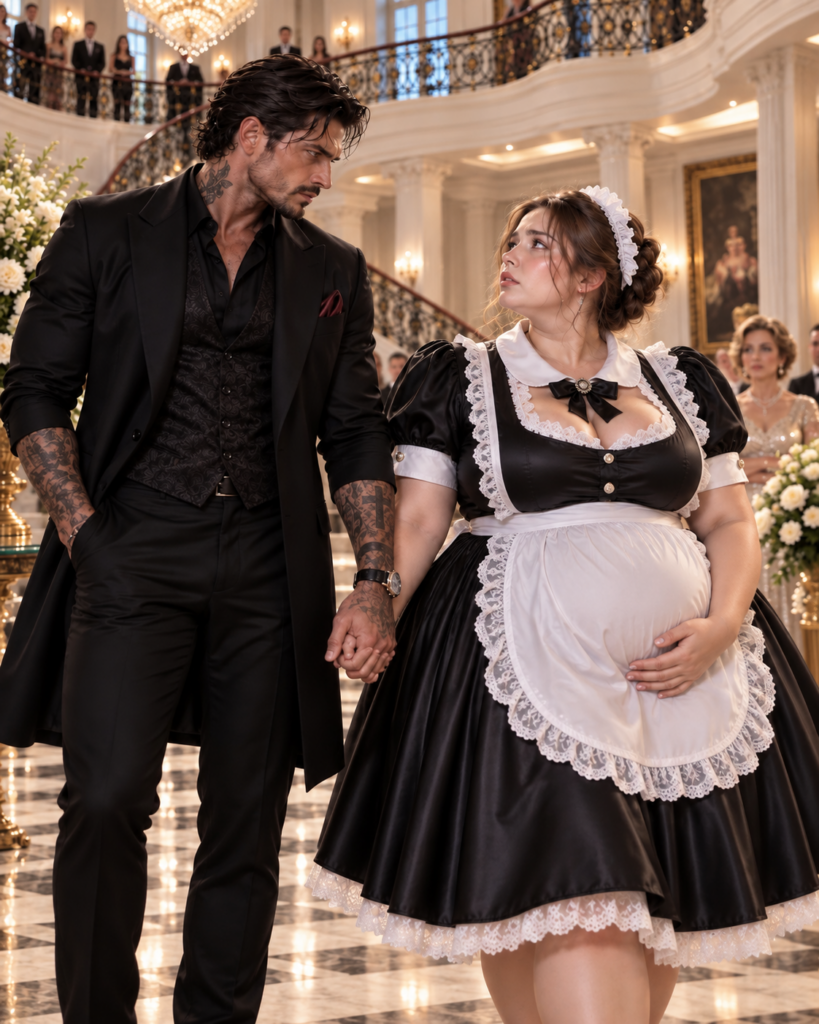
PART 2
“Lydia, who threatened you into wearing that dress?”
For a moment, the only sound in the chapel was the rain.
It ran in silver sheets down the stained-glass windows, blurring saints and angels into watercolor shadows.
Somewhere behind me, a man shifted his weight.
Leather creaked.
Someone coughed and immediately seemed to regret it.
Margaret Aldridge stood so still that even the pearls at her throat appeared frozen.
I looked at her.
For six years, I had worked in her house.
I knew how she liked her coffee, how she folded letters before putting them into envelopes, how she could dismiss an employee without raising her voice, how she carried grief with perfect posture and inconvenience with a faint tightening around the mouth.
I also knew something else.
People like Margaret rarely said exactly what they meant when implication could do the work for them.
“She reminded me,” I said carefully, “that my mother lives in an Aldridge cottage.”
Cassian Vale’s expression did not change.
“And?”
“And that her medical assistance comes through the family.”
Margaret finally found her voice.
“Cassian, this is an unfortunate misunderstanding.”
He looked at her.
Nothing in his face sharpened.
That somehow made the silence worse.
“Is it?”
“The situation became complicated this morning.
Evelyn was frightened.
She acted impulsively.
I needed time to locate her.”
“So you brought someone else.”
“Only temporarily.”
I stared at her.
Temporarily.
As if one could borrow a bride the way one borrowed a serving tray.
Cassian’s gaze returned to me.
“Did you agree to this?”
I thought of my mother asleep in her narrow bed that morning, the knitted blanket tucked around her knees.
I thought of the blue pill organizer on the table and the envelope from the cardiologist that I had not yet opened because I already knew what it would say.
More appointments.
More treatment.
More money.
“I put the dress on,” I said.
“That isn’t what I asked.”
The words were quiet.
I had spent years hearing powerful people ask questions that were really instructions.
This did not sound like one.
“No,” I said.
Cassian nodded once.
Then he turned toward the priest.
“There will be no wedding today.”
The priest, an elderly man whose hands had been folded around a leather prayer book throughout the exchange, gave a small, relieved nod.
Margaret took one step forward.
“Cassian, please.”
He looked at her.
She stopped.
Not because he threatened her.
He didn’t.
He simply waited.
For the first time since dawn, I realized something strange.
Margaret Aldridge did not know what would happen next.
That frightened her more than anger would have.
Cassian spoke to one of the men near the door.
“Daniel.”
A dark-haired man in his early forties stepped forward.
“Arrange transportation for Mrs.
Aldridge.”
Margaret’s mouth tightened.
“I have my own car.”
“Then Daniel can walk you to it.”
Her eyes flicked toward me.
I expected fury.
Instead, what I saw was panic.
It lasted less than a second.
Then the Aldridge mask returned.
“Lydia,” she said, “come with me.”
Cassian did not move.
Neither did I.
It was the smallest rebellion of my life.
My knees were trembling beneath the borrowed silk, but I stayed exactly where I was.
Margaret stared at me.
I could almost hear the calculations moving behind her eyes.
My job.
The cottage.
My mother.
Every invisible thread connecting my life to hers.
Then Cassian said, “Mrs.
Aldridge.”
Nothing more.
Margaret’s gaze shifted away from me.
She walked out of the chapel without another word.
The heavy wooden door closed behind her.
And suddenly I was standing in a wedding dress before twenty strangers with no idea what I had just done.
My hands began to shake.
I pressed them together.
Cassian noticed.
“Sit down.”
“I’m fine.”
“That wasn’t an order.”
I looked at him.
The faintest line appeared between his eyebrows.
“It was a suggestion,” he said.
“You look like you’re going to fall over.”
“Oh.”
One of the men near the back coughed into his fist.
It sounded suspiciously like he was hiding a laugh.
I sat in the front pew.
The dress spread around me in a ridiculous cloud of ivory satin.
Cassian took the pew across the aisle instead of sitting beside me.
The distance surprised me.
So did what he said next.
“Do you want tea?”
I stared at him.
He glanced toward the chapel doors.
“There’s a kitchen in the residence.”
“You stopped a wedding and now you’re offering me tea?”
“You’ve had a difficult morning.”
“That is a very strange answer.”
“I’ve had a strange morning too.”
Despite everything, a laugh escaped me.
It was small and startled and completely inappropriate.
Cassian’s mouth moved slightly.
Not a smile.
Almost.
Then his expression became serious again.
“Your mother.”
My laughter disappeared.
“What about her?”
“What does she need?”
My spine stiffened.
“I’m not asking you for money.”
“I didn’t say you were.”
“People like you don’t ask questions like that without expecting something.”
His gaze held mine.
“You don’t know what people like me do.”
“I know six women left your house.”
One of the men near the chapel entrance suddenly became intensely interested in the floor.
Cassian leaned back.
“That story travels farther than I thought.”
“Were there six?”
“Yes.”
My stomach tightened.
He didn’t deny it.
“What happened to them?”
“That would take more than one cup of tea.”
“Are any of them dead?”
This time he did smile.
Barely.
“No.”
“You find that funny?”
“I find it refreshing.”
“What?”
“No one asks directly.”
I studied him.
He did not look offended.
He looked almost tired.
“All six are alive,” he said.
“And contrary to popular mythology, none escaped barefoot through snow.”
“So that story isn’t true.”
“Technically, Isabelle was barefoot.”
My stomach dropped.
“In June.”
I blinked.
“She hated shoes.”
Somewhere behind him, the man named Daniel had returned.
He sighed.
“Boss.”
Cassian looked over his shoulder.
“You’re ruining the story.”
“There is no story.”
“There’s always a story.”
Daniel shook his head.
Cassian turned back to me.
“Tea?”
I should have left.
I knew that.
I should have found a taxi, changed out of Evelyn’s dress, gone home to my mother, packed whatever we owned and prepared to face whatever Margaret decided to do.
Instead I heard myself ask, “Do you have coffee?”
Cassian stood.
“Better than the Aldridges’.”
“That seems unlikely.”
“You’ve insulted me twice in ten minutes.”
“I thought you were supposed to be terrifying.”
“I’m beginning to question my reputation.”
Daniel opened the chapel door.
Cassian gestured toward it.
“You’re free to leave whenever you wish, Lydia.
But before you do, I think we should discuss why Margaret Aldridge believed replacing her daughter with you would solve anything.”
That stopped me.
Because I had been asking myself the same question.
Cassian had never met Evelyn.
But surely a marriage arranged between families involved lawyers, contracts, signatures, records.
How could Margaret possibly believe I could step into her daughter’s place for longer than ten minutes?
Unless she had never expected the deception to last very long.
I stood.
“What exactly was supposed to happen today?”
Cassian’s eyes rested on me.
“That,” he said, “is what I’d like to know.”
The residence attached to the chapel was not what I expected.
I had pictured marble floors, gold fixtures, portraits of stern men holding cigars.
Instead, I found old wood, worn rugs, bookshelves and a kitchen that looked as though people actually cooked in it.
A woman in her sixties stood at the counter slicing lemons.
She took one look at me and then at Cassian.
“No wedding?”
“No wedding.”
“Good.”
I stared at her.
She shrugged.
“The cake was too sweet.”
Cassian pulled out a chair for me.
“This is Rosa Bellini.”
Rosa placed both hands on the counter.
“And you are definitely not Evelyn Aldridge.”
Apparently I had been the last person to understand how bad Margaret’s plan had been.
“I’m Lydia.”
Rosa nodded.
“You look hungry.”
“I’m not.”
“That means yes.”
Within five minutes, there was toast in front of me.
I ate it.
I had not realized how hungry I was until the first bite.
Cassian poured coffee.
I watched him.
“You do that yourself?”
He raised an eyebrow.
“Pour coffee?”
“I don’t know.
You have twenty armed men.”
“Most of them would ruin it.”
Daniel came in.
“I heard that.”
“It was intended.”
Daniel took the seat at the far end of the table.
Up close, he seemed less like hired muscle and more like an exhausted accountant.
He loosened his tie.
“Margaret left.”
Cassian nodded.
“Did she say anything?”
“Several things.”
“Anything useful?”
“No.”
Cassian looked at me.
“May I ask you some questions?”
I wrapped my hands around the coffee cup.
“You already have.”
“A few more.”
I nodded.
“How long have you worked for the Aldridges?”
“Six years.”
“And your mother?”
“She used to work for them too.”
“Doing what?”
“Housekeeping at first.
Then sewing and alterations.
She was good at it.”
“Was?”
Her hands.
I looked down at mine.
“Arthritis.”
Rosa quietly placed a small dish of jam beside my plate.
Cassian continued.
“How long have you lived on Aldridge property?”
“My mother has lived in the cottage for almost nineteen years.”
His expression changed.
Very slightly.
“Nineteen?”
“Yes.”
“And your father?”
“He died when I was eleven.”
“I’m sorry.”
I gave a brief nod.
Sympathy from strangers always made me uncomfortable, especially when the stranger was supposed to have frightened six wives out of a mansion.
“Did he work for the Aldridges?”
“No.”
“What did he do?”
“He repaired clocks.”
Cassian stopped.
Daniel looked up.
Even Rosa turned from the sink.
I noticed all three reactions.
“What?”
Cassian set down his coffee.
“What was his name?”
“Thomas Carter.”
No one spoke.
A cold sensation moved down my spine.
“You know that name.”
Cassian’s face had gone still.
Not alarmed.
Not exactly.
Recognizing.
“Did your father ever work in New York City?”
“He repaired clocks all over the Hudson Valley.”
“Did he own a shop?”
“Yes.
Carter & Bell Clockworks.”
Daniel muttered something under his breath.
I stood.
The chair scraped sharply against the floor.
“What is going on?”
Cassian rose too, but stayed on his side of the table.
“Lydia—”
“No.
Don’t do that.”
“Do what?”
“Say my name like you’re about to explain something gently.”
Rosa turned around fully.
Cassian glanced toward Daniel.
Daniel reached inside his jacket.
My body went rigid.
Then he pulled out his phone.
“I’ll get the file.”
“A file?”
Cassian exhaled.
“I think your father may be the reason you’re here.”
Daniel returned twenty minutes later carrying a thin brown folder.
I had changed by then.
Rosa had found me a simple navy dress that belonged, apparently, to her niece.
The wedding dress lay folded across the back of a chair in the bedroom upstairs.
I had never been happier to take off anything in my life.
When I returned to the kitchen, Cassian was standing by the window.
The rain had softened.
Mist floated over the river.
Daniel placed the folder on the table.
Cassian did not touch it.
Instead, he looked at me.
“My father knew yours.”
That was not what I expected.
“My father repaired clocks.”
“So did mine.”
I frowned.
Cassian pulled out a chair.
This time I sat.
Daniel opened the folder.
The first photograph was old.
Two men stood in front of a narrow storefront.
One was my father.
Younger than I remembered him.
Dark hair.
Rolled shirtsleeves.
Smiling.
Beside him stood another man I had never seen.
He was taller and heavier, but the resemblance to Cassian was unmistakable.
My fingers touched the edge of the photograph.
“Who is that?”
“Matteo Vale,” Cassian said.
“My father.”
I stared at him.
“My father never mentioned him.”
“Mine rarely mentioned Thomas either.”
“Why?”
“That’s what I spent several years trying to understand.”
He sat across from me.
“Our fathers met before either of us was born.
My father’s family owned several warehouses.
Thomas serviced the clocks and mechanical systems in the buildings.”
“That doesn’t explain this.”
“No.”
Cassian turned over another photograph.
This one showed four people sitting around a table.
My father.
Matteo Vale.
A younger Margaret Aldridge.
And Margaret’s husband, Charles.
The room seemed to tilt slightly.
“No.”
Cassian said nothing.
I picked up the picture.
Margaret could not have been more than thirty-five.
She was laughing.
Actually laughing.
I had worked in her house for six years and had never seen that expression.
“My father knew the Aldridges before my mother started working for them.”
“Yes.”
“But she said we only came to the estate because she needed employment after he died.”
Cassian watched me quietly.
“Maybe she believed that was the simplest version to give you.”
A headache had begun behind my eyes.
“What were they doing together?”
“That’s the missing part.”
Daniel slid several papers toward me.
“They formed a company.”
I read the name.
Riverside Renewal Trust.
“What is this?”
“A property investment partnership,” Cassian said.
“At least officially.
Your father handled restoration work.
My father invested capital.
Charles Aldridge handled acquisitions.”
“And Margaret?”
“She managed records.”
I gave a short, disbelieving laugh.
“You make it sound like a neighborhood project.”
“In the beginning, it may have been.”
He showed me a faded brochure.
It described a program purchasing neglected apartment buildings, repairing them, and offering long-term leases to working families.
Affordable housing.
Local contractors.
Protected rents.
It did not fit anything I knew about either family.
“So what happened?”
“The partnership dissolved.”
“Why?”
“We don’t know.”
“Someone must know.”
“Most of the people involved are dead.”
“Margaret isn’t.”
“No.”
I stared at the photo again.
My father’s arm rested casually across the back of his chair.
He looked comfortable with them.
Trusted them.
Something about that hurt more than I expected.
I had been eleven when he died.
Old enough to remember his laugh.
Young enough to have accepted every explanation adults gave me afterward.
A heart attack.
Bills.
The shop sold.
My mother taking work with the Aldridges.
A cottage offered out of kindness.
I looked at Cassian.
“What does this have to do with Evelyn marrying you?”
“That agreement began with my father and Charles Aldridge.”
“A marriage agreement?”
“Not exactly.”
Daniel leaned forward.
“After Riverside dissolved, ownership of several properties became disputed.
The legal structure was complicated.
Over time, those properties became extremely valuable.”
“How valuable?”
Cassian met my eyes.
“Enough that the dispute has never really disappeared.”
I felt a sinking sensation.
“And the marriage?”
“A way to consolidate the remaining interests.”
I almost laughed again.
“You were going to marry a woman you’d never met because of real estate?”
“When you say it like that, it sounds foolish.”
“It is foolish.”
“Yes.”
The simple agreement disarmed me.
“You were really going to do it?”
“I was going to meet Evelyn today.”
“At the wedding?”
“The wedding was never supposed to happen today.”
I stared.
“What?”
Cassian’s eyes hardened, but not at me.
“The chapel was arranged for a private family meeting and formal announcement.
The wedding was scheduled for three months from now.”
I slowly set down my cup.
Margaret had dressed me as a bride.
Brought me to a chapel.
Surrounded me with people who believed they were attending something else.
“She lied.”
“Yes.”
“Why?”
“I don’t know.”
The mystery rearranged itself inside my head.
Maybe Margaret had not expected me to fool Cassian forever.
Maybe she had needed me to fool someone for an hour.
But who?
I looked at Daniel.
“The armed men.”
“Security.”
“Why so many?”
“The Vale board was meeting afterward,” Cassian said.
“Board?”
“Our legitimate companies have one too.”
“You sound offended.”
“I’m choosing to be.”
Rosa placed another piece of toast in front of me.
“You need food for family secrets.”
I almost smiled.
Then Daniel pushed one final page forward.
My smile disappeared.
It was a copy of a trust document.
At the bottom were three names.
Matteo Vale.
Charles Aldridge.
Thomas Carter.
My father.
“What does this say?”
Cassian answered carefully.
“That your father owned a portion of Riverside.”
I read the percentage.
Twenty-five.
My heart started pounding.
“That can’t be right.”
“It appears to be.”
“He fixed clocks.”
“He also restored buildings.”
“He was never wealthy.”
“No.”
“Then where did the money go?”
Cassian looked toward the window.
“That is another question we haven’t answered.”
I went home before noon.
Not to the Aldridge house.
To my mother.
Cassian offered a car.
I refused.
Then Rosa pointed out that it was still raining and the chapel was miles from the nearest train station.
I accepted.
Daniel drove.
For the first ten minutes, neither of us spoke.
The road curled along the river beneath dripping trees.
Finally I said, “How many wives?”
Daniel glanced at me.
“Excuse me?”
“Cassian.”
He sighed.
“Technically, six.”
“Technically?”
“Two actual marriages.
Four engagements that tabloids decided were marriages because corrections are less interesting.”
I turned toward him.
“What happened?”
“Nothing dramatic.”
“That’s disappointing.”
He smiled faintly.
“The first marriage was when Cassian was twenty-three.
Her name was Sofia.
They were young.
They cared about each other.
They wanted different lives.”
“And the second?”
“Amelia.”
He was quiet for a moment.
“That one hurt both of them.
She wanted children immediately.
He didn’t believe he could be a good father yet.
They kept trying to persuade each other instead of listening.
Eventually they stopped.”
That sounded painfully ordinary.
“And the barefoot woman?”
“Isabelle Moreau.
Engagement number four.
She left a summer garden party after discovering her boyfriend from college had flown in from Paris.”
“Barefoot.”
“She was wearing heels on wet grass.”
I looked out the window.
“People turned that into something else.”
“People usually do.”
“Does Cassian care?”
Daniel considered.
“He used to.”
The car slowed at the Aldridge estate gates.
They were open.
Too open.
No gatekeeper.
No gardener.
No delivery truck.
Something felt wrong.
Daniel noticed.
“Is this normal?”
“No.”
We drove toward the employees’ cottages behind the main house.
My mother’s cottage was the third.
The porch light was on.
I was out of the car before Daniel fully stopped.
“Mom?”
I hurried inside.
She was sitting at the kitchen table.
Still in her blue robe.
A suitcase stood beside her.
My chest tightened.
“What happened?”
She looked up.
Her face softened with relief.
“Oh, thank goodness.”
I crossed the room.
“Are you all right?”
“I’m fine.”
“Why is there a suitcase?”
She looked past me toward Daniel.
“Who’s that?”
“Daniel.
He works for Cassian Vale.”
My mother’s expression changed.
Not fear.
Recognition.
It vanished quickly.
Too quickly.
“Mom.”
She folded her hands.
“You met him.”
“Cassian?”
“Yes.”
“Apparently I nearly married him.”
“Lydia.”
“You knew.”
She closed her eyes.
I took a step back.
“You knew about the arrangement.”
“I knew some of it.”
“How much?”
“Enough to know this morning would be difficult.”
I stared at her.
“You knew Margaret was sending me?”
“No.”
That answer came instantly.
“I swear to you, Lydia, I did not know that.”
“Then why is your suitcase packed?”
My mother looked toward the window.
“Margaret came by after you left.”
My stomach dropped.
“What did she say?”
“That I should prepare to move.”
Anger rose in me, hot and immediate.
Daniel shifted behind me.
My mother lifted a hand.
“She was upset.”
“That doesn’t matter.”
“It matters if you want to understand someone.”
“I don’t care about understanding her.”
“Yes, you do.”
I turned toward my mother.
Her eyes were tired but steady.
“You always have,” she said softly.
“That’s the problem with you.
You pretend anger is easier.”
I swallowed.
I wanted to stay angry.
Anger was clean.
The morning was not.
“Mom, did Dad know the Vales?”
Her face went completely still.
That was my answer.
I sat across from her.
“You knew.”
She looked down at her hands.
“Yes.”
“How long were you planning to keep that from me?”
“I wasn’t planning anything anymore.”
“That isn’t an answer.”
“No.”
Daniel quietly stepped back.
“I’ll wait outside.”
I barely noticed him leave.
My mother touched the worn edge of the table.
“Your father believed people could build things together even when they came from different worlds.”
“What does that mean?”
“It means Thomas Carter had more hope than caution.”
She gave a sad little smile.
“He loved old houses.
Old clocks.
Anything people had stopped noticing.”
I waited.
“He met Matteo Vale while repairing a mechanical clock in one of the Vale warehouses.
Matteo hated the building.
Your father thought it was beautiful.”
“That sounds like Dad.”
“They argued for three hours.
By the end of the week, they were friends.”
“And the Aldridges?”
“Charles came later.”
“Margaret too.”
My mother nodded.
“They were all young.
Ambitious.
Before money became complicated.”
“Money is always complicated.”
“Yes.”
She looked at me.
“But youth convinces you friendship can solve everything.”
I pulled the trust document from my bag and placed it on the table.
Her face changed.
“You have that.”
“You’ve seen it.”
“Yes.”
“Dad owned twenty-five percent.”
“Yes.”
“Where is it?”
My mother was silent.
“Mom.”
“After your father died, the ownership was disputed.”
“By whom?”
“Everyone.”
She stood slowly and walked toward the old dresser near the wall.
Her fingers shook slightly from arthritis as she opened the bottom drawer.
She removed a tin sewing box.
I had seen it a thousand times.
Buttons.
Needles.
Thread.
She lifted the tray.
Underneath was a bundle of letters.
My breath caught.
“Dad’s?”
“Some.”
She handed me one.
The envelope had never been mailed.
Helen—
If anything happens before we settle this properly, remember what I told you.
The buildings were never the point.
The promise was.
I looked up.
“What promise?”
My mother sat again.
“I never knew.”
“How could you not know?”
“Your father thought he was protecting me by keeping business away from home.”
“That seems to be a family tradition.”
She flinched.
Immediately I regretted it.
“Mom—”
“No.
You have every right.”
Her voice remained gentle.
“I told myself silence kept you safe from old arguments.
Then each year made the truth harder to explain.”
I unfolded the next letter.
It was addressed to Matteo Vale.
Matteo,
Charles wants to sell.
Margaret thinks we should reconsider the trust.
I understand why.
But if Riverside becomes only an investment, then everything changes.
There was more, but one sentence caught me.
Helen found the original ledger.
Tell no one until I can verify the entries.
I looked at my mother.
“You found a ledger?”
She nodded slowly.
“Where is it?”
“I gave it back to Thomas.”
“And after he died?”
“I thought it disappeared.”
“You thought?”
“A few weeks later, Margaret came to me.”
My pulse quickened.
“What did she say?”
“That Thomas had left unpaid debts.
She offered me work and the cottage.”
My gaze moved around the little kitchen.
Nineteen years.
“You thought she was helping us.”
“She was helping us.”
“Or keeping you close.”
My mother looked toward the window.
“I’ve wondered.”
A quiet knock came at the door.
Daniel entered only when my mother nodded.
“Sorry.
Lydia, Cassian called.”
“What?”
“Evelyn contacted him.”
I stood.
“Evelyn?”
“She says she didn’t run away from the marriage.”
“Then why did she leave?”
Daniel’s expression was thoughtful.
“She says her mother told her to.”
Evelyn agreed to meet us at a small café in Tarrytown.
Not at the Vale residence.
Not at the Aldridge house.
Her choice.
Cassian arrived before us.
He stood when my mother entered.
For all the stories surrounding him, he behaved like a man meeting someone important.
“Mrs.
Carter.”
“Helen.”
He shook her hand gently.
“You have your father’s eyes,” my mother said.
Something in his face softened.
“So I’ve been told.”
Evelyn arrived ten minutes later.
She wore jeans, a green sweater and no makeup.
Her blond hair was pulled into a loose knot.
I had spent years cleaning up after her.
Picking up dresses from her bedroom floor.
Collecting coffee cups from windowsills.
Listening to phone conversations in which she complained about parties, people, vacations and once the color of a new car.
I had assumed I knew her.
Then she walked into that café looking as though she had not slept at all.
Her gaze landed on me.
She stopped.
“Oh, Lydia.”
I stood automatically.
She came toward me.
“I’m sorry.”
The words were so unexpected that I did not respond.
“I didn’t know,” she said.
“I swear.”
“Know what?”
“That she would send you.”
Cassian pulled out a chair.
Evelyn sat.
She glanced at him.
“So you’re Cassian.”
“Yes.”
“You’re less frightening than the photographs.”
“I get that occasionally.”
“You don’t.”
“No.”
For the first time, I understood why the tabloids wrote so much about him.
He had a very dry sense of humor.
Evelyn looked at her mother’s empty chair as though Margaret might somehow appear.
“She told me the agreement was changing.”
Cassian folded his hands.
“How?”
“She said the announcement today would trigger a transfer.”
“What transfer?”
“She didn’t explain.”
“She told you to leave?”
“Yes.”
“Why?”
“Because she said if I was absent, the process would stall.”
Evelyn looked at me.
“I thought she wanted time to renegotiate.”
My mother leaned forward.
“When did Margaret tell you this?”
“Last night.”
“Did she tell you where to go?”
“No.
She told me not to contact anyone until this afternoon.”
“And the money?”
I asked.
Evelyn grimaced.
“I took cash from my own account.”
“Forty thousand dollars?”
“I panicked.”
That was, unfortunately, very Evelyn.
Cassian looked at her.
“What did your mother say would happen if the transfer went through?”
Evelyn hesitated.
“That something belonging to our family would become yours.”
“Property?”
“She didn’t say.”
“Shares?”
“I don’t know.”
Cassian leaned back.
Then Evelyn took a folded piece of paper from her bag.
“She gave me this.”
It was a photocopy of an old handwritten page.
The paper had been enlarged.
My mother made a sound beside me.
I turned.
“What?”
Her eyes were fixed on the page.
“That handwriting.”
“Whose?”
“Thomas’s.”
My father’s.
Cassian placed the paper flat on the table.
There were names.
Dates.
Addresses.
Columns of numbers.
At the bottom, my father had written:
The beneficiary must remain Carter.
No transfer by marriage, inheritance, merger, or sale may alter that designation.
My heart began to pound.
“Beneficiary of what?”
No one answered.
Evelyn looked confused.
Cassian looked stunned.
My mother looked as though she had suddenly remembered something from a dream.
Then she whispered, “The promise.”
I turned toward her.
“What?”
She touched the paper.
“The buildings were never the point.”
Her finger moved to one of the addresses.
“I know this place.”
Cassian read it.
“River House.”
My mother nodded.
“Thomas used to take you there when you were little.”
I frowned.
“No, he didn’t.”
“Yes.”
“I would remember.”
“You were five or six.”
“What was it?”
“An old apartment building near Dobbs Ferry.”
Daniel, who had been standing near the café entrance, walked over.
“It’s still there.”
Cassian looked at him.
“Who owns it?”
Daniel checked his phone.
“Riverside Community Holdings.”
“Which is controlled by?”
Daniel scrolled.
His expression changed.
“No one.”
“What do you mean?”
“The controlling shares are in a dormant trust.”
My skin prickled.
Cassian looked at me.
“Named?”
Daniel’s gaze moved between us.
“Carter Family Beneficial Trust.”
The café suddenly seemed very quiet.
I laughed softly because the alternative was apparently forgetting how to breathe.
“That’s impossible.”
Daniel continued reading.
“The beneficiary was originally Thomas Carter.”
My mother closed her eyes.
“And after his death?”
Cassian asked.
Daniel looked at me.
“His only child.”
Nobody spoke.
Evelyn whispered, “Lydia.”
I stared at the paper.
At my father’s handwriting.
At a truth that had been sitting somewhere beneath my life for nineteen years while I polished silver in the Aldridge dining room and worried over medical bills in a cottage owned by people who had once sat laughing beside my father.
I looked at Cassian.
“You said the marriage agreement was meant to consolidate interests.”
“Yes.”
“What happens if Evelyn marries you?”
“We combine Aldridge and Vale claims.”
“And then?”
His face became thoughtful.
“We would have had enough votes to petition the court to dissolve dormant holdings.”
My mother inhaled sharply.
Evelyn went pale.
I understood.
Not all of it.
But enough.
“The trust.”
Cassian nodded.
“If the court granted the petition, yes.”
“And my ownership?”
“Would have to be located and notified.”
“But nobody located me.”
Daniel looked uncomfortable.
“That appears to be the problem.”
I stared at him.
“I worked in the Aldridge house.”
“Yes.”
“For six years.”
“Yes.”
“You’re telling me no one could find me?”
Cassian’s voice was quiet.
“No.
I’m telling you someone apparently made sure no one looked.”
By late afternoon, we were back at my mother’s cottage.
Evelyn came with us.
That surprised me more than anything.
She helped my mother unpack the suitcase Margaret had told her to prepare.
At first, Evelyn had no idea how to fold clothes.
My mother watched her struggle with a cardigan.
“Have you never folded anything?”
Evelyn looked offended.
“I’ve folded things.”
“Name one.”
“Napkins.”
“At restaurants?”
Evelyn frowned.
My mother laughed.
It had been months since I heard that laugh.
I stood in the doorway holding two cups of tea.
Something inside me loosened.
Evelyn noticed me.
“Don’t start.”
“I didn’t say anything.”
“You were thinking loudly.”
I handed her a cup.
She took it.
For years we had lived in the same house without ever standing on equal ground.
Now, in my mother’s tiny bedroom, surrounded by old quilts and medicine bottles and a half-unpacked suitcase, we were simply two daughters trying to understand decisions our parents had made before either of us knew enough to ask questions.
“Why didn’t you want to marry him?”
I asked.
Evelyn looked toward the window.
“I didn’t know him.”
“That stopped bothering you?”
“No.”
“Then why agree?”
She traced the rim of the cup.
“My father asked me before he died.”
Charles Aldridge had been dead three years.
Evelyn rarely spoke about him.
“He believed the arrangement would repair something,” she said.
“What?”
“I never knew.”
“Did you ask?”
“Once.”
“And?”
“He said our families had made a mistake a long time ago.”
My mother appeared in the doorway.
“What mistake?”
Evelyn shook her head.
“He wouldn’t tell me.”
My mother looked troubled.
“Charles changed after Thomas died.”
I turned.
“How?”
“He became quieter.”
“That doesn’t sound unusual after a friend dies.”
“No.”
She sat on the bed.
“But Charles wasn’t grieving only for your father.”
“What else?”
“Something had happened between the four of them before Thomas died.
Matteo stopped visiting.
Margaret became distant.
Thomas worked late every night.”
“The ledger.”
“Yes.”
Evelyn sat beside her.
“My father kept a locked cabinet in his study.”
I knew the cabinet.
Mahogany.
Brass handles.
Margaret kept old tax files inside now.
“He never let anyone open it,” Evelyn continued.
“Your mother uses it,” I said.
“Maybe now.”
My mother looked at me.
“Could the ledger be there?”
“After nineteen years?”
“Margaret keeps everything.”
That was true.
Receipts.
Invitations.
Letters.
Old menus.
She once made me search three trash bags because she thought a florist’s business card had been thrown away.
Evelyn stood.
“We should look.”
I stared at her.
“You want to break into your mother’s study?”
“It’s my house too.”
“Is it?”
She paused.
“Probably?”
I laughed.
She smiled.
Then the smile faded.
“Lydia, if that trust belongs to you—”
“I don’t know what belongs to me.”
“But something does.”
I looked around the room.
The worn curtains.
The faded wallpaper.
My father’s old clock ticking above the dresser.
“I spent my entire life worrying we could lose this cottage.”
My mother reached for my hand.
“And maybe your father spent his trying to make sure you never needed it.”
I swallowed.
That thought was almost unbearable.
Not because of the money.
Because of him.
Because suddenly every memory carried another shadow behind it.
Dad fixing the clock over the fireplace.
Dad bringing home paint on his sleeves.
Dad whispering with my mother after he thought I was asleep.
I had remembered him as a man with a small shop and gentle hands.
Maybe he had been more.
Maybe every parent was more than the version their children knew.
We did not break into the Aldridge house.
Not exactly.
Evelyn had a key.
The house was quiet when we entered just before sunset.
Margaret was gone.
Her car was missing.
Most of the staff had been given the afternoon off.
The grand hallway smelled faintly of lilies and furniture polish.
I had crossed that floor thousands of times in uniform.
Walking across it beside Evelyn in Rosa’s borrowed navy dress felt strangely different.
My mother stayed in the cottage.
Cassian stayed away entirely.
His choice.
“This is family territory,” he had said.
I had appreciated that more than I told him.
Evelyn led me upstairs.
Her father’s study had been closed since breakfast.
She pushed open the door.
Dust floated in the late sunlight.
“This room always smelled like him,” she said.
“Cedar?”
“And peppermint.”
I smiled.
“My father smelled like machine oil.”
“Better than peppermint.”
“Definitely.”
She crossed to the old cabinet.
Locked.
“Do you have the key?”
“No.”
“So much for not breaking in.”
She opened the desk drawer.
Nothing.
Second drawer.
Nothing.
Third.
She stopped.
Inside was a small envelope.
On the front, in Charles Aldridge’s handwriting, were two words.
For Helen.
Evelyn looked at me.
Neither of us touched it.
Finally I whispered, “That’s my mother.”
“Yes.”
“You should take it.”
“It’s from your father.”
“To yours.”
We carried it back unopened.
My mother was sitting at the kitchen table when we arrived.
The envelope slipped from Evelyn’s fingers onto the table.
My mother stared at it for a long time.
Then she sat.
Her hands trembled as she opened it.
Inside was a key.
And one sheet of paper.
Helen,
I should have told Lydia myself, but cowardice has many respectable names, and I called mine “timing.”
Thomas was right about Riverside.
Matteo was right too.
Margaret and I were wrong.
We believed the safest way to protect the properties was to put them under family control.
Thomas believed the safest way was to put them beyond us all.
He created the Carter trust not for wealth, but stewardship.
Lydia is not meant to own Riverside in the ordinary sense.
She is meant to decide what it becomes.
The original ledger is in the cabinet.
If Margaret still cannot tell her the truth, perhaps you must.
I am sorry.
Charles
My mother’s eyes filled.
Evelyn turned away.
I stood frozen.
“What truth?”
My mother said nothing.
“Mom.”
She folded the letter.
“There is more.”
A car sounded outside.
Evelyn looked through the window.
Her face changed.
“It’s my mother.”
Margaret entered without knocking.
She stopped when she saw the three of us.
Then she noticed the letter.
For once, no mask came down.
She looked tired.
Older.
Human.
“Charles left that,” she said.
My mother nodded.
Margaret closed the door behind her.
Evelyn crossed her arms.
“You told me to run.”
“Yes.”
“You sent Lydia in my place.”
Margaret looked at me.
“Yes.”
“Why?”
The answer took a long time.
“Because I was trying to stop today.”
Cassian had already told us there had never been a wedding scheduled.
I watched her carefully.
“You knew the marriage agreement would expose the trust.”
“Yes.”
“And you knew I was the beneficiary.”
“Yes.”
My mother closed her eyes.
I felt strangely calm.
Sometimes the truth you dread arrives so quietly that anger has nowhere to land.
“How long?”
Margaret’s voice dropped.
“Since your father died.”
Nineteen years.
The number passed through me like cold air.
“You knew every day I worked in your house.”
“Yes.”
“You knew every time my mother worried about medical bills.”
“Yes.”
Margaret’s composure cracked.
Only slightly.
But enough.
“I also knew that once the trust was activated, Lydia, everything your father tried to protect would become vulnerable.”
“To whom?”
“To all of us.”
Evelyn frowned.
“What does that mean?”
Margaret sat at the small kitchen table where she had once threatened my mother’s home.
Now she looked at the three of us.
“When we began Riverside, we told ourselves we wanted to preserve affordable homes.
Then the properties became valuable.
Very valuable.
Investors came.
Developers came.
Everyone had plans.”
“My father too?”
Evelyn asked.
“Yes.”
Her face tightened.
Margaret continued.
“Charles wanted expansion.
Matteo wanted stronger financial controls.
I wanted security.
Thomas was the only one who kept asking what happened to the families living in those buildings.”
I thought of my father fixing clocks.
Things people had stopped noticing.
“So he created the trust.”
“Yes.”
“Without telling you?”
“He told us.”
“And you fought him.”
“We disagreed.”
“That sounds cleaner.”
Margaret accepted that.
“Yes.”
My mother spoke quietly.
“What happened to Thomas’s ledger?”
“In the cabinet.”
“You had it all these years?”
“No.
Charles did.”
Margaret looked at Evelyn.
“He found it after Thomas died.”
Evelyn’s voice was small.
“And he never told me.”
“He spent years trying to repair what we had done without destroying everything in the process.”
I looked at Margaret.
“What is in the ledger?”
Her eyes met mine.
“Proof that your father never intended Riverside to become a private fortune.”
I frowned.
“That isn’t a crime.”
“No.”
“Then what are you afraid of?”
Margaret looked toward the fading light beyond the window.
When she answered, her voice was barely above a whisper.
“That when you see what Thomas planned, you’ll understand why your father trusted you with something none of us were willing to give up.”
“What?”
“The right to say no.”
She took the key from Charles’s envelope and placed it in my palm.
Not Evelyn’s.
Not my mother’s.
Mine.
“The cabinet is upstairs,” she said.
“Inside it is your father’s ledger.”
I closed my fingers around the key.
“And after I read it?”
Margaret looked at me with an expression I had never seen before.
Not authority.
Not pity.
Something closer to uncertainty.
“After you read it,” she said, “you’ll have to decide whether Riverside belongs to the families who built it, the people who live in it…”
She paused.
“…or no one at all.”
PART 3
The ledger was blue.
That surprised me.
I had expected leather.
Something old and solemn.
Instead, when Evelyn unlocked her father’s cabinet and I pulled the book from behind a stack of property files, it looked like something a schoolteacher might have used to record attendance.
Blue cloth cover.
Rounded corners.
Thomas Carter written inside in my father’s narrow handwriting.
For several minutes, I could not turn the first page.
Evelyn waited beside me.
Margaret stood near the study window.
My mother had remained downstairs because the staircase hurt her knees.
Nobody hurried me.
That mattered.
All morning, other people had been making decisions around me.
For me.
About me.
Now the room had gone still until I was ready.
I opened the book.
My father had written dates first.
Then addresses.
Repair costs.
Tenant names.
Contractors.
Building conditions.
Notes filled the margins.
Mrs.
Alvarez needs lower kitchen shelves.
Roof must be done before winter.
Do not raise rent after plumbing repair.
Third-floor window sticks.
Child in room.
Fix immediately.
I swallowed.
This was my father.
Not the signatures.
Not the percentages.
Not the trust documents.
This.
He had always written reminders that way.
Buy Helen peppermint tea.
Lydia school play Thursday.
Clock parts—Brasswell.
Call plumber.
The ledger was not the secret journal of a businessman.
It was the notebook of a man trying to remember people.
I turned pages slowly.
Halfway through, the entries changed.
Investor proposals.
Offers.
Arguments.
My father had written summaries of conversations with Matteo and Charles.
Matteo says expansion requires higher rents.
Charles says we cannot preserve buildings without capital.
Margaret says families will eventually leave anyway.
I disagree.
Another page.
If we lose the reason we started, Riverside becomes ordinary.
Another.
Matteo angry.
Charles frustrated.
Margaret says I am sentimental.
Perhaps.
Still no.
I almost smiled.
Evelyn leaned over my shoulder.
“He wrote ‘still no’ three times.”
“That sounds like him.”
“It sounds like you.”
I looked at her.
She smiled faintly.
The final pages were different.
There were no numbers.
Only a letter.
To Lydia, if this ever becomes yours.
My breath stopped.
I sat down.
Evelyn silently moved away.
I read.
If you are reading this, then I failed to explain something while I had the chance.
That would not surprise your mother.
She has always said I speak better to machines than people.
A small laugh caught painfully in my throat.
I kept going.
Riverside is valuable, but value and price are not the same thing.
The buildings have a price.
The land has a price.
The apartments have a price.
What does not have a price is the promise made when people trusted us with their homes.
I do not know what Riverside will look like when you are grown.
Perhaps the buildings will be old.
Perhaps the neighborhood will change.
Perhaps people will tell you that selling is sensible.
Perhaps it will be.
I am not asking you to preserve my choices forever.
I am asking you to make your own.
Do not keep Riverside because I loved it.
Do not sell Riverside because someone powerful tells you that is progress.
Listen.
Learn.
Then decide.
That is the trust.
Not the papers.
You.
I stopped reading.
The room blurred.
I had spent nineteen years wishing I could remember the sound of my father’s voice more clearly.
Now I could hear him in every sentence.
Not instructing me.
Trusting me.
That was harder.
A person could obey instructions.
Trust demanded something else.
I wiped my face with the heel of my hand.
Evelyn looked away politely.
Margaret did not.
Her eyes were wet too.
That surprised me.
“You read this before,” I said.
“Yes.”
“When?”
“Nineteen years ago.”
“And you still kept it from me.”
“Yes.”
There was no defense in her tone.
That somehow made it easier to ask the next question.
“Why?”
Margaret sat across from me.
“When Thomas died, you were eleven.”
“You could have told me later.”
“Yes.”
“At eighteen.”
“Yes.”
“Twenty-one.”
“Yes.”
“Yesterday.”
A pause.
“Yes.”
I closed the ledger.
“So why didn’t you?”
Margaret looked at the shelves surrounding us.
Her husband’s books.
Her family records.
A lifetime of documents carefully filed and preserved.
“Because your father’s plan made me irrelevant.”
I frowned.
She gave a humorless little smile.
“That is not flattering, but it is true.”
For the first time, Margaret Aldridge was not describing business.
She was describing herself.
“My entire life,” she continued, “I believed responsible people were the people who stayed in control.
My father lost nearly everything when I was young because he trusted the wrong partner.
I watched my mother sell jewelry to pay bills while he kept insisting things would improve.”
Evelyn sat quietly by the window.
Margaret glanced at her.
“So when Riverside grew valuable, I thought protecting it meant controlling it.”
“And my father disagreed.”
“Completely.”
“What about Cassian’s father?”
“Matteo understood Thomas better than Charles and I did.
But he had his own fears.”
She folded her hands.
“He grew up in a family where nothing was secure unless someone stronger protected it.”
That sounded like the Cassian I had met.
Not frightening.
Guarded.
Careful.
“What happened after Dad died?”
Margaret looked at me.
“Everything stopped.”
“The trust?”
“The partnership.”
“Why?”
“Matteo blamed Charles.”
Evelyn straightened.
“For what?”
“For pushing Thomas too hard.”
“Did he?”
Margaret’s expression tightened.
“No.”
She said it with certainty.
“Your father’s death was natural, Lydia.
His heart had been weaker than any of us knew.”
I nodded.
I had not asked because part of me feared the answer.
Margaret understood anyway.
“Matteo was grieving,” she said.
“He withdrew from Riverside.
Charles did too.
I spent months untangling accounts.”
“And the trust?”
“Dormant.”
“Because I was a child?”
“In part.”
“And when I became an adult?”
She looked down.
“That is where the truth becomes less comfortable.”
Evelyn spoke.
“Mother.”
Margaret nodded.
“I filed extensions.”
My pulse quickened.
“For nineteen years?”
“Not nineteen.
The first seven were legitimate.
After that, there were legal mechanisms.”
“You hid me.”
“No.”
“Then what do you call it?”
Margaret’s voice broke slightly.
“I convinced myself I was protecting something Thomas had built until you were ready.”
“Did you ever plan to ask whether I was ready?”
Silence.
That was answer enough.
I stood and walked toward the window.
Below us, the Aldridge gardens stretched toward the woods.
I had weeded those flowerbeds.
Carried breakfast trays across those lawns.
Hung Evelyn’s dresses in closets larger than my mother’s bedroom.
I had known exactly what my place was in this house.
Except I hadn’t.
Not really.
Evelyn came beside me.
“Lydia.”
“I need air.”
She nodded.
“I’ll come.”
“No.”
She stopped.
“So will I,” Margaret said.
I looked at her.
“No.”
She stopped too.
It was strange how powerful one ordinary word became after a lifetime of rarely using it.
I walked downstairs alone.
Cassian was sitting on the front steps.
I almost laughed.
“Do powerful men often sit on other people’s porches waiting?”
He looked up.
“Only when they’ve been told they are not allowed inside.”
“Evelyn?”
“Your mother.”
That did make me laugh.
“Mom ordered you out?”
“She was polite.”
“That means yes.”
He moved slightly, leaving room beside him.
I sat.
The rain had stopped.
Water dripped from the trees.
The air smelled clean and green and newly washed.
For a while, neither of us spoke.
Then he said, “You found it.”
“The ledger.”
“And?”
“My father left me a decision.”
Cassian nodded as though that made sense.
“Aren’t you going to ask what?”
“No.”
“Why?”
“Because if he left the decision to you, then asking immediately would be rude.”
I looked at him.
“You really are terrible at being a terrifying crime boss.”
His mouth curved.
“I’ve had an unusually damaging day.”
The quiet between us became easier.
I studied his profile.
The scar through his eyebrow.
The tiredness around his eyes.
“What about you?”
“What about me?”
“Why did you agree to marry Evelyn?”
He looked toward the drive.
“I told you.
The family agreement.”
“That explains the paperwork.”
“And you want the real answer.”
“Yes.”
Cassian rested his forearms on his knees.
“My father died believing the Vale and Aldridge families had unfinished business.”
“So you thought marriage could fix it?”
“No.”
He paused.
“I thought cooperation might.”
“That sounds less romantic.”
“It wasn’t intended to be romantic.”
“Comforting.”
He glanced at me.
“I would have been honest with Evelyn.”
“About what?”
“That I did not love her.”
I winced.
“You might have opened with something gentler.”
“I’m beginning to understand why Daniel usually handles conversations.”
I smiled.
Then he became serious.
“I would never have asked her to pretend.”
Something about those words stayed with me.
Maybe because pretending was exactly what everyone else had done.
Margaret pretending control was protection.
My mother pretending silence was safety.
Charles pretending timing would make truth easier.
Evelyn pretending she did not care what was expected of her.
Me pretending resentment was simpler than fear.
“What happened with your father?”
I asked.
Cassian was quiet.
“Matteo loved Thomas.”
“As a friend?”
“As a brother, I think.”
“And after Dad died?”
“He stopped talking about Riverside.”
“Completely?”
“Almost.”
“That doesn’t sound like grief.”
“It was guilt.”
“Why?”
Cassian looked toward me.
“Because he had voted with Charles and Margaret.”
“Against my father.”
“Yes.”
“What did they vote on?”
“Whether Riverside could sell three buildings to outside investors.”
My father’s ledger mentioned that.
“Dad said no.”
“Matteo eventually agreed with him.
But not soon enough.”
“He regretted it.”
“Yes.”
“And you’re trying to fix his regret.”
Cassian considered that.
“Possibly.”
“That seems like a dangerous reason to marry someone.”
“Yes.”
“Yet you were going to.”
“Yes.”
“You agree too easily.”
“I’m trying something new.”
I smiled.
Then his expression softened.
“Parents leave us unfinished things.”
I looked back at the house.
“Yes.”
“The difficult part is deciding which ones belong to us.”
That sounded like something my father might have written.
I turned toward him.
“What if Riverside isn’t mine to keep?”
“Then don’t keep it.”
“What if selling it is a mistake?”
“Then don’t sell it.”
“You are spectacularly unhelpful.”
“I’m not the one your father trusted.”
There was no jealousy in his voice.
No pressure.
For the first time all day, I understood why he had remained outside.
Cassian Vale had every financial reason to care about my decision.
He also knew the decision had to remain mine.
Trust, I was beginning to learn, often looked like giving someone enough space to disappoint you.
The next week changed everything slowly.
That surprised me.
I had expected dramatic meetings.
Lawyers slamming documents onto tables.
Secret accounts.
Threats.
Instead, there were phone calls.
Appointments.
Records.
Questions.
Cassian introduced me to Elena Ruiz, an attorney who specialized in trusts and community property organizations.
She was small, brisk and unimpressed by everyone.
Especially Cassian.
When he interrupted her explanation once, she raised one finger without looking at him.
He stopped talking.
I liked her immediately.
The first meeting took place in a conference room overlooking Manhattan.
Elena opened three binders.
“First,” she said, “you are not secretly a billionaire.”
I exhaled.
“Good.”
Evelyn, beside me, looked disappointed.
Elena continued.
“The Carter Family Beneficial Trust holds controlling authority over Riverside Community Holdings.
That does not mean you can empty a bank account and buy an island.”
“I wasn’t planning to.”
“Everyone says that before seeing islands.”
Cassian coughed.
Elena ignored him.
“Your authority concerns governance.
Sales.
Development.
Tenant protections.
Reinvestment.
The trust generates income, but much of that is legally restricted.”
I looked at the figures.
“They’re still enormous.”
“Yes.”
“Why was my mother worrying about medical bills?”
Elena’s expression softened.
“Because no one activated the beneficiary provisions.”
“Margaret.”
“She delayed them.”
“Was that legal?”
“Parts of it were questionable.”
Margaret, sitting at the opposite end of the table, did not look away.
Elena continued.
“But before anyone discusses lawsuits, I recommend understanding what happened.”
I stared at her.
“You don’t think I should sue?”
“I think that is your decision.
My job is to explain your options, not manufacture your anger.”
Margaret looked at her for the first time.
Something like gratitude crossed her face.
I noticed.
So did Evelyn.
Family relationships, I discovered, changed in inches.
Not miles.
Later that afternoon, my mother and I sat in Central Park eating sandwiches.
She had insisted on coming to the city.
“It has been fifteen years,” she said.
“You hate traffic.”
“I hate many things.
That doesn’t mean I should let them win.”
That sounded suspiciously like something Rosa would say.
Mom watched a little boy sail a toy boat across the pond.
“Are you angry with me?”
I looked at my sandwich.
“Yes.”
She nodded.
“I expected that.”
“I’m also not angry every minute.”
“That’s encouraging.”
“I keep thinking about all the times you could have told me.”
“I know.”
“Why didn’t you?”
She took her time answering.
“When your father died, you stopped sleeping.”
I remembered some of it.
Lights left on.
Nightmares.
My mother sitting beside my bed.
“You kept asking whether we would have to leave our house,” she said.
“We did leave.”
“Yes.”
“The shop too.”
“Yes.”
“When Margaret offered the cottage, I accepted before I understood anything about Riverside.”
She looked at me.
“Then Charles came one evening.
He told me Thomas’s affairs were complicated and asked me to let him handle them.”
“And you trusted him.”
“I was thirty-six.
My husband was dead.
I had a child.
Debts.
No savings.”
She looked toward the water.
“I trusted anyone who sounded certain.”
I swallowed.
That was painfully understandable.
“Later, when I learned about the trust, you were older.
Happier.
You had friends.
School.
A life that did not revolve around your father’s death.”
“So you decided not to tell me.”
“Yes.”
“Then it became easier.”
“No.”
She looked at me.
“It became harder.”
I frowned.
“Every year I waited, the truth grew heavier.
Eventually I was not protecting you anymore.”
“What were you protecting?”
“Myself.”
The honesty hurt.
But it also opened something.
I took her hand.
“I wish you had told me.”
“I know.”
“I might wish that for a long time.”
“I know.”
I rested my head against her shoulder.
She smelled like lavender hand cream.
“You’re still my mother.”
Her fingers tightened around mine.
“Yes.”
“Even when I’m angry.”
“Yes.”
“Unfortunately.”
She laughed.
And so did I.
Forgiveness did not arrive like sunlight.
It arrived like that.
A hand held while the hurt still existed.
Evelyn moved out of the Aldridge house.
Not dramatically.
She rented a small apartment over a bookstore in Hastings-on-Hudson.
The place had crooked floors, terrible plumbing and a kitchen smaller than her old closet.
She loved it.
“This cabinet sticks,” she told me proudly when I visited.
“That’s not a feature.”
“It gives character.”
“You sound poor already.”
“Thank you.”
She handed me a mug.
The coffee was awful.
I drank it anyway.
She had also gotten a job.
That surprised everyone.
Including her.
A local arts foundation hired her to coordinate donor events.
“You’re good at that,” I said.
“At spending other people’s money?”
“At remembering people.”
She considered.
“I used to think that was just social trivia.”
“It matters.”
She looked down at her mug.
“I spent years thinking nothing expected of me was real.”
“What does that mean?”
“My clothes.
Parties.
Charity boards.
The marriage agreement.”
She leaned against the counter.
“It was all arranged before I had an opinion.”
“And now?”
“Now I have a terrible apartment and an underpaid job.”
“You’re glowing.”
“I know.”
We smiled.
Then she became quiet.
“I’m not ready to forgive my mother.”
“You don’t have to.”
“I thought you might tell me I should.”
“No.”
“You seem closer to her.”
“Closer isn’t the same as finished.”
Evelyn nodded.
That became another thing I learned.
Forgiveness was not a door one walked through once.
It was a house built room by room.
Some rooms stayed locked longer.
Cassian and I became friends.
At least, that was what I called it.
Daniel called it “a situation.”
Rosa called it “obvious.”
Cassian called Daniel and Rosa traitors.
It started with the trust meetings.
Then coffee.
Then dinner after a meeting ran late.
Then a Saturday afternoon when Cassian drove my mother to River House because she wanted to see it again and I discovered he knew more about old architecture than I did.
“You studied this?”
I asked.
“Urban planning.”
I stopped walking.
“You?”
He looked offended.
“What did you expect?”
“Organized crime.”
“Minor in organized crime.”
I laughed so loudly my mother turned around.
River House stood five stories tall near the Hudson.
Red brick.
White-trimmed windows.
A garden behind it.
Children’s bicycles rested beneath the stairs.
An elderly man watered tomatoes in raised beds.
Nothing about the building looked extraordinary.
That was the point.
People lived there.
Mrs.
Alvarez’s daughter still did.
The original Mrs.
Alvarez had died years ago, but her daughter, Teresa, invited us upstairs.
“I remember Thomas,” she said.
My heart stopped.
She disappeared into another room and returned holding a photograph.
My father was kneeling beside a radiator.
Beside him stood a little girl in overalls.
Me.
“I told you,” my mother whispered.
I touched the photograph.
I remembered none of it.
Yet there I was.
Smiling.
Holding a wrench.
Teresa laughed.
“You followed him everywhere.”
“What was he doing?”
“Fixing everything.”
Her expression softened.
“He used to say buildings should make people feel held.”
I looked around her apartment.
Family photographs.
Plants.
A piano.
A stack of library books.
Held.
Maybe that was what Riverside had been meant to do.
Not make anyone rich.
Not freeze the neighborhood in time.
Simply give people enough stability to build lives.
That evening, Cassian and I sat by the river behind the building.
“You know what you want to do,” he said.
I picked up a pebble.
“I think so.”
He waited.
“I don’t want the Vale shares.”
“You don’t have them.”
“I mean I don’t want to merge anything.”
“That simplifies my week.”
I smiled.
“I want Riverside independent.”
He nodded.
“No Aldridge control.
No Vale control.
No Carter control either.”
That got his attention.
“What do you mean?”
“I want the trust converted.”
“Into what?”
“A permanent community stewardship organization.”
Cassian considered.
“Tenant board?”
“Yes.”
“Local representation?”
“Yes.”
“Professional management?”
“Obviously.”
“And you?”
“One seat.”
“Only one?”
“One is enough.”
He stared at the river.
“My father would have liked that.”
“So would mine.”
“I think you’re right.”
“You’re not supposed to tell me.”
“You already decided.”
“Convenient.”
He smiled.
Then I asked the question I had been avoiding.
“What happens to your family’s money?”
“We lose some potential value.”
“How much?”
“Enough.”
“I’m serious.”
“So am I.”
“Does that bother you?”
He looked at me.
“No.”
“Why?”
“Because potential value isn’t the same as loss.”
“That sounds suspiciously philosophical.”
“I’ve been spending time with a woman who reads old ledgers.”
I smiled.
He reached toward my hand.
Then stopped.
Not dramatically.
Just enough for me to notice the question.
I turned my palm upward.
He took it.
No fireworks.
No sweeping music.
Just warmth.
And the strange relief of being asked without words.
Margaret resisted the plan.
Of course she did.
Not because she wanted the money.
I had assumed that at first.
I was wrong.
“You cannot place millions of dollars in assets under the control of people with no experience managing them,” she said.
We were sitting in my mother’s cottage.
The same kitchen.
The same table.
But this time Margaret had been invited.
Elena sat beside her.
Evelyn sat near the window.
Cassian had deliberately stayed away.
“This isn’t turning over a checkbook,” I said.
“There will be professional management.”
“And a tenant board.”
“Yes.”
“People vote emotionally.”
“So do investors.”
Elena hid a smile.
Margaret noticed.
“You are supposed to be neutral.”
“I am billing neutrally.”
Evelyn laughed.
Margaret glared at her.
Then, unexpectedly, Evelyn reached across the table and touched her mother’s hand.
“Mom.”
Margaret stopped.
It was the first time I had heard Evelyn call her that in weeks.
“You taught me something when I was little,” Evelyn said.
Margaret looked suspicious.
“That seems unlikely to help my argument.”
“You said good hosting means the house is never more important than the people inside it.”
Margaret’s expression changed.
“I said that?”
“At my twelfth birthday.”
“You spilled punch on an antique rug.”
“Yes.”
“You cried for an hour.”
“And you told me the rug was replaceable.”
Evelyn smiled faintly.
“You were nicer before I became a teenager.”
Margaret almost smiled back.
Then Evelyn continued.
“Maybe Riverside is the house.”
Silence settled around the kitchen.
Margaret looked at me.
Not defeated.
Thinking.
That was all I wanted.
Finally she asked, “What protections would prevent rapid resale?”
I exhaled.
Elena opened a binder.
For the next two hours, Margaret dismantled our proposal.
Then helped rebuild it.
It was the most Margaret thing imaginable.
By the end, she had added five clauses, rejected two funding structures and discovered a tax problem no one else had noticed.
When she stood to leave, I walked her to the porch.
“Margaret.”
She turned.
“Thank you.”
Her face softened.
“I should have helped your father instead of trying to outlast him.”
“You can help now.”
She looked back through the window.
At Evelyn.
At my mother.
At the table covered with papers.
“Yes,” she said.
“I suppose I can.”
Three months later, Riverside Community Trust became official.
No grand gala.
No newspaper spectacle.
Just signatures.
Twenty-three buildings entered the new structure.
Residents gained permanent representation.
A portion of profits funded repairs, accessibility upgrades and emergency assistance.
Another portion went toward purchasing additional housing under the same model.
The Carter trust remained, but only as one piece of the governance structure.
My father’s twenty-five percent became something stranger than inheritance.
It became responsibility.
My mother received the medical support she should have had years earlier.
She refused to move from the cottage.
At first.
Then Evelyn found a small yellow house near River House.
One floor.
Wide doors.
A little garden.
My mother protested until she saw the sewing room.
Then she became suspiciously quiet.
“You like it,” I said.
“It has potential.”
“You love it.”
“The windows need curtains.”
“Mom.”
“And the roses are neglected.”
“You love it.”
She sighed.
“Yes.”
Margaret came to help her move.
That was awkward.
For the first hour, they communicated almost entirely through boxes.
“Kitchen.”
“Books.”
“Linens.”
Then Margaret found an old photograph.
Four young people stood outside Carter & Bell Clockworks.
Thomas.
Helen.
Charles.
Margaret.
Everyone smiling.
Margaret sat down on a box.
“I had forgotten this.”
My mother looked over her shoulder.
“So had I.”
“You wore that awful coat.”
“You gave me that coat.”
“I had terrible taste.”
“You still do.”
Margaret stared at her.
Then laughed.
A real laugh.
The same one from the photograph.
I stood in the hallway and watched two women who had spent nearly twenty years trapped by their own silence begin, clumsily, to speak again.
They did not become best friends.
That would have been too simple.
But Margaret visited.
My mother accepted.
Sometimes healing looked less like reunion and more like choosing not to close the door.
There remained one unanswered question.
The six wives.
I had received several explanations.
Daniel’s version.
Cassian’s version.
Tabloid versions.
Rosa’s version, which involved stronger language than the others.
But one Saturday morning, the question answered itself.
I was at Cassian’s house.
Not the estate I had imagined.
His actual home.
A large stone house overlooking the river, yes, but full of books, plants and completely ordinary clutter.
I was making coffee when the doorbell rang.
Cassian answered.
A woman swept inside carrying three garment bags.
Tall.
Dark hair.
Huge sunglasses.
She kissed Cassian on both cheeks.
“Darling.”
I nearly dropped a spoon.
Cassian looked at me.
“Lydia, this is Isabelle.”
Barefoot Isabelle.
She removed her sunglasses.
“So you are Lydia.”
I stared.
She stared back.
Then she grinned.
“Oh, I like you.”
A second woman arrived twenty minutes later.
Then another.
By lunch there were four women sitting around Cassian’s dining table.
Two ex-fiancées.
One former wife.
One woman tabloids had incorrectly named as a former wife after three photographs at a charity gala.
I stood in the doorway.
“What is happening?”
Cassian looked deeply unhappy.
“Rosa invited them.”
“Why?”
Rosa appeared behind me carrying salad.
“Education.”
Sofia, Cassian’s first wife, smiled.
“He has complained for years about those stories.”
“You all still talk to him?”
“Occasionally.”
Isabelle lifted her glass.
“I fled barefoot.”
“In June,” I said.
She pointed at me.
“Exactly.”
Everyone laughed.
Even Cassian.
The last woman to arrive was Amelia.
His second wife.
She brought her husband.
And two children.
The children were immediately escorted into the garden by Rosa, who had apparently prepared an entire treasure hunt.
Amelia hugged Cassian.
Not romantically.
Like family.
Then she approached me.
“Don’t believe everything people say about him.”
Cassian glanced over.
“Thank you.”
Amelia smiled sweetly.
“Some things are worse.”
Everyone laughed again.
Cassian closed his eyes.
“This was a mistake.”
I sat beside him.
“You’re blushing.”
“I don’t blush.”
“You absolutely do.”
He looked at me.
Around us were people from his past.
Not erased.
Not enemies.
Not evidence of failure.
Simply people who had shared parts of a life and chosen different directions.
I understood then why Cassian never defended himself publicly.
The truth was ordinary.
Relationships ended.
People changed.
Stories became larger than the people inside them.
He had survived being misunderstood by learning not to chase every misunderstanding.
I was still learning that.
A year after the chapel, I went back.
The rain was different.
Gentler.
Spring rain.
Sunlight showed through the clouds.
There were flowers this time.
Not hundreds.
Just white roses from my mother’s garden.
Rosa arranged them.
Margaret complained about the placement and then rearranged two stems when Rosa wasn’t looking.
Evelyn wore green.
Daniel wore the same dark suit from the year before.
“You own other clothes,” I told him.
“Unconfirmed.”
My mother sat in the front pew.
Her health had stabilized.
Not magically.
There were still difficult days.
Appointments.
Medication.
Pain.
But she had a life that no longer revolved around fear of losing her home.
Margaret sat beside her.
Not because anyone planned it.
Because sometime during the previous year, the distance between them had become smaller than an empty chair.
I stood at the chapel doors.
My dress was simple.
Mine.
Chosen by me.
That mattered too.
Cassian waited at the altar.
No twenty armed men.
No business agreement.
No Aldridge arrangement.
No Vale obligation.
Just him.
I walked down the aisle alone.
Halfway there, I stopped.
Everyone looked at me.
Cassian’s expression changed.
Concern flickered across it.
I smiled.
Then I turned.
“Mom.”
My mother’s eyes widened.
“Come here.”
She laughed softly.
“Lydia.”
“Please.”
She stood carefully.
I waited until she reached me.
Then I took her arm.
“We’re already halfway,” she whispered.
“I know.”
Together we walked the rest.
At the front, Cassian held out his hand.
My mother placed mine in his.
Then she looked at him.
“You understand she is stubborn.”
“I’m aware.”
“She works when she should rest.”
“I’ve noticed.”
“She will pretend she isn’t worried when she is.”
“Mom.”
“I’m helping.”
Cassian smiled.
“I’ll remember.”
My mother kissed my cheek.
When she sat down, I looked at Cassian.
“You know this is completely voluntary.”
“I was going to ask you the same thing.”
“Good.”
The priest opened his book.
It was the same priest.
Before he began, he looked over the top of his glasses.
“Are we certain everyone is who they claim to be this time?”
Laughter filled the chapel.
Even Margaret laughed.
Cassian looked at me.
“Lydia?”
“Still Lydia.”
“Good.”
The ceremony was small.
The vows were smaller.
No promises about forever being easy.
No declarations that love erased differences.
We promised honesty.
Space.
Kindness.
We promised to ask rather than assume.
To choose each other without turning choice into obligation.
When Cassian placed the ring on my finger, I thought about the woman who had stood in the same chapel a year earlier wearing another woman’s dress.
She had believed security came from keeping powerful people happy.
She had believed gratitude meant obedience.
She had believed love was a luxury belonging to people whose lives were already stable.
I did not dislike her.
She had survived with what she knew.
I simply knew more now.
After the ceremony, Evelyn found me outside.
“You realize,” she said, “technically you did replace me.”
I stared at her.
She smiled.
“Eventually.”
“That is not funny.”
“It’s a little funny.”
Cassian appeared beside us.
“What did I miss?”
“Nothing.”
Evelyn grinned.
“Lydia stole my husband.”
“You ran away.”
“I postponed.”
“You took forty thousand dollars.”
“I panicked elegantly.”
Cassian looked at me.
“I’m reconsidering my friendships.”
“You don’t have many.”
“Now I remember why.”
Evelyn hugged me.
The joke disappeared.
“I’m happy for you.”
“Thank you.”
She pulled back.
“I mean it.”
“I know.”
That was another thing that had changed.
A year earlier, neither of us would have known how to believe the other.
Now we did.
Across the lawn, Margaret was speaking with my mother.
Rosa was arguing with Daniel about the cake.
Children from several Riverside families ran beneath the trees chasing bubbles.
Amelia and Sofia had both sent flowers.
Isabelle sent shoes.
Flat ones.
Naturally.
Cassian slipped his hand into mine.
“Ready?”
“For what?”
“The reception.”
“That sounds ominous.”
“Rosa planned it.”
“Terrifying.”
He smiled.
Then I noticed Margaret standing alone for a moment.
I squeezed Cassian’s hand.
“One minute.”
I walked to her.
She watched me approach.
“You look beautiful,” she said.
“Thank you.”
A year ago, that compliment would have felt like approval from an employer.
Now it was simply something one woman said to another.
“Margaret.”
“Yes?”
“I never asked.”
“Asked what?”
“Why me?”
Her expression shifted.
I did not have to explain.
Why had she chosen me that morning?
Of all the people she could have used to delay the chapel meeting, why put Lydia Carter in Evelyn’s dress?
She looked toward the river.
“When I realized Evelyn was gone, I panicked.”
“That part I understand.”
“I needed the Vale representatives to believe the Aldridge side was present.”
“So you dressed me as Evelyn.”
“Yes.”
“But you knew Cassian would probably discover the truth.”
Margaret hesitated.
“Yes.”
The answer surprised me.
“You expected him to?”
“I hoped he would.”
I stared at her.
“That makes no sense.”
“I know.”
She folded her hands.
“For years, I had delayed the trust because making a decision felt impossible.
Then Charles died.
Evelyn’s marriage agreement approached.
The Vale attorneys began reviewing the old records.”
“You knew everything would come out.”
“Yes.”
“So you sent me.”
“I told myself I was solving one problem.”
“But?”
She looked at me.
“I think some part of me was forcing the truth into the room.”
My anger had faded long ago, but the answer still hurt.
“You could have told me.”
“Yes.”
“You could have simply knocked on our cottage door.”
“Yes.”
“You could have said my father left something.”
“Yes.”
A sad smile touched her mouth.
“But then I would have needed courage.”
I looked at her.
Margaret Aldridge, who had spent her life making decisions for other people because making them seemed easier than admitting uncertainty.
Maybe this was the most honest thing she had ever said to me.
“I don’t forgive the way you did it,” I said.
“I know.”
“But I understand it better.”
Her eyes filled.
“That is more generous than I deserve.”
“Don’t turn it into generosity.”
She blinked.
“It’s just where I am.”
A small smile returned.
“Thomas would approve of that answer.”
“I hope so.”
“No.”
She shook her head.
“He wouldn’t want you to hope.”
I remembered the ledger.
Make your own choice.
I smiled.
“You’re right.”
Behind us, Evelyn called.
“Mother!
Lydia!
If you both disappear into a meaningful conversation, Rosa is going to cut the cake without you.”
Margaret looked toward her daughter.
For a second, I saw that younger woman from the photograph.
The one who laughed at tables with people she trusted before fear had taught them all to hold too tightly.
Then Margaret held out her arm.
“Shall we?”
I took it.
We walked back together.
Not mother and daughter.
Not employer and servant.
Not debtor and benefactor.
Just two people connected by choices, mistakes, grief and the difficult work of trying again.
That evening, after everyone had gone, Cassian and I returned to River House.
It had become a private tradition.
Whenever the noise of meetings or family became too much, we walked through the garden.
The tomatoes had already been planted.
Someone had painted the benches.
Light glowed from apartment windows.
A piano played somewhere on the third floor.
Cassian stopped beside the old brick wall.
“Do you regret anything?”
“That is a dangerously large question.”
“About today.”
I looked down at my ring.
“No.”
“About the trust?”
“Ask me in twenty years.”
“Reasonable.”
“About you?”
His eyebrows rose.
“I regret that you make terrible coffee.”
“That is slander.”
“Rosa agrees.”
“Rosa is disloyal.”
I smiled.
Then I leaned against him.
For a long time, we listened to the building around us.
Doors opening.
Someone laughing.
Water running through pipes.
A baby crying briefly and then quieting.
Ordinary sounds.
My father had believed they mattered.
Maybe that was what inheritance really was.
Not receiving everything someone owned.
Receiving enough of what they believed to decide what you believed yourself.
I had inherited my father’s stubbornness.
My mother’s endurance.
Some lessons from Margaret that I would keep and others I would deliberately leave behind.
From Evelyn, I had learned that privilege did not prevent loneliness, and that changing your life required more than running from the one chosen for you.
From Cassian, I learned that trust did not always arrive with declarations.
Sometimes it looked like someone sitting outside because you had not invited him in.
I looked up at him.
“What?”
He glanced down.
“You’re thinking.”
“How can you tell?”
“You get a line between your eyebrows.”
“You have one too.”
“Mine is distinguished.”
“Yours is permanent.”
He laughed.
Then he kissed my forehead.
No witnesses.
No chapel.
No bargain.
Just a choice.
Mine.
His.
Repeated quietly.
That, I thought, was the part everyone had misunderstood from the beginning.
The story had never really been about a seventh bride.
There had never been six discarded wives waiting to warn me away from a monster.
There had never been a helpless maid rescued by a powerful man.
There had been frightened parents.
Stubborn children.
Old friends who let money distort what they had once built together.
A mother who confused silence with protection.
A daughter who ran because she did not know how to refuse.
A man trying to finish his father’s unfinished business.
And a woman in a borrowed wedding dress who finally learned that gratitude did not require surrender.
My father had written that the buildings were never the point.
He was right.
Neither was the money.
Neither was the marriage.
The promise was simpler.
A life should not belong to the person with the most power in the room.
It should belong to the person living it.
For most of my life, I had believed choices were something wealthy people could afford.
Now I understood differently.
Choice was not freedom from consequence.
It was accepting consequence for something you had decided yourself.
I had chosen Riverside.
I had chosen forgiveness without pretending nothing had happened.
I had chosen to trust my mother again without demanding that the past disappear.
I had chosen friendship with Evelyn instead of resentment.
I had chosen to see Margaret as a complicated woman rather than only the worst thing she had done.
And I had chosen Cassian.
Not because I owed anyone.
Not because my mother needed a house.
Not because fathers long dead had signed papers.
Not because powerful families expected it.
Because when he asked my name in that chapel, he had waited for me to answer.
And every meaningful thing between us had begun the same way.
With a question.
And the freedom to say no.
The river moved quietly beyond the garden wall.
Cassian held out his hand.
“Home?”
I looked once more at the glowing windows of River House.
Then I put my hand in his.
“Yes.”
And this time, when I walked beside him, I was wearing my own shoes.


