
Part 1
The radio was more static than music, and the tools in the bed kept knocking every time the truck hit a seam in the asphalt. I was past the point of wanting conversation. Tuesdays ended that way more often than not. A man running a post driver all afternoon does not come home looking for people. He comes home looking for a shower, a dog, and a kitchen that stays quiet.
Then I saw her.
A kid on the gravel shoulder of Frankfort Pike, backpack sliding off one arm, walking like she had an appointment and the road was late. Six, maybe seven. Cars were doing fifty. You do not drive past that. Not out here. Not anywhere I was raised.
I slowed and rolled the window down. “Hey. You lost?”
She turned. Steady eyes. The kind of focus seven-year-olds usually save for a screen. “No. I’m looking for my dad.”
That answer did not fit the shoulder she was standing on. I put the truck in park, which was not smart with traffic whipping past, and got out so we were not doing this through a window.
“Get in the cab a second. Just so you’re not on loose gravel.”
She considered it the way a tiny lawyer considers a settlement. Then she climbed up, backpack and all.
Up close she looked worn in a way kids that age should not look. Not sleepy. Used up. Dust on the cuffs of her jeans. A scrape on one knee that had been ignored.
“What’s your name?”
“Josie.”
“I’m Dalton. Josie, does your mom know you’re out here looking for your dad?”
Her jaw went tight. “No. And you can’t tell her.”
“That’s not an option I’m offering.”
She crossed her arms and looked through the windshield like the conversation had already gone wrong. I waited. Silence works better on kids than people think, if you can stand it.
“Today was dad’s day at school,” she said finally. “Everybody’s dad came. Emma’s. Trevor’s. Even Layla’s, and he lives in Ohio now. Mine didn’t. He’s never come. Trevor said maybe I don’t even have one.”
Her voice did not crack. It went flat, the way a voice goes when a kid has already decided crying will not fix it.
“So I decided I was going to find him myself. Grown-ups always say wait. I’m tired of waiting.”
Something in my chest pulled tight. I did not examine it. “Here’s the problem. I don’t know your dad, and walking the pike isn’t going to find him. I’m not leaving you out here either. Two choices. Sheriff’s office, or you tell me where you live and I get you home, and the grown-ups sort the rest.”
She studied me a long moment, deciding whether I was a liar. “Do you promise you’re not weird?”
“About as un-weird as they come. I mostly talk to a dog and some fence posts.”
That got the smallest twitch of a smile. Gone fast. “Fine. Ashworth Lane. Big house. You can’t miss it. There’s a fountain that doesn’t work right.”
The name landed like a dropped maul.
Ashworth.
I had not heard it out loud in eight years, and hearing it in my own truck, out of a seven-year-old, did something to the air in the cab.
“Ashworth,” I said, keeping my voice even. “That’s your last name?”
“Ashworth Pruitt.” She was already digging in the backpack for something, distracted. “Mom says I get to pick which one I use when I’m older.”
I did not say anything else for a full mile. I drove. Behind my ribs an old door creaked, one I had spent eight years keeping shut.
My name is Dalton Pruitt. I am thirty-four. I build fences and grade land, mostly horse farms out past Midway, the kind of Kentucky property where the barns cost more than most people’s houses. Steady work. Quiet work. Nobody expects conversation out of a man on a post driver, and most days that suits me. I have a house with too many empty rooms, a dog named Rusty who is better company than most people I have dated, and a truck payment that behaves if I do not miss a week. Until that Tuesday I did not spend much time asking whether the shape of my life was right. It just was.
Eight years back I had been twenty-six and running fence on an Ashworth horse property. Old Lexington money. More of it than the county courthouse. Vivian Ashworth used to come out to the barns in the afternoons, not because she rode much, but because she was tired of the people her family kept putting in front of her. We started talking over a busted gate latch. That turned into eight months her family never knew about, conducted in the tack room and a diner two towns over where nobody would recognize her car.
I loved her the uncomplicated way you love somebody at twenty-six, before you have been burned enough times to guard against it. She said she loved me back. Right up until her father found out and made it clear what would happen to my contract, my reputation, and possibly my kneecaps if I did not disappear. Vivian did not fight him. She stopped answering. One week we were planning Nashville. The next her number did not work, and a different crew finished the fence line. I never got an explanation. I built a wall around that memory and did not go looking at it.
Nobody had ever mentioned a kid.
“How old are you, Josie?”
“Seven and a half. Everybody forgets the half.”
Seven and a half. Eight years since Vivian Ashworth stopped answering her phone. The math sat in my stomach like a swallowed stone.
I kept both hands on the wheel. If I opened my mouth I was going to ask a question I was not ready to hear answered. Josie went quiet too, watching the farms. Somewhere in the last few miles her head started toward the window. By the time we turned onto Ashworth Lane she was asleep, backpack in her lap, mouth slightly open, looking as young as a kid who had run off to find her father probably needed to look for a minute.
The gate was open. I did not have a plan for ornamental iron and a sleeping child. I parked in the circle drive and sat a second looking at the house. It had not gotten smaller. Marble steps. A door tall enough for a giant. The fountain in the center of the drive coughed once and went still, which at least meant she had told the truth about that.
I lifted her carefully. Her head settled against my shoulder like she had done it a hundred times. That struck me as strange, and a little devastating, for a girl I had known forty minutes.
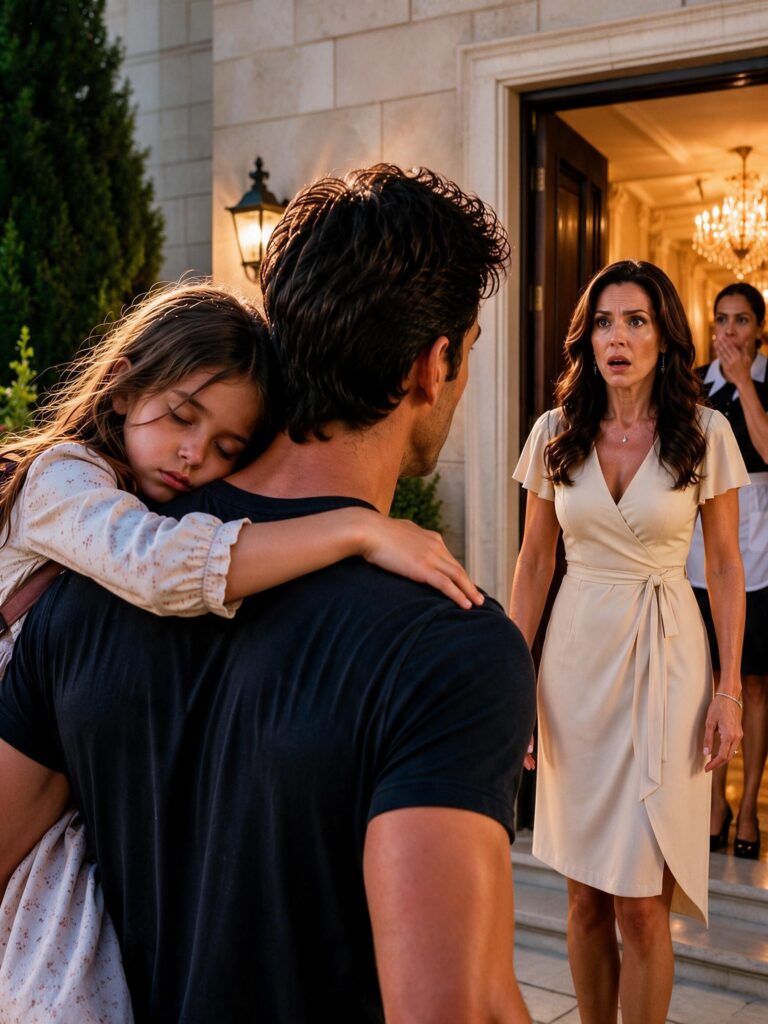
I carried her up the steps. Before I could knock, the door opened.
Vivian stood in the porch light with her hand halfway to her mouth. She looked at me like I had crawled up out of her past and rung the bell. Behind her, a woman in a black uniform pressed her fingers to her lips and went very still, the way people do when they already understand something the person holding the child does not.
“Vivian,” I said.
She did not answer right away. She stared at the girl sleeping against my chest, and something moved behind her eyes that I did not have a name for yet.
“Where?” she said, and stopped, and started again. “Where did you find her?”
“On Frankfort Pike. Walking the shoulder like she owned it.”
Vivian’s eyes dropped to the girl’s face, then came back to mine. I watched years of secrets rearrange themselves behind her expression.
“Dalton,” she said, so quiet I almost missed it. “You need to put her down. And then you need to sit. Because there is something I should have told you a long time ago.”
The maid’s name, I learned in the next minute, was Carmen. She had Josie’s bed turned down already, voice tight, and she disappeared to do whatever needed doing, throwing one more look back at me like she could not quite believe the porch. I carried Josie into a front sitting room that smelled like money and old flowers, laid her on the couch where Vivian pointed, and stood there waiting for the woman I used to love to explain why her daughter had my name folded into hers.
Vivian did not waste time once we were in the hall, the door pulled most of the way shut.
“She ran off from school today. There was a father-daughter thing. Hers didn’t.” She pressed two fingers to her temple. “I need to just say it. I’ve needed to say it for years, and I kept finding reasons not to.”
“Say it.”
“Josie is your daughter.”
I had done the math in the truck. I already knew it the way you know a storm is coming before the sky changes color. Hearing it in that hallway still knocked something loose.
“Eight years,” I said. My voice came out rougher than I meant. “Eight years, Vivian. I found out—” I stopped, pulled it down. “I found out nothing. Because nobody told me.”
“I found out I was pregnant three weeks after my father ran you off. I tried calling. Your number had changed.”
“Because your father had my old contractor’s line disconnected out of spite. I got a new one. It was posted on every truck I owned. You could have found me. People find people.”
Her eyes filled. She did not look away. “My father told me if I contacted you, he’d make sure you never worked another job in this county. I believed him. I was twenty-four and scared, and I let that fear decide for both of us. I have spent eight years telling myself I did the responsible thing.” Her voice cracked on the last word. “I didn’t. I did the safe thing. There’s a difference. I know it now.”
I stood there with my jaw tight enough to ache, looking at a woman who used to be the only person who made twenty-six feel like a good age. What I felt was not only anger. Grief sat under it, for eight years I did not get to have.
“She was on the side of the road,” I said, “because nobody showed up for her today. And nobody showed up for her because you decided a long time ago that I didn’t get to.”
Vivian flinched. I had not meant it as a blow, exactly. I did not take it back.
“I know,” she said. “I am not going to stand here and give you excuses that make me feel better. You have every right to be furious. I just need you to also see her. Not the situation. Her.”
From behind the half-open door, a small voice said, “I can hear you, you know.”
We both turned. Josie was sitting up, blanket half kicked off, watching us with the expression of a kid who has just learned something enormous and has not decided how to feel about it yet.
“Is that true?” she asked. Not Vivian. Me. “Are you my dad?”
There is not much that prepares a man for that question in a stranger’s sitting room at eight o’clock on a Tuesday. I crouched so I was not looming.
“Looks like it,” I said. I did not have anything smoother, and kids can smell smoother a mile off.
Her chin trembled, just slightly. Then she said the thing that undid me.
“I looked for you today because I thought maybe if I found you myself, you’d want to come. Nobody makes you if you find them yourself. It’s different than being asked.”
I did not have words ready. I said, “I would have come if I’d known you existed. There is not a single dad’s day, dad’s week, or dad’s anything I would have missed.”
She studied my face the way she had studied it in the truck. Whatever she found, she seemed to accept it. “Okay,” she said, in the practical voice of someone closing a deal, and lay back down like the conversation had used itself up for the evening.
Out in the hall again, neither of us spoke for a second.
“I want a paternity test,” I said finally. Not because I doubted it. Because I needed something official between us, something that was not only her word after eight years of her word being the reason I missed all of this.
“Of course,” Vivian said. “Whatever you need. I should have offered before you asked.”
“And I want a lawyer. Not because I’m trying to take her from you. Because I am done being a man who finds things out by accident.”
Something in her face broke open. Guilt and relief, tangled. “That’s fair. That’s more than fair.”
I looked past her shoulder to the sitting room. My daughter, if the paper agreed with the math, was already half asleep again, worn out from hunting a man she did not know she had already found once, briefly, years before either of them knew it.
“I’m not walking away,” I told Vivian. “Not from her. I don’t know yet what that means for you and me, and honestly that’s not the part I’m thinking about tonight. But her. I’m not walking away from her.”
“I wasn’t expecting you to,” she said quietly. “I was expecting you to hate me. You’d have every right.”
“I might get there,” I admitted. “Tonight I’m just tired. And I’ve got a kid asleep on your couch who decided the best plan for finding her father was to start walking a county road alone. So we’re going to need a longer conversation about supervision. Eventually. Once I’m done being furious at the both of you for different reasons.”
That got the ghost of a laugh out of her, wet and unsteady. “That’s fair too.”
Carmen appeared at the end of the hall with a folded blanket and stopped when she saw us. She did not pretend she had not heard any of it. She only said, “I’ll sit with her until she settles,” and went in without waiting to be thanked. On the way past me she added, low enough that Vivian might not have caught it, “She asks about you. Not by your face. By the fences. Her mother never said the name. The child invented the rest.”
Then she was gone, and I was left with that in the marble quiet.
Part 2
It was close to midnight when I actually left. I drove home with the radio off and the windows cracked, trying to let the night air do something about the noise in my head. Eight years. I kept turning the number over like a rock I could not stop picking up. Eight birthdays. Eight first days of school. A first word, a first step, a first scraped knee, all of it happening past those iron gates while I was thirty minutes away building fences and telling myself I had gotten over her.
I did not sleep much. Around two I was at the kitchen table with a legal pad, writing down every year of Josie’s life like I could retroactively attend it. Christmases. Summers. Somewhere around the fourth column I put the pen down because it was not helping. Rusty came and put his head on my knee, which was more than I could say for most people that week.
The money worry showed up with the morning, the way it always does when the feeling wears off. A lawyer costs. A test costs. I had a materials bill due Friday for a job out past Versailles, wire and posts I had fronted because the barn manager paid on thirty days and my supplier did not. If I missed that, the next job slipped. If the next job slipped, the truck payment got interesting. I stood at the counter with the checkbook and did the ugly arithmetic twice. Then I called Pete Hollis anyway.
Pete had handled a property dispute for me a few years back and had not padded the bill to make himself feel important. I told him the short version. He went quiet, then said, “All right. First we get a paternity test on the books, clean, through a lab, nothing either family can dispute later. Then we talk custody. But Dalton. Courts move slow. Kids don’t wait for courts. You start showing up now, consistently, and you let the paperwork catch up.”
That turned out to be the best advice anybody gave me.
I called Vivian and told her I wanted to see Josie again before any results came back. I was not going to let one more week of paper decide whether I was allowed to be her father. She did not argue. I think some part of her had braced for a much uglier fight than the one I was giving her. My refusal to punish Josie for her mother’s silence seemed to catch her off guard more than anything else I said that week.
Saturday I drove back out to Ashworth Lane. Josie was on the front steps before I got the truck fully stopped, which told me Vivian had let her watch from the window. That small kindness landed harder than I expected.
“You came back,” Josie said, like she had been running odds.
“Told you I would.”
“People say that a lot.”
“I know. I’m going to be annoying about actually meaning it.”
She almost smiled. The same careful half-smile from the truck, rationed until she was sure it was safe to spend.
We ended up on the tailgate for an hour. I let her turn the ratchet on a spare fence bracket I had tossed in the bed, mostly to give her hands something to do. She told me about Trevor, the boy who had said maybe she did not have a dad at all. I watched her jaw do the same thing it had done on the roadside. Tight. Flat. Not crumbling.
“You know that’s not true anymore, right? Whatever it was before, it’s not true now.”
“I know,” she said, in the voice of someone who knew it about sixty percent and was working on the rest. “Are you going to come to the next one? The dad thing?”
“I’m going to come to whatever your school lets me sign up for. And if they’ve only got one dad slot on the form, I will fight the school about that policy personally.”
That got the real smile, the one that was not rationed. I decided right then that getting that particular smile out of her regularly was going to be one of my main jobs, right alongside fence posts and paperwork.
The weeks after that were not a straight line. I showed up Saturdays, then wednesdays too, when a job let me knock off by four. Vivian met me at the door and did not hover, which I appreciated and did not say. Carmen started putting an extra glass on the porch table without being asked. Once, when Josie ran inside for a jacket, Carmen said, “Mr. Ashworth knows. He has not come down yet. When he does, it will not be a conversation. It will be an arrangement.” She said it like weather. Then she went back to the fountain, which still did not work right.
The paternity test came back twelve days later. I already knew what it would say. Some part of me had known the second Josie said Ashworth Pruitt in my truck like it was nothing. There is still a difference between knowing something and holding the paper. I read the results at the kitchen table with Rusty’s head on my boot and sat there a long while just breathing.
Pete called that afternoon. “Clean result. We can file. Don’t expect a hearing this month. Keep the calendar. Judges like calendars more than speeches.”
I kept the calendar. I also kept the materials bill from going late by eating sandwiches for a week and putting off a brake job the truck was starting to ask for. The pedal went soft on a hill outside Midway one evening. I made it home. I did not tell anybody. Pride is a stupid line item, and I kept it anyway.
Vivian’s father, predictably, tried to make noise. Lawyers. Arrangements. Boundaries that would keep me at a comfortable distance. He showed up at my place unannounced on a Thursday, standing in the driveway in a coat that cost more than my truck, telling me he was prepared to be generous if I understood the wisdom of keeping things quiet and structured.
Josie was inside, unpacking a bag from her last visit. I kept my voice level because of that.
“Structured,” I said. “That’s an interesting word for what you did eight years ago.”
“I protected my daughter’s future.”
“You cost your granddaughter eight years of a father who would have shown up to every single thing that mattered to her. That’s not protection. That’s a decision you made for other people and called it protection so you could sleep.”
He looked past me at the house, at the truck, at the dog watching from the porch like he was considering a opinion. “Generosity is still on the table. A trust. Distance. You keep your work. She keeps her life.”
“I’m not asking your permission this time. I’m telling you how it’s going to go. I’ll be reasonable because that’s who I am. I am not disappearing again because it’s inconvenient for your family’s version of things.”
He did not have much to say to that. He left. Looking back, part of me wonders if I should have let more of what I was actually feeling into that driveway instead of keeping it controlled. If a man had cost you every one of your kid’s early years and then offered to be generous about it, I am still not sure I would stay that calm a second time.
Near as I could tell, he did not come around again. Vivian later told me he had tried other angles through her. She shut them down, which was new for her. That was the thing I kept noticing that spring. Not only that she was letting me into Josie’s life, but that she was becoming someone who did not hand her decisions to her father anymore. I told her, eventually, that I noticed. I let myself notice it without deciding yet what to do with the noticing.
Josie and I built something slower than either of us expected. I taught her the difference between a post driver and a come-along, which she found unimpressive until she got to use one, at which point she declared fence building kind of awesome for boring work. She has her mother’s stubbornness and, according to Vivian, my way of going quiet when I am working something out instead of saying it. We are both trying to unlearn that, separately and slowly.
It was not all easy Saturdays. One night in February, over grilled cheese at my kitchen table because her mother had a board dinner and had asked, carefully, if Josie could stay, she looked up and said, “Are you going to disappear again the way you did before?”
“I didn’t disappear before. I didn’t know you existed.”
She looked at me with an expression too old for her face. “That’s what Mom said about you too. And then you were still gone a long time.”
I did not have a clean answer. I still do not, not really. What I have is Wednesdays and Saturdays and showing up enough times in a row that the fear in her voice gets a little quieter. It has not disappeared. I am not sure it ever fully will. Some nights that keeps me up worse than the paperwork.
Work got thinner in March. Two barns pushed their spring fence jobs to summer. The brake pedal got worse. I limped the truck to a shop in town and stood at the counter while the man wrote a number that made the week rearrange itself. Rotors, pads, a line that was weeping. I could do one of those things and pray about the others, or I could do all of it and miss a materials payment I had already promised.
“How bad if I only do the line,” I asked.
He did not soften it. “Bad enough I’d rather you didn’t drive a child in it.”
That settled it. I put the whole job on a card I do not like using and drove home with a steering wheel that felt like someone else’s. Josie noticed the truck was quieter on Saturday. She said it smelled like a store. I said it had been to the doctor. She accepted that, which was more grace than the card company was going to give me.
The school called on a Monday. Not Vivian. Me. A woman named Mrs. Ellison, who said she ran the front office and had my number from a form Vivian had finally updated.
“Mr. Pruitt, we need you here Thursday at three-fifteen. Not the makeup event. Before that. The principal would like a word, and she’d like you to come alone.”
She did not say why. She did not say whether it was about the day Josie had left campus, or about a man whose name had just appeared on a file eight years late, or about something worse. I stood in a feed-store parking lot with a bag of bolts in one hand and the phone in the other, and I could not tell whether I was about to be thanked or explained to.
Part 3
I wore a clean shirt. I ironed it myself, badly. The school smelled like floor wax and construction paper. Mrs. Ellison looked at me over the counter, recognized something in my face, and did not make me wait long.
The principal’s name was Adele Brooks. She had Josie’s file open and did not pretend otherwise.
“She left campus on a Tuesday in the fall,” she said. “We locked down the pickup line for twenty minutes before her mother arrived. I am not interested in punishing a seven-year-old for a hole the adults left. I am interested in knowing the hole is closed.”
“It’s closed,” I said. “Or it’s closing. I didn’t know she existed until the day I picked her up off Frankfort Pike.”
Mrs. Brooks studied me. “Carmen Reyes called this office the morning after. Not to gossip. To say a man had brought the child home asleep and had not asked for anything, and that the school should not treat the next absence like a whim. I don’t usually take domestic reports from household staff. I took that one because the child had already walked a county road.”
I did not know Carmen had called. I filed it away.
“There’s a makeup fathers’ event Friday,” Mrs. Brooks said. “I don’t know if we do it every year. This year we are doing it. You are on the list if you want the slot. The boy who told her she might not have a father will also be there. I would prefer that conversation happen in a gym, not on a roadside.”
“I’ll be there.”
“Good.” She closed the file. “Mr. Pruitt, for what it’s worth, the form your name is on now is the one we should have had in kindergarten. I’m not interested in whose fault that is this afternoon. I’m interested in whether you sign the next one.”
“I will.”
Friday I showed up early. The gym was covered in paper decorations that would not survive the weekend. I stood in the doorway scanning until I found her.
Josie saw me before I finished looking. She did not walk. She ran, full sprint, and hit me hard enough that I had to take a step back to catch her. Some of the other kids looked over. A couple of the dads nodded, the kind of nod men give when they recognize a moment and do not need to make it bigger.
“You’re early,” she said into my shirt.
“I’ve got some catching up to do. Figured I’d start now.”
She pulled back. None of the careful rationing was in her face this time. “Trevor’s here too. He’s not going to say anything, is he?”
“If he’s got opinions about my attendance record, he can bring them to me. I will patiently explain how many fence posts I’ve driven until he begs me to stop talking.”
She laughed, loud enough that a teacher glanced over. I decided that laugh was worth every uncomfortable conversation it had taken to get there.
Trevor did not bring his opinions. He looked at Josie, then at me, then at his own father, and went back to a paper crown he was stapling wrong. That was enough.
Afterward, in the parking lot, Vivian waited by her car and did not rush the goodbye. Josie climbed into the back seat with a paper flower crushed in one fist and said, through the open window, “Same time Wednesday?”
“Same time Wednesday.”
When the car was gone, Carmen was somehow there, which meant Vivian had brought her, or Carmen had brought herself. She held a Tupperware that was not fancy.
“She didn’t eat lunch,” Carmen said. “Nerves. This is just rice and chicken. It is not a statement.”
“Thank you.”
“Mr. Ashworth will not stop entirely,” she said. “He will get quieter. Quiet is not the same as done. You should know that, and you should not let it change Wednesdays.”
“I won’t.”
She nodded once, like a job had been checked, and went back to the car.
The months that followed stayed ordinary on purpose. Pete filed what needed filing. The order that came down was not dramatic. Shared time. A schedule. Vivian did not fight the parts that mattered. Her father sent one letter through a firm in town, full of words like stability and continuity. Pete answered it in plainer language. The letter did not come back.
I will not tell you Vivian and I became a clean reunion. We did not. Stories that pretend eight years of silence heal in a season are lying. We are careful with each other. We are honest in a way we were not allowed to be when her father was writing the rules. Some evenings I drop Josie off and we talk on the porch twenty minutes longer than we need to. Some evenings I do not stay past the driveway. We are figuring out whether what we had at twenty-six survives what happened after, or whether what is left is two people doing right by the kid they made without meaning to lose eight years over it.
What I know is narrower than that, and more useful.
There was a Saturday in May when the fountain on Ashworth Lane coughed and actually held water for an hour, because Josie had decided it was a project and I had decided not to tell her it was ornamental on purpose. We got wet to the elbows. Vivian came out with towels and did not mention her father once. Rusty, who had been allowed on the property for the first time, lay in the shade and supervised badly.
On the drive home Josie said, “I still think I found you. Not the other way around.”
“You’re not wrong.”
“If you had driven past, I was going to walk to the gas station. They have a map on the wall. I checked once with Mom.”
“Don’t walk to the gas station.”
“I know. Now I don’t have to.”
Every Wednesday when I pull into that circle drive and she comes out the door yelling my name before the truck is in park, I think about how close I came to driving past her on that shoulder, the way you drive past a hundred things a day without knowing what you are missing.
I did not drive past her. That is the only part of this story I got right on the first try. Everything else we are still working out, one Wednesday at a time.
Last week, coming off the pike with a load of posts, I saw another kid on a shoulder. Older. Waiting on a bus that was late, not lost. I slowed anyway. He waved me on, annoyed, which was fair. I went on. At the next light I sat with my hands on the wheel and thought about a backpack sliding off one arm, and a fountain that does not work right, and a girl who had decided finding someone yourself was different from being asked.
The light changed. I drove home to a dog and a kitchen that is less quiet than it used to be, and a calendar on the fridge with Wednesday circled in marker that is not mine.


