
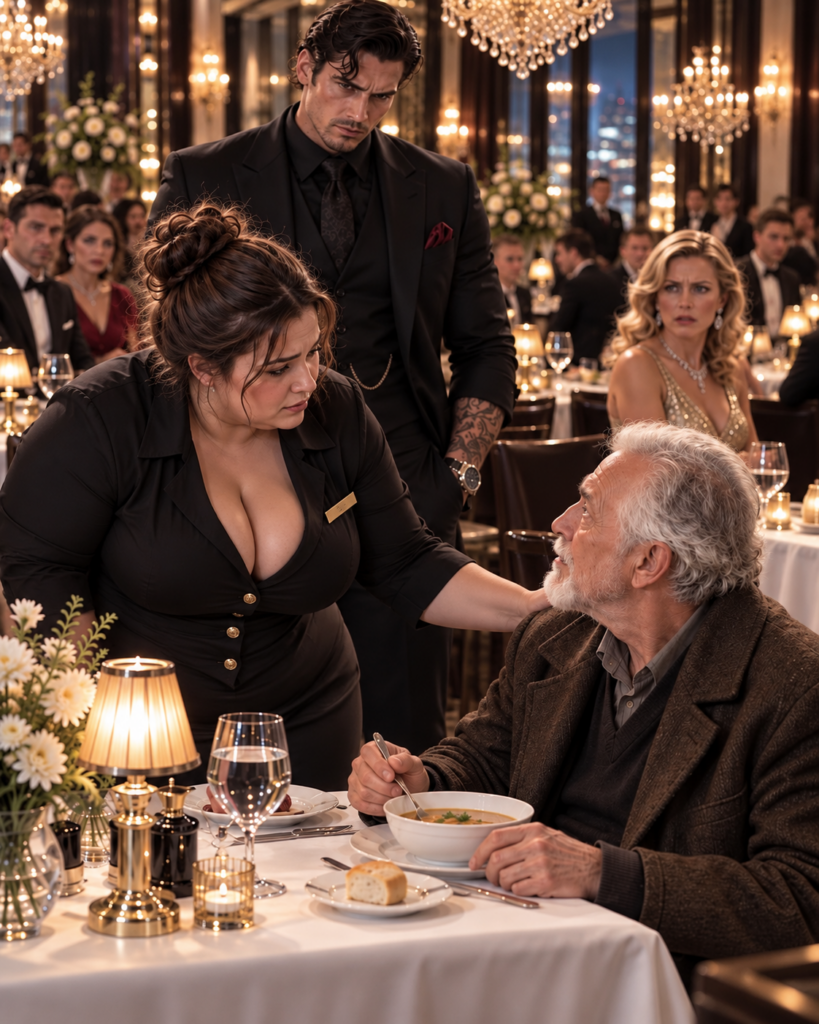
PART 2
The man who entered The Meridian Room did not hurry.
That was the first thing I noticed.
Everyone else seemed to react at once—Greg straightened, two servers exchanged startled looks, and Vanessa Price’s expression changed so quickly that, for a second, I wondered if I had imagined it.
But the newcomer simply stood inside the doorway and removed his gloves.
He was in his early sixties, perhaps, with neatly combed gray hair and the kind of charcoal overcoat that looked expensive without advertising the fact. I recognized him from company newsletters displayed in the staff hallway and from the framed photograph hanging near Greg’s office.
Daniel Calder.
Chief executive officer of Calder Hospitality Group.
The man whose signature appeared at the bottom of half the notices posted in our employee break room.
Greg reached him first.
“Mr. Calder.”
Daniel’s eyes moved past him.
They settled on table twelve.
On the old man.
Something unreadable crossed his face.
Not shock exactly.
Recognition.
“Dad?”
The word was quiet.
Yet everyone near us heard it.
Vanessa’s arms slowly lowered.
The elderly man looked down at his soup.
For several seconds, he said nothing.
Then he sighed.
“Hello, Daniel.”
I stared between them.
Greg did too.
Apparently neither of us had known that the man in the frayed coat was Arthur Calder—the retired founder of the company that owned the restaurant.
Daniel walked toward him.
“What are you doing here?”
Arthur glanced at the bowl in front of him.
“At the moment? Trying to finish some excellent soup.”
Daniel did not smile.
“Dad.”
“I was hungry.”
“You could have called me.”
“I know.”
There was something beneath the exchange that had nothing to do with soup.
I felt suddenly embarrassed to be standing there.
This was a family conversation happening under chandeliers.
Vanessa seemed to recover first.
“Mr. Calder,” she said quickly. “I’m afraid there’s been a misunderstanding.”
Arthur turned toward her.
His face remained gentle.
“I don’t think there has.”
Her color changed.
“My father has worked for Calder Group for twenty-two years.”
“Yes,” Arthur said. “Charles is very good with numbers.”
That was all.
Not praise.
Not criticism.
Just a fact.
Vanessa looked as though she had expected something more useful.
Daniel finally noticed the apron folded on the host stand.
Then he looked at me.
“Are you leaving?”
Before I could answer, Greg cleared his throat.
“There was a service issue.”
Arthur raised one eyebrow.
Greg’s voice weakened.
“I suspended Lily.”
Daniel looked at him.
“For what?”
Nobody answered.
The silence itself told him enough.
Arthur picked up his spoon again.
“She declined to remove me from my table.”
Daniel glanced toward Vanessa.
Then toward the investors seated across the room.
Then back to me.
“You were suspended because you refused to move a paying guest?”
Greg shifted his weight.
“I was trying to resolve a difficult situation.”
Daniel’s expression was calm.
“So am I.”
Those four words changed the room more effectively than shouting ever could.
He turned to me.
“Ms. Carter, would you mind waiting a few minutes before leaving?”
I looked at Greg.
Then at the clock above the bar.
Rent was due tomorrow.
My job had apparently disappeared and reappeared several times in the last five minutes.
“I suppose I can stay.”
“Thank you.”
Arthur gestured toward the chair opposite him.
“Sit down, Daniel.”
Daniel hesitated.
Then he did.
That surprised me more than anything else.
The chief executive of Calder Hospitality sat at table twelve like a son summoned to the kitchen table.
Arthur pushed the bread basket toward him.
Daniel ignored it.
“You disappeared from the hotel this afternoon.”
“I went for a walk.”
“You left your phone.”
“That was intentional.”
“Dad, you’re seventy-eight.”
“Yes. I’ve had quite a bit of practice being seventy-eight this year.”
A tiny smile appeared on the face of a nearby waiter before he caught himself.
Daniel rubbed his forehead.
“You could have told someone.”
Arthur’s expression softened.
“I could have.”
For the first time, I sensed that Daniel’s irritation was not really anger.
It was worry.
Arthur seemed to know that too.
“I’m sorry,” he added.
The apology was so simple that Daniel’s shoulders loosened.
“Thank you.”
Vanessa was still standing beside us.
“Mr. Calder,” she said, “I truly didn’t realize—”
Arthur looked at her.
“That I was Arthur Calder?”
She swallowed.
“Yes.”
He nodded.
“That seems to be the problem.”
Nothing about his voice was harsh.
Somehow that made the moment heavier.
“You shouldn’t need my last name to decide whether I deserve a chair.”
Vanessa looked down.
I expected her to argue.
Instead she said quietly, “No.”
Arthur studied her for a moment.
Then he nodded once.
“That’s something worth remembering.”
Daniel stood.
“Greg, I want to speak with you in your office.”
Greg followed him without protest.
Vanessa returned to her party.
The investors had become fascinated by their menus.
I remained near the host stand, unsure whether I was employed.
Arthur lifted his spoon.
“Sit with me, Lily.”
“I’m still technically on duty.”
“Are you?”
“That is an excellent question.”
He smiled.
The chair across from him was empty now, so I sat.
Up close, he seemed older than I had realized. There were shadows under his eyes. His hands trembled slightly when he lifted the spoon.
I wondered whether Daniel had been worried for a reason.
“You knew who I was?” Arthur asked.
“No.”
“Would anything have changed if you had?”
“I probably would have been more nervous.”
He laughed quietly.
“That’s refreshingly honest.”
“I might also have tried to talk you into ordering dessert.”
“You still can.”
“We have lemon tart.”
“I hate lemon tart.”
“Chocolate cake?”
“Now you’re negotiating professionally.”
For several seconds, we said nothing.
Then Arthur looked toward the office where Daniel and Greg had disappeared.
“Do you have family, Lily?”
The question felt unexpectedly personal.
“My husband.”
“Children?”
“Not yet.”
He nodded.
“My wife and I had Daniel late.”
His gaze drifted toward the pendant lights.
“His mother used to say he arrived because we had finally learned enough patience to deserve him.”
“Where is she?”
Arthur’s smile faded.
“She died six years ago.”
“I’m sorry.”
“So am I.”
There was no self-pity in his voice.
Only absence.
The kind people learn to carry.
“My husband lost his job three months ago,” I said.
I had no idea why I told him.
Maybe because he had told me something first.
Arthur looked at me.
“What does he do?”
“Industrial maintenance. Mostly manufacturing equipment.”
“Any luck finding work?”
“Thirty-seven applications.”
“That sounds like a number someone keeps counting.”
“I do.”
He understood that immediately.
I looked toward the kitchen.
“I probably shouldn’t be telling the founder of the company how badly I need this job.”
“Former founder.”
“You can’t be a former founder.”
Arthur considered that.
“Fair point.”
The kitchen doors opened and Greg emerged alone.
His face looked tired.
He walked toward me.
“Lily.”
I stood.
“Mr. Calder would like to see you.”
“Which one?”
Arthur smiled into his soup.
“Daniel.”
Greg led me into his office.
Daniel sat behind the desk, though it clearly belonged to Greg.
There was a staffing schedule beside him.
My name had been crossed out.
Daniel noticed me looking.
“Sit down.”
I did.
Greg remained standing.
Daniel folded his hands.
“I reviewed what happened.”
My pulse started climbing again.
“I also spoke with three employees who witnessed the conversation.”
I nodded.
“Greg has withdrawn your suspension.”
Relief arrived so suddenly that I almost laughed.
Instead I said, “Thank you.”
“But I want to be clear about something.”
My stomach tightened.
“You shouldn’t have had to risk your job to apply a policy we already have.”
I blinked.
“What policy?”
Daniel pulled a folder from the desk drawer.
“Calder Hospitality’s guest standards prohibit discrimination based on appearance, perceived income, disability, age, or social status.”
Greg stared at the floor.
I had never seen the policy.
Daniel seemed to guess my thought.
“You haven’t been trained on it properly.”
“No.”
“That’s our failure.”
Greg finally spoke.
“I should have handled it differently.”
I looked at him.
He seemed genuinely ashamed.
Not humiliated.
Not defensive.
Just tired.
“I panicked,” he said. “Vanessa mentioned her father, and I thought about the investors, the revenue, corporate complaints…”
His voice trailed off.
“I made the wrong call.”
I had spent the last twenty minutes believing Greg was a coward.
Hearing him admit it so plainly complicated the feeling.
“How long have you managed this location?” Daniel asked him.
“Eight years.”
“And how many times has someone threatened to call corporate?”
Greg gave a humorless laugh.
“Too many.”
“Then maybe we need to make corporate less frightening.”
That answer surprised both of us.
Daniel looked at me again.
“You can return to your shift tonight.”
I hesitated.
“Is Greg still my manager?”
“Yes.”
Greg looked up.
I understood what Daniel was offering.
Not a dramatic victory.
Not a sudden reversal where I replaced my boss because I had done one good thing.
A chance for the workplace itself to become better.
I nodded.
“Then I’d like to finish my shift.”
Greg looked relieved.
“Thank you.”
Daniel leaned back.
“There is one other matter.”
Of course there was.
“My father has been visiting properties.”
I waited.
“Unofficially.”
That explained the coat.
The cracked shoe.
Maybe.
“He does this sometimes,” Daniel said. “He believes executives see a different company than everyone else.”
Greg’s face tightened.
“Was tonight some kind of test?”
Daniel’s jaw moved slightly.
“No.”
I believed him.
“My father has terrible timing, but he doesn’t stage situations like this.”
“What was he doing here?”
Daniel looked toward the closed office door.
“That’s what I’m trying to understand.”
When we returned to the dining room, Arthur’s bowl was empty.
So was the chair.
I looked around.
“He left?”
The host nodded.
“About two minutes ago.”
Daniel closed his eyes.
“Of course he did.”
On the table sat eighteen dollars in cash.
Beside it was a folded paper napkin.
My name had been written on the outside.
LILY.
I unfolded it.
Inside, in shaky handwriting, were nine words.
Thank you for remembering that a chair is a chair.
Below that was a phone number.
No explanation.
I slipped the napkin into my pocket.
The rest of my shift was strangely ordinary.
People ordered steak.
Someone sent back a bottle of wine.
A couple celebrated their anniversary.
Vanessa and her husband left without speaking to me, though she paused near table twelve for a moment before walking out.
Greg apologized again after closing.
This time, without Daniel present.
“I should have backed you.”
I was stacking menus.
“Yes.”
He blinked.
Maybe he expected me to make it easier for him.
I didn’t.
But I wasn’t cruel either.
“I know you were scared.”
“That doesn’t make it right.”
“No.”
He nodded.
“I’d like to do better.”
I finally looked at him.
“Then do better next time.”
He gave a small smile.
“That sounds fair.”
When I got home, Mason was sitting at our tiny kitchen table surrounded by printed job applications.
Our apartment smelled like coffee and laundry detergent.
He looked up when I entered.
“You’re late.”
“I got fired.”
His face fell.
“Lily.”
“Then I got unfired.”
He stared at me.
I dropped my bag onto the chair.
“It was a complicated evening.”
Ten minutes later, he knew everything.
When I finished, he leaned back.
“The old man was Arthur Calder?”
“Apparently.”
“The Arthur Calder?”
“I don’t know how many there are.”
“The guy who built Calder Hospitality?”
“Yes.”
Mason whistled softly.
Then his expression changed.
“What?”
I asked.
“Nothing.”
“That was definitely something.”
He rubbed his chin.
“I applied to Calder three weeks ago.”
“For what?”
“Regional facilities supervisor.”
I sat straighter.
“You never told me.”
“I didn’t want to get your hopes up.”
“Mason.”
“I’ve gotten twenty-six rejection emails.”
“Thirty-seven applications.”
He pointed at me.
“See? You’re counting too.”
I smiled despite myself.
Then I remembered the napkin.
I took it from my pocket.
Mason read it.
“You’re calling him?”
“I don’t know.”
“It might be his personal number.”
“That feels inappropriate.”
“He gave it to you.”
“Maybe he gives everyone his number.”
Mason looked at me.
“Billionaires probably don’t hand out personal phone numbers on napkins.”
“I don’t know if he’s a billionaire.”
“Rich enough that this argument is beside the point.”
I placed the napkin beside the salt shaker.
“What would I even say?”
“Thank you?”
“For what?”
“For making your shift the strangest story I’ve heard all year.”
I laughed.
Then I grew quiet.
“What if he offers me something?”
Mason’s face softened.
“What would be wrong with that?”
“I don’t want tonight to become a transaction.”
He understood.
That was one of the things I loved about him.
He did not rush to solve feelings just because they made him uncomfortable.
After a moment, he said, “Then don’t call because you want something.”
“Why call?”
“Because maybe he does.”
The thought stayed with me.
At seven the next morning, our landlord slid a rent reminder beneath the door.
By nine, I was back at The Meridian Room.
Greg had called an all-staff meeting.
For the first time in my four years there, he read the guest dignity policy aloud.
He also admitted why.
No corporate language.
No softened version.
“I failed to apply this policy last night,” he said. “Lily didn’t.”
Nobody clapped.
I was grateful for that.
Greg was not turning his mistake into a performance.
He simply owned it.
Afterward, one of the servers, Tasha, touched my arm.
“You okay?”
“Ask me after coffee.”
She smiled.
“You know Vanessa’s father called this morning.”
I stopped.
“What?”
“Greg told the kitchen manager.”
My stomach sank.
“What did he say?”
“No idea.”
Greg appeared before I could ask more.
“Lily. Office.”
Again.
I followed him.
The moment we entered, he closed the door.
“Charles Price called.”
I waited.
“He apologized.”
That was not what I expected.
“To you?”
“To the restaurant. And to you.”
I sat down.
“Why?”
Greg shrugged.
“He said Vanessa told him what happened.”
“She told him?”
“Apparently.”
That confused me even more.
“He also said he wants his daughter to make her own apology.”
“I don’t need one.”
“No. But she may need to give one.”
I thought about that.
Maybe apologies were not only for the person receiving them.
Greg handed me an envelope.
“Corporate courier dropped this off.”
My name was printed on the front.
Inside was a handwritten note from Daniel Calder.
Lily—
My father has asked whether you would be willing to join him for lunch today. I understand this is unusual. You are under no obligation to accept. Your schedule has been covered from noon until two if you choose to go.
Below that was an address.
Not a corporate office.
A house.
I showed Mason during my break.
He stared at the message on my phone.
“You’re going.”
“That sounded less like an opinion and more like an order.”
“You spent yesterday defending an old man’s right to eat soup. The least you can do is let him buy you a sandwich.”
“At his house?”
“Maybe rich people have sandwiches at houses too.”
I laughed.
Then I saw something on Mason’s face.
A hesitation.
“What?”
He looked toward the window.
“I got an email this morning.”
My chest tightened.
“Another rejection?”
“No.”
He swallowed.
“Calder wants to interview me.”
I stared at him.
“When?”
“Tomorrow.”
“Mason.”
“I know.”
“Did Arthur arrange it?”
“I don’t know.”
“Did you tell anyone what happened last night?”
“No.”
“Did you use my name on your application?”
“No.”
We both fell silent.
Coincidence was possible.
But it felt thin.
“Do you want the interview?” I asked.
“Yes.”
His answer was immediate.
Then quieter:
“I just don’t want a job because someone feels grateful to you.”
The exact fear I had carried about calling Arthur appeared on his face.
I reached across the table.
“Then ask.”
“What?”
“If they offer you something, ask whether you earned it.”
He smiled faintly.
“That simple?”
“No.”
I squeezed his fingers.
“But clear.”
Arthur Calder’s house was smaller than I expected.
Large, certainly, but not the sprawling mansion I had imagined.
It stood on a quiet tree-lined street twenty minutes from downtown, built of pale brick with dark green shutters.
Daniel answered the door.
“You came.”
“That sounds like you weren’t sure.”
“I wasn’t.”
He stepped aside.
“My father can be persuasive.”
“I noticed.”
Arthur sat in a sunroom overlooking a garden.
He wore the same frayed coat.
Inside his own house.
That was odd.
“Lily.”
He smiled.
“I was afraid you might prefer lemon tart.”
“Never.”
Lunch was tomato sandwiches, pickles, and tea.
No staff.
No silver platters.
Arthur made the sandwiches himself.
“You look disappointed,” he said.
“I expected something fancier.”
“So did Daniel when he was twelve.”
Daniel, sitting across from us, shook his head.
“My father believes expensive restaurants are for everyone except him.”
Arthur ignored that.
For a while we talked about ordinary things.
Mason.
My mother, who lived three hours away.
Arthur’s garden.
Daniel’s daughter, Claire, who was in graduate school studying urban planning.
Then Arthur placed his cup down.
“I asked you here because I owe you an explanation.”
“For what?”
“For last night.”
He looked toward the garden.
“My wife’s name was Margaret.”
Daniel became very still.
Arthur continued.
“When we opened the first Calder hotel forty-eight years ago, we had almost no money. Margaret worked the front desk. I fixed plumbing. Daniel slept in a crib in the office.”
A small smile appeared.
“We were not impressive.”
He looked down at his coat.
“Especially me.”
Something clicked.
“This was your coat back then?”
Arthur touched the cuff.
“It was.”
Daniel looked surprised.
“You kept that?”
“In a cedar chest.”
“Why?”
Arthur’s expression changed.
“Because one night, before we had our own hotel, your mother and I walked into a restaurant after signing our first bank loan.”
Daniel said nothing.
“We wanted to celebrate.”
Arthur ran his fingers over the worn fabric.
“I wore this coat.”
I knew where the story was going before he finished.
“They refused to seat you.”
“Yes.”
Arthur did not sound angry.
Only distant.
“They assumed we couldn’t afford dinner. Margaret cried in the parking lot. Not because she wanted the food. Because we had spent months convincing bankers, suppliers, contractors, everyone that we belonged in business.”
He took a breath.
“And one stranger’s look made her feel small again.”
The garden clock ticked.
“I promised her our hotels would never become places where someone’s worth was measured by a coat.”
Daniel looked down.
Arthur continued.
“For years, I visited properties wearing this.”
“So last night was a test,” I said.
“No.”
He met my eyes.
“Last night was grief.”
The room changed.
Daniel looked at him.
Arthur’s voice softened.
“Yesterday would have been our fifty-third anniversary.”
Daniel inhaled slowly.
“I didn’t remember.”
“I didn’t expect you to.”
“Dad.”
“You have your own life.”
Arthur looked toward the garden again.
“I put on the coat because I missed her.”
Nothing about that required a response.
So none of us offered one.
After a while, Arthur said, “I walked past the first building we leased. Then I ended up at The Meridian.”
“And ordered soup?”
“Margaret loved chicken soup.”
I felt something in my chest tighten.
Not sadness exactly.
Recognition.
The way ordinary objects become doors after someone is gone.
A coat.
A bowl of soup.
A chair.
Daniel stood and walked toward the window.
“I wish you’d called me.”
Arthur nodded.
“So do I.”
That simple sentence seemed to carry years inside it.
Daniel turned.
“I mean it.”
“I know.”
“You don’t always have to disappear when you miss her.”
Arthur looked at his son for a long time.
“I’m still learning that.”
I began to understand that the mystery of Arthur Calder had never really been about whether he was secretly wealthy.
It was about why a man with every resource in the world had chosen to spend his anniversary alone in an old coat.
And why his son had not known where he was.
Lunch ended without grand announcements.
Arthur did not offer me money.
Daniel did not promote me.
For some reason, I respected them more for that.
At the door, Arthur handed me a small envelope.
I almost refused.
“It isn’t a check,” he said.
“That was exactly what I was worried about.”
“It’s worse.”
I opened it.
Inside was a folded sheet of paper.
At the top were the words:
Calder Hospitality Employee Council
“What is this?”
Daniel answered.
“We’re forming a committee of hourly staff from across the company.”
“For what?”
“To tell us what executives aren’t hearing.”
I looked at Arthur.
“Was this your idea?”
“Partly.”
Daniel leaned against the doorway.
“We started planning it three months ago.”
“So this isn’t because of last night?”
“No.”
Arthur smiled.
“But last night convinced Daniel you should be invited.”
I read the page.
Quarterly meetings.
Paid attendance.
Employees from housekeeping, kitchens, maintenance, front desks, restaurants.
“You want me to tell corporate what’s wrong?”
Arthur nodded.
“That seems dangerous.”
“Only if we’re doing our jobs badly.”
I laughed.
“I’ll think about it.”
“That’s all I’m asking.”
When I returned to the restaurant, Vanessa Price was waiting in the lobby.
Alone.
For one terrible second, I considered turning around.
Then she stood.
“Lily.”
I stopped.
She seemed different without the expensive dinner party around her.
Younger.
Uncertain.
“I won’t keep you,” she said.
“All right.”
“My father told me I should apologize.”
I said nothing.
She looked at the floor.
“But I didn’t come because he told me to.”
That caught my attention.
Vanessa took a slow breath.
“My grandmother saw the post.”
“What post?”
“Someone wrote about last night online.”
My stomach dropped.
“Names?”
“No. Not yours. Not mine.”
That was something.
Vanessa continued.
“My grandmother called me this morning.”
A sad smile appeared.
“She grew up poor. Very poor.”
She folded her hands.
“She asked me whether I would have wanted someone to move her from a table.”
I looked at her.
“What did you say?”
“The truth.”
Her eyes met mine.
“No.”
We stood beneath the same brass pendant lights.
“I’m sorry,” she said. “Not because he turned out to be Arthur Calder.”
I waited.
“I’m sorry because it should not have mattered.”
I believed she meant it.
Maybe not perfectly.
Maybe not completely.
But enough to begin.
“Thank you.”
She nodded.
Then she left.
That evening, Mason ironed his only suit for the Calder interview.
I sat on the bed reading the employee council invitation.
“Are you going to do it?” he asked.
“I don’t know.”
“You should.”
“You haven’t even asked what it pays.”
“What does it pay?”
“Regular hourly wage plus travel.”
He laughed.
“Then I withdraw my enthusiastic support.”
I threw a pillow at him.
He caught it.
Then he grew thoughtful.
“You know what’s strange?”
“What?”
“I found the Calder job because of your mom.”
I frowned.
“My mother?”
“Remember when she sent me that list of companies from the newspaper?”
“A month ago?”
“Yeah.”
He went to his laptop.
“She circled Calder because she recognized the name.”
“Why?”
“I assumed because they’re big.”
He opened his email.
“But this afternoon I asked her.”
Something in his voice made me sit straighter.
“And?”
He turned the screen toward me.
My mother had forwarded him a photograph.
Old.
Faded.
Four people stood in front of a small roadside hotel.
I recognized Arthur immediately, decades younger.
Beside him stood a dark-haired woman who had to be Margaret.
And beside Margaret—
I stopped breathing for a second.
A young woman smiled at the camera.
She had my mother’s eyes.
Under the photograph, my mother had written:
That’s your grandmother Evelyn. She worked with Margaret Calder before Daniel was born. I haven’t thought about this picture in years.
I looked at Mason.
“What?”
“There’s another message.”
He scrolled.
My mother had added:
Lily should ask Arthur what happened in the winter of 1978. I think he’s been waiting a long time for someone from our family to ask.
The room seemed suddenly too quiet.
My grandmother had died when I was eleven.
She had never once mentioned Arthur Calder.
Or Margaret.
Or any hotel.
I picked up my phone.
Arthur’s number was still saved from the napkin.
For the first time, I understood that perhaps table twelve had connected us long before either of us walked into The Meridian Room.
The question was no longer why Arthur Calder had come to the restaurant.
It was what he knew about my family.
And why my mother believed he had been waiting nearly fifty years to tell me.
PART 3
I did not call Arthur that night.
I wanted to.
My thumb hovered over his number twice.
But each time, I stopped.
Some questions become heavier the moment you know an answer exists.
Until that evening, my grandmother Evelyn had belonged to the quiet collection of memories I carried from childhood: peppermint candies in her purse, hand cream that smelled faintly of roses, a kitchen drawer filled with rubber bands she insisted might be useful someday.
She had been my mother’s mother.
She had made peach cobbler.
She had hated television commercials.
She had taught me how to sew on a button.
She had never been connected to a hospitality company worth millions of dollars.
At least, not in any story I had heard.
Mason closed his laptop.
“You okay?”
“No.”
“That seems reasonable.”
I paced toward the window.
“Why wouldn’t Mom tell me?”
“Maybe she didn’t know much.”
“She knew enough to tell me to ask Arthur about 1978.”
Mason nodded.
“That part is strange.”
I turned.
“Maybe Arthur did something.”
“What kind of something?”
“I don’t know.”
“You’re guessing.”
“Yes.”
He waited.
“Badly.”
“Yes.”
He stood and took both my hands.
“Then maybe don’t build the story before you hear it.”
That was annoyingly sensible.
“I hate when you sound reasonable.”
“I’ve been unemployed for three months. I’ve had time to develop wisdom.”
I smiled despite myself.
Then his expression softened.
“Call your mom.”
So I did.
She answered on the fourth ring.
“Lily?”
“Why was Grandma in a photograph with Arthur Calder?”
Silence.
Not surprise.
Silence.
That bothered me more.
“Mom?”
“I thought Mason might show you.”
“You sent him the photo.”
“I know.”
“Then why didn’t you send it to me?”
She sighed.
“Because I knew you’d call immediately.”
“I am calling immediately.”
“Yes.”
I sat down.
Mason moved quietly into the kitchen, giving me space.
“What happened in 1978?”
My mother was silent again.
Finally she said, “I don’t know everything.”
“What do you know?”
“That your grandmother worked at the first Calder property.”
“As what?”
“Bookkeeper. Reception. Laundry. Whatever needed doing.”
That sounded believable.
Grandma had been capable of fixing almost anything.
“Why did she leave?”
“That’s the part I don’t know.”
“Did something happen with Arthur?”
“No.”
Her answer came quickly.
“Nothing like that.”
“Then what?”
Mom took a breath.
“Your grandmother loved Margaret Calder.”
“As a friend?”
“As family.”
I leaned against the sofa.
“They met before either of them had much money. Margaret helped Grandma after Grandpa left.”
That surprised me.
I knew my grandfather had disappeared when my mother was young.
Nobody spoke about him.
“Arthur and Margaret gave Grandma work,” Mom continued. “She brought me to the hotel sometimes because she couldn’t afford childcare.”
I pictured my mother as a little girl in the lobby of a roadside hotel.
“Why didn’t you tell me?”
“Because it never seemed important.”
“That family now owns the restaurant where I work.”
“I know that now.”
My mother sounded almost amused.
“When you took the job four years ago, I didn’t realize Calder Hospitality was the same family.”
“How many Calder families did you think owned hotels?”
“Lily.”
“Sorry.”
She laughed softly.
Then grew serious.
“There was a disagreement.”
“With Arthur?”
“I think so.”
“About what?”
“Money.”
My stomach tightened.
“What kind of money?”
“I don’t know.”
“Mom.”
“I really don’t.”
Her voice was gentle but firm.
“Grandma quit. After that, she never spoke to Arthur again.”
“What about Margaret?”
“That was harder.”
I waited.
“They kept writing letters.”
“How long?”
“Years.”
I closed my eyes.
Another hidden door.
“Do the letters still exist?”
“I have some.”
“You have them?”
“I found them after Grandma died.”
“Mom.”
“I didn’t read all of them.”
“Why not?”
“Because they weren’t written to me.”
That answer stopped me.
It was exactly the kind of thing Grandma would have said.
Private was private.
“Why tell me now?”
“Because when Mason mentioned Arthur Calder, I remembered one letter.”
“What did it say?”
“I only read the first line.”
Mom hesitated.
“Margaret wrote, ‘Evelyn, Arthur still wants to make it right.’”
I looked toward the dark window.
“Make what right?”
“I don’t know.”
“And you never asked?”
“Your grandmother wouldn’t talk about it.”
There was regret in my mother’s voice.
“When people we love refuse to tell us something, sometimes we convince ourselves that respecting them means never asking again.”
She paused.
“I’m not sure that was always the right choice.”
Neither was I.
“Can I see the letters?”
“Yes.”
“When?”
“I can drive down Saturday.”
Today was Wednesday.
Saturday suddenly felt very far away.
After we hung up, Mason returned carrying two mugs of tea.
“Well?”
I told him.
He listened without interruption.
When I finished, he sat beside me.
“You’re going to call Arthur.”
“Yes.”
“In the morning?”
“Yes.”
“Good.”
Then I remembered his interview.
“Oh no.”
“What?”
“Your interview is tomorrow.”
“So?”
“What if this family history affects it?”
Mason stared at me.
“You think Arthur Calder has spent forty-eight years waiting to sabotage the grandson-in-law of his former bookkeeper?”
“When you say it like that, it sounds ridiculous.”
“It sounded ridiculous before I said it.”
I leaned against him.
“I don’t want my family story to become your employment strategy.”
“Neither do I.”
He kissed the top of my head.
“So I won’t mention it.”
The next morning, Mason left early.
I stood in our kitchen staring at Arthur’s number.
At 8:12, I called.
He answered after two rings.
“Lily.”
That unsettled me.
“You saved my number?”
“Of course.”
I swallowed.
“Do you know who Evelyn Mercer was?”
The silence on the other end was long.
Then Arthur said, very softly, “Yes.”
Not was.
No confusion.
No searching memory.
Just yes.
“She was my grandmother.”
“I know.”
I stood.
“You knew?”
“Not when you sat down with me.”
“When did you know?”
“Yesterday.”
“How?”
“Daniel mentioned your full name after you left.”
“My last name is Carter.”
“Your mother’s maiden name was Mercer.”
My grip tightened around the phone.
“How do you know my mother?”
“I met her when she was six.”
The room seemed to tilt.
“Arthur.”
“I think we should talk in person.”
I almost refused.
Then I remembered Mason’s advice.
Don’t build the story before you hear it.
“When?”
“Whenever you’re comfortable.”
“Today.”
“All right.”
This time we met at Calder’s oldest property.
Not the original hotel.
That building no longer existed.
But on its former site stood the Calder House, a modest boutique hotel renovated from a brick warehouse.
Arthur waited in the lobby.
No frayed coat.
He wore a blue sweater.
He looked strangely ordinary.
“Thank you for coming.”
“I almost didn’t.”
“I would have understood.”
We sat near the fireplace.
On the table between us lay a worn leather ledger.
My eyes went immediately to it.
Arthur noticed.
“This belonged to your grandmother.”
I stopped.
“How did you get it?”
“She left it behind.”
“For forty-eight years?”
“Yes.”
“Why didn’t you return it?”
“I tried.”
The answer came without defensiveness.
“Evelyn returned every package unopened.”
That sounded like Grandma.
Arthur rested his hand on the ledger.
“She was the best bookkeeper Margaret and I ever had.”
“What happened?”
Arthur looked toward the fire.
“In 1978, we were nearly bankrupt.”
I had not expected that.
“The company?”
“The company was one motel and a mountain of debt.”
He smiled faintly.
“We were good at hospitality. We were less good at understanding cash flow.”
“Grandma understood it.”
“Better than I did.”
He opened the ledger.
Her handwriting filled the pages.
Columns.
Dates.
Notes in blue ink.
“She found a problem.”
My heartbeat quickened.
“What kind?”
“One of our suppliers was billing us twice.”
“Fraud?”
Arthur shook his head.
“No.”
He turned a page.
“A clerical error.”
That was not dramatic.
It was also strangely believable.
“Thousands of dollars were being withdrawn twice each month. Evelyn caught it.”
“Then why did she quit?”
“Because I didn’t believe her.”
I looked at him.
Arthur did not look away.
“I thought I knew the business better.”
His voice was steady.
“I thought she misunderstood the new payment system.”
“But she didn’t.”
“No.”
“Did you accuse her of something?”
“Not theft.”
He shook his head.
“I accused her of making mistakes.”
Something in me tightened.
Grandma had been proud.
Quietly, fiercely proud.
“And?”
“She insisted I stop the payments.”
“Did you?”
“No.”
“Why?”
“Because I was thirty years old and very certain that being responsible for a company made me the smartest person inside it.”
He gave a rueful smile.
“It did not.”
I almost smiled too.
Almost.
“What happened?”
“Two months later, the bank froze our credit line.”
Arthur looked at the ledger.
“I finally checked everything myself.”
“And realized she was right.”
“Yes.”
“Too late.”
“For the business, almost.”
“What about Grandma?”
“For Evelyn, definitely.”
I understood.
“It wasn’t the money.”
“No.”
Arthur’s eyes met mine.
“It was trust.”
That word settled between us.
“She had given Margaret and me years of work. Long nights. Weekends. She had raised your mother in that lobby because she couldn’t afford a sitter. And when she told me something was wrong, I treated her like an employee who didn’t understand my business.”
His face tightened.
“She deserved better.”
“What did you do?”
“I apologized.”
“And she didn’t accept?”
“She accepted the apology.”
That surprised me.
“But she didn’t come back.”
“No.”
“Why?”
“Because forgiveness and returning are not the same thing.”
I sat very still.
That sounded like something Grandma might have believed.
“She told Margaret she forgave me,” Arthur continued. “But she said she needed to build a life somewhere she was trusted before she had to prove herself.”
“What happened to her?”
“She found work with a manufacturing company.”
I knew that.
Grandma had worked there twenty-six years.
“She became their accounting supervisor,” I said.
Arthur smiled.
“I know.”
“You kept track?”
“Margaret did.”
He reached into the ledger.
A faded photograph slipped out.
My grandmother stood beside a desk.
On the back, Margaret had written:
Evelyn’s promotion. Told you she’d run the place someday.
I stared at the handwriting.
“Why did Grandma stop talking to you?”
“She stopped talking to me.”
Arthur smiled sadly.
“She never stopped talking to Margaret.”
“What happened to their friendship?”
“Life.”
That answer hurt in a different way.
“They wrote. They visited twice. Then your mother grew older. Daniel grew older. Margaret and I moved. Evelyn remarried briefly. Years became decades.”
“And then Margaret died.”
“Yes.”
Arthur looked down.
“Afterward I found the letters.”
I thought of my mother’s box.
“Apparently Grandma kept hers too.”
Arthur nodded.
“Margaret hoped she would.”
I touched the leather cover.
“So why did Mom say you wanted to make something right?”
Arthur did not answer immediately.
Instead, he opened the ledger to the back page.
There was a handwritten calculation.
$4,840.
Below it:
E.M. share of recovery.
“What is that?”
“When Evelyn found the duplicate payments, she saved the company.”
“You said you didn’t listen.”
“I didn’t.”
“But you eventually recovered the money.”
“Yes.”
“With her records.”
“Yes.”
I looked at him.
“You wanted to pay her.”
“More than that.”
Arthur turned another page.
“When we finally stabilized, Margaret wanted Evelyn to receive a small ownership stake.”
My chest tightened.
“What?”
“Not because we owed her legally.”
He was careful with the words.
“Because we believed she had contributed something foundational to the company.”
“How much?”
“Two percent.”
I almost laughed from surprise.
“Two percent of Calder Hospitality?”
“Of the original company.”
“What would that be worth now?”
Arthur shook his head.
“That isn’t the question Evelyn asked.”
“What did she ask?”
“She asked whether I was giving it to her because I respected her work or because I felt guilty.”
I knew the answer before he said it.
“I said both.”
“And she refused.”
“Yes.”
I leaned back.
Of course she did.
Arthur almost smiled.
“You look exactly like she did when she thought I was being an idiot.”
“I’ll take that as a compliment.”
“It is.”
“Why keep the ledger?”
“She told me to.”
That surprised me again.
“She said, ‘Arthur, keep it somewhere you’ll have to look at it.’”
He touched the worn cover.
“So I did.”
Forty-eight years.
Not as punishment.
As a reminder.
“You built an entire company with that lesson?”
“Not by myself.”
He looked around the lobby.
“Daniel made half the decisions that turned Calder into what it is.”
“But the employee policies?”
“Margaret.”
“The employee council?”
“Daniel.”
I thought about that.
People were rarely one lesson.
One mistake.
One virtue.
Families even less so.
“Why didn’t you tell me yesterday?”
Arthur’s expression softened.
“Because yesterday you were Lily Carter.”
“And today?”
“Today you are still Lily Carter.”
He paused.
“But now I know you’re Evelyn’s granddaughter.”
I appreciated that more than I expected.
He pushed the ledger toward me.
“It belongs with your family.”
I did not touch it.
“Grandma told you to keep it.”
“She told me to keep it where I’d have to look at it.”
He smiled.
“I’ve looked long enough.”
I placed my hands on the leather cover.
For the first time since seeing the photograph, I felt something settle inside me.
Not certainty.
Connection.
Grandma had never told me this story.
Maybe because it was painful.
Maybe because she considered it finished.
Maybe because she did not want her granddaughter inheriting an old resentment that no longer belonged to anyone.
“Did you forgive yourself?” I asked.
Arthur looked surprised.
“No one’s asked me that.”
“Did you?”
He considered.
“Eventually.”
“How?”
“By becoming someone who might make a different decision next time.”
I thought of Greg.
I thought of Vanessa.
I thought of myself.
Maybe growth was rarely a grand transformation.
Maybe it was simply the next decision.
And the next.
My phone vibrated.
Mason.
I answered.
“How did it go?”
He was quiet.
Then:
“They offered me the job.”
I stood.
Arthur looked up.
“What?”
Mason laughed.
“I got it.”
My eyes filled before I could stop them.
“You got it?”
“I got it.”
Arthur’s expression changed.
He smiled.
I pointed at him.
“Did you have anything to do with this?”
Arthur raised both hands.
“No.”
Mason heard me.
“Is Arthur there?”
“Yes.”
“Put me on speaker.”
I did.
“Mr. Calder?”
“Yes?”
“Did you arrange my interview?”
“No.”
“Did you tell anyone to hire me?”
“No.”
Mason exhaled.
“Good.”
Arthur grinned.
“I like your husband.”
“So do I.”
Mason continued.
“The hiring manager said my application was already in final review before yesterday.”
Arthur glanced at me.
“There you are.”
I sat again.
“What job?”
Arthur asked.
“Regional facilities supervisor.”
His eyebrows rose.
“That’s not an easy position to get.”
Mason laughed.
“Thank you for making me nervous after I already got it.”
Arthur smiled.
“Congratulations.”
“Thank you.”
Then Mason grew quieter.
“Lily?”
“Yeah?”
“The salary…”
He stopped.
I knew what he meant.
Enough.
Enough for rent.
Enough to breathe.
Enough to stop counting the checking account every morning.
My eyes filled.
“I know.”
“We’re okay.”
For months, Mason had avoided saying those words because neither of us wanted to pretend.
Now I let myself believe them.
“We’re okay,” I repeated.
After we hung up, Arthur looked toward the fire.
“Good news?”
“The best.”
I took the ledger.
At the door, Arthur stopped me.
“Lily.”
I turned.
“Evelyn once told me that dignity matters most when nobody important is watching.”
I smiled.
“That sounds like her.”
“I thought of it when Daniel told me what happened at table twelve.”
He slipped his hands into his pockets.
“You didn’t know who I was.”
“No.”
“That mattered to me.”
“Why?”
“Because for years I’ve wondered whether the values we wrote into company policies existed anywhere outside the paper.”
I understood now.
“You found out.”
“Yes.”
“But not because of the company.”
He smiled.
“No.”
“Because of Grandma.”
His eyes softened.
“Perhaps a little.”
Saturday morning, my mother arrived carrying a cardboard box.
Mason made coffee.
I placed Grandma’s ledger on the kitchen table.
Mom stopped when she saw it.
“Oh.”
That one word held childhood.
Memory.
Years.
She touched the cover.
“I remember this.”
“You do?”
“I used to draw inside the back cover.”
She opened it.
There, beneath forty-eight-year-old accounting notes, was a faded purple flower drawn in crayon.
My throat tightened.
“You drew that?”
“I was six.”
Mason leaned over.
“Strong early work.”
Mom laughed.
We spent the next three hours reading letters.
Not all of them.
Some felt too private.
But enough.
Margaret wrote about Daniel losing his first tooth.
Grandma wrote about my mother joining the school choir.
Margaret complained about Arthur forgetting anniversaries.
Grandma complained about a neighbor who let his dog dig beneath her fence.
Ordinary life.
Between those stories were the pieces history leaves out.
In one letter, Margaret apologized for not defending Evelyn sooner.
In another, Grandma wrote:
You did not make Arthur’s mistake. He did. I won’t charge you for someone else’s bill.
“That sounds like her,” Mom whispered.
Later came another letter.
This one from Grandma.
Tell Arthur I’m not angry anymore. But please stop asking me to return. I found work where my judgment is trusted, and I need to stay long enough to learn what that feels like.
I read it twice.
Not revenge.
Not bitterness.
A boundary.
And a new beginning.
Mom wiped her eyes.
“I wish I’d asked her about this.”
“Maybe she would have told you.”
“Maybe.”
She looked at me.
“Or maybe not.”
That was true too.
We do not get every answer from the people we love.
Sometimes we inherit only enough pieces to understand them better.
The following Monday, I accepted the employee council position.
Greg seemed pleased.
“Does this mean you’re going to report everything I do wrong?”
“Only the interesting things.”
He grimaced.
“I regret supporting this already.”
But he was smiling.
The restaurant changed gradually.
Not because Arthur appeared one night.
Not because Daniel issued a dramatic order.
Because Greg started paying attention differently.
He changed the reservation policy so employees could not be pressured to remove seated guests for preferred customers.
He added dignity standards to new-hire training.
He also stopped taking every corporate threat personally.
That last change helped him most.
Vanessa returned three weeks later.
This time she came with her grandmother.
They sat near the windows.
When I approached, Vanessa looked slightly embarrassed.
“My grandmother insisted.”
The older woman smiled.
“I wanted to meet the waitress who made my granddaughter call me at seven in the morning asking if I thought she was becoming a snob.”
Vanessa covered her face.
“Grandma.”
I laughed.
“What did you tell her?”
Her grandmother looked at Vanessa affectionately.
“I told her if she had to ask, there was still hope.”
Vanessa groaned.
There was no hostility in the moment.
Only a family doing what families sometimes do best—holding up mirrors without refusing love.
Before leaving, Vanessa stopped beside table twelve.
“I’ve been thinking about something.”
“What?”
“You said the soup cost eighteen dollars.”
“Yes.”
“That was a very specific thing to remember.”
“I’m a server.”
“No.”
She smiled.
“You were making a point.”
“Maybe.”
She nodded.
“It worked.”
Then she left.
Months passed.
Mason started his new job and discovered, to his disappointment, that regional facilities supervision involved approximately ten thousand emails.
He loved it anyway.
Our bank balance slowly stopped frightening us.
We renewed our lease instead of moving.
On Sundays, we began driving to see my mother more often.
The old photograph of Evelyn, Margaret, and Arthur now hung in our hallway.
Arthur remained on my phone under one simple name:
ARTHUR — SOUP.
He found that hilarious.
Daniel did not.
The employee council held its first meeting in October.
Twelve employees sat around a conference table at Calder headquarters.
Housekeepers.
Cooks.
Maintenance workers.
Front desk agents.
Servers.
Daniel attended.
Arthur did not.
That seemed important.
This was Daniel’s company now.
During the meeting, a housekeeper from Milwaukee raised concerns about inconsistent scheduling.
A maintenance technician spoke about equipment requests getting lost between departments.
I talked about managers needing clear authority to protect staff and guests when high-spending customers demanded exceptions.
Daniel took notes.
Real notes.
Not ceremonial ones.
Afterward, he asked me to stay.
For a second, I wondered what I had done wrong.
Then he handed me an envelope.
“No.”
He looked confused.
“You haven’t opened it.”
“If it’s money, no.”
“It isn’t money.”
“That family says that a lot.”
He laughed.
Inside was a photograph.
Table twelve.
Empty.
On it sat a brass plaque.
I read the inscription.
THE EVELYN MERCER TABLE
I looked up sharply.
Daniel shook his head.
“Before you object, it was Dad’s idea.”
“That does not make me less likely to object.”
“The rest was mine.”
I read the second line.
A reminder that every guest deserves the same welcome before we know their name.
For several seconds, I could not speak.
“We didn’t use her full story,” Daniel said. “That belongs to your family.”
I appreciated that.
“Does Mom know?”
“Yes.”
“You asked her?”
“Yes.”
“And she agreed?”
“She made three wording changes.”
I laughed.
“That also sounds like Grandma.”
Daniel smiled.
“The plaque is small.”
“Good.”
“It’s inside the menu holder.”
“Better.”
“No ceremony.”
“Best.”
He looked relieved.
“There’s one more thing.”
“Daniel.”
“No plaque.”
“All right.”
He sat against the edge of the conference table.
“Dad wants to visit your mother.”
I became still.
“He asked?”
“He’s afraid to.”
“Arthur Calder is afraid of my mother?”
“Terrified.”
I smiled.
“Good instincts.”
Then Daniel’s face softened.
“He wants to give her Margaret’s letters.”
I understood immediately.
The other half.
Not business records.
Not money.
A friendship.
“I’ll ask Mom.”
“Thank you.”
She agreed.
Arthur visited the next Sunday.
Mason and I were there.
Mom made too much food.
Arthur arrived with flowers and a wooden box.
For the first few minutes, conversation was awkward.
Then Mom opened the box.
Inside were decades of letters.
Her childhood appeared piece by piece.
Margaret describing her school play.
Her first bicycle.
The time she broke a window throwing a baseball indoors.
Mom laughed.
“I blamed Daniel for that.”
Arthur looked horrified.
“You did?”
“I was seven.”
“Daniel got punished.”
“I know.”
“You knew?”
“I was seven, not honorable.”
We all laughed.
Later, Arthur stood in front of a photograph of Grandma.
“I’m sorry, Evelyn,” he whispered.
Mom heard him.
“She forgave you.”
“I know.”
“She wrote it.”
“I know.”
“Then believe her.”
Arthur looked at my mother.
For a moment, neither spoke.
Then he nodded.
“I’ll try.”
That was perhaps the most meaningful thing anyone said that afternoon.
Not that everything was fixed.
Not that the past disappeared.
Only that he would try to accept the forgiveness he had already been given.
That evening, after everyone left, Mason and I stood in Mom’s driveway beneath the porch light.
“You know,” he said, “none of this would have happened if Vanessa hadn’t wanted table twelve.”
I thought about it.
“Maybe.”
“Or if Arthur hadn’t worn the coat.”
“Or if Margaret hadn’t written letters.”
“Or if Grandma hadn’t kept the ledger.”
“Or if Mom hadn’t circled your job listing.”
Mason smiled.
“Everything sounds important when you look backward.”
I leaned against him.
“That’s because we know where it led.”
He considered that.
“What do you think Grandma would say?”
I looked through the window.
Mom was sitting at the table reading one of Margaret’s letters.
Arthur’s flowers stood in a vase beside her.
“I think she’d tell us to stop making her story more dramatic than it was.”
Mason laughed.
“She’d say it was bookkeeping.”
“Exactly.”
Then I thought of the line in her letter.
I need to stay long enough to learn what trust feels like.
“She’d also probably say we get to choose what we carry forward.”
Mason slipped his arm around me.
“What are you carrying?”
I thought about Greg choosing to admit he had been wrong.
Vanessa choosing to return with her grandmother.
Arthur learning that forgiveness was not the same thing as forgetting.
Daniel learning that policy meant little unless employees felt safe enough to follow it.
Mom learning that unanswered family questions could still be asked decades later.
Mason choosing to keep applying even after thirty-six disappointments.
And me.
The waitress who had been afraid of losing a job because three hundred and twelve dollars stood between my family and uncertainty.
“I think I’m carrying the chair.”
Mason looked confused.
“The chair?”
“The one Arthur wouldn’t let me give away.”
“He offered to move.”
“I know.”
I smiled.
“But I didn’t let him.”
Years later, that is still the part I remember most.
Not discovering that the old man was wealthy.
Not learning that my grandmother had once helped save his struggling company.
Not the job Mason got or the council I joined.
I remember the moment before any of that mattered.
An old man sat alone beneath a brass light.
A woman decided his coat told her who he was.
My manager became afraid.
And I had to choose whether someone else’s dignity was worth risking my own security.
At the time, I thought I was protecting Arthur Calder.
I understand now that I was protecting something my grandmother had spent her life teaching without ever giving it a name.
People deserve to be trusted before they become useful to us.
Welcomed before they impress us.
Respected before we know their connections.
And forgiven, sometimes, without being required to return to the place where they were hurt.
The Meridian Room still serves chicken soup.
It still costs eighteen dollars.
Table twelve still sits beneath the brass pendant light.
Most guests never notice the tiny plaque inside the menu holder.
They sit down.
They order dinner.
They talk about work, families, anniversaries, bills, children, mistakes, plans.
They have no idea that nearly half a century of one family’s unfinished story once came together at that table.
That seems appropriate.
Because Arthur was right from the beginning.
A chair is only a chair.
Until we decide who deserves to sit in it.
And sometimes the smallest decision we make for a stranger becomes the place where an old family story finally finds its way home.


