THE HOUSEKEEPER MOVED THE MAFIA BOSS’S DEAD MOTHER’S CHAIR—THEN SHE SAW THE RED LIGHT UNDERNEATH
The slap cracked across the Blackwood dining room just seconds after Emma Lawson moved the one chair nobody had touched in twelve years.
Every servant expected Victor Blackwood to fire her—or worse—when he saw his dead mother’s chair sitting three inches out of place.
Instead, Emma dropped to her knees, pointed beneath the carved wooden leg, and whispered, “Sir… that red light is blinking.”

PART 1 — THE CHAIR NO ONE WAS ALLOWED TO TOUCH
At Blackwood Manor, new employees learned three rules before they learned where the extra linens were kept.
Never enter Victor Blackwood’s west-wing office without permission.
Never repeat anything heard at the family table.
And never move Lady Eleanor Blackwood’s chair.
Not an inch.
Emma Lawson had been employed at the estate for twenty-one days.
At twenty-eight, she was the newest housekeeper and the easiest member of staff to underestimate. Her soft, plus-size figure made certain people assume she was slow before they had seen her work.
Emma never argued.
She simply noticed things.
A wineglass rotated half an inch away from the others.
A picture frame wiped clean except for the dust trapped behind one corner.
A dining chair sitting two inches farther from the table than it had the day before.
Rooms spoke.
Most people simply did not listen.
That Tuesday morning, the dining hall gleamed beneath three chandeliers.
Twenty place settings waited for a private Blackwood dinner that evening.
Emma polished the enormous oak table, aligned the silverware, and straightened the chairs one at a time.
Then she reached the far end.
The empty chair.
Dark walnut.
Carved roses along the back.
Never occupied.
Nobody had explained why.
They had only said:
“Do not touch it.”
Today it sat crooked.
Barely.
But enough to bother Emma.
She crouched and compared the front legs with the edge of the rug.
Definitely wrong.
“Two inches,” she murmured.
She wrapped her hands around the backrest.
Pulled.
SCRAPE.
The sound cut through the room.
“STOP!”
Emma turned.
Harold Whitmore, the senior butler, was coming toward her.
His face had gone white.
“Mr. Whitmore, I was just—”
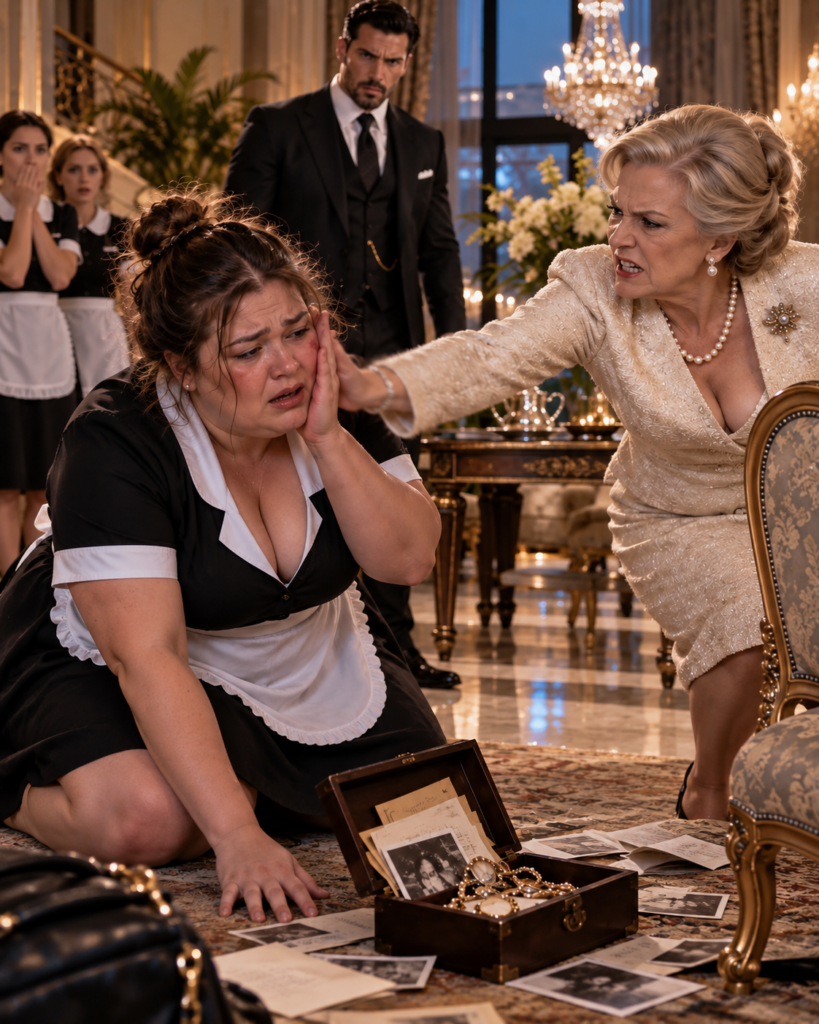
CRACK.
His palm struck her cheek.
Emma staggered into the table.
Crystal rattled.
Every servant in the doorway froze.
Harold’s hand shook.
“What have you done?”
Emma pressed her fingertips to her burning cheek.
“I straightened it.”
“No one touches that chair.”
“I didn’t know—”
“You were told.”
Heavy footsteps sounded in the corridor.
Every head lowered.
Victor Blackwood entered.
Thirty-eight.
Black suit.
Silver-gray eyes.
A man who never needed to raise his voice because everyone already feared what silence meant around him.
His gaze moved across the servants.
Then stopped.
The chair.
Three inches from its sacred position.
Harold lowered his head.
“My failure, sir. The new housekeeper—”
Emma forced herself upright.
“I’m sorry.”
Victor looked at her.
Then at the chair.
Emma’s stomach tightened.
She expected dismissal.
Security.
Anything.
Instead, something beneath the chair caught her eye.
Red.
Tiny.
Gone.
Then again.
Blink.
She frowned.
Harold saw her move.
“Don’t.”
But Emma was already kneeling.
“It’s not the chair.”
Victor’s gaze sharpened.
“What?”
“There.”
She pointed beneath the carved seat.
“A light.”
Victor stepped closer.
Everyone held their breath as he crouched.
His fingers disappeared beneath the wooden frame.
When his hand emerged, a small black device rested in his palm.
Matchbox-sized.
No markings.
A tiny red indicator flashed once.
Then died.
Nobody spoke.
Victor looked at the device.
Then at the chair his entire household had been too afraid to move for twelve years.
Harold whispered:
“My God.”
Victor rose slowly.
His expression had changed.
Not anger.
Something colder.
“Clear the room.”
The servants disappeared.
Emma remained frozen beside the table.
Victor looked at Harold.
Then at Marco Duca, his security chief.
Then finally at Emma.
“Someone knew no one would ever look beneath my mother’s chair.”
His gaze returned to the dead device.
“And whoever planted this is still inside my house.”
PART 2 — THE RULE THAT PROTECTED A MEMORY ALSO PROTECTED A TRAITOR
The doors closed.
The dining room suddenly seemed too large for four people.
Emma stood beside the table with one side of her face burning.
Harold remained several feet away, his white-gloved hands held stiffly at his sides.
Marco Duca took the listening device from Victor and turned it under the chandelier light.
He was forty-five, square-shouldered, compact, and carried the constant stillness of a man who spent his life waiting for other people to make mistakes.
“No serial number,” he said.
He ran a thumbnail carefully along the seam.
“No commercial branding.”
Victor asked, “Can you tell how long it was there?”
“Not from looking.”
“Battery?”
“Internal.”
Marco’s jaw tightened.
“Professional enough that I don’t want anyone touching it until my technical team examines it.”
Victor nodded.
Emma stared at the chair.
She could still see where the legs had rested for years. Four faint impressions lived in the polished floor.
Harold finally spoke.
“I checked this room every morning.”
Victor’s eyes shifted toward him.
“I checked every window latch. Every service door. Every decanter. Every cabinet.”
His voice sounded thinner than Emma had ever heard it.
“But not that.”
Nobody answered.
Harold looked at the chair.
“I never checked that.”
Victor’s face remained unreadable.
“Because I told you not to.”
Harold swallowed.
“Sir—”
“My order.”
Victor’s words landed quietly.
“My mistake.”
Harold looked almost pained by the mercy.
Emma did not understand any of it.
Victor noticed.
“You don’t know whose chair it was.”
“No, sir.”
A long silence followed.
Then Victor walked toward it.
“My mother’s.”
Emma’s breath caught.
Harold closed his eyes briefly.
Victor rested one hand on the carved back.
“Eleanor Blackwood sat there every Sunday night for twenty-six years.”
His voice contained no dramatic grief.
That made it heavier.
“She died twelve years ago.”
Emma looked at the roses carved into the wood.
“I’m sorry.”
“She hated condolences.”
That surprised her.
Victor almost smiled.
Almost.
“She believed grief became selfish if you made everyone else carry it.”
He removed his hand.
“I did exactly that.”
Harold whispered, “You were twenty-six.”
“I was old enough.”
Marco looked uncomfortable being present for something so private.
Victor turned away from the chair.
“After the funeral, I told Harold nobody would sit there again.”
Harold nodded.
“I told the staff not to move it. Not to use it. Not to change the place setting.”
Emma looked at the empty plate waiting in front of the chair.
There had been one every morning she worked here.
Fresh napkin.
Polished fork.
Unused glass.
An empty place maintained as meticulously as the occupied ones.
“Every new servant learned the rule,” Victor said.
Emma understood.
A rule repeated so many times eventually stopped requiring explanation.
Fear had done the rest.
Marco held up the device.
“Which made it the safest place in the mansion.”
Victor’s eyes hardened.
“Yes.”
Harold sank slowly into a nearby chair.
“I protected it.”
Victor looked at him.
“You protected my mother’s memory.”
“I protected whoever did this.”
“No.”
Victor’s tone sharpened.
“You obeyed me.”
Harold’s eyes glistened.
“That may be worse.”
Emma looked away.
Her anger over the slap had not disappeared.
But she suddenly saw something beneath Harold’s rigid uniform.
A man who had spent twelve years performing grief as duty.
Victor walked toward the tall windows.
Rain had started outside, soft against the glass.
“My mother despised blind obedience.”
Harold looked up.
Victor stared into the darkening gardens.
“She once dismissed a chauffeur for following my father’s instructions when he knew they were unsafe.”
Marco raised an eyebrow.
“She fired him for obeying?”
“She fired him for surrendering judgment.”
Victor’s mouth tightened.
“She would have moved the chair herself.”
Nobody spoke.
Marco placed the device inside a clear evidence bag.
“If this transmitted in real time, conversations from this room may have been compromised.”
“What conversations?”
“Depends how long it was active.”
Victor turned.
“Family dinners.”
Marco nodded.
“Business discussions.”
“Yes.”
“Financial meetings.”
“Yes.”
Emma felt cold despite the room’s warmth.
Victor’s family did not discuss ordinary matters at dinner.
She knew that much even after three weeks.
Men arrived in dark cars.
Documents were sometimes brought in sealed leather folders.
Conversations stopped when staff approached.
Marco said:
“The battery life suggests weeks, perhaps months. We need testing.”
Victor looked toward Emma.
“What made you move it today?”
She hesitated.
Harold looked at her too.
“It was crooked.”
Marco stared.
Victor waited.
Emma’s cheeks heated.
“I know that sounds stupid.”
“No,” Victor said.
“It looked wrong.”
“How wrong?”
“Two inches. Maybe less.”
Marco’s eyes narrowed.
“You noticed that?”
“I clean this room.”
“That doesn’t answer—”
Victor lifted one hand.
Marco stopped.
Emma continued.
“The front legs didn’t line up with the edge of the rug. All the other chairs did.”
“You moved it for symmetry.”
“Yes.”
“Then saw the light.”
“Yes.”
Victor studied her.
Emma had the uncomfortable sense that he was not merely listening.
He was cataloguing.
Tone.
Breath.
Hands.
Eyes.
Everything.
Marco asked:
“Who told you the rule?”
“Mr. Whitmore.”
Harold lowered his eyes.
“When?”
“First morning.”
“Exact wording?”
Emma thought.
“Never sit in that chair. Never move it. Never allow a guest to use it. If anything touches it, tell me.”
Marco glanced at Harold.
The old butler nodded.
“That is what I say to every new employee.”
Emma added quietly:
“No one told me why.”
Victor looked at Harold.
“That changes today.”
The door opened.
Two security officers entered.
Marco gave instructions.
Every exit sealed.
Staff devices collected.
No employee permitted to leave until cleared.
The Blackwood estate moved from mansion to fortress in under ten minutes.
Emma watched men she had seen carrying umbrellas now lock electronic doors.
Drivers were pulled from vehicles.
Kitchen staff were ordered into the service hall.
Gardeners were called inside from the rain.
The transformation frightened her more than Victor had.
She suddenly understood the size of the world hidden beneath polished floors and formal dinners.
Victor looked at Emma.
“You’re done for tonight.”
She blinked.
“Sir?”
“Go to your room.”
Marco said, “Not yet.”
Victor turned.
Marco continued carefully.
“She found the device.”
“Yes.”
“She started three weeks ago.”
“Yes.”
“The bug appears recent.”
Emma’s stomach dropped.
Victor’s expression cooled.
“You think she planted it.”
“I think we cannot exclude anything because it feels insulting.”
Victor stared at him.
Then nodded once.
“Good.”
Emma’s hands went cold.
Marco looked at her.
“You’ll answer questions.”
“How many?”
“As many as I have.”
She looked toward Victor.
He did not rescue her.
Strangely, that made her trust him more than if he had.
He said only:
“If you’re telling the truth, the evidence will survive questions.”
Emma swallowed.
“And if it doesn’t?”
Victor’s gaze did not move.
“Then neither will the lie.”
The interrogation room used to be a wine cellar.
Emma knew because the stone walls still smelled faintly of oak and dust.
A single lamp hung over the table.
Marco sat opposite her.
The bug lay between them in its plastic bag.
“Full name.”
“Emma Grace Lawson.”
“Age.”
“Twenty-eight.”
“Previous employer.”
“Riverside Hotel.”
“Reason you left.”
“They cut housekeeping staff after renovations.”
“Who recommended you here?”
“Placement agency.”
“Any family connected to Blackwood businesses?”
“No.”
“Debt?”
“Student loan.”
“How much?”
“Eleven thousand four hundred.”
“Gambling?”
“No.”
“Drugs?”
“No.”
“Boyfriend?”
“No.”
“Girlfriend?”
Emma blinked.
“No.”
“Anyone pressuring you for money?”
“No.”
“Anyone contact you after you took this job?”
“My mother.”
Marco did not smile.
“Anyone unusual.”
“No.”
He questioned her for two hours.
Then took a break.
Then returned.
Asked everything again differently.
Why did she choose housekeeping?
Why did she notice spacing?
Why did she move the chair when explicitly forbidden?
Why had she not called Harold first?
“Because it looked wrong.”
Marco stared.
“That answer remains ridiculous.”
“It remains true.”
“Do you always break rules because furniture bothers you?”
“No.”
“Then why this one?”
Emma’s cheek still throbbed.
She was tired.
Hungry.
Humiliated.
Her patience finally cracked.
“Because I was working.”
Marco went still.
“I was told to make that dining room perfect.”
Her voice shook now.
“Every napkin. Every fork. Every glass.”
She pointed vaguely upward.
“That chair was crooked.”
“So you ignored an order.”
“Yes.”
“Why?”
“Because I thought the worst thing that could happen was Mr. Whitmore yelling at me.”
Her eyes burned.
“I was wrong.”
Marco looked briefly at the fading handprint on her cheek.
Then back at the file.
At one in the morning, he asked:
“Why did you see the red light when nobody else had?”
Emma laughed once.
No humor.
“Because nobody else was lying on the floor after being slapped.”
Silence.
Marco’s expression shifted.
Barely.
He closed the folder.
Outside, suspicion had already found her.
Employees packed the servants’ dining hall.
No phones.
No privacy.
Fear moving from one face to another.
Emma entered to get water.
Conversation stopped.
A young maid named Claire lifted her cup from the table before Emma could sit.
Emma froze.
Claire’s face reddened.
But she did not put it back.
Someone whispered near the pantry:
“She knew exactly where to look.”
Another:
“Three weeks.”
Another:
“Convenient.”
Emma poured water.
Her hand trembled enough that it splashed across the rim.
Nobody helped.
She returned to her room.
Locked the door.
Then stared at herself in the mirror.
The mark on her cheek had deepened to red.
Her body filled the narrow uniform more than the other maids’.
Her hips broader.
Her stomach softer.
Her arms thick.
She had heard the little comments since arriving.
The uniform supplier probably doesn’t stock her size.
She’ll never manage the back staircase.
Kitchen work would suit her better.
Emma had learned young that people often turned bodies into evidence for conclusions they had already reached.
Clumsy.
Lazy.
Slow.
Now they had another conclusion.
Spy.
Her size had made her visible when they wanted someone to mock.
Newness made her visible when they needed someone to blame.
Emma sat on the bed.
For the first time, she considered packing.
Then remembered the locked gates.
She laughed bitterly.
Even quitting required clearance now.
A knock came at 2:15.
She opened the door cautiously.
Harold stood outside.
No gloves.
No jacket.
He held an ice pack wrapped in linen.
Emma stared.
“For your cheek.”
She almost closed the door.
Harold lowered his eyes.
“I deserve that.”
“Yes.”
The honesty stopped her.
He held the ice out.
She accepted it.
“Why did you hit me?”
His face tightened.
“I heard the chair move.”
“That isn’t an answer.”
“No.”
His hands folded together.
“Lady Eleanor was kind to me when I was nineteen.”
Emma waited.
“My father drank.”
The old man looked toward the empty corridor.
“I came to Blackwood service because nowhere else would hire someone with no references.”
“Mrs. Blackwood did?”
“She asked whether I could carry a tray without spilling it.”
A faint smile.
“I said yes.”
“Could you?”
“No.”
Emma almost laughed.
Harold’s eyes grew wet.
“She taught me.”
He swallowed.
“When she died, Mr. Blackwood gave one order about that room.”
No one touched her chair.
“I made that order into religion.”
Emma pressed the cold pack to her face.
“And when I moved it…”
“You did not move furniture.”
Harold’s voice broke.
“In my head, you touched the last thing I thought I could still protect.”
Emma looked at him.
“That doesn’t make the slap okay.”
“No.”
He straightened.
“It makes it shameful.”
The words landed differently than an excuse.
He looked directly at her.
“I protected a rule instead of protecting a person.”
Emma said nothing.
“I am sorry.”
She believed him.
Forgiveness did not arrive with belief.
It would take longer.
“I need sleep.”
“Yes.”
He stepped away.
Then stopped.
“Emma?”
“What?”
“If I had moved that chair once in twelve years…”
He looked down.
“Perhaps we would have found it sooner.”
She shook her head.
“Or there would’ve been nothing there yet.”
Harold looked up.
That thought had not occurred to him.
“Don’t punish yourself for not seeing something somebody deliberately hid.”
A strange expression crossed his face.
“You sound like Lady Eleanor.”
“I never met her.”
“No.”
He nodded.
“But I suspect she would have liked you.”
At three forty-eight in the morning, Victor was still awake.
Security footage covered the monitors in his study.
Marco stood behind him.
Family members had begun demanding answers.
Victor’s uncle Dominic wanted Emma handed over immediately.
Cousin Adrien Blackwood called her arrival “too coincidental.”
An accountant questioned the staffing agency.
Victor listened.
Then asked:
“Where is the dining-room footage?”
Marco paused.
“We haven’t reviewed the exact discovery window.”
“Why?”
“We focused on entry records.”
“Then we are speculating.”
Marco said nothing.
Victor turned.
“My mother used to say fear makes stupid people confident.”
Marco nodded toward the security office.
“Let’s stop being stupid.”
The footage began at 11:32 a.m.
Emma entered with silverware.
She worked.
No unusual pause.
No hidden exchange.
No suspicious object.
At 11:41, one teaspoon slipped from her tray.
It bounced.
Rolled.
Disappeared beneath the table.
Emma put the tray down.
Kneeled.
Reached.
The chair blocked her arm.
She hesitated.
Then pulled it.
Exactly three inches.
Retrieved the spoon.
Started to stand.
Stopped.
Her face changed.
She looked under the chair again.
The red blink appeared faintly on camera.
Marco leaned toward the monitor.
“Pause.”
The technician froze the image.
Emma’s hand was empty.
Both before and after.
“Earlier angle.”
Rewind.
Nothing placed.
No opportunity.
Marco’s jaw tightened.
Victor said:
“Again.”
They watched three times.
Four.
Five.
The truth refused to become more complicated.
Emma had dropped a spoon.
She had moved a chair.
She had accidentally uncovered the most serious security breach the Blackwoods had faced in years.
Marco exhaled.
“I was wrong.”
Victor looked at him.
“You were cautious.”
“I treated her like a suspect.”
“She was one.”
Marco frowned.
Victor continued:
“She was also innocent.”
Both things could be true during an investigation.
“Release her.”
“What about the family?”
“Tell them the footage cleared her.”
“They won’t like it.”
Victor’s gaze sharpened.
“Truth does not require their enjoyment.”
Emma expected Marco when the lock opened.
Instead, Victor stood outside.
She immediately straightened.
“Sir.”
“You’ve been cleared.”
Emma blinked.
“That’s it?”
“Security footage showed the discovery from start to finish.”
Relief should have felt warm.
Instead, it made her knees weak.
She grabbed the back of the chair.
Victor noticed.
“You need to sit.”
“I’m fine.”
“No, you’re upright.”
She almost smiled.
Then remembered who he was.
Victor stepped aside.
“Walk with me.”
They moved through dark corridors.
The mansion at four-thirty in the morning felt unfamiliar.
No servants.
No dinner conversations.
Only security men in distant intersections and rain tapping the windows.
Victor brought her to the dining hall.
The chair remained displaced.
Evidence markers now sat beneath it.
Emma stopped near the doorway.
Victor walked to the table.
“My family accused you quickly.”
“Yes.”
“You noticed.”
“Yes.”
“Does that surprise you?”
Emma thought.
“No.”
Victor looked at her.
“Why?”
“I’m new.”
“Anything else?”
She hesitated.
“People like easy explanations.”
He said nothing.
Emma added:
“And I was easy.”
Victor understood the second meaning.
Not only new.
A housekeeper.
Overlooked.
Different.
Expendable.
He looked toward her cheek.
“Harold apologized.”
“How do you know?”
“He told me.”
“I didn’t forgive him yet.”
Victor’s mouth shifted slightly.
“I did not ask you to.”
That surprised her.
He looked at the forbidden chair.
“For twelve years, this room obeyed one story.”
“My mother sat there.”
She died.
The chair remained empty.
Nobody touched it.
“Simple stories are dangerous.”
Emma stood beside him.
“What story now?”
Victor looked at the listening device.
“That someone inside my family understood my grief better than my security.”
Marco’s forensic report arrived at dawn.
The transmitter was high-grade.
Custom modified.
Designed for brief burst transmissions.
Installed recently.
Estimated within six to ten weeks based on adhesive condition, dust displacement, and power usage.
Six to ten weeks.
Emma had been employed three.
That reduced suspicion further.
It also meant someone with access during the previous two months had physically approached the sacred chair.
Marco created a list.
Family members.
Senior advisers.
Long-serving staff.
Security.
Trusted contractors.
Everyone who could enter the dining room unsupervised.
The list contained forty-three names.
Victor studied it.
Then tore nothing apart.
No screaming interrogations.
No dramatic arrests.
Instead, he restored normal life.
At nine a.m., employees were allowed to return to assigned duties.
Phones remained temporarily controlled.
By noon, some devices were returned.
By afternoon, cars moved through the gates again.
Emma found the normality more frightening than lockdown.
Something dangerous remained hidden.
And everyone knew it.
Victor told Marco:
“No aggressive sweep.”
Marco frowned.
“They know we found it.”
“Yes.”
“Then they’re cleaning their tracks.”
“Probably.”
“So we move.”
“No.”
Victor leaned back in his office.
“We stop hunting evidence they expect us to seek.”
“What do we hunt?”
Victor looked through the open study door toward the dining wing.
“A reaction.”
That afternoon, Emma returned to work.
Nobody openly accused her anymore.
But apologies came strangely.
Claire left a cup of tea beside Emma’s cart without mentioning the dining-room incident.
The chef gave her two pastries instead of one.
A gardener said:
“Heard you’ve got good eyes.”
Then immediately looked embarrassed.
Emma accepted all of it quietly.
Harold did more.
At six each morning, a fresh cup of Earl Grey waited beside her cart.
No note.
No speech.
On the fourth day, Emma finally said:
“You know tea isn’t an apology.”
Harold looked startled.
“No.”
“But it helps.”
His shoulders loosened.
That evening, Victor asked Emma to come to his office.
She stood just inside the door.
“Sit.”
She remained standing.
“Am I in trouble?”
“No.”
“That usually comes before sitting.”
Victor looked amused.
Barely.
“Fine. Stand.”
Marco was there.
So was a large diagram of the dining table.
Photographs of everyone with regular access covered another board.
Victor pointed to the empty-chair position.
“The transmitter heard whatever happened in this room.”
Emma nodded.
“We need whoever planted it to believe another device survived.”
She understood.
“You’re going to lie where they can hear.”
“No device remains.”
“Then how—”
Victor’s eyes moved to the photographs.
“We tell the lies to everyone who might carry them.”
Marco added:
“Same information. Controlled audience.”
Emma looked at the board.
“A leak test.”
Victor’s gaze sharpened slightly.
“You know the term?”
“My hotel manager used fake shift schedules once to find out who kept warning employees before surprise inspections.”
Marco smiled.
“Same principle. Higher stakes.”
Emma looked again at the photographs.
“What do you need from me?”
Victor said:
“You prepare the dining room.”
“That’s all?”
“No.”
She waited.
“You watch.”
Emma stared.
Marco looked surprised too.
“Sir?”
Victor continued.
“You noticed a two-inch chair shift nobody else saw.”
Emma folded her arms.
“That was furniture.”
“People are furniture with better excuses.”
She almost laughed.
Victor did not.
“I want your observations.”
“Why?”
“Because everyone else in that room will be watching me.”
He looked directly at her.
“No one watches the housekeeper.”
The sentence stung.
Victor saw it.
“I did not say that was right.”
Emma swallowed.
“You said it was useful.”
“Yes.”
She thought of every dinner where guests had talked over her while she poured wine.
Every wealthy person who handed coats toward her without looking at her face.
Every whispered assumption that a woman her size must be invisible even while occupying more physical space than they expected.
People saw what they decided mattered.
Emma nodded.
“What should I watch for?”
Victor said:
“Anything that doesn’t belong.”
The mandatory dinner invitation went out the next morning.
Twenty-one guests.
Family shareholders.
Legal counsel.
Financial adviser.
Regional captains.
Two cousins.
Victor’s uncle Dominic.
Adrien Blackwood, Victor’s cousin and childhood friend.
No explanation.
At seven that evening, rain moved across the estate.
Emma arranged the table.
Her hands slowed near Eleanor’s chair.
Harold stood behind her.
“You can touch it.”
She looked at him.
“I know.”
But she did not.
Not because she feared punishment.
Because the chair was evidence now.
And because something about its emptiness still commanded respect.
Harold said quietly:
“Mrs. Blackwood hated empty tables.”
Emma turned.
“You said that before.”
“She used to bring staff in on Christmas.”
“To this room?”
“Yes.”
“Even servants?”
Harold looked almost offended.
“She hated the word servants.”
“What did she call you?”
“Harold.”
Emma smiled.
He continued:
“One Christmas, a junior footman dropped an entire pudding.”
“What happened?”
“She laughed until she cried.”
“Mr. Victor?”
“He was seventeen.”
“Did he laugh?”
“No.”
“Of course not.”
Harold smiled.
“He cleaned it up.”
That image stayed with Emma as guests arrived.
Victor Blackwood at seventeen.
On his knees with a cloth.
Before power became armor.
At seven precisely, Victor entered.
Everyone stood.
He sat.
Everyone followed.
The empty chair remained untouched.
Dinner began.
For ten minutes, ordinary conversation.
Markets.
Construction.
A charity foundation.
One cousin complained about airport delays.
Victor allowed everyone to relax.
Then he placed his wineglass down.
“The security investigation is concluded.”
Several faces changed.
Emma watched from the wall.
A tiny exhale from Dominic.
A glance between two advisers.
Adrien continued cutting his meat.
Victor said:
“The transmitter obtained nothing useful.”
Lie one.
Marco, seated near the opposite end, looked bored.
Victor continued:
“We will move several overseas holdings tomorrow morning.”
Lie two.
Emma watched hands.
Aunt Camille reached for water.
Attorney Nolan paused before lifting his fork.
Adrien remained still.
“Chicago distribution moves to Warehouse Twelve next week.”
Lie three.
Emma poured wine for Dominic.
His hand trembled slightly.
Age, perhaps.
Victor’s voice remained casual.
“And Friday’s shipment will carry assets valued at fifty million.”
Lie four.
That produced more reactions.
One adviser swallowed too quickly.
Another looked toward Marco.
Adrien finally moved.
Only one gesture.
His left thumb brushed the inside edge of his jacket.
Then disappeared.
Emma noticed because his right hand remained on the table.
A normal person adjusting a jacket would use whichever hand was closer.
Adrien’s gesture seemed deliberate.
Checking something.
Pocket.
Phone?
No devices were supposed to be carried to the table.
Emma moved behind his chair with the wine.
“More, sir?”
Adrien covered his glass.
“No.”
His voice was steady.
Too steady?
She stepped away.
As dinner continued, she observed something else.
Adrien asked no questions.
Everyone else did.
Why transfer overseas funds?
Why Warehouse Twelve?
What route?
What timing?
Adrien accepted every statement.
As if the information was not something to understand.
Only something to remember.
Emma caught Victor’s eyes once.
She did not signal.
Not yet.
Dinner ended at nine.
Guests moved toward the drawing room.
Emma cleared plates.
Victor passed close enough to whisper:
“Anything?”
She kept her eyes on the dishes.
“Adrien touched his inner pocket after Warehouse Twelve.”
Victor did not react.
“He asked nothing.”
Victor kept walking.
Marco met him in the study ten minutes later.
“You’re watching Adrien?”
“Yes.”
“Because Emma noticed him?”
“Because I noticed him too.”
Marco nodded.
“Pocket?”
“Yes.”
“Device?”
“Could be.”
“We searched everyone.”
Victor looked toward the window.
“Not every message needs to leave from this house.”
They waited.
The wait lasted forty-seven minutes.
Marco’s phone vibrated.
He answered.
Listened.
His expression sharpened.
Then he ended the call.
“Encrypted burst from Adrien’s estate.”
Victor’s eyes went cold.
“Content?”
Marco placed a tablet on the desk.
Four pieces of information.
Overseas transfer.
Warehouse Twelve.
Friday.
Fifty million.
Every lie.
Victor stared.
Emma stood near the doorway with a coffee tray.
She had not meant to hear.
Nobody told her to leave.
Marco said:
“Could be coincidence.”
Victor looked at him.
“All four?”
“No.”
“Source?”
“Device registered to a secure system on Adrien’s property.”
“His personal terminal?”
“Guest wing office.”
Victor remained silent.
Marco continued:
“And we have movement.”
“Where?”
“Opposition vehicles redirected toward Warehouse Twelve.”
Warehouse Twelve had been empty for six years.
The false information had traveled.
Fast.
Clean.
Exactly as designed.
Victor picked up Adrien’s photograph.
Turned it face down.
Emma expected satisfaction.
There was none.
Only exhaustion.
“He grew up here,” Victor said quietly.
Marco did not answer.
“He broke his arm climbing the east wall when he was ten.”
Victor looked at nothing.
“My mother sat beside his hospital bed.”
Emma realized then that betrayal was not frightening because enemies existed.
Enemies were simple.
Betrayal hurt because love had provided the access.
Marco asked:
“What do you want done?”
Victor’s eyes sharpened.
“Proof.”
“We have the transmission.”
“I want the chain.”
“Before action?”
“Yes.”
“I thought—”
“No guessing.”
Victor looked at him.
“No fear making us confident.”
Marco understood the reference.
Lady Eleanor’s lesson.
The next two days tightened around Blackwood Manor.
Adrien behaved normally.
Too normally.
Victor invited him for coffee.
They discussed nothing important.
Adrien smiled.
Asked about a horse Victor no longer owned.
Mentioned an old school friend.
Emma served them.
Once, Adrien looked at her.
“Famous housekeeper.”
Her stomach tightened.
Victor’s eyes moved immediately.
Emma said:
“I prefer Emma.”
Adrien smiled.
“Of course.”
Victor said quietly:
“So do I.”
Adrien’s smile disappeared for half a second.
There.
Something small.
Something ugly.
After he left, Victor asked:
“What did you hear?”
Emma hesitated.
“He didn’t mean famous.”
“What did he mean?”
“I think he meant servant.”
Victor’s jaw tightened.
“You can tell?”
“I’ve heard the word without people saying it.”
Victor looked toward the door Adrien had used.
“So have I.”
Marco’s technical team recovered older encrypted traffic.
Not enough for complete history.
Enough for pattern.
Messages often followed dinners.
Routes.
Meeting changes.
Names.
Payments to shell companies appeared near Adrien-linked accounts.
Slowly, evidence became structure.
When Victor finally confronted him, there was no warehouse dungeon.
No spectacle.
No family audience.
Only the study.
Victor.
Marco.
Adrien.
Emma was nowhere near it.
Later, Harold heard only fragments.
Adrien denied everything first.
Then accused Marco.
Then claimed coercion.
Then asked what Victor wanted.
Finally:
“How much do they know?”
That was the sentence that broke him.
Not a confession.
A surrender.
Victor answered:
“Enough.”
Adrien sat down.
His face collapsed.
“They were going to kill me.”
Victor stared.
“When?”
“Two years ago.”
“Why?”
“Debt.”
“What debt?”
“Investment losses.”
Victor’s expression did not move.
“Why didn’t you come to me?”
Adrien laughed bitterly.
“Because you would’ve looked at me like this.”
“Like what?”
“Disappointed.”
Victor went still.
Adrien’s eyes filled.
“You don’t understand what it’s like being the cousin of Victor Blackwood.”
“No.”
“You walk into every room and everyone already knows who matters.”
Victor said nothing.
Adrien continued.
“I gave them small things first.”
“A schedule.”
“A shipment delay.”
“Nothing that would hurt anyone.”
Marco asked:
“And then?”
Adrien looked at the floor.
“Then small things became expensive.”
“Then expensive things became useful.”
Victor’s voice was almost whisper-soft.
“And my mother’s chair?”
Adrien flinched.
There.
The answer before words.
“You planted it.”
Adrien’s face twisted.
“I knew nobody moved it.”
Victor looked as if he had been struck.
Not visibly.
But Emma would later hear from Harold that the silence afterward lasted almost a minute.
Adrien said:
“I’m sorry.”
Victor finally replied:
“You used the one thing in this house you knew I would protect without question.”
Adrien looked away.
“I knew you.”
“No.”
Victor stood.
“You knew my wound.”
Then, colder:
“You mistook that for knowing me.”
Adrien was removed from Blackwood operations that night.
Financial investigators took over his accounts.
The betrayal did not become a public execution.
Victor wanted records.
Evidence.
Assets protected.
Networks exposed.
The rival organization lost the source it had spent years cultivating.
The family learned only what it needed.
Adrien was alive.
But the Blackwood name no longer opened doors for him.
For someone who had built his identity around belonging, exile from trust was its own consequence.
Three days later, the mansion became quiet.
Not peaceful.
Quiet.
There is a difference.
Emma returned to routines.
Sheets.
Silver.
Glass.
Flowers.
But people looked at her now.
That was strangely uncomfortable.
Employees who had ignored her asked questions.
One young maid requested Emma’s help organizing supply inventory because:
“You notice everything.”
The chef asked whether his spice shelves looked uneven.
Emma told him yes.
He regretted asking.
Harold continued bringing tea.
One morning Emma took the cup.
Then handed him a folded cloth.
“What’s this?”
“Your silver polish rag is dirty.”
He stared.
Then laughed.
It was the first time she had heard him laugh.
Victor became harder to read after Adrien.
Some evenings he sat alone in the dining hall after everyone left.
Emma noticed because she cleaned late.
He never sat in his mother’s chair.
He sat across from it.
Looking.
One evening she entered carrying fresh candles.
Victor was there.
She stopped.
“I can come back.”
“No.”
She replaced the candles.
The empty chair remained between them.
Victor asked:
“Do you think objects remember people?”
Emma paused.
“That sounds like a question with a dangerous answer.”
“Try.”
She looked around.
“My mother had a sewing box.”
Victor waited.
“After she died, my father kept it closed for years.”
“Why?”
“He said opening it felt disrespectful.”
“And?”
“One day I opened it.”
Victor’s eyes narrowed slightly.
“Why?”
“I needed a needle.”
He almost smiled.
“What happened?”
“It smelled like her hand lotion.”
Emma’s voice softened.
“For ten seconds I felt like I was eight.”
Victor looked toward the chair.
“Did opening it ruin the memory?”
“No.”
“What did it do?”
Emma thought.
“Changed it.”
“How?”
“It stopped being a box nobody could touch.”
She looked at him.
“It became useful again.”
Victor said nothing.
Emma finished the candles.
Then left.
The following afternoon, Harold found Victor in the dining room.
“What was my mother’s favorite dinner?”
Harold stared.
“Sir?”
“Her favorite.”
“Roast chicken.”
Victor nodded.
“Potatoes with too much rosemary.”
A faint smile appeared.
“And?”
“Apple cake.”
“She hated apple cake.”
“She complained every time.”
“She ate two pieces.”
Harold smiled.
“Yes.”
Victor looked at the chair.
“Friday.”
“Sir?”
“Dinner.”
Harold understood something had shifted.
“Family?”
Victor shook his head.
“Household.”
Harold’s eyes widened.
“All staff?”
“Yes.”
“In here?”
“Yes.”
Harold looked toward Eleanor’s chair.
Victor said:
“Especially in here.”
Friday evening, the dining table looked different.
Not ceremonial.
Warm.
Less silver.
More food.
Kitchen staff complained that feeding the entire household at once was logistical madness.
Victor told them to manage.
Emma helped set places.
Drivers.
Gardeners.
Housekeeping.
Security.
Kitchen.
Everyone.
The family dining room had never held so many people in Emma’s three weeks there.
Harold stood beside Eleanor’s chair.
“Do we set it?”
Emma asked.
He looked toward Victor.
Victor had just entered.
He answered himself.
“Yes.”
Emma placed a plate there.
Knife.
Fork.
Glass.
The same ritual as always.
But tonight something about it felt different.
Employees entered cautiously.
Nobody knew where to sit.
Years of hierarchy did not disappear because one invitation said dinner.
Victor stood at the head.
“Sit anywhere.”
No one moved.
Marco finally pulled out a chair.
Others followed.
Emma stayed near the wall.
Habit.
Victor noticed.
“Emma.”
Every face turned.
Her stomach tightened.
“Yes, sir?”
“Sit.”
She looked around.
“There isn’t—”
There was.
One chair remained.
Eleanor’s.
Emma’s breath stopped.
Harold froze.
Marco looked at Victor.
No one else moved.
Victor walked toward the far end.
Placed one hand on the carved back.
For twelve years, not even cleaning staff had pulled it away from the table willingly.
Victor did.
SCRAPE.
The sound crossed the marble floor.
Harold closed his eyes.
Emma whispered:
“Sir.”
Victor looked at her.
“That was your mother’s chair.”
“No.”
The room became completely still.
Victor’s voice softened.
“It was.”
Emma shook her head.
“I can sit somewhere else.”
“Why?”
“Because it isn’t my place.”
Victor looked at the empty seat.
“That sentence has caused enough damage in this house.”
Emma did not move.
Victor continued.
“My mother never left chairs empty when someone needed one.”
Harold’s eyes filled.
Victor looked toward him.
“You remember.”
“Yes.”
“She hated servants eating after everyone else.”
“She did.”
“She used to bring kitchen staff in on Christmas.”
“Yes.”
Victor returned his gaze to Emma.
“I spent twelve years telling myself leaving this chair untouched honored her.”
His fingers tightened on the wood.
“It did not.”
Nobody breathed.
“It honored my refusal to accept that she was gone.”
Emma’s throat tightened.
Victor pulled the chair farther out.
“I turned grief into a rule.”
He looked around at the household.
“And the rule became so sacred a traitor used it against us.”
Harold lowered his head.
Victor said:
“No more.”
Then to Emma:
“Sit.”
Her eyes burned.
“I didn’t find the device because I was brave.”
“I know.”
“I found it because I dropped a spoon.”
A ripple of nervous laughter moved around the table.
Victor almost smiled.
“History has turned on worse things.”
Emma looked toward Harold.
His face was wet.
Not broken.
Relieved.
She sat.
The chair did not feel sacred.
It felt like wood.
Fabric.
A slightly worn cushion.
That ordinariness nearly made her cry.
Victor returned to his seat.
Harold remained standing from habit.
Victor looked at him.
“Harold.”
“Yes, sir?”
“Sit down.”
The old butler looked horrified.
“Where?”
Victor pointed to the chair beside Emma.
Harold sat.
Then kitchen staff.
Marco.
Security.
Gardeners.
Drivers.
For several minutes, nobody knew how to behave.
Then the roast chicken arrived.
Somewhere between the potatoes and the second basket of bread, the room changed.
A gardener told a story about Victor’s mother catching him pruning roses incorrectly twenty years earlier.
Harold corrected three details.
The chef complained Lady Eleanor had always entered the kitchen and stolen apple slices.
Victor denied it.
Marco said he had personally witnessed it.
People laughed.
Victor did too.
Quietly at first.
Then fully.
Emma looked at the man everyone called cold.
For one brief moment, he looked younger.
Not harmless.
Not ordinary.
Simply human.
Dessert arrived.
Apple cake.
Victor stared.
Harold said:
“She hated it.”
Victor smiled.
“She ate two pieces.”
“Every time.”
Emma took one slice.
Victor took two.
Nobody commented.
After dinner, Emma automatically stood and reached for plates.
Victor’s voice stopped her.
“Tonight you’re not serving.”
She looked at him.
“Someone has to clear—”
“Tomorrow still exists.”
Emma slowly sat again.
The room began emptying almost an hour later.
Not because Victor dismissed anyone.
Because people were tired.
Harold remained beside Emma.
He looked at the chair.
“How does it feel?”
She considered.
“Like a chair.”
He laughed softly.
“Lady Eleanor would approve of that answer.”
Emma ran one hand across the carved rose on the armrest.
“Do you miss her?”
“Every day.”
“Does this make it worse?”
Harold looked around the room.
Victor stood near the window talking quietly with Marco.
Kitchen staff carried trays out while arguing about whether the cake was too sweet.
Someone had left a napkin unfolded.
One wineglass was crooked.
The room was imperfect.
Alive.
“No,” Harold said.
His voice broke.
“For the first time in twelve years, it makes missing her feel less lonely.”
Emma looked down.
That was when Victor approached.
Harold stood automatically.
Victor shook his head.
“Stay.”
Harold remained seated.
Another small revolution.
Victor looked at Emma.
“You could leave this job.”
She blinked.
“What?”
“After what happened.”
He glanced toward her cheek, now healed.
“After suspicion.”
The interrogations.
The locked house.
“My family.”
Emma thought.
“Are you asking me to?”
“No.”
“Then why say it?”
“Because choice matters.”
That answer surprised her.
Victor continued.
“You came here for work.”
“Yes.”
“Not loyalty.”
“Yes.”
“You owe this house nothing beyond the job you agreed to do.”
Emma looked around.
“I’d like to stay.”
Victor’s gaze held hers.
“Why?”
She smiled faintly.
“Your chairs need supervision.”
Victor laughed.
It was only one sound.
Short.
But genuine.
“That appears true.”
Weeks passed.
The dining room never returned to its old ritual.
Eleanor’s chair remained part of the table.
Nobody claimed it permanently.
Sometimes Harold sat there.
Sometimes Emma.
Once Marco arrived late and, after visibly debating with himself for ten seconds, took it.
Victor noticed.
Said nothing.
That was the point.
It had stopped being forbidden.
Security changed too.
Traditions were reviewed.
Rooms previously exempt from routine checks became part of them.
Not because memory was no longer respected.
Because respect no longer meant blindness.
Harold rewrote the training book for new staff.
Emma found him at his desk one afternoon.
“What are you doing?”
“Removing a rule.”
He showed her the old page.
NEVER MOVE LADY ELEANOR’S CHAIR.
He crossed it out.
Underneath he wrote:
No area of the residence is exempt from safety inspection. Handle personal memorial items respectfully and report concerns immediately.
Emma smiled.
“Less dramatic.”
“Better.”
“Yes.”
He looked at her.
“Anything else?”
She pointed.
“Add: Senior butlers may not slap housekeepers.”
Harold stared.
Then, to her surprise, wrote:
Physical discipline of staff is prohibited.
Emma stopped smiling.
“You didn’t have to actually—”
“Yes.”
He capped the pen.
“I did.”
That was the moment she forgave him.
Not completely.
But enough.
Victor never spoke publicly about Adrien.
The family knew betrayal had been confirmed.
They knew access was revoked.
They knew business systems had been restructured.
They learned fewer details than they wanted.
Emma understood why.
Not every truth needed spectacle.
Some needed boundaries.
One rainy evening, several months after the bug was discovered, Emma entered the dining room alone.
No formal dinner.
No guests.
Only sunset fading behind wet windows.
She carried a vase of white roses.
She placed them at the center.
Then noticed something on Eleanor’s old place.
A photograph.
Lady Eleanor Blackwood.
Mid-fifties.
Dark hair.
Laughing.
Not the formal portrait Emma had seen upstairs.
In this photograph she wore an apron.
Flour on one cheek.
One hand raised toward whoever held the camera.
Victor entered behind her.
Emma turned.
“Is this your mother?”
“Yes.”
“She looks…”
“Dangerous?”
“Happy.”
Victor stood beside her.
“She was.”
“What was she doing?”
“Destroying a pie.”
Emma laughed.
Victor looked at the photograph.
“For years, I remembered the hospital.”
Emma became quiet.
“The last week.”
Machines.
Doctors.
Her voice disappearing.
He touched the edge of the photograph.
“I thought grief meant keeping the last things exactly as they were.”
Emma said nothing.
Victor continued.
“But the last things were not the best things.”
His eyes stayed on his mother’s laughing face.
“I had forgotten flour on her cheek.”
Emma felt something tighten behind her ribs.
Victor picked up the photograph.
Then placed it on a side cabinet instead of the chair.
“Better?”
Emma asked.
“Yes.”
Outside, thunder moved far away.
The dining hall smelled faintly of roses and polished wood.
The chair waited beneath the table.
Not sacred.
Not abandoned.
Available.
Emma adjusted it half an inch because it was crooked.
Victor watched.
For one second, she froze.
Then remembered.
He raised an eyebrow.
“Symmetry?”
“Yes.”
“Carry on.”
Emma pushed it into line.
No slap.
No shouting.
No room full of frightened servants.
Just the quiet scrape of wood against marble.
A sound that once had meant sacrilege.
Then danger.
Then revelation.
Now it meant almost nothing.
And that was why it mattered.
Later, during dinner, Victor entered after everyone else.
Only one chair remained.
His mother’s old seat.
Emma was sitting two places away talking with Harold.
Victor stopped.
The household went quiet for half a second out of old instinct.
Then Victor pulled the chair out.
Sat.
Reached for the bread.
Conversation resumed.
No ceremony.
No speech.
No permission.
The chair held him the same way it had held his mother.
The same way it had held Emma.
Wood does not care who grief says belongs.
Emma watched him tear a piece of bread.
Harold caught her looking.
He smiled.
Victor glanced toward them.
“What?”
“Nothing,” Emma said.
Victor narrowed his eyes.
“You notice too much for nothing.”
She smiled.
“Maybe the chair was crooked.”
He looked down at it.
Then back at her.
“Don’t start.”
Harold laughed.
And under the warm chandelier light, around a table that had spent twelve years orbiting one carefully preserved absence, the Blackwood household finally sounded like a home.
Not because they had forgotten Eleanor.
Because they had remembered her correctly.
Not as an empty chair.
Not as a rule.
Not as grief polished every morning and protected every night.
But as the woman who hated empty tables.
And for the first time since her death, there was not a single empty seat.