
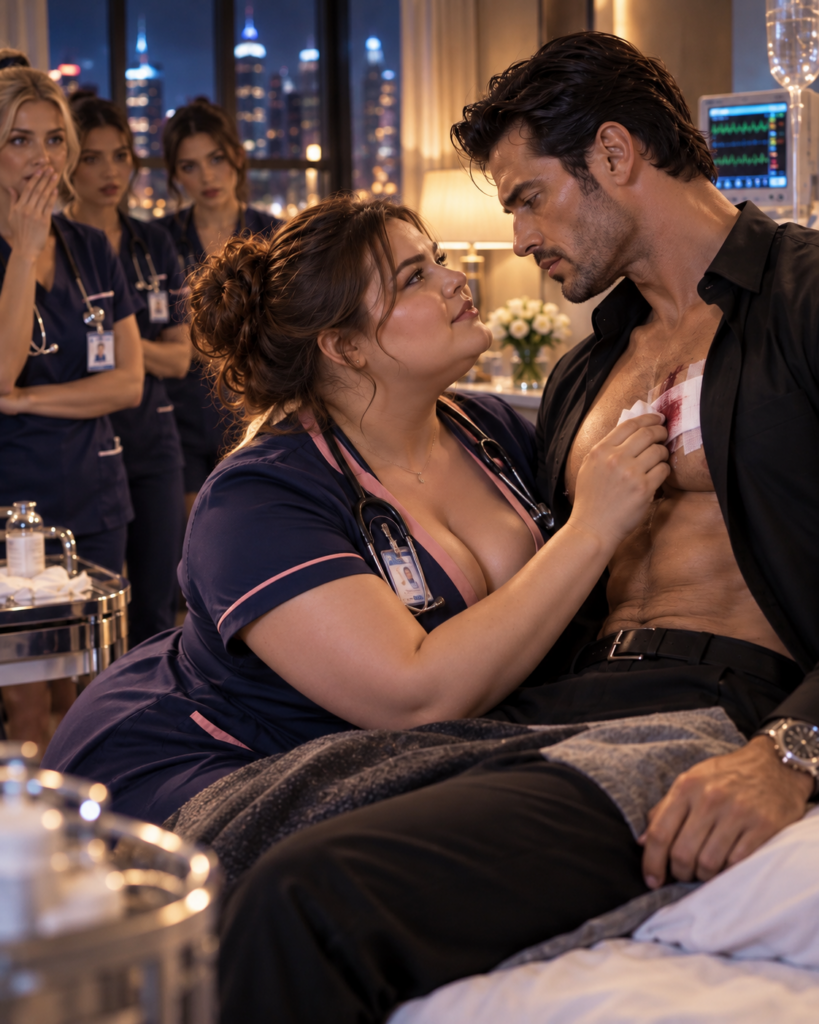
THE MAFIA BOSS MOCKED THE 280-POUND NURSE HIRED TO SAVE HIM—THEN SHE USED HER OWN BODY TO STOP HIM BLEEDING OUT
Every private nurse Agostino Costello hired fled his estate crying before her first paycheck cleared.
Then Brielle Edwards—280 pounds, broke, exhausted, and recently fired for reporting a doctor’s negligence—walked into his bedroom and told the most feared man in New York to roll up his sleeve.
Eight nights later, when Agostino began bleeding out in a thunderstorm, the body he had mocked became the one thing strong enough to keep him alive until help reached the room.

PART 1 — THE LAST NURSE ON THE LIST
The fourth nurse lasted fourteen hours.
Darwin Myers watched her cross the Costello foyer with tears streaking through expensive mascara and one hand pressed over her mouth.
Behind her, the master-suite door slammed hard enough to rattle a Renaissance painting.
“I hope he dies alone,” she whispered.
Then the mahogany front doors closed.
Darwin looked down at the clipboard in his hand.
One name remained.
BRIELLE EDWARDS, RN.
She sat in a velvet chair beneath a chandelier large enough to illuminate her entire Brooklyn apartment.
Navy scrubs.
Brown hair twisted into a severe bun.
Thick orthopedic shoes.
Worn canvas tote.
At 280 pounds, Brielle had spent most of her adult life watching strangers decide what her body meant before she opened her mouth.
Lazy.
Weak.
Uncontrolled.
She had stopped explaining herself years ago.
Darwin approached.
“Ms. Edwards?”
She stood.
Slowly.
Steadily.
“Yes.”
“My employer is difficult.”
“So was my last charge nurse.”
“He threw a silver tray at the woman who just left.”
“Did he hit her?”
“No.”
“Then his aim needs work.”
Darwin stared.
Brielle did not smile.
She needed the job.
Belmont Memorial had fired her six weeks earlier after she formally reported a senior physician who ignored a deteriorating psychiatric patient until the man went into medical crisis.
Official reason:
failure to maintain collaborative professional conduct.
Real reason:
She refused to retract her report.
Her rent was late.
Her mother’s long-term-care bills were not.
Five times standard private-duty pay could keep both women housed.
“I worked six years of psychiatric night shifts,” Brielle said. “I’ve been punched, bitten, spit on, and called things your boss probably hasn’t invented yet.”
Darwin folded the clipboard.
“Follow me.”
The master suite smelled of antiseptic, stale sweat, and something metallic beneath both.
Agostino Costello lay beneath dim lights.
Three gunshot wounds had left him with a fractured rib, a damaged shoulder, and a surgically repaired liver injury.
He looked terrible.
He also looked dangerous.
Green eyes.
Black hair pushed back from a pale forehead.
Bandages around his torso.
IV line.
Heart monitor.
Power radiated from him even while bedridden.
Darwin opened his mouth.
Agostino beat him to it.
“No.”
His gaze traveled over Brielle.
Then returned.
“You cannot be serious.”
Brielle set down her tote.
Agostino’s mouth curled.
“The last nurse looked like she belonged in a medical journal.”
He looked at Brielle’s body again.
“This one looks like she delivered the bakery.”
Darwin stiffened.
Brielle did not.
“My name is Brielle Edwards.”
She walked closer.
“I’m a registered nurse.”
Agostino’s eyes narrowed.
“And judging from the sweat at your hairline, your breathing rate, and the fact that your last two nurses quit before completing their shifts, you are probably overdue for vitals and antibiotics.”
“You’re diagnosing me from the doorway?”
“No.”
“I’m observing you from the doorway.”
She picked up the blood-pressure cuff.
“Diagnosis costs extra.”
Darwin almost coughed.
Agostino stared.
“Take another step toward this bed and I’ll have you thrown out the window.”
Brielle looked toward the tall windows.
Second floor.
Landscaped rose garden below.
Then back at him.
“I’m a heavy woman, Mr. Costello.”
Her tone remained clinically bored.
“I’d probably survive.”
A pause.
“Your roses would not.”
Darwin’s hand stopped near his jacket.
Silence pressed against the room.
Agostino studied Brielle for fear.
He found annoyance.
Fatigue.
Professional impatience.
No fear.
She held out the cuff.
“You can insult me after I confirm you aren’t quietly becoming septic.”
His green eyes sharpened.
“You give orders in my house?”
“When you are my patient.”
She stepped beside the bed.
“Roll up your sleeve.”
For five full seconds, the most feared man in the room did not move.
Then, slowly, Agostino Costello extended his arm.
And Darwin quietly closed the bedroom door before his boss had enough time to realize he had obeyed.
PART 2 — THE BODY HE MOCKED BECAME THE WALL BETWEEN HIM AND DEATH
Agostino’s blood pressure was elevated.
His temperature was 100.7.
Not catastrophic.
Not something Brielle ignored either.
She checked the medication log.
One antibiotic dose had been delayed fifty-eight minutes after the previous nurse left.
Another dose from earlier that day had no administering nurse’s initials beside it.
Brielle looked at Agostino.
“Did you refuse medication?”
“I refused incompetence.”
“That was not my question.”
“She stuck me twice.”
“You have terrible veins right now.”
“She was shaking.”
“You threatened to bury her family.”
Agostino looked toward Darwin.
Darwin suddenly found the curtains fascinating.
“She should have steadier hands.”
Brielle put the chart down.
“Here is how this will work.”
Agostino’s eyebrows rose.
“You will not throw equipment.”
“You will not threaten staff for performing necessary care.”
“You may refuse any non-emergency treatment after risks are explained.”
“You may complain.”
“You may swear.”
“You may insult my shoes.”
His gaze dropped.
“They are hideous.”
“They’re orthopedic.”
“I stand by the insult.”
“Fine.”
She prepared his medication.
“But if you deliberately interfere with your own treatment and create an emergency because you enjoy frightening people, I will document it.”
Agostino’s stare sharpened.
“You think paperwork scares me?”
“No.”
“I think infection should.”
She attached the IV medication according to the orders and verified the rate.
Agostino watched her hands.
They were broad.
Steady.
Precise.
He hated that he noticed.
The First War Was Breakfast
Morning came with oatmeal.
Agostino looked at the bowl.
Then at Brielle.
“No.”
“Your surgeon wants protein and consistent calories.”
“That is wallpaper paste.”
“There are berries.”
“That makes it colorful wallpaper paste.”
Brielle adjusted his tray.
“Eat half.”
“Take it away.”
“No.”
His eyes darkened.
“You forget who employs you.”
“The agency employs me.”
“Darwin signs the checks.”
“Then Darwin can fire me after you eat half.”
Agostino leaned back.
“You enjoy this.”
“No.”
“I enjoy preventing avoidable readmissions.”
He lifted the spoon reluctantly.
“You are the most irritating woman I’ve ever met.”
“You’ve clearly had a fortunate life.”
He ate.
Three spoonfuls.
Paused.
Then five more.
Brielle wrote down the percentage consumed.
“You’re actually documenting the oatmeal?”
“Your liver does not care about your dignity.”
He almost smiled.
Almost.
The Stairs
Agostino tested her body because he believed it must contain the weakness he had not found in her face.
“Water.”
Brielle pointed toward the pitcher.
“Right there.”
“Fresh.”
“It was filled twenty minutes ago.”
“Kitchen water.”
“The kitchen is downstairs.”
“I know.”
The marble staircase had thirty-eight steps.
He requested things from downstairs six times the first day.
Fresh water.
Different tea.
A pillow supposedly stored in the library.
A book he never opened.
Brielle made the trips because some requests were reasonable and because she refused to give him the satisfaction of seeing her negotiate with a staircase.
By the sixth trip, sweat dampened the back of her scrubs.
Her knees ached.
Agostino watched.
“Getting tired?”
“Yes.”
The blunt answer surprised him.
“You admit it?”
“Why would I lie?”
“Most people do.”
“I am carrying two hundred eighty pounds up your ridiculous staircase.”
She placed his book on the table.
“Cardiovascular effort occurs.”
He smirked.
“Maybe it will be good for you.”
Brielle stared at him.
Then pulled a chair beside the bed and sat.
“No more recreational errands.”
His smirk faded.
“Excuse me?”
“Clinical needs? Yes.”
“Reasonable comfort requests? Yes.”
“Making me climb stairs because you want to prove my body embarrasses me?”
“No.”
Agostino’s gaze became dangerous.
“You don’t tell me why I’m asking.”
“I just did.”
Darwin, standing near the door, held his breath.
Agostino said:
“You’re refusing an order.”
“I’m refusing harassment unrelated to patient care.”
“This is my house.”
“And this is my license.”
She folded her arms.
“If you want a servant, hire one.”
“If you want a nurse, act like a patient.”
For thirty seconds nothing moved.
Then Agostino said:
“The tea tastes terrible.”
“I agree.”
“You made it.”
“Your surgeon ordered it.”
He looked away.
“Bring coffee tomorrow.”
“One cup if your pressure behaves.”
That was the first negotiation they ever completed.
Brielle’s Hands
By day four, Agostino stopped watching her size when she entered.
He watched her hands.
The dressing change hurt.
No medication eliminated that.
Brielle always told him before removing tape.
Waited during muscle spasms.
Supported his injured shoulder.
Used warm saline instead of cold because the first morning he flinched when cold liquid touched the wound.
She never mentioned noticing.
The room simply changed.
A second pillow appeared beneath his ribs at exactly the angle that allowed him to sleep longer.
The blackout curtains opened for twenty minutes each afternoon because Brielle said human beings healed badly in caves.
The room temperature stayed at sixty-eight because he slept best there.
He noticed all of it.
“Why did Belmont fire you?”
The question came during a bandage change.
Brielle’s fingers stopped.
“How do you know they did?”
“Darwin investigates everyone entering this estate.”
“Comforting.”
“You reported a doctor.”
“Yes.”
“What happened?”
She resumed taping gauze.
“A patient deteriorated.”
“The attending ignored the resident’s calls.”
“He nearly died.”
“I filed the report.”
“The doctor had donors on the hospital foundation board.”
Agostino’s mouth hardened.
“They fired you.”
“They called it incompatibility.”
“You should sue.”
“I filed through the appropriate process.”
“Appropriate processes are what powerful people invent to make angry people wait.”
She looked up.
“And men like you believe power means skipping every process that inconveniences you.”
His expression changed.
“Do not solve Belmont for me.”
“I didn’t offer.”
“You were about to.”
A pause.
He smiled faintly.
“You think you know me.”
“I know your type.”
“What type?”
“The type who hears a problem and immediately wants somebody punished so you can call the feeling justice.”
For once, Agostino had no response.
The Eighth Night
The storm arrived just after midnight.
Thunder shook the old windows.
Rain hammered the glass hard enough to sound like thrown gravel.
Brielle slept on a cot in the dressing room adjoining Agostino’s suite.
At 2:01 a.m., she woke to coughing.
Not normal coughing.
Wet.
Strangled.
She was moving before her mind finished waking.
Agostino was half upright.
Face gray.
One hand gripping his side.
The heart monitor raced.
“Agostino.”
He inhaled sharply.
A dark stain spread across the abdominal dressing.
Brielle switched on the lamp.
Blood.
Too much.
Her body went cold while her training became calm.
“Darwin!”
She hit the emergency bell.
Agostino tried to swing his legs off the bed.
“No.”
“Something tore.”
“I know.”
She lowered him safely.
The outer surgical wound had reopened along part of the incision, and blood was pushing through the dressing.
There might also be deeper bleeding.
External pressure would not solve that.
It could buy time.
That was all she needed.
She pulled on gloves.
Pressed sterile pads over the wound.
Agostino groaned.
“Harder than that.”
“I’m getting there.”
Darwin entered with two guards.
“What happened?”
“Call Evans.”
“Possible postoperative hemorrhage.”
“Have the emergency surgical team bring blood and portable imaging.”
She looked at the guards.
“Now.”
They moved.
No one asked whether the nurse had authority to give orders anymore.
Agostino’s breathing became shallow.
Brielle increased direct pressure.
Blood soaked the first pads.
Then the second.
“Stay with me.”
“I’m awake.”
“Good.”
His eyes unfocused.
“Agostino.”
“What?”
“What color is my uniform?”
He looked down.
“Blue.”
“Specific.”
“Ugly navy.”
“Good.”
Darwin crouched at the head of the bed.
“What do I do?”
“Keep his shoulders stable.”
Agostino coughed again.
The wound surged beneath Brielle’s hands.
“Damn it.”
Her forearms began shaking.
She needed sustained downward pressure while keeping the injured area stable.
She repositioned.
One knee onto the mattress.
Then the other.
Agostino’s eyes widened.
“What are you doing?”
“Using physics.”
“Edwards—”
She stacked fresh pads over the wound.
Locked her elbows.
Shifted her body forward.
Not all 280 pounds.
Not blindly.
Controlled leverage through her arms and torso, enough sustained pressure to slow the external loss while the surgical team raced upstairs.
Agostino cried out.
“You’re crushing me.”
Brielle’s face hovered above his.
“Excellent.”
“What?”
“If you can complain, you’re conscious.”
His eyes rolled slightly.
“Stay with me.”
Her arms burned.
Sweat ran down her temples.
The storm shook the windows.
Brielle kept talking.
Not about medicine.
About the bodega beneath her Brooklyn apartment.
The orange cat that slept on the newspaper rack.
The Q train screeching around a curve near midnight.
Her mother insisting nursing-home coffee violated the Geneva Convention.
Agostino’s mouth moved.
“What’s the cat’s name?”
“Nobody knows.”
“You feed a nameless cat?”
“He doesn’t answer to anything.”
“Call him Darwin.”
Darwin looked offended.
Brielle almost laughed.
“Stay awake.”
Agostino’s green eyes fixed on hers.
They remained that way for twenty-three minutes.
Then Dr. Elias Evans arrived with a surgical team.
Portable ultrasound.
Blood products.
Emergency instruments.
“Move when I tell you.”
Brielle nodded.
Evans assessed quickly.
“Possible deeper source.”
“We need transfer to the estate procedure room.”
“On three.”
Brielle released pressure only as the team replaced her hands.
Blood rushed back into her arms painfully.
She climbed off the bed.
Her knees nearly gave out.
Darwin caught her elbow.
“You saved his life.”
“No.”
She stared at the medical team wheeling Agostino away.
“I bought him minutes.”
“Evans saves him.”
As the stretcher passed, Agostino turned his head.
His gaze found her.
Stayed.
Until the doors closed.
Gratitude Makes Agostino Worse Before It Makes Him Better
The repair took less than an hour.
A bleeding vessel near the healing surgical tract had reopened after the coughing episode, and the team confirmed no catastrophic recurrent liver hemorrhage.
Brielle sat outside.
Blood dried on her forearms.
Her scrub top was ruined.
Darwin handed her coffee.
“You should change.”
“I know.”
“You’re shaking.”
“I know.”
“You always say that?”
“When people tell me obvious things.”
He sat.
“Why did you stay?”
She looked at him.
“I’m the nurse.”
“That stopped being enough of an answer about fifteen minutes in.”
Brielle drank.
“Because leaving would have killed him.”
Darwin considered.
Most people in Agostino’s life measured decisions differently.
Would leaving offend him?
Endanger me?
Cost money?
Trigger retaliation?
Brielle measured one thing.
Would the patient die?
That was why Agostino trusted her before he even understood that he did.
When he woke near dawn, Brielle sat in the velvet chair.
Asleep.
Mouth slightly open.
One cheap plastic clip had fallen from her hair.
Agostino watched her for almost ten minutes.
He had been shot by men who wanted him dead.
Protected by men he paid.
Betrayed by men who swore loyalty.
And kept alive by a woman he had spent a week insulting because her body made him think she would be easy to shame.
Something bitter moved through him.
When Brielle woke, she caught him staring.
“What?”
“Nothing.”
“Your face never means nothing.”
He opened his mouth.
Closed it.
Then:
“Thank you.”
Brielle went still.
“What?”
“Do not make me repeat it.”
She checked his monitor.
“Fever’s down.”
“Did you hear me?”
“Yes.”
“And?”
“You’re welcome.”
That was all.
Agostino had expected gratitude to change the hierarchy.
Brielle refused.
It only changed the truth.
The Apology
Two days later:
“Edwards.”
“Yes?”
“I was wrong.”
She stopped beside the medication cart.
“About which thing?”
He frowned.
“Do you keep a catalog?”
“You generate enough material.”
His mouth twitched.
Then he became serious.
“Your weight.”
Brielle waited.
“I used it because I wanted to find something that hurt you.”
“That is more honest than apologizing for the jokes.”
Agostino looked at the bed rail.
“I thought if I embarrassed you, you’d leave.”
“Why?”
“So I wouldn’t need you.”
There it was.
The real wound.
Brielle sat.
Not near enough to comfort him.
Near enough to listen.
“Depending on somebody makes you angry.”
“Yes.”
“Why?”
His face closed.
“Different question.”
“Fair.”
She stood.
“Apology accepted.”
He looked surprised.
“That easily?”
“No.”
She adjusted his IV.
“Accepting an apology does not mean pretending it never happened.”
Another lesson Agostino disliked because it could not be bought.
The Physical Therapist
By week four, Agostino could sit in a chair for an hour.
His shoulder remained stiff.
Dr. Evans ordered physical therapy.
Darwin hired Gregory Lane through a Manhattan sports-rehabilitation service.
Thirty-seven.
Lean.
Quiet.
Professional smile.
Credentials checked.
At least superficially.
Brielle disliked him in the first minute.
Not because he looked dangerous.
Because he looked at the wrong things.
When evaluating range of motion, his attention kept shifting toward the IV access.
Agostino noticed Brielle noticing.
“What?”
“Nothing yet.”
Gregory rotated Agostino’s shoulder.
Pain tightened the boss’s jaw.
“Again.”
Brielle said:
“Rest thirty seconds.”
Gregory smiled.
“One more.”
Agostino hissed.
Gregory reached into his pocket.
A prefilled syringe.
Brielle’s entire body went alert.
“What is that?”
“Muscle relaxant.”
“Ordered by whom?”
“Dr. Evans.”
“Show me.”
Gregory moved toward the IV port.
Brielle stepped between them.
“Physical therapists do not administer IV medication in this house.”
“It’s already cleared.”
“Then you have an order.”
His smile disappeared.
“Move.”
“No.”
Agostino looked at Gregory.
Then Brielle.
The room changed.
Gregory lunged.
Fast.
Syringe toward the line.
Brielle did not think.
She drove forward.
Her shoulder struck his chest.
Two hundred eighty pounds of momentum took both of them sideways.
Gregory hit the floor hard.
The syringe flew.
Shattered near the fireplace.
He swung.
His fist caught Brielle across the cheek.
Pain flashed white.
She kept going.
Knee over his torso.
Hands locking one wrist.
Her weight pinned him long enough.
“DARWIN!”
The doors opened.
Guards rushed in.
Gregory was dragged away.
Brielle sat back on the floor.
Blood touched her lower lip.
Agostino had forced himself halfway out of the chair.
“Sit down.”
His eyes were black with rage.
“He hit you.”
“Sit.”
“Brielle.”
First time he used her name.
She noticed.
So did Darwin.
“Sit down before you reopen something.”
Agostino slowly obeyed.
Evans later confirmed the syringe contained medication not authorized for Agostino and at a concentration dangerous in his condition.
The exact criminal intent belonged to investigators.
Agostino had already decided it belonged to him.
“Bring Gregory downstairs.”
Darwin nodded.
Brielle’s head snapped up.
“No.”
Both men looked at her.
“What?”
“You are not disappearing anybody because I got punched.”
Agostino’s face became frighteningly calm.
“He tried to kill me.”
“Then turn the evidence over to the people investigating the attack.”
Darwin said carefully:
“That isn’t how everything works here.”
Brielle looked at him.
“It is how anything involving me works.”
Agostino stared.
She wiped blood from her lip.
“If you use me as justification for whatever happens in your basement, I leave tonight.”
His jaw tightened.
“You threaten me in my home.”
“No.”
“I tell you my boundary in yours.”
Five seconds.
Ten.
Then Agostino looked at Darwin.
“No basement.”
Darwin blinked.
“Boss?”
“Secure him.”
“Call the attorney.”
“Contact the investigators already handling the steakhouse shooting.”
“Understood.”
Brielle stood.
Her cheek was swelling.
Agostino watched.
“You are impossible.”
“So I’ve been told.”
The Second Attack Changed the Estate
After Gregory, security doubled.
Brielle hated it.
Two guards outside the suite became four.
A car waited whenever she left the compound.
Her personal phone was scanned.
Her mother’s care facility was quietly assigned security without Brielle being told.
When she discovered that, she walked into Agostino’s study.
He was working at a desk for the first time since being shot.
“You put men near my mother.”
He did not look up.
“Yes.”
“Without asking me.”
“Yes.”
“No.”
That made him look up.
“She could be targeted.”
“Then tell me.”
“I did what was necessary.”
“You did what made you feel in control.”
Agostino stood.
Cane beside him.
“You saved my life twice.”
“And?”
“You think that does not make you important to my enemies?”
“It may.”
“Then you need protection.”
“I need information.”
She stepped closer.
“I decide what protection I accept.”
His voice lowered.
“In my world, that can get you killed.”
“In mine, removing a person’s choices while saying it is for their safety is still control.”
They stared.
Agostino had commanded rooms for twenty years.
No one had ever explained protection to him as something requiring consent.
He hated the concept.
Because it was correct.
“What do you want?”
“Discreet security at the facility if there is a verified threat.”
“No men following my mother’s nurses.”
“No approaching her.”
“No telling her who you are.”
“And I receive the threat information relevant to me.”
Agostino nodded once.
“Done.”
Brielle turned toward the door.
“Brielle.”
She stopped.
“I am learning.”
She looked back.
“Slowly.”
“Very.”
His smile followed her into the hall.
Lorraine Edwards
Brielle’s mother was seventy-one.
Retired cafeteria worker.
Diabetes.
Advanced arthritis.
Early cardiac disease.
Mind sharp enough to insult everybody equally.
When Brielle visited on Sundays, Lorraine inspected her face like a detective.
“Who hit you?”
“A patient situation.”
“You hit him back?”
“Mom.”
“That means yes.”
Brielle laughed.
Then Lorraine looked at the bruise.
“Your job dangerous?”
“Sometimes.”
“Pays?”
“Very.”
“Then I hate it slightly less.”
Brielle sat beside the bed.
Lorraine squeezed her fingers.
“You look different.”
“How?”
“Someone making you mad in an interesting way.”
“Please go back to complaining about lunch.”
“It was dry chicken.”
Agostino would have liked her.
That realization frightened Brielle.
Attraction Does Not Arrive Politely
By week five, Agostino walked the long corridor twice a day.
Cane.
Brielle beside him.
No touching unless needed.
He still swore when pain shot through his ribs.
She still ignored theatrics.
One afternoon he stopped by a window.
Autumn rain silvered the lawn.
“You’re leaving soon.”
“Contract ends next week.”
“I know.”
“You hired me for six weeks.”
“Darwin hired you.”
“Semantics.”
Agostino looked at her.
“What happens after?”
“I go home.”
“To what?”
The question irritated her.
“My life.”
“Which clinic?”
“Whichever hires me.”
“You were fired.”
“I remember.”
“You have debt.”
“I also remember.”
He turned.
“I can fix that.”
There.
The old instinct.
Buy the obstacle.
Erase discomfort.
Make the problem stop.
Brielle shook her head.
“No.”
“I didn’t say anything.”
“Your face did.”
“My face has excellent ideas.”
“Your face thinks money creates consent.”
His expression hardened.
“I am offering help.”
“Then ask what help I want.”
“What help do you want?”
She considered.
“Reference letter from Evans.”
Agostino looked offended.
“That’s it?”
“Yes.”
“I could clear every debt your mother has.”
“That debt is not permission to own my future.”
His eyes narrowed.
“You think that’s what I’m trying to do?”
“I think you don’t know the difference yet.”
That hurt him.
Good.
Sometimes hurt was information.
The Contract Ends
On the final morning, Brielle packed the canvas tote.
Six weeks earlier, it had contained two scrubs, cheap hand cream, protein bars, and eviction notices she refused to open.
Now it contained a reference letter from Dr. Evans and the same hand cream.
Agostino stood at the window.
No cane.
He still leaned slightly when tired.
“I’ll triple your salary.”
“No.”
“Quarter million.”
“No.”
“Three.”
“No.”
“Brielle.”
She zipped the bag.
“You don’t need a twenty-four-hour trauma nurse.”
“I wasn’t offering the job anymore.”
She looked up.
The room changed.
Agostino’s voice lowered.
“Stay.”
“Doing what?”
He had no answer ready.
Exactly.
“Agostino.”
She walked closer.
“You survived.”
“You can walk.”
“You can eat without threatening oatmeal.”
“I still hate oatmeal.”
“Healthy sign.”
He did not smile.
“I don’t want you to leave.”
“I know.”
“Then don’t.”
“That is not enough.”
His face tightened.
“For everyone else, it is.”
“I’m not everyone else.”
Silence.
Brielle placed one hand over his fist resting on the window ledge.
Gentle.
Nothing clinical about it.
Agostino stopped breathing.
“If there is something between us,” she said, “you do not get to turn it into another contract where you set the rate and decide the terms.”
“What do you want?”
“I want my own life back first.”
He looked down at her hand.
“And me?”
“I haven’t decided.”
The ruthless Agostino Costello looked genuinely frightened.
Brielle almost smiled.
“Take your antibiotics.”
She withdrew her hand.
Then left.
Darwin waited by the staircase.
“Car is ready.”
“I can take the train.”
“The boss will have a coronary.”
“His heart is fine.”
“Mine isn’t.”
She laughed.
Accepted the car.
Agostino watched from the upstairs window until the black sedan disappeared beyond the gates.
Then he turned to Darwin.
“Belmont Memorial.”
Darwin’s eyes narrowed.
“What about it?”
“I want every public filing.”
“Every complaint involving Dr. Halpern.”
“Every document related to Brielle’s termination.”
Darwin hesitated.
“Should I send someone to speak with the doctor?”
“No.”
Agostino looked toward the empty bedroom.
“Lawyers.”
“Investigators.”
“No threats.”
Darwin stared at him.
“You sure you’re Agostino Costello?”
“Find out what happened.”
“And if they broke the law?”
Agostino’s expression went cold.
“Then for once, we let the law frighten them.”
PART 3 — THE MONSTER LEARNS HOW TO ASK
Brooklyn welcomed Brielle home with a broken elevator.
Of course it did.
Her building superintendent had taped a handwritten sign to the lobby:
OUT OF SERVICE. PART ARRIVES MONDAY. SORRY.
Brielle looked at three grocery bags.
Then at four flights of stairs.
“Wonderful.”
At the Costello estate, ten men would have appeared before she lifted one bag.
Here, she carried two at a time.
Her apartment smelled faintly of radiator heat and dust.
No Renaissance paintings.
No armed guards.
No linen sheets that cost more than her monthly rent.
The kitchen light buzzed.
Her refrigerator contained mustard, yogurt, two eggs, and a piece of cheese with ambitions beyond its expiration date.
She stood in the middle of the room.
Home.
Why did it feel strange?
Silence After Agostino
The first night, Brielle slept eight uninterrupted hours.
The second, she woke at 2:01 a.m.
Sat upright.
Heart racing.
No monitor.
No wet cough.
No thunder against reinforced windows.
Only a garbage truck grinding down the street.
She lay back.
“Ridiculous.”
On Monday she submitted applications.
Outpatient clinic.
Rehab center.
Home-health agency.
One hospital in Queens.
Two applications asked whether she had ever been terminated.
Yes.
Explain.
She did.
No dramatic version.
Reported patient-safety concern.
Employment ended after dispute.
Matter under review.
Tuesday, she visited Lorraine.
Her mother chewed hospital pudding with suspicion.
“You miss him.”
“I miss the paycheck.”
“Liar.”
“Eat your pudding.”
“I have survived childbirth and two knee replacements.”
“I will not be bullied by vanilla.”
Brielle took the spoon away.
Lorraine smiled.
“He handsome?”
“Mom.”
“Dangerous?”
“Yes.”
“Very?”
“Yes.”
“Then absolutely not.”
“Thank you.”
Lorraine waited.
Brielle sighed.
“He’s also…”
“What?”
“Different when nobody else is looking.”
“That is how women get in trouble.”
Brielle looked at her mother.
Lorraine shrugged.
“I was young once.”
Agostino Tries Another Nurse
Her name was Angela Ruiz.
Forty-six.
Home-health veteran.
The first morning, she placed Agostino’s oatmeal in front of him.
He stared.
Angela stared back.
“Something wrong?”
“No.”
He ate.
Darwin watched from the doorway.
“Who are you?”
Agostino asked.
“Angela.”
“You’re not Edwards.”
“Excellent observation.”
He almost fired her for that.
Didn’t.
By day three, Darwin realized something strange.
Agostino was behaving.
Not kindly.
Never confuse the two.
But he said please twice.
He stopped throwing objects.
When Angela checked his surgical site, he did not argue.
Darwin reported this to Brielle only because she called Dr. Evans to ask about recovery progress.
“Good,” Brielle said.
“You sound disappointed.”
“I’m not.”
“He’s miserable.”
“That is not a medical emergency.”
“You should tell him.”
“I am hanging up now.”
Belmont
Agostino’s legal investigators found more than he expected.
Dr. Malcolm Halpern, the senior physician Brielle reported, had been named in three previous internal complaints.
Delayed escalation.
Retaliatory behavior.
Documentation irregularities.
None alone proved criminal misconduct.
Together they justified review.
Belmont’s parent nonprofit was also financially unstable.
Debt.
Deferred maintenance.
A pending merger.
Agostino called a lawyer named Naomi Feld.
“I want the hospital.”
Naomi paused.
“What does that sentence mean?”
“Buy it.”
“You cannot buy a nonprofit hospital like a steakhouse.”
“Then buy what can be bought.”
Naomi sighed.
This was why he paid her absurdly well.
“You could acquire debt connected to affiliated real estate.”
“You could fund the merger.”
“You could acquire a for-profit outpatient subsidiary.”
“You could donate to the parent system.”
“None of those gives you lawful authority to fire a doctor because he upset someone you care about.”
Agostino hated competent lawyers for the same reason he liked Brielle.
They ruined simple plans with facts.
“What can I do?”
“Support an independent whistleblower review.”
“Fund patient-safety reform without controlling findings.”
“And stay away from individual employment decisions.”
“Fine.”
Naomi waited.
“That was too easy.”
“I’m learning.”
“From whom?”
He hung up.
The Mother’s Bill
Darwin found Brielle’s mother’s care-facility debt.
Agostino stared at the number.
Then reached for a pen.
Stopped.
He remembered Brielle.
Ask what help I want.
He put the pen down.
“Call her.”
Darwin smiled.
Agostino looked up.
“Something funny?”
“No.”
“You look like a man learning to use a fork.”
“Call her.”
Brielle answered on the fifth ring.
“What?”
“You sound pleased.”
“I’m at the pharmacy.”
“I have a question.”
“That is new.”
He ignored it.
“Your mother.”
Instantly, her tone sharpened.
“What about her?”
“I learned there is an outstanding balance.”
“Agostino.”
“I have not paid it.”
Silence.
“That sentence may be the first romantic thing you’ve ever said.”
His chest tightened.
“I can.”
“I know.”
“Do you want help?”
The pharmacy speaker announced prescription pickup.
Brielle stepped aside.
“My mother has an insurance appeal pending.”
“If it fails?”
“I’ll figure it out.”
“That is not an answer.”
“It’s my answer.”
He forced himself not to push.
“All right.”
Brielle became quiet.
“Thank you for asking.”
Agostino sat back.
That one sentence felt better than buying the entire facility.
It irritated him.
The Independent Review
Belmont reopened Brielle’s whistleblower complaint.
Not because Agostino threatened anybody.
Naomi Feld helped a coalition of donors fund an outside patient-safety review across the hospital system after the pending merger exposed governance concerns.
Brielle was asked to give a statement.
She arrived wearing navy slacks and a white blouse.
No scrubs.
Three independent reviewers sat across from her.
They did not ask:
Did Dr. Halpern dislike you?
They asked:
Timeline.
Calls.
Orders.
Vital signs.
Escalation attempts.
Documentation.
Names.
Brielle answered.
Two hours.
At the end, one reviewer said:
“We found earlier complaints consistent with parts of your account.”
Brielle’s hands tightened in her lap.
“Why wasn’t I told?”
“The prior complaints were closed internally.”
Of course.
“What happens now?”
“That depends on the full findings.”
Not revenge.
Process.
She went home emotionally exhausted.
On the sidewalk outside her building, a black SUV waited.
Brielle stopped.
Agostino sat inside.
Window lowered.
“No.”
He looked offended.
“I haven’t spoken yet.”
“Your car is illegally parked again.”
“I paid the ticket last time.”
“That is not permission.”
Darwin looked toward the windshield.
“I told him.”
Agostino opened the rear door.
“Get in.”
Brielle stared.
He corrected himself.
“Would you like a ride?”
Darwin covered a smile with his hand.
Brielle got in.
“Progress.”
Dinner
Agostino did not take her to a private dining room.
Brielle refused.
They went to a neighborhood Italian restaurant near her apartment.
Twenty tables.
Red checkered cloths.
A waiter named Pete who called everybody sweetheart.
Two Costello guards sat outside in a separate car.
Her rule.
Agostino looked around.
“You eat here?”
“Yes.”
“The lighting is terrible.”
“The food is good.”
“They put fake candles in Chianti bottles.”
“You own houses with painted naked cherubs on the ceilings.”
“Fair.”
Brielle laughed.
It changed his entire face.
He stared too long.
“What?”
“Nothing.”
“Stop doing that.”
“Doing what?”
“Looking like I’ve performed a miracle because I laughed.”
“You have a nice laugh.”
She became still.
Agostino had complimented her competence.
Her courage.
Her hands once, awkwardly.
Never something simply hers.
“Thank you.”
He looked almost surprised that she accepted it.
What He Wants
After dinner, they stood beneath the restaurant awning.
Rain.
Traffic.
Brooklyn noise.
Agostino held his cane although he barely needed it now.
“Brielle.”
“Yes?”
“I want you back.”
“No.”
His jaw tightened.
“I mean in my life.”
She waited.
“I do not know how to do this.”
“Good beginning.”
“I want to see you.”
“Without paying me?”
“Yes.”
“Without assigning guards I didn’t ask for?”
He grimaced.
“Yes.”
“Without solving my career behind my back?”
A pause.
“That is more complicated.”
“What did you do?”
He looked annoyed with himself.
“Nothing that decides your job.”
“Agostino.”
“I funded an independent safety review.”
Her eyes narrowed.
“Through lawyers.”
“No threats.”
“No influence on findings.”
“Naomi says I behaved.”
“Naomi?”
“My attorney.”
“I want her number.”
“Why?”
“To verify that.”
He actually laughed.
“Of course you do.”
Brielle held out her phone.
He dictated the number.
The Assassin’s Trail
Gregory Lane had not acted alone.
Investigators tied him to the same rival network involved in the steakhouse shooting.
More unsettling:
Someone inside Agostino’s estate had leaked medical schedules.
A security employee.
Not Darwin.
Not Evans.
The man was dismissed and later arrested through the broader investigation after evidence supported charges.
Agostino did not tell Brielle the violent fantasies he had entertained.
He told her what mattered.
“The leak is closed.”
“How do you know?”
“Evidence.”
“Not your intuition?”
He looked wounded.
“My intuition is exceptional.”
“That’s not what I asked.”
“Law enforcement has the man.”
“Good.”
He waited.
“You’re not going to ask what I wanted to do to him?”
“No.”
“Why?”
“Because I care what you did.”
Agostino looked at her.
Another sentence he kept.
Belmont’s Findings
The review took four months.
Dr. Halpern had violated escalation policy in Brielle’s case.
He had also retaliated improperly in staff evaluations.
He was removed from supervisory responsibility pending credentialing action and later resigned.
Belmont formally corrected Brielle’s personnel file.
Her termination changed to separation following protected safety reporting.
Back pay dispute settled through mediation.
Brielle received enough to clear her rent arrears and a portion of Lorraine’s medical debt.
Not millions.
Enough.
More importantly, she got a letter.
Your patient-safety concerns were substantially validated.
She read it in her kitchen.
Sat down.
Cried.
Not because the paper proved she was a good nurse.
She had known.
Because institutions had spent months trying to convince her courage was misconduct.
Her phone rang.
Agostino.
She answered while still crying.
“What happened?”
“They corrected my file.”
Silence.
“Brielle.”
“I’m okay.”
“You’re crying.”
“I can do both.”
“What did they say?”
She read the sentence.
Agostino breathed out slowly.
“I am proud of you.”
Her crying stopped for one second.
He continued:
“And before you get angry, no one was threatened.”
She laughed through tears.
“Good.”
The Offer
Belmont offered Brielle her old job back.
She declined.
That surprised everybody.
“You fought for reinstatement,” Lorraine said.
“I fought for the record.”
“Different?”
“Yes.”
Brielle had spent six years in psychiatric nights.
She loved the patients.
She no longer loved what constant crisis had done to her body.
An independent nursing-safety program created through the hospital merger offered another position.
Clinical educator.
Patient-safety liaison.
Still nursing.
Day shift.
Better benefits.
Less money than Agostino offered.
More autonomy.
She accepted.
When Agostino heard:
“How much?”
“No.”
“I asked a question.”
“You are about to compare salaries.”
“I would never.”
“You absolutely would.”
He smiled.
“Do you like it?”
“Yes.”
“Then good.”
That answer mattered.
Lorraine Meets the Monster
Lorraine demanded to meet him.
“You cannot keep describing a man as dangerous and then expect your mother not to inspect him.”
“No.”
“I raised you.”
“That does not give you subpoena power.”
“It gives me emotional subpoena power.”
Agostino arrived at the care facility carrying flowers.
Lorraine looked at them.
“Allergies.”
He stared.
“To flowers?”
“Yes.”
He handed them to Darwin.
Lorraine nodded.
“Strike one.”
Agostino sat.
She looked him over.
“You insulted my daughter’s body?”
His eyes moved toward Brielle.
“She told you?”
“I have eyes.”
Brielle covered her face.
Lorraine continued.
“She’s been large since she was thirteen.”
“Doctors blamed everything on weight.”
“Teachers assumed she was lazy.”
“Men acted like being attracted to her was charity.”
Agostino’s expression hardened.
“Those men were idiots.”
“Good answer.”
Lorraine leaned closer.
“If you ever make her feel like your money means she owes you love, I will rise from this wheelchair and haunt you while alive.”
Agostino nodded solemnly.
“Understood.”
Brielle looked between them.
“This is horrifying.”
Lorraine smiled.
“I like him.”
“Mom.”
“Not enough to approve.”
“Good.”
Agostino actually looked nervous.
Brielle enjoyed that more than she should.
Courtship
Agostino Costello did not know how to court anybody.
He knew how to send cars.
Jewelry.
Private chefs.
Security.
Money.
Brielle rejected all of it.
“What do normal people do?”
Darwin asked.
Agostino glared.
“If I knew, would I ask?”
“Dinner.”
“Walks.”
“Movies.”
“I hate movies.”
“Then lie.”
“No.”
Darwin considered.
“Ask what she likes.”
Agostino stared.
“That seems suspiciously obvious.”
“It is.”
Brielle liked used bookstores.
He lasted forty minutes before criticizing the shelving.
She liked botanical gardens.
He complained about benches.
She liked Sunday breakfast.
He learned to make coffee.
Terribly.
The first cup could have stripped paint.
Brielle drank two sips.
“This is a crime.”
“I’ve committed worse.”
“I believe you.”
He tried again.
The Argument That Almost Ended It
Six months after Brielle left the estate, a man associated with an old Costello dispute appeared near her hospital parking garage.
Security spotted him.
Nothing happened.
Agostino learned before Brielle did.
He doubled guards.
Assigned a driver.
Ordered her schedule changed through hospital security.
When Brielle discovered it, she went straight to his house.
“You changed my work schedule.”
“Security changed it.”
“Because you ordered them.”
“Yes.”
“We discussed this.”
“There was a threat.”
“You tell me.”
“There wasn’t time.”
“There was enough time to call my employer.”
Agostino stood.
“I am not gambling with your life because you enjoy independence.”
Brielle went silent.
Wrong sentence.
He realized it.
Too late.
“You think my choices are a hobby.”
“No.”
“You just said exactly that.”
“I meant—”
“I know what you meant.”
She picked up her bag.
“You still believe fear suspends consent.”
“Brielle.”
She turned.
“I love you.”
His face changed.
First time she had said the word.
He took a step.
She lifted one hand.
“And I will still leave if you turn love into permission.”
She walked out.
Agostino did not follow.
That was the hardest thing he had learned so far.
What He Does Next
He called the next morning.
Not thirty times.
Once.
She answered.
“I was wrong.”
“Yes.”
“I should have told you about the threat first.”
“Yes.”
“I should not have changed your schedule.”
“Yes.”
“I have asked hospital security to restore it.”
Brielle sat on her bed.
“What about the threat?”
“I will send the verified information to you and to hospital security.”
“Then I decide what extra measures I accept.”
His voice tightened.
“Yes.”
A pause.
“You said you love me.”
“I did.”
“Was that temporary?”
“No.”
“Good.”
He exhaled.
“Can I come over tonight?”
“You can ask again after work.”
“Why?”
“Because I’m teaching.”
“Fine.”
He hung up.
Brielle smiled despite herself.
The Belmont Fundraiser
One year after her firing, Belmont hosted a patient-safety fundraiser.
Not glamorous.
Hospital atrium.
Donors.
Nurses.
Residents.
Coffee in paper cups.
Brielle spoke for seven minutes.
No story about mafia bosses.
No story about revenge.
She spoke about escalation.
How organizations fail when junior employees are punished for asking uncomfortable questions.
How patient safety depends less on perfect people than on systems that survive imperfect people.
Agostino sat in the back row.
No entourage inside.
Darwin waited in the lobby.
Afterward, a young nurse approached Brielle.
“I reported something last month.”
“How did it go?”
“I was terrified.”
“But?”
“They listened.”
Brielle smiled.
“Good.”
That was worth more than reinstatement.
Across the atrium, Agostino watched her.
Not like something he owned.
Like something he was lucky to witness.
The Offer He Finally Makes Correctly
Outside, autumn rain had started.
Agostino stood beside the curb.
“Car?”
Brielle looked toward the subway entrance.
“Train.”
He looked offended.
“You own three cars.”
“I own none.”
“You know what I mean.”
“I do.”
He opened his mouth.
Then corrected himself.
“Would you like a ride?”
She smiled.
“Yes.”
In the car, he handed her an envelope.
She stared suspiciously.
“What did you buy?”
“Nothing.”
“Agostino.”
“Open it.”
Inside:
No deed.
No check.
No employment contract.
A copy of amended governance terms for Belmont’s new patient-safety fund.
Costello-linked donations would be placed under independent administration.
No donor control over clinical staffing.
No individual employment instructions.
Whistleblower protections written into the grant conditions.
Brielle looked at him.
“You did this?”
“Naomi did.”
“You agreed?”
“Yes.”
“Why?”
“Because you were right.”
That sentence was becoming less painful for him.
She folded the pages.
“Thank you.”
Then he said:
“I also have a question.”
“What?”
“Come home.”
Her expression changed.
Agostino lifted one hand quickly.
“Bad wording.”
“Very.”
He tried again.
“Come to the estate.”
“As what?”
“My partner.”
He looked almost angry at his own vulnerability.
“Not my nurse.”
“Not staff.”
“Not someone who owes me because I paid anything.”
Brielle said nothing.
Agostino continued.
“Or don’t.”
“I can come to Brooklyn.”
“I hate your staircase.”
“The elevator works now.”
“I checked.”
She stared.
“You checked my elevator?”
“I asked Darwin.”
“Borderline.”
“I’m trying.”
She laughed.
Then:
“I’m not moving into your house tomorrow.”
“I assumed.”
“You absolutely did not.”
“Fine.”
“I hoped.”
She took his hand.
“I’ll spend weekends.”
His fingers closed carefully around hers.
“And you will spend some in Brooklyn.”
He looked horrified.
“Your shower pressure is criminal.”
“Deal breaker?”
“No.”
She leaned closer.
“Good.”
Two Years Later
Brielle never became Mrs. Agostino Costello overnight.
There was no sudden wedding under chandeliers.
No transformation into a “mafia queen.”
She kept her job.
Kept her apartment for another year.
Kept her own bank account.
Agostino spent enough nights in Brooklyn to learn which radiator knocked and which deli made Lorraine’s preferred soup.
Eventually, they bought a home together.
Not the compound.
Not her apartment.
Neutral ground near the Hudson.
Brielle chose half the furniture.
Agostino hated the yellow sofa.
They bought it anyway.
The Costello estate remained heavily guarded.
His business remained complicated and not everything about his world became something Brielle approved.
Her boundary stayed clear.
She did not participate.
He did not ask her to.
When danger touched her directly, information came first.
Choice second.
Protection third.
It was not perfect.
That was why it worked better than his old idea of loyalty.
Oatmeal
One rainy morning, Agostino came into the kitchen limping slightly after an old rib injury flared.
Brielle placed oatmeal in front of him.
He stared.
“No.”
She raised one eyebrow.
“We have been together two years.”
“And?”
“You still serve this?”
“Your cholesterol.”
“My cholesterol is excellent.”
“Because you eat oatmeal.”
He looked betrayed.
Lorraine, visiting for the weekend, laughed from the table.
“Eat it, gangster.”
Agostino looked at Brielle.
“You told her to call me that.”
“I did not need to.”
He ate.
Brielle watched him.
Green eyes.
Gray beginning at his temples now.
Scar beneath his shirt.
Still dangerous.
Still difficult.
Still capable of arrogance.
Also capable of saying:
“Can I?”
“Do you want?”
“Are you comfortable?”
Words he once believed powerful men did not need.
The Old Canvas Bag
Brielle kept the canvas tote.
Agostino offered to replace it.
She refused.
One strap was repaired twice.
Inside pocket held a faded Belmont ID.
The original Costello contract.
And one small piece of gauze packaging dated the night of Agostino’s hemorrhage.
Not because she romanticized almost losing him.
Because that night had changed how both of them understood strength.
Agostino once found it.
“You kept this?”
“Yes.”
“Why?”
She thought.
“Because you were helpless.”
His face darkened.
“That is sentimental in a very insulting way.”
“Exactly.”
He smiled.
Agostino’s Question
Three years after they met, he asked her to marry him.
Not in the estate ballroom.
Not at an expensive restaurant.
In Brielle’s kitchen while she was trying to fix a leaking faucet.
He stood behind her holding a small ring box.
She turned.
“Why are you standing like that?”
“I have a question.”
“If it’s about the plumber, call one.”
“It is not.”
She saw the box.
Went still.
Agostino’s hands were actually shaking.
The sight moved her more than the diamond.
“I spent my whole life believing loyalty was something I could buy or frighten out of people.”
His voice was quieter than usual.
“You were the first person who stayed when you had every reason to run.”
Brielle opened her mouth.
He stopped her.
“I know.”
“You eventually did run.”
“You left.”
“Because staying had to be your choice.”
He swallowed.
“That was the lesson.”
He opened the box.
“I’m not asking you to belong to me.”
His green eyes held hers.
“I am asking whether you want to keep choosing the same home.”
Brielle looked down at the ring.
Then at him.
“One condition.”
His mouth twitched.
“Of course.”
“You never buy another hospital without discussing it with me.”
Agostino sighed.
“That happened once.”
“Promise.”
“I promise.”
“And oatmeal.”
His face fell.
“That is unrelated.”
“It is absolutely related.”
“Fine.”
She smiled.
“Yes.”
The Wedding
Small.
Thirty guests.
Lorraine cried before the ceremony even began.
Darwin cried and denied it.
Dr. Evans toasted to patients who ignored medical advice and nurses stubborn enough to keep them alive.
Naomi Feld said the marriage agreement was the most aggressively negotiated romantic document she had ever reviewed.
Brielle wore cream.
Not because black was supposedly slimming.
Not because anybody told her how a bride her size should dress.
Cream because she liked it.
The dress followed her body instead of apologizing for it.
Agostino saw her.
Forgot to breathe.
Lorraine elbowed him.
“Close your mouth.”
He did.
At the altar, Brielle looked directly at him.
No fear.
Just as the first day.
That was what had captured him.
Not her lack of fear exactly.
Her refusal to let his opinion decide what she knew about herself.
The Final Emergency
Years later, Agostino developed pneumonia after ignoring a respiratory infection too long.
Of course.
Brielle sat beside his hospital bed.
He looked offended by oxygen tubing.
“This is humiliating.”
“You’re alive.”
“Still humiliating.”
A young nurse entered.
Checked the infusion.
Agostino watched her.
Then politely held out his arm.
Brielle nearly laughed.
After the nurse left:
“What?”
“Nothing.”
“You’re smiling.”
“I remember a man who threatened to throw his nurse through a window.”
“He was recovering from gunshots.”
“He was an ass.”
Agostino considered.
“Yes.”
Brielle leaned back.
Rain tapped against the hospital glass.
Same sound as that eighth night long ago.
Agostino looked toward her.
“You would do it again?”
“What?”
“Stay.”
“Press on the wound.”
“Save me.”
Brielle frowned.
“If medically indicated.”
He laughed until coughing interrupted him.
She handed him water.
What Strength Actually Looked Like
People who learned pieces of their story always loved the dramatic parts.
The bleeding.
The assassin.
The mafia boss on a cane outside a Brooklyn apartment.
They said Brielle had “tamed” him.
She hated that.
Agostino was not an animal.
She was not a magical woman whose love transformed violence into goodness.
He changed because consequences finally became personal enough that he chose to examine himself.
Slowly.
Imperfectly.
Sometimes badly.
And Brielle did not become strong because a dangerous man finally recognized her value.
She was already strong when he insulted her on the first day.
Strong when Belmont fired her.
Strong when rent was due.
Strong carrying grocery bags upstairs.
Strong enough to walk away from three hundred thousand dollars because staying under the wrong terms would have cost more.
Her body was never the punchline.
It was simply hers.
The same body strangers judged.
The same body that worked twelve-hour shifts.
Held terrified patients.
Carried her mother’s groceries.
Pinned a would-be attacker long enough for help to arrive.
And once, during a thunderstorm, became the steady leverage that bought a dying man twenty-three more minutes.
The Window
On a quiet Sunday morning, Brielle stood at the kitchen window in the home they had chosen together.
Agostino sat at the table.
Oatmeal.
Black coffee.
Newspaper.
Lorraine’s voice came from the guest room, complaining that someone had moved her slippers.
Normal life.
Ridiculously normal.
Agostino looked up.
“What?”
Brielle smiled.
“Nothing.”
“I hate when you say that.”
“You’ll survive.”
“Apparently.”
Outside, sunlight moved over the Hudson.
Agostino came behind her.
Did not touch until she leaned back first.
Then his hands settled around her waist.
Years earlier, when she walked into his bedroom, he had looked at her body and searched for a weakness.
Now he rested his cheek against her hair.
“What are you thinking?”
“The first day.”
He groaned.
“No.”
“You called me a bakery truck.”
“I was injured.”
“You were obnoxious.”
“I apologized.”
“You did.”
He became quiet.
“Why didn’t you leave?”
Brielle considered the question.
That first day?
She had needed money.
Her mother needed care.
Rent was overdue.
Nothing romantic about it.
“I needed the paycheck.”
Agostino laughed.
“That’s devastating.”
“You asked.”
“And why did you stay after?”
“Because you were my patient.”
“And after the contract?”
“I left.”
His arms tightened slightly.
She tapped his hand.
He loosened immediately.
There.
That tiny movement contained years.
“You came back because I bought the hospital.”
“No.”
“Because of my charm.”
“No.”
“Because I’m devastatingly handsome.”
“Debatable.”
He sighed.
“Then why?”
Brielle turned in his arms.
Looked up at the man who once believed staying meant obedience.
“I didn’t come back.”
His brow furrowed.
“You learned how to come to me.”
Silence.
Then Agostino understood.
The mansion had not won.
Money had not won.
Fear had certainly not won.
He had gone to Brooklyn.
Asked.
Waited.
Learned that love could survive the word no.
Brielle kissed his cheek.
Then pointed toward the table.
“Your oatmeal is getting cold.”
Agostino looked at the bowl.
For one moment, the old ruthless expression returned.
“Brielle.”
“Yes?”
“I survived bullets.”
“I know.”
“Internal bleeding.”
“Yes.”
“An assassin.”
“Yes.”
He looked at the oatmeal.
“This is where I draw the line.”
Brielle picked up the spoon.
Agostino sighed.
Opened his mouth.
And somewhere between the bright kitchen window, Lorraine yelling about her slippers, and the terrible oatmeal he ate anyway, Brielle understood what victory had finally become.
Not ruling the lion’s den.
Not becoming queen of anybody’s jungle.
Not being rescued from Brooklyn by a rich and dangerous man.
It was waking beside someone who understood that strength did not mean forcing the world to obey you.
Sometimes strength meant letting another person remain entirely themselves—
and asking, every morning, whether they still chose to stay.


