
Part 1
The Duke of Blackwood was still smiling when his wife asked him whether he loved another woman.
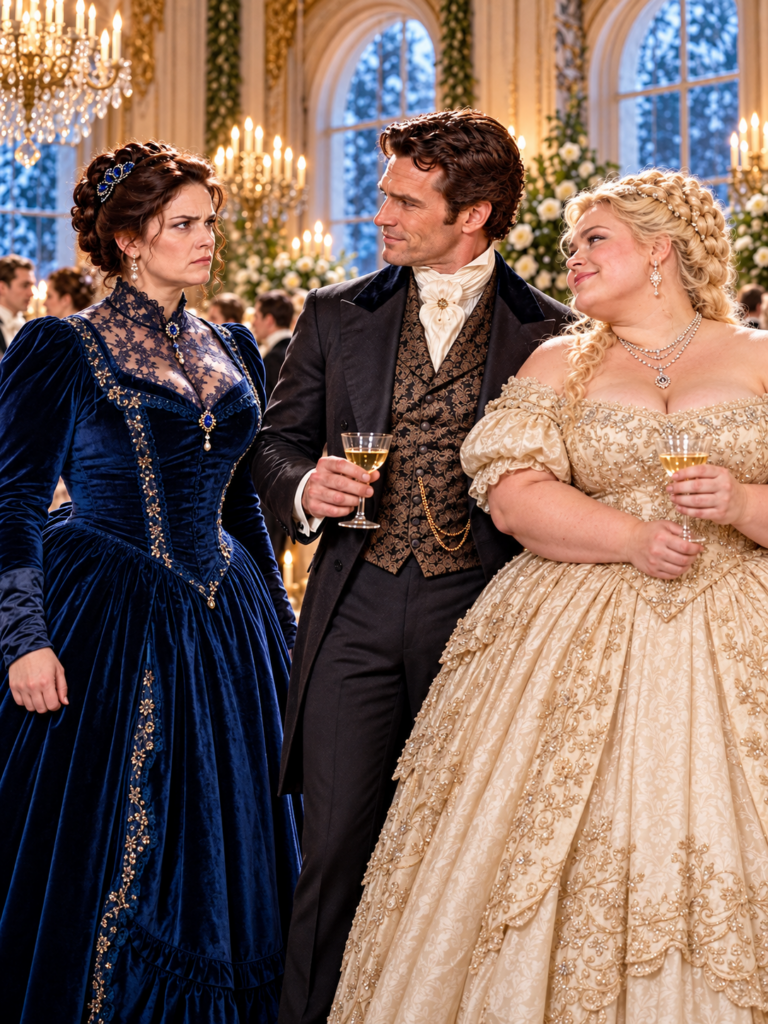
Snow drifted against the glass walls of the winter conservatory, turning the gardens beyond into a wilderness of white. Inside, the air smelled of cold stone, damp earth, and the last stubborn blossoms of the orange trees.
Adrian Blackwood stood beside a marble fountain with a glass of brandy in his hand. Lady Vivian Carlisle was near enough to touch his sleeve.
Neither appeared particularly ashamed.
Eleanor had expected denial. Perhaps anger. Perhaps the familiar aristocratic performance in which a gentleman expressed profound offense that anyone should question his honor.
She had not expected amusement.
“Yes,” Adrian said, studying the amber liquid in his glass. “Vivian and I have been involved for some time.”
He looked up.
“And what of it?”
Behind him, Vivian lowered her eyes. The movement might have suggested embarrassment had Eleanor not seen the satisfaction that preceded it.
For several moments, Eleanor heard nothing but the winter wind brushing snow against the glass.
Six years.
Six years of marriage.
Six years of learning the habits of a man who considered kindness an inconvenience and gratitude a form of weakness.
She had entered Blackwood Hall at twenty-four, bringing with her a respectable fortune, a talent for figures, and the foolish conviction that devotion could eventually awaken affection.
Now, at thirty, she knew better.
“Does it trouble you at all,” she asked, “that I am standing here?”
Adrian’s smile faded into impatience.
“Eleanor, you must be reasonable. You are my duchess. You have an extraordinary house, a title envied throughout England, servants, carriages, jewels, every comfort imaginable.”
He gestured vaguely toward the ballroom, where their guests were still celebrating the annual winter assembly.
“What more can you possibly require?”
She looked at him.
“Respect.”
His laughter came immediately.
“My dear, you have the respect of every person in the county.”
“Except my husband.”
A muscle moved in his jaw.
“You are making an emotional matter unnecessarily complicated.”
Vivian finally spoke.
“Perhaps I ought to leave.”
“No,” Eleanor said.
Both of them looked at her.
“There is no reason to pretend I interrupted something innocent.”
Adrian set down his glass.
“Enough. You will return to the ballroom, Eleanor, and we will discuss this when you have recovered your composure.”
For the first time that evening, something almost like amusement touched her own face.
“My composure?”
She glanced toward the frosted panes.
Then she looked back at her husband.
“I believe, Adrian, that I have never understood our arrangement more clearly.”
She turned and walked away.
Behind her, Adrian said something quietly to Vivian.
The woman laughed.
Eleanor heard it through the closing conservatory door.
She would remember that sound for a very long time.
But she would never again arrange her life around preventing it.
At two o’clock the following morning, Blackwood Hall had become silent.
The guests were gone. The servants were extinguishing candles. Snow pressed against the great windows, and the ancestral portraits watched over corridors that smelled of dying fires.
Eleanor sat alone in the estate office.
It was a small room on the second floor, positioned between the old nursery and the unused music gallery. There were no gilded mirrors, no elaborate tapestries, and no evidence that a duchess spent much of her life there.
There were only shelves.
Shelves filled with ledgers.
Six years of correspondence with bankers, merchants, tenants, solicitors, surveyors, and agricultural suppliers.
Adrian had never entered the room voluntarily.
Once, during their second year of marriage, he had glanced through the doorway and called it her little counting chamber.
He had meant the remark affectionately.
Or so she had persuaded herself.
Eleanor pulled the first ledger toward her.
The accounts for Blackwood’s northern farms.
Then the second.
The timber revenues.
Then a third.
The private advances made during the previous four years.
She studied the figures without sentiment.
Adrian had inherited one of the oldest dukedoms in England, along with the obligations of an estate whose grandeur concealed its growing debts.
His grandfather had mortgaged portions of the woodland. His father had neglected improvements to the farms. Adrian himself had developed an expensive fondness for racing horses, London clubs, and investments he scarcely understood.
None of these things had entirely ruined Blackwood.
Because Eleanor had been there.
When a merchant demanded payment, she negotiated.
When a tenant threatened to leave, she listened.
When a bank grew suspicious, she produced a convincing financial statement.
And when the estate lacked sufficient funds to meet an obligation, she quietly provided them from her own income.
She turned to a page dated three years earlier.
A transfer from the Ashford family trust.
Another from the income of Wintermere Hall.
A third from an investment account established in her maiden name.
She had regarded those payments as contributions to a shared future.
Now she studied them as a stranger might study evidence.
At dawn, she found the document she had not examined since her wedding.
The marriage settlement.
The parchment was folded inside a green leather portfolio bearing her late father’s initials.
She remembered signing it.
She remembered her father’s solicitor explaining clauses that had seemed tedious and unnecessary.
Most vividly, she remembered Adrian glancing at the pages before signing and remarking that he trusted everyone concerned to have arranged matters properly.
He had trusted them because he had never considered the possibility that anything important might belong to his wife.
Eleanor reread the settlement.
Then she rang for her maid.
“Mary, I require a messenger.”
“At this hour, Your Grace?”
“Yes.”
“Is something wrong?”
Eleanor looked down at the parchment.
“Something has been wrong for a considerable time.”
She folded a sheet of paper.
“Address this to Mr. Nathaniel Grey, solicitor, Haverford.”
Nathaniel Grey arrived shortly after noon.
He was a reserved man of thirty-nine, with prematurely silvered hair and the patient expression of someone accustomed to delivering unpleasant truths.
He had served Eleanor’s mother for many years and had assisted with the complicated transfer of her father’s investments after his death.
He examined the marriage settlement before accepting tea.
Then Eleanor placed the ledgers in front of him.
Nathaniel looked at the first account, then the second.
His expression changed.
“Your Grace, may I ask why these payments were made directly from your separate accounts?”
“Because the estate required them.”
“Were they gifts?”
“I thought they were.”
“That was not my question.”
Eleanor was silent.
Nathaniel removed his spectacles.
“Did you execute any documents transferring permanent ownership of these funds or properties to His Grace?”
“No.”
“Did you authorize their treatment as gifts?”
“Not formally.”
He considered this.
“And these eastern farms?”
“They were purchased during our third year of marriage.”
“With whose money?”
“Mine.”
“Whose name appears upon the conveyances?”
Eleanor opened a second portfolio.
“Mine.”
Nathaniel looked at her for a long moment.
“Does the duke know?”
“I doubt he remembers purchasing them.”
“He did not purchase them, Your Grace.”
The distinction hung in the air.
Outside, a groom led two horses across the snow-covered yard.
Nathaniel closed the ledger.
“What would you like me to establish?”
Eleanor had imagined the question would be simple to answer.
Instead, it unsettled her.
For six years, she had been asked what Adrian needed, what the household required, what duties were expected of her.
Nobody had asked what she wanted.
“I want to know,” she said at last, “what would happen if I stopped making his life possible.”
Nathaniel regarded her carefully.
“There may be serious consequences.”
“I know.”
“Not all of them will fall upon the duke.”
Eleanor looked up sharply.
He continued.
“Tenants may lose employment. Servants may find their wages delayed. Creditors may demand repayment. An estate is not merely its owner.”
She knew that better than anyone.
For a moment, she looked toward the window.
Then she straightened.
“Then we must be precise. I will not punish the people who depend upon Blackwood. But I will no longer conceal my husband’s obligations or subsidize his extravagance.”
Nathaniel inclined his head.
“That,” he said, “is a distinction worth preserving.”
The first change was so small that Adrian did not notice it.
Eleanor stopped answering letters addressed to him.
The second was equally ordinary.
She ceased extending her personal guarantees to suppliers who had long accepted her signature as sufficient security.
The third required greater courage.
She informed Mr. Pruett, the estate steward, that future negotiations concerning the duke’s lands must be conducted through the duke’s office.
Pruett turned pale.
“But Your Grace, His Grace has never taken much interest in the leases.”
“He will have to begin.”
“The eastern tenants expect you in December.”
“The eastern farms are a separate matter. Mr. Grey is reviewing their ownership.”
Pruett swallowed.
“Should I tell the duke?”
“Certainly.”
“He may be displeased.”
Eleanor returned to her writing.
“That is becoming less important to me.”
Within ten days, the first warning arrived from London.
Ellsworth and Crane, the bankers who administered Blackwood’s timber loans, requested a review of the estate’s security before renewing a substantial advance.
Normally, Eleanor would have answered immediately.
Instead, she sent the letter to Adrian’s secretary.
Two days later, a wool merchant requested an appointment concerning an overdue account.
Then three tenant families refused to renew their leases without an inspection of damaged drainage channels.
Every letter was delivered to the duke’s office.
Adrian was away attending the winter races.
When he returned, the correspondence lay on his desk in a disorderly heap.
He summoned his secretary.
“What is the meaning of this?”
Mr. Hollis nervously explained that the duchess had directed all matters concerning His Grace’s finances to His Grace.
Adrian stared at him.
“Has she taken leave of her senses?”
“I could not say, Your Grace.”
“Fetch her.”
Eleanor came only after she had finished her meeting with the head gardener.
Adrian did not invite her to sit.
He threw three letters across the desk.
“Explain yourself.”
She glanced at them.
“They appear to be your correspondence.”
“You know perfectly well what I mean.”
“I am afraid I do not.”
“The bank is making threats. Fenwick wants to terminate the wool agreement. Pruett says the tenants are becoming unreasonable. Why have these matters not been settled?”
“Because you have not settled them.”
Adrian stared.
“Eleanor.”
“Adrian.”
“You have always handled these things.”
“Yes.”
“Then why have you stopped?”
She studied his face.
Not because she hoped to discover remorse.
Because she wanted to know whether he genuinely understood what he was asking.
“I used to believe,” she said, “that helping you was part of loving you.”
He made an impatient movement.
“Must everything return to that ridiculous conversation in the conservatory?”
“No. That conversation merely brought certain things into focus.”
“I have explained my position.”
“And I have accepted it.”
That seemed to relieve him.
Until she continued.
“You owe me no affection, you said. Very well. But neither do I owe you unpaid labor, unlimited funds, or protection from the consequences of your decisions.”
His expression hardened.
“You are my wife.”
“Indeed.”
“Your duty is to this family.”
“I have discharged that duty for six years.”
“And now?”
She stood.
“Now I intend to discover where duty ends and choice begins.”
Adrian laughed harshly.
“You are making a spectacle of yourself.”
“No,” Eleanor replied. “I have spent six years ensuring that you never made one of yourself.”
She left him with the letters.
He watched the door long after it closed.
Then, with deliberate contempt, he pushed the correspondence aside.
She would recover her senses.
Women always did, in his experience, once the immediate injury to their pride had passed.
He would give her a week.
The week ended with the arrival of Lady Vivian Carlisle.
Adrian announced at breakfast that Vivian had accepted an invitation to remain for the Christmas festivities.
“Lady Margaret is staying with us,” he explained. “Vivian will enjoy her company.”
Across the table, his widowed aunt lowered her teacup.
“I have never met Lady Vivian.”
Adrian ignored her.
Eleanor spread marmalade upon her toast.
“Which room shall she have?”
He looked surprised.
“The blue guest chamber, I suppose.”
“Very well.”
Lady Margaret watched Eleanor with troubled eyes.
Later that morning, she followed her into the morning room.
“My dear child, you need not endure this.”
Eleanor continued arranging a basket of letters.
“Endure what, Aunt Margaret?”
“Do not insult us both by pretending.”
Eleanor placed the final letter on top.
Lady Margaret, usually severe and formidable, suddenly looked very old.
“I knew your husband as a boy,” she said. “I defended his arrogance because I mistook it for confidence. I fear we all did.”
Eleanor said nothing.
“I am ashamed of him.”
For one dangerous instant, Eleanor felt her composure falter.
Kindness, she discovered, was far more difficult to withstand than cruelty.
“Thank you,” she whispered.
Margaret took her hand.
“Whatever you decide, remember that dignity does not require silence.”
The Christmas dinner was attended by seventeen guests.
Lady Vivian entered the dining room late.
That was intentional.
So was the necklace around her throat.
Three strands of antique diamonds surrounded a magnificent pear-shaped stone, pale as frozen water.
The Blackwood Winter Diamonds.
For two centuries, they had been worn by the reigning duchess on significant family occasions.
Eleanor recognized every stone.
She had personally supervised their insurance and their return to the family strongbox after the previous winter’s celebrations.
Conversation faltered as Vivian approached the table.
Lady Margaret’s face hardened.
Adrian avoided looking at Eleanor.
Vivian took her seat opposite her.
“Such a beautiful necklace,” she said lightly, touching the central diamond. “His Grace insisted I wear it.”
Eleanor looked at her.
“Did he?”
“Yes. He said it suited me.”
A footman nearly dropped the wine decanter.
Vivian smiled.
Eleanor rested her hands beside her plate.
“How fortunate that His Grace has such confidence in his taste.”
Nothing more.
Not during the soup.
Not during the fish.
Not when Vivian repeatedly touched the diamonds.
The silence became unbearable to everyone except the woman who had been expected to break it.
After dinner, Eleanor excused herself.
Upstairs, she entered her office, opened the lower drawer of her desk, and removed a letter written by Nathaniel Grey.
It had arrived that morning.
She read the final paragraph again.
The relevant conveyances and settlement provisions appear to establish your separate interest beyond reasonable dispute. I recommend that the trustees attend a formal conference with the duke’s legal representative before any property is transferred or further advances are made.
Eleanor picked up her pen.
She wrote only a few lines.
Then she rang for Mary.
“Send this to Mr. Grey at first light.”
“Yes, Your Grace.”
“And Mary?”
“Yes?”
“Please have my mother’s traveling trunks brought down from the attic.”
The maid hesitated.
“Are we going somewhere?”
Eleanor folded the letter.
“Yes.”
“Where, Your Grace?”
For the first time in many months, Eleanor smiled without effort.
“Home.”
Part 2
Adrian discovered the missing diamond necklace before he discovered the legal conference.
It was not the jewels themselves that were missing.
They had been returned to the strongbox after dinner, placed inside their velvet case by the butler under Lady Margaret’s supervision.
What was missing was something far less valuable in appearance.
A leather-bound inventory.
Eleanor had removed it from the cabinet beside the family archives.
For a century, Blackwood’s treasures had been recorded in that book, including details of ownership, loans, insurance, and inheritance restrictions.
Adrian learned of its absence when he ordered the necklace brought out again.
He intended to offer Vivian the use of it during a visit to London.
The butler informed him that the jewels were no longer available for personal lending.
“By whose authority?”
“Mr. Grey’s instructions, Your Grace, conveyed through the trustees.”
Adrian’s face darkened.
“Grey is my wife’s solicitor, not the master of this house.”
“Yes, Your Grace.”
“Then tell him to remember it.”
The butler bowed.
“Very good, Your Grace.”
Adrian stormed into the breakfast room.
Eleanor was reading a letter near the fire.
“Have you instructed the servants to refuse my orders?”
“No.”
“Then why can I not have the diamonds?”
“Because the trustees have requested that the family collection remain undisturbed pending clarification of its legal status.”
“Clarification?”
“Yes.”
“Of what?”
“Ownership.”
Adrian stared at her.
“The diamonds belong to Blackwood.”
“Then the documents will establish that.”
“What game are you playing?”
She folded her letter.
“It is remarkable how often you describe ordinary legal procedure as a game when it concerns something you want.”
He advanced a step.
“Eleanor, I warn you—”
“No.”
The single word interrupted him.
Not loudly.
Not dramatically.
But so completely that he stopped.
Eleanor rose.
“You have warned me for six years. You have warned me that I would lose my position if I displeased you. That I would lose the respect of society if I contradicted you. That I ought to be grateful for a marriage in which my husband cannot even offer me ordinary courtesy.”
She walked toward the door.
“I have listened to every warning. I am finished.”
He caught her wrist.
Not violently, but with the instinctive authority of a man accustomed to stopping whatever tried to leave him.
Eleanor looked down at his hand.
“Release me.”
For a moment he hesitated.
Then he did.
She stepped away.
“The meeting is on Tuesday,” she said. “At ten.”
“What meeting?”
“With the trustees, Mr. Grey, and Mr. Price.”
“Samuel Price? My own solicitor?”
“Naturally. You should have competent representation.”
Adrian felt an unfamiliar coldness move through him.
“What have you done?”
Eleanor looked back.
“Nothing that was not permitted by papers you signed yourself.”
On Monday evening, Vivian came to Eleanor’s room.
She arrived without knocking, wearing a pale green gown and the expression of a woman determined to maintain the appearance of superiority.
Eleanor was packing books.
Vivian watched her place a volume of agricultural reports between two folded shawls.
“So it is true.”
Eleanor did not turn.
“What is true?”
“You intend to leave.”
“Yes.”
Vivian moved farther into the room.
“I suppose you believe that will force Adrian to abandon me.”
Eleanor closed the trunk.
“I do not believe Adrian requires forcing to do anything he wishes.”
“Then why all this unpleasantness?”
Eleanor faced her.
Vivian looked younger without diamonds, almost ordinary.
A faint uncertainty troubled her carefully composed features.
“Because,” Eleanor said, “I have decided not to remain in a marriage that requires my humiliation.”
Vivian’s mouth tightened.
“You cannot imagine he will come begging.”
“I have no desire to see him beg.”
“Then what do you want?”
“My own life.”
Vivian gave a short laugh.
“You speak as though you have been imprisoned.”
Eleanor considered her.
“Have you ever managed an estate, Lady Vivian?”
The question visibly surprised her.
“No.”
“Have you dealt with a bank refusing to extend credit? A tenant whose children have no coal? A merchant who demands settlement before the harvest has been sold?”
“Of course not.”
“Then perhaps you do not understand what you are hoping to inherit.”
Vivian stiffened.
“I am not hoping to inherit anything.”
Eleanor glanced at the empty jewel case on the dressing table.
“No?”
For the first time, Vivian looked away.
Eleanor approached her.
“I shall tell you something I wish someone had told me before my wedding. There is a difference between being admired by a powerful man and being respected by him. The first can disappear the moment you cease to amuse him.”
Vivian’s face flushed.
“You are jealous.”
“No.”
Eleanor opened the door.
“I am leaving you free to discover whether I am mistaken.”
Three carriages arrived at Blackwood Hall the following morning.
The first carried Nathaniel Grey.
The second brought Edmund Hale and Robert Whitcombe, trustees of Eleanor’s separate inheritance.
The third contained Samuel Price, who had represented the Blackwood family for more than thirty years.
Adrian entered the great hall at half past ten.
A long table had been arranged beneath the windows.
Documents covered its polished surface.
Eleanor stood near the fireplace in a dark traveling gown.
Adrian looked from one man to another.
“What is the meaning of this gathering?”
Samuel Price rose.
“Your Grace, there are certain legal matters requiring immediate attention.”
“Then explain them.”
Nathaniel opened the first portfolio.
“Under the marriage settlement executed six years ago, Her Grace retained separate beneficial interests in a number of properties and investment accounts. The trustees have now requested formal recognition of those interests.”
Adrian waved a hand.
“I am familiar with my marriage settlement.”
Samuel Price cleared his throat.
“With respect, Your Grace, I fear you are not.”
Nathaniel laid out a document.
“The eastern farms were acquired with funds belonging separately to Her Grace. Title was conveyed to her trustees.”
Another document followed.
“The northern grazing leases were secured using capital from the Ashford trust and have remained subject to that trust.”
Then another.
“Wintermere Hall, together with approximately two thousand acres, was devised to Her Grace through her mother’s estate.”
Adrian’s impatience diminished.
Nathaniel continued.
“Her Grace’s investment income has also been used repeatedly to support Blackwood’s general accounts. Those payments did not transfer ownership of the underlying funds.”
“Everybody knows my wife has contributed to the estate,” Adrian said.
Nathaniel met his eyes.
“Her Grace has contributed substantially more than you appear to understand.”
He turned a ledger toward the duke.
“These entries show the estate’s deficits over the last six years.”
Adrian leaned forward.
Lines of figures ran down the pages.
He recognized none of them.
Nathaniel indicated several amounts.
“Here are the payments applied to debts arising from the racing establishment. Here are the funds supplied during the poor harvest four years ago. Here are the advances that enabled the northern wool operations to continue.”
He turned another page.
“And these cover obligations owed to London merchants, including several that had become overdue.”
Adrian stared at the figures.
“Where did the money come from?”
Eleanor answered.
“From me.”
The words were quiet.
They altered the room.
Adrian looked at her.
“All of it?”
“No. Blackwood has productive assets of its own. But considerably more of its apparent prosperity has depended upon my money and management than you ever troubled to learn.”
He turned to Samuel Price.
“Why was I not informed?”
The elderly solicitor removed his spectacles.
“Your Grace, the annual statements were provided to your office.”
“I never saw them.”
“They were placed before you.”
“Then somebody should have explained!”
Samuel’s voice remained respectful.
“Her Grace offered to do so on numerous occasions.”
Adrian remembered those occasions.
Eleanor standing beside his desk with an open account book.
Eleanor asking him to review the timber renewals.
Eleanor requesting his signature on correspondence.
And himself saying, again and again, that she ought to handle whatever it was.
A terrible possibility began to take shape.
He had believed his wife was occupied with trivial household arrangements.
He had never asked what those arrangements cost.
Nor who paid.
Nathaniel placed a final document before him.
“This confirms that the trustees will administer Her Grace’s separate properties independently. Any further use of their income by the Blackwood estate will require fresh agreement.”
Adrian looked at Eleanor.
“You intend to strip Blackwood of its resources.”
“No.”
“You will take the farms, the leases, the money—”
“The farms will continue operating. Their tenants will remain. Necessary repairs and wages will be paid. I have made arrangements for that.”
“Then what am I to do?”
“Manage what is yours.”
His face reddened.
“And if I cannot?”
She regarded him sadly.
“Then you will finally understand what I have been doing.”
Silence settled over the long table.
Somewhere beyond the hall, a clock struck eleven.
Adrian glanced at the men in dark coats, the neatly organized documents, and his wife standing calmly beside the fire.
The entire machinery of his life seemed suddenly visible.
And he did not know how to operate a single part of it.
He found her in the entrance hall half an hour later.
Mary was fastening Eleanor’s cloak.
Two trunks stood beside the doors.
A carriage waited beyond the steps.
“Surely you do not mean to leave today.”
“Yes.”
Adrian glanced at the luggage.
“You cannot expect me to accept this.”
“I am not asking you to enjoy it.”
“What will people say?”
Eleanor looked at him.
It was almost painful how familiar the question sounded.
Not Are you unhappy?
Not Have I hurt you?
Not Can I do anything to repair this?
Only what people might say.
“I imagine they will say many things.”
“You will become a subject of ridicule.”
“Perhaps.”
“You may lose your place in society.”
“Perhaps.”
He lowered his voice.
“And what of your marriage vows?”
Something changed in her face.
“Do not speak to me of vows, Adrian.”
He fell silent.
She pulled on her gloves.
“I do not intend to seek a public scandal. Nor do I ask you for money beyond what is legally mine. But I will not live here while you treat my presence as a privilege for which I must tolerate contempt.”
She moved toward the door.
He made one final attempt.
“Without Blackwood, what are you?”
Eleanor stopped.
For six years, she had feared that very question.
Without the title, the household, the husband, the endless obligations, who would remain?
She turned toward him.
“I intend to find out.”
Then she stepped into the snow.
Adrian watched her carriage disappear beneath the bare elms.
Only when it had gone did he notice that there was no one left to ask what should be done next.
Wintermere Hall stood at the northern end of a narrow valley, forty miles from Blackwood.
It had once been a graceful country residence, known for its orchards and excellent pasture.
Now its stone walls were dark with damp, its gardens overgrown, and its eastern wing closed after years of neglect.
The old caretaker, Walter Dunn, met Eleanor with a lantern.
He bowed deeply.
“Your Grace, I fear the place is not ready for visitors.”
“I am not visiting, Walter.”
He looked startled.
She gazed up at the house.
“My mother loved this place.”
“That she did, ma’am.”
“Then we shall see whether it can be made to live again.”
Walter shifted uneasily.
“The roof above the east corridor is failing.”
“We shall inspect it.”
“The drainage ditches are blocked.”
“We shall clear them.”
“And the tenants—”
She stopped him.
“What about the tenants?”
He hesitated.
“They have not been treated very fairly since the previous agent was appointed.”
Eleanor handed him her gloves.
“Then that is where we begin.”
The first month was exhausting.
Eleanor rose before sunrise, reviewed accounts by candlelight, and spent her mornings visiting cottages scattered throughout the valley.
Some families had endured rent increases while their fields became less productive.
Others had repaired their own buildings because requests to the former agent went unanswered.
The worst condition belonged to a widow named Agnes Cole.
Three children lived with her in a small cottage whose roof leaked above the sleeping room.
Eleanor visited on a bitter December afternoon.
Water had frozen inside the window frame.
The youngest child wore a coat too large for him.
Agnes apologized repeatedly for the condition of the house.
Eleanor listened.
Then she asked how long the roof had been damaged.
“Since Michaelmas, ma’am.”
“Was the agent informed?”
“Three times.”
“And what was his answer?”
Agnes looked down.
“He said repairs were costly and that I might move elsewhere if I found the cottage unsuitable.”
Eleanor felt anger rise.
Not the wild anger she had expected to feel toward Adrian.
Something colder.
More useful.
She returned to Wintermere and ordered the materials that evening.
Two carpenters repaired the roof before Christmas.
Then she reviewed the rents.
She inspected the drainage.
She dismissed the negligent agent after settling his contractual entitlements and appointed a capable local steward.
Within six weeks, the tenants began coming directly to Wintermere.
They brought questions, complaints, and suggestions.
Eleanor answered what she could.
What she could not answer, she investigated.
She discovered that an estate flourished not merely through authority, but through knowledge.
And that knowledge required listening.
One afternoon, a broad-shouldered farmer named Thomas Marsh stood in her kitchen, cap in hand.
He had come to discuss a damaged millrace.
After Eleanor explained the repairs she intended to undertake, he hesitated.
“May I say something, ma’am?”
“Certainly.”
“I’ve worked this valley forty years. My father before me. We have had four different agents and two landlords who never came north.”
She waited.
Thomas looked embarrassed.
“I don’t think any of them ever asked what we knew about the land.”
Eleanor smiled faintly.
“Then they were remarkably foolish.”
He laughed.
It was a small sound.
But it filled the kitchen with something Wintermere had lacked for years.
Hope.
Meanwhile, Blackwood Hall was beginning to unravel.
The duke had never considered how many decisions were made before he woke each morning.
He learned quickly.
The first week brought an urgent meeting with the bank.
Adrian arrived in London expecting to be received immediately.
Instead, a clerk informed him that the senior partners were occupied.
He waited forty-five minutes.
When he was finally admitted, Mr. Crane explained that the estate’s credit could no longer be assessed using assets belonging to Eleanor’s separate trust.
Adrian protested.
Crane remained polite.
“Your Grace, no institution can lend against security the borrower does not own or control.”
Adrian left furious.
The next week, a tenant delegation requested repairs to a flooded access road.
He ordered Pruett to attend to it.
Pruett explained that the repair budget had already been exhausted.
“Then use the reserve.”
“There is no reserve, Your Grace.”
“What nonsense. There has always been a reserve.”
Pruett swallowed.
“Her Grace provided it.”
Adrian dismissed him.
Later, alone in the estate office, he opened one of Eleanor’s ledgers.
For the first time, he tried to understand it.
The figures did not yield easily.
He worked until midnight.
By morning, he had learned only enough to realize that his ignorance was dangerous.
Then he discovered that Arthur Fenwick, the wool merchant whose agreement sustained the northern farms, intended not to renew his contract.
Adrian sent a sharp letter.
Fenwick returned it with an equally sharp reply.
He had tolerated the duke’s insults for years, he wrote, only because the duchess had consistently dealt with him honorably.
Without her involvement, he saw little reason to continue.
Adrian read the letter three times.
He remembered laughing at Fenwick’s son during a hunting dinner.
The young man had spoken awkwardly and spilled wine upon the tablecloth.
Adrian had made a joke at his expense.
Eleanor had quietly repaired the offense afterward.
Apparently, she had repaired much more than he knew.
Vivian departed Blackwood before New Year’s Day.
She had expected an elegant Christmas followed by parties in London.
Instead, she found the household preoccupied with debts, repairs, and anxious conversations.
Adrian had little patience for her.
When she asked why the winter ball had been canceled, he snapped that she knew nothing of estates.
That evening, she entered his study.
“I have decided to return to London.”
He barely looked up from an account book.
“As you wish.”
Her face tightened.
“Is that all you have to say?”
“What would you have me say?”
“I thought I mattered to you.”
Adrian shut the book.
“Not now, Vivian.”
She stared at him.
For a moment, something in her expression suggested she had understood the warning Eleanor had offered.
“You were kinder,” she said slowly, “when another woman was doing all the difficult things for you.”
He looked up angrily.
But she had already turned away.
The following morning, her carriage left without ceremony.
Adrian made no effort to stop it.
The silence afterward was not peaceful.
It was merely empty.
In January, Adrian wrote to Eleanor.
His first letter invoked duty, dignity, and the unfortunate gossip surrounding their separation.
She read it once.
Then she returned to the drainage plans for Wintermere.
His second letter was longer.
He argued that their differences should not be allowed to damage the standing of the Blackwood family.
She placed it beneath the first.
His third letter arrived during a week of hard frost.
It contained no mention of public opinion.
Instead, Adrian wrote that he had visited the eastern farms.
He had sat in the kitchen of a tenant whose fields had flooded for three consecutive years.
The farmer had told him about the drainage failures, the broken fencing, and the repeated complaints.
Adrian confessed that he had not known the man’s name.
He had owned the property all his life.
Yet he had not known the name of the person responsible for making it productive.
Eleanor read the letter twice.
The next one spoke of the bank.
The one after that described a meeting with Fenwick.
Then came a confession Eleanor had never expected.
I believed your work was effortless because you never complained. I mistook your competence for evidence that nothing required doing.
She folded the letter slowly.
For the first time, she felt something other than exhaustion when she thought of her husband.
Not forgiveness.
Not love.
But the faint possibility that he had begun to see a world beyond himself.
In February, Nathaniel Grey came to Wintermere to review the estate accounts.
He arrived with news.
Adrian had sold a portion of the western woodland to settle outstanding debts.
He had employed a new estate manager, Mrs. Clara Bennett, a widow with considerable experience in agricultural administration.
He had also begun attending meetings of the county agricultural society.
Eleanor raised an eyebrow.
“Adrian?”
Nathaniel’s mouth twitched.
“So I am told.”
“Does he listen?”
“Mrs. Bennett reports that he is learning.”
Eleanor looked toward the fire.
“That must be painful for him.”
“Learning often is.”
Nathaniel studied her thoughtfully.
They had grown closer during the months since her departure.
He admired the life she was building, and he never pretended that her achievements were surprising.
When they disagreed, he argued with her directly.
When she was tired, he noticed.
When she succeeded, he congratulated her without attempting to claim a share in the success.
For the first time in years, Eleanor understood how little genuine respect demanded from the person offering it.
Nathaniel rose to leave.
At the door, he paused.
“Your Grace, there is another matter.”
She turned.
“Yes?”
“The duke has requested permission to visit Wintermere.”
Eleanor’s fingers tightened around the edge of the table.
“When?”
“He has suggested the first Thursday in March.”
She considered the request.
Then she nodded.
“He may come.”
Nathaniel hesitated.
“May I ask what you hope to accomplish?”
Eleanor looked out across the valley.
The snow was beginning to melt.
“I do not know.”
She spoke the truth.
And for once, uncertainty did not frighten her.
Adrian arrived in March without an escort.
His boots were muddy, his coat damp, and his face thinner than Eleanor remembered.
Walter showed him into the small sitting room.
Eleanor was reviewing spring planting accounts.
She did not rise immediately.
Adrian waited.
Then she indicated a chair.
“Thank you,” he said.
He sat.
For a time, neither spoke.
The fire crackled between them.
At last Adrian looked down at his hands.
“I have rehearsed what I meant to say.”
Eleanor closed her ledger.
“Then I hope you have chosen your words carefully.”
He gave a brief, humorless smile.
“I have. But I suspect they are inadequate.”
She waited.
“I treated you,” he said, “as though your loyalty were a possession I had inherited.”
Her face remained still.
“I believed that because you could solve every problem, I need never understand any of them.”
He swallowed.
“And when you stopped, I blamed you for the trouble that followed.”
Eleanor watched him closely.
This was not the man who had smiled over his brandy in the conservatory.
But neither was he a stranger to cruelty.
She knew how easily a person could change his manner without changing his nature.
Adrian continued.
“I used your money without gratitude, your labor without acknowledgment, and your silence as permission.”
His voice faltered.
“I do not expect an apology to make that right.”
“No,” Eleanor said.
“It will not.”
He nodded.
“I know.”
A silence followed.
Then he asked the only question that mattered to him.
“Have I lost you altogether?”
Eleanor looked toward the window.
Beyond it, workmen were clearing the last winter debris from the orchard.
She thought of the humiliation.
The diamonds.
The conservatory.
The six years in which she had diminished herself so that Adrian might remain comfortable.
Then she thought of the letters.
Of the tenant meetings.
Of the reluctant honesty she now heard in his voice.
“I cannot answer that today,” she said.
Adrian closed his eyes briefly.
When he opened them, there was disappointment but no anger.
“Then I shall not ask you to.”
He stood.
She rose as well.
At the door, she stopped him.
“If you wish, you may return next Thursday for luncheon.”
He turned.
“Truly?”
“At one o’clock.”
“I shall be here.”
“One condition.”
“Anything.”
“Do not promise anything you cannot sustain.”
He looked at her.
Then he nodded.
“I understand.”
Eleanor opened the door.
As he stepped into the pale afternoon, she added:
“And do not be late. I have work to do.”
For the first time, Adrian smiled without arrogance.
“I would not dream of it.”
But neither of them knew that a far more difficult test was approaching.
Because while Adrian had begun learning how to live without Eleanor’s protection, he was about to discover that another man’s dishonesty had placed the future of Blackwood in jeopardy.
And this time, no apology would be enough to save it.
Part 3
The trouble began with a letter from a surveyor.
In April, Adrian’s new estate manager, Mrs. Bennett, uncovered a series of discrepancies in the woodland accounts.
Several parcels sold by Adrian’s father had never been accurately entered into the estate maps.
One of those parcels bordered the northern grazing lands administered through Eleanor’s trust.
Another included an old access road used by farmers from both properties.
A London investment company had acquired the adjoining land and now claimed that Blackwood had no legal right to maintain the road.
The company demanded either a substantial payment or the closure of the route.
Without it, several tenants would face considerable expense transporting livestock and wool to market.
Adrian studied the documents with Mrs. Bennett.
The old conveyances were confusing.
The boundaries were worse.
“Could we not simply pay them?” he asked.
“We could,” Mrs. Bennett replied, “if we wished to reward a doubtful claim.”
“What do you advise?”
She looked surprised.
It was the first time he had asked without offering his own answer first.
“I advise a proper survey and examination of the original deeds.”
“Then arrange it.”
“We may need documents held by the duchess’s trustees.”
Adrian hesitated.
In the past, he would have sent a demand.
Now he considered the consequences.
“Write to Mr. Grey,” he said. “Explain the difficulty and ask whether Her Grace is willing to assist.”
Mrs. Bennett nodded.
“Very good, Your Grace.”
Eleanor received the request three days later.
She recognized the disputed road immediately.
Her mother had once taken her along it during a summer visit to Wintermere.
It followed the edge of an old stone boundary and passed through a narrow woodland valley before joining the market road.
Eleanor remembered being told that the route had been maintained jointly by two neighboring estates for generations.
She searched her mother’s papers.
After several hours, she found a reference to an agreement made decades earlier between the former Duke of Blackwood and her maternal grandfather.
But the original document was missing.
Nathaniel examined the reference.
“If the agreement was properly executed, it may establish continuing rights of passage.”
“Where would the original have been kept?”
“Possibly among the Blackwood deeds.”
Eleanor considered that.
Adrian had never taken much interest in his own archives.
But she knew exactly where they were.
The old charter room.
A narrow chamber behind the library, containing boxes of parchment, obsolete maps, and papers left untouched for generations.
She wrote to Adrian that evening.
I will come to Blackwood on Monday to examine the records. Please have Mrs. Bennett and the surveyor present. I shall be acting on behalf of my trustees and the tenants who may be affected.
There was no affectionate closing.
But Adrian read the letter twice.
Then he ordered the charter room opened and properly heated.
Returning to Blackwood was stranger than Eleanor expected.
The house looked the same.
The great staircase rose beneath its painted ceiling.
The portraits gazed down from their gilded frames.
Sunlight touched the marble floor where winter snow had once blown through the open doors as she departed.
But she no longer felt that every room required her attention.
She passed a vase of flowers arranged differently from the way she would have chosen.
She did not correct it.
She noticed that the drawing-room curtains had been replaced.
She did not ask why.
For six years, she had considered every object beneath that roof her responsibility.
Now she was simply a visitor.
Adrian met her in the hall.
He bowed.
“Eleanor.”
“Adrian.”
His eyes moved over her face.
“You look well.”
“I am well.”
He smiled faintly.
“I am glad.”
There was no attempt to embrace her.
No claim upon her time or affection.
He merely led her toward the library, where Mrs. Bennett and the surveyor were waiting.
They worked until afternoon.
Maps were spread across a long table.
Deeds were compared.
Old measurements were checked against modern surveys.
Eventually, Mrs. Bennett discovered an inconsistency.
The investment company’s claim relied upon a boundary description copied from a later document.
But the earlier maps showed a different line.
“If that original agreement exists,” the surveyor said, “their position may be considerably weaker.”
Eleanor studied the map.
Then she pointed to a small notation near the old road.
“What does that mark signify?”
The surveyor leaned closer.
“An access reference, perhaps.”
“No. Look at the lettering.”
Nathaniel adjusted his spectacles.
“Shared carriageway.”
Mrs. Bennett nodded slowly.
“That would explain why maintenance expenses appear in both estate accounts.”
They searched the next box.
Then another.
At last, beneath several unrelated documents, Eleanor found a folded parchment with two seals.
One bore the Blackwood crest.
The other belonged to her grandfather.
Nathaniel examined it.
Then smiled.
“This is precisely what we required.”
Adrian looked from the parchment to Eleanor.
“What does it establish?”
She handed the document to Nathaniel.
He read the relevant clause aloud.
The road had been secured for continuing agricultural access under an agreement binding the relevant estates, subject to the legal interpretation of its surviving terms.
The document did not immediately settle every issue.
But it provided strong evidence against the investment company’s demand.
The surveyor exhaled.
“Well, that changes the argument entirely.”
Adrian looked at Eleanor.
A year earlier, he would have laughed and said the matter had resolved itself.
Now he knew better.
“You found it,” he said.
“We found it,” she replied. “Because Mrs. Bennett recognized the boundary discrepancy, the surveyor examined the maps, and Nathaniel identified the necessary agreement.”
Adrian nodded.
“Yes.”
He looked around the table.
“Thank you. All of you.”
Mrs. Bennett lowered her gaze to hide a smile.
The dispute took several more weeks to resolve.
Solicitors exchanged letters.
Surveyors revisited the boundaries.
The investment company ultimately agreed to recognize the documented access rights under a revised settlement that clarified maintenance responsibilities.
No one was carried away in triumph.
No villain confessed.
No fortune appeared beneath a floorboard.
But the road remained open.
The farmers could reach the market.
And Adrian paid a share of the costs himself, rather than expecting Eleanor to provide the money.
When Thomas Marsh heard what had happened, he remarked that it was the first sensible thing the Duke of Blackwood had done in years.
The comment reached Eleanor through Nathaniel.
She laughed.
A year earlier, she might have defended her husband.
Now she allowed the observation to stand.
The Thursday luncheons continued.
At first, they were awkward.
Adrian arrived ten minutes early and waited in the hall until Eleanor finished her work.
They ate simple meals beside a window overlooking the valley.
Sometimes they discussed agriculture.
Sometimes politics, books, or music.
Sometimes they said very little.
Gradually, Eleanor discovered changes that were not dependent upon her approval.
Adrian had begun reading every contract before signing it.
He attended tenants’ meetings even when the complaints were uncomfortable.
He consulted Mrs. Bennett without treating her experience as an affront to his authority.
He had written personally to Arthur Fenwick, apologizing for the insult to his son.
The wool contract was eventually renewed on revised commercial terms.
Most importantly, Adrian no longer described these actions as favors.
He understood that they were responsibilities.
One Thursday in June, Eleanor asked him a question.
“Would you continue doing these things if I never returned to Blackwood?”
Adrian stopped cutting his meat.
He took some time before answering.
“I hope so.”
“Hope?”
“I cannot promise to become a good man merely because I wish to be one.”
Eleanor watched him.
He continued.
“But I have learned that ignorance is not innocence. If I neglect the estate again, the consequences will belong to me.”
“And if no one praises you?”
“Then I shall have to endure the disappointment.”
She laughed unexpectedly.
Adrian smiled.
It was the first time she had laughed with him in years.
He did not mistake it for forgiveness.
And because he did not, the moment meant more.
By late summer, Wintermere had changed beyond recognition.
The southern drainage was functioning.
The orchards had been pruned.
Several neglected cottages had been repaired.
New tenancy agreements offered greater clarity, while revised rent schedules reflected the actual productivity of the land.
Eleanor purchased an adjoining farm when its elderly owner retired.
She also established a small fund to assist tenants with essential repairs, administered with written records and clear conditions.
The estate had not become prosperous through magic.
There were still debts to manage, crops that failed, workers who disagreed, and expenses that exceeded expectations.
But Wintermere was alive.
And it was hers.
In September, Eleanor received an invitation to address the regional agricultural society in York.
Nathaniel brought her the letter.
She read it twice.
“They want me to speak.”
“Yes.”
“About estate management.”
“Precisely.”
She looked up.
“Not Adrian?”
Nathaniel smiled.
“No, Eleanor. You.”
The use of her Christian name surprised them both.
She lowered her eyes.
Then smiled.
“I believe I should like to accept.”
The assembly took place in October.
The hall was crowded with landowners, agricultural advisers, estate agents, and several women who had come specifically to hear the duchess.
Eleanor stood behind a wooden lectern.
She had prepared careful notes.
At first, her hands trembled.
Then she began speaking about the practical cost of neglecting drainage, the importance of predictable leases, and the financial value of listening to those who worked the land.
She described how small repairs prevented larger losses.
How honest accounts made investment possible.
And how an estate’s prosperity depended upon the people who sustained it.
She did not mention her marriage.
She did not mention Adrian.
For thirty minutes, she spoke only about work.
Her work.
When she finished, the applause surprised her.
Not because it was loud.
Because for the first time in her adult life, she had not been praised as an ornament of the Blackwood family.
She had been recognized for something she knew.
Something she had built.
Nathaniel stood among the audience.
He was smiling.
So was Adrian.
Eleanor had not known he would attend.
He stood near the back of the hall, having arrived quietly and taken an ordinary seat.
Afterward, he approached her.
“You were extraordinary,” he said.
She smiled.
“Thank you.”
He hesitated.
“I hope my presence was not unwelcome.”
“No.”
“I wished to hear you speak.”
“And what did you think?”
He considered.
“I think I should have listened to you six years ago.”
Eleanor looked down briefly.
Then she met his eyes.
“Yes,” she said.
“You should have.”
He accepted the words without defense.
And she found that she no longer needed him to suffer beneath them.
Later that evening, Nathaniel walked Eleanor back to her lodging.
The streets of York shone beneath the lamps.
Autumn wind rattled the bare branches along the road.
They walked in comfortable silence.
At last Nathaniel spoke.
“The duke has made considerable progress.”
“He has.”
“Do you believe it will last?”
Eleanor considered.
“I cannot know.”
Nathaniel nodded.
They walked a little farther.
Then he said, “May I ask you something more personal?”
She glanced toward him.
“Of course.”
“Are you waiting to become certain that he will never hurt you again?”
The question stopped her.
Nathaniel’s voice remained gentle.
“No one can offer that certainty, Eleanor. Not the duke. Not I. Not anyone.”
She looked at him.
There was no demand in his expression.
No attempt to influence her decision.
Only the steady kindness she had come to trust.
He continued.
“What matters is whether you can make a choice without surrendering yourself to it.”
Eleanor thought about that as they walked.
She remembered her wedding day, when she had believed marriage meant giving everything and asking for nothing.
She remembered the conservatory.
Adrian’s smile.
Vivian’s diamonds.
The terrible emptiness of being told that she possessed everything except the right to expect love.
Then she remembered Wintermere.
The repaired roofs.
The tenants’ voices.
The satisfaction of balancing her own accounts.
The applause that afternoon.
A year earlier, she had believed her identity belonged to Blackwood.
Now she knew it did not.
Whatever happened next, she would remain herself.
The following Thursday, Adrian arrived at Wintermere at one o’clock.
They ate together in the smaller dining room.
Outside, rain moved across the valley, blurring the distant hills.
For most of the meal they discussed ordinary matters.
A troublesome harvest.
A new tenant.
Mrs. Bennett’s plans for the Blackwood dairy.
When the dishes were cleared, Eleanor placed her hands upon the table.
“Adrian.”
He looked up.
“There is something I wish to say.”
He became still.
She took her time.
“I have been thinking about our marriage.”
He did not interrupt.
“I cannot return to the arrangement we once had.”
“I know.”
“I will not live as the person who manages everything while you receive the credit.”
“I would not ask you to.”
“And I will not give up Wintermere.”
His expression did not change.
“Nor should you.”
She watched him carefully.
“Whatever happens between us, this estate will remain separately managed. Its income will remain under the arrangements established by my trustees.”
“Of course.”
“And I require honesty. Not the convenient kind that appears after a disaster, but the difficult kind. When you disagree with me, you must say so. When you fail, you must admit it. And when I disagree with you, you must listen.”
Adrian nodded slowly.
“Yes.”
She drew a breath.
“Then I think there may be a way forward.”
He stared at her.
“Eleanor…”
She lifted a hand.
“I am not promising to move back to Blackwood. I am not promising that everything we lost can be restored.”
He remained silent.
“But I am willing to see whether we can build something different.”
His eyes brightened.
He did not reach for her.
He did not rush to make declarations.
Instead, he asked quietly:
“On what terms?”
Eleanor looked at the man across from her.
Once, that question would have frightened her.
Now the answer was simple.
“Equality.”
Adrian lowered his head.
When he spoke, his voice was rough.
“Then equality it shall be.”
She smiled faintly.
“That will require considerably more than a promise.”
“I know.”
“And I shall expect to see evidence.”
He gave a soft laugh.
“You sound like Nathaniel Grey.”
“Mr. Grey is a very sensible man.”
“He is.”
For a moment, the old jealousy might have risen.
Instead, Adrian said something Eleanor had never heard from him before.
“I owe him a great deal.”
She looked at him.
“Why?”
“Because he helped you when I would not.”
The words settled between them.
There was no performance in them.
No audience.
No advantage to be gained.
Only a truth finally spoken.
Their reconciliation did not happen overnight.
There were difficult conversations.
There were memories Eleanor could not easily forget.
Sometimes a careless remark from Adrian brought back the cold anger of the conservatory.
When it did, she told him.
At first, he struggled not to defend himself.
Then he learned to listen.
They discussed the practical realities of their marriage, their separate properties, and the responsibilities each would retain.
Wintermere remained Eleanor’s home.
Blackwood remained Adrian’s charge.
They visited one another.
They argued.
They apologized.
They learned the unfamiliar discipline of allowing a disagreement to end without somebody being diminished.
Vivian Carlisle never returned to Blackwood Hall.
Eleanor heard that she had married a gentleman in London the following year.
She felt neither triumph nor bitterness.
The woman had once represented everything Eleanor feared losing.
Now Eleanor understood that the things worth keeping had never belonged to Vivian or Adrian in the first place.
They belonged to her.
The next spring arrived early.
Rain washed the last snow from the hills surrounding Wintermere.
The orchards flowered.
New lambs appeared in the fields.
Water ran cleanly through the repaired drainage channels beneath the southern pasture.
One bright morning, Eleanor stood beside the garden wall with a notebook in her hand.
Walter Dunn approached carrying a letter.
“From Blackwood, ma’am.”
She accepted it.
Inside was a brief note from Adrian.
He would arrive on Thursday.
He had completed negotiations with the northern tenants and wished to discuss an agricultural exhibition planned for the summer.
At the bottom, in a line that made Eleanor smile, he had written:
Mrs. Bennett insists that I show you the figures before I congratulate myself.
Eleanor folded the letter.
“Good news?” Walter asked.
“Very good.”
He looked toward the fields.
“Never thought we’d see the old place like this again.”
Eleanor followed his gaze.
The cottage roofs were sound.
The fences stood straight.
Smoke rose from the valley homes.
Along the orchard wall, the first green leaves trembled in the sunlight.
Once, she had mistaken love for the willingness to disappear into another person’s needs.
Once, she had believed that being indispensable meant being cherished.
She knew the difference now.
A person could be needed without being valued.
Praised without being respected.
Married without being loved.
And a person could leave without losing herself.
Eleanor had not won by bringing Adrian Blackwood to ruin.
Nor had she won by making him plead for her return.
She had won on the morning she opened the old marriage settlement and understood that the life she had been told to accept was not the only life available to her.
The greatest discovery had not been the eastern farms, the investment accounts, or the inheritance safeguarded by her parents.
It had been her own freedom to choose.
Adrian had once asked what she would be without Blackwood.
Now the answer stretched before her in green fields, repaired homes, honest work, and a future she no longer feared.
She was Eleanor.
Not merely a duchess.
Not merely a wife.
A woman whose judgment mattered, whose work had value, and whose life was hers to direct.
Beyond the garden, sunlight broke across Wintermere Hall.
Eleanor closed her notebook and walked toward the fields.
There was work to be done.
And this time, she was doing it for a life of her own choosing.


