
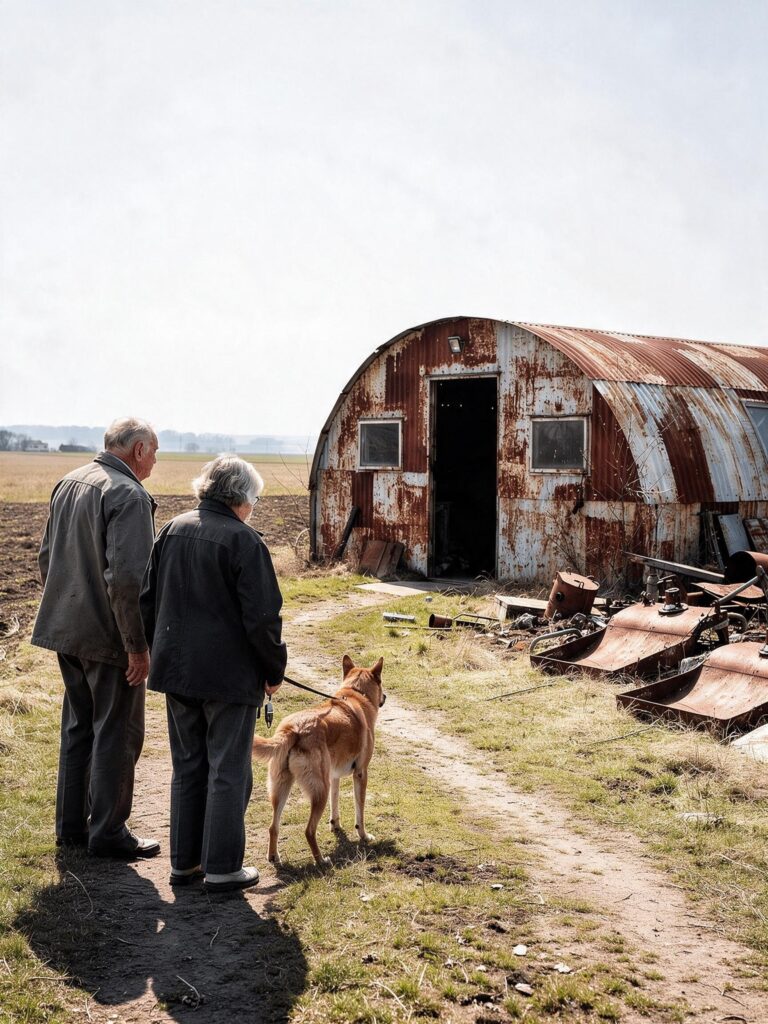
they laughed when the old farmer spent his last five hundred dollars on a rusted quonset, but the dog would not leave the locked box his father had hidden for seventy years
Part 1
The gavel hit the block like a shot.
“Lot forty-seven,” the auctioneer said. His name was Bert, and his voice had gone flat from saying the same things all morning. “Three acres. One Quonset. Condition listed as salvage.”
A few people in the folding chairs chuckled. It was not a loud laugh. It was the soft, automatic kind people make when they have already decided the joke.
Matthew Marsh did not laugh. He sat with his coat buttoned and his hands in his pockets, feeling the hard edges of nine hundred dollars folded tight enough to hurt. Olivia sat beside him. Her breathing was thin and careful, the way it had been since the textile mill years and worse since January. Duke lay at her feet with his chin on his paws, amber eyes moving from stranger to stranger like a dog who still believed a post was a post.
“Opening bid, five hundred.”
No one moved.
Matthew had driven out to Mill Creek Road two weeks earlier in the church van, leaving Olivia resting in the RV they no longer owned and taking Duke in the passenger seat. What he found was what the newspaper said it was. Three acres of winter-killed weeds. A corrugated half-cylinder the color of dried blood. Vegetation coming up through the concrete pad. A sliding door stuck a hand’s width open on rusted track. He had stood in the March wind a long time, an old man in a borrowed coat, and he had not been able to explain to himself why the place did not feel finished.
“Five hundred,” Bert said again. “Do I have five hundred? Four hundred? Come on, folks. Three acres and a structure.”
Matthew raised his hand.
Heads turned. He felt them. Carl Hendricks, whose dairy bordered the old Marsh place before the sale. Jerry Whitmore from the salvage yard on Route 20, already calculating scrap. A woman from the diner who used to refill Olivia’s coffee without being asked.
“Three hundred to Matthew Marsh,” Bert said. “Do I hear three-fifty?”
The room stayed quiet long enough for the whispers to start. Matthew knew the shape of them. Poor old Matthew. Lost the farm and lost his mind with it. What’s he going to do with a rust heap and three acres of weeds.
“Three hundred going once.”
“Three-fifty,” Jerry said.
Matthew did not look at Olivia. They had agreed on eight hundred as the ceiling and hated even that number. Every dollar above the bid was a dollar that would not buy propane, or medicine, or the next tank of gas.
“Four hundred,” he said.
Jerry’s smirk thinned. “Four-fifty.”
Olivia’s hand found his arm. Light. Insistent.
“Five hundred,” Matthew said.
Jerry studied him the way a man studies a load he is no longer sure he wants. Then he shook his head. “Too rich for my blood. You want that rust heap, it’s yours.”
The gavel came down. Sold.
The paperwork took less than twenty minutes. Matthew signed where Bert pointed, counted out five hundred in cash, and received a key that looked as if it had not turned in anything since Eisenhower. The deed would be filed with the county within the week. Outside, the March sun was pale and without heat. Duke pressed against Olivia’s coat. Laughter followed them as far as the church van.
Carl Hendricks did not bother to lower his voice. “Matthew Marsh. What in God’s name are you going to do with that worthless piece of land?”
Matthew did not turn around. “Live on it.”
The drive back through Cedar Falls took them past the hardware store where he had bought bolts for sixty years, past the diner where Saturday breakfast had been eggs and the same corner booth, past the bank that had foreclosed on neighbors in the eighties while Matthew hauled hay to their barns and pretended it was extra. No one had hauled anything to the Marshes when the notices came.
“You’re quiet,” Olivia said.
Duke had his head on the armrest, watching the familiar streets go by as if he were memorizing them in case they did not come again.
“Thinking about what they said.”
“Doesn’t matter what they say.”
“No,” she said. “But it still hurts.”
He took her hand. The fingers were thinner than they had been at the harvest dance in 1962, the skin spotted, the grip still stronger than people expected. She had been seeing through him since they were seventeen, since the night he tried to convince her he did not care if she went with Billy Morrison.
“I’m going to build us something, Libby. I don’t know exactly what yet. A place that’s ours. With whatever we’ve got left.”
“That’s four hundred and fourteen dollars,” she said, “and a Quonset held together by rust and prayers.”
“And you,” he said. “And Duke. That’s not nothing.”
The dog’s tail thumped the seat once.
They reached the property as the light began to soften. Matthew had prepared himself to be disappointed. He had told himself, on the drive, that the land would look smaller and the building worse, and that he would stand in the weeds and understand why the room had laughed. Duke jumped down and began to circle, nose to the ground, tail level. Not play. Work.
The Quonset rose out of the overgrowth like something asleep. Rust streaked the curved panels. Weeds had split the pad. The sliding door stood ajar on darkness. Olivia came behind him slowly, one hand on Duke’s back for balance.
“It’s bigger than I remembered.”
He had guessed forty feet from the listing photo. Standing in front of it, he revised the guess. Fifty, maybe more. He put his palm on the metal. Cold, even in the weak sun, rough with corrosion. When he pushed, the door moved easier than he expected and groaned across the empty acres.
Light fell in a shaft.
Matthew’s breath caught.
The building was not empty.
Against the far wall, under canvas gone gray with dust, stood shapes his hands knew before his mind finished naming them. A tractor. A baler. Implements stacked with the kind of care that meant someone had believed they would be used again.
“Matthew,” Olivia whispered. “Is that equipment?”
“Old,” he said. “But equipment.”
Duke went past his legs, nails clicking on concrete, and did not wander. He went to a corner where industrial shelving stood in shadow, sat, and looked back with the same alert expectation he had worn the day he found the break in the north fence, and the day he led Matthew to a calf that had wandered off its mother in a spring storm.
Matthew followed.
The shelves held boxes, cans, containers he could not identify in the dimness. On the bottom shelf sat a metal box about the size of a small suitcase, army green, the padlock rusted open. Stenciled on the side, barely visible under dust, were initials.
E.T.M.
Edgar Thomas Marsh.
“Libby,” he said, and his voice sounded strange to him. “Come look at this.”
He carried the box to the tailgate. Duke sat at his boots and watched the lid as if the dog could smell what was inside. The seal had held. On top lay a leather journal, cover cracked, pages intact. Under it, photographs in a rubber band that crumbled when Matthew touched it. Manila folders. A pocket watch with a stopped face. At the bottom, a hand-drawn map in handwriting he had not seen since 1978.
“Your father never mentioned any of this?”
“Dad never talked about the years before he married Mom. Said the past was past.”
Edgar had come home from the war, bought the Cedar Falls farm, and worked it until his heart quit. Matthew had been forty-one at the funeral and had believed he knew the important things. He opened the journal carefully. The first entry was dated August 1, 1946.
I found a place to start over. Three acres on Mill Creek Road with a Quonset I can convert to storage. Nobody knows about the money yet, and I aim to keep it that way until I’m sure who I can trust. The farm is the priority. Everything else can wait.
“Money,” Matthew said.
“Keep reading.”
The entries ran nearly two years. The secret purchase. Equipment stored. Cryptic lines about the account and the arrangement. March 1, 1948: The banker in Des Moines says the certificates have matured nicely. I’ve added the Mill Creek deed to the deposit box. Someday, when the time is right, this will all go to whoever needs it most. I’ve seen what happens when families fight over money. Better to let it wait until it finds the right hands.
Matthew looked at the dog.
“He bought this separate from the farm. Stored equipment here. Something in Des Moines. Certificates. And no one knew. Not Mom. Not me.”
Olivia’s hand found his arm again. “Matthew. The children. When Robert did all that—”
“The farm was all anyone knew about,” he said. “This property, whatever’s in Des Moines, Robert couldn’t touch it. He didn’t know it existed.”
For the first time in three months, since the morning strangers drove away with his grandfather’s tools, Matthew felt something he had stopped permitting himself to feel. It was thin. It could still be nothing. Worthless paper. A dead bank. A journal seventy years old. Wars and recessions had happened since a young veteran wrote those lines. Still, he stood a little straighter and looked at the Quonset as if it might be a beginning instead of a joke.
“We’ll need to make it livable first,” he said. “Insulation. Electric. Plumbing. In stages.”
“We have four hundred dollars.”
“We have four hundred dollars, this land, this building, and a mystery. That’s more than we had yesterday.”
Duke got up, walked to the open door, looked back, and went inside. A moment later his bark came out of the dark. Not alarm. The bark that meant come see.
Olivia smiled, small. “That dog has been finding things we couldn’t see our whole lives.”
Matthew helped her across the uneven ground. Duke stood beside one of the tarped shapes, pawing the canvas. Matthew pulled it back.
A 1947 Farmall Model M. Red paint faded, not gone. Tires flat. An engine that had likely last turned when Truman was president. Tied to the steering wheel with twine that should not have survived was a note on paper gone yellow.
For my son, when he finds his way here. The land provides for those who don’t give up on it. Dad.
Matthew read it three times.
“He knew,” he said.
“Knew what?”
He looked at the tractor, at the shrouded implements, at the building the auction room had laughed at.
“That someday I’d need a place to start over.”
Outside, the sun finished dropping and caught the curved roof. For a moment the rust looked like something kept instead of something discarded.
They were not the only ones who had heard about the Marsh misfortune. By nightfall, Cedar Falls would be talking. Some of that talk would stay pity. Some of it would turn into a different kind of interest, the kind that arrives when people begin to wonder what an old man might have found.
Part 2
They slept in the church van with Duke wedged between them, his body a blessing against the March cold. The Quonset stood thirty yards off, a dark bulk in the window, keeping watch the way a building can when a man has decided it is his.
Matthew barely slept. He kept seeing his father’s handwriting. What kind of man hides a property from his own family? What kind of father ties a note to a steering wheel for a son who might never come? The answer, forming slowly in the dark, was a man who had learned not to trust what money did to people. Edgar had tried to protect his son from the fate that found him anyway.
At first light he eased out of the van and gestured Duke to stay. The air had the bite of late winter and, under it, the faint green smell of things preparing to grow. He walked the boundaries. Three acres was nothing beside the two hundred he had lost. Walking it, he began to understand the choice. Gentle slope toward a creek on the east line. Dark bottomland where the weeds had died back. A stand of mature oaks at the northwest corner for windbreak and, later, firewood. The Quonset on the high ground, above whatever the creek might do in a wet spring.
Edgar Marsh had not bought junk. He had bought potential and hidden it where people would not think to look.
Olivia had the camp stove going when he returned. The coffee was weak, made from grounds already used twice.
“You were walking the land.”
“Dad knew what he was doing. It’s good land, Libby. Really good.”
“So what’s the plan?”
He had been turning it over all night. “First, make the Quonset somewhere we can sleep that isn’t this van. Second, get to Des Moines and find out what he left in that box. Des Moines is a hundred and fifty miles. That’s gas we don’t have. So we start here. Maybe some of what he stored is worth something.”
Duke came out, stretched, and looked from Matthew to the building.
“He wants to show us something else,” Olivia said.
“He always does.”
Morning light changed the interior. Sun came through gaps in the panels in shafts and showed what the afternoon had only suggested. The Farmall. A John Deere baler from the early fifties, green paint still caught in the seams. A disc with blades that needed sharpening and no structural damage Matthew could see. Hand tools on pegboard, each one outlined in paint so a missing wrench would announce itself. On the shelves: cans with faded labels and intact seals, copper wire, nails sorted by size, kerosene lanterns with fuel still in them, wool blankets in paper that crinkled under his fingers.
“He was preparing for something,” Olivia said. “Like he expected the world to fall apart.”
Matthew nodded. Everyone in Cedar Falls had said the war changed Edgar. The boy who left in 1942 came back quiet, watchful, given to studying horizons. “I think he wanted to make sure someone in the family could survive no matter what happened.”
Duke barked once, sharp, at the far end near stacked crates. Same posture as yesterday. Matthew shifted the crates until his back complained and found what the dog had been pointing at. A door. Not the big slider. A human-sized door welded into the curved wall, padlocked with the same old brand as the box. He took bolt cutters off the tool wall. The lock gave.
Earth. Concrete. Motor oil. Old paper. The smell of a root cellar, of underground rooms where time moved differently.
“There’s a cellar,” he said. “Dad built a cellar under the Quonset.”
Duke went down the steps without hesitating. Matthew lit a lantern with matches that still struck and followed. The room was about thirty feet square, poured walls, a floor cold through his boots. Shelves of a more personal kind. Boxes labeled photos, letters, army records. A trunk with Edgar’s name stenciled on it, the same trunk that had gone to Europe and come home. In the center, on a wooden table, another metal box. Newer. The lock still bright.
Matthew’s hands shook opening it.
The letter inside was addressed to him. The handwriting was his father’s and shakier than the journal.
Matthew, if you’re reading this, then things went bad enough that you had to find your way here. I’m sorry for that. I always hoped the main farm would be enough, that you’d never need what I’ve stored on Mill Creek. The certificates I mentioned are in a safety deposit box at First Federal Bank of Des Moines, box number 443. The key is taped to the bottom of this box. The bank may have changed hands. The box was paid up through 2020. After that, I don’t know. There’s a letter in the box for whoever’s running the bank. It explains everything and authorizes you to claim the contents.
I should have told you while I was alive. I should have trusted you. I saw too many families torn apart by inheritance, by money, by the poison of expecting something you didn’t earn. I wanted you to build your own life. To know that everything you had came from your own hands. Maybe I was wrong. All I can do now is leave you what I can and hope it’s enough. The land provides for those who don’t give up on it. I meant that. Whatever happened to bring you here, don’t let it break you. You come from people who survived worse. You have your mother’s faith and my stubbornness. I love you, son. I should have said it more when I had the chance. Dad.
Matthew read it three times before he noticed he was crying.
Olivia’s hand found his shoulder in the lamplight. “He loved you. He just didn’t know how to show it the way you needed.”
“He knew this would happen.”
“No,” she said, gentle and firm. “He didn’t know specifically. He understood that life can take everything without warning. So he prepared. He gave you a safety net you didn’t know you had.”
Duke pressed his head against Matthew’s thigh. Matthew scratched behind the dog’s ears and felt his voice steady.
“Okay. Des Moines.”
The key was taped where the letter said, small and brass and still bright. Des Moines was still a hundred and fifty miles, and four hundred dollars had no business stretching that far.
The next week was triage. Matthew sorted from dawn until his body quit, using sixty years of knowing what iron was worth. Most of it was too old to sell quickly. Antique dealers might want the Farmall eventually. He did not have eventually. Under a tarp in a corner he had not fully cleared, he found three fifty-gallon drums of diesel, sealed, stabilized. A sample ran clean in the van.
“Diesel’s four dollars in town,” Olivia said. “If someone will buy it.”
“Oliver Jensen will buy it.”
The name sat between them. Oliver had owned the feed store forty years. He had been a friend when the Marsh name meant something. Since the eviction he had been one of the men who suddenly found themselves too busy to talk.
“You think he’ll deal with you?”
“He’s a businessman. He’ll deal if the price is right.”
Matthew drove in alone. The feed store looked as it had for decades, red paint, white trim, the sign Oliver’s father had carved in 1952. Conversation near the register died when he walked in.
Oliver looked up. Surprise, discomfort, then a careful neutral. “Matthew.”
“I have diesel to sell. Three fifty-gallon drums. Stabilized. Tests clean. I’m asking three-fifty a gallon.”
“That’s below market.”
“I know. I need the money quickly.”
“Where’d you get three drums of diesel?”
“My property.”
Oliver stopped himself. “I heard about the auction. That Quonset on Mill Creek.”
“That’s right.”
Something shifted in the other man’s face. Not quite sympathy. Near it. “People are talking. Saying you’ve lost your mind, buying that rusted heap.”
“People have been wrong about me before.”
Oliver studied him, then came around the counter and put out his hand. “I’m sorry. About everything. What your kids did. How the town treated you. It’s not right.”
Matthew shook, surprised by the tightness in his throat. “Thank you.”
“I’ll take the diesel. Three-fifty. Cash. Tomorrow, if you’ll give me directions.”
As Matthew turned to leave, Oliver said, “Whatever you’re building out there, I hope it works. Some of us remember what your family used to mean to this town. Some of us are rooting for you, even if we haven’t said so.”
Five hundred and twenty-five dollars. With what remained, they were near nine hundred again. Gas to Des Moines and back. A little for making the building livable. Enough to breathe without counting every hour.
Oliver arrived the next morning with his truck and with what he called a loan that didn’t need paying back: a propane space heater and two full tanks. “My wife cleaned out the garage. She was going to donate it. Might as well go somewhere useful.”
That night they slept inside the Quonset for the first time, on wool blankets over pallets, the heater pushing the cold back, Duke at their feet.
“Tomorrow,” Olivia said in the dark. “Des Moines. I’ve been feeling stronger. The spring water from the creek. Ever since I started drinking it, my chest feels clearer.”
He had noticed. Her breathing, damaged by the mill in the seventies and by age, had eased since Mill Creek. He had blamed clean air and the lifting of one particular fear. Lying there, he thought of his father’s line. The land provides for those who don’t give up on it. Maybe Edgar had chosen these three acres for reasons that were not only on a deed.
Duke shifted and made a soft sound of contentment, as if the dog had already voted.
Part 3
They left at dawn. Duke rode with his head on the center console so he could watch both of them. The highway ran west through fields still brown, with green pushing at the edges. Matthew had called ahead. First Federal had become Prairie Trust Financial after mergers and name changes. A manager named Susan Chen confirmed that box 443 still existed, paid through 2020 on an account since closed, technically in arrears, and that an heir with papers might be able to resolve it.
He had the letter, the key, his license, and Edgar’s death certificate from the county file. Whether a bank would care was another question.
Des Moines rose off the prairie in glass and traffic that felt chaotic after months of county roads. Prairie Trust occupied the ground floor of a building that had been impressive in the eighties and now wore its age without apology. Parking was two blocks off. Olivia worried they would not allow the dog.
Susan Chen came out, looked at Duke, and smiled. “Is he a service dog?”
“He’s a farm dog,” Matthew said. “Best friend I’ve ever had.”
“We have a policy about service animals. We don’t have a policy about best friends. If he’s behaved, he’s welcome.”
Duke walked beside them with the bearing of a dog who had attended important meetings his entire life.
The vault was in the basement. Box 443 sat on the bottom row, larger than Matthew expected. Susan examined the license, the letter, the key, the death certificate, and made notes on a tablet.
“This appears to be in order. There’s back rent since 2020. Roughly two hundred and forty dollars.”
Matthew’s stomach dropped. They had it. Barely.
“However,” she said, “given how long this box has been with us and our predecessors, I’m authorized to waive the fee. A courtesy to a long-standing customer.”
“You have no idea what that means.”
She used her master key beside his. The box came free. She set it on the table and left them.
Duke sat, ears forward.
Inside was what the letter had promised, and more. Stock certificates held by the pressure of the box after the rubber bands failed. Bearer bonds in denominations that made the numbers blur. A savings passbook from 1985 showing forty-seven thousand dollars, with a note that the account had been converted to a certificate and rolled over. Beneath the paper, one more letter, in a hand Matthew knew from birthday cards and the inside of his childhood coat. His mother’s. The paper still smelled faintly of flowers.
My darling Matthew, if you’re reading this, then your father’s plan worked and you found your way here when you needed to. This was our idea together. We both knew what money could do to families. The certificates and bonds are real, and they’re yours. Your father invested carefully for thirty years. The returns were better than either of us expected. The savings account should still be active. Use what’s here to build something good. Use it to help people who need help. Remember that wealth isn’t about what you have. It’s about what you do with it. I loved you from the moment you were born, and I will love you until the stars go dark. Your father wasn’t good at saying such things, but he felt the same. Be happy, my son. That’s all we ever wanted. With all my love, Mom.
Ruth Marsh had died in 1992. She had never mentioned the property, the investments, or a box in Des Moines. They had kept the secret together and trusted it to time.
Olivia’s hand rested on his shoulder. “How much?”
“I don’t know exactly. Some of this has to be verified. If it’s worth what it looks like—” He stopped.
“Tell me.”
“Hundreds of thousands, Libby. Maybe more.”
Duke whined and pressed against his leg. Matthew whispered, “We’re not broke. We were never really broke. We just didn’t know it yet.”
She pulled him in. Her arms were thin and surprisingly strong. “Your parents loved you enough to prepare for the worst and hope for the best. That’s the greatest gift anyone can give.”
They held each other in a basement vault, surrounded by paper that had outlasted both the people who signed it, while an old dog watched the door.
On the drive back, the box sat on the seat beside Olivia and Duke rested his chin on its edge as if he had appointed himself guard.
“We should find a lawyer,” she said. “Someone who can tell us what we actually have.”
“Tom Redhawk handled business for the farm years ago. Honest. He sent a card after the eviction. Just said he was sorry. No excuses. That’s more than most.”
They reached Mill Creek as the sun dropped and turned the rust the color of amber. Duke bounded out and began his perimeter check with the seriousness of a soldier returning to post.
Matthew could not sleep. He sat on an overturned crate in one of his father’s blankets and watched stars come out in a sky with no town light in it. The creek murmured. An owl called. Eighty-one years old. He had buried his parents, watched his children become strangers, and lost a farm that had been in the family a century. Here he was, starting over. The absurdity hit him and he laughed, a rusty sound that brought Duke’s head up.
“It’s all right, boy. I’m just realizing life doesn’t stop surprising you.”
Tom Redhawk’s office was above a bakery on Main Street. Bread smell in the stairwell. The lawyer was compact, silver in his black hair, eyes that missed nothing. He rose when they came in.
“Matthew. Olivia. I was hoping I’d hear from you.”
Duke settled at Matthew’s feet after a raised eyebrow and a small smile.
Matthew set the box on the desk. “My father left these in Des Moines. We brought them back yesterday.”
Tom worked for nearly an hour. Glasses on, notes on a legal pad, the occasional long look at a certificate. Duke watched him the way he watched a rabbit, alert and patient.
At last Tom set the glasses down.
“I’ll need to make calls. Based on what I’m seeing, your father was a smart investor. Some of these companies don’t exist anymore, but several were acquired. Shares would have converted. Conservatively, the stocks alone could be three to four hundred thousand. Bearer bonds, if they’re still valid, another fifty to seventy-five. The savings account with forty years of compound interest—” He shook his head. “We may be looking at over half a million. Maybe more.”
Olivia’s hand tightened on Matthew’s arm.
“That can’t be right. My father was a farmer.”
“He had time,” Tom said. “And patience. These started in the fifties. Sixty years of growth, dividends, splits. Time is the most powerful force in finance. He understood that.”
“What do we do?”
“Let me verify. A few days, maybe a week. Keep this private. Once word gets out you’ve come into money—” He did not finish. He did not have to.
The week that followed was the strangest of Matthew’s life. On the surface nothing had changed. They still slept on makeshift beds. They still heated wash water on the camp stove. Duke still made his rounds and still led Matthew to corners he had missed. Under the surface, the weight that had sat on his chest since the eviction had lifted into something that felt dangerously like anticipation.
He repaired the main door with scavenged parts. Oliver delivered metal sheeting for the gaps in the panels and waved off payment. “Call it a loan. You can make it up when you’re back on your feet.”
Word had moved through Cedar Falls. The laughter from the auction had begun to thin. Oliver, it seemed, had been telling people to reserve judgment. He’s Matthew Marsh. I’ve known him sixty years. If he sees something in that land, there’s something there to see.
“You earned it,” Olivia said when Matthew did not know what to do with being defended. “Not as a favor. Oliver’s repaying a debt you probably don’t remember creating.”
She was right. Equipment loans. Emergency hay. Showing up when hands were needed. He had never kept a ledger.
Tom called on a Thursday, eight days after the meeting.
“It’s real. All of it. The stocks are worth more than I first estimated. The bonds are valid. The savings account exists at a successor bank and has been accruing. You’re looking at roughly six hundred and twenty thousand in liquid assets. Taxes, yes, but your basis is so old the rates will be favorable. You could net around five hundred thousand.”
Matthew sat on an overturned bucket. Duke abandoned the cellar entrance and came to sit beside him.
Five hundred thousand. More than he had ever held. More than the farm had been worth at the sale. More than everything Robert had taken and lost.
“Come in tomorrow,” Tom said. “We’ll start the paperwork. And Matthew—I need to tell you something before you hear it from someone else. Robert has been calling around town. He heard you’ve been working the Mill Creek property. That you found things. He’s asking about inheritance law. About whether assets discovered on property you own are subject to claims from family.”
The cold moved through Matthew’s chest and settled.
“He’s going to try to take it.”
“He’s going to try something. Everything your father left is legally yours. You’re his only heir. That doesn’t mean Robert won’t make noise.”
Duke growled, low, as if the name had come through the phone.
“Let him come,” Matthew said, and was surprised by the steel in his own voice. “Let him try.”
Part 4
Spring arrived in the third week of April, and the place Matthew had bought with a desperate bid began to answer the work.
The Quonset was weathertight. The door ran on greased track. He had partitioned the interior: a living space with a real mattress on a frame of salvaged lumber, a kitchen corner with a propane stove and a sink draining to a gray-water barrel, a workshop where the old equipment waited. The cellar stayed cool enough to keep food. Olivia discovered that Edgar’s sealed cans were still edible. Decades-old green beans and corn that tasted like history and filled a bowl.
Outside, the three acres gave ground slowly. Brush piled and burned. Soil turned. Duke investigated each cleared section as if approving it. Matthew limped in one evening from post holes, back aching.
“You’re going to hurt yourself.”
“I’ve been hurting myself for eighty-one years. Hasn’t killed me yet.”
She was right to worry. He was pushing harder than he had in decades. Some of it was necessary. Some of it was reclamation. Every post, every weed, every patch on the building was a sentence he needed to say out loud with his hands. I am not finished. I am not broken. I am still here.
Duke stayed close, sometimes dragging branches toward the burn pile, sometimes lying in a patch of sun as proof that Matthew was not doing the work alone.
One afternoon, while Matthew was elbow-deep in the Farmall’s fuel system, Duke stood up and fixed on the access road. A dark sedan came up the rutted track, wrong for the place as a piano in a barn.
Robert stepped out.
Matthew had not seen his eldest since the day Robert handed over a nursing-home pamphlet and called Ranger, the old collie, a disposal problem. The man in the clearing looked prosperous in spite of the clients he had lost. Suit. Polished shoes that picked up dust at once.
“Dad. We need to talk.”
Duke’s growl was continuous. Matthew put a hand on the dog’s back and did not restrain him. “So talk.”
Robert looked at the building, the cleared ground, the evidence of weeks, and something crossed his face. Surprise, then calculation.
“I heard you’ve been making progress. That’s good, Dad. Really.”
“Say what you came to say.”
The concern slipped. “Fine. I know about the investments. The box in Des Moines. The money Mom and Dad hid.”
“They didn’t hide it from me. They left it for me.”
“For you, or for the family?” Robert stepped closer. Duke’s growl rose. “I’m their grandson. Their heir as much as you are. Patricia, Michael, we all have a claim.”
Matthew studied the man wearing his son’s face. Not the boy he had raised. Not the young man he had co-signed for. A stranger who had learned to treat love as leverage.
“You have a claim,” he said slowly, “to money your grandparents saved and left to me. Assets you didn’t know about, never contributed to, never had reason to expect.”
“The law—”
“The law says it’s mine. I’ve talked to lawyers too. Everything they left is mine to do with as I choose. I choose not to share it with someone who stole my farm, destroyed my retirement, and left your mother and me to die in a church parking lot.”
“That’s not fair. The investments failed. I was trying to help.”
“You were trying to help yourself. You saw two old people with assets you wanted, and you took them. You didn’t care what happened after.”
Robert’s face hardened. The last of the performance left it. “You can’t prove I did anything illegal. The risks were disclosed.”
“I’m not interested in proving anything. I’m not interested in courts. I’m interested in living whatever years I have left with some dignity. You can’t take that from me.”
“We’ll see.” Robert turned toward the car, then stopped. “I tried to help you. The nursing home was a good facility. You would have been comfortable.”
“Comfortable,” Matthew said, and the word tasted bitter. “You wanted us comfortable and out of the way. You wanted to visit twice a year and feel decent about it. I’m living on land my father prepared for me. With your mother. With a dog who’s shown me more loyalty than you ever did. I’d rather live in this barn than in any house you might build, because here I know who I am.”
The sedan left dust hanging over the track. Matthew sat on the step. Duke climbed into his lap, all seventy pounds, and pressed his face to Matthew’s chest.
“You’re too big for this.” He held on anyway.
Olivia found them twenty minutes later, coming back from the creek with a basket of wild herbs. “Robert came.”
“He came. He made his threats. He left.”
She sat. Duke redistributed himself between them, tail thumping the wood.
“Are you all right?”
He thought about it. “I think I am. I thought seeing him would hurt more. Mostly I felt tired. Tired of pretending it was anything but betrayal.”
“It was betrayal. It’s all right to call it what it is.”
“I spent years making excuses. Robert was trying to help. Patricia was busy. Michael was fragile, we couldn’t pressure him.”
Olivia nodded. “We taught them that. We taught them their needs mattered more than ours. That our job was to sacrifice and theirs was to receive. Maybe we shouldn’t be surprised they believed us.”
It was the most honest thing either of them had said about where it had gone wrong. Not only Robert’s maneuvering, or Patricia’s coldness, or Michael’s absence. The pattern laid down over decades.
“We can’t change the past,” Matthew said. “We can decide what happens next.”
“And what happens next?”
He looked at the building, the land, the dog.
“We build something worth building. We live well. We figure out how to make this mean something beyond just us.”
Duke barked once. Olivia laughed, the first real laugh Matthew had heard from her in months. “If Duke approves, who are we to argue?”
Robert filed a claim alleging that Edgar’s assets belonged to a family trust and should be divided among all descendants. Patricia added her name. Michael, characteristically, declined to participate either way. Tom handled the defense with the calm of a man who had already walked the board. The will was clear. The investments were in Edgar’s name. The Mill Creek deed had been bought with personal funds decades before any grandchild was born.
“They’re hoping you’ll settle to make it go away,” Tom said. “They don’t have a legal leg. Lawsuits are expensive and exhausting. They’re betting on the hassle.”
“I won’t.”
“I know. I wanted you to see the strategy.”
The case was dismissed in six weeks. It still took time, money, and more peace than Matthew wanted to spend. Every envelope felt like an attack. Through it, Duke remained the anchor, appearing with a tennis ball or simply leaning until the tension eased.
“That dog is better than any therapist,” Tom said on a visit. “Have you considered he might actually be magic?”
“I stopped questioning what Duke knows a long time ago.”
By midsummer the change was impossible to ignore. Fresh paint. Solar panels on the curved roof, bought with a portion of the inheritance, power that did not depend on a line Robert could have cut if he had thought of it. A small bathroom addition. A well Duke had led Matthew to by scratching at a low place near the oaks until Matthew, half joking, drove a probe and hit water. Gardens where the weeds had been. Fruit trees set as saplings in April, already holding. The creek cleared, banks steadied, water cold and clean.
Oliver came often, left with vegetables, brought what the feed store could spare. Pastor Williams from the Methodist church, whose parking lot had held their RV through the worst weeks, drove out and left visibly moved. Neighbors who had looked through the Marshes when they had nothing now stopped with offers and invitations.
“Funny how that works,” Olivia said one evening on the porch Matthew had built, watching Duke chase fireflies. “When we had nothing, no one wanted to know us. Now everyone’s a friend.”
“Are you angry?”
She considered it. “I was. Then I decided holding the anger was like drinking poison and expecting someone else to get sick. Most of them weren’t cruel. They didn’t know how to help, so they stayed away. That’s human nature.”
“Oliver didn’t stay away.”
“Oliver saw something in you that reminded him who you used to be, and he decided it was worth backing. That’s friendship. The rest is community. People doing what people do.”
“So we forgive everyone and move on?”
“We don’t have to forgive anything. We decide what kind of people we want to be.” She took his hand. “I’d rather build than keep score.”
Duke came back damp with dew and flopped at their feet. His tail swept the boards once, twice, three times.
The first autumn arrived gently, which felt, to Matthew, like a kind of forgiveness. He stood at the edge of the property and watched oak leaves come down gold and rust. Woodsmoke from the new chimney. Apples in the small orchard. Behind him the Farmall sat in morning light, restoration finished. Most of the summer had gone into it, early and late, learning the machine the way Edgar must have learned it. In September the engine turned over, coughed, and settled into a rhythm Matthew felt in his bones. He sat in the seat for nearly an hour, not going anywhere, listening to something broken become whole. Duke stayed beside the tire, tail moving in slow arcs.
Contentment was not too simple a word if he let it mean the complicated weave of grief and gratitude. Work done. Purpose that still fit his hands. A life that had not ended when the farm did.
“You’re woolgathering again,” Olivia called. Her gait was steadier than it had been in years. She rarely coughed on the creek path now.
“Thinking about Dad. Wondering what he’d make of this.”
“He’d be proud. He’d also find something to criticize. That post isn’t straight. The garden rows could be neater. The Quonset needs another coat.”
He laughed, because it was true. Under Edgar’s criticism there had always been the belief that his son could do the thing right.
“I found something yesterday,” she said. “In the cellar, behind the canning jars. Duke led me. Come see.”
The cellar had become her domain, shelves of garden vegetables, roots in sand, herbs drying from the beams. Duke went down ahead of them and pawed at a row of pickled beets until she moved the jars. Behind them sat a cedar box, six inches square, missed in every earlier search.
Inside, in faded velvet: a woman’s ring with a small diamond, and a folded note in Edgar’s hand.
Matthew knew the ring. His grandmother’s. She had died before he was born. Her photograph had hung in the farmhouse kitchen his entire childhood.
This ring belonged to my mother. She wore it every day of her married life and asked that it be passed to someone who understood what marriage really means. Not the ceremony. The choice to stay when staying is hard. I never gave it to your mother because she already had her own mother’s ring, and this one was meant to wait. If you’ve found this, you found the rest. You’ve done the hard work. Give this ring to Libby. She’s earned it. So have you.
His hands trembled in the autumn light. The stone was small and clear.
“He saved it for you,” he said.
Her eyes filled. He gestured at her left hand, where the 1962 band had worn thin.
“May I?”
She nodded. He slid his grandmother’s ring on beside the original. The two bands sat together as if the decades between them had been a pause, not a break.
“I, Matthew Marsh, take you, Olivia Marsh, to be my wife. Again. Still. Always.”
She laughed through the tears. “We’re already married, you old fool.”
“I know. I wanted to say it. If I had to do every struggle and every loss of the last sixty-two years over again, I’d choose you. I’d choose this life.”
Duke came off the cellar stairs and pressed against both their legs, closing the circle.
Part 5
The letter came on a Tuesday in late October. Matthew knew the handwriting before he opened it. Michael. He almost threw it on the stove. The lawsuit was done, and the wounds were not. Every envelope from his children still felt like a hand in his pocket.
He opened it anyway.
Dad, I don’t expect you to read this. I wouldn’t blame you if you burned it. I needed to write it. I’m sorry. Not the kind that expects forgiveness. Sorry for not being there. For not standing up to Robert. For letting fear keep me from doing what was right. I was always the one who avoided a fight. When Robert started talking about optimizing your assets, I knew something was wrong. I didn’t say anything, because saying something meant a fight, and I’ve spent my life avoiding those. That’s not an excuse. It’s the truth. I heard what you’ve built on Mill Creek. Oliver Jensen’s daughter works with my wife. She says people are starting to call it the Marsh place, the way they used to call the farm. I’m proud of you. I know I have no right to be. I’m not asking to visit. I’m not asking for money or forgiveness. I wanted you to know that not all of your children forgot what you taught us. Some of us just weren’t strong enough to live up to it. I love you and Mom. I always have, even when I was too weak to show it. Michael.
Matthew read it three times. Duke sniffed the page, looked up, and wagged once, slowly. Not an endorsement. Not a rejection.
He did not answer at once. The anger had become a companion, warm on cold nights and expensive in daylight. He and Olivia talked about it the way they talked about everything now, longer and straighter than the polite fiction of the old marriage.
“Michael was always different,” she said by the woodstove, Duke stretched between them. “More sensitive. More afraid. That doesn’t excuse what he didn’t do.”
“No. It might explain it.”
“When Robert was planning it, Michael probably saw it and felt powerless. He’s spent his life feeling powerless.”
“Whose fault is that?”
The question sat there, uncomfortable and necessary.
“Maybe ours, partly,” she said. “We protected him too much. We fought his battles. Then we wondered why he never learned to stand up.”
Matthew thought of a small boy at the edge of family gatherings, and of every blow they had softened until the path had no stones in it.
“Robert’s sins are Robert’s,” he said. “Michael’s weakness—maybe we helped make it. I don’t know if that means I write back.”
He was still undecided when the first snow came in early November, a light dusting that made the porch look like a card. Duke caught flakes on his tongue and looked, for a minute, like a puppy instead of an eleven-year-old dog with gray in his muzzle.
“First winter here. Think we’re ready?”
Duke trotted to the edge of the porch and looked back. Invitation.
They went to the workshop corner, oil and sawdust, tools on pegboard. Duke pawed a wooden box Matthew had set aside weeks ago and forgotten. Inside, letters. Dozens, twine crumbling. Correspondence between his parents from before the marriage through the years of his childhood, ending only with Ruth’s death in 1992.
He sat on a shop stool. They had written to each other even when they lived in the same house. He opened one at random, 1955.
My darling Edgar, Matthew asked me today why you work so hard. I told him his father is building something, not just the farm, but a future. He didn’t understand. He’s only eight. Someday he will. I watch you when you don’t know I’m looking. The way you study the horizon. I know the war changed you. I know you carry fears you’ll never speak. I want you to know I’m not afraid. Whatever you’re preparing for, I trust you. We’ll face it together. Yours always, Ruth.
His vision blurred. He read until the snow deepened outside. The marriage he had watched as a child had not been the silent practical partnership he remembered. It had been a private correspondence of fear, devotion, and plans no one else was allowed to see. Edgar in 1962: I’m not doing this because I expect disaster. I’m doing this because I can’t bear the thought of you or Matthew ever being helpless. If I can build a net strong enough to catch you, then whatever happens to me doesn’t matter.
Matthew wept without shame. His father had not been cold. His father had been terrified, and the terror had come out in the only language Edgar trusted. Preparation. Provision. Protection.
That night he read some of the letters aloud. They sat in a room that had become a home: real furniture from barn sales, photographs, rugs, the small things that turn shelter into a place a person can rest.
“They had a whole relationship we never saw,” Olivia said. “All those years, love letters, and I thought your father was almost without feeling.”
“Some men are like that. His generation especially.” She was quiet a moment. “Matthew, I think you need to write to Michael.”
“Why?”
“Because you’ve been angry at your children for not seeing the love behind what you did. Now you know your father spent his life loving you in ways you couldn’t see. I’m not saying forgive everything. Robert did real harm on purpose. Patricia chose coldness. Michael wasn’t strong enough. Maybe part of that is ours.”
Duke lifted his head from beside the stove and waited.
“What would I even say?”
“The truth. That you got the letter. That you’re not ready to pretend it’s fine, and you’re not ready to close the door forever. That you’re still his father when you’re angry. That love doesn’t disappear because it’s wounded.”
He looked at the stack of his parents’ letters. He had spent a life not fully seeing his father. He did not want Michael spending a life not fully seeing him.
The letter took a dozen drafts. Duke lay at his feet through all of them. At last Matthew stopped crafting and wrote what was true.
Michael, I received your letter. Thank you. I’m not going to pretend everything is fine, because it isn’t. What Robert did, what Patricia supported, what you didn’t stop, caused real harm. Your mother and I almost died. That is not an exaggeration. We were left with nothing in the coldest months, at an age when people should be secure. I’m also not going to pretend I’m blameless. Your mother and I have talked about how we raised you. Maybe we taught you that our role was to sacrifice and yours was to receive. Maybe we made it too easy to see us as resources. None of that excuses what happened. It might explain some of it. I’m writing because I don’t want to be the man who closes doors forever. I learned recently that my father loved me in ways I never recognized, and I never understood until he was gone. I don’t want that for us. I love you because you’re my son. Nothing changes that. I don’t trust you. Trust gets rebuilt by action, not words. If you want a place in our lives, you’ll have to earn it slowly, without expectation. We’ve built something good on Mill Creek. I don’t know if there’s room in it for you. I’m willing to find out if you’re willing to do the work. Your father.
He mailed it before he could retreat.
Winter settled kindly. Snow came and the Quonset held its heat. Duke dozed by the stove and slept against their feet. Matthew built a chicken coop from scrap and took six hens from Oliver, who kept finding reasons to drive out. Olivia filled the rooms with bread, soup, dried herbs, blankets knitted from wool Edgar had stored. They talked about the children without the first months’ recrimination. Honest inventory.
“I think we expected gratitude by osmosis,” she said. “We modeled sacrifice and never taught them it was supposed to move both ways. We wanted to give them everything we didn’t have, and we taught them that having was the same as earning.”
It was not comfortable. It was necessary. In the honesty he found a peace he had not expected. Not absolution for what his children chose. Release from the need to keep assigning blame every waking hour.
Michael’s answer came in February, short, and it contained more action than plea. He had started volunteering at a food bank. He was learning what it meant to give without expecting a return. He was not asking for anything. He wanted his father to know. Matthew wrote back a few lines. Acknowledgment. Encouragement. Nothing more. Not reconciliation. A door cracked, not opened.
Spring returned hard and green, as if the previous year’s planting had been a promise the land intended to keep. Matthew stood at the property line—his line, bought with the last money and turned into something that held—and watched robins work soil he had amended with compost and stubbornness. Blossom on the fruit trees. Beds ready. The Quonset, rust addressed, catching morning light as if it had always belonged on the rise.
Duke sat beside him, grayer, slower on cold mornings, eyes still bright.
“We did it, boy.”
The tail moved once. Agreement.
Olivia shaded her eyes from the porch. “Oliver’s coming up the drive. Something in the truck.”
Seed potatoes. Jars of jam. “My wife says it’s not proper to let neighbors go without homemade jam.”
Neighbors. A year ago the same town had laughed at a rusted hut and three acres of weeds.
“That’s what you are,” Oliver said. “Marshes have been part of this community a hundred years. That didn’t stop being true because Robert tried to erase it.”
They stood watching spring take the ground. Duke had finished his inspection and settled in a sunny patch.
“You’ve built something good here,” Oliver said. “Not just the property. You and Libby. People noticed.”
“We had help.”
“You had a foundation.” Oliver nodded at the building. “Your father left you more than money and equipment. He left you the belief that starting over was possible. Most people, knocked down as hard as you were, stay down. You didn’t. That’s not luck. That’s character.”
After the truck left, Matthew thought about Edgar’s net of savings and secrecy, about letters to Ruth that showed a heart no one had been allowed to see. Edgar had never learned to show love by staying in the room and saying the words. He had shown it by provision, by a legacy that waited seventy years to be needed. Matthew had spent his own life showing love by sacrifice, by work, by giving his children every chance he had not had. Like his father, he had failed to teach them that love was supposed to move both directions. The failure did not erase the love. It only made it harder to see.
That evening he wrote a page to no one in particular, or to whoever might someday need it. He sat at the table Olivia had refinished, Duke at his feet, spring at the open window.
What I know now that I didn’t know a year ago. That starting over is possible at any age, if you can let go of what you thought your life was supposed to be. That the people who love you sometimes say it in ways you won’t recognize until later. That forgiveness is not pretending the hurt didn’t happen. It is deciding the hurt will not be the only thing that defines what comes next. That a dog can teach you more about loyalty than most men ever will. That home is not a place you find. It is a place you build, one decision at a time. That the land provides for those who don’t give up on it.
He folded the page into the cedar box with his parents’ letters. Someday someone might find it. Or no one would, and that would be all right. The meaning was not in being discovered. It was in the living.
He crossed to Olivia’s chair and kissed the top of her head.
“What was that for?”
“For staying. For believing we could build something when everyone said we couldn’t.”
“We did build something.” She held his hand against her cheek. “A life worth living.”
Outside, the last light put gold on the curved roof. The three acres nobody had wanted were green and working. Duke woke, padded over, and pressed against both their legs, completing the circle that had held through the parking lot, the auction, the cellar, the lawsuit, and the winter.
They were home. Not because they had no other choice. Because they had chosen the land, and each other, and the work, and refused to be finished when the town and their own children had already written the ending.
The Quonset everyone had laughed at stood solid against the evening sky. Matthew and Olivia Marsh, betrayed and left with nothing but a dog and four hundred dollars, had proved that nothing could be enough if you had the right person beside you, work worth doing, and an old dog willing to show you what you could not yet see. The creek kept its quiet sound. The hens settled. Somewhere in a city two hundred miles away, a younger son read and reread a letter that did not absolve him and did not cast him out. On Mill Creek Road, an old farmer banked the stove, checked the latch, and rested his hand a moment on the dog’s head before he turned in.
The land had provided. They had not given up on it.


