
his five sons drove off nine housekeepers in a single year — the tenth was a widow with six boys of her own who had already buried a husband and a farm and was not impressed
Part 1
The ninth housekeeper came off the Kirk porch at a dead run, her carpetbag banging against her knees, and she did not stop for her hat.
The hat stayed where it had fallen, brim down in the mud by the step, a plain brown thing with a frayed ribbon. Owen Kirk stood in his own doorway and watched the woman go. The October wind took the dust of her leaving and threw it back at the house. Behind him, from somewhere in the wrecked kitchen, came the unmistakable sound of a bucket of well water hitting a wall, followed by five boys laughing like it was the funniest thing that had ever happened in Montana Territory.
“Pete,” he said, without turning around. His voice had gone flat the way a board goes flat after too many winters. “Whichever one of you did that, I want this floor dry before supper.”
“Wasn’t me, Pa,” said Pete, who was thirteen and the ringleader of every disaster that had happened to the house in the last year, in the exact tone that meant it had absolutely been him.
Owen did not argue. Arguing with Pete had become a kind of weather. You endured it. You did not expect it to change.
He stepped back into the kitchen and found what he had expected to find. The water bucket lay on its side under the window. The wall above the woodbox was dark with a fresh splash that was already running down into the cracks between the boards. Frankie, ten and quick as a weasel, was trying to look innocent with both hands behind his back. The twins, Eli and Ned, seven years old and built like a matched pair of trouble, were sitting on the table with their boots still on. Little Danny, five, had flour in his hair and no clear idea why everybody was laughing, which only made him laugh harder.
Nine women in eleven months. Owen counted them sometimes when he could not sleep, the way another man might count cattle. Mrs. Pell, who had lasted six weeks and left a note saying the boys were not bad, only ungoverned, which Owen had thought was a kind way of putting a hard thing. Miss Adler, who had made it nine days. A Swedish woman from Helena whose name he had never quite caught, gone before the first Sunday. Two sisters who had come together and left together after Pete put a garter snake in the butter crock. A widow from Three Forks who had cried in the yard and said she was sorry, she truly was, but she had buried one husband and did not have the strength to bury her own nerves in this house. And now this one, whose name had been Mrs. Keene, hat still in the mud, already a dark speck on the road toward town.
Their mother had been gone fourteen months. Clara Kirk had taken a fever in the late summer of the year before and had not come back from it. She had been the one who could look at a boy and make him set a bucket down without raising her voice. Owen had fixed fences and branded calves and sat up with sick stock and thought that was the hard part of raising children. He had been wrong about that, and he knew it every time he walked into a kitchen that smelled like wet wood and boy.
He went to his desk that night after the floor was more or less dry and the boys were more or less in their beds. The desk had been Clara’s father’s, a heavy thing with one drawer that stuck. He lit the lamp, took out the placement agency’s last letter, and wrote to Helena for the tenth time.
He laid it out plainly, because he had learned that plainness was the only courtesy left to him. Five boys. Ages thirteen, ten, seven, seven, and five. Mother passed. House needing a woman who could cook and keep order. Wages fair, room and board, no objection to a widow or a woman with no family of her own. He did not write what he wanted to write, which was that he was tired in a way sleep did not fix, and that the boys were not mean, only wild with the particular wildness of children who had learned that every woman who came eventually left.
He sealed it and set it by the door for the next rider going toward town.
The letter that came back three weeks later was shorter than any of his had been.
Mr. Kirk, we regret we have no one further to send. Please do not write again. The agency.
He sat with that letter a long while in the lamplight. Upstairs, five boys slept in two beds and a trundle, the twins tangled together the way they always were, Danny with his thumb near his mouth though he swore he had quit that. The wind moved in the stovepipe. Somewhere out in the pasture a cow lowed once and went quiet. Owen folded the letter and put it in the drawer with the others and thought he had officially run out of hope.
He did not know, folding it away, that two counties over a widow named Harriet Bow had just lost the last of her husband’s farm to the bank.
Harriet had stood in the dooryard of the Bow place on a gray morning while a man from the bank tacked a notice to the gatepost and tried not to meet her eye. The farm had been thirty acres of creek bottom and a little rise where the house sat, nothing grand, but it had been hers and Tom’s, and before that Tom’s father’s. The winter had been hard. Tom had died in March of a kick from a horse that should not have been in the barn in the first place, and the notes had come due in a year when the hay was thin and the calves brought less than anybody had promised. She had sold what she could sell. She had kept the boys fed. It had not been enough.
Six sons stood behind her in a line that was not quite straight. Jack, fourteen, tall already, watchful in the way of a boy who had started doing a man’s listening. Sam, twelve, who could take apart anything with a moving part and sometimes put it back. Then Cal and Will, nine and eight, then little Tom, six, named for his father and still saying the name like it might call the man back. And at the end, four-year-old Eddie, round-faced, holding a wooden spoon he had refused to leave in the house because he had decided it was his.
“We’ll have the wagon ready by Friday,” the bank man said. “You’ve got kin?”
“Not that can take six boys,” Harriet said.
He nodded as if that were a weather report and went back to his horse.
That evening a neighbor woman came by with a basket of bread she could not really spare and a story she seemed half afraid to tell. She had fled the Kirk house after four days back in the summer. Her hands worried the handle of the basket while she talked.
“Eleven boys between the two houses,” she said. “I mean that plainly, Mrs. Bow. It cannot be done. The man pays fair, I’ll give him that. Owen Kirk is not a drunk and not a cruel man. But those boys have run off every woman sent to them, and you’ve got six of your own who are no choir either. I would not wish it on a person I liked.”
Harriet looked at her own six, who at that moment were taking a wagon wheel apart in the yard to see how it worked. Jack was holding the hub. Sam had the grease pot. The little ones were filthy and interested.
“What’s the wage?” she asked.
The woman told her.
Harriet watched Jack set the hub down carefully, the way his father had taught him, even while he was doing a thing he had been told not to do.
“We’ll see about that,” she said.
They left on a Monday with the rocking chair lashed down in the wagon bed and the good quilt rolled in oilcloth and a sack of flour that was heavier than it looked. Harriet drove. She had driven since she was sixteen. The reins sat loose and sure in her hands, and the road ran west through country that was already showing its winter bones. Jack rode beside her part of the way and then climbed back with the others when Eddie started to fuss. Nobody talked much about what they were going toward. Harriet had told them the truth in the plainest words she had. A man with five boys needed a housekeeper. They needed a roof. If it did not suit, they would find another road. She did not say that there was no other road she could see from where she stood.
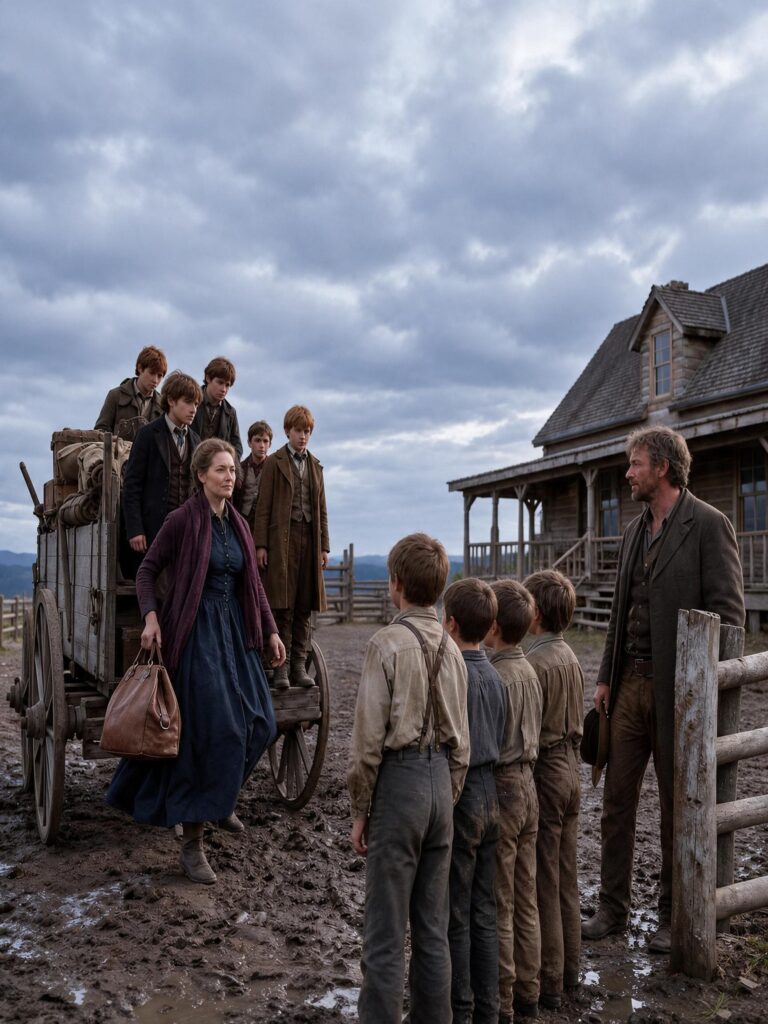
The wagon came up the Kirk road on a Tuesday morning in a cloud of dust.
Owen came out onto the porch expecting nothing, because he had learned over the last year not to expect anything from wagons that came up that road. A woman sat on the driver’s bench with a battered hat shading a face that looked past surprise entirely. She was not young and not old. Forty, maybe, or a hard thirty-eight. Brown hair pinned up without fuss. A dress that had been good once and was clean now, which was more than he could say for his own boys. Behind her, packed into the wagon bed among trunks and a rocking chair lashed down with rope, sat six boys, ranging from a lanky, watchful fourteen-year-old down to a round-faced four-year-old asleep against a sack of flour.
Owen’s own five had come tumbling out of the barn at the sound of the wagon and stood now in a ragged line in the yard, every one of them mud to the eyebrows. Pete was in front with his arms crossed like he dared the wagon to be trouble.
The woman set the brake, climbed down without waiting for help, and looked over Owen’s five. The mud. The torn shirts. The general air of boys who had not answered to anybody in longer than was good for them. Her expression was one Owen could not read at all.
“I was told it was bad,” she said.
That was all she said.
Owen opened his mouth and found, for the first time in eleven months, that he did not have an answer ready.
“Ma’am. Five boys in a house that’s merely muddy.”
She looked past him at the porch and the windows, at the hat still lying by the step because he had not had the heart or the time to pick it up, and something in her shoulders eased, like a woman setting down a heavier weight than she had expected.
“I buried a husband and a farm, both, this spring, Mr. Kirk. I’ve got six of my own in that wagon. The eldest fourteen and the youngest four, and nowhere left to put any of us. I heard this position was the worst in the territory. I’ve seen worse before breakfast.”
Behind her, the eldest boy hopped down and sized up Pete the way one general studies another’s forts.
Owen heard himself say the only word he had left.
“Well. Welcome, Mrs. Bowley.”
“Harriet,” she said, already rolling up her sleeves. “Show me the kitchen. I understand there’s a wall that wants scrubbing.”
Part 2
The kitchen was worse than the wall.
Harriet stood in the doorway with her sleeves rolled and took inventory the way she had taken inventory of a storm-wrecked henhouse, without commentary and without despair. The stove had not been blacked in months. The dishpan sat with a skin on the water. Somebody had tried to wash a shirt in it and given up. There were crumbs in the butter, which did not surprise her, and a garter snake skin nailed above the door, which did. The table had one leg shimmed with a folded catalogue. Eleven people were going to eat at that table or they were going to eat standing up in the yard like stock, and she had not driven two counties to run a yard.
“Jack,” she said. “You and the tall one. Pete, is it? Bring the trunks in. Not the rocking chair yet. Sam, find me a bucket that doesn’t leak. The rest of you, smallest first, out to the pump. Hands and faces. I don’t cook for mud.”
Pete did not move.
He stood with his arms still crossed, studying her the way he had studied the last four women, looking for the place where they would flinch. Harriet looked back at him. She did not smile. She did not scold. She picked up the wooden spoon from the wagon seat, where Eddie had finally let it go, and tapped it once against the porch rail. The sound was small and exact.
“I run a regiment,” she said, “not a nursery. You can test that if you like. Most boys do. It won’t change the pump.”
Pete held another second, because he was Pete. Then he jerked his chin at Jack, and the two of them went for the trunks with the careful hostility of boys who had not yet decided whether they were enemies.
Owen stood out of the way and felt, for the first time in a long time, like a man in his own house who was not the only adult in it. He did not know whether to be grateful or uneasy. He settled on both.
By the second morning Harriet had eleven boys lined up at the pump before breakfast, youngest to eldest, washing in an order she had established with nothing more than a look and that spoon. Eddie cried once, briefly, because the water was cold. She dried his face with her apron and put him back in line without a speech. Danny watched this with interest and then washed his own hands properly for what Owen suspected was the first time since Clara.
Breakfast was biscuits, eggs from the hens Owen had been meaning to cull, and bacon that had been hanging in the smokehouse longer than was wise. Eleven boys ate at an actual table. Owen sat at the head of it because Harriet had set his plate there and said, “That’s your place,” in the same tone she used for the pump. He ate more than he had eaten in weeks. He kept waiting for the crash. It did not come until the plates were mostly clean.
“I run a regiment, not a nursery,” she told him over the last of the coffee, watching the boys file out toward chores she had already named. “Boys need to know what happens if they don’t fall in line. And someone who follows through every time. No exceptions.”
“They’ve had exceptions,” Owen said. “I’m the exception. I get tired.”
“Then don’t be the one who hands out the exceptions,” she said. “Be the one who sits at the table. I’ll be the one with the spoon.”
It was not a bargain he had expected to make with a woman he had known for a day. He nodded anyway.
They tested her, of course. Testing was practically their trade.
Pete put a garter snake in the flour bin the first week. Harriet lifted it out by the tail without a flinch, carried it to the yard, and set it in the grass.
“Jack tried that trick two winters back,” she said. “Used a bull snake. Bigger. He spent the afternoon restacking the whole woodpile by himself, and the snake went on with its life. You can restack this one. It’s shorter than ours was.”
Pete looked at Jack. Jack, to his credit, did not smirk. He picked up a stick of wood and started. After a moment Pete did too. Owen, watching from the barn door, felt something in his chest move that he did not have a name for.
Frankie hid her good scissors. Harriet found them in an hour, in the oat bin, because her own Sam had once hidden a whole ham for three days and she had learned to think like a boy hiding something a long time ago. She did not raise her voice. She set Frankie to grinding coffee until his arm shook, and she told him the scissors were for sewing the shirts he kept tearing, so hiding them was a fool’s economy.
The younger Kirk twins tried tears, the oldest trick of all. They had used it on Miss Adler with great success. Harriet dried their faces with her apron and said crying was allowed anytime it was honest, but it would not get them out of bringing in the kindling. They cried a little longer, experimentally. The kindling still came in.
One by one, that first ferocious week, eleven boys who had run off nine housekeepers between them discovered that every trick they knew had already been tried and beaten by someone in that house. There was no version of themselves Harriet Bow had not already seen.
“She’s not scared of us,” Pete reported to his father one evening, in the tone of a scout returning from difficult country.
They were in the barn, oiling harness because Owen had asked and because Pete, for once, had come without being asked twice. The smell of neat’s-foot oil and dry hay sat between them.
“No,” Owen said, watching Harriet march past the open door with an armload of boys’ shirts, giving orders to two of them about the woodpile without breaking stride. “I don’t imagine she is.”
“Jack says she buried their pa in the spring and didn’t let anybody else dig the last of the grave. Says she finished it herself.”
Owen was quiet a moment. “That sounds like her.”
“You going to keep her?”
The question was too large for a barn and a thirteen-year-old, and also exactly the right size. Owen set the harness down.
“If she’ll stay,” he said. “That’s the part I don’t get to decide alone.”
By the third week he had stopped eating his supper standing at the counter and started eating it at the head of his own table. Eleven boys passed biscuits down the line without being told. Eddie sat on a crate with a book under him so he could reach. Danny copied him and put a catalogue under his own place, though he did not need it. The twins stopped kicking each other long enough to eat. Jack and Pete sat at opposite ends of the boys’ side and did not speak, but they also did not throw anything.
It warmed something in Owen’s chest every time. A small, ordinary miracle nobody else thought to remark on.
“I never once got them all sitting at once,” he told Harriet quietly after the boys had been sent to their beds. The lamp was low. She was wiping down the table with brisk, unhurried strokes. “Not since their mother passed. I’d about given up trying.”
“They just needed enough of them to make sitting together the interesting option,” Harriet said. “Eleven boys left to scatter is eleven separate messes. Eleven boys made to sit is a kind of company. Boys like company, even when they’d rather die than admit it.”
He almost smiled. “You talk like you’ve had practice.”
“I’ve had six,” she said. “And a husband who thought the boys would raise themselves if he kept the fences standing. They don’t. Fences don’t raise boys either. Somebody has to look at them and mean it.”
She did not say Tom’s name with bitterness. She said it the way a person says a place they have walked away from and still carry in their shoes. Owen recognized the sound. He heard it in his own mouth when he said Clara.
Harriet, for her part, noticed things she had not expected to find in a widower’s house.
She came around the barn looking for Sam one afternoon and found Owen crouched in the dirt with the youngest Kirk boy’s foot in his lap, working a splinter out with the patient care of a man who had done it a hundred times unasked. Danny was sniffling but not wailing. Owen’s big hands were steady. He had a needle from the sewing kit and a little bottle of something that smelled like the liniment Clara used to keep on the high shelf.
“You didn’t have to do that yourself,” Harriet said, surprised into saying it aloud. “I’d have mended it.”
“I know,” Owen said, not looking up from his work. “But he came to me crying about it, and it seemed a poor thing to hand off a crying child to somebody else just because there’s a woman in the house now to do it.”
He finished, pressed a clean bit of cloth to the spot, set the boy down, and watched him run off satisfied, already shouting for Eli.
“Their mother used to say a father who won’t fix his own son’s boot isn’t much of a father. I’ve tried to keep that up. Even on the hard days.”
Harriet stood there a moment longer than she meant to. She thought of Tom, who had been a good man and a tired one, who had loved his boys in the large way and left the small ways to her. She had not, in all her years married, once seen a father fix a boy’s boot unasked. It settled into her quietly, unannounced and impossible to unknow.
“Well,” she said, and found she had nothing else ready to follow it, which was a rare enough thing for Harriet Bow that she went back to the house turning it over the whole way.
That night she lay in the narrow bed off the kitchen, the one the housekeepers had used, and listened to the house settle. Eleven boys breathing under one roof. A man moving once in the room at the end of the hall, the floorboard by his door giving its small complaint. She thought of the bank notice on the gatepost and the neighbor woman’s wringing hands. It cannot be done, the woman had said.
Harriet closed her eyes.
We’ll see about that, she thought, and slept.
Part 3
The fight came on a Sunday over nothing either boy could have named afterward.
Whose turn it was to lead the others to the creek, most likely. Or some wordless argument over which of them was the rightful general of the whole unruly eleven. The creek was the reward for a week of chores done without a bucket hitting a wall. Harriet had promised it at breakfast. By midafternoon Pete and Jack were in the yard with their shoulders set and their voices gone low, which was worse than shouting. The other boys had formed a loose ring without being invited. Even Eddie was watching, spoon in his fist.
Owen came out of the toolshed and saw the shape of it a second too late. Pete swung first. Jack took it on the cheek and gave it back. They went down in the dirt together, bloody-lipped and furious, rolling toward the porch step like a pair of dogs that had forgotten they were supposed to share a yard.
Harriet came out of the kitchen with a pan still in her hand, set the pan on the rail, and hauled them apart by their collars with a grip that surprised both thirteen- and fourteen-year-olds into instant stillness. She was not a large woman. She had buried a husband and finished a grave and driven a wagon across two counties, and her hands knew how to hold on.
“You will not,” she said, low and furious, “tear this family apart fighting each other over who’s in charge of it. There is room enough in this house for two eldest sons. There has never once, in the whole history of families, been room for two eldest sons who won’t work together.”
Pete’s lip was split. Jack’s eye was already darkening. Neither of them looked at her. They looked at the dirt.
She marched them both to the pump, washed their faces without gentleness, and set them to mending the same fence, shoulder to shoulder, until the sun went down. The broken section was out past the corral, three posts and a sagging run of wire the cows had been testing all month. She put the tools in their hands and stood there until they started.
“It should not work,” Owen said, watching from the porch with Harriet beside him. The other boys had been sent to the creek without the generals, under Sam’s reluctant command. Their shouts came back thin across the pasture. “They’ll kill each other before that fence is finished.”
“Watch,” Harriet said.
The first hour was silence and the smack of a hammer hitting a little off the nail. The second hour was muttered accusations about who had pulled the wire wrong. By the third hour Pete and Jack were not fighting. They were laughing over a fence post that would not sit straight, Jack holding it while Pete kicked the base, both of them filthy and, against their own intentions, a team.
Owen leaned on the rail.
“I’ll be damned,” he said, quietly, so the yard would not hear him swear on a Sunday.
“Language,” Harriet said, but she was almost smiling.
By week’s end they had become something neither household had seen before. An unstoppable alliance of two eldest sons, testing every rule with a combined ingenuity Owen admitted was almost admirable, even when it was exhausting. They short-sheeted Sam’s bed and somehow made it look like Cal had done it. They rerouted the clothesline so that Owen’s good shirt ended up in the hog pen, then retrieved it before Harriet saw, which Owen counted as growth. They took the younger boys night-fishing and had them all back before full dark, muddy, proud, and sworn to secrecy that lasted until Eddie told Harriet the whole thing over breakfast because he liked the way she listened.
“You know what’s coming,” Harriet said one evening, watching the two boys huddled by the barn, heads together over some new scheme.
The light was going gold on the ridge. Supper was done. The little ones were in, the middle ones were arguing over a horseshoe game that had no clear rules, and the two eldest were planning something that would probably cost somebody a Saturday.
“I do,” Owen said. “They’ll run this whole valley by the time they’re twenty. The both of them together.”
“I meant the other thing,” he said, and Harriet understood from the way he was watching her rather than the boys exactly what he meant.
Something had shifted these last weeks that had nothing to do with fence posts. She had started setting his coffee on the table before he asked. He had started bringing in the wood without being told when he saw her hands were full. They met in the kitchen at odd hours, two adults in a house of children, and the quiet between them had changed its weight. It was not the quiet of strangers sharing a roof. It was the quiet of two people who had begun to leave room for each other in a day.
Neither of them, standing there with eleven boys’ laughter carrying up from the barn, seemed inclined to run from it.
“Well,” Harriet said again, because it seemed to be the only word this man kept leaving her with lately.
This time Owen laughed, low and warm, and did not ask her to explain it.
She thought about that laugh later, washing the last pan. Tom had laughed loud, at jokes, at the boys’ worse ideas, at his own mistakes when he could bear to. Owen’s laugh was a smaller thing, rusty from disuse, and it had been aimed at her. She set the pan to dry and put her hand on the edge of the table until the feeling settled into something she could carry.
The valley noticed before they did.
A neighbor named Hoyle, who ran the mercantile and a sideline in other people’s business, stopped Owen on the road one Saturday and said he’d heard the Kirk place had a woman who had lasted past a month, which was either a miracle or a lie. Owen said it was neither. Hoyle spat in the dust and said he’d bet a dollar no woman alive could tame eleven boys and keep her temper, and another dollar she wouldn’t stay through winter. The doctor’s wife, who had come along for thread, said she’d take that bet on the other side. Owen drove home with a sack of beans and the uncomfortable sense that his private life had become a wager at the counter.
He told Harriet that night, because it seemed dishonest not to.
“Let him bet,” she said. “Men like that need a hobby. I’ve got shirts to mend.”
But she was quieter than usual while she mended them, and Owen sat in Clara’s old chair by the stove and did not pretend to read the week-old paper. The house ticked. Upstairs, somebody coughed once and rolled over. Eleven boys. Two adults. A winter coming on that neither of them had planned to meet in the same kitchen.
“I don’t know what this is,” he said at last. “I know what it isn’t. It isn’t me looking for a free housekeeper, and it isn’t you looking for a roof you can’t get another way. I want that said plain.”
Harriet tied off a thread.
“It’s said,” she said. “And I heard it.”
She did not look up right away. When she did, her face was the same face that had climbed down from the wagon, past surprise, but something in it had opened a crack.
“I didn’t come here for a husband, Owen Kirk. I came here because my boys needed eating and I had used up the other choices. If something else is growing in the yard, I’m not going to pretend I don’t see it. I’m also not going to rush it because a man at the mercantile has a dollar on the table.”
“Fair,” he said.
They left it there. It was enough, and it was not enough, and it held.
The first hard frost came on a Thursday. Harriet had the boys bring the last of the squash in and bank the foundation with straw where the wind cut. Owen rode the fence line and found two places the alliance of eldest sons had mended better than he would have himself. He came back cold and found coffee waiting, and eleven pairs of boots lined up by the door in an order that was almost the pump order, and he stood a moment in his own hallway like a man who had walked into the wrong year and found it kinder.
He thought of the agency letter in the drawer. Please do not write again. He thought of Clara saying a father ought to fix his own son’s boot. He thought he might, if he were careful and if she were willing, have a life in this house that was not only endurance.
Then Danny came down the stairs with a hot forehead and a rash like fine red sand across his chest, and the careful future went out of the room like a lamp in a draft.
Part 4
The fever came in with the youngest Kirk twin first, though afterward nobody could swear to the order. Eli was flushed at breakfast and irritable, which was not news, and by noon he was shivering under a quilt with a heat coming off him that made Harriet’s mouth go tight. Ned followed before supper. Then Cal, Harriet’s nine-year-old, who had been proud of not being a Kirk and was now miserable in the same bed they had dragged into the front room. By the time the doctor rode out from town, three more were flushed and sorry for themselves, and the word he used in his grave, careful way was the word every parent in the territory had learned to fear.
Scarlet fever.
“Eleven boys in this house,” the doctor said, packing his bag with the brisk efficiency of a man who had seen this before and knew exactly how bad it could get. His name was Pell, no relation to the housekeeper, a thin man with cold hands and no patience for false comfort. “Keep them separated where you can. Keep them cool. Keep them drinking. And pray. I’ll come every other day. Past that, it’s in your hands and God’s.”
Owen stood on the porch and watched him ride off toward the other calls that would be waiting, because fever did not visit one house and call it a day. The wind had an edge now. The light on the ridge was the hard white light of coming winter.
“We split the nights,” Harriet said behind him. She had already stripped the front room down to what could be washed. “I’ll take the small hours before dawn. You take the long afternoon into evening. We meet in the kitchen at the change and we tell the truth about who’s worse. No brave lying.”
“All right,” Owen said.
They moved through those weeks like two halves of one machine built for exactly this.
Harriet knew how to make a boy swallow broth he did not want. She knew the voice that was firm without being frightened, and the boys, even burning, answered it. She kept a pot on the back of the stove and a basin of cool water that she changed until her hands cracked. Owen knew how to sit up half the night with a frightened child and make the dark feel less like an ending. He told them about the year the creek jumped its banks, about Clara teaching Pete to whistle, about a horse he had owned before any of them were born that would come to a whistle and no other sound. He did not tell them he was afraid. They knew anyway, and they watched his face to see if the fear was bigger than he was.
Between them, cloth after cool cloth, broth after broth, they kept eleven boys breathing through the worst of it. Jack ran a fever for two days and came out of it angry at being weak, which Harriet took as a good sign. Pete scared them on the third night and then broke into a sweat and demanded eggs. The twins recovered in a tangle, refusing to be in separate blankets. Sam hid the medicine once, out of habit, and then brought it back himself and said he was sorry, which was a sentence Owen had not heard from a Bow boy or a Kirk boy in some time.
One after another, they turned the corner. The fever worked its way down the line of beds like something finally running out of places to go.
All of them but one.
Little Danny Kirk, five years old, the youngest of Owen’s five, would not break his fever. He lay in his bed on the ninth night, burning so hot Harriet could feel the heat off him without touching his skin. His breath came shallow and fast. The rash had gone dull and angry across his chest. He did not ask for water. He did not ask for his father. He made a small sound now and then that was not a word.
Owen sent Jack, who was well enough to ride, for the doctor in the black middle of the night. Pell came, looked, and would not promise anything when Owen asked him to.
“I’ve done what I know to do,” the doctor said quietly in the hallway, where he thought Harriet could not hear. She could. She was on the other side of the door with a cloth in her hands, and she stood very still. “The rest is his own strength now, and God’s mercy. I won’t lie to you, Mr. Kirk. Tonight will tell.”
Owen stood in that hallway a long moment after the doctor left. The house was full of sleeping boys and the smell of vinegar and tallow. Somewhere Eddie whimpered and settled when Sam, half awake, put a hand on him. Owen went in and sat by his son’s bed and did not move.
Harriet found him there past midnight, still in the same chair, his hand wrapped around his son’s small one, his face gray with an exhaustion that went far past the physical kind. She came in without a word and took the other side of the bed, wrung out a fresh cloth, and laid it against Danny’s burning forehead. She settled in as if she had always meant to sit there all night too.
“You don’t have to do this,” Owen said, not looking up. “He’s not yours, Harriet. You’ve ten others of your own and his to worry over already. Go and sleep. I’ll sit with him.”
“I decided he was mine the first week,” Harriet said, not looking up either, her hands steady on the cloth. “The night he cried about a splinter and you fixed his boot yourself instead of handing him off to me. I watched you do that and I thought, that’s a man raising his boys right. And I thought, those are my boys too, now. Whether anybody’s put it on paper or not. I don’t unclaim a child because the nursing gets hard. That was never how I was raised, and it’s not how I intend to finish.”
Owen looked up at her, then across his son’s fevered small body, and something in his chest that had been braced tight for nine days came loose all at once. He had to look away a moment before he trusted his voice.
“I don’t know what I’d have done this year without you,” he said. “I mean that plainer than I’ve ever meant anything.”
“You’d have managed,” Harriet said. “Men generally do. But I’m glad you didn’t have to find out.”
They sat together through the worst of that night, trading cool cloths and quiet words and long silences, watching the small chest rise and fall. Owen talked a little about Clara, not as a ghost he was apologizing to, but as the woman who had taught him the boot and the whistle and the way a child should be spoken to when he was afraid. Harriet talked a little about Tom, about the grave she had finished herself because the neighbor men had meant well and dug too shallow, about the bank notice, about the moment on the wagon seat when she had seen the Kirk house and thought, well, it is a roof, and we will start there.
Around three in the morning Danny’s breathing eased. The terrible heat radiating off him broke into a slick, ordinary sweat. His eyes fluttered open just enough to find his father’s face.
“Pa,” he whispered, hoarse and small. “I’m thirsty.”
Owen laughed, a broken, relieved sound, half a sob, and Harriet was already reaching for the water before he had finished laughing. Across the boy’s bed, the two of them looked at each other with the particular exhausted joy of two people who have just watched something terrible fail to happen.
Danny drank. He complained that the water was warm. He asked if the snake was still in the barn, a question that belonged to some earlier week of his life, and then he slept, really slept, with his mouth open and his hand still in Owen’s.
Harriet stayed until dawn. When she stood, her knees cracked, and Owen reached without thinking and steadied her elbow. She let him. Outside, the frost on the pasture was the color of milk, and eleven boys, one of them only just returned, were still breathing under the roof.
“Go lie down,” she said. “I’ll wake you if he asks for you. He will. That’s the thing about boys. They come back hungry and loud, and they want the person they cried for.”
Owen nodded. At the door he stopped.
“When this is over,” he said, “I want to talk about the paper. Not because the preacher will say it. Because I don’t want there to be a version of this house where you’re still the housekeeper and I’m still the man who hired you. Not after this night.”
Harriet’s eyes were red and steady.
“When this is over,” she said, “we’ll talk. Now go lie down before you fall down and I have twelve to nurse.”
Part 5
By the end of that fourth week, all eleven boys had turned the corner. They were thin and pale and thoroughly sick of broth, but alive and mending, and already, within days, back to their usual mischief, which Harriet privately considered the truest sign of full recovery any doctor could have given her. Danny followed Owen from room to room for three days and then remembered he was five and went back to the twins. Pete and Jack were forbidden from fence schemes until their strength returned, a rule they obeyed for almost a week.
The preacher rode out that Sunday to see for himself how the Kirk and Bow household had fared. He had heard the whole valley’s worried talk of the fever running through eleven children at once. His name was Adler, and he had buried Clara Kirk, and he had a face that kept other people’s trouble without making a show of it.
Harriet showed him into the front room, where all eleven boys, in a rare fit of order, knelt in a ragged double line saying grace before their thin recovery broth. Pete and Jack were shoulder to shoulder at the head of it, like the two generals they had become. The littlest ones mumbled along a half beat behind. Eddie had his spoon. Danny had both eyes open and his hands almost folded.
The preacher stood in the doorway and took in the whole scene. Eleven boys bowed in prayer. Harriet at one end of the long table with a ladle in her hand. Owen at the other end with his sleeves still rolled from three weeks of nursing. Both of them watching those boys with the same unguarded tenderness on two entirely different faces.
“Well,” the preacher said slowly, when the grace was finished and eleven heads came back up, “I came out expecting to find a house half wrecked by fever. I find instead the most orderly congregation in this valley, and a widow and a widower running it together like they’ve done it all their lives.”
He looked between Harriet and Owen a long moment, and something knowing crept into his tired face.
“Eleven boys is a fine number. But I find myself wondering, watching the two of you, whether I oughtn’t come back out here before long and make it twelve. A family, I mean. On the paper, as well as in the practice of it. Seems to me the practice has been settled a good while already.”
Harriet felt her face go warm. She did not look away from Owen, who was looking back at her with an expression that answered the preacher’s question a good deal more plainly than either of them had yet managed with words.
They had talked, two nights after Danny’s fever broke, at the kitchen table with the lamp trimmed low and the boys finally asleep. Owen had said he was not a clever man with speeches. Harriet had said she did not require one. He had asked if she would marry him, not as a rescue and not as wages, but as the woman who had claimed his boys and let him claim hers. She had said yes, and then she had said she wanted the boys told before the valley was, and she wanted a plain wedding, and she did not want Clara’s ring. She had her own thin band in a tin in her trunk, and he could wear a new one, and the past could sit at the table without being asked to leave. Owen had agreed to all of it. He had looked relieved to be given terms he could meet.
“I believe,” Owen said slowly, now, in front of the preacher and eleven witnesses, “that might want doing.”
“I believe it might,” Harriet agreed.
Eleven boys, catching the sudden charge in the room, went up in a ragged cheer that had nothing to do with broth or grace and everything to do with eleven children who had quietly wanted exactly this for weeks. Eddie banged his spoon. Danny climbed into Owen’s lap without asking. Jack looked at Pete, and Pete looked back, and some old argument passed between them and was set down.
The wedding was held in the Kirk front yard on a bright fall morning, a week later, because neither of them saw a reason to wait for a better Saturday and because the boys, once told, became a committee that could not be slowed. Eleven boys scrubbed pink and combed flat, arranged as ushers along an aisle of trampled grass. Each one took his post with a gravity that suggested they considered this the most important assignment of their young lives, which in a fashion it was.
Pete and Jack stood together at the head of the line, both of them grinning like the two conspirators they had become. It was Pete, in a fit of showmanship neither parent had authorized, who stepped forward first and offered Harriet his arm to walk her the last few steps to where Owen stood waiting.
“Somebody had to do it properly,” he said, with tremendous solemnity. “I figured it ought to be family.”
Harriet took his arm. Her plain good dress was the one she had kept back from the bank sale. Her hat was the battered one from the wagon, brushed. She looked at Pete’s split-lip scar, already fading, and at Jack waiting, and at the muddy yard that was not muddy today, and she thought of the words that had come out of her before she had even climbed down from the wagon.
The preacher, presiding at last over the twelfth he had promised, could barely get through the vows for smiling. Out past the fence line, Hoyle from the mercantile stood with his hat in his hands. He had bet against the whole arrangement from the first week, certain, he had said loudly at the counter, that no woman alive could tame eleven boys and win a widower besides. He paid out his wager to the doctor’s wife in full view of half the valley, muttering that he had never in his life been so glad to lose money.
Harriet, standing with eleven boys arranged around her like an unruly honor guard, caught Owen’s eye across the preacher’s shoulder.
“I was told it was bad,” she murmured, low enough for only him to hear, as the preacher called for the rings.
“Was it?” Owen murmured back, eyes bright.
“Not for a single day since,” Harriet said, and she kissed him before the preacher had quite finished giving them leave to.
Eleven boys whooped loud enough to startle every bird off the fence line. Eddie lost his spoon and did not care. Danny shouted that he had a ma again, which was not the sentence anyone had rehearsed and was somehow the right one. The neighbor women cried in a useful way and then went inside to set out the food they had brought, because a wedding without food was just a speech in a yard.
Later, when the pie was gone and the boys had been turned loose and the light was long on the grass, Owen and Harriet stood on the porch where the ninth housekeeper had started running. The hat was gone. Harriet had washed it and given it to the church box weeks ago. The kitchen wall was clean. The table leg still had its catalogue shim, because some things did not need fixing once they held.
“They’re going to test us tomorrow,” Owen said.
“I know,” Harriet said. “Jack’s already got a look. Pete’s helping him.”
“You sorry?”
She watched the two eldest sons disappear around the barn, already in conference, already a problem she would be glad to have.
“No,” she said. “I’m home.”
The whole ragged, hard-won family of them stood together in the autumn sun, exactly as ordinary and as unlikely as any family Harriet Bow Kirk had ever hoped to have.
his five sons drove off nine housekeepers in a single year — the tenth was a widow with six boys of her own who had already buried a husband and a farm and was not impressed
Disclaimer: This story is fictional and created for entertainment purposes only.
Any names, characters, places, or events are fictitious or used fictitiously.
No real person or organization is intended to be portrayed.
Share:


